A long-in-the-works project of ours, here comes A Tribe Called Kotori's first foray into full-length territories, as the immensely talented Rampue takes us on a melancholy-riddled ride across his phantasmatic mindscapes. A true sound explorer, deftly steering his ship down the junction of electronica, abstract and balearic-infused prog house, the Berlin-based vibist has us transfixed and elevated throughout the twelve cuts that form the backbone to this lushly textured promenade in sound - at times understatedly euphoric, at others rivetingly exotic.
Of the creative process that lead to 'Bubblebath Trance', Rampue explains "It all started and ended in the same moment: my cherished feline companion, my laptop awash with an unintended bath, and alas, a dearth of backups. The resultant calamity, an echo of chaotic tranquility." Under the generous layer of irony lies some unaltered truth about Rampue's debut long-player for A Tribe Called Kotori: this sense of serenity that goes with stepping into this warm and bubbling primitive chaos of sorts infuses the listening experience far and wide. Distantly emulating the "euphonious strains" of iconic PS1 video games soundtracks from his youth days, the album has us surfing a constant paradox of emotions, wistful but not abandoning itself to sorrow, dynamic yet suspended in some sort of mind-expanding stasis. As if you were looking at the world beneath you in exploded view, conscious of all thing, slowly moving up the many layers of our atmosphere towards uncharted skies.
A paragon of Rampue's most poignant take on classic electronica tropes, 'Harmonie' blazes with a poetic fire that engulfs about everything in its wake. Just figure yourself riding a chocobo across the sand-covered expanse of North Corel (toasting to the FFVII nerds here) as this blasts out in the distance. From this trancey bubblebath emerge lots of musical shades and nuances, from the nicely dubbed-out, brass-heavy coastal jazz of 'Schattenschranz' to the choppy, trip-hop-adjacent future electronics of 'Inside', via the exuberantly joyous mess of faux-organic number 'Tripomatic' and cinematic charisma of 'Ich hasse Sonne' high-flying orchestrations.
Connecting the dots between that trance-indebted ebullience and further downtempo-friendly attraction, 'Verfahren' perhaps encompasses best what 'Bubblebath Trance' is about: gracefully walking the tightrope in-limbo nostalgia-soaked inner movements and a powerful outward thrust, burning to let the feelings ooze out from the shell that holds them.Clad in purely 90s-compatible breaksy motion, 'Salz' is another attempt to reconcile emotional and physical dissonance, like kneading all states - solid, liquid and vaporous - into an impossible mega-vibe of its own; malleable, strong and enveloping in equal measure. Borrowing from two-step and UK garage, 'Take Away' is a definite high in Rampue's master unfolding of musical twists and turns, summoning a Boarder Community-esque atmosphere and clashing it alongside floor-ready footwork motifs to fascinating effect.
An ode to his studio companion, 'Buchla Trip' finds Rampue's exploring his machinic friend's quirky yet soulful array of electronic potentialities - making it sound like a conversation you'd have with R2-D2 in the heart of a Sandcrawler, whereas 'Kajal' beams us up to a fragmented headspace, halfway altered PC-Pop and arps-loaded electronica on amphetamines. Effusive and transporting, the title-track 'Bubblebath Trance' could well figure as the album's no.1 medley in essence: a bountiful lucid dream of dancing forms, colours and sentiments to wrap your head around, confidently drifting from a liminal state of consciousness down the rapids of one's troubled inner workings.
Rounding off the package, the languid ambient finale of 'Die Leiden des hungrigen Fruehstuecks' rubber-stamps the feeling that 'Bubblebath Trance' belongs to that rare category of albums. The ones that mint their own alphabet aside from typical norms and expectations, teaching you the ropes of their new language as it unreels between your ears - real and unreal, elusive to any other meaning than the one your guts and brains will be inclined to give it to, in real time. A crystal-pure object if you will, that shall not reveal its secrets, even after a thousand listens and just as many wowing moments.
Cerca:two vibe
Vienna-based producer and 303 maestro Tin Man returns to Acid Test for his first solo EP for the label in over 5 years. It's another impeccable outing of romantic acid variations, especially tailored for unforgettable dancefloor revelations.
Tin Man has been setting the pace for forward-looking acid lovers for close to two decades now, and on his 15th Acid Test appearance he takes the vibe back to early and proto-house roots, stripping back the musical elements while layering in the euphoria with four perfectly crafted slices of feelgood 303.
Opening track Hidden Acid already sounds like a long lost classic, with strings draped over bouncy acid and motorik drums, stretching out over nearly nine minutes, and beautifully capturing the feel of house music circa 1991. Swaying Acid comes in all propulsive, toms and congas setting the foundation for melodic acid lines to weave through your heart strings.
On the B Side, Running Acid is fully optimized for the autobahn fast lane - a gradual, slow-filtered acid meltdown that builds and releases in tandem with driving hats and vaporous pads that hang over the track like early morning mists. Wrapped Up Acid brings the EP to a fitting close, slowing the tempo for a low-key easy dance excursion par excellence - smooth yet spikey 303 riffs punctuate the chords that drift through with a hint of Badalamenti in the progression.
With the Hidden Acid EP Tin Man might hark back to more vintage times, but the emotive power is as strong as ever. The naivety of the ‘90s is instead replaced with a conviction behind the musical choices that brings even more weight to the heartwarming vibes. This is acid in some of the best shape it's ever been, enhanced and upgraded specifically for the dance.
On his third album Comité Hypnotisé let you belly flop into his eleven chambers of the Danza Del Piri-Piri: expanding the feral and contagious universe he started to build a lifetime ago. Levitating and shimmering a glistering way through deep old skool 70's sitar vibes and jitterbug grooves. This boogieman aka the Millionaire-mind and part of the Evil Superstars has carved some hot smoked out bass and organ flared cuts on wax, ready to never leave you again. Whether it is with woodchopped kazou sounds stretching into hazy sunshine desire or dazzling basslines blending with interstellar and stuttering kick drums: the Danza Del Piri-Piri flip-flops and slams into a wiggly relentless sonic future.
FFO Sven Wunder, Ennio Morricone, Khruangbin, Flying Lotus, The Meters, Parliament, Edan, The Gaslamp Killer.
Comité Hypnotisé is the brainchild of Tim Vanhamel, frontman of Millionaire and Evil Superstars, two of Belgium's most famous alternative rock bands. In 2013 Tim started creating solo music that only got released in 2021 on his first solo album through the Belgian eclectic Cortizona label
- A1: Puppet (Equinox Remix)
- A2: Daisy Takes Two (Meat Beat Manifesto Dub Selection Remix)
- B1: Stachybotrys (Coco Bryce Rework)
- B2: Lucky Gonk (Macc & Dgohn Remix)
- C1: Electryon (Wisp Remix)
- C2: Lucky Gonk (Forest Drive West Remix)
- D1: Turnips Are Ok (Rognvald Remix)
- D2: Conty (Scrase Remix)
- E1: Ninnyhammer (Djrum Remix)
- E2: Robin's Windmill (Skee Mask Remix)
- F1: Af0156984 (Quavis Remix)
- F2: Invisible Sandwich (Carl Brown's Pea & Mint Mix)
repressed !
Undesignated remixes is an expansive project containing 12 remixes of tracks from dgoHn’s iconic 2020 full-length by some choice artists from in and around the Love Love sphere. Remixes that take dgoHn’s unique razor-sharp original productions and send them through a loop and round the twist, some stripped down, some messed up, most but not all maintaining the speedier tempos that dgoHn likes to work around. The result is a collection of seriously futuristic electronic music with some stylistic leanings towards labels like braindance or drumfunk or jungle but completely genre-eluding as a whole, reshaped from the minerals of the original LP by some absolute dons of their craft.
Opening the album Equinox does a fantastic job highlighting the lushness of ‘Puppet’ layering sky-high sunshine pads before sliding into Meat Beat Manifesto’s heavy sci-fi acid dub version of ‘Daisy Takes Two’. A woozy remix of ‘Lucky Gonk’ by Macc & dgoHn marks the first new material from them as a duo since ’09 and Wisp also makes a rare appearance bringing his inimitable post-rephlexian vibes on an agonisingly wonderful, melody-heavy remix of 'Electryon'. Skee Mask’s choice of remixing ‘Robin’s Windmill’ turns the original into a bundle of writhing rhythms organically unfolding with swelling ambient tones. Homegrown heroes Rognvald & Scrase both opt for pumped up post-breakcore in unconventional time signatures while Djrum emphatically provides the LP’s dose of peak jungle choppage, tempering the drum breaks of ‘Ninnyhammer’ with a blistering amen. Also featured on the LP are crisp and beefy drum workouts courtesy of Coco Bryce and Forest Drive West, visceral and apocalyptic half-time bass from Activia Benz affiliated duo Quavis and virtuosic noir-jazz tearout from fellow East-Anglian Carl Brown.
A truly enigmatic character from the golden era of Jamaican roots music, Icho Candy is an artist that has, to me, always been shrouded in mystery. A devout rastafarian born with a gift for prophetic songwriting, Candy always writes in a way that is true to himself and his deep seated beliefs, regardless of the external pressures he endures as a veteran artist, an incredible feet for an independent artist with a career that spans fifty years.
First recording for the great Joe Gibbs and Jack Ruby in the late seventies, Icho’s big break in the industry came with the hit record “Captain Selassie”, a track that is widely considered to be one of the greatest rastafari anthems in dancehall. During this time Icho also recorded for labels such as Jah Life, Rockers International, Tesfa, Jah Shaka and many more. Like so many of the great artists in the eighties Icho recorded and toured in America for an extended period alongside Sugar Minott, Nicodemus, Nitty Gritty, King Kong before returning to Jamaica to record two amazing albums for the late Jah Shaka.
The A side of this latest seven inch gives us the classic writing style of Icho Candy. Pairing his lyrical depth with an early 70’s Phil Pratt style production. An eerie horns line meets the clean sharp, older school backing vocals provided by The Mighty Viceroys to create something magical, the type of record we thought we may have already heard on some scratchy 45 deep in a soundmans crate.
Yakka once again returns to the label on B side duties, providing another Tubby inspired voyage into dusty fx units and quick draw fades. The bassline increases, the vocal decreases but the vibe never ceases.
Welcome home Icho Candy
- 1: Spectacular
- 2: Best Believe
- 3: Vibe Check (Ft. Cadence Weapon)
- 4: Baby Boy (Ft. Paul Wall)
- 5: Loosen Up (Ft. B.k. Habermehl)
- 6: Alexis (Ft. Harriet Brown)
- 7: We Still Here (Ft. Harriet Brown)
- 8: Opportunist Convention
- 9: Kickin’ In
- 10: Don’t Tap In / Contusion (Feat. B L A C K I E)
- 11: Boss Up
- 12: Make A Baby
- 13: Jasper, Tx
With I Will Make a Baby in this Damn Economy, Fat Tony embodies the kind of quixotic figure he would rap about; a singular entity who’s motivated, confident, and hungry; a perpetual-motion-machine locked in a staring contest with his country. It’s the latest album in his catalog produced entirely by L.A-based producer Taydex since 2020’s Wake Up. Later that same year Fat Tony released Exotica, and ever since he’s demonstrated he is in his own lane as a professional rapper with the mind of a magician, as quick to conjure an image as pull it out from under you, deftly manoeuvring through so many details and references a listener feels as if they have witnessed the work of an illusionist. He paints these canvases inside of songs that rarely spill past three minutes; they’re pocket-sized diaries replete with acute observations, character studies, microdoses of storytelling, and single-minded ruminations on a topic that bud, blossom, and fade before too long. Fat Tony & Taydex’s I Will Make a Baby in this Damn Economy cements Tony’s status as someone whose albums are not so much lyrically-lyrical as they are picaresque.
As with any Fat Tony project, the bars are tight as ever, but are so fluid for the 34-year-old it’s almost easy to take for granted the details, warmth, and humanity inside his free-associative tales of day-one friends who’ve passed, edgelord grifters who want to spit game, and nights on ketamine. Taydex’s production sprints through disparate yet simpatico styles, dipping its toes into Pi’erre Bourne-esque bass (see lead single “Spectacular”), house (“Loosen Up”), and even hyperpop. Meditations on loss and grief are woven throughout, but Tony throws a few curveballs as well: Consider “Alexis,” which sweetly reflects on a long-term platonic friendship. Taydex finds a Teddy Riley-indebted New Jack Swing groove just deep enough for the feeling to land and underlines the song’s sincere candor. This is the appeal of Fat Tony writ-large: his boisterous voice and genial personality invite you to the party, then you stick around to hear what he’s saying, which is frequently more introspective and complex than one assumes.
Written and recorded in Taydex’s new studio in North Hollywood, Tony says, “We had much more freedom and flexibility in making this album and you can hear it. It felt like a family project.” If the album is comfortable and loose, it is also dense and substantial. The album’s final two tracks contextualize the immediacy of what came before it—the mezcal with ices drank, Paul Wall swangin’ through to drop knowledge, the Polaris Prize-winning rapper Cadence Weapon providing a vibe check. “Make a Baby” accounts for Tony who’s seen everything, and knows he’s met the one to be a father with, and yet chooses to take his time to get it done. Taydex’s beat recalls turn-of-the-century R&B and the millennial promise of an endless good time. Sombre closer “Jasper, TX” is Tony coming to grips with the story of James Byrd, Jr., a Black man from East Texas dragged to his death by three white supremacists in 1998. These songs are not only trademarks of Tony’s fastidious rapping—they are deeply personal examples of his approach to artistry and life itself, where every decision is made in the shadow of history.
It’s here the mission statement of I Will Make a Baby in this Damn Economy comes into focus—you get the sense he means it, he’s ready for it, he’ll fight for it. He’s waiting to take the world at its word.
Amanaz were serious, and they made a serious stab at an album. They titled their album Africa, according to original band member Keith Kabwe, “because of how it was shared and how its inhabitants were butchered and enslaved, its resources stolen… all the atrocities slave drivers committed. “ Thus, their “Kale,” a blues sung in Nyanja, that traced the continent’s arc from slavery to Zambia’s independence closes the album. Kabwe and rhythm guitarist John Kanyepa have a winsome softness to their vocals, which sit politely aside the feral growl of drummer Watson Baldwin Lungu, bassist Jerry Mausala and bandleader/lead guitarist Isaac Mpofu. Africa’s vibe ranges from anxious (“Amanaz”) to escapist (“Easy Street”) to straight-up pissed-off. On the “History of Man,” his voice whiskeyburned, his distorted guitar buzzing like swarming hornets, Mpofu indicts his species.
There’s a darkness to Africa not found on any other Zamrock records, and a melancholy drifts throughout, specifically on Mpofu’s more restrained “Khala My Friend,” which stands as an effective, bleak situation for the Zambian everyman, the average citizen of a struggling, new nation, who might have had relatives in conflict-torn countries on the horizon, who might have been struggling to find his next meal, who might have seen a bleaker future than his president promised. Then there’s the clear Velvet Underground-influence on the nostalgic “Sunday Morning,” which, as Kabwe
recalls, was the first song written for the album, back in 1968, when Velvet Undergound and Nico was a new release - and the underground funk of “Making The Scene.” The album also tackles traditional Zambian music and early-‘60s rock – punctuated, of course by Kanyepa’s wah-wah and Mpofu’s fuzz guitars. But every time Amanaz get too deep, too violent, they come back with an accessible song and woo their listener back to the groove. “Green Apple” is a civil song, featuring Kanyepa’s sighing guitar. It is a perfectly arranged album, from the dichotomy of Mpofu’s and Kanyepa’s lead and rhythm guitars, to the vocal harmonies, to the rhythm section’s sense of space and time, which allows Africa’s funk to build. Inexplicably, Africa was given two separate mixes and two separate presses: one version is dry, with the vocals and drums mixed loud, the other slathered in reverb, with the vocals and drums disappearing into the mix, and with the guitar solos mixed much louder. We’ve presented them both here as they each have their appeal: it’s up to the listener to pick the one he or she prefers. This is a highpoint of the Zamrock scene and we hope that this can be seen as its definitive reissue.
How can anyone do a new remix of Q-Projects definitive old skool jungle classic "Champion Sound"? Well, almost nobody could without retreading the past or losing the thread...But Hyper-On Experience isn't "nobody". Hyper-On Experience takes the original and makes something truly special, keeping the dark and nasty vibe, but bringing it up to date in a way that is both authentic and classic. Flipped with RayKeith remixing The Trip - The Erb in his unmistakeable junglist style, this is two legendary classics on one slim piece of wax....
- A1: I Wanna Dance With Somebody (Who Loves Me) (Who Loves Me)
- A2: Just The Lonely Talking Again
- A3: Love Will Save The Day
- A4: Didn't We Almost Have It All
- A5: So Emotional
- B1: Where You Are
- B2: Love Is A Contact Sport
- B3: You're Still My Man
- B4: For The Love Of You
- B5: Where Do Broken Hearts Go
- B6: I Know Him So Well
Whitney did more than turn Whitney Houston into a pioneering sensation known around the world by her first name. Originally released in June 1987, the singer's blockbuster sophomore record became the first album by a female artist to debut at No. 1 on the Billboard 200 chart — a position it claimed for a total of 11 weeks en route to selling more than 10 million copies in the U.S. The Diamond platinum effort also contains four No. 1 Hot 100 hits that, when combined with the three chart toppers from her 1985 debut, gave her seven consecutive No. 1 singles — an accomplishment that no other artist has accomplished. Commercially and creatively, Whitney stands on hallowed ground — especially now that the record plays with a sound that puts into perspective just how extraordinary, engaging, and vital Houston's music remains.
Mastered from the original master tapes and pressed on MoFi SuperVinyl at RTI, Mobile Fidelity's 180g 33RPM SuperVinyl LP of Whitney invites listeners to experience the Rock & Roll Hall of Fame inductee's pivotal album in audiophile quality for the very first time. Free of the dynamic limitations and tonal flatness prevalent on prior vinyl and CD pressings, it lets the music breathe and reveals the copious detail, nuance, and texture within the immaculately produced songs. MoFi's SuperVinyl profile offers further advantages in the forms of a nearly inaudible noise floor, dead-quiet surfaces, and superb groove definition.
In addition to featuring extreme clarity and immediacy, this numbered-edition reissue does wonders for the attribute that inspired more than 20 million people around the globe to add Whitney to their record collections: that inimitable voice. Houston's trademark mezzo-soprano — an acrobatic instrument equally capable of taking off on fantastic flights and unwinding for hushed meditations — benefits from the fantastic airiness and transparency afforded by this meticulously restored edition. Whitney has never sounded or looked better. The crossover landmark deserves nothing less.
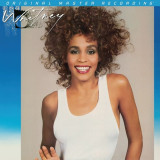
Issued just two years after Houston's breakthrough debut, Whitney immediately signalled the genre-defying singer's intent to continue to push ahead and expand her palette. Shot by photographer Richard Avedon, the album cover depicts an iconic image of Houston — captured with a gleaming smile, bright eyes, teased-out afro, toned arms, and a right hand that appears to wave a friendly hello — whose active, athletic profile stands in contrast to the extremely formal sit-down shot of her that graces her '85 record. The change is telling: Whitney overflows with unfettered joy, rhythmic vibes, and deep-seated emotions that forever endeared her to the hearts and minds of countless listeners — and which set the standard for the wave after wave of divas that followed in her footsteps.
It's no coincidence that the first track on Whitney is the declarative "I Wanna Dance with Somebody (Who Loves Me)." Like Michael Jackson's "Billie Jean" and Madonna's "Material Girl," the feel-good smash is one of the quintessential '80s gems — a lithe, melodic, celebratory release of pent-up energy and loneliness that glides across club floors, shouts to the rooftops, and shrugs off any concerns about vulnerability or embarrassment. Houston's swooping voice moves in sync with the sleek beats and dipping-and-diving synths. She practically takes her fellow musicians by their hand and leads them in a blissful dance that nobody would dare sidestep. Focusing on Houston's singing — a task made challenging only because of the impossible-to-ignore hooks and grooves — showcases the virtuosic facets of not only her register but her control, discipline, smoothness, and warmth.
That she replicates those feats for the entirety of the nearly 53-minute-long album makes Whitney that much more special. Houston reaches back and channels her childhood gospel training on the R&B-flared "So Emotional"; effortlessly slips into Quiet Storm mode on the duet with her mother, gospel great Cissy Houston, on "I Know Him So Well"; flirts with smooth jazz and collaborates with tenor saxophonist Kenny G on the lush "Just the Lonely Talking Again"; conjures dreamscapes and shadow-boxes with supple funk on a romantic cover of the Isley Brothers' "For the Love of You"; and, for the majestic power ballad "Didn't We Almost Have It All," displays the sky-scraping reach of her vocals amid a grand arrangement made even bigger by Houston's sweeping performance and triumphant finish.
Houston's once-in-a-generation talents weren't lost on the adoring public, radio deejays, or industry experts. In addition to harbouring four No. 1 hits and receiving nominations for four Grammy Awards, Whitney generated another Top 10 success in the guise of the Afro-Cuban-leaning "Love Will Save the Day." The album also netted Houston four American Music Awards; two Billboard Music Awards; back-to-back People's Choice Awards; a Soul Train Award; and various other accolades. It all makes the crux of the Washington Post's July '87 review of the album appear prophetic: "Her voice sounds stronger still and the songs are varied but so consistent she could garner 10 Top 10s out of a field of 11."
That claim still holds true. A brilliant fusion of pop, R&B, smooth jazz, and soul, Whitney is a showstopper – and one of the key reasons Houston is the most-awarded female artist of all time.
Julian Cannonball Adderley's only Blue Note album, Somethin' Else, would likely forever be famous in music lore if just for the presence of Miles Davis. The iconic composer/trumpeter steps into the role of sideman on the 1958 set, one of just a handful of times he'd make such a move after the calendar passed the mid-1950s. Yet evaluating Somethin' Else strictly on Davis' involvement misses the big picture. Plain and simple, Adderley's jubilant work remains a jazz landmark due to the chemistry of its Hall of Fame personnel, enthusiasm of its participants, and sophistication of its arrangements – not to mention the reference-grade production and inclusion of the definitive renditions of two all-time jazz standards.
Limited to 6,000 numbered copies, pressed on dead-quiet MoFi SuperVinyl at RTI, and mastered from the original master tapes, Mobile Fidelity's ultra-hi-fi UltraDisc One-Step 180g 45RPM 2LP collector's edition pays tribute to the record's merit and includes the bonus track "Allison's Uncle." Offering reference-calibre sonics, this spectacular collector's version provides a clear, transparent, ultra-dynamic, and up-close view of a cornerstone effort that witnesses Adderley and Davis sharing horn duty alone for the only time in their fabled careers – an arrangement that occurred as a result of Adderley having joined Davis' majestic sextet a year prior.
The premium packaging and beautiful presentation of the UD1S Somethin' Else pressing befit its extremely select status. Housed in a deluxe slipcase, it features special foil-stamped jackets and faithful-to-the-original graphics that illuminate the splendour of the recording. No expense has been spared. Aurally and visually, this UD1S reissue exists as a curatorial artefact meant to be preserved, touched, and examined. It is made for discerning listeners that prize sound quality and production, and who desire to fully immerse themselves in the art – and everything involved with the album, from the iconic photos to the gorgeous finishes.
The vibrant potency reveals itself openly on an analogue set that provides full-range reproduction of an ensemble that also includes pianist Hank Jones, bassist Sam Jones, and drummer Art Blakey. Each and every snare hit, downbeat, and cymbal splash registered by the latter take on realistic proportions, blooming and decaying as they would right in front of you on a stage. Jones' foundational bass lines register with uncommon depth and palpability, the litheness of the strings and fullness of the instrument epitomizing the definition of rhythm. Stellar, too, are the surefooted 88s. Sublime in scale, tonality, and attack, with the delineation such you can practically separate the white and black keys in your mind. As for that liquid interplay between Adderley and Davis? Breathtakingly lifelike in timbre, naturalism, purity, and presence. This collector's version takes you there – there being Rudy Van Gelder's legendary New Jersey studio in March 1958 to witness it all unfold, again and again.
For reasons that extend far beyond the outstanding playing and flawless repertoire, Somethin' Else is without question a record you'll always want to watch and hear come together. As veteran critic Bob Blumenthal observed writing about the album four decades after its release, "The instant rapport achieved by the quintet is thus the product of much shared and common history, though the tensile strength that they create throughout created a totally unique feeling that can be attributed to the sensitive musicianship of all concerned, including the supposedly hard bopping leader and drummer." Such inimitable feeling, or emotion, courses throughout every passage, and no where more obviously than on "Autumn Leaves" and "Love for Sale."
Without question, the discreet interpretations of the Johnny Mercer and Cole Porter songs, respectively, found on Somethin' Else have long been considered part of jazz's alluring mystique. Adderley and Davis bring contrasting approaches to the table yet sound of a singular mind on "Autumn Leaves," with the latter's muted trumpet and the headliner's lush alto saxophone dovetailing into a performance that endures as a blueprint for expression, counterpoint, sophistication, fluidity, and linearity. Blues, melody, and romance pour from their horns. Their bandmates, picking up on the intimate vibe and calm mood here – as well as on the spry, head-over-heels spirit of "Love for Sale" – join in on the conversation with sharp economy and float-on-air roundedness.
Not to undersell the other three numbers, all deserving five-star status. Twelve measures in length, the title track offers a slow burn in swing. Written by Adderley's brother, Nat, the 12-bar "One for Daddy-O" transmits funk flavors. The closing "Dancing in the Dark" pops with lushness and temptation, its stream of bold colours and understated textures calling for a moonlight twirl, or at least fantasies suggestive of a memorable night. Somethin' else, indeed.
Over the past eight years Teenage Wrist have continually evolved their sound, a process that"s peaking with their third full-length, STILL LOVE. Reaching new heights in both scope and execution, the album sees the duo-Marshall Gallagher (vocalist, guitarist, bassist) and Anthony Salazar (drums, vocalist, percussion)-producing the album themselves to handcraft their most expansive collection of songs to date from the ground up. ? e result is a self-realized collection of songs that saw the band borrowing vintage gear, bringing in friends in the form of members from 311 vocalist/turntablist Doug "SA" Martinez and Softcult and incorporating tasteful pop sensibilities to craft a collection of songs that rede? nes the band"s sound while staying true to their guitar-driven roots. From the atmospheric, fuzzed out opener "Sunshine" (which Gallagher says is "the coolest ri? he"s ever written") to the midtempo rocker "Dark Sky"" (the latter of which features the aforementioned cameo from 311 vocalist/turntablist Doug "SA" Martinez), the album will undoubtedly please fans who favor distorted guitars and crunchy chords. However, that"s only one aspect of the album and Teenage Wrist aren"t ashamed to admit that there"s a strong pop sensibility on the album that shows how much they"ve grown as songwriters since 2021"s Earth is a Black Hole. From the brain-invading ballad "Something Good" to the downbeat electronic vibe of "Diorama," the album is teeming with unexpected moments that are reminiscent of Radiohead"s ? air for experimentation. ? e powerful bond between these two collaborators lies at the core of Teenage Wrist"s music and, more than any other factor, that"s evident on every moment of STILL LOVE. "? ere was a certain feeling that music gave me as a kid and this is honestly the ? rst time on any record I feel like we kind of came close to achieving that," Gallagher says of the end result. "We just shot from the gut on this record and tried not to overanalyze things... and I think the record speaks for itself."
After taking time out from working together to focus on separate musical projects, maverick composer Alan Roberts (Jim Noir) and crowd-rousing vocalist Leonore Wheatley (International Teachers of Pop / The Soundcarriers) have re-joined forces to introduce Co-Pilot. Each the other’s wing person, they’re plotting an escape through Manchester’s claustrophobic grey skies with the pencil case colour of a hand-sewn multi-coloured primary school patchwork quilt. “We are both the creators in charge of navigating Co-Pilot’s overall sound which changes from track to track,” Leonore hints at what to expect. “There are about 6 different genres on one album, it's a pick n mix record!”
Happy in the haze of many boozy hours the album was recorded over just a few months whilst holed up and hanging out in Al’s city centre Dookstereo studio. The former Mill allowed the pair to relax, laugh and create without constraint. Armed with their original demos and vocal recordings from Al’s flat, they’d nip by the offie to pick up some Dutch courage before setting to work: building arrangements from a drum beat and basic chord pattern, the pair were so in tune they rarely spoke, allowing only the music to lead the way. “We’d communicate through nods of agreement or grimaces of dismay,” Leonore recalls. “Using the instruments with Al in production mode, we let the sound dictate the process whilst being drunk enough to follow it.”
The sound of life coming full circle after honing their separate crafts, Leonore had previously played keys and vocals in Jim Noir’s live band before moving on to front International Teachers of Pop for two critically lauded albums of joyous dancefloor filling bangers - their self-titled debut (2019) and Pop Gossip (2020). During that time Al would further expand Jim Noir’s universe with AM Jazz, which was celebrated as the no.1 album in Piccadilly Records’ ‘End of Year Review’ (2020), followed by the Deep View Blue E.P. (2021) cementing his status as one of Manchester’s finest songwriters.
As Leonore added her vocal magic to Al’s early demos of what would eventually become Co-Pilot’s ‘Spring Beach’ and a crooked original version of closing track ‘Corner House’, the vibe was prophetic “like the ending of Grease as Danny and Sandy take flight through the clouds”, letting their imaginations fly. The songs were the catalyst to spark a new phase of the pair working together, picking up where they left off. “From messing about with sounds during rehearsals in the very beginning it was always clear we liked the combination of sounds we made,” Leonore recalls.
Powered by a ‘try anything’ approach, Co-Pilot blends the musical DNA of what you’ve come to expect from each of the pair’s previous flight paths. “Whatever is switched on or nearby gets used. There's no 'correct' for us. If it sounds good, record it,” Al tells. United through typically turbulent wonky pop and lurking samples, whether culled from 70s TV themes or recreations of past and found sounds (see Al’s 60s tropicalia guitar on ‘Brick’, or the innocent ‘Swim to Sweden’ which opens with an ice cream van jingle Al recorded from his bedroom window) their process offers up a bucket load of Easter eggs. The album even features snippets from dearly departed pal Batfinks whilst ‘Motosaka’ is perhaps the most expensive 2-minutes on the album, featuring a Columbia Records Japan-cleared sample of Ryuichi Sakamoto’s ‘Thousand Knives’. Its synth squelches and Tom Tom Club funk also received the blessing of Haroumi Hosono, Godfather of Japanese Electronica, who agreed to being sampled in an original version of the song. “We just kept listening back and hitting gold,” Al recalls. “I was thinking ‘yeah, not sure what this is but I like it! We were buzzing with what we had made.”
But the sound wouldn’t come without self-imposed instrumental challenges. Thanks to an old mellotron sample on ‘Move To It,’ the moog riff and nautical accordion breaks on ‘Swim To Sweden’ and the 6/8 and 7/8 jaunt of ‘Brick’, time signatures were lovingly skewed to create Co-Pilot’s unique mood. “It was a bastard getting the drums right,” Leonore reveals, “but I like the wonkiness”. Levelling up through the lyrics, the words of smoky and evocative ‘She Walks In Beauty’ are based on a Lord Byron poem, with the sentiment of remembering Leonore’s late grandparents. “I wanted to see how much I could get away with just singing on one note, and how I could harmonically change everything else around it vocally,” she says. Elsewhere ‘Can You See’ was written from the perspective of a concerned sister to a brother which tells of keeping someone safe. “The lyrics are quite metaphorical about day-to-day happenings, people loved and lost. Others are rhythmic nonsense! It’s up to the listener to figure out what’s true.”
It’s clear from Al’s productive production techniques and Leonore’s knack for vocals and lyricism, Co-Pilot’s course is engineered by two aeronautically adept sonic storytellers. “We share a pretty similar sense of humour,” Al tells, “It is funny listening to this quite serious album but knowing we were giggling as we recorded it all. It’s been great to have another brain to bounce off.” Their destination might be unknown, but the clouds are about to part for a sound that is light years ahead. “You'll like at least one song,” Leonore suggests, “and hopefully them all.”
Vibes player Johnny Lytle was one of the heroes of the early acid jazz club circuit, with his cuts 'Selim' and 'The Man' being anthems of the scene.
The Ohio-born player’s first album as a leader was on the Jazzland label in 1962 with “Nice And Easy”. His second, three years later, on Riverside, "The Village Caller", made him a star in the jazz world. When Riverside encountered difficulties, co-owner Orrin Keepnews collaborated with Lytle on two albums which came out on the Detroit label, Tuba.
The first of these, "The Loop", featured his regular trio partners, organist Milt Harris and drummer “Peppy” Hinnant. This line-up was augmented on some tracks by former Miles Davis pianist Wynton Kelly and bassist George Duvivier. A 7” version of the title track actually spent five weeks in the Billboard Hot 100 in January 1966. As for the album, as well as the acid jazz cut 'The Man', it features a stunning version of Duke Pearson's 'Cristo Redentor' and the dancefloor-friendly 'Possum Grease' and 'Hot Sauce'. The band also stretch out on extended track ‘The Shyster’.
“The Loop” is a classic album and Ace’s pressing is the first time it has been legally reissued on vinyl.
'Seven Years Of Love' is our second label compilation with nine original tracks by resident artists and friends from around the world. The versatile vibe spreads across two parts, each dedicated to a certain dancefloor mood: System 108 and RadugaDiscoClub. Outstanding artwork has been created by Uno Moralez.
Part 1 of the compilation is opened by new Locked Club gem that playfully recycles a well known video meme, 'Smog Izdevatsya'. Followed by Philipp Gorbachev's industrial / house / dub infused (!) fairy tale about a bird. ('Raven'). The last track of side A comes from our new shooting star, Maksimovna. Originally sent as a demo, '3a Gribami' tells a story about collecting mushrooms, it got signed immediately and is destined to become a big hit! Time to flip the side and enter the kingdom of dark physical beats and fun acid blackouts on side B: it is Kovyazin D who is back at it with 'Brainwash'. Disconnected electro mind, disconnected electro mind, disconnected electro mind! Closing out the EP is an exclusive by Inga Mauer. Rare to hear Inga's vocal experiments provide a transcendental experience in 'Comes From Nothing'
Representing Seattle Funk. The Oscillators' debut album is deep, raw and energetic. Led by drummer oLLi kLoMp, the line up features members of the polyrhythmics, Rippin' Chicken, the Pulsations, Lucky Brown, the Trueloves, 45th Street Brass, The S.G.'s, and more...
REAL, DEEP FUNK WITH A PSYCHEDELIC NUDGE.
As of yet, as these words were written, the Oscillators is not a band. the Oscillators is an experimental recording collaboration that turned out swimmingly.
Our gauge was this: "Do we like it?" No agenda or goal. The main mode being simply; create what we like out of thin air. Yet the air was heavy therefore create what we like out of thick air. Magical, gravy-thick air. Molecules, olli'cules. Alchemically thick. Apparently, we needed to sample something out-of-the-ordinary… the process is called, "stackin- phat". Minimal gear, maximum vibe. In fact, this process and this gear would make most educated sound engineers cringe but the players know.
Pushing the tape…yes, tape! 4 track to be exact, pushing the tape to it's edge. First, stack two drum tracks. bounce them to one primal track. Sometimes one drummer, sometimes two; "a great drumbeat already contains melody." This is your first layer of phat. Generally, unless the muse says otherwise, you wanna bring in your bass player next, gently caress guidance and encouragement (maybe a beer or a hit a grass), then he or she can stack the next layer of phat. The next few layers are where things really take off. Maybe it's guitar then horns, maybe keys. Maybe just horns. Whatever the tune calls for. Whatever the muse "calls" for. Everyone stacking is simultaneously inspired, while hindered, by the previous layer; "constricted genius" works of magic from thin/thick air.
Most of the time the players weren't in the same room at the same time, and in some cases, haven't seen each other in years, but it sounds like a family and feels like a band. Create what we like.
The natural unfolding of this creation was affirming, in that the process of creation proved most relevant. An expression of faith and appreciation of the experiMENTAL process with no preparation for something else. Beyond fortunate for the allowance of time. "never underestimate the power of positive thought"
-Ned Blanski
Keni Burke's seminal Changes yielded the eternal club classic "Risin' To The Top". You need this record for this iconic steppers anthem alone. However, it's crucial to acknowledge that the whole of Changes, first released in 1982 on RCA but now a tricky one to find, is something truly special. It's a masterpiece of sophisticated 80s groove, containing first class funky soul that sounds as fresh as ever. This is multi-tempo soul music conceived in heaven.
Ace bass player, songwriter, arranger and producer, Keni Burke was discovered by Curtis Mayfield and a childhood member of the Five Stairsteps. Emanating from that magical 81-83 era and pristinely recorded at Philadelphia's legendary Sigma Sound Studios, his third solo album Changes really perfected Keni's groove. It incorporated tight, snappy rhythm arrangements which, despite the era, featured *real drums* courtesy of Steve Ferrone (from Average White Band) to compliment Keni's meaty bass lines. With Dean "Sir" Gant on synths and keyboards and Ed Walsh handling the Vocoder-OBX and Prophet 5, wonderful lines from Earth, Wind & Fire's legendary horn section and hooky rhythm and lead guitar riffs courtesy of Ed "Tree" Walsh, Keni was truly spoiled for excellence. With Doc Gibbs on percussion and Vince Montana on vibes elevating the sensational writing and arrangements, Keni couldn't really go wrong.
“Risin’ To The Top” is undoubtedly the defining crown and lasting legacy of this album. Wth its instantly captivating bassline, slowly creepin' groove and uplifting lyrics, it was a favourite among both the 80s soul steppers and hip-hop crowd and remains canonical to this day. Written by Burke, Allan Felder, and former Chic member Norma Jean Wright, it incredibly failed to garner much American radio play or really trouble the soul charts. Whilst it was an instant classic in the U.K., in the States it took the hip-hop generation and later R&B and hip-hop samples of the tune to finally make it popular, many years later. Of note, Big Daddy Kane sampled it for "Smooth Operator", LL Cool J for "Around The Way Girl", Pete Rock & CL Smooth for "Take You There" and O.C. with "Born 2 Live".
But the highlights are not restricted to this one behemoth. For example, the track which precedes "Risin'" on Side B is another steppers favourite. "One Minute More" is a perfect mid-tempo ballad and the epitome of deep modern soul. A truly timeless work of genius. We, for one, struggle to think of a better song segue than the moment you're still reeling from the intense beauty of "One Minute More" and "Risin'" elegantly stirs into action. Frisson in excelsis. The propulsive, bass-heavy opener "Shakin" is an indisputable cracker and its followed by the timeless mid-tempo class of "Hang Tight". Just gorgeous. Next up, "Can't Get Enough" is another emotional, horn heavy chugger. The side closes with the sparse, tender, floating sl-o-o-w jam "Who Do You Love"; a truly divine ballad. The B-side beings with the title-track, "Changes", a squelchy, melodic boogie banger with fantastic keys, incredible vocals, ace shuffling percussion and spacey synths. It's followed by the ultimate one-two in "One Minute More" and "Risin'" before this sensational set closes with the glorious easy glide "All Night".
An absolutely essential record for fans of deeply soulful modern-funk, Changes was mastered for vinyl by Simon Francis and cut by Cicely Balston for Alchemy at AIR Studios. The artwork was restored at Be With HQ over many painstaking months so, hopefully, this fresh new edition ensures this long-lusted after album is no longer so awkward to find.
Renowned Italian spiritual jazz master, DJ, producer, guitarist, and bandleader Nicola Conte proudly presents his new album Umoja via London based label Far Out Recordings.
A joyous exultation across ten tracks, Umoja taps into the abundant well of knowledge Conte has amassed over his career as connoisseuring compiler and archivist of deep jazz, latin, afrofuturist, bossa-nova and soul music from around the world. Expressing unity, oneness and harmony in Swahili, Umoja coalesces universal feelings through the multifaceted global music Conte has spent his life studying and researching.
Having released music with Blue Note, Impulse! and Schema records, Nicola Conte’s relationship with Far Out began over a shared love of hard-edged bossa-nova and swinging samba-jazz. Between 2009-2013 Nicola Conte compiled five volumes of forgotten 60s Brazilian music for his Viagem series. He then released his critically acclaimed Natural album: a collaboration with vocalist Steffania Dippiero, featuring jazz standards alongside covers of lesser known Brazilian gems.
The music of Umoja draws on the deep-dug 70's independent spiritual and free jazz sounds, private-press soul records, and African and Afro Caribbean rhythms in Conte’s collection. But he equally recognises his debt to many of the decade’s more celebrated musical icons, such as North American cosmic jazz masters Lonnie Liston Smith and Gary Bartz, and Afrobeat originators Fela Kuti and Tony Allen.
Since founding the Bari-based bohemian cultural movement and club night Fez at the dawn of the nineties, Conte has proven to be a pillar of the contemporary, international soul-jazz scene. Composed alongside his long time friend, guitarist Alberto Parmegiani, Conte brings together a dazzling host of guests from around the world, including award winning British vocalist Zara Mcfarlane, acclaimed Finnish saxophonist Timo Lassy, french vibes player Simon Mullier, US vocalist Myles Sanko, rising South African drummer Fernando Damon, former Roy Hargrove bassist Ameen Saleem and Serbian flute sensation Milena Jancuric.
Proudly revivalist, Umoja was recorded direct to analog tape, with just two takes for each track. “Searching for an unadulterated, spontaneous, almost improvised feeling”, Nicola made sure that the few overdubs were also transferred to tape in order to retain the colour and warmth of the analog sound. “Very little post production or editing has been added, so what you hear is largely what happened in those magical live sessions”.
- A1: Speedboat (2023 Edit)
- A2: Low Res Skyline (2023 Edit)
- B1: Blocks (2023 Edit)
- B2: Burma Heights (2023 Edit)
- B3: Skin Diving (2023 Edit)
- C1: Fukumachi (2023 Edit)
- C2: L O.9.V.e. (2023 Edit)
- C3: Cone (Mix 2)
- D1: Bueno (2023 Edit)
- D2: French Dub (2023 Edit)
- D3: Evil Dub (2023 Edit)
- E1: Blufarm (Abbey Road 2023 Edit)
- E2: Unknown Mind
- E3: Bueno (Ambient Mix)
- F1: Speedboat (96 Demo)
- F2: L O.9.V.e. (Boat Mix, 2023 Edit)
- F3: Redfarm (Abbey Road 2023 Edit)
Dance music has always been grounded in a sense of place. Chicago, Detroit, London, Berlin—a zip code can tell you as much about the music as the year it was made.
But beyond the nuts and bolts of the here and now lies a netherzone where some of the best electronic music floats, impossible to pin down. Swayzak’s Snowboarding in Argentina is one such record.
The title hints at its uncanny placelessness. The music has nothing outwardly to do with Argentina, for one thing. The work of UK producers David Nicholas Brown and James S. Taylor, it was recorded in a number of locations—mostly bedrooms—around London. Yet there is little that is quintessentially British about the music.
Instead, Brown and Taylor drew much of their inspiration from, on the one hand, the luminous chords and silky heft of Detroit techno, and on the other, the staccato drums and clipped textures that were then beginning to bubble out of Berlin and Cologne.
That brings us to the question of time. For if Snowboarding in Argentina belongs to nowhere, it is equally a product of nowhen.
On a practical level, the music took shape in the mid to late 1990s, although it took nearly 10 years for it to come to fruition. Brown and Taylor began jamming on instruments, then machines, in the late 1980s. Then, after Brown suffered a serious car accident, the two musicians began working together more seriously. Trial and error yielded a promising single with a downtempo vibe that a hired-gun studio producer promptly ruined; Swayzak retreated to their bedrooms.
They learned about Chain Reaction from a radio show, found new ways to burrow into the circuitry of their machines, and by 1996 they had hit upon their sound. brought 10 copies of the first to Berlin’s Hard Wax, sold them directly to the shop for a fistful of Deutschmarks, and turned around and spent the money on records; that’s how DIY electronic music worked in those days.) The album itself appeared in 1998 on London’s Pagan label and quickly built a cult following. It was clear that the music was in conversation with its contemporaries: Heard from the right angle, it was possible to imagine it as a halfway point between the proto progressive house of Underworld and the monochromatic minimalism of Kompakt. But it also didn’t quite sound like anything else around; it was a dispatch from an unknown territory that needed no special understanding to decipher.
A quarter century later, Snowboarding in Argentina sounds simply eternal. Certain hallmarks of ’90s production are available—the music’s almost murky warmth is a reminder of what electronic music sounded like before software swallowed everything into its digital maw—but there’s nothing dated about it. The exploratory nature of these tracks, as the result of experimenting with their machines’ limitations, never eclipses their musical or emotional essence.
Long since been deemed a classic, Snowboarding in Argentina remains an underdog in the annals of electronic music. Its semi-obscurity was surely not helped by the decision to publish nine of its original 12 tracks on the CD, and seven on the vinyl, with only four appearing on both formats. Twenty-five years after its original release, Lapsus’ Perennial Series edition unites, for the first time, all the album’s tracks as a single triple-vinyl package, rounding out the 12 original songs with previously unreleased material. Working off the original DAT premasters, Swayzak have created new edits of all the tracks. The result might be considered the definitive edition of the album as it was meant to be, after a 25-year journey. It seems fitting that an album so timeless would continue morphing throughout its lifespan. For fans, it’s the chance to hear a beloved album as never before. And for newcomers, it’s the perfect introduction to a record that, in its own quiet way, reshaped the sound of electronic music, opening up new frontiers unbound by cartography or calendars.
The core of Snowboarding in Argentina appeared on a series of three two-track singles in 1997. (Taylor brought 10 copies of the first to Berlin’s Hard Wax, sold them directly to the shop for a fistful of Deutschmarks, and turned around and spent the money on records; that’s how DIY electronic music worked in those days.) The album itself appeared in 1998 on London’s Pagan label and quickly built a cult following. It was clear that the music was in conversation with its contemporaries: Heard from the right angle, it was possible to imagine it as a halfway point between the proto progressive house of Underworld and the monochromatic minimalism of Kompakt. But it also didn’t quite sound like anything else around; it was a dispatch from an unknown territory that needed no special understanding to decipher.
A quarter century later, Snowboarding in Argentina sounds simply eternal. Certain hallmarks of ’90s production are available—the music’s almost murky warmth is a reminder of what electronic music sounded like before software swallowed everything into its digital maw—but there’s nothing dated about it. The exploratory nature of these tracks, as the result of experimenting with their machines’ limitations, never eclipses their musical or emotional essence.
Long since been deemed a classic, Snowboarding in Argentina remains an underdog in the annals of electronic music. Its semi-obscurity was surely not helped by the decision to publishnine of its original 12 tracks on the CD, and seven on the vinyl, with only four appearing on both formats. Twenty-five years after its original release, Lapsus’ Perennial Series edition unites, for the first time, all the album’s tracks as a single triple-vinyl package, rounding out the 12 original songs with previously unreleased material. Working off the original DAT premasters, Swayzak have created new edits of all the tracks. The result might be considered the definitive edition of the album as it was meant to be, after a 25-year journey. It seems fitting that an album so timeless would continue morphing throughout its lifespan. For fans, it’s the chance to hear a beloved album as never before. And for newcomers, it’s the perfect introduction to a record that, in its own quiet way, reshaped the sound of electronic music, opening up new frontiers unbound by cartography or calendars.
Three timeless tracks from the esteemed D.C. LaRue back catalogue get brand new remixes from three equally exciting producers to give a modern spin to these ‘70s classics.
LaRue joined the music industry by recording two top 40 pop records influenced by the teen-idol era. In his early adulthood, he began writing songs about the fast-growing club and bar subculture he frequented where the most outcast of society’s young and marginalized could safely congregate after being ostracized in work, church, school, and often family. In this relatively brief selection of LaRue classics, contemporary remixes paradoxically bring out the timelessness of his songs, in tone, message and musicality.
First up, ‘Do You Want the Real Thing’ gets a fresh update from re-edit royalty Opolopo in the style of the lush yet sharp Motown and Philadelphia production pieces that inspired the arrangement originally, still resonates as a nightly inner dialogue or negotiation, another of LaRue’s literary signatures.
‘Let Them Dance’ greeted in its time as a one of the breakthrough moments of new music technology, is reinterpreted by Dr Packer mainly with its live acoustic tracks, also retaining bright, rhythmic synthesizer hooks with results that are still true to his intentionally oblique lyric, a novelistic portrayal of the drug dealers, the LGBTQ+ underground community, and the powerful upper class elite that made up the multi-racial, socially integrated crowds on the dance floors at the height of disco.
Last up, ‘Indiscreet’ from LaRue’s 1976 concept album, ‘The Tea Dance,’ tells much of the story about how disco had already birthed its own far more popular and influential successor form, Hip-Hop, by the time it was declared dead by the superannuated establishments of the radio, media, and record businesses. Released in a highly limited, personally inscribed 12-inch 45 rpm edition for a select list of top disco DJs, its complex, elastic polyrhythm made it as irresistible to younger black DJs and breakdancing teens as any of the year’s other big street breakouts. Only Good Vibes Music head honchos and Scotland’s finest The Knutsens give it the magic touch for the modern dancefloor.
2023 Repress
Len Faki: Many thanks for sending the promo. Favorites Distillery and will test it on tour.
Whyt Noyz: Listened to your track and it really doesn't hold back, stomping! I dig how relentless it is...
Florian Meindl: Griessmuhle is cool man!
Thomas hebler: Thanks bro! Good Stuff :)
Charlotte De Witte: Strong underground vibes going on here, amai.
Mark Fanciulli: Thanks for sending the music over. My favourite of the 2 is "Distillery". Great track and a great name.
Marc Holzer: KILLER track!
Dave Clarke: Support
Dimitri Andreas: NICE! vet en vuil!
Oliver Deutschmann:'Griessmuhle' is amazing!
DanceTrippin: Griessmuhle is my favorite
Groove Magazine: Two bangers
Label by Emmanuel Top: FoKaLM
FK002