“(Cheer-Accident have) earned a reputation for extreme left turns - following collections of complex, metallic art rock with albums stuffed with piano-driven balladry cementing a practice of defying expectations that’s endured for more than three or four decades, depending on when you recognize as the group's actual genesis” - THE WIRE
From Cheer-Accident's liner notes: It’s weird to have so few words to say about our best album to date, but… well…
Our Best Album? Out of 26?
That’s not nothing.
What makes it “our best?” Is it the songs? Is it the production? Is it the convergence of those two elements? What if we added “accessibility?” It is, after all, a pop album. You know, very much in the same way that “The Why Album” and “What Sequel?” are. In fact, we very nearly named it “Now What”, viewing it as the final installment in this pop trilogy.
But that started to feel wrong, because: Why get locked into a “series” every time we happen to lean on the more melodic and concise aspect of what we do?
You know, and the thing is, this isn’t any kind of “return.” This is something new. Though it certainly shares DNA with the aforementioned What/Why releases, it also very much incorporates the rock and dissonance and experimentation present in many of our other forays. Maybe this is simply where we landed. Maybe this is what we are now. Maybe we’ve finally found the combination of ingredients that so perfectly synthesize as our aesthetic that there’s no need to go on from here. Maybe we’ve stopped. Maybe we’re done. Maybe we’ve finally found that sweet spot between the “adventurous” and the “palatable,” and we now intend to rest on our laurels.
What an Admission that would be.
quête:two words
- All I Really Want
- You Oughta Know
- Perfect
- Hand In My Pocket
- Right Through You
- Forgiven
- You Learn
- Head Over Feet
- Mary Jane
- Ironic
- Not The Doctor
- Wake Up
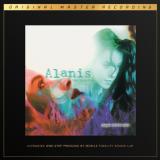
When Alanis Morissette took direct aim at an ex who wronged her on the eviscerating “You Oughta Know” in 1995, everything about the Top 10 song communicated it wasn’t the usual narrative about love gone south. Or the typical wounded singer wallowing in self pity. Morissette, and both the lead single from and her entire American major-label debut — the profoundly personal Jagged Little Pill — represented a sea change. They kickstarted a movement, one whose impact continues to echo throughout the mainstream nearly three decades later.
Ranked the 69th Greatest Album of All Time by Rolling Stone, included on the Rock and Roll Hall of Fame’s list of 200 Definitive Albums, and featured in several books about essential albums, Jagged Little Pill remains more than a blockbuster that has sold more than 17 million copies in the U.S. and 33 million units worldwide. It’s a statement, an attitude, a soundtrack for anyone seeking inspiration, an outlet, or permission to be themselves.
Sourced from the original master tapes, pressed at Fidelity Record Pressing on MoFi SuperVinyl, and strictly limited to 4,000 numbered copies, Mobile Fidelity’s UltraDisc One-Step 180g 45RPM 2LP box set of Jagged Little Pill presents the landmark effort in audiophile-grade sound for the first time. A key part of the record’s appeal and accessibility — Glen Ballard’s smooth production, touches that help Morissette’s exposed-nerve fare seem more accessible and melodic — comes through on this special 30th anniversary edition with an openness, presence, and dynamic explosiveness that make the vocalist’s songs that much more real and visceral.
The singer’s distinctive mezzo-soprano deliveries — the octave-rippling highs, dark-hued lows, dramatic crescendos, belted choruses, wispy reflections, occasional yodels — resonate with full-range ardor and depth. As crucial as anything on the record, Morissette’s confessional words take center stage like never before. Ditto the instrumentation and atmospherics that form the magnetic backgrounds of the songs. Key in on the contributions from Red Hot Chili Peppers Dave Navarro and Flea on “You Oughta Know” to Tom Petty & the Heartbreakers' co-founder Benmont Tench’s organ playing on six tracks.
The deluxe packaging of Mobile Fidelity’s Jagged Little Pill UD1S set underscores the work’s distinguished status. Housed in a slipcase, the LPs come in special foil-stamped jackets with faithful-to-the-original graphics that illuminate the splendor of the recording. Benefitting from an ultra-low noise floor, superior groove definition, and dead-quiet surfaces, this UD1S reissue is for listeners who prize sound quality and desire to engage themselves in everything involved with the album, including the now-iconic cover art that juxtaposes two portraits of the then-21-year-old singer-songwriter and features typewriter font.
That script — which suggests a raw, blood-on-the-floor document created without modern aids like spell check or language correction — hints at the heightened level of unvarnished intimacy, honesty, and catharsis Morissette offers throughout Jagged Little Pill. Named after a phrase uttered on the astute “You Learn,” the album explores the frank emotions, inherent contradictions, and wishful desires people feel everyday but are often too afraid to express. Morissette displays no such fear or shyness.
Akin to a woman reading from a diary, Morissette leaves nothing to the imagination as she skewers hypocrisy during the poignant “Forgiven,” seeks recompense on the vengeful “You Oughta Know,” and spills her guts on the soul-purging “All I Really Want.” For all the anger and bile ascribed to the singer and record, Jagged Little Pill is incredibly healthy and upbeat. Morissette uses the catchy pop-rock frameworks and moody ambience to suss out situations, to learn, to give hope. There’s the clever yearning of “Hand in My Pocket”; wry contrarianism of “Ironic”; kind-heartedness of “Hand over Feet”; the live-and-let-live spirit of “You Learn” – all positive and amiable.
Throughout Jagged Little Pill, the ever-approachable Morissette connects with listeners who recognize themselves in her — and has an intelligent conversation with anyone who wants to participate. It seemed almost everyone did. In addition to the mammoth sales that make the effort the 17th-best-selling album in American history, Jagged Little Pill collected four Grammy Awards, two American Music Awards, three Billboard Music Awards, and eight Juno Awards. In 2018, the record became the basis for a musical that netted 15 Tony nominations on Broadway.
Ironic? Anything but. Jagged Little Pill transcends generations, gender, and trends. As Morissette sings on the opening “All I Really Want,”, the album represents “deliverance” — “a place to find common ground.”
Recital presents a new double album of rarely heard Robert Ashley compositions performed by baritone singer Thomas Buckner.
“(Robert Ashley) turned speech into music” - Alvin Lucier.
In the 1960s, Robert Ashley pioneered the American avant garde with the ONCE Group and festivals, before irrefutably changing the face of American opera later in the 20th century. Buckner, in addition to running the fabulous 1750 Arch record label in the 1970s and 80s, is a noted baritone who has collaborated for decades with the likes of Roscoe Mitchell, Annea Lockwood, and the late Noah Creshevsky, amongst countless others.
The title of the album, Spontaneous Musical Invention, refers to Ashley’s method of instructing the singer to do what he called “spontaneous musical invention based on the declamation of the text.” A vocal practice that Thomas Buckner perfected over the 33 years that he collaborated with Ashley. First performing in Ashley’s 1984 opera Atalanta (Acts of God), Buckner continued on as an integral performer in the ensemble until Ashley’s death in 2014.
The album is composed of two halves, the first is a new rendering of Ashley’s second opera Atalanta (Acts of God). Robert Ashley wrote about ten hours of music for the opera Atalanta, divided into three acts: ‘Max', for the surrealist artist Max Ernst; ‘Willard', for the composer’s uncle, Willard Reynolds, a great story teller; and ‘Bud', for Bud Powell, the great jazz pianist and composer. One is invited to construct a version using any material from these ten hours. Over the years they worked together, Thomas Buckner commissioned three reworkings of arias from Atalanta that he could perform in concert: the ‘Odalisque' aria from Max, 'The Mystery of the River' from ‘Willard', & 'The Producer Speaks' from ‘Bud'. So this first section of the album is one of many possible versions of Atalanta, albeit in strikingly different versions from the originals.
The second section of the album is dubbed Occasional Pieces, and holds two unpublished Ashley works. ‘When Famous Last Words Fail You' & 'World War III Just the Highlights' are not from any Ashley opera. However, each is highly dramatic and theatrical. They were written as standalone pieces for Thomas Buckner. Buckner’s distinct vocal cadence projects the sharp wit and wry storytelling of Ashley’s librettos.
A portion of the record was recorded live at Roulette in Brooklyn, NY, at an intimate memorial concert held for Robert Ashley in 2014. Spontaneous Musical Invention, in essence, functions as a tribute to both exceptional artists, and to their decades of collaboration.
Vinyl edition comes with a 24 page 12” x 8.5” booklet of Ashley librettos, scores, & program notes, with an introduction by Alvin Lucier.
Thomas Valverde unveils Polka, his second album. This new record dedicated to solo piano takes the approach of a pared-down, minimalist production. Both upright and grand pianos are used. The grand piano is used to develop a powerful, committed and liberating discourse, while the upright piano brings a more organic sound and allows an intimate experience. The tracks on the album are conceived as sidereal love songs. Songs without words, more apt to translate the invisible, the threads of love and beauty. Everything has to be said on the keyboard, in the notes and between the notes. The album was recorded at the prestigious La Fabrique des Ondes studio, with David Chalmin (collaborator of Thom Yorke, The National, Katia & Marielle Labèque) recording and mixing. The album's title is a nod to two of his teenage heroes: Serguei Rachmaninov (genius composer) and Vladimir Horowitz (legendary pianist), whose music haunts so many musicians and music lovers. It's also a pun on the name of DJ and producer Paul Kalkbrenner (Paul K), whose simple, powerful tunes influenced the title "Polka". Thomas Valverde is also the founder and artistic director of the Biarritz Piano Festival, which features some of the world's finest pianists.
- A1: Paprika
- A2: Be Sweet
- A3: Kokomo, In
- A4: Slide Tackle
- A5: Posing In Bondage
- B1: Sit
- B2: Savage Good Boy
- B3: In Hell
- B4: Tactics
- B5: Posing For Cars
From the moment she began writing her new album, Japanese Breakfast’s Michelle Zauner knew that she wanted to call it Jubilee. After all, a jubilee is a celebration of the passage of time—a festival to usher in the hope of a new era in brilliant technicolor. Zauner’s first two albums garnered acclaim for the way they grappled with anguish; Psychopomp was written as her mother underwent cancer treatment, while Soft Sounds From Another Planet took the grief she held from her mother‘s death and used it as a conduit to explore the cosmos. Now, at the start of a new decade, Japanese Breakfast is ready to fight for happiness, an all-too-scarce resource in our seemingly crumbling world.
Jubilee finds Michelle Zauner embracing ambition and, with it, her boldest ideas and songs yet. Inspired by records like Bjork’s Homogenic, Zauner delivers bigness throughout - big ideas, big textures, colours, sounds and feelings. At a time when virtually everything feels extreme, Jubilee sets its sights on maximal joy, imagination, and exhilaration. It is, in Michelle Zauner’s words, “a record about fighting to feel. I wanted to re-experience the pure, unadulterated joy of creation...The songs are about recalling the optimism of youth and applying it to adulthood. They’re about making difficult choices, fighting ignominious impulses and honouring commitments, confronting the constant struggle we have with ourselves to be better people.”
Throughout Jubilee, Zauner pours her own life into the universe of each song to tell real stories, and allowing those universes, in turn, to fill in the details. Joy, change, evolution - these things take real time, and real effort. And Japanese Breakfast is here for it.
- Mission Creep
- Lonely Town Feat. Emma Anderson
- High Teens
- A Porsche Shaped Hole
- Swiss Air Feat. Emma Anderson
- I Don’t Know How To Sing
- Messengers Feat. Verity Susman
- 1988:
- Motor Boats
Neon Green Vinyl[27,94 €]
Ride bassist Steve Queralt’s debut solo album Swallow is a beautifully brooding nine-track collection that combines the darkly textured soundscapes of early M83 and Sigur Rós with an electronic sheen reminiscent of Boards Of Canada. It also features guest vocals from Sonic Cathedral labelmate Emma Anderson (formerly of Lush and Sing-Sing) and Verity Susman (Electrelane, Memorials).Swallow has been slowly but surely pieced together between Ride albums and tours over the past five years and, perhaps as a result, has a slightly dystopian, Blade Runner feel that reflects the liminal spaces in which it was created.Despite the fact that the majority of the album is instrumental, there is plenty of power and emotion poured into these moody, moonlit soundtracks. When words do appear, an underlying anger and political slant emerges and amplifies the album’s dark intensity. This is most notable on the closing track, ‘Motor Boats’, where he overlays words from Julie Sheldon’s polemic poem The Same Boat (“We’re all in the same boat they say, but I would disagree”). According to Steve, these simple words of rejection “capture the reality of our times perfectly”. However, it was the collaborations with the two guest vocalists that tied the whole thing together and paved the way to the finished album. “After a few false starts, I had started to doubt the project altogether. It was going nowhere,” says Steve. “Then, out of the darkness, Emma got in touch to tell me that she’d found her voice and could I send her some tracks. A few files back and forth and an afternoon in the studio later and we had ‘Lonely Town’ and ‘Swiss Air’.”In the meantime, Verity from Electrelane had added vocals to the song ‘Messengers’ and transformed the track. Matthew Simms, now her bandmate in Memorials, would go on to mix the finished album.“Swallow has turned out so much better than I had hoped,” enthuses Steve. “I’d fallen out of love with it so many times I was thinking of calling it Loveless. But then, that wouldn’t be the whole story.”
From the moment she began writing her new album, Japanese
Breakfast’s Michelle Zauner knew that she wanted to call it
‘Jubilee’. After all, a jubilee is a celebration of the passage of time
- a festival to usher in the hope of a new era in brilliant technicolor.
Zauner’s first two albums garnered acclaim for the way they
grappled with anguish; ‘Psychopomp’ was written as her mother
underwent cancer treatment, while ‘Soft Sounds From Another
Planet’ took the grief she held from her mother’s death and used it
as a conduit to explore the cosmos.
Now, at the start of a new decade, Japanese Breakfast is ready to
fight for happiness, an all-too-scarce resource in our seemingly
crumbling world.
‘Jubilee’ finds Michelle Zauner embracing ambition and, with it, her
boldest ideas and songs yet. Inspired by records like Bjork’s
‘Homogenic’, Zauner delivers bigness throughout - big ideas, big
textures, colours, sounds and feelings. At a time when virtually
everything feels extreme, ‘Jubilee’ sets its sights on maximal joy,
imagination and exhilaration. It is, in Michelle Zauner’s words, “a
record about fighting to feel. I wanted to re-experience the pure,
unadulterated joy of creation… The songs are about recalling the
optimism of youth and applying it to adulthood. They’re about
making difficult choices, fighting ignominious impulses and
honoring commitments, confronting the constant struggle we have
with ourselves to be better people.”
Throughout ‘Jubilee’, Zauner pours her own life into the universe
of each song to tell real stories and allowing those universes, in
turn, to fill in the details. Joy, change, evolution - these things take
real time and real effort. And Japanese Breakfast is here for it.
Available on clear with yellow swirl coloured vinyl.
- Like Jacob On The Hill
- Outside Beauty
- Johnny The Baptist
- One More Morning
- Let Us Compare Supermen
- I Used To Be A Mansion
- Two Different Halloweens
- Last Temptation
- Carmen
- A Nightmare And A Goddess
Marcus Index.
Wordsmith and musical wanderer.
Across a decade as the front man of Spookyland, and more recently Beth & Blue, Index received worldwide critical attention for the raw intensity of his vocals and poetic lyrics, garnering comparisons to artists like Jeff Mangum and Bob Dylan.
- A1: Early Autumn; Bass – Milt Hinton; Drums – Osie Johnson; Flute – Jerome Richardson; Guitar – Billy Mure; Piano – Billy Rowland, Written-By – Johnny Mercer, Ralph Burns, Woody Herman 3:09
- A2: Round Midnight; Bass – Milt Hinton; Drums – Osie Johnson; Guitar – Billy Mure; Piano – Billy Rowland; Trumpet – Billy Butterfield, Written-By – B. Hanighen*, C. Williams*, Thelonious Monk 2:59
- A3: Prelude To A Kiss; Bass – Milt Hinton; Drums – Osie Johnson; Guitar – Billy Mure; Piano – Billy Rowland; Trombone – Urbie Green; Written-By – Duke Ellington, Irving Gordon, Irving Mills 2:58
- A4: My One And Only Love; Bass – Wendell Marshall; Drums – Don Lamond; Piano – Hank Jones; Tenor Saxophone – Al Cohn; Written-By – Guy Wood, Robert Mellin 3:28
- A5: In Other Words; Bass – Wendell Marshall; Drums – Don Lamond; Piano – Hank Jones; Tenor Saxophone – Al Cohn; Written-By – Bart Howard 3:51
- A6: Two For The Blues; Baritone Saxophone – Jerome Richardson; Bass – Milt Hinton; Drums – Osie Johnson; Guitar – Billy Mure; Piano – Billy Rowland, Written-By – J. Hendricks*, Neal Hefti 2:38
- B1: Blue And Sentimental; Bass – Milt Hinton; Drums – Osie Johnson; Guitar – Billy Mure; Piano – Billy Rowland; Trombone – Urbie Green, Written-By – Count Basie, Jerry Livingston, Max David* 2:52
- B2: Speak Low; Bass – Wendell Marshall; Drums – Don Lamond; Piano – Hank Jones; Tenor Saxophone – Al Cohn, Written-By – Kurt Weill, Ogden Nash 3:57
- B3: Oh What A Night For Love; Bass – Milt Hinton; Drums – Osie Johnson; Guitar – Billy Mure; Piano – Billy Rowland, Written-By – Neal Hefti, Steve Allen (3) 2:55
- B4: You Go To My Head; Bass – Wendell Marshall; Drums – Don Lamond; Piano – Hank Jones; Tenor Saxophone – Al Cohn, Written-By – Haven Gillespie, J. Fred Coots 3:04
- B5: Caravan; Bass – Milt Hinton; Drums – Osie Johnson; Flute – Jerome Richardson; Guitar – Billy Mure; Piano – Billy Rowland, Written-By – Duke Ellington, Irving Mills, Juan Tizol 3:51
- B6: Soft Winds; Baritone Saxophone – Jerome Richardson; Bass – Milt Hinton; Drums – Osie Johnson; Guitar – Billy Mure; Piano – Billy Rowlandm, Written-By – Benny Goodman, Fred Royal 2:36
Divine Dances. In plural form.
The fourth album from DjeuhDjoah & Lieutenant Nicholson couldn't have a more explicit title.
Masters of emotions and feelings, the duo has always known how to express melancholy and nostalgia with precision. Yet this time, all their efforts have concentrated on a single goal: taking listeners by the hand—no, by the ear, obviously!—to bring everyone back to the dance floor and explore a variety of atmospheres together.
And naturally, a variety of styles. Funk, ndombolo, electro, hip hop or zouk, each new vibration discovered carries away the previous one to form a dancefloor where all eventually come together.
Divinely light.
The body, surrendered to this call to dance in all its forms, has been so caught up in the whirlwind of groove that the mind has fallen in behind it to continue as one. Words explode into syllables that metamorphose into notes, then perfectly align with those from the score.
One second. A bit of attention. Caught by an irrepressible groove, then comes the moment to slalom through melodies to discover, at the turn of a rhyme, a new meaning. Approached head-on, certain overly serious themes would empty the room and bring the atmosphere down to lead levels. The diagonal approach, humor, and apparent nonchalance of the two men are the best weapons at their disposal. Their Trojan horse to put substance into their form(s). To evoke transidentity, consent, economic malaise as well as the spiritual, or to tell little stories of frustrated loves, seemingly insoluble but which will end well.
Anthony Hilaire for Creole words, Sarah Solo for hip-swiveling soukous, Patrick Bebey for pygmy flute notes, and Grégoire Mahé to bring electricity to DjeuhDjoah & Lieutenant Nicholson's songs; styles blend in a musicality worked into its smallest interstices.
Gathered on this dance floor illuminated with 80s disco brilliance, you observe brassy notes slithering under the electronic veneer, synthesizer keys splashed by furious hip movements. To raise your eyes to connect with the spiritual is to watch the sky become constellated with crystalline Fender Rhodes notes, destined to fall like rain on the heavy bass of afrobeat groove.
Smiles attached to faces, no one should think they can get through the ten tracks of Divine Dances while remaining seated : he's doomed to fail.
OUT MAY 2025 DELUXE WHITE VINYL 180 G /CD / DIGITAL
- Idag
- Drömmar Av Is
- Drömmen Om Död Och Förruttnelse
- Om Du Vill
- Gläntan
- Burning Cross
- Irreligious Flamboyant Flame
- Christmas
- Spirit
- Om Du Vill (Slight Return)
More than 20 years after their debut, Witchcraft's seventh album, 'IDAG,' is an awaited full accounting of who they are as a band. Those who have clamored for the return to an earlier sound rooted in '70s classic progressive and heavy rock will delight to the strut of "Irreligious Flamboyant Flame" while the eight-minute opening title-track is the heaviest the band have ever sounded, and a succession of interspersed acoustic-based pieces helps create a vision of a new, soulfully folkish doom taking shape as they continue to move inexorably forward. Founding guitarist/vocalist, Magnus Pelander, says of 'IDAG': "This album will reap souls and destroy wicked minds. And perhaps mend a couple of broken ones." These enigmatic few words from the Swedish band's main songwriter give clues as to the songs' intentions; a reference dropped to Coven's 1969 album, 'Witchcraft Destroys Minds and Reaps Souls.' Coven also had a folkish, proto-doomed take at that point in their history, and that multifaceted nature has been a part of Witchcraft all along. On one level, Magnus is winkingly telling you it's a Witchcraft record. The actual meaning of that becomes clear when you hear the album and find out just how much 'a Witchcraft record' can encompass. The storyline of Witchcraft's growth, from Pelander's starting the band in Örebro in 2000 in the wake of his prior outfit Norrsken's disbanding. A generational landmark of a 2004 self-titled debut helped spark a retroist movement that has become its own subgenre, but Witchcraft never stopped growing. 2005's 'Firewood' and 2007's 'The Alchemist' introduced more progressive sounds, and five years later, the pointedly modern 'Legend' established in 2012 that they had moved beyond the analog worship they had been a part of pioneering within the contemporary heavy rock and doom scene. In 2016, the 2LP 'Nucleus' introduced fuller-toned doom, and 2020's 'Black Metal' diverged into moody acoustic minimalism familiar to some fans from Pelander's early solo work, but different from anything Witchcraft had done prior. 'IDAG,' then, is the tie that draws all of this - more than two decades of exploring and growth - together. Whatever they've done in the past and whatever they'll do in the future, 'IDAG' feels like a nexus for defining who and what Witchcraft are. Even crazier, that might be the point of the thing. JJ Koczan
Purple Vinyl, limited to 450 copies. More than 20 years after their debut, Witchcraft's seventh album, 'IDAG,' is an awaited full accounting of who they are as a band. Those who have clamored for the return to an earlier sound rooted in '70s classic progressive and heavy rock will delight to the strut of "Irreligious Flamboyant Flame" while the eight-minute opening title-track is the heaviest the band have ever sounded, and a succession of interspersed acoustic-based pieces helps create a vision of a new, soulfully folkish doom taking shape as they continue to move inexorably forward. Founding guitarist/vocalist, Magnus Pelander, says of 'IDAG': "This album will reap souls and destroy wicked minds. And perhaps mend a couple of broken ones." These enigmatic few words from the Swedish band's main songwriter give clues as to the songs' intentions; a reference dropped to Coven's 1969 album, 'Witchcraft Destroys Minds and Reaps Souls.' Coven also had a folkish, proto-doomed take at that point in their history, and that multifaceted nature has been a part of Witchcraft all along. On one level, Magnus is winkingly telling you it's a Witchcraft record. The actual meaning of that becomes clear when you hear the album and find out just how much 'a Witchcraft record' can encompass. The storyline of Witchcraft's growth, from Pelander's starting the band in Örebro in 2000 in the wake of his prior outfit Norrsken's disbanding. A generational landmark of a 2004 self-titled debut helped spark a retroist movement that has become its own subgenre, but Witchcraft never stopped growing. 2005's 'Firewood' and 2007's 'The Alchemist' introduced more progressive sounds, and five years later, the pointedly modern 'Legend' established in 2012 that they had moved beyond the analog worship they had been a part of pioneering within the contemporary heavy rock and doom scene. In 2016, the 2LP 'Nucleus' introduced fuller-toned doom, and 2020's 'Black Metal' diverged into moody acoustic minimalism familiar to some fans from Pelander's early solo work, but different from anything Witchcraft had done prior. 'IDAG,' then, is the tie that draws all of this - more than two decades of exploring and growth - together. Whatever they've done in the past and whatever they'll do in the future, 'IDAG' feels like a nexus for defining who and what Witchcraft are. Even crazier, that might be the point of the thing. JJ Koczan
Part 2[11,72 €]
A noughties classic, an earworming anthem, an eventual schoolyard ringtone favourite; Roman Flügel’s once inescapable ‘Geht’s Noch?’ celebrates turning 21 on Running Back, refreshed and remixed by a scene-spanning set of artists paying keen tribute to its absurdist energy.
Casually released as part of a Cocoon Records compilation in 2004, ‘Geht’s Noch?’ rose from the depths with the support of Sven Väth, becoming an international phenomenon, conquering and uniting the dominant scenes of minimal and electroclash alike. Some have said it laid the foundations for the ‘Dirty Dutch’
house scene, albeit from over the border in Germany.
Well known for injecting much-needed levity into the contemporary club landscape via her Live From Earth parties, DJ Gigola adds additional firepower to ‘Geht’s Noch?’, inducing a planet-shaking kick drum, before sending the track’s signature bleeps into nonsensical Morse code for even greater pleasure. Another rave
culture connoisseur, Luca Lozano, offers two alternate takes; his ‘Technocs’ mix rolls deep with additional cowbells, robotic voice commands and stadium-sized claps. Meanwhile, the ‘Gehts Garage Remix’ draws a savvy connection with the original’s as-yet-untapped UK funky potential.
Peder Mannerfelt, who straddles the line between innovation, functionality, humor and seriousness quite like its original author, takes ‘Geht’s Noch?’ to truly wuthering heights. His remix builds unexpected drama and catharsis around the enduring riff, before a collaboration with studio partner Par Grindvik as Aasthma
spins the club out with a glossy, anime-tinted take, full of whimsy and colour.
And while the digital release of Geht’s Noch? also spans interpretations from Audion, Domnik Eulberg & Moguai, this vinyl release presses Steve Angello vs Who’s Who remix to wax, that which helped take ‘Geht’s Noch?’ out of the underground and into the stratosphere. Twenty years on, and Flügel’s offbeat hit is
always ascending. Love it or hate it, ‘Geht’s Noch?' will still get you good.
Words by John Loveless
- A1: Die-Biden 02 02
- A2: Kodō 07 39
- A3: Teiko 04 21
- A4: Hasan (Ypy Remix) 04 16
- A5: Teiko (Lena Willikens Remix) 04 49
- A6: Ekusutashī (Efdemin Version) 06 18
- B1: Sakura 06 24
- B2: Kodō (Barnt & Jens-Uwe Beyer Remix) 09 04
- B3: Ekusutashī 05 57
- B4: Shojo No Yo Ni 03 52
- B5: Shojo No Yo Ni Flp (Hibotep Remix) 03 08
The project by Jens-Uwe Beyer and Thomas Venker boasts a remarkable origin story. In 2017, Venker, co-founder and co-editor-in-chief of Cologne’s Kaput magazine, hosted a gathering at Beyer's house, bringing together journalists, creatives, and musicians. To mark the occasion, the pair decided to join forces for an impromptu ambient-electronic performance, presenting themselves as a two-man band. That evening, donned in special costumes designed by artist Sarah Szczesny and fuelled by a generous amount of Japanese whisky, Hasan Poppu was born. Over the course of the pandemic, the duo thought about creating a record based on the live recording of their premiere show. However, the synergy of their collaborative creative energies led them in entirely novel directions. Their self-titled, double-sided album traverses a wild and raucous terrain, moving swiftly from hybrid noise-techno to giddy party ecstasy, to strange and shadowy atmospheres.
Including remixes by YPY, Hibotep, Lena Willikens, Efdemin and Barnt, the 11 tracks span a dizzying array of experimental dance-facing styles. 'Die-Biden' kicks off as a high-vibrational vocal experiment seemingly voiced by a sentient German vocoder. 'Kodō' follows, featuring Venker's playful mantra set against a stomping beat. Willikens' reimagining of 'Teiko' transports the track to obscure realms inhabited by strange creatures emitting ungodly sounds. Meanwhile, Efdemin's take on 'Ekusutashī' pulsates with a kinetic buzz. Flipping over to the B-side, 'Sakura' is a euphoric wall of drone punctuated by eerie whispers and mystical singing. Then, the second installment of 'Kodō' takes a fresh trajectory with a touch of Barnt’s electronic groove stylings. Finally, Hibotep's 'Shojo no yo ni flp' serves as the finsher – an unrepentant trance belter that disintegrates into sampled fragments. Loosely translating to "broken pop music," Hasan Poppu is informed by Beyer and Venker's shared love for Japan. The band takes their cues from the country’s rich sonic cultures while also drawing on Venker's wordsmith background and Beyer's flair for melding melodic tech-house with song-based synth-pop. Originally out on Beachcoma Recordings, Hasan Poppu’s debut album gets a new lease of life on Osàre! Editions with a digital and limited edition cassette tape release. Sarah Szczesny reprises her role in shaping the visual identity of Hasan Poppu by creating beautiful, painterly artwork for the record. words by Hannah Pezzack
TOTEMIC MODULATIONS, UNEARTHED FROM WIND AND WORDS
“The album Chênes mainly brings together songs. These songs are narratives of scenes that unfold in the forest, or in the city but with animal and plant protagonists. One song also tells the story of a solitary walk in the mountains. They are like zoomed-in snapshots of the world of insects, amphibians, birds, and mammals. They are also celebrations of growing life, and the pleasure and joy it brings.
Composed over the course of about two or three years, it was a deliberate choice to bring them together for this album, even though they were not initially connected to one another. One of them is an exception and is more of a collection of vocalizations and cries without actual words, composed in a language incomprehensible to humans because it is nonverbal.
This collection of imitated chants and sung songs had to be illustrated by the collages of my friend Fen. Even though the stories describe real species and elements, they are indeed imagined tales. Her collages are, too. There’s also the violin that adds a wandering touch to the pieces, and other instruments that shape the environment and setting of these stories. Bells, bird calls, whistles, flutes, jaw harp, harmonica — all imitate more or less imaginary species. Each has its role and its life, down to the horsehair of the bow that rubs the strings of my violin to bring forth the sound.
Chênes is a title that pays homage to trees I love so much, though without preference over others. They have embodied several giants that I’ve often come across, greeted, and embraced” ~ Roxane Métayer
Contemporary Belgian techno powerhouses Charlotte de Witte and Amelie Lens come together on a groundbreaking new “One Mind” EP.
Between them, this pair have very much refined the sound of techno over the last few years. Both hail from Belgium, and both came up through the clubbing scene with their own unique interpretations of techno and its many different nuances.
Charlotte de Witte, a global techno icon and founder of the KNTXT label, has released numerous EPs with a focus on acid and techno, blending in trance and ambient into compelling club cuts. With millions of fans, she also has a history making presence in underground clubs, at electronic music festival main stages like Tomorrowland and Ultra, and crossover festivals with her recently completed production tour "Overdrive". She’s also been crowned DJ Magazine’s World’s Number 1 Techno DJ five years in a row. Through KNTXT, she innovates with ventures like the archival Époque label, immersive pop-ups and spontaneous street parties. Poised for a groundbreaking 2025, she remains at the forefront of revolutionizing the electronic music landscape.
Amelie Lens, the leading figure in modern techno, is known for her exceptional productions and performances. Beyond music, she is a proud mother, record label owner, and activist. She founded Exhale and LENSKE, two globally recognized labels and event platforms celebrated for their inclusivity and unique on-site experiences. Exhale focuses on nurturing fresh talent, signing its youngest artist at just 16 years old. Amelie made history as the first woman with a residency in Ibiza and is now collaborating with Vogue Collective, becoming the first techno artist to do so. Her strong relationships with top designers like Chanel further highlight her creative vision beyond music. From festival appearances at the biggest festivals in the world to performances at iconic venues like The Sphere in Las Vegas, Amelie consistently pushes boundaries, shaping the future of electronic music.
To enhance the unified concept of the EP, both Amelie and Charlotte’s voices are subtly layered into the tracks, together, as one.
The brilliant 'One Mind' kicks off with rock solid, earth rattling kicks and intimate vocal whispers that draw you in close. Flashy, strobe lit synths soon electrify the groove and ensure hands will go skywards as acid lines bring extra drama. 'Where Do We Go' is another fantastic, turbocharged and acid-laced trance-techno gem with high-speed drums and synths racing along under icy spoken words that bring spine tingling sensuality.
This is a super coming together of two of modern techno's most potent creative forces.
The compositions of Miłosz Kędra (b. 2001) explore synthetic sound, electroacoustic music, and self-built acoustic instruments, seeking diverse timbres, tunings, and textures. His main field of work is the pipe organ. Through minimalist motifs, he has transported the instrument’s sound beyond the church space by synthetically processing its tones. He is currently pursuing a Master’s degree in New Media Music at the Academy of Music in Poznań and recently completed a Bachelor’s degree in Electroacoustic Composition, during which he built his own pipe organ from scavenged pipes.
~ Liner notes ~
Miłosz Kędra - "their internal diapasons"
The pipes that Miłosz Kędra used to craft his own organ emulator have lived many lives. They come from churches scattered across Greater Poland—some trimmed for a more presentable façade, others left to gather dust in parish houses until, stripped of purpose, they were cast away. Their first voices have faded, their inner resonance unsettled, yet with patience, one can teach them to sound again—to sing in their altered state, to be gently coaxed out of silence.
Audiomancy—the conjuring of lost sounds—is the word that lingers when I try to grasp the lore crystallizing with Kędra’s second album.
The resolve with which the musician and composer has inhabited his self-built instrument recalls Witold Szalonek and his search for “unexploited properties of wind instruments in classical music.” Szalonek sought to map these hidden voices into a system of multiphonics, revealing over 160 on the oboe alone by 1968. Some sound eerily alike, yet emerge through distinct gestures—“a particular breath, a precise choreography of levers and apertures, the seamless fusion of the two.”
The splitting of a single note into its spectral fragments—allowing a melodic instrument to speak in two, three, even four voices at once—enabled Szalonek to bend the rigid structures of Western music. "their internal diapasons" follows a similar path: an aesthetic bypass through which Kędra taps into the sacred gravity of the church organ, only to reveal it as a domesticated echo of something far older—the primal theater of transformation. To listen closely to an instrument is to learn its flaws, to turn its imperfections into a new way of speaking.
Each of the nine compositions on "their Internal diapasons" is an invitation—to approach the material world with the intent of letting it speak beyond expectation. An instrument that is at once a sculpture, a performance, and a manifesto of voicing the discarded suggests that its creator—following the path of Didier Eribon (Returning to Reims)—might take as his motto, a principle of asceticism, Sartre’s words: “What matters is not what is made of us, but what we ourselves make of what is made of us.”
Filip Szałasek
Two years after releasing the acclaimed Crash Recoil, Anthony Child aka Surgeon returns to Tresor with new LP, Shell~Wave. Retaining the minimal equipment list and studio-version-of-live-show-sets approach of the previous album in order to focus on the work itself, Shell~Wave is a deeply personal document of both where Surgeon is and has been, converging three decades of experience with a continued curiosity in the untested.
“To make this project, I had to dig really deep in terms of what my relationship was to techno; I’ve been involved with it for a really long time and there’s a lot about it I feel dislocated from, so I had to really think hard about what techno is to me. I often get asked “what is techno to you?” but I can’t answer that with words; this album is the answer.” From the complex, twisting track Infinite Eye to the caustic Soul Fire, the eight tracks that make up the body of the album are single-take explorations of the vast, hard yet minimal techno Child is synonymous with.
Neatly dividing the record in two, the emotional centre of the record comes in the form of Dying, a vibrating, beatless piece that with a mantra-like vocal loop steeped in reverberating effects. Further echoes of dub production appear throughout the record as tracks like Divine Shadow, and Empty Cloud have an almost ever-present mist of reverberation, driven by the appearance of a new delay unit in the equipment list; while much of the philosophy of Crash Recoil’s creation is present, the process and the instruments have changed as Child again switches up his approach to studio work.
This insistence on trying novel techniques doesn’t preclude returning to old ones, as this use of modern digital machines with live, hands-on takes that are as inspired by 60s producer Joe Meek and 70s reggae as they are by this year’s synthesiser expos.
“For me, it’s an interesting experience returning to old techniques again after 30 years. I’m always exploring and finding myself back at the beginning. Connecting the present with the past.”
This philosophy of ‘time travel’ is inherent to the music itself as the synchronised loops repeat while the delay and effects branch out, forming unique eddies; distinct quantum moments within the circular whole; the future leaking through the spaces between the sounds. All of the concepts on the album are perfectly communicated through the painting by Taiwanese artist Jazz Szu-Ying Chen which suggests the movement of water, sound waves, and the chitinous shells of sea creatures.