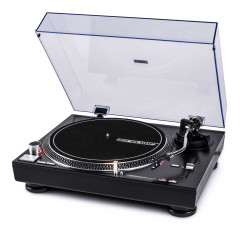
The RP-4000 MK2 is a solid DJ turntable for advanced users. The new MK2 version comes with several improvements, including a newly developed top panel and reworked metallic buttons with enhanced feel as well as a variety of functions. Precise motor control with 3 speeds: The precision-engineered die-cast platter is accelerated by a powerful motor with a high-torque direct drive of more than 1.8 kg/cm. The precise motor control with 3 speeds (33 1/3, 45 & 78 rpm) allows for the RP-4000 MK2 to play back any record. The pitch section with a selectable range of +/-8% and +/-16%, respectively, is suitable for the finest pitch adjustments. Statically balanced s-shaped tone arm: The RP-4000 MK2 features a statically balanced s-shaped tone arm with hydraulic lift and anti-skating mechanism. Via the universal connection for pick-up systems (SME) a large number of pick-up systems can be connected. Reverse function, pitch reset and extendible needle illumination: Additional features, such as reverse play and pitch reset, offer all DJs direct control of their turntable. With the push of a button the aluminium target light can be extended, so that the needle position can be seen in dark surroundings. Newly developed top panel and sturdy housing design: The new deep black metallic top panel construction is equipped with metallic buttons for start/stop, platter speed, pitch control, reverse function and tempo reset. The improved touch upon hit offers a clear haptic feedback. The sturdy construction with optimized damping features and shock-absorbing feet improve isolation from unwanted vibrations. With pick-up and headshell (made by Ortofon in Denmark): The RP-4000 MK2 comes with the high-quality OM Black pick-up, handmade by Ortofon in Denmark, pre-fitted to a headshell ready for immediate playback.
Technical data Turntable:
Type: direct drive turntable
Drive: quartz-driven high-torque direct drive
Motor: 8-pol., 3-phase, brushless DC motor
Turntable speeds: 3 speeds, manual (33 1/3, 45, 78 rpm)
Starting torque: > 1.8 kg/cm
Brake time: 50 dB (DIN-B)
Brake system: electronic brake
Platter:
Material: aluminium die-cast
Diameter: 332 mm
Tone arm:
Type: universal, statically balanced, s-shaped
Effective length: 230.5 mm
Overhang: 16 mm
Tracking angle error: < 3°
Applicable pick-up weight: 3.5 - 8.5 g (incl. headshell 13 - 18 g)
Anti-skating range: 0 - 7 g
Connections:
1x PHONO out (gold-plated), 1x GND
General:
Power supply: AC 115/230 V, 60/50 Hz (EU/US), AC 100 V, 50/60 Hz (JP)
Power consumption: 12 W
Dimensions: 450 (w) x 352 (d) x 144 (h) mm
Weight: appr. 9.8 kg
Included accessories:
Platter, OM Black pick-up system (by Ortofon), headshell, slipmat, counterweight, AC psu, instruction manual
Features
NEW in the MK2 version:
Newly developed top panel and reinforced housing construction
Reworked metallic buttons with improved feel & tactile response
Precision Pitch with selectable ranges of +/-8 % & +/-16 %
Tempo reset (Quartz Lock) feature
Superior finish in deep black metallic
Quartz-driven DJ turntable with high-torque direct drive
Designed for professional use
Powerful brushless DC motor with more than 1.8 kg/cm torque
Precise motor control with 3 speeds selectable (33 1/3, 45 & 78 rpm)
Reverse function: switch for forward/reverse playback
Precision-engineered die-cast aluminium platter with stable rotation
Statically balanced s-shaped tone arm with hydraulic lift and anti-skating mechanism
Universal connection for pick-up systems (SME)
Extendible needle illumination
Shock-absorbing feet for vibration isolation
Sturdy, heavy construction with optimized damping features
Prepared for dust cover (available as optional accessory)
Incl. slipmat, removable headshell and ready-mounted OM Black pick-up made by Ortofon
Buscar:type 5 2
BBE Music is thrilled to present J Jazz: Free and Modern Jazz From Japan 1954-1988, a
remarkable large-format book covering some of the deepest, rarest, and most innovative
jazz music released anywhere in the post-war era. Compiled by Tony Higgins and Mike
Peden, co-curators of BBE Music's acclaimed J Jazz Masterclass Series, the book also
features a foreword by Japanese jazz icon, Terumasa Hino.
This is the first time a book of this type has been published outside of Japan and the first
anywhere of this size and scale. It is a unique collection of over 500 albums of free and
modern jazz released in Japan during a period of radical transformation and constant
reinvention. An era that saw Japan return from the ravages of World War Two to become a
global economic power and emerge as both a technological leader and an international
cultural force.
Through a unique gallery of albums, J Jazz charts the development of jazz in Japan from the
first stirrings of the modern jazz scene in the mid to late 1950s and on through the hard bop
and modal jazz of the 1960s. It steers the reader into the radical directions of the 1970s when
free jazz, fusion, post-bop, and jazz-funk opened up a growing number of Japanese jazz
artists to a new global audience before consolidating in the mid to late 1980s with a musical
scene that laid the path for the contemporary jazz generation to follow.
Over 500 full-colour sleeves from many of the leading names in Japanese jazz sit alongside
rare and private pressings that tell a story of constant change and musical exploration. J
Jazz includes profiles of several leading record labels such as East Wind, Frasco, King
Records, and Nippon Columbia as well as critical independents such as Three Blind Mice,
ALM, and Aketa’s Disk.
J Jazz includes interviews with celebrated jazz photographer Tadayuki Naito, and pianist
Tohru Aizawa, bandleader on the totemic spiritual jazz album, Tachibana Vol 1, as well as
free-jazz record collector and jazz musician Mats Gustafsson.
The book also features a chapter on albums by non-Japanese artists that only received a
Japanese release, with collectible, rare, and obscure releases by figures such as Herbie
Hancock, Miles Davis, Mal Waldron, Steve Lacy, and Art Blakey. J Jazz includes Japanese
jazz charts from some of the world's leading jazz DJs including Gilles Peterson, Toshio
Matsuura, Paul Murphy, and Shuya and Yoshihiro Okino. Among the specialist content is a
feature on obi strips by record dealer and Japanese jazz expert, Yusuke Ogawa, plus a
special article on Japanese Blue Note albums.
Across its 300-plus pages, J Jazz includes a detailed introduction contextualising the music,
tracing the story of Japan's fascination with jazz back before the war. It also features
biographical information on many of the key artists involved in shaping the post-war
Japanese jazz scene including Sadao Watanabe, Toshiko Akiyoshi, Masabumi Kikuchi,
Masahiko Togashi, Terumasa Hino, Yosuke Yamashita, Fumio Itabashi, Masayuki
Takayanagi, Takeo Moriyama, Isao Suzuki, and many more
Darning Woman is an intentional, beautiful, sometimes confrontational album that shreds expectations of DIY, bedroom music, and feminine themes. There's a lushness and maternal instinct at play, as Coope connects the dots between physicality, ephemera, and the ultrafeminine. "I don't really like to deal that much with themes of personal hardships, or heartache and love," says Anastasia Coope. "Ultimately, I work most honestly with the language of what is happening in a moment and the passage of time around it. That, coupled with my reaction to entering the artistic landscape, and my thoughts about what does and doesn't get representation, comprises most of this album." Darning Woman explores, among other things, the meditative aspect of sewing, patching and embellishment, care and repair, collection not as modern, craven consumption but as a counterpoint to materialism. This sort of collection - the good kind, the gathering of things to make a home - can be, in Coope's words, "A very baby way to critique capitalism. Birds make nests, right? It can be a new life for a thing that was made. What you surround yourself with matters." To that end, Anastasia Coope is also the founder and leader of the Bonzo collective and show series, an exciting new home for the type of expansive, profoundly creative scene that New York has been missing for some time. And while Bonzo may well be the ascent of a new community, Darning Woman is the story of Anastasia Coope, herself. It is the sound of Coope entering the world as an artist, acknowledging the tangle of what changes - the gaze of the world, Coope's art in reaction and community to art in general - and what does not: her ideas and her own self.
Some songs are so ingrained in our consciousness that they are immediately identifiable upon hearing one or two notes. Featuring one of the most indelible riffs ever played, Foghat's air-guitar anthem "Slow Ride" is such a tune. The hit single turned the British band into stars and catapulted 1975's Fool for the City up the charts. And what a ride it is.
We hear a lot of yearning today about the good-old, glory days of rock and roll, the simple kind that just locked into a good beat, turned out a raunchy groove, and simply kicked you in the butt. The no-pretense type meant for kicking back, letting loose, and surrendering to the melody. Bare-bones music that doesn't need image or looks as a crutch.
Well, this is it, friends, classic meat-and-potatoes 70s rock that comes with killer slide-guitar solos, crunchy leads, driving rhythms, and soaring vocals. No need for any further instructions or explanations. The pact between artist and audience is understood. Here, the band trusts that you know what to do and is ready to rock out with anyone in earshot.
Pressed at Fidelity Record Pressing, Mobile Fidelity's remaster of this Foghat gem bring to the surface the band's marble-solid sturdiness and bluesy structures like never before. Bass notes are thicker and richer, the dual guitars bite and snap, and Lonesome Dave Peverett's singing comes across with realistic grit. This LP invites you to hear and feel the energy Foghat brings to the boogie-infused title track, great cover of the Righteous Brothers' "My Babe," and, of course, the everlasting "Slow Ride."
FEATURES
NEW in the MK2 version:
Metal top panel and reinforced housing construction
Reworked metallic buttons with improved feel & tactile response
Precision pitch with range of +/-10 %
Superior finish in deep black metallic
Turntable with belt-drive for DJ and hifi use
Perfect for aspiring DJs and hifi enthusiasts
Powerful belt-drive motor system absorbs unwanted vibration and noise
Precise motor control with 2 selectable speeds (33 1/3 & 45 rpm)
Precision-engineered, die-cast aluminium platter with stable rotation
Statically balanced S-shaped tone arm with hydraulic lift and anti-skating mechanism
Universal connection for pick-up systems (SME)
Extendible needle illumination
Shock-absorbing feet for vibration isolation
Sturdy, heavy construction with optimized damping features
Dust cover available as optional accessory
Incl. platter, Reloop OM Black cartridge (by Ortofon), headshell, slipmat, counterweight, power cord, instruction manual
TECHNICAL DATA
Turntable:
Type: belt drive turntable
Drive: belt drive
Motor: DC motor
Turntable speeds: 2 speeds, manual (33 1/3, 45 RPM)
Brake time: 50 dB (DIN-B)
Brake system: electronic brake
Platter:
Material: aluminium die-cast
Diameter: 332 mm
Tone arm:
Type: universal, statically balanced, s-shaped
Effective length: 230.5 mm
Overhang: 16 mm
Tracking angle error: < 3°
Applicable pick-up weight: 3.5 – 8.5 g (incl. headshell 13 – 18 g)
Anti-skating range: 0 - 7 g
Connections:
1x PHONO out (gold-plated)
General:
Power supply: AC 115/230 V, 60/50 Hz (US/EU)
Power consumption: 10 W
Dimensions: 450 (w) x 352 (d) x 144 (h) mm
Weight: appr. 5.7 kg
In one sense, it's easy for artists-songwriters, specifically-to express their feelings in their work. After all, that's what the lyrics are for! But it's much harder to convey emotional energy in how you play, slash at the guitar, and the structure of the music itself. That's precisely why Girl and Girl's Sub Pop debut, Call A Doctor, feels like such a vital, electrifying shock to the senses. Not since the early work of Car Seat Headrest or Conor Oberst's widescreen emotional brutality as Bright Eyes has indie rock managed to come across as this intimate and grandiose, as the Australian quartet led by Kai James lay a lifetime's worth of woes-mental health, the human race's planned obsolescence if you've been living on this cursed rock you know what we're getting at-across a canvas of indie rock that feels both timeless and in-the-moment. An audacious and aggressively tuneful blast of a record, Call A Doctor is an unforgettable first bow from Girl and Girl, whose origins lie in James and guitarist Jayden Williams jamming in his mother's garage in the afternoon after school. One afternoon, James' Aunty Liss headed down to their practice space after walking her dog and asked if she could sit in on drums. "It sounded really great," James recalls. "We begged her to stay, and she said, 'I'll stay until you find another drummer.' We wore her down, and she eventually became a permanent member." After bassist Fraser Bell joined to round things out, Girl and Girl hit the road and began to make a name for themselves beyond the Australian bush, eventually signing to Sub Pop off the strength of word of mouth. Call A Doctor came together quickly soon after, largely recorded in marathon sessions in a two-story industrial complex over the course of two weeks. "That added to the intensity of the album," James says about the frenzied creative process overseen by producer Burke Reid. "I can hear the stress in the record, which is good because that's what it's about-being tense, tied up, and in your own head." Call A Doctor's eleven songs-spanning sweeping guitar epics and wry acoustic shuffles to spiky punk maneuvers and the type of raw, adoringly unvarnished indie-pop associated with legendary PacNW label K Records-are literally plucked from James' personal history, as he reworked older recordings with newer lyrics reflecting his past struggles as well as new anxieties that emerged prior to the album's recording. "I've struggled with mental health for a lot of my life," he explains, "and I went through a particularly difficult patch when we were making the album; the band had started to get some attention, and I felt an enormous amount of pressure to live up to it." "This record is about an individual who's too far in their head, trying to get out," James continues while discussing Call A Doctor's overall outlook-specifically the snapshot it offers of its creator. But even though this record deals with uneasy topics we all know well from within ourselves, it's important to emphasize how teeming with life Girl and Girl's music is. There's a brazen, bold sense of humor to this stuff, an undeniable brightness to the darkness that makes it impossible not to be drawn in as a listener. Feeling down never sounded so goddamn good.
In the Merry Month of May is the final studio recording of the late, great Tony Conrad, and the first duo release with Jennifer Walshe, one of Conrad"s most important collaborators in the final decade of his life. A wild, improvisatory flaying of song; the sheer sonic force recalls the ecstatic charge of Conrad"s Slapping Pythagoras, with Walshe"s clarion voice at the heart of it. A one-of-a-kind concoction whipped up by two fearless and often peerless souls. It"s a joy to hear their manifest mutual regard and commitment to busting a gut.
In one sense, it’s easy for artists—songwriters, specifically—to express their feelings in their work. After all, that’s what the lyrics are for! But it’s much harder to convey emotional energy in how you play, slash at the guitar, and the structure of the music itself. That’s precisely why Girl and Girl’s Sub Pop debut, Call A Doctor, feels like such a vital, electrifying shock to the senses. Not since the early work of Car Seat Headrest or Conor Oberst’s widescreen emotional brutality as Bright Eyes has indie rock managed to come across as this intimate and grandiose, as the Australian quartet led by Kai James lay a lifetime’s worth of woes—mental health, the human race’s planned obsolescence if you’ve been living on this cursed rock you know what we’re getting at—across a canvas of indie rock that feels both timeless and in-the-moment.
An audacious and aggressively tuneful blast of a record, Call A Doctor is an unforgettable first bow from Girl and Girl, whose origins lie in James and guitarist Jayden Williams jamming in his mother’s garage in the afternoon after school. One afternoon, James’ Aunty Liss headed down to their practice space after walking her dog and asked if she could sit in on drums. “It sounded really great,” James recalls. “We begged her to stay, and she said, ‘I’ll stay until you find another drummer.’ We wore her down, and she eventually became a permanent member.”
After bassist Fraser Bell joined to round things out, Girl and Girl hit the road and began to make a name for themselves beyond the Australian bush, eventually signing to Sub Pop off the strength of word of mouth. Call A Doctor came together quickly soon after, largely recorded in marathon sessions in a two-story industrial complex over the course of two weeks. “That added to the intensity of the album,” James says about the frenzied creative process overseen by producer Burke Reid. “I can hear the stress in the record, which is good because that’s what it’s about—being tense, tied up, and in your own head.”
Call A Doctor’s eleven songs—spanning sweeping guitar epics and wry acoustic shuffles to spiky punk maneuvers and the type of raw, adoringly unvarnished indie-pop associated with legendary PacNW label K Records—are literally plucked from James’ personal history, as he reworked older recordings with newer lyrics reflecting his past struggles as well as new anxieties that emerged prior to the album’s recording. “I’ve struggled with mental health for a lot of my life,” he explains, “and I went through a particularly difficult patch when we were making the album; the band had started to get some attention, and I felt an enormous amount of pressure to live up to it.”
Far from the sound of collapsing under pressure, Call A Doctor finds James and Co. stepping up with their entire collective chest. This is a record that’s so out-and-out alive that you nearly feel like you’re in the same room with Girl and Girl as you listen to it; lead single “Hello” practically bursts through the speakers, amplified by Aunty Liss’ unbelievable stickhandling duties. “‘Hello’ is all about romanticizing your own misery. Letting those deep, dark, dirty thoughts take over. Understanding that even if you could pull yourself out, you wouldn’t because the constant stress and worry is far too familiar and comfortable.”
“Mother” pogos on a spiky groove that’s reminiscent of the geographically close New Zealanders who make up the legendary Flying Nun label, while “Oh Boy” draws from the Shins’ own jangly sound, injected with James’ wonderfully nervy vocals. Then there’s Call A Doctor’s sorta-centerpiece “Maple Jean and the Anthropocene,” a five-minute epic offering a new perspective on climate change and the notion of what it means, in a personal sense, to suffer: “I live in the bushland, and I was driving home one night and hit and killed a wallaby with my car,” James recalls while discussing the song’s lyrical inspiration. “My first thought was, ‘What is the universe trying to tell me?’ No remorse, no guilt, just total self-centeredness. Which was like, Woah, you fucking psychopath! This wallaby wasn’t put on this earth to send you a message. That’s what the song is about, our egocentric species - thinking you’re the main character and that everything that happens is somehow about you.”
“This record is about an individual who’s too far in their head, trying to get out,” James continues while discussing Call A Doctor’s overall outlook—specifically the snapshot it offers of its creator. But even though this record deals with uneasy topics we all know well from within ourselves, it’s important to emphasize how teeming with life Girl and Girl’s music is. There’s a brazen, bold sense of humor to this stuff, an undeniable brightness to the darkness that makes it impossible not to be drawn in as a listener. Feeling down never sounded so goddamn good.
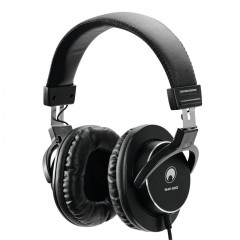
High-class monitor stereo headphones
Closed, circumaural, dynamic stereo headphones
Very good attenuation of background noise makes them especially suitable for use as monitoring headphones in a noisy environment, film and theater applications, DJ or recording applications
Very high output power
Powerful 45 mm neodymium magnet and HQ voice coil
Enhanced frequency response tuned to deliver high-output bass with extended highs
Well-padded, adjustable leatherette headband
Soft circumaural ear pads
Optimal wearer-comfort due to single OFC cable
Gold-plated 3.5 mm stereo jack with 6.3 mm adapter
Incl. velour bag for safe transportation
Frequency range: 10 - 26000 Hz
Sensitivity: 98 dB
Max. SPL: 98 dB
Rated power: 1800 mW
Cable length: approx. 3 m
Connector type: 6.3 mm jack (stereo); 3.5 mm jack (stereo)
Connections: Headphones via 6.3 mm jack (stereo)
Headphones via 3.5 mm jack (stereo)
Speakers: (1.75") approx 4.5 cm with Neodymiummagnet
Transducer type: Dynamic
Type (Headphones): Closed, earenclosing
Weight: 0.34 kg
"A Twangy Touch On 1960s Hits!
As one of America’s most influential guitarists, Duane Eddy’s famed twangy, reverb-drenched guitar shines on a wide variety of pop-rock hits, standards, and more!
Backed by two drummers, four more guitars, organ, piano, bass, saxes, and that's just the beginning, Duane goes unafraid at the kind of tunes that normally are "one person songs" Like "Ballad of the Green Berets" which becomes a twang-bang march under Duane's banner. Like "Monday, Monday" which was "The Mamas and Papas" and now has the wild newness of Duane Eddy.
After rising to fame in the late ‘50s with “Rebel Rouser,” Eddy’s influence on radio inspired musicians like George Harrison and Bruce Springsteen. Rockabilly and country music were both major factors in Eddy’s trademark sound; heavy, catchy guitar riffs over a ska-type beat. His hits included “Peter Gunn,” “Because They’re Young,” and “Twistin’ ‘n’ Twangin’.”
As music morphed into melodic sunshine pop, Eddy adapted his sound to fit chart hits of the ‘60s in his own twangy style."
"The Biggest Twang Of Them All" includes the following tracks: "Monday, Monday", "Night Train", "Day Dream", "Younger Girl" and more.
"A Twangy Touch On 1960s Hits!
As one of America’s most influential guitarists, Duane Eddy’s famed twangy, reverb-drenched guitar shines on a wide variety of pop-rock hits, standards, and more!
Backed by two drummers, four more guitars, organ, piano, bass, saxes, and that's just the beginning, Duane goes unafraid at the kind of tunes that normally are "one person songs" Like "Ballad of the Green Berets" which becomes a twang-bang march under Duane's banner. Like "Monday, Monday" which was "The Mamas and Papas" and now has the wild newness of Duane Eddy.
After rising to fame in the late ‘50s with “Rebel Rouser,” Eddy’s influence on radio inspired musicians like George Harrison and Bruce Springsteen. Rockabilly and country music were both major factors in Eddy’s trademark sound; heavy, catchy guitar riffs over a ska-type beat. His hits included “Peter Gunn,” “Because They’re Young,” and “Twistin’ ‘n’ Twangin’.”
As music morphed into melodic sunshine pop, Eddy adapted his sound to fit chart hits of the ‘60s in his own twangy style."
"The Biggest Twang Of Them All" includes the following tracks: "Monday, Monday", "Night Train", "Day Dream", "Younger Girl" and more.
The Stabbing Jabs - vocalist Peter Aaron (Chrome Cranks), guitarists William G. Weber (Chrome Cranks, GG Allin & the Murder Junkies) and Chris Donnelly (Gang Green), drummer Andrew Jody (Barrence Whitfield & the Savages), and bassist Jamie Morrison - breathe fiery life into the type of tough, timeless rock 'n' roll a generation had left for dead. Here it is, ready to make your life a living hell: an arsenal of hard, hammering tunes built on thick, cinder-block guitars. Blood-flecked screams. Dirty, fuzzy low end. Drums that swing as hard as they bash. And RIFFS. Riffs, riffs, and more riffs. Did we mention the riffs?
The Madlib Invazion Music Library Series Entry #11: Madlib sampled composer, producer and multi-instrumentalist Kevin Henkel on his Bandana album with Freddie Gibbs, leading to this collection of decelerated rare grooves. The Madlib Invazion Music Library Series was created by Madlib and Egon to give their creative friends a chance to stretch out and indulge in whatever type of music they wanted. This music was created for easy, one-stop clearance in film and television synchronization usage and for sampling. You can also enjoy these albums in the way that many do with the best of the best vintage library catalogs – listen, ponder, repeat.
The legend continues. The pioneer cult band Esplendor Geométrico offers us their new album, Strepitus Rhythmicus, of machine-like and futuristic post-industrial music. The new album includes 9 tracks on a limited-edition vinyl LP and 11 tracks on the CD digipack version. After recording an album of the amazing new project ASA together with Uwe Schmidt/ATOM TM (Raster 2023), the pioneer cult band Esplendor Geométrico offers us their new album. Electric pulse of mechanical rhythms, hidden voices, and factory noises. E.G. reinvent themselves again and again without losing their unique essence. Based now in Islamabad and Rome, Arturo Lanz & Saverio Evangelista have not stopped their live performances all over the world in the last years with great success. Born in 1980 as a trio, and currently a duo formed by Arturo Lanz (founding member) and Saverio Evangelista (member since 1991), Esplendor Geométrico is an influential and international electronic cult band and also a rare case in the Spanish music scene, as they have developed their own independent path aside from tags, fashion or trends, in spite of being often classified as industrial music. Their career during this four decades hasn't had interruptions. They haven't stopped composing, releasing albums or playing live (with more intensity since the nineties), and they have continued for the simple pleasure of making music. Esplendor Geométrico has achieved a personal and distinct style that can be appreciated from their 80's albums, when they used analog synthesizers and primitive electronic percussion, to the present time with new digital tools. Their influence has marked many later artists, usually classified in the so-called industrial music or rhythm & noise, as well as artists from current techno and certain types of experimental noise music.
- Yellow Magic Orchestra - Seoul Music
- Sandii - Zoot Kook
- You An’ Me Orgasmus Orchestra - Sakisaka To Momonai No Gokigen Ikaga One Two Three
- Yukihiro Takahashi - Drip Dry Eyes
- Jun Togawa - Suki-Suki-Daisuki
- Miharu Koshi - Parallelisme
- Haruomi Hosono & Yukihiro Takahashi - Bikkuri Party No Theme
- Apogee & Perigee - Sakasa Kenjin Eagas
- Haruomi Hosono - Yumemiru Yakusoku
- Hajime Tachibana - Rock
- Ryuichi Sakamoto - Riot In Lagos
- Jun Togawa - Radarman
- Haruomi Hosono - Platonic
- Super Eccentric Theater - Beat The Rap
- Yellow Magic Orchestra -Rap Phenomena
- Ryuichi Sakamoto - Lexington Queen
- Sheena - Chanel No #5 No On The Rock
- Testpattern - Beach Girl
- Yukihiro Takahashi - Flashback
- Tamao Koike - Automne Dans Un Miroir
- Interior - Ascending
Recording technology was completely revolutionized in the 80s by the multitrack recorder, with the popularity of 24-channel SSL consoles sweeping the world. Japanese pop music created during this wave of digital improvement is now recognized worldwide as ""City Pop."" Techno Pop was another offshoot born of the same revolution. Precise, computer-controlled beats produced by groups like Yellow Magic Orchestra (YMO) introduced a different type of sound to the masses. By now, these works have been brought into the international limelight and continue to be a major influence on today's music.
At the center of Tokyo’s Techno Pop scene was ALFA/YEN Records. The label left behind an impressive body of work, but much of it wasn't made widely available... until now! This new, definitive compilation focuses on the music archives of the YEN Records catalog, available for the first time exclusively at Light in the Attic. This is a true celebration of Japan's Techno Pop scene of the 80s, reissued with the intent that future generations, internationally, will be able to discover, enjoy, and appreciate ALFA/YEN and its significant contributions to the sonic landscape of the 80s and beyond.
- A1: Pacho Galán Y Su Orquesta - Funeral Del Labrador
- B1: Orquesta José Ramón Herrera - Cumbia Sabanera
- C1: Super Combo Los Platinos - La Reina Y La Cumbia
- D1: Cuarteto Del Mónaco - Cumbia Gua Gua
- E1: Andrés Landero Y Su Conjunto - El Nacimiento De La Cumbia
- F1: Andrés Landero Y Su Conjunto - Sabor De Gaita
With this new three 45 set, the second in our "Cumbia Sabrosa" series, Rocafort digs deep into the vaults of Discos Tropical to bring you six more vintage cumbia sound system bangers. Each 45 showcases a different type of flavor with the emphasis on big band brass (Pacho Galán, José Ramón Herrera), electric guitar (Super Combo Los Platinos, Cuarteto Del Mónaco), and accordion (Andrés Landero). Like its larger rivals Discos Fuentes and Sonolux, Tropical was one of the most influential in the development of cumbia as an important genre not only in its home country of Colombia, but also in Mexico (and beyond), participating in a cross-cultural exchange that would spawn Mexico's own domestic musical artists, sonidero DJs and sound systems, record collectors and a dance scene devoted to tropical music with Colombian roots.
Following 2020’s 'Point Vacancies', the debut EP from Jamie Paton and Mike Bourne’s collaborative act Metal, the duo return with a trio of dubwise remixes from Mr Paton himself as well as a peak-time stormer from fellow Bristolian artist, Hodge. The latter immediately sets the record ablaze with a driving-tempo kick thump, a duo of grain-textured 16th note hi-hats and chalky clap. He layers an anthemic three-chord pad progression with layered octaves, peppering in arpeggiated bleeps and articulate lead melodies, then tops it off with a few modular elements that retain the character of the original, before climaxing in true rave fashion. Proper. The following three mixes by Metal’s own Jamie Paton make clear his sonic obsession, the type of infinite tweaking that sees some artists/producers to the edge of madness, or at the very least satisfies some dragon-chasing addiction. There’s a successive deconstruction from 'Remix' to 'Dubwise' to 'Dubwise II', most notably in the reduction of rhythm and drum machinery, but also in the general tonality. The melody remains central but is gradually obscured, taking on a less and less recognizable form, and by the end we’re left with a skeleton of the track, quips and cranks, an assembly line of aluminum sheeting punctuated by an array of demented nuts and bolts. As with the previous EP, the sparsity of elements illustrates just how far one can twist an aesthetic, proving that self-imposed limitations can often propel an artist’s process and land them somewhere unfamiliar, somewhere foreign, somewhere enchanted.
“Guitars” von Mike Oldfield wurde ursprünglich 1999 veröffentlicht. Das Konzept des Albums bestand darin, es nur mit gitarrenähnlichen Instrumenten zu spielen. Oldfield spielt die gesamte Musik auf dem Album und verwendet dabei nur 3 verschiedene Gitarren-Typen. Der bemerkenswerteste Einsatz ist der seiner Roland MIDI-Gitarren, mit denen er Drum-Samples auslöst und streicherähnliche Klänge erzeugt. "Four Winds" ist ein vierteiliges Werk, dessen Abschnitte musikalische Porträts der vier Himmelsrichtungen (Nord, Süd, Ost und West) sind.