The album was intended as an experiment using musical styles Brubeck discovered abroad while on a United States Department of State sponsored tour of Eurasia, such as when he observed in Turkey a group of street musicians performing a traditional Turkish folk song that was played in 9/8 time, a rare meter for Western music. Columbia president Goddard Lieberson took a chance to underwrite and release Time Out. It received negative reviews by critics upon its release, but despite this, it became one of the best-known and biggest-selling jazz albums, charting highly on the popular albums chart when 50,000 units sold for a jazz album was impressive. It consequently produced a Top 40 hit single in "Take Five", composed by Paul Desmond, and the one track not written by Dave Brubeck. The cover art is just as important as the LP itself featuring specific artwork created by S. Neil Fujita best known for his covers for CBS Records, which introduced abstract art to jazz LP packaging.
Buscar:u god
Much has changed in the musical life of renowned composer and director John Carpenter since 2016's Lost Themes II. Following the release of that album, he went on his first-ever concert tour, performing material from the Lost Themes albums, as well as music from his classic film scores. He re-recorded many of those classic movie themes for 2017's Anthology album, working alongside son Cody Carpenter and godson Daniel Davies. The following year, he was asked to executive produce and compose the music for the new Halloween movie directed by David Gordon Green, which promptly became the highest-grossing installment in the series. Now, he returns with his first album of non-soundtrack music in nearly five years, Lost Themes III: Alive After Death. Underpinning Carpenter's renaissance as a musician has been his collaboration with Cody Carpenter and Daniel Davies. They've composed and performed as a trio throughout this entire run, on studio albums, on soundtracks, and onstage. Here, the trio reaches a new level of creative mind meld. Richly rendered worlds are built in the interplay between Davies's guitar and the dueling synthesizers played by the Carpenters. "We begin with a theme, a bass line, a pad, something that sounds good and will lead us to the next layer," John says of the trio's process. "We then just keep adding on from there. We understand each other's strengths and weaknesses, how to communicate without words, and the process is easier now than it was in the beginning. We've matured." Whereas the original Lost Themes album came as a pleasant surprise after years of relative silence from Carpenter, the third installment sees him in the midst of a resurgent moment as a cultural force. The 2018 Halloween score gave his music its biggest audience in decades, and the world he releases his new album into is one that has, at long last, given him the credit he deserves as a founding father of modern electronic music.
- A1: Noriko Miyamoto - Arrows & Eyes
- A2: Mishio Ogawa - Hikari No Ito Kin No Ito
- A3: Yoshio Ojima - Days Man
- B1: Mkwaju Ensemble - Tira-Rin
- B2: Rna-Organism - Weimar 22
- B3: Naoki Asai - Yakan Hikou
- B4: Takami Hasegawa - Koneko To Watashi
- C1: Mammy - Mizu No Naka No Himitsu
- C2: Dip In The Pool - Hasu No Enishi
- C3: Wha Ha Ha - Akatere
- D1: D-Day - Sweet Sultan
- D2: Perfect Mother - Dark Disco-Da Da Da Da Run
- D3: Neo Museum - Area
- D4: Sonoko - Wedding With God (A Nijinski) (A Nijinski)
Somewhere Between: Mutant Pop, Electronic Minimalism & Shadow Sounds of Japan 1980–1988 hovers vibe–wise between two distinct poles within Light In The Attic’s acclaimed Japan Archival Series—Kankyō Ongaku: Japanese Ambient, Environmental & New Age Music 1980–1990 and Pacific Breeze: Japanese City Pop, AOR & Boogie 1976–1986. All three albums showcase recordings produced during Japan’s soaring bubble economy of the 1980s, an era in which aesthetic visions and consumerism merged. Music echoed the nation’s prosperity and with financial abundance came the luxury to dream.
Sonically, Somewhere Between mines the midpoint between Kankyō Ongaku’s sparkling atmospherics and Pacific Breeze’s metropolitan boogie. The compilation encompasses ambient pop, underground electronics, liminal minimalism and shadow sounds—all descriptors emphasizing the hazy nature of the nebula. Out–of–focus rhythms wear ethereal accoutrements, ballads are shrouded in static, and angular drums snake skyward on transcendent tones. From the Avant–minimalism of Mkwaju Ensemble and Yoshio Ojima, to the leftfield techno-pop of Mishio Ogawa and Noriko Miyamoto (featuring members of YMO), and highlights from the groundbreaking Osaka underground label Vanity Records, these are blurry constellations defying collective categorization.
These tracks also exist in a space of transition when the major label grip on the Japanese recording market began to give way to the escalation of independents. Thanks to the idyllic economic climate and innovations in domestically–manufactured music gear, creators on the edges were empowered to focus on satisfying their artistic visions in the open headspace of home studios. While labels like Warner Music and Nippon Columbia explored new sounds through traditional channels, it was possible for Vanity, Balcony and other indie labels, not to mention self–released artists like Ojima and Naoki Asai, to publish their work via affordable media such as cassettes, 7" vinyl, and flexi–discs.
Expertly curated by Yosuke Kitazawa and Mark “Frosty” McNeill (dublab), Somewhere Between is a collection of music, much of it released for the first time outside Japan, that is bound more by energetic vibration than shared history, genre or scene. They are the sounds of transition and searching—a celebration of the freedom found in floating.
Note: The track “Days Man” by Yoshio Ojima is only available on the LP and Cassette versions.
- A1: Today I Sing The Blues
- A2: Love Is The Only Thing
- A3: Won’t Be Long
- A4: Right Now
- A5: Are You Sure
- A6: Maybe I’m A Fool
- A7: Rock-A-Bye Your Baby With A Dixie Melody
- A8: Operation Heartbreak
- B1: I Surrender, Dear
- B2: Rough Lover
- B3: Don’t Cry, Baby
- B4: Without The One You Love
- B5: Try A Little Tenderness
- B6: Just For A Thrill
- B7: Trouble In Mind
- B8: God Bless The Child
A fantastic collection focusing on Aretha Franklin hits from the period 1960-62. That's when she started to gain fame as a unique and powerful singer who later became world-known as the Queen of Soul. A great selection of songs full of all the essential ingredients that will inform the development of Soul, Gospel and R&B. The perfect introduction to the spirit and art of the unforgettable Lady Soul.
- Churchill’s | Speech
- Aces | High
- Where | Eagles Dare
- 2: Minutes To Midnight
- The | Clansman
- The | Trooper
- Revelations
- For | The Greater Good Of God
- The | Wicker Man
- Sign | Of The Cross
- Flight | Of Icarus
- Fear | Of The Dark
- Iron | Maiden
- The | Number Of The Beast
- The | Evil That Men Do
- Hallowed | Be Thy Name
- Run | To The Hills
Parlophone Records are pleased to announce the release of IRON MAIDEN’s new double live album Nights Of The Dead - Legacy Of The Beast, Live in Mexico City on November 20th. Containing over 100 minutes of classic Maiden music and available in multiple formats, Nights Of The Dead - Legacy Of The Beast, Live in Mexico City was recorded during the band’s three sold out arena shows there in September 2019 and is a celebration of their Legacy Of The Beast World Tour which began in 2018 and will finish next Summer in Europe.
Iron Maiden founder and bass player Steve Harris comments,
“When the final leg of our 2020 Legacy tour this summer had to be cancelled due to the COVID pandemic, the whole band was very disappointed and deflated and we know our fans felt the same. We’d been really looking forward to bringing the show to even more countries and although we’ve been able to reschedule most of our European own-shows for 2021, we thought we’d take a listen to the recordings from the tour so far and see if we could create a definitive live album souvenir that everyone, everywhere could enjoy. I’m very pleased with the results, especially as this set list includes songs which have never made it to a live CD before, such as For The Greater Good Of God, and other older songs like Where Eagles Dare, Flight Of Icarus, The Clansman and Sign Of The Cross which haven’t been included in our live set releases for many years.
We’ve never released a live album from Mexico before and I think this recording does justice to the passion and joy of our Mexican fans who always give us such a fantastic welcome whenever we play there.”
FULL OF HELL make their Relapse debut with their most explosive album to date, Weeping Choir. Dynamic, pissed, and wholly urgent, the highly-anticipated Weeping Choir is a definitive statement of intent by one of the underground’s most dynamic and virulent entities. FULL OF HELL have once again culled the extreme elements from hardcore, metal, and power electronics to redefine darkness and sheer brutality. Distorted guitars and ominous, disparate electronics grind and gnash against rapid-fire drumming as FULL OF HELL take themes of religion, loss, hatred, and set them ablaze. Recorded by the critically acclaimed Kurt Ballou at GodCity Studio, Weeping Choir sees FULL OF HELL fully unleashed. Abrasive, confrontational, none equal!
2015. Two boys with guitars on their chests, stretching songwriting muscles and finding, to their delight, new possibilities at every run up the neck. This means trading vocal parts mid-song, then trading back again, modulating madly through rhythm changes, looking for a note in the harmony they’d never played or sung before. All in the service of locating the feelgood pop alchemy in a song in which no parts are repeated. Laying it all down with a sweet solid state vibe.
“Whatever happened to ‘She’s a Beam’!?!” has been a question/passive-aggressive demand from Ty and Cory aficionados over the past few years. This is what happened. It went to Heaven and lived a beautiful life there. This is the sound of it. Guitars and harmonies. Helium-coated keyboards. A celestial, Steve Millerish synth transformation. Positivity. Lightness. Rock. Epic. Energetic. Happy, headbanging days.
‘Milk Bird Flyer’ is a perfect other ‘A’ to pair with ‘She’s a Beam’, hovering on a fade-in fanfare of gleaming guitar godness before shifting into a countryish tripper with cheerful Psilo-sci-fi-bin lyrics to bend and stretch the ecstatic shuffle of the beat. As with ‘She’s a Beam’, Ty and Cory are floating so tight in the harmony that we’re like “Who’s who?”
The pure sounds of yesterday are bright like a moment in time just waiting for its chance to exist, a nugget of potency landing right between the eyes in any era. Turn it up and smile, smile, smile.
- Episode One
- Episode Two
- Episode Three
- Episode Four
- Episode Five
- Episode Six
‘‘I am not as other detectives!’
Presently in triple gatefold vinyl for the very first time, Dirk Gently – The Long Dark Tea-Time of the Soul sees Harry Enfield return as the singular detective in this full-cast BBC radio dramatisation of the novel by Douglas Adams. First broadcast on Radio 4 in 2008, these fantastically entertaining comedy sci-fi dramas are adapted and directed by Dirk Maggs, acclaimed for his dramatisations of The Hitchhiker’s Guide to the Galaxy, Good Omens, Neverwhere and many others.
When Dirk Gently’s long-suffering secretary, Janice, resigns to work in an airport, it’s the beginning of a very strange adventure for both of them. The detective takes to reading palms whilst dressed as an old gypsy woman, but meanwhile the ancient Norse God Odin has fallen into the hands of an unscrupulous advertising executive (and her husband). Bring on Odin’s son, Thor, a godlike curse that turns Janice into a vending machine, and countless other interconnected things…
Starring Harry Enfield as Dirk Gently and Olivia Colman as Janice, with Billy Boyd as Richard MacDuff, Laurel Lefkow as Kate Schechter, Stephen Moore as Odin, John Fortune as Dr Standish, Philip Jackson as the Vagrant, Jan Ravens as Cynthia Draycott and Peter Davison as Simon Draycott, with a guest cast including Rupert Degas, Morwenna Banks, Sally Grace, Jon Glover, Michael Fenton Stevens and Susan Sheridan, and music by Philip Pope. Adapted by Dirk Maggs and John Langdon from the novel of the same name by Douglas Adams. Directed by Dirk Maggs.
Three 140g coloured vinyl discs – in Holistic Red, Yellow and Blue - are presented in an illustratedc triple gatefold sleeve, with an exclusive sleeve note by Dirk Maggs.
Take a much-loved UK soul gem, Loose Ends classic from ‘85 ‘Hangin’ On A String’ and hand it to the godfather of house, Frankie Knuckles to work his unquestionable magic and there was no doubt the result would be a slice of house music heaven. South Street Records unlock the vaults once again, reissuing this melding of transatlantic minds presenting a triple threat that sees both Frankie’s 1992 Club Mix and the elusive Classic Club Reprise sit alongside the Loose Ends Original 12 Inch Mix, on either side of a 12 inch.
Taking the best of London’s soul and coupling it with the heart of Chicago, the master Frankie Knuckles purrs this one out across the highways with a slung-back house interpretation of ‘Hangin’ On A String’. A bumping beat, punchy bass line and effortless percussive touches give the perfect platform for Loose End’s vocal dynamics to provide a power, emotion and sincerity often lacking in modern dance music.
Flip it over to find the Classic Club Reprise - straight up sunset business with Frankie side-lining the vocals to let the instrumentation sing with added trademark flourishes in true spiritual style. Finally, the Original 12 Inch Mix gets a well-deserved inclusion which, back in 1985 was a true game changer bridging a multiplicity of scenes in the UK with its use of drum machines and synthesizers whilst maintaining that pure soul vibe. A track that topped the US Billboard R&B chart, making Loose Ends the first ever British band to do so, it’s a UK soul classic drenched in drum machine hits, soaring synths and crunchy guitar licks that’s infused with an ‘80s electro style and a quintessentially London flavour.
Tape / Cassette
Spite Cathedral is an S+M regular but the music found on his releases speaks for an artist that is constantly challenging his own creative boundaries. With equal ease Spite Cathedral delves in micro sounds, multilayered noisescapes or more conventional yet daring musical form and structure. ‘The Human Touchʼ is not an exception of this creative modus operandi and certainly takes things further. Dan Mortazaviʼs teams up with his long term partner Karsten Svendsen on his latest album as Spite Cathedral which is a 13-track sonic shapeshifter that will take you all the way from the clinical minimalist sub-tech realms of opener ‘Wake Up Darling Iʼm Spitting Bloodʼ to the industrial- influenced and raw vocal-driven ‘In Godʼs Cornerʼ, the microscopic sound bits and muted angst of “Without a Soundʼ, to the freeform drifting ambiance of ‘Spellcasterʼ. While these pieces might be a guideline of sorts between them there definitely lies more. While it is indeed impressive that Spite Cathedral can speak to us through a plethora of electronic sub-genres itʼs more fascinating how all his different ways are not only not clashing but are always somehow working together in a hypnotizing unison.
- 1: From A Dark Night
- 2: Down To Babylon
- 3: I?Ll Give It Away
- 4: Thinking Of You
- 5: Lay You Down
- 6: Song Of A Drunken Nightingale
- 7: Quartermaster?S Wintertime
- 8: Sycamore
- 9: Mary Of The Wild Moor
- 10: All Dried Up
- 11: Dixie Darling
- 12: My Baby Crying
- 13: Burning Down A Snowflake
- 14: Bonded To You
- 15: Saga Of Bus Station Joe And Rag Luck Addie
- 16: Portland Town
- 17: When I Blow
These newly remastered editions of Bill Fox’s second album are the first since its 1998 release, including the first-ever vinyl pressing. Listeners will hear a wider soundstage, more detail, and improved listenability. Recorded on 4-track cassette, the fidelity belies the sophistication and nuance of the songwriting, This adept remaster by John Golden Sr helps bring definition to the intimate, at-home feel of the album. It sparkles.Very similar in feel and quality to Fox’s debut album, much of Transit Byzantium draws from the same group of recordings. It has the same feel of musical inevitability, that the songs exist beyond time itself, their eventual manifestation guaranteed by Apollo. He could’ve given them to the Everly Brothers, or the Byrds, or the Who, but instead they were channeled through an everyman from Cleveland with an aversion to the limelight. And while a traditional folk influence colors several songs, even those possess the indelible stamp of Fox’s charismatic voice and personality. Although nearly entirely acoustic and with minimal percussion, these eighteen songs cycle through a remarkable variety of textures and moods.While much has quite rightly been written about the god-tier songwriting here (“Song of a Drunken Nightingale,” “My Baby Crying,” “I’ll Give It Away” for starters), it should also be noted that this is a guitar player’s record, though more in terms of conception than flash. Lines of harmony and counterpoint wander between parts, sublime in their invention though sometimes crudely documented.
After two full-length albums, freshly released and shortly out on S+M, Evitceles & Spite Cathedral meet their equally twisted but often polar approaches to electronic music for a 12” split release. Five tracks are inhabiting the Evitceles side of the record and while two of them we already heard on his latest cassette they seem to be living a completely new life when put in the context of this shared release. ‘Endless Reachʼ deceivingly sets a more dreamy tone which is instantly shattered by the tracks to follow. Itʼs not until the second half of ‘Restless Headʼ that the skies are clear again and weʼre once again ready to fall in the warm embrace of “Нелюбов”, the most heart-breaking track in the ever-growing discography of Bulgarian producer Etien Slavchev as Evitceles. While a bigger chunk of Spite Cathedralʼs tracklist can be found on forthcoming new full-length ‘The Human Touch” (Sores022) his side on this record is not less tense and emotionally charged. Usually indulging his musical searches in lengthier releases, here Dan Mortazavi teams up with his long term partner Karsten Svendsen on several tracks to offer us a more dense and saturated version of his recent work as Spite Cathedral. The first half of the material is more rhythm and beat oriented, then the producers carefully refocuses on melody until it all disintegrates into amorphic ambiances and microsound debris.
- A1: Samba Negra - Eberebijara
- A2: King Somalie - Monkey 'S Dance
- A3: El Grupo Folclórico - Tamba
- A4: Los Viajeros Siderales - El Campanero
- A5: Rio Latino - Ayu
- B1: Aníbal Velásquez - La Mazamorra Del Diablo
- B2: La Francachela - Mosquita Muerta
- B3: El Grupo Folclórico - Juipiti
- B4: King Somalie - Le Mongui
- C1: El Grupo Folclórico - El Tornillito
- C2: Samba Negra - Long Life Africa
- C3: La Banda Africana - Te Clavo La... Mano
- C4: Myrian Makenwa - El Platano
- D1: El Grupo Folclórico - Tucutru
- D2: Grupo Bola Roja - Caracol
- D3: El Grupo D'abelard - Otro Perro Con Ese Hueso
- D4: Conjunto Barbacoa - Wabali
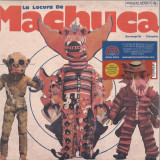
La Locura de Machuca is the story of one man’s bizarre odyssey into Colombia’s coastal music underground, and the wild, hypnotic sounds he helped bring up to the surface.
One night in 1975, a successful tax lawyer named Rafael Machuca had his mind blown in Barranquilla’s ‘Plaza de los Musicos’. Overnight he went from a high ranking position in the Columbian revenue authority to visionary production guru of the newly formed record label that bore his name, Discos Machuca, and for the next six years he devoted his life to releasing some of the strangest, most experimental Afro Psychedelia Cumbias ever produced. La Locura de Machuca is the story of one man’s bizarre odyssey into Colombia’s coastal music underground, and the wild, hypnotic sounds he helped bring up to the surface.
The Colombian music industry was thriving in the mid-seventies, but while homegrown bolero and vallenato tunes were doing well on the charts, it was imported African records that were setting crowds on fire at the picos – the sound-systems that fuelled neighbourhood parties – and wherever those records were played there were always a handful of groups who were inspired to plug traditional Cumbia directly into the electric currents coming from across the Atlantic.
It was these obscure bands, who fused Colombian and African rhythms with the swirling organs and psychedelic guitars of underground rock, that fired Machuca’s imagination. While the label made its money releasing popular hits by legends such as Alejandro Durán and Aníbal Velásquez, that money was poured back into a unique run of experimental releases by fringe artists such as La Banda Africana, King Somalie, Conjunto Barbacoa, and Abelardo Carbono, one of the godfathers of Champeta Criolla.
When Machuca couldn’t find groups to realise his particular vision, he simply created them himself. Drawing on a fearsome roster of musicians associated with the label, he assembled bands that lasted only as long as it took to record an album ,and unleashed the results – complete with arrestingly unusual album covers – under a series of different names such as Samba Negra or El Grupo Folclórico. This unorthodox approach led his longtime recording engineer, Eduardo Dávila, to describes Machuca’s productions as the “B-Movies of Colombian music.”
The story of Doctor Machuca and his eccentric exploits tells of one of Colombia’s most atypical and peculiar record companies; a defining pillar of Afro-Caribbean psychedelia. His productions have come to represent the roots of Champeta and set the pedigree standards for Afro and Costeño avant-garde. The seventeen tracks on La Locura de Machuca, harvested from the darkest, strangest corners of the Discos Machuca catalogue, sound like little else recorded before or since.
In 1978 Pharoah Sanders went into the studio with pianist, Ed Kelly, who was an important figure in the local San Francisco and Oakland jazz scene. The two of them recorded six tracks which ranged from covers of standards, through soul jazz through to two real gems. The album was originally released as Ed Kelly and Friend due to Pharoah being contracted to Arista Records at the time. Indeed, as you can see, the cover shows Kelly playing next to Pharoah’s hat, shoes and Selmer tenor saxophone.
Rainbow Song, a Kelly composition, opens matters in a manner far removed from Pharoah’s work on his Impulse albums (although there had been a dramatic change of course when he signed with Arista and recorded). This is firmly in Grover Washington Junior territory with a liberal sprinkling of oh so tasteful strings. The Master’s sound is full and mighty as ever.
With the radio track out of the way it is business as hoped for and Newborn is a Sanders composition that burns with intensity. The power of his solo is as good as anything he has produced and he runs over the full span of the tenor’s range and onwards into territory lesser known or explored by 99% of sax players.
Sam Cooke’s You Send Me is treated with reverence and respect, with Pharoah delivering a sensitive and heartfelt rendition and ending with some extraordinary phonics, which we will meet again on later albums. Kelly’s accompaniment complements Sander’s playing before he receives his own space for a shimmering yet restrained solo which discloses what this non-pianist assumes to be an agile right hand.
Answer Me My Love is an early 50’s ballad with a fascinating back story. On its initial release in post-war Britain, covers of this fine melody stirred sufficient controversy for the song to be banned by the BBC. What led to it being barred from broadcast on the Light Programme and treated like Anarchy For The UK, Wet Dream and Give Ireland Back To The Irish? I can reveal that the reason for this draconian action was that the original version was entitled ‘Answer Me, My Lord’. In the olden days, it seems that a direct appeal to God was considered to be blasphemous- especially if set in a secular or selfish. Further research indicates that Nat King Cole made the most celebrated recording and that Bob Dylan used to sing it live in the 1990’s, presumably during his overtly Christian phase. Anyway, it is a grand tune.
Pharoah went on to record at least three studio versions of his great anthem You’ve Got To Have Freedom but the one here is the earliest incarnation that I am aware of. It is also the most restrained treatment of the theme, although Pharoah’s solo shows his ability to play with fire and power over the entire range of the horn. There’s plenty of space for Kelly’s piano too and he provides an elegant setting for Sanders’ exploratory work.
ACCEPT ARE BACK! The German kingpins of heavy metal will release their new, eagerly-awaited studio album via Nu- clear Blast on January 15th 2021. The ingenious title of the masterpiece is “Too Mean To Die”.
Speaking of heavy metal kingpins, when ACCEPT first launched at the end of the 70s, the metal genre didn’t even exist - at first the band could only be labelled with the (quality) seal “crazy loud and crazy wild”. Today we know that this was (and is) metal par excellence. And we also know that ACCEPT opened the door to thrash metal, inspiring giants such as Metallica. Guitarist Kirk Hammett recently stated in the German magazine “Gitarre & Bass”: “Wolf Hoffmann has a huge influence on me.“
ACCEPT, who once had their origins in the city of Solingen, a city of sound, have been a worldwide music phenomenon for more than 40 years. They still impress with razor-sharp guitar licks and a steel-hard sound. The band created all-time metal classics like “Balls To The Wall”, “Metal Heart” and many more.
Countless world tours and headline slots at the biggest, cutting-edge festivals cemented the band’s reputation as one of the best, hottest and loudest live acts ever. In addition, the band has sold millions of records, has achieved gold status in the USA, top 10 chart positions worldwide and a number 1 album (Germany, Finland) for “Blind Rage” (2014).
Now with “Too Mean To Die” their 16th studio album is in the starting blocks - it is the fifth album that US vocalist and front man Mark Tornillo has put his incomparable vocal stamp on.Recorded in the world music capital of Nashville (USA), ACCEPT’s music was once again produced by British master producer Andy Sneap, who is responsible for the mix. Sneap, who works for Judas Priest and Megadeth among others, has also been responsible for all ACCEPT productions since 2010.
Special circumstances often lead to very special albums. This is certainly true for “Too Mean To Die”, which of course alludes to the Corona period, although in a different way than one might assume. Hoffmann says: “Its to be expected that many musicians will address the Corona situation in their songs. There will certainly be slogans for cohesion, through which positive vibes should be spread, which is also good. But we have decided to not let ourselves be influenced by it. The fans will get a hard, direct and uncompromising metal album, but of course accompanied with a wink: We are too mean to die! Weeds do not go away! ACCEPT do not let themselves get down!”
Wolf isn’t wrong - the title track is a classic Accept cracker: dynamic and unwavering, turned up to eleven!
Zombie Apocalypse’, also relentless and hard, strikes the same note in the band’s signature style.
The first single - which will be released on October 2nd 2020 together with a remarkable video - is different. Titled ‘The Undertaker’, its a terrific midtempo number with great vocals and a built-in character that chugs along – certain to deliver some mermorable live moments! According to Wolf Hoffmann its one of the most catchy, pleasing pieces of the album.
New to the band, and thus to be heard for the first time on an ACCEPT album, is Philip Shouse (Gene Simmons Band, among others). The US guitarist fights hot duels with Hoffmann, while Uwe Lulis makes the guitar trio perfect and pro- vides the right rhythm. “Phil was part of our orchestra project and was also completely convincing live. We recognised his great talent immediately and simply didn’t let him go,” explains Hoffmann.
Just how varied the ACCEPT guitar trio performs on the new album is proven by one of the secret highlights: ‘The Best Is Yet To Come’ – a beguiling ballad in which Mark Tornillo is at his best. The metal world knows that Mark can scream like no other, but here it shows once again that the frontman can also sing magnificently. “Mark sang this, for us rather unusual song stunningly well. The fantastic thing about Mark is that he not only masters the typical metal screams, but can also sing melodically and beautifully. He proves this impressively in this song”, chief guitarist Hoffmann raves.
In addition, ACCEPT have strengthened their team even further with newcomers Martin Motnik (bass) and Philip Shouse (guitar), thus forming an unbeatable team together with “Drum God” Christopher Williams and “Rhythm Mas- ter” Uwe Lulis.
There’s no doubt that with “Too Mean To Die” Accept are once again playing at the top of the Champions League of the genre. Wolf Hoffmann & Co. present the (music) world eleven masterpieces at the beginning of 2021 - eleven songs for eternity!
- A1: “Hellbound”
- A2: “Goddamn Electric”
- A3: “Yesterday Don’t Mean Shit”
- A4: “You’ve Got To Belong To It”
- A5: “Revolution Is My Name”
- B1: “Death Rattle”
- B2: “We’ll Grind That Axe For A Long Time”
- B3: “Uplift”
- B4: “It Makes Them Disappear”
- B5: “I’ll Cast A Shadow”
- C1: “Avoid The Light”
- C2: “Immortally Insane”
- C3: “Cat Scratch Fever”
- C4: “Hole In The Sky”
- D1: “Electric Funeral”
- D2: “Goddamn Electric” – Radio Mix
- D3: “Revolution Is My Name” – Radio Edit
- D4: “I’ll Cast A Shadow” – Radio Edit
Pantera’s final opus, Reinventing The Steel, represented a recommitment to everything the band loved about heavy metal. Released in 2000 at the peak of nu-metal’s popularity, the album’s back-to-basics approach flew in the face of the trend and served as a potent reminder of the enduring power of primal metal.
Pantera’s 9th and final studio album turns 20 this year and is celebrated with this 2LP set, pressed onto 180g audiophile silver vinyl, featuring the new Terry Date mix on one album, plus eight rare bonus tracks making their vinyl debut on the other.
The album received widespread critical acclaim as well as high praise from fans, who voted the album as Album of The Year 2000 as well as voting the single “Revolution is My Name” Single of The Year 2000. The album also ranked No.2 on Guitar World’s readers’ poll for Top 10 Guitar Albums of 2000.
Gang of Ducks welcomes back Haf Haf, whose Notch ep, released in 2014, helped define the early sound of the label. Pattern of chaos is a journey through 8 heterogeneous tracks, where Haf Haf's unique timbre is the narrative voice.The pleasure of the exploration, finding out new places beyond what we're used to, is the main concept of the record.All the tracks sit on a blurred line. On one hand you feel the echoes of different genres, extracts of voices, samples, that you may be familiar with.On the other hand these tracks take a final shape you're not used to, making each one of them hard to label. Every track feels like observing a planet through a window, which filters the landscape while at the same time reflecting the image to the observer.Pattern of Chaos is a really singular record, which moves energies in a new way."