While fighting through label limbo and placing his budding film career on freeze, Antwan “Big Boi” Patton spent a couple years readying the artillery for his solo close-up. Sir Lucious Left Foot: The Son of Chico Dusty is both a testament to the maturation of Big Boi and a tribute to his late father; underneath, it’s a speakeasy at breakneck speed, sittin’ on 32s. Where many other formidable MCs would be eaten alive, Big Boi shapeshifts across every mood and landscape with his trademark tenacity. He’s an effortless showboat who can portray sleaze with ease, but he’s a true class act who’s got nothing left to prove, yet will never let it show. Flanked by his known co-conspirators and many more, Big Boi blesses the senses the way only an East Point playboy can; it’s an intergenerational time warp, and another funky ride in HD. The final product is a natural progression of his Organized Noize lineage, sent across dimensions to return with an assemblage of time-tested potent Black grooves, then pressure-cooked in the kitchen of the finest booty club in Georgia.
Louis De Roo already knows a thing or two about what life can throw at a person, yet this young Belgian songwriter is still very much on the threshold of a promising international musical career. Fall 2024 sees the release of his debut album ‘Troubled Waters’ as Isaac Roux. His debut and breakthrough single White Rose (which is not on the album) became an alternative hit in Belgium and the Netherlands, with follow-up singles Colours and Autumn Love opening doors in Germany (radioeins), France (Radio Néo) and Austria (FM4) and to trendy streaming playlists. Roux’s combination of warm indie folk and alternative rock works even better on stage, never failing to leave a crowd open-mouthed, like during a live session on German national radio (Deutschlandfunk Kultur). Impressing crowds at the Rock Werchter and Pukkelpop festivals in his home country, he did the same in the Netherlands and Germany (playing Reeperbahn three times), and supporting Dotan on his European tour in places like London, Paris and Vienna. Every song, and the album as a whole, gives the listener a glimpse into the life of De Roo, who hasn’t always had it easy, hoping that his music can give people in similar situations something to hold on to. “To win, to lose, to dream and to hope, they’re just some of the things that have shaped me into the person that I am today”, De Roo says. “And through my stories I hope to provide a little bit of a moral compass for people who, like me, haven’t always been treated nicely by life.”
Mysterious, multifaceted collective i Häxa have unveiled their epic self-titled, full length debut; a ground-breaking conceptual double album shaped by a collision of ancient gods and bleeding-edge technology_ Released as four distinct Parts over the course of the year, `i Häxa' now comes together as a singular vision that weaves together genre-defiant soundscapes, abstract cinema and ancient meteorological mythologies from singer-songwriter and visual artist Rebecca Need-Menear (also of electronic alt-rock duo Anavae) and forward-thinking producer Peter Miles (Architects, Dodie, Fizz). i Häxa is a ritualistic dissection of the world as we know it, a forceful separation of the monotony of modernity from the rites and rituals that for centuries formed the foundations for who we are, how we came to be and where we claim to belong. Disjointed fragments of time collide. Two sides, one of logic and one of chaos, seeking unity and balance through an expression of freedom. This is i Häxa. Whilst the album is composed of four distinct movements, each consisting of four distinct tracks themselves; pulling them apart into easily digestible, standalone singles isn't an easy feat and, as is now clear from the project's sprawling cyclic nature, was never the intention. In an age of fast fun and instant gratification, the ties that bind these works together are intended to transcend tracklisting. With aural, visual and lyrical themes freely intertwining, i Häxa is something to be consumed whole; just as it will, in time, consume you. Charting an existential journey to the very depths of what makes us who we are, with every dark corner illuminated in glitched out, discordant glory; i Häxa is a project years in the making that draws simultaneously from rituals for old gods and the modern day deification of data. i Häxa is both heartwarming and horrifying; i Häxa is ancient history and hyper-real; i Häxa is everybody and no one at all. Check out if you like Radiohead, Julie Christmas, Agnes Obel, Bjork, Fever Ray, Massive Attack, Dead Can Dance, Emma Ruth Rundle, Jenny Hval, Cult of Luna, Eivor, Zola Jesus, Marissa Nadler, Soft Moon
Plastic Crimewave Syndicate returns with one collective foot in overdriven space-biker scuzz rock, but the other bigfoot kicking upward into new galaxies of synth punk, no-prog, and freek funk. Yes, dare we say it, the new PCWS LP, Tales From the Golden Skull, GROOVES--but from the perspective of the Japan n' Kraut/Eurorock undergrounds, coated in some nasty Windy City grime. Aided by the Chicago Cosmonaut Couriers Crew, ala famed renaissance man Mac Blackout (synths/horns/electronics), Przemyslaw Krys Drazek (trumpet) of longtime zone-jammers Drazek Fuscaldo/Mako Sica, Will MacLean on Moog keytar (!-- of local Silver vocoder-ed Apples lovin' treasures Protovulcan), plus the oldest-school synthlord Bil Vermette, who's been modulating since the 70s. We'll call Tales From the Golden Skull a near-concept lp (aren't they always?) that looks back at fallen friends and collaborators, and then into the unwritten golden future (as PCW himself hit the golden 50). The sonic journey dips into dark textural valleys, and chugging riffs rising to thee fiery heavens, as the thundering-but-subtle rhythm section of Jose "Beast but Best" Bernal and Rob "Dead Feathers" Rodak know when to crash and when to burn (one). Sir PCW lays down his trademark big muff-blastage and echo-cries, to channel the despair and feral bark of the mighty Vega/Hammill/Iggy/Dickie P/Haino/Mojo-Risin/Mizutani, but also knows when to shut up for some layered instrumental Embryo/Harvester/Fausty trance rock and dabbed/dubbed out "not-quite-shoegazin" calmness in the eye of the Ur-storm. This might be the most expansive, detailed yet furious PCWS LP yet, recorded at Rec Room studios with Eric Block, who has done all from a band with Sonic Youth's Steve Shelley to recorded Rhys Chatham 100+-peeps guitar orchestras. So strap the headphones on and absorb the tales of this spaced ritual-rock opus. Artwork - Steve Krakow
Repress! There are very few albums across any genre that stand the test of time better than 93 ‘Til Infinity, the classic debut record from the Hieroglyphics crew’s very own Souls of Mischief. In an era where Gangsta Rap and G-Funk dominated the West Coast Rap scene, Souls broke ground on a completely unique and thoroughly west coast sound. While the Dr. Dre’s and the Snoop Doggs were garnering much of the mainstream attention, Souls were quietly forging a charismatic, critically acclaimed, and cohesively shaped record that when categorized, sounded much closer to A Tribe Called Quest than N.W.A. The sound of their debut is characteristic of the distinct style explored by the collective, including a rhyme scheme based on internal rhyme and beats centered around a live bass and obscure jazz and funk samples.
93 ‘Til Infinity was propelled into success by its title track and lead single, which reached #32 on the Billboard Hot 100. It also featured singles “That’s When Ya Lost” and “Never No More” which also reached the Hot Rap Singles. In 1998, the album was selected as one of The Source’s 100 Best Rap Albums of All Time. Considered by many to be a text book “slept-on” classic Rap record, 93 ‘Til Infinity has only grown better with age. The album simply defines the Hiero golden age with a sound that would later be fine tuned with strong releases from MCs Del The Funkee Homosapien, Casual and Pep Love.
It takes some serious bravado to name your album 93 ‘Til Infinity, but certainly the goal of creating a Hip Hop “classic” must have been on the collective minds of group members A-Plus, Tajai, Opio, and Phesto when recording this landmark moment in Hip Hop history. It’s true, even seventeen years after the album’s initial release many people are still discovering it, and with this re-mastered reissue on double vinyl, fans all over the world will once again discover the brilliance that 93 ‘Til Infinity delivers and will continue to deliver beyond infinity.
out of Stock
Last delivered 2 years ago available to reorder, subject to availability
Known for the monolithic force of their music and their inventive production techniques, The Body"s albums are benchmarks in the expansion and evolution of heavy music. Tightly packed with deceptively nuanced arrangements and exhilarating, challenging distortion, their compositions are possessed of an unmistakably singular sound. The Crying Out of Things is no exception; a culmination of all that The Body have done before, highlighting their mastery of dynamic and monumental music that pushes toward the unmistakable sound of oblivion The Body have produced a wealth of groundbreaking collaborations with the likes of Full of Hell, Thou, Uniform, BIG|BRAVE, OAA, and Dis Fig. The duo"s benchmark albums have, over the past 2 decades, changed the perceptions and directions of heavy music. The Crying Out of Things" embrace of noise is a comprehensive display of the multitude of expressions possible with abrasive sound, a skill that The Body have pioneered and refined. "I think for us the key to the way we use noise is, it"s not the only element," says Buford. "You"ve gotta really listen if you"re into noise. But it also has to have dynamics. Where, say, BIG|BRAVE (who have a similar ethos) expresses it in this more intellectual, minimalist way, The Body comes from an instinctual, maximalist way. We"re trying to cover it ALL." The Body stand alone in their ability to connect disparate influences and collaborators into a wholly original, potent and singular work. Alongside producer/engineer Seth Manchester, the duo"s voracious and omnivorous musical appetites have pushed the studio as an instrument into new avenues to conjure profound feelings from the music. The Crying Out of Things cements The Body"s place as a leader of heavy new music, their boundless creativity, their defining ability to convey anguish, created with a visceral clarity to devastating impact.
Known for the monolithic force of their music and their inventive production techniques, The Body"s albums are benchmarks in the expansion and evolution of heavy music. Tightly packed with deceptively nuanced arrangements and exhilarating, challenging distortion, their compositions are possessed of an unmistakably singular sound. The Crying Out of Things is no exception; a culmination of all that The Body have done before, highlighting their mastery of dynamic and monumental music that pushes toward the unmistakable sound of oblivion The Body have produced a wealth of groundbreaking collaborations with the likes of Full of Hell, Thou, Uniform, BIG|BRAVE, OAA, and Dis Fig. The duo"s benchmark albums have, over the past 2 decades, changed the perceptions and directions of heavy music. The Crying Out of Things" embrace of noise is a comprehensive display of the multitude of expressions possible with abrasive sound, a skill that The Body have pioneered and refined. "I think for us the key to the way we use noise is, it"s not the only element," says Buford. "You"ve gotta really listen if you"re into noise. But it also has to have dynamics. Where, say, BIG|BRAVE (who have a similar ethos) expresses it in this more intellectual, minimalist way, The Body comes from an instinctual, maximalist way. We"re trying to cover it ALL." The Body stand alone in their ability to connect disparate influences and collaborators into a wholly original, potent and singular work. Alongside producer/engineer Seth Manchester, the duo"s voracious and omnivorous musical appetites have pushed the studio as an instrument into new avenues to conjure profound feelings from the music. The Crying Out of Things cements The Body"s place as a leader of heavy new music, their boundless creativity, their defining ability to convey anguish, created with a visceral clarity to devastating impact.
Mac DeMarco's breakthrough sophomore album, Salad Days - released on April Fools', 2014 - garnered widespread critical acclaim, landing on over 30 Year End lists. It was the album that catapulted DeMarco from "loveable slacker" to "mature songwriter with a gaptoothed grin," all at the tender age of 23. DeMarco's demos for Salad Days, originally included in an expanded edition of the album only available on Captured Tracks Mail Order site, peel back the curtain of said artist, who, up until then, may have been more known for his raucous live shows than his genuine talent as a songwriter and craftsman. This collection of demos and sketches as well as previously unreleased instrumental demos offer a rare insight into Mac's world and process.
The legendary Lagoa club, a temple of techno in Menin, is celebrating its 34th anniversary in style with the exclusive release of LAGOA TRAX Vol. 1, a vinyl compilation featuring four unreleased tracks composed by four of the club's iconic resident DJs: Manu Kenton, DJ HS, Jamie Dill, and Max Walder. These artists, who have made their mark in Lagoa's history with their memorable performances, pay tribute to the soul and energy of the club through compositions that are true to its unique musical style, known for its powerful beats and dynamic sounds.
This vinyl captures the essence of Lagoa's legendary nights, offering fans four exclusive tracks to once again vibe to the intense rhythm that has shaped the club's reputation.
Le légendaire club Lagoa, temple de la techno à Menin, célèbre son 34ème anniversaire en grande pompe avec la sortie exclusive de LAGOA TRAX Vol. 1, un vinyle regroupant quatre titres inédits, composés par quatre des DJ résidents emblématiques du club : Manu Kenton, DJ HS, Jamie Dill et Max Walder. Ces artistes, qui ont marqué l’histoire de Lagoa avec leurs performances mémorables, rendent hommage à l'âme et à l'énergie du club à travers des compositions fidèles à son style musical unique, reconnu pour ses rythmes puissants et ses sonorités dynamiques.
Ce vinyle capture l'essence des nuits légendaires de Lagoa, offrant aux fans quatre morceaux exclusifs pour vibrer à nouveau sur le rythme intense qui a forge la reputation du club.
out of Stock
Last delivered 3 months ago available to reorder, subject to availability
Matter-of-factly, Lycox exclaims "Yaaahh" right at the beginning. That's an affirmation but in times of distress it can also mean resignation, something like "Yeah, whatever". Lycox says he was only freestyling though. Then the bassline appears. Elastic, expressive, full-bodied. And it's not even present the whole time. He was "trying to develop a new formula for the Kuduro beat."
Songs for the club? Most certainly. Different sensibilities, one same focused mind. Lycox evolves within tradition, he has mastered the groove, the ambience, the right tones. Simply called "Energia", the last track circles above wistfully, menacing but maybe just promising some sort of action. With a few drops one could almost switch over to a parallel universe of old school Trance, a reference that feels as alien here as maybe this track feels to someone for whom the standard Afro House sound represents modern African music.
These songs pile up in a threshold balanced between styles, sensations, maybe in the middle of life itself. Such a concentration of energy is bound to need release and that comes figuratively through details in the music reaching out to receptive ears. "To Bem Loko" explicitly tries to "literally drive everyone crazy on the dancefloor." Once again Lycox provides vocals, as in "Edson no Uige", about a friend who embarked on a trip to the Angolan province of Uige and came back speaking only the local dialect known as lingala. A nod to tradition, very emotional, without compromising complex arrangements. Consequently, we the listeners are kept believing there is still enough space for a bright future. To ears accustomed to Lycox productions the title "Contemporaneo" (opening of side B) reads like a redundancy, then.
Maybe this music can never be quite as massive as other Afro styles. Without sounding pretentious, it avoids simplistic patterns, it demands a bit more mental processing while it certainly aims to loosen the limbs. Universal in vocation, underground at the core, Lycox definitely calls it Batida but for some it is still Ghetto Music. Like DJ Veiga said when describing a previous release for Príncipe, Ghetto is home, though. Lycox adds it is a foundation of personality. "Few in our community will recognize your work when you come from the same environment, but once you establish your reputation outside of the neighbourhood and even outside of the country, people will look at you differently, as if you were a star."
out of Stock
Last delivered 22 months ago available to reorder, subject to availability
Jawad Nawfal and Mazen El Sayed, better known by their stage names of MUNMA and EL RASS, met for the first time in Beirut, during the summer of 2011. A common friend told Jawad wonders about an MC who rapped and slammed in the classical Arabic language, as opposed to the vernacular Lebanese dialect. The two musicians met in a small café in Beirut’s Hamra neighborhood, spoke of music, argued about politics, and decided to collaborate at once. They began working on tracks the following day. A month later, they had already produced a dozen sketches, instrumental beds and accapella vocal tracks. These demos eventually landed in the hands of Ziad Nawfal and Fadi Tabbal, who set out to bring to life the duo’s first recorded album. “Kachf el Mahjoub” (the title is from a Sufi master-work penned some 900 years ago) was eventually released as a limited edition of 500 CD’s, during a launch event at then-budding alternative venue Metro al Madina in Hamra, on the 22nd of February 2012. These CDs went out of print in record time, as can be expected, and the album’s mythical status became reinforced over time – El Rass & Munma collaborated sporadically during the next ten years, but never fully grasped the level of musical intensity and explosive tension attained on this first outing. It has been a longstanding dream of ours, here at Ruptured, to produce a vinyl version of this album, and we are thrilled to say this moment has finally come. Artist ALI RAFEI’s original artworks have been painstakingly reproduced, the music has been dutifully remastered for vinyl by CEDRIK FERMONT, and the records were pressed by our friends at Mother Tongue in Verona. We added bonus track "Fi Kala'at Tarablus" to this 10th anniversary reissue for good measure – recorded during the same sessions that yielded “Kachf el Mahjoub”, it appears on the digital version of the album. “Kachf el Mahjoub” is a landmark album in Lebanon’s alternative music scene, and the MENA region’s hiphop and indie scenes writ large. At the time of their collaboration, El Sayed was a prolific writer and musician, at ease with a variety of instruments, notorious for his masterful flow in the classical Arabic language, with lyrics tackling both social and political sensitive subjects; Nawfal has previously released an impressive number of albums and EPs, exploring downtempo electronica and ambient dubstep, for a number of Lebanese and international labels. The collision of the former’s brazen, slammed vocals and the latter’s harsh beats works wonders on “Kachf el Mahjoub”, Munma’s sound-world perfectly fitting El Rass’s agitated discourse, alternating between broken beats, elaborate percussion, and ambient layers of synths. At times reminiscent of mutant hiphop outfit Shabazz Palaces, at others of the collaboration between dubstep producer Kode9 and the late vocalist The SpaceApe, this album is an uncanny meeting of Arabic hip-hop and electronica, an exceptional event in the realm of contemporary Lebanese alternative music.
out of Stock
Last delivered 23 months ago available to reorder, subject to availability
For number 93 in the Brazil45 series, we present two favourites from the Harmony Cats. A female vocal quintet (who later became a trio) from São Paulo. They formed in 1976 and were most prolific in the disco period.
'Harmony Cats' Theme' from 1976 is probably the group best known track outside of Brazil. Owing a lot to Rhythm Heritage's version of 'Barretta's Theme (Keep Your Eye On The Sparrow)’ it's wonderfully spacey breakbeat and percussive production with lush, floaty vocals makes it a real crossover classic record.
'Seja Como Nos (De Pe No Chao)' is instantly recognisable. Tucked away on the b-side of their 1979 single 'Tem Dinheiro Nisso' on Young Records, it is a beast of a cover version of The Jacksons' classic ' Shake Your Body (Down To The Ground)'. Nothing subtle or sophisticated here. Just a song of pure disco joy, enhanced with awesome Brazilian production and the Cats' trademark vocal arrangements. A get-of-jail-free card for any DJ that finds themselves stuck with an empty dance-floor, but also one that will put smiles on the faces of the more discerning leftfield club crowds.
- Next installment in BRAZIL45 Series.
- Features cover of The Jacksons ‘Shake Your Body (Down To The Ground)’.
- 2 tracks of pure disco joy.
out of Stock
Last delivered 14 months ago available to reorder, subject to availability
2025 marks 50 years since the release of Donna Summer’s debut international hit ‘Love To Love You Baby’. To herald in this milestone anniversary, we proudly present this newly expanded edition of Donna’s classic hits collection “On The Radio”. • This 24 track/2LP collection features the international hits that propelled Donna’s popularity through the decades, from her 1976 UK Singles chart debut up until her 2008 studio album and includes eighteen UK Top 20 hits. • They include ‘Hot Stuff’, ‘Bad Girls’, ‘This Time I Know It's For Real’, ‘Down Deep Inside (Theme From 'The Deep')’, ‘I Remember Yesterday’, ‘Love's Unkind’, the vocal powerhouse track ‘No More Tears (Enough Is Enough)’ with Barbra Streisand and the groundbreaking #1 ‘I Feel Love’. • Donna Summer gained prominence during the disco era of music, rightly earning the title "The Queen of Disco" and becoming one of the most successful recording artists of the 1970s and all-time best-selling female Artists. • She was the first artist to have three consecutive Double Albums hit No. 1 on the US Billboard charts, as well as becoming the first female artist to have four No. 1 singles in a thirteen-month period. • Donna’s catalogue has sold more than 130 million units worldwide and her music is still relevant today, as her music continues to fill the radio airwaves, appears in TV programmes, movies, as well as TV commercials. • In 2023, her daughter, Brooklyn Sudano, who along with Roger Ross Williams, directed “Love To Love You, Donna Summer”, a documentary that followed Donna’s personal life and career. The film had its world premiere at the 73rd Berlin International Film Festival and was screened at SXSW. HBO released it in May 2023. • Earlier this year, Donna was posthumously awarded a Recording Academy Special Merit Lifetime GRAMMY, as well as ‘I Feel Love’ being inducted into the GRAMMY Hall of Fame
a 1. Love To Love You Baby Single Edit
b 2. Could It Be Magic 7" Version
c 3. I Feel Love [Edit]
[f] 6. Love's Unkind [7" Version]
[g] 1. I Love You [Single Version]
[h] 2. Rumour Has It [Single Version]
[i] 3. Last Dance [7" Version]
[j] 4. MacArthur Park [Single Version]
[k] 5. Heaven Knows [7" Version]
[l] 6. Hot Stuff [Single Version]
[m] 1. Bad Girls [Single Version Edit]
[n] 2. Dim All The Lights [7" Single Version]
[o] 3. No More Tears (Enough Is Enough) [7" Version]
[p] 4. On The Radio [7" Version]
[r] 6. State Of Independence [7" Version]
[s] 1. She Works Hard For The Money [7" Version]
[t] 2. Unconditional Love [Edit]
[u] 3. Dinner With Gershwin [Edit]
[v] 4. This Time I Know It's For Real [7" Mix]
[7" Remix]
[PWL 7" Mix]
out of Stock
Last delivered 18 months ago available to reorder, subject to availability
~~~From Mississippi and Olvido Records~~~~~~ Steel-string guitar and vocals by the great Giorgos Katsaros, a mythic figure of Greek rembetiko. Our obsession with underground Greek music continues with 10 ultra-rare recordings of heartbreak and vice from rembetiko legend Giorgos Katsaros. Katsaros, who by some accounts lived to be over 100 years old, carried the old songs of Greece to the Diaspora in the United States, bridging centuries of music in one storied lifetime. Born in 1901 on the Greek island of Amorgos, Katsaros' was enchanted with the songs he picked up as a kid in the streets of Piraeus and Athens. Encouraged by his grandfather, an amateur singer, Katsaros developed a style that mirrored his upbringing - centuries-old Asia Minor songs, island rhythms of his homeland, well-known Athenian songs of the time, and anonymous `rebetiko' songs. Katsaros' songbook was vast, but he was most drawn to the street life and music of the manges of early 20th-century Greece: outcasts who dealt with the indignities of an unstable economy and an inauspicious future with the old standbys: wine, hash, and dancing. These ten tracks are remastered from Katsaros's 64 surviving early recordings, many rarely heard since their original release. Hypnotic melodies plucked over repeating thumbed basslines back his deep, mournful voice. Katsaros brought this nostalgic late-night music to smoke-filled rooms of Greek exiles in Chicago, Philly, and New York, where he emigrated in 1917. He continued to travel the country and play until his music was supplanted by more modern styles in the 1950s. He retired to the town of Tarpon Springs, FL, famous for its Greek sponge fishers, til a late-in-life revival brought him back to Greece for a few massive concerts and national accolades in the 1990s. Like many great artists, Katsaros carefully curated his own mythic backstory over the decades. He sometimes claimed he was born in 1888, making him 109 on his passing, and conflicting accounts of his birth and travels circulate to this day. Greek researchers Stavros Kourousis and Konstantinos Kopanitsanos, who also compiled these tracks, contribute groundbreaking new historical research on Katsaros' life. Lyrics, poetically translated by Tony Klein, further fill in the picture. Clean and rare 78s were remastered by Stereophonic. Katsaros has never sounded better than on this LP, pressed on red vinyl, with extensive notes and lyrics.
Quantum Baby is the second instalment of Tinashe’s BB/ANG3L trilogy following last fall’s first instalment, BB/ANG3L. The album includes the explosive single “Nasty” which is currently rising up the charts and has become the song of the summer amassing over 200M+ global streams. Billboard Hot 100 - #61, Top 5 Rhythm Radio, Spotify Viral US - #1, TikTok Billboard Top 50 - #2. The genre-blending album contains elements of R&B, Pop, Electronic and Hip-Hop. This album features production from Grammy Award Winning producer Ricky Reed, along with Nosaj Thing and more! Tickets are currently on sale for the North American leg of Tinashe’s Match My Freak World Tour, which kicks off October ‘24. The vinyl is housed in a gatefold jacket with printed sleeve and insert booklet. Available in standard black and a limited Indie Exclusive Edition pressed on Blue & Orange Swirl colored vinyl. Quantum Baby is the second instalment in Tinashe’s BB/ANG3L album trilogy. The first in the series, BB/ANG3L, was released Fall ‘23 and was followed by the BB/ANG3L tour and Tinashe’s first Tiny Desk performance. Tinashe began teasing the hit single “Nasty,” this past Spring, debuting the song at Coachella 2024. The song quickly went viral, to become the song of the summer. This led to everyone asking the most prevalent question of the summer: “Is somebody gonna match my freak?” “Quantum Baby is about getting to know me on a deeper level. It's about exploring who I am as a person and who I am as an artist. I’ve never been one to be put into a box, so the name Quantum Baby encompasses all the different parts that make up who I am as a creative,” says Tinashe, describing the album as “forward, hot and lots of bass
The acclaimed trio of Mikkel Ploug, Sissel Vera Pettersen, and Joachim Badenhorst is set to release their fourth studio album, Lento, on November 1, 2024, through the Klein label. Following their celebrated albums 'Equilibrium', 'Walking Voices', and 'Liquid Light', this new release further cements the group’s position as an innovative voice in contemporary music.
Lento offers an evocative blend of jazz, folk/world, classical, minimalism, and avant-garde influences, crafted through a dynamic mixture of free improvisation and original compositions. The trio’s unique synergy is evident in every track, pushing the boundaries of genre while maintaining an intimate and expressive core.
The trio comprises of the Norwegian vocalist and saxophonist Sissel Vera Pettersen, a multifaceted artist known for her collaborations with Chick Corea and Marilyn Mazur, Her contributions to Lento showcase her versatility, moving seamlessly between voice and saxophone with a fluidity that anchors the group’s explorative sound.
On guitar is Danish virtuoso Mikkel Ploug, who is renowned for his work with saxophonist Mark Turner and composer Bent Sørensen, Ploug's playing on Lento is both intricate and expansive. Completing the trio is the Belgian reed player Joachim Badenhorst, whose talents on the clarinet have earned him a spot in Downbeat Magazine’s "Rising Star" polls. Badenhorst is known for his work with Han Bennink Tony Malaby’s, Kris Davis and his own projects Carate Urio Orchestra and Zero Years Kid.
Having garnered praise from critics and fans alike for their previous albums, the trio continues to evolve and captivate. Lento is a testament to their ability to fuse disparate musical elements into a coherent, deeply moving whole. Expect meditative passages, explosive bursts of improvisation, and moments of pure musical dialogue that transcend traditional boundaries.
Just under a year after their acclaimed self-titled debut, dreampop duo deary release a brand new six-track EP – Aurelia – via Sonic Cathedral on November 1. It includes the singles ‘The Moth’, ‘Selene’ and ‘The Drift’ and features Slowdive drummer Simon Scott playing on three songs. It will be available on three different vinyl variants, a CD with three bonus tracks and digitally. It’s a stunning record, which displays a new-found maturity in terms of production as well as musically and lyrically. The band – singer Rebecca ‘Dottie’ Cockram and guitarist/producer Ben Easton – have had to grow up in public since the release of their debut single at the start of 2023, supporting legends such as Slowdive and Cranes and TikTok sensations like Wisp along the way. An aurelian is a rare old term for a lepidopterist – someone who studies and collects moths – derived from the Latin aurelia, meaning chrysalis. The perfect title for an EP which is based around the theme of metamorphosis and change. “It leans on the natural world, the human body, the earth and sky as well as human emotion,” says Ben of how the EP represents physical and metaphysical growth. “Change can be daunting but equally exciting, which is something we’ve come to learn.” “While writing the EP, I found a letter I had written to myself when I was 22,” adds Dottie. “I was fresh out of university and had moved back in with my parents as Covid was in full force. I was uninspired and lost and reaching out to my future self for some hope. It was a physical representation of what can happen in a few years; how much can change and how you never know what’s coming next. “I found it interesting that – at the age of 26 – here I was looking back to my younger self for hope or just some comfort in the fact that things will and do move on. It was important to me to bring both of these versions of myself into the new songs.” “Personally, I had noticed a change in myself; a new level of social anxiety, a strange disassociation to things that once brought me joy as well as negative repetitions in my daily life,” reveals Ben. “I began the year sober which allowed me to finish the writing process as a letter of care to my own mental health. There are motifs throughout the EP – for example the riffs in ‘The Moth’ and ‘The Drift’ being reminiscent of each other – which are like musical reflections of these repeated cycles.” It’s musically where the change deary have undergone is most obvious. ‘The Moth’ mixes howling guitars atop a strident breakbeat making it more Curve than Cocteaus; ‘Selene’ is a slow-building wall of noise; ‘The Drift’ combines a perfect pop melody with an incredible sense of urgency. These three singles are balanced by the brief but beautiful ‘Where You Are’ which leads into the Portishead-style trip-hop of ‘Dream Of Me’. The title track has been a staple of their live sets for about a year as ‘Can’t Sleep Tonight’, but its mix of The Cure circa Disintegration and Mezzanine Massive Attack has grown and evolved so much that they renamed it ‘Aurelia’ as the embodiment of the change they have been through. “We’ve allowed deary to naturally grow over the past year, we didn’t want to force it to take a certain shape or sound,” explains Dottie of the duo’s slow and steady approach. “A lot of the last EP was written by sending ideas back and forth over WhatsApp, but this time we were able to sit in the same room and I think that really shows. We know each other a lot better now as we have experienced this journey together and that benefits the writing process as we are more open with each other and can be vulnerable.” “Aurelia definitely feels a lot more collaborative, more personal and more fully realised than the first EP,” concludes Ben. “It feels like a real document of what has been a very important time in both of our lives. Ironically, the band has changed and matured even more since the recording, so we’re both excited to document the next stage
On How It Ends (?), slinky melodies snake through nocturnal atmospherics, drawing you into a world built on poetic, painterly lyricism. Night Crickets, a long-distance groove affair that materialized during the drawn-out days of lockdown, has emerged once again to soundtrack our waking dreams.
David J (Bauhaus, Love & Rockets), Victor DeLorenzo (Violent Femmes) and multi-instrumentalist Darwin Meiners spearhead a loose collective of like-minded creative souls whom, through sheer tenacity and a burning desire to collaborate and create, transcend the restrictions of space and time. Audio files shared from Los Angeles to Milwaukee, from London to the San Francisco Bay, and the ghosts of Candlestick Park shimmer through the fog, coalescing in a glorious ‘gesamtkunstwerk’ that draws from the past, the present and the imagined future.
Declaring Bauhaus, Love And Rockets, and Violent Femmes iconic, foundational bands in the history of alternative music would receive little pushback from those in the know. San Francisco born artist Darwin Meiners is a fan of all three. A chance meeting with David J grew into a friendship, and Darwin not only became a bandmate, but his manager. After reaching out to Victor DeLorenzo through e-mail, Darwin met the Violent Femmes drummer after their set at Coachella. Soon, after the three collaborated on Darwin’s 2014 release Souvenir.
As the pandemic took hold, Darwin was looking for a new project to occupy the lock down time and approached Victor, who was keen to proceed and suggested that David join as well. The musical trust established between these three was immediate and Night Crickets were born. Within weeks a global process was initiated between them, the recordings eventually forming the album, A Free Society.
Following that release, inspired by how well – and quickly – they all worked together, the trio kept up their collaboration. “We are each free to discover musical connections that could only exist in an ideal creative setting” explains Victor. “We are very lucky to have three musicians who write, sing and play various instruments in one trio… our egos seem to melt into one when we face musical decisions, so our expeditions are always filled with pure discovery, humor and drive!”
How It Ends (?) was crafted with the same collaborative spirit as A Free Society. Each member contributed contributed unique elements to spur their collective creativity—whether a drum pattern, a lyrical concept, or a musical idea—and together, they expanded these initial sparks into the finished work. True to their approach, much of what you hear was captured in the first take, reflecting a genuine, unfiltered moment.
The music on the How It Ends (?) is a true evolution of the debut album. It is deeper and darker. Having said that, the dark tone is alleviated by a healthy measure of the buoyant, bouncy and melodic. “Much of the new material is very psychedelic and the contrast between this heavy, dark psychedelia and the more uplifting pop elements puts me in mind of The Beatles’ ‘Revolver’ album to some degree,” tells David J. “The recording process for the new album was exactly the same as the first in that we all recorded remotely, taking turns to share files and reacting spontaneously to the previous track, overdubbing then passing on once again until we all felt that the track was done.”
“While we didn’t start with a specific theme, the album emerged as a contemplative exploration of endings” says Darwin. “It touches on the loss of individuals, the shifting of ideas, and the fragility of systems. Beneath this sense of darkness and finality, however, there are threads of beauty and glimpses of hope. We invite you to immerse yourself in the album and experience the journey we’ve embarked upon.”
In the age of streaming platforms and social media, stimulation is easy to come by. Real pleasure, however_the kind that feeds our soul rather than draining it_is in shockingly short supply. The second LP by THUS LOVE is full of that kind of nourishing euphoria. It swoons, shakes, and swaggers with a combination of grit and sensuality that's been hard to locate in music lately. It's called, fittingly, All Pleasure. The album came out of a period of dizzying growth and transformation for the group. When they began work on it, vocalist/guitarist Echo Mars and drummer Lu Racine were still reeling from the runaway success of their 2022 debut Memorial_a set of lush, elegant post-punk that brought praise from The FADER, the NME, and the Guardian_along with processing the departure of the founding bassist. With All Pleasure, the band re-formed with new bassist Ally Juleen and guitarist/keyboardist Shane Blank. The group convened in a barn in the woods that Mars had transformed into a recording studio, and kept one rule at the forefront: "If it's not joyful, don't do it." What emerged from that mission is a stunningly gorgeous album, full of big, arcing melodies and a range of kinky stylistic twists that will surprise listeners who know the group just for Memorial's chorus-drenched 80s-style psychedelia. "Birthday Song" gives grungy glam rock with a transcendent hook that underlines Echo's lyrical tribute to communal joy. "Get Stable" transmutes existential panic into sharp-angled punk pop. The anthemic title track is something like the album's mission statement, paying tribute to the power of joyful creation. Mixed by Matthew Hall and Rich Costey and mastered by Bob Weston, All Pleasure was recorded as live as possible, capturing the sheer infectious ecstasy that comes from sharing space together and making a divine racket. Put on All Pleasure, tap into the energy that THUS LOVE is putting out, and you just might find an escape.
Camelot, the legendary seat of King Arthur's court in Early Middle Ages Britain, was probably not a real place. A corruption of the name of a real Romano-Briton city, the word "Camelot" accumulated symbolic, mythic resonances over centuries, until achieving its present usage as a near-synonym of "utopia." In the mid-20th century alone, Camelot inspired an explosion of representations and appropriations, among them the violent, affectless Arthurian court of Robert Bresson's 1974 film Lancelot du Lac and the absurdist iteration of Monty Python's 1975 Holy Grail, both of which feature armored knights erupting into fountains of blood; the mystical Welsh world of novelist John Cowper Powys's profoundly weird 1951 novel Porius, with its Roman cults, wizards and witches, and wanton giants; and the nationalist nostalgia of President John F. Kennedy's White House. Unsurprisingly there are fewer Camelots in more recent memory. Camelot, Canadian songwriter Jennifer Castle's extraordinary, moving 2024 chronicle of the artist in early middle age, charts a realer, more rooted, and more metaphorical place than the fabled Camelot of the Early Middle Ages (or its myriad depictions), but it too is a space more psychic than physical. In Castle's Camelot, the fantastic interpenetrates the mundane, and the Grail, if there is one, distills everyday experience into art and art into faith, subliming terrestrial concerns into sublime celestial prayers to Mother Nature, and to the unfolding process of perfecting imperfection in one's own nature. Co-produced by Jennifer and longtime collaborator Jeff McMurrich, her seventh record is at once her most monumental and unguarded to date, demonstrating a mastery of rendering her verse and melodies alike with crisply poignant economy. For all their pointedly plainspoken lyrical detail and exhilarating full-band musical flourishes, these songs sound inevitable, eternal as morning devotions. "Back in Camelot," she sings on the lilting, vulnerable title track, "I really learned a lot / circles in the crops and / sky-high geometry." The album opens with a candid admission of sleeping "in the unfinished basement," an embarrassing joke that comes true. But the dreamer is redeemed by dreaming, setting sail in her airborne bed above "sirens and desert deities." If she questions her own agency_whether she is "wishing stones were standing" or just "pissing in the wind"_it does not diminish the ineffable existential jolt of such signs and wonders. This abiding tension between belief and doubt, magic and pragmatism, self and other, sacred and profane, and even, arguably, paganism and monotheism, suffuses these ten songs, which limn an interior landscape shot through with sunstriped shadows of "multi-felt dimensions" both mystical and quotidian. The epic scale and transport of "Camelot," with its swooning strings, gives way dramatically to "Some Friends," an acoustic-guitar-and-vocals meditation in miniature on Janus-faced friends and the lunar and solar temperatures of their promises_"bright and beaming verses" versus hot curses_which recalls her minimalist last album, 2020's achingly intimate Monarch Season. (In a symmetrical sequencing gesture, the penultimate track, the incantatory "Earthsong," bookends the central six with a similarly spare solo performance and coiled chord progression, this time an ambiguous appeal to _ a wounded lover? a wounded saint? our wounded planet?) Those whom "Trust" accuses of treacherous oaths spit through "gilded and golden tooth"_cynics, critics, hypocrites, gurus, scientists, doctors, lovers, government, the so-called entertainment industry_sow uncertainty that can infect the artist, as in "Louis": "What's that dance / and can it be done? What's that song / and can it be sung?" Answering affirmatively are "Lucky #8," an irrepressible ode to dancing as a bulwark against the "tidal pools of pain" and the "theory of collapse," and "Full Moon in Leo," which finds the narrator dancing around the house with a broom, wearing nothing but her underwear and "big hair." But the central question remains: who can we trust, and at what cost faith, in art or angels or otherwise? Castle's confidence in her collaborators is the cornerstone of Camelot. Carl Didur (piano and keys), Evan Cartwright (drums and percussion), and steadfast sideman Mike Smith (bass) comprise a rhythm section of exquisite delicacy and depth. This fundamental trio anchors the airiness of regular backing vocalists Victoria Cheong and Isla Craig and frames the guitars of Castle, McMurrich, and Paul Mortimer (and on "Lucky #8," special guest Cass McCombs). Reprising his decennial role on Castle's beloved 2014 Pink City, Owen Pallett arranged the strings for Estonia's FAMES Skopje Studio Orchestra. On the ravishing country-soul ballad "Blowing Kisses"_Pallett's crowning achievement here, which can be heard in its entirety in the penultimate episode of the third season of FX's The Bear_Jennifer contemplates time and presence, love and prayer_and how songwriting and poetry both manifest and limit all four dimensions: "No words to fumble with / I'm not a beggar to language any longer." Such rare moments of speechlessness_"I'm so fucking honoured," she bluntly proclaims_suggest a state "only a god could come up with." (If Camelot affirms Castle as one of the great song-poets of her generation, she is not immune to the despairing linguistic beggary that plagues all writers.) Camelot evinces a thoroughgoing faith not only in the natural world_including human bodies, which can, miraculously, dance and swim and bleed and embrace and birth_but also in our interpretations of and interventions in it: the "charts and diagrams" of "Lucky #8," a daydreamt billboard on Fairfax Ave. in LA in "Full Moon in Leo," the bloody invocations of the organ-stained "Mary Miracle," and all manner of water worship, rivers in particular. (Notably, Jennifer has worked as a farmer and a doula.) The album ends with "Fractal Canyon"'s repeated, exalted insistence that she's "not alone here." But where is here? The word "utopia" itself constitutes a pun, indicating in its ambiguous first syllable both the Greek "eutopia," or "good-place"_the facet most remembered today_and "outopia," or "no-place," a negative, impossible geography of the mind. Utopia, like its metonym Camelot, is imaginary. Or as fellow Canadian songwriter Neil Young once sang, "Everyone knows this is nowhere." "Can you see how I'd be tempted," Castle asks out of nowhere, held in the mystery, "to pretend I'm not alone and let the memory bend?"
Anadol and Marie Klock have teamed up for a joint album, La Grande Accumulation. They met two years ago at a festival in England crowded with violent seagulls and outsider musicians. Klock being prone to barking on stage and Anadol not laughing at jokes she doesn’t find funny, they straight away had the intuition that they would meet again. And so they did, a few months later, at Anadol’s studio in Istanbul.
Today, the two Pingipung artists present the fruit of this musical friendship. La Grande Accumulation was born out of the peculiar atmosphere of the studio neighbourhood in Büyükada, an island where thousands of cats run free and humans randomly destroy things during apocalyptic times when parts of Turkey had just been turned into dust by terrible earthquakes. The French lyrics are inspired by hours of conversations, the music is consequently drenched in absurdity, overflowing with a strong urge to live and enjoy. According to the LP sticker, this album has been certified “Best handshake of 2024”, and stickers never lie.
La Grande Accumulation brings together Marie Klock's mysterious metaphors and Anadol's intriguing radiophonic psych-pop. Stretching forms beyond common sense to see how long they can resist is probably their favourite game. The result are six highly imaginative tracks that challenge the sub-3-minutes standards of Spotify pop.
Gözen Atila aka Anadol is well known to the Pingipung audience, with three solo LPs on the label. Her music follows a kind of collage logic, she interweaves countless styles, combining field and studio recordings with obscure quotation marks here and there. "I hope no one will come and explain this music to me, because it's the most beautiful music there is", says Kristoffer Cornils about her solo album Felicita.
Marie Klock is a French writer and musician who produces songs oscillating between synthpop and neo-folk, full of anarchic humour and existential dread. Her recent solo LP on Pingipung was a captivating tribute to the recently deceased poet Damien Schultz entitled Damien est vivant.
Marie Klock delivers her lyrics in song or spoken word, stream-of-consciousness musings on strange human adventures, and her rich keyboard melodies culminate in a nonchalant dialogue with the bass trombone (La Reine des Bordels). In the opulent opening piece (La Grande Accumulation), a woman is cursed to take home everything she kicks in the street; a bit later, we stumble upon a ghoul hiding in the gutter (Sirop amer), Mona Lisa loses her teeth (Sonate au Jambon) and a warthog struggles to climb the stairs of a silver tower (Sabots triviaux).
La Grande Accumulation was mixed and mastered by Jonas Romann at Chaos Compressor Club in Hamburg and cut to vinyl by Kassian Troyer at D&M in Berlin. It's an audiophile LP that invites to focus on every detail in this heap of musical ideas.
out of Stock
Last delivered 21 months ago available to reorder, subject to availability
Robert Glasper’s holiday album In December was released last year as an Apple Music exclusive. We’re now able offer it widely available to physical retail and all DSPs!
Is there anything to be done with carols like “God Rest Ye Merry Gentlemen” and “Joy to the World” that hasn’t been done in the past 300 years? If there is, Grammy-winning pianist, composer, and producer Robert Glasper is the kind of artist to do it. “I like covering songs that people know well,” Glasper tells Apple Music. “That’s what I’ve done throughout my whole career.” It’s true: As a jazz pianist, he’s obviously learned his way around making classics his own, whether they were written by Mongo Santamaría or Kurt Cobain. But, he says, “The biggest challenge in making a holiday album was trying to do it in a way that feels festive but at the same time feels real and not corny.”
He succeeds on both fronts on In December, his holiday album that mixes classic carols with a set of originals, and which was recorded in Spatial Audio. Part of what keeps it credible is the fact that Glasper’s hiphop/R&B/jazz fusion is done on a compositional level instead of just a cosmetic one (no collages of sampled sax solos and drum loops here). The covers reveal a lot about his musical worldview: Sung by Tony winner Cynthia Erivo (The Color Purple), “God Rest Ye Merry Gentlemen” is turned into dark, airy neo-soul, while “Joy to the World”—sung by Alex Isley—feels like a Stevie Wonder ballad. But the originals reveal even more. “The intention for this album was less about Christmas songs and more about songs that feel good during the holidays,” Glasper says. “I stayed away from thinking too much about Christmas and its traditional lingo, and concentrated on real things people go through during the holiday season.”
The 2015 edition of Winnipeg’s send + receive festival, focussed on rhythm, turned out to be a generative meeting of minds. There, Mark Fell encountered the music of Will Guthrie, a meeting that was eventually to result in the frenetic acoustic drumkit and digital synthesis pairing heard on Infoldings and Diffractions (2020). At the same festival, Limpe Fuchs first heard and appreciated the music of Mark Fell, planting the seed of a collaboration that came to fruition when Fell (along with his son Rian Treanor) visited Fuchs at her home in Peterskirchen, Germany in September 2022. Black Truffle is pleased to announce the release of the results of this extensive session in the audacious form of a triple LP, housing over two hours of music across its six sides. The collaboration might appear unlikely: what common ground could exist between Fuchs, classically trained pianist, legend of improvised music, instrument builder and sound sculptor active since the 1960s, whose group Anima Sound connected the dots between free jazz, krautrock and ritual, and Fell, proponent of radical computer music, known for his bracingly austere productions that twist remnants of club music into algorithmic stutters? For all their seeming disparity in technology, approach and background, the music on Dessogia/Queetch/Fauch makes it immediately evident the pair share a great deal in their essentially percussive approach and ability to, in Fuch’s phrase, ‘establish silence’. Recording at her home studio, Fuchs had the use of her entire array of instruments, found, invented, and traditional, and treats the listener to some that don’t often make their way to concerts, including extensive passages performed (with Gundis Stalleicher) on pieces of wooden parquetry. Alongside metallic, wooden and skin percussion of all kinds, sounded and struck in every conceivable way, we also hear bamboo flute, viola, and Fuchs’ distinctive free-form vocalisations. Fell also stretched himself, with his contributions ranging from characteristically fizzing pitched percussive pops to swarms of sliding tones and abstract digital noise. Showing both remarkable restraint and improvisational freedom, much of the music consists of duets between a single percussion instrument and a distinctive mode of digital sound, often lingering in one timbral-rhythmic space for minutes at a time. Improvisational forward momentum coexists with a free-floating, wandering quality. On opener ‘Dessogia I’, the shimmering almost-gilssandi tones of Fuchs’ enormous set of microtonally tuned metal tubes ripples across Fell’s rubbery pulse, which moves up the frequency spectrum as Fuchs becomes more animated and switches to horn. At some points, as on the metallic chiming tones that open ‘Fauch I’, only the unexpected dynamic behaviour of Fell’s sounds distinguish them from Fuchs’ acoustic instruments. At others, like on ‘Queetch III’, the waves of sliding tones and noise textures are bracingly synthetic, joined by piercing squeaks and scrapes from Fuchs’ metal objects. Epic in scope, immersing the listener in an entirely distinctive world of sounds, and thrillingly bold in its melding of the most ancient musical procedures with cutting edge technologies, Dessogia/Queetch/Fauch is an unexpected major statement from two of the great mavericks of contemporary music.
"Good Lovelies are proud to reissue their holiday classic EVERGREEN just in time for the upcoming holiday season. Originally released in 2019, this fifth anniversary limited edition of 500 has been pressed on beautiful peppermint green vinyl.
Caroline Brooks, Kerri Ough and Susan Passmore are a trio of songwriters, multi-instrumentalists, and gorgeous harmonizers known for their nostalgic sound during the holidays that crosses between folk-roots, old-time swing, soul and bluegrass. ""Evergreen"" includes three original songs that the band have added to the Christmas canon alongside their versions of songs like ""Little Saint Nick"", ""Christmas (Baby Please Come Home)"" and ""(Everybody’s Waiting For) The Man with the Bag"" to really get you in the mood for the season ahead.
The band’s annual Christmas tour hits the road again this December, bringing classic holiday songs, timeless winter selections, and original Good Lovelies material to the stage. A Good Lovelies holiday show is a guaranteed good time for the whole family.
“...while most festive albums are best experienced during the correct season, when it comes to the amazing talents of the Good Lovelies, the rule book can be tossed out.” - GREAT DARK WONDER -
“Some of the most gorgeous Christmas harmonies you’ll ever hear on an album jammed full of warmth and good cheer. Featuring a mix of fun favorites, lesser-heard gems and three truly fine originals, the trio strikes the perfect blend of smiles and sentiment...” - BOB MERSEREAU
Good Lovelies first came together in 2006 and have since recorded thirteen albums, including two Christmas collections. They have toured extensively across North America, Europe, the UK, and Australia, and have earned such accolades as a JUNO Award, a SOCAN #1 Single award, and four Canadian Folk Music Awards. Their latest album “We Will Never Be the Same” is in stores now."
When Your Old Droog first entered the Hip-Hop scene a decade ago, he was cloaked in anonymity. The Ukraine-born, Brooklyn bred rap phenomenon was known solely for his sharp, punchy lyrics wrapped in a gruff delivery. He finally came into the light with his eponymous debut release, the catalyst for what has become a prolific career. Since then, Droog has crystallized his place in hip-hop as the erudite rapper who can tackle any beat with precision; a product of the underground, yet designed for the mainstream. With his new project Movie, YOD is in a new era, where his days of being the dark horse in rap are over. He has countless co-signs from some of the greatest to ever touch a mic, and now he’s finally geared to join them. “Movie is everything that's dope about me,” Droog explains. “Every song, every mood. This is my story.” A layered masterpiece, the album features appearances by Method Man, and Denzel Curry, plus production by industry stalwarts like Just Blaze, Harry Fraud, Conductor Williams, and the legendary Madlib.
Kenner von Richard Swift wissen, dass sein Katalog umfangreich und phantasievoll ist, vollgepackt mit ebenso vielen ausgefeilten, eiskalten Klassikern wie verrückten Ein-Take-Experimenten. Diese Kleinode kommen in allen Formen und Größen, und während das den Eingefleischten nichts ausmacht, ist der Einstieg in die Musik von Swift für den Neuling schwierig: Wo soll man anfangen? Was kommt in die engere Wahl? Wie viele Crooner? Wie viele wilde Lieder? Vor diesem Hintergrund präsentiert Secretly Canadian "4 Hits & A Miss - The Essential Richard Swift", einen bescheidenen Versuch, die siebenundvierzig Minuten und vierzehn Songs zusammenzutragen, die die Uneingeweihten einführen können. Wenn Sie Richard Swift nicht kennen, lassen Sie sich von dem unvergleichlichen Kevin Morby aufklären: "Es gibt einen alten Pfadfindermythos, von dem ich als Kind gehört habe, dass man eine Kapelle bauen kann, wenn man die richtige Person mitten in den Wald setzt, bewaffnet nur mit einem Schweizer Taschenmesser. Wenn ich an diesen Mythos zurückdenke, denke ich an Richard Swift, der, wenn man ihn mitten im Wald mit einem 10-Dollar-Radio-Shack-Mikrofon absetzte, irgendwie ein Studio bauen konnte und in diesem Studio eine Kapelle des Klangs errichtete. Tatsächlich hat er genau das in seinem eigenen National Freedom Studio mitten in den Wäldern von Oregon getan, in einer Stadt namens Cottage Grove, wo er unzählige Stunden seiner eigenen Musik und der anderer Leute aufgenommen hat. Diese Kapellen des Klangs werden - und ich habe es bereits erlebt - kommende Generationen in Ehrfurcht versetzen und inspirieren, so wie es die Steinkapellen im frühen Europa tun. Beide lassen die Menschen verblüfft zurück und fragen sich: Wie konnte etwas so Massives und Schönes mit so minimalen und archaischen Mitteln gebaut werden - und in Richards Fall so schnell? Nach ihrem Tod scheinen die meisten Künstler endgültig zu ruhen, ihre Kataloge ruhen für immer neben ihnen. Aber Richard scheint aus dem Jenseits rastlos zu sein, und die Arbeit, die er hier unten auf der Erde begonnen hat, geht weiter. Sein letztes Album, The Hex, wurde nur wenige Monate nach seinem frühen Tod im Jahr 2018 veröffentlicht, und jetzt haben wir mit 4 Hits and A Miss eine Sammlung seiner beliebtesten Songs sowie einen neuen, noch nie zuvor gehörten Track "Common Law", aufgenommen um 2012. Ob Gelegenheitsfan oder Swift-Purist, 4 Hits & A Miss ist entweder ein perfekter Startpunkt oder ein Ziel für uns eingefleischte Fans, um wieder einmal etwas Neues zu finden, das uns beeindruckt und inspiriert. Wie ein versteckter Raum in seiner bereits beeindruckenden Kapelle gibt es immer etwas Neues von unserem geliebten Freund und Helden, dem verstorbenen großen Richard Swift, zu entdecken." Viel Spaß!
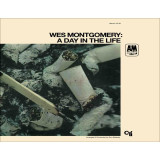
A Day in the Life' was released in 1967 and reached #1 on the Billboard Jazz Albums chart.
From the early 1960s to the late '80s, A&M was one of the most eclectic and powerful independent record labels in the world. The roster of artists who recorded there includes The Carpenters, Captain Beefheart, The Police, Joe Cocker, Suzanne Vega, Procol Harum and Janet Jackson, among others. Founded as an independent company by Herb Alpert and Jerry Moss in 1962, soon the label garnered interest and success, and was acquired by PolyGram in 1989. Throughout its operations, A&M housed well-known acts such as Sting, Sergio Mendes, Supertramp, Bryan Adams, Burt Bacharach, Liza Minnelli, Paul Williams, Quincy Jones, Cat Stevens, Peter Frampton, Carole King, Extreme, Joan Baez, the Human League, Soundgarden, Duffy, and Sheryl Crow, among others. Reissue of the debut album on A&M Records by jazz guitarist Wes Montgomery, released in 1967. It reached #1 on the Billboard Jazz album chart and #2 on the R&B chart. Considered by far the best of his three albums on A&M (in partnership with Creed Taylor’s CTI Records), A Day in the Life features a plethora of star sidemen, such as Herbie Hancock, Ron Carter, Ray Barretto and Grady Tate, among others, as well as superb arrangements by Don Sebesky.
Alternative Jazz. This is a 5 track EP of brand new, previously unreleased material from The Near Jazz Experience (Terry Edwards, Mark Bedford and Simon Charterton). Whilst recording the new album Terry asked pianist Mike Garson (best known for his work with David Bowie, Nine Inch Nails, Smashing Pumpkins) - whom Terry has toured with if he'd like to play on a track. Mike said yes, recorded a stupendous solo for Character Actor at his home studio and sent it over. All in the space of 24 hours! On hearing the piano part NJE bassist Mark Bedford came up with the idea of having the piano mixed with the original track (as intended) but also using it as the basis for a completely new recording with the piano leading rather than complementing the band. Side 1 of the EP has these two very different versions from the same seed. Unidentical twins indeed. Side 2 of the EP contains 4 outliers from the album sessions. These aren't out-takes or unfinished pieces. They simply couldn't find a place for themselves within the album - along the lines of the tunes Tom Waits put together for his Orphans compilation of 2006. They are standalone tunes which have found a home together on this EP because in some way they all have filmic qualities. Side 1 contains 2 takes on Character Actor (the title being a nod to Cracked Actor, a tune on Aladdin Sane, the album that introduced Bowie fans to Mike Garson), and Side 2 has The Loping Four; Projector; MacGuffin and Lockstep, all titles which contain strong cinematic elements, MacGuffin in particular. It was Alfred Hitchcock's favourite word for a red herring in the plot. The musical cast on this release has a remarkable pedigree. The NJE consists of Terry Edwards (solo artist and session player with PJ Harvey, Franz Ferdinand, Siouxsie, Jimi Tenor, Piroshka, Tindersticks etc); Mark Bedford (Madness, Robert Wyatt, Robyn Hitchcock, Nightingales etc); Simon Charterton (The Higsons, Alex Harvey, Zook, Serious Drinking etc). Alongside featured guest Mike Garson there is an appearance by Oliver Cherer (Aircooled, Miki Berenyi Band) on keys and synth. This is an RSD exclusive, 500 copies on black vinyl in full colour sleeve which reflects the filmic quality of the recorded material. No download. The title track will appear on the next Near Jazz Experience studio album. The 4 additional tracks, however, will remain exclusive to Record Store Day.
Sly Dunbar and Robbie Shakespeare or Sly and Robbie as they are affectionately known are the drum and bass backbone of Reggae Music, they have played on, produced, invented, reinvented more records then many of their contemporaries put together.
Sly Dunbar born Lowell Charles Dunbar on 10 May 1952, Kingston, Jamaica, drummed his first session for Mr Lee Perry which included a Jamaican hit ,a track called 'Night Doctor', before moving on to the group Skin, Flesh & Bones who had a residency at Kingston's famous 'Tit for Tat' club. This band would evolve into the Channel One house band The Revolutionaries where Sly named after his fondness of the band Sly and the Family Stone would begin to play alongside a bass player who would become his long standing partner in music, namely one Robbie Shakespeare.
Robbie Shakespeare born 27 September 1953, Kingston, Jamaica, had worked his way through session bands including the legendary Aggrovators before uniting with Sly Dunbar in The Revolutionaries. Both musicians had worked with other respective bass / drum players including such figures as Lloyd Parks bass, Carlton 'Santa' Davis drums, but everything seemed to fall into place when they worked together.
They also both had a quest to push the boundaries of reggae music, which they would do throughout their careers, over many sessions to numerous to mention. But highlights would include the groundbreaking Mighty Diamonds 1976 set 'Right Time' with its fresh rockers rhythms which lead the way in the 1970's. Also their work with the bands Culture and Black Uhuru the later of which they toured extensively with, spreading the reggae vibes across Europe and America. Not to forget to mention their Taxi label / productions which are always inventitive whether its in the reggae field or outside where their playing / production skills are much in demand.
The third piece of this jigsaw is the mighty Mr Bunny 'Striker' Lee who brought these legends together. Born Edward O'Sullivan Lee 23 August 1941, he must be one of reggae's most underrated producers. Leading the way in the 1970's especially in the dub field and being one of the early exponents of a King Tubby remix ,which would see nearly all his 7'' releases carrying a Tubby reworking on its flip side. Bunny started his musical career in 1962 working for Duke Reid's Treasure Isle label and soon moved into the world of production gaining his first hit in 1967 with 'Musical Field' by Roy Shirley for the WIRL label. The 1970's was a very productive time for Bunny Lee and saw the launch of his LEE'S label which was producing hits in Jamaica. Not having a studio of his own and renting studio time from the existing establishments like Randy's Studio 17 and Channel One he had to have a crack team of session players to carry out this task, fast and efficiently. This happened firstly under the guise of THE AGGROVATORS see The Aggrovators dubbing it studio 1 style JRCD005 and then with the group of musicians THE REVOLUTIONARIES[ see The Revolutionaries at Channel 1 dub plate specials JRCDOO3]. It’s here in the latter of these groups that Bunny matched Sly and Robbie together for the first time and it’s this match made in heaven that these tracks on this release are culled from. Sessions that Bunny Lee produced with Sly and Robbie during this magical 70's period. These rare dubs are taken from the original master tapes, you may have heard the tune before but not these versions. So sit back and enjoy Reggae Musical History in the making....
out of Stock
Last delivered 23 months ago available to reorder, subject to availability
Robert Sotelo is a bedroom pop songsmith who lives in Glasgow. Sotelo has released six albums since 2017, three of which came out on Upset The Rhythm. He also performs in Order of the Toad, Dancer and Nightshift. Mary Currie is best known as half of touchstone DIY experimentalists Flaming Tunes, alongside Gareth Williams (of This Heat). Currie also performed in Officer! with Mick Hobbs amongst others.
Introduced via a mutual friend, Sotelo approached Currie last year about collaborating on four songs he was constructing with producer/electronic guru Joe Howe. This resulted in the ‘Dream Songs’ 7” EP (out October 4th on Upset The Rhythm).
Not only does the title capture the hazy, reflective nature of the music it also expounds on the origin of tracks. Sotelo experienced several lucid dreams in the first half of 2023 that left him in a state of confusion. He recalled visiting parts of London vividly, including a disused theatre of great familiarity, yet it slowly transpired that these places and circumstances were not real, much to Sotelo's disbelief.
These reveries informed the lyrical narrative of the four songs from the forthcoming EP. Currie took a similar approach with her lyrics, focusing on memory and time for her passages on the record. Currie recorded her parts in London (assisted by her good friend Alison Craig) and then sent them to Howe, alongside additional location recordings to consolidate into the mixes. These four tracks flutter with a minimalist bass, drum machine and keys dynamic, allowing Sotelo and Currie’s vocals to speak deeply into the back of your mind. ‘Expectations’ is a pensive triumph of whirled moments and momentum with Currie’s final words lending much gravity “the outcome of my days is always the same, a void that must be filled, a battle against time that drags us along; mutating, spinning, ebbing, flowing. Begin again, we work to give value to time.” ‘Telegraph Hill’ boasts a glossy fluidity, as it plays with images of motorways, ancient citadels, crows, paralysis and emanations. ‘Lady Fortune’ meanwhile is a tranquil treatise on fate, imbued with finessed electronic embellishments and clarinet flourishes. You can't quite trust where these songs will take you, they feel particularly mercurial. Dreams indeed.
‘Dream Songs’ by Robert Sotelo & Mary Currie will be released on October 4th, followed by some live performances from the band. These will include the aforementioned EP tracks, as well as recreated cuts from the Flaming Tunes era, leaning into happenstance rather aptly.
out of Stock
Last delivered 23 months ago available to reorder, subject to availability
Scott Gilmore’s Volume 01, an Analog Synth Gem, Makes Its Vinyl Debut - Pressed at 45RPM for maximum fidelity.
Recorded on a vintage Tascam 388, the LP version of Gilmore’s alluring, easy-going instrumental electronic record arrives in the physical world via In Sheep’s Clothing Hi-Fi Records.
Los Angeles, CA — When the Los Angeles electronic musician and multi-instrumentalist Scott Gilmore recalls the creation of the songs on Volume 01, he describes specific moments of spontaneous inspiration. “I remember sitting at the tape deck, watching the leaves outside the window as they flittered in the sunlight—a moment of stillness that became intertwined with the melody I was recording,” Gilmore recalls, speaking of the track “Song For Cate.”
This sense of simplicity and presence is at the heart of Volume 01, which was recorded entirely on a Tascam 388 using a carefully curated selection of instruments.
Volume 01, an intimate, instinctual album that mixes lo-fi digital rhythms, strummed guitar, and melodic synth layers, is a collection of songs that captures Gilmore’s magnetic fluidity and the spontaneity of his process. Initially released digitally and as a limited edition cassette, Volume 01 is set to be issued on vinyl for the first time by In Sheep’s Clothing Hi-Fi.
The Tascam 388 is a classic mid-1980s analog machine that combines an 8-track reel-to-reel tape recorder with a built-in mixing console. Volume 01 exudes the kind of hazy, nostalgic warmth that only such recorders can provide. For the nine-song album, Gilmore harnessed analog synths including the Arp Odyssey, Yamaha CS-01, Korg DW-8000, Hohner Pianet T, Roland TR 606, and Roland SH 101, as well as bamboo alto saxophone, clarinet, electric guitar, and electric bass.
The album is awash in brief, propellant pieces. At just over four minutes, the relatively epic “Horizon Line” is driven by a three-note snare pattern, a two-note cymbal tap, with a humble bass-line serving as the rudder; Gilmore’s improvised keyboard runs move with an intuitive, conversational glee. The pensive "Shade" sounds like it could be a Penguin Cafe Orchestra demo. Closing track “D. Hareem” runs on a wobbly time signature but with an insistent, determined rhythm that belies genre descriptives. “I prefer to not know what I’m making as I compose,” Gilmore says. “It’s when I can’t clearly define what the music is that it’s then something that I want to put out into the world.”
In hindsight, Volume 01 was a portent. After its 2016 cassette release, Gilmore connected with International Feel, the Balearic imprint run by Marc Barrot, to release the sublime Subtle Vertigo. In 2019, Gilmore’s music caught the attention of Marc Hollander, the experimental composer and founding member of Aksak Maboul, which led to a signing with the Belgian label Crammed Discs. That deal enabled the creation of Gilmore’s solo album Two Roomed Motel and Doctor Fluorescent, a retro-futuristic, Vocoder-heavy 2020 collaboration with Eddie Ruscha V, a.k.a. Secret Circuit). Across these projects, Gilmore’s work has been mentioned in the same sentences as Stereolab, Arthur Russell, Woo, Air, R. Stevie Moore, and others, all of whom have combined synths and non-synths to memorable effect.
With the upcoming vinyl release, Volume 01 will set into wax an enduring set of works, offering listeners the chance to experience analog artistry in its most authentic, tangible form. In Sheep’s Clothing Records is honored to bring Gilmore’s work to vinyl.
You Are The Morning was formed amid personal upheaval in 2021. "I came out as trans to my nearest and dearest," she says, "Some did not accept me, but some did." Jasmine got divorced, and a difficult home life meant she was writing while experiencing homelessness and precarious housing, sleeping on friend's couches and relying on community support. Despite the pain of some of its background, the record is an uplifting look at t4t love. Jasmine describes her first trans romance as the first time she experienced joy in a deep sense, because of her experience of living as a woman. First single `Skin on Skin' explores the new joy of physical touch. Usually a quick writer, it's a rare song that grew over time, during which a close connection with a friend began to form. "Sticking to the physical boundaries we wanted to have with each other became increasingly difficult. We were spending lots of time together, then falling in love. This song became a celebration of healing and physical catharsis found through unrepressed queer love." The first UK signee on Saddest Factory Records, the album was produced by Julien Baker, Phoebe Bridgers and Lucy Dacus. Jasmine and her band travelled to L.A. to record at Sound City Studios. It was made across 12 days in a highly collaborative and emotional process, and because Jasmine sees her songs as fluid and ever-changing, the recordings carry that free and spontaneous spirit. jasmine.4.t is supported by an all-trans band, Phoenix Rousiamanis contributes piano and strings, with Eden O'Brien on drums and Emily Abbott on bass. With Jasmine's voice and songwriting at the centre, the record incorporates a wider cast of voices. `Best Friend's House' features a chorus including her bandmates, Julien Baker, Phoebe Bridgers and Lucy Dacus ("the girls and the boys"), Saddest Factory Records label-mate Claud, Becca Mancari and E.R. Fightmaster. The song carries the communal spirit of the record's creation. On the closing track, `Woman', she is backed by the Trans Chorus of Los Angeles, a cross-generational group of trans singers who, like Jasmine, use their voice as a source of communal power. The song blossoms from solo performance to wider group catharsis. All the while, Jasmine sings unwaveringly about the power of knowing yourself at a core level: "I am, in my soul, a woman". The writing of You Are The Morning pulled from dark moments to tell its story. Surrounded by friends, the recording process was full of light. Through her performances, activism and artistry, jasmine.4.t is ushering in a new dawn.
Diving deeper into the story of Japanese reggae pop, Tokyo Riddim Vol. 2 explores an electronic, new wave and often experimental sound unlike anything Japan or Jamaica had ever heard before.
The first time Ryuichi Sakamoto left Japan, he did not go to the United States or Europe - he went to Jamaica. It was 1978, YMO were about to release their debut album, but Sakamoto was in Kingston, invited to play synths for Japanese idol singer Teresa Noda at Dynamic Sound Studios in a band alongside Neville Hinds and none other than Rita Marley. It’s not a story many know, but one which would spark Sakamoto’s fascination with dub and mark a new chapter in the ongoing Japanese love affair with reggae.
The Teresa Noda tracks they cut - ‘Tropical Love’ and ‘Yellow Moon’ - bookend this second volume of Time Capsule’s Tokyo Riddim compilation, which tells the wider story of how a fascination with Jamrock swept Japan, adding a dash of lime to that sweet city pop sound, embracing a globalised musical palette and creating a whole new genre in the process.
For some, like Sakamoto, a diversion into reggae was part of broader fascination with new sounds and styles, tipped into the global disco of homage and appropriation that made Japanese music of the late ‘70s and early ‘80s some of the most creative and undefinable in the world.
You had iconic shape-shifter Yosui Inoue, who toyed with reggae, afro-beat and electro-Balearic, (and whose For Life Records released several tracks on this comp), and Kay Ishiguro, who enlisted J-reggae originator Pecker on the ambitious Stevie Wonder-esque ‘Red Drip’.
Then there were the Compass Point devotees - producers and musicians alike who were enthralled by the sound of the Bahamas studio and drew on the detached cool of Grace Jones - as heard in the music of Juicy Fruits, and the disco noir of Casablanca-signed femme fatale Yuki Nakayamate. Sometimes, as was the case with Risa Minami, the J-reggae influence said more about Japan than it did about Jamaica.
But where Tokyo Riddim Vol. 1 focused on the city pop sound, this compilation goes further, digging out the more experimental collaborations and hybrids exemplified by Tomoko Aran, who in working with Yusuaki Shimizu and Mariah emphasised just how far reggae had travelled to be recast into something entirely new on the other side of the world.
Perhaps more than anything, in connecting the dots between Tokyo and Kingston, between Jamaica and Japan, the Japanese reggae was building a musical language that existed outside of the paradigms of US and European cultural hegemony - an encounter shaped by commerce, capital and creativity that is now being recognised more broadly for the first time.
out of Stock
Last delivered 16 months ago available to reorder, subject to availability
“Friends, they are my ticket out of this place I am in… feels like nothing more than a dirt bike vacation stop between Phoenix and San Diego.” Dirt Bike Vacation—for Worried Songs Records—explores the sonic world of the late amateur guitar player, Charles ‘Poppy Bob’ Walker, through a captivating set of instrumental songs made in the mid-1980s. Recorded on a single-track, Marantz field recorder, the project is a transportive document of Walker’s days spent as a meatpacking employee in Yuma, Arizona and the dailiness of that existence: driving to work, sitting in his backyard, walking around drunkenly, unwinding on the couch with a friend. These sketches, showing an experimental tendency, are surprisingly ahead of their time; some exhibit ad hoc tape delay (“Granite Bluffs,” “Goodbye YMCA”), while others make use of primitive overdubbing (“Continuation to Moon Doctor”). Not dissimilar to works such as Bruce Langhorne’s The Hired Hand soundtrack, Walker’s guitar playing is melodic, texturally rich and beautifully sober. On a musical tour from Nashville to Los Angeles, musician-archivist, Cameron Knowler, uncovered these songs from a series of dusty cassette tapes housed at a branch of the Yuma County Library. Originally tipped off by cryptic metadata entries found through an online finding aid, Knowler requested a sound sample and was immediately drawn in by their eerie, yet hopeful nature: “I didn’t care what they sounded like at first, but once I heard just a few seconds, I had to find out everything I could about Charles, who he was, and if he was still alive.” As it turns out, the two had miraculously crossed paths over 20 years prior when Cameron was a young boy accompanying his mother, a gem trader, on a biyearly sojourn to Quartzsite, a town 80 miles north of Yuma: “Charles, sitting down and smoking in a recliner, withdrawn, held what I now understand to be a mid-1990s Martin D-28 guitar. Unlike other old-timers, his instrument was sharply tuned and had a nice sound, even to my young and uncalibrated ears. Though his left hand showed signs of highly developed arthritis, his musical ideas were animated by a palpably deep understanding of fretboard anatomy, arrangement and harmony.” Sorting through the index cards associated with these tapes, Knowler was able to gain a detailed sense of most recording’s provenance, whereabouts and time: Walker’s Datsun pickup truck chugging along boiling hot Interstate 80, the Marine Corps Air Station parking lot, the Eastern Wetlands on the banks of the Colorado River, a fishing trip to Martinez Lake. Trying to reduce the amount of his own subjectivities coloring the work, Cameron constructed titles and track sequences by borrowing information gleaned from Charles’ handwritten notes: “I tried to organize everything by time of day, giving the listener the sense of how a Yuma day might sound and feel like, and each song title—even the record itself—is borrowed from his own words.” This proved no small task, as many notecards had to be deciphered and then coupled with their native tapes which needed extensive restoration treatments. The result is a project very much out of the blue, and one that is intensely personal to Knowler, having grown up in the same town under similar circumstances. “It feels like a part of my own journey as a guitarist reckoning with the defining marks of a gothic border town,” he remarks. “At the time I would’ve met Walker, I didn’t have much outside influence, but he has been in there all the while.” In their current form, the tracks combine to create a sonic journey that boldly contributes to the traditions of acoustic guitar soli, archival digs and field recordings all the same; most importantly, it is a creative document which shows a day-in-the-life of a man grappling with the human experience under a ubiquitous Yuma sun.
Strange Power!, the fifth record from Durham, NC-based songwriter and poet Anne Malin Ringwalt, emerges from the darkest waters of the self into a world remade. Releasing in conjunction with her second book of poetry, What Floods (Inside the Castle, Oct. 2024), Strange Power! overflows with Ringwalt's teeming and sensuous personal symbolry: glowing lilacs and gentle queens, dolphins wild and girls who grew up brave _ T.S. Eliot sung by Cat Power, backed by Mount Eerie. She sings: "I rose up from water." Ringwalt writes and performs with the authority of a lifetime spent harnessing the alchemy of storytelling; her belief in the power of words to heal and transform is palpable in each achingly- delivered lyric. Made amidst profound inner and outer change, Strange Power! also sees Ringwalt taking up the role of self-producer for the first time, mirroring and supporting the record's Orphic quest by gathering contributions from a coterie of friends wielding an electric range of American instruments. Violins, vibraphones, drum machines, electric guitars dappled with spring reverb, wind-blown shells, and a host of other numinous sounds form an unfurling and shadowy world which was then carefully honed during the mixing process (shepherded by Michael Cormier-O'Leary and Lucas Knapp) _ settling the final record in an eerie meridian between spareness and verdancy. The result is a beguiling and darkly blooming realm: the sound of a personal cosmos being remade, piece by piece. Ringwalt is at the height of her spirit as both songwriter-poet and singer, her willowy voice by turns conjuring and keening as she reckons with her deep past and the stories told since. Opening track "The Pines" sets the stage for a record of truly life-long scope: "I was a child, now I hold her / I was asleep for many years." Some songs, like the gorgeous "North Carolina" and "The Saint," were written as early as 2013 but, Ringwalt says, "insisted upon being remembered" as the record took shape; in its final form, they serve as inciting moments of self-discovery before the journey to come. "The Visionary" recalls one of Ringwalt's earliest musical breakthroughs _ her re-rendering of an Emily Brontë poem into a song at age 15 _ and, she says, "`cites' the melody of that song in the context of this new one _ a holding of the past and present and every layer in between/beyond, in utter solitude _ a solitude that reflects certain aspects of abandon as a child and an adult..." This unusually lengthy time-scale lends Strange Power! a deeply moving sense of narrative fullness. Stretches of the record _ particularly the "Judgment Day" ? "River" ? "Lilac Bloom" trifecta that form the black heart of Side 1 _ may recall familiar wanderings of personal underworlds such as Mount Eerie's Lost Wisdom Pt. 2 or Neil Young's Ditch Trilogy. Yet this hollowed landscape is in turn exorcized by the a capella "I Know," in which Ringwalt sings "I won't be gutted by you / For giving and trying to heal / I won't be gutted, I am not a fool / I deserve a love that is new" before the song concludes with a piano passage that recalls hymnal music _ suggesting a faith in life itself to offer new beginnings. Side 2 features some of Ringwalt's most powerfully introspective writing to date, as the songwriter casts off myth after myth in her search for personal transformation. By the final song, "Stories," the energy that has been gathering all throughout the record breaks loose as Ringwalt reflects: "I wrote so many stories, not knowing what the end was." But at this stage in the journey, we know there is no such thing as an ending; if the healing process is never complete, the storyteller's strange power is what finally offers liberation.
Somehow, 15 years has passed since I worked on A Colour For Autumn.
This recording was, in many ways, a critical one for me. In some respects, it rounded out a period of work that was focused on a particular marriage of thematics and harmony. Like For Varying Degrees Of Winter, it dwelled on old world impressions of the seasons, something that, in the southern hemisphere, isn’t intrinsically part of our way of approaching place. I think it was this incongruity with my own lived experience that kick started the interest in making these recordings.
The intention had originally been to take Vivaldi head-on , as the holder of the Four Seasons terrain (I jest of course), but shortly after completing this album, it became resoundingly clear that even in the old world, seasonality was a thing that was known ‘then’, and unknowable ‘now’.
Climate change, as a lived experience and not merely as a ‘possibility’, suddenly came into focus with reports flooding in about the climatic dynamics since the turn of the century and events like the Black Saturday fires here in Australia. It felt like, and continues to feel like, seasonality as some predictable measure of our world is relegated to the ‘before’ times. This record is not about these climatic shifts however, more a recognition of how we have used patterns and predictability to guide us over the centuries and perhaps a realisation that the way forward is not the path we have known historically.
Listening back to the record with fresh ears, a process made completely delightful by Stephan Mathieu who has carefully remastered it, I am struck by how minimal some of the structures were. There are moments that strike me as uncharacteristically patient and even generous, allowing one element to hold without interference. I’m grateful to still feel a deep connection to this edition and to the people and places that helped shape it.
I hope you find some sense of your place here. It’s offered with that intention and invitation.
Charlie Parker had a complicated relationship with his hometown of Kansas City, MO owing both to its history of racial segregation and to his strong ties to his family and friends there. This new set of rare recordings dating from 1941–1951 — most of them never having been heard before and some never even having been known to exist — chronicle Bird’s evolution from a blossoming soloist with the Jay McShann Band into a brilliant improviser who dominated the jazz landscape for decades to come. In addition to two unreleased 78s with the McShann band, this set offers two sets of private recordings (at the home of Bird’s friend Phil Baxter and at Vic Damon’s studio) made with local musicians and a very relaxed-sounding Parker who has the room to really stretch out and show us the shape of jazz that was to come in his wake.
Luther Dickinson, 10-time Grammy nominated North Mississippi All Star, joins up with noted Bay Area mensch David Katznelson to chase the spirits and get weird. World Boogie is Coming! This is the debut project from Luther Dickinson and David Katznelson, who famously signed The Flaming Lips. It also features the last known audio of Jim Dickinson and is limited to 400 foil stamped numbered vinyl copies.
After working within various collectives, rapper Davodka is celebrating his ten-year solo career with the album "Heritage." With a myriad of concerts in France and Europe, 6 solo albums, and features with the entire French independent rap scene (Demi Portion, Melan, Dooz Kawa, 3ème Œil, Swift Guad...), Davodka is known for his incisive words and the speed of his flow, making him one of the leading lyricists.
This new album is the heritage of the past ten years, where the artist takes a step back and captures the universe in which he has evolved, paying homage to it through music. The rapper's lyrics have never been more personal. He addresses rarely discussed topics in rap, such as his depression in the track "Arc en ciel," his relationship with his autistic child in "Enfant bulle," and his awareness of the difficulty in having completely selfless relationships as an artist in "On naît seul, on meurt seul."
"Heritage" attests to Davodka's undeniable place in conscious rap, notably with the track "Avec des mots," where he shares the mic with Sinik, an emblematic artist of the golden age of French rap. Although Sinik, a French artist with countless certifications, had announced the end of his career two years earlier, he makes an exception for Davodka and records a powerful track in homage to all those who come from the bottom.
Davodka, true to himself and his audience, primarily raps over boom bap and trap beats; however, he ventures into unknown territories, notably in "On naît seul, on meurt seul," where he adopts a ragga flow, and "Feuille froissée," with its auto-tuned chorus. He also takes the time to pay homage to the beginning of his career, when he was part of the MSD collective, by reprising a verse written at the time in the track "Les minots dorment – Remix."
Join him on October 25, 2024, to discover "Heritage," Davodka's 7th album. He will be touring throughout France, Switzerland, and Belgium, and in Paris at the Cabaret Sauvage on December 5, 2024, for the release party.
Something About Livingis an album of live recordings by experimental jazz composer/multi-instrumentalist Robert Stillman. The music was captured over the course of Stillman's time as the solo support act for The Smile (Thom Yorke, Jonny Greenwood, Tom Skinner). The album weaves excerpts from various theater and arena shows along the tour's North American routing into a seamless whole, creating a 40-minute program that represents an expanded version of Stillman's ever-transforming live set.
Something About Livingis the product of a steady, on-stage evolution that happened over the course of the nearly 60 shows opening for the Smile across the EU, UK, US, Canada and Mexico. However, the creative origins of the set began in relative isolation during the pandemic, through Stillman's work on projects like his multi-media installationUnseen Forcesand his monthly broadcast for Margate Radio, both of which drew upon solo improvisation using saxophone, cassettes, Yamaha DX7 synthesizer, and effects.
"At the time The Smile asked whether I'd like to open for them on their first tour, I felt like I'd already been preparing without really knowing it," says Stillman. "I'd been doing this music constantly, but always for a hypothetical audience" During the pandemic, Stillman's solo set-up served as the research lab where he worked on all the concepts he was interested in: solo improvisation, creating and manipulating cassettes, FM synthesis, analogue delays chains, no-input mixing, and non-metric rhythmic pulses. So when he was offered the first Smile tour, the idea was to bring "the lab" onto the stage.
What Stillman could not have prepared for was the experience of playing in venues with capacities of up to ten thousand listeners. "The first tour was in summer 2022, so not that long after the worst of the pandemic, when I had pretty much made peace with the idea that I might never be able to perform for an audience again. Then all of a sudden I found myself in front of huge numbers of people, and felt the massive responsibility of being with an audience, of this thing I'd done alone for so longactually being witnessed, and it was completely overwhelming!" On the flip-side, Stillman also recalls, was a new appreciation of how powerful the live performance was as a social phenomenon. "It's a cliche, but also true: the moment of making and hearing music in a shared time and space has a very specific meaning and power; there was a sense that everyone in the venue was necessary to make it real, regardless of what they were doing, or how they felt about it. There was an inevitability about it that I'd never fully appreciated."
Over the course of the tours that followed, Stillman transformed this appreciation of the shared moment into an ethic of spontaneity that guided the development of his live set. "An important reference for this set has always been an Animal Collective show I saw when I first moved to New York, probably in 2001 or so, that has always set the high-water mark for what I wanted to do live- they were improvising a lot, and out of what would seem to be absolute chaos they'd find their way to something structured, and then back out again into the unknown. It was so thrilling to witness".
ThoughSomething About Livingcompiles recordings from different dates along the tour, Stillman has edited and mixed them into a work that seeks to reflect the ebb and flow between 'chaos and control' that characterizes his live set. Among the compositions featured are some from previous album releases ("Time of Waves", "What I Owe", "What Does it Mean to Be American") as well as some new compositions ("The Dream of Waking", "Renaissance 2.0," and the title track, "Something About Living").
The album/track title "Something About Living" is a reference to a line from Stillman's favorite film,My Dinner With André: "André Gregory is explaining the value of life experiences that, as he says, are'to do with living'.That really struck me, the way he articulated it. I strongly believe live music situations can ask these kinds of questions, for performers and audiences. I hope that's reflected in this music."
[a] 01: Time of Waves (Live in Miami FL) [Live]
[b] 02: What Does It Mean to Be American (Live in Forest Hills NY) [Live]
[c] 03: The Dream of Waking (Live in St Augustine FL) [Live]
[d] 04: Something About Living (Live in Richmond VA) [Live]
[e] 05: What I Owe (Live in Chesterfield MO) [Live]
[f] 06: Renaissance 2.0 (Live in Chesterfield MO) [Live]


![El Rass & Munma - Kachf el Mahjoub / Unveiling the Hidden [10th Anniversary Reissue]](https://www.deejay.de/images/l/7/0/997770.jpg)