The classic debut LP by Dub Narcotic Sound System, originally released on K Records and unavailable on vinyl for 25 years. The oddball indie-funk collective Dub Narcotic Sound System was spearheaded by vocalist Calvin Johnson, the former frontman of the legendary Beat Happening as well as the founder of the famed K Records label. Named in honor of Johnson's own Olympia, WA-based basement studio Dub Narcotic, the project was begun in 1994 with a rapid-fire series of funk-, rap-, and reggae-influenced singles including "Bite," "Fuck Shit Up," "Booty Run," and "Shake-a-Puddin'"; from the outset Johnson was the group's sole constant member, although over the course of subsequent releases, including the EPs Industrial Breakdown, Ridin' Shotgun, and Ship to Shore, the revolving lineup grew to include Olympia scenesters like Lois Maffeo as well as Larry Butler, Todd Ranslow, and Brian Weber, all three members of the hip-hop unit Dead Presidents. The first Dub Narcotic Sound System full-length, Rhythm Record, Vol. One: Echoes From the Scene Control Room, appeared in 1995; later efforts included 1996's Boot Party and 1998's Out of Your Mind. Sideways Soul, a collaboration with Jon Spencer Blues Explosion, followed in 1999. Trouser Press wrote that "when not delving deep into the usual sorts of ambient studio trickery, the songs hit a '60s R&B stride, bathing in the stoned soul picnic ambience with uplifting spirit."
Suche:u s test
The latest thrilling incarnation of master rock'n'roll storyteller Tex Perkins (The Cruel Sea, Beasts of Bourbon, Thug, Tex Deadly and the Dum Dums, Tex, Don et Charlie.) and the Fat Rubber Band began with a rare vinyl copy of Link Wray's Beans and Fatback album, recorded in 1971. Perkins and his respected musician, songwriter, producer and bandmate Matt Walker share a mutual admiration of the American electric guitar innovator, whose iconic power chords in his signature 50s rock'n'roll instrumentals, had a profound influence on the evolution of rock guitar. The Fat Rubber Band is borned with this rare vinyl, the pair have enjoyed countless musical conversations over the decade while hanging out backstage and on the road. Walker offered the debut album's opening track, the wide-screen drama of "Pay The Devil's Due". Perkins responded with the plaintive blues of "My Philosophy". Walker replied with the album's fuzz driven debut single "Danger Has Been Kind" and Perkins countered with the glacially-paced, intimate "Poor Simple Minded Fool". The pair road-tested their works in progress as a duo before enlisting bassist Steve Hadley, drummer Roger Bergodaz and Evan Richards on percussion to complete the Fat Rubber Band line-up to record the album's ten tracks at Walker's Stovepipe Studios in Victoria's Dandenong Ranges. "At Matt's studio - you open the door to the studio and nature floods in," Perkins says. "We wanted it to sound rural, to feel the dirt and the grass and the leaves." Even after all these decades, when you think you know that gravelly baritone inside out, Perkins finds new emotional tones in the service of the Fat Rubber Band's songs vivid narratives, with their characters wrestling, but sometimes dancing, with the tougher, darker qualities of the human condition. This is truly existential blues. Bubbling underneath those upfront vocals and raw harmonies are intricately entwined guitar conversations and unexpected percussive flourishes. "Another aspect that we wanted was for the sound to be sometimes a collision and sometimes a marriage of acoustic and electric instruments. We wanted that tension between mandolins and bouzoukis meeting fuzz guitars." "We also considered percussion to be a vital element of the sound we were going for; we noticed in the recordings we loved from the 50s and 60s that often the tambourine hit, or the maracas, or whatever percussion, was right up there in the mix, right next to the vocal," Perkins says.
Miles Davis Kind of Blue meets Analogue Productions' UHQR, the pinnacle of high-quality vinyl!
Best-selling album in jazz history; mastered from the original master tapes by Bernie Grundman
Pressed at Quality Record Pressings using Clarity Vinyl® on a manual Finebilt press
Purest possible pressing and most visually stunning presentation and packaging!
Dream team of Davis, Adderley, Coltrane, Evans, Kelly, Chambers, Cobb make history.
Legends have a way of sticking around. If there was ever an album awaiting a high-fidelity, custom-pressed vinyl treatment of the level you now hold in your hands, it is Miles Davis' Kind of Blue. The top-selling jazz album of all time, it has been lauded, entered into "Best Of" lists and Halls of Fame, and universally acknowledged as a landmark recording — a five-track masterpiece of melancholy mood and melody.
It continues to be one of the most listened-to and studied recordings of all time, a required primer for many young musicians, and one of the most transcendent pieces of music ever recorded. Davis played trumpet sublime with his ensemble sextet featuring pianist Bill Evans, drummer Jimmy Cobb, bassist Paul Chambers, and saxophonists John Coltrane and Julian "Cannonball" Adderley with Wyton Kelly playing piano on "Freddy the Freeloader."
Now Analogue Productions, together with Quality Record Pressings, is putting Kind of Blue where it belongs: the Ultra High Quality Record (UHQR) pressed on Clarity Vinyl on a manual Finebilt press with attention paid to every single detail of every single record.
The 200-gram records will feature the same flat profile that helped to make the original UHQR so desirable. From the lead-in groove to the run-out groove, there is no pitch to the profile, allowing the customer's stylus to play truly perpendicular to the grooves from edge to center. Clarity Vinyl allows for the purest possible pressing and the most visually stunning presentation. Every UHQR will be hand inspected upon pressing completion, and only the truly flawless will be allowed to go to market. Each UHQR will be packaged in a deluxe box and will include a booklet detailing the entire process of making a UHQR along with a hand-signed certificate of inspection. This will be a truly deluxe, collectible product.
Kind of Blue is more than Miles Davis's most enduring recording, it's a testament to Miles' experimental approach, drastically simplifying modern jazz by returning to melody unlike the chord complexity more often heard at the time. "The music has gotten thick," Davis complained in a 1958 interview for The Jazz Review. "... There will be fewer chords but infinite possibilities as to what to do with them." Kind of Blue is, in a sense, all melody — and atmosphere.
None of the musicians had played any of the tunes before heading into the first of two recording sessions in early spring of 1959. In fact Miles had written out the settings for most of them only a few hours before the session. Miles also stuck to his old recording procedure of having virtually no rehearsal and only one take for each tune.
Miles remained proud of the album, performing at least two of its tracks — "So What" and "All Blues" — for years after, until his musical path took him in a different direction.
History was on the side of Kind of Blue; it was born in 1959, at the peak of the golden age of high-fidelity, featuring innovations in studio equipment (magnetic tape, high-quality condenser microphones), matched by advancements in home audio reproduction (long-player records — LPs; high-end turntables, and other stereo components). Kind of Blue also benefited from Miles' being signed to the leading major record company of the day — Columbia Records, a part of the CBS media conglomerate. Columbia had the means and wisdom to invest in cutting edge recording technology, and their own professional recording studio.
A minor audio complication with Kind of Blue has been addressed with this UHQR edition. The motor on the studio's 3-track master recorder was running slowly the day of the album's first session. This speed issue affected the album's first three tracks, "So What," "Freddie Freeloader" and "Blue in Green," making them a barely perceptible quarter-tone sharp. Before now, it was only addressed in 1995 for the Classic Records edition and by Columbia Records — or their latter-day parent, Sony Music — on a CD reissue in the late '90s.
Sixty years have passed; this LP bridges that time span in the best way possible, struck from the master reel of Kind of Blue, free of speed issues and replete with all the instrumental detail, sonic environment and minimal noise. As we set out to make our UHQR series the world's best-sounding vinyl records, we have also used Clarity Vinyl, which is free of any carbon black pigment which might introduce surface noise. All-in-all this edition of Kind of Blue meets the highest audiophile standards and offers the truest sound for the most enjoyment.
The second release in January to celebrate the 25th anniversary of Frank de Groodts career as a recording artist is a re-press of his legendary Sonar Bases 4 10 double 12 . Exactly 21 years ago, in January 1997, Frank elevated to electro stardom with this astonishing combination of dark electronica and electro beats.
Frank at the time lived just outside the city of Amersfoort, which is where he was born and lives again these days, some 30 minutes northwest of Utrecht. His first ever release in January 1994 was a techno EP on U-TRAX, as Pieces of a Pensive State of Mind. Later that year, he released his first 12"-es on Djax records as The Optic Crux, and he continued to keep making up artists names in the following 25 years, like Fastgraph and The Operator. He is also one half of the live outfit Random XS (together with DJ Zero One), collaborated with Arno Peeters (a.k.a. Spasms) as Urban Electro and with Detroit's Dennis Richardson as Ultradyne. And that s not even all of his alter egos.
The sound of these eight unique tracks called for a new moniker back in the nineties: Sonar Base (ironically misspelled on the original release as Sonar Bass). All track on this re-press have been remastered for maximum impact. The double vinyl goodness kicks off with Earth Probe, that very subtly creeps towards us, before it kicks in with a rather obese bassdrum. As if Frank wanted to ease his listeners into his then new sound, this track basically is in techno/acid style, but has the slower tempo that characterizes the rest of the electro tracks of this release.
Immediately following, is the unrivaled beauty of Welcome To Sonar Base #4, a track that slowly builds up before it takes us on a deep space journey at two thirds. The 11 minute Sonar Base #5 has been a DJ favorite for 21 years, reaching out to both electro and techno lovers, while Sonar Base #6 is the type of ultra-pure electro that really puts your woofers to the test.
Arrival At Dwell Probe is another one of our favorites, with superfine beats, desolate voice samples and deep and moody synths. Very musical, truly a top piece that will leave you totally unprepared for Blunted. This track has the rolling type of hiphop-style beats that mix well with LL Cool J's Mama Said Knock You Out, but of course has the space-station atmosphere that makes it unmistakably a Sonar Base track.
The fast pace and merciless beats of Intergalactic Anecdote rush us to the finale: Sonar Base #10, a worthy closing track, with deep bassdrum patterns and melancholic strings that also please fans of broken beats. It stops and goes and keeps demanding your attention, making you wanting to go back again to the first track disc and start your Sonar Base trip all over again.
For his first solo EP, Tushen Raï designed a record in the form of a colorful patchwork of sounds, a meticulous collage of samples, surrounding noises and synthesizers. Here, Maori percussion dug on field recording discs from the late 60s and 70s meet Indonesian chants recorded on phones and posted anonymously online. A nostalgic yet deeply contemporary testimony to an imagination weakened resulting from the cultural globalization.
With Drums Circles, Tushen Raï wants to reconnect with the adventure novels, from Jules Vernes to Barjavel, which nourished his childhood. Thought out as an ode to the diversity of our cultures, our practices and our beliefs, Drums Circles is a cry in favor of open-mindedness and curiosity. It is an invitation to discovery rather than to conquest.
A humble invitation to embark on a journey and to collective trance.
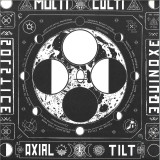
Multi Culti launch a new quarterly 12" series in step with the seasons beginning with SOLSTICE I:
Post-pandemic lockdown inspiration can be found in the great planetary balancing act that has taken place since a cataclysmic impact with an asteroid caused mass extinction and set our earth’s orbit off axis. This AXIAL TILT, or obliquity, is responsible for the seasons, and life as we know it has evolved around these unleashed forces. As our lives and for many, careers, have spun dramatically off axis as of late, we look ahead to the coming seasons, with the hope that we can weather the changes, and maintain inner stability. To aid in this quest, Multi Culti promises to deliver sonic support with utmost regularity at the peak moments of cosmic significance, with each Solstice and Equinox.
Beginning this journey are some of the label’s most beloved artists. Israeli duo RED AXES provide a chakra-elevating soundtrack with their inimitable blend of psych-garage-tronica, a sun-kissed banger that signals a long-awaited return to the togetherness of the dancefloor.
ZILLAS ON ACID turn in a robustly wiggly jam that electrifies, frazzling zaps and frenetic percussion recall the fritzy tension of the past year, a cathartic shock-treatment for traumatized dancers looking to get back to prime spine-shaking shape.
Mexico managed to stay open for the most part, and TYU seems to have not skipped a beat here, still in perfect form after breaking out as one of the hottest young producers to emerge in recent years. Dark disco, Mexi-chug, call it what you want, but the emergent genre is never better represented than here… spooky, phosphorescent tribal dance, Tulumminati-tested and approved.
Finally, the big guy - MANFREDAS - whose remixes and edits have been highlight-reel material the past couple of years, delivers a long awaited original track with his requisite heavy-weight swag. Wonky tunings and a chunky downtempo beat underpin Manny’s trademark masterful arrangement style, building patiently, with breakdowns that managed to wring every last drop of impact out of an odd, other-worldy assortment of sounds.
- A1: Mulatu Astatqe - Munaye
- A2: Mulatu Astatqe - Meche Dereshe
- A3: Tesfa Maryam Kidane - Yetesfa Tezeta
- A4: Mulatu Astatqe - Kasalefkut Hulu
- A5: Mulatu Astatqe - Tezeta
- B1: Bahta Gebre Hiwot - Ewnet Yet Lagegnesh
- B2: Mulatu Astatqe - Yegele Tezeta
- B3: Mulatu Astatqe - Bemgnot Alnorm
- B4: Mulatu Astatqe - Yekermo Saw
- B5: Tesfa Maryam Kidane - Heiwote
The fact that Ethiopian Modern Instrumentals Hits has been reissued on numerous occasions over the last two decades is testament to the enduring quality of this most obscure of compilations.
KiNK is back with number six on his sometimes experimental, often exemplary, but always exciting Sofia outfit. The driving force of Clap On 2 are the tropes of acid and its numerology (101/202/303/). The opener Disco Spectrum shows why the sound rose from the shards of smashed mirror balls in Chicago – updated and optimized for today. Turbo – nomen best omen – takes it even further, faster and fiercer, while the theme song completes the pogo picture. Finally, Almond Break lulls you into a false sense of security (think yoga camps, namaste cults, kale drinks and Balearic sunsets), before it turns into a pagan ritual to complete this acid test. Remember: wo wants to own the future needs to conquer the past!
SOFIA: Founded by Strahil Velchev and Konstantin Petrov, Sofia is not only the physical location where this music was made, the city where they met and developed as artists, but also a paradox that is reflected in the art and music that comes from the place. Beautiful and ugly at the same time, clean and dirty, brutal as well as romantic, it’s a place where aesthetically seemingly incompatible styles come together in a twisted, yet unifying form. The photographs for the sleeves are made by influential local selector DJ Valentine, effortlessly capturing the local reality.
Black vinyl[145,84 €]
"CHRISTMAS SPECIAL EDITION OF JOHNNY HALLYDAY'S 2 SYMPHONIC ALBUMS COMBINED
INCLUDES INSTRUMENTAL VERSIONS OF DIÉGO AND LE PENITENCIER, 4LP Coloured VINYLS • 32 PAGES BOOK • LIMITED EDITION An exceptional Christmas special edition accompanied by many photos The whole story of the realization of this event project With the exclusive testimonials of YVAN CASSAR: arranger and musical director and of FRANÇOIS DARMIGNY photographer of the two albums. Reviews and Ads in R2 and London Macadam "
Coloured vinyl[145,84 €]
"CHRISTMAS SPECIAL EDITION OF JOHNNY HALLYDAY'S 2 SYMPHONIC ALBUMS COMBINED
INCLUDES INSTRUMENTAL VERSIONS OF DIÉGO AND LE PENITENCIER, 4LP Coloured VINYLS • 32 PAGES BOOK • LIMITED EDITION An exceptional Christmas special edition accompanied by many photos The whole story of the realization of this event project With the exclusive testimonials of YVAN CASSAR: arranger and musical director and of FRANÇOIS DARMIGNY photographer of the two albums. Reviews and Ads in R2 and London Macadam "
- 1: Sex And Love
- 2: Be My Hole
- 3: Heavy Breather
- 4: I Guess I'll Just Jerk Off Again
- 5: Wind In My Belly
- 6: Guilt
- 7: Band From France
- 8: Tom
- 9: Womyn
- 10: What Is This Thing Called Love
- 11: Fascist Love Song
- 12: Lullaby On Blow
- 13: Why
- 14: We Back Together
- 15: Young And Alive
- 16: Thanks For The Disco
- 17: A Wig
- 18: Pepper Pot
- 19: Lorenzo The Chef
- 20: Give In
- 21: The People Have Spoken
- 22: What Do I Wear On A Trip To The Moon
- 23: Christopher
- 24: Testicle Delight
- 25: Water Nymph
- 26: A Queen's Lament
- 27: Julie Newmar
- 28: Madamifesto
- 29: Let's Hear It For Show Business
Mouth Congress – friends Paul Bellini and Scott Thompson of Kids In The Hall fame - wrote and recorded hundreds of songs in the ‘80s with - out ever putting out a proper release. Alongside various cohorts and conspirators, the band drew on their experiences as gay men to craft hilariously crude punk songs that run the gamut of strange characters and taboo subject matter. Their rag tag approach to songwriting blended various styles from noisy punk to lo-fi new wave and DIY disco, all with a very gay bent. Without trying, they were surprisingly cutting edge.
Mouth Congress did dozens of live shows through the mid-80s that gained a reputation for being theatrical, combining props, sets, multiple costume changes, unusual song choices, guest stars, and Scott’s stand-up comedy. In 1988, they recorded a 7-song demo tape. The tracks were recorded quickly, as the Kids in the Hall were about to go to New York City to develop their material. Then, caught up in the excitement of the Kids in the Hall being signed to television, Mouth Congress activities slowed to a crawl.
In 2011, Paul dug out an old VHS tape of one of the live shows. The sight of one of the Kids in the Hall covered in sweat, writhing on stage like Iggy Pop, was something he felt comedy fans might enjoy seeing. Naturally, Scott agreed and they uploaded everything - over 600 recordings - onto Bandcamp. One day in 2019, Mike Sniper of Captured Tracks stumbled upon the Bandcamp page, got in touch, and suggested assembling a compilation of the best recordings to be officially released for the very first time.
Waiting for Henry is a collection of 29 tracks over 2 LPs with a booklet of interviews and ephemera from one of the ‘80s
last queercore bands.
Who is Henry? We don’t really know, but we certainly hope he shows up soon.
During the mid-1970s, the Aggrovators could do no wrong. This ace team of session musicians that was forged as an off-shoot of the Soul Syndicate were responsible for some of the biggest hits of the decade, recorded with Bunny Lee's rising stars, such as Johnnie Clarke and his rival, Cornell Campbell. Following on from the great Shalom Dub set of 1975, Rasta Dub '76 is another truly magnificent dub set culled from Aggrovators hits (by Johnny Clarke, Cornell Campbell and others), this time, the entire album was given a scintillating mix-down at King Tubby's studio by the great Prince Jammy, and the sonic excellence has stood the test of time. Another must-have for all connoisseurs of dub.
- A1: Alpha – Anteludium – Omega Alive
- A2: Abyss Of Time – Countdown To Singularity – Omega Alive
- A3: The Skeleton Key – Omega Alive
- A4: Unchain Utopia – Omega Alive
- B1: The Obsessive Devotion – Omega Alive
- B2: In All Conscience – Omega Alive
- B3: Victims Of Contingency – Omega Alive
- C1: Kingdom Of Heaven Pt 1 – A New Age Dawns Part V – Omega Alive
- D1: Kingdom Of Heaven Pt 3 – The Antediluvian Universe – Omega Alive
- E1: Rivers – A Capella – Omega Alive
- E2: Once Upon A Nightmare – Omega Alive
- E3: Freedom – The Wolves Within – Omega Alive
- F1: Cry For The Moon – The Embrace That Smothers Part Iv – Omega Alive
- F2: Beyond The Matrix – Omega Alive
- F3: Omega – Sovereign Of The Sun Spheres – Omega Alive
For many years now, the comparative of epic has simply been EPICA. Since their formation in 2002 and their quick ascension to stalwarts of symphonic metal noblesse with trailblazing masterpieces “The Divine Conspiracy” (2007) or “Requiem for the Indifferent” (2012), Dutch metal titans only knew one way: Up. Especially with their last three releases “The Quantum Enigma”, “The Holographic Principle” and this years’ “Ωmega”, forming a metaphysical trilogy that’s both alpha and omega of all things symphonic metal, EPICA became rightful monarchs of a genre they themselves helped made become a global phenomenon.
Yet, as every other band, EPICA couldn’t take their latest installment of breathtaking cinematic grandeur to the seven corners of the world as they would have normally done. You know why. Thus, plans have been made and visions fulfilled to produce a once-in-a-lifetime event that couldn’t be further away from yet another streaming show. What EPICA unleashed upon the world on Saturday, June 12th, 2021, was a monument to their music, their career, and their enduring legacy as forebears of a whole genre. Now finally being released on Blu-ray and DVD and various audio formats, “Ωmega Alive” is the EPICA show of your wildest dreams, brought to life by blood, sweat, tears and a healthy dose of megalomania. Think Marvel meeting Cirque de Soleil in a Tim Burton universe.
Celebrating the release of their gargantuan new opus magnum, „Ωmega“, the streaming event saw fans from over a 100 countries flock to the screens to witness a show that has proven to be the defining moment in EPICA‘s concert history. A show that’s nothing short of the band’s most explosive performance to date, brought to life with an enormous production on an ever-evolving stage setting that’s full of visual surprises. For the first time ever, EPICA performed songs like ‘The Skeleton Key’ or the insanely monumental “Kingdom of Heaven Part 3” from “Ωmega”, alongside the band’s most popular songs, rare songs, fan favorites and huge surprises. “What started as a basic idea to do an online release show for “Ωmega” quickly spiraled out of control and became our most ambitious project to date,” creative director and keyboard wizard Coen Janssen says. “As usual, we wanted to push the boundaries, explore the limits, and think outside the box. We found ourselves back in our happy place. This concert film, our ray of light for you in the dark times that we have all been living in.”
For half a year, the band worked tirelessly on a show that’s been setting a new standard for concert films and streaming events. “What we wanted to do was the ultimate EPICA show where we could fulfill every dream we ever had, where there was room for all the ideas, effects and props that are just too big to be taken on tour.” Far from your usual streaming concert, the band developed a trademark feature called a “living backdrop.” Coen explains: “We built another stage right behind our stage where lots of things were going on the whole time. And we meant that very literally,” he laughs. “Every song got something extra, something unique that was fitting its world.”
He can say that again: Elaborate visuals, tailor-made videos and graphic effects, fire, and flames on a Nibelungen level, dancers and actors, artistic performances or fire performers all add to the aura of symbolism and cinematic splendor, setting the stage for a band that can’t be happier to finally bring their new album to life, harmonizing wonderfully and giving their A game for a show to remember. “It was so great finally playing with the band again, actually standing on stage with them. Boy, did we miss this,” Coen emphasizes and adds: “We also built a pretty cool new stage with some fire-breathing snakes and lots of rotating elements. Good thing is, we might also take it on the road when we can finally tour again.”
Until then, “Ωmega Alive” will be a more than efficient remedy against no-concerteritis – for bands, fans, and crew alike who all look back on an extra-long dry spell. Divided into five acts as there are letters in EPICA and “Ωmega”, each part gets a different theme, look, and feel, complemented with references to the history of EPICA, the symbolism of the band and the videos they did. It’s, in short, the best show they ever did, a two-hour spectacle spanning their storied career up to their latest endeavors and graced by Simone Simons’ breathtaking a-cappella rendition of ‘Rivers’ from “Ωmega” complete with choir, easily the most emotional and achingly beautiful moment in their entire career. Frankly, you don’t see this on a normal tour.
What EPICA brought to life here with the help of 75 artists and crew members is a testimony to their burning will to take their band ever higher – even now, in the darkest of times we ever had to endure. Let “Ωmega Alive” be your ray of light as it was theirs, a journey into the heart, body and soul of one of the most passionate and visionary metal bands alive today.
- A1: Titoli Di Testa - Canzonetta - Notturno
- A2: Cadillac - Arrivederci Roma - Caracalla's
- A3: La Dolce Vita - Via Veneto
- A4: Patricia - Canzonetta - Entrata Dei Gladiatori - Valzer (Parlami Di Me)
- A5: Lola (Yes Sir, That's My Baby) - Valzer (Parlami Di Me) - Stormy Weather
- B1: Via Veneto E I Nobili
- B2: Blues - La Dolce Vita Dei Nobili
- B3: Notturno E Mattutino
- B4: La Dolce Vita - La Bella Melanconica
- B5: La Dolce Vita Nella Villa Di Fregene - Can Can - Jingle Bells - Blues - La Dolce Vita - Why Wait
- B6: La Dolce Vita – Finale
The original soundtrack from the 1960 comedy-drama, La Dolce Vita, directed and co-written by Federico Fellini.
- A1: Hands Up
- A2: Bow (Feat Corey King)
- A3: Ugly (Feat Mic Holden)
- A4: Just Hold On
- A5: Take Time, Look Up (Jawwaad Speaks) (Jawwaad Speaks)
- A6: Safe Travels (Feat Fat Tony & Zeroh)
- A7: C'est Un Mot
- B1: For The Youth (Feat Corey King)
- B2: Pause In His Presence (Feat Lisa E Harris & Sam Gendel)
- B3: No One Knows
- B4: When It Gets Dark (Feat Kenneth Whalum)
- B5: And Then The Anointing Fell
Black Vinyl[23,82 €]
Grey Marbled Vinyl
But Only After You Have Suffered is a densely layered and deeply personal new work from multidisciplinary artist, composer, percussionist & producer Jamire Williams. Conceived as a spiritual, autobiographical artistic statement, Jamire applies sound collage practice to modern jazz composition, beat production, MC/vocalist features, and his uniquely impressionistic drumming style - making an album as akin to minimalist painting as an art-house film soundtrack or a classic hip-hop mixtape. A "self-reflective, almost testimonial work" that swiftly cycles across a vast spectrum of styles, it's the culmination of his five-year musical journey to the outer reaches of his own sound. It's the album he has always wanted to make.
Tartelet has a knack for uncovering virtuosic, off-kilter electronic music. Max Graef—born, bred and still holding it down in Berlin's Prenzlauer Berg—is their latest artist in this mold. Though adventurous dance music is thick on the ground in the German capital, Graef's 2013 run of singles, cropping up on Graef's own Box aus Holz, plus Melbourne Deepcast, The Gym, Heist and Tartelet, continually surprised, infusing worn-in house with manic energy and acrobatic elasticity. Where many of his peers make languid, self-consciously laid-back tunes, Graef makes brilliantly restless ones. Dropping the needle on one of his EPs, you nearly expect it to pop right off again.
Rivers of the Red Planet, Graef's first full-length and Tartelet's latest album project, takes all that wildness and refines, expands, updates and scrambles it. It's as ambitious and deviously entertaining a record as you'll hear in 2014, the fulfillment of Graef's desire to make anything but another contemporary house music album. At any given moment, Rivers of the Red Planet feels like it could have been recorded through the smoke at a jazz club in the booth at a techno club 30 years from now or inside an MPC stocked with crusty dollar-bin samples. (We'd guess the staff at Graef's beloved OYE Records in Berlin will have a difficult time settling on which section to file it in.) If it sounds sampled, it's a testament to Graef's natural musicianship and production prowess —the record is heavy on sounds he played himself, from drums and Rhodes to fat synth melodies wrung out of an old Crumar Performer water-damaged to perfection. For vocals, Graef enlisted Nigerian singer Wayne Snow, whose rugged soulfulness makes him a natural pairing. On cuts like "Drums Of Death" and "Speed Metal Jesus," the club- readiness of his EPs lives on. But Rivers of the Red Planet may be most at home in your living room, with a good bottle of red and a roaring fire's crackles mixing with the pops and hiss of the vinyl—a playful listen that sinks in, burrowing deep and getting you all warm and gooey on the inside.
Cie has been on an exciting musical journey since the foundation of the Form & Terra Records label and the first record "Auf Los" and now delivers further highlights with "Adventures". Together with a remix by Oliver Hess, the record has four driving tracks that will be released exclusively on vinyl.
The “Löwenburg” first appears on the horizon, and the closer you get to it, the more powerful it appears. Arriving at the gates, the lion extends his claws and with his pounding, multi-faceted beat and bubbling, lively sounds pulls every dance-loving clubber into the castle with full force.
Oliver Hess waits here with his musical tools and refines the masonry of the "Löwenburg" with crisp percussions and incredibly driving beats in his inimitable way. With a hammer and chisel, he sharpens the original in his remix and opens up new sound paths to the castle's secret locations.
Through the dark corridors of the castle we get to the "Bergfried", the first track on the B-side. Hypnotic synth runs and pulsating basses demand everything from every wall, no matter how thick, and enjoy testing it for stability.
Finally, it goes deeper into the underground with "Der Stollen". Wherever digging deep, fascinating things come to light in the club night: brilliant flashes of sound briefly sparkle like precious stones, and rattling, tirelessly driving beats ensure that you lose yourself in the depths of the sound of the
„Stollen“. Four exciting tracks that are ready for any club adventure. Vinyl only.
Truly adventurous and life enhancing music that invigorates your soul. TIP!
Press Release:
Gordan join traditional Serbian singing with abstraction, energy and minimalism. Their music is marked by radical reduction, seemingly endless ascension and a passion for experiments.
The Serbian singer Svetlana Spajić is an internationally recognized and acclaimed artist. She, like almost no other contemporary singer, is a master of all the complex local stylistic variations of singing from Balkan music. Guido Möbius plays bass and various electronic sound generators. Additionally he uses guitar amps, microphones and effects to provoke feedback which either harmonize or are juxtaposed with the song. It is a dialogue between sound and noise which is accentuated or fragmented by means of Andi Stecher’s expressive drumming. With a rich pool of ideas the percussionist drives the sound forward breathlessly and grounds it. Together the trio form a dynamic body of sound.
Gordan recorded their debut during the first wave of the Covid19 pandemic in Europe in March 2020. Due to the lockdown in Berlin at that time the city didn’t have many distractions to offer, so the trio just concentrated on work. The atmosphere of being isolated in a recording studio had a big impact on the musical results. All three band members came up with ideas for new pieces, which were immediately tested, worked out and recorded. On abstract instrumentals provided by Stecher and Möbius, Svetlana Spajic sometimes reacted with personal interpretations of serbian traditionals, and the other way around. Most of the time it was as if the music just happend to the band; playing together felt natural from the first moment on.
Some of the old serbian traditional songs that Spajic sang are extinct forms with a specific local melodic mode. The skillful improvisation of their lyrics and ornaments was of great importance and very estimated among village singers. The title song Down In The Meadow for instance originally is a love song from the village of Odevce in eastern Kosovo, Serbia. The singing manner is of a great intensity and sonority, with lots of specific local ornaments. It disappeared along with the village communities from the area. Oh, my Rose flowers is from the region of Kopaonik mountain (southwest Serbia) and the mode, scale is known as ”kopaonički glas” (Kopaonik mountain air). Svetlana adopted the style from the late singer Veličko Veličković from the village of Ostraće. It is an old mountain solo chant, rich in fast ornamentation movements and microtonal intervals. Don’t ask how I live is Svetlana’s homage to the new popular folk music movement from the 80ies known as Južni Vetar (Southern Wind) led by a musician and composer Mile Ilić, known as Mile Bas (“Mile the Bass”) which revolutionized popular music introducing tabooed oriental music and original arrangements.
All music by Spajic Stecher Möbius except ‘Don’t Ask How I Live’ by Miodrag M. Ilić, original title Što me pitaš
All lyrics are traditional, except ‘Don’t Ask How I Live’
Svetlana Spajic — vocals
Andi Stecher — drums & percussion
Guido Möbius — bass, feedback, electronics
Recorded by Alberto Lucendo at UFO sound studios Berlin in March 2020 mixed by Morphosis
Mastering by Neel at Enisslab, Rome
Artwork by Lorenzo Mason Studio
- A1: The Cambrian Explosion (Live In Bremen)
- A2: Cambrian Ii: Eternal Recurrence (Live In Bremen)
- A3: Ordovicium: The Glaciation Of Gondwana (Live In Bremen)
- A4: Silurian: Age Of Sea Scorpions (Live In Bremen)
- A5: Devonian: Nascent (Live In Bremen)
- A6: The Carboniferous Rainforest Collapse (Live In Bremen)
- A7: Permian: The Great Dying (Live In Bremen)
- B1: Triassic (Live At Roadburn Redux)
- B2: Jurassic
- C1: Palaeocene (Live At Roadburn Redux)
- C2: Eocene (Live At Roadburn Redux)
- C3: Oligocene (Live At Roadburn Redux)
- C4: Miocene
- C5: Pleistocene (Live At Roadburn Redux)
- C6: Holocene (Live At Roadburn Redux)
The Berliners present an unusual live album that is a testimony of strange times: their Phanerozoic concept album performed live in its entirety at a time when no shows were happening anywhere in the world. 3 LPs / 2 CDs plus DVD and access to HD video download and streaming. Phanerozoic I was streamed live from Pier 2, a big hall in the port of Bremen, on March 25, 2021. Phanerozoic II, recorded at "Die Mühle" studio, aired on April 16, 2021 as part of the digital edition of Roadburn Festival, this year abtly named Roadburn Redux. Both shows couldn't have been more different: where the first part boasts with a pompous, mesmerizing lighting production on a big stage, the 2nd part is quite the opposite: intimate, almost cosy, focused on musicianship rather than performance. A stripped down setup in a dark barn, with moody, minimal but not any less efficient lighting. "We wanted to give people 2 totally different experiences", says band leader Robin Staps. "In Bremen, we had the chance to record a proper Ocean live show, the way people know us. We played facing towards the front of the stage, to an invisible crowd, essentially to a huge empty room_ but we knew people were watching, even if we didn't see them. There was the same rush of adrenaline right before going on stage as you get before going on at any big open air festival_ maybe with a little extra anxiety added, because knowing that so many people are watching you without being able to see them yourself was super weird." This release is yet another master class of record packaging from Norwegian artist and long term friend and collaborator, Martin Kvamme: the trifold is made from thick, rough and incredibly fibrous cardboard, adorned with a filigrane copper foil embossing of a bitmapped live fotography from the Bremen event. It contains 3 vinyl records in printed inner sleeves or 2 CDs, plus a DVD and a concert ticket with a streaming and HD video download link to both concerts.
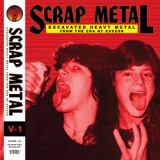
By now you’re probably familiar with our wildly popular Brown Acid series of rare, lost and unreleased proto-metal and stoner rock singles from the 60s-70s. In the endless pursuit of those glorious gems, we often uncover equally brilliant rarities from the late-70s to late-80s Golden Age of Heavy Metal that also just must be heard, but they don’t fit the series’ aesthetic. Scrap Metal, Volume 1 collects some of the greatest unknown and lost Heavy Metal tracks, long buried beneath the avalanche of the era’s classic output.
We all know the old adage that history is told by the winners. But sometimes the losers tell the best stories. And while none of these bands found fame and fortune, this artifact and the volumes to come are testament to the enduring power of heavy music. You can hear the blood, sweat and beers that went into each of these singles. The recordings may be low budget, but the inspiration and talent is immutable. Not only are the amps turned up to 11, the boyish sexual innuendo is cranked to 69. You can hear the convergence of influences — NWOBHM, thrash, glam metal, doom, etc — colliding at once as the era birthed a wellspring of subgenres.
Many of these singles are self-released and were thus limited to a small run of copies. Those that remain are hoarded by collectors and sold for exorbitant amounts. We’ve collected the best of the best for you here. As with Brown Acid, all of these tracks are licensed legitimately and the artists all get paid. Because it’s the right thing to do.
LINER NOTES:
Rapid Tears launch this series with the perfect christening. The Toronto, ON quintet’s 1981 single “Headbang” is such the pinnacle of heavy metal madness that it almost sounds like a spoof. There’s also enough of the rapid-fire sputum that inspired Metallica to bang the head that doesn’t, as such, engage in said practice, to be found on the band’s sole full length Honestly. But “Headbang” is a straightforward glammy anthem for the ages.
Air Raid’s “69 In A 55” may be lyrically so sophomoric that it’s actually pretty clever, but this 1983 Bay Area power metal single is loaded with sleek Judas Priest riffs and interwoven melodies that are downright sublime. The band’s sole release, the 2-song Rock Force 7” features a curious band photo in which 3 band members — dolled up in Crüe makeup and leather — are sexually menacing the lead singer/guitarist tied to a bed. Another low budget highlight is when singer/guitarist Tommy “Thrasher” Merry imitates a delay effect on his vocals as he sings, “tonight!...tonight...night.”
Hades’ “Girls Will Be Girls” has a real demo cassette feel to its vastly uneven mix, but the energy to the performance makes this an undeniable keeper. The long running Paramus, NJ quintet’s 1982 2- song debut 7” titled Deliver Us From Evil features this blistering thrasher dominated by shimmering leads and confident vocals that show why the band went on to near-fame on Metal Blade Records.
Resless don’t need no T to prove that they’ve got “The Power” with this 1984 driving mid-tempo rocker in the vein of Mötley Crüe and Ratt. The River Vale, NJ quartet’s tight crunch wails all over Bon Jovi posers but it’s the band’s unique and subtle deployment of background vocals that gives this rager its staying power.
Pittsburgh, the Steel City, is home to Don Cappa, a band that pays tribute to the burgh, the metal, and the awesomeness of both with “Steel City Metal.” Their lone single, issued in 1987 with only 300 copies released, sounds like the work of some serious steel driving men, with a drummer who might’ve forgotten to wear a hard hat one too many times on the construction site.
The Beast has more of a punk feel to their aggressive “Enemy Ace” track from the 4-song Power Metal EP from 1983 — something like Dr. Know meets D.O.A. But their look, artwork and lyrics all prove that Heavy Metal is where their hearts lie. And this hook filled monster delivers repeated lines like, “I command them all in my lofty realm,” with commendable conviction.
Dead Silence from Denver, Colorado, debuting in 1984 is not to be confused with Dead Silence from Denver, Colorado, who also debuted in 1984. The former a workman’s hard rock bar band, the latter a political peace punk band and neither knowing of the other’s existence throughout their tenure. The pre-internet days were a marvel, indeed.This Dead Silence spits out a slick, Nugent tinged rocker called “Can’t Stop” about life on the road.
The Danger Zone is, by all accounts, not the place to be. And, Hazardous Waste of Boston, MA saw fit to add their two cents on the matter with this 1986 single that combines Van Halen’s flashy musicianship with NWOBHM aggression that sounds so awesome it teeters on itself entering the “Danger Zone.”
Czar’s heavy, doomy “Iron Curtain” single from 1982 hearkens to the sleazy sounds of Saint Vitus and Pentagram with its cranked up DOD Distortion pedal in a Peavey combo amp guitar tone and meaty, barking vocals. The upstate NY quintet only issued this 2-song single, but its driving rhythm, nosedive whammy-bar guitar solos and comparatively mature Cold War subject matter show they had real potential.
Not much is known about Real Steel’s majestic “Viking Queen” from 1987, other than it rocks hard and the 7” 45 sells for upwards of a grand on the collectors market. The Flint, Michigan band recorded at the home studio of local radio personality Bill Lamb, who primarily released Christian Gospel recordings. So, perhaps the band was struck down by a bolt of lightning shortly after this rare single’s release. Whatever the case may be, it’s a must have for fans of classic metal mayhem.