This special release revisits classic Brothers' Vibe tunes, edits and a never before released on vinyl track. Kicking off proceedings is the 1989 gem "I Ain't Gonna Wait". An early Brothers' Vibe piece and massive underground anthem! Brothers' Vibe distinctive gritty style of groovy house takes us on a hypnotic journey into uncharted territory. Melody and percussion interchange amongst a framework of zippy synths and sinuous kicks. Released under the moniker Silent Rodgerz, the second track "Infractions" saw the light of day back in 2008 solely in digital format on a MixxRecords compilation. Low slung with an acid influence, the cut reveals a distinctly natural groove lead by the classic bassline. The final track is the definition of a house classic!! Featuring echoing words of the great Maya Angelou, "Words To a Nation" exudes a timeless quality, unveiling a masterpiece which stays firmly in your head...
Cerca:under the influence
Modelisme is proud to welcome the french talented and prolific artist Anaxander we use to
see on labels as Pokerflat, Tasteful Nudes, Quintessential, Local Talk to name a few..
House - Techno moods have no secret for him, and for this 30th release on the label, he
delivers a surprising and solid EP based on House Music mainly.
B1 - « Turn Out » is a great boogie house track, plenty of Disco Funk influences built on a fat
groove with a slight mainstream vocals.
B2 - « Party Track (Midnight In Malmousque Mix) » is an exceptional Slow Deep House
Techno with a slight Soul Electro Funk touch, solid and floating, warm bodies and sunglasses
ready to make dance under early sunrise or smoked club dance floor inside.
A1 - « Party Track (Kai Alce Remix) » remixed by one of Deep House fathers Kai Alce,
NDATL label Boss and author of numerous Eps on Track Mode, Mahogani Music, FXHE,
Deep Explorer.. This superb remix is in classical Deep Chicago House vein, close to some
Glenn Underground works, Jazz Funk influences and subtle grooves.
Already Supported by Jimpster, Ooft, Kelton Prima, Grego G, Jee, Mugwump, Hardrock
Striker, Oyvind Morken, Dj Steef, Jona Saucedo, Michael Zucker, Hydergine, Kriss
Liferecorder, Dawad & Mokic, Virgo Music, La dame Noir & more...
Italian rudeboy Ivan Iacobucci brings his brand of lowdown funk-influenced tech house to Apollonia with this sterling three-tracker. Over two decades of hard work and dedication to his craft has culminated in Ivan's untainted reputation and widespread respect within the underground from true heads like Zip and, of course, the Apollonia boys. His love of jazz in evident throughout this EP which is full of subtlety and depth, pulsating b-lines and smooth chords are interlaced with razor-sharp percussion and delicate keys. The first track 'Old In On' has a laid back, though driving, groove, pushing forward with a hefty bassline that is perfectly counterbalanced by the light twinkling keys and barely-there pads. 'Scris Frumos' encapsulates more of an ominous, tribal feeling with intricate effects trickling through every pore of its deep, dark exterior. Its atmospherics keep you intrigued, voices echo in the background and a few moments of softened chimes really intensify the already mysterious vibe. 'Mini Ass' channels more of that electro-funk that forms the foundation of Ivan's love for music, haywire radio pulses prance around stuttered beats, giving it a slightly cosmic feel, while pipes add a more organic nuance to the track. Absolutely masterful work from Ivan, and another inspired addition to the Apollonia catalogue.
With a solid collection of productions and remixes to his name, Arturo's music has helped define the unique and emerging Silicon Valley sound. This approach blends the driving, beat-laden beauty of techno with the soulful, deep melodies of house.
Born and raised in San Jose, California, Arturo Garces has been surrounded by dance music his entire life. The son of a serious collector of funk, soul and disco records, Arturo grew up listening to the roots of house music. Interested in making his own music, Arturo got hold of a sampler in 1995 and hasn't looked back since. These early influences are evident in his works as a DJ and producer today for labels such asMagnetic Recordings (DJ Sneak) and Phil Weeks' Robsoul imprint.
He has new projects and remixes coming out continually on the underground scene, hitting the right mood for the dance-floor consistently. In addition Arturo is the label manager for San Jose's house imprint Jump Recordings, Beat Bum Music, and techno label Resource Records. He also has a new Tuesday night residency in downtown San Jose, Ca Rhythm Ritual. With his hard work, dedication and passion for dance music, Arturo is definitely one to watch.
This is Arturo's 3rd release on Cross Section with the label boss Chris Simmonds on remix duties.
- A1: Lost Women 3:15
- A2: Over Under Sideways Down 2:23
- A3: The Nazz Are Blue 3:07
- A4: I Can't Make Your Way 2:28
- A5: Rack My Mind 3:15
- A6: Farewell 1:32
- B1: Hot House Of Omagararshid 2:48
- B2: Jeff's Boogie 2:25
- B3: He's Always There 2:32
- B4: Turn Into Earth 3:17
- B5: What Do You Want 3:26
- B6: Ever Since The World Began 2:07
- B7: Happenings Ten Years Time Ago 2:57
- B8: Psycho Daisies 1:50
The English blues rock band The Yardbirds released
their album Roger the Engineer in 1966. It was the
only Yardbirds album with all original material.
Although the record was officially titled Yardbirds it has
since its release been referred to as Roger the
Engineer, a title stemming from the cover drawing of
the record's audio engineer Roger Cameron by band
member Chris Dreja. Due to the influence of Jeff
Beck's experimentation with guitar distortion, the
album is considered a precursor to heavy metal.
This 2016 LP reissue features the bonus non-album
single Happenings Ten Years Time Ago b/w Psycho
Daisies at the end of Side B.
Sheffield DJ/Producer Louis 'Taiko' Robson has consistently agitated the boundaries of dubstep music, manipulating eclectic influences in to his productions with bold, original arrangements, intricate percussion, experimental instrumentation and unforgettable subs, and he's not held back with ALBION002.
Title track Splinted dons the A Side of the release and sets the standard high with its heavy sub, percussive melody, and string lead. Robson has taken inspiration from contemporary orchestral composers such as Terry Riley and Steve Reich initiating the creation of the drums and percussion, which add a rich analogue sound to the track, and with that an almighty atmosphere. Folk-like scratchy strings take the lead which is a theme set for the EP and highlights Taiko's tenacity for sound design and disregard for convention. Each eclectic element of the track compliments the next resulting in a guttural, energetic dance floor cut, with dark undertones making the listener feel agitated or anxious. A pulse raiser strictly for sound system use.
Over on the flip side, starting with the outer, Taiko offers a much warmer vibe throughout Fractal, flexing another experimental set of instrumentation, this time round building rhythm with an accordion sample. An enormous rolling sub bass instantly becomes dominant after the short intro and meticulous percussion exaggerates the astounding impact from the drums. In the break expect a much murkier tone with a grimey string sample leading to the second drop. Robson achieves a certain level of feel-good whilst maintaining a dark and aggressive tone in his unmistakably raw track.
Nickel takes the inner side on the flip, following form to the prior with its accordion sample adding a distorted guitar drone for the melodic intro. The acoustic instrumentation couples up with irregular drum work solidifying the EP's 'live' aesthetic, whilst maintaining a dance floor orientation. Tonnes of energy meets masses of bass, Nickel is a recommended set opener and a great close to the EP.
'Sidetracking - Part 1: Prologue' is the first vinyl taste of Jona's de- but album project for Alex Niggemann's forward-thinking AEON la-bel. The musical puzzle will be completed in February 2016 with the release of a second vinyl instalment, featuring 6 more original tracks, and the full 10-track album on CD format. Created over the course of two highly creative years, the concept for 'Sidetracking' was for Jona to invite some of his musician and producer friends to collaborate with him in the studio and compli- ment his album's solo productions. This impressive coming together (to be fully revealed over the coming months) features Varoslav (Rue de Plaisance, Paris), Usio (Studio Barnhus), David K (Cocoon), Bo- livian percussionist Daniel Aguilar, Italian pianist Giovanni Verga, and Edinburgh-based producer The Reverse Engineer. Driven by his desire to explore new sound perspectives and ideas, Jona has carefully forged his career path by consistently creating exciting and forward-thinking music. His previous label outings: 'Traffic' on 'Lost Tapes Volume 1' (AEON010) and 'Gemini EP' (AE- ON016) have seen him fine-tune his own unique sound. By incor- porating a wide range of styles into his tracks, Jona strives to break down unnecessary boundaries and explores new ideas and ways to ignite that hallowed dancefloor flame. It is therefore no wonder that his collaborative creations for 'Sidetracking' have yielded such stimulating aural delights. Fittingly, the album prologue opens with a track whose style is heav- ily influenced by the jazz music that Jona was so in love with dur- ing his formative years. Calling on the somewhat mysterious Usio (whose 'Kuwa Huru' LP on Studio Barnhus should be checked by everyone) to join him in a studio jam, has resulted in 'The Chase', an utterly compelling afro-beat influenced percussive groove, topped with swirling funk-fuelled stabs and strings, mesmerising chiming piano, and a large helping of pure, hip-swinging goodness. Taking 'The Chase' on an entirely different and yet perfectly com- plimentary twisted trip, AEON family members Simone Sinatti and Marco Paladin (aka Speaking Minds) conjure up a futuristic technoid disco demon that is all about throbbing energy, sweat, darkness and hissing smoke machines - perfect ingredients for an unforget- table strobelight serenade. Changing the mood entirely and cutting the tempo to a dublicious skank, 'Transmission Breakdown' sees Jona's experimental creative juices in full flow, as he teams up with Edinburgh-based digital com- poser and sound artist Dave House (aka The Reverse Engineer) for a delightfully hazy downtempo jam. Both as an artist and a DJ, Manchester's Marcus Intalex has been at the forefront of soulful, musical drum & bass for what seems like forever. A passion for techno has always run deeply through his music and under his Trevino moniker he is also a powerful creative force (check his recent 'Front' album to get the full picture). Here, he takes 'Transmission Breakdown' on a magical excursion, filled with subtle, hypnotic, evolving energy, anchored with an irresistible pul- sating bassline throb - a perfectly synergetic interpretation to round off Jona's 'Sidetracking' album prologue in style.
- A1: Interview - Salut Des Salauds
- A2: Philippe Krootchey - Qu'est Ce Qu'il A (D'plus Que Moi Ce Négro-Là)
- A3: Gérard Vincent - Gérard Vincent Pas Gérard Vincent
- A4: Style - Playboy En Détresse
- B1: Pierre-Edouard - A Mon Age Déjà Fatigué
- B2: Casino - Pât Impérial
- B3: Bianca - La Fourmi
- B4: Trigo & Friends - La Dégaine
- B5: Hugues Hamilton - Je M'laisse Aller
- C1: Pascal Davoz - Cinéma
- C2: Anisette - Scratch Au Standard
- C3: Pilou - Ça Va
- C4: Henriette Coulouvrat - Miam Miam Goody
- D1: New Paradise - Easy Life
- D2: Gérard Vincent - Tas Qu'à Fermer Ta Gueule
- D3: Ich - Ma Vie Dans Un Bocal
- D4: Attaché Case - Les Crabes
- D5: Yannick Chevalier - Ecoute Le Son Du Soleilv
This is France in the Mitterrand years: fashions fleet as fast as governments. In the early eighties, the happy-go-lucky gather the nectar of each and every new release.
Believing in a bright future for videotex, and loosened up by the sexy talks broadcasted on the budding pirate radios, the new generation dreams of dance floors and holiday clubs. French Boogie, which preserves the spirit of these years of boodle and bunkum, is the ideal soundtrack to their dreams.
What the web now refers to as French Boogie is some synthetic funk reflecting the spirit of those days when nothing was impossible, or so it seemed. Its syncopated flow heralded the dawning of French rap. Often considered as some kind of post-disco, inspired as much by black music as by new wave, this carefree pop music with bawdy lyrics indulged in simple pleasures: holidays, swank and sun were recurrent themes. Totally in tune with its time, it incidentally glorified luxury, success, and a certain consumerism embodied, for instance, in Bernard Tapie.
In popular clubs such as La Main Bleue in Montreuil, or L'Echappatoire in Clichy-sous-Bois - where Micky Milan could be seen behind the decks - an enthusiastic audience discovered this new sonic wave, influenced as much by French pop as by Sugar Hill Gang or Kurtis Blow. The artists who first launched the movement engaged in it wholeheartedly, but as often the case with new music trends in France, humour and casualness quickly became a decoy to impose a new style. This explosive mixture, in which startling and typically Frenchy French lyrics go along New-York-style tunes, is sometimes reminiscent of the kinky comedies directed by Max Pécas or Claude Zidi. On this prolific scene, partly originating from the Jewish community, everybody was looking for success, trying to hit the jackpot with what was to hand. Famous media personalities, one-hit wonders or John Does in quest of fame, all had a go at French Boogie - more or less successfully. Apart from « Vacances j'oublie tout » by Elégance, « Un fait divers et rien de plus » by Le Club, or « Chacun fait ce qui lui plaît » by Chagrin d'amour (produced by Patrick Bruel), very few songs became hits: the story of funk in France is that of a half-baked robbery.
In this myriad of new musicians, the very young François Feldman and Phil Barney pioneered a fresh and hybrid style. Other well-known artists like Gérard Blanc from Martin Circus (Attaché Case), Richard de Bordeaux (Ich), or Jean-Pierre Massiera (Anisette, Pirate Scratch Band, Mandrake, Scratch Man...) added an eccentric touch to this sound-wave, making it often entertaining, and sometimes showy.
Capture d'écran 2015-10-26 à 12.55.43Singers like Agathe (the author of 'La Fourmi' and of the hit song 'Je ne veux pas rentrer chez moi seule') were far more than just window dressing. They even tried to give an ironic and subversive twist to this rather harmless genre. The very vindictive rebel Gérard Vincent shared in this spirit, but as a whole, French Boogie became associated with nonchalance and sauciness. Thus, Stéphane Collaro, Gérard Jugnot, Alain Gillot Pétré and other TV clowns would clumsily contribute to this French variation on funky sounds. In a few but intense years, French Boogie gave all the tips to party with style.
If some hits made it possible for the happy few to get a real house under truly exotic palm trees, the wave actually ebbed away very quickly, leaving quite a few musicians stranded on the shore. Whether they were sincerely motivated, or simply opportunistic, they had failed. In 1984, French Boogie was already breathless, and got merged with other genres: on the one hand, rap and breakdance adapted its flow to a more urban world, especially with Sydney's show, H.I.P.H.O.P, and Dee Nasty's broadcasts on Radio Nova; on the other, italo, new beat and house began to rule over dance floors, even more strongly asserting the will to develop music for clubs.
Squeezed in between the age of disco and that of modern electronic music, French Boogie was a transitional phase, but it remains an amazingly refreshing testimony to the intermingling of pop and underground cultures. The genre was hastily categorized as anecdotal in spite of its pioneering synthetic groove and matchless bass lines. An attentive ear will discover the poetry of the ephemeral beyond the eccentricities of the genre, as well as a certain unexpected avant-gardism. At the origin of major music trends, always cheerful and catchy, French Boogie is what you need to party.
Avian's first release since absorbing its sister label Mira comes from Chicago based musician Connor Camburn under the alias Litüus, with an entirely beatless collection that well establishes Avian as the home for the kind of searching electronic experimentation that would have been found on the ten-inch focused imprint that Shifted recently announced would merge with its parent label. The EP follows previous cassette releases under the Litüus name for Brave Mysteries, Notice Recordings and Mazurka Editions and comprised entirely of real time single-take recordings on hardware instrumentation.
Shorn of percussive elements yet not without their own rhythmic structures, Camburn's six compositions are free of immediate electronic genre influences and instead draw primarily on non-musical inspiration in addition to various other contextual reference points, as he sought to express ideas of the unraveling or "de-composition" of musical or architectural spaces through musical forms imagined as inverted contours and negative spaces.
Written & Produced by Connor Camburn / Mastered by Matt Colton at Alchemy, London / Avian 2015 Published by Copyright Control
Something is looming on the horizon, a flickering presence, a sparkle in the twilight, hardly visible at first, then slowly taking shape and finally coming into view: "I will depart/I see, I will, I won't go far," Stefanie Boehm (Couch) sings on "Sirens", one of 10 tracks Ms. John Soda have recorded for "Loom", their first album in eight years – and it's true: It's a return that often feels like yet another departure, like it's time to say farewell once again, one last hug and off it goes into the valley, where life is already waiting.
A lot has changed since Ms. John Soda released the first 7" back in 1998, since Micha Acher (The Notwist, Tied & Tickled Trio, Alien Ensemble) joined Stefanie Boehm and completed the creative nucleus of this band around the turn of the millennium; day-to-day life indeed feels different some 16 years later (and half as many since the release of their sophomore album, "Notes and the Like"), but the basic chemistry, the intricate balance of electronic and analog molecules that orbit this nucleus – and thus, the resulting mood and vibe -, they're still recognizable, still undeniably Ms. John Soda: Whether it's the dense, intensely rushing soundscapes of "Hero Whales", numerous layers pushing and taking off into the same direction, the propelled clatter of "Sirens", a track like "Millions" that blows off more and more steam, a glistening, wheezing sort of madness even (though there is a tender side to it as well), the perpetual, magic lantern-like motions of "Name It" (think Trish Keenan and Broadcast) or the gradually descending melodies of opening track "In My Arms" – they're all lined with a certain tension, underpinned by a certain atmosphere, a unique brand of melancholy that never quite gives in, keeps searching for new outlets and answers.
The album title Ms. John Soda have chosen for their third full-length, "Loom", obviously hints at this feeling of re-emergence, gathering and looming, but according to the singer, it also refers to a weaving loom: It's about "weaving and combining a vast number of influences, ideas, instruments, melodies, rhythms, and layers to create a whole," says Boehm, whose vocals span these new tracks like thick, reliable ropes that glow with marine luminescence. "It's about weaving individuals into a group ('Millions'), weaving and merging former ideals and hopes with reality ('The Light'), combining 'hi' and 'bye', beginning and end ('Hi Fool'), interweaving opposite or contradicting concepts, such as pushing forward vs. being pushed ('In My Arms')." And while the weaving, just like life itself, can easily get out of hands, "because you lose track, and yet life goes on ('Name It')," a lot of these songs – e.g. "Hero Whales", the billowing "Sodawaltz", "Fall Away" – revolve around a shimmering sense of something we can't quite grasp or put a finger on just yet: "Intuitions, hopes, dreams, wishes, affinities, distances, temptations…"
Whereas Cico Beck aka Joasihno (drums, electronics), also part of Aloa Input and the latest addition to Ms. John Soda's live band, and drummer Thomas Geltinger helped out on various tracks they recorded with Oliver Zülch in Weilheim, Boehm and Acher were also joined by Karl-Ivar Refseth (percussions) and Matthias Götz (trombone). Together, they keep feeding the loom with countless spools of yarn, until epic piano closer "Fall Away" seems to offer a temporary respite: "find your way/take the dry suit off/for a night". Time to rest, to take a deep breath. Or is it already the first rays of dawn looming on the horizon?
- 1: Oblique Axis
- 2: Lets Go
- 3: Wholly Unaware
- 4: Champagne Walk
- 5: Rave Splurge Noise Fm
- 6: Improvisation #1
- 7: In The Air Today
- 8: Gas Attack
- 9: Interlude
- 10: Drive (Minimal)
- 11: Heavy Handed Sunset
- 12: Underwater Electronic Struggle
- 13: Confirmation Of Our Worst Fears
- 14: Hardwax Flashback
- 15: Broken Mantra
- 16: Extended Industry Knowledge (For Oscar)
- 17: Noise Rave
Repress!
As Sure As Night Follows Day is Russell Haswell's landmark second album for London's Diagonal Records. Consolidating a quarter-century at the coal face of extreme computer music, techno and death metal in 19 tracks and 49 minutes, it's Haswell's most coherent yet varied burst of activity to date — zigzagging from improvised n0!se outbursts and asphyxiated R&B to a brace of thundering acid bullets that positively froth for the 'floor.
The album was extracted over a fast-working period in late 2014, and is best perceived as a sort
of fractured regression to his formative influences: you can hear the picnoleptic recollections of
grindcore shows in the Black Country, the refracted shades of mega-raves at Coventry's Eclipse,
the conflating toxic texture-memories of early Japanese noise, and the incandescent stomp of
Mills and Hood in that early 90s phase.
Fortunately for the ravers, this album includes some of Haswell's most direct dance floor attacks to
date. 'Hardwax Flashback', for instance, finds him in pure tekno panik mode — a four-to-the-floor
wrecking ball groove that someone, somewhere, may even be able to mix. 'Gas Attack' distils his
penchant for all things Belgium into a vicious strain of New Beat lactic acid. Haswell then doffs his
cap to Detroit electro legends Drecxiya on 'Underwater Electronic
Struggle' — a story goes that he once thrashed a jet-ski all over the Mediterranean while listening
to 'Wave Jumper' in his 'phones — before he does the salty freestyle electro flex 'ting on 'Industry
Knowledge (For Oscar)' while reminding his trusty apprentice, Powell, that he still has a lot to
learn. In between these 'floor-flexers, we find more freakish disturbances and intrusive drum-box
improvisations: the modular mind-floss of 'Rave Splurge Noise' or 'Noise Rave', for instance, or the
self-explanatory 'Improvisation #1'. 'In The Air
Today' investigates warehouse-ready electro-acoustic percussion, while the chaotic clusters
of 'Interlude' swarm and invade your senses with psychoacoustic incision. This is Diagonal and
Russell at their most f**ked up and fizzy, and an important reminder of the artist's stream-of-
consciousness genius — and the pressing need for more chaos and unpredictability in electronic
music today.
Finale Sessions is really pleased to launch new series Finale Sessions Limited with Berlin up and coming act Arcarsenal. Duo comprised of Alan Mathias and Etienne Dauta, both founders of Bass Cadet Records and its dedicated vinyl store located in the heart of the german capital, they are also active members of the large Underground Quality family. Arcarsenal have already started to establish themselves as proponent of a crossover sound, mixing many influences from jazz, house, ambient to dub and techno. They are always giving a prominence to jam, improvisation and textures work in their studio routine. This EP called « Dark Skies & Wetlands », even if slightly grittier than usual, is no stranger to the rules of the duo. The opening track « Different Planet » is an epic dark deep house cut which develops itself over a course of 8:40. Starting with a stamping ground bassline and hazy atmosphere, the track opens up with synth attacks, dub echoes and slowly brings in a blissful melody that ends up linking all the elements. « Substance Of Arjuna », the following track on the A-side, is a-contrario a short but intense ambient work. Shot in one take, this subtle cut showcases the kind experimentations that Mathias and Dauta can end up doing late at night in front of their machines. The b-side of the EP leaves all the space to « Racoons », one of the weirdest and yet most powerful work of the duo to date. Tribal techno could be a short try to define what they achieved here, but the track goes far more than this. Built on a gritty mental acidic bass and a huge drum kick, the frenchmen bring over aggressive synth work that could sound like an orchestra on rehearsal, pachydermic screams or an overdriven guitar larsen. Underlined by a complex percussion pattern recorded live in their nest and chopped up to the best effect, the track ends up in a looping transe from which the listener might not leave in a normal state.
Introverted Dancefloor is Bevan Smith, a New Zealander who has released music under names like Signer and Aspen, and who has played in the Ruby Suns and Skallander throughout the last decade. His prior output has been spread over many international labels and has touched on sundry genres (like techno, IDM, folk, ambient) while featuring restraint and sophistication as compositional hallmarks.
As Introverted Dancefloor, Smith has kept those features as guiding principles while allowing a more propulsive low end to dominate the construction of this music, winding up with understated but energetic dance tracks. Gestation, too, is a prominent attribute of this music, though not necessarily an obvious one. Smith started these songs with hundreds of layers, which he then pared down to a few core elements before rebuilding again.
For Introverted Dancefloor, Smith limited himself to the use of two synthesizers, one mic, one filter, and one effects processer. This constraint is not obvious upon listening as the album works across the idioms of electro, Detroit techno, pop house, and leftfield disco, playing with the line between fluid melody and drum machine programming. Each track has a playlist as its scaffolding, Smith's goal being to filter a certain set of varied influences through just a couple of instruments. Metro Area's Miura' (Original Mix) turned into Introverted Dancefloor's Happiness is such a mess/Pipedream.' If there can be such a thing as a subtle banger, then Smith may have earned that distinction here. Take it high' seems to be a constant ascent with its climbing bass and layers of chords, relying on no hackneyed drops or releases for its crescendo. Smith's layering practices show their precision on tracks like Even if you try' and Tiger bones,' in which disparate elements contribute to pointed melodies, an unidentifiable percussive part entering the same expressive plane as a sung line.
One of the record's most striking features is Smith's inclusion of certain elements of a song in a neighboring one (vocals from Pipedream' in Happiness is such a mess,' a synth line from Even if you try' in Always turn your head') to lend a phantasmagorical effect to the procession, blurring the distinction between a track and its reprise. The result is a song cycle wrought from painstaking labor, while nonetheless retaining core values of amorphousness and motion.
Roland Clark has without any doubt written house music history. Under names like South Street Player, Dark Clark and of course Urban Soul he has influenced the evolution of house music like only a few others. His different vocals on Fatboy Slim´s records are timeless, such as - What the f*ck and - Song for shelter .
Gourmets of old school house music become excited when they listen to Roland´s - Alright . The song, released in 1991, became a milestone in terms of soulful house, in the same way like Adeva´s - Respect and Terrence Parker´s - Love´s got me high .
Marc Romboy has re-explored this pearl for his series - Lost Treasures and was able to convince Roland to release it again, fort he nyoung generation and fort he old school lovers.
The package comes along with a respectful interpretation of no one else than Gerd (Clone, 4 Lux) and the fine remaster of the original club mix from more than 20 years ago.
- A1: Abayomy - Obatala (Pd)
- A2: Zebrabeat_Zebrabeat Afro - Amazônia Orquestra (Zebrabeat)
- A3: Burro Morto - Lúcifer Colômbia (Daniel Jesi/Burro Morto)
- A4: Ive Seixas - Cervejas Populares (Ive Seixas)
- B1: Iconili - O Rei De Tupanga (Iconili)
- B2: Zulumbi - Zulumbi (Rodrigo Brandão / Lúcio Maia / Pg / Dengue)
- B3: Passo Torto - Faria Lima Pra Cá (Kiko Dinucci / Rodrigo Campos)
- B4: André Sampaio E Os Afromandinga - Ecos De Niafunke (André Sampaio)
- B5: Fabrício - Feito Tamborim, Pará Céu (Fabrício.)
Over the past few decades, there has been a seismic shift in Brazil's musical landscape. A plethora of varying musical undergrounds has developed across the nation. While Rio and São Paulo have been overwhelmed with networks of talented musicians for a long time, creative life is now bursting all over the country. Amplificador exists to document and propagate the wonderfully diverse music currently blossoming from Brazil's vivacious and geographically varied musical undergrounds. Presenting an up-to date insight into Brazilian music, this compilation draws together some of the components of 'Novíssima Música Brasileira' (brand new Brazilian music), ranging from afro-grooves to rock, to modern samba and MPB. The music reaches back across Brazil's incredibly rich musical and cultural traditions, while also taking in influence from other movements around the globe.
Having begun life in 2012 as a Brazilian music blog run by Marcelo Monteiro, Eduardo Rodrigues, Mateus Campos, and Ricardo Calazans, the aim of Amplificador is to document and propel to wider audiences, Brazilian music of the '00s and '10s generation. This is a task made more significant by obvious changes in the way music is consumed. 'People are no longer obliged to listen to what the radio and TV are presenting. There is a whole new generation that wants to listen to new bands and new sounds and we try to connect those bands with other bands, producers, fans and even the mainstream.' These changes in technology and the way music is discovered and shared have developed parallel to the proliferation of these emerging scenes. The ostensible decentralization of the music industry means the promoting and filtering work of journalists and blogs, like Amplificador, have become increasingly important, as people try to keep up with the tsunami of new music and media flooding the country on a daily basis.
Marcelo uses the example of the Mangue Beat movement to explain a trend in contemporary Brazilian music that looks both inwards, to Brazil's own musical traditions and outwards, to movements around the world to create a novel, localised identity: 'The 90's Pernambuco art-social movement was inspired by Coco, Maracatu and Forró all mixed with modern riffs and grooves. The mythical
revolutionary Chico Science, his Nação Zumbi, Mundo Livre, Siba, and many others do this blend perfectly. There are also the references to the older generations and masters - Gil, Caetano, Luiz Gonzaga, João Gilberto, Tim Maia, Jorge Benjor - as a constant inspiration for all bands.' This is very much the case for the Brazilian artists of today.
Music is unquestionably informed by place. Brazil has always been famed for its regional differences in this sense. Indeed there are still pronounced variations between the scenes of Rio, Sao Paulo, Natal, Goiânia, Belo Horizonte and Belém for example, there are also great divergences within cities and while technology has brought changes to the way musical influences are shared, there are cultural differences, rooted in folkloric traditions, that aren't going away. Expressing his appreciation for this fact, while highlighting the potential of Brazil's spread of musical flavours, Marcelo explains that 'what we have now is new ingredients to make an even better mixture.'
This compilation heavily features music from a scene in Brazil's current musical make-up, which draws inspiration from African music, particularly Afro-beat music. Abayomy Afrobeat Orchestra from Rio formed because of their shared love of the music of Fela Kuti, uniting initially in 2009 for a jam session in his honour. But what sets Abayomy apart from other groups of a similar nature, is the fact that their sound also brings with it the songs and rhythms of candomblé. In this sense, Abayomy was the first band of its kind. The thirteen members of the orchestra have a palpable current of Rio's musical heritage - its rhythms and culture - running through them. So while their sound is distinctly African, it is also inherently Brazilian. Similarly, Zebrabeat Afro-Amazônia Orquestra draw upon traditional guitarradas and carimbos from the state of Pará and fuse these with the poly-rhythms of Afrobeat to create another regional hybrid, which stays true to both its Amazonian and African roots, yet which results in a very fresh, Brazilian sound. From Belo Horizonte (capital of Minas Gerais), Iconilli are another key band on Brazil's Afro-groove scene. With influences as varied as funk, jazz and psychedelic rock, congado, mining harmonies, maracatu, coco, ijexá, carimbó, Iconilli somehow manage to balance all of these sounds in such a way that makes it impossible to pin them down. From the Northeastern city of Joao Pessao, Parayba, Burro Morto's pshychadelic afro sound leans more towards rock and funk influences, with hint of regional Brazilian rhythms such as frevo and forro. They add another flavour to the Brazilian afro-groove scene: just one of the many exciting facets of Novíssima Música Brasileira.
While African-inspired music features heavily on the compilation, it is just one of the many styles within. Ive Seixas has a fresh approach to MPB, based on traditional rhythms and instrumentation, punctuated by a pop sensibility, coupled with a powerful female vocal. As an artist she is a product of a 'Do It Yourself' outlook to creativity, taken from her love of rock growing up. In 2013 she embarked on a project of street performance: wandering, like a lonely troubadour with just her guitar. Ive and her project began to gain notoriety and shortly after, her first EP was recorded, featuring some important names of South Rio's underground scene. 'Cervejas Populares' taken from the EP, is a beautiful, sombre piece of modern Brazilian pop, with a traditional samba rhythm. Another artist of the new MPB scene is Fabricio, from the city of Vitoria, who's 'Feito Tamborim' melds rock and funk and is also clearly reminiscent of the old Brazilian masters. It's an appreciation for the national musical heritage, alongside a keen ear for melody and an acceptance of foreign influences that results in these promising new sounds of Brazilian MPB.
Sao Paulo's super group of the underground 'Passo Torto' have been at the helm of an emerging scene in the city: an innovative approach to samba which draws in and experiments with afro grooves, jazz melodies and rock structures. Their sound is naturally very Brazilian, but the nylon twang of Faira Lima Pra Ca, interspersed with ominous strings and light rolling percussion, seems reminiscent of Captain Beefheart or Tom Waits, as the band lament their frustrations with their native city through their music.
The Future of Novíssima Música Brasileira looks very bright. The main challenge (and purpose of this album) is to get the music beyond Brazil's underground and into view of international audiences. In the last 10 years this goal has become somewhat more attainable, as the Brazilian government has begun to see the internationalisation of the nation's culture as a strategic objective, with public projects gaining increased investment and backing. The continuing project of Amplificador is to reinforce this international bridge by writing, filtering and promoting the scene as a whole. There is a wealth of great music currently blooming in Brazil and using new media tools, Marcelo and the team, alongside many others, will passionately continue to get the voices of Brazil's underground heard.
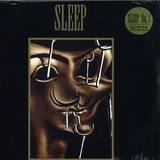
BACK IN STOCK NOW!! "Volume One is the debut album. It was the only album recorded with original guitarist Justin Marler, before he became an Orthodox monk. Volume One showcases a darker sound and stronger doom metal influence than Sleep's later work. The image featured on the cover is taken from the Salvador Dali painting "Soft Self-Portrait with Fried Bacon".
Their only album as a four piece of Al Cisneros, Matt Pike, Justin Marler and Chris Haikus
LP repressed for first time in many years.
allmusic
"For all their budding, precocious talent, Sleep's 1991 debut, Volume One, quickly betrays their still quite heavy debt to doom metal forefathers like Black Sabbath, Witchfinder, and Saint Vitus. Driven by Matt Pike and Justin Marler's lumbering mass of low-tuned guitar riffs, Al Cisneros' (still going as Luke here) serpentine bass and ragged screams, and drummer Chris Haikus' cyclopean kit pummeling, occasional highlights such as "The Suffering," "Nebuchadnezzar's Dream," and "The Wall of Yawn" prove less memorable than they are sensorially overwhelming. And yet, ironically, Sleep's rhythm guitars would never again be kept as under control, nor would their leads sound quite as refined as they do here (see the cleaner harmonies employed to good use on "Numb" and "Catatonic," for example). This was probably due to the onetime involvement of the significantly less stoned Marler, who would soon exchange the group for a monastery where he would study to become a monk. Fittingly enough, however, losing the versatility of a second guitarist was exactly what Sleep needed to focus their singular power into a crushing force, and the remaining trio would flourish immediately behind the sheer physicality of Pike's six-string style, as proven by 1993's superlative sophomore LP, Sleep's Holy Mountain."
This is the story of C POWERS. To understand OYSTERS, you must understand the man behind it all...
THE UNITED STATES TERRITORY OF GUAM, ca. 1989
Abandoned at the island nation's only beachfront techno club as an infant, young Christoph (C POWERS) was adopted by the club's owner, Geraldo Powers. During Geraldo's time as a naval officer, he traveled the world throughout rave's formative years, secretly going to the underground parties when arriving to European ports after having originally fallen in love with early house music as a teenager in his native Chicago via roller-rink parties and the legendary Music Box headed by Ron Hardy. Rear Admiral Geraldo, outed as a gay homosexual during the discriminatory days of Ronald Reagan's U.S. military, was forced to retire, but spared a dishonorable discharge thanks to his roster of medals earning during his exemplary leadership for the invasion of Grenada in 1983.
Throughout his three year stay at the local naval base, the now 30-something Gerry Powers had been struck by the natural beauty and unsettling mysticism of Guam and its peoples and made the choice to permanently set up shop on the island after his unexpected retirement. Taking his partner and newly-crowned Supreme Butch Queen of the New York vogue circuit--Amadeus Lector--with him and financed with $6669.69 in prize money, the new era of DAS POUNDHAUS LTD. was to begin.
In 1990, Gerry founded the notorious Guamanian club DAS POUNDHAUS (the name of which was strongly influenced by a two-week long ecstasy and Polish speed-fueled bender during 1989's inaugural Love Parade in West Berlin). Located inside a decrepit lighthouse originally built during Spain's reign over the island, the club played host to a steady stream of closeted, Pacific-touring U.S. military personnel and later, the party-craving barons of the dot com bubble. Outed in private usenet circles for its off-the-charts hedonism, the club's infamous parties would inevitably lead to its perilous demise, and the eventual deportation of Gerry Powers and his family to the mainland.
But there was one thing that could never be taken away from them...
...synesthesia...
You see, young Christoph was diagnosed with the "disorder" as a pre-teen after having been exposed to nearly a decade of DAS POUNDHAUS first-hand and at such a young age. The youngster was like a fish in water during his childhood in Guam, but when the family was deported in 1999, he began to show signs of anxiety and depression. His ability to hear colors and see sounds had simply turned into a stream of incomprehensible, uncontrolled static. He was now a pariah among his peers. Shunned and admonished. Assigned to sit by himself during school lunch. One of "those" kids.
By this time, his two dads' relationship was on the rocks and would quickly unravel. Amadeus, frustrated with Gerry's incessant ramblings about bunkering in Montana because of the Clinton-Illuminati conspiracy to enslave the middle-class, decided to leave Gerry in an attempt to become a backup dancer for Madonna during her "Drowned World Tour" in 2001 (which would have provided a significant sum of financial security to the family, considering their life savings had been destroyed thanks to the toppling of the NASDAQ from its peak of 5048 in March of 2000--and thanks to those dot com baron stock tips, the Powers were all-in). However, Amadeus' unflinchingly "authentic" vogue style was considered obsolete, and he would go to die in a Reno Motel 6, a victim of drug abuse and that kind of thing apparently.
>>>>Fast-forward to the year2012ish>>>>
Since its 2005 debut, Torsten Profrock's T++ project has grown in stature and scope to the point where it's admired by fans of techno, dubstep, d'n'b and experimental electronics alike, and annexed by none. Anchored in the kind of scuffed, sub-heavy atmospherics Profrock developed in his 90s recordings for Chain Reaction, and naturally influenced by his work with Robert Henke as Monolake, the sound of T++ is singular, always evolving, difficult to fix.
Long ago snagged by the rhythmic innovations of the post-jungle underground, here Profrock makes explicit his debt to the radical fringe of UK garage. Snapping 2-step rhythms are at the heart of all four tracks; for all the distress, deconstruction and detournement they undergo at his hands, the spirit and swing of the British soundsystem tradition is unmistakable.
Further, Wireless is a kind of remix, a commission, shot through with the contorted samples of voice and ndingidi from a handful of old East African 78s (collected on the Honest Jon's compilation Something Is Wrong).
The result is a record that sounds at once ancient and modern, possessing a unique tonal language, and with it a curious, almost occult power — his most expressive, energetic and fully-realised work, affirming the enduring fundamentals of the T++ aesthetic even as it steers it into uncharted climes.
This EP was made during a period where my whole outlook on everything was transforming. The Voidloss project started as an investigation, I was conducting a lot of research and study on the mind, the occult, on different thought modes, and the Voidloss project represented this. The idea was about a leap in to the void. A leap of abandonment into the dark, with total acceptance, total commitment. The idea was to lose myself to the void. This was mainly a spiritual journey for me, and could be best explained by 3 things, the void of Miyamoto Musashi from Go Rin No Sho, The concept of the Tao from the writings of Lao Tzu, and the concept of the abyss from the works of Aleister Crowley. Part of this journey deep inside the self was frightening and horrific, the total loss of self, of all identity and ego, and part of it was beautiful and enlightening. I wanted the music to reflect this, and I wanted the music to change as I changed, as I went to and through all these interesting places. In essence this was about freedom. So fast forward some years and I felt I had sharpened my mind quite effectively, the music had twisted and changed and flowed with me. At the point I began making the music for this EP, I had grown quite angry with the amount of conformity I was perceiving in life. Politically, socially, musically, there was this drive of conformity in the world. I think part of it, and only a part, comes from the prevalence of social media, the need to belong and to be liked, the idea of judging yourself and your works through the perception of others. Musically I felt that within techno there was a tendency for the music to fit within a set of confines dictated by fashion and hype, and this was reducing the diversity of the music, it seemed also that the practices of commercial music were seeping in to techno as the music became more popular. Hype and business driven decisions, brand building and so on. I always felt techno was more about art, and I began to get frustrated. Equally I felt that politically there was less and less choice, as all decisions seemed to lead to the same outcomes. I became more interested in the concept of anarchism, of the idea that government was no longer needed. I have always in my life had a drive to question everything. I've always been 'naughty' and rebellious and done things my way, to my advantage or my disadvantage, I could never accept being anything other than myself all the way. If everyone walks in one direction, I will walk the other way, even if it takes me over the edge of a precipice, just to see what is there. All this stuff influences my music, and during the period of making this EP I was angry, kicking against the things I no longer liked or wanted, screaming dissent. There is a lot of anger and rage, and of course rebellion. I wanted the music to capture that unbridled fury you have when you are in your late teens, when you just start learning about yourself and you start rebelling and questioning things around the time the world is really pushing you to conform. I was soundtracking my own philosophical riot. Previous to this my Voidloss stuff had been more introverted, more pensive and melancholy, more self destructive, more cerebral. For this new music I wanted something more immediate but without being too obvious. In terms of the choices I made I still leaned more towards broken rhythms for beat structure. I find it very difficult to do anything interesting with 4x4 kicks any more, it's too rigid for me, it limits my freedom. I like the looseness you get from more 'drummer' like beats, I guess probably because I have been playing drums all my life. The challenge is to get the same rolling power from broken rhythms as you get from 4 to the floor. It's not easy, there is a ridiculous amount of trial and error and the rejection percentage is high. I also was trying to use less 'synthy' sounds. I wanted to try to take a more acousmatic approach to sound design. With the current modular synth revival in techno I was hearing a lot of 'old' synth sounds re-emerging, and this didn't seem like a progression to me. I wanted to make sounds that were hard to source for the listener, where they weren't sure if it was synth or real world sample, digital or analogue. This involved a lot of experimentation. My process involved a lot of field recording, especially with contact microphones, which open up a whole new world of interesting sounds. You are effectively recording sounds through objects in the environment, 'hearing' the world as these objects hear them, I was using guitars, feedback loops, handmade instruments as well. So I was combining this with different synthesis, granular synthesis, sample synthesis, physical modelling, FM synthesis and of course analogue. Everything was reprocessed and re-synthesised, I tried hard to obscure the source and make something new as much as possible. The stuff on this EP was part of my live PA for some time, so as I learned how the music worked live I could go back and make changes, sometimes the environment I was playing in transformed the sound as well, and so I would try to go back an incorporate this in to the music. For remixes I wanted to choose artists that I respected for their vision as well as for their output, so my list of people I wanted was extremely short. Inigo Kennedy has always been an artist I have respected greatly. His music has always been unique to himself, he remains outside of fashions and trends even though his name has become very big recently. He takes risks with his work, experimenting and exploring, yet remaining relevant to the club, and just tirelessly forging ahead, seemingly for the sake of art above all else. And he's just a really nice guy to deal with. His remix is everything I expected it to be in that it is the unexpected. Regis is another artist who forges his own path in music, you cant really even begin to discuss the avantgarde in techno without including his name, he is one of the foundation stones for artistry and the outsider mentality in techno. His music is always unique to his own vision, and along with it comes an interesting artistic philosophy taking in situationism, post punk and industrial ideology and a good dose of tricksterism ala PT Barnum, all of which comes out in his music and the way it is presented. The man is a truly singular force and it is an honour to have him on this record. Overall the concept here is that of rebellion and dissent. Of asking questions, following your own path, of maintaining some place in yourself that burns like a forest fire.
Whether or not I have succeeded I guess is down to the listener, I'm never happy with my music, I keep wanting to move forwards, or somewhere else, and am constantly trying and failing to capture some essence of perfection. But like Bukowski said
'It's the only good fight there is'
Imagined as a sharp contrast and complement to Funn City's trashy vintage vibes, Darshan Jesrani's new Cylinder moniker sets out to explore the more streamlined, forward-facing side of Startree's vision, while sacrificing none of the warmth or funk of its classic influences. 'Disco Engine' is a futuristic joyride which draws upon late 80s and early 90s techno vibes as much as it does disco and R&B to produce a groove which is warmly insistent, buoyant, sexy and a little menacing. Ruthless, detuned 808 toms and a punchy, round analog bass synth provide a floor you can push the gas pedal to. A greasy, giddy synth rhythm holds the middle down like a session guitarist when rent is due, and ecstatic choral synth pads and vocals by Chelsea Adewunmi soar just above the horizon. Underground dance music with the top way down. Side B's '4-Stroke Dub' works a more DJ-oriented angle around that 808 and juxtaposes parts which do not play together in the original, creating a track which is subtly driving and every bit as engaging. The gorgeous, understated vocal refrain in the middle is a destination you will have been happy to go the extra distance to reach. Startree is happy to present its second release as a continuing statement of its musical intentions and its simple desire for all to have a really good time.