Tape
The occult and folk music have been friends for a while. In the 21st century, hauntology and the resurface of some cult soundtracks from the 1970s and 1980s helped to create a new sense of folk, not associated with the typical acoustic feeling, but more relatable with library, krautrock/kosmische and industrial music. João Kyron and Tony Watts, long time collaborators since the late 1990s with their band Hipnótica, and more recently with Beautify Junkyards (Ghost Box) are well acquainted with this friendship. Hidden Horse is their new project as a duo and “Opala” their first release.
With eight tracks and almost thirty minutes, their first release explores dense and greyish urban utopias. The song titles explore ideas that mix sci-fi, horror, science, space and urban phobia, and the music Kyron and Watts create delivers, using electronics and drums with great relish. Their relationship as musicians, which spans more than two decades, can be felt in the way their music flows with a continuous dialogue.
“Opala” is always keen to take you to another dimension. It lives in its own twilight zone, where the obscure entangles the most obvious senses of reality. It sounds like Jacques Tati “Playtime” with a hauntology soundtrack: it kind of feels that this imaginary world is real, but it’s not. And it sucks you in to be a part of it and enjoy it: close your eyes and let yourself go while listening to “Levitação Magnética” or “Fantasmas do Planeta”. You will feel like a foreigner in a new city.
Buscar:urban r
Snowmelt is a new record by Australian artists Seaworthy (aka Cameron Webb) and Matt Rosner, the long awaited follow up from their 2010 collaboration Two Lakes. Matt Rosner continues to explore the natural world to inspire his work based out of remote Western Australia. His most recent release being No Lasting Form (Room40). Webb's output as Seaworthy has been sparse in recent years as he continues to pursue a career in environmental research, focusing on urban wetlands and their ecosystems. This marks the first substantial release since Wood, Winter, Hollow, a collaboration with Taylor Deupree in 2013.
Rome's Egisto Sopor has been making little waves with his releases for quite a while now. As Polysik, he’s put out music on Legowelt’s Strange Life Records, on 100% Silk label, and on Mike Paradinas' Planet Mu. As ‘TheAwayTeam’ he’s released a DVD ‘Relax & Sleep’ and a cd ‘Star Kinship’ on Japanese label Moamoo, and he's also one half of the low key video unit AAVV (whose work has graced many of the important releases of new lofi electronic movement). This time around he delivers another fine instalment to the Edizioni Mondo's kaleidoscopic catalogue. If you've been following Egisto Sopor's productions over the years, chances are you're already familiar with the visual, highly cinematic, quality of his works – it's music that don't evoke just emotions, it suggests landscapes, painting vivid pictures as it builds up. In the same way, Flora e Fauna tells the story of an extemporaneous, surreal walk in Rome. The 8-track album, organically navigates through imaginary urban and maritime scenarios, with an expansive sound palette that draws on deep and shimmering atmospheres, occasionally drifting from blissful textures and sub-aquatic, swirling moods to eerily quiet, suspended moments, often perfused by subtle field recordings of city life, wild animals and distant shores. Take a deep breath and soak away.
Words have a force of their own: a life generated by their meaning and by the imaginary world they refer to; a power increased by the dynamic interplay with other words. Just put 'Moon' and 'Apollo' together, and you'll be almost inevitably transported to mankind's greatest adventure: the Moon landing and, before that, the space race between the US and USSR, the early missions, and the incredible technological challenges faced at the time by astronauts and engineers.
It is against this imaginative background that beat-maker and bass player Moonbrew and organist and keyboardist Paolo Apollo Negri conceived The LEM Tales project. Their collaboration, too, is the coming together of 'Moon' and 'Apollo', and of their two worlds: a sonic universe where hip hop meets funk, pop merges with jazz, old school interacts with new possibilities, and urban and space blend into something new.
The LEM Tales - Chapter One narrates the space race from the American point of view. This vinyl edition, which includes two exclusive tracks (*) not on the digital release, takes us on a journey from "Project Gemini" - NASA's second human spaceflight program - to "Tranquillity Base" (*) (the site on the Moon where Armstrong and Aldrin landed and walked in July 1969) , through tracks titled "Capsule Communicator" (the individual in the mission control center who maintained communication with the astronauts in space), "EMU" (Extravehicular Mobility Unit, better known as the spacesuit), "Saturn V" (a threestage, liquid-fuelled rocket used between 1967 and 1973), and "Mercury Seven" (*) (the group of seven astronauts chosen for the Mercury Program in 1959).
Inspired by iconic images that are part of our collective visual memory, Moonbrew and Apollo's first collaborative effort tries to provide a contemporary sonic representation of what the past means to us today – and, perhaps, will mean to future generations. It does so through a feast of vintage synthesizers, transistor and tonewheel organs, string machines, electric pianos, tube amplifiers, obscure analogue devices, electric bass, and modern samplers.
An old-school hip hop approach was used in the first stages of writing the album: individual drums hits from old, dusty records were first sampled and then physically played on real instruments to create patterns and build up the rhythm section. Moonbrew then laid down the electric bass grooves and Apollo layered his dreamy, evocative vintage keyboards on top. The result is a combination of different styles, sounds and genres that is fresh, original and contemporary while being clearly influenced by many musical legends of the past.
The LEM Tales - Chapter One is released by Four Flies in partnership with Record Kicks.
- A1: Opening - 03 24
- A2: Call Center - 02 22
- A3: End Love - 00 58
- A4: Sister - 01 39
- A5: Mdma - 01 33
- A6: Paris 13Th - 01 52
- A7: Mother - 01 27
- A8: Arrival - 01 43
- B1: Nora - 02 05
- B2: Humiliation - 1 34
- B3: One Month Later - 02 37
- B4: Camille & Emilie - 01 39
- B5: Emilie Dance - 01 54
- B6: Looks - 01 10
- B7: Porno - 2 40
- B8: Nora & Amber - 2 56
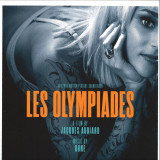
Sixteen musical vignettes of electrifying emotion at the crossroads of ambient, modern synthesizer productions and organic orchestral music experimentation, which tint French director Jacques Audiard's new feature film with the illuminated glow of a whole new generation.
Textextext - (add your write up)
When Jacques Audiard contacted him, Rone was just a few weeks away from receiving the Cesar award for best film score for his very first soundtrack "Night Ride", the highest honor in French film for a composer.
Throughout his career, the French director has been able to surprise his audience by playing on the codes of "genre films", while remaining faithful to the aesthetics of "art film". His cinema is both profound and entertaining, sophisticated and accessible, dark and dreamlike.
"Jacques' cinema is physical, sensual, modern", Rone says about the director, "when he asked me to do the music for Paris, 13th District , I immediately accepted, without seeing any images or reading the script. He is simply one of the greatest contemporary filmmakers."
His new feature film deals with youth in general and their sexuality in particular in a way no one may have done before. The story is based on four young characters and their existential questionings, whose destinies intertwined against the backdrop of the Parisian "Olympiades" high rises in the 13th arrondissement.
But time was already running out, as the film was set to be nominated for *Cannes' Palm D'or* at the rescheduled edition of the festival in July 2021. Between the releases of "Rone & Friends" and his remixes for Agnes Obel, Go Go Penguin and Jehnny Beth (who also plays a role in the film), the producer decided to lock himself away in in his brand-new Isola Studio in Cancale, French Brittany. He also invested in a large screen on which he projected loops of the film and started manipulating his gear. "I had Miles Davis in mind and the way he composed "Ascenseur pour l'échafaud" by improvising with his band while watching excerpts from the film."
After a first conclusive test on three scenes of the film which allowed Rone to showcase the skills he had developed in composition in various musical fields, a relationship of trust developed between the musician and the director, which resulted in over 45 minutes of Rone's music used for the final cut.
"There was a lot of music to be made in a short time, but the talks with Jacques were very stimulating. He had a fairly precise idea of what he wanted, while at the same time, I think, having the desire to be surprised, or even a little shaken up."
If the black and white aesthetic recalls the great hours of the "Nouvelle Vague", Rone´s music gives a new layer to the film which fits resolutely with 2020's zeitgeist.
This second soundtrack by Rone is a sonic urban adventure in itself. As it is used in the film, colouring in the lives of Audiard's protagonists, it will have the same impact on us, the listeners, in our own everyday lives.
Black Truffle is pleased to announce For McCoy, a new work by Eiko Ishibashi dedicated to the widely loved character of Jack McCoy, portrayed by Sam Waterston in Law & Order. Following on from Hyakki Yagyō (BT064), For McCoy finds Ishibashi further exploring the unique space she has carved out in recent years, bringing together musique concrète techniques, ECM-inspired jazz, lush layers of synths and hints of pop into immersive and affecting structures crafted in her home studio, aided by a group of close collaborators.
Beginning with overlapping layers of descending flute lines, the expansive ‘I Can Feel Guilty About Anything’ (whose two parts stretch out over more than thirty minutes) unfolds with a free-associative logic, embracing dreamlike transitions and unexpected cinematic cuts. As a hovering cloud of synthetic tones and multi-tracked voices fans out from the spare opening moments, Joe Talia’s skittering cymbals settle into a gently propulsive groove, soon joined by melodic fragments performed by Daisuke Fujiwara on multi-tracked saxophone. As the drums cede to field recordings and ominous synth figures, the uncommon meeting of saxophone and electroacoustic techniques call to mind the more spacious moments of Michel Redolfi and André Jaume’s Synclavier-propelled oddity Hardscore or the early work of Gilbert Artman’s Urban Sax. As the piece continues on the LP’s second side, distant dialogue rumbles beneath a surface of processed flutes, blurring into a cavernously reverberant backdrop for stark ascending lines performed by MIO.O on violin. Eventually, the piece settles into a gorgeous passage of abstracted dream pop, where Ishibashi’s multitracked vocal harmonies glide atop synth chords, errant pings and snatches of outdoor sound.
Fragments of melodic material reappear throughout the spacious opening piece, finally stepping to the forefront on the closing track, ‘Ask Me How I Sleep at Night’. Here, over a shuffling groove supplied by Jim O’Rourke on double bass and Tatsuhisa Yamamoto on drums, layers of flutes, saxophones and guitars sound out melodies whose combination of twisting irregularity and soulful immediacy calls up prime Keith Jarrett, while their closely voiced harmonies suggest Kenny Wheeler or even Wayne Shorter’s Atlantis. In a classical gesture of closure, the web of melodic lines eventually leads back to the descending flute figures with which the record began. Presented in an immersive, impeccably detailed mix by Jim O’Rourke and arriving in a sleeve featuring Ishibashi’s beautiful drawings of Jack McCoy, For McCoy is an essential release for anyone following the enchanted and unique path being forged by Eiko Ishibashi.
The Israeli producer Yotam Avni, though not one of the main players in the Stroboscopic Artefacts story to date, nevertheless shows that he is definitely here for a reason: having contributed with an entry in the Monad series back in July, he returns with a new set of tracks that fit perfectly into the label's overall aesthetic of evolving hyper-reality, while also being a strong personal statement. With both his S.A. debut and this new offering, Avni shows himself to be a truly 'progressive' musician: a creator whose musical techniques are informed by his creative disposition and not the other way around, an individual who seems to be using the richness and differentiation of human experience in order to let yet more of it arise.
The new record begins with the galloping rhythm of "Tehillim", bringing a whole inventory of struck wood and metal elements into play, and leading listeners on an adventurous voyage through liturgical chanting and volcanic eruptions of synthesizer magma, all the while being accented with nimble percussive fills that convey the improvisational feel of classic bebop drummers. The following "Orma," while more stripped down in terms of individual elements, continues down the same path with clever spatial arrangements, and with tonal and percussive elements that seem snatched out of their buys urban environments and placed under austere laboratory investigation: this holds true for the isolated bits of sax and vaguely middle-Eastern percussive accents that the improvisational feel of classic bebop drummers. The following "Orma," while more stripped down in terms of individual elements, continues down the same path with clever spatial arrangements, and with tonal and percussive elements that seem snatched out of their buys urban environments and placed under austere laboratory investigation: this holds true for the isolated bits of sax and vaguely middle-Eastern percussive accents that distinguish this track, and which leap out mischievously from their carefully controlled setting.
"Shlok" begins with a deep subterranean kick pattern and percolating bell tones that, while first bringing to mind recent efforts from Planetary Assault Systems, soon transform into something much unique to Avni's imagination - smooth arcing vocals and contrasting shades of nocturnal ambience turn this into a very sinuous and sultry piece of rhythmic music. Once the listener has been lured in by this siren song, the closer "Even" brings the EP's most forceful and demanding beat - though its heavy punch is tempered with a sense of contemplative sophistication. Once the insistent beat is overlaid by a shimmering latticework of piano, breezelike pads, and concentrated string plucks, it testifies to Avni's ability to create tracks that are loaded with emotional nuance and defy easy description.
Fresh sounding and (mostly) slower paced house tracks with a twist coming out of Detroit. Filled with a sample-soaked miasma of sonic mutations that will appeal to fans of Moodymann, Theo Parrish, Urban Tribe... From the first to last thud, it moves the listener from head-shaking bewilderment to head nods of agreement at a moment's notice. Not much is known about K-6000, but based on this initial offering it is evident that the orbit of this group is broad...
Pelagos come from the deep, dark waters on the southwestern coast of Finland, the same city as Circle and a few other remarkable local underground acts. Pelagos’ sound is melancholy in a decidedly post-industrial minimalist, repetitive urban Finnish way, but it is also soaked in romantic wanderlust and Balearic exotica. New album "The Boat" will be released 10th of December 2021.
For 100 LIMOUSINES’ third release, mad genius KEMETRIX unleashes 8 tracks of pure, raw, underground Detroit techno.
As a long time member of URBAN TRIBE, the name KEMETRIX rings out loud throughout the underground as a force to be reckoned with. Yet only the savviest of listeners seem aware of the prophetic depths of this artist’s unique style of anthemic, futuristic street music. HERE AND NOW explores a terrain of paranoid industrial soundscapes - an extinction level event at the centrifuge of a particle collider that endlessly creates a vast universe. This album is a clinic in the sacred and profane, the horror and the beauty, that can only be brought to you by someone that has truly lived it.
HERE AND NOW will appeal to lovers of ONYX, CYBOTRON, WU-TANG, and the SP-1200.
The second release in January to celebrate the 25th anniversary of Frank de Groodts career as a recording artist is a re-press of his legendary Sonar Bases 4 10 double 12 . Exactly 21 years ago, in January 1997, Frank elevated to electro stardom with this astonishing combination of dark electronica and electro beats.
Frank at the time lived just outside the city of Amersfoort, which is where he was born and lives again these days, some 30 minutes northwest of Utrecht. His first ever release in January 1994 was a techno EP on U-TRAX, as Pieces of a Pensive State of Mind. Later that year, he released his first 12"-es on Djax records as The Optic Crux, and he continued to keep making up artists names in the following 25 years, like Fastgraph and The Operator. He is also one half of the live outfit Random XS (together with DJ Zero One), collaborated with Arno Peeters (a.k.a. Spasms) as Urban Electro and with Detroit's Dennis Richardson as Ultradyne. And that s not even all of his alter egos.
The sound of these eight unique tracks called for a new moniker back in the nineties: Sonar Base (ironically misspelled on the original release as Sonar Bass). All track on this re-press have been remastered for maximum impact. The double vinyl goodness kicks off with Earth Probe, that very subtly creeps towards us, before it kicks in with a rather obese bassdrum. As if Frank wanted to ease his listeners into his then new sound, this track basically is in techno/acid style, but has the slower tempo that characterizes the rest of the electro tracks of this release.
Immediately following, is the unrivaled beauty of Welcome To Sonar Base #4, a track that slowly builds up before it takes us on a deep space journey at two thirds. The 11 minute Sonar Base #5 has been a DJ favorite for 21 years, reaching out to both electro and techno lovers, while Sonar Base #6 is the type of ultra-pure electro that really puts your woofers to the test.
Arrival At Dwell Probe is another one of our favorites, with superfine beats, desolate voice samples and deep and moody synths. Very musical, truly a top piece that will leave you totally unprepared for Blunted. This track has the rolling type of hiphop-style beats that mix well with LL Cool J's Mama Said Knock You Out, but of course has the space-station atmosphere that makes it unmistakably a Sonar Base track.
The fast pace and merciless beats of Intergalactic Anecdote rush us to the finale: Sonar Base #10, a worthy closing track, with deep bassdrum patterns and melancholic strings that also please fans of broken beats. It stops and goes and keeps demanding your attention, making you wanting to go back again to the first track disc and start your Sonar Base trip all over again.
Spiralling through the space-time continuum, Alberta Balsam's debut EP amalgamates clipped breakbeat with lithe IDM and sawtooth electro. Inspired by the visionary author Ursula K. Le Guin, the vinyl is presented by Dekmantel Records together with a transcendental sci-fi narrative. Printed on a poster-inlay designed by British artist Alex Morgan, the story tells of a quest for survival on a planet ravaged by ecological collapse.
In a bid to rescue all lifeforms from impending destruction, a lone holobot frantically consults her neurobiological interface. Humans can no longer subsist on Earth: waterways are contaminated, and the unbreathable atmosphere has taken on a toxic purple, almost holographic hue. Faced with environmental apocalypse, she turns skyward, to take root among the stars. With nods to the utopian futurism, attunement to nature and alien visions of pioneering electronic artists such as Drexciya and Delia Derbyshire, Alberta transmutes a synergy that's entirely her own. Higher Dreams journeys elsewhere on a passage that's equal parts intergalactic and introspective, questioning how, on the brink of the abyss, we can find hope.
Blasting off the A-side with 'Atuan Tombs' – a reference to Le Guin's masterful Tales From Earthsea series – a cyborg voice narrates plundering through the skeletal remains of an urban landscape. Hollowed out kick-drums thunder in 'Cascade;' glitched-out beats that shatter into incandescent, intricate melodies. On the B-side, the titular track crescendos, it’s biblical vocals conveying the gravitas of an approaching dystopia. Yet Higher Dreams is far from doom-inducing – the EP closes off with ‘Suspended in the Manifold,' the vibrant Roland TR-808 rhythm fuelled by the colossal power of a solar flare.
Renowned for her live hardware-based sets, Alberta flexes her immeasurable skill as a tech-savvy producer adept at constructing danceable, yet simultaneously lush and expansive interludes. Having trained as an epidemiologist, the theme of care reverberates through her music. Crucially, she regards dance as medicine – a primordial remedy to sustain our interconnected existence.
- A1: Sagittarius A (Right Ascension) 05 15
- A2: Pleasure Discipline 05 57
- A3: Ertrinken 05 38
- B1: Growth Cycle (Featuring Robert Owens) 05 52
- B2: Zahlensender 08 04
- B3: The Approach 03 27
- C1: Nylon Mood 06 26
- C2: Alphabet City 05 43
- C3: Don't Ask, Don't Tell 06 10
- D1: No Entiendes 06 56
- D2: Kurzstrecke 06 43
- D3: Golden Dawn (Featuring Stefanie Parnow) 07 14
- E1: Interdimensional Interferenc 05 58
- E2: Distant Paradise 08 05
- F1: Be (Featuring Robert Owens) 04 50
- F2: Vampir 06 29
- G1: Downtown | 161 11 38
H- side is etched
The American cable-television industry exploded in the 1980s, pushing broadcasts of diverse programming and emissions of low-laying cultures into homes. Community stations piggybacked on the digital developments of the time, extending their existence through telephony and broadcast a iliates. For those growing up in this time, in locations such as New York City, the localized communications beamed into their homes exposed them to an impressionable array of disparate sounds and visions.
Move into the 1990s and New York was filled to the brim of emergent cultures drawing from this ebullition of communication. From Rammellzee’s shapeshifting to the late Judy Russell and Frank and Karen Mendez’s Nu Groove imprint fusing reggae, poetry and house, nascent ideas emanated from the city walls, from within stores such as Sonic Groove store and on VHS releases such as Stakker’s The Evil Acid Baron Show, a legendary technicolor psychedelic trip along the wildest frontiers of acid house. As scenes expanded and identities developed, such individuals weather the events of the visceral now, expressing themselves right into an unpredictable future.
Function’s long career has seen him uncover a vast range of sonic identities, a mainstay through house, techno and industrial with collaborations with the likes of Regis, Damon Wild alongside his highly influential Infrastructure imprint. With influences deeply tied to pop art, rave and gay scenes, and early memories of block-parties emitting Kraftwerk and Strafe, he found himself seeking out the undercover illegal nights of the 90s on a quest of sexual unearthing, mixing the ever-yearning escapology mission of disco with the influential DJ sets of Jeff Mills.
For his new album Existenz, he marks a clear step away from the corporeal techno of his recent releases. Pivoting around themes of religion, sexuality, trauma and healing, it is a work expansive and celebratory, a clear liberation from a deeply internalized past. Formed from a collection of recordings made in a period from late 2016 to mid 2019, Existenz takes the form of a creative outburst in reaction to a number of traumas - recent, childhood and throughout Function’s life. Life partner Stefanie Parnow assisted the production process in its entirety, providing inspiration, spiritual healing and featuring vocal contributions.
Cosmic synths soar and swoop in ‘Pleasure Discipline’ through towering stacks of rhythm that stutter and creak to a halt before rebooting, a firm robotic response to human intervention. ‘Zahlensender’ reflects a spatial tetris of urban life, as digitalization set within an XYZ matrix confronts the sprawling city. Constant arpeggiated meditations echo synaptic transmissions, e ecting a dissolution of boundaries. ’The Approach’ recalls the unification of the self, a state of delirium non-subjective and smooth, as all connections and functions give way to simple intensities of feeling, crossing the threshold into spirituality. ’Golden Dawn’, featuring Stefanie Parnow, marks a further elevation of dubbed-out euphoria, as once more positive rays emerge. His ode to the effortless short-trip urban navigation 'Kurzstrecke' finds Function in motion, upfront and bold, snapshots of conversation and flickers of light. 'Ertrinken' finds metallic bass jabs swamping snipped synthetic voices, with hidden stores of emotion set as a nod to the history of vocoders as a tool for encrypted military communication. House icon Robert Owens features on 'Growth Cycle' and 'Be', entrenching a celebratory atmosphere over Function's clubwise leanings. Closing track 'Downtown 161' reflects the unmistakeable filtered and squashed interjections of television, and sampled dance vocals - a sound for the curious, dreamers and dancers.
With Existenz, Function reveals an essential body of work, spread over 4LP - thought experiments on the role of identity and spirituality after a lifetime of upheaval and trauma. Leading up until the release date, Function will undertake an album promo tour with select dates - A/V shows at Berlin Atonal and Rural festival in Japan, and three dates as part of his Bassiani residency.
'There is a sense of mirth rising within me as I riddle these notes down. I'm here at the Cube Cinema in Bristol with John Stevens from Qu Junktions in the garden talking music, while Rhodri Karim whizzes through setting up gear for Matana Roberts and Kelly Jayne Jones. They are in situ for three days for another playthecube.
All the while I lounge back and time-travel back to Dec '17, picturing the times we all shared with the musicians you hear in these
recordings. To slow things down a wee touch is such a powerful gesture, it feels. Ali and Jamie Lindsay (from the Cube) where so gentle in setting up the framework for Tartine de Clous and Neil to
join in and and spend five epic days and nights with us. Showing old and new films, talking, singing tight together around a table and then en masse with the Bristol Sacred Harp group, everything weaved around the Microplexian complex. The ad hoc series playthecube is inspired by olden-day folks stopping by settlements to sing, jest and make love for a hazy period, as well as urban fairytale jazz residencies and the desire to jig up the connections that frizzle between The Cube's curious volunteer workforce, visiting artists and our audiences when you have a little more time on your hands.
Over the two nights, Tartine de Clous, Alasdair Roberts and Neil McDermott entertained plenty. The computer capturing the music at the back of the auditorium and the exquisitely placed hanging mics, like flowers at a fête, all added to the recording angel ritual. On the first evening every breath, every track and each chair inch mattered; they shuffled things round and, on the second evening, the suite of song swept the crowd and the musicians together into a fine fettle.
To have this album and to hear these songs is to taste the stews we ate, the stories we swapped, the technology we manipulated and the people we touched. The cubic circles rippled and we all loosed a little, and the way I figure it, you can hear it.'
With his first release as EBM outfit Voltage Control on Antler Subway in 1989, Utrecht-based Arno Peeters can easily be considered one of the Dutch Dance pioneers.
Influenced by hip hop, electro and acid house, and his uncontrollable urge to experiment, he moved on to produce techno. Disappointed by the genre s conventions, he rather suddenly stopped with dance music altogether around 1995, letting a wealth of DATs with unreleased material collect dust in his studio.
To our great pleasure, U-TRAX was allowed to pick some nuggets from these archives, resulting in this Titanic EP and an album later this year.
Arno started experimenting with sound at very young age, resulting in his first cassette releases with experimental soundscapes in 1983. In 1986 he joined the notable Centre for Electronic Music (CEM), where he was able to take his experiments to a new level in a professional studio-environment.
In his techno episode , he recorded several 12 -es and CDs as Sp@sms and The Implant, and as part of Random XS, Urban Electro, African Nightflight and The AWAX Foundation, with most of his records being released on the famous DJAX label.
After turning his back on techno, he applied himself to more experimental music again. In 1996, he created AeroSon, a 40-minute sound collage that won him the first prize in the category Composers Under 30 at a high-brow international contest for electro-acoustic music. This piece was later released on the prestigious Mille Plateaux label.
Since then, his focus has shifted away from releasing music, towards working more project-based: on remixes, compilations and interactive (installations, video, sound design), building himself a successful career as radio maker, teacher and engineer, contributing to several award-winning documentaries and podcasts.
This EP is a nice cross section of Arno s dance productions, serving you some acid, techno and electro.
Titanic V1 was originally created to be a Random XS track, the techno band he formed in 1991 with Sander Friedeman. It was performed during their live set at one of the G.U.R.U. parties, organized by U-TRAX label boss DJ White Delight and label artist P.A. Presents.
This acid track was remixed into a techno monster when Friedeman replaced the 303 with a 101 and added a ton of delay on the bass drums, resulting in the woofer destroying Titanic (Underwater Dub).
The flipside sees a rare post-1995 recording by Arno: CEM Traxx 1. As the title suggests, this melancholic electro gem was created using the intricate machinery of the CEM Studio. Originally created as one half of a two-part composition for some project in 2003, it was never released before.
The EP closes with a typical Arno brainchild, the tongue-in-cheek acid banger XD5 Acid Master, from 1994. Tracks like this happen if you leave Arno unattended with a rather un-hip machine like the Kawai XD-5: he turns it inside out and uses it for things it was never intended for. Buckle up!
All tracks have been produced by Arno Peeters and mastered by Ruud Lekx. Label art by Botterman Ontwerp.
white & blue marbled vinyl
With his first release as EBM outfit Voltage Control on Antler Subway in 1989, Utrecht-based Arno Peeters can easily be considered one of the Dutch Dance pioneers.
Influenced by hip hop, electro and acid house, and his uncontrollable urge to experiment, he moved on to produce techno. Disappointed by the genre s conventions, he rather suddenly stopped with dance music altogether around 1995, letting a wealth of DATs with unreleased material collect dust in his studio.
To our great pleasure, U-TRAX was allowed to pick some nuggets from these archives, resulting in this Titanic EP and an album later this year.
Arno started experimenting with sound at very young age, resulting in his first cassette releases with experimental soundscapes in 1983. In 1986 he joined the notable Centre for Electronic Music (CEM), where he was able to take his experiments to a new level in a professional studio-environment.
In his techno episode , he recorded several 12 -es and CDs as Sp@sms and The Implant, and as part of Random XS, Urban Electro, African Nightflight and The AWAX Foundation, with most of his records being released on the famous DJAX label.
After turning his back on techno, he applied himself to more experimental music again. In 1996, he created AeroSon, a 40-minute sound collage that won him the first prize in the category Composers Under 30 at a high-brow international contest for electro-acoustic music. This piece was later released on the prestigious Mille Plateaux label.
Since then, his focus has shifted away from releasing music, towards working more project-based: on remixes, compilations and interactive (installations, video, sound design), building himself a successful career as radio maker, teacher and engineer, contributing to several award-winning documentaries and podcasts.
This EP is a nice cross section of Arno s dance productions, serving you some acid, techno and electro.
Titanic V1 was originally created to be a Random XS track, the techno band he formed in 1991 with Sander Friedeman. It was performed during their live set at one of the G.U.R.U. parties, organized by U-TRAX label boss DJ White Delight and label artist P.A. Presents.
This acid track was remixed into a techno monster when Friedeman replaced the 303 with a 101 and added a ton of delay on the bass drums, resulting in the woofer destroying Titanic (Underwater Dub).
The flipside sees a rare post-1995 recording by Arno: CEM Traxx 1. As the title suggests, this melancholic electro gem was created using the intricate machinery of the CEM Studio. Originally created as one half of a two-part composition for some project in 2003, it was never released before.
The EP closes with a typical Arno brainchild, the tongue-in-cheek acid banger XD5 Acid Master, from 1994. Tracks like this happen if you leave Arno unattended with a rather un-hip machine like the Kawai XD-5: he turns it inside out and uses it for things it was never intended for. Buckle up!
All tracks have been produced by Arno Peeters and mastered by Ruud Lekx. Label art by Botterman Ontwerp.
Alleviated Records is proud to present the Dovie Cote' EP as well as to present his first release with us & we hope you enjoy it as much as we enjoyed working on it. Starting of the EP with "My Desire" a future classic with warm and soothing vocals by Dovie. ''Change Lanes'' offers a urban-soul-funk style in the tradition of groups like Slave, Cameo or The Ohio Players. We hope you enjoy these selections at the club and at home for a long time to come. Musically Yours...
WRWTFWW Records is absolutely honored to announce the release of Kenji Kawai’s complete soundtrack to Mamoru Oshii's 1993 superb political thriller science-fiction mecha anime PATLABOR 2: The Movie, available on vinyl for the first time ever and housed in a beautiful heavy gatefold sleeve with obi, as well as on digipack CD. Both versions come with liner notes by the great Masaaki Hara.
A true soundtrack maestro, Kenji Kawai is behind the legendary soundscapes of cult animes and movies such as Ghost in the Shell, Avalon, Ring, Ip Man, and Seven Swords among numerous others. PATLABOR 2: The Movie (Original Soundtrack) is one of his most experimental offerings, an outstanding palette of emotion-filled ambient atmospherics and percussion mastery breathing beautifully through Kawai’s minimalism meets modern classical approach. His symphony of moods paints a delicate picture of urban isolation, a central theme in the movie, but doesn’t hide hints of hope for a joyful future.
PATLABOR 2: The Movie (Original Soundtrack) is an ideal companion to Kenji Kawai’s Ghost in the Shell soundtrack, already available on WRWTFWW Records.
- A1: Wallpaper For The Soul
- A2: 1,000 Times
- A3: The Other Side
- A4: Separate Ways
- B1: Get Yourself Together
- B2: Happy End
- B3: Fun Fair
- B4: Sould Deep
- B5: Open Book
- C1: The Train
- C2: Don't Look Below
- C3: Memories Of The Past
- C4: Don't Misunderstand
- C5: Silently Walking
- D1: Listen
- D2: Antonelli
- D3: Aftermath
- D4: Strange Thing
- D5: Better Day Will Come
- D6: In My Arms
After the worldwide success of their first album Puzzle (1999), which sold over 200,000 copies and went gold in Japan, Xavier Boyer (vocals, guitars), Pedro Resende (bass), Médéric Gontier (guitars) & Sylvain Marchand (drums) reunited with producer Andy Chase to record the follow-up, Wallpaper for the Soul, in New York City. Starting in November 2001 at Stratosphere Sound, the prolific sessions gave birth to twenty tracks, twelve of which appeared on the original tracklist. The eight outtakes were compiled on the mini albums A Piece of Sunshine (2003) & Extra Pieces of Sunshine (2004). This new vinyl edition will be the first time all these songs appear together.
Almost 20 years on, WFTS is a tour de force of contemporary songwriting with obvious nods to the past somehow revisited in a timeless fashion. Tahiti 80’s second effort can also be seen as an alternative and more sophisticated snapshot of an era often associated with the rebirth of rock (The White Stripes, The Strokes…). This set of songs also established them as stalwarts of the Post French Touch cannon, showcasing both their ability to write catchy songs and their knack for mélanges & experimentation. 1,000 Times or The Train are unique examples of blue-eyed soul augmented with French flair (« Prefab Sprout as produced by Thomas Bangalter » suggested Uncut which listed WFTS in their Top Ten’s albums of 2003). Listen to Don’t Look Below today, and ask yourself who was mixing Destiny’s Child with My Bloody Valentine in 2001? Delicate numbers like Open Book or live favorite Better Days Will Come both demonstrate T80’s songwriting skills and their innate sense of melancholia.
Listening back to WFTS today, one cannot help but think of it as an album recorded in a state-of-the-art fashion. All four members would typically perform together in the same room. Basic takes were printed on a 24-track analog tape machine and then bounced onto a computer for editing. A fine example of this method is the title track itself. Originally written on acoustic guitar, Wallpaper … is the result of three eight minutes synthesizer jams pieced together. The Frenchmen were keen to try out multitude of ideas and had developed a taste for experimentation. The sessions also coincide with a rich outburst of creativity from a band on top of their game after several months of touring around the world.
Another typical WFTS characteristic is Richard Hewson’s orchestration. Veteran string arranger, famous for arranging The Beatles’ The Long And Winding Road or writing RAH Band’s ‘80s classic Clouds Across The Moon Hewson gave the songs a sweeping orchestral touch. Strings, Horns & woodwinds were all performed at the now defunct Olympic Studios in London. Urban Soul Orchestra, a 24-piece ensemble who played on Oasis’ or Spice Girls’ hits can be heard on five songs: the opening trilogy Wallpaper…, 1,000 Times and The Other Side, then on the Northern Soul revival Soul Deep and lastly on the album’s closer Memories Of The Past.
Rouen’s most famous four-piece, now relocated in a house on France’s North West Coast, in the quiet seaside town of Étretat, added more bells & whistles and resumed production on the songs. With one last transatlantic leap during the summer of 2002, the boys flew to Portland, Oregon to attend the mixing sessions held by sound wizard Tony Lash (Elliott Smith, The Dandy Warhols…). Suggested by Sub Pop’s craftsman Eric Matthews, also a guest on trumpet and keyboards, Lash would later become a major collaborator on Tahiti 80’s subsequent albums.
In the meantime, Laurent Fétis, the designer behind Puzzle’s iconic artwork, had started working with artist Elisabeth Arkhipoff on a set of nostalgic photographs transfigured with a soft air-bush technique. Those visuals, like their predecessors, have since become an inseparable companion to Tahiti 80’s music.
Many musical fashions and flavors of the month have come and gone, but twenty years after its release, WFTS still sounds fresh and relevant. And always forward-looking, Tahiti 80 is currently wrapping up the recording of their eighth album, to be released in early 2022.