A unique new album of poetry and music featuring Marianne Faithfull set to the music of Warren Ellis, and featuring Nick Cave, Brian Eno and Vincent Ségal
With She Walks in Beauty, Marianne Faithfull with composer and multi-instrumentalist Warren Ellis releases one of the most distinctive and singular albums of her long, extraordinary life and career. It was recorded just before and during the first Covid-19 lockdown – during which the singer herself became infected and almost died of the disease – with musical friends and family including not only composer Warren Ellis but Nick Cave, Brian Eno, cellist Vincent Ségal and producer-engineer Head. She Walks in Beauty fulfils Faithfull’s long-held ambition to record an album of poetry with music.
It’s a record that draws on her passion for the English Romantic poets, a passion she fostered in her A Level studies with one Mrs Simpson at St Joseph's Convent School in Reading. From there she entered the world of As Tears Go By, of Mick Jagger and the Rolling Stones, Top of the Pops and the left-hand path of pop and stage stardom. Sixties iconography and outrage followed, as did her subsequent battles with addiction before her 1979 return to powerful female and artistic autonomy with Broken English, an album which featured her setting to music Heathcote Williams’ poem of eviscerating rage, Why D’Ya Do It?
Drawing deep on the poetry of Shelley, Keats, Byron, Wordsworth, Tennyson and Thomas Hood, Faithfull’s vocal performances set to Ellis’s subtle collages of sound draw out the heart, the quick, the vibrant living matter in all these great poems, making them fresh, renewing them with the complex, lived-in timbres of her voice, and set to a subtle palette of ambient musical settings. It’s both a radical departure and a return to her original inspirations as an artist and performer.
The greatest poetry is best heard, and Faithfull’s accounts of some of the greatest lyric poetry in our language – Keats’ Ode To A Nightingale and Ode To Autumn – are spine-tingling in their deep understanding of the poetry’s powerful currents of meaning and identification. On Nightingale, her voice opens up like an epic landscape, while in Shelley’s miniature masterpiece, To The Moon, she sounds otherworldly, as if calling down from another medium, and the atonal, otherworldly sound textures provided by Eno on Bridge of Sighs and La Belle Dame Sans Merci become a compelling foil for Faithfull’s haunting interpretations of these rich, dark poems.
“They’ve have been with her her whole life,” says Ellis. “She believes in these texts. That world, she inhabits it, embodies it, and that really comes through. There’s just something about the way she can deliver that is incredibly affecting.”
“Eventually I always end up where I was meant to be,” says Faithfull. “I’ve noticed that. It may take a long time, but I get there. I never forget these things. After all these years, I’ve drawn the strands back and they still mean something and they resonate more, actually, because I now have life experience. Life and near-death experience. Many times! Not just once.” She Walks in Beauty is scheduled for release April 30th, with artwork created for the album by British artist and lifelong friend, Colin Self, and with the full texts of the poems, and commentary, included in the liner notes. While Faithfull continues to recover from the after-effects of Covid-19, and the world around us continues to struggle with the impact of the worldwide pandemic, these are poems and performances to steady and lift the spirit.
Suche:v effect
- 01-01: Jiu Yue Noge _ September Song
- 01-02: Jia _ A House
- 01-03: Jian Wei Inoshi _ The Fruit Of Errata
- 01-04: Qiang Ifeng _ Storm
- 01-05: Keki _ Cake
- 01-06: Samishii _ Lonely
- 01-07: Aruri Yi Jiang , Sonota _ Since A Certain Day, Others
- 01-08: Gan Ikuai _ The Sweetest Mass
- 01-09: Shibuyakun _ Shibuya-Kun (Vinyl Bonus Track)
- 02-01: Sahuin _ Surfin (Vinyl Bonus Track)
- 02-02: Koregaxian Shi Da _ Thats Reality
- 02-03: Lai Tare, Si Yo _ Come Away, Death
- 02-04: Shi Gajiang Ru _ Raining Stones
- 02-05: Gui Huo _ Onibi
- 02-06: E Mo Noge _ The Devil Song (12_ Edit)
- 02-07: Shi Bai Wobao Kishimeyou _ Lets Hug Failure (Vinyl Bonus Track)
- 02-08: Ren _Nosan _ Umbrella People
- 02-09: Shi Zai Surushi Nozhong _ The World Exists
Following in the footsteps of the pathbreaking Minna Miteru compilation of Japanese indie music, Morr Music and Alien Transistor have again joined forces to release The Fruit Of Errata, a compilation introducing the world to the intimate DIY pop of yumbo. Led by songwriter, pianist, and occasional vocalist Koji Shibuya, the Japanese band has released four albums since forming in 1998. This compilation draws fifteen songs (eighteen on vinyl) from those albums, and some ancillary releases, to uncover a biographical narrative of yumbo, showing how Shibuya’s songwriting, and the group’s limber, sensitive playing, has developed over the decades. It also places them squarely within a tradition of home-spun but ambitious Japanese pop that takes in Maher Shalal Hash Baz, Tenniscoats, Nagisa Ni Te, Yuzo Iwata, Kazumi Nikaido and more.
yumbo is very much the vision of Shibuya, an amiable iconoclast whose songs seem informed by some of his early listening – there’s the playful seriousness of Maher Shalal Hash Baz’s Tori Kudo here, an avowed long-time hero for Shibuya, but also the flexibility of freely improvised music. You can also hear Shibuya’s fondness for Mayo Thompson and The Red Crayola in both the idiosyncracies of the writing and the egalitarian looseness of the playing. Shibuya also carries those energies into the group’s membership – there are fantastic stories of him having a conversation at a record shop, or overhearing someone speaking, and asking the person in question to join yumbo as one of their various singers. He seems open to chance as a driving force, as a way to make space for unexpected possibilities to blossom.
The great achievement of yumbo and Shibuya, though, is translating all of this into beautiful, unpredictable pop songs. There’s a gorgeous soul-inflected lilt to “A House” that makes it delightfully affecting; the swaying brass on “Storm” propels its melody to a moody, dreamlike conclusion; the nakedness of “The Sweetest Mass” is slightly reminiscent of Carla Bley’s more pop-focused writing, crossed with the classicism of the songs that spilled from the Brill Building in the ‘60s. Throughout, Shibuya renders pop a deeply personal experience; you can hear musings here on friendship, family, intimacy, the complexity of relationships, mortality, and imbalances of power. These musings are also shadowed by real-life events: the effects and impact of the Great East Japan Earthquake of 2011 are captured in songs like “Umbrella People” from Onibi.
Throughout the performances on The Fruit Of Errata, Shibuya and the group play with tenderness; they also often draw on other players to flesh out the music even further, two such guests being the aforementioned Tori Kudo (on “Umbrella People”) and Olympia, Washington’s LAKE (on “The Devil Song”). Community-minded and generous in approach, the writing of Shibuya and the music of yumbo is never less than lovely, and The Fruit Of Errata is a welcome introduction to their world. Open and gentle, confident and generous, these pop songs are filled with charm and spirit.
Marcus Schmickler's music is designed for multi-channel sound projections and references German electronic music tradition, spectral music, experimentalism as well as 1990s club music. His artistic practice explores avant-garde trajectories in electronic music composition, formal systems, sonification and psychoacoustics. EMEGO 296 features two new major works from this audacious sound explorer.
Sky Dice / Mapping the Studio premiered at Donaueschinger Tage fur Neue Musik 10.20.2018 having being commissioned by SWR and realized at the Experimentalstudio (EXP) in Freiburg. This is a work for ARP 2500, Publison DHM89B, Publison Infernal Machine and Computer. Taking cues from Bruce Nauman's Mapping the Studio I (Fat Chance John Cage) (2001) the piece draws a fragmented acoustic map of the SWR facility itself; the studio serves as a source-model for the sonic display of historical signal flow graphs. Various acoustic and psychoacoustic effects come into play including the Larsen effect, as well as Style Transfer and Topological Sonification. The result is a daring and dizzying display of disorientating audio. Sound moves in most unusual ways, rising and falling simultaneously, appearing and disappearing like apparitions, nothing here behaves in expected ways. To paraphrase Albert Einstein's now famous quote regarding quantum mechanics, this is spooky audio at a distance.
Fortuna Ribbon is a selection of sonic material that emerged from a research based on how DPOAEs (Distortion Product Otoacoustic Emission) can be designed in the context of musical frameworks, augmenting the compositional pallets in regard to spatial hearing. In this manifestation, the materials are presented without context. The resulting emissions from the ear that are excited in varying ways from the 6 examples on display here. Playback in undisturbed acoustic environments is recommended at >82 dB/A.
Schmickler's ongoing investigation of sound matter conjures impossible audio that delight's in the extremity of form and resulting effects on the listener. Schmickler's audio invocations explore the capabilities of contemporary technology resulting in dizzying new worlds of sound.
Thanks to the Experimentalstudio crew, Detlef Heusinger, Björn Gottstein, Julian Rohrhuber and Peter Rehberg.
Lotus Wash drops his debut album on LBD Sounds, bringing a whole load of fresh material which came out from his experience as a session musician, and performing his experimental live sets around the Czech Republic. He connects the dots between classically trained musician and modular synth-head, working in Prague's DIY shop and creative community Noise Kitchen. The album spans across 6 original tracks of pure analogue bliss and live ideas, alongside three remixes from his closest allies, local producers Oliver Torr, Vision of 1994, and Hrtl.
The Field Theory was created during a period of deep fascination with quantum physics, with the tracks being conceptually and aesthetically inspired by some of its phenomena. Acoustically, it's mostly a slow and dark affair, with Lotus Wash only letting the light in very briefly when the sun is young (Magnetic Moment), keeping the shutter firmly closed for the rest of the record. His music does not rely on banging beats to drive it, instead letting intense grooves do the job from deep underground, just like on earth-shattering album opener Vacuum Fluctuation. He masters his craft of building atmosphere, a skill learnt during multiple collaborations with various Czech theatres. Of course, he lets the steam out occasionally, and always with devastating effect (Higgs Field, Casimir Force), but mostly choses to keep it capped, humming and hissing. When the sky clears, he opts for a minimalistic and hypnotic approach, only to disturb this peace with a killer bassline in one of the album's highlights – Spooky Action in A Distance – later re-imagined and re-electrified by Oliver Torr. Standard Model is anything but your standard techno, while Hrtl's remix of Magic Moment flirts with techno too, but on a dubbier and brighter side. Bringing the album to a close is Vision of 1994's downtempo take on the same track, finally letting you breathe out.
- A1: Dialogue - Open Wide The Gates
- A2: The Curse Of Margaret Morgan
- A3: Blinded By The Light
- A4: Dialogue - A Person In Number Five
- A5: A Special Child
- A6: Dialogue - Our Philosophy
- A7: Crushing The Ritual
- A8: Give It To Me Baby
- A9: Dialogue - Ladies Choice
- A10: The Spirit Of Radio
- A11: Dialogue - Smash Or Trash
- A12: The Lords Theme
- A13: Dialogue - Salem Rocks
- A14: Venus In Furs
- A15: Three Sisters
- A16: Dialogue - You Know What I Think
- A17: I'll Always Know
- A18: Apartment Five
- A19: Dialogue - Lord Hear Us
- A20: All Tomorrow's Parties
- A21: Dialogue - Wiqz News
- B1: Corpse Eater: Satanic Misery Live For The Dead
- The complete film music available for the first time on vinyl - 180 Gram "Satanic Rite" Colored Vinyl - Exclusive liner notes by Rob Zombie - 16 Page Booklet featuring unreleased photography - Bonus Black Metal live album by Count Corgan pressed to 180 gram black vinyl with B-Side etching // Waxwork Records is proud to present Rob Zombie's THE LORDS OF SALEM Original Motion Picture Soundtrack. Available for the very first time on vinyl and pressed to 180 gram "Satanic Rite" colored vinyl, the music of THE LORDS OF SALEM features The Velvet Underground, Rick James, Rush, Leviathan the Fleeing Serpent, John 5, and more. THE LORDS OF SALEM is a 2012 American supernatural horror film written, produced, and directed by Rob Zombie. The film stars Sheri Moon Zombie (The Firefly Trilogy), Meg Foster (They Live), Bruce Davison (X-Men), Dee Wallace (E.T., The Hills Have Eyes), and Patricia Quinn (The Rocky Horror Picture Show). The plot focuses on a troubled female disc jockey, Heidi (Sheri Moon Zombie), who is a recovering drug addict living in Salem, Massachusetts. Her life becomes entangled with a coven of ancient Satan-worshipping women after receiving a strange wooden box and listening to the album inside it by a band named "The Lords". The soundtrack features classic songs by The Velvet Underground, Lou Reed, Manfred Mann's Earth Band, and several more. The score features original cues by John 5 and Griffin Boice. In line with other Zombie soundtracks, the album features intermittent dialogue tracks from the movie. Waxwork is thrilled to present the debut vinyl release of THE LORDS OF SALEM as a deluxe album package featuring 180 gram "Satan Rite" colored vinyl (Blood Red and Blue Butterfly effect with White Splatter), exclusive liner notes by Rob Zombie, new and original art by Robert Sammelin, a 12"x12" 16-page booklet including unreleased set photography from Zombie's personal archive, a heavyweight art print, printed inner sleeves, and old-style tip-on gatefold jackets with satin coating. Also included is a bonus black metal album by Count Gorgann entitled Corpse Eater: Satanic Misery Live for the Dead. This bonus album features a 2015 live recording at Black Forest Discothek and is pressed to 180-gram black vinyl with an etched B-Side.
Tibor Szemző is not only a skillful and experienced Hungarian musician but also a media artist with a vast imagination. His last LP, ARBO X – Csoma Grooves, refers to his full-length film A Guest of Life released in 2006, for which he not only directed but also composed all the music. The film is inspired by the life of Alexander Csoma de Körös, a remarkable polyglot from the 19th century who set out from his native Transylvania to central Asia on foot to look for the roots of the Hungarian language. He reached Tibet, dedicated the rest of his life to study of Tibetan manuscripts and finally became the founder of tibetology. After 14 years Tibor Szemző decided to explore the theme further and composed the cinematic performance, Silverbird and the Cyclist, where he as narrator presented the story of Csoma from a different perspective.
ARBO X is the music from this performance and it is based on the soundtrack of the original movie but the material has been restructured and enhanced by new layers. There are fourteen relatively short tracks on the album and each of them has a very specific character, sometimes mysterious as the titles of the tracks themselves. Their arrangement is ingeniously composed. Szemző’s typical bass flute and voice with percussion accompaniment on the first track Axis is a very impressive introduction to the whole album. The following tracks build up a series of colorful sound parables, which are in no way descriptive. Every element, whether it’s a double bass, viola, soprano voice, vocal trio or electronics, fits perfectly within the overall sound fabric with effective timing. Listening to ARBO X one unwittingly concentrates on interweaving details without loosing the sense of the whole. It’s certainly a great benefit, as in previous recordings, that most of the musicians participating in the recording of ARBO X are very familiar with Szemző’s music and his collaboration with some of them goes back to Group 180, a new music ensemble he founded in 1978 and soon earned international acclaim. This most recent album belongs among a long line of recordings that Tibor Szemző has released during his musical career and displays great compositional complexity and a keen sense of a perfectly balanced sound spectrum.
Alexandr Krestovský
LP edition of the sold out CD/Pamphlet from 2016. The score by Schmid, reading by Landry, and edited/produced by McCann. Includes a big poster of The St. Francis List.
Emily Martin and Derek Baron on St. Francis (Feb. 2021):
What does it mean to pray? To address someone, to plead for something, to welcome humiliation and failure: Please, let me forget about the China Chalet parties, please let there be no countries and no war, please let me love you. Is prayer iteration, or just repetition: My god, my god, my god, my god… To know spleen you just have to be down to be humiliated. But do we know for sure that we are miserable? How do we know?
This is how it has to go. We listened to this for the first time together in May 2017, while driving from Chicago to New York along the I-80 in Pennsylvania, stopping at the rest area that I later mistook for the famous picture of American “culture.” We stayed at a hotel and may have ordered a pizza. Content first, then, content again. Went inside and drank wine in relative silence, burping. Recognizing the sacredness in the plot of Friends. A choral melisma representative of holy Joy.
The dreams of moving through a convoluted space of passages, staircases, open courtyards, rooms just glimpsed past a door. It doesn’t seem possible that you can get from one place to the next but according to the logic of the dream you do. I think this has to do with how each little unit of ‘content’ happens at a different distance from your ear. The holiness of the periphery. That you can catch a shard of history if you only find the right distance to stand from the painting.
But prayer is also like the magic language we were talking about — faith that words do something more than just mean — they have the capacity to effect change in the world, and not just in the like, “words change ppl’s minds” kind of way, but in that the words themselves actually have agency. Form: sing-along.
Captain Rip Hayman (b.1951, New Mexico) has come ashore again, bearing fresh cargo. A student of John Cage, Ravi Shankar, and Philip Corner, Rip was a founding editor of the notable Ear Magazine (1975-1991), and since 1977 he has run New York's oldest bar, the Ear Inn. The focused minimalism of his new LP Waves: Real and Imagined varies from the collaged spectacle of his first Recital LP, Dreams of India & China (2019).
This oceanic dish holds two side-long works: “Waves for Flutes,” a multi-tracked flute composition recorded by the artist in 1977. ‘Angelic’, ‘Grave’, and ‘Sad’ modes overlap an effect of medieval choral organum, as shifting patterns evoke water and wind variations of the shore and vast sea beyond. An enchanting and arresting piece.
The second side holds “Seascapes,” which was recorded on the Pacific ocean in February and March of 2020 – through calm seas and tempestuous storms. The ship as the instrument played by the sea. We feel both lost and saved when at sea, the landfall feared or longed for.
The album is dedicated to all those whose souls have been lost and found at sea amidst the waves, for each sea wave is a child of Oceanus & Tethys, Greek gods of the sea, every one sent on their way to play...
May 28 will see prolific Japanese vibraphonist, multi-percussionist and composer Masayoshi Fujita mark a new sonic direction with his forthcoming album Bird Ambience on Erased Tapes.
Bird Ambience brings several fresh changes for the artist. Until now, Fujita would separate his acoustic solo recordings from the electronic dub under his El Fog alias and experimental improvisations with contemporaries such as Jan Jelinek, Bird Ambience sees him unite all of these different sides to his work for the first time, into one singular vision. He also makes a lateral leap from his signature instrument the vibraphone, on which he created his acclaimed triptych Stories (2012), Apologues (2015) and Book of Life (2018), to the marimba, which takes centre stage on his new album alongside drums, percussion, synths, effectors and tape recorder.
“The way of playing the marimba is similar to the vibraphone, so it was kind of a natural development for me and easier to start with, yet it sounds very different”, explains Masayoshi. “The marimba bars are made with wood and it has a wider range than the vibraphone, which gives me a bigger sound palette with more possibilities. I play the instrument with bows and mallets, and sometimes manipulate it with effects.”
Bird Ambience also marks his liberation from fastidious preparation for past solo releases to new endeavours in improvisation. “I prioritised trying to capture the wonder which happens during those occasional magic improv moments. Sometimes the mic-ing and placement of instruments was pretty rough; things weren’t perfect and everything was done quickly, but it turned out as the final recording. Overall when I
couldn’t decide between two takes, I told myself to go with the first”, Masayoshi recalls.
Arranged with a perfect Kanso-like balance, the unhurried pace of Bird Ambience allows each sound and phrase enough time to be mindfully absorbed and savoured. This subtle but affective work carries ethereal remnants of Midori Takada’s minimalism, the static atmospheres of Mika Vainio, To Rococo Rot’s organics and the bucolic electronics of Minotaur Shock. Fujita vaporises contemporary and classical, ambient and dismantled dub, controlled noise and fragments of jazz into an atmospheric, static mist, which he skilfully coerces into new forms.
After 13 years in Berlin, Masayoshi recently relocated to a new home and studio in the rural Japanese mountain village of Kami-cho, Hyogo, following his life-long dream of creating music in nature. Even though the album was entirely recorded in Germany before he left, it has this palpable sense of reverie found in the natural world. From there we can only imagine the kind of impact his new life in rural West Japan will have on future works.
The group Magizter formed in Malmö, Sweden in the early 90s, and mainly consisted of former members of the Hungarian industrial band Das Kapital, of which some managed to flee to Sweden from the communist regime before the fall of the Soviet Union.
Gyula Szilagyi, who was the first to make his escape via train through Berlin in 1987, recalls: “it was a few weeks before mandatory military service would begin, and our passports should have been turned over to the authorities”. Risking deportation and prison, he was granted asylum in Sweden after some months in Stockholm.
Szilagyi and the rest of the band were all part of the underground scene in Budapest, of which some had been under surveillance by the secret police since their teens. It was a tight knit community where anti-communist and illegal literature was distributed, and many bands shared mutual members.
The track “Das Kapital” was produced in Malmö in 1993 by Szilagyi and fellow Magizter member Zoltan Lengyel, in a home studio overlooking the Möllevång Square, were Szilagyi had moved after some years working at the glass factory in Orrefors. He had managed to save a few performances by Das Kapital recorded on cassette, of which one served as sample material for the Magizter track; an homage of sorts to a group involuntarily disbanded.
The cassette sampled here was recorded in 1986 during a live concert at the university-affiliated venue Ráday Klub, where Das Kapital performed alongside the British industrial act Left Hand Right Hand (who had formed from the Sheffield band Zahgurim).
On the eve in question, Szilagyi remarks: “we used a guitar that we had made ourselves to resemble a Kalachnikov rifle. During the concert at Ráday Klub the guitar was destroyed using a drill machine. It made a powerful sound effect”
A remix of the remix is offered by Vienna-based Heap, who with his own productions as well as his work with the Neubau label is building a bridge towards the new era of European industrial music.
If you mention the name of Metamorfosi in front of any fan of Italian progressive rock, you get a unique effect: awe, wonder, united to the memory of the masterpiece that firmly established them as fundamental exponents of the genre. We are obviously talking of "Inferno", published in January 1973 and inspired by the eponymous first poem of the Divine Comedy by Dante Alighieri.
But the musical maturity of "Inferno" had not come immediately, at least not in discographic terms, as it happened for example in the case of Alphataurus, Biglietto per l’Inferno and Campo di Marte, typical meteors of Italian prog that made their debut with a bang and then dissolved into thin air for decades. In fact, Metamorfosi debuted with a work that was indeed less complete, but not negligible.
“...e fu il sesto giorno” is born after two years of gestation, since the singer Jimmy Spitaleri joined the band I Frammenti in 1970. It is the period of maximum splendour for the music which at the time was called ‘avant-garde pop’ and that only later would be labeled as ‘progressive rock’, a music scene in which the Metamorfosi of the beginning just partially fit in as they were partly still anchored to old beat styles, and as they engaged in the exaltation of the Catholic faith at the textual level. The religious content of the album is substantially unequivocal from the cover, in which Jimmy Spitaleri is portrayed in a symbolic laying on of hands to the rest of the band, his disciples and fellow adventurers.
If it is true that the weakness of the Italian prog scene has always been found in the singing, Spitaleri is a notable exception, who does not show any shortcoming throughout the disc. In addition, some elements - the guitar solos, the interventions of flute and keyboards, a solid rhythmic base, a sometimes unpredictable song structure - anticipate what will come from there after a few months. "...e fu il sesto giorno" is, therefore, contrary to what is often said, a major premise, a flower waiting to bloom and show everyone its own beauty.
Have you ever felt like you’re being watched? Have you felt unseen eyes staring at you, monitoring your every move? Composer and guitarist Daniel Davies reflects on this familiar paranoia on his new EP, Spies. Across its five stirringly atmospher- ic tracks, the frequent John Carpenter collaborator evokes the tingle you get on the back of your neck when you sense you’re under surveillance - a feeling some psychologists have dubbed the “psychic staring effect.”
The songs for Spies were composed in the fall and winter of 2020, in the depths of pandemic lockdown. Working in isolation in his L.A. studio, Davies composed the five tracks entirely alone. With no collaborators, his gaze turned inward, and the songs feel intimate and intense. Yet at the same time, they would become the most sonically expansive material he’s ever put on a solo record. His guitar and synthesizer are bolstered by double bass, cello, viola, and violin, adding a new depth to the music.
As he did for his 2020 full-length Signals, Davies teamed up with acclaimed visual artist Jesse Draxler for the artwork. The stark, black-and-white piece that Draxler contributed for the cover of Spies perfectly captures the mood of the record. Eyes are cut out, disassociated from faces, their gazes made inscrutable. Yet they seem to fix on the listener. Have you ever felt like you’re being watched? Maybe you are.
2008 saw fledgling filmmakers RKSS release a faux trailer for NINJA ELIMINATOR. It was a love letter to the kung fu flicks of Godfrey Ho they grew up watching, loaded with over-the-top acting, gory DIY effects & crazy vocal dubs. It was a massive hit with festival crowds. A then-unknown LE MATOS provided the score. Inspired by DAFT PUNK, ED BANGER & the whole French Techno scene, LE MATOS delivered a driving, pulsating & intense melodic score that helped solidify the blueprint for the singular sound they have today. This EP collects tracks from all three NINJA ELIMINATOR shorts and have been extensively reworked, remixed and remastered for this release. Includes download code and insert written by Aaron Veling.
Kscope Re-Issue Of The Classic ‘Radiation’ Featuring 2013 Mixes, 2 x LP 140Gram Vinyl in a Gatefold sleeve. The CD edition will include both the original 1998 version and the 2013 mixes, whilst the LP edition will host the 2013 mixes with an etched D-side
Marillion formed in 1979 and have since sold over 15 million albums worldwide. Rightly regarded as legends of progressive rock, the band have continued to evolve and have been keen to embrace the possibilities of the internet, using innovative ways to interact with listeners resulting in an incredibly loyal legion of fans around the world.
‘Radiation’ was the band’s tenth studio album and debuted in the top 40 in the UK when it was originally released in 1998. The album saw the band abandon the acoustic approach of ‘This Strange Engine’ and instead revisit a heavier sound previously found on ‘Afraid Of Sunlight’. This change in sound as well as the experimentation with different instrument tones and vocal effects and samples led to a more pop sound than that previously heard from the group.
The album was subsequently remixed and remastered by Michael Hunter in 2013. Kscope are now pleased to present a reissue of this highly regarded album on LP.
The trio of fiddle player Erlend Apneseth with guitarist Stephan Meidell and drummer Oyvind Hegg-Lunde follows up their Nordic Prize-nominated album of 2019, ‘Salika, Molika’, with a remarkable suite of tunes inspired by the rhythms and physicality of the human body in motion.
Originally commissioned by FRIKAR Dance Company to accompany the performance of a new work, ‘Skaut’, dealing with the covering of the body in different cultures, the music of ‘Lokk’ takes the trio further than ever before into completely fresh areas of electro-acoustic improvisation.
The sounds of their original instruments are integrated with electronic beats and treated textures to form a kind of enhanced digital-folk style whose influences stretch from traditional south Asian ragas to contemporary dance culture from around the globe.
The result is intense, and intensely rhythmic, music where the normally separate realms of the cerebral and the corporeal can appear to fuse into one irresistible groove.
As the trio rocks on - in a dream of perfect interplay between instruments and players, soloists and ensemble - deep, trembling sub-bass intersects with ethereal ambient soundscapes. Elsewhere, the twittering of birdsong - from both real bird-calls and the uncanny imitation of them by Apneseth’s Hardanger fiddle - meets archival recordings of Norwegian herdswomen.
“Our musical idea for this project was to unite different extremes, connections that felt “forbidden” in one form or another”, says Stephan Meidell. “For example, by using the sampled recording of traditional herd-calling, blended together with aesthetics from more contemporary music styles. This exploration has led us further into a rhythmic and danceable landscape than in previous releases. We also wanted to use this opportunity to deliberately make more dance-related music. As regards the original commission, were pretty free to do what we wanted, but there was one specific dance in mind, ‘Valdresspringar’, for which Erlend wrote the melody. It’s a traditional, asymmetrical dance and has a very particular form. The melody is on the track called ‘Springar’, which we then messed around with.”
This “messing around with” element is key to the sound of ‘Lokk’, whose playful experimentation over the nine separate tracks creates a beguiling, constantly surprising sense of adventure and intrigue that both draws the listener in, and then keeps them on their toes as to where the next stage of the journey will take them. It also becomes inescapably obvious that this is a group of three equals.
The contributions of Stephan Meidell and Oyvind Hegg-Lunde, as musicians, co-composers and producers, appear every bit as important as that of Erlend Apneseth, who performs superbly throughout. “Even though the trio carries Erlend’s name, it’s a band in every sense of the word”, says Stephan Meidell. “We make the music together, where everyone brings their ideas and we build on each other’s input and output. This is not our “coming out” as a band, but the group is sometimes interpreted as having a hierarchical structure, as a soloist and accompaniment.”
As is evident from the trio’s live performances, where each member seamlessly integrates the acoustic and the electronic elements in their respective sounds through constant monitoring and tweaking, Apneseth, Meidell and Hegg-Lunde are also pioneers,
creating real-time effects that in the past were only available through post-production or the intervention of a sympathetic engineer and a truck-load of kit. ‘Lokk’ translates this fleet-footed improvisational approach, and the players’ lightning-speed reaction times, back into the environment of the recording studio, where the music composed for the original FRIKAR dance piece was further embellished and adapted. Played live, it will continue to change again, as improvised music always does.
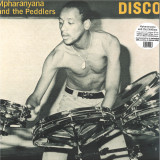
Kalita are proud to announce the first ever official re-release of Mpharanyana & The Peddler's 1979 South African disco and funk recordings 'Disco' and 'Freak Out With Botsotso', backed by a devastating extended edit of 'Disco' courtesy of Amsterdam-based DJ and producer Jamie 3:26. Cut on a loud 12" single and accompanied by an extended edit of 'Disco' courtesy of Jamie 3:26, this truly is another no-brainer from the Kalita camp.
Born on 15th November 1949 in Kattlehong, South Africa, Jacob ‘Mpharanyana’ Radebe was one of South Africa’s greatest ever musicians, releasing a canon of legendary soul, jazz and disco albums before his untimely death in August 1979 at the age of just twenty-nine.
Here, Kalita select his highly sought-after disco and funk recordings ‘Disco’ and ‘Freak Out With Botsotso’, both selected from his 1979 invisible final album, ‘Hela Ngwanana’, re-releasing them for the first time in forty years. Including Paul Simon and Herbie Hancock session musician Bakithi Kumalo on bass and Themba Mokena of Dick Khoza ‘Chapita’ fame on lead guitar, the recordings feature some of the country’s top contemporary musicians joining forces to glorious effect.
With the original album currently fetching eye-watering prices on the rare occasion that they turn up for sale, the time is now ripe to share this masterpiece with the world once more.
RNXRX returns to VEYL for his debut album, 'Impreciso'. No stranger to the label, the artist first made an appearance on 'Previously Undisclosed Rituals' and then again with 'Sigil', a collection of B-sides which act as the perfect prelude to this offering.
Derived from an alchemy of inspiration, the album is the result of endless nights unearthing samples, vinyl oddities, effects databases from a bygone era and the artist’s own post-processed vocals - imprecise components which all combine perfectly to form this LP.
Unconstrained by genre, 'Impreciso' journeys through strains of body music, psychedelic rock, soundtrack and more, delivering electronic experimentations which expose the artist’s darkest tendencies while
revealing a long admiration of post-punk, hip hop and science fiction’s finest.
Twelve tracks falling somewhere between homage and reinvention, 'Impreciso' operates with 80’s circuitry, throws back to 90’s beat nostalgia and drills into a cyber-verse for a familiar yet unexpected trip perfect for this moment.
In 1970 Barney Wilen assembled a team of filmmakers, technicians and musicians to travel to Africa for the purpose of recordi ng the music of the native pygmy tribes. Upon returning to Paris two years later, he created Moshi, a dark, eccentric effort fusing avantjazz sensibilities with African rhythms, ambient sound effects and melodies rootedin American blues traditions. Cut withFrench and African players including guitarist Pierre Chaze, pianist Michel Graillier and percussionist Didier Leon , this is music with few precedents or followers, spanning from extraterrestrial dissonance to earthbound, streetlegal funk. Wilen pays little heed to conventional structure, assembling tracks like "Afrika Freak Out" and "Zombizar" from spare parts of inde terminate origins. (Jason Ankeny, AMG)
Revelatory reissue of Barney Wilen’s ambitious jazz-fusion journey, Moshi (1972), presenting the legendary French jazzman and Miles Davis-sideman’s wildly ambitious effort fusing recordings of Pygmy tribes with African rhythms and stellar avantjazz leanings, sounding little like anything before or since its release. (boomkat)
Super rare and long out of print, the ground-breaking 1972 album from saxophonist Barney Wilen receives a reissue treatment of the highest order. Complete with a 20-page booklet and a never before seen DVD chronicling Wilen’s trip to Africa, this one is sure to be a delight for fans old and new. The deepest spiritual jazz grooves meet field recordings from the Upper Volta and b eyond, whilst psych rock influences collide with hypnotic and shamanistic percussion work. Truly one of the most out -there jazz records we’ve stocked for a long time! (bleep)
Originally issued by the seminal imprint Saravah in 1972, and among the most uncategorizable and sought after artefacts of the French avant-garde, Barney Wilen’s Moshi is nothing short of a masterpiece - long holding a coveted spot in the hearts of adventurous listeners and record collectors alike. A wild unkept cultural collage. A series of sonic experiments. A spiritual, psychedelic pilgrimage into the unknown - darting from one continent to the next, each of its tangents building toward a more optimist world view through ordered sound. Its scope remains as difficult to understand today as it was when it was released. Now brought back into the light by Souffle Continu, this is a moment to be celebrated far and wide. (Soundohm)
Deluxe reissue with additional artwork & remastered audio. 20-page booklet including rare pictures, sheet music & original liner notes. Bonus DVD with exclusive artwork of Caroline de Bendern’s movie « à l’intention de Mlle Issoufou à Bilma » documenting this incredible african journey.
Domino are immensely proud to announce the signing of my bloody
valentine, with new physical editions of the band’s seminal catalogue
being made available. ‘Isn’t Anything’ and ‘loveless’ have been
mastered fully analogue for deluxe LPs and also mastered from new
hi-res uncompressed digital sources for standard LPs, with each
being made available widely for the first time ever. Fully analogue
cuts of ‘m b v’ will also be available on deluxe and standard LPs
globally for the first time.
my bloody valentine, the quartet of Bilinda Butcher, Kevin Shields,
Deb Googe and Colm Ó Cíosóig, are widely revered as one of the
most ground-breaking and influential groups of the past forty years.
During an era in which guitar bands denoted, at best, a retroclassicism, not only did my bloody valentine sound unlike any of their
contemporaries, the band achieved the rare feat of sounding like the
future.
With their debut album, ‘Isn’t Anything’ (originally released in 1988),
my bloody valentine revolutionised alternative music and heralded a
new approach to guitar music for generations to come. The album
birthed a sound which became a template for thousands of new
subgenres, heralding a new approach to guitar music and studio
production. Not only was it a new type of music, it paved the way for a
new type of journalism; inciting comparisons to elemental
phenomenon, tapping into how the music affected the psyche.
Shields and Butcher frequently sang in a similar vocal range that
allowed their voices to blend together. This had the effect of making
their gender indistinguishable, to the point where their voices could
be used as another melodic layer to complement the vertigo-inducing
sounds made by Shields’ guitars. It is a record characterised by the
ominous sense of space that inhabits many of its songs, which
veered between the harried and propulsive, to the subdued and eerie.
Joviale is a multidisciplinary artist from North London making otherworldly, immersive music that plays with “minimal textures, killer interjections and vocals that are equal parts restraint and rage.” (The Times) Looping these high vocals with heady, emotional chords, they weave a screen around the listener, pulling them into chaptered, strangely sweet variations of the artist, divided out across albums, and designed to generate a performative atmosphere, both on stage and through the recording.
For their forthcoming EP Hurricane Belle NEVER SEVEN, spring 2021, Joviale combines warm sensual exposure with a flash of teeth, as the fictional Hurricane Belle whirls onto the scene, an embodiment of the “sense of electric and spiralised chaos” erupting from the artist’s centre. Hurricane Belle is a Champion that was inspired by Peter Shenai’s “Hurricane Bell” experiment, in which he cast brass bells modelled on the five stages of Hurricane Katrina. Industrial, insatiable and metallic, Hurricane Belle is embedded in the album not only through sound, but also through sight; the first single of the project, Blow, will be accompanied by a self-directed video, reflecting Joviale’s increased interest in the visual arts, and in building multisensory experiences. As written in the accompanying prose for the album, “Let yourselves into my breath, my rhythm and my core. Take pleasure in the whiplash of this collection.”
2019 saw the release of the artist’s debut EP Crisis, in which Joviale wielded narrative and storytelling to build a dreamy, silk-wrapped universe across songs such as Dreamboat, and Taste of the Heavens. As with Hurricane Belle, Crisis was created in collaboration with the producer Bullion, and it has been widely supported by press, including interviews in The Face and Coeval, and features in Dazed, Line of Best Fit, Guardian, The Times, Fader, Crack and Clash, among others. The EP also merited radio support from Huw Stephens on BBC Radio 1, Jamz Supernova on BBC 1xtra, Selector FM, Matt Wilkinson on Beats 1, Tom Ravenscroft, Tom Robinson on BBC 6 Music, Dan Alani on Reprezent, and Worldwide FM, among others.
Joviale belongs to a generation of artists with a strong sense of collaborative, interdisciplinary practice. The artist leans into this skill-sharing, research-led community, valuing project-based work that allows for the development of concepts related to visual and sound culture. This is reflected in them having recently directed a video for Laura Groves, as well as running a bi-monthly radio show on NTS over a period of twelve months. They carry a deep interest in the connection between the arts, ecological sciences, and semi-fictive encounters, as well as the wider London scene. In 2019, The Face described Joviale’s sound and aesthetic as “building the London artist a loyal fan base”, an effect that encompasses their involvement in the city’s music circuit; Joviale built a reputation for their live shows before releasing any official music. They have played support shows for artists that include Celeste, Zsela, Kate Tempest, Nilufer Yanya, Babeheaven, Kindness, and Westerman, and, in 2019, Joviale sold out their first headline show at Folklore, Hackney.