
Поиск:v light
Стили
Все

9
2024 repress.
The 2019 Stroom〰 split EP with Hessel Veldman marked the long-awaited vinyl debut of Enno Velthuys and served as a teaser for a reissue campaign of his work, shared between different labels. Finally!
In 1984 Velthuys released his classic tape ‘A Glimpse of Light’ on EXART, the label of Veldman, who stayed in close contact with Enno after hearing one of his private tapes being played on the radio by Willem de Ridder in 1980. During a live-broadcast event random tapes were played. “From Enno Velthuys, The Hague”, was written on the package. Willem introduced the tape, played it and a serene silence filled the studio. Present was a friend of De Ridder, Rob Smit, who visited Enno and his mother a few weeks later. This eventually resulted in Enno’s first release ‘Ontmoeting’ on KUBUS Kassettes in 1982. In those years, Enno was living a solitary life and rarely left his mother’s apartment. He managed to release 6 tapes of introvert, melancholic music from another dimension. Atmospheric melodies backed with sparse percussion, showing an excellent handling of the synthesizer.
The gifted musician with two souls silently passed away in 2009. Now we present, with involvement of the few once close to him, the first reissue of probably his most beloved work. Using the original master tape from the EXART vaults, carefully transferred, edited and remastered. Just Enno with his stripped-down compositions and fragile ambient sounds. An intimate experience celebrating bedroom-music and the glory days of do-it-yourself counterculture.

Cassandra Jenkins ist ganz einfach eine der besten Songwriter-Geschichtenerzählerinnen, die derzeit Musik machen. Sie gehört zu den großen amerikanischen Songwritern, zu Künstlern wie David Berman, Adrianne Lenker, Jeff Tweedy und Sufjan Stevens. Es sind Künstler, die durch ein Gefühl der Unmittelbarkeit verbunden sind, nicht nur durch ihre Texte - die präzise, aufrüttelnd, manchmal brutal und im richtigen Moment witzig sind -, sondern auch durch die Art und Weise, wie sie singen, mit einer tiefgehenden, totalen Überzeugung, die einen durch ihre Lieder trägt. Das sind die Künstler und Lieder, die sich anschleichen und wirklich für immer mit uns leben, und auf „My Light, My Destroyer“ reiht sich Jenkins in diese Reihe ein. Das Bemerkenswerteste an „My Light, My Destroyer“ ist, dass es eine Künstlerin an einem aufregenden Sprung in ihrer Entwicklung zeigt. Vieles an diesem Album unterscheidet sich von seinen Vorgängern; Field Recordings und Found Sound durchdringen es, erzählerisches Songwriting kracht in berauschende, wirbelnde Kompositionen. Jenkins singt mit einer Stimme, die man nur als Powerwhisper bezeichnen kann (man denke an Sufjan Stevens, Annie Lennox, Margo Timmins oder Tweedy aus der YHF-Ära), ihr Gesang ist nah und intim, aber subtil konfrontativ. Aber hier fühlt sich alles größer an, ausgefeilter, kühner und reichhaltiger als bei ihren früheren Arbeiten. Geboren und aufgewachsen in New York City, ist Jenkins seit ihrer Kindheit auf Tournee und tritt auf. Ihre ersten Aufnahmen veröffentlichte sie im Eigenverlag, bevor sie 2021 ihr bahnbrechendes Album „An Overview auf Phenomenal Nature“ veröffentlichte. Auf „My Light, My Destroyer“ sind viele der Songs bestimmten Gefühlen gewidmet, und es geht darum, sich in diese Gefühle hineinzuversetzen, im Gegensatz zu einem erzählerischen Bogen. Die Leadsingle "Only One" ist ein Beispiel dafür, dass ein Moment oder ein Song völlig kurzsichtig sein kann; er kann ein einzelnes Gefühl verkörpern und bietet keine Antworten. Songs wie "Devotion", "Delphinium Blue", "Clams Casino", "Echo" und "Only One" sprechen von der befreienden Qualität einer fokussierten Beobachtung, selbst bis zum Punkt der Desillusionierung. "Es gibt diese Idee der Desillusionierung, an der ich festgehalten habe", sagt sie. "Ich schätze Desillusionierung als einen Prozess, bei dem man neue, unerwartete Ergebnisse entdeckt. Wir lassen auf diese Weise Erwartungen los. Erwartungen halten uns zurück. Es ist leicht, sich auf Abstumpfung oder Enttäuschung zu konzentrieren, aber ich sehe es eher als Freiheit".

Cassandra Jenkins ist ganz einfach eine der besten Songwriter-Geschichtenerzählerinnen, die derzeit Musik machen. Sie gehört zu den großen amerikanischen Songwritern, zu Künstlern wie David Berman, Adrianne Lenker, Jeff Tweedy und Sufjan Stevens. Es sind Künstler, die durch ein Gefühl der Unmittelbarkeit verbunden sind, nicht nur durch ihre Texte - die präzise, aufrüttelnd, manchmal brutal und im richtigen Moment witzig sind -, sondern auch durch die Art und Weise, wie sie singen, mit einer tiefgehenden, totalen Überzeugung, die einen durch ihre Lieder trägt. Das sind die Künstler und Lieder, die sich anschleichen und wirklich für immer mit uns leben, und auf „My Light, My Destroyer“ reiht sich Jenkins in diese Reihe ein. Das Bemerkenswerteste an „My Light, My Destroyer“ ist, dass es eine Künstlerin an einem aufregenden Sprung in ihrer Entwicklung zeigt. Vieles an diesem Album unterscheidet sich von seinen Vorgängern; Field Recordings und Found Sound durchdringen es, erzählerisches Songwriting kracht in berauschende, wirbelnde Kompositionen. Jenkins singt mit einer Stimme, die man nur als Powerwhisper bezeichnen kann (man denke an Sufjan Stevens, Annie Lennox, Margo Timmins oder Tweedy aus der YHF-Ära), ihr Gesang ist nah und intim, aber subtil konfrontativ. Aber hier fühlt sich alles größer an, ausgefeilter, kühner und reichhaltiger als bei ihren früheren Arbeiten. Geboren und aufgewachsen in New York City, ist Jenkins seit ihrer Kindheit auf Tournee und tritt auf. Ihre ersten Aufnahmen veröffentlichte sie im Eigenverlag, bevor sie 2021 ihr bahnbrechendes Album „An Overview auf Phenomenal Nature“ veröffentlichte. Auf „My Light, My Destroyer“ sind viele der Songs bestimmten Gefühlen gewidmet, und es geht darum, sich in diese Gefühle hineinzuversetzen, im Gegensatz zu einem erzählerischen Bogen. Die Leadsingle "Only One" ist ein Beispiel dafür, dass ein Moment oder ein Song völlig kurzsichtig sein kann; er kann ein einzelnes Gefühl verkörpern und bietet keine Antworten. Songs wie "Devotion", "Delphinium Blue", "Clams Casino", "Echo" und "Only One" sprechen von der befreienden Qualität einer fokussierten Beobachtung, selbst bis zum Punkt der Desillusionierung. "Es gibt diese Idee der Desillusionierung, an der ich festgehalten habe", sagt sie. "Ich schätze Desillusionierung als einen Prozess, bei dem man neue, unerwartete Ergebnisse entdeckt. Wir lassen auf diese Weise Erwartungen los. Erwartungen halten uns zurück. Es ist leicht, sich auf Abstumpfung oder Enttäuschung zu konzentrieren, aber ich sehe es eher als Freiheit".

10
Boxed set of five 7-inch vinyl records, 300 copies limited edition. Artwork poster included.
All tracks remastered from the original master tapes.
Alessandro Alessandroni is no longer remembered simply as 'the whistler' in Morricone's spaghetti western soundtracks – and rightly so, since he was the key figure behind much of Italian 'secret music' from the 60s and 70s, always there in the studio during recording sessions, whether as a multi-instrumentalist or as the leader of session vocal group I Cantori Moderni di Alessandroni. Today his pervasive presence and important role has been finally recognized by music professionals and enthusiasts alike, so much so that he is now considered the true father of Italian library music – a genre whose sound he shaped since 1968.
As a film composer, Alessandroni often worked for small productions that had very limited (and often regional-only) distribution, and whose budgets were worlds apart from those in the 'top league' where friends and colleagues like Morricone, Bacalov, Trovajoli or Piccioni thrived. Rarely released as a soundtrack, this music ended up, at best, forgotten inside dusty ¼-inch reels or, at worst, disappearing into thin air.
After a string of releases that have brought back to life forgotten or lost works by Alessandroni (Sangue di Sbirro, Afro Discoteca, Lost and Found, etc.), it was pretty natural for us at Four Flies to start delving into a little investigated area of his filmography: his scores for erotic films, the last genre to gain popularity in the flourishing Italian film industry of the 60s and 70s, and perhaps the most extreme too, the one that, by pushing things too far, eventually put an end to that industry and its genres.
So, we're now very proud to present Alessandroni Proibito, an exclusive boxed set of five 7-inch records. It contains a total of 14 previously unreleased tracks from the soundtracks of 4 soft-core erotic films that included hard-core sequences and, therefore, fell somewhere in-between normal commercial distribution and the underground scene of adult movie theatres.
Taking an artisanal approach to his musical craft, Alessandroni was not afraid of having to deal with spicy subject matter, wobbly productions, implausible plots, improvised actors, or cinematographers who were clearly no disciples of Storaro. And he was so good at making a virtue out of necessity, at turning budget constraints into creative advantages, that he created soundtracks that far surpass the films' quality, with music that at once captures and elevates the spirit of the erotic genre as if into a condensed symbol.
More specifically, the maestro recorded many of the pieces in a DIY fashion at home, using a 4-track Teac tape machine to arrange his compositions. The Teac allowed him to play different instruments on each track, which meant he could basically put an entire soundtrack together all by himself, or almost all by himself.
These recordings often feature drum machines – which provide that retro, early electronic music vibe – as well as funk guitars and exotic-sounding percussion in the rhythm tracks. In addition, there is an extensive, almost bewildering use of synthesizers to replace solo instruments that would have required a paid session player. On top this minimalist arrangement, Alessandroni layered what he could: some piano chords, a little flute and, most importantly, his signature 12-string guitar phrasing.
The result is just stunning: a unique mixture of electronic music and acoustic instruments, in a style that stops short of kitsch and ranges from cinematic ambient pieces like "Tensione erotica" to disco-funk tracks like "Snake Disco" and "One Sunday Morning", both of which feature vocals by Alessandroni himself.
Alessandroni Proibito comes with artwork by Eric Adrien Lee and a matching 30x70cm folded poster inspired to the insert-size posters which used to be hung outside movie theatres to attract cinema-goers.
The boxed set is being released in a limited edition of just 300 copies and will never be reissued. First come, first served.

For The Elektric Band’s sophomore outing, Chick Corea - the venerated 27-time Grammy winner and National Endowment for the Arts Jazz Master - entered the studio with Dave Weckl on drums, John Patitucci on bass, and two new players who would solidify the band’s classic line up, guitarist Frank Gambale and saxophonist Eric Marienthal.
More heavily produced than its predecessor, Light Years contains several sequence-driven tracks, Corea’s attempt at reaching out to a wider audience with a brand of music that was tighter, funkier and eminently more communicative than he had recorded on 1986’s The Chick Corea Elektric Band.
The crisp, irrepressibly catchy title track is a prime example of Corea’s more commercial aspirations for the album, with Patitucci laying down a fat, funky groove with some hearty slap bass lines (a distinct flavor of the time), and Marienthal’s pungent alto sax strutting over the top. Not only did this groove-oriented track catch on with listeners, it also won a Grammy for Best R&B Instrumental Performance at the 31st Annual Grammy Awards.
Originally released on GRP Records in 1987, the album also contains the dreamy contemporary jazz offerings of “Second Sight” and “The Dragon,” the sequence-driven “Time Track”, “Flamingo,” featuring Carlos Rios on guitar and, the electrifying, techno tour de force, highly complex closer, “Kaleidoscope.

10
For fans of - Darko, Bad Omens, Deftones, Alice In Chains On tour in the US April- May 2024 w/ Attila + Born Of Osiris Band names go a long way in helping paint a figurative picture in the listeners mind of what to expect before one ever hits “play.” When it comes to Extortionist, you think crime—you think gritty, raw, merciless and unsavory and maybe, just maybe, a little sprinkling of suaveness. When it comes to the Pacific Northwest’s resident moshslingers, those premonitions from their name are exactly what you get. As a band who have proven themselves exemplary at styles of heavy music ranging from downtempo deathcore to grunge- tinted metal, Extortionist are more than just a jack-of-all-trades; they’re masters. Utilizing bold, roaring guitars overtop crushing, steamrolling percussion and vocals that run the gamut from guttural to grating, pitched singing and topped off with—you guessed it—a now-infamous dodgeball-smack snare, Extortionist have proven that not only are they incredible at what they do, they’re a band that the heavy scene just can’t go without.

6
When the world's chatter is hushed to a whisper and emptiness replaces clutter, time falls away completely, exposing a vast, open canvas for the imagination fill with reflection, contemplation and abstraction. On their first collaborative album, released via Caterina Barbieri's light-year's label, Grand River and Abul Mogard gaze longingly into the abyss, capturing atemporality, splendour and tranquility with confident, impressionistic sonic strokes. Dynamic and poignant, 'In uno spazio immenso' balances on a knife-edge between booming, operatic grandeur and soft-focus simplicity, casting as much light on the subtle outlines and illusory rhythms as it does its dense, almost overpowering textures.
Berlin-based Dutch-Italian composer and sound designer Aimée Portioli, aka Grand River, has been evolving her unique musical language since she released 'Crescente' on Donato Dozzy and Neel's Spazio Disponibile imprint in 2017. A trained linguist, she uses her instrumentation and advanced processes to challenge cultural perceptions, portraying emotions and moods rather than fixed, visual images. Abul Mogard meanwhile is just one of veteran Italian producer Guido Zen's many aliases, and over a series of acclaimed albums for labels like Ecstatic, Houndstooth and VCO, he's muddled fiction with stark reality, shaking kosmische synth fantasies into post-industrial ambience and blissful shoegaze memories.


11
"Light Up The Sky" ist die zweite Veröffentlichung von SUNBOMB, der musikalischen Allianz zwischen zwei unerschütterlichen Vertretern der
amerikanischen Hard Rock/Metal Szene, Tracii Guns und Michael Sweet.
Es ist eine Hommage an den klassischen Heavy Metal der 80er Jahre und vereint Einflüsse klassischer Metal-Bands wie Black Sabbath, Ozzy Osbourne,
Dio und Judas Priest. Die Musik ist sehr heavy und fest in der Kategorie 'Metal' verankert, mit einem Augenzwinkern zu einem traditionellen Ansatz
des Genres. Während Tracii die Musik für das Album schrieb, machte die Tatsache, dass Michael Sweet auf den letzten Stryper-Alben einen
zunehmend härteren Stil verwendete, ihn zur perfekten Wahl für den Gesang auf dem Album.
Tracii ließ die Neuigkeiten über das neue Projekt in einem Tweet im März 2019 durchsickern, in dem er die Debüt-LP des Projekts als "die
Metal-Platte, die ich mit 17 Jahren gemacht hätte" beschrieb. Tracii hat auf dem Album alle Gitarren und den Bass gespielt, die Drums wurden von
Traciis altem L.A. Guns-Bandkollegen Adam Hamilton übernommen.

Introducing Jahnah Camille (pronounced Hannah), a young artist emerging from the DIY scene of Birmingham, Alabama. Camille's songs capture the rollercoaster of teenage angst, heartbreak and introspection over a well-made bed of driving guitars and catchy, compact melodies. A five-track EP infused with anxiety and grit, i tried to freeze light, but only remember a girl, is a shining introductory project smoothed over by Camille's sugar-sweet voice and cutting lyricism. Much of the EP's songs were written and recorded while Camille was still in high school, taking trips back and forth from Atlanta to record. In the time following, Camille dug into the local DIY scene, steadily gaining an impressive resume of opening slots as she cut her teeth supporting acts like Clairo, Soccer Mommy, Cryogeyser and Wednesday as they came through town. Now 19 years old, Camille delivers an excellent snapshot of those uncertain and wildly hopeful late teen years. i tried to freeze light captures Camille approaching heartbreak and self-perception from a variety of angles-each track playing slightly with genre and cadence and infused with influence from her musical heroes, like Liz Phair and Fiona Apple. The EP pulls at a range of alternative rock and pop threads, there's the 90s alternative rock opener "flesh" and the country-gaze-tinged "roadkill." Camille then softens on the swooning synth-layered ode to love lost, "elliot," before relaxing into a folksy, acoustic "paper doll."I wanna talk and not spill out carnival sounds" Camille confides on closer "carnival sounds"--a track that illuminates the singer's art-pop influences and knack for revealing tender and at times searing admissions through her lyricism. While misunderstandings color the emotional sentiment of the EP, Camille's artistry and expression come through clear as day on i tried to freeze light, presenting her as a promising young voice with real talent and a hunger for musical experimentation.

- A1: State Of The Art - Live
- A2: The Way We Used To Roll - Live
- A3: Room 13 - Live
- A4: Ameri'ka - Live
- A5: Shining Down - Live
- A6: I & I Survive - Live
- B1: She Don't Love Me Now - Live
- B2: If I Should Fall From Grace With God - Live
- B3: St. Christopher - Live
- B4: Gray Skies Look So Blue - Live
- B5: Meet Me At The End Of The World - Live
- B6: Greener Pastures - Live
12
Der begleitende Film von Dave Stekert und Xander Strohm fängt die Zeit in New York ein, als Covid 19 alles abschaltete, die Menschen Angst hatten
und nichts sicher war. Die Kreativen mussten trotzdem kreativ sein, und Jesse Malin fand einen Weg, die Menschen über seine wöchentliche
Streaming-Show "The Fine Art of Self Distancing" zu erreichen. Ein großes Publikum fand Gefallen daran, dass Jesse Geschichten erzählte, sang,
tanzte, uns zum Lachen brachte und uns wissen ließ, dass alles gut werden würde. Er lud seine Freunde ein, mit ihm über die Geschehnisse in der
Welt zu sprechen, darunter Lucinda Williams, Debbie Harry, Jimmy G, Alejandro, Bob Gruen, Craig Finn, Tommy Stinson, Fred Armisen, David Fricke,
Pete Yorn, Graham Parker, Butch Walker, Lenny Kaye, Michael Imperially, Jim Jarmusch, DMC, Uncle Floyd und Bob Strauss.
Zu den musikalischen Gästen gehören Tommy Stinson, H.R. (Bad Brains), Eugene Hutz (Gogol Bordello), Cat Popper (Puss N Boots, Jack White, Grace
Potter), David "Immy" Immerglück (Counting Crows). Sie singen die Lieder von Jesse Malin und Lieblingslieder von The Pogues, Bad Brains, The
Ramones.

- Moon Watching (Shin Joong Hyun)
- Please Don't Bother Me Anymore (Golden Grapes)
- The Man Who Must Leave (Kim Sun)
- The Sun (Kim Jung Mi)
- I Don't Like (Lee Jung Hwa)
- Please Wait (Jang Hyun)
- Spring Rain (Park In Soo)
- Tomorrow (Lee Jung Hwa)
- Blues 72 (Shin Joong Hyun)
- Pushing Through The Fog (Jang Hyun)
- I've Got Nothing To Say (Shin Joong Hyun)
- Why That Person? (Bunny Girls)
- Sunset (Jang Hyun)
- Beautiful Rivers And Mountains (Shin Joong Hyun & The Men)
14
Nachpressung! Black Blue Splatter Vinyl Doppel-LP im Klappcover. "Beautiful Rivers And Mountains: The Psychedelic Rock Sound Of South Korea's SHIN JOONG HYAN 1958-1974": erzählt die persönliche, spirituelle und tiefgründige Geschichte von SHIN JOONG HYUN und zeigt das gesamte Spektrum der menschlichen Emotionen, die in wunderschönen und rastlosen Sounds münden. Zum ersten Mal ist diese Musik auch außerhalb von Korea erhältlich. "Beautiful Rivers." versammelt einen Überblick über die gesamte Karriere des Gitarristen, Songwriters, Produzenten, Komponisten und Talentscouts. Als er mit seiner Karriere Mitte der Fünffziger Jahre begann, spielte er vor den amerikanischen Truppen in Korea. Obwohl er nur wenig Englisch sprach, kommunizierte er durch seine Gitarren, konnte jedoch viel mehr ausdrücken als nur das, was ein Sessionmusiker konnte. Ein musikalischer Trip zwischen Motown, HENDRIX und THE VELVET UNDERGROUND, so süchtig machend wie eine Flasche des besten koreanischen Soju. Der erste asiatische Musiker und erst der sechste, der so wie zum Beispiel ERIC CLAPTON und EDDIE VAN HALEN, eine Fender Custom Shop Tribute Series Gitarre erhielt.

7
- 7 essential classics from Shin Joong Hyun, the godfather of Korean rock - Includes track-by-track notes from Mr. Shin - Pressed on "Yellow Jacket" Wax // Shin Joong Hyun's tale is personal, spiritual, and deep, not only reflecting the full spectrum of human emotions but also reverberating with echoes of sound, some beautiful and life-giving, others restless and ungovernable. These career-spanning anthologies gather Shin's work as a guitarist, songwriter, producer and arranger of mind-altering experimental pop, acid-folk, and extended psych-funk jams. A musical trip existing somewhere between Motown, Hendrix, and the Velvet Underground. "...as important to Korean rock in 1970-75 as Phil Spector had been to America's pop scene a decade earlier, and every bit as busy." - MOJO

- A1: Anna's Theme - 1 55
- A2: The Light Ii With / Schola Cantorum Reykjavicensis - 3 49
- A3: 17 03.22 - 3 15
- A4: Tranquillant - 2 53
- A5: Disturbance - 2 02
- A6: Transcending - 3 31
- A7: Tephra Horizon - 3 00
- B1: Fragility - 2 19
- B2: Near Ending - 4 38
- B3: Full Circle - 3 44
- B4: Dreaming Of Light - 4 15
- B5: Resolution - 4 59
Auf ihrem neuen Album "The Light" folgt die isländische Pianistin und Komponistin Eydís Evensen ihrem inneren Licht und eröffnet verträumte musikalische Räume voller Hoffnung. Dabei verbindet sie ihre minimalistischen Piano-Melodien und emotionalen, teilweise um Bläser erweiterten Streicherarrangements erstmals mit subtilen Vokalpassagen. So ist nicht nur ein Chor zu hören, sondern auch meditativ übereinander geschichtete Gesangspassagen von Eydís Evensen selbst. Thematisch reflektiert die aus dem rauen Norden Islands stammende Musikerin auf "The Light" wie die kargen und zerklüfteten Landschaften ihres Heimatlandes ihre Persönlichkeit geformt haben. Für Eydís Evensen ist diese Erfahrung von dem Aufeinandertreffen zweier Pole gekennzeichnet: dem "inneren Licht", das uns leitet, und dem natürlichen Licht, das in den dunklen isländischen Wintern so selten zu sehen ist. Das "innere Licht" beschreibt für sie ein Gefühl von Hoffnung und Zuversicht. Einen persönlichen Safe-Space, den sie bereits als Kind mit der Musik nach Außen getragen und in der realen Welt eröffnet hat; in die Dunkelheit und Einsamkeit im Norden Islands. Mit "The Light" möchte Eydís Evensen diesen musikalischen Safe-Space mit ihren Zuhörer*innen teilen und eine Botschaft der persönlichen und kollektiven Hoffnung und Widerstandsfähigkeit an sie weiter geben. Mit den Titeln ihrer Kompositionen stellt Eydís Evensen immer wieder den Zusammenhang von der inneren Prägung mit der äußeren Erfahrung entlang der spektakulären Landschaftsbilder Islands her. So bezieht sich "Tephra Horizon" auf den Abdruck, den die Asche eines einzigen Vulkanausbruchs in der Landschaft hinterlassen kann. Die Inspiration für dieses kraftvolle Stück mit Klavier, Bläsern und Streichern liefert der Vulkanausbruch des Fagradalsfjall im Jahr 2021 mit seiner zerstörerischen Kraft und seinem dramatischen Ausgang. Im dazugehörigen Musikvideo von Einar Egilsson ist zu sehen, wie Eydís Evensen in der Nähe des ursprünglichen Ausbruchsorts auf der Tephra-Schicht - der erkalteten Lava - tanzt, als würde sie das Gebiet für sich beanspruchen. Darüber hinaus hat Eydís Evensen Einflüsse aus der isländischen Chor- und Erzähltradition mit ihren vielen Sagen, die bis auf die frühesten Tagen der Besiedlung zurückgehen, auf ihrem Album verarbeitet. Ihr Chorstück "The Light II" basiert auf einem ihrer eigenen Gedichte und wurde mit dem isländischen Chor Schola Cantorum Reykjavicensis aufgenommen. Ihre eigene Gesangsstimme ist im Lied "Dreaming of Light" zu hören, für das Evensen auch den Text geschrieben hat.

Having been based in Sussex, Philip moved to an old mill in France and never stopped writing. In 2014 he released his organic and honest solo debut album "I'm Not The Man I Used To Be". This was followed up by the critically acclaimed Mental Home Recordings is upon us. And now Philip Parfitt is set to release Dark light via Chicago/London/Paris based label Tip Top Recordings.
A significant milestone in his long accomplished career, Dark Light features 10 beautifully crafted pieces, including deep cuts 'I know I shouldn't but voices' and 'Dark light' the title track, give ample evidence of Philip's prowess as a wordsmith and musician, but also arranger and producer. Think Nick Drake and Captain Beefheart accidentally bumping into each other at a private viewing of Bright Sta
in Heaven, you won't be too far out of the crease. Philip is accompanied by a merry band of friends and luminaries including Alex Creepy Mojo, Amelie Fish, Lucie Robet (who also wrote title track Dark Light with Philip), Gilda Scouarnec, Rog Mogale (who also mastered the album), and Mark Refoy.
Dark Light is released on digital, CD, limited edition vinyl LP with 200 copies in black and 200 copies in dark purple to match the darkly beautiful artwork by Fernando Ruibal. Sleeve notes come from Matthew Spector within the included booklet with art from Joane Charlotte Senechal, photography by Sarah Baba, and design by Anna Mort.

Echoplex Makes a Triumphant Return With His Latest Ep, "Light Strike," on Soleil Records. After Overcoming Adversity, He's Back With a Revitalized Sound That Blends Classic Techno With New Energy. the Ep Promises to Ignite Dancefloors With Its Haunting Pads, Pulsating Rhythms, and Bold Experimentation. Welcome Back, Echoplex - the Techno Underground Awaits Your Electrifying Beats!...

11
First time on vinyl!
Newly remastered. LP housed in a gatefold jacket.
Featuring Herbie Hancock, Martha Reeves, Alphonse Mouzon, Chuck Rainey, Patryce “Choc’let” Banks, Carlos Morales, and members of The Pointer Sisters.
In the 1970s, Betty Davis defied genre and gender by pushing her voice to extremes and embracing the erotic. She articulated a kind of pre-punk, funk-blues fusion that had yet to be normalized in mainstream music – a style that few musicians have come close to replicating. As one of the first Black women to write, arrange, and produce her own albums, Betty was a visionary who disregarded industry boundaries and constraints. Raw, unapologetic and in full control, Betty paved the way for generations of future artists who said “funk you” to the music industry and social norms.
In 1979, when Davis entered an L.A. studio to record her fifth and final album, she was reeling from a series of setbacks. Three years earlier, after recording her fourth album, Is It Love Or Desire, Davis was dropped from her label and the LP was subsequently shelved. In 1978, her beloved band Funk House went their separate ways. Looking for a fresh start, Davis relocated to Hollywood to focus on songwriting. Before long, British manager Simon Lait (Toni Basil), offered to fund her next project.
With renewed vigor, Davis reunited with former Funk House guitarist Carlos Morales and brought together industry veterans like fusion drummer Alphonse Mouzon and session bassist Chuck Rainey. Old friends Anita and Bonnie Pointer (The Pointer Sisters) and Patryce “Choc’let” Banks joined Davis on vocals, as did Motown legend Martha Reeves. The resulting album, Crashin’ From Passion, was her most musically diverse, blending elements of reggae and calypso (“I’ve Danced Before”), jazz (“Hangin’ Out in Hollywood,” “Tell Me a Few Things”), dark synth-pop (“She’s a Woman”), and even disco (“All I Do Is Think of You”). Equally exploratory are Davis’ vocals, as she trades in her signature sass and snarls for more nuanced stylings.
Among the album’s few funk tracks is “Quintessence of Hip,” in which Davis hails musicians like Bob Dylan, Billie Holiday, Stevie Wonder, and John Coltrane, while deftly integrating elements of their work. The song also offers a moment of stark vulnerability, as she sings, “Isn’t rich? Isn’t it queer? Losing my timing so late in my career.” It would prove to be a prophetic line in the months to follow.
The mixing process was mired by artistic differences and then cut short, amid the death of Davis’ beloved father. Bereft and exasperated, Davis returned home for the funeral, setting into motion her retirement from the music industry. Crashin’ From Passion, meanwhile, would be shelved for 15 years and licensed for a CD-only release, without Davis’ consent, in the ‘90s. This 2023 edition of the album, made with Davis’ full approval and cooperation, marks its first official release and first time ever on vinyl. The package was designed by GRAMMY®-winning artist, Masaki Koike, while the album cover features an incredible shot of Betty captured in London in the mid-1970s by renowned photographer Kate Simon.
Crashin’ From Passion was remastered by Dave Cooley at Elysian Masters and pressed on vinyl at Record Technology, Inc. (RTI). The accompanying booklet includes a treasure trove of rare photos from the era, plus lyrics, and new liner notes by writer, ethnomusicologist, and Betty’s close friend, Danielle Maggio, who integrates interviews that she conducted with Davis, marking her last ever interviews.
One can hardly imagine the genre-busting, culture-crossing musical magic of Outkast, Prince, Erykah Badu, Rick James, The Roots, or even the early Red Hot Chili Peppers without the influence of R&B pioneer Betty Davis. Her style of raw and revelatory punk-funk defies any notions that women can’t be visionaries in the worlds of rock and pop. In recent years, rappers from Ice Cube to Talib Kweli to Ludacris have rhymed over her intensely strong but sensual music.
There is one testimonial about Betty Davis that is universal: she was a woman ahead of her time. In our contemporary moment, this may not be as self-evident as it was thirty years ago – we live in an age that’s been profoundly changed by flamboyant flaunting of female sexuality: from Parlet to Madonna, Lil Kim to Kelis. Yet, back in 1973 when Betty Davis first showed up in her silver go-go boots, dazzling smile and towering Afro, who could you possibly have compared her to? Marva Whitney had the voice but not the independence. Labelle wouldn’t get sexy with their “Lady Marmalade” for another year while Millie Jackson wasn’t Feelin’ Bitchy until 1977. Even Tina Turner, the most obvious predecessor to Betty’s fierce style wasn’t completely out of Ike’s shadow until later in the decade.
Ms. Davis’s unique story, still sadly mostly unknown, is unlike any other in popular music. Betty wrote the song “Uptown” for the Chambers Brothers before marrying Miles Davis in the late ’60s, influencing him with psychedelic rock, and introducing him to Jimi Hendrix — personally inspiring the classic album Bitches Brew.
But her songwriting ability was way ahead of its time as well. Betty not only wrote every song she ever recorded and produced every album after her first, but the young woman penned the tunes that got The Commodores signed to Motown. The Detroit label soon came calling, pitching a Motown songwriting deal, which Betty turned down. Motown wanted to own everything. Heading to the UK, Marc Bolan of T. Rex urged the creative dynamo to start writing for herself. A common thread throughout Betty’s career would be her unbending Do-It-Yourself ethic, which made her quickly turn down anyone who didn’t fit with the vision. She would eventually say no to Eric Clapton as her album producer, seeing him as too banal.
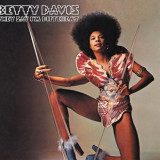
Her 1974 sophomore album They Say I’m Different features a worthy-of-framing futuristic cover challenging David Bowie’s science fiction funk with real rocking soul-fire, kicked off with the savagely sexual “Shoo-B-Doop and Cop Him” (later sampled by Ice Cube). Her follow up is full of classic cuts like “Don’t Call Her No Tramp” and the hilarious, hard, deep funk of “He Was A Big Freak.”

11
First time on vinyl!
Newly remastered. LP housed in a gatefold jacket.
Featuring Herbie Hancock, Martha Reeves, Alphonse Mouzon, Chuck Rainey, Patryce “Choc’let” Banks, Carlos Morales, and members of The Pointer Sisters.
In the 1970s, Betty Davis defied genre and gender by pushing her voice to extremes and embracing the erotic. She articulated a kind of pre-punk, funk-blues fusion that had yet to be normalized in mainstream music – a style that few musicians have come close to replicating. As one of the first Black women to write, arrange, and produce her own albums, Betty was a visionary who disregarded industry boundaries and constraints. Raw, unapologetic and in full control, Betty paved the way for generations of future artists who said “funk you” to the music industry and social norms.
In 1979, when Davis entered an L.A. studio to record her fifth and final album, she was reeling from a series of setbacks. Three years earlier, after recording her fourth album, Is It Love Or Desire, Davis was dropped from her label and the LP was subsequently shelved. In 1978, her beloved band Funk House went their separate ways. Looking for a fresh start, Davis relocated to Hollywood to focus on songwriting. Before long, British manager Simon Lait (Toni Basil), offered to fund her next project.
With renewed vigor, Davis reunited with former Funk House guitarist Carlos Morales and brought together industry veterans like fusion drummer Alphonse Mouzon and session bassist Chuck Rainey. Old friends Anita and Bonnie Pointer (The Pointer Sisters) and Patryce “Choc’let” Banks joined Davis on vocals, as did Motown legend Martha Reeves. The resulting album, Crashin’ From Passion, was her most musically diverse, blending elements of reggae and calypso (“I’ve Danced Before”), jazz (“Hangin’ Out in Hollywood,” “Tell Me a Few Things”), dark synth-pop (“She’s a Woman”), and even disco (“All I Do Is Think of You”). Equally exploratory are Davis’ vocals, as she trades in her signature sass and snarls for more nuanced stylings.
Among the album’s few funk tracks is “Quintessence of Hip,” in which Davis hails musicians like Bob Dylan, Billie Holiday, Stevie Wonder, and John Coltrane, while deftly integrating elements of their work. The song also offers a moment of stark vulnerability, as she sings, “Isn’t rich? Isn’t it queer? Losing my timing so late in my career.” It would prove to be a prophetic line in the months to follow.
The mixing process was mired by artistic differences and then cut short, amid the death of Davis’ beloved father. Bereft and exasperated, Davis returned home for the funeral, setting into motion her retirement from the music industry. Crashin’ From Passion, meanwhile, would be shelved for 15 years and licensed for a CD-only release, without Davis’ consent, in the ‘90s. This 2023 edition of the album, made with Davis’ full approval and cooperation, marks its first official release and first time ever on vinyl. The package was designed by GRAMMY®-winning artist, Masaki Koike, while the album cover features an incredible shot of Betty captured in London in the mid-1970s by renowned photographer Kate Simon.
Crashin’ From Passion was remastered by Dave Cooley at Elysian Masters and pressed on vinyl at Record Technology, Inc. (RTI). The accompanying booklet includes a treasure trove of rare photos from the era, plus lyrics, and new liner notes by writer, ethnomusicologist, and Betty’s close friend, Danielle Maggio, who integrates interviews that she conducted with Davis, marking her last ever interviews.
