Search:väth

Styles
All
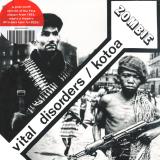
Vital Disorders & Kotoa - Zombie (7")

Vital Disorders & Kotoa

Zombie (7")

7"-VinylWAH7065
Wah Wah 45s
11.09.2025
  • A1: Vital Disorders - Zombie
  • B1: Kotoa - Zombie

Wah Wah 45s present a unique moment from 1982 where New Wave and Post Punk collided with Afrobeat in the shape of Norwich DIY outfit Vital Disorders and their subversive yet instantly memorable version of the Fela Kuti classic, Zombie.

Band member Suzy Cox explains more:

"The song came to the band through our vocalist Lenneka Van Gilst who was in the group between January 1980 and December 1981. Lenneka grew up in Nigeria and had the original track on vinyl. When she moved to Trowse House, Norwich, the flat under Chris, the VD's bass player, he heard the vibes floating through the floorboards. One thing led to another and it was in our set for ages. Lenneka had left the band to travel to Mexico by the time we recorded the track. We did well to choose it as the song has really stood the test of time. Lenneka had a lot of African Beat which was a big influence on us."

The track came to label boss Dom Servini's attention having been unearthed by BBC 6 Music DJ Gilles Peterson in late 2024, and a vinyl reissue of this rare and one-off gem was the obvious choice. Rather than pairing it with its original punky B-side though, Dom enlisted new signings to the label - young Afro-dub outfit Kotoa - to record their take on the Kuti classic. The quintet delivered what is a three minute, intense take on the Afrobeat genre, complete with youthful voices of protest echoing those of over 30 years ago.

The 7-inch vinyl only release of Zombie comes with re-worked art courtesy of our award winning designer Animisiewasz, taking the home-made look of the original cover and updating it respectfully for 2025.

out of Stock

Order now and we will order the item for you at our supplier.

18,07

Last In: 47 days ago
Various - Dolores: Salsa & Guaracha From 70's French West Indies

In Guadeloupe, many people think that jazz and ka music are like a ring and a finger. To some extent, the same could be said about so called Latin music and the music played in the French West Indies.

Both aesthetics were born in the Caribbean and bear so many connections that they can easily be considered cousins. In constant dialogue, there are lots of examples of their fruitful alliance and have been for a while. The English country dance that used to be practiced in European lounges came to be called kadrille in Martinique and contradanza in Cuba. They both featured additional percussion instruments inherited from the transatlantic deportation. Drawing from shared feelings about the same traumatized identity – later to be creolized – it would be hard not to assume that they were meant to inspire each other. The golden age of the orchestras that graced the Pigalle nights during the interwar period further proves the point. As soon as the 1930s, Havana-born Don Barreto naturally mixed danzón and biguine music in a combo based at Melody's Bar. In the following decade, Félix Valvert, a conductor who was born and raised in Basse-Terre in Guadelupe, also worked wonders in Montparnasse with La Coupole, which was an orchestra made up of eclectic musicians. Afro- Caribbean performers of various origins were often hired on rhythm and brass sections in jazz bands, which used to enliven the typical French balls of the capital. In the 1930s and onwards, Rico’s Creole Band was one of them.


Martinican violinist-clarinettist Ernest Léardée, who would become the king of biguine music as well as the main figure of French Uncle Ben's TV commercials (a dark stigma of post-colonial stereotypes), had musicians from the whole Caribbean sphere play at his Bal Blomet – and they all enchanted "ces Zazous-là" (according the words of Léardée's biguine-calypso piece). In les Antilles (French for French West Indies), music history started to speed up in the 1950s, when trade expanded and radio stations grew bigger. The Guadelupean and Martiniquais youth tuned in their old galena radio sets to South American and Caribbean music. As for the women traders, les pacotilleuses, they bought and sold goods across different islands (the "passing of items through various hands" was thought to be most pleasurable) and brought back countless sounds in their luggage. Such was the case of Madame Balthazar, who once returned from Puerto Rico with the first 45rpm and 33rpm to ever enter Martinique.

Out of this adventure was created the famous Martinican label La Maison des Merengues, a music business she opened and undertook with her husband and which proved to be a major landmark. At the end of the 1950s, in Puerto Rico, Marius Cultier competed in the Piano International Contest playing a version of Monk's Round 'Midnight. He won the first prize and this distinction foreshadowed everything that was to come. Cultier, the heretic Monk of jazz, was quickly praised for writing superb melodies, always tinged with a twist that conferred a unique sound to his music. It didn't take long for the gifted self-taught musician to get to play with Los Cubanos, making a name for himself thanks to his impressive maestria on merengues.

The rest is history. Besides, in the late 1950s, Frantz Charles-Denis, born into the upper middle class in Saint-Pierre and better known by his first name Francisco, went back home after working at La Cabane Cubaine – a club located rue Fontaine where he had caught the Latin fever. Francisco's music was therefore heavily marked by his Cuban cousins' influence, which gave the combos he led a specific style and also led to renewal. Things were swinging hard in La Savane, located in the main square in Fort-de-France. He set up the Shango club close by and tested out the biguine lélé there, a new music formula spiced up with Latin rhythms. Soon afterwards, fate had him fly to Puerto Rico and Venezuela.

As for percussionist Henri Guédon (percussions were only a part of his many talents), he was born in Fort-de-France in May 22nd 1944, the day marking the celebration of the abolition of slavery. As an old man, he could remember that in " his father's Teppaz, a lot of hectic 6/8 music was constantly playing...". In the opening lines of his Lettre à Dizzy, a small illustrated collection of writings published by Del Arco, he highlighted the huge impact that cubop had on him as a teenage boy, around 1960. He eventually turned out to be the lider maximo in La Contesta, a big band steeped in Latin jazz. He was also the one who originated the word zouk to describe music which brought the sound of the New York barrio to Paris. It was the culmination of a journey that started in Sainte-Marie: "a mythical place for bélé, the equivalent of Cuban guaguancó". In the early 1960s, the tertiary economy developed to the detriment of agriculture. Yet rural life was where roots music emerged in Martinique and in Guadeloupe.

Record companies played a major part in the process of Latin versions sweeping across the islands – before reaching everywhere else. Producer Célini, boss of the great Aux Ondes label, and Marcel Mavounzy, both the head of Émeraude records - a firm which was founded in 1953 - as well as the brother of famous saxophonist Robert Mavounzy, were big names to bear in mind. Although there were many of them - all of whom are featured on this record - Henri Debs was definitely the major figure in the recording adventure. He proved to be so influential that he even got compared to Berry Gordy. In the mid 1950s, when he acquired his first Teppaz, he worked on his first compositions: a bolero and a chachacha. Then, he became the one man who made people discover Caribbean music, from calypso to merengue. He was among the first ones to rush out to San Juan, Puerto Rico, to buy records and distribute them through a store run by one of his brothers in Fort-de-France. He had members of the Fania All Star come and perform there, which he was madly proud about. He was also the first one to pay attention to Haitian music, such as compas direct and various other rhythms which would soon flood the market. As a result, many of the combos hitting his legendary studio would end up boosted by widespread "Afro-Latin" rhythms. However, he never denied his identity: gwo ka drums were given a major role, although they were instruments which had long been banned from the "official" music spheres. The present selection bears witness to such a creative swarming. Here are fourteen tracks of untimely yet unprecedented cross-fertilization: all types of music rooted in the Creole archipelago have found their way, whatsoever, to the tracklisting. Whether originating from the city or being more rural, they all go back to what Edouard Glissant, in an interview about the place of West Indian music in the Afro-American scope, called "the trace of singing, the one which got erased by slavery." "It is so in jazz, but also in reggae, calypso, biguine, salsa... This trace also manifests through the drums, whether Guadelupean, Dominican, Jamaican or Cuban... None of them being quite the same. They all point to the idea of a trace, seeking it out and connecting to each other through it. This is the hallmark of the African diaspora: its ability to create something new, in relation to itself, out of a trace. It may be the memory of a rhythm, the crafting of a drum, a means of expression which doesn't resort to an old language but to the modalities of it." The opening track features one of the emblematic orchestras of this aesthetic identity, criscrossing many music types from the archipelago. The 1974 Ray Barretto guajira – Ray Barretto was a major New York drummer influenced by Charlie Parker and Chano Pozzo – is magnificently performed by Malavoi, a legendary Fayolais group (i.e from Fort-de-France). Additionally, the compilation ends on a piece by Los Martiniqueños de Francisco. It symbolically closes the circle as it is a genuine potomitan of Martinique culture which also functions as a tireless campaigner for Afro-Caribbean music. Practicing the danmyé rounds (a kind of capoeiria) to the rhythm of the bèlè drum, it delivers a terrific Caterete, a kind of champeta of Afro- Colombian obedience which was originally composed by Colombian Fabián Ramón Veloz Fernández for the group Wgenda Kenya. The icing on the cake is Brazilian Marku Ribas, who found refuge in Martinique in the early 1970s, bringing his singing to the last trance-inducing track. These two "versions" convey the whole tone of a selection composed of rarities and classics of the tropicalized genre, swarming with tonic accents and convoluted rhythms. It is the sort of cocktail that the West Indians never failed to spice up with their own ingredients. For instance, the Los Caraïbes cover of Dónde, a famous Cuban theme composed by producer Ernesto Duarte Brito, has a typical violin and features renowned Martinique singer Joby Valente and his piquant voice.


The track used to be – or so we think – their only existing 45rpm. The meaningful Amor en chachachá by L'Ensemble Tropicana, a band which included Haitian musicians among whom was composer and leader Michel Desgrotte, also recalls how Latin music was pervasive in the tropics in the mid-1960s. They were the ones keeping people dancing at Le Cocoteraie in Guadelupe and La Bananeraie in Martinique. Around the same time, another "foreign" band, Congolese Freddy Mars N'Kounkou's Ryco Jazz, achieved some success on both islands by covering Latin jazz classics – such as their adaptation of Wachi Wara, a "soul sauce" by Dizzy Gillespie and Chano Pozo whose interweaving of strings and percussions can have anyone hit the dancefloor. How can you resist Dap Pinian indeed, a powerful guaguancó by Eugene Balthazar, performed by the Tropicana Orchestra and published by the Martinique-founded La Maison des Merengues? It also acts as a symbol of the maelstrom at work. Going by the name Paco et L'orchestre Cachunga, Roger Jaffory used to play guaguancó too: his Fania-inspired Oye mi consejo is one example of his style. Baila!!!!! Dancing was also one of the Kings' focus points. Oriza is a Puerto Rican bomba and a "classic" originally composed by Nuevayorquino trumpeter Ernie Agosto, which reserves major space for brasses, giving it a special sheen.

Emerging from the New York barrios crucible was also La Perfecta, a Martinique group originating from Trinidad, whose name directly references the totemic Eddie Palmieri figure as well as his own band, also called La Perfecta. Here they borrow Toumbadora from Colombian producer and composer Efraín Lancheros and interpret it by emphasizing percussions, which set fire to the track even more than the wind instruments. The same goes for Martinique's Super Jaguars, who use Tatalibaba – a composition by Cuban guitarist Florencio "Picolo" Santana which was made famous by Celia Cruz & La Sonora Matencera – as a pretext for sending their cadences into a frenzy. In a more typically salsa vein, the Super Combo, a famous Guadelupean orchestra from Pointe-Noire that was formed around the Desplan family and had Roger Plonquitte and Elie Bianay on board, adapt Serana, a theme by Roberto Angleró Pepín, a Puerto Rican composer, singer and musician also known for his song Soy Boricua. Here again, their vision comes close to surpassing the original. In the 1970s, L'Ensemble Abricot provided a handful of tracks of different syles, hence reaching the pinnacle of the art of achieving variety and giving pleasure. They played boleros, biguines, compas direct, guaguancó and even a good old boogaloo - the type they wanted to keep close to their hearts for ever, "pour toujours", as they sang along together in one of their songs. Léon Bertide's Martinican ensemble excelled at the boogaloo which had been composed by Puerto Rican saxophonist Hector Santos for the legendary El Gran Combo.


Three years later, in 1972, Henri Guédon, with the help of Paul Rosine on the vibraphone, tackled the Bilongo made famous by Eddie Palmieri. Such a classic!!!!! And so were the Aiglons, the band from Guadelupe: choosing to execute Pensando en tí, a composition by Dominican Aniceto Batista, on a cooler tempo than the original, they noticeably used a wonderfully (un)tuned keyboard in place of the accordion. On the high-value collectible single – the first one released by Les Aiglons under the Duli Disc label – there is a sticker classifying the track under the generic name "Afro". Now that is what we call a symbol. Jacques Denis
out of Stock

Order now and we will order the item for you at our supplier.

21,43

Last In: 48 days ago
Various - Simbioza

Various

Simbioza

12inchBERGA08
BERG AUDIO
10.09.2025

After several years, revered dub techno craftsman Andrey Pushkarev finally return with a solo release - Simbioza. Taking its name from the Romanian word for symbiosis, this release is a testament to creative exchange, built entirely from collaborations with dear friends & artists that have crossed Pushkarev’s path numerous times during his 20 years long musical journey. While staying true to Andrey’s signature deep & dubby aesthetic, the release also includes the artist’s first drum and bass output, featuring Los Angeles based Svetti’s haunting & mesmerizing vocals. The EP will be released on the well regarded BERG AUDIO during the month of September 2025 - limited vinyl copies.

out of Stock

Order now and we will order the item for you at our supplier.

11,72

Last In: 27 days ago
Various - Summer Of Love LP

An incredible journey through the dark and seductive soundtracks of the Italian nights, this compilation takes you deep into the after-hours soul of Rimini, Riccione, and Milan between the late 1980s and the early 1990s — a period of wild experimentation, underground parties, and sonic exploration. Eight rare and visionary tracks, all produced in the Belpaese, reflect a sound that was too ahead of its time to be fully appreciated back then, yet feels incredibly fresh and relevant today, as if they were made for the dancefloors of now.

In the middle of this evocative collection, a blasting remix by Milord stands out — a peak-time weapon that has already destroyed dozens of dancefloors with its hypnotic energy and raw power. Also featured is the stunning debut of Luca Sorrentini, who breathes new life into an obscure Italo-Arabic track originally composed by Ray Ridha
Credits.

out of Stock

Order now and we will order the item for you at our supplier.

23,11

Last In: 14 days ago
Various - NECH032

Various

NECH032

12inchNECH032
TECHNO Records
09.09.2025

NECHTO returns with its second 12” vinyl compilation, continuing the mission of presenting forward-thinking techno from both rising talents and trusted names. Each of the six tracks adds a unique voice to the raw and honest collection.
Mecha opens the record with “All My Love”, a hypnotic debut techno track shaped by years in drum and bass. Contakt follows with “Peak Jam”, a one-take hardware jam built around the warmth of a signature synth. “16th Symphony” by Human Safari is a jazz-influenced cut intended for special moments in a DJ set. Unspent delivers “Moog Gorning”, a track that shifts from percussive 4x4 to broken rhythm, carrying deep personal emotion. ARGIE’s “Strangers” captures the tension of connection and distance with layered percussion and melody. Franz Jäger closes with “Get Simon to sync”, a rave-influenced hybrid track designed for peak-time impact.
With contributions from the UK, Poland, Malta, France, the Netherlands, and Sweden, this compilation once again highlights NECHTO’s dedication to showcasing both emerging and established artists while pushing the boundaries of modern techno.

out of Stock

Order now and we will order the item for you at our supplier.

13,24

Last In: 6 months ago
Vacations - Changes

Vacations

Changes

12inch313091
Nettwerk
08.09.2025
  • 1: Anything Could Happen
  • 2: On Hold
  • 3: Moving Out
  • 4: Telephones
  • 5: Club Social
  • 6: Steady
  • 7: Honey
  • 8: Soft
  • 9: Be There
  • 10: In Retrospec
pre-order now08.09.2025

expected to be published on 08.09.2025

27,69
Various Artists - Borga Revolution!

Various Artists

Borga Revolution!

12inchKALITALP9
Kalita
08.09.2025
  • A1: Uncle Joe\'S Afri-Beat - Eshe Wo Kon Ho
  • A2: Thomas Frempong - Mada Meho So
  • A3: Native Spirit - Odo San Bra Fie
  • B1: George Darko - Medo Menuanom (12" Version)
  • B2: Wilson Boateng - Mabre Agu
  • B3: Paa Jude - Odo Refre Wo
  • C1: Aban - Efie Nny
  • C2: Wilson Boateng - Asew Watchman
  • C3: Uncle Joe\'S Afri-Beat - Mr Dj
  • D1: George Darko - Obi Abayewa
  • D2: Dr K Gyasi\'S Noble Kings - Damfo Agoo/David Akofo/ Obegyaa Nowa/Okwantuni Moboro (Medley)
pre-order now08.09.2025

expected to be published on 08.09.2025

27,02
Bernadette Price - A Widows Cry
  • 1: Intro (Words From Keisha Plum)
  • 2: Drama Time (Feat. Ruste Juxx)
  • 3: Real Life (Feat. Smif N Wessun & Terror Van Poo)
  • 4: Flatlined (Feat. Terror Van Poo)
  • 5: Interlude 1
  • 6: Bars (Feat. Ruste Juxx & Terror Van Poo)
  • 7: Widows Cry
  • 8: Gloomy (Feat. Terror Van Poo)
  • 9: Interlude 2
  • 10: Seans Gone
  • 11: S.t.f.u. (Feat. Sean Price)
  • 12: Skully
  • 13: No Love (Feat. Terror Van Poo)
  • 14: Now Ain't The Time (Feat. Terror Van Poo)
  • 15: Do About It
  • 16: Outro

Bernadette Price, wife of the late, legendary Sean Price, steps into the spotlight with her solo debut album, A Widow’s Cry. This deeply personal project features hard-hitting production from some of hip-hop’s finest producers, including Khrysis, Da Beatminerz, Stu Bangas, and more.
A Widow’s Cry not only honors Sean Price’s legacy but amplifies it, featuring collaborations with fellow Boot Camp Clik members Smif-N-Wessun, Ruste Juxx, Rockness Monsta, along with a rare, never-before-heard verse from Sean Price himself—a true gem for longtime fans.
More than just a tribute, this album is Bernadette Price’s bold statement that she’s here and ready to make her mark.

pre-order now05.09.2025

expected to be published on 05.09.2025

28,36
LA DISPUTE - NO ONE WAS DRIVING THE CAR LP 2x12"
  • I Shaved My Head
  • Man With Hands And Ankles Bound
  • Autofiction Detail
  • Environmental Catastrophe Film
  • Self-Portrait Backwards
  • The Field
  • Sibling Fistfight At Mom's Fiftieth / The Un-Sound
  • Landlord Calls The Sheriff In
  • Steve
  • Top-Sellers Banquet
  • Saturation Diver
  • I Dreamt Of A Room With All My Friends I Could Not Get
  • No One Was Driving The Car
  • End Times Sermon

It"s been six years since LA DISPUTE released their last album, Panorama. Since then, the Michigan post-hardcore band-made up of Jordan Dreyer on vocals, Brad Vander Lugt on drums, Chad Morgan-Sterenberg and Corey Stroffolino on guitar, and Adam Vass on bass-dealt with the stagnance of the pandemic, celebrated the ten-year anniversaries of Wildlife and Rooms Of The House, and began working on NO ONE WAS DRIVING THE CAR. The fifth studio LP is the first entirely produced by the group, and it came together in Grand Rapids and Detroit, the United Kingdom, Australia, and the Philippines: "I think the change in environment was really helpful to breathing new life into the process each time we came back to it," Dreyer says. Partly inspired by the 2017 psychological thriller First Reformed, NO ONE WAS DRIVING THE CAR reckons with malaise in the shadow of the looming apocalypse, which has noticeably been worsened by the advancement of tech. The title comes from a quote from a police officer Dreyer read in a news article about a lethal self-driving Tesla crash, an absurd event which raises questions about the amount of control we have in our own lives. In fourteen dynamic tracks, the band grapples with the existential topic and the human need to find comfort and a sense of security in an existence where we"re often thrust into chaos without permission.

pre-order now05.09.2025

expected to be published on 05.09.2025

26,01
The Beatles - Live From Canada 1964 – Vancouver August 22nd LP
  • A1: Introduction
  • A2: Twist And Shout
  • A3: You Can't Do That
  • A4: All My Loving
  • 5: She Loves You
  • 6: Things We Said Today
  • 7: Roll Over Beethoven
  • 8: Can't Buy Me Love
  • 9: If I Fell
  • Side Two
  • 1: Boys
  • 2: A Hard Day's Night
  • 3: Long Tall Sally
  • 4: Vancouver Press Conference

20,000 fans were there for The Beatles’ first appearance in Canada at the open-air Empire Stadium, Vancouver. The boys’ set lasted just under half an hour and they forgot to play ‘I Want To Hold Your Hand’. The show was broadcast live by local radio station CKWX and the engineer only got the balance right on the fourth song, the vocals on the previous songs had too much distortion. It almost didn’t happen as the airline pilot didn’t have the correct paperwork for entering Canada, and the group only got to the venue at 9.15pm. The fans loved it but the critics were less impressed. “Seldom in Vancouver’s entertainment history have so many paid so much for so little” said Jack Wasserman, covering for Owl Prowl radio show.

pre-order now05.09.2025

expected to be published on 05.09.2025

19,96
Teppana Jänis & Arja Kastinen - Teppana Jänis LP

Teppana Jänis was born in the village of Uuksujärvi in Suistamo on 21 June 1850. After becoming blind in the late 19th century, he went house to house, supporting himself by playing the kantele, a traditional Finnish and Karelian plucked string instrument belonging to the southeast Baltic box zither family. He performed at dances and in schools, and also participated in the Suistamo kantele and runosong competitions in 1911.

In the summers of 1916 and 1917, the young folk music researcher Armas Otto Väisänen (1890-1969) made collecting trips to Border Karelia. His aim was to collect kantele tunes, laments and shepherd melodies, which were confusingly few in the archives. The 1916 trip was financed by the Finnish Literature Society, who provided a phonograph for recording purposes. In 1917, the trip was financed by the Kalevala Society and the recording was carried out using a parlograph. During these two summers, Väisänen recorded kantele players in the parishes of Suojärvi, Korpiselkä, Suistamo, Tuupovaara, Kitee and Impilahti. Väisänen met Teppana Jänis in both summers and transcribed 22 kantele melodies from him. He recorded 14 of these on wax cylinders.

This LP, titled simply 'Teppana Jänis' fuses and intertwines the original raw cylinder recordings with replayed pieces by Kantele player and researcher Arja Kastinen together with the now late Finnish folk musician Taito Hoffrén, taking into account the additional information and notes found in Väisänen's sheet music manuscripts. Warm thanks to the Finnish Literature Society for permission to use the archive recordings, to Risto Blomster for his invaluable assistance, and to the Karelian Cultural Foundation.

pre-order now05.09.2025

expected to be published on 05.09.2025

23,49
Olaf Nicolai - Every day at noon... (LP 2x12")

Posters announce a daily action: A professional marksman shoots daily at 12 o’clock from a distance of approximately 15 meters at a paper flower. The number of shots is limited to a maximum of three per day. Upon a hit, the flower is replaced by a new one, the action ends and is continued the next day with a new flower. The bullet holes in the wall are not removed. The flowers remain lying on the floor until the end of the exhibition or event and are then given away.
Posters are produced in color variants (yellow, orange, red, violet, light blue, green) to advertise the action:
Every day at noon a professional marksman will shot at a paper flower (place of action to be filled in).
This performance was first presented at The Fruitmarket Gallery, Edinburgh in November and December 1999 and subsequently repeated (Aberystwyth, London, Nottingham, 2000 – 2002 and Langenhagen, 2007).
The action will be re-staged as part of the Klang Moor Schopfe Festival in Gais, September 4 –14, 2025.

pre-order now05.09.2025

expected to be published on 05.09.2025

24,79
Satyricon - Age Of Nero LP

Satyricon

Age Of Nero LP

12inchMOVLP3886
Music On Vinyl
05.09.2025
  • A1: Commando
  • A2: The Wolfpack
  • A3: Black Crow On A Tombstone
  • A4: Die By My Hand
  • B1: My Skin Is Cold
  • B2: The Sign Of The Trident
  • B3: Last Man Standing
  • B4: Den Siste

Gatefold sleeve Insert Seventh studio album by black metal band Satyricon Includes the single "Black Crow n A Tombstone" and “My Skin Is Cold” Originally released in November 2008 through Roadrunner Records, The Age of Nero is the seventh studio album by black metal band Satyricon. Most of the album was written in a forest cabin, with the collaboration of Snorre Ruch (Thorns).

It was recorded in part at Sound City Studios in Van Nuys, California. In this studio bands like Metallica and Nirvana had also recorded. In support of the release The Age of Nero the band did a full European headlining tour in November /December 2008. The album includes the single "Black Crow on a Tombstone" and “My Skin Is Cold” (also released as 5 track EP prior to album release). Available on black vinyl housed in a gatefold sleeve and it includes an insert.

pre-order now05.09.2025

expected to be published on 05.09.2025

33,82
LES DUNES - FROM ETNE TO THE EDGE OF SPACE
  • Pax
  • Lost Signals
  • From Utsira
  • Agf
  • Den Hopsack
  • Koen's Theme
  • Vangen
  • From Etne To The Edge Of Space

Les Dunes is an alternative band from Haugesund, Norway. Consisting of members from bands like The Low Frequency in Stereo, Undergrünnen, Lumen Drones, Helldorado and Action & Tension & Space. The band consists of Per Andreas Haftorsen on guitar, Morten Jackman on drums and Per Steinar Lie on bass. The result reminds of the fantastic slow-core era bands of the 90ies, like Codeine who create their own version of Explosions In The Sky songs or like Per Steinar Lie claims "it feels like the vibe of the early days of The Low Frequency in Stereo". The music is rooted in a thought of a long freeway drive at night where time stops and the mind flows.

pre-order now05.09.2025

expected to be published on 05.09.2025

21,81
HAWA & KASSE MADY DIABATE - TOUMARO
  • Keme Bourama
  • Sozani
  • Kasse Dya
  • Kasse Moro
  • Fognana Kouma
  • Niagaleba
  • Kaira
  • Simbo
  • Mande Djali
  • Toumaro

Kasse Mady Diabate, a key figure in Malian music, left his mark on history with his gentle yet powerful voice, earning him the nickname "the golden voice of Mali". A respected Mandingo artist, he was known for his ability to touch souls with melodies and texts steeped in depth and tradition. As a griot, he carried the musical heritage of his people with dignity and talent. The album title song, Toumaro (A bientôt), written by his daughter Hawa Kasse Mady Diabate, is part of this heritage, celebrating love and gratitude. After Kasse Mady"s sudden death in 2018, Hawa continued the album her father had started, offering a poignant tribute to his legacy and a beautiful way to connect with him spiritually through music. Hawa herself is an iconic figure on the Malian music scene, particularly as a member of Trio Da Kali, the griot "super-group" whose album Ladilikan with the Kronos Quartet was a true masterpiece. Toumaro is a testament to the richness of the griot tradition, carried on by artists such as Hawa as well as Lassana Diabate and Madou Kouyate. Their collaboration on Toumaro with renowned musicians underlines the importance of passing on cultural and musical values, while renewing the genre through contemporary arrangements.

pre-order now05.09.2025

expected to be published on 05.09.2025

23,49
Various - Nihon No Wave 2 2x12"

Various

Nihon No Wave 2 2x12"

2x12inchMEC099
Mecanica
05.09.2025

After the success of the first volume, “Nihon No Wave 2” continues to unearth the hidden history of Japan’s underground electronic scene from the ’80s. This second installment digs even deeper into the archives, showcasing more rare tracks from obscure artists who operated on the fringes of Japan’s independent music world.

Like its predecessor, “Nihon No Wave 2” captures the raw energy and experimental spirit of the "Nippon-wave" era—where lo-fi synths, minimal rhythms, and post-punk aesthetics converged into a uniquely Japanese take on global sounds. Many of these recordings, originally released on cassette compilations or small-run vinyl with no international reach, have remained virtually unknown outside Japan.

pre-order now05.09.2025

expected to be published on 05.09.2025

35,25
YOUNG GUV - GUV III & IV LP 2x12"
  • Couldn't Leave U If I Tried
  • It's Only Dancin
  • Lo Lo Lonely
  • Only Wanna See U Tonight
  • Good Time
  • Take Up All My Time
  • But I Ain't Got U
  • Same Old Fool
  • She Don't Cry For Anyone
  • Scam Likely
  • April Of My Life
  • Too Far Gone
  • Change Your Mind
  • Sign From God
  • Overcome
  • Love Me Don't Leave Me
  • Cry 2 Sleep
  • Cold In The Summer
  • Maybe I Should Luv Somebody Else
  • Helium
  • Nervous Around U
  • Nowhere At All
  • Wind In My Blood

In the spring of 2020, Ben Cook _ a.k.a. Young Governor, Young Guv, or just Guv _ was holed up in the New Mexico high desert, his U.S. tour having been abruptly covid-cancelled during a southwest swing. He and his bandmates were living moment to moment in something called an Earthship, a solar-rigged adobe structure sustainably constructed with, among other things, recycled bottles and tires. And out there in the serene vastness, as a short ride-it-out stint turned into a nine-month sojourn, Ben was writing music, slowly, little by little, mostly at night while the others slept. By the New Year, almost in spite of himself, he had created a new album, two new albums actually, and through the ordeal he was forever changed. In a place he never expected to be, under circumstances no one could have predicted, and in the face of physical isolation, emotional desolation, and existential dread, Ben created GUV III & IV, a collection of songs dedicated and testifying to the eternal healing power of love _ how to find it in the world, in others, and most importantly, in himself.

pre-order now05.09.2025

expected to be published on 05.09.2025

33,57
DIANE DENOIR & EDUARDO MATEO - INEDITAS
  • Je Suis Sans Toi
  • Rendez-Vous D'automne
  • La Dernière Valse
  • Le Lendemain
  • Un Amour, Un Sourire, Une Fleur
  • Corcovado
  • Gua De Beber
  • Berimbau
  • Vivo Sonhando
  • Fever
  • Garota De Ipanema
  • So Nice
  • Las Flores Nuevas
  • Y Hoy Te Vi
  • Esa Tristeza
  • Mejor Me Voy

Born as Diana Reches, Diane Denoir made her debut as a singer in 1966, backed by Eduardo Mateo on guitar. Influenced by Françoise Hardy and Astrud Gilberto, along with her own unique style, she performed a special blend of chanson française, bossa nova (sung in Portuguese, English, and French), and jazz. By then, Mateo was already a well-known guitarist in the Uruguayan music scene and a sought-after arranger. He was also beginning to establish himself as an incredible songwriter, connecting different musical universes in unique ways. The two formed a fruitful artistic partnership that lasted until the early seventies. This album, originally released in 1998 on CD, is a compilation of various unreleased recordings from different sources (concerts, radio and TV recordings, homemade tapes) made between 1966 and 1968. It is a unique document that showcases their incredible musicianship and creativity in their early years. The duo swings from bossa nova classics like "The Girl from Ipanema" to the rhythm and blues of "Fever," including chanson française standards like "Le lendemain" and "La Dernière Valse." The album also features earlier versions of the three best-known Mateo songs performed by Diane: "Y hoy te vi," "Esa tristeza," and "Mejor me voy," all of which were inspired by Diane. Inéditas unveils a new dimension of South American music from an unforgettable era.

pre-order now05.09.2025

expected to be published on 05.09.2025

35,50
Items per Page:
N/ABPM
Vinyl