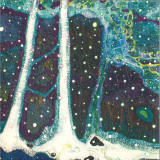
Debut album from Cardiff indie-pop collective Live, Do Nothing (ex-members of Rosehip Teahouse/Deadlines). Hiraeth & Loathing explores feeling disconnected from your childhood self. The record questions if there is value in re-discovering this inner child, or if we’re better off eschewing the trappings of nostalgia and living for our current reality instead. Since their debut Ep, 2018’s “Oh Dear”, a collection of scrappy indie-punk songs from the original four-piece line-up, the band has doubled in size (and is still growing!). Countless numbers of new instruments have been added to the mix, including: vibraphone, toy piano, violin, flute and saxophone. Recorded by Thomas V. Westgård at Sail Loft Studios, mixed by Bob Cooper at Chairworks Studios and mastered by Leon West at After Life Studios. Track listing: The Hardest Band In Cardiff Presents...; The Real Animals Of...; Mouse Death; All Wax No Honey; Novelty is the Best Policy; A Legendary Run; Hopelash; Delusions Of Ganja; Oso Jugoso; Too Late In The Day; Chromatic Delight
Search:val e
ARCHITECTS have delivered their 10th studio album; an arena-ready
opus entitled, the classic symptoms of a broken spirit , the follow up to
their 2021 breakout album For Those That Wish To Exist, which hit #1 on
the UK sales chart.Finding yourself with a UK Number One album and
selling out arenas is enough for some to repeat a winning formula
Architects however, are forever moving forward. "It was definitely validating and
felt really cool for like a day," recalls drummer, producer and songwriter Dan
Searle of hitting the top spot with For Those That Wish To Exist."For a lot of the
bucket list things you reach in any career, there's a momentary gratification then
you're like, 'What next?' You just move on. By the time the album came out, my
head was already in the mindset of 'broken spirit'. That was where I was at."
Searle notes how it was their albums Lost Forever/ Lost Together, All Our Gods
Have Abandoned Us, and Holy Hell that really "cemented what the band was
about" and "took them to a new level" as a rock powerhouse and leaders of the
UK's metalcore scene – making it all the more "daunting" to reinvent themselves
on the records that would follow. "I wanted to make this album with a different
aesthetic. We were enjoying working with the synths and doing stuff that we
hadn't done before."
As a band who never stop writing, the kernels of the songs that make up the
classic symptoms of a broken spirit were already in progress before the ink had
time to dry on the artwork of their last record. Architects were on a creative roll,
and the record was born of that creative freedom. Produced by Dan Searle and
guitarist Josh Middleton, with additional production from frontman Sam Carter at
Decon's Middle Farm Studios and their own Brighton Electric Studios before being
mixed by Zakk Cervini, the band were buoyed by finally being back in a room
together after their last album was made mostly remotely due to COVID
restrictions. The result was something altogether more "free, play - ful and
spontaneous," Searle explains.
Carter agrees: "This one feels more live, more exciting and more fun – it has that
energy. We wanted it to be a lot more industrial and electronic. That was the main
mission. They can sit side-by-side: Mr. Electronic and Mr. Organic."
Gondwana Records announces Horizons the debut album from Jasmine Myra, produced by Matthew Halsall, it's an elevating debut record of understated beauty
Jasmine Myra is a Leeds-based saxophonist, composer and band leader Her original instrumental music has a euphoric and uplifting sound, influenced by artists as diverse as Kenny Wheeler, Bonobo and Olafur Arnalds and like Mammal Hands and Hania Rani her music has a special, emotive quality that draws the listener into her world. Matthew Halsall first heard Myra's music in 2019 shortly before the pandemic hit, signing her to Gondwana Records and producing her beautiful debut album, Horizons.
"I was immediately drawn to Jasmine's music. I could hear jazz, electronica in her music but with a deep, honest, emotional quality. I was really impressed with her skills as a composer and bandleader, that she is open and intelligent enough to bring all those influences together, to make something fresh and original. We were also delighted to work with a young artist from the North of England. London is often seen as the place to be, but cities like Manchester and Leeds are full of creative musicians too, and that sense of local community is at the heart of our values as a label."
Myra came-up through the bustling, creative Leeds music scene and her music draws on the sense of community that permeates life in the city and which is notable for a strong DIY ethos in its musical community. She attended Leeds Conservatoire and played with the Leeds based Abstract Orchestra, a jazz big-band, led by tutor Rob Mitchell that explores the synergy between jazz and hip-hop found in the recordings of Madlib, MF Doom of J Dilla. Indeed, Myra cites MF Doom and Soweto Kinch as early influences on her own music. It was in her last year at the conservatoire that Myra started to consider leading her own group and started to really think about what her own music might sound like and her first band featured guitarist Ben Haskins and drummer George Hall who both feature on Horizons and her band draws heavily on the Leeds community featuring rising stars such as pianist Jasper Green and harpist Alice Roberts.
Myra also mentions local legend, Dave Walker, who owns an instrument repair shop called 'All Brass and Woodwind' which is right next to the music college. She worked there while studying and he introduced her to a lot of local musicians. Walker also has his own line of saxophones (played by Shabaka Hutchins, Pete Wareham and Nubya Garcia), and gifted Myra the saxophone she plays on Horizons. It was Walker who encouraged Myra to apply for Jazz North Introduces, a scheme that supports emerging jazz artists in the North of England and Myra credits her winning a place, in 2018,with helping her grow in confidence.
" It gave me the opportunity to start gigging outside of Leeds, which I was very keen to do. I was quite surprised by people's reaction to the project and the support I was being shown, which helped me gain a lot of confidence. It became clear to me very quickly that being a solo artist was what I wanted to do and it was also apparent to me that mine was one of the only female-led instrumental bands on the Leeds scene, which encouraged me even more, as I wanted my project to inspire younger female musicians".
Horizons was produced by Matthew Halsall and mixed by Portico Quartet collaborator Greg Freeman, and much of the music was written during lockdown. It was a hard time for a lot of people, and initially Myra struggled mentally, deprived of shows and the connections of making music with her band and friends, but she also realised what she wanted as an artist and the result is heard on Horizons.
"I realised that my aim was to start writing music that made people feel happy and uplifted. Writing is one of my biggest passions, but I also love performing. Playing live and seeing the audience connect with my music and have a positive experience brings me so much joy".
This sense of elevation is at the heart of Horizons, together with the feeling of a journey, of reaching new ground. Prologue and Horizons were originally composed as one piece as they encapsulate Myra's own personal development as she worked on the album - taking the listener on a journey, especially Prologue; and then Horizons is that moment of release when you've reached the end goal. 1000 Miles takes inspiration from the music of Shabaka and the Ancestors. Whereas Words Left Unspoken was written after Myra's grandmother unexpectedly passed away in June, and due to Covid restrictions she was unable to visit her before she passed and say how much she loved her. Morningtide is a nod to Kenny Wheeler, particularly the track Opening from Sweet Time Suite on Music for Large and Small Ensembles but Myra also puts her own spin on it as she also does with Promise, another track influenced by Wheeler. Awakening has a calm and euphoric quality and represents that sense of problems lifting, or of reaching the other side, and New Beginnings finishes the album with a positive vibe and a sense of moving forward from darkness
This then is Horizons. A soulful, emotional and up-lifting debut from a major new voice. A snapshot of a young artist at the beginning of her journey - drawing on jazz and electronica influences to create something fresh and new. But also a celebration of her home town Leeds, and a record built on a sense of support and community before looking out to wider Horizons.
Jamie Cullum on BBC Radio 2 "...That's Jasmine Myra and 'New Beginnings', wonderful to hear new music from a new artists i've not heard before, a great new artist!"
Tom Ravenscroft on BBC 6 Music "Leeds-based saxophonist, composer and band leader Jasmine Myra. 'New Beginnings' on Gondwana Records. Compositions drawing influence by Kenny Wheeler, Bonobo, Ólafur Arnalds. Produced by Matthew Halsall"
The third and most seasoned Drugdealer album, Hiding In Plain Sight, almost didn't happen at all. Frustrated and insecure with his own singing voice prior to the pandemic, Drugdealer founder and primary songwriter Michael Collins was nearly ready to throw in the towel. Due to a frequent impulse to hand over the microphone to friends and collaborators like Weyes Blood, Jackson MacIntosh, and his trusty musical companion Sasha Winn, Collins became increasingly unsure of himself as a singer. While attending Mexican Summer's annual Marfa Myths festival, a chance encounter with artist and composer Annette Peacock changed his outlook. Collins says, "I was so inspired by Annette. But similarly to all these other vocalists I'd worked with, I didn't feel like I had it in me." he recalls. "I told her my plight, then I played her a song, and she told me I wasn't singing high enough for my speaking voice. When I returned to LA, I started coming up with new progressions, which I'd modulate up three half steps. It forced me to find a new way to sing." "Madison," is the first song Collins wrote singing in this suggested range. His newfound confidence as a yarn-spinning vocalist in the gruff tenor tradition of Nick Lowe, or even Van Morrison, is readily apparent, with Conor "Catfish" Gallaher's pedal steel adding a dusting of cosmic country to Collins' down-hard love song. When Collins wrote the would-be AM Gold hit, he was summoning an imaginary vision of a love that had eluded him in reality. Tim Presley sings on the second song, "Baby," and Collins had a clear role in mind for the California avant-rock mainstay. "I love White Fence so much, but I also wanted to hear Presley sing a song that sounded like an early '60s sock hop band who had never tried drugs in their life." Meanwhile, Kate Bollinger floats an effervescent lead vocal over the Rhodes-driven groove in “Pictures of You.”. Taking inspiration from a canon of gruff but soulful rock vocalists like Phil Lynott, Collins looks back on his nocturnal meanderings through LA's warrens of bars and clubs ("New Fascination"). He’s right up front in the mix, detailing a search for love in all the wrong places.
I[38,53 €]
Black Vinyl[24,50 €]
Black & Orange Pinwheel Vinyl[24,50 €]
Yellow vinyl[26,01 €]
Pink/White Swirl Vinyl[26,01 €]
THERION have always been a band that have challenged themselves to explore new paths, while remaining true to their musical core values. For their 17th studio album, mastermind Christofer Johnsson and his collaborator Thomas Vikström have created something that has been previously unthinkable to the guitarist and the singer. "We have done the only thing that was left of all the different angles to explore", explains Christofer. "We have decided to give the people what they kept asking for. 'Leviathan' is the first album that we have deliberately packed with THERION hit songs."
True to the Swede's words, the album opens with the catchy and swift tune 'The Leaf Of The Oak Of Far' featuring female and male antiphonal singing as well as a choir that seems to have evolved straight out of THERION's breakthrough full-length "Theli" (1996). This is immediately followed by the obvious highlight 'Tuonela', in which Christofer cleverly underscores this hit-track's Finnish vibe by employing NIGHTWISH’s "metal voice" Marko Hietala. Next up in this parade of future fan-favourites is the title track 'Leviathan' that offers classic THERION material with operatic female vocals and a massive choir.
Christofer Johnsson's passion for classic voices, choirs, and orchestral elements as well as his penchant for epic melodies in combination with rock and metal shines clearly through the following sing-along ballad 'Die Wellen Der Zeit', which indicates another nod to German romantic composer Richard Wagner. "Ever since 'Theli', Wagner has been and will always be at the core of THERION", emphasises Christofer. "When we started to combine metal and opera, it was something new and original. Today, symphonic metal has long been a firmly established genre." When THERION came into being in 1988 by changing name from the already existing band BLITZKRIEG, which was founded a year earlier, Christofer had rather taken inspiration from SLAYER's "Reign In Blood" among other classic metal albums.
At the beginning, the Swedes were firmly rooted in death metal, a genre which they helped to define, as witnessed by their debut album "Of Darkness...." (1991). Yet even back then, there were hints of "something else" lurking beneath the rough surface. The use of female vocals is another core ingredient of THERION today, which developed gradually. CELTIC FROST had basically introduced the female element to extreme metal on "To Mega Therion" in 1985. THERION began with both a female and male vocalist emulating a church like choir already in their sophomore full-length 'Beyond Sanctorum' (1992). With Symphony "Masses: Ho Drakon Ho Megas" (1993) and "Lepaca Kliffoth" (1995), Christofer continued to developed his trademark sound by gradually drifting towards cleaner vocals and more keyboards.
With "Theli", the Swedes had firmly established a reputation of pushing the boundaries of metal in the 90s –among such acts as their compatriots TIAMAT, THE GATHERING, and MOONSPELL that were often referred to as "gothic metal" at the time. THERION continued to break new ground leaving inspiration for others to follow in their wake: On "A'arab Zaraq -Lucid Dreaming" (1997), Christofer further explored the use of Near Eastern music in metal which he had already begun in 1992, while "Secret Of The Runes" (2001) dared to have Swedish lyrics in some songs.
While critics were left confused and fans challenged, THERION were often ahead of their times and vindicated in hindsight. Even the band's 25th anniversary excursion "Les Fleurs Du Mal" has by now overcome the initial shock the album caused and is only beaten in terms of streaming by the classic "Vovin" (1998). When Christofer faced the question of where to go next after the dramatic "Beloved Antichrist" (2018) had finally fulfilled his musical mission, his answer is "Leviathan" named after a giant sea monster from Judeo-Christian myth that has roots in Babylonic lore: THERION have created a giant hit album –and for the first time in the history of the Swedes, their fans are not asked to explore something new, but simply to lean back and enjoy the best from their band!
Clear Vinyl
Downwards’ deep bonds with NYC catalyse the debut LP by Jim Siegel’s Vivid Oblivion, a reveberating post-industrial salvo produced by adopted Brooklynite Karl O’Connor (Regis), and co-mixed by Anthony Child (Surgeon) and Simon Shreeve, who also mastered it. It’s a super deep, highly atmospheric beast somewhere between Valentina Magaletti’s most expressive percussion work, Bark Psychosis, and classic, moody 4AD, which is coincidentally referenced via the artwork, made by Chris Bigg - legendary graphic designer and longtime assistant to Vaughan Oliver.
Invoking the density, vertiginous scale, and dark grimy nooks of NYC, ‘The Graphic Cabinet’ was realised by Jim Siegel - hardcore legend and occasional/regular drummer with everyone from Raspberry Bulbs to Damo Suzuki and Boredoms, made in close collaboration with Karl O’Connor aka Regis during 2021.
Stemming from intently deep listening sessions immersed in LPs by Viennese aktionist Hermann Nitsch and the myriad eras of Killing Joke, while also absorbing the atmospheres of classic Tarkovsky flicks, the album began life as gonzo field recordings of Siegel smashing the f*ck out of his drum kit, zither, scrap metal and gongs in an array of abandoned warehouse spaces. The recordings formed the basis of Karl’s compound productions, which add depth charge bass and sonorous metallic atmospheres to the mix, along with birdsong and gibbon hoots, plus guitar textures by Nick Forté (Raspberry Bulbs, Rorschach) for a dread-lusting jag deep in the belly of the Big Apple.
With a palpable tang of rust and blood in the air and grime under the fingernails, the seven tracks evoke a resoundingly brutalist portrait of space and place. Siegel’s nervy percussive discipline is framed in alternating barometric and light settings from cut to cut, variously snaking from the poltergeist clang and haunted resonance of ‘Converging and Dissolving’ to slamming motorik thrum in ‘Oblivion’ via imaginative descent into cyberpunk simulacra of the city as jungle-at-night in ‘Remnant Corridor’, replete with animalistic atmospheres that recall Organum.
While the raw attack and devilish swerve of the rhythms are utterly fundamental to the record, Karl’s atmospheric content and the animist mixing magick of Anthony Child and Simon Shreeve most potently give flesh to its bones. Patently evident on the stepping pulse and searching zither that keens into detuned orchestration on ‘Immediate Possession’, the zoned-out klang of ‘Stand Aside’ or in the flooded warehouse chaos of ‘Test For Traps’. The attention to spatial, textural and proprioceptive detail is tightened throughout, peaking with ‘Bargemaster’, a dense slab of tension that sounds like Jon Mueller’s Silo recordings fed through The Caretaker’s fogged machinery.
It’s one of the most impressive records on Downwards for a long while, bound to gnaw and spark the nerves of experimental rock and post-industrial’s greats, anything from The New Blockaders to Faust, Flying Saucer Attack and into iconic Blackest Ever Black releases in the modern era.
Max Loderbauer’s career in music spans the last 3 decades, yet he’s still managed to keep his listeners hungry by releasing only 3 solo albums to date. Two of those releases (Transparenz, 2013 and Donnerwetter, 2020) were on Tobias Freund’s label Non Standard Productions - his long time collaborator and Templehof studio mate. In between those releases, Loderbauer graced Marionette with Greyland in 2016, revealing a previously unheard youthful and sentimental side. Now in 2022, the seasoned mind voyager is back with Petrichor, making yet another rare and treasurable solo appearance.
Petrichor distills the elements of Loderbauer’s work that are fundamental to the initiation of the label. With his Buchla, modular synth, and Haken fingerboard, Loderbauer’s improvised studio maneuvers dilate into imagined journeys from glacial peaks into the exosphere. This is Maxi at his most exhilarating state, morphing through bittersweet and optimistic soundscapes to bleak moments of throbbing unease - all while maintaining a sense of grace and elegance. Petrichor is a reflection of Loderbauer’s impactful trips to the mountains, and returning from these summits with an electrifying urge to paint this mighty perspective. The harmonies and melodies on the tracks simulate emotional peaks and valleys, with vibration and rhythm rooted in the foundation of the sound, as though it's woven into the fabric of the fauna and flora.
Legendary collaborations like Vilod (with Ricardo Villalobos), the Moritz Von Oswald Trio, Non Standard Institute, Sun Electric in the early nineties, and the newly formed Ambiq ensemble have gained this unique artist the respect of the underground and avant garde scenes alike.
- A1: Tonari No Totoro (My Neighbor Totoro)
- A2: Nausicaä Of The Valley Of The Wind (Nausicaä Of The Valley Of The Wind)
- A3: Sampo (My Neighbor Totoro)
- A4: Yasashisa Ni Tsutsumareta Nara (Kiki’s Delivery Service)
- A5: The Girl Who Fell From The Sky (Castle In The Sky)
- A6: The Princess Mononoke (The Princess Mononoke)
- A7: Always With Me (Spirited Away)
- B1: County Road (Whisper Of The Heart)
- B2: Arrietty’s Song (Arrietty)
- B3: Therru’s Song (Tales From Earthsea)
- B4: Itsudemo Dareka Ga (Pom Poko) B5. The Rose (Only Yesterday)
- B6: Gake No Ue No Ponyo (Ponyo)
2[36,77 €]
With arrangements from DUBFORCE’s Ippei Tatsuyama and vocals contributed by Kyoko Abe, these records will please both Studio Ghibli fans and reggae fans.
Songs from “My Neighbor Totoro”, “Nausicaa of the Valley of the Wind”, and “Princess Mononoke” are arranged
with a sense of fun that can only be found in reggae while still maintaining their distinct character. Enjoy the world of Ghibli reggae with full comfort
- A1: The Path Of Wind (My Neighbor Totoro)
- A2: Rouge No Dengon (Kiki’s Delivery Service)
- A3: Sampo (My Neighbor Totoro)
- A4: Hitoribocchi Wa Yameta (My Neighbours The Yamadas)
- A5: Sayonara No Natsu (From Up On Poppy Hill)
- A6: The Girl Who Fell From The Sky (Castle In The Sky)
- B1: Meguru Kisetsu (Kiki’s Delivery Service)
- B2: The Promise Of The World: The Merry-Go-Round Of Life (Howl’s Moving Castle) B3. Nausicaä Requiem (Nausicaä Of The Valley Of The Wind)
- B4: Tokiniwa Mukashino Hanashi Wo (Porco Rosso)
- B5: Toki No Uta (Tales From Earthsea)
- B6: One Summer’s Day (Spirited Away)
Plus[36,77 €]
With arrangements from DUBFORCE’s Ippei Tatsuyama and vocals contributed by Kyoko Abe, these records will please both Studio Ghibli fans and reggae fans.
Songs from “My Neighbor Totoro”, “Nausicaa of the Valley of the Wind”, and “Princess Mononoke” are arranged
with a sense of fun that can only be found in reggae while still maintaining their distinct character. Enjoy the world of Ghibli reggae with full comfort
- 1: Give It Up (Feat. J-Live)
- 2: Supa
- 3: Renaissance 2.0 (Feat. Hell Razah, Tragedy Khadafi, And Timbo King)
- 4: Windows Of The World (Feat. Ayatollah And Dynasty The Emp)
- 5: Uncommon Valor: A Vietnam Story (Feat. Jedi Mind Tricks)
- 6: Who's Dat Guy (Feat. Havoc Of Mobb Deep)
- 7: L.i.'s Finest
- 8: Stanley Kubrick
- 9: Cunt Renaissance (Feat. The Notorious B.i.g.)
- 10: 3 Kingz (Feat. Kool G Rap And Big John)
- 11: Smithhaven Mall
- 12: Posse Cut (Feat. Hell Razah, Jojo Pellegrino, Remedy, And Blaq Poet)
- 13: What The Fuck (Feat. Akinyele)
- 14: Poor People
- 15: 50,000 Heads (Feat. Sadat X)
- 16: Effin' Yo' Bitch
- 17: Every Record Label Sucks Dick
- 18: The Greatest (Feat. Marcella Puppini) (Bonus)
Reissue! Before the acclaimed albums "Legends Never Die" and "All My Heroes Are Dead" brought his career to new heights, R.A. The Rugged Man spent years as an underrated rap enigma, with a slew of storied records to his name that had never received a proper release.
With the 2009 compilation "Legendary Classics Vol. 1, R.A. finally unleashed many of the lost gems that earned him a reputation as one of hip-hop's most feared lyricists, showcasing his undeniable history.
An essential collection from a true hip-hop original, the album features appearances by The Notorious B.I.G., Havoc of Mobb Deep, Jedi Mind Tricks, Kool G Rap, J-Live, Hell Razah, Tragedy Khadafi, Akinyele, and Sadat X, along with track-by-track commentary from the Rugged Man himself. This "Legendary Classics Vol. 1" reissue also includes the new bonus track “The Greatest” featuring famed Italian singer Marcella Puppini, which has never before been available on vinyl.
Following the compass of an entrancing debut, Flore Laurentienne’s Volume II presents another palette of rich orchestral sound, where changing forces of water inspire metaphorical markers that navigate passages of life and loss.
Mathieu David Gagnon resumes his voyage into environment and emotion with Volume II, drawing inspiration from the rivers and rugged wilderness of the composer’s native Quebec. In his return as Flore Laurentienne – the namesake of an inventory documenting St. Lawrence Valley flora – Gagnon assembles vivid melodic motifs and delicate modulation with a vast string ensemble to emulate the tides of human experience.
Listeners of Volume I will recognise Gagnon’s signature approach towards reworking and reframing an emblematic melody or concept across a series of works inVolume II, a process he likens to that of a painter creating multiple sketches of the same view. Continued from the first album, the enigmatic “Fleuve” series is conjured to evoke the multiple personalities of the great St. Lawrence River, and the “Navigation” works (“III” and “IV”) wade through dappled progressions and expansive streams of string, the latter of which harbors the gentle meanderings of improvised clarinet.
Pinkshift are a vehemently unapologetic punk
band whose songs rail against prejudice and
oppression while also examining in great depth the
human condition.
Foregoing more traditional careers in the hard
sciences / medicine, Baltimore natives Ashrita
Kumar (singer), Paul Vallejo (guitar) and Myron
Houngbedji (drums), are inspiring fans in a
different way.
The band smash any preconceived notions of what
a punk band should look or sound like.
After self-releasing the viral hit ‘I’m gonna tell my
therapist on you’ and the ‘Saccharine’ EP, Pinkshift
partnered with Hopeless Records to release their
debut album, Love Me Forever’.
Produced by Will Yip (Turnstile, Code Orange,
Tigers Jaw), the band have put together an
emotionally cathartic, raucous, and powerful debut
that centres their unique perspective as POC
individuals in a scene that historically did not
represent them.
- A1: It Is Nothing (2022 Remaster)
- A2: In Your Heart (2022 Remaster)
- A3: Lost Feeling (2022 Remaster)
- A4: Deadbeat (2022 Remaster)
- A5: Keep Sipping Away (2022 Remaster)
- B1: Ego Death (2022 Remaster)
- B2: Smile When You Smile (2022 Remaster)
- B3: Everything Always Goes Wrong (2022 Remaster)
- B4: Exploding Head (2022 Remaster)
- B5: I Lived By Life To Stand In The Shadow Of Your Heart (2022 Remaster)
Following their eponymous debut in 2007, Exploding Head is A Place To Bury Strangers’ most notable record, garnering the New York noise rock outfit critical praise and a cult fanbase. Lead by Oliver Ackermann, the band had a simple goal for ‘their first proper studio album’; “to create the craziest, most fucked-up recording ever."
Recorded at their Death By Audio studios in New York and released on Mute Records, the album was critically praised for its explorative sound, taking inspiration from shoegaze icons such as Jesus & Mary Chain and My Bloody Valentine. Pitchfork described the album as “frustrated aggression, lacerating feedback… saturated with slender indie-pop melody."
The album has now been digitally remastered by Oliver Ackermann and is presented in three formats; Deluxe 2LP (Band Website & Tour D2C Exclusive), 2CD Deluxe & 1LP Standard. This 1LP 140g Transparent Red Vinyl is housed in Standard Sleeve and features exclusive sleeve notes by music journalist Tris McCall.
- 1: Naya (Wassingue Krew) - Piannah
- 2: Amazone Expérience - On Lache Rien (Vocal & Violon Live)
- 3: Asher - Acid Riff 164 Bpm
- 4: Pix'elles - Pandorah Box
- 5: Mpi (Siamese) - Primitive
- 6: Jamsh - Quasar
- 7: Asher & Al Core - Acid Recall
- 8: Izard & Al Core - Core? No Fulgure!
- 9: Dozash - Form All
- 10: Asher & Jamsh - Fatal Error
- 11: Doodax - Inner Mind
- 12: Samoth - Chernobyl Generation
- 13: Anna Scheele - Sunflower Frequency
- 14: Asher And Jamsh - Tinkle On Acid
Value Pack of last Oniroblast in stock.
MINT records from stock of course.
A chance to get dem all at a cheap easy price :)
DEDICATED COPY !
Calle Sound System est un mini-album conçu par Sidi Wacho en réponse à la crise sanitaire. Leur univers musical est constamment en
renouvellement pour sortir des stéréotypes et des étiquettes.
Leur groove binaire s’inspire de la cumbia chilienne avec des arrangements inspirés des fanfares balkaniques.
Rap, rythmes latinos et reggae peuvent aussi plonger dans cette sauce relevée à souhait !
Time 2 Love is an album based on Irene’s many influences and foregrounds her sensitivities. All the tracks embody reminiscent of the 00s R&B vocals, inspired by legends like Brandy and Aaliyah.
The production has the signature of RSN, one of the music’s most influential artist and producer, who together with Irene bridge the gap between cinematic soul, R&B classics, Hip Hop and contemporary music scene.
Time 2 Love is about the journey we make from love to toxic relationships and independence. Irene’s journey goes through love to loneliness and shows how the reminisce of a past love may force to toxic old habits. Life pointed her back in the same old directions, but as she is ultimately the master of her own individual destiny, she progressed and moved from abandonment to a healing experience and she regained to be emotionally independent. The album features Anduze from Parov Stelar, MC Yinka, Word Of Mouth, Mr. Collage and the vinyl edition includes an extra track with BNC.
Time 2 Love is available on vinyl by the label Mind The Wax and on all digital platforms via Hidden Track as of September 16th 2022 and includes 10 tracks.
Irene is an R&B artist, born in Athens and based both in UK and Greece. Her debut album “Time 2 Love” is an album sank into her feelings about self-love, toxic relationships, love and independence.
Irene has received three Awards at Manhattan’s IMTA 2011 and released her breakout single ‘Like A Rainbow’ on 2016 with Ian Ikon which was included in the global collection “NOW 2016” from Universal.
In addition, Irene collaborated with celebrated artists such as Anduze (Parov Stelar) and MC Yinka and she released four songs ‘Familiar’, ‘Light It Up’, ‘Piece Of You’, ‘Whatsa Say’ (via Hidden Track Records).
A colossus of the funk & soul world, Adam Gibbons (aka Lack of Afro) has been releasing music for 15 years and continues to go from strength to strength. Previously signed to Freestyle Records in London and running his own label The Bastion Music Group since 2015, he has been responsible for some of the genre’s most important releases, not least his debut album Press On described by iDJ as “one of the most important albums of the modern funk era” and more recently given ‘classic’ status by Future Music Magazine.
An accomplished multi-instrumentalist, producer, DJ and composer, his music has won worldwide critical acclaim and to date has gained 115 million streams on Spotify. It has been featured on films, TV shows and adverts all over the globe, on networks including HBO, ABC, Sony Pictures, BBC, ITV, Sky TV, Fox Pictures & Warner Brothers Television, and used in multi million ad campaigns by the likes of Google, Spotify, Miller Lite and Adidas.
As a DJ and live performer, he has performed in over 20 countries worldwide and undertaken countless live sessions for radio and TV including two for the BBC at the highly revered Maida Vale Studios.
To date, he has released seven albums under the Lack of Afro moniker (most recently I’m Here Now in 2020), three as The Unity Sextet, one under LUSTRE, one under his own name, an EP with Herbal T as The Damn Straights, albums for other artists, music for several TV shows and over 60 remixes. He has also produced 13 award winning, sample packs for Loopmasters.
- A1: Rock This Mother
- A2: Talk To Me Girl
- A3: You Can Find Me
- A4: Check This Out
- A5: Jesus Going To Clean House
- A6: Hope You Understood
- A7: Is It What You Want
- A8: Love Is Everlasting
- A9: This Is Hip-Hop Art
- A10: Opposite Of Love
- A11: Do You Know What I Mean
- B1: Saving All My Love For You
- B2: Look Out Here I Come
- B3: Girl You Always Talking
- B4: Have A Great Day
- B5: Take My Hand
- B6: I Need Your Love
- B7: Your Town
- B8: Talk Around Town
- B9: Booty Head/Take A Little Walk
- B10: I Love My Mama
- B11: I Never Found Anyone Like You
Vinyl LP[23,49 €]
As the sun sets on a quaint East Nashville house, a young man bares a piece of his soul. Facing the camera, sporting a silky suit jacket/shirt/slacks/fingerless gloves ensemble that announces "singer" before he's even opened his mouth, Lee Tracy Johnson settles onto his stage, the front yard. He sways to the dirge-like drum machine pulse of a synth-soaked slow jam, extends his arms as if gaining his balance, and croons in affecting, fragile earnest, "I need your love… oh baby…"
Dogs in the yard next door begin barking. A mysterious cardboard robot figure, beamed in from galaxies unknown and affixed to a tree, is less vocal. Lee doesn't acknowledge either's presence. He's busy feeling it, arms and hands gesticulating. His voice rises in falsetto over the now-quiet dogs, over the ambient noise from the street that seeps into the handheld camcorder's microphone, over the recording of his own voice played back from a boombox off-camera. After six minutes the single, continuous shot ends. In this intimate creative universe there are no re-takes. There are many more music videos to shoot, and as Lee later puts it, "The first time you do it is actually the best. Because you can never get that again. You expressing yourself from within."
"I Need Your Love" dates from a lost heyday. From some time in the '80s or early '90s, when Lee Tracy (as he was known in performance) and his music partner/producer/manager Isaac Manning committed hours upon hours of their sonic and visual ideas to tape. Embracing drum machines and synthesizers – electronics that made their personal futurism palpable – they recorded exclusively at home, live in a room into a simple cassette deck. Soul, funk, electro and new wave informed their songs, yet Lee and Isaac eschewed the confinement of conventional categories and genres, preferring to let experimentation guide them.
"Anytime somebody put out a new record they had the same instruments or the same sound," explains Isaac. "So I basically wanted to find something that's really gonna stand out away from all of the rest of 'em." Their ethos meant that every idea they came up with was at least worth trying: echoed out half-rapped exhortations over frantic techno-style beats, gospel synth soul, modal electro-funk, oddball pop reinterpretations, emo AOR balladry, nods to Prince and the Fat Boys, or arrangements that might collapse mid-song into a mess of arcade game-ish blips before rallying to reach the finish line. All of it conjoined by consistent tape hiss, and most vitally, Lee's chameleonic voice, which managed to wildly shape shift and still evoke something sincere – whether toggling between falsetto and tenor exalting Jesus's return, or punctuating a melismatic romantic adlib with a succinct, "We all know how it feels to be alone."
"People think we went to a studio," says Isaac derisively. "We never went to no studio. We didn't have the money to go to no studio! We did this stuff at home. I shot videos in my front yard with whatever we could to get things together." Sometimes Isaac would just put on an instrumental record, be it "Planet Rock" or "Don't Cry For Me Argentina" (from Evita), press "record," and let Lee improvise over it, yielding peculiar love songs, would-be patriotic anthems, or Elvis Presley or Marilyn Monroe tributes. Technical limitations and a lack of professional polish never dissuaded them. They believed they were onto something.
"That struggle," Isaac says, "made that sound sound good to me."
In the parlance of modern music criticism Lee and Isaac's dizzying DIY efforts would inevitably be described as "outsider." But "outsider" carries the burden of untold additional layers of meaning if you're Black and from the South, creating on a budget, and trying to get someone, anyone within the country music capital of the world to take your vision seriously. "What category should we put it in?" Isaac asks rhetorically. "I don't know. All I know is feeling. I ain't gonna name it nothing. It's music. If it grabs your soul and touch your heart that's what it basically is supposed to do."
=
Born in 1963, the baby boy of nine siblings, Lee Tracy spent his earliest years living amidst the shotgun houses on Nashville's south side. "We was poor, man!" he says, recalling the outhouse his family used for a bathroom and the blocks of ice they kept in the kitchen to chill perishables. "But I actually don't think I really realized I was in poverty until I got grown and started thinking about it." Lee's mom worked at the Holiday Inn; his dad did whatever he had to do, from selling fruit from a horse drawn cart to bootlegging. "We didn't have much," Lee continues, "but my mother and my father got us the things we needed, the clothes on our back." By the end of the decade with the city's urban renewal programs razing entire neighborhoods to accommodate construction of the Interstate, the family moved to Edgehill Projects. Lee remembers music and art as a constant source of inspiration for he and his brothers and sisters – especially after seeing the Jackson 5 perform on Ed Sullivan. "As a small child I just knew that was what I wanted to do."
His older brother Don began musically mentoring him, introducing Lee to a variety of instruments and sounds. "He would never play one particular type of music, like R&B," says Lee. "I was surrounded by jazz, hard rock and roll, easy listening, gospel, reggae, country music; I mean I was a sponge absorbing all of that." Lee taught himself to play drums by beating on cardboard boxes, gaining a rep around the way for his timekeeping, and his singing voice. Emulating his favorites, Earth Wind & Fire and Cameo, he formed groups with other kids with era-evocative band names like Concept and TNT Connection, and emerged as the leader of disciplined rehearsals. "I made them practice," says Lee. "We practiced and practiced and practiced. Because I wanted that perfection." By high school the most accomplished of these bands would take top prize in a prominent local talent show. It was a big moment for Lee, and he felt ready to take things to the next level. But his band-mates had other ideas.
"I don't know what happened," he says, still miffed at the memory. "It must have blew they mind after we won and people started showing notice, because it's like everybody quit! I was like, where the hell did everybody go?" Lee had always made a point of interrogating prospective musicians about their intentions before joining his groups: were they really serious or just looking for a way to pick up girls? Now he understood even more the importance of finding a collaborator just as committed to the music as he was.
=
Isaac Manning had spent much of his life immersed in music and the arts – singing in the church choir with his family on Nashville's north side, writing, painting, dancing, and working various gigs within the entertainment industry. After serving in the armed forces, in the early '70s he ran The Teenage Place, a music and performance venue that catered to the local youth. But he was forced out of town when word of one of his recreational routines created a stir beyond the safe haven of his bohemian circles.
"I was growing marijuana," Isaac explains. "It wasn't no business, I was smoking it myself… I would put marijuana in scrambled eggs, cornbread and stuff." His weed use originated as a form of self-medication to combat severe tooth pain. But when he began sharing it with some of the other young people he hung out with, some of who just so happened to be the kids of Nashville politicians, the cops came calling. "When I got busted," he remembers, "they were talking about how they were gonna get rid of me because they didn't want me saying nothing about they children because of the politics and stuff. So I got my family, took two raggedy cars, and left Nashville and went to Vegas."
Out in the desert, Isaac happened to meet Chubby Checker of "The Twist" fame while the singer was gigging at The Flamingo. Impressed by Isaac's zeal, Checker invited him to go on the road with him as his tour manager/roadie/valet. The experience gave Isaac a window into a part of the entertainment world he'd never encountered – a glimpse of what a true pop act's audience looked like. "Chubby Checker, none of his shows were played for Black folks," he remembers. "All his gigs were done at high-class white people areas." Returning home after a few years with Chubby, Isaac was properly motivated to make it in Music City. He began writing songs and scouting around Nashville for local talent anywhere he could find it with an expressed goal: "Find someone who can deliver your songs the way you want 'em delivered and make people feel what you want them to feel."
One day while walking through Edgehill Projects Isaac heard someone playing the drums in a way that made him stop and take notice. "The music was so tight, just the drums made me feel like, oh I'm-a find this person," he recalls. "So I circled through the projects until I found who it was.
"That's how I met him – Lee Tracy. When I found him and he started singing and stuff, I said, ohhh, this is somebody different."
=
Theirs was a true complementary partnership: young Lee possessed the raw talent, the older Isaac the belief. "He's really the only one besides my brother and my family that really seen the potential in me," says Lee. "He made me see that I could do it."
Isaac long being a night owl, his house also made for a fertile collaborative environment – a space where there always seemed to be a new piece of his visual art on display: paintings, illustrations, and dolls and figures (including an enigmatic cardboard robot). Lee and Issac would hang out together and talk, listen to music, conjure ideas, and smoke the herb Isaac had resumed growing in his yard. "It got to where I could trust him, he could trust me," Isaac says of their bond. They also worked together for hours on drawings, spreading larges rolls of paper on the walls and sketching faces with abstract patterns and imagery: alien-like beings, tri-horned horse heads, inverted Janus-like characters where one visage blurred into the other.
Soon it became apparent that they didn't need other collaborators; self-sufficiency was the natural way forward. At Isaac's behest Lee, already fed up with dealing with band musicians, began playing around with a poly-sonic Yamaha keyboard at the local music store. "It had everything on it – trumpet, bass, drums, organ," remembers Lee. "And that's when I started recording my own stuff."
The technology afforded Lee the flexibility and independence he craved, setting him on a path other bedroom musicians and producers around the world were simultaneously following through the '80s into the early '90s. Saving up money from day jobs, he eventually supplemented the Yamaha Isaac had gotten him with Roland and Casio drum machines and a Moog. Lee was living in an apartment in Hillside at that point caring for his dad, who'd been partially paralyzed since early in life. In the evenings up in his second floor room, the music put him in a zone where he could tune out everything and lose himself in his ideas.
"Oh I loved it," he recalls. "I would really experiment with the instruments and use a lot of different sound effects. I was looking for something nobody else had. I wanted something totally different. And once I found the sound I was looking for, I would just smoke me a good joint and just let it go, hit the record button." More potent a creative stimulant than even Isaac's weed was the holistic flow and spontaneity of recording. Between sessions at Isaac's place and Lee's apartment, their volume of output quickly ballooned.
"We was always recording," says Lee. "That's why we have so much music. Even when I went to Isaac's and we start creating, I get home, my mind is racing, I gotta start creating, creating, creating. I remember there were times when I took a 90-minute tape from front to back and just filled it up."
"We never practiced," says Isaac. "See, that was just so odd about the whole thing. I could relate to him, and tell him about the songs I had ideas for and everything and stuff. And then he would bring it back or whatever, and we'd get together and put it down." Once the taskmaster hell bent on rehearsing, Lee had flipped a full 180. Perfection was no longer an aspiration, but the enemy of inspiration.
"I seen where practicing and practicing got me," says Lee. "A lot of musicians you get to playing and they gotta stop, they have to analyze the music. But while you analyzing you losing a lot of the greatness of what you creating. Stop analyzing what you play, just play! And it'll all take shape."
=
"I hope you understood the beginning of the record because this was invented from a dream I had today… (You tell me, I'll tell you, we'll figure it out together)" – Lee Tracy and Isaac Manning, "Hope You Understand"
Lee lets loose a maniacal cackle when he acknowledges that the material that he and Isaac recorded was by anyone's estimation pretty out there. It's the same laugh that commences "Hope You Understand" – a chaotic transmission that encapsulates the duality at the heart of their music: a stated desire to reach people and a compulsion to go as leftfield as they saw fit.
"We just did it," says Lee. "We cut the music on and cut loose. I don't sit around and write. I do it by listening, get a feeling, play the music, and the lyrics and stuff just come out of me."
The approach proved adaptable to interpreting other artists' material. While recording a cover of Whitney Houston's pop ballad "Saving All My Love For You," Lee played Whitney's version in his headphones as he laid down his own vocals – partially following the lyrics, partially using them as a departure point. The end result is barely recognizable compared with the original, Lee and Isaac having switched up the time signature and reinvented the melody along the way towards morphing a slick mainstream radio standard into something that sounds solely their own.
"I really used that song to get me started," says Lee. "Then I said, well I need something else, something is missing. Something just came over me. That's when I came up with 'Is It What You Want.'"
The song would become the centerpiece of Lee and Isaac's repertoire. Pushed along by a percolating metronomic Rhythm King style beat somewhere between a military march and a samba, "Is It What You Want" finds Lee pleading the sincerity of his commitment to a potential love interest embellished by vocal tics and hiccups subtlely reminiscent of his childhood hero MJ. Absent chord changes, only synth riffs gliding in and out like apparitions, the song achieves a lingering lo-fi power that leaves you feeling like it's still playing, somewhere, even after the fade out.
"I don't know, it's like a real spiritual song," Lee reflects. "But it's not just spiritual. To me the more I listen to it it's like about everything that you do in your everyday life, period. Is it what you want? Do you want a car or you don't want a car? Do you want Jesus or do you want the Devil? It's basically asking you the question. Can't nobody answer the question but you yourself."
In 1989 Lee won a lawsuit stemming from injuries sustained from a fight he'd gotten into. He took part of the settlement money and with Isaac pressed up "Saving All My Love For You" b/w "Is It What You Want" as a 45 single. Isaac christened the label One Chance Records. "Because that's all we wanted," he says with a laugh, "one chance."
Isaac sent the record out to radio stations and major labels, hoping for it to make enough noise to get picked up nationally. But the response he and Lee were hoping for never materialized. According to Isaac the closest the single got to getting played on the radio is when a disk jock from a local station made a highly unusual announcement on air: "The dude said on the radio, 107.5 – 'We are not gonna play 'Is It What You Want.' We cracked up! Wow, that's deep.
"It was a whole racist thing that was going on," he reflects. "So we just looked over and kept on going. That was it. That was about the way it goes… If you were Black and you were living in Nashville and stuff, that's the way you got treated." Isaac already knew as much from all the times he'd brought he and Lee's tapes (even their cache of country music tunes) over to Music Row to try to drum up interest to no avail.
"Isaac, he really worked his ass off," says Lee. "He probably been to every record place down on Music Row." Nashville's famed recording and music business corridor wasn't but a few blocks from where Lee grew up. Close enough, he remembers, for him to ride his bike along its back alleys and stumble upon the occasional random treasure, like a discarded box of harmonicas. Getting in through the front door, however, still felt a world away.
"I just don't think at the time our music fell into a category for them," he concedes. "It was before its time."
=
Lee stopped making music some time in the latter part of the '90s, around the time his mom passed away and life became increasingly tough to manage. "When my mother died I had a nervous breakdown," he says, "So I shut down for a long time. I was in such a sadness frame of mind. That's why nobody seen me. I had just disappeared off the map." He fell out of touch with Isaac, and in an indication of just how bad things had gotten for him, lost track of all the recordings they'd made together. Music became a distant memory.
Fortunately, Isaac kept the faith. In a self-published collection of his poetry – paeans to some of his favorite entertainment and public figures entitled Friends and Dick Clark – he'd written that he believed "music has a life of its own." But his prescience and presence of mind were truly manifested in the fact that he kept an archive of he and Lee's work. As perfectly imperfect as "Is It What You Want" now sounds in a post-Personal Space world, Lee and Isaac's lone official release was in fact just a taste. The bulk of the Is It What You Want album is culled from the pair's essentially unheard home recordings – complete songs, half-realized experiments, Isaac's blue monologues and pronouncements et al – compiled, mixed and programmed in the loose and impulsive creative spirit of their regular get-togethers from decades ago. The rest of us, it seems, may have finally caught up to them.
On the prospect of at long last reaching a wider audience, Isaac says simply, "I been trying for a long time, it feels good." Ever the survivor, he adds, "The only way I know how to make it to the top is to keep climbing. If one leg break on the ladder, hey, you gotta fix it and keep on going… That's where I be at. I'll kill death to make it out there."
For Lee it all feels akin to a personal resurrection: "It's like I was in a tomb and the tomb was opened and I'm back… Man, it feels so great. I feel like I'm gonna jump out of my skin." Success at this stage of his life, he realizes, probably means something different than what it did back when he was singing and dancing in Isaac's front yard. "What I really mean by 'making it,'" he explains isn't just the music being heard but, "the story being told."
Occasionally Lee will pull up "Is It What You Want" on YouTube on his phone, put on his headphones, and listen. He remembers the first time he heard his recorded voice. How surreal it was, how he thought to himself, "Is that really me?" What would he say to that younger version of himself now?
"I would probably tell myself, hang in there, don't give up. Keep striving for the goal. And everything will work out."
Despite what's printed on the record label, sometimes you do get more than one chance.