In a time where everyone from Whitney Houston to Frank Zappa have been re-created in hologram form, where Grimes recently suggested in an interview that “we were at the end of human art”; there could scarcely be a better time for genre-shifting Leeds-based six-piece Team Picture to bring forth the thrillingly expansive synth-pop opus of their debut album The Menace of Mechanical Music.
Inspired by an early 20th century essay under the same name by American marching band leader John Philip Sousa, Team Picture take a look at the automation of creativity on this, their first record with a fully settled line up. Themes centre around the value of creative identity in an automated age, the increasingly disposable nature of art and where that leaves its creators. At twelve songs split into a three-part suite; The Menace of Mechanical Music is emphatically maximalist.
Tracks like the breathy, twinkling Flowerpots, Electric Beds and Handsome Machines’ Icarus-like striving for the sun are an antidote to a music world awash with digital production manipulation and songs written to algorithm. In debating the loosening of the human grip on creativity, Team Picture have poured every last drop of emotion into the recording process.
The group’s now trademark three-way vocal delivery and blurring of textures takes on new structure and purpose. They’ve always had a self-awareness to themselves, too. Initially grouped in with the guitar psych crowd, thanks to their fledgling repeato-rock, they were quick to disassociate themselves from that on 2018's mini-album Recital. With The Menace of Mechanical Music, they expand their sound further still, pirouetting from the likes of Sleeptype Auction – which glimmers like a late 80’s 4AD artefact – through various FX-laden dreamscapes, to the squelchy post-punk of closer Quit Reading. Yet the group were as much influenced by the work of the Early Netherlandish painter Hieronymus Bosch, and his triptych The Garden of Earthly Delights, as they were music touchstones ranging from Kate Bush, Cass McCombs and The Cure.
It’s Sousa words that resonate most deeply within the record however: “The fears of Sousa echo the fears of today's musician,” says Lewis of the late band leader’s 1907 text. “The re-appropriation of funds and support that the artist needs to survive, the gradual erosion of musicianship and self-improvement, that art will become disposable, and that our cultural identity will disappear.”
Recorded with producer Matt Peel (W.H Lung, Eagulls), half the group were unemployed during the session and a daily routine would see them undertake universal credit meetings and job interviews in the morning, before heading to the studio to work into the night. “It was an anxious process but an enjoyable one” says the band’s guitarist Josh Lewis. Indeed, beyond the increasingly golden gated idea of ‘making it’ as an artist, this new album is simply about surviving as one.
Sousa’s vision of a society that had deferred to automation, where babies were rocked to sleep by wheels and pulleys, and people no longer played piano with their own hands. Well over 100 years later and on the precipice of a technological shift never seen before, The Menace of Mechanical Music is the most human response that Team Picture could have given.
Search:val ex
THERION have always been a band that have challenged themselves to explore new paths, while remaining true to their musical core values. For their 17th studio album, mastermind Christofer Johnsson and his collaborator Thomas Vikström have created something that has been previously unthinkable to the guitarist and the singer. "We have done the only thing that was left of all the different angles to explore", explains Christofer. "We have decided to give the people what they kept asking for. 'Leviathan' is the first album that we have deliberately packed with THERION hit songs."
True to the Swede's words, the album opens with the catchy and swift tune 'The Leaf Of The Oak Of Far' featuring female and male antiphonal singing as well as a choir that seems to have evolved straight out of THERION's breakthrough full-length "Theli" (1996). This is immediately followed by the obvious highlight 'Tuonela', in which Christofer cleverly underscores this hit-track's Finnish vibe by employing NIGHTWISH’s "metal voice" Marko Hietala. Next up in this parade of future fan-favourites is the title track 'Leviathan' that offers classic THERION material with operatic female vocals and a massive choir.
Christofer Johnsson's passion for classic voices, choirs, and orchestral elements as well as his penchant for epic melodies in combination with rock and metal shines clearly through the following sing-along ballad 'Die Wellen Der Zeit', which indicates another nod to German romantic composer Richard Wagner. "Ever since 'Theli', Wagner has been and will always be at the core of THERION", emphasises Christofer. "When we started to combine metal and opera, it was something new and original. Today, symphonic metal has long been a firmly established genre."
When THERION came into being in 1988 by changing name from the already existing band BLITZKRIEG, which was founded a year earlier, Christofer had rather taken inspiration from SLAYER's "Reign In Blood" among other classic metal albums. At the beginning, the Swedes were firmly rooted in death metal, a genre which they helped to define, as witnessed by their debut album "Of Darkness...." (1991). Yet even back then, there were hints of "something else" lurking beneath the rough surface.
The use of female vocals is another core ingredient of THERION today, which developed gradually. CELTIC FROST had basically introduced the female element to extreme metal on "To Mega Therion" in 1985. THERION began with both a female and male vocalist emulating a church like choir already in their sophomore full-length 'Beyond Sanctorum' (1992). With Symphony "Masses: Ho Drakon Ho Megas" (1993) and "Lepaca Kliffoth" (1995), Christofer continued to developed his trademark sound by gradually drifting towards cleaner vocals and more keyboards. With "Theli", the Swedes had firmly established a reputation of pushing the boundaries of metal in the 90s – among such acts as their compatriots TIAMAT, THE GATHERING, and MOONSPELL that were often referred to as "gothic metal" at the time.
THERION continued to break new ground leaving inspiration for others to follow in their wake: On "A'arab Zaraq - Lucid Dreaming" (1997), Christofer further explored the use of Near Eastern music in metal which he had already begun in 1992, while "Secret Of The Runes" (2001) dared to have Swedish lyrics in some songs. While critics were left confused and fans challenged, THERION were often ahead of their times and vindicated in hindsight. Even the band's 25th anniversary excursion "Les Fleurs Du Mal" has by now overcome the initial shock the album caused and is only beaten in terms of streaming by the classic "Vovin" (1998).
When Christofer faced the question of where to go next after the dramatic "Beloved Antichrist" (2018) had finally fulfilled his musical mission, his answer is "Leviathan" named after a giant sea monster from Judeo-Christian myth that has roots in Babylonic lore: THERION have created a giant hit album – and for the first time in the history of the Swedes, their fans are not asked to explore something new, but simply to lean back and enjoy the best from their band!
The Light Below is the third album from Walking Papers. This is a limited edition collector’s double white vinyl
The Seattle-based blues rock outfit were called ‘the best rock band in Seattle’ by The New York Times and UK’s Classic Rock magazine voted Walking Papers one of the Top Bands of 2016. The Light Below is a continuation of the impactful and artful sound Walking Papers have developed that brings listeners to new places every time
Audiophile reissue of the first RSD release from legendary jazz bassist Ron Carter, the most-recorded jazz bassist in history and member of the second great Miles Davis Quintet (1963 - 1968).
180g double vinyl, gatefold sleeve.
Carter leads his “Foursight” quartet on this live recording from Sweden recorded in November 2018. The group includes drummer Payton Crossley, tenor saxophonist Jimmy Green, the and star pianist Renee Rosnes.
“With us, nobody knows exactly what happens when,” Carter praised the Foursight Quartet’s unique selling point. “This is precisely why every concert is a real challenge. We almost always play 35 to 40 minutes without a stop at the beginning. No breaks, just slight changes that show the beginning of a new song. If we were a classical music band, it would be called a symphony with five movements.
This kind of thing only works with this band!”
Personnel: Ron Carter (bass), Renee Rosnes (piano), Jimmy Greene (tenor saxophone), Payton Crossley (drums)
Sabaturin is Charles-Émile Beullac (Galerie Stratique, Canada) and Simon Crab (Bourbonese Qualk, United Kingdom). In the spirit of old school tape exchanges that resulted in musical collaborations developed over long periods of time but informed by the infinitely easier processes of the digital age, "Kenemglev" was assembled without the musicians ever meeting.
The title "Kenemglev" means "consensus" in Breton, something which quite naturally had to be achieved between both musicians. The other consensus was a sort of virtual middle ground symbolized by the Breton language, particular to a geographical area (Brittany) that both agreed would stand for a neutral meeting point between their respective native languages and, consequently, cultures. All titles are Breton words and the name Sabaturin ("standing on one feet", "to be off-balance") expresses mainly Charles' excitement: "Simon's bold approach has been some kind of a shock therapy for my music".
The sleeve was designed by Simon Crab, using a Chladni pattern simulation based on specific pitches. Looking like stained glass, it sort of reflects the way the music is presented: although including 9 titles, the album's tracklist flows uninterrupted on each side of the vinyl, semi-mixed, blended.
Detailed electronic ambience, glitches, loops and tiny details are augmented by a sort of signature rhythmic grid we recognize from "My Government Is My Soul"-era Bourbonese Qualk. It never settles into a formula and so the music remains loose, as much Mille Plateaux as classic 80s industrial shortwave-sampling or dub, rolled into one same entity, touching base with the gorgeous glitch dub "Morgouskus". This concludes a gentle and discreet album that doesn't require the validation of being associated with any of the current keywords in the electronic music scene.
- A1: Samba Negra - Eberebijara
- A2: King Somalie - Monkey 'S Dance
- A3: El Grupo Folclórico - Tamba
- A4: Los Viajeros Siderales - El Campanero
- A5: Rio Latino - Ayu
- B1: Aníbal Velásquez - La Mazamorra Del Diablo
- B2: La Francachela - Mosquita Muerta
- B3: El Grupo Folclórico - Juipiti
- B4: King Somalie - Le Mongui
- C1: El Grupo Folclórico - El Tornillito
- C2: Samba Negra - Long Life Africa
- C3: La Banda Africana - Te Clavo La... Mano
- C4: Myrian Makenwa - El Platano
- D1: El Grupo Folclórico - Tucutru
- D2: Grupo Bola Roja - Caracol
- D3: El Grupo D'abelard - Otro Perro Con Ese Hueso
- D4: Conjunto Barbacoa - Wabali
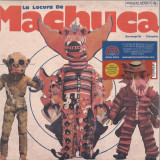
La Locura de Machuca is the story of one man’s bizarre odyssey into Colombia’s coastal music underground, and the wild, hypnotic sounds he helped bring up to the surface.
One night in 1975, a successful tax lawyer named Rafael Machuca had his mind blown in Barranquilla’s ‘Plaza de los Musicos’. Overnight he went from a high ranking position in the Columbian revenue authority to visionary production guru of the newly formed record label that bore his name, Discos Machuca, and for the next six years he devoted his life to releasing some of the strangest, most experimental Afro Psychedelia Cumbias ever produced. La Locura de Machuca is the story of one man’s bizarre odyssey into Colombia’s coastal music underground, and the wild, hypnotic sounds he helped bring up to the surface.
The Colombian music industry was thriving in the mid-seventies, but while homegrown bolero and vallenato tunes were doing well on the charts, it was imported African records that were setting crowds on fire at the picos – the sound-systems that fuelled neighbourhood parties – and wherever those records were played there were always a handful of groups who were inspired to plug traditional Cumbia directly into the electric currents coming from across the Atlantic.
It was these obscure bands, who fused Colombian and African rhythms with the swirling organs and psychedelic guitars of underground rock, that fired Machuca’s imagination. While the label made its money releasing popular hits by legends such as Alejandro Durán and Aníbal Velásquez, that money was poured back into a unique run of experimental releases by fringe artists such as La Banda Africana, King Somalie, Conjunto Barbacoa, and Abelardo Carbono, one of the godfathers of Champeta Criolla.
When Machuca couldn’t find groups to realise his particular vision, he simply created them himself. Drawing on a fearsome roster of musicians associated with the label, he assembled bands that lasted only as long as it took to record an album ,and unleashed the results – complete with arrestingly unusual album covers – under a series of different names such as Samba Negra or El Grupo Folclórico. This unorthodox approach led his longtime recording engineer, Eduardo Dávila, to describes Machuca’s productions as the “B-Movies of Colombian music.”
The story of Doctor Machuca and his eccentric exploits tells of one of Colombia’s most atypical and peculiar record companies; a defining pillar of Afro-Caribbean psychedelia. His productions have come to represent the roots of Champeta and set the pedigree standards for Afro and Costeño avant-garde. The seventeen tracks on La Locura de Machuca, harvested from the darkest, strangest corners of the Discos Machuca catalogue, sound like little else recorded before or since.
- 1: Dungeon Dance
- 2: Poison Moon
- 3: I Fire Myself
- 4: The Bell
- 5: Painted Horses
- 6: The Hour Glass
- 7: 13 Bees
- 8: The Golden Fruit
- 9: Whisper From The Tree
- 10: 1542
- 11: Valley Of One Thousand Perfumes
- 12: Tiger Rising
- 13: An-Deluzion
- 14: The Fox And Hound
- 15: Rider On The Stormy Sea
- 16: Return To Pirates (Kingston St Session)
- 17: Poison Moon (Kingston St Session)
- 18: Killed By The Telephone (Kingston St Session)
- 19: Valley Of One Thousand Perfumes (Orchestral Version)
Remastered by Bob Weston, ‘Mountains’ comes back to us as a gold foil-embossed gatefold double LP and includes the previously unreleased original takes of ‘Return to Pirates’, ‘Poison Moon’ and ‘Killed by the Telephone’, which were delivered along with the original master tapes 20 years ago but were omitted from the final album.
The record is completed by a newly recorded orchestral version of ‘Valley of One Thousand Perfumes’ produced by composer Joe Wong (Russian Doll, Midnight Gospel) and mixed by Dave Fridmann.
At the turn of the Century, Timony (Ex Hex, Wild Flag, Hammered Hulls) was already a celebrated presence in American underground music - a fixture of D.C. and Boston rock ’n’ roll via her work in Autoclave and Helium respectively. By 1998, though, Helium was drawing to a close and Timony was feeling uncertain about the future. “I had never been good at the rock ‘n’ roll business, and making a living from being in a band just didn't seem like it was in the realm of possibility for me,” she writes. “I just knew I wanted to make another record because that was the part of being in a band that I liked the most.”
As Midnight Sister, multi-disciplinary LA artists Juliana Giraffe and Ari Balouzian make motion pictures. Yes, sometimes with moving images _ but most often only with the music they create together. Balouzian's serpentine, string compositions are movie scenes that allow Giraffe, a brilliant character actor, to cloak herself in a new roles and voices. A bit of Jon Brion's score work; some old Hollywood strings; a solid dose of glam and outsider disco from 70s independent cinema. Any perceived artifice is always matched by an indelible human fingerprint, something perfectly off. Giraffe and Balouzian's respective work in fashion, visual art, video and film scoring _ along with the gang of virtuosos with which they surround themselves _ all wonderfully coalesce as Midnight Sister. And if 2017's `Saturn Over Sunset' was their collection of short films about outcast life in The San Fernando Valley, then their new album `Paining the Roses' is the inventive, meta motion picture that cements them as auteurs. `Painting the Roses' is in many ways a fairy tale -- not so much the sweet-and-happyending kind as something richer, packed with imagination and rooted in the complex human messiness beneath a story's artifice. Frontwoman Giraffe describes it as "this tightrope of being real yet synthetic, organic yet staged, light yet dark, logical yet irrational, beautiful yet dilapidated. Joyful nonsense." Here, disguises like masks and paint are not meant to hide but to liberate, to "set a part of us free", and Midnight Sister often embody this themselves, appearing highly stylized, curious, warm and inviting but a little askew. `Painting the Roses' is a story told through the looking glass, one where we examine ourselves in a funhouse mirror but find clarity in its twists. Giraffe traveled to visit family in Argentina during the making of the album and reconnected greatly with that part of her family history, art and culture. Balouzian created the core album opener "Doctor Says" during a session in the desert outside of LA. The guitar, which reminded Giraffe of South America, has a slow, sweltering surf-tango to it, like Dick Dale doing Carlos Gardel. And even though the song was inspired by Giraffe's reconnection with Argentina, the song is about the fading of some close friendships during the making of the album. "Man, you have changed," Giraffe sings, unclear if tis directed to a friend or to herself. Later on the album, "Wednesday Baby" _ named after Giraffe's rescue dog _ is patient, subtly baroque pop. It follows Giraffe through one of those gloomy days spent in tunnelvision doldrums from which only a sunbathing turtle or your canine companion can pull you out. By the time collaborator Max Whipple's saw comes beaming down from heaven in the song's 3rd part, we're hypnotized by the song's charming ennui. The song lands someplace both familiar and aloof, a little slice of timelessness taken straight from The Cake of Perfect Songcraft.
James Giuffre was an American jazz clarinetist, saxophonist, composer, and arranger, notable for his development of forms of jazz which allowed for free interplay between the musicians. His 1960 album Western Suite features an unusual trio of clarinet, guitar and valve trombone. The first half of the album is devoted to Giuffre’s country music/folk- inspired suite, while the second half features a lengthy and abstract version of the big band standard “Topsy” and a Thelonious Monk song.
- 1: Fourth Of July
- 2: Hearing Voices
- 3: Spook
- 4: Summertime
- 5: Way Up High
- 6: Listen, The Snow Is Falling
- 7: Sorry
- 8: Melt Away
- 9: King Of Spain, Part Two
After producing two albums celebrated by a thirsty underground network of fans, Galaxie 500 released what turned out to be their unexpected swansong, This Is Our Music. The title is an intentionally declarative statement. After being labeled masters of the disengaged and forlorn, Damon Krukowsi, Dean Wareham, and Naomi Yang delivered a full-length comprised of their most stately material. Here, one can hear potential realized, as well as changes afoot. "Fourth of July" is a surprisingly up-front song for the band, with rolling drums and a bass-heavy refrain, and it proved to be their most popular single. The track sets the stage for the dynamism of This Is Our Music. When Galaxie 500 sounds wistful ("Summertime"), it sounds like years of yearning actualized; when the band sounds regretful ("Sorry"), it comes pleading on its knees. The trio found a beautiful balance between increased production values and knob-twiddler Mark Kramer's oddhanded approach. For the first time since its original pressing, This Is Our Music is available again on vinyl. Cut by vinyl ace Kevin Gray from a remaster by Kramer and Alan Douches, the album sounds more vibrant than ever, and Galaxie 500 exists again as one of the most enrapturing and glorious bands to emerge from the underground in the past 25 years.
Dark Green Marbled Vinyl
One town, three times of the day, a triarchy of Techno music, rolling into the deep – coming as green marbled vinyl with an exclusively designed festival wristband!
Rico Puestel rears a monument to his growing-up-town „Uslar“ with three different approaches on this second part of the home-loving „Solling“ series that dig deep into a downscaled and natural framework of sound (all recorded and produced right at that place).
The initiation ritual on A1 with Uslar at 6'23 in the morning starts off with an actual electric guitar theme, originally recorded back in 2003, that builds the foundation hub to one crisp and point-blank Techno-Electro ceremony. The clean minimalistic sound will showcase all the details of any structure within while one's certainly getting caught by the overall force of melodic attraction like the sun working its path through the misty valleys.
At 13'35 noon, a rising rhythmical and progressive interpretation of the initial morning sounds makes an appearance on the flipside that doesn't allow much time to leap right into the centre of the da(y)nce, immediately creating the guesswork where side AA is leading all along.
The evening hours at 21'55 then take a flying leap into the mystical peak of the whole process, taking the morning sounds from side A into some uneasy realms and sceneries, prevailed by an almost voodoo-like momentum and a dance into the depths of its surrounding woods that will coherently dignify 90's loop Techno par excellence.
This fourth record on Exhibition is and feels right here and right now, paying tribute to the past and many different streams of Techno while cherishing a future that has yet to be written, celebrating the
Flippen Disks follows up their much acclaimed label-debut with an intriguing second release by Yuto Takei.
Throughout the Bells From The East EP, Yuto Takei’s first vinyl release, displays a wide array of sounds with a particular interest in rhythmic experiments and the negotiation of sonic space.
The Tokyo-based producer and DJ takes the listener onto a trip through deep spheres, percussive workouts, jammy compositions and electronic psychedelia, leaving the listener at times startled as to whether humans are manipulating machines here, or vice-versa.
Having worked as an electronic music composer for video games such as Gran Turismo, this uncanny valley is known territory for the artist. It is, however, further explored on this four tracker, staying true to Flippen Disks paradigm of releasing club-oriented music, non-functional enough to not only be danced but also listened to.
While the title track Bells From The East is an 8 minute jam, in which the krauty psych attitude pairs up perfectly with the goofy lead melody, Eclectic Matters is an intense percussive workout, refined with a pinch of Digi-Dub.
On the flip, Karma Fuchi feels like a paraglide through a landscape of tree tops, curious winds passing and entrancing synths and percussion stabs leading the way. Mostica closes the EP beautifully and spaciously, allowing for deep dives into its detailed soundscape and waving the listener peacefully goodbye.
Joshua Abrams’ first album Natural Information from 2010, superb avant-jazz, newly remastered at Dubplates & Mastering.
In his book Powershift, published in 1990, writer and businessman Alvin Toffler predicted that the century ahead would be defined by speed and that time itself is destined to become our most valuable commodity. When Joshua Abrams recorded Natural Information, originally released by Eremite in 2010, he was reacting against such commodification of time and the diminishing attention span that accompanies it by offering music with an irresistible groove, rooted in the sinuous rhythms of the human body and the full play of our senses.
At the heart of this music is the sound of the guimbri, a North African three-stringed bass lute, which Abrams started to play following a visit to Morocco during the late 90s. Traditionally the instrument has a key role in mystical healing ceremonies. Abrams, already a well-established figure in Chicago’s vibrant musical communities, had no desire to repackage tradition. He recognized however that the involving, springy and percussive sound of the guimbri was just the right voice to communicate vital data, to relay the natural information we all need in order to get back in touch with the pulsating continuities of a world we all share.
With Natural Information Abrams entered a new phase of his musical life, extending an invitation to the trance, where time intersects with timelessness. He carried with him a wealth of playing and listening experience. As a bass player he had worked with a host of notable musicians including guitarist Jeff Parker and percussionist Hamid Drake, and had been a member of back porch minimalism outfit Town And Country and the improvising trio Sticks And Stones.
The guimbri is a shaping presence on this remarkable recording, but Abrams also plays bass, bells, kora, sampler and synthesizer. Sympathetic friends including guitarist Emmett Kelly, vibraphonist Jason Adasiewicz and drummers Frank Rosaly and Nori Tanaka join him for the project. They set out not to contrive some neat hybrid but to enable coordinated energies and enriching influences to pulse and flow through living, breathing music. Ten years further into a century seemingly dedicated, as Toffler foresaw, to the survival of the fastest, the deep involving groove of Natural Information seems still more relevant, more illuminating, more vital.
Joshua Abrams: guimbri, mpc, percussion, harmonium, bass, bells, dulcimer, donso ngoni, ms20
Jason Adasiewicz: vibraphone
Emmett Kelly: guitar
Frank Rosaly & Noritaka Tanaka: drums
- A1: Machinecode - Flat Earth
- A2: Machinecode - 031703
- A3: Machinecode - King Trigger
- B1: Machinecode - Lefortovo
- B2: Machinecode - Moksha
- B3: Machinecode - Mj-12
- C1: Machinecode & Coppa - Iron Mountain
- C2: Machinecode - Hollow Moon
- C3: Machinecode - Everyone's & Nothing's
- D1: Machinecode - Paperclip
- D2: Machinecode - Bluebeam
- D3: Machinecode - Mockingbird
Pink Vinyl
Machinecode is a duo comprising Current Value and Dean Rodell, a pair of artists who have shaped a unique sound in bass music and techno throughout their careers. Everyones and Nothings is an exploratory body of work that is immediately identifiable with the Machinecode audio aesthetic, and that moves through genres with ease - from 130 bpm leftfield bass, to Dr.Octagon-inspired halftime, techno, ambient and experimental dnb. It is layered with mystery and myth, exploring conspiracy, the stories that people tell each other, and the things that are whispered about in obscure corners of the Internet. The album artwork is by Zeke Clough (of Skull Disco notoriety and more) and an accompanying video by animator Oskar Alvarado retells and reimagines the folklore behind the Mesoamerican serpent deity, Kukulkan.
- A1: Secret Rendezvous - Back In The Day (High Hoops Flip) (High Hoops Flip)
- A2: Moods & Two Another - Control
- A3: Izo Fitzroy - When The Wires Are Down (Kraak & Smaak Remix)
- A4: Saux - You're Not Wrong
- A5: Jean Tonique - Too Bad (Kraak & Smaak Remix)
- B1: Kraak & Smaak - Centro De Placer
- B2: David Harks - Twice (Nteibint Remix)
- B3: Inkswel - The People (Feat Dave Aju - Cody Currie Remix)
- B4: Vhyce - Say We Will (Feat Wolfgang Valbrun - Titeknots Remix)
Ending the season on a breezy note, our new VA 'Boogie Angst, Edition Three' delivers the ideal wares for a buoyant last stretch to an otherwise trying year. Spanning a brightly hued kaleidoscope of pop-infused house and mellifluous boogie, Edition Three pushes forth a selection of our choicest grooves from the past year as well as a batch of unheard and exclusive gems to keep you in the warmest, most positive mindset for the winter to come. Through fifteen cuts covering a wide but cohesive spectrum of balmy sonics, the compilation once again offers a much spitting image of what the label's been up to in recent times.
HIGH HØØPS playful revamp of Secret Rendezvous' fresher-than-fresh RnB joint 'Back In The Day' sets the tone right away, followed closely by Moods & Two Another's lush coastal disco number 'Control' and Snacks & Eric Biddines neo-big band style house treat 'All Night' - a singular chunk of ballroom bop tinged with soulful blues tropes and Caribbean melodic accents, sure to have the dancers jiving without further ado.
Here comes Inkswel's synth-splattered mix of 8-bit pixelation and Run DMC-esque hip-hop 'Too Late' (ft. Stan Smith) and Saux's dream folk excursion 'You're Not Wrong'. A highlight of the package and mesmerizing piece of wistful, kosmische-laced disco, Kraak & Smaak 'Centro De Placer' ushers us in a realm of velveteen ingenuousness and sun-streaked utopianism, steering us away from the tar-scented gloom of soulless metropolises into an all engulfing prism of hope, love and grace.
Utrecht-based vibist Feiertag punches the clock with 'Encino Boogie' - a four minute-odd slab of buoyant funk sprinkled with laid-back house tropes and brass-heavy, loungey dub tonalities, perfect for drawing out the pleasure of dreamlike summer boogie sessions. Clear your mind and shuffle your feet to that solar-powered mix of fevered drums, slap bass and sensually aqueous groove.
Next, Kraak & Smaak's add their easily identifiable, almost Beck-ian spin to Jean Tonique's lysergic pop hit-en-puissance 'Too Bad' whilst Bondax lo-slung remix of Moods' sense-awakening soul tune 'Slow Down' (ft. Damon Trueitt) eases you into a place of inviting suavity.
Inkswel's funky robot chugger 'The People' (ft. Dave Aju) picks up the torch next, followed by Flevans, your go-to man for proper electroid floor traction. The UK-based producer has you covered with 'Everything I See' - a surefire, bass-driven roller inbound for severe club impact with its infectious mix of fiery riffs, mangled female vox slivers and racing groove. Next, Secret Rendezvous' sun-beamy ballad 'Your Love' takes us on a gently bouncy, romantic ride.
Last but not least, Vhyce's smooth hybrid of synth-strewn RnB and lo-velocity funk 'Lose Our Minds' (ft. Yves Paquet), David Harks' metronomic disco-pop anthem 'Twice' and Saux's sleek-textured synthpop exponent 'Night Is All There Is' round off the package on a typically smooth and vibrant sentimental touch.
For the wax heads out there, a limited 9-track vinyl sampler will be issued alongside the digital compilation, featuring some of the tracks on the album + a few alternative versions, and furthermore a vinyl exclusive of Kraak & Smaak's remix of Izo FitzRoy's 'When The Wires are Down', initially released only digitally via Jalapeño Records.
h 08 | Inkswel The People (Cody Currie Remix) feat Dave Aju
feat Wolfgang Valbrun
The sixth vinyl release of the Valencian label HC Records is signed by the legendary
brothers John & Paul Healy aka "Somatic Responses" in "Interlinked Ep". To talk about
them is to talk about real heroes of the history of the most personal, raw and abstract
electronic music born in Wales. Active since 1994, to this day they continue experimenting
with all their analogical stuff to compose with tremendous regularity.
The neural connection of wet cable with the Somatic Responses universe begins with "Satin
Armour", a stunning and beautiful electro melodic track surrounded by rough rhythms and
strange atmospheres like a rose protected by steel thorns. Raw, primitive and rough rhythms
are the presentation card of "Snake"; a track with a marked industrial influence where an
avalanche of beams and Martian LFOs, with a marked acid taste, develop along this
primitive discharge of high electric voltage. The mechanical and industrial force hits our
prefrontal cortex in "Interlinked (Cell Mix)", a sonic aggression that combines all the
violence of the Intelligent Hardcore Techno with an avalanche of mysterious and fatalistic
auras coming from a future Cyberpunk.
"Aria" inaugurates the B side of the vinyl in a demonstration of harmonic virtuosity and
synthesizer juggling, seasoned with a whirlwind of accelerated broken rhythms totally
saturated with emotion, passion and hope.
The album's farewell track is "Heading South", a strange emotional trip, with velvety
cadences and dreamy pads seen through a stereogram, a potential anthem.
Four digital bonus tracks complete the journey through the dark future designed by the
Healy brothers:
"Dolaucothiacid v2" is an advanced and sharp experiment in several layers of pressure and
distortion around the amalgam of possibilities of the stacking of corrosive sequences and
abstract structures.
"Automaton Reign" reinvents all the concepts of the most acidic and vengeful Techno
Industrial, a merciless brain-roller. Persistent Illusion infiltrates us in the middle of an epic
and decadent combat of space cruisers where nobody survives, rhythmic rage and metallic
histrionics. We don't abandon the forcefulness or the post-apocalyptic hysteria in "Cell
(Loquelic Mix)" a demolishing closure that connects us fully in the already tangible manmachine
connection.
For this special release, we have collaborated with the Valencian artist Manuel Monzonís,
who has been in charge of creating the cover illustration. A stunning work that perfectly
captures the spirit of this Interlinked EP.
WRWTFWW Records is feeling total bliss as it announces the full official reissue of two major works from the great Somei Satoh gathered into one LP: the mystic and meditative Emerald Tablet (1978) and Echoes (1981), sourced from original masters and available on vinyl with liner notes by passio-nate Japanese music connoisseur/collector/critic/dj Masaaki Hara.
Fall into the ambient vastness, let yourself go…
Originally released by highly respected label ALM, these pivotal pieces of late 70s / early 80s Ja-panese experimental music majestically showcase Satoh’s intuitive approach to composition and mastery of creating infinite worlds of sound from very, very little.
Emerald Tablet, recorded at the fabled NHK Studio of Electronic Music in 1978, is a spellbinding take on musique concrète meets tape music relying solely on sound harmonics from tubular bell, cymbals, and 'kin' (Buddhist standing bell) overdubbed endlessly, voyaging into vertiginous sonic depths.
Echoes was composed for the Mist, Sound, and Light Festival, a 10-day event organized by the hot spring tourist association of Kawaji, Tochigi Prefecture, held on May 20-29, 1981. It was played in the Kawaji hot spring's Ojika river valley, with 8 gigantic loudspeakers set up on hills surrounding the stream and connected to an octuple channel-tape system - thanks to a combined length of cables exceeding one kilometer - while artificial fog rose from a ravine and laser beams shot up on the mountains. Cinematic and resonating, this breathtaking piece from Somei Satoh is a transcending sonic experience.
Emerald Tablet / Echoes is reissued in conjunction with Somei Satoh’s Mandala Trilogy + 1 double LP, also available on WRWTFWW Records.
D Leria debuts on Avian.
Giuseppe Scaccia shows his range on a new six track EP, arriving late 2020.
Produced diligently across the last two years, the record showcases a range of styles. Tonally, the material is bound by a recognisable engineering palette – driven, but not to the point of corrosion, tight and focused in the low end with caustic, percussive synth patches driving much of the more dance floor material.
In the terms of the form, though – Scaccia draws for a disparate arrangement. Opener A Life On The Run clocks in at over 140bpm, with a demented lead synth line providing the action buoyed by a simplistic drum machine rhythm. Divergences offers a more immersive experience in terms of tempo – again letting the lead do the work, while shifting hats operate around the sonic periphery to break up the recording. On Il Giardino Degli Unicorni the artist utilises a single, staccato sequence, letting the sends do the bulk of the business with careful processing and live articulation helping to build the intensity. On the flip, pulsing workout Noises from The Room develops surreptitiously over its run time – fathoms deep kicks are submerged under a heated sequence and Red Flowers, an exercise in careful reduction reintroduces a little musicality to the record, before warping closer Tribalism places the listener back on the dance floor with a half-time rhythm driving the droning sound design.
A careful meeting point at which the multiple styles that underpin Scaccia’s D Leria project meet, Still Standing offers insight into how future work might manifest whilst remaining a valuable document on the current state of both left field Techno music and the artist’s own creative identity.
Ginno Russo follows up summery sizzler She Is On Fire with his full debut vinyl 12' for MOM. The Valencia based DJ and producer presents a stylish four track EP. It is entitled Travelling Around Zambia and features rhythms and beats inspired by Africa. Russo has been an active DJ since he was 17, with DJ residencies in Valencia and the surrounding region, as well as frequent trips to the Balearic Islands. Due to this experience, Russo knows what works on the dancefloor. Therefore it is no surprise that all four tracks on this EP are built for club play. However, the fun rhythms and ear catching grooves also make them suited to other occasions. Lio is a powerful and uplifting opener. It features steady textured beats, a stylish keyed groove and rising strings. Dubby is a relentless follow-up. Exploding chords and a live bass take centre stage over not stopping beats. Rosas is a funky number for the dancefloor. Textured percussion and powerful synths work the groove here alongside looped vocal fragments. Poble finishes off the EP with a vocal winner. Call and response sung vocals are laid over a powerful bassline and strong beats. This is a fine debut EP from Russo.
Isolation Tapes is a 3 part series from Audiojack, featuring guest vocals from Polarbear, Eli & Fur and Lady Vale.
'The Isolation Tapes came together accidentally during lockdown. Getting lost in the music-making process was our way to escape the feelings of anxiety and uncertainty which presented themselves with the emergence of Covid. We had no plan beyond escapism, but a cleared schedule gave us lots of time to explore new ideas. After we'd made a few tracks we started to realize the importance of bringing this music together under one project, a musical reference point for this strange period in time, and so the Isolation Tapes was born - a series of singles we made during lockdown whose titles all begin with a different letter from the word: I S O L A T I O N.' - Audiojack