Limited repress
AZOTO is a Celso Valli’s project, one of the most important exponents of Italo-disco. He pioneered the whole italo sound, with incredibly ahead of their time productions going right back back too ’70’s. “DISCO FIZZ” contain ‘San Salvador’, one of the most covered disco tracks of all time, which has reared its head under countless of remixes and cover versions, however if you dig a little deeper this album is packed full of incredible and timeless italo disco: ‘Anytime Or Place’ literally jumps out the speakers to get you moving, while ‘Exalt-Exalt’ showcases their take on the darker side of electronic disco. “DISCO FIZZ” bridging traditional disco from america ‘s 70s with the spaceage syntheziser/vocoder powered Italian brand of Disco that was beginning to invade with new innovations at that time (1979).
The record is officially reprinted on LP for the 1st time from original master tapes, and includes a sticker inside. A must-have for any DJs.
Поиск:val ex
Все
- A1: Rock This Mother
- A2: Talk To Me Girl
- A3: You Can Find Me
- A4: Check This Out
- A5: Jesus Going To Clean House
- A6: Hope You Understood
- A7: Is It What You Want
- A8: Love Is Everlasting
- A9: This Is Hip-Hop Art
- A10: Opposite Of Love
- A11: Do You Know What I Mean
- B1: Saving All My Love For You
- B2: Look Out Here I Come
- B3: Girl You Always Talking
- B4: Have A Great Day
- B5: Take My Hand
- B6: I Need Your Love
- B7: Your Town
- B8: Talk Around Town
- B9: Booty Head/Take A Little Walk
- B10: I Love My Mama
- B11: I Never Found Anyone Like You
Cassette[11,72 €]
As the sun sets on a quaint East Nashville house, a young man bares a piece of his soul. Facing the camera, sporting a silky suit jacket/shirt/slacks/fingerless gloves ensemble that announces "singer" before he's even opened his mouth, Lee Tracy Johnson settles onto his stage, the front yard. He sways to the dirge-like drum machine pulse of a synth-soaked slow jam, extends his arms as if gaining his balance, and croons in affecting, fragile earnest, "I need your love… oh baby…"
Dogs in the yard next door begin barking. A mysterious cardboard robot figure, beamed in from galaxies unknown and affixed to a tree, is less vocal. Lee doesn't acknowledge either's presence. He's busy feeling it, arms and hands gesticulating. His voice rises in falsetto over the now-quiet dogs, over the ambient noise from the street that seeps into the handheld camcorder's microphone, over the recording of his own voice played back from a boombox off-camera. After six minutes the single, continuous shot ends. In this intimate creative universe there are no re-takes. There are many more music videos to shoot, and as Lee later puts it, "The first time you do it is actually the best. Because you can never get that again. You expressing yourself from within."
"I Need Your Love" dates from a lost heyday. From some time in the '80s or early '90s, when Lee Tracy (as he was known in performance) and his music partner/producer/manager Isaac Manning committed hours upon hours of their sonic and visual ideas to tape. Embracing drum machines and synthesizers – electronics that made their personal futurism palpable – they recorded exclusively at home, live in a room into a simple cassette deck. Soul, funk, electro and new wave informed their songs, yet Lee and Isaac eschewed the confinement of conventional categories and genres, preferring to let experimentation guide them.
"Anytime somebody put out a new record they had the same instruments or the same sound," explains Isaac. "So I basically wanted to find something that's really gonna stand out away from all of the rest of 'em." Their ethos meant that every idea they came up with was at least worth trying: echoed out half-rapped exhortations over frantic techno-style beats, gospel synth soul, modal electro-funk, oddball pop reinterpretations, emo AOR balladry, nods to Prince and the Fat Boys, or arrangements that might collapse mid-song into a mess of arcade game-ish blips before rallying to reach the finish line. All of it conjoined by consistent tape hiss, and most vitally, Lee's chameleonic voice, which managed to wildly shape shift and still evoke something sincere – whether toggling between falsetto and tenor exalting Jesus's return, or punctuating a melismatic romantic adlib with a succinct, "We all know how it feels to be alone."
"People think we went to a studio," says Isaac derisively. "We never went to no studio. We didn't have the money to go to no studio! We did this stuff at home. I shot videos in my front yard with whatever we could to get things together." Sometimes Isaac would just put on an instrumental record, be it "Planet Rock" or "Don't Cry For Me Argentina" (from Evita), press "record," and let Lee improvise over it, yielding peculiar love songs, would-be patriotic anthems, or Elvis Presley or Marilyn Monroe tributes. Technical limitations and a lack of professional polish never dissuaded them. They believed they were onto something.
"That struggle," Isaac says, "made that sound sound good to me."
In the parlance of modern music criticism Lee and Isaac's dizzying DIY efforts would inevitably be described as "outsider." But "outsider" carries the burden of untold additional layers of meaning if you're Black and from the South, creating on a budget, and trying to get someone, anyone within the country music capital of the world to take your vision seriously. "What category should we put it in?" Isaac asks rhetorically. "I don't know. All I know is feeling. I ain't gonna name it nothing. It's music. If it grabs your soul and touch your heart that's what it basically is supposed to do."
=
Born in 1963, the baby boy of nine siblings, Lee Tracy spent his earliest years living amidst the shotgun houses on Nashville's south side. "We was poor, man!" he says, recalling the outhouse his family used for a bathroom and the blocks of ice they kept in the kitchen to chill perishables. "But I actually don't think I really realized I was in poverty until I got grown and started thinking about it." Lee's mom worked at the Holiday Inn; his dad did whatever he had to do, from selling fruit from a horse drawn cart to bootlegging. "We didn't have much," Lee continues, "but my mother and my father got us the things we needed, the clothes on our back." By the end of the decade with the city's urban renewal programs razing entire neighborhoods to accommodate construction of the Interstate, the family moved to Edgehill Projects. Lee remembers music and art as a constant source of inspiration for he and his brothers and sisters – especially after seeing the Jackson 5 perform on Ed Sullivan. "As a small child I just knew that was what I wanted to do."
His older brother Don began musically mentoring him, introducing Lee to a variety of instruments and sounds. "He would never play one particular type of music, like R&B," says Lee. "I was surrounded by jazz, hard rock and roll, easy listening, gospel, reggae, country music; I mean I was a sponge absorbing all of that." Lee taught himself to play drums by beating on cardboard boxes, gaining a rep around the way for his timekeeping, and his singing voice. Emulating his favorites, Earth Wind & Fire and Cameo, he formed groups with other kids with era-evocative band names like Concept and TNT Connection, and emerged as the leader of disciplined rehearsals. "I made them practice," says Lee. "We practiced and practiced and practiced. Because I wanted that perfection." By high school the most accomplished of these bands would take top prize in a prominent local talent show. It was a big moment for Lee, and he felt ready to take things to the next level. But his band-mates had other ideas.
"I don't know what happened," he says, still miffed at the memory. "It must have blew they mind after we won and people started showing notice, because it's like everybody quit! I was like, where the hell did everybody go?" Lee had always made a point of interrogating prospective musicians about their intentions before joining his groups: were they really serious or just looking for a way to pick up girls? Now he understood even more the importance of finding a collaborator just as committed to the music as he was.
=
Isaac Manning had spent much of his life immersed in music and the arts – singing in the church choir with his family on Nashville's north side, writing, painting, dancing, and working various gigs within the entertainment industry. After serving in the armed forces, in the early '70s he ran The Teenage Place, a music and performance venue that catered to the local youth. But he was forced out of town when word of one of his recreational routines created a stir beyond the safe haven of his bohemian circles.
"I was growing marijuana," Isaac explains. "It wasn't no business, I was smoking it myself… I would put marijuana in scrambled eggs, cornbread and stuff." His weed use originated as a form of self-medication to combat severe tooth pain. But when he began sharing it with some of the other young people he hung out with, some of who just so happened to be the kids of Nashville politicians, the cops came calling. "When I got busted," he remembers, "they were talking about how they were gonna get rid of me because they didn't want me saying nothing about they children because of the politics and stuff. So I got my family, took two raggedy cars, and left Nashville and went to Vegas."
Out in the desert, Isaac happened to meet Chubby Checker of "The Twist" fame while the singer was gigging at The Flamingo. Impressed by Isaac's zeal, Checker invited him to go on the road with him as his tour manager/roadie/valet. The experience gave Isaac a window into a part of the entertainment world he'd never encountered – a glimpse of what a true pop act's audience looked like. "Chubby Checker, none of his shows were played for Black folks," he remembers. "All his gigs were done at high-class white people areas." Returning home after a few years with Chubby, Isaac was properly motivated to make it in Music City. He began writing songs and scouting around Nashville for local talent anywhere he could find it with an expressed goal: "Find someone who can deliver your songs the way you want 'em delivered and make people feel what you want them to feel."
One day while walking through Edgehill Projects Isaac heard someone playing the drums in a way that made him stop and take notice. "The music was so tight, just the drums made me feel like, oh I'm-a find this person," he recalls. "So I circled through the projects until I found who it was.
"That's how I met him – Lee Tracy. When I found him and he started singing and stuff, I said, ohhh, this is somebody different."
=
Theirs was a true complementary partnership: young Lee possessed the raw talent, the older Isaac the belief. "He's really the only one besides my brother and my family that really seen the potential in me," says Lee. "He made me see that I could do it."
Isaac long being a night owl, his house also made for a fertile collaborative environment – a space where there always seemed to be a new piece of his visual art on display: paintings, illustrations, and dolls and figures (including an enigmatic cardboard robot). Lee and Issac would hang out together and talk, listen to music, conjure ideas, and smoke the herb Isaac had resumed growing in his yard. "It got to where I could trust him, he could trust me," Isaac says of their bond. They also worked together for hours on drawings, spreading larges rolls of paper on the walls and sketching faces with abstract patterns and imagery: alien-like beings, tri-horned horse heads, inverted Janus-like characters where one visage blurred into the other.
Soon it became apparent that they didn't need other collaborators; self-sufficiency was the natural way forward. At Isaac's behest Lee, already fed up with dealing with band musicians, began playing around with a poly-sonic Yamaha keyboard at the local music store. "It had everything on it – trumpet, bass, drums, organ," remembers Lee. "And that's when I started recording my own stuff."
The technology afforded Lee the flexibility and independence he craved, setting him on a path other bedroom musicians and producers around the world were simultaneously following through the '80s into the early '90s. Saving up money from day jobs, he eventually supplemented the Yamaha Isaac had gotten him with Roland and Casio drum machines and a Moog. Lee was living in an apartment in Hillside at that point caring for his dad, who'd been partially paralyzed since early in life. In the evenings up in his second floor room, the music put him in a zone where he could tune out everything and lose himself in his ideas.
"Oh I loved it," he recalls. "I would really experiment with the instruments and use a lot of different sound effects. I was looking for something nobody else had. I wanted something totally different. And once I found the sound I was looking for, I would just smoke me a good joint and just let it go, hit the record button." More potent a creative stimulant than even Isaac's weed was the holistic flow and spontaneity of recording. Between sessions at Isaac's place and Lee's apartment, their volume of output quickly ballooned.
"We was always recording," says Lee. "That's why we have so much music. Even when I went to Isaac's and we start creating, I get home, my mind is racing, I gotta start creating, creating, creating. I remember there were times when I took a 90-minute tape from front to back and just filled it up."
"We never practiced," says Isaac. "See, that was just so odd about the whole thing. I could relate to him, and tell him about the songs I had ideas for and everything and stuff. And then he would bring it back or whatever, and we'd get together and put it down." Once the taskmaster hell bent on rehearsing, Lee had flipped a full 180. Perfection was no longer an aspiration, but the enemy of inspiration.
"I seen where practicing and practicing got me," says Lee. "A lot of musicians you get to playing and they gotta stop, they have to analyze the music. But while you analyzing you losing a lot of the greatness of what you creating. Stop analyzing what you play, just play! And it'll all take shape."
=
"I hope you understood the beginning of the record because this was invented from a dream I had today… (You tell me, I'll tell you, we'll figure it out together)" – Lee Tracy and Isaac Manning, "Hope You Understand"
Lee lets loose a maniacal cackle when he acknowledges that the material that he and Isaac recorded was by anyone's estimation pretty out there. It's the same laugh that commences "Hope You Understand" – a chaotic transmission that encapsulates the duality at the heart of their music: a stated desire to reach people and a compulsion to go as leftfield as they saw fit.
"We just did it," says Lee. "We cut the music on and cut loose. I don't sit around and write. I do it by listening, get a feeling, play the music, and the lyrics and stuff just come out of me."
The approach proved adaptable to interpreting other artists' material. While recording a cover of Whitney Houston's pop ballad "Saving All My Love For You," Lee played Whitney's version in his headphones as he laid down his own vocals – partially following the lyrics, partially using them as a departure point. The end result is barely recognizable compared with the original, Lee and Isaac having switched up the time signature and reinvented the melody along the way towards morphing a slick mainstream radio standard into something that sounds solely their own.
"I really used that song to get me started," says Lee. "Then I said, well I need something else, something is missing. Something just came over me. That's when I came up with 'Is It What You Want.'"
The song would become the centerpiece of Lee and Isaac's repertoire. Pushed along by a percolating metronomic Rhythm King style beat somewhere between a military march and a samba, "Is It What You Want" finds Lee pleading the sincerity of his commitment to a potential love interest embellished by vocal tics and hiccups subtlely reminiscent of his childhood hero MJ. Absent chord changes, only synth riffs gliding in and out like apparitions, the song achieves a lingering lo-fi power that leaves you feeling like it's still playing, somewhere, even after the fade out.
"I don't know, it's like a real spiritual song," Lee reflects. "But it's not just spiritual. To me the more I listen to it it's like about everything that you do in your everyday life, period. Is it what you want? Do you want a car or you don't want a car? Do you want Jesus or do you want the Devil? It's basically asking you the question. Can't nobody answer the question but you yourself."
In 1989 Lee won a lawsuit stemming from injuries sustained from a fight he'd gotten into. He took part of the settlement money and with Isaac pressed up "Saving All My Love For You" b/w "Is It What You Want" as a 45 single. Isaac christened the label One Chance Records. "Because that's all we wanted," he says with a laugh, "one chance."
Isaac sent the record out to radio stations and major labels, hoping for it to make enough noise to get picked up nationally. But the response he and Lee were hoping for never materialized. According to Isaac the closest the single got to getting played on the radio is when a disk jock from a local station made a highly unusual announcement on air: "The dude said on the radio, 107.5 – 'We are not gonna play 'Is It What You Want.' We cracked up! Wow, that's deep.
"It was a whole racist thing that was going on," he reflects. "So we just looked over and kept on going. That was it. That was about the way it goes… If you were Black and you were living in Nashville and stuff, that's the way you got treated." Isaac already knew as much from all the times he'd brought he and Lee's tapes (even their cache of country music tunes) over to Music Row to try to drum up interest to no avail.
"Isaac, he really worked his ass off," says Lee. "He probably been to every record place down on Music Row." Nashville's famed recording and music business corridor wasn't but a few blocks from where Lee grew up. Close enough, he remembers, for him to ride his bike along its back alleys and stumble upon the occasional random treasure, like a discarded box of harmonicas. Getting in through the front door, however, still felt a world away.
"I just don't think at the time our music fell into a category for them," he concedes. "It was before its time."
=
Lee stopped making music some time in the latter part of the '90s, around the time his mom passed away and life became increasingly tough to manage. "When my mother died I had a nervous breakdown," he says, "So I shut down for a long time. I was in such a sadness frame of mind. That's why nobody seen me. I had just disappeared off the map." He fell out of touch with Isaac, and in an indication of just how bad things had gotten for him, lost track of all the recordings they'd made together. Music became a distant memory.
Fortunately, Isaac kept the faith. In a self-published collection of his poetry – paeans to some of his favorite entertainment and public figures entitled Friends and Dick Clark – he'd written that he believed "music has a life of its own." But his prescience and presence of mind were truly manifested in the fact that he kept an archive of he and Lee's work. As perfectly imperfect as "Is It What You Want" now sounds in a post-Personal Space world, Lee and Isaac's lone official release was in fact just a taste. The bulk of the Is It What You Want album is culled from the pair's essentially unheard home recordings – complete songs, half-realized experiments, Isaac's blue monologues and pronouncements et al – compiled, mixed and programmed in the loose and impulsive creative spirit of their regular get-togethers from decades ago. The rest of us, it seems, may have finally caught up to them.
On the prospect of at long last reaching a wider audience, Isaac says simply, "I been trying for a long time, it feels good." Ever the survivor, he adds, "The only way I know how to make it to the top is to keep climbing. If one leg break on the ladder, hey, you gotta fix it and keep on going… That's where I be at. I'll kill death to make it out there."
For Lee it all feels akin to a personal resurrection: "It's like I was in a tomb and the tomb was opened and I'm back… Man, it feels so great. I feel like I'm gonna jump out of my skin." Success at this stage of his life, he realizes, probably means something different than what it did back when he was singing and dancing in Isaac's front yard. "What I really mean by 'making it,'" he explains isn't just the music being heard but, "the story being told."
Occasionally Lee will pull up "Is It What You Want" on YouTube on his phone, put on his headphones, and listen. He remembers the first time he heard his recorded voice. How surreal it was, how he thought to himself, "Is that really me?" What would he say to that younger version of himself now?
"I would probably tell myself, hang in there, don't give up. Keep striving for the goal. And everything will work out."
Despite what's printed on the record label, sometimes you do get more than one chance.
- A1: Cook Strummer - For Berlin
- A2: Los Cabra & Manuel Sahagun - Italian Groove (Vinyl Edit)
- A3: Freudenthal Feat Nowhere People - Cipher (Vinyl Edit)
- A4: Marvin Jam & Le Mythe - Bad Karma (Vinyl Edit)
- B1: Daniel Jaeger & Valenti - Quarantine Cowboys (Vinyl Edit)
- B2: Air Horse One - Out Of The Blue (Vinyl Edit)
- B3: Dramasquad - Ziggy (Vinyl Edit)
- B4: Abayomi – Juba
- C1: Keene - Ecoute (Vinyl Edit)
- C2: Dan Buri - Zion (Vinyl Edit)
- C3: Max Joni & Mukkimiau - Everafter (Vinyl Edit)
- C4: Red Pig Flower & Lulla - Radioactive (Vinyl Edit)
- D1: Mike Book - Ready To Go (Vinyl Edit)
- D2: Freedomb - State Of Shock (Vinyl Edit)
- D3: Electronic Elephant - Ask Yourself (Vinyl Edit)
Three years after Reno Wurzbacher’s entry into the series, Cook Strummer now offers up his own Berlin Gets Physical, a collection of all-new and exclusive tracks.
Berlin-based, Belgium-born Strummer has been a Get Physical associate for several years. He has dropped various singles including the standout 'Rising' which also featured on the Words Don't Come Easy series, and always crafts the perfect mix of rhythm and melody with plenty of hints of his homeland's famous cold wave sound. He often uses his own voice, drum machines, synths and guitars in his music, and since his debut album in 2018 on LOK Recordings, he has had high profile support from the likes of Laurent Garnier, Adam Port and Ame. This summer, he dropped 'Atmosphere' on Obsolet Records which proved another successful outing and now Berlin Gets Physical finds him digging deep into the famous city's freshest and most essential house sounds across 15 well-sequenced tracks.
His own new offering 'For Berlin' kicks off with a dark and edgy vibe, gothic vocals and tense drums. Glitchy hits and blurting synths add to the prickly atmosphere and immediately lock you in while Los Cabra & Manuel Sahagun's 'Italian Groove' then takes off on waves of serrated dark disco synths and Freudenthal feat. Nowhere People continue that macho disco vibe with the rugged chug and cosmic rays of 'Cipher.'
The twinkling 'Bad Karma' by Marvin Jam & Le Mythe then allows you to catch your breath with a slower, more spacious dub disco sound and the twanging bass riffs and exotic effects of Daniel Jaeger & Valenti's 'Quarantine Cowboys' rebuilds the atmosphere with some innovative house blues. The mid-section brings brain-frying synth work on 'Out Of The Blue', bubbling dub house and disco courtesy of dramasquad's sprawling 'ziggy' and percussive deep house looseness from 'Abayomi.'
After KEENE's rubbery and rolling Afro sounds comes more cosmic house richness from Dan Buri and Max Joni & MUKKIMIAU, the driving tech of Red Pig Flower & Lulla and heady sounds of Mike Book. There is a raw house heaviness to FreedomB's 'State of Shock' and things shut down with Electronic Elephant's tightly coiled minimal drum funk on 'Ask Yourself'.
This on point collection is an authentic snapshot of the contemporary underground sound of the Berlin.
With his Arjunamusic label and a growing catalog of category-defying releases, Samuel Rohrer
continues to quietly, yet confidently, make a name for himself as a genuinely unique figure within
the European electronic music realm. Over the past decade he has assembled a repertoire of
music that fills a sadly neglected gap in the modern musical landscape. That is to say, he has
made a number of “electronically”-aided works that never seem to make “electronic-ism” the main
selling point or raison d'être. Rohrer understands that we inhabit a networked media landscape
that no longer sees a novelty value in every synthetic or technological sound, and by realizing
this, he makes a music that fully engages with the present without completely disregarding the
exciting speculative sensibility that has allowed electronic music to solidify into a tradition. His
latest solo album, Hungry Ghosts, again shows the high quality of sonic design that can be
achieved by conceptualizing musical passages as living, breathing entities rather than as
signposts to some still distant reality.
Maybe more so than any of Rohrer’s solo records to date, Hungry Ghosts is the one that
most unambiguously displays the artist as a kind of inspired sound “cultivator” or landscaper
rather than just a straightforward “producer”. The emphasis here seems to be biological growth
processes rendered in musical form, and in fact some track titles namechecking the biodiversity
of the external world (“Slow Fox”, “Ctenophora”) and neurochemistry (“Serotonin”) lend some
additional credence to this interpretation.
As with previous outings, Rohrer starts with his skills as a genre-resistant percussionist
and builds from there, with dense clusters of drum hits and icy cymbal exclamations leading the
way into a wide-open atmosphere full of fragmented phrases, marked with strange reversals or
compressions of time. The percussive portions and other ambiences merge together in such a
way that the latter seems like a kind of shifting, holographic camouflage for the former; an effect
which makes for a greater than usual number of shifts in mood. Rohrer’s already established
ambiguity and mystery are the moods that permeate throughout, to be sure, but there are also
surprising moments of humorous whimsy (the flourishes of cartoon mischief and teasing silences
on the tracks “Human Regression” and “Bodylanguage”), reverence (the optimistic organ swells
and steady sequencer guiding “Ceremonism”), and meditative focus (the slow-motion spectral
waltz of “Treehouse”). Also notable here are very brief etudes, such as “Window Pain,” whose
dark, lush ebb and flow actually seem tailored to repeated or looped listening.
It’s particularly remarkable that almost all of this material is recorded solo and in a “live /
no overdubs” mode, given how much it feels like well-rehearsed ensemble playing, and given the
impeccable timing involved in continually exchanging the sounds at the very forefront of the mix.
And here we come full circle to the idea of “electronic music” mentioned at the beginning here:
instead of making us feel that we are in the presence of some fully-realized form brought back
from “the future,” Rohrer invites us instead to witness fascinating processes of transition and
mutation, and to value them for what they are now as much as for where they are headed.
Jackie Cohen decided the only way forward was to succumb to crisis, to
relax into it instead of fighting, to find beauty even in the flame an
approach that fuels her sublime new album, Pratfall
Because of the record's pandemic origins, Cohen was only aided in studio by two
collaborators: her husband, Foxygen's Jonathan Rado, and engineer Rias Reed.
"We were a tight pod," she laughs. The three musicians holed up at Sonora
Recorders in Los Angeles, tapping into the studio's vaulted ceilings and haunted
feeling to amplify Cohen's widescreen songwriting. "Elliott Smith recorded some
stuff there, and it always seemed like there was a ghost banging around in there,
turning lights on and off," she says, before adding a cheery followup: "Shakira
recorded there too, can't forget another 5'2" icon." On Pratfall, Cohen renders both
extremes of that range of experience in warm, inviting indie pop. "I didn't want to
write a dirge inspired by the darkest moments of my life, I wanted a cathartic
moment, to experience the emotion and build from it," Cohen says. "This record is
a climax where everything becomes explosive and you can just close your eyes,
give in, and dance it off."
LP Tracks: Two Days / Coup De Grace / The Valley / Pratfall / Ghost Story /
Moonstruck / Dire Love / Lost Without Fear / Some Days / Extra Credit / Scraps
Of Love
3rd volume in Luaka Bop’s critically acclaimed World
Spirituality Classics series, illuminating the relationship between
music and belief following Alice Coltrane and “Time For Peace Is
Now”
Alhaji Waziri Oshomah begins his sermon before a dancing crowd. His
lyrics warn about the vice of jealousy but the congregation is here to get down. We’re in a small part of Edo State in southern Nigeria called
Afenmailand, which is known for being a harmonious region where Muslims and Christians live and dance together. The atmosphere is one of enjoyment, excitement, and pleasure, because to see Waziri perform is to be addressed, body and soul. He’s the creator of a unique dance music that’s fused with local folk styles, highlife, and Western pop, and imbued with Islamic values— and he’s the greatest entertainer in all of Edo State.
They call him the Etsako Super Star.
Alhaji Waziri Oshomah begins his sermon before a dancing crowd. His lyrics warn about the vice of jealousy but the congregation is here to get down. We're in a small part of Edo State in southern Nigeria called Afenmailand, which is known for being a harmonious region where Muslims and Christians live and dance together. The atmosphere is one of enjoyment, excitement, and pleasure, because to see Waziri perform is to be addressed, body and soul. He's the creator of a unique dance music that's fused with local folk styles, highlife, and Western pop, and imbued with Islamic values - and he's the greatest entertainer in all of Edo State. They call him the Etsako Super Star.
Purple Vinyl
Concentric Records present this special edition EP by the Berlin-based duo YHDESSA - composed of Dutch-Italian composer and poly- instrumentalist Grand River and Sardinian electronic music experimentalist Enrica Falqui.
Entitled Along The Simple Line, the 5-track EP is a unique sonic journey that merges in pure form the distinct worlds of the two composers, exposing a warm and delicate essence. Perfectly punctuated, and in a pace of its own, the album gently and precisely unfolds through touching musical spaces, dramatic textures, entrancing rhythms and unexpected vocal lines, revealing a wonderful depth. The result is so perfectly uniting as if woven by the same two hands.
Yhdessa is a collaborative project made up of Grand River and Enrica Falqui which was conceptualised in 2017 while the duo shared a music studio and were living as a couple in Berlin. Their first piece, released in 2018 on the label One Instrument Records, was named after the Vermona E-Piano and is composed entirely using the analogue synthesizer that was built in 1978. Following this came their lingering soundscape Waldorf Micro Q featured on the record “One Instrument Volume 01” as well as an impelling remix of Dunes by Jiska Huizing and Rudi Valdersnes.
Aimée Portioli is a Berlin-based Dutch-Italian composer and sound designer who records and performs as Grand River. The name Grand River evokes nature, scale, and movement, all key forces in Portioli’s work. Her first release as Grand River was the resolute 2017 Crescente EP, which includes Flies, a composition named by XLR8R as one of the best tracks of that year. She followed this with her melodious debut album Pineapple (Spazio Disponibile, 2018), which garnered praise from The Quietus, amongst others. The moving and dynamic subsequent album, Blink A Few Times To Clear Your Eyes (Editions Mego, 2020) was lauded by Resident Advisor and The Verge, and was elected among the best albums of 2020 by Inverted Audio. Separately, Grand River’s work has appeared on compilations by Ghostly International, Tresor, Longform Editions and has composed an official remix for Tangerine Dream.
Enrica Falqui is a Sardinian music producer and DJ currently based in Berlin. With artistic versatility as one of her defining traits: she comfortably traverses between the dimensions of electronic music. For over a decade she has dedicated herself to the study of sound and the relentless excavation of lesser-known music, which has earned her bookings all over the world and commissions for her productions from some of the most respected labels including Marignal Returns which released Plexus, a mini-album of cool, divergent compositions. Enrica is also part of the coveted duo, ERIS, whose debut and sophomore EPs, Moments and Champions League, found their home on the illustrious Cabaret Recordings. The releases entwine the forceful with the ethereal and create an original, future-facing and club-orientated sound. Moloko, a drum-focussed track laced with weaving synths, was considered by Resident Advisor as one of the best tracks of 2019.
Aimée and Enrica’s musical union through Yhdessa, is one of colour and warmth. It expresses an experimental electro-ambient side of the two composers, to form a style that is meditative, other-worldly and at times introspective. Although, the two are now, no longer romantically engaged, they maintain a passionate friendship to match this profound musical partnership.
Uruguayan music that sheds light on a new path, guarded by candombe & hip hop. An hypnotic, contemporary and ancestral record. To listen from beggining to end, in a trance. Include contributions of Hugo Fattoruso y Ruben Rada. Txt: Martín Buscaglia . DESCRIPTION Sankofa is the debut album by Avr (Alvaro Silva), a work that takes form through the research and fusion of Candombe and other Afro rhythms from Río de la Plata region with Hip Hop and Black American Music. Avr, the great-grandson of Juan Julio Arrascaeta (one of the first afrodescendant poets to be published in Latin America) writes throughout the album, using several "africanisms" and lost words that date back from colonial and slavery times, giving the lyrics a connection with his great-grandfather's work, introducing himself as a skilfull MC who travels through past, present and future while using several Candombe rhythms in his flow. Highlighting several personalities from the Afrouruguayan culture and from across the American continent, it also presents itself as a valuable work for those interested in researching cultural figures of Black America, especially, Uruguayan. Under the production of Felipe Fuentes, an album knitted with tons of messages, some direct, some to be discovered, came to life. Sankofa means "to look back, to go forward" which is exactly from the beggining what this musical journey is, from a very heavy and dense, ancestral, drum presence, to complex harmonic compositions and arrangments, a work that counts with important contributions of some of the main afrouruguayan artists. A musical "Guiso" (South American stew) Sankofa is the vision of the world of a young black male, his way of feeling and interpreting the past, present and future; and how to transform it in order to generate something new.
For the first time, super drummer Steve Gadd reunites with his friends
from the "Gadd Gang" days, Eddie Gomez and Ronnie Cuber for a
production with the multiple Grammy Award-winning WDR Big Band
Under the direction of Michael Abene, a deeply grooving album was created,
centered around Steve Gadd and his friends. They are joined by Bobby Sparks II
and Simon Oslender as special guest musicians. The recordings took place in
Studio 4 of the WDR in January and February 2022. Classics from the Gadd Gang
repertoire can be found on Center Stage: "I Can't Turn You Loose," "Che Ore So',"
"Them Changes," "Way Back Home," "Lucky 13," "Honky Tonk/I Can't Stop Loving
You" and "My Little Brother."
A perfect mixture of groovy songs and an excellent ensemble around Steve Gadd
guarantee highest entertainment value.
- B2:
- A1: Nekta - Who´s Sorry Now
- A2: Mop Mop - Hot Pot (Ezequiel Lodeiro "Latinazo " Dub)
- A3: Gabriele Poso - Freedom
- A4:
- B1: Aromabar - Calling
- B3: Metropolitan Jazz Affair - You Can Dig
- B4: Dublex Inc Feat. Stee Downes - Something´s Missin
- B5: Valique - Herbie's Delight
- C1: Jhelisa - Love Is A State Of Mind
- C2: Woodland Conclave - Celebration Of Life (Song For Simon)
- C3: Matthias Vogt Trio – Driver (Joash Remix)
- D1: Taxi – The Accessory
- D2: Rime - Smoke And Regret
- D3: Shantel - Considerando (Video Version)
- D4: Kosma - La Seule Fleur Dans Le Jardin (For Karen)
INFRACom!, one of the longest operating Independent labels in Germany, celebrate it´s 30yrs anniversary with a vinyl compilation consisting of tracks that have never been released on vinyl before. Label co-founder Jan Hagenkötter handpicked these from various artist in the catalog, true to the spirit of the label and its operator – We couldn´t save the entire planet but we still like to save your soul.
The artwork was once again designed by Rafael Jimenez Heckmann, a well-known graphic designer from Offenbach. He is responsible for most of the artworks and designs on INFRACom!... his covers have already been awarded several times e.g. in Lürzers Archive and others.
The inlay was designed by the long time friend & well known artist Jim Avignon. In the nineties before Jim went to Berlin and New York to get world famous he lived in Frankfurt for a few years and drew and partied a lot with Jan Hagenkötter & Namé Vaughn…the two DJ´s, friends and founders of INFRACom! He even contributed a song to the very first INFRACom! production. Since that time they cultivate a lovely friendship and Jim was happy to contribute an artwork to this anniversary release.
Most of the tracks included on the compilation were released only on CD and then digitally in the so-called 2000s or noughties, as it was very difficult to release any album on vinyl during that time due to the situation in the music market while the transition from physical to digital products and the piracy phenomenon. Fortunately, today the different formats can coexist again.
INFRACom!, once started locally in Frankfurt with artist like Shantel who released his first recordings on the label. He is featured by a collaboration with the Brazilian duo Rosanna & Zélia. Soon INFRACom! expanded to an international platform for artist from all over the world like Jhelisa (USA), Mop Mop & Gabriele Poso..both from Italy, Metropolitan Jazz Affair the brainchild of French producer and musician Patchworks, Taxi from the UK, Rime from Finland or Aromabar from Austria…all with different styles of music.
The vision of the two founders Jan Hagenkötter & Namé Vaughn was and still is artistically oriented and has never favored just only one style of music.
The roots of INFRACom as a label are based in the various form of black music culture - conditiopned to the influences and personal history of the two founders - but also deeply rooted in the club and DJ culture and various forms of electronic music. The compilation can only show a small glimpse into the universe with tunes that stand the test of time.
One of the best examples is Matthias Vogt with whom the label has a long standing collaboration and who just this year released the album PIANISSIMO on INFRACom!. He can be heard with his Matthias Vogt (Jazz) Trio in a cinematic remix from Joash and two pieces by the highly successful re:jazz band which he leads.
With Valique we are happy to feature a Belarus/Russian artist on the release these days….one who already showed ten years ago on his album artworks what he thinks about the politics of his government. As an open minded label and ethnical diverse ppl. we think “Fuck Putin and his disciples and like-minded people, but let's not condemn all Russian-born people. Some prefer to worship Herbie Hancock...like Valique and we want to support that.”
With Nekta, Dublex Inc. feat Stee Downes and Kosma this release features three more artists from various regions in Germany, each with their great moments.….and last but not least the mysterious Woodland Conclave (UK)…a waltz and a story yet to be told and hopefully will be…on INFRACom!…in the near future!
d A4 | re jazz Feat N'dea Davenport - Don't Push Your Luck (Wagon Cookin´ Vocal Remix)
f B2 | re jazz Feat Mediha - Tears
d A4 | [Re:Jazz] feat. N'Dea Davenport - Don'T Push Your Luck (Wagon Cookin' Vocal Remix)
[f] B2 | [Re:Jazz] feat. Mediha - Tears
- A1: Joe White - My Guiding Star
- A2: Delroy Wilson - I Want To Love You
- A3: Alton Ellis & Phyllis Dillon - Why Did You Leave Me (To Cry) (To Cry)
- A4: The Sealmates - She Said She Loves Me
- A5: The Sensations - Right On Time
- A6: Leslie Butler & The Originals Orchestra - Revival
- B1: Stranger Cole & Gladstone Anderson (As Stranger & Gladdy) - Over Again (As Stranger & Gladdy)
- B2: The Maytals - Reborn
- B3: Glenmore Brown & Hopeton Lewis (As Glen & Hopeton) - Girl You're Cold (As Glen & Hopeton)
- B4: The Black Brothers - Baby Come Back To Me
- B5: Ken Boothe - Can't See You
- B6: Val Bennett & The Carib Beats - Take Five
- C1: The Overtakers - Girl You Ruff
- C2: The Melodians - Sweet Rose
- C3: Charley Kelly - So Nice, Like Rice
- C4: Justin Hinds & The Dominoes - You Fight Too Much
- C5: Ewan & Jerry - You've Got Something
- C6: Roland Alphonso & The Beverley's All Stars - Dreamland
- D1: Austin Faithful & The Hippies - Miss Anti-Social
- D2: Nehemiah Reid - Give Me That Love
- D3: Alfred Brown - One Scotch, One Bourbon, One Beer
- D4: The Rulers - Be Mine
- D5: The Gladiators - Socking Good Time
- D6: Tommy Mccook & The Supersonics - The Shadow Of Your Smile
Right On Time - Trojan Rock Steady is the 2nd part of the exclusive Music On Vinyl’s Trojan compilation series, which celebrates the best works from the legendary reggae label Trojan Records. It was compiled by Laurence Cane-Honeysett, who also wrote the linernotes. Some of Trojan’s finest are featured on this compilation; as there are The Gladiators, The Melodians, The Gladiators, Ken Boothe a.o.
- 1: La Bête Noire (Intro) 0' 34
- 2: Chasser La Bête Noire ' 37
- 3: Histoire De Daniel 1' 29
- 4: The Black Beast (Effets Cords) 0' 5
- 5: Rythme De La Bête Noire 2' 46
- 6: Danse De La Bête Noire 3' 32
- 7: Le Dealer 1' 42
- 8: Karen-Antonia 0' 59
- 9: The Black Beast 2 (Effets Cords) 0' 26
- 10: The Writer-Yves 1' 14
- 11: Chasser Bête Noire (Revenir) 1' 17
- 12: The Juvenile Judge 1' 05
- 13: La Bête Noire (Generique) 3' 44
- 14: Paris N’existe Pas (Opening Titles) 2' 09
- 15: Angela En Ambré 1' 34
- 16: Télékinésie En Turquoise 0' 38
- 17: Simon Slips 1' 00
- 18: La Chambre Rose 1' 43
- 19: Fantôme Félicienne 2' 40
- 20: Le Feu 0' 00
- 21: La Tête 0' 19
- 22: Les Chemins N’existent Pas 1' 01
- 23: Fantôme Soirée 1' 09
- 24: Le Temps Passe 0' 57
- 27: Flipbook (Outtake) 1' 20
- 25: Flipbook 0' 58
- 26: Fantôme Soiree (Outtake) 1' 12
With a discography held in such high esteem amongst fans of conceptual French pop and soundtrack composition, the likelihood of finding an unturned stone amongst maestro Jean-Claude Vannier’s fertile psychedelic rockery falls somewhere between slim and skeletal. Even the most intrepid explorers of the most fearless and fastidious nature should naturally expect to encounter one or two shadowy characters when braving the oblique corners of the Vannier vault, but few lost souls cast a darker silhouette than the cinematic obscurity known only as La Bête Noire (The Black Beast).
Lost and presumed missing for decades the soundtrack tapes to this lesser-known 1983 French thriller (featuring a cast culled from films such as Alphaville, The Modern Couple and Sweet Movie) captures the revered composer and arranger of Serge Gainsbourg’s Histoire De Melody Nelson embarking on a darker exploration of free jazz, frenzied batucadas and cyclic carousel psychedelia. Counting key players of the French jazz scene within its ranks, The Insolitudes group comprises a crack team of Palm/Futura/Actuel/Saravah regulars such as saxophonist Philippe Mate´ (Acting Trio/Mate´-Vallancien/Tacet) alongside drummer Bernard Labat (Mad Ducks) and legendary Arpadys/Voyage rhythm masters Marc Chantereau and Pierre-Alain Dahan (Brutus Drums) all of whom alongside Michel Zanlonghi (Ensemble De Percussion De Paris) make up this thunderous, tumultuous, four-headed rhythm machine bridging an authentic gap between The Jef Gilson Groups and France’s signature “cosmic” revolution. Naturally these previously unheard compositions are spearheaded by lead pianist and composer Vannier and for devotee’s of his 1972 concept album L’Enfant Assassin Des Mouche there is much to admire and cross-reference herein.
Having been the most loyal and long-running guardians of Jean-Claude’s monster archive over the past two decades Finders Keepers Records are proud to present this first catch of newfound vintage Vannier discoveries on this limited and unlikely free jazz 45 single (which should find a perfect home between coveted Euro jazz 7”s by Krzysztof Komeda, Franc¸ois Tusques and Brussels Art Quintet). Almost 15 years since Finders Keepers once liberated the
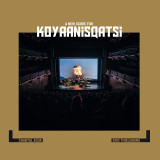
Dark-folk songwriter Chantal Acda and beyond drums-percussion musician extraordinaire Eric Thielemans propose a new score for Koyaanisqatsi, re-actualising the incredibly beautiful, raw, rhythmic and touching images of this 80-ties cinematographic masterpiece. Slow deep electric waves, lonely synths in sonic desert landscapes, rhythmic pulses, transporting drums and bells, and deeply longing sounds and voices make up the audible fundamentals of this imagined, neo shamanic, ritualistic music to accompany the Earth as it keeps on supporting our post human frenetics even today. This release contains a selection of the musical material scored for a live performance together with the screening of the movie. The live performance premiered on Film Festival Gent and Vooruit in the fall of 2022.
Currently based in Belgium, Dutch-born Chantal Acda (b. 1978) has worked under the Sleepingdog moniker since 2006, making three acclaimed albums that closed on the 'With Our Heads in the Clouds and Our Hearts in the Fields' (2010) album for which she collaborated with Adam Wiltzie (Stars of the Lid, A Winged Victory For The Sullen). They toured the UK and Benelux with Low in 2011. After all this, it was time for her first real solo record. Playing in various formations (Isbells, True Bypass, Marble Sounds) had made her conscious of the patterns that we all, as humans, share in. So, she sought out kindred spirits with whom she might record an album filled with freedom and intensity, and who were conscious of the patterns we so often fall back on. Nils Frahm was the first of these to cross her path. The inventive German pianist and producer is an intense and adventurous performer and was a perfect match for it. Acda also experienced a direct bond with Peter Broderick, a multi-instrumentalist known from his solo work (on labels such as Bella Union and Erased Tapes) and from his work with, among others, Efterklang. Cellist extraordinaire Gyda Valtysdottir from Icelandic group Múm had previously worked with Chantal as a member of the Sleepingdog live band. And lastly, Shahzad Ismaily stumbled into this picture by chance, but when Acda and he found themselves in the same room they formed an instant rapport. After this first record, 3 other solorecords followed. Chantal kept on searching for a deeper connection with the outside world and recorded "The Sparkle In Our Flaws" (2015) and "Bounce Back" (2017). She also released some live recordings with her band and also Bill Frisell, a highly respected jazz guitarist.(2018). These records were released on the German label Glitterhouse. Chantal and her band toured with these records in Europe. In 2019 Chantal created her first music/theatre performance P_wawau for Oerol Festival, The Netherlands. She worked with Valgeir Sigurdson (Björk, Bonnie Prince Billy,...) and singers from Het Nederlands Kamerkoor. As a result of this, she released the recorded music: Puwawau (2019). In 2021 Chantal released her most recent album Saturday Moon. (2021) For this album she worked with her band (Eric Thielemans, Alan Gevaert, Gaetan Vandewoude and Niels Van Heertum) but also with Bill Frisell, Shahzad Ismaily and Mimi and Alan Sparhawk (Low). Saturday Moon was very well received, internationally, by the press.
Eric Thielemans is a drummer and percussionist. Travelling across music scenes and disciplines, Thielemans navigates by means of his own compass. Most known for his resonant solo works like a Snare is a Bell, Sprang, Aural Mist and Bata Baba Loka and many collaborations with musicians in the experimental music scene, as well as the Jazz scene, and indie folk/pop/rock scenes Thielemans keeps on pushing the borders and expanding conscious aural spaces and territories. Recently, Thielemans has collaborated with PVT - a trio together with Mika Vainio & Charlemagne Palestine (album released April 2020) , PAT - a new trio together with Oren Ambarchi and Charlemagne Palestine, A new duo together with Oren Ambarchi, Billy Hart ("Talking about the Weather"), Chantal Acda ("The Sparkle in our Flaws", "Bounce Back", "Puwawau", "Saturday Moon"), Marshall Allen (Sun Ra), Tape Cuts Tape, Distance Light & Sky, Jozef Dumoulin, Trevor Dunn, Shahzad Ismaily, Vaast Colson, Nico Dockx, and many more. Currently Thielemans is working on r-e-s-o-n-a-n-c-e , a culminative work that encompasses and brings to the surface the underlying currents within his life in and with music. Withing r-e-s-o-n-a-n-c-e he investigates the everyday magic through conversations, writing and score writing to invite as many souls as possible to experience and co create the magic in the everyday.
This album presents two multichannel works recorded at the seminal INA GRM Studio in Paris and ZKM Institute in Karlsruhe respectively, mixed to stereo at the composer's Cellule 75 Studio in Hamburg with excellent mastering by Rashad Becker. While his releases under the Black To Comm moniker often touched the fringes of acousmatic techniques and Musique Concrete this is Richter's first foray into a more abstract spatial music.
Recorded in the week leading up to the Paris terror attacks at the GRM studio, "Diode, Triode" (21:57) is loosely based on a reading of (and, in parts, a failure to understand) "Le Parasite" (1980) by Michel Serres, a philosophic metaphor about human interaction and communication (which can also be interpreted as a lyrical essay on capitalism; part confusion, part enlightenment).
As core elements Richter is using speech synthesis and the transformation and distortion of concrete sounds, instruments, voices and breathing. Abstract incognisable sounds are combined with strings, reeds and percussion while dismembered musical fragments emerge and vanish rapidly. Chunks of interfering noise are followed by long periods of silence; chaos and order are alternating. Choirs of synthetic and processed human voices are recounting stock market values, seemingly random sequences of numbers and inscrutable lyrics while parasitic sounds are trying to crack, collapse and fractionise the compositional stream and sonic interactions. Finally, a haunting piano chord is wrestling with a broken Publison machine. Like the book, it's part confusing, part enlightening - and a radical piece of sonic art.
"We are buried within ourselves; we send out signals, gestures, and sounds indefinitely and uselessly. No one listens to anyone else. Everyone speaks; no one hears; direct or reciprocal communication is blocked." (Le Parasite)
"Diode, Triode" was premiered on the Acousmonium at INA GRM's Akousma Festival in Paris, January 22, 2016 alongside new works by François Bayle, Robert Hampson, Leo Kupper and Ragnar Grippe.
The second piece "Spiral Organ of Corti" (17:00) has been composed in 2014 for the 47-speaker Klangdom concert hall at ZKM Karlsruhe at the foot of the Black Forest (where Richter was born and raised).
How does one listen with closed ears? Sine tones, alienated human voices and breathing noises build a labyrinthine puzzle alternating between the natural and the artificial. Human sounds merge with winds and strings, sine tones morph into metal sounds. Acoustic illusions confuse the listener, and dense noise-clouds slowly emerge from deceptive silence. Deep base sounds define space. Temporary focus glides into chaos. "Spiral Organ of Corti" is yet another extended composition that proves Richter is on a path of his very own.
"Spiral Organ of Corti" is dedicated to the late Gary Todd.
"Tongues that came from wind and noise. To speak in tongues after the fire." (Le Parasite)
Marc Richter records as Black To Comm for Thrill Jockey, Type and Dekorder and under the Mouchoir Ètanche and Jemh Circs monikers for his own Cellule 75 imprint. He collaborated with visual artists such as Ho Tzu Nyen, Jan van Hasselt and Mike Kelley. Under his own name he is composing for film and installations.
Old-School-Hip-Hop how it has to be! Creamy soul samples and sing-along choruses. With this release we celebrate 2 things: our (Lonestar’s) 20th anniversary (yes, we’re old!) and the 10th anniversary of this excellent album. It was originally released only in a small edition on vinyl done by the band. Now it gets a proper re-release with an exclusive-coloured version. But it’s limited to only 300 copies. So be fast or regret it later! "Party people hold onto your hats!" Ugly Duckling presents their fifth full-length album Moving at Breakneck Speed. After more than a decade in the music business, Young Einstein, Andy Cooper and Dizzy Dustin are well accustomed to the recording process. For their latest LP, the boys dug deep into their bag of tricks to create what they feel is their most dynamic and complete release to date. Moving at Breakneck Speed is an exciting and musically exotic adventure story that has our desperate heroes circling the globe to outrun an evil gang of super-criminals determined to put an end to UD once and for all. The record is made up of 14 power packed tracks that showcase Ugly Duckling’s classic production sound as well as the flavourful and humorously soulful vocal styles of Dizzy and Andy. “By the time you work on your fifth record, you ought to know how to do it, right?” asks Andy, “I think we put all of the pieces together to make a really, really good album”. We've made a habit of finding talented artists to create our artwork and this album is certainly no exception. This time around we enlisted the help of Justin Ridge. A native of smoggy Southern California, Justin has enjoyed making silly drawings and directing on animated shows like Avatar: The Last Airbender, Star Wars: Clone Wars, The Cleveland Show, and most recently Black Dynamite: The Animated Series. You can see more of his stuff on his website at justinridgeart. It has been a pleasure working with Justin on this venture and look forward to seeing what the future has in store for this very gifted animator. Also contributing his talents to this album is photographer Noel J. Hadley. We have Noel to thank for the awesome photos that you see displayed throughout the site. Noel's specialty is actually wedding photos, but he was kind enough to join us on a fun-filled afternoon in Los Angeles to capture the theme images for the new album. He was also along for the ride during the filming of the Elevation video, set to be released later this year. You can check out photos from the video shoot on Noel's blog. In addition, there are a number of people who donated their time and effort to help bring this album to life. Comedian TJ Miller can be seen in the Elevation video, a combination live-action/cartoon which will be animated by Justin Ridge. We would also like to thank Andy Carpenter, Jon St. James, Josh Barlow, Josh Fischel, Victor, Dago, Tamika, Tiko, Hiroko, Missy, Brian, Ashley-Dominique, Clout, and the entire Tru Beatz Crew for their contributions. You are all valued members of the UD family. Track listing: Keep Movin’; Momentum; $100 Weekend; Elevation; I Wonder Where She Is Now; One Horse Town; Anything Can Happen (In The Big City); How It Used To Be; Einstein Got A Monkey; Run For The Light; Sprint!; The Homecoming; The Breakneck Theme; Endless Summer
- A1: Laboratorija - Jugoton Express
- A2: Laboratorija - Devica 69
- A3: D'boys - Zaba
- A4: Beograd - Sanjas Li U Boji
- A5: Data - Neka Ti Se Dese Prave Stvari
- A6: Brazil - Gdje Nema Te
- B1: Denis & Denis - Jugoton Express
- B2: Denis & Denis - Ti I Ja
- B3: Du Du A - Romance
- B4: The Master Scratch Band - Pocket
- B5: U Skripcu - Noc Ca, Ca, Ca
- B6: Parlament - Kad Je Kraj Blizu
- C1: Dorian Gray - Jugoton Express
- C2: Dorian Gray - Tonemo U Mrak
- C3: Hc Andersen - Palcica
- C4: Sladana & Neutral Design - Neko Je Tu (Sa Mnom U Sobi) (Sa Mnom U Sobi)
- C5: Amila - Vodi Me Iz Ovog Grada
- C6: Tuzne Usi - Ti Me Uci
- C7: Zana - On
- D1: Oliver Mandic - Jugoton Express
- D2: Oliver Mandic - Dode Mi Da Vrisnem Tvoje Ime
- D3: Hc Andersen - Snjezna Kraljica
- D4: Dubravka - Harakiri
- D5: Milka Lenac - Ponocni Express
- D6: Nicky - Radio Video
- D7: Mladen Kusec - Tonkica Palonkica Frrrrrrr
Synthetic Music From Yugoslavia 1980-1989
"The galloping technical progress in the second half of the last century dominated all spheres of daily life, art and culture. In the music industry machines took over the role of classical instruments and did not stop at RnR, punk nor industrial music. No one could resist the challenge, but also the prevailing trends in the 80s. The music industry was influenced by the electronic virus globally, not sparing even the remotest corners of the planet, producing bands like Depeche Mode, New Order, Soft Cell or lesser known ones like Liquid Liquid, Section 25, The Wake as well as the pioneers of the electronic music Silver Apples, Pierre Henry,etc .
What was going on in the music industry of former Yugoslavia and at Jugoton, the biggest YU music label at that time? The all over answer is given by a new release of Everland Music: Electronic Jugoton - Synthetic music from Yugoslavia 1964. - 1989. Vol. 1
Electronic Jugoton is the first part of two double albums, where the second part will even go back to pre-electronic music from 1964. Both double albums were initially released by Croatia Records (ex-Jugoton) in 2014 on a 2CD set with no less than two and a half hours of material (47 songs, 35 performers), showing the contemporary trend of Jugoton at that time towards avant-garde and provocative directions in electronic music. This untimely compilation is released for the first time on vinyl now on two double LPs, housed in gatefold sleeves by Everland Music, where part 2 will be released in 2023.
The brave and insightful creators of the compilation Electronic Jugoton, veteran crate diggers Višeslav Laboš and Zeljko Luketić, have excelled at reconstructing the musical past of electronic music in Yugoslavia from 1964 – 1989. Jugoton's extensive research included the most exciting and progressive moments of pop and disco music, early rap, electronic responses of new wave, RnR, post punk and industrial bands to the current trend of the 80s, but also pioneers of avant-garde electronic music.
Electronic Jugoton part 1 is officially opened by the band Laboratorija with the song Devica 69, which opens a window to a completely new and experimental world in former Yugoslavia.Laboš and Luketić have boldly chosen the material without reservations, suggesting that for the first time in one place we have a section of forgotten, unique underground bands like Beograd, Data, Brazil, The Master Scratch band, DU DU A and beyond.
Besides the excellent underground bands, we find popular performers of the time performing less well-known songs: Denis & Denis, Oliver Mandić, Slađana & Neutral Design.
Electronic Jugoton part 2 is partly dedicated to unique electronic music in the performance of important Yugoslav punk, new wave, RnR and industrial bands: Zana, Pekinška patka, Električni orgazam and Borghesia, while the second part of the material is focused on avant-garde early electronic music in Yugoslavia, where the works of composers Igor Savin, Branimir Sakac, Igor Kuljerić and Miroslav Miletić were presented. Luketić and Laboš rescued the obscure electronic tune Elektra by Zdenka Kovačiček, who was at that time Jugoslovska Soul and funk diva.
The uniqueness and quality of this compilation are also audio stories for children, which were extremely fertile ground for an experimentation with electronic sounds, as they should be highly imaginative to attract the attention of the childrens. Electronic Jugoton is also the first compilation in which the listener will find fragments of interviews with actors from the time gave for Jugoton Express. This was a series of promo vinyls printed in extremely small quantities in the 80's and intended to be exclusively for radio stations. An average of 30 minutes of promotion material and interviews with musicians were available for the first time through this compilation.
The value of this compilation is time and priceless. The only question is whether you will be fast enough to catch your copy of the limited double vinyl editions!"
Our French brother returns to TAU with his latest outing, Return From Delta EP - a collection of four tracks that further cement his reputation for classy synthwave-inspired dance floor artillery. Darlyn is based in Valencia, where he is always deeply immersed in his audio lab, concocting new and unique ways to express his creativity. In 2021 he dropped the Doble Impacto EP, and now he’s back to bring us more synthesised freshness as only he can do...
"What took you so long?" might be a valid question concerning the ten year gap between Zanshin's new album "In Any Case By Any Chance" and his first album "Rain Are In Clouds".
Of course it is a question that the Viennese musician has asked himself quite startled in his usual self-critical manner, just to realize at a closer look that it has not been a lack of creativity or laziness at least. He used the Zanshin moniker on four EP releases and several remixes, plus a game soundtrack. Not to forget all his output as one half of producer duo Ogris Debris (the album "Constant Spring" from 2016 and roughly two dozen singles and remixes) and the many, partly award-winning audiovisual installations and performances with Leonhard Lass as DEPART (depart.at). Furthermore he has also built two sound installations in 2021, "I Gong" at Elevate Festival and "Cymatic Sands" at Ars Electronica. In addition, Zanshin performs with the Max-Brand-Synthesizer from time to time as part of the compositions by Elisabeth Schimana, and together with label mate Dorian Concept he has also composed and performed the piece "Half Chance/Music for Moogtonium" for this unique instrument, built by Bob Moog himself.
Not spared by certain global developments of recent years, but rather invigorated by exploring his own resilience, Zanshin had a talk with Affine Records Operator Jamal in the beginning of 2021, speaking of future ideas and releases. And what was initially a single release spawned into a whole album in seemingly no time. An old skit ("Polar Polychrome") on the Roland MC-505 groove-box that had never really been forgotten, but was rather waiting patiently somewhere in the back of his mind, suddenly proved to be the initial spark for the album.
The term "Zanshin", roughly translated as un-focussed attention, is in fact more than just a pseudonym but rather a directive in the artists life. Zanshin really likes to go in several directions at once, kind of according to Wittgenstein's claim that "The world is everything that is the case.", to find out where his love for music might lead him this time. He also somehow went back to his roots with this album. Not necessarily in the sense of certain musical influences or genres, because then the album would be even more eclectic than it already is. More like a focus on the core values in the fabrication process of the music itself, the freedom to rather follow the structures and sounds than to shape them in a completely predetermined way. Somebody once called it, "to weave what the music demands."
In this regard, Zanshin often feels more like a sculptor and tries not toadhereto strongly to the rules of specific sub-genres of electronic music. Searching for sounds and designing them is one of the energies that fuels his interest the most, thus at the beginning of a lot of tracks there are small skits and ideas that have the freedom to grow in whatever direction.
Hence this album has no elaborate story to tell, there is no extensive "narrative" or big time "storytelling" at work. "In Any Case By Any Chance" is not a novel but rather a collection of short stories (which are certainly dense and have complex plots nonetheless). The result is a long-player where playful electronica, skillful songwriting, extrovert dance music and symphonic film music enter into a symbiotic relationship. Returning to another Wittgenstein quote, "Whereof one cannot speak, thereof one must be silent", the emotional impact of music is the main focus and the results can be quite solemn at times, but around the corner always lurks the next bone-breaking rhythm pattern and gnarly sound design.
The infamous saying, "writing about music is like dancing about architecture", is another brick in the wall of sound in Zanshin's approach to music. He rarely roots himself in traditions or uses them too overtly, he really likes to agglomerate sounds, to challenge the listeners. It seems like he tries to avoid classification on purpose, because he knows that everyone has their own perception anyway. The only thing that this music demands implicitly is a willingness to listen attentively.
Very dense, at times really heavy and massive, then again airy and playful. "Music for clubs that don't exist.", might be another fitting caption to describe this album, which lasts for a little more than an hour.
The opener "Heatseeker" rushes to a sudden head start with its steel pan extravaganza, tropical vibes meet a bass line drenched in electro funk, and electrified synth stabs support the declaration of love in the lyrics. Kind of Jamie XX meets Electro meets Diva House. The monster that is "Bronteroc Brawl" is up next, a serious test for the speakers and a wild ride with metallic, growling sounds. The aggressive sound design reminds of suspense ridden shark chases, vicious dogs and cunning dinosaurs, in any case a track for people who love a proper bass stomper.
A new approach for the "indie discotheque" brings the emotional roller-coaster "In Gloom" with snappy drums and hypnotic synth motives á la Alessandro Cortini, creating an epic atmosphere together with the multi-layered vocals. A psycho-acoustic treat is position 4, the crisp instrumental "Polar Polychrome", you could even go as far as calling this a Zanshin signature track. Like mentioned before, the roots of this track go back to 2002 and you can hear the unmistakable influence of beat wizards like Photek, a piercing bass line is supported by poly-rhythmic drums, while dense pads try to escape the claustrophobic lockdown mood of winter 2020/21.
Another round of intense pathos waits for the listeners in the ensuing track "In Search Of". Moderat say "Hello", a melancholy piano melody is rushed to a climax by a wild bass arpeggio and forceful drums, the desire for a perfect sunrise at the next after-hour to the max. Initially just an appendix to the preceding track, "Time After Thought" swiftly developed from a mere improvisation to an ambient epic with a croaking alien piano, as if Keith Jarrett were on his way to Alpha Centauri.
Up next is the first single "Because Why", a breakbeat driven, synth-heavy track with winged vocals and a popular film quote. The title refers to the movie "Alphaville" by Jean-Luc Godard, a dystopian science fiction film noir, in which an omniscient computer system named Alpha 60 is ruling society and humans can only say "because" but never "why". As if the gears of a galactic mechanism were spinning into motion sounds "Identity Slices". A raspy chord structure finds its counterbalance in a kind of stumbling, wonky beat, and Zanshin would never deny the huge influence that Autechre's sounds and structures always have had on his music. Micro- and macrocosm meet on the same level and this friction is also a metaphor for questions of identity and self-awareness, without using voices or lyrics.
Off we go into the IDM bubble bath of "Enzyme Enigma", the bass drum is stomping and a fizzy acid-line is twisting in all directions behind rolling dub-techno chords. "Corrosion Creak" is a kind of acoustic degradation process, the rave dogs are finally let loose and everything happens at once, funky synths shred, string sounds wail and then there is this bass that sounds like smashing a rusty metal plate in the junk yard with a vengeance.
Towards the end everything slows down a bit, the beat in "Whatever Words" is Warp school cerebral hop at its best and therefore loads of glittery, creaky sounds swarm out until the synapses are overloaded, cumulating in a mighty bass ending. Last but never least, "Rebus Redux" guides us into the limitless night sky, with long indulgent pads dotted by an aimlessly wandering piano, while a compact net of tamed resonances and meandering sub frequencies unfolds in the background, enticing navel-gazing imagination.
DJ Black Low burst on the international scene last year with Uwami, a collection of his early, downright avantgarde amapiano work. The young producer and DJ makes electronic music that sounds like nothing else: glitchy and fierce while smooth and soulful, all under the rubric of South Africa's most-exported dance music movement to date. Now comes Uwami II, which features the rest of the tracks from the acclaimed debut plus a new song "Gijima." The Pretoria, South Africa-based artist has more work in the pipeline as we present these inimitable songs for the first time on vinyl. The song "Gijima" is a previously unreleased track Black Low chose to include in this collection as cremates more work at a furious pace. "This is essential listening from a 20 year-old star." - Resident Advisor Best Tracks of 2021 "Uwami keeps an adventurous spirit at its core and pushes far beyond genre conventions in the process." - The Vinyl Factory "A producer with a fully realized voice." - Bandcamp Best Albums of Winter 2021 "The hard hitting beats of the electronic percussions make the songs seem like they're out of this planet." - AfroPop Worldwide