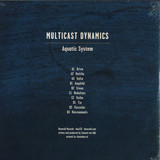
"Aquatic System"" is the second installment of the series, written and composed in two remote geographical places - namely at waters in Finland and Fuerteventura. Inspired by the complexity of water, its movement, various forms, inhabitants and hidden energy, the album was assembled mainly using synthesizers and processed field recordings of the ponds, streams, lakes and oceans of the different locations. With a vibrant story and conceptualization the focus lies in taking the listener on a observing, thoughtful and reflective journey through the aquatic system of our waters. Aquatic System opens with an impression of a frozen surface imagining icy and calm underwater movements underneath. Soon a slow process of melting begins and while the water starts to move in tiny streams of sound, small lifeforms evolve, curiously sending out small pulses in their flowing and constantly moving habitat. The aquatic nature awakens. Zooming out to larger waters high frequencies arise and colliding forms become audible. Larger marine life forms can be faintly heard when entering a much wilder environment, sensing sound-swirls of wind, foaming water tops and impressive large waves crashing on dark rocks. Finally ending at the shore, where the great ocean appears on the horizon, the environment is surrounded with moisture. From the calm reflective landscape derives an inward moment, recalling the organic and atmospheric quality of the sound journey. ""Aquatic System"" has been developed into an audiovisual performance together with visual artist Emilia Kwiatkowska and was performed several times in Spain and Finland, before the music has been finalized for the tracks.
Cerca:various artist
Following the first Installment of The Furnace Series, Solpara's Thinking of Jaeta is a dark techno ode to a fictional androgynous creature who lives on the moon, haunted by earth's turmoils. Sector Y's Hozvepian is a pulsing journey, inspired by the early winter mornings of Montréal's Fattal. Blue Shift's In Absentia is an extract of Oren Ratowsky's and Hugo Bocca's debut live set in the summer of 2014.On the B side, pt's untitled leads you on an entrancing tribal journey, unwinding your thoughts into dreamy pads, spiraling up as it goes. Finishing up the Furnace Series is Arabie '82's woozy, introspective Caravan.
Optimo Trax 16 is a various artists EP featuring tracks from Glasgow, London, New York & Edinburgh.
First up is Glasgow dj, Beta with his debut release "Endless Plains" a broken percussive, spine tingler. 100% emo.
Next London's L/F/D/M who had the first release on Optimo Trax returns under the modified moniker Love's Flaccid Disco Muscle with something a little different. "3am at the Aqua Disco" is bass heaviness with an almost exotica-style lead line. Unique and glorious.
Side two kicks off with New York's Alex Burkat (now relocated to Philadelphia) with an 8-minute depth-charge, "Culture Full Circle" that features a mutated sample form a legendary reggae track. One to get lost in.
The EP closes out with Modini (aka Neil Landstrumm and Alan Parley) with "Ghost Seducer": bass, dub and bleeps 21st century style.
4 different artists, 4 A-sides!
Part 2 of Editors Kutz 005 pressed on Purple Vinyl feat cuts from JKriv / Noodleman / Riccio & EmVee who round things off nicely.
With edits and reworks on little known or impossible to find originals, and some beloved classics, this release covers various disco styles, keeping the right balance between the up-tempo and low tempo vibes. Limited Repress act fast.
- 01: Fly Away - Abraham Battat
- 02: Dawn - Richard Martian & Co
- 03: Missed Another Day - The Gingerbread Express
- 04: Would You Believe - Gloria Rosebud Black
- 05: Spanish Guitar (Feat. Willie Moore's Quintet) - Jimmy Briggs
- 06: In A Galaxy Far Away - Third Stream
- 07: The Dude - Joe B
- 08: The Provider - Seeds Of Fulfillment
- 09: Masquerade - Larry Covin
- 10: In A Strange Strange Land - Bobby Boyd Congress
- 11: Wild Wild World - Larry Dismond
- 12: Take You For A Ride - St. John's Wood
- 13: Seasons Of Doubt - Finnigan/Finlan
- 14: When The Time Is Right - Timberlake
- 15: Summer Love - Portis Brothers
- 16: Midnight And You - Odyssey Group
- 17: Scratch My Back - Soul Scratchers
"...don't ask if there will ever be a Volume 2. We don't know yet. What we do know is that if we ever come across a similar tour de force as Don McCaslin's composition, Praise Poems, then there will certainly be one..." These were the final words of the sales notes for Praise Poems Volume 1 - which we proudly released earlier this year. And indeed, since then, we have discovered a tune which led us to continue to curate this series of obscure, soulful, jazzy and spiritual sounds from back in the day. The song to which we refer to is Abraham Battat's jazz-samba masterpiece, Fly Away. Fly Away is a righteous combination of sonorous jazz guitar, crackling drums and warm acoustic piano. Floating through the tones as if in a private concert for you in your very living room, it is an earnest, honest vocal performance bringing a rainbow message of freedom and liberty to the world. This is the standard by which we judged the entirety of this compilation. Though they may be known in some circles, selections by Richard Martian, Larry Covin, and The Gingerbread Express are in the same category of pure beauty. Of course, good luck finding a copy of Larry Covin's Masquerade or the Portis Brothers' Summer Love. The single hit you receive while doing an online search is the exact same copy from which we took the master. To find a needle in a haystack is a cakewalk compared to turning up a copy of some of these gems to be found here.
Berlin Atonal is proud to pick up on a tradition begun in 1984 with the publication of two volumes of live recordings from the 1983 edition of the festival. Those records bore witness to the most inventive, adventurous sounds of the festival, and therefore of their time, containing live bits
from Psychic TV, La Loora and Z'EV.
Berlin Atonal Vol. 3 carries this custom forward three decades with selections from four of the standout performances of Berlin Atonal 2014. Of course Cabaret Voltaire's lauded and historical rst show in over 20 years is featured, Richard H Kirk's no-nostalgia and machinery driven set rmly putting the Cabaret Voltaire project in a future-facing direction.
Miles Whittaker's surprising and muscular live performance also contributes a cut, as does festival favourite Fis with his characteristically lumpy, textural soundscapes.
Finally, two selections from Abdulla Rashim's memorable session gesture toward a possible future for synthesised music.
Tapper Zuki's debut album 'Man Ah Warrior' was originally released in 1973.It's classic Dee Jay style has been copied by many but bettered by few. An album that more than most shows that raw talent with little resources can still be a great, great thing.
Tapper Zukie (b.1956,David Sinclair , Kingston, Jamaica) was raised in the rough and tough West Kingston area of Jamaica between the districts of Trench Town and Greenwich Farm.
Living pretty much on the streets from an early age the youth including the young Tapper had no choice but to fall into the hands of the political parties that controlled the various ghetto areas of the town.
Fear of landing in even more trouble, a plan was devised by Tapper's Mother ,Brother ,Reggae producer 'Blackbeard' and family friend Bunny 'Striker' Lee .The plan was to send the wayward Tapper to England to cool his ways.
A UK tour with the number 1 Reggae Dee Jay U-Roy was already arranged on his arrival, Bunny Lee got the young Tapper to toast over a Slim Smith rhythm, the London crowd loved it
He also caught the eye of producer Larry Lawrence who took Tapper on and cut his first single 'Jump and Twist'
Nine further tracks were recorded for producer Clement Bushey that would result in this album 'man ah Warrior.
We hope this introduction to Tapper Zukie's music inspires you to look further into his catalogue of great music.
An artist ahead of his time, whose music has influenced many........
as Patti Smith stated 'Music of the Most High'............
- A1: John Kameel Farah - Fugue And Toccata On Hold
- A2: Ana Maria Rodriguez - Pocket Songs For Violoncello & Live Electronics
- A3: Zeitblom - Ikon
- A4: Eliav Brand - Individual Stuff
- A5: Guido Möbius - Entertain Premium
- B1: Juliana Hodkinson - Ring A Ring
- B2: Alex Paulick - Jingle Bells
- B3: Ari Benjamin Meyers - Telekom Ii For 2 Baritone Saxophones
- B4: Adi Gelbart - Musical Offering Against Telecommunication For
- B5: Magnetic Tape, Bass Clarinet And Electronics
- B6: Patric Catani - Baka Baka Dam
There used to be a time when ring tones were important. You were easily recognizable as one of the few people actually owning one of these new gadgets called ›mobile phone‹ (or ›handy‹ as the Germans say). Later you could make an important distinction by choosing a ›cool‹ ring tone...
In May 2014 the Festival »Doofe Musik« (»Stupid Music - Songs for Dreaming, Sedation and Forgetting«) took place at Haus der Kulturen der Welt (HKW) in Berlin. As part of the »Anthropocene Project« the festival focussed on escapism and the special function of music when retreating from reality. Detlef Diederichsen, curator at HKW, and Holger Schulze, Head of Sound-Studies-Lab Berlin, decided to not only focus on music which music lovers usually hate, e.g. ›Schlager‹, German folk music, Light Jazz, but also on ring tones.
The audio logo of Deutsche Telekom has been part of Germany's mobile phone culture from the very beginning so it acted as a starting point to question the usual concepts for ring tones. Using Christian Kellersmann's idea of the »Pocket Symphony« ten artists were invited to come up with adaptations of Telekom's audio logo. The results were performed for the first time during »Stupid Music« and once again in October of the same year when most of the recordings you can find on the album were made.
As you will hear: The short motif, as simple and unforgettable as it is, is ideal musical material.Everyone knows it, everyone has some sort of connection to it and these ten different versions, these ten different positions, open up the most varied possibilities for associations.
It is time that we take the ring tone seriously again. As the most reduced musical form that is the most-widely available in the whole world it contains enormous and unrealised potential!
Continuing on from Vol 1's theme of established artists working in disguise, 'Music First Vol 2' delivers another sonic assault with this absolute rollercoaster ride of a record. The mysterious Scorpio T opens the EP with 'Neptune Rising', a squelching acid-bass boomer that can simultaneously spiritually elevate and physically devastate any dancefloor. Rounding off Side A it's followed by Scandalous Arthur's 'Acid In My Mind', a lo-fi tape-hissed jacking beast of a banger that sounds like it's genuinely been brewing in a vat of highly toxic acid for at least 25 years and guaranteed to melt your mind. On the flipside comes JaX DaX returning from Vol 1 with the low-frequency moody slo-mo electro workout 'Fucking Computer' that oozes bad attitude and booty-shaking basslines in equal abundance. Bringing the trip to a close is Kyrenic Azalee with the self-titled 'Kyrenic Azalee', an x-rated new beat tour-de-force of epic proportions that will fry minds and bodies with its relentless energy. Limited edition so don't sleep on it, not that it would let you.
When a label within thirteen catalog releases has only one of them branded as 'various artists', than the focus on this release seems to be really interesting. Exactly that is the case with DREIZEHN and it's three protagonists. Der Dritte Raum co/pilot ‚Ralf Uhrlandt' opens up the split-release with his elegant-motor - skills house to techno track New Sights on the A side. With his contribution the door's lifted from the hinges and when the guitar hook line appears you're kissed from the sun in a world of an easy-going, feather light dance expressed manifest. On the B1 CLICK FARM crafts a wonderfully layered, deep minimal bassline driven hunter-techno masterwork which surely will be heard this summer on the dancefloors. B2: Der Dritte Raum - an old friend and labelowner of the swinging addiction- grooves here with his tune ‚El Sonido' and shows again the great school of easy techno music production. Big 12 release.
With a magnificent compilation Dial Records celebrate their 15th anniversary! ALL offers a collection of exclusive works by long related label artists and friends.
Part 2 of the Vinyl 12Inch Editions features contributions by Carsten Jost, RNDM, Physical Therapy, John Roberts, James K.
- A1: Abayomy - Obatala (Pd)
- A2: Zebrabeat_Zebrabeat Afro - Amazônia Orquestra (Zebrabeat)
- A3: Burro Morto - Lúcifer Colômbia (Daniel Jesi/Burro Morto)
- A4: Ive Seixas - Cervejas Populares (Ive Seixas)
- B1: Iconili - O Rei De Tupanga (Iconili)
- B2: Zulumbi - Zulumbi (Rodrigo Brandão / Lúcio Maia / Pg / Dengue)
- B3: Passo Torto - Faria Lima Pra Cá (Kiko Dinucci / Rodrigo Campos)
- B4: André Sampaio E Os Afromandinga - Ecos De Niafunke (André Sampaio)
- B5: Fabrício - Feito Tamborim, Pará Céu (Fabrício.)
Over the past few decades, there has been a seismic shift in Brazil's musical landscape. A plethora of varying musical undergrounds has developed across the nation. While Rio and São Paulo have been overwhelmed with networks of talented musicians for a long time, creative life is now bursting all over the country. Amplificador exists to document and propagate the wonderfully diverse music currently blossoming from Brazil's vivacious and geographically varied musical undergrounds. Presenting an up-to date insight into Brazilian music, this compilation draws together some of the components of 'Novíssima Música Brasileira' (brand new Brazilian music), ranging from afro-grooves to rock, to modern samba and MPB. The music reaches back across Brazil's incredibly rich musical and cultural traditions, while also taking in influence from other movements around the globe.
Having begun life in 2012 as a Brazilian music blog run by Marcelo Monteiro, Eduardo Rodrigues, Mateus Campos, and Ricardo Calazans, the aim of Amplificador is to document and propel to wider audiences, Brazilian music of the '00s and '10s generation. This is a task made more significant by obvious changes in the way music is consumed. 'People are no longer obliged to listen to what the radio and TV are presenting. There is a whole new generation that wants to listen to new bands and new sounds and we try to connect those bands with other bands, producers, fans and even the mainstream.' These changes in technology and the way music is discovered and shared have developed parallel to the proliferation of these emerging scenes. The ostensible decentralization of the music industry means the promoting and filtering work of journalists and blogs, like Amplificador, have become increasingly important, as people try to keep up with the tsunami of new music and media flooding the country on a daily basis.
Marcelo uses the example of the Mangue Beat movement to explain a trend in contemporary Brazilian music that looks both inwards, to Brazil's own musical traditions and outwards, to movements around the world to create a novel, localised identity: 'The 90's Pernambuco art-social movement was inspired by Coco, Maracatu and Forró all mixed with modern riffs and grooves. The mythical
revolutionary Chico Science, his Nação Zumbi, Mundo Livre, Siba, and many others do this blend perfectly. There are also the references to the older generations and masters - Gil, Caetano, Luiz Gonzaga, João Gilberto, Tim Maia, Jorge Benjor - as a constant inspiration for all bands.' This is very much the case for the Brazilian artists of today.
Music is unquestionably informed by place. Brazil has always been famed for its regional differences in this sense. Indeed there are still pronounced variations between the scenes of Rio, Sao Paulo, Natal, Goiânia, Belo Horizonte and Belém for example, there are also great divergences within cities and while technology has brought changes to the way musical influences are shared, there are cultural differences, rooted in folkloric traditions, that aren't going away. Expressing his appreciation for this fact, while highlighting the potential of Brazil's spread of musical flavours, Marcelo explains that 'what we have now is new ingredients to make an even better mixture.'
This compilation heavily features music from a scene in Brazil's current musical make-up, which draws inspiration from African music, particularly Afro-beat music. Abayomy Afrobeat Orchestra from Rio formed because of their shared love of the music of Fela Kuti, uniting initially in 2009 for a jam session in his honour. But what sets Abayomy apart from other groups of a similar nature, is the fact that their sound also brings with it the songs and rhythms of candomblé. In this sense, Abayomy was the first band of its kind. The thirteen members of the orchestra have a palpable current of Rio's musical heritage - its rhythms and culture - running through them. So while their sound is distinctly African, it is also inherently Brazilian. Similarly, Zebrabeat Afro-Amazônia Orquestra draw upon traditional guitarradas and carimbos from the state of Pará and fuse these with the poly-rhythms of Afrobeat to create another regional hybrid, which stays true to both its Amazonian and African roots, yet which results in a very fresh, Brazilian sound. From Belo Horizonte (capital of Minas Gerais), Iconilli are another key band on Brazil's Afro-groove scene. With influences as varied as funk, jazz and psychedelic rock, congado, mining harmonies, maracatu, coco, ijexá, carimbó, Iconilli somehow manage to balance all of these sounds in such a way that makes it impossible to pin them down. From the Northeastern city of Joao Pessao, Parayba, Burro Morto's pshychadelic afro sound leans more towards rock and funk influences, with hint of regional Brazilian rhythms such as frevo and forro. They add another flavour to the Brazilian afro-groove scene: just one of the many exciting facets of Novíssima Música Brasileira.
While African-inspired music features heavily on the compilation, it is just one of the many styles within. Ive Seixas has a fresh approach to MPB, based on traditional rhythms and instrumentation, punctuated by a pop sensibility, coupled with a powerful female vocal. As an artist she is a product of a 'Do It Yourself' outlook to creativity, taken from her love of rock growing up. In 2013 she embarked on a project of street performance: wandering, like a lonely troubadour with just her guitar. Ive and her project began to gain notoriety and shortly after, her first EP was recorded, featuring some important names of South Rio's underground scene. 'Cervejas Populares' taken from the EP, is a beautiful, sombre piece of modern Brazilian pop, with a traditional samba rhythm. Another artist of the new MPB scene is Fabricio, from the city of Vitoria, who's 'Feito Tamborim' melds rock and funk and is also clearly reminiscent of the old Brazilian masters. It's an appreciation for the national musical heritage, alongside a keen ear for melody and an acceptance of foreign influences that results in these promising new sounds of Brazilian MPB.
Sao Paulo's super group of the underground 'Passo Torto' have been at the helm of an emerging scene in the city: an innovative approach to samba which draws in and experiments with afro grooves, jazz melodies and rock structures. Their sound is naturally very Brazilian, but the nylon twang of Faira Lima Pra Ca, interspersed with ominous strings and light rolling percussion, seems reminiscent of Captain Beefheart or Tom Waits, as the band lament their frustrations with their native city through their music.
The Future of Novíssima Música Brasileira looks very bright. The main challenge (and purpose of this album) is to get the music beyond Brazil's underground and into view of international audiences. In the last 10 years this goal has become somewhat more attainable, as the Brazilian government has begun to see the internationalisation of the nation's culture as a strategic objective, with public projects gaining increased investment and backing. The continuing project of Amplificador is to reinforce this international bridge by writing, filtering and promoting the scene as a whole. There is a wealth of great music currently blooming in Brazil and using new media tools, Marcelo and the team, alongside many others, will passionately continue to get the voices of Brazil's underground heard.
For more than a decade, The Bunker New York has been a nexus point for the transnational techno community.
A chance meeting at The Bunker in 2011 brought together Gunnar Haslam and Johannes Auvinen (also known as Tin Man), who became fast friends and collaborators soon after, conceiving a joint project called Romans. The Bunker New York is proud to present Romans' Ambulare Aude, a collection of atmospheric acid techno tracks following the project's debut on Auvinen's own Global A in 2014."The Roman theme opens a world to explore beyond both of our past endeavours," says Auvinen, explaining
the conceptual genesis of the collaboration. "In the same way Ennio Morricone may have conceived the 'Spaghetti Western' genre by fusing together various contemporary motifs and moods to conjure the spirit of a past era, we're imagining stories and scenes from the Roman era, trying to manifest narratives while celebrating the distortions we see looking through the murky lens of time." And while Morricone may be a conceptual reference point for Romans, their sound is anything but—instead offering up a pair of murky, psychedelic acid-etched cuts (Emona, Delmenium) buffered by a gradually unfolding up-tempo floor-burner
(Coptos).
The record is the result of several extended improvisational jam sessions in Vienna and Brooklyn in which both
artists would play off of each other in the studio. Accordingly, each of the three tracks have a slight aleatory
air about them, as though both artists are being led down an unforeseen musical path, not entirely certain of
where it leads. This culminates in Delmenium, the record's B-side, a true techno journey, featuring an emotional, metallic synthesizer coruscating against a melancholy background.
"I like to think what we make sounds simultaneously like both of us and neither of us. We both push each other
in different ways," Haslam says, recounting their production process. Auvinen adds that "(Collaboration) offers a chance to hear from someone else's perspective. Working with others, I'm often reminded of how radically different the way people hear things, and relate to them in a musical context, can be."
With a magnificent compilation Dial Records celebrate their 15th anniversary! ALL offers a collection of exclusive works by long related label artists and friends. Part 1 of the Viny 12Inch Edition features contributions by Stefan Tcherepnin, Dj Richard, Christian Naukoks, Pantha Du Prince and Queens.
Zaquoir alias Matthias Groß is a producer and musician currently living in Leipzig. After sending us more than 10 GIGABITES of great music, we sat down together and tied a selection of his really eclectic styles of production together into one LP, creating some sort of showreel created in the timespan of over 15 years.
Zaquoir himself sees the record as a reminiscent mood of a donkey in the Sardinian sun and describes the record as a trip in itself, allowing the listener to traverse the lines of various acoustic landscapes.
The tracks on the LP where produced in six different places, including a historic house in the centre of Vilnius, the artist residency "Blumen" in Leipzig, a French-German art association and a village in Northern Bavaria.


