Sunny Crypt is happy to announce the reissue of "Sur L'Eau", the sought after debut EP by French IDM pioneers Les Dupont, an electronic duo composed by Didier Blasco and Louis-Frédéric Apostoly at Nice’s Fine Arts school. Originally released in 1994 on the seminal Virtual... label, this record is a unique-sounding blend of trippy acquatic-themed house meets electronica meets ambient. Now up in demand and with OG copies hard to get ahold of, this new fully licensed and remastered edition comes with a bonus techno / trance jam called "Outremer", previously released only on CD on Les Dupont's 1995 debut album titled "Miracle". In the words of the artists, a kind of equivalent of surrealism, a work of collage, chance, freedom and experimentation of all kinds.
Cerca:virtua
New RAWAX 069 Series is dedicated to the musical history of Frankfurt“s artists, clubs and labels. We are honored to present you the genius Gerald Becker aka Virtual Symmetry on first edition. This beauty was released on legendary Eye Q Records in 1993, now nearly 30 years later it will be out on vinyl again - re-mastered!
Eastenderz highly anticipated sub-label Belief continues to grow with the third EP in the series.
More groove-driven tracks made for the dancefloor.
Highlighting the freshest of talents, alongside producers who have been on the radar for a while.
We belief.
DJ support,
EAST END DUBS, JESSE MAAS, ARCHIE HAMILTON
- A1: Mlo - Birds & Flutes
- A2: Pulusha - Isolation (Part Two)
- A3: Space Time Continuum - Fluresence
- B1: David Moufang - Sergio Leone's Wet Dream
- B2: La Synthesis - Frozen Tundra (Dub)
- C1: Richard H Kirk - Oneski
- C2: A Positive Life - The Calling (Loved'ub Mix)
- D1: Sideral - Mare Nostrum
- D2: Primitive Painter - Levitation
- D3: Sun Electric - Love 2 Love
- E1: Lfo - Helen
- E2: Dubtribe Sound System - Sunshine's Theme (Sunshine Remix)
- E3: Human Mesh Dance - 8 (Infinit) (Infinit)
- F1: Link - Arcadian (Global Communication Remix)
- F2: The Arc - Orphic Mysteries
- F3: Bedouin Ascent - Joyriding Iii
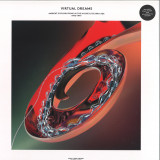
Music From Memory is delighted to be turning 50 with a special release: MFM050 - V/A - Virtual Dreams: Ambient Explorations In The House & Techno Age, 1993-1997 (3xLP/2xCD). The first in a series of compilations, alongside more in depth artist-focused releases, Virtual Dreams will delve into music produced during the 1990’s that redefined the boundaries of ‘Ambient’. This was music that explored the possibilities of Ambient music within a new setting, created often by House & Techno music producers for a world beyond dance floors but made very much with the pre and post-clubbing listener in mind.
When House and Techno exploded out of America in the mid 1980s a whole generation was redefined not only musically but also culturally and chemically speaking. Peaking, quite literally, with a second ‘Summer of Love’ in 1988, millions of young people across the world would experience the life-changing ups of a brave new world but with it of course came the downs; enter the concept of a ‘Chill-out’ room. Whilst early Chill-out rooms lacked a specific sound and were often soundtracked by music such as reggae and soul, slowly young Techno and House producers themselves would become increasingly interested in developing a futuristic ‘Ambient’ soundtrack to a world beyond the thud of the main room.
‘Ambient’ in this new age now though had sharper teeth than in Brian Eno's key text for ‘Music for Airports’, instead here the sounds were the mode of transport rather than the backdrop. While the melodies were pretty, the soundscape steered away from the pastoral, dreaming of outer-space and technology as opening up exciting new dimensions. Much like in the first Summer Of Love; the musicians were again exploring psychedelic, mind-altering and transcendental possibilities of music. And also much as in the first Summer Of Love, a psychedelic visual language would accompany the music. Though now the tracks could be accompanied by music videos, utilising early CGI techniques, they would look almost entirely to the future: envisioning technology, nature and humanity intertwined in a new Utopian future. Virtual Dreams of a better world.
From Ambient and early Chill-out classics, to lesser known one-off projects, as well as Ambient deviations by some of House and Techno’s leading producers, Volume One of Virtual Dreams features tracks by Bedouin Ascent, LA Synthesis, LFO, Marc Hollander, Mark Pritchard & Kirsty Hawkshaw, Richard H. Kirk and more.
To celebrate our 50th release the first 1000 copies include a holographic 'Virtual Dreams' sticker plus a special insert poster with artwork by Victoria Pacheco and design by Steele Bonus.
Hot on the heels of last year's Dear Diary EP on Lobster Theremin, explosive performances on HOR and an intimate interview with celebrated German publication Groove Magazine, frequent Berlin & Leipzig DJ Narciss comes through with four deep and groovy cuts of bass-driven techno.
'Feather Boa Constrictor' features one of Copenhagen's most exciting emerging producers in recent years - Vixen - fresh off her own acclaimed release, Hard Magik For Soft Souls, on Lobster Theremin in December. Now the pair link up on the DJ Mag Breakthrough Label of the Year imprint that blends all the best elements of the Berlin and Copenhagen scenes in a highspeed trip through psy-trance, synth-wave and techno.
Narciss is on his ones as we enter the A2; 'Lovechild' (Outrun Mix) is aptly named with its reference to the 1986 arcade game Outrun, which featured some of the best video-game music to ever be created. Deep basslines, swirling synth-stabs and a soothing deepness and contemplativeness that can only come with driving a virtual car down a never-ending highway. 'Tokyo' makes use of polyrhythms and textures blended with what sounds like an old Sampha record. It's a wonderful combination of dark, deep and forward-thinking sound, before Copenhagen producer Repro comes through with a typically EBM-focused remix combining elements of every track.
- A1: Unreality
- A2: Don't Look Down (Feat Natalie Shay)
- A3: Faded Memory (Feat Sarah Appel)
- A4: Taking Over Me (Feat Natalie Shay)
- B1: Only A Dream
- B2: Come Alive (Feat Sarah Appel)
- B3: Be The Horizon (Feat Dom Youdan)
- B4: Last Light
- C1: Virtual Companion (Feat Dom Youdan)
- C2: Closer Apart (Feat Natalie Shay)
- C3: Disconnected (Feat Sealine)
- D1: Pattern Recognition
- D2: Look To The Light
- D3: Our Cosmic Insignificance
This is about remembering our humanity, which perhaps we lost a little bit over the last couple of years - maybe we can get a bit of it back in the dark, under some strobe lights." There's a considered and conscientious edge to every record that comes from the studio of Graeme Shepherd, a.k.a. Grum. Strip away the club exterior and you will find a nuanced, sometimes provocative, message that asks us to challenge our outlook on the world. 'Unreality', Grum's fourth studio album, is his most reflective work to date, putting human connection in the digital age under the microscope. "Based near Glasgow, Scotland where I had to spend a lot of time by myself. I watched, alone, as world events unfolded and I think that has funnelled itself into the music somewhat." The visceral nature of Graeme's work has been present since his debut LP 'Heartbeats'. A feel good, get up and dance record championed by Annie Mac and Pete Tong in the early 2010s, Grum was a product of the blog era, riding the heights of Hype Machine with his synth heavy sound.
First striking us with his exhilarating ‘Yakka’ EP, Bambi OFS has continued to surprise us with his musical output ever since. (…) The Belgium-based producer is carving out an almost unique take on dance music with a heavy debt of gratitude to the endless rhythms and percussion-centric styles of Gamelan, and other styles of music native to Indonesia and further afield (…) the revised ‘Kwon-9’ EP goes for the jugular and ties together the percussion-heavy originals on vinyl alongside phenomenal remixes from Don’t DJ, Georgia, Icon Template and Broken English Club.” Inverted Audio Super excited to bring this killer release on vinyl with a brand new remaster and remixes by Broken English Club, Georgia, Don’t DJ and Icon Template! Meshing together industrial mirages and ethnofictional mindscapes, Bambi OFS provides Antibody with a new suite of polyrythmic spins. Extending on his first ep YAKKA, KWON-9 blurs the line between the synthetic and the organic while pushing the Brussels-based producer’s interest in uneven grooves and mixed meters into sharper detail. Mirrored by the puzzling archaic-futuristic alphabet featured on the cover, this new set of trax softly draws the listener in an elusive and multi-faceted experience. Bambi OFS is Cédric Dambrain, composer, electronic musician and virtual instruments designer based in Brussels, Belgium. Dambrain’s approach to music is motivated by an exploration of perception thresholds, psychoacoustics, and the physiological impact of sound. This diversity of themes is matched by a wide range of productions which include electroacoustic computer music, compositions for ensembles, noise, sound installations and, more recently, club- oriented polyrythmic explorations. Dambrain has also been composing extensively for performance artists and music theatre.
Having crested the west coast modular-ambient wave in just a few releases - including 2018's Sharing Waves on the influential LA experimental imprint Leaving Records - Sean Hellfritsch has swapped the mossy analog synth improvisations of his prior output for refined melodic arrangements dressed in sprightly dawn-of-digital textures. Big Earth Energy plumbs the depths of Hellfritsch's multimedia mind and naturalist heart, spinning an impressionistic narrative world off of cultural touchstones like the PC game MYST, and the work of Studio Ghibli composer Joe Hisaishi. Inspired by the aforementioned, and guided by Hellfritsch's experience as an animator and filmmaker, Big Earth Energy is the soundtrack to a hypothetical video game with a pointedly ecological premise, and a twist of psychedelic charm. In Hellfritsch's imagined virtual journey, the player assumes the perspective of a treefrog sixty-five-million years ago, hopping epochs with each new level, forming a comprehensive picture of the massive changes the planet has gone through over the eons. The ultimate goal of the game is not to amass resources, defeat enemies, or gain power, but to fully witness the unfolding of one of the biggest systems of energy imaginable - or as the album's creator puts it - "to explore the incomprehensibly vast energetic expression and mystery that is Earth." Big Earth Energy is steeped in exploratory RPG intrigue, possibility, and contemplation, lovingly overlaid with Miyazaki-an sentiments and aesthetics. The through-composed, organic, meandering synthesis heard on previous Cool Maritime albums has been fully replaced by meticulous polygonal arrangements that recall the computerized sheen of late 80s work by composers like Hiroshi Yoshimura, and Yoichiro Yoshikawa - using true-to-period gear no less. Even given its referentiality, Big Earth Energy comes off as forward-facing where so much reminiscent music remains fixed to a bygone moment in pop culture. Hellfritsch has created a musical world where the endless verdancy of the biosphere finds its parallel in the golden age of early 1990s video games, and late 80s Japanese environmental music, all while pointing to a hopeful planetary and artistic future that vindicates the motives of all of these muses.
It might seem tongue-in-cheek on the surface, but the fact that the title of Eldritch Priest's sprawling debut vinyl release, Omphaloskepsis, is the Greek translation for “navel-gazing” unlocks something essential to the Vancouver-based composer and writer's singular outlook.
Perhaps even more telling is the title of Priest's 2013 book Boring Formless Nonsense: Experimental Music and the Aesthetics of Failure (Bloomsbury), whose 300-odd pages read as though you've been dosed with potent hallucinogens. Throughout the text Priest addresses—celebrates, even—the titular elements via various musical examples, including that of his peers. What's so bewildering it is that his descriptions of how boredom, formlessness, and nonsense manifest are laced with the very tactics he's depicting. Passages tie themselves in knots, footnotes engulf the “primary text,” he even deliberately misleads the reader.
The restless stasis of Omphaloskepsis could be regarded as an extension of this book's wayward spirit. Things unfold fairly slowly and consistently but it'd be a stretch to describe it as properly contemplative. Like attempting to meditate with a high fever, any sense of tranquility is constantly derailed as one succumbs to queasy agitation. The piece's foundation is a seemingly endless guitar melody; an organic meander that neither seems to repeat or offer any concessions to narrative directionality. Priest unfurls this rambling cantus firmus in a rich, clean, jazz-like tone, but as it's played, it's repeatedly tangled with snarls of dense digital processing and shadowed by stumbling virtual “band.” These strident interjections blatantly contrast with the guitar, yet they aren't so violent as to offer more than a faint itch of distraction. As such, the distinctive amorphousness that this piece asks us to inhabit for its 54-minute duration leaves a strong impression, but also feels utterly intangible.
In addition to his recorded forays, Priest's disorienting music has also been performed by top-tier interpreters such as the Arditti Quartet, Quatuor Bozzini, Philip Thomas, Anton Lukoszevieze, and Continuum. While living in Toronto he co-founded the collective neither/nor with John Mark Sherlock, which featured a cross section of musician-composers playing each other's work including Eric Chenaux, Doug Tielli, Eric KM Clark, Heather Roche, and Rob Clutton. “Though the name refers specifically to a loosely knit group of composers and performers,” remark's the collective's website “neither/nor is also a sensibility that refuses art’s messianic pretensions and the gaping maw of commercialized society, opting instead for art’s right to be esoteric.” In 2021, when Eric Chenaux and Martin Arnold relaunched their neither/nor-adjacent Rat-drifting imprint, an album by Priest, Many Traceries, was among the first to be released. Perhaps unsurprisingly, Priest was a student at the University of Victoria, a school that's come to be known for fostering such staunch individualists as Arnold, Linda Catlin Smith, Allison Cameron, and Anna Höstman.
As a scholar, Priest writes from a 'pataphysical perspective and deals with topics such as sonic culture, experimental aesthetics and the philosophy of experience. Priest brings these interests to his job as an Associate Professor in the School for the Contemporary Arts at Simon Fraser University, interests that also inform his work as a member the experimental theory group The Occulture. In addition to Omphaloskepsis, his new book, Earworm and Event: Music, Daydreams and Other Imaginary Refrains,
The Tel-Aviv centered Yotam Avni officially joined forces with Stroboscopic Artefacts last year, turning in a sensual an invigorating entry for the Monad series. Thanks to his personalized fusion of esoteric and worldly sound elements, Avni immediately made a case to deliver more work to the label, and now he has done so with 'Perlude to Dybbuk,' the second in a new series of S.A. releases to feature the Oblique Artefacts visual team's distinct, elegant portrayals of scanned foliage. As with Avni's previous Monad contribution, the new Perlude to Dybbuk makes references - both in title and in sonic content - to the ancient Hebrew folklore of his homeland (a 'dybbuk' being a kind of limbonic spirit attaching itself to the body of a living human until it has successfully reached its final destination). However, the atmospheric, rather than overt, use of these references gives this record a level of dignity and quality as well as a premonitory feeling that hovers over the proceedings.The opening 'Avka (New Life)' opens with the twin stimuli of chthonic, rolling percussion and ambience that has become a modern Stroboscopic tradition, but ever so gradually deviates from the realm of the easily anticipated. Some of the surprises to be found here are sharp, organic drum fills and sighing strings that have an uncanny vocal quality to them. By the time a surgically clipped acid synth sample comes into the mix, the track has reached a simmering level of excitement and the listener's imagination will have license to reside in a virtual world seamlessly combining elements both ancient and futuristic.Dybbuk' temporarily situates listeners back in brutal modernity, with the first sounds heard being something like insistently slicing helicopter blades. Avni merely uses this as the foundation, though, for a genuinely unique construction whose shamanic beats, throttled horn and undertow of frenzied electronics combine to give the feeling of being menaced and eventually overtaken by a spirit entity. This piece shows just what Avni is capable when operating in a more aggressive, 'post-industrial' mode, and the result stands up with some of the best exponents of that genre.The finale 'Modern Matters' is the most readily club-friendly selection from the disc. This potent, floor-shaking and perspiration-inducing number superimposes resonant vocals from traditional Middle Eastern folk song onto this alchemical mixture of machine oil and sweat, and provides a romantic flair without resorting to naïve, touristic 'ethno-techno.' Avni's skillful dedication to counterpoint, and determination to make a finished form is more than the sum of its parts, shines through here and throughout the duration of this record.
In the fight against Alzheimer’s, epilepsy, schizophrenia and other diseases characterized by an imbalance in neuronal activity, there are chemical weapons, such as those that try to prevent the protein fragments known as beta-amyloid plaques from developing in the
cerebral cortex , and physical, such as electrical stimulation that allow to restore the functionality of brain cells. This last resort, which has already been shown to be effective in modifying the activity of the cerebral cortex, is today a weapon of general intervention.
Converting it to precision requires the development of individualized and predictive brain models that allow identifying where and how much to stimulate each patient. To achieve this, an international European team is working on the creation of virtual replicas of the
most unknown organ in the body: the Neurotwin project.
According to recent research, the decrease in power in the neuronal oscillations of the gamma band of the cerebral cortex (a pattern whose frequency ranges between 20 and 50 Hertz) favors the development of protein fragments related to Alzheimer’s.
Transcranial application of weak electrical currents has proven to be an effective and painless way to modulate brain activity without side effects.
The objective is to create complete computational models of the brain with real data of living beings (human patients) and that allow to anticipate and specify the effects of noninvasive stimulation techniques on neurological mechanisms.
“Never turn your back on a friend.”
Alfred Hitchcock
Mastering – Eternal Midnight Mastering Studio
Cover Art – Nitasha Singh Brett
Visuals - Dietriamgle, Espii Studios, Irene Avellanal
It’s time for the label founders to take control over our spaceship. Clusterhead offers four slices of proper abstract techno for those who know.
Release starts with Alteración del orden: a broken kick spiced with elastic synth washes and microdrones sets the pace while the rest of the percussive elements appear softly in the arrangement. The main sequence grows and mutates as minutes go by, reverb and stereo treatment goes heavier until repetition makes the desired effect on the virtual dancefloor.
Second cut Resiliencia Incesante again relies on broken kicks and processed synth lines. The BPM rate is higher here and the percussive elements are snapper and tighter. Sounds twist and change over time as the frequency range grows. An industrial ode to obscurity.
On the flip side, Automutilación creativa brings us again into oblivion, shuffled grooves obsessive sequences continuously moving and high pitched synthetic drums running through the stereo field.
Closing the release we have Notzing on board, still recovering from his amazing experimental work on our label, we give him again the commands of our spaceship to translate his mental obsessions in this superb rework of Automutilación creativa.
One more time we push the sound boundaries on behalf of timeless futuristic music in touchable format.
ESPAÑOL
Es hora de que los fundadores del sello tomen el control de nuestra nave
espacial. Clusterhead ofrece cuatro rebanadas de techno abstracto para aquellos que saben de lo que hablamos.
El disco comienza con Alteración del orden: ritmos rotos condimentados con sonidos elásticos de sintetizador y microdrones marcando el ritmo, mientras que el resto de los elementos percusivos aparecen suavemente en el arreglo. La secuencia principal crece y muta a medida que pasan los minutos, la reverberación y el tratamiento estéreo se vuelven más presentes hasta que la repetición produce el efecto deseado en la pista de baile virtual.
Como segundo corte Resiliencia Incesante nuevamente se basa en bombos rotos y líneas de sintetizador procesadas. La tasa de BPM es más alta aquí y los elementos de percusión son más rápidos y ajustados.
Los sonidos se retuercen y cambian con el tiempo a medida que aumenta el rango de frecuencia. Una oda industrial a la oscuridad.
En la cara B, Automutilación creativa nos trae de nuevo al lado oscuro, grooves mezclados, secuencias obsesivas en continuo movimiento y percusiones sintéticas de alto rango recorriendo el campo estéreo.
Cerrando el lanzamiento tenemos a Notzing a bordo, todavía recuperándonos de su asombroso trabajo experimental en nuestro sello, le damos de nuevo los comandos de nuestra nave espacial para plasmar sus obsesiones mentales en esta soberbia reelaboración de Automutilación creativa.
Una vez más empujamos los límites del sonido en nombre de la música futurista atemporal en formato táctil.
- A1: Fink - Covering Your Tracks
- A2: Alfa Mist - Mulago
- A3: Charlotte Day Wilson - Mountains
- A4: Moreton - Count A Heart (Feat Jordan Rakei)
- B1: Puma Blue - Untitled 2
- B2: Connan Mockasin - Momo's
- B3: C Duncan - He Came From The Sun
- B4: Oso Leone - Virtual U
- B5: Joe Armon-Jones - Idiom (Feat Oscar Jerome)
- C1: Snowpoet - Eviternity
- C2: Maro - Forever & Always
- C3: Homay Schmitz - Speak Up
- C4: Bill Laurance - Singularity
- D1: Jordan Rakei - Lover, You Should've Come Over (Exclusive Jeff Buckley Cover Version)
- D2: Cubicolor - Counterpart
- D3: Jordan Rakei - Imagination (Exclusive Original Piece)
- D4: Alejandro Gonzalez Inarritu - Imagination (Exclusive Spoken Word Piece)
Clear Repress[26,68 €]
“I wanted to try and showcase as many people as I knew on this mix. My idea of Late Night Tales was to distil a series of relaxing moments; the whole conceptual sonic of relax- ation. So, I was trying to think of all the collaborators and friends that I knew, who’d recorded stuff with this horizontal vibe. Plus, I was also trying to help my friends' stuff get into the world. I know the story of Khruangbin blowing up after appearing on the series (in fact, I think that's how I discovered them). So, the main idea was to create a certain atmosphere, but also to help some of my favourite collaborators and bud- dies to give their songs a little push out into the world. Hope you like it” Jordan Rakei
Due for release on 9th April, Late Night Tales celebrate their 20th anniversary with the release of multi-instru- mentalist, vocalist and producer Jordan Rakei’s majestic compilation. The 28-year-old modern soul icon effortlessly stamps his own jazz and hip-hop driven sound all over this gorgeous array of handpicked tracks. A beautifully layered blend that is mirrored in the music he’s made, itcomes as no surprise that such a supremely gifted songwriter should deliver a mix that is all about the song.
Rakei, born in New Zealand, but raised in Australia, moved to the UK in 2015; he released his debut album, Cloak, with Oz label Soul Has No Tempo, but his two subsequentLPs, Wallflower and Origin, came out on Ninja Tune, the former#2 in Album Of The Year for Gilles Peterson’s Worldwide poll, while Origin was nominated for Best Album at the AIM Awards. Jordan had this to say on his upcoming mix:
As Jordan says,there’s so much more to the song selection on Late Night Tales’latest outing than a random collection of artists. Many have some sort of personal connection, so just as Bonobo provided a platform for the breakout of Khruangbin on a previous LNT, this may have the same ef- fect for Rakei’s friends. After a soothing opener from Fink, good friend and big influence Alfa Mist (part of the Are We Live collective) delivers ‘Mulago.’ “I want to champion their sound and show the world how good he is, and I thought it’d be fitting to start the mix with family,” says Jordan.
Next up is Charlotte Day Wilson with ‘Mountains,’ followed by ‘Count A Heart’ from Moreton, an exclusive collab- oration with Jordan, who grew up on the same street in Brisbane, Australia. “She was the first artist I ever collabo- rated with, and one of the first artists to be involved in mycareer,” he explains. Elsewhere we hear Scottish producer and multi-instrumentalist C Duncan’s haunting ‘He Came from the Sun,’ Barcelona collective Oso Leone deliver a dreamy ‘Virtual U’ and Bill Lauren’s ‘Singularity,’ which evokes a striking sense of time and place.
Snowpoet’s ethereal ‘Evitenity’ is a “long mediative nar- rative over a beautiful soundscape,” which at times seems chaotic, nicely juxtaposed with undeniable beauty, and Maro’s kooky songwriting shines on ‘Always And Forever.’ Long-time buddy Armon-Jones contributes ‘Idiom,’ and Jordan’s exclusive cover version is a two-for-one, Radio- head’s ‘Codex’ merging with ‘Lover, You Should’ve Come Home’ by Jeff Buckley and another exclusive,original com- position by Jordan, ‘Imagination.’ The latter works as a piece with the spoken (Spanish) word voiced by movie director Alejandro González Iñárritu (Babel, Birdman, and The Reve- nant,) who is a big fan of Jordan’s. “He messaged me when I went to L.A and asked to come to my show. I was in such shock and we hung out after. I thought it would be nice to get him to do this in his native tongue, because I don’t think that’s been done yet on the series.” It certainly is a familyaffair. Not theblood is thicker than water kind, but certainly musical kindred spirits.
Madame E. is a musical setting of Georges Bataille's 'Madame Edwarda', a short novel that interlaces themes of eroticism, religiosity and death, and was written under the pseudonym Pierre Angelique in 1941, during the occupation of Paris.
Composer Mirco Magnani wrote eleven electronic pieces and presented them to actor/singer Ernesto Tomasini. They turned them into songs by adding vocal melodies and together they produced a libretto based on Bataille's French text. The result of their dynamic interpretation is a hypnotically spellbinding performance where the audience is transported through worlds - ancient and new - and where Tomasini's haunting falsetto conveys the tormented emotions in Bataille's work and becomes the instrument that articulates the writer's famously obscure themes.
The experimental operatic performance captures the atmosphere of heightened human passion, reminiscent of opera seria and revisited through hazy and minimalistic lens. The resulting dark and twitchy mood amalgamates old vintage electronic devices, string piano and Stella Veloce´s touching violoncello. The stage becomes a space where Eros and Thanatos, real and virtual, analogue and digital, cluster and melody, spirituality and technology are intermixed and turned unidentifiable, hence collapsing the binary logic of dualism.
Written by Magnani/Tomasini and produced by Mirco Magnani, with lyrics taken from "Madame Edwarda" by Georges Bataille, Madame E. was developed between Berlin and London where Magnani and Tomasini are respectively based. Recorded in Berlin, mastered by Murcof and released by Magnani's label Undogmatisch, a collective that also includes Nicolas Defawe (Urban Spree) and Valentina Bardazzi, the painter responsible for the album artwork.
UILTY RAZORS, BONA FIDE PUNKS.
Writings on the topic that go off in all directions, mind-numbing lectures given by academics, and testimonies, most of them heavily doctored, from those who “lived through that era”: so many people today fantasize about the early days of punk in our country… This blessed moment when no one had yet thought of flaunting a ridiculous green mohawk, taking Sid Vicious as a hero, or – even worse – making the so-called alternative scene both festive and boorish. There was no such thing in 1976 or 1977, when it wasn’t easy to get hold of the first 45s by the Pistols or the Clash. Few people were aware of what was happening on the fringes of the fringes at the time. Malcolm McLaren was virtually unknown, and having short hair made you seem strange. Who knew then that rock music, which had taken a very bad turn since the early 1970s, would once again become an essential element of liberation? That, thanks to short and fast songs, it would once again rediscover that primitive, social side that was so hated by older generations? Who knew that, besides a few loners who read the music press (it was even better if they read it in English) and frequented the right record stores? Many of these formed bands, because it was impossible to do otherwise. We quickly went from listening to the Velvet Underground to trying to play the Stooges’ intros. It’s a somewhat collective story, even though there weren’t many people to start it.
The Guilty Razors were among those who took part in this initial upheaval in Paris. They were far from being the worst. They had something special and even released a single that was well above the national average. They also had enough songs to fill an album, the one you’re holding. In everyone’s opinion, they were definitely not among the punk impostors that followed in their wake. They were, at least, genuine and credible.
Guilty Razors, Parisian punk band (1975-1978). To understand something about their somewhat linear but very energetic sound, we might need to talk about the context in which it was born and, more broadly, recall the boredom (a theme that would become capital in punk songs) coupled with the desire to blow everything off, which were the basis for the formation of bands playing a rejuvenated rock music ; about the passion for a few records by the Kinks or the early Who, by the Stooges, by the Velvet mostly, which set you apart from the crowd.
And of course, we should remember this new wave, which was promoted by a few articles in the specialized press and some cutting-edge record stores, coming from New York or London, whose small but powerful influence could be felt in Paris and in a handful of isolated places in the provinces, lulled to sleep by so many appalling things, from Tangerine Dream to President Giscard d’Estaing...
In 1975-76, French music was, as almost always, in a sorry state ; it was still dominated by Johnny Hallyday and Sylvie Vartan. Local rock music was also rather bleak, apart from Bijou and Little Bob who tried to revive this small scene with poorly sound-engineered gigs played to almost no one.
In the working class suburbs at the time, it was mainly hard rock music played to 11 that helped people forget about their gruelling shifts at the factory. Here and there, on the outskirts of major cities, you still could find a few rockers with sideburns wearing black armbands since the death of Gene Vincent, but it wasn’t a proper mass movement, just a source of real danger to anyone they came across who wasn't like them. In August 1976, a festival unlike any other took place in Mont-de-Marsan – the First European Punk Festival as the poster said – with almost as many people on stage as in the audience. Yet, on that day, a quasi historical event happened, when, under the blazing afternoon sun, a band of unknowns called The Damned made an unprecedented noise in the arena, reminiscent of the chaotic Stooges in their early adolescence. They were the first genuine punk band to perform in our country: from then on, anything was possible, almost anything seemed permissible.
It makes sense that the four+1 members of Guilty Razors, who initially amplified acoustic guitars with crappy tape recorder microphones, would adopt punk music (pronounced paink in French) naturally and instinctively, since it combines liberating noise with speed of execution and – crucially – a very healthy sense of rebellion (the protesters of May 1968 proclaimed, and it was even a slogan, that they weren’t against old people, but against what had made them grow old. In the mid-1970s, it seemed normal and obvious that old people should now ALSO be targeted!!!).
At the time, the desire to fight back, and break down authority and apathy, was either red or black, often taking the form of leafleting, tumultuous general assemblies in the schoolyard, and massive or shabby demonstrations, most of the time overflowing with an exciting vitality that sometimes turned into fights with the riot police. Indeed, soon after the end of the Vietnam War and following Pinochet’s coup in Chile, all over France, Trotskyist and anarcho-libertarian fervour was firmly entrenched among parts of the educated youth population, who were equally rebellious and troublemakers whenever they had the chance. It should also be noted that when the single "Anarchy in the UK" was first heard, even though not many of us had access to it, both the title and its explosive sound immediately resonated with some of those troublemakers crying out for ANARCHY!!! Meanwhile, the left-wing majority still equated punks with reckless young neo-Nazis. Of course, the widely circulated photos in the mainstream press of Siouxsie Sioux with her swastikas didn’t necessarily help to win over the theorists of the Great Revolution. It took Joe Strummer to introduce The Clash as an anti-racist, anti-fascist and anti-ignorance band for the rejection of old-school revolutionaries to fade a little.
The Lycée Jean-Baptiste Say at Porte d’Auteuil, despite being located in the very posh and very exclusive 16th arrondissement of Paris, didn’t escape these "committed" upheavals, which doubled as the perfect outlet for the less timid members of this generation.
“Back then, politics were fun,” says Tristam Nada, who studied there and went on to become Guilty Razors’ frontman. “Jean-Baptiste was the leftist high-school in the neighbourhood. When the far right guys from the GUD came down there, the Communist League guys from elsewhere helped us fight them off.”
Anything that could challenge authority was fair game and of course, strikes for just about any reason would lead to increasingly frequent truancy (with a definitive farewell to education that would soon follow). Tristam Nada spent his 10th and 11th unfinished grades with José Perez, who had come from Spain, where his father, a janitor, had been sentenced to death by Franco. “José steered my tastes towards solid acts such as The Who. Like most teenagers, I had previously absorbed just about everything that came my way, from Yes to Led Zeppelin to Genesis. I was exploring… And then one day, he told me that he and his brother Carlos wanted to start a rock band.” The Perez brothers already played guitar. “Of course, they were Spanish!”, jokes their singer. “Then, somewhat reluctantly, José took up the bass and we were soon joined by Jano – who called himself Jano Homicid – who took up the rhythm guitar.” Several drummers would later join this core of not easily intimidated young guys who didn’t let adversity get the better of them.
The first rehearsals of the newly named Guilty Razors took place in the bedroom of a Perez aunt. There, the three rookies tried to cover a few standards, songs that often were an integral part of their lives. During a first, short gig, in front of a bewildered audience of tough old-school rockers, they launched into a clunky version of the Velvet Underground's “Heroin”. Challenge or recklessness? A bit of both, probably… And then, step by step, their limited repertoire expanded as they decided to write their own songs, sung in a not always very accurate or academic English, but who cared about proper grammar or the right vocabulary, since what truly mattered was to make the words sound as good as possible while playing very, very fast music? And spitting out those words in a language that left no doubt as to what it conveyed mattered as well.
Trying their hand a the kind of rock music disliked by most of the neighbourhood, making noise, being fiercely provocative: they still belonged to a tiny clique who, at this very moment, had chosen to impose this difference. And there were very few places in France or elsewhere, where one could witness the first stirrings of something that wasn’t a trend yet, let alone a movement.
In the provinces, in late 1976 or early 1977, there couldn’t be more than thirty record stores that were a bit more discerning than average, where you could hear this new kind of short-haired rock music called “punk”. The old clientele, who previously had no problem coming in to buy the latest McCartney or Aerosmith LP, now felt a little less comfortable there…
In Paris, these enlightened places were quite rare and often located nex to what would become the Forum des Halles, a big shopping mall. Between three aging sex workers, a couple of second-hand clothes shops, sellers of hippie paraphernalia and small fashion designers, the good word was loudly spread in two pioneering places – propagators of what was still only a new underground movement. Historically, the first one was the Open Market, a kind of poorly, but tastefully stocked cave. Speakers blasted out the sound of sixties garage bands from the Nuggets compilation (a crucial reference for José Perez) or the badly dressed English kids of Eddie and the Hot Rods. This black-painted den was opened a few years earlier by Marc Zermati, a character who wasn’t always in a sunny disposition, but always quite radical in his (good) choices and his opinions. He founded the independent label Skydog and was one of the promoters of the Mont-de-Marsan punk festivals. Not far from there was Harry Cover, another store more in tune with the new New York scene, which was amply covered in the house fanzine, Rock News (even though it was in it that the photos of the Sex Pistols were first published in France).
It was a favorite hang-out of the Perez brothers and Tristam Nada, as the latter explained. “It’s at Harry Cover’s that we first heard the Pistols and Clash’s 45s, and after that, we decided to start writing our first songs. If they could do it, so could we!”
The sonic shocks that were “Anarchy in the UK”, “White Riot” or the Buzzcocks’s EP, “Spiral Scratch” – which Guilty Razors' sound is reminiscent of – were soon to be amplified by an unparalleled visual shock. In April 1977, right after the release of their first LP, The Clash performed at the Palais des Glaces in Paris, during a punk night organised by Marc Zermati. For many who were there, it was the gig of a lifetime…
Of course, Guilty Razors and Tristam were in the audience: “That concert was fabulous… We Parisian punks were almost all dressed in black and white, with white shirts, skinny leather ties, bikers jackets or light jackets, etc. The Clash, on the other hand, wore colourful clothes. Well, the next day, at the Gibus, you’d spot everyone who had been at this concert, but they weren’t wearing anything black, they were all wearing colours.”
It makes sense to mention the Gibus club, as Guilty Razors often played there (sometimes in front of a hostile audience). It was also the only place in Paris that regularly scheduled new Parisian or Anglo-Saxon acts, such as Generation X, Siouxsie and the Banshees, the Slits, and Johnny Thunders who would become a kind of messed-up mascot for the venue. A little later, in 1978, the Rose Bonbon – formerly the Nashville – also attracted nightly owls in search of electric thrills… In 1977, the iconic but not necessarily excellent Asphalt Jungle often played at the Gibus, sometimes sharing the bill with Metal Urbain, the only band whose aura would later transcend the French borders (“I saw them as the French Sex Pistols,” said Geoff Travis, head of their British label Rough Trade). Already established in this small scene, Metal Urbain helped the young and restless Guilty Razors who had just arrived. Guitarist for Metal Urbain Hermann Schwartz remembers it: “They were younger than us, we were a bit like their mentors even if it’s too strong a word… At least they were credible. We thought they were good, and they had good songs which reminded of the Buzzcocks that I liked a lot. But at some point, they started hanging out with the Hells Angels. That’s when we stopped following them.”
The break-up was mutual, since, Guilty Razors, for their part, were shocked when they saw a fringe element of the audience at Metal Urbain concerts who repeatedly shouted “Sieg Heil” and gave Nazi salutes. These provocations, even still minor (the bulk of the skinhead crowd would later make their presence felt during concerts), weren’t really to the liking of the Perez brothers, whose anti-fascist convictions were firmly rooted. Some things are non-negotiable.
A few months earlier (in July 1978), Guilty Razors had nevertheless opened very successfully for Metal Urbain at the Bus Palladium, a more traditonally old-school rock night-club. But, as was sometimes the case back then, the night turned into a mass brawl when suburban rockers came to “beat up punks”.
Back then, Parisian nights weren’t always sweet and serene.
So, after opening as best as they could for The Jam (their sound having been ruined by the PA system), our local heroes were – once again – met outside by a horde of greasers out to get them. “Thankfully,” says Tristam, “we were with our roadies, motorless bikers who acted as a protective barrier. We were chased in the neighbouring streets and the whole thing ended in front of a bar, with the owner coming out with a rifle…”
Although Tristam and the Perez brothers narrowly escaped various, potentially bloody, incidents, they weren’t completely innocent of wrongdoing either. They still find amusing their mugging of two strangers in the street for example (“We were broke and we simply wanted to buy tickets for the Heartbreakers concert that night,” says Tristam). It so happened that their victims were two key figures in the rock business at the time: radio presenter Alain Manneval and music publisher Philippe Constantin. They filed a complaint and sought monetary compensation, but somehow the band’s manager, the skilful but very controversial Alexis, managed to get the complaint withdrawn and Guilty Razors ended up signing with Constantin with a substantial advance.
They also signed with Polydor and the label released in 1978 their only three-track 45, featuring “I Don't Wanna be A Rich”, “Hurts and Noises” and “Provocate” (songs that exuded perpetual rebellion and an unquenchable desire for “class” confrontation). It was a very good record, but due to a lack of promotion (radio stations didn’t play French artists singing in English), it didn’t sell very well. Only 800 copies were allegedly sold and the rest of the stock was pulped… Initially, the three tracks were to be included on a LP that never came to be, since they were dropped by Polydor (“Let’s say we sometimes caused a ruckus in their offices!” laughs Tristam.) In order to perfect the long-awaited LP, the band recorded demos of other tracks. There was a cover of Pink Floyd's “Lucifer Sam” from the Syd Barrett era – proof of an enduring love for the sixties’ greats –, “Wake Up” a hangover tale and “Bad Heart” about the Baader-Meinhof gang, whose actions had a profound impact on the era and on a generation seeking extreme dissent... On the album you’re now discovering, you can also hear five previously unreleased tracks recorded a bit later during an extended and freezing stay in Madrid, in a makeshift studio with the invaluable help of a drummer also acting as sound engineer. He was both an enthusiastic old hippie and a proper whizz at sound engineering. Here too, certain influences from the fifties and sixties (Link Wray, the Troggs) are more than obvious in the band’s music.
Shortly after a final stormy and rather barbaric (on the audience’s side) “Punk night” at the Olympia in June 1978, Tristam left the band ; his bandmates continued without him for a short while.
But like most pioneering punk bands of the era, Guilty Razors eventually split up for good after three years (besides once in Spain, they’d only played in Paris). The reason for ceasing business activities were more or less the same for everyone: there were no venues outside one’s small circuit to play this kind of rock music, which was still frightening, unknown, or of little interest to most people. The chances of recording an LP were virtually null, since major labels were only signing unoriginal but reassuring sub-Téléphone clones, and the smaller ones were only interested in progressive rock or French chanson for youth clubs. And what about self-production? No one in our small safety-pinned world had thought about it yet. There wasn’t enough money to embark on that sort of venture anyway.
So yes, the early days of punk in France were truly No Future!
Repress.
Step into a journey through time with Lapa Dula's debut album "Agua", proudly presented by the Early Sounds team. “Agua” is a sonic and aesthetic collage, a tribute to the sounds and memories of Naples and its surroundings in the vibrant cultural and social scene of the mid 1980s, not just a reflection of producer’s Alessandro La Padula childhood memories, but also a nod to the myths and legends of Partenope. Written between Rome and Naples and co-produced by label head Pellegrino, "Agua" is the latest addition to the imprint’s distinctive "Mediterranean sound" blending funk, Latin, world music, and disco, with songs like the balearic title track "Agua" and the nostalgic ode to rural life "Sibilla", also inspired by the myth of the Sibyl of Cumae, this album takes you on a journey of emotions and experiences.
From vernacular "Scemanfu", a fun play on the French expression "je m'en fous" (I don't care), to the contemplative "Navigante", dedicated to those who have found solace in the sea or in the virtual world, and the final track "Baibai", inspired by the adventurous and licentious affairs of English nobleman Sir Nathaniel Thorold, who lived on the island of Capri, each song tells a story and adds a piece to this mosaic of sounds, images, and places.
- 1: The Avatars
- 2: The Mothership & The Fatherland
- 3: 2Nd Sun Syndrome
- 4: The Sea Priestess
- 5: I Don't Want To Be The One
- 6: Mu-Ur
Clear Vinyl[56,09 €]
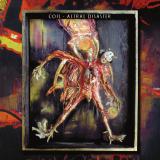
At the turn of the millenium the original „Astral Disaster“ subcription-only vinyl release was somewhat of an Unholy Grail for Coil collectors!
Virtually unobtainable in its original fiercely limited format of only 99 copies, it is the only album apart from the original „Musick to play in the
Dark“ record to combine the genius of Balance and Sleazy with both Drew McDowall and Thighpaulsandra's talents.
Like „Musick“ it is an essentially tidal/lunar record with literal washes of sound enveloping the listener. Intensely engaging tracks like „The Avatars“ and the later concert tour-de-force „I don't want to be the one“ owe equal amounts to drone and kraut, but are quintessentially Coil.
The record was re-imagined and enhanced a short time later, but even this more widely available re-edition on Coil's own Thresholdhouse imprint has been unavailable for too long now.
At the turn of the millenium the original „Astral Disaster“ subcription-only vinyl release was somewhat of an Unholy Grail for Coil collectors!
Virtually unobtainable in its original fiercely limited format of only 99 copies, it is the only album apart from the original „Musick to play in the
Dark“ record to combine the genius of Balance and Sleazy with both Drew McDowall and Thighpaulsandra's talents.
Like „Musick“ it is an essentially tidal/lunar record with literal washes of sound enveloping the listener. Intensely engaging tracks like „The Avatars“ and the later concert tour-de-force „I don't want to be the one“ owe equal amounts to drone and kraut, but are quintessentially Coil.
The record was re-imagined and enhanced a short time later, but even this more widely available re-edition on Coil's own Thresholdhouse imprint has been unavailable for too long now.