Originally released on Polydor Records in August 1981, it remains a very special and discrete record and has gone on to achieve a cult status separate from the rest of their august catalogue.
Formed at London's Guildhall School of Music and Drama by way of Paris and the Isle Of Wight, Level 42 marked the union of four talented friends – Mark King, Mike Lindup, and brothers Phil and Roland 'Boon' Gould – complete with Wally Badarou, their very own studio-based synthesiser whizz-kid. From building a fervent following through the nascent Britfunk scene, they signed to Polydor and went on to make a series of fascinating albums.
The sheer invention, melody and imagination of this four-piece was astounding, aided by their secret weapon, French-Belizean Badarou, whom the band had met playing sessions for M, Robin Scott's art-disco ensemble. Although Level 42 had recorded – and made waves – for indie label Elite, they signed to Polydor and released this album, with three of their original calling cards, Starchild, Turn It On and the mighty, UK Top 40 breaching Love Games.
By the mid 80s Level 42 had become arena-filling superstars, with their commercial pop-funk with everyman lyrics that delighted fans not just in Europe, but also in America, too. Hear the roots of that on this frequently surprising, always entertaining debut album. Think of this album as the missing link between Talking Heads and Herbie Hancock.
Out of print on LP for a number of years, this re-issue faithfully replicates the original 1981 Polydor UK release with insert and is pressed onto high quality 180g vinyl.
Cerca:wave form
GER JUNG IN WIEN - NEUE JANGLE-POP GRUPPE MIT 80ER INDIE WAVY VIBE. IHRE ERSTEN BEIDEN MINI-ALBEN "TROUBLE" & "LIGHTNING TRAILS" JETZT AUF EINER LP. "Der gerade erst volljährig gewordene Tobias Hammermüller steht für weichgespülten Bedroom-Wave und formte für sein Debütalbum auf Siluh Records die Band Laundromat Chicks." (THE GAP) - Hinter dem Namen LAUNDROMAT CHICKS verbirgt sich das Musikprojekt von TOBIAS HAMMERMÜLLER, der gerade 19 Jahre alt geworden ist. Nach dem selbstproduzierten Debüt "Trouble" haben die LAUNDROMAT CHICKS ein neues Album vorgelegt, das deutlich ruhigere Töne anschlägt. "Lightning Trails", das Band-Mastermind Tobias Hammermüller zusammen mit Martin Rupp (Jansky) produziert hat, ist ein folkiges Manifest für die leisen Töne geworden, die wir dringend brauchen. Beide Alben sind jetzt auf einer LP verewigt. Seite A mit dem eher ruppigeren "TROUBLE", auf der B-Seite das folk-inspirierte Kleinod "LIGHNTING TRAILS" "Lightning Trails" ist ein Meisterwerk an Musikalität und Zurückhaltung zugleich, eine Ode an die Verträumtheit und Nachdenklichkeit in Zeiten des Aufruhrs und der aufeinanderprallenden Ideologien. Es ist eine Einladung, aus dem Fenster zu klettern und eine aus den Fugen geratene Welt von einem versteckten Sims aus zu betrachten. Wie das Nachglühen eines Blitzes auf der Netzhaut, in der nahen Ferne." (Paul Buschnegg) Für Freunde von PASTELS, THE RADIO FIELD, THROW THAT BEAT, COMET GAIN, UK-Indie, Teen Angst, Twee-Pop...
[ENG] BEING YOUNG IN VIENNA - NEW JANGLE-POP GROUP WITH SOME 80S INDIE WAVY VIBE. THEIR FIRST TWO ALBUMS "TROUBLE" & "LIGHTNING TRAILS" ON ONE LP "Conversational lyrics depict a night on the phone amid claustrophobic misgivings and obsessive mental wanderings. Energetic, bittersweet sentiments ignite wandering clusters of shimmering strumming riffs and jangly wistful guitar melodies to weave swaying paths of vibrant nostalgia through low pulsing bass lines, skipping drumbeats, and pinpoint synth stabs to accompany heartfelt yet angsty vocal harmonies, haloed in distant echoes of doubt, through a sad discomforting timeline of uncertainty and dread." (WHITE LIGHT / WHITE HEAT) Behind the name LAUNDROMAT CHICKS is the music project of TOBIAS HAMMERMÜLLER, who just turned 19. After their selfproducued debut "Trouble", LAUNDROMAT CHICKS has presented a new album that touches on much quieter tones. "Lightning Trails", which band mastermind Tobias Hammermüller produced with Martin Rupp (Jansky), has become a folky manifesto for the quiet nuances that we desperately need. Both albums are now immortalised on one LP. Side A with the rather rough "TROUBLE", on the B-side the folk-inspired gem "LIGHNTING TRAILS". "Lightning Trails is a masterpiece of musicality and restraint at the same time, an ode to dreaminess and thoughtfulness in times of turmoil and clashing ideologies. It is somehow an invitation to climb out the window to view an unhinged world from a hidden ledge. Similar to the afterglow of a flash on the retina, in the near distance." (Paul Buschnegg) RIYL Pastels, The Radio Field, Throw That Beat, Comet Gain, UK-Indie, Teen Angst, Twee-Pop...
Zakmina presents a commanding dark disco release for Minimood with two spellbinding originals filled with unique and captivating sounds. The EP is complemented by compelling remixes from Curses and Rude 66. “Makam” comprises of an alluring array of instruments that create a mesmerizing atmosphere with an oriential mood to it. Curses retains this atmosphere in his remix, albeit with a deeper and darker tone. Unfolding a massive EBM vibe, “Mental Syndicate” forms a dancefloor destroyer that is driven by a vigorous kick and snare. The reimagining from Rude 66 features intergalactic vocals, raw electro sounds, as well as a truly addictive hookline.
Deluxxe is a new post punk/new wave band from Buffalo, NY.
It was formed by Mason and Greg, and later completed with Nick, Bailey and Mackenzie, sharing members of Oi and hardcore bands such as Violent Way, Bad Blood and Exhibition. Their punk background can be heard in the music, but it’s the love for new wave, post punk, darkwave, and goth that led to creation of their debut record “If You Were Me”. Written in the cold winters of Buffalo, you can almost feel the harshness of the weather affecting the sounds that propagate from these grooves. Icy and frostbitten but somehow still relevantly civic and urban.
The Chameleons and The Sound are two main references here, but that whole cold dimension is rocked by a strong pop vein reminiscent of After The Snow-era Modern English and occasionally enhanced by an hoarseness typical of a young Paul Weller. Passionate lyricism proper of Echo And The Bunnymen and hopeless romanticism à la Sad Lovers And Giants get balanced by a sharp songwriting which keeps everything in perfect order, giving you exactly what you need, nothing more and nothing less.
You can tell some skinheads are involved here because the outcome is so tidy and neat, without losing one inch of atmosphere or enchantment. If you are wondering how something that was invented forty years ago can still sound, literally, fresh and cool, look no further because what this band delivers lives just up to its name.
- A1: Eazycon -Double Life
- A2: The Modern Model - (The) Days On
- A3: Die Form - No Kill
- A4: Bisca - Dott. Jekyll
- A5: Funkwagen – Ebdomero
- A6: Nofun –Mongolia
- B1: Hakkah – Stairs
- B2: Illogico - 871Zx
- B3: Rinf - Was Besonders
- B4: State Of Art - Scoop 'N' Loop
- B5: Hi-Fi Bros -Stranger In The Night
- B6: Band Aid - L’inviato D’oltreoceano/Festa Happening
- B7: Confusional Quartet - Nebdo Zip
Taking up the gauntlet thrown down by New York's no wave scene, many Italian bands of the early '80s, playing far from the footlights of the world's stage, began creating compelling, and often cutting edge, hybrid sounds. This kind of experimenting soon went viral along the entire peninsula: from Southern Italy to the Alps, creating a brave new Italian take on post-punk. From the nervous white funk of Neopolitans Bisca, to the instrumental explorations of Confusional Quartet, to the "fake jazz" of the Hi-Fi Bros (who even had a track produced by Arto Lindsay), to Band Aid, this collection testifies to one of the most creative periods of the Italian underground. Also features: Eazycon, Modern Model, Die Form, Funkwagen, Nofun, Hakkah, Illogico, Rinf, and State Of Art. Includes CD; CD features the previously unreleased bonus track by La Maison, "Noise Express".
- A1: Boku No Kakera (Lp1 Hidari Ude No Yume Japanese Edition)
- A2: Saru To Yuki To Gomi No Kodomo
- A3: Kacha Kucha Nee
- A4: The Garden Of Poppies
- A5: Relache
- B1: Tell 'Em To Me
- B2: Living In The Dark
- B3: Slat Dance
- B4: Venezia
- B5: Saru No Ie
- C1: Boku No Kakera (Lp2 Hidari Ude No Yume Instrumental Mix)
- C2: Saru To Yuki To Gomi No Kodomo
- C3: Kacha Kucha Nee
- C4: The Garden Of Poppies
- C5: Relache
- D1: Tell 'Em To Me
- D2: Living In The Dark
- D3: Slat Dance
- D4: Venezia
- D5: Saru No Ie
RYUICHI SAKAMOTO'S LANDMARK 1981 ALBUM REISSUED FOR THE FIRST TIME IN DECADES OUTSIDE OF JAPAN. THE ALBUM WILL BE REISSUED IN ITS RARE JAPANESE EDITION TOGETHER WITH A 2-LP LIMITED EDITION FEATURING THE ALBUM PLUS A 2ND LP FEATURING ITS NEVER-RELEASED FULL INSTRUMENTAL MIX, ALL REMASTERED BY BERNIE GRUNDMAN.
Wewantsounds is proud to announce the reissue of Ryuichi Sakamoto's third solo album "Hidari Ude No Yume" (Left Handed Dream), originally released in 1981 on the Alfa label. Save for a small-scale Dutch vinyl release in 1981, it is the first time the album's original Japanese edition is released outside of Japan (the European release on Epic Records included significantly different tracks and mixes). Newly remastered from the original tapes by renowned engineer Bernie Grundman, this LP edition comes with original artwork featuring a striking cover shot by famous photographer Masayoshi Sukita (sourced from the original negative), OBI strip and 4-page insert with new introduction by journalist Anton Spice. The album will also be released as a 2-LP limited edition gatefold including the album's full instrumental mix.
Ryuichi Sakamoto's third album, "Hidari Ude No Yume" was recorded at the legendary Alfa Studio 'A' in Tokyo during the Summer of 1981. it came after "B-2 Unit" in 1980 and his debut album "Thousand Knives Of" in 1978, the very year Sakamoto was invited by Haruomi Hosono to join Yellow Magic Orchestra alongside Yukihiro Takahashi. In the process, they became global stars as the group rewrote the rules of electronic pop and toured around the world, yet Sakamoto was keen to remain active as a solo artist.
?In 1981, the musician decided to record an album rooted in Pop, following "B-2 Unit" which had a more of an experimental edge and his landmark electro debut from 1978. For this new album entitled "Hidari Ude No Yume," Sakamoto invited British producer Robin Scott, who had had huge hit with 'Pop Muzik,' to co-produce. They entered the Alfa studio in July 1981, accompanied by a handful of musicians. These included his fellow YMO musicians Haruomi Hosono and Yukihiro Takahashi, keyboard programmer extraordinaire Hideki Matsutake who'd been on Sakamoto's first two albums and became YMO's unofficial fourth member, violinist Kaoru Sato, saxophonist Satoshi Nakamura and American guitarist Adrian Belew who'd played with David Bowie, The Talking Heads' "Remain In Light" and more recently, Tom Tom Club’s debut (co-writing 'Genius Of Love').
?Together, they created a fascinating mix of pop, ambient and electronic music with elements of avant garde and traditional Japanese music, the whole firmly rooted in a solid groove. Sakamoto wanted to give the album a spontaneous feel and decided to let ideas flow and evolve organically during the sessions as musicians would develop them together. From the funk of 'Relâché' to the new wave feel of 'Venezia' and the ambient minimalism of 'Slat Dance,' the album is remarkably consistent while displaying a wealth of global influences as shown by the diversity of instruments featured on the credits: Marimba, didgeridu, traditional Japanese instruments such as the Sho and Hichiriki flutes.
?The album was released in Japan in 1981 and Epic Records picked it up for Europe a year later but decided to release it in a significantly altered version. The sequencing was completely reshuffled and two tracks, 'Saru No Ie' and 'Living In The Dark' were completely dropped while three others, ‘Relâché’, ‘Tell 'em To Me’, ‘Venezia’ were heavily remodelled with english lyrics and became 'Just About Enough', 'Once In A Lifetime' and 'The Left Bank'. Last but not least, a new English-sung track, 'The Arrangement,' was added, making the album nine tracks instead of ten for the Japanese edition.
Altogether this International version called "Left-Handed Dream" was a very different album from the Japanese one and although both were successful at the time and further established Ryuichi Sakamoto as a global solo artist, the Japanese edition of "Hidari Ude No Yume" remains largely unknown to international ears.
Wewantsounds is now delighted to release this original Japanese edition for the first time in decades as a single LP together with a 2-LP limited-edition set adding, as a bonus, its fascinating instrumental mix, discovered in the label's vaults a few years ago (Note that 'The Garden Of Poppies', 'Slat Dance' and 'Saru No Ie' are instrumentals but for the consistency of the album we kept them on the Instrumental Mix). "Hidari Ude No Yume" is an essential album in Ryuichi Sakamoto's rich discography. It is now available in its purest original Japanese form.
Black Truffle is pleased to announce its first release from celebrated London-based Canadian composer Cassandra Miller. Though her body of mature work stretches back almost twenty years, many listeners were introduced to Miller through the success of her astonishing 2015 Duet for Cello and Orchestra, which sets an imperturbable two-note cello part against a series of increasingly dense orchestrations of an Italian folk melody; in 2019, it was selected by The Guardian as one of the ‘best classical music works of the 21st century’. Traveller Song / Thanksong, the first release of her music on vinyl, presents a pair of compositions for voice and ensemble that exemplify Miller’s gently absurd, strikingly beautiful, and utterly unique work.
Like many of Miller’s compositions, these pieces originate in existing music. Traveller Song (2016/2018) begins from a 1950s song of an anonymous Sicilian cart driver recorded by Alan Lomax and Diego Carpitella, which Miller recorded herself singing along to, going on to then record herself singing to her own layered voices. Miller’s untutored voice is an unsteady, wavering wail that has, in her words, ‘more in common with a quasi-shamanistic keening than anything Sicilian’. Heard sometimes alone, sometimes layered, her pre-recorded voice is accompanied by a chamber sextet drawn from London’s Plus-Minus Ensemble. In the first section, Miller’s exposed warble is set to a spare piano accompaniment, somehow both faintly preposterous and magisterial. Following the voice note for note, the piano part often makes use of almost mechanical sequences of parallel chords, reminiscent both of Satie’s Rosicrucian period and the abrupt harmonic movements of a chord organ. The orchestration then opens up to guitar, clarinet, and sliding strings, a delicate environment for Miller’s voice, which, especially when it begins to be layered, generates a powerful sense of intimacy. In its concluding minutes, the folk roots of the original melody return in the form of a glorious full ensemble setting dominated by accordion, clarinet, and strummed guitar. Thanksong begins from recordings of Miller singing along to the third movement of Beethoven’s late quartet in A minor (Op. 132), the ‘holy song of thanks’ the composer wrote to express his gratitude for (temporarily) recovering from illness. Recording herself singing along repeatedly to each of the individual parts of the quartet, Miller created an aural score where each member of the string quartet listens to their own part on headphones, playing by ear. Performed on this recording by Montreal's Quatuor Bozzini, with whom Miller has a decades-long relationship, they are joined by the British soprano Juliet Fraser, who sings material from the Beethoven quartet ‘as slowly and quietly as possible’. The atmosphere of the opening of Beethoven’s Dankgesang, of hushed reawakening and thoughtful reflection, is sustained throughout the fourteen minutes of Miller’s piece, building at points almost to sentimentality before the five individual parts again fall back into a gentle burble of unsynchronised melodic gestures. Like Traveller Song, here the use of the voice is a long way from the mannered performance of much contemporary music, reaching for a human and bodily presence more connected to the reality of the everyday, albeit suffused with wonder. Presented in a stylish sleeve adorned with photography by Lasse Marhaug and liner notes by Cassandra Miller, this is a key release from a major contemporary composer whose work challenges and dazzles in equal measure. .
In Rumi's poem A Great Wagon he writes of a place of total acceptance. "Out beyond ideas of wrongdoing and rightdoing, there is a field. I'll meet you there," It is a boundless, liminal space where we can release the judgments we make and carry of ourselves, and the comparisons to others. When we think of this field, there is a sense of tranquility that only comes when we are undisturbed by the shadow self and see existence as neither bright nor dim, white nor black. But as lead singer Greg Bertens explains, arriving there is a whole different story. "This is a poem I've returned to over the years, and I love the idea of this place, but getting there is life's journey." Bertens adds "I think the longing for and elusiveness of this field is a recurring theme in our music." Field is enveloped by themes of regret, disconnection and frustration but with the space to understand that these feelings are a natural part of the struggle between reconciling the inner and outer self. The Los Angeles/San Francisco-based group have been indie shoegaze stalwarts since their formation in 2001. After two decades and a handful of line-up changes, their extensive discography presents a dynamically textural, lush psychedelic rock that has featured guest appearances by members of Pavement, My Bloody Valentine, and Snow Patrol, among others. 2021's LP We Weren't Here was hailed for its dense instrumental blanket, where unrelenting hi-hats and heavy kicks exist alongside dreamy drone guitar. This propulsive nature permeates Field, as members Bertens, Noël Brydebell (vocals), Nyles Lannon (guitar), Jason Ruck (synths), Justin LaBo (bass), and Adam Wade (drums) produce a kaleidoscopic sonic landscape. Patient, sprawling instrumentation builds a foundation in which Bertens' themes of endurance, perseverance and clarity can bloom with a considered poise. As a lyricist who writes in response to the instrumental arrangements, rather than a focus on a specific theme or person, Field is a testament to Film School's ability to create in the moment, and to showcase the magic that stems from when we are truly present. Album opener "Tape Rewind" is a swirling rush of color, as sustained guitars, darkened bass lines and urgent, percussive swells dance alongside each other. "This is the newest of all the songs on the record and feels like a new level of heaviness for the band," Bertens explains, noting that its lyrical context of struggling to move past trauma adds to its cathartic essence. Field is bookended by heavier themes, with closer "All I'll Ever Be" taking on the perspective of those we hurt when we embrace our own toxic behaviors. Originally written to be a simple acoustic guitar and vocals song soon turned into an ethereal, effects-laden composition, with Noël's hazy lead vocals ushering in a new-found acceptance. "It's all I want / To be released / And all I can be," she laments, cementing Field's message of accepting ourselves in whatever form we find ourselves in. "Defending Ruins" is a murky relentless underworld, inspired by the freewheeling tones of Texas-based band Holy Wave. "Defending the ruins, defending remains," Bertens spits, among a richly-layered outro. "Don't You Ever" confirms Film School's ability to merge both delicate and growling instrumentation throughout the album, with the song's softly spoken section hovering above sparkling guitar. "Is This A Hotel" bends towards the electronic aspects of the band, with wailing synths accompanying a story of bitter desire. With over two decades in the industry, Field cements Film School as a distinct, dominant force in the shoegaze scene. Soaked in an emotionally open, imaginative atmosphere, the album is both singular and expansive, and leaves the door open for a constantly evolving interpretation. Film School have never confined themselves to the rigidity of specifics, and it's on Field that they urge us to look beyond the binary of certainty, and to take a second look
Wewantsounds Is Pursuing Its Ambitious Akiko Yano Reissue Program With The Release Of "japanese Girl", Her Landmark Debut Album From 1976. Backed By Little Feat With Lowell George And By The Cream Of Japanese Musicians (including Haruomi Hosono), Japanese Girl Is One Of The Most Important Japanese Albums Of The 70s, Mixing Pop, Rock, Japanese Folk Together With Little Feat's Superb Classic Sound. This Is The Very First Time The Album Is Released Internationally. The Deluxe Lp Edition Includes Remastered Sound, Tip-on Lp Sleeve, Download Card Plus The Original 4-page Insert With Lyrics And Full Line-up!
When Akiko Suzuki Left Her Home Town Of Aomori For Tokyo In The Early 70s Aged Just 15 To Become A Professional Musician, She Quickly Started Making Waves On The Local Music Scene Performing At The Jazz Club Rob Roy. In 1973 She Released A 7" With The Group Zariba And Caught The Attention Of A&r Man Koki Miura. She Then Recorded One Song, "oinaru Shiino-ki" With Haruomi Hosono On Bass And Drummer Tatsuo Hayashi (who Features On Many Hosono Albums And Also Hiroshi Sato's 1979 Album Orient) With A Full Album In Mind.
After A Marriage With Musician/producer Makoto Yano And The Birth Of Her Son (named Fuuta), Yano And Her Team Resumed The Recording Of The Album And Decided To Pitch Little Feat For A Collaboration As She Loved The Group. Against All Odds They Said Yes And Yano Left Tokyo For Los Angeles In March 1976 To Record A Full Side With Them. The Legend Has It They Found It So Difficult To Keep Up With Yano's Compositions They Returned Some Of Their Fee. The Session Was Nevertheless Stunning And Lowell George Even Compared Yano To Stevie Wonder. The Little Feat Blend Of New Orleans Groove Matched Yano's Melodies Perfectly, As Witnessed On "funamachi-uta Part 2." Originally A Traditional Song From The Nebuta Festival In Her Hometown Of Aomori (part I On Side 2 Gives A Good Idea Of What The Original Form Sounds Like), The Little Feat Version Is A Formidable Slow-funk Workout Not Dissimilar To Their Classic, "spanish Moon", Serving Yano's Beautiful Vocals And Sense Of Groove To Perfection. The Whole Side Is A Match Made In Heaven, Showcasing The Classic Little Feat Line Up At Their Funkiest With Yano's Unique Japanese Twist.
The Japanese Side On The Album Gives A Great Snapshot Of The Tokyo Music Scene Of The 70s With Many Musicians Gravitating Around Haruomi Hosono (and Present On His 1973 Classic Album 'hosono House' Including Sound Engineer Kinji Yoshino) And Also Several Musicians From Japanese Band, The Moonriders.
Recorded At The Legendary Onkyo Haus Studio In Tokyo, The Sessions Mix Singer-songwriter Sensitivity And Pop With Traditional Japanese Sounds And Instruments Like The Shinobue Transverse Flute, The Koto String Instrument Or The Tsuzumi Hand Drum As Played On "hekoriputaa" By The Legendary Percussionist Kisaku Katada Who Was Appointed Living National Treasure By The Japanese State In 1999; Together They Create A Beautiful East-meets-west Mix Masterfully Driven By Yano's Creativity And Unique Talent.
A Breathtaking Debut Album That Made Akiko Yano One Of The Most Important Artists To Emerge From The 70s, Japanese Girl Has Since Become A Milestone In Japanese Music With A Recent Documentary On Nhk Tv Telling The Whole Story Behind This Classic. Wewantsounds Is Now Proud To Present This Essential Album To The Rest Of The World.
Factory Benelux presents a special 35th anniversary edition of Here Comes Everybody, the highly-regarded second album by Scottish group The Wake, originally released by Factory Records in 1985. Just 800 copies will be made available for Record Store Day on 18 April 2020, pressed in crystal clear vinyl with a bonus 7-inch single + digital copy.
The Wake formed in Glasgow in 1981 after singer/guitarist Caesar left Altered Images. Joining Factory the following year, the group toured with New Order and released popular mini-album Harmony. Trailed by sprightly single Talk About the Past in 1984, second album Here Comes Everybody was eventually recorded as a trio, combining dreampop melodies and wistful lyricism typified by standout track O Pamela (later interpreted by artful French new wave covers project Nouvelle Vague).
Praise for Here Comes Everybody: “Holds up as a touchstone for aching, atmospheric synth-pop, all slinky guitars, crispy percussion, textured keyboards and limber bass" (Pitchfork); “The album stands as a pillar of moody synth pop, still bearing passing resemblance to New Order while retaining the bounce of the Postcard label bands and the cavernous production of Closer-era Joy Division, covering it all in some of the heaviest synth wash this side of Klaus Schulze" (Dusted)
Newly re-mastered for this special 35th anniversary edition, the original 8 track album is now augmented by companion singles Talk About the Past and Of the Matter, pressed on a bonus 7-inch single in a picture sleeve. Here Comes Everybody itself is pressed on clear vinyl, housed in a white reverse board sleeve with printed inner bag containing lyrics, images and liner notes by band members Carolyn Allen and Caesar.
RYUICHI SAKAMOTO'S LANDMARK 1981 ALBUM REISSUED FOR THE FIRST TIME IN DECADES OUTSIDE OF JAPAN. THE ALBUM WILL BE REISSUED IN ITS RARE JAPANESE EDITION TOGETHER WITH A 2-LP LIMITED EDITION FEATURING THE ALBUM PLUS A 2ND LP FEATURING ITS NEVER-RELEASED FULL INSTRUMENTAL MIX, ALL REMASTERED BY BERNIE GRUNDMAN.
Wewantsounds is proud to announce the reissue of Ryuichi Sakamoto's third solo album "Hidari Ude No Yume" (Left Handed Dream), originally released in 1981 on the Alfa label. Save for a small-scale Dutch vinyl release in 1981, it is the first time the album's original Japanese edition is released outside of Japan (the European release on Epic Records included significantly different tracks and mixes). Newly remastered from the original tapes by renowned engineer Bernie Grundman, this LP edition comes with original artwork featuring a striking cover shot by famous photographer Masayoshi Sukita (sourced from the original negative), OBI strip and 4-page insert with new introduction by journalist Anton Spice. The album will also be released as a 2-LP limited edition gatefold including the album's full instrumental mix.
Ryuichi Sakamoto's third album, "Hidari Ude No Yume" was recorded at the legendary Alfa Studio 'A' in Tokyo during the Summer of 1981. it came after "B-2 Unit" in 1980 and his debut album "Thousand Knives Of" in 1978, the very year Sakamoto was invited by Haruomi Hosono to join Yellow Magic Orchestra alongside Yukihiro Takahashi. In the process, they became global stars as the group rewrote the rules of electronic pop and toured around the world, yet Sakamoto was keen to remain active as a solo artist.
?In 1981, the musician decided to record an album rooted in Pop, following "B-2 Unit" which had a more of an experimental edge and his landmark electro debut from 1978. For this new album entitled "Hidari Ude No Yume," Sakamoto invited British producer Robin Scott, who had had huge hit with 'Pop Muzik,' to co-produce. They entered the Alfa studio in July 1981, accompanied by a handful of musicians. These included his fellow YMO musicians Haruomi Hosono and Yukihiro Takahashi, keyboard programmer extraordinaire Hideki Matsutake who'd been on Sakamoto's first two albums and became YMO's unofficial fourth member, violinist Kaoru Sato, saxophonist Satoshi Nakamura and American guitarist Adrian Belew who'd played with David Bowie, The Talking Heads' "Remain In Light" and more recently, Tom Tom Club’s debut (co-writing 'Genius Of Love').
?Together, they created a fascinating mix of pop, ambient and electronic music with elements of avant garde and traditional Japanese music, the whole firmly rooted in a solid groove. Sakamoto wanted to give the album a spontaneous feel and decided to let ideas flow and evolve organically during the sessions as musicians would develop them together. From the funk of 'Relâché' to the new wave feel of 'Venezia' and the ambient minimalism of 'Slat Dance,' the album is remarkably consistent while displaying a wealth of global influences as shown by the diversity of instruments featured on the credits: Marimba, didgeridu, traditional Japanese instruments such as the Sho and Hichiriki flutes.
?The album was released in Japan in 1981 and Epic Records picked it up for Europe a year later but decided to release it in a significantly altered version. The sequencing was completely reshuffled and two tracks, 'Saru No Ie' and 'Living In The Dark' were completely dropped while three others, ‘Relâché’, ‘Tell 'em To Me’, ‘Venezia’ were heavily remodelled with english lyrics and became 'Just About Enough', 'Once In A Lifetime' and 'The Left Bank'. Last but not least, a new English-sung track, 'The Arrangement,' was added, making the album nine tracks instead of ten for the Japanese edition.
Altogether this International version called "Left-Handed Dream" was a very different album from the Japanese one and although both were successful at the time and further established Ryuichi Sakamoto as a global solo artist, the Japanese edition of "Hidari Ude No Yume" remains largely unknown to international ears.
Wewantsounds is now delighted to release this original Japanese edition for the first time in decades as a single LP together with a 2-LP limited-edition set adding, as a bonus, its fascinating instrumental mix, discovered in the label's vaults a few years ago (Note that 'The Garden Of Poppies', 'Slat Dance' and 'Saru No Ie' are instrumentals but for the consistency of the album we kept them on the Instrumental Mix). "Hidari Ude No Yume" is an essential album in Ryuichi Sakamoto's rich discography. It is now available in its purest original Japanese form.
In the beginning there was FAUVE, cult french rock band with unique on-fire spoken-word singing & epic concerts.
4 out of the 5 former Fauve members decided to resume creation and to change everything. They are back on a new name : MAGENTA & with a totally different global identity, up to the music: new foundations. No more rock, pure electronic music from classic french touch to new electro vibes. But still featuring lyrics & singing reminding their former roots. And electronic played live using a drummer & a guitarist on top of machines & keyboards.
On its’ release in November 2022, Daniel Stenger’s debut mini-album as Flashbaxx, Take Care My Friend, won plenty of plaudits for its’ enticing blend of jazz-funk instrumentation, audible warmth, effortless musicality, and memorable, sun-soaked songs. Now the set returns in remixed and reworked form, with a sextet of artists taking it in turns to put a new spin on the German producer’s carefully crafted and immaculately executed tracks.
The six-cut vinyl version boasts two revisions that have already made waves on digital download: a genuinely life-affirming hip-hop-soul take on ‘Strangers’ courtesy of East Midlands’ maestro Atjazz, where Katherine Kempf’s smouldering lead vocals rise above head-nodding beats, woozy electric piano chords, yearning horn arrangements and smooth bass guitar, and a sublime Moods mix of ‘Love Boat’ that re-frames the track as a languid, groove-fired shuffle through Balearic jazz-funk territory.
The other four reworks, which are exclusive to this EP, are similarly inspired. Chris Pookah collaboration ‘City Lights’ is given the remix treatment not once, but twice. First NuNorthern Soul regulars Mike Salta and Mortale re-imagine the track as a gently breezy, dusk-ready blend of bouncy, samba-influenced grooves and colourful Balearic nu-disco, before BJ Smith – the first artist to release music on Phil Cooper’s imprint way back in 2012 – takes the track into semi-acoustic, blue-eyed-soul-meets-Balearic jazz-funk territory. Gentle, tactile, and vibrant, it’s a stunning, soul-stirring revision.
To round off the EP, two producers renowned for creating atmospheric, sunrise-ready soundscapes deliver their versions of Stenger’s kaleidoscopic, musically rich aural visions. Marshall Watson handles ‘Alright’, smothering a languid, slow-motion drum machine beat in jazzy double bass, delay-laden electric piano motifs, lazy jazz guitars, rising synth strings and the dreamiest of pads.
Then, to round things off in considerable style, Tambores En Benirras reworks title track ‘Take Care My Friend’, teasing out the track’s inherent musical colour and warmth whilst adding his own distinctive spin. Pleasingly hard to pigeonhole, his remix makes extensive use of deep, dubby bass, Latin-style percussion, leisurely beats, blossoming synth sounds and all manner of effects-laden instrumental flourishes – including guitar solos that recall some of Dave Gilmour’s most laidback, eyes-closed moments. It provides a genuinely brilliant conclusion to an effortlessly impressive set of remixes.
After Miss Machine, Dillinger Escape Plan fans were divided. Many of the folks who were attached to the screaming mathematical metal of Calculating Infinity bailed on the band, disapproving of the experimental musical direction and the meathead appearance of new singer/screamer Greg Puciato. Open-minded listeners were excited about the progressive journey they were taking and many critics hailed the group as a true innovator of metalcore. Ire Works succeeds in many of the same ways that their previous album did, while branching out creatively. They continue to toy with technical metal, blistering hardcore, jazz breaks, and post-punk, but here they evolve again by adding more twists and turns with additional electronic elements. While the merging of too many styles in hardcore can make for a convoluted result (see Avenged Sevenfold's self-titled release), the added instruments and genre changeups enhance the result rather than acting as ornamental distractions. Edgy Aphex Twin-style drill'n'bass drum breaks and stretched and squeezed electro blips feel strangely at home next to the psychotic time-signature changes and manic riffs, especially on the tracks "Sick on Sunday," "Dead as History," and "When Acting as a Wave." Violins, pianos, and trumpets sit nicely in the mix, and the group's willingness to take chances leads to stunning artistic endeavors rather than stale attempts at crossing genres just for the sake of being clever. Original vocalist Dimitri Minakakis makes an appearance, as does Mastodon guitarist Brent Hinds, but the most notable inclusion is drummer Gil Sharone, who proves himself an expert at picking up the slack after the departure of founding member Chris Pennie to play in Coheed and Cambria. Undoubtedly, this act added anger to fuel the fire of their heavier numbers. "82588," "Fix Your Face," and "Party Smasher" are as wicked and manic as their most difficult earlier stuff; conversely, the melodic hooks and falsetto of "Black Bubblegum" and the watery ambience of "Mouth of Ghosts" balance out the album nicely. It can be inaccessible and terrifying all at once, but in a genre overly saturated with formulaic groups, Ire Works is a true standout. If DEP aren't careful and continue down this innovative path, they could easily be labeled the Radiohead of metalcore
London label Mysticisms knows how to dig out some truly lush house grooves whether that's in the form of unreleased house meets IDM, classic reissues or debuts from new school artists. N-GYNN falls into that latter camp having started to make waves on the likes of Hamam House Pleasure Club and his Superlux Records label. He explores a dreamy and cuddly house world here with rolling analogue drums, wispy new-age percussion and whimsical cosmic melodies that all make for otherworldly grooves. 'Journeys' has the feeling of an ancient ritual in the sky, 'Alistera' is a kaleidoscope of colour and 'Kebaya' has a more earthy Afro feel. 'Funk Break Beat' closes with a jumbled groove peppered with dial tones, string loops and bulbous acid.
Lovely Little Girls is a theatrical art-rock band from Chicago that features
members of Cheer-Accident and The Flying Luttenbachers - They
specialize in odd harmonies and catchy melodies served with a histrionic
flair
"Effusive Supreme", their third LP for SKiN GRAFT Records, delves into more
personal and abstract territory, highlighting the utilitarian and fetishistic
relationship to shoes on one track, while enthusiastically accepting ego- death's
indifferent embrace on the next. Equally informed by Magma and Dead Kennedys,
Lovely Little Girls pull from a range that runs the gamut yards past the finish line -
everything from Esquivel to Toto.
PRESS QUOTES:
"What makes Lovely Little Girls unique is the care for complex arrangements,
creating quirky prog- no wave hybrids... impressive psychodramas of melodic
detours and anguished explosions - full of theatrical uneasiness" - ChainDLK
"Stuns listeners into submission with heavy doses of horns and lyrical flogging.
Equal parts jazz, prog, and avant- garde, this horde of provocateurs revels in
disturbing the peace" - Razorcake
"Lovely Little Girls deal in absurd and jarring contrasts. The group's knotty,
intricate songs heave and dance and skitter - sometimes gracefully dexterous
and sometimes grotesquely lumpy - but clearly the work of formidably talented
musicians with vivid imaginations. Jacobsen's demented lead vocals flicker from
frighteningly histrionic to carefully declamatory, with eruptions of abject mania or
borderline obscenity, while behind him a chorus of singers might deliver a
pristine, almost angelic chant of "the pain, the horror"... - Chicago Reader
"Lovely Little Girls are your favourite cartoon villains, plotting the takeover of the
city before the Joker does" - The Organ
- An Anxious Host Is Described
- A Grift Is Detailed
- One Man's Trash Is Another Man's Garbage
- Skull Of Cortázar
- The Aftermath Of Post Office Arson Is Described
- The Sunken Cost Is Detailed
- Goes Reptile
- The Other Side Of The Coin Of The Confession Of The Medievalist
- Cart Dog
- Tired To The Bone
- Spanish House Is Described
Since the early 2010s, Josh Mason has slowly amassed an enchanting discography, publishing recordings on labels such as Florabelle, Dauw, Longform Editions, and his retired Sunshine Ltd. imprint. Whether focusing on electric guitar or modular synthesizer, Mason approaches his music with intentionality, tenderness, and a keen ear for detail, resulting in an exceptional and enduring oeuvre.
His workmanlike approach to craft and monomaniacal interest in circuit design culminated in 2021’s “Utility Music,” a daunting book/CD project that documents and unpacks a yearlong exploration of a Doepfer A-100 Eurorack system. The irony of such a project is that it might lead listeners to believe that academic technique and synthesis technology are the animating principles of his practice, but the reality is that this is only part of the story. Listening to Mason’s music one gets the sense that, like a good novelist, he truly cares about his characters, which take the forms of the textures and timbres of archaic wavetable oscillators, idiosyncratic filters, pulverized samples, and exotic noise sources.
“An Anxious Host” feels like a pivotal release in Mason’s catalog. It’s his first vinyl outing since 2019’s astounding “Coquina Dose,” and it may be the most succinct and potent album he’s made. The track titles function like stage directions in a play, intimating a hazy, filmic narrative populated by schemers, dreamers, and lost souls. As ever with Mason’s work, place is paramount, and this record is thoroughly shot through with the humidity, warmth, and “end of the line”-ness of the state of Florida. Seasick swells and sunken melodies; swampy, sputtering loops; sonic flotsam pooling together and flowing out, beckoning the listener to come have a soak.
In ihrer dritten Inkarnation schlägt die Berliner Supertruppe Berlin Diskret um Don Lotze, Asphalt Tiger und The Artist Formerly Known As Metal Warrior mit der neuen Frontfrau Elli ein neues Kapitel auf. Asphalt Tiger hat die Hälfte der souverän-schnoddrigen Texte spendiert und als Neuköllner Szenegröße hat Elli zudem ein hinreißend ruppiges Mundwerk, das auf den 14 exzellenten Songs von "Erinnere Dich" ebenso ein lyrisches Highlight nach dem anderen liefert, bei denen nahezu jeder und alles sein Fett wegkriegt. Messerscharfe Gitarrenlicks treffen auf herrlich wummernde Bassläufe, knackige Schießbuden-Action, geil nölige Backingvocals und immer wieder köstlich angerichtete Überraschungen in Form von Synthie, Mundharmonika, Schellenkranz und charmant zweckentfremdeten, nicht ganz unbekannten New Wave Riffs. Kombos wie Östro 430, Hans-A-Plast, Bärchen & Die Milchbubies, frühe Abwärts, ganz frühe Cure lassen Berlin Diskret liebevoll um jede Ecke lugen und schütteln derweil mit "Erinnere Dich" ganz locker ihr bezauberndes drittes und gleichzeitig bestes Album aus dem Ärmel.
- A1: I Wanna Dance With Somebody (Who Loves Me) (Who Loves Me)
- A2: Just The Lonely Talking Again
- A3: Love Will Save The Day
- A4: Didn't We Almost Have It All
- A5: So Emotional
- B1: Where You Are
- B2: Love Is A Contact Sport
- B3: You're Still My Man
- B4: For The Love Of You
- B5: Where Do Broken Hearts Go
- B6: I Know Him So Well
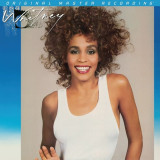
Whitney did more than turn Whitney Houston into a pioneering sensation known around the world by her first name. Originally released in June 1987, the singer's blockbuster sophomore record became the first album by a female artist to debut at No. 1 on the Billboard 200 chart — a position it claimed for a total of 11 weeks en route to selling more than 10 million copies in the U.S. The Diamond platinum effort also contains four No. 1 Hot 100 hits that, when combined with the three chart toppers from her 1985 debut, gave her seven consecutive No. 1 singles — an accomplishment that no other artist has accomplished. Commercially and creatively, Whitney stands on hallowed ground — especially now that the record plays with a sound that puts into perspective just how extraordinary, engaging, and vital Houston's music remains.
Mastered from the original master tapes and pressed on MoFi SuperVinyl at RTI, Mobile Fidelity's 180g 33RPM SuperVinyl LP of Whitney invites listeners to experience the Rock & Roll Hall of Fame inductee's pivotal album in audiophile quality for the very first time. Free of the dynamic limitations and tonal flatness prevalent on prior vinyl and CD pressings, it lets the music breathe and reveals the copious detail, nuance, and texture within the immaculately produced songs. MoFi's SuperVinyl profile offers further advantages in the forms of a nearly inaudible noise floor, dead-quiet surfaces, and superb groove definition.
In addition to featuring extreme clarity and immediacy, this numbered-edition reissue does wonders for the attribute that inspired more than 20 million people around the globe to add Whitney to their record collections: that inimitable voice. Houston's trademark mezzo-soprano — an acrobatic instrument equally capable of taking off on fantastic flights and unwinding for hushed meditations — benefits from the fantastic airiness and transparency afforded by this meticulously restored edition. Whitney has never sounded or looked better. The crossover landmark deserves nothing less.
Issued just two years after Houston's breakthrough debut, Whitney immediately signalled the genre-defying singer's intent to continue to push ahead and expand her palette. Shot by photographer Richard Avedon, the album cover depicts an iconic image of Houston — captured with a gleaming smile, bright eyes, teased-out afro, toned arms, and a right hand that appears to wave a friendly hello — whose active, athletic profile stands in contrast to the extremely formal sit-down shot of her that graces her '85 record. The change is telling: Whitney overflows with unfettered joy, rhythmic vibes, and deep-seated emotions that forever endeared her to the hearts and minds of countless listeners — and which set the standard for the wave after wave of divas that followed in her footsteps.
It's no coincidence that the first track on Whitney is the declarative "I Wanna Dance with Somebody (Who Loves Me)." Like Michael Jackson's "Billie Jean" and Madonna's "Material Girl," the feel-good smash is one of the quintessential '80s gems — a lithe, melodic, celebratory release of pent-up energy and loneliness that glides across club floors, shouts to the rooftops, and shrugs off any concerns about vulnerability or embarrassment. Houston's swooping voice moves in sync with the sleek beats and dipping-and-diving synths. She practically takes her fellow musicians by their hand and leads them in a blissful dance that nobody would dare sidestep. Focusing on Houston's singing — a task made challenging only because of the impossible-to-ignore hooks and grooves — showcases the virtuosic facets of not only her register but her control, discipline, smoothness, and warmth.
That she replicates those feats for the entirety of the nearly 53-minute-long album makes Whitney that much more special. Houston reaches back and channels her childhood gospel training on the R&B-flared "So Emotional"; effortlessly slips into Quiet Storm mode on the duet with her mother, gospel great Cissy Houston, on "I Know Him So Well"; flirts with smooth jazz and collaborates with tenor saxophonist Kenny G on the lush "Just the Lonely Talking Again"; conjures dreamscapes and shadow-boxes with supple funk on a romantic cover of the Isley Brothers' "For the Love of You"; and, for the majestic power ballad "Didn't We Almost Have It All," displays the sky-scraping reach of her vocals amid a grand arrangement made even bigger by Houston's sweeping performance and triumphant finish.
Houston's once-in-a-generation talents weren't lost on the adoring public, radio deejays, or industry experts. In addition to harbouring four No. 1 hits and receiving nominations for four Grammy Awards, Whitney generated another Top 10 success in the guise of the Afro-Cuban-leaning "Love Will Save the Day." The album also netted Houston four American Music Awards; two Billboard Music Awards; back-to-back People's Choice Awards; a Soul Train Award; and various other accolades. It all makes the crux of the Washington Post's July '87 review of the album appear prophetic: "Her voice sounds stronger still and the songs are varied but so consistent she could garner 10 Top 10s out of a field of 11."
That claim still holds true. A brilliant fusion of pop, R&B, smooth jazz, and soul, Whitney is a showstopper – and one of the key reasons Houston is the most-awarded female artist of all time.
In 2018, New York based composer and improviser Lucie Vítková made recordings in caves in the Czech Republic and an abandoned Gothic church in Slovakia. Their album Cave Acoustics combines a beguiling exploration of the physicality and acoustics of these unique locations with profoundly personal themes of family legacy and roots.
Lucie performed with their sisters in Výpustek Cave – an underground system of tunnels and former Soviet-era bunker. The choreography-based piece creates crescendos of metallic noise as the trio moves around the spaces. It begins with echoing clanks of tins and coins and accelerates towards a rattling cacophony with distant singing floating up from deep in the shadows. Bearing in mind the siblings had never performed together before, their frenzied kinetic outpourings seem even more special, a wordless cohesion forming between them. Lucie clearly doesn’t shy away from a physically full on experience; they embarked on a Fitzcarraldo-style journey to carry heavy props up a steep hill and across a river to reach the less accessible Jáchymyka Cave.
‘Hair Score’ is an attempt to process the death of the siblings’ mother through a serene then slightly unsettling swaying ritual, with rising and falling waves of wailing and emergency siren sounds growing in intensity as they emerge from their mourning mouths.
After the cavernous acoustics, ‘Stones’ by American experimental classical composer Christian Wolff feels more immediate with its textural sounds and fast, insistent rhythms, as we hear different sized stones knocked together rapidly, following the composer’s instructions not to break anything.
‘Inside the Ritual’ was a “transformative” experience for Lucie, where they felt their body merge with the forest and hills in Slovakia. The 23-minute long track is hypnotic, listening to cowbells and chirping insects at the end of a hot summer’s evening. Things get stranger as metallic clatter is punctuated with Lucie’s voice and reedy tones from their Japanese hichiriki flute.
The album is a calm, contemplative but also energetic and moving reflection of these rare and unheard environments and Lucie’s reunion with the people and places that have shaped them.