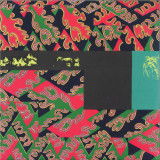
Over the past several years, the recorded output of Carl Stone has been turned on its head. In previous decades, Stone perennially toured new work but kept a harboring gulf of time between the live performances and their recorded release. This not only reflected the careful consideration of the pieces and technical innovations that went into the music but also the largely academic-minded audience that was themselves invested in the history and context of the work. The time span of Stone's recorded output in both sheer musical duration and year range was generously expansive. Following multiple historical overviews of Stone's work on Unseen Worlds and a re-connection with a wider audience, the time between Stone's new work in concert and on record has grown shorter and shorter until there is now almost no distance at all. Stone's work has often at its core explored new potential within popular cultural musics, simultaneously unspooling and satisfying a pop craving. On Stol en Car, the forms of Carl Stone's pieces have also become more compact, making for a progressive new stage in Stone's career where he is not only creating out of pop forms but challenging them. Stolen Car is the gleeful, heart racing sound of hijack, hotwire, and escape. Stone carries the easy smirk and confidence of a car thief just out of the can, a magician in a new town setting up a game of balls and cups. With each track he reaches under the steering wheel and yanks a fistful of wires. Boom, the engine roars to life, the car speeds off into the sunset, the cups are tipped over, the balls, like the car, are gone. "These tracks were all made in late 2019 and 2020, much of when I was in pandemic isolation about 5000 miles from my home base of Tokyo. All are made using my favorite programming language MAX. However distinct these two groupings might be they share some common and long-held musical concerns. I seek to explore the inner workings of the music we listen to using techniques of magnification, dissection, granulation,, anagramization, and others. I like to hijack the surface values of commercial music and re-purpose them offer a newer, different meaning, via irony and subversion." - Carl Stone, Los Angeles, September 2020
‘The Watchful Eye Of The Stars’ is Adrian’s ninth studio album.
Produced by luminary John Parish (Aldous Harding, PJ
Harvey), this sublime collection of ten songs invites us to join
Adrian at his storytelling best, regaling us with tales of travel
and wonder, by sea, by road, all quietly transfixing,
transformative and wholly captivating.
Suffused with a hazy and surreal quality, Crowley describes
‘Watchful Eye’’s poignant narratives as those which insisted
themselves upon him. After the fact, it seemed these songs
came to him more or less fully formed. “It’s a beautiful and
mysterious thing,” he says. Perhaps it is a tendency to hold onto
memories (“It’s taken me so long to write to you / Well I just
couldn’t find a pen,” he laments in ‘Bread And Wine’), that
allows him to unleash them lyrically in completion. For Crowley,
the creative process is an organic event rather than a practice
he feels compelled to regulate or control. He approaches lyrics
much like he does short story writing. “The songs straddle the
conscious and subconscious world and some are even
psychedelic in my mind, but to me they are all at once true
stories and born of another place,” he shares.
In making the album, Crowley moved between studio and at
home recording, while John Parish produced. The pair worked
from tracks made initially by Crowley on a charity shop ¾ size
nylon string guitar or Mellotron: “In this way, John wanted to
keep some of the magic of that first take,” says Crowley.
Contradictions and complexities are left intact, initial recordings
were limited to one or two takes and the songs feel more like a
dream recounted upon waking.
Jim Barr of Portishead contributed double bass and was
brought in to engineer parts of ‘Watchful Eye’ in Bristol. Nadine
Khouri and Katell Keineg were invited in as guest backing
singers.
The heavyweight vinyl includes a digital download card.
Womack updates his material for the 80s, creating grown-up sensual soul.
The passion for earthy R&B seemed to have dimmed as the 80s began.
Synthesised confections abounded and veteran Bobby Womack, the Midnight Mover, was at a crossroads. His peers were either in the wilderness (Marvin Gaye, James Brown and Isaac Hayes) or otherwise indisposed (Sam Cooke, Jackie Wilson, Sly Stone), so it was left to Womack to fly the flag for down-to-earth, quality soul.
Womack had been a recording artist for best part of two decades when he made The Poet. After making his name with The Valentinos in the 60s, he cut a string of heartfelt, emotional albums for Minit, United Artists and Columbia throughout the 70s. The Poet was written with great optimism; Womack was out of contract and was approached by agent Otis Smith to set up on his new label, Beverly Glen.
Working with Patrick Moten, Womack crafted eight songs that sounded breathlessly contemporary. If this material had been put in the hands of a soul crooner, it could have sounded perfunctory. The Poet works because of the juxtaposition of Womack’s feral growl with the album’s sweet, smooth, urbane soundtrack. This is grown-up, sensual music; from So Many Sides of You to its epic closer Where Do We Go From Here, this is a luscious collision of Womack’s soul mastery and slick musicianship. It rises and falls, with Womack sidestepping cliché thanks to his preaching, heartfelt delivery. For example, when he cries “I wanna dedicate this song to all the lovers tonight / And I expect that might be the whole world,” on If You Think You’re Lonely, it sounds honest, simple and sincere.
The Poet put Womack back on the map, and gave him his first US R&B chart-topper and first mainstream top 30 album. It was adored in the UK, and sent many back to investigate his grittier 70s heyday as an albums artist. The album became the best-selling record of Womack’s career
Womack cut the equally sublime follow-up The Poet II, released in 1984.
Womack updates his material for the 80s, creating grown-up sensual soul.
The passion for earthy R&B seemed to have dimmed as the 80s began.
Synthesised confections abounded and veteran Bobby Womack, the Midnight Mover, was at a crossroads. His peers were either in the wilderness (Marvin Gaye, James Brown and Isaac Hayes) or otherwise indisposed (Sam Cooke, Jackie Wilson, Sly Stone), so it was left to Womack to fly the flag for down-to-earth, quality soul.
Womack had been a recording artist for best part of two decades when he made The Poet. After making his name with The Valentinos in the 60s, he cut a string of heartfelt, emotional albums for Minit, United Artists and Columbia throughout the 70s. The Poet was written with great optimism; Womack was out of contract and was approached by agent Otis Smith to set up on his new label, Beverly Glen.
Working with Patrick Moten, Womack crafted eight songs that sounded breathlessly contemporary. If this material had been put in the hands of a soul crooner, it could have sounded perfunctory. The Poet works because of the juxtaposition of Womack’s feral growl with the album’s sweet, smooth, urbane soundtrack. This is grown-up, sensual music; from So Many Sides of You to its epic closer Where Do We Go From Here, this is a luscious collision of Womack’s soul mastery and slick musicianship. It rises and falls, with Womack sidestepping cliché thanks to his preaching, heartfelt delivery. For example, when he cries “I wanna dedicate this song to all the lovers tonight / And I expect that might be the whole world,” on If You Think You’re Lonely, it sounds honest, simple and sincere.
The Poet put Womack back on the map, and gave him his first US R&B chart-topper and first mainstream top 30 album. It was adored in the UK, and sent many back to investigate his grittier 70s heyday as an albums artist. The album became the best-selling record of Womack’s career
Womack cut the equally sublime follow-up The Poet II, released in 1984.
At first glance, Sarah Louise might seem an unlikely candidate
to credit technology as inspiration for her new album, Earth Bow.
After all, she has lived in rural Appalachia for the last decade,
foraging numerous species of wild mushroom, concocting
medicine from plants she gathers, and performing what she
terms “Earth Practices” to deepen her relationship with the
natural world. But it is precisely her ability to find connections
between false binaries that makes this album so novel and richly
immersive.
Louise conceived Earth Bow as an interconnected ecosystem,
meant to evolve, interact and grow. Known for her inventive
guitar playing, vocal harmonies and electronic experiments,
it was her use of the SP-404SX sampler that became a primary
inspiration for the album’s woven nature. “Improvising with the
404 during live shows allows me to collaborate with the music
as a living system, almost the way generative music works,” she
says. “I kept finding more and more samples that worked together
and realized I wanted to connect the entire record—and
that there were many ways it could be connected.”
Through this process, what began as eight core songs
blossomed into two sweeping suites. Samples—denizens of
her electronic forest—move around the record with changing
context like words in a sestina or phrases in the I Ching,
revealing new connections with each listen. Mesmeric sounds
abound on Earth Bow, from analog synth tones, to digitally
manipulated sonics that she stretches and layers with a painterly
touch. These electronic sounds inhabit the same environment as
field recordings, ceremonial percussion, guitars and empathic
vocals, weaving together her vast and borderless influences into
an enveloping world. “I want this record to take people on a
journey through the wonders of our incredible planet, to help
people feel held by the mysteries of nature,” she enthuses. “I
believe music can heal.” After a string of celebrated releases on
Thrill Jockey, Sarah Louise is self-releasing Earth Bow on her
new imprint of the same name.
Optimo Music presents “Janara” the new album from Italy’s José Manuel. We always have our ears open for music that is unique, powerful and that can conjure up a ritualistic atmosphere, and this meistrerwerk did all that, and then some. We knew we had to release it after the first listen.
We’ll let José tell you about it….
This album is a result of the necessity of exploring and opening my mind to new musical horizons, by testing the main traditional instrument of the Italian region Campania, whose name is “Tammorra”. It is a big drum, which must not be confused with the typical tambourine, made from a wrap of wood shaped in a circle and covered with dried skin (almost always goatskin or sheepskin). This instrument was used during playful events, especially during rituals and ceremonies, such as the frequent devotional pilgrimages in honour of the Virgin Mary. By using this instrument, the sound, the rite and the magic could take possession of the mind and the body creating a perfect union. Also, the dancers, as if they were bitten by a tarantula and possessed by a strange evil, launched themselves to an uncontrolled dance by moving every part of their body.
In addition to the Tammorra, I also inserted some texts, which have been written by some Neapolitan friends and interpreted with Neapolitans voices, in honour of the “JANARA”. The Janara represents a popular belief of the Southern Italian regions, particularly of the Benevento area. The Janara is one of the many types of witches represented by folktales belonging to the rural tradition.
The Janara was expert in medical herbs, which were also be used for her magical practices, such as the manufacturing of ointment. The ointment gave her the power to become incorporeal with the same nature as the wind. According to the tradition, in order to snatch the Janara it was necessary to grab her by the hair. It was also said that if anyone was able to capture the Janara during her incorporeal moment then Janara herself would offer protection to them and their family for seven generations, in exchange for her freedom.
With this work I hope that the listener might get carried away by the spirit of this pagan and popular legend that can be still be considered as current. As a matter of fact, the folk tales speak of a probable comeback of the Janara, who after being burned at the stake seems to be thirsting for revenge for the evil suffered.
out of Stock
Last delivered 3 years ago available to reorder, subject to availability
Just in time for the holidays comes a brand new Christmas classic from Academy Award-winning composer Michael Giacchino (Up, Ratatouille & Lost) and if the world ever needed a shot of positivity right now then this is it!
The idea of writing a Christmas single happened whilst hosting a Christmas party with Richard Kind at the Royal Albert Hall in 2019. During that party, they heard a radio announcement regarding a Christmas song competition, and they immediately began trying to
write a song and find someone to sing it! Throughout the party, guests turned up, but no one wanted to sing the song, that is until Himesh Patel and UK band Itchy Teeth knocked on the door and took up the challenge. Himesh was fresh from starring in Danny Boyle’s film Yesterday, and Itchy Teeth were the band that performed with him throughout the movie.
Recalling classic Christmas earworms such as Wings ‘Wonderful Christmastime,” the single is written by Michael Giacchino, Elyssa Samsel and Kate Anderson and performed by Itchy Teeth. The B-side is a beautiful smokey lounge version of Christmas Number One performed by the John Robert Wood Yule Sextet.
The LTD 7’ comes complete with a digital download card and is presented in gatefold Christmas card cover, ready and waiting to be given as a gift and inscribed with your very own holiday greeting.
Let us see 2020 out in a flurry of positivity, optimism and fun, so get ready to be singing this song around the christmas tree this year with all your family (even if that mean doing so on Zoom)
Rich in musical associations yet utterly singular in its voice, joyous with an inner tranquility, the music of Natural Information Society is unlike any other being made today. Their sixth album in eleven years for eremite records, descension (Out of Our Constrictions) is the first to be recorded live, featuring a set from London’s Cafe OTO with veteran English free-improv great Evan Parker, & the first to feature just one extended composition. The 75-minute performance, inspired by the galvanizing presence of Parker, is a sustained bacchanalia of collective ecstasy. You could call it their party album.
This was the second time Parker played with NIS. Joshua Abrams: “Both times we played compositions with Evan in mind. I don’t tell Evan anything. He’s a free agent.”
The music is focused & malleable, energized & even-keeled, drawing on concepts of ensemble playing common to musics from many locations & eras without any one specific aesthetic realization completely defining it.
“The rhythms that Mikel plays are not an exact reference to Chicago house, but that’s in there,” Abrams says. “I like to take a cyclic view of music history, can we take that four-on-the-floor, & consider how it connects to swing-era music? Can we articulate a through line? I dee-jayed for years in Chicago & lessons I learned from playing records for dancing inform how I think about the group’s music. The listener can make connections to aspects of soul music, electronic music, minimalism, traditional folk musics, & other musics of the diaspora as well. It’s about these aspects coming together. I don’t need to mimic something, I need to embody it to get to the spirit, to get to the living thing.”
For jazz fans, the sound of Parker’s soprano & Jason Stein’s bass clarinet might evoke Coltrane & Dolphy, even though they didn’t necessarily set out to do that & they play with complete individuality. Abrams sees a bridge to the historical precedent, too. “Since we first met in the 1990s, one of the things that Evan and I connected on was Coltrane’s music,” he says. “I hoped that we would tap into that sound world intuitively. In this case, I think that level of evocation adds another layer of depth, versus a layer of reference.”
Indeed, this is a performance in which the connections among the ensemble & the creative tension between improvisation and composition build into a complex mesh of associations & interactions. While the band confines itself to the territory mapped out by Abrams’ composition, they are remarkably attentive & responsive, making adjustments to Parker’s improvisations. When Parker’s intricate patterns of notes interweave with the band, the parts reinforce one another & the music rockets upward. Sometimes, Parker’s lines are cradled by the group’s gentle pulse & an unearthly lyrical balance is struck.
Drummer Mikel Patrick Avery is locked-in, playing with hellacious long-form discipline, feel & responsiveness. Jason Stein’s animated, vocalized bass clarinet weaves in & out with Lisa Alvarado’s harmonium to state the piece’s thematic material; the pulsing tremolo on the harmonium brings a Spacemen 3 vibe to the party. Abrams ties together melody & rhythm on guimbri, a presence that leads without seeming to. Like his bandmates, he shifts modes of playing frequently, improvising & then returning to the composed structure.
“As specific as the composition is, the goal is to internalize it & mix it up,” Abrams says. “The idea is to get so comfortable that we can make spontaneous changes, find new routes of activity, stasis & byways every gig. It’s like a web we’re spinning. If someone makes a move, we all aim to be aware of it, make room for it. Experiencing & listening is what it’s about, & Evan supercharges that.”
& “supercharged” is the word for this album. With Parker further opening up their music, descension (Out of Our Constrictions) is the sound of Natural Information Society growing both more disciplined and freer, one of the great bands of its time on a deep run.
Aguirre edition: Mastered by Helge Sten, Audio Virus, Oslo. Lacquers by Dubplates & Mastering. Liner Notes by Theaster Gates. LPs pressed on premium audiophile-quality vinyl at Pallas Records. US 2xLP edition available thru Eremite records.
out of Stock
Last delivered 5 years ago available to reorder, subject to availability
"We want to make people feel good about things that we feel terrible about." says David Brewis, who has co-led the band Field Music with his brother Peter since 2004. It's a statement which seems particularly fitting to their latest album, Flat White Moon released on 23 April via Memphis Industries. Sporadic sessions for the album began in late 2019 at the pair's studio in Sunderland, slotted between rehearsals and touring. The initial recordings pushed a looser performance aspect to the fore, inspired by some of their very first musical loves; Free, Fleetwood Mac, Led Zeppelin and The Beatles; old tapes and LPs pilfered from their parents' shelves. But a balance between performance and construction has always been an essential part of Field Music. By March 2020, recording had already begun for most of the album's tracks and, with touring for Making A New World winding down, Peter and David were ready to plough on and finish the record. The playfulness that's evident in much of Flat White Moon's music became a way to offset the darkness and the sadness of many of the lyrics. Much of the album is plainly about loss and grief, and also about the guilt and isolation which comes with that. Those personal upheavals are apparent on songs like Out of the Frame, where the loss of a loved one is felt more deeply because they can't be found in photographs and compounded by the suspicion that you caused their absence, or on When You Last Heard From a Linda, which details the confusion of being unable to penetrate a best friend's loneliness in the darkest of circumstances. Some songs are more impressionistic. Orion From The Streets combines Studio Ghibli, a documentary about Cary Grant and an excess of wine to become a hallucinogenic treatise on memory and guilt.. Others, such as Not When You're In Love, are more descriptive. Here, the narrator guides us through slide-projected scenes, questioning the ideas and semantics of 'love' as well the reliability of his own memory. The result is a generous record of bounteous musical ideas, in many ways Field Music's most immediately gratifying to date.
"We want to make people feel good about things that we feel terrible about." says David Brewis, who has co-led the band Field Music with his brother Peter since 2004. It's a statement which seems particularly fitting to their latest album, Flat White Moon released on 23 April via Memphis Industries. Sporadic sessions for the album began in late 2019 at the pair's studio in Sunderland, slotted between rehearsals and touring. The initial recordings pushed a looser performance aspect to the fore, inspired by some of their very first musical loves; Free, Fleetwood Mac, Led Zeppelin and The Beatles; old tapes and LPs pilfered from their parents' shelves. But a balance between performance and construction has always been an essential part of Field Music. By March 2020, recording had already begun for most of the album's tracks and, with touring for Making A New World winding down, Peter and David were ready to plough on and finish the record. The playfulness that's evident in much of Flat White Moon's music became a way to offset the darkness and the sadness of many of the lyrics. Much of the album is plainly about loss and grief, and also about the guilt and isolation which comes with that. Those personal upheavals are apparent on songs like Out of the Frame, where the loss of a loved one is felt more deeply because they can't be found in photographs and compounded by the suspicion that you caused their absence, or on When You Last Heard From a Linda, which details the confusion of being unable to penetrate a best friend's loneliness in the darkest of circumstances. Some songs are more impressionistic. Orion From The Streets combines Studio Ghibli, a documentary about Cary Grant and an excess of wine to become a hallucinogenic treatise on memory and guilt.. Others, such as Not When You're In Love, are more descriptive. Here, the narrator guides us through slide-projected scenes, questioning the ideas and semantics of 'love' as well the reliability of his own memory. The result is a generous record of bounteous musical ideas, in many ways Field Music's most immediately gratifying to date.
"Flowers Bloom, Butterflies Come" is the result of a dialog between the stunning Japanese photographer and artist Miho Kajioka and the wonderful UK musicians and composers Ian Hawgood and Craig Tattersall (The Humble Bee), initiated by IIKKI, between August 2019 and January 2021.
Born in the United Kingdom, Ian Hawgood spent most of his adult life living in Japan, Italy and Poland. Currently he calls Peacehaven (on the south coast, near Brighton) his home. Since 2009, he’s well-known with his work as the curator of the Home Normal label. He makes music using an array of reel-to-reel and tape machines in his studio by the sea, where he also master works for many labels and artists alike. You could often catch him on the coast with his faithful Nagra recorder, hydrophone and field microphones. These days his focus of music is on decayed ambient works using old synths and reels mostly, alongside his childhood piano. (site)
Craig Tattersall is a former member of The Remote Viewer and Famous Boyfriend bandmate Andrew Johnson. Tattersall's music can be found these days more often under his alias The Humble Bee; as a founder member of The Boats; and in his collaborative works with the likes of Bill Seaman in The Seaman And The Tattered Sail. He has run the wonderful label Cotton Goods from 2008 to 2015 and since 2009 he has recorded 12 albums on his moniker The Humble Bee.
Miho Kajioka (b. 1973, Japan, lives in Kyoto) is an artist and a photographer since 2011. Kajioka’s work has been exhibited in Spain, Italy, France, the Netherlands, the USA, Germany, Belgium, Portugal and the United Kingdom. Kajioka’s latest book ‘so it goes’ won Prix Nadar in October 2019. "Kajioka's artistic practice is in principal snapshot based; she carries her camera everywhere and intuitively takes photos of whatever she finds interesting. These collected images serve as the basic material for her work in the darkroom where she creates her poetic and suggestive image-objects through elaborate, alternative printing methods. Kajioka regards herself more as a painter/drawer than as a photographer. She feels that photographic techniques help her to create works that fully express her artistic vision. Her images evoke a sense of mystery in her constant search for beauty. The focused, creative and respectful way in which she uses the medium of photography to creating her works seems to fit in the tradition of Japanese art that is characterized by the specifically Japanese sense of beauty, wabi sabi. (…) According to her, photography captures moments and freezes them; printing impressions is like playing with the sense of time and getting lost in its timeline." (Ibasho Gallery)
out of Stock
Last delivered 5 years ago available to reorder, subject to availability
Afrosound's mission was to emulate the guitar-heavy tropical sounds emanating from Perú and Ecuador at the time. To add to the hippie vibe, there were plenty of whacky improvised vocal asides (called 'inspiraciones'), plus custom fuzz, wah-wah, flange and echo effects boxes for the guitar and keyboards. A barrage of odd sounding synths, drum machines and other electronic flourishes were also sprinkled in to spice up the proceedings. The dozen tracks on Afrosound's debut long play make for a surprisingly diverse palette from which these Colombian musicians painted their daring portrait of Peruvian cumbia, returning the favor in bold colors that still resonate almost 50 years later. "La danza de los mirlos" kicks off with most famous Afrosound hit of all, 'Caliventura', a genius blend of funk and cumbia. Aside from the cumbia amazónica title tune, there are several other covers including three popular songs by Nelson y Sus Estrellas, plus radically reimagined versions of various Colombian costeño classics published by Fuentes. Mario "Pachanga" provides a sad but still groove-oriented Christmas son montuno / cumbia hybrid while Fruko brings us the bomba-funk ditty 'El chorrillo' and the rocking cumbia andina gem 'Cabeza de chorlito' where Sepúlveda channels Enrique Delgado. Fruko collaborator Hernán "Hercovalle" Colorado Vallejo rounds things out with the melancholic psychedelic cumbia 'Esperando por ti', proving that every tropical party has to have its down side as well. The record was also released in the US, Ecuador, Perú, Panamá, Mexico and Venezuela, and probably had an influence of its own, at least in South America. The cover of this lovingly restored reissue features the artwork for the Peruvian edition, which was licensed and issued by Lima's El Virrey label in 1974. The original Fuentes artwork, with a far more outrageous "cheesecake" image, can be seen on the back cover.
out of Stock
Last delivered 5 years ago available to reorder, subject to availability
Sometimes a work of art comes unintentionally from a place from deep within the soul. It meanders and flops onto a table and sits and waits for its birth.
The album begins with "Wait Till The Stars Burn", a planetary ode to the Sun. The second track "Tribute to the Pharoahs Den", is a requiem for Danny Ray Thompson (R.I.P.) of the Sun Ra Arkestra, his music and legacy now floating above us in the infinity of space. Both tracks and featuring Marshall Allen and Knoel Scott (of the Sun Ra Arkestra).
The album ends with a requiem for Hal Willner (R.I.P.) whose devotion to celebrating the weird and insane was like an insatiable thirst leading to deep introspection and joy in harmony and sonic dissidence.
These compositions have all come from this place inside my bipolar, seroquil ridden mind. It is as much a tribute to the great composers who have inspired me; Alice Coltrane, Rahsaan Roland Kirk, Philip Kelan Cohran, Bernard Herrmann, Ennio Morricone, Miles Davis, Sun Ra, John Carpenter, Quincy Jones, Old Bollywood, Film Noir, to name just a few. In my 23 years of being a composer of music I have had the great opportunity to score several films all of which never got any commercial fame. These films were made from the blood and sweat of film directors and their crews who tirelessly made incredible documents that were ultimately ignored by humanity. But that never stopped them nor will it stop me. These tracks are from the infinite celluloid that runs deep in my mind, body and soul. In my lifetime i never thought i would see the deaths of "Celluloid" or "analog recording". I refuse to accept the coroner reports on said fatalities, so here is my offering to the canon of cinematic overtures and analog self-preservation, for the films in our heads yet to be made.
out of Stock
Last delivered 5 years ago available to reorder, subject to availability
Alfa Mist is one of the driving forces behind a young and vibrant scene of UK musicians, who've taken on jazz as their musical narrative. On his new album Bring Backs the producer, self-taught pianist and rapper takes us on a sonic trip back to his beat-making past on the streets of East London, through the depth and musicality he discovered composing and playing jazz. 2017 saw the release of Alfa's breakthrough record, Antiphon and the 2019's album Structuralism were both self-released on his Sekito label. His latest endeavour, 2021's Bring Backs, sees Alfa taking on new challenges. The record marks his first release for the label Anti and is also the most detailed exploration of his upbringing in musical form.
out of Stock
Last delivered 2 years ago available to reorder, subject to availability
Alfa Mist is one of the driving forces behind a young and vibrant scene of UK musicians, who've taken on jazz as their musical narrative. On his new album Bring Backs the producer, self-taught pianist and rapper takes us on a sonic trip back to his beat-making past on the streets of East London, through the depth and musicality he discovered composing and playing jazz. 2017 saw the release of Alfa's breakthrough record, Antiphon and the 2019's album Structuralism were both self-released on his Sekito label. His latest endeavour, 2021's Bring Backs, sees Alfa taking on new challenges. The record marks his first release for the label Anti and is also the most detailed exploration of his upbringing in musical form.
out of Stock
Last delivered 5 years ago available to reorder, subject to availability
Demon Records presents Distortion: The Best Of 1989-2019, the first career spanning
compilation of solo recordings by legendary American musician Bob Mould.
• Bob Mould’s career began in 1979 with the iconic underground punk group Hüsker Dü before forming
the beloved alternative rock band Sugar and releasing numerous critically acclaimed solo albums. At
the vanguard of his field for over four decades, Mould’s music has inspired generations of musicians.
• Compiled by Bob Mould himself, this new collection gathers together 24 essential recordings across
two LPs. Highlights include classic recordings such as ‘See A Little Light’, ‘If I Can’t Change Your Mind’,
‘A Good Idea’, and ‘The Descent.
• Mastered by Jeff Lipton and Maria Rice at Peerless Mastering and pressed on two 140g vinyl. Housed in
printed inner sleeves and a deluxe gatefold sleeve with artwork from illustrator Simon Marchner.
17 Track compilation of all of their studio recordings, remastered and pressed on Electric Blue Vinyl. Presented in gatefold sleeve with never seen before photographs ,a printed lyric inner sleeve and poster.
The VIP’s were formed in 1978 while at Warwick University. Within weeks they were gigging at clubs in the Midlands, often on the same bill as THE SPECIALS in Coventry. Soon they found a manager, Clive Solomon, who with Timmy Mallet (now a TV and Radio presenter) and both students at the university, financed the group’s first single the EP ‘Music For Funsters. In the summer of 1978 they built up a loyal following in London. The single was picked up by John Peel, who played it constantly on his BBC radio show through the year. The 3 track EP, featuring ‘I’m Perfect’, ‘I Believe’ and ‘Boys of the City’ was released on Clive Solomon’s own ‘Bust’ label.
In 1979 the VIP’s could be found playing all over the country, frequently on the same bill as Squire, stablemates on Clive Solomon’s label.
In early 1980 they went into Olympic Studios in Chiswick to record some tracks with ex-THE ANIMALS bass player and SLADE/Jimi Hendrix manager Chas Chandler. The track ‘I Thought You Were My Friend’ was recorded at these sessions A few weeks later a major record deal was agreed with Gem Records/RCA and ‘Causing Complications’ came out in March. To coincide with the release the VIP’s went on tour supporting SECRET AFFAIR.
After the tour the single ‘The Quarter Moon’ was released, another track produced by Mike Leander. It received extensive airplay around the UK and beyond, and was also picked as BBC Radio 1’s Record of The Week by DJ Mike Reid on his Morning Show, as well as being Radio Luxembourg’s ‘Power Play’ for two weeks. The constant touring, recording and radio play had earned them a spot on Top of The Pops but they were suddenly told -on the afternoon that they were due to appear - that an industrial dispute at the BBC had resulted in the show being cancelled. Disappointed, they continued to record and tour, this time with MADNESS, THE BEAT and DEXYS MIDNIGHT RUNNERS amongst others. This time Bob Seargent (of The BEAT and HAIRCUT 100 fame) was recruited to give ‘Need Somebody To Love’ that sparkle and edge to capture The VIP’s live sound on vinyl. Although perhaps the most representative of the band’s sound, Top of The Pops again eluded them.
By the end of 1980 the VIP’s were selling in Spain, Germany, Italy and France through the RCA label but they seemed to be losing heart with the business. Illness -Jed had been touring with a collapsed lung - and tensions saw the band play their last concert at Leicester University. A fourth and final GEM single, ‘Things Aren’t What They Used To Be’ (a song taken from their earlier Mike Leander recording sessions) proved to be their last. With several songs still to be recorded, it was a frustrating time for all.
Paul Shurey and Guy Morley has already made alternative plans for THE NEW VIP’s and recruited Simon Smith from THE MERTON PARKAS to play drums while Paul returned to his native keyboards. With Tony Conway on guitar and Andy Godfrey on bass they became MOOD SIX.
Paul Shurey played a central part in the birth and proliferation of the Rave movement in the 80’s, 90’s and 2,000’s, initiating a great a great many DANCE RAVES all around the world. Very sadly he died in 2017. He was also a gifted artist/cartoonist, and it’s his picture which graces the album’s sleeve. He is a brother very greatly missed.
Guy Morley works in film editing and Andrew Price is involved in developing community projects in and around his native Bristol.
“We became lifelong friends and shared a great and very exciting rock and roll dream.”
Surrender is the debut full length from DJ, producer, and songwriter Endgame. Stepping out for the first time as a vocalist, and lyricist, Surrender is his most ambitious and vulnerable work to date; a striking statement of intent, with moments of beauty and brutality. Endgame has carved an iconoclastic niche in club culture. Breaking into the scene as co-founder of the legendary collective Bala Club, and resident of the radical club-night Endless. Whilst continuing almost a decade hosting his infamous NTS radio show (and now label) Precious Metals, he has forged a path against the tide of formulaic club music. A visionary DJ and producer, Surrender sees Endgame continue this trajectory, with a project that both amplifies the ferocious club constructions he's known for, whilst making space to open up wounded memories and with sombre unfeigned requiems. Having previously released records on Hyperdub, PTP, Golden Mist and Infinite Machine, Endgame's first release on his own Precious Metals imprint, is him at his most reflective. Surrender is a deeply personal record, about loss and finding meaning in despair. Death is a prevailing theme, with the passing of his father a totemic subject. The recollection of his father's torturous final moments leaves him to mournfully contemplate temporality. Using this sense of anguish, he blurs reality-creating a world where angels and demons are among us in a decaying cityscape; akin to the work of Todd McFarlane. The opener Faithless, propels us into this world, with the slow build of industrial precision amidst the sombre build of harsh melodic synths. We descend deeper into this vision with Barbed Heart, featuring a defining vocal from scene staple and long time collaborator Yayoyanoh, as 808's and skittering hi hats ricochet off one another beneath his bass driven vocal. No Heroes continues our journey into the unknown with a chaotic rush of acidic riffs, pounding percussion, and a reference to the brutalist anthem from hardcore punk band Converge (where the track borrows its name). Requiem acts as the turning point of the record as Endgame steps into the foreground as a vocalist. As the name suggests, this lament is a sombre reflection of grief; its minimalist instrumental allows Endgame's haunted verse to rise into the foreground, like an apparition amidst the smoke in the depths of a dimly lit club. The dark clouds fade into the distance in Exhumed, as the elegant melancholic vocal of Bala Club affiliate and gifted vocalist Organ Tapes reflects off Endgame's sanguine verses bringing hope into the heartfelt instrumental filled with melodic flourishes and bass-bin rattling subs. The thematic haze thickens in Abyss, as the pulsating and doom laden instrumental interweaves with Endgame's sepulchral vocal. Like a message from the void, his words act as an agnostic hymn that pulls apart his sense of self. The contrast of his plaintive verse with the intensity of the instrumental creates a contrast that is symbolic of the record itself, a duality that presents moments of soft reflection against a severe sonic palette to create moments of transcendence.
Songwriter and fingerstyle guitarist, Jason McNiff releases his 7th full length album, Dust Of Yesterday, on April 16th. Produced and engineered by Roger Askew (Joe Strummer, Wilko Johnson, Christy Moore) the album was recorded throughout the summer and autumn of 2020 in Roger's home studio in Eastbourne, UK. It features McNiff's signature acoustic guitar work throughout with significant contributions from Beth Porter (of Eliza Carthy's band) on cello and Basia Bartz (most London based folk bands) on violin.
His first album since leaving London - McNiff is now based in Hastings - Dust of Yesterday is an elegy on moving away from a beloved place and a lament for lost youth. We are treated to a musical tour of McNiff's life to date, from his 8-year residency as a Flamenco guitarist in a Spanish bar in Waterloo (Damaged Woman) to hopping the northbound train from King's Cross, hiding in the lavatory up to Nottingham (A Load Along). All the songs on Dust of Yesterday, in one way or another, speak of the past. But it is not bleary-eyed nostalgia.
"I read somewhere that it is possible to literally change the past and I became very interested in this idea. It so happened around the same time that I discovered the Greek/Egyptian poet, Cavafy. In his poems he would talk about the past, but the memory is not a thing of the past, but something that is still part of him in the present. I could relate to that. "
Musically, Jason is influenced by the British acoustic guitarists (Jansch, Graham, Wizz Jones) and the great folk/rock troubadours of the 60s and 70s. He loves Mark Knopfler in the early days; the English teacher turned reluctant rock star, singing about Leeds and Newcastle and sounding like JJ Cale. For McNiff, the lyrics are central, and he has been especially captivated by those considered poets and writers as well as musicians. He loves literature and cites Hemingway, Chekhov and the aforementioned Cavafy, as major influences in his work. ( He has 'translated' Hemingway's 'For Whom the Bell Tolls' into a song on a previous album, 'Nobody's Son')
Jason McNiff was born in Bradford, Yorkshire in 1974 to an Irish father and Polish mother. Academically gifted, he did well at school and went to the University of Nottingham to study French and Russian. He fell in with the Folk & Blues scene in that city before moving to London in the mid-nineties to do another degree in English Lit. He was just in time to catch the Bert Jansch residency at the 12 Bar club. For 6 months, every Wednesday night, McNiff would be in the front row of Soho's tiny club learning fingerstyle from the master. He would later sign his first record deal with Snowstorm Records, a label run by Bert's brother-in-law and found himself opening for Bert on numerous occasions.
There followed a string of albums on various labels, including 2003's Nobody's Son (Americana UK album of the year) and 2011's April Cruel (nominated for best alt-country album at the Independent Music Awards in the US.)
Following the hard-hitting return single ‘Anxious’ and a slew of mysterious ‘West Gazette’ posters appearing around the UK hinting at the announcement (including Birmingham, Manchester, Glasgow, Bristol and London), West London’s AJ Tracey assumes the character of a rising young basketball player appearing in a livestreamed press conference to reveal his next move: a lucrative deal with major
franchise Revenge Athletic ahead of a crucial playoff game. The broadcast ends with the true reveal: AJ’s highly anticipated sophomore album ‘FLU GAME’ will finally arrive.
Always pushing boundaries with his creative output, AJ’s campaign draws influence from the story of Michael Jordan and his Chicago Bulls team in the late 90s, with ‘FLU GAME’ referencing one of MJ’s most memorable championship games where he overcame a nasty bout of food poisoning (brought on by a dodgy takeaway pizza) and took the Bulls to the championship. Revenge Athletic are a franchise on the brink of a massive championship win and AJ is their new star. All we know for now is that AJ is about to take us into this new world, as he dons the number 10 jersey and states he’s “ready to get going and do what I’ve always done.”
‘FLU GAME’ sees AJ showcasing twelve brand new tracks, with tantalising features including Kehlani, T-Pain, SahBabii, NAV and Millie Go Lightly. On the production
front, AJ calls on regular collaborators Nyge, The Elements, Kazza, AoD and Remedee.
The project also features the UK Top Five singles ‘Bringing It Back’ with Digga D, ‘West Ten’' with Mabel and the Platinum smash ‘Dinner Guest’ featuring MoStack. AJ Tracey is a man on an unstoppable, independently built trajectory. 2020 was his
biggest year to date, with (certified Gold) single ‘West Ten’ alongside Mabel landing in the wake of chart-scaling ‘Dinner Guest’ featuring MoStack (Platinum), Number 1 charity single ‘Times Like These’ (alongside Dua Lipa, Rag & Bone Man and The Foo Fighters) and the Platinum-certified TikTok sensation ‘Rain’ with Aitch, which went on
to become the most watched UK YouTube video of 2020. AJ finished the year with a stand-out feature on Headie One’s enormous anthem ‘Ain’t It Different’ alongside Stormzy, a Platinum certified track that peaked at Number 2 in the UK Singles Chart.
In 2019, AJ released his debut self-titled album which, after landing at Number 3 in the UK Official Charts, has gone on to clock over 350 million streams globally and is certified Gold. His Conducta-produced breakout hit ‘Ladbroke Grove’ was officially the
top selling independent single of 2019, spending an astounding 14 weeks in the UK Top 10, and is now certified Double Platinum (over 1.2 million sales). It was nominated for a BRIT, was named Best British Song at the NME Awards and is now the biggest-selling UK Garage record of all time - an incredible feat. AJ rounded off a
huge 2019 with two sold-out headline shows at London’s 10,000 capacity Alexandra Palace.
A music and cultural icon, and boasting over 1 billion global streams independently, AJ’s formidable talent and unmatched creative vision is set to see him scale even higher heights in the coming months.
a Anxious [prod Remedee]
[b] Kukoč (ft. NAV) [prod Pxcoyo + Yung Swisher]
[c] Bringing It Back (with Digga D) [prod. The Elements + AoD)
[d] Cheerleaders [prod Kazza & Swidom]
[e] Draft Pick [prod 5ive Beatz] Eurostep [prod AJ Tracey]
[f] Cherry Blossom [prod Nyge & AoD]
[g] Glockie [prod The Elements & AoD]
[h] Little More Love [prod YOZ BEATZ, RyFy & Mark Raggio]
[i] Top Dog [prod Nyge & AoD]
[j] Summertime Shootout (ft. T-Pain) [prod Nyge & AoD]
[k] Perfect Storm [prod YOZ BEATZ & JBJ]
[l] Coupé (ft. Kehlani) [prod The Elements]
[m] Numba 9 (ft. SahBabii & Millie Go Lightly) [prod The Elements]
[n] Dinner Guest (ft. MoStack) [prod The Elements & AJ Tracey]
[o] West Ten (with Mabel) [prod FRED & Take a Daytrip]
[a] Anxious [prod Remedee]
[b] Kukoč (ft. NAV) [prod Pxcoyo + Yung Swisher]
[c] Bringing It Back (with Digga D) [prod. The Elements + AoD)
[d] Cheerleaders [prod Kazza & Swidom]
[e] Draft Pick [prod 5ive Beatz] Eurostep [prod AJ Tracey]
[f] Cherry Blossom [prod Nyge & AoD]
[g] Glockie [prod The Elements & AoD]
[h] Little More Love [prod YOZ BEATZ, RyFy & Mark Raggio]
[i] Top Dog [prod Nyge & AoD]
[j] Summertime Shootout (ft. T-Pain) [prod Nyge & AoD]
[k] Perfect Storm [prod YOZ BEATZ & JBJ]
[l] Coupé (ft. Kehlani) [prod The Elements]
[m] Numba 9 (ft. SahBabii & Millie Go Lightly) [prod The Elements]
[n] Dinner Guest (ft. MoStack) [prod The Elements & AJ Tracey]
[o] West Ten (with Mabel) [prod FRED & Take a Daytrip]
After making a name for itself through acclaimed reissues of forgotten gems, Lyon’s Tunnel Vision Records is back, this time with a previously unreleased cult EP from the Serbian underground: InnVision’s Lake produced by Welljam aka Velja Mijanović, one of the pioneers of electronic music in Serbia and host of the legendary “Liquid” show on Yu Radio.
While it is fairly common these days for tracks to reach cult status after being uploaded to Youtube and picked up by its recommendation algorithm, the story of the Lake EP is truly unique.
Picture this: it’s the summer of 94 in Serbia and despite US sanctions, something was going on in the country’s musical underground with open-air parties on lakesides and other natural locations, fuelled by a feeling of freedom and creativity. At the time, InnVision was a 26-year-old producer inspired by the likes of The Orb, Brian Eno, Underworld, and Spooky. Unconcerned with adhering to trends or finding ways to make commercially-viable music, he created the tracks on this EP with Cubase running on an Atari computer and several synths fairly common at the time.
But the result was beyond anything common or ordinary. Described by its creator as “organic (ambient) house, but you can call it trance”, LAKE is rapture in its highest form. Pure enthusiasm seems to be driving this uplifting track, with an abundance of heavenly arpeggios and positive energy, along with masterful arrangements that make it even more grandiose, while retaining a light and dreamy quality (perhaps it is no coincidence that Lake in Serbian evokes weightlessness). It is one of those rare tracks that have a deep impact on body, mind, and soul and for which the repeat button was created. While adhering to a central theme, it never feels stale and this is explained by the fact that it was arranged live, with InnVision muting and tweaking everything in one go, which makes this track a “deskmix”, to use dub terminology. In fact, the producer remembers jumping around and shedding occasional tears while he recorded the final take.
On the flipside is another previously unreleased track, the forward-thinking NIGHTY. By no means filler, this is a timeless track with a subaquatic feel. With lush pads and elements doused in delay and reverb, you’d think this is a purely ambient cut, but it’s much more than that. Subtle melodic and rhythmic elements are engaged in a dialogue, and distant breakbeat samples can be detected in the background, enough to induce movement but never overtaking the vibe carefully created by InnVision. The result is a track that is at the same time featherlight and impossible to listen to without some sort of movement. Once again, truly unique music that transcends time and place.
out of Stock
Last delivered 5 years ago available to reorder, subject to availability
"...a swirl of the bedrock elements that make up modern music, his LP lifts from Soul, Funk and Hip-Hop to create this ode to Detroit House."
A NATION OF MILLIONS
EARLY SUPPORT FROM ALEXANDER NUT ("Tight beats from Snips as always. Dexters Pain is my fave here. Big ups"), KARIZMA ("Proud to hear a friend grow musically, great work on the album my friend...Full Support. K'), RED RACK'EM, SK VIBEMAKER
SNIPS delivers the first vinyl release on Houseology. The Barbershop LP is a tongue in cheek play on the production techniques Todd Worsnip aka Snips normally uses when making his Hip-Hop work. This 8 track LP is meeting of the two worlds of House and Hip-Hop tapping into Snips' raw ability to find the best cuts and chops needed for any genre.
DJ Snips began his career at legendary London record store Deal Real', where he ran the open mic night alongside British host and comedian Doc Brown, Snips' years at Deal Real saw him DJ'ing alongside performances from several US heavy hitters including Kanye West, Mos Def and the Black Eyed Peas.
Snips' knack for manoeuvring through a wide range of Hip Hop oeuvres has seen him play around the world, Specifically in NYC where he has been a guest at legendary parties including Everyday People, Bible Study, Mobile Mondays and Ginny's Supper Club. As well as being a regular in NY, Snips has also headlined events in The Philippines, Australia, Germany, Hong Kong, The Netherlands, Qatar, France, Norway and Spain. When Snips isn't touring or on the Club circuit, he's known for churning out beats for some of the most talented MCs on both sides of the Atlantic. His production work includes tracks for several major US recording artists including M1 (Dead Prez), Capadonna (Wu Tang), Sean Price.
Work on the Houseology record label allows Snips the opportunity to articulate himself even more so within his skilled production, by drawing a definitive line between the House/Hip-Hop relationship which has existed for years.
Here's another piece of music history. The Temptations, one of the greatest and influential vocal groups in the history of "Soul" are well represented here through a selection of their early singles. The group's immaculate vocal harmonies stand as a unique sound monument in American music culture and this disc shows us the origins of such a myth.
Raf Rundell announces the release of his second album, ‘O.M. Days’,
released on Heavenly Recordings.
Features guest appearances from Chas Jankel, Lias Saoudi, Terri Walker,
Andy Jenkins and Man & The Echo.
The cover features a striking Keith Haring-meets-the Green Man image from
acclaimed artist and longtime collaborator Ben Edge, the picture was
inspired by the folk tale of the giant of Dawson, who is both male and
female, human and vegetation and lived in the imagination of Dawson’s Hill,
a stretch of South London parkland a stone’s throw away from Dawson’s
Heights, the flats featured on the cover of the debut album ‘Stop Lying’.
Edge and Rundell, for reasons they can’t entirely comprehend, concocted a
rite which took place the first full moon after this year’s summer solstice
(the results of which can be seen in the short film trailer for the album).
This involved the giant - also known as Tommy Hill Figure - being created
on Dawson’s Hill. “Ben’s been digging deeper and deeper into ancient
myths, the green man, all the stuff that’s been co-opted by organised
religion,” Rundell explains. All this chimed with him because he is a magnet
for signs and symbols. He has been ever since his Mod-loving parents
named him after the RAF roundel symbol.
“We’d been talking about this sort of stuff a lot,” Rundell continues. “The
rite was about the birth of the new and using the coronavirus as a catalyst
for that change, like a full stop to the way things were before. The corona
was called the spark in the ceremony, although we’re not being too specific
about the virus because this is a thing we hope to do annually.”
This is the backdrop to the album, a record far larger and more confident
than its creator could ever have imagined. Unlike his itinerantly created
previous records, ‘O.M. Days’ was entirely recorded in the same Forest Hill
studio, with the aforementioned collaborators. “I love collaborating with
people - like Lias Saoudi or Andy Jenkins, who are both on this record -
that’s where it’s at for me,” Rundell says. “I worked really hard on this one.
And although I had no plan about where it was going, I always have a
notion about how I want things to sound. I had a particular idea about
that.”
Initial copies are eco-wax vinyl, reverting to standard vinyl (HVNLP181)
when sold out.
Digital download code included.
To Sonic Boom’s Pete Kember, re-imagining the past can lead to ways forward on life’s natural, interconnected path. In April of 2020, he released his first album in over 20 years called All Things Being Equal, a lush and psychedelic record full of interwoven synthesizers and droning vocal melodies, concerned with the state of humanity and the natural world. An entire year later, Kember has re-imagined his last release and created an album of self-remixed tracks called Almost Nothing Is Nearly Enough, inspired by the spirit of late 70s, early 80s records by artists like Kraftwerk, Blondie and Eddy Grant. His new album is hypnotic and moody, holding onto the existential framework of the original, but exposes a fresh, beating realm of possibility.
In his last album, All Things Being Equal, Kember told regenerative stories backwards and forwards as he explored dichotomies zen and fearsome, reverential of his analog toolkit and protective of the plants and trees that support our lives. His work is always complex, both in its instrumentation built using modular synthesizers, and with his attempts to observe the many variables that exist in the universe that are intrinsically connected. Kember takes his existential and musical curiosity even further in Almost Nothing Is Nearly Enough, explaining “how we interact now is especially critical.” Written while the world endures many environmental and human crises, the album is both a balm and a reminder to nurture our own relationships, both natural and personal.
Almost Nothing Is Nearly Enough includes remixes of six tracks from All Things Being Equaland two tracks previously released exclusively in Japan. The album opens just like the original, with “Just Imagine”in its remixed form. The modular synthesizer at its foundation sounds familiar, but as the song progresses it branches out into various veins of sparkling embellishments and deep humming to truly expand the world that the song attempts to envision. On the albums’title track “Almost Nothing Is Nearly Enough,” Kember’s instrumentation mirrors the interactions he wishes to inspire; synthesizers responding and building on one another, a conversation of sorts that the human world currently seems to avoid.
Almost Nothing Is Nearly Enough sets itself up to be a grooving, night-time record, while carrying on Sonic Boom’s sense of urgency to assess our relationship with the world. As Sonic Boom revisits his last album, he exposes the arteries and bones of his past work and shares its raw, exciting potential. The result is a re-textured and re-colored new set of songs, emphasizing Sonic Boom’s ability to make a sonically expansive album feel distinctly impactful for anyone who listens closely.
Zwerm is a Belgian-Dutch electric guitar quartet (with a backyard rehearsal shed located in Antwerp) that operates along the borders between styles and traverses traditions that are typically not convergent. Zwerm rhymes Larry Polansky with Nadah El Shazly and are galvanized by the likes of guitars pioneers like The Velvet Underground and Sonic Youth, the microtonal DYI-er Harry Partch, Middle Eastern sonorities and the prog-madness of Kind Gizzard & the Lizard Wizard. ‘Musical adventure’ is not just a hollow cliché for this quartet, but a genuine commitment. Zwerm calls itself a ‘guitar quartet’, but that can be interpreted broadly as well as with a pinch of salt: “If we want to do something on instruments we don’t really master, we’ll just figure out a way to make it work.”
Toon Callier, Johannes Westendorp, Kobe van Cauwenberghe and Bruno Nelissen all met in 2007 while working on a project with Glenn Branca. A new guitar quartet was born and it became clear rather quickly that staying in the strictly contemporary compositions lane was not for this quartet-with-five-to-six-members (an organizational chart is available upon request).
An appetite for new and lasting collaborations has been a constant theme throughout their artistic parcours. The group has shared stages with theatrical producers like Walpurgis and Post uit Hessdalen, dancers such as Ecce and with the musicians Fred Frith, Stephen O’Malley, Shiva Feshareki, Rudy Trouvé, Mauro Pawlowski, Larry Polansky, Eric Thielemans, Yannis Kyriakides, François Sarhan, Serge Verstockt and Stefan Prins. These projects have not always translated into records, but they have been decisive in creating a unique musical approach. In 2015, when Zwerm was asked by De Handelsbeurs to collaborate with Fred Frith, they proceeded to pen a few new musical sketches over which Firth sublimely improvised. In 2018 ‘Badminton in Tehran’ was released, their first record that was made up completely of only the group’s compositions.
“a basket full of buttons here
and if you push the wrong one: fear
and if you push the right one: love
or maybe none of the above”
The route that Zwerm has taken is often defined by the question “What if... ?” - like a dart thrown at a musical map, not quite blindly, but naive enough to lead to unexpected endings.
“What if we play Renaissance pieces written by John Dowland, but instead of playing lutes we play these tunes with a Telecaster – and then jam it through effect pedals and an amplifier?”
“What if we connect one hundred guitar pedals and just leave our guitars at home?”
“What if we record a record with ten different one-page-pieces that we found on the Internet?”
In 2020 our metaphorical dart landed on “What if we tried microtonality?”.
‘Microtonality’ sounds a bit creepy, but actually there is nothing to be afraid of: there are no out-of- tune notes, just alternate notes. On the continents where Western musical theory is less stringently applied, microtonality is the rule, and has become the subject of many deep and thoughtfully written theories. However for Zwerm, this phenomenon occurs in many, often surprisingly lighthearted forms. A dilapidated piano that has settled into a beautiful microtonal tuning of its own accord, enthusiastic choral singing, a guitar whose three strings are tuned a quarter-tone higher, a saz (Turkishquarter-tone lute), a maddening guitar pedal, ...
"the dreams they were convicted for telling only lies reality came after for claiming to be wise what you don’t see is what you get just never light a spark I’m a crow in the dark”
“And… what if we work with a drummer?” Enter Karen Willems - dummer, extraordinaire, and ardent player in groups, projects and collaborations galore. One chance meeting and the deal was done. It was obvious before the start that Willems was the versatile and creative percussionist-in-a-toy-store necessary for this project. And in the studio, to our delight, she demonstrated an easy dexterity when switching quickly from one idea to the next.
At the reins behind the scenes was producer Rudy Trouvé, who – during previous sessions for ‘Badminton in Terhran’, when the classically trained guitarists went completely off the rails, staring deeply and forlornly into their scores, looking for answers – was able to pinpoint the problem and get the wagons rolling in the right direction again. Completing the team were Mark Dedecker (recording)and Joris Calluwaerts (mixing).
The results are in and it’s called ‘ Great Expectations’ – a title that, in several ways, fits perfectly with these strange times.‘Great Expectations’ goes wide! Zwerm is at its best when it can run along the borders between style and across traditions that otherwise would not necessarily intersect. The most straightforward rockers have a proggy tinge while the dreamy psychedelic songs lean more toward Richard Youngs. And if a nice melody dared come to close to becoming a ‘Kit-Katjingle’, then barbs-a-la-Pere-Ubu were trailed, tracked, found and promptly embedded. ‘Heavy Machinery’ sits neatly somewhere between Captain Beefheart and Richard Wagner, and ‘On My Way To Aguno’, set to an Iranian folk song chord progression, grew into a hyper-personal lullaby. Zwerm used the saz (Turkish lute) and the sinter (Moroccan gnawa bass instrument) without falling into pastiche psychedelia, but you can still sense the orient.
The Copenhagen-based, Scottish-born composer Clarissa Connelly’s music is evocative of the whimsical and almost child-like, tainted by an undercurrent of dark sensuality, disquietude and existential dread. Characterized by complex arrangements, big compounded chords, as well as a broad array of instruments, effects and sounds, her songs orient the listener towards utopian beauty that lie somewhere between the baroque and the primordial. With an experimental approach to vocal techniques, her voice can manifest benevolent fay-like creatures as easily as banshees and maleficent spirits singing melodies that retain the accessibility typically associated with pop-music. The compositions are lyrically and aesthetically grounded in Celtic folklore and Scandinavian vitalism. The threshold between the mundane and the fantastical are accentuated in her work, in such a way that the pursuit for – and the ability to recognize – real beauty in the world become anchored in the realm of work, everyday anxiety, motivation, human brilliance and failure.
With forthcoming album The Voyager, Connelly sets out to not only to study the relationship between nature and music, but also its relationship with time. She says: “I’ve always been especially excited about times in the north before Christianity came, and how the Pagan culture and Christianity became intertwined in people through rituals and formations in the landscape - burial mounds, passage graves, dolmens, etc.” She continues: “In some way, it’s very difficult to translate nature into an understandable movement of change. Looking at a mountain I often view a still picture of time – a moment right now – but sometimes, I can look at the mountain and see millions of years of change and movement. I believe that this point of view can be assisted by art and music. In a landscape ornamented with ruined Viking fortresses or ancient burial mounds, I find that I, for whatever reason, seem to be able to perceive time and comprehend history (the history of nature and culture) as a series of changes in a more salient way.”It is here that The Voyager derives so much of its power. It roots itself in history, mythology, capable of intertwining and unravelling both past and present. Songs such as Holler and The Hills Are Crying – opening and closing tracks on the album, respectively – conjure images of these ancient Danish sites, offering something more than just a fluid, long-forgotten way, and instead a tangible reverie that can educate, engage and thrill in equal measure. Connelly explains: “I have the idea, that the mystical and fantastical nature of these olden barrows and ruins can kindle a more dynamic and historically informed perspective. I think that an understanding of time as a movement is articulated when looking at the landscape in this way and can maybe bring us out of our little bell jar, and into a greater experience of life as a whole.”
The Voyager is released in conjunction with an app Vandringen (released 27 september 2020), conceived and created by Clarissa Connelly - along with the contributions of 21 other Danish musicians, painters, sculptures, performers - which highlights special ancient Danish locations, not viewable on Google Maps. These locations are presented with local knowledge and a number of them are interpreted for the modern day by the creatives involved. Connelly concludes: “I am very eager to write music that sounds like something that is happening now but has also happened a very long time ago. I have always found it fascinating to view history through changes in the landscapes around us, and therefore I started created this app and wrote this album.”
Objets Trouvés
1 – ein Alltagsgegenstand, der zum Kunstwerk gemacht wird, indem der Künstler ihn findet, seiner bisherigen Funktion entledigt und ihn als Kunstwerk behandelt.
2 – ein Album von Twit One mit 16 Songs, inspiriert von verschiedenen Situationen und Sounds. Die Gästeliste wird geschmückt von Reginald Omas Mamode IV aus London, Kurt Wagner (Lambchop) aus Nashville und den Kölner Artists Keshavara und Imam Ally Salaam. “Objets Trouvés” ist Twit Ones drittes Soloalbum bei Melting Pot Music. Wenn wir seine Projekte mit Hulk Hodn (als Testiculo Y Uno), den Summers Sons (als Syrup), Lazy Jones (als Flatpocket), Count Bass D und Fleur Earth dazuzählen, dann blicken wir auf 10+ LPs zurück (LP steht für Longplayer; die Betonung ist uns wichtig, da wir jedes Twit One Album auf Vinyl releasen). 2009 startete Twit One das Beat-Game in Deutschland zusammen mit seinem Weggefährte Hulk Hodn. Twit One war Lo-Fi lange bevor Instrumental-Hip-Hop zu Coffeshop-Musik wurde (Wun Two und FloFilz können das bestätigen), obwohl er seinen Sound niemals mit einem solchen Begriff beschreiben würde. Heute spielt Twit One in seiner eigenen Liga und hat einen Ausdruck eigens für sein Genre geprägt: Cool Bap. Er ist ein Beats schaffender Tausendsassa, der Musik, Artworks und Videos kreiert. Er ist Musikkurator, DJ, Radiohost und betreibt einen Plattenladen (Groove Attack Recordstore in Köln). Auf der Suche nach „Beats to chill or study to“ wird man bei „Objets Trouvés“ nicht fündig. Bei einer Vorliebe für Musik, die ausdrucksvoll und vielseitig ist, eine Botschaft transportieren kann und ihre Wurzeln kennt, sollte „Objets Trouvés“ zum Standardrepertoire werden. Unterstützt von einem Team aus grandiosen Gästen – von Londoner MC/Sänger Reginald Omas Momade IV bis zu Kurt Wagner von den US-Alternativ-Rock-Ikonen Lambchomp – vereint Twit One Hip-Hop, Soul, Jazz und Funk wie nur er es kann. Untangiert von Trends und Moden ist sein Sound charakterisiert von Humor und kompromissloser Eigensinnigkeit, besonders empfehlenswert für Fans von Sun Ra, Dilla oder Moodymann (um nur ein paar der GOATS zu nennen).
out of Stock
Last delivered 5 years ago available to reorder, subject to availability
Robert Zimmerman, aka the rock-folk singer-songwriter Bob Dylan, was born in Duluth, Minnesota in 1941. His first three albums – Bob Dylan, The Freewheelin’ Bob Dylan, The Times They Are A-Changing – reoriented both folk music and rock. His early songs were largely inspired by Woody Guthrie, and in turn provided inspiration (and soon a religion) to many music fans around the globe.
There is no doubt that the baby-boomers of 1968 – a whole generation – were seeking an ideal, and the promise of change in Dylan’s first songs transformed a merely average nasal-toned folk singer into a figurehead of the protest movement, and later one of its high priests.
But there are also those who will remember how Dylan invented his own life-story as an orphan with Indian blood who spent his childhood in a circus/ Or how he happily explained to 'Time' why their magazine was pointless (and to CBS News why opinions expressed by media were useless and harmful.) Of course they were, and so Bob was there to change the world. Times, indeed, they were changing, and Bob began wearing silk shirts way before he was handed the Nobel Prize for Literature. We need more Jesus Christs and Bob Dylans as world-changers.
In 1984, German band Alphaville released their iconic debut album "Forever Young" that enjoys international popularity to this day. The album contains some of their biggest 80's classics such as the first single "Big In Japan", which went to number one in several territories, and the timeless 80s-anthem "Forever Young"!
Even before the album was released, the band unveiled their second single "Sounds Like a Melody" that topped the charts in Sweden yet again and reached the Top 10 in several European countries. The title track "Forever Young" was released along with the album on September 27th, 1984. Since then the track has become one of the greatest pop anthems of all time.
"Forever Young" the album hit the Top 20 in six European countries, went triple Gold in Germany and was awarded a Swedish Rockbjörnen as "best foreign album". The iconic album from 1984 has been remastered for the first time ever including additional bonus material.
CD1 & LP
Original Album Remastered
01-A Victory Of Love
02-Summer In Berlin
03-Big In Japan
04-To Germany With Love
05-Fallen Angel
06-Forever Young
07-In The Mood
08-Sounds Like A Melody
09-Lies
10-The Jet Set
CD2
Original Singles, B-Sides, 12" Versions
01-Big In Japan (Single Version)
02-Seeds
03-Sounds Like A Melody (Single Version)
04-The Nelson Highrise Sector 1-The Elevator (Single Version)
05-Forever Young (Version Rapide)
06-Welcome To The Sun
07-The Jet Set (Single Remix)
08-Golden Feeling
09-Big In Japan (Extended Remix)
10-Sounds Like A Melody (Special Long Version)
11-The Nelson Highrise Sector 1-The Elevator
12-Forever Young (Special Extended Dance Mix)
13-The Jet Set (Jellybean Mix)
14-Big In Japan (Extended Instrumental)
15-The Jet Set (Dub Mix)
CD3
Demo Versions
01-A Victory Of Love (Demo Remix)
02-Summer In Berlin (Original Demo)
03-Big In Japan (Demo Remix)
04-To Germany With Love (Original Demo)
05-Fallen Angel (Demo Remix)
06-Forever Young (Demo Remix)
07-In The Mood (Demo Remix)
08-Sounds Like A Melody (Original Demo)
09-Lies (Original Demo
10-The Jet Set (Original Demo)
11-Leben Ohne Ende/Seeds (Original Demo)
12-Traumtänzer (Original Demo)
13-Blauer Engel (Original Demo)
14-Romance (Demo Sketch)
15-Colours (Instrumental)
16-Into The Dark (Demo Remix)
DVD
New 60 min documentary "Never grow up - The story of Forever Young" incl. new interviews with Marian Gold & Bernhard Llyod (both Alphaville), Wolfgang Loos & Colin Pearson (both original album producers) and the original artwork designer
Original music videos: Forever Young, Big In Japan & Sounds Like A Melody
ALPHAVILLE FOREVER YOUNG (Remastered) Release Date: 15th March 2019 Format: 1LP 180g black vinyl PPD: £13.00 UPC: 0190295526283Track List
Original Album Remastered
01-A Victory Of Love
02-Summer In Berlin
03-Big In Japan
04-To Germany With Love
05-Fallen Angel
06-Forever Young
07-In The Mood
08-Sounds Like A Melody
09-Lies
10-The Jet Set
ALPHAVILLE FOREVER YOUNG (Deluxe) Release Date: 15th March 2019 Format: 2CD digipack PPD: £12.50 UPC: 0190295509040
Track List
CD1
Original Album Remastered
01-A Victory Of Love
02-Summer In Berlin
03-Big In Japan
04-To Germany With Love
05-Fallen Angel
06-Forever Young
07-In The Mood
08-Sounds Like A Melody
09-Lies
10-The Jet Set
CD2
Original Singles, B-Sides, 12" Versions
01-Big In Japan (Single Version)
02-Seeds
03-Sounds Like A Melody (Single Version)
04-The Nelson Highrise Sector 1-The Elevator (Single Version)
05-Forever Young (Version Rapide)
06-Welcome To The Sun
07-The Jet Set (Single Remix)
08-Golden Feeling
09-Big In Japan (Extended Remix)
10-Sounds Like A Melody (Special Long Version)
11-The Nelson Highrise Sector 1-The Elevator
12-Forever Young (Special Extended Dance Mix)
13-The Jet Set (Jellybean Mix)
14-Big In Japan (Extended Instrumental)
15-The Jet Set (Dub Mix)
It is our distinct pleasure to present Penrose, a new imprint poised to usher in a whole new era of soulful sounds.
Founded by Daptone Records' own Bosco Mann after building a new recording studio in his hometown of Riverside, California, Penrose will showcase the most exciting acts emerging on the blossoming SoCal souldies scene today.
For its inaugural release, the label offers up five singles by five exciting new artists: Thee Sacred Souls from San Diego; Jason Joshua from Miami; East L.A. mainstays Thee Sinseers, and The Altons; and Altadena veterans, Los Yesterdays.
out of Stock
Last delivered 3 years ago available to reorder, subject to availability
Indie rockers The Ordinary Boys, team up with ska vocalist Ranking Junior
on brand new single ‘Legacy’, a poignant yet jubilant tribute to Murphy’s
father the late Ranking Roger, front man of legendary
Birmingham band The Beat.
This limited edition 7” single also includes “Jump and Skank” on the flip side.
The Ordinary Boys first met Ranking Junior way back in 2005 at a festival in
Japan, when Junior was performing with his father as part of The Special Beat,
a band made up of members of 2 Tone heavyweights The Specials and The
Beat. The Ordinary Boys were fresh from chart success following the release
of their celebrated single ‘Boys Will Be Boys’.
After sharing the stage and performing together, the two bands bonded over
their love of ska, rock and being on the road, sparking a close friendship between The Ordinary Boy’s front man Samuel Preston and Ranking Junior.
It was when Junior called Preston to inform him of his father’s death on 26th
March 2019 at the young age of 56, that they decided to get into the studio,
both feeling the need to pay homage to Ranking Roger and mark his passing
by working together on new songs.
The result is ‘Legacy’, a catchy and accessible track that is both deep and euphoric in equal measure, that perfectly showcases Ranking Junior’s powerful
vocal and highlights the songwriting skills of Samuel Preston, who had been
penning hits for artists as diverse as Cher, Enrique Eglesias and Liam Payne
prior to recording.
Ranking Junior comments: “This song is a celebration of my father’s life and it
seems a fitting tribute to release it on the anniversary of his passing.”
“It was my wish to cool things down a bit,” says David Helbock. The
Austrian-born pianist has formed a new trio with guitarist Arne
Jansen and trumpeter Sebastian Studnitzky and it is clear when he
talks about it how far he has already moved on since his previous
group: “In the Random Control Trio we had a lot of instruments on
the stage, there was a lot of changing from one instrument to
another… and a lot of notes.” And the new group? “It is more about
emotions. And emotions are the most important thing in music.”
There are other differences too. Whereas Helbock’s previous groups
have consisted of musicians from his native Austria, he has now lived
in Berlin for five years, and ‘The New Cool’ presents his first group
formed with players who have also adopted Berlin as their home city.
With Arne Jansen, originally from Kiel, what appeals to Helbock is
that “he is such an unselfish player, very centred and very calm - and
subtle too. With him it’s all about the music.” Studnitzky is originally
from the Black Forest and Helbock liked “his style of playing with that
very airy sound” and the fact the range of timbres and moods he
creates with just one effects device. And how does it work in the
trio? “All three of us are melody players, but we are all capable of
holding back and giving space to the others.”
It would be wrong, however, to see the elegiac feel of much of this
album as a response to the pandemic. Helbock and producer Siggi
Loch were having “a productive and fruitful discussion” about these
ideas a full year before the recording sessions took place at the Emil
Berliner studios in August 2020. Loch has a fascination for the way
cool jazz “turned the wheel around” to connect with a wide audience
and references and connections with the cool jazz movement are
scattered throughout this album. It is also the very first time that
Helbock has included a tune by his teacher for over a decade,
American pianist Peter Madsen, who toured extensively with Stan
Getz and also taught Maria Schneider.
Helbock has been inspired by the innovations and concepts of Lennie
Tristano and his sense of affinity with the Chicago-born genius runs
deep. Tristano once decreed that “the jazz musician’s function is to
feel.” Helbock, Jansen and Studnitzky have taken that maxim to their
hearts.
LP pressed on 180g vinyl with digital download included.
Remastered from the original tapes in 2004 for release on World Circuit, 2021 sees this classic album back on vinyl for the first time since its original 1984 release.
In 1982, the great Malian singer songwriter and guitarist Ali Farka Touré, then still in the early years of his recording career, teamed up with the brilliant percussionist Hama Sankare. Together, from a base in Ali’s home village of Niafunké they travelled through Northern Mali, refining a collection of new songs. When they were ready to record they followed the River Niger as it wound down through the desert, to the capital city of Bamako.
In one afternoon, the great Radio Mali house engineer Boubacar Traore captured these eight superb performances on two microphones: two voices so close it was thought they were double tracked, one guitar (the distinctive Bulgarian acoustic model that Ali treasured) and Hama’s calabash percussion making its first appearance on record. The album, which includes some of Touré’s best loved songs, was released self-titled with no sleeve notes, just an enigmatic group photo on the cover. It became known as the ‘Red’ album due to the colour of its original sleeve.
Vinyl and cassette copies of ‘Red’ began to circulate in West Africa, as well as making their way to Ry Cooder in the US and to specialist journalists and DJs in the UK and France. It was popular in Mali and the Tuareg refugee camps in Libya, where it became an influence on the musicians who came together as Tinariwen.
On a tip from Toumani Diabaté and with a copy of ‘Red’ in hand, World Circuit’s Anne Hunt travelled to Mali in the mid 80s to find Ali to invite him to record and tour. An appeal was broadcast over Radio Mali, and Ali, who by chance was visiting the capital Bamako, heard it. Thus began Ali’s incredibly successful international career which took him around the world and resulted in the release of eight acclaimed albums including three GRAMMY winning collaborations, with Ry Cooder (Talking Timbuktu) and Toumani Diabaté (Ali & Toumani; In The Heart of the Moon).
"Flowers Bloom, Butterflies Come" is the result of a dialog between the stunning Japanese photographer and artist Miho Kajioka and the wonderful UK musicians and composers Ian Hawgood and Craig Tattersall (The Humble Bee), initiated by IIKKI, between August 2019 and January 2021.
Born in the United Kingdom, Ian Hawgood spent most of his adult life living in Japan, Italy and Poland. Currently he calls Peacehaven (on the south coast, near Brighton) his home. Since 2009, he’s well-known with his work as the curator of the Home Normal label. He makes music using an array of reel-to-reel and tape machines in his studio by the sea, where he also master works for many labels and artists alike. You could often catch him on the coast with his faithful Nagra recorder, hydrophone and field microphones. These days his focus of music is on decayed ambient works using old synths and reels mostly, alongside his childhood piano. (site)
Craig Tattersall is a former member of The Remote Viewer and Famous Boyfriend bandmate Andrew Johnson. Tattersall's music can be found these days more often under his alias The Humble Bee; as a founder member of The Boats; and in his collaborative works with the likes of Bill Seaman in The Seaman And The Tattered Sail. He has run the wonderful label Cotton Goods from 2008 to 2015 and since 2009 he has recorded 12 albums on his moniker The Humble Bee.
Miho Kajioka (b. 1973, Japan, lives in Kyoto) is an artist and a photographer since 2011. Kajioka’s work has been exhibited in Spain, Italy, France, the Netherlands, the USA, Germany, Belgium, Portugal and the United Kingdom. Kajioka’s latest book ‘so it goes’ won Prix Nadar in October 2019. "Kajioka's artistic practice is in principal snapshot based; she carries her camera everywhere and intuitively takes photos of whatever she finds interesting. These collected images serve as the basic material for her work in the darkroom where she creates her poetic and suggestive image-objects through elaborate, alternative printing methods. Kajioka regards herself more as a painter/drawer than as a photographer. She feels that photographic techniques help her to create works that fully express her artistic vision. Her images evoke a sense of mystery in her constant search for beauty. The focused, creative and respectful way in which she uses the medium of photography to creating her works seems to fit in the tradition of Japanese art that is characterized by the specifically Japanese sense of beauty, wabi sabi. (…) According to her, photography captures moments and freezes them; printing impressions is like playing with the sense of time and getting lost in its timeline." (Ibasho Gallery)
Armellodie Records is proud to present 'whence, the', the new album from Thirty Pounds of Bone aka, Johny Lamb. 'whence, the' is the sixth full-length album by Thirty Pounds of Bone and the third in a series of records that play deliberately with the affordances and problems of studio recording. 2015's 'The Taxidermist' was awash with huge, constructed ensemble pieces, 2019's critically-acclaimed, 'Still Every Year They Went' was recorded live, at sea, on a commercial fishing boat, and this last takes Johny Lamb's fascination with analogue synths further than before using Eurorack modular synths as the bedrock for each song. The result of working in this way is of course, that many of the parts on the record are all but impossible to recreate; the nature of the patches being built in the moment, captured, and undocumented. This time around Johny has focused on the tiny details of sadness, largely inspired by the events of 'A Story of Long' where the central moment of the song is observing a close friend pouring his husband a glass of water in a hospice, just some few hours before his death. This was an intimacy and time that Johny did not expect to be a part of (the album is dedicated to the couple in question). But this stirred a way of thinking about how huge events are often typified or defined by very small gestures or happenings, and each of the tracks here comes from that place. Be it the existential crisis brought on by stripping wallpaper in 'Woodchip', how a single day might signify the end of a long relationship ('A Note to Myself'), or the miniature resignations to compromise we make in professional life which eventually overwhelm our very identity ('The Cynical Start to a Jaded Career #1'). Johny's lyricism and composition remain oblique but touching, and these songs of little moments of sadness, regret and grief are built to remain small. They are paradoxically content in their sorrow and should perhaps be kept as companions to similar feelings. "Organic and immediate. Music you can touch with your fingertips" The Irish Times // "Talent to appeal far more than only folk fans alone" Record Collector // "Exquisite index of gin-soaked desolation.... Lamb sings like a man unable to see beyond keeping a stiff upper lip to the end of the song. Even if he manages it, you might not." Mojo
Acid Jazz present ‘Circles: The Ultimate Fleur De Lys’, the
definitive compilation centred around one of the greatest 60s
bands.
Atlantic Records, Andrew Loog Oldham, Shel Talmy, Cream,
Isaac Hayes and Tony Blackburn - all these and so many more
turn up in the story of Southampton band the Fleur De Lys. You
may not have heard of them and if you have it may be just
because of their glorious cover of the Who’s ‘Circles’, an
ultimate freakbeat anthem that this compilation is named after,
but the singles they released in the second half of the 1960s
are one of the greatest collections of singles by any band,
ranging from R&B through freakbeat and psych and back into
club soul.
Emerging from the English South Coast’s competitive club
scene they signed to Rolling Stones’ manager Andrew Loog
Oldham’s pioneering indie label Immediate where they
recorded two singles before being taken under the wing of
Frank Fenter, who worked out of the UK Polydor office running
the UK arm of Atlantic. The group went through numerous line
up changes as they recorded a series of singles which are now
some of the most collectible of the era.
Acid Jazz and Countdown Records have been the custodians of
the Fleur De Lys catalogue for the last decade and this
compilation is the culmination of that work, containing all the
singles that they released for Immediate, Polydor and Atlantic
(where they pipped Led Zeppelin to become the first UK signed
band to that legendary label).
Issued on CD and gatefold coloured double vinyl, the album
has been produced with the full co-operation of the group’s
Keith Guster, allowing us access to previously unseen photos
and illustrations. Compiled by Eddie Piller and Dean Rudland
and the band’s official biographer Paul ‘Smiler’ Anderson, who
has contributed an extended note that tells the band’s story in
compelling detail.
The Only Way Is Up” has long been regarded as a dance floor anthem and with its uplifiting lyric couldn’t be more appropriate as the soundtrack to current times as we slowly return to a more normal way of life. It has taken 40 years for this magnificent, original version of the song to finally see a reissue and our thanks go to Otis Clay’s daughter, Ronda, for helping to make this possible.
The song was written by George Jackson and Johnny Henderson and originally recorded by Otis Clay in 1980 on his own ‘Echo’ imprint. Incredibly it was a non-hit at the time and came towards the end of a long and prolific career for the Chicago R&B singer. Clay had previously recorded for the Leaner brothers at ‘One-derful!’ before moving on to ‘Cotillion’, ‘Atlantic’ and ‘Hi’ (amongst others). George Jackson also worked as a staff writer for ‘Hi’, after a successful run at Goldwax, but it was while he was with the Muscle Shoals Sound Studio that he wrote “The Only Way Is Up” for Clay.
In 1988 Jackson hit paydirt when his song was reinveted by the dance duo Coldcut for Yazz and the Plastic Machine. It was an immediate hit and spent five weeks at the top of the U.K. pop charts. It also became a No.1 hit across Europe although barely scraped into the Hot 100 in the U.S.A. In recent times it has been used as the theme to the popular TV show The Only Way Is Essex.
But, of course, it is Otis’ ‘soulful’ original that we all want to hear and it is still packing the dancefloors across the country as witnessed at last years fabulous ‘International Soul Festival’ at the Blackpool Winter Gardens! With prices in 3-figures and rising its time to grab a bargain… “the only way is up”!
out of Stock
Last delivered 5 years ago available to reorder, subject to availability
Back in 2015, to celebrate the 50th anniversary of the BBC broadcast of Delia Derbyshire & Barry Bermange’s “Inventions For Radio: The Dreams”, The Eccentronic Research Council released their own super-limited edition cassette soundtracking the recalled dreams (and nightmares) of friends, artists, actors, musicians, scientists, poets and filmmakers. The release was called “The Dreamcatcher Tapes Volume 1”. Five years on, and with a large part of the planet under lockdown and with nowhere to go but within their imagination, the ERC put a call out once again to music collaborators, nurses, teachers, truck drivers, writers, journalists and shop workers to upon waking, record their dreams straight into their phones and to then send them to the ERC to soundtrack. And thus, Volume 2 of The Dreamcatcher Tapes was born!
How did you make the album during lockdown?
“We got around 26 dreams sent to us via email over the space of a couple of weeks then Dean Honer my partner in The ERC and I revved up the old analogue equipment and would record music and collage sounds to the dreams (remotely) from our home recording studios and bounce them back and forth to each other till they were done. It was a really good way to work actually, sometimes I didn’t even have to put on any trousers!” says ERC/ Moonlandingz founder Adrian Flanagan. Why a second volume of The Dreamcatcher Tapes? “I was really interested to see how the enforced lockdown and the removal of people’s basic needs such as human contact and hanging out in close proximity to friends was affecting the dreams of my friends, peers and those at the very front line of this horrible pandemic”, Adrian continues. “The Important shared experiences for people’s mental health such as going out to gigs, the pub, the cinema etc. ”It was an interesting experiment. Nurses dreaming of inadequate PPE and having to use blow up Elvis costumes to protect themselves. Teachers dreaming of zombies and lots of people dreaming about sex - where the hair of Greek sorceress’s Circe meets bouncy castle breasts and where other dreamers dream of serial killers or seeing dead family members, or taking baby elephants for a walk, or having discos for one in the middle of the ocean and so much more. I’m really proud of this record. It’s psychedelic in its truest most cerebral form”
Who’s on “The Dreamcatcher Tapes Volumes 1 & 2”? Who are the dreamers?
“Although our long time collaborator Maxine Peake wasn’t on the very first tape (her dream ended up on LTD edition split 7” ERC single we did with Pye Corner Audio) - she was the first dream that we soundtracked when I came up with the idea of doing the concept record. However, on the new vinyl and tape box set - she opens volume 1. Across the 2 volumes there’s film maker Carol Morley, Andy Votel from Finders Keepers records, John Doran from The Quietus (who also wrote the albums brilliant sleeve notes), acclaimed writers Benjamin Myers & Adelle Stripe, musicians such as Evangeline Ling from the group Audiobooks, Lias Saoudi from my ‘semi fictional band’, The Moonlandingz and fat white family, Sidonie from The Orielles, journalists /writers Wyndham Wallace (he wrote lee Hazelwood’s brilliant biography) and Daniel Dylan Wray amongst a whole array of musician friends, eccentrics and people with actual proper jobs!”
Why did you chose Castles in Space for this release?
“Jim Jupp at Ghost Box records suggested them to me so I looked into them and saw they were doing loads of really great strange little bespoke electronic record releases. I think that because this is a very niche limited run release, it required a label that was willing to treat it like a piece of art and not a throwaway mass produced commodity. So making sure the packaging was special, the artwork was bang on point and the sleeve notes were written by a writer we like all were very important to us. “It was also important that we could turn it around from the finished recording to being in people’s hands really quickly as Dean and I have another ten projects between us on the boil - and so far, Castles in Space have been true to their word. It’s an artists label done with love and there’s not many of them about anymore - believe it or not.“
“The Dreamcatcher Tapes Volumes 1 & 2” is an immense collaborative achievement which makes for a thoroughly compelling, and gloriously disorientating listening experience.
It is released as a double coloured vinyl LP in deluxe gatefold sleeve w/insert and a highly limited deluxe double cassette box set. The album is released on March 19th, 2021.
Calgary songwriter Chad VanGaalen’s new album, ‘World’s Most Stressed Out
Gardener’, is a psychedelic bumper crop. A collection of tunes that does away with
obsessiveness, the anxiety of perfectionism, in favour of freshness and immediacy -
capturing the world as it was met while recording alone at home over a period of
years. “Don’t overthink it,” VanGaalen told himself again and again, despite the
push/pull love/hate of his relationship with songwriting. “I’m always trying to get
outside of the song - but then I realize I love the song.”
This is a record that gleams with VanGaalen’s musical signatures: found sound,
reverb, polychromatic folk music that is by turns cartoonish and hyperphysical - like
ultra-magnified footage of a virus or a leaf. Apparently, the album began life as a
“pretty minimal” flute record. (There’s only a vestige now, on ‘Flute Peace’, one of
three instrumentals.) Later it became an electronic record “for a while” and finally,
“right at the last second,” it “turned into a pile of garbage.” The good kind of
garbage: glinting, useful, free. Music as compost - leaves and branches ready to be
re-ingested by the earth, turned into a flower.
Throughout these 40 minutes, VanGaalen floats from mania to solace to oblivion,
searching for zen in all the wrong places. “Turn up the radio / I think we’re dead,”
he sings on ‘Nothing Is Strange’; or, on the inside-out rocker ‘Nightmare Scenario’:
“You’re stressed out when you should be feeling very well.” The singer’s mental
landscape is rotting and redemptive, beautiful in spite of itself - and his soundscapes
reflect this fertile decay.
He has been influenced by his instrumental work on TV scores (Dream Corp’s third
season began this fall) but still “nothing can really replace the human voice,” he
admits. Like Arthur Russell or Syd Barrett, it’s VanGaalen’s vocals that shine a path
through the swampland - from the cello-lashed ‘Water Brother’ to ‘Starlight’’s
krautrock pipe-dream.
These days, VanGaalen cherishes the privacy of the studio, the capacity to wander
around, get distracted, and “move at the speed of life.” Whereas once he would
obsess over mic techniques, now he puts the microphone in the same place every
time - trying to capture a song quickly, the idea at its heart. He’ll act on his
infatuations - for the flute, a squeaky clarinet, his basement’s copper plumbing
(remade into xylophones for ‘Samurai Sword’) - and then he’ll try to get out, “veering
away from responsibility,” before he overdoes his stay.
In the end, it’s like gardening. You have to live with your horrible decision-making;
the weather’s going to mess with you if it wants to; and if you plant a hundred
heads of broccoli, “now you gotta eat a hundred heads of broccoli - or watch them
go to seed.” But mostly VanGaalen just tries to be a deer: “I remember seeing some
deer come out in the Okanagan Valley once,” he says, “watching them wait for a
sunbeam to hit a perfect bunch of grapes - and then eating them right out of the
sunbeam. I’d recommend that.”
Initial LP copies pressed on clear with gold, red and blue high melt coloured vinyl.