Cinema – which features tracks in English and Spanish – draws inspiration from the classic films and directors that María and Josh grew up watching, including Pedro Almodóvar and Wes Anderson. The title also pays homage to how the band first began creating music in the first place.
The Marías have fast proven among the most visionary and entrancing new bands in recent memory. Born in Puerto Rico and raised in Atlanta, María Zardoya moved to Los Angeles in 2016 where she met drummer Josh Conway after a performance at the famed Kibitz Room Bar at Canter’s Deli. The two began writing together, crafting a remarkable collection of mesmerizing original songs fusing kaleidoscopic soul, gentle jazz, and imagistic, bilingual lyricism.
Last year saw The Marías unleash a series of new songs affirming their continued creative evolution. “Hold It Together” and “Jupiter” were released in the top half of 2020, accompanied by official music videos. The former received praise from The FADER, which wrote, “The pop-leaning and low-key love song features guitar and key lines that interlock hand in hand. Right in the pocket is the cotton candy-textured voice of vocalist María that coolly asks you to slow down with her. ”Meanwhile, “Jupiter” was hailed as “a soothing dream from retro outer-space,” by Melted.
In October of last year, the group released two new songs written and recorded during lockdown – “Care For You” and “bop it up!” – both joined by official videos co-directed by María with longtime visual collaborator Bethany Vargas. “Care For You” received acclaim from V Magazine, which praised it as “a slow, jazzy jam, both sensual and soothing,” while Órale enthused, “‘bop it up!’ is unlike any project The Marías have put out before... Although their signature tenderness is still recognizable, listeners will discover a newfound sense of invigoration. ”International art and fashion magazine Teeth added: “Both tracks are quarantine jams to dance and cry to, the kind of music we need during this endlessly trying time... The Marías have this incredible ability to transport you.”
quête:wes the mes
Drug Store Romeos formed at college in nearby Farnborough when childhood friends Jonny (Gilbert) and Charlie (Henderson) pinned an ad about finding a bassist for their new band to the school’s notice board – Sarah (Downie) replied and quickly proved herself a better vocalist than either of them. The trio spent the subsequent 24 hours discussing their love of Stereolab over messenger and watching Portishead and Mild High Club videos in the college’s computer lab. The band soon cut their teeth playing live at college, at Guildford Boiler Room and Aldershot West End Centre, rather than the familiarly trodden paths in London although they did frequent Brixton Windmill as often as three times a week at one point; carrying all of their equipment back to Fleet by train as none of the band were old enough to drive. The 3am walk home from Fleet station, with amps and flight cases slung over their shoulder, would become a rite of passage; the quiet countryside influencing their hushed atmospheric sound and nocturnal aesthetics as much as their shared affection for Suburban Lawns, Broadcast, and Tom Tom Club. Lyrical abstractness / concrete meaning. Danceability / lyingdownability. Minimalism / fullness. Introspective melancholy / playfulness. Lo fi / hi fi. Drug Store Romeos play with the senses and flip the expectations, finding the sweet spot every time.
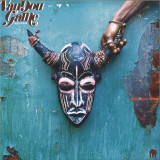
African, funky, sarcastic, bewitching, green, ecstatic: these words collide to describe Vaudou Game and all of them are true.
Noussin is the fourth album of the french Afro Funk band. Forced into lockdown, like much of the planet, Peter Solo and his Vaudou Game had no choice but to retreat into the studio. A reunion to once again invoke the spiritual forces of the Voodoo Deities. A reunion that was Initially imagined for an EP…yet these spiritual forces behind that imagination yearned for something more, and as we all know, these forces are impossible to push away once they have decided to stay.
Under the strain enforced by the current socioeconomic climate, as much as by the environmental peril that faces us all today - they diverted the course of the groove towards daring new vibrations. Without extinguishing or diminishing its highly communicative power, they released Vaudou Game from its origins of pure Afro-Funk to gradually engage into compositions which crystallized themselves into tones resembling more rock than funk.
On this fourth album, with an entirely revisited line-up, Peter Solo separates for the first time in his career from his brassy guard, leaving saxophone, trumpet and trombone outside to invite an arsenal of keyboards to define, with him, this new voodoo sound. A sound, as usual, built on vintage and precise analogical material - grime even on the white side of the tape, a blunt instrument used to blanket anything that strived to shine too much in the mix.
Graced with tapered guitars stringing out rhythmic bumps or withdrawing a few beats to indulge in infectious solos, this album is boisterously alive with vintage 70's Funk, infused with a few digressions into other ethers of the funk timeline, nicking different sounds and frequencies to render the black and white keys of an inspired keyboard to reach new euphoric levels of melodic acidity.
Tearing off the enigmatic mask to reveal his true face: on a few titles, Peter Solo ventures outside of his sacred voodoo range to reconnect with his London years, these titles feature small nods to the time he spent in “The Smoke” where the incantations of British music culture were written within him.
Noussin which means “Stay strong” in Mina, a dialect spoken in the south-west of Togo. Noussin, a message of hope as much as a call to come together to weather the turmoil and to come out better on the other side. Don’t let them grind you down…Noussin!
Cousins Gilberto and Karin Rodriguez have been steadily synthesizing a unique type of musical and cultural fusion together as Almas Fronterizas. Blending their lived experiences in Mexico City, Los Angeles and the San Francisco Bay Area with a musical lineage paying homage to their Indigenous roots, they've created a representative musical offering, a modern day psychedelic sonic painting of analog blues, rock, and brown-eyed soul.
The group's first several releases, via their own imprint Discos Pistolas y Saguaros, solidified their space in a wide encompassing and constant changing West Coast music scene, yet stood out with an experimental freedom and independent hustle that found kindred spirits in New York City record label Names You Can Trust.
Now, after a suitable time marinating together with NYCT, a natural continuation of the group's ethos is presented in the form of two new songs on 7-inch vinyl. Featuring a third cousin in Carlos Rodriguez on trumpet, plus percussive powerhouse Ahkeel Mestayer on timbales, conga and maracas, Brian Tuley on flute, Devin Hollister on bass and horn arrangements by La Doña's Cecilia Peña-Govea, the tracks were recorded in Berkeley by Mike Walti and mixed down in Brooklyn for a true coast to coast collaboration. Out in the front, Gilberto's vocals drive drop-top down, wide open and honest in melancholic blue notes, whether he's motoring down the highway over northern soul-with-a-hook A-side, "Cruel Desperation," or cruising on the avenue in the slow-motion B-side ballad burner, "Linda Morenita," it's another showcase of the tremendous range of style and engaging expression that this group can hit.
Sub Rosa presents in their Early Electronic series, the final chapter of music by Beglian key composer of early electronic experiments, André Stordeur (1941-2020). Side A features a previously unreleased, stark and poignant composition from 1979; while the B side is vibrant and almost playful of pieces from the 2000s.
André Stordeur His musical career started in 1973 with a tape composition for the soundtrack to a film on Gordon Matta-Clark titled Office Baroque. Later in the 1970s, he participated to avantgarde music ensemble Studio voor Experimentele Muziek, founded in Antwerp, Flanders, by Joris De Laet. Since 1980, Stordeur composes exclusively on Serge synthesizer, either a Serge series 79 and a Serge prototype 1980, which was especially built for him by Serge Tcherepnin himself. In 1981, Stordeur composed the music of Belgian film director Christian Mesnil's documentary Du Zaïre au Congo. He studied at IRCAM in 1981 with David Wessel and then flew to the US to study with Morton Subotnick. Stordeur became an influential sound synthesis teacher and, in 1997, completed his Art of Analog Modular Synthesis by Voltage Control,4 a guide to everything modular.
Oberheim While 'Oberheim' is the centerpiece of this LP, we pressed for the first time on vinyl three pieces from the session André called 'Synthesis Studies,' previously featuring on Complete Analog and Digital Electronic Music, 1978-2000. 'I was helped in my studies by a must-have book: The Techniques of Electronic Music, by Thomas Wells and Eric Vogel (University Stores, 1974). That book aside, I learned synthesis on my own. After a trip to India in 1968, I discovered Indian music and took tabla and sitar classes in New Delhi; my teachers were students of Chatur Lal and Ravi Shankar. Later, in the 2000s, while living in the US, I tried to recreate through synthesis all the Indian musical instruments I loved so much.' 'Drone' is one of his most spectacular works.
Die Geschichte von Sons Of Raphael ist eine, die am Rande der Mythologie und des Wahnsinns schwankt; eine kaum zu glaubende Mischung aus dem Erhabenen und dem Zufälligen. Es ist eine Geschichte von Engeln und Teufeln, davon, aus einer 250 Jahre alten Kapelle geworfen und in einer irischen Bingohalle willkommen geheißen zu werden. Wie zwei moderne Dandys am Bug eines Klipperschiffs navigiert das West-Londoner Duo durch die Irrungen und Wirrungen der Geschichte und ist nun mit seinem ersten Testament in der Hand an Land gesprungen: „Full-Throated Messianic Homage“. Ein Album, das sieben Jahre in der Mache war, aber - wie die Band selbst sagt - ’mit 2000 Jahren angesammeltem Leid darin’. Eine vierstimmige Hymne auf Leben, Tod, Sünde, Liebe und Auferstehung: Lieder für die Toten, um die Lebenden zu retten.
First-ever official re-issue of the Ecuadorian composer's stunning electroacoustic composition "Oeldorf 8" on vinyl and CD. Remastered by KASSIAN TROYER at D&M, Berlin.
MESÍAS MAIGUASHCA (b. December 24th, 1938 in Quito / Ecuador) is a composer of Neue Musik, especially electroacoustic music, who studied at the Conservatorio Nacional de Quito, at the Eastman School of Music in Rochester, NY (1958–65), with ALBERTO GINASTERA at the Instituto di Tella in Buenos Aires, at the Hochschule für Musik in Cologne and, after a short return to Ecuador, attended the Internationale Ferienkurse für Neue Musik in Darmstadt and the Fourth Cologne Courses for New Music in 1966–67 where he studied with KARLHEINZ STOCKHAUSEN. From 1968 to 1972, MAIGUASHCA worked closely with STOCKHAUSEN in the Electronic Music Studio of the Westdeutscher Rundfunk in Cologne and joined STOCKHAUSEN's ensemble for performances at the German Pavilion at the Expo '70 in Osaka. In 1971 he became a founding member of the OELDORF GROUP of composers and performers, and began work at the Centre Européen pour la Recherche Musicale in Metz, at IRCAM in Paris, and at the ZKM in Karlsruhe. From 1990 – 2004 MAIGUASHCA was Professor of Electronic Music at the Musikhochschule of Freiburg im Breisgau where he still lives today.
The OELDORF GROUP, named after the small village 40 km away from Cologne where they lived and worked in a rented farmhouse where they set up their own studio for electronic music and studio productions, was a musicians' collective active during the 1970s. In the adjacent barn, the group held concerts for audiences up to 300 people with an emphasis on live-electronic music and other kinds of new and avant-garde music. Thanks to a long-standing contact with the Westdeutscher Rundfund, the core members of the OELDORF GROUP (PETER EÖTVÖS - electronics and keyboards, the violinist/violist and composer JOACHIM KRIST, electronics specialist and composer MESÍAS MAIGUASHCA, who also played keyboards, and his wife GABY SCHUMACHER – cello) received commissions for compositions, invitations to perform in the Musik der Zeit concert series, as well as having many of their summer concerts recorded for the late-night broadcasts of WDR3.
One of these commissioned compositions is "Oeldorf 8": a retrospective portrait of the OELDORF GROUP consisting of a series of ten short pieces for four instrumentalists (clarinet, violin, cello, electric organ/synthesizer) and tape which may be played either simultaneously or continuously without a break. It premiered in 1974 at the Darmstädter Ferienkurse and was released on LP two years later and turned into a sought-after, but not very well-known rarity achieving collector's prices., and was later unofficially reissued on KEITH FULLERTON-WHITMAN's Creep Pone CDr label.
Conceived as a sonic diary with an edge to encompass radical electronic synthesis, the 48 minute composition proves " … a thing of wonder; from the outset, MAIGUASHCA's spoken introduction of the players & concept gets slowly eroded by errant, pointillist electronic sound … which then lets loose for a good 10 minutes before a swarm of slowly rising held tones c/o the players acoustic arsenal slowly comes to the fore. On the second side, the acoustic sounds - patiently, elegantly state their cases across a good half of the segment until a rising pulse-wave drone essentially annihilates the more nuanced phrasing & slowly builds to an almost ROLAND KAYN-esque climax of raw oscillator gristle" (Soundohm).
44 years after its original release, MAIGUASHCA's stunning album finally sees its deserved and overdue re-release on CD and LP, carefully remastered by KASSIAN TROYER at D&M, Berlin.
"Maiguashca … is part of the first generation of South American maverick sound explorers that in the 1960s paved the way for a tradition of innovation that persists in the present noise and psychedelic scenes of the continent. Along with Edgar Valcárcel, César Bolaños, Beatriz Ferreyra, Mauricio Kagel or José Vicente Asuar, he contributed to expand the possibilities of musical language beyond the dominant Western canon …"
David Jarrin / Kraak Festival
- 1: The Ballad Of Crowfoot
- 1: 2 Peruvian Dream (Part )
- 1: 3 Charlie
- 1: 4 Broker
- 1: 5I Pity The Country
- 1: 6C Razy Horse
- 1: 7L Ouis Riel
- 1: 8 S Hool Days
- 1: 9 Te Carver
- 1: 0O Canada!
- 1: Down By The Stream (Starlight Maiden)
- 1: 2 Rattling Along The Freight Train (To The Spirit Land)
- 1: 3 Pontiac
- 1: 4 The Pacific
- 1: 5 Nova Scotia
- 1: 6 The Dreamer
- 1: 7 Sonnet 33 And 55 / Friendship Dance
- 1: 8 Wounded Lake
- 1: 9 Métis Red River Song
- 1: 20 Son Of The Sun
- 1: 2 The Lovenant Chain
- 1: 22 Bear And Fish
- The definitive overview of one of Canada's unsung musical heroes - Rare/previously unreleased recordings, photos, and interviews - Lyrics, discography, and filmography - Audio re-mastered by John Baldwin Mastering - Artwork by Christi Belcourt and Alanna Edwards - Liner notes by Kevin Howes (Voluntary In Nature) - Contributions from the Dunn family, Bob Robb, and Alanis Obomsawin (OC) // How did you first experience the poetry, music, and film of Willie Dunn? In a Montreal coffeehouse during the mid-1960s? On a CBC Indian Magazine broadcast with host Johnny Yesno? At a Toronto record store or Native Friendship Centre at the turn of the 1970s? Waiting outside of the Mohawk Nation Longhouse? Maybe in your parent's record collection on the Rez? A White Roots of Peace gathering? Pow wow? The Mariposa Folk Festival? Or was it that Save James Bay Benefit back in '73? On a good friend's stereo? Sitting around a crackling campfire? How about an old NFB film reel or VHS tape in high school? Or while attending Manitou College? A German concert hall in the 1980s? Maybe a direct action protest on the colonial streets of Canada? Busking in Ottawa during the 1990s? College radio? At Willie's celebration of life service in 2013 alongside Alanis Obomsawin and Willy Mitchell? LITA's Grammy-nominated Native North America (Vol. 1) compilation or the very anthology you hold in your hands? There should be no judgment for coming to things when you do. All that's important is remaining open to life-changing messages such as these_ Willie Dunn shared truth through song and celluloid. His original composition, "I Pity the Country," is an unparalleled statement on the greed and hate created by humankind, recorded in 1971 and still unfortunately needed today. "It's like the reason you're supposed to make music," said Kurt Vile about the song to MOJO Magazine in 2015. With "Charlie," Willie was the first to deliver the devastating story of Chanie Wenjack and the Canadian residential school system to the music community, nearly 50 years before the much-celebrated Secret Path, yet ignored outside of Indian Country and the folk festival circuit. Dunn's film technique, featured in 1968's The Ballad of Crowfoot (NFB), predates the "Ken Burns effect" to great effect. Are you catching the drift? Willie Dunn was not only a trailblazing leader in his time, but well ahead of the curve, simply without the PR push and big money backing of major label players. "He was our Leonard Cohen," said singer-songwriter Eric Landry about his musical hero. The only difference is that Willie refused to play the Hollywood showbiz game. In talent, he is Cohen, Dylan, and Cash rolled into one and along with Buffy Sainte-Marie, Floyd Red Crow Westerman, and A. Paul Ortega, brought a new set of perspectives and realities to the folk music tradition. Willie spoke directly to his people and Mother Earth through his creations, not only from experience but by examining his roots and connecting with the world in which he lived. We are humbled to help honor Willie Dunn. May he never be forgotten_ PEACE
Heady power pop trio Portable Radio announce the release of their debut eponymous LP on March 12th 2021 on Crimson Crow Records. Lead track and first single Hot Toddy, out in February, introduces the album with its ethereal brooding pop arrangement.
Some years ago, the world started to go weird – and that’s when the then duo, Portable Radio, decided it was as good a time as any, to start making first steps.
Phil … and Mof … shared some messages and a love of melodies, and as a gift to friends and those feeling the weight of everything, recorded a version of Brian Wilson’s gorgeous opus, ‘Love & Mercy’. The result was enough for them to start writing songs, and the blueprint for Portable Radio was born – hope, empathy, fun, love, and mercy.
Phil had cut his teeth in the Beep Seals and Mof was a DJ and student of pop, and in each other they both wanted to make music that was a tonic for the times; what transpired was a clutch of songs that were filled with uplifting, rich harmonies – stirring power pop inspired by Todd Rundgren, Wings, Carole King, Electric Light Orchestra, NRBQ, Emitt Rhodes, ‘70s West Coast AOR, The Zombies, and of course, The Beach Boys.
The duo released their Baroque Pop debut single with You Are The Cosmos recordings – the double A-Side of ‘Seven Hills’ and ‘Parades’. A cult following started and some shows and radio sessions ensued, joined by extended family – tap room-Mozart Jim Noir, shed-pop wizard Aidan Smith, and Phil’s previous bandmate, the supremely talented Ian Smith (Beep Seals/Alfie).
Soon, Robyn Gibson (The Junipers/Bob Of The Pops) joined the ranks for their star turn and appearance on the ‘12 String High’ compilation. The two becoming a trio, the output cranked up, seeing the release of the debut Portable Radio EP (produced by Jim Noir) and the Christmas Selection Box, all loaded with killer hooks, washes of dreamy harmonies, and just a sprinkling of cynicism because no-one is impervious to the all-encompassing weirdness of the last couple of years.
All of these things were the groundwork for the imminent full-length, self-titled debut, out in March 2021. The LP (vinyl/download/streaming) is full to bursting with big choruses, reflective popsike, FM ready pop, melancholic ballads, with each song is treated like it’s going to be a single.
Legendary pedal steel player Susan Alcorn presents her music as curated and arranged by cellist and composer Janel Leppin. This recording is from a live performance from her residency at Issue Project Room in July 2012. Leppin’s arrangements and curation emotes the brilliance, transparency and resonance of the pedal steel guitar. Through this ensemble, the mastery of Susan Alcorn's compositions shine.
Susan Alcorn has taken the pedal steel guitar far beyond its traditional role in country music. Having first paid her dues in Texas country & western bands, she began to expand the vocabulary of her instrument through her study of 20th century classical music, visionary jazz, and world musics. Struck by the music of Messiaen she began transcribing classical music from recordings and scores on her instrument. Soon, she began to combine the techniques of country-western pedal steel with her own extended techniques to form a personal style influenced by free jazz, avant-garde classical music, Indian ragas, Indigenous traditions, and various folk musics of the world. By the early 1990s her music began to show an influence of the holistic and feminist “deep listening” philosophies of Pauline Oliveros. As her records gained a cult following she moved to Baltimore, MD. She performs internationally and is a key figure in the free improv scene in the US.
Janel Leppin is a core member of the Washington, D.C. experimental, jazz, punk and improvisational scenes and is a celebrated visual artist as a weaver. DownBeat Magazine describes her as “An absolute virtuoso”, NPR Music says “instrumental intimacy swept up in arrangements that cluster around her voice, as delicate and as imposing as a sheet of falling ice.”. Janel leads and writes for her free jazz sextet, Ensemble Volcanic Ash “a rarity..ahhh-vant garde at it’s finest." -Capital Bop. Leppin and Alcorn also recorded the composition “Thick Tarragon” by Eyvind Kang from the album Visible Breath on Ideologic Organ. Leppin appears as a string arranger on many recordings on labels from Dischord Records to Sacred Bones.
For Another Michael, it all boils down to trust. In mid-2017, the critically acclaimed indie three-piece packed their bags and collectively relocated from Albany, NY to a shared house in West Philadelphia. This move signaled not only the start of a new chapter for the trio, but also a deepening of the bonds that would come to define their captivating debut LP, `New Music and Big Pop.' "It's hard for a group of people to get closer than living together," says bassist and producer Nick Sebastiano. "The stronger our connection grew, the more it shaped the music we found ourselves making." It should come as little surprise, then, that `New Music and Big Pop' is Another Michael's most collaborative work yet. Recorded in a small A-frame house-turned-makeshift studio outside Ferndale, NY, the record finds the trio pushing their sound in a dreamier, more folk-influenced direction, building songs around vulnerable, intimate performances using an ethereal palette of breezy guitars, subtle keyboards, and layered harmonies. As on the band's early EPs, singer and songwriter Michael Doherty's mesmerizing voice is front and center here, calling to mind Robin Pecknold or Ben Bridwell in its reedy, crystalline timbre, but it feels more at home than ever before amidst the album's lush, Technicolor landscape, which the band partnered with producer and fellow housemate Scoops Dardaris to create. The result is a masterfully understated record that belies its status as a full-length debut, a thoughtful, poetic, collection all about growth and change, hope and faith, endings and beginnings, delivered by a band that's only just begun to scratch the surface of their story.
With 2017’s ‘Planetary Prince’, pianist/composer Cameron Graves established himself as a visionary creative force emerging from the Los Angeles genre-defying collective The West Coast Get Down.
With his sophomore album ‘Seven’, Graves further expands on his otherworldly inspirations, alongside guitarist Colin Cook, bassist Max Gerl, drummer Mike Mitchell and special guest Kamasi Washington.
Upon an initial listen, the juggernaut metal force and hardcore precision of ‘Seven’ can knock you back. After all, Graves grew up in metal-rich Los Angeles, headbanging to Living Colour as a kid and, after immersing himself in jazz and classical studies for years, he reignited his love for hard rock through records by Pantera, Slipknot and his most profound metal influence, Swedish titans Meshuggah.
But a closer listen to ‘Seven’ reveals a myriad of other influences at work. “Los Angeles is a melting pot of everything,” Graves points out. His father, Carl Graves, was a great soul singer, and you can hear his imprint along with the likes of Marvin Gaye and Otis Redding, on “Eternal Paradise,” which marks the younger Graves’ vocal debut.
Throughout the album, the generation of 1970s jazz-rock fusion pioneers is a source of inspiration. “Our mission is to continue that legacy of advanced music that was started by bands like Mahavishnu Orchestra, Weather Report and Return to Forever,” Graves says. “That was instilled in us by the masters. Stanley Clarke, Chick Corea, Herbie Hancock - these guys sat with us and told us, ‘Look, man, you’ve got to carry this on.’
“Cameron Graves is a musical genius. He has an innovative approach to the piano that is completely unique.” - Kamasi Washington
“In all aspects of his being, Graves embodies intense seeking and absurd skill.”
- LA Weekly
You could think of the collection of tracks here as a library record of sorts, and each track inhabits its own universe. Tropical fits various moods and situations, and it could soundtrack any number of activities at home or on a dancefloor - whether real, imaginary, or hallucinated. Strangely enough, it sounds like it could have been constructed from obscure Italian library breaks, when instead every instrument has been played and panned, several times over, across magnetic tape.
The genesis of many of these tracks began when CV Vision moved to Berlin in 2014. His flat had a small chamber where he could fit a drum set, so he treated the walls with foam, and in true DIY style, dived headfirst into recording these tracks. It was the natural next step on an audio adventure that first began when CV Vision picked up the guitar in his teens, and a couple years later started recording with friends in his home town of Bayreuth. Fast forward ten years and here is his debut - a culmination of practising chops and learning instruments, mastering recording techniques and fine-tuning the CV Vision sound.
It’s a sound that condenses elements of acid rock, psych soul, library funk and new wave oddities into a movie soundtrack for your mind. It’s a journey from ‘60s west coast LSD-drenched excursions to ‘80s synth and post-punk mutations. Tropical is a plunge into another time, another music you can simply swim around in and explore.
Side A opens up with Tropical Tune In, which rides in on a clave and a warm wind, blowing a distinctly herbal aroma and recalling exotica dons like Les Baxter and Martin Denny. Following on with the aural equivalent of a sea breeze through your mind, Spaziergang am Meer blows away the cobwebs and conjures some nice library moments like Stringtronics or F eelings . Next, Ba_c_k(Lava) bounces out of a cold wave post-punk melting pot and crashes through the speakers like a blazed Zebedee, with some sweet eastern synths for added flavour, before the rolling bass licks of Der Böse Schamane take us into another dimension, landing somewhere between a psych rock freak out and a Black Ark dub session. Mr Maze channels the arpeggiators of synth outsiders like Mort Garson and Bruce Haack, creating a glorious interlock of robotic electronics and freakbeat vocals. The side comes to a close with the guitars of Der Strand (außer Rand und Band) letting loose like syrupy springs, and setting a languid mood like the bedroom scene in Bedazzled (1967 version). Side B kicks off with Parallel Universum, which comes through like a woozy krautrock workout, all ducking synths with big chord shifts to create an epic deranged beehive of a soundtrack. Im Land der Ameisen evokes the spirit if not the sound of White Rabbit, when logic and proportion have fallen sloppy dead, before waking up and wandering through the side alleys of Marrakech with the West Coast Pop Art Ensemble and the Electric Prunes, as Ritual (No. 4) blares out the speakers of passing tuk tuks. Ein Wasserfall plumbs the deep synth depths, like Raymond Scott in scuba gear, modular rack strapped to his back delivering oxygen as he swims between connector cables and seaweed forests through a watery underworld. Banana King sounds like a lost soundtrack to Donkey Kong or Mario Cart, if the cart radio was tuned into a synth
documentary hosted by James Pants, while Das Kloster am Berg takes the baton from Brenda Ray and her Naffi cohorts, all dubbed-out niceness and post punk swagger. The LP closes out with Tropical Drop Out, a dreamscape rather than a wake up call, coaxing you deeper into the trek across the desert of your mind.
And that’s Tropical in its essence: capsules from another time, snapshots of another sound, messages from another mind - all in the service of inducing the visions in your head.
written by Max Cole
- A1: Palia Itia (Old Willow Tree)
- A2: Echasa Ton Anthropo Mou (I Lost My Loved One)
- A3: Ta Goumara Ki Apidia (Berries And Pears)
- A4: I Efchi Tou Xenitemenou (Immigrant’s Wish)
- A5: Dirminitsa (The Bride’s Dance)
- B1: Miroloi Tis Xenitias (Lament For The Missing Ones)
- B2: Argyrokastritikos Choros Syngathistos (Argyrokast-Ron Dance)
- B3: Pitsirika Katergara (Femme Fatale)
- B4: Gi Ayta Ta Erima Lefta (For The Sake Of The Dam-Ned Money)
- B5: Delvino Kai Tsamouria (Delvino And Tsamouria)
(LP + 12 page booklet) This ancient psychedelic folk with jazzy improvisations from the North West of Greece is unique and will touch your soul so deeply that epirotika aficionados always remember the place and the moment when they got to know this hypnotic and mes-merising music. In a similar way to the music of Alice Coltrane or Mulatu Astatke, it can take you out of the here and now - the pure beauty of the magical epirotika sound can make your mind drift off to otherworldly places.
Blue Vinyl
Hailing from Wolverhampton, Weeping Messerschmitts gave us one absolutely cracking 12”, released on Upright in 1986 and then disappeared . Previously only available on 12” only we bring you 2 of those tracks on 7” for the very first time
Coming out of the West Midlands Weeping Messerschmitts cut their teeth supporting schoolfriends The Mighty Lemon Drops.
Initially called The Railway Children (until another band from Manchester nicked the name and pressure from lawyers at Virgin Records forced a change.) and briefly managed by Gerry Cott of The Boomtown Rats (until a disagreement about the bands direction, forced him to quit) the Messerschmitts gigged constantly all over the UK, creating quite a buzz, building a following and gaining favourable reviews from the music press.
It was no surprise that they were soon offered contracts with 3 major labels before choosing to take the indie route with Upright Records. For whom they recorded one of the greatest lost indie records of the 80’s. Unfortunately, this was to be their only release before splitting in 87
- A1: Willie West & Cold Diamond & Mink - Give It Back
- B1: Cold Diamond & Mink - Let's Get Together (Instrumental)
- C1: Cold Diamond & Mink - Give It Back (Instrumental)
- D1: Emilia Sisco & Cold Diamond & Mink - Don't Believe You Like That
- E1: Cold Diamond & Mink - Don't Believe You Like That (Instrumental)
- F1: Carlton Jumel Smith & Cold Diamond & Mink - I Can't Love You Anymore Feat Pratt
- G1: Cold Diamond & Mink - I Can't Love You Anymore (Instrumental)
- H1: Ernie Hawks & The Soul Investigators - The Scorpio Walk (Instrumental)
- I1: Ernie Hawks & The Soul Investigators - Message Of Love (Instrumental)
- J1: Jonny Benavidez & Cold Diamond & Mink - Let's Get Together
Here comes another bundle of Timmion soul to decorate your record shelf and grace your turntables. It's a fantastic opportunity to sink yourself into Pratt & Moody's second release, the crossover gem "Words Words Words", the equally sublime rolita by Thee Baby Cuffs "My My My Baby" or continue your soulful trip with Willie West's latest deep offering "I Can't Leave You Alone".
In case you didn't yet get your hands on Carlton Jumel Smith's beautiful dancer "This Is What Love Looks Like", it's naturally included in this box of joy, as is jazz funker Ernie Hawk's non-album blaxploitation tinged track "Tracking Down", which can only be found as the b-side of "Cold Turkey Time" single release. Buy now and you'll be unboxing in no time.
The Vision returns with the third single from their eponymous debut album, along with remixes from two of the scene’s most revered producers. ‘Missing’ treads the familiar tale of love lost with a stark openness, a funk-filled track underpinned by a catchy vocal hook sure to resonate with its listeners. As one half of The Vision, this release is the first where Ben Westbeech provides vocals as well as producing behind the scenes alongside Kon, perfectly matched with regular collaborator Andreya Triana to bring the heartfelt lyrics to life. On this special 12” package, underground hero Maurice Fulton’s remix opens the A-Side, an artist described by Resident Advisor as “making some of the most unhinged house out there”, his mix may strike listeners as surprising with its stripped-back feel. With extended instrumental breaks perfect for club play, the reflective feel of Maurice’s mix aptly suits the message of the record, as elegant guitar riffs and warm synths make his remix an irresistible version. The Accapella closes out the A-Side, an essential DJ tool that allows Andreya and Ben’s flawless vocals to really shine. On the flip, the original version of ‘Missing’ opens, before Swiss DJ Deetron provides his remix, impeccably executed with bubbling synths and snapping percussion, as the Character Records boss explores the emotional potential of dancefloor-destined house to compelling effect. ‘Missing’ is no exception to The Vison’s existing discography, as meaningful messaging is paired with flawless execution to produce a record with all the makings of a future classic.
After his acclaimed debut EP « Cotonou » on Alma Negra’s record label, James Stewart comes back with his new EP Atlantic River Drive for Mawimbi Records, featuring two collaborations with Ghanaian kologo musician Ayuune Sule as well as two remixes from Simbad aka SMBD.
James Stewart met Ghanaian kologo musician Ayuune Sule, after booking several shows of kologo music star King Ayisoba in Lyon. Stewart was quick to witness the bluesy tone of Ayuune’s voice and his kindness as a musician, despite his impressive stature. Quite logically, Stewart invited Sule to record vocals on two of his ongoing demos at Bruno Patchworks’ recording studio (Voilaaa, Mr. President, Da Break), with the idea of making a rather unheard crossover between traditional kologo music and contemporary styles that would both appeal to Ghanaian crowds and a Western audience. Stewart then had a number of his arrangement ideas re-recorded by a talented cast of musicians, resulting in a brilliant mix of acoustic and electronic textures, sounding both vintage and modern.
Nodding to Eddie Palmieri’s landmark record “Harlem River Drive”, “Atlantic River Drive” is a stomping dancefloor track, drawing from the 6/8 feel of kologo music and the energy of contemporary club music. The track can be read as a tribute to the musical cross-pollinations between the African continent and its many diasporas, which Stewart has dedicated a long part of his life to, but also as a more intimate story about his life and family. All words were written by Stewart and then translated by Sule in his native Fra fra language from Northern Ghana.
“Where Are We Going?” is a two-part journey that reminds us that we should care about each other, about our communities while we don’t know what the future is made of. An important and much welcome message to navigate through these troubled, uncertain times. Referencing congolese N’dombolo tracks, the track has two parts and rich arrangements, with its first part going deep with syncopated clarinet hooks and playful percussion parts, and its second part moving to a four-on-the-floor pattern and an entrancing baritone saxophone solo.
The EP also features Worldwide FM and Brownswood maestro Simbad, who delivers two dancefloor-ready reworks of the track “Where Are We Going?” under his SMBD moniker, turning it into a spiritual, dubby journey, as well as an emotional house music track.
- A1: Negus Introduction
- A2: Creole Brothers
- A3: Feel That Today
- A4: Patterns Of The Maroons
- A5: We Keep It Up
- B1: This Kind Of Music
- B2: Sega Move
- B3: Mama Ode (Interlude)
- B4: That S Game
- B5: My Brother (Ti-Ton Lament) (Ti-Ton Lament)
- B6: My Brother
- C1: Don't Preach
- C2: All Of That
- C3: Going Right
- C4: Typik Morisien
- D1: Wadada Lasts
- D2: Creole Soul Clap
- D3: Descendants (Interlude)
- D4: Mele Mele Colonial
- D5: Tales Of The Maroons
Brothers Reginald Omas Mamode IV and Jeen Bassa come together as Mama Odé on full length album 'Tales And Patterns Of The Maroons'. At its core this is a classic "hip hop" format LP - but have you ever heard Creole Sega Rap Roots music before? Of Creole descent from a group of African islands that transiently have hosted many settlers, west African slaves, colonialists and the potentially indigenous East African-Malagache Maroons; the brothers have an inherent spirit of diversity that runs through their recordings. Musical influences consist of jazz, funk, blues and reggae to un-placeable but definite Afro-drum patterns, through to their Golden-Era-Rap vocal flows, which have a sure nod to ATCQ and Slum Village. The album's deep grooves overwhelmingly seed optimism, subscribing to a positive future drawn from historically multi-ethnic ancestral lines. The brothers' natural vocals carry messages of unity, love and well being as well as a conscious questioning of humanity's ill practices and ideas.
West coast composer, artist, and producer Kaitlyn Aurelia Smith has chartered a pioneering career with multiple critically-acclaimed albums since 2015. Following the release of The Kid in 2017, Smith focused her energy in several directions. She founded Touchtheplants, a multidisciplinary creative environment for projects including the first volumes in her instrumental Electronic Series and pocket-sized poetry books on the practice of listening within. She's continued to explore the endless possibilities of electronic instruments as well as the shapes, movements, and expressions found in the physical body's relationship to sound and color. It is this life-guiding interest that forms the foundational frequencies of her most recent full-length, The Mosaic of Transformation, a bright, sensorial glide through unbound wave phenomena and the radiant power discovered within oneself. "I guess in one sentence, this album is my expression of love and appreciation for electricity," says Smith. While writing and recording, she embraced a daily practice of physical movement, passing electricity through her body and into motion, in ways reflecting her audio practice, which sends currents through modular synthesizers and into the air through speakers. Not a dancer by any traditional definition, she taught herself improvisatory movement realizing flexibility, strength, and unexpectedly, a "visual language" stemming from the human body and comprised of vibrational shapes. Understood as cymatics, as Smith says, "as a reference for how frequencies can be visualized," much like a mosaic. Smith describes her first encounters with this mosaic; "the inspiration came to me in a sudden bubble of joy. It was accompanied by a multitude of shapes that were moving seamlessly from one into the other...My movement practice has been a constant transformation piece by piece. I made this album in the same way. Every day I would transform what I did yesterday...into something else. This album has gone through about 12 different versions of itself." As it has arrived, in a completed state, The Mosaic of Transformation is a holistic manifestation of embodied motions. Smith's signature textural curiosity that fans have grown to adore pivots naturally into a proprioceptive study of melody and timbre. Airy organ and voice interweave with burbling Buchla-spawned harmonic bubbles. "The Steady Heart" quivers to life, peppering blasts of wooden organ between winding vocal affirmations. As with a body, moving one portion requires a balance and counterbalance; here, subtle tonal twitchy signals fire in conjunction with coiling arias to create a mesmeric core. When the beat arrives at the midway mark, a swooping and jittery waltz, a sense of stasis in motion, a flow state, is sonically achieved. As soon as it syncs, it disappears back into the swirling ebbs of electric force. Other tracks stray into more ruminative physical realms. "Carrying Gravity" is built around string-like pads that expand and contract like a solar plexus, becoming taught and then loose. If the record could be summarized in a single movement, it is the 10-minute closing suite, a rapturous collage called "Expanding Electricity." Symphonic phrases establish the piece before washes of glittering electric peals and synthesized vibraphone helix into focus. Soon, Smith's voice grounds it all with an intuitive vocal hook, harmonized and augmented by concentric spirals of harp-and-horn-like sounds. Smith's music doesn't capture a specific emotion as much as it captures the joys of possessing a body, and the ability to, with devotion and a steady open heart, maneuver that vessel in space by way of electricity to euphoric degrees.