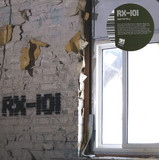
RX-101 has quietly been making waves in the IDM/electronic music underground for the past few years, through a series of archival releases — material recorded in the late-90s, but previously unreleased until Suction Records began compiling and releasing these records in 2016. What’s truly mind-boggling about RX-101’s output is the sheer quantity of stunning, top-drawer material that Dutch producer Erik Jong recorded over the period of just 3 years, 1997-1999. Many have suggested that the whole thing is a publicity stunt — some insisting that this is all new material masquerading as vintage, while others have proposed that the material may in fact be a secret alias for Aphex Twin to release gems from his own legendary ’90s audio archive. RX-101 has absolutely nailed the sound, and quality, of early-90s AFX/Rephlex, that much is true. “Serenity,” this latest full-length RX-101 release, is no exception.
Just as RX-101’s last album, 2019’s Dopamine, concentrated on one hallmark of Aphex Twin’s sound — the smooth melodic techno of his Selected Ambient Works 1985-1992 LP — so too does Serenity reference another classic early-Aphex era, but this time it’s a completely different beast. Don't let the title fool you - Suction Records' latest dive into RX-101's 1997-1999 tape archives is not all lush, serene melodies. On Serenity, scorched, crunchy jackhammer beats combine with emotional, plaintive pads, delivering a classic set of vintage-Rephlex-style bliss, à la AFX, Caustic Window, and Cylob. It was Cylob who coined the term Industrial Folk Songs for his classic 1995 LP, and that release is clearly a blueprint for RX-101’s latest collection.
Standout cut Hearts Utd., featuring a stunning music video by Aidan Fantinatto and I Dream Of Wires’ director Robert Fantinatto, not only nails the magic of AFX’s trademark, irresistible jackhammer-beats-meets-plaintive-melody device, it arguably rivals the master at his own sound. As a whole, what could be a harsh and monotonous collection is lifted by RX-101’s subtle diversity and skill, particularly in his ability to create eerie, evocative moods, with gorgeous melodies that speak volumes of emotion.
Search:what! what! records
The Death To Digital series comes to a (perhaps temporary) end with volume 5. And what a way to end, with four slamming tracks that maintain the original concept of diversity in style while staying true to the Kniteforce ethos of, well diversity and style!”. Sunny & Deck Hussy drop a traditional styles beakbeat piano anthem, while Shadowplay brings something that is not quite everything. Abyss shocks us all by making something a little happier than usual while retaining the heaviest of beats and bass, and Idealz brings a rolling, thoughtful d’n’b tinges lick to close the series. Big stuff.
Club / DJ Support
Billy Bunter, the Fat Controller, Glowkid, Slipmatt, Dj Jedi, Dj Luna-C, Dj Brisk, Clayfighter, Jimni Cricket, Bustin, Sc@r, Doughboy, Saiyan, Dave Skywalker, Ponder and many others
At home, in the islands of Cabo Verde, there was grog, or grogu, a strong sugarcane moonshine not dissimilar to Colombian aguardiente, copiously consumed at Funaná parties. In the diaspora, in Europe, there was leite quente (hot milk). "I can still remember the taste of the first leite quente I drank in Lisbon," says Antonino Furtado Gomes, Pilon's drummer and current band leader.
Synthesize the Soul, Ostinato Records' second compilation, revealed chapter one of the Cabo Verde cultural story in Europe, zooming in on visionaries like Paulino Vieira who made Lisbon the headquarters spearheading the musical revolution taking place within Cape Verdean emigre communities across Europe in the 1980's. Musicians from across the diaspora would eagerly travel to the Portuguese capital to record.
Grupo Pilon represents the second chapter of the Krioulu diaspora story. In smaller pockets, second generation musicians were independently contributing to one of the most lush periods of cultural innovation by immigrants in Europe. In Luxembourg, in 1986, a group of teenagers formed the largely unknown (outside of Cape Verdean circles) but consistently brilliant band named after the blunt instrument used in the islands to pound corn for Cabo Verde's national dish, cachupa.
With only five members, Pilon combined searing estilo Krioulu drumming and the hybrid ColaZouk style with blissful synth work and rugged guitar licks, creating a stripped-down, addictive sound that masterfully straddled two worlds, a seductive electro-Funaná carnival born from the first few sips of hot milk.
The band drew from the inspiring political changes of the day: the release of Nelson Mandela in South Africa and the fall of the Berlin Wall. The right to democracy became a constant theme in Pilon's songs.
With access to better opportunities than their parents' generation, Pilon's roster were part time musicians. Music was not part of their academic upbringing nor a full-time gig. Their rhythm and style were wonderfully imperfect, made out of rawer skills and inexperience. Pilon did not follow the templates established by revered Cabo Verde bands. Keyboard player Emilio Borges played off beat and the band preferred arranging their songs to start from the beat normally heard in the middle of a composition rather than the beginning.
These two elements made Pilon's music simple, unique, and inimitable. From 1997-2015, a lack of concerts and professional musicians proved near fatal. Today, Antonino and what remain of the original quintet are slowly piecing back together the puzzle of their once mighty outfit from an unlikely pocket of Europe. In it's heyday in the 90's, Pilon serenaded audiences in Paris, Lyon, Marseille, Lisbon, Rotterdam and Frankfurt, securing their reputation as a respected and unifying cultural force.
This LP, drawing from the six most powerful songs from Pilon's three-album catalog, is the serving of still fresh leite quente to spice the summer and maybe even fuel the next generation of musicians in the Krioulu corners of Europe.
Repress.
stunning second 12" single on his new label´is finally coming folks. what a name for this pretty incredible 2 tracker!! "Return of the Zombie Bikers" is a massive spine shiveringly intense almost dnb b lined big room track recorded in early 2005 and can easily be compared to Mat´s strongest moments including "decompression" on minus. Don't get us wrong though, this track doesn´t necessarily need the comparison,it easily stands out by far.let it work on and let it touch you, we feel it´s probably one of the strongest records MJ ever did!! "Put your booty shorts on" is yet another a side track written in 2002 dedicated to his wife Frank and remixed with including a vocal in 2005. A unique taste of what is to come in future live sets at the festivals this summer.this is the "hi end" in micro house coming.
Here it is! Our debut release. This is just the start of our journey and sculptured on to this record is what you can expect to hear from our releases. The VA is a perfect collaboration of artists with each track complementing the next and capturing the Sub:Conscious ethos through the medium of groovy dubby sounds.
After his debut on Wilson Records with his first LP, Sanso is back with another record which has been inspired by the US scene of Detroit and Chicago. If you like Theo Parrish, Kyle Hall, Jay Daniel and you are fan of early Dance Mania Records this is definitely something for you.
- A1: Adam E Eve (Feat Patrick Tulippe)
- A2: Ansanm Pou Demen (Feat Henri Louis)
- A3: Konsyans (Feat Patrick Tulippe)
- B1: Elwa (Feat William Casse)
- B2: Yenki Sa An Pa Enme (Feat Leonard Zozio)
- B3: Kan La Line Leve (Feat Francois Dinane)
- C1: La Gwadloupeyen (Feat Thierry Dernault)
- C2: Latilye Valo (Feat William Casse)
- C3: Lekiri A Misie O (Feat Francois Dinane)
- D1: O La Ou Te Ye (Feat Francois Dinane)
- D2: O Moman Lesclavaj (Feat Patrick Tulippe)
- D3: Yo Pe Ke Jen Chanje (Feat Patrick Tulippe)
Soul Jazz Records continues its journey into the world of Afro-Caribbean roots music with this album of newly recorded music of Gwo Ka music recorded and produced by Soul Jazz Records on the island of Guadeloupe, French West Indies.
Gwo Ka music is a fantastic fusion of African-derived musical form ( call and response), with vocal styles that draw upon the equally powerful French chanson singers to create a truly unique combination.
Tradition Ka, made up of some of the island’s finest singers and master drummers, is part of a powerful network of politicised Gwo Ka groups on the island – upholding the traditions and cultural importance of Gwo Ka as part of a larger process of defining the identity of Guadeloupe and its culture.
This album is newly studio recorded in Pointe-A-Pitre, Guadeloupe by Soul Jazz Records. Like the cult music of Haiti’s Vodou and Cuba’s Santeria or the roots music of Belize’s Garifuna (all of which Soul Jazz have also released), Gwo Ka is the musical and cultural product of the region’s African ancestry, forcibly brought to the Caribbean through slavery.
Gwo Ka exists only in Guadeloupe, a very different island from much of the Caribbean, in that it remains a ‘department’ of its original colonial master, France. Here, the currency is the Euro and the baker sells croissant and café au lait.
This constant ‘European-ising’ of the island means that Gwo Ka plays a fundamental and important role in the defining of Guadeloupean identity. As an African-derived music, its position as a counter-balance to French influence means that the definition of how and what Gwo Ka represents is also in a constant state of flux.
These new recordings show how Gwo Ka is both a modern Caribbean music form and one firmly rooted in ancestral history.
Over the last 20 years Soul Jazz Records have been documenting and presenting the often hidden histories and deep musical worlds of Cuba, Haiti, Jamaica, Belize, Trinidad, the Bahamas and more. This documentation encompasses reissuing lost recordings, such as the mighty Studio One catalogue of reggae, producing films/dvds (such as the 3-hour documentary Mirror To The Soul in conjunction with British Pathé, and Dub Echoes), books (check the forthcoming photography book on the Caribbean 90 Degrees of Shade, with text by Paul Gilroy, and Kanaval) as well as travelling to the region to produce new recordings.
Established in 2017 as a spin off of Cannonball Records, to focus only on contemporary soul artists. Many talented singers and characters out there just missing a career developement platform. We aim to provide them with what they need, produce and release their music bringing it to the international dancefloor.
This 7" , pressed on Crystal-Gold Coloured Vinyl, limited to 300 Copies and usual works from the belonging, forthcoming album out March ‘20 on DGT, CD and LP.
- A1: The Explosions - Hip Drop
- A2: Aaron Neville - Hercules
- A3: Bo Dollis & The Wild Magnolia Mardi Gras Indian Band - Handa Wanda
- A4: The Meters - Handclapping Song
- B1: Eddie Bo - Check Your Bucket
- B2: Professor Longhair - Big Chief
- B3: Cyril Nevilille - Tell Me What's On Your Mind
- B4: Lee Dorsey And Betty Harris - Love Lots Of Lovin
- C1: Mary Jane Hooper - I've Got Reasons
- C2: Lee Dorsey - Who's Gonna Help Brother Get Further
- C3: Huey Piano Smith & His Clowns - Free Single And Disengaged
- C4: Eddie Bo - Hook'n'sling (Pt Ii)
- D1: The Gaturs - Gator Bait
- D2: Danny White - Natural Soul Brother
- D3: Ernie K Doe - Here Come The Girls
- D4: Dr John - Mama Roux
- E1: Allen Toussaint - Get Out Of My Life Woman
- E2: The Explosions - Garden Of Four Trees
- E3: Robert Parker - Hip-Huggin
- E4: Chuck Carbo - Can I Be Your Squeeze
- F1: Gentleman June Gardner - It's Gonna Rain
- F2: Marilyn Barbarin - Reborn
- F3: The Meters - Just Kissed My Baby
- F4: Sonny Jones - Sissy Walk (Pt Ii)
Album features Ernie K Doe’s ‘Here Come The Girls’, The Meters, Eddie Bo, Professor Longhair, Lee Dorsey, Wild Magnolias and more.
This is the definitive collection of New Orleans Funk featuring acknowledged masters next to some of the earlier artists who shaped the meaning of funk. The album is also filled with many rare, sought after and undiscovered funk tracks. It covers the period from the emergence of New Orleans Funk in the early 1960's through to the mid-seventies.
The record is an essential part of anyone in any way interested in Funk's record collection. It has some vital ingredients in it that you can't find elsewhere. With the sound of the New Orleans Funeral March Bands, Mardi Gras Indian Tribes and Saturday Night Fish Fries all as inspiration New Orleans Funk developed into a unique sound.
New Orleans is a port town. Originally owned by the French, this was where many slaves were brought from the West Indies. Many of these slaves came from Haiti and brought with them the religion of Voodoo and its drums and music. It became one of the first parts of America to develop a strong African-American culture leading to the invention of Jazz in the early 1900's.
A main feature of Jazz in New Orleans were the Jazz Funeral Marching bands. Solemn Brass bands accompanying a coffin would, on burial, be joined by a second line of drummers and dancers which would turn the event into a celebration of the spirit cutting free from earth. This African tradition is strong in New Orleans and still goes on to this day. The backline drums play a syncopated style that is neither on the beat nor the off-beat. It is these rhythms that are the basis of New Orleans Funk.
The album comes with a booklet presenting a historical explanation to how and why this music came about, and with lots of information about the people involved.
Reviews: "A Perfect Primer For Funk Fans" Q (Top 5 albums of the year). "Probably the finest compilation that Soul Jazz has released. Essential" Time Out.
- A1: Four Below Zero - Esp
- A2: Florence Miller - The Groove I'm In
- A3: Personal Touch - It Ain't No Big Thing
- A4: Jesse Gould - Out Of Work
- B1: Wild Honey - I've Been Working
- B2: Smokie Brook - Long Time Ago
- B3: Sentimental Souls - It's Party Time With Getting In The Groove
- B4: Eddie Owen - Determination
- B5: Hooker - Hooker (Part 1)
- C1: Dennis Mobley - Superstition
- C2: Magnetic Touch - Ain't Gonna Be A Next Time
- C3: Ella Hamilton & Don Willis Spoon Band - I'm Gonna Fool You!
- C4: Eddie Owen - Shake Off That Dream
- D1: Sons Of Darkness - What It Look Like
- D2: Flame & The Sons Of Darkness - Solid Funk
- D3: King David - Hitch Hike One More Time
- D4: Henry Brooks - Mini Skirt
- D5: Otis & The King Pins - Funky Donkey
Peter Brown is one of the ultimate in Harlem underground music business entrepreneurs. From the 70's, all through the 80's he had a stream of releases on a plethora of labels, but ultimately under the
P&P banner. From soul, to disco to the birth of hip hop, he covered all the street sounds of New York and in a series of comps Demon are exploring his legacy. P&P soul and funk covers the 1970's with a number of rare, sought after masterpieces and some
equally essential obscurities.
From the former category we have the magnificent ESP by Four
Below Zero, Dennis Mobley's Rare Groove instrumental version of Superstition and Florence Miller's soul floor filler 'The Groove I'm In' Super rare funk is present from Wild Honey, Smokey Brooks and Flame & The Sons. The roots of disco is well represented with Magnetic Touch's original version of Ain't No Big Thing and Ella Hamilton's I'm Gonna Fool You.
Producer duo Hudson Mohawke and Lunice stare at the moon for too long, get abducted and return just in time to deliver their second EP ‘II’. Following the release of the mysterious ‘Serpent’, a lunar chart that was decrypted by fans in minutes and a dangerous Radio 1 Essential Mix, TNGHT’s crescent moon is appearing once again from behind heavy clouds. It has been seven years since Hudson Mohawke (Ross Birchard) and Lunice’s (Lunice Fermin Pierre II) prodigious debut which accidentally changed the sound of the pop music caught in its wake. The pair of bedroom-producers-cum-superproducers hail from Glasgow and Montreal and have aligned once again on a record which aims to chew up and spit out every influence across a single 12”.
Repress
Be With Records present the hugely anticipated first ever vinyl release of r'n'b star Cassie's seductive debut. A late-night classic of chilly electro-soul, the self-titled album has influenced many in the dance music fraternity since its original CD-only appearance back in 2006. Particularly revered by Jamie xx, Four Tet, Hot Chip and Tri Angle Records, the r'n'b cognoscenti went into overdrive when rumours of this release first leaked.
Perhaps most famously, it features the slick summer smash "Me&U" which reached No.6 in the UK charts and topped the US equivalent. Yet the remaining 10 tracks serve to create a "minimalist r'n'b" masterpiece; the intricate and space-filled arrangements are laced with sinister synth bleeps that wouldn't have been out of place on an early 90s Warp record. The dark, hypnotic high ends coupled with Cassie's ice-queen delivery made this stand out from the tired crowd of mainstream r'n'b at the time. It still sounds wholly and eerily unique.
Like all Be With releases, this record is officially licensed and has been cut by Frank Arkwright at the legendary Abbey Road Studios. Pressed on audiophile 180gram vinyl - befitting the heaviness of the music contained within - it also features the original artwork set elegantly within its 12"x12" borders.
As electronic musician Lorenz Brunner sketched his vision for the first Recondite full-length on Ghostly in five years he took a step back to assess who and where he was as an artist. 2013’s Hinterland accelerated a progression — he’s since been touring around the world and releasing music with labels such as Hotflush and his own Plangent Records — yet, for him, the album cast a shadow of pressure that widened over time. As with most art forms, perhaps especially music, there is an expectation to change, to creatively pivot elsewhere with each project. After careful consideration, Brunner rejects this notion with his new work, opting alternately to use the icy Hinterland as an aesthetic and tonal template for a like-minded map of evocative compositions aptly titled after the German word “stillstand,” now presented as Dwell.
“I am coherent with what I do, even if I’m not reinventing myself,” Brunner says contentedly. In regards to the album title, he adds, “It’s like when you’re on a hike and you stop and look at the scenery; you may know which path you want to go next but right now you are dwelling.” The title also doubles as a reference to everyday domestic life, a restorative haven for Brunner between tours. Like Hinterland, he incorporates a subtle range of field recordings to intensify the textural atmosphere. While he worked at home on “Mirror Games,” Brunner noticed the buzz coming from across the room, where his wife was using an electric toothbrush, naturally harmonized with the track. He decided to push that frequency further and record the device directly, syncing vibrations for added urgency across the propulsive piece as well as parts of the ambient “Interlude 2.”
Windswept, moody, and melodic, moments on Dwell linger with emotional resonance. The title track sends an eerie synth loop through a field of techno kicks. The beats recede for a breather four minutes in as if to survey the surroundings. If Brunner pivots anywhere — possibly just a new perspective afforded by being confidently stationary in his craft — it’s by leaning more into hip-hop structures. He’s an avid rap fan and his love for those production techniques is notably present on “Nobilia,” a queasy shuffler (titled in reference to the Super Nintendo game Secret of Evermore), “Interlude 1,” which skitters in lockstep with contemplative synth chords, and “Surface,” an isolatory, ruminative sequence. The closer “Moon Pearl” soothes and shimmers like its namesake, a cherished gem in The Legend of Zelda series that allows carriers of the gem to retain their shape and essence in the Dark World.
In an era where constant reinvention and highly self-reflexive brand awareness reigns supreme in the music industry, Brunner as Recondite does something many artists try to avoid, he dwells in his own established identity, one that has garnered him a devoted fanbase. His murky electronic productions, built around mirage-like pads and clipped drum programming, have proven to be highly functional and spectrally enveloping; Dwell is not a return to form, it is a further study of the shapes, it is the modes, and the structures Brunner has trademarked.
As electronic musician Lorenz Brunner sketched his vision for the first Recondite full-length on Ghostly in five years he took a step back to assess who and where he was as an artist. 2013’s Hinterland accelerated a progression — he’s since been touring around the world and releasing music with labels such as Hotflush and his own Plangent Records — yet, for him, the album cast a shadow of pressure that widened over time. As with most art forms, perhaps especially music, there is an expectation to change, to creatively pivot elsewhere with each project. After careful consideration, Brunner rejects this notion with his new work, opting alternately to use the icy Hinterland as an aesthetic and tonal template for a like-minded map of evocative compositions aptly titled after the German word “stillstand,” now presented as Dwell.
“I am coherent with what I do, even if I’m not reinventing myself,” Brunner says contentedly. In regards to the album title, he adds, “It’s like when you’re on a hike and you stop and look at the scenery; you may know which path you want to go next but right now you are dwelling.” The title also doubles as a reference to everyday domestic life, a restorative haven for Brunner between tours. Like Hinterland, he incorporates a subtle range of field recordings to intensify the textural atmosphere. While he worked at home on “Mirror Games,” Brunner noticed the buzz coming from across the room, where his wife was using an electric toothbrush, naturally harmonized with the track. He decided to push that frequency further and record the device directly, syncing vibrations for added urgency across the propulsive piece as well as parts of the ambient “Interlude 2.”
Windswept, moody, and melodic, moments on Dwell linger with emotional resonance. The title track sends an eerie synth loop through a field of techno kicks. The beats recede for a breather four minutes in as if to survey the surroundings. If Brunner pivots anywhere — possibly just a new perspective afforded by being confidently stationary in his craft — it’s by leaning more into hip-hop structures. He’s an avid rap fan and his love for those production techniques is notably present on “Nobilia,” a queasy shuffler (titled in reference to the Super Nintendo game Secret of Evermore), “Interlude 1,” which skitters in lockstep with contemplative synth chords, and “Surface,” an isolatory, ruminative sequence. The closer “Moon Pearl” soothes and shimmers like its namesake, a cherished gem in The Legend of Zelda series that allows carriers of the gem to retain their shape and essence in the Dark World.
In an era where constant reinvention and highly self-reflexive brand awareness reigns supreme in the music industry, Brunner as Recondite does something many artists try to avoid, he dwells in his own established identity, one that has garnered him a devoted fanbase. His murky electronic productions, built around mirage-like pads and clipped drum programming, have proven to be highly functional and spectrally enveloping; Dwell is not a return to form, it is a further study of the shapes, it is the modes, and the structures Brunner has trademarked.
"I'm always looking for ways to be surprised," says composer and multi instrumentalist Jeff Parker as he explains the process, and the thinking, behind his new album Suite for Max Brown, released via a new partnership between International Anthem and Nonesuch Records.
"If I sit down at the piano or with my guitar, with staff paper and a pencil, I'm eventually going to fall into writing patterns, into things I already know. So, when I make music, that's what I'm trying to get away from-the things that I know." Despite its musical departures, in presentation Suite for Max Brown is an informal companion piece to The New Breed, Parker's debut release on International Anthem, which was honored as one of the "Best Albums of 2016" by New York Times, Observer, and Los Angeles Times.
"I made The New Breed based off these old sample-based compositions and mixed them with improvising," Parker says. "That's in a nutshell how I make a lot of my music; it's a combination of sampling, editing, retriggering audio, and recording it, moving it around and trying to make it into something cohesive... With Max Brown, it's evolved." Though Parker collaborates with a coterie of musicians under the group name The New Breed, theirs is by no means a conventional "band" relationship.
Parker is very much a solo artist on Suite for Max Brown. His accompanists are often working alone with Parker, reacting to what Parker has provided them, and then Parker uses those individual parts to layer and assemble into his final tracks. The process may be relatively solitary and cerebral, but the results feel like in-the-moment jams-warm-hearted, human, alive. Suite for Max Brown brims with personality, boasting the rhythmic flow of hip hop and the soulful swing of jazz.
- A1: Michna - Triple Chrome Dipped
- A2: Dabrye - Temper
- A3: Dark Party - Active
- A4: Tycho - Cascade (Live Version)
- A5: Jdsy - All Shapes
- B1: Deastro - Light Powered
- B2: Matthew Dear - R+S
- B3: Flyamsam - The Offbeat
- B4: Cepia - Ithaca
- B5: Aeroc - Idiom
- C1: The Reflecting Skin - Traffickers
- C2: Ben Benjamin - Squirmy Sign Language
- C3: Kill Memory Crash - Hit + Run
- C4: Osborne - Wait A Minute
- D1: Milosh - Then It Happened
- D2: 10 32 - Blue Little
- D3: Mux Mool - Night Court
- D4: Solvent - Hung Up
Legend has it that Brian Eno’s concept of ambient music came to him while laid up in a hospital bed after an automobile ac-cident in the 70's. A friend brought him some records, playing them too low to be properly heard, and Eno couldn’t get out of bed to adjust the volume. While the record spun softly, Eno’s idea for music you could ignore as easily as you could give it your full attention, like a sort of sonic wallpaper, was born. It’s in that spirit of quiet isolation that Ghostly International, in associ-ation with Adult Swim, shares Ghostly Swim 2, our way of giving listeners a space to get away from the manic holiday bustle.
For those keeping track at home, Ghostly is wrapping up its 15th anniversary as an Ann Arbor/Brooklyn-based indie. 2014 has seen the company soundtracking video games (Playstation’s Hohokum), collaborating with awesome companies like Warby Parker and VOID watches, and clearing 300 releases of for-ward-thinking music with records from Tycho, Com Truise, and HTRK. What better way to end this banner year than to revisit one of our favorite partnerships from the past decade and a half?
Released in 2008, Ghostly Swim was praised for its adventurous survey of exploratory dance and pop music. Our curatorial focus has shifted this time around, moving further inward (spiritually) and outward (as far as our roster goes) to reflect the electron-ic underground in all of its hazy and vibrant experimentalism. Ghostly Swim 2 is a document of textured ambient zone-outs and woozy, granular house and techno that will help you find some downtime away from The Most Wonderful Time of the Year. So sit back, lower the volume, and enjoy our selections.
Legacy Chicago craftsman Mark Nelson’s latest offering as Pan. American is less a distillation or divergence than it is a return to his musical and spiritual beginnings. Spare, subdued, and largely acoustic, A Son unfurls like late summer dusk on the edge of town, expansive but intimate.
Motivated by notions of “moving backward” and tracing roots – as well as a couple years of hammered dulcimer lessons – the album’s nine songs were written and recorded in his home in Evanston, Illinois, and honed during a recent solo tour in Europe. The emphasis on uncluttered arrangements and the centrality of the guitar and vocals reveal these songs as the most direct and emotional statement of his career.
Nelson cites everything from June Tabor, The Carter Family, Suicide and Jimmy Reed as oblique inspirations, though his truest muse was creative self-inquiry: “What does music do, Where does music start? How simple can it be? How honest can it be?”
After decades of mining post-rock pathways and latticework electronics in Labradford and early Pan. American, A Son strips away ornament and distraction in favor of a direct gaze into the heart of what is.
Cititrax presents a full length LP by a new duo called Tornische. Julio Tornero and Hanna Chamiarytskaya (aka Anneq) got together in Madrid after having met through mutual friends. Immediately, they bonded and found a musical chemistry between them. They went into the studio and began revisiting Julio's unreleased archives, incorporating what he had already recorded years ago with fresh sounds and Neu Deutsche Welle style duets. The result is a modern, chaotic, take on 80s European new wave, 90s detroit electro, and contemporary indie pop. The energy level is always high, the melodies are catchy and the vocal delivery and lyrics futuristic, subversive, italo-disco / punk, and surreal. A special album, this one is line with Medio Mutante's classic debut EP, 'Inestable' (2008) and not unlike the pioneering sound of Liaisons Dangereuses.
The vinyl will be pressed on 160 gram ultra clear and limited to 500 copies. The record is housed in a PVC printed sleeve, with a neon graphic designed by Peter Miles. The back features an image by Nastya Porukevich along with the track titles and album info.
A chance meeting in a New York club led to the conception of Mowgan’s debut album, in collaboration with renowned African Benin-born Nigeria raised singer and multi-instrumentalist, Kaleta (Leon Ligan-Majek) an ex Fela Kuti, Sunny Ade, Lauryn Hill cohort who also fronted Akoya Afrobeat Ensemble and presently heads up a 70s style afro funk band called Super Yamba based in NYC.
The Frenchman was working at Lina Frey when he overheard a Beninese salsa singer called Laurent Hounsavi channeling Afro-centric vibes through his performance. He approached the singer and was put in touch with Kaleta, who lives in the Big Apple, too. What happened next was pure magic, as the two men got to work in the studio to bring their two worlds together.
It’s the kind of mystical alchemy that only happens once in a blue moon; Kaleta was given carte blanche over Mowgan’s extensive collection of Africa-inspired electronic instrumentals.
He selected his favourites and performed on each one, delivering an original vocal, and his own guitar licks, over the top. To stir up even more electrifying vibes, Kaleta also invited several of his talented friends to join the recordings sessions - they included vocalists Shade Myers Emmanuel, Justin Masters and Gbenga Wise, Freddie Deboe on sax, Mic Dada assisting Mowgan on synth pads and Takuya Kuroda, the infamous Japanese trumpet player from Kobe who specialises in neo-soul, hip hop and electronica.
The result is ‘Karoussel’, a vibrant, dynamic, soul-enriching hybrid between electronica and deep African musicality that sets the standard for contemporary collaborations between western and African artists, and the first in a series of album projects from Mowgan on his fledgling label Mow Records...
“Osondi owendi. What is cherished by some is despised by others. One man’s meat is another man’s poison. Different strokes for different folks. To each their own. Osondi owendi.
It’s a conventional aphorism in the Igbo language but if you utter the word “osondi owendi” in Nigeria today, the first thing that comes to anybody’s mind is the cucumber-cool highlife music maestro Chief Stephen Osita Osadebe and his legendary album that takes its name from the adage. Released in 1984, Osondi Owendi was instantly received as Osadebe’s magnum opus, the crowning event of an exalted career stretching back to the early years of highlife’s emergence as Nigeria’s predominant popular music.
Stephen Osadebe first appeared on the music scene in 1958 as a spry, twenty-two year-old vocalist in the Empire Rhythm Skies Orchestra, directed by bandleader Steven Amechi. With his dapper suits, urbane Nat King Cole-influenced vocal stylings and jaunty, uptempo, calypso-scented dance tunes, he personified the frisky spirit and anxious aspirations of a young, educated generation that had come of age in the wake of the Second World War, in a Nigeria that was rapidly shaking off British colonization and marching towards an independent future. 1959 would be the year that he truly made his mark in the business with his debut solo single “Lagos Life Na So So Enjoyment.” A giddy exhortation of the music, sex, fun and freedom availed by life in the big city, the song became a sensation and an anthem, and Stephen Osadebe became the leader of his own popular dance band, the Nigerian Sound Makers.
Osadebe would ride this wave of acclaim through most of the nineteen sixties, but a change in direction would be called for at the dawn of the seventies. As Nigeria emerged from a devastating civil war, so did a new generation of youth inspired by rock and funk, confrontational sounds reflective of a more violent, less idealistic era. All of the sudden, the idioms of the post-WWII dance orchestras that nurtured Osadebe’s cohort seemed quaint, the stuff of nostalgia. Osadebe needed to evolve to respond to the new tumultuous, turned-up times.
His response? He cooled it down.
Abetted by a new crop of fire-blooded young players, Osadebe slowed his music to a mellow, meditative tempo, brought forward the lumbering, Afro Cuban-accented bass and percussion, from the rockers he borrowed searing lead lines on the electric guitar. Over this musical bedrock, doesn’t so much as sing as he dreamily muses, coos, sighs aphorisms, words of wisdom and inspiration. “When one listens to my music, all I say appears meaningful,” Osadebe explained his lyrical approach, “at times they are in the form of proverbs which provoke much thought afterwards.” The result is a blend that is both rollicking and soothingly languid. Osadebe christened the style Oyolima—a tranquil, otherworldly state of total relaxation and pleasure. Osondi Owendi represents oyolima at its finest, and possibly Nigerian highlife in epitome.
Osondi owendi. What is cherished by some is despised by others. In some way, the album’s title constitutes a paradox. Because Osondi Owendi is a record that it’s almost impossible to imagine being despised by anybody."


