Have you heard of the Nurse With Wound List? If you are a fan of creative-experimental-unlikely music, certainly. You would therefore be aware that amongst the recommendations that Steven Stapleton slipped into the first album of his group Nurse With Wound, were to be found a few restless frogs: Jef Gilson, Luc Ferrari, Jacques Thollot, Urban Sax, Horde Catalytique and last but not least Jean-Jacques Birgé and Francis Gorgé. Stapleton admired their album Défense de. The two Frenchmen just had to conceive of a fabulous precursor to the channel tunnel (check out the inside of the record, you’ll see) to enable Stapleton to come to France in 1980. The Englishman was looking for contributions to a compilation to be released on his United Dairies label that he had created with John Fothergill, and he naturally called on Birgé and Gorgé, who were then playing with Bernard Vitet in ‘Un drame musical instantané’.
It was a done deal and the compilation would be named In Fractured Silence. Alongside Nurse With Wound and Un drame musical instantané, could be heard Hélène Sage (whom Birgé introduced to Stapleton) and Sema, a project from the experimental British musician Robert Haigh who had participated in key records in the Nurse With Wound discography, such as Homotopy to Marie and Spiral Insana.
The curtain is raised and it is Un drame musical instantané who start the ball rolling. Mystery abounds; synthesisers lurk, percussion clatters and the sounds (creaks, whistles, vocal insertions...) fire in all directions. For the piano, it’s a debacle, the Drame won, Hélène Sage can take over. Heading up a quintette including Gorgé and Vitet, she creates a cushioned chamber music with strings and many silences.
On the B side, it’s the other side of the channel. Sema’s piano first off, which dares everything, even melody, before spilling out its darkest ideas in a raucous requiem. Finally, Stapleton appears, delving into his collection of female voices to devote himself to an iconoclastic transformation and concoct a song which collapses under the assault like Marianne at Agincourt. After having listened to In Fractured Silence, you will simply have to choose sides.

Cerca:whistles
Like an annabac, the first seconds of the first song from the first album by SAFFRON EYES (a group from Saint-Etienne including members of Raymonde Howard, Le Parti, ThOmas.W...) summarize, for those in a hurry, the themes and feelings that will be developed on the short half-hour of music that the disc contains: smiles in front, blows in the back, amicable breakups and deaf threats. Smile Until It Hurts encapsulates all of this: pleasure in offering (racy and referenced songs, in the fine tradition of indie rock), joy in receiving (pies in the mouth). If the previous EP - first recording act - of the group Pursue a Less Miserable Life (released in 2020 on our label) had a taste of the end of summer, this one clearly smells of the Cold War. He is degreased, boned and only the desire to fight remains, mischievously camouflaged under a form of obvious beauty that whistles in the shower. A production fed on indie rock and its roots (blues, post-punk and a hint of doo-wop), bringing together around a happy campfire the Pixies, Jesus Lizard, Wet Leg, Fugazi, The Cramps, The Gun Club, La Luz, The Feelies, The Bad Seeds, Kathleen Hanna, Anna Waronker…
Essential South African jazz, funk and soul - An anthology dedicated to the legendary Black Disco ensemble. Distilling the group’s recorded output into a single commemorative document, Discovery 1975-1976 compiles cuts from the lauded Night Express album alongside rare gems from the group’s long-out-of-print first and third albums. The newly remastered selection features previously unissued single versions of the mighty “Night Express” itself, a funk juggernaut with piercing flute whistles and rapturous sax cries as well as “Dawn” from the album Black Disco 3, a trippy, flute-driven awakening of soft light and gentle colours.
With a Yamaha organ and a dream, Pops Mohamed started his musical journey in the mid-1970s as the bandleader and composer of Black Disco, creating a hip melange of chill-out jazz with futuristic drum machine sounds and spiritual overtones. His cosmic organ transmissions were accompanied by two of the most sought-after session players on the South African scene, the sax and flute wizard Basil Coetzee, who had risen to fame in 1974 as one of the soloists on the hit “Mannenberg,” and Sipho Gumede, the young bass prodigy who was already rubbing shoulders with the old guard at the outset of his career. Backed at first with polyphonic beats from Mohamed’s electric organ and later taking on a drummer, Black Disco created a signature sound and a trilogy of innovative albums in a burst of studio creativity between 1975 and 1976.
On the heels of their epic various artists compilation, As-Shams Archive have produced a doozy of a compilation of some very essential South African jazz.
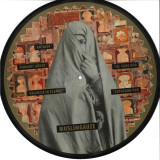
Brilliantly remastered (picture) LP/CD with new stunning artwork!
Lo-Fi India Abuse was recorded in 1998, some tracks are “pure” Muslimgauze and some are re-mixs of tracks from Systemwide’s “Sirius” CD (see also Systemwide meets Muslimgauze “at the City of the Dead” 12″). Nearly all of the tracks have hand percussion in varying tempos and intensities and at least 1/2 make use of electronic noise surges. The sound is very crisp and clean, extremely well produced, recorded and nicely varied throughout the length of the disc. Some track by track comments: “Antalya” is obviously from the same sessions as “Fakir Sind” seeing as it shares the same hand percussion sound, whistles, vocal wailing, cut-ups and delays. “Valencia Flames” sounds like a Systemwide remix. A dub bass line, hi-hat and background vocal of some sort are all obliterated by numerous delays, starts, stops and re-starts with an unpredictable nature in these cut-up tracks. “Al Souk Dub” injects background voices, market sounds and drones into the cut-up mix of slow hand percussion playing. “Catacomb Dub” and the final two tracks make use of twinkling synth waves, presumably a Systemwide sound source. “Dust of Saqqara” has a heavy pulsating electronic sound wave over an old beat box rhythm. “Android Cleaver” is brutal (as is “Nommos’ Afterburn”) hand percussion, jabs of noise and an oft repeated, unintelligible vocal sample. Yes, Lo-Fi India Abuse is yet another great Muslimgauze release, grab it!
All tracks recorded by Muslimgauze 1998
Some tracks are re-mixes from Systemwide’s “Sirius” album
Re-mastered by Višeslav Laboš
Sleeve by Oleg Galay
Originally released in 1999 via BSI Records (BSI 1999-3).
- 1: Part Of The Poetic Talent - Yeong Die
- 2: Dome Cciaran Jacob, Flora Yin-Wong
- 3: Catch - Yl Hooi
- 4: Borghese Gardens September - Chantal Michelle
- 5 07: 182018-02.03.05 - L'vovna
- 6: Rare Endless Stirring Sun - Burning Pyre
- 7: Tethered Snakes - Severin Black, Zeynep Ağcabay
- 8: Memory Loss - Geklaper
- 9: Not Ready For Whistles - Suburban Cracked Collective
- 10: Visit To The Optometrist - Saint Abdullah
Archaic Vaults is pleased to present the first vinyl album for the label, cataloguing ten tracks from ten artists spanning the globe. This curation brings together a multiplicity of genres within the label’s ongoing thematic output - durational ambience, field recordings, oversaturated improvisations and spatialised synthetic loops among them. A diverse cohort of familiar and new collaborators alike.
Born of a thousand nights lost in a surrender to stillness and contemplation, In The Air is Anna St. Louis’ second full length album and her most considered work yet. St. Louis’ debut If Only There Was a River seemed to emerge fully formed out of the recesses of her mind; a gritty, mesmerizing affair, filled with jagged edges and ghostly apparitions. The type of record that announces a new voice; one haunted by what has come before.
But this time, St. Louis is no longer concerned with what could have been and sets her sights to exploring what could be. It’s an outlook on the world that was formed when her immediate one was small. The intervening years since her last album found St. Louis in a small one-bedroom cabin in the middle of the woods of upstate New York with a new love and time to think of what she wanted to express with her music. For weeks on end, the only trips she took were to and from her job as the front desk clerk at a nearby hotel. The previous years she had spent on tour and performing constantly in the venues of Los Angeles felt like they had occurred in another lifetime.
“It really compelled me to surrender to the unknown,” she says. And in this surrender, she found liberation. St. Louis is more self-assured, open-hearted and ready to say what she wants. St. Louis describes the writing period as one of a slow harvest; a fertile time but one that required a newfound patience. Instead of documenting her first thoughts, she spent more time with each song, going deeper with the themes and ideas she wanted to express.
This slower approach also guided the sonic textures of the album. Working with producer Jarvis Taveniere (Purple Mountains, Woods) in two extended recording sessions in Los Angeles in 2021, St. Louis used the studio in a previously unexplored way, opening up her songs to more experimentation featuring brighter tones and a more orchestral sound to accompany her new perspective. To that end, she was aided by a cast of friends and collaborators including Jess Williamson, Kacey Johansing, Oliver Hill (Kevin Morby, Vagabon) on strings, Alex Fischel (Spoon) on piano, Josh Adams on drums (Bedouine, Tim Heidecker) and Keven Lareau (Cut Worms, Hand Habits).
In the Air has the sound of a joyous consideration of the present moment; a quiet morning revealing a new snowfall outside, steam coming from the kettle, just before it whistles, St. Louis with her guitar, staring out the window, with a few free hours before work. She’s reflecting on the scene in front of her, imagining the times yet to come. You can hear it; she’s a long way from the noisy bars of Los Angeles, the rigors of the road. As she intones in “Rest”: “You spend your whole life believing in the chase. And then you realize that being somewhere doesn’t matter like it used to.” She doesn’t need a river to carry her anymore ... She’s in the air.
At only 19 years old, Dar Es Salaam's DJ Travella represents a new wave of singeli producers who are driving Tanzania's breakneck dance sound into fresh, innovative spaces. Unaffiliated with any of the well-known studios like Sisso and Pamoja, Hamadi Hassani's music points singeli's fusion of taraab and techno towards the stars, locating a cyber-singeli style that's dense, kinetic and unashamedly sexy. Hassani started producing at 15, and a few years later his debut is a jagged set of hi-nrg dance music that pulls influence from across the globe, folding together elements of dembow, rave, R&B, and trap. But nothing's straightforward: opening track 'Crazy Beat Music Umeme 2' juxtaposes grinding 200bpm rhythmic intensity with urgent plucked strings, sounding like Timbaland conjuring a Thunderdome soundtrack for a Tanzanian street party. 'Crazy Beat Music Umeme 4' is even more barbed, with neon rave synths and hand-jammed percussion that's one part 808 Mafia and one part DJ Diaki. On 'London Bandcamp', Travella meshes hi-speed singeli backbeats with downtempo dembow kicks, squeezing out unexpected sleaze in the process, while on 'London Uwoteeee' there's an almost romantic sparkle, with ethereal vocals draped across woodblock cracks and whistles. But Travella sounds most nimble when giving the nod to Atlanta, and his merging of earworm synth hooks and neck-snapping East African rhythms on tracks like 'London Jomon Beat' will leave no doubt that the young producer is capable of bending singeli completely to his will.
Brazilian experimental multi-instrumentalist Carla Boregas follows plates for Bokeh Versions and Hive Mind with a ghostly set of deep listening electronics that plays like a symphony for an imagined woodwind orchestra.
Carla Boregas is best known from her tenure in São Paulo's genre-bending experimental post-punk scene, playing in long-running outfit Rakta as well as other related offshoots. Her solo material has been knottier to unpick, here developing ideas from a collection of unfinished fragments and notebook scribbles exploring the possibility of finding a wind instrument that could be played collectively by several musicians. Coinciding with the pandemic, however, she soon realised the inherent risks involved with sharing breath and so the concept took a different direction, with added resonance.
Boregas developed a synthetic alternative, layering vocals and environmental recordings to suggest wind instrumentation without attempting to mimic it. The sounds here are airy, but rarely diegetic - on the title track, Boregas uses analog arpeggios and plucked, sustained tones to approximate the kosmische world of Ash Ra Tempel or more recently Emeralds, as if trapped in a wind tunnel, moved forward by an unseen force.
There's a whisper of the ancient past that harmonises with Wojciech Rusin's speculative medieval gasps, and Bloedneus & de Snuitkever's severely underheard ‘Milli Mille’, an examination of the ancient Greek aulos. On ’Grafia Do Invisível' the sound is completely different again, but the concept remains, using precise analog drones and minuscule timbral shifts to imitate the character of a wind instrument and simultaneously harmonise with the deep listening meditations of Éliane Radigue and Kali Malone.
A voice enters the frame on 'Sopro’, chopped into deviated gulps and syllables, creating a language that's unfamiliar and percussive. The use of breath is subtle, and vocalisations criss-cross between synths and faint whistles, forming an expression that's different from its predecessors but intrinsically interlinked. This is where ‘Pena Ao Mar’ excels, by viewing breath and its application in electronic music from multiple angles simultaneously. Fans of Lucy Duncombe, Lucrecia Dalt, or Sarah Davachi - don't miss this one.
Brilliantly remastered (picture) LP/CD with new stunning artwork!
Lo-Fi India Abuse was recorded in 1998, some tracks are “pure” Muslimgauze and some are re-mixs of tracks from Systemwide’s “Sirius” CD (see also Systemwide meets Muslimgauze “at the City of the Dead” 12″). Nearly all of the tracks have hand percussion in varying tempos and intensities and at least 1/2 make use of electronic noise surges. The sound is very crisp and clean, extremely well produced, recorded and nicely varied throughout the length of the disc. Some track by track comments: “Antalya” is obviously from the same sessions as “Fakir Sind” seeing as it shares the same hand percussion sound, whistles, vocal wailing, cut-ups and delays. “Valencia Flames” sounds like a Systemwide remix. A dub bass line, hi-hat and background vocal of some sort are all obliterated by numerous delays, starts, stops and re-starts with an unpredictable nature in these cut-up tracks. “Al Souk Dub” injects background voices, market sounds and drones into the cut-up mix of slow hand percussion playing. “Catacomb Dub” and the final two tracks make use of twinkling synth waves, presumably a Systemwide sound source. “Dust of Saqqara” has a heavy pulsating electronic sound wave over an old beat box rhythm. “Android Cleaver” is brutal (as is “Nommos’ Afterburn”) hand percussion, jabs of noise and an oft repeated, unintelligible vocal sample. Yes, Lo-Fi India Abuse is yet another great Muslimgauze release, grab it!
All tracks recorded by Muslimgauze 1998
Some tracks are re-mixes from Systemwide’s “Sirius” album
Re-mastered by Višeslav Laboš
Sleeve by Oleg Galay
Originally released in 1999 via BSI Records (BSI 1999-3).
After more than 45 years forgotten in the personal archives of Jean Schwarz, Transversales Disques is very happy to release this previously unpublished recording which brings together the great Don Cherry and his friend, composer Jean Schwarz, pioneer in electro-acoustic music and member of G.R.M.
This concert was recorded in 1977 at the Paris MIX festival (Théatre Récamier) organised by G.R.M and hosted by director François Bayle. An elegant mix of spiritual jazz and electronic sounds around this astounding quintet made up of JF Jenny Clark, Nana Vasconcelos and Michel Portal.
Remastered from the original master tapes. Exclusive pictures and liner notes
- 1: Mano Vs. Mente - Ft. Suprah
- 2: Arazoak Dantzatzen - Ft. Mad Muasel
- 3: Nor Gara - Ft Belardi Rockers
- 4: Caminando Estilo Kinki - Ft. Priteo
- 5: My Favourite Song - Ft. Inés Pardo
- 6: Renace Desde Dentro - Ft. Reguilon & Daka
- 7: Gure Alegriya - Ft. Dr. Bita Banton
- 8: Turista Jauna - Ft. Xatiro
- 9: Maitasune Jaso Ta Emon - Ft. Gatom
- 10: Vasmoh Pa'l Norte - Ft. F.r.a.c
BABILBON is the fusion between Babylon and Bilbo. A collective of musicians with experience in other bands from Bilbao with the idea of bringing a modern twist to the old Jamaican rhythms, fusing them with dancehall and hip-hop rhythms without any pretension of sounding purist, and also lending the microphone to 10 artists from Bilbo and "surroundings": Bite Akatz, Suprah, Mad Muasel, Xatiro, Belardi Rockers, Gatom, Ras Reguilón & Daka, Fundación de Raperos Atípicos de Cádiz, Inés Pardo and Priteo. Their eponymous debut album (called 10 Beats and Riddims Basque Label) was recorded at Mamba Beltza studios in the Iturralde neighborhood of Bilbao, with the aim of thundering in all the sound-systems of the great Babylon. For the purpose, the band gives the microphone to 10 vocalists from Bilbo and "surroundings" to the delight of locals and strangers. The selection is of bells and whistles, but behind the rhythmic recitation of rhymes, puns, breaks and Jamaican riddims, there is a solid and versatile band that, adapting to the guests, builds a homogeneous sound around the Babylonian assortment of languages, dialects, accents, textures, styles, personalities, moods, cultures and subcultures.
Originally released in 1969 in a quantity so low that it was once rumored
to not even exist (seriously)
While groups like The Holy Modal Rounders were turning traditional American
folk on its head in the states throughout the 60s, The Maglory Dengluch's
approach took influence from the Scottish and Irish. Armed with banjos, tin
whistles, kazoos, and jugs they recorded the now infamous album to tape.
Officially released for the first time since the storied 99-copy, 1969 run on the long
defunct Granta label and includes exhaustive new liner notes from the band and a
download card with the entire album as well as five bonus tracks recorded during
the same session.
Fire Red Color Vinyl[34,41 €]
Five tracks of masterful, ritualistic, and pitch-black evil make up the
entirety of Ng'ambu - an album which is meant to be interpreted as a
hymnal to invoke and praise spirits - shows the band drenched in
offerings to the bands personal connection and dedication to Quimbanda,
the Afro-Brazilian diasporic belief system based around magic, rituals,
and offerings
The band explains, "It is both an offering to our Cabula, that is our house, as it is
to the spirits of Quimbanda themselves. In some sense we are turning what could
otherwise be poison into medicine. It is a process of engaging, through struggle,
with those aspects of ourselves and the world which live at the pivot point of
chance and desire. It is about seeking agency even in the thistles of the road.
Quimbanda is the fire by which we forge our iron and the strangling plantst that
cure disease. Quimbanda is both the pox and the inoculation. Quimbanda is our
anxiety and the motivation that anxiety produces. It is conflict and the strength
that comes from engaging that conflict. People say, idle hands are the devil's
plaything, and so we have put those hands and The Devil to work."
For the band's sophomore release, MEHENET connects a powerful fury of black
metal mastery to the deeply rooted sounds of New Orleans - by way of utilizing
samples of the bustling French Quarter and by paying respect and praise to the
cultural music of the city by incorporating congas, whistles, and bells. Recorded
and mixed in 2019 by James Whitten at High Tower Recording in New Orleans,
LA.
Black Vinyl[34,41 €]
Five tracks of masterful, ritualistic, and pitch-black evil make up the
entirety of Ng'ambu - an album which is meant to be interpreted as a
hymnal to invoke and praise spirits - shows the band drenched in
offerings to the bands personal connection and dedication to Quimbanda,
the Afro-Brazilian diasporic belief system based around magic, rituals,
and offerings
The band explains, "It is both an offering to our Cabula, that is our house, as it is
to the spirits of Quimbanda themselves. In some sense we are turning what could
otherwise be poison into medicine. It is a process of engaging, through struggle,
with those aspects of ourselves and the world which live at the pivot point of
chance and desire. It is about seeking agency even in the thistles of the road.
Quimbanda is the fire by which we forge our iron and the strangling plantst that
cure disease. Quimbanda is both the pox and the inoculation. Quimbanda is our
anxiety and the motivation that anxiety produces. It is conflict and the strength
that comes from engaging that conflict. People say, idle hands are the devil's
plaything, and so we have put those hands and The Devil to work."
For the band's sophomore release, MEHENET connects a powerful fury of black
metal mastery to the deeply rooted sounds of New Orleans - by way of utilizing
samples of the bustling French Quarter and by paying respect and praise to the
cultural music of the city by incorporating congas, whistles, and bells. Recorded
and mixed in 2019 by James Whitten at High Tower Recording in New Orleans,
LA.
Jon K and Elle Andrews’ MAL imprint returns with a new LP from one of the London experimental underground's best kept secrets, Rory Salter aka Malvern Brume. His music is rare, eccentric and mysterious - somewhere between Coil's bleak ritual magick and the BBC Radiophonic Workshop's most experimental, minimal fringes.
Malvern Brume operates just beneath the radar, occasionally turning up at Café OTO lineups and on a smattering of releases for Low Company, Alter, Infant Tree and Kasual Plastik - but he’s never one to shout too loudly about his work. ‘Body Traffic’ is his most interesting set to date, laying bare a process melting found sounds, field recordings and spoken word into throbbing, pulsing rhythms. It’s an evocation of a fraught mindset during the early weeks of lockdown in 2020; sequestered in his flat next to a trainline, the infrasonic - and more audible - rumbles of rolling stock and a nagging sense of dread infecting his ambiguously discomfiting recordings.
Operating in a headspace that values world-building and vivid, visual emotionality, Salter’s careful melodies are familiar - the distant, weeping melancholia of 1970s British TV hangs off the recordings like net curtains, and his atmosphere loops into experiments that weave through bare traces of industrial music, blank-faced electro pop, and hedonistic Brummie techno, all reduced to a cinder.
The mood is set on the bellyaching resonance and crawling walls of the title tune, while 'Through Beaked Fog Horns' is drowned beneath morning mists: lopsided synth drones choke and drift, percussion mutates into inebriated bubbles, and tape-f*cked environmental whirrs create an atmosphere that’s hard to decipher in one take.
‘Moss Spines Clenched’ follows cryptic stains on peeling flocking, and the icy creep of ‘Tense Branches Waver’ quivers beyond a cracked windowpane. The artist’s voice appears from beneath a cardboard box fort in the imaginary world of ‘Cornered Into Sleat’ as a distant drum beats out a marching thud and traffic squeals are sculpted into chirpy whistles, before ‘Bri Dun’ resolves the eerie tension in an OOBE-like ascent above the dado-rail and across the tracks, watching himself fade into a dissociative bliss.
"All chatter falls quiet…” Salter murmurs thru saturation and white noise. It’s a sound that’s gonna stick with us for a while.
- A1: La Danza Delle Foglie (The Dance Of Leaves)
- A2: Flauti (Flautes)
- A3: Osso D’aquila Per La Danza Degli Spettri (Eagle Bone For The Ghost Dance)
- A4: Rombi Volanti (Flying Rhombs)
- A5: Il Corno, La Tartaruga, L’arco E La Selce (The Horn, The Tortoise, The Bow & The Flintstone)
- A6: Le Pietre Sonore Della Caverna (Sonorous Stones In The Cave)
- B1: Le Pietre Del Fiume (River Stones)
- B2: I Semi Vegetali Voci Della Jungla (Vegetable Seeds: Jungle Voices)
- B3: Lo Spirito Della Palude (The Spirit Of The Marshed)
- B4: Il Linguaggio Del Mare (Sea Language)
- B5: Reperti Amazzonici (Amazonian Finds)
Art Of Primitive Sound is a sensational journey to the origin of Music. In his crucial research chapter on the Paleolithic, Walter Maioli between 1986 and 1991 investigates the soundscape of different geographical, climatic and botanical environments, in which the mystery of the ancient human-nature relationship resides. What emerges is an expanded and unprecedented Paleorganology, with a range of acoustic and natural instruments from all over the World. Rubbing of fossils, animal artefacts, plant elements of all sorts, everything becomes sound and each object opens up forms of imaginary communication, psychic effect and unexplored languages. Whistles, flutes, leaf and shell rattles, rhombuses, horns, bone pipes, slate slabs, bamboo arches, stones, vertebrae, seeds, stalagtites etc...how great can be the Natural Orchestra inherent in the spirit of forests, rivers, caves, seas, swamps or Amazon jungles? Thanks to an interdisciplinary partnership (Anthropology, Archaeology, Botany, Ethnomusicology) of collaborating friends, Maioli directs an Opera of universal character inspired by the archaic essence of sound and infrasonic dimension.
While frontman Tom Greenhouse’s off-kilter observations and bizarro anecdotes remain front and centre, this time round the band up their game with a more vigorous sound that keeps pace with Greenhouse’s wholly distinctive lyrical style. Greenhouse continues to revel in telling increasingly surreal short stories, rejoicing in the power of the deadpan one-liner and bedecking his songs with far-flung cultural references. But now the band employ a variety of techniques with improved pro- duction, from the impulsively bashed keyboards and jubilantly repetitive guitar stabs that have be- come their trademark, to flirtations with–heaven forbid!–melody, chord progressions and arrangements which elevate their tried-and-tested blueprint into a more exciting and cohesive whole.
Opener Musicians is the perfect embodiment of this conscious development. Here, Greenhouse re- counts a sarcastic tale of half-truths that see him galavanting around town trying to put a band to- gether. Sonically, it begins with a caustic callback to the group’s first EP Crap Cardboard Pet and its über-minimalist aesthetic. But by the end of the song a joyous festival of afrobeat-inspired in- struments including samba whistles, bongos and saxophones are added to the mix as the front- man, ironically, fails in his mission to recruit more players.
With Get Unjaded, the band have somehow conjured something close to pop, without abandoning the repetition and wit that’s relished by their early fans. I Lost My Head also adopts a jangle-pop sheen with a luscious synth melody, as the frontman ditches the spoken-word for a surly croon (his first known attempt at actual singing!) that provides a welcome breather from the onslaught of dense recantations that are the band’s bread-and-butter.
While the lyrics here are still often humorous and political, Greenhouse has also notably expanded his interests on this album to include a new host of topics. The influence of extraterrestrials, for ex- ample, infiltrates the subject matter frequently. On The UFOs, the mysterious protagonist Blinkus Booth’s isolationist lifestyle is apparently interrupted by the spectres of otherworldly visitors, while closer The Neoprene Ravine feels like an extract from a deep space rock opera. Here, jaunty and angular instruments pile-on as we are fed images of an interstellar Spinal Tap, the titular fictional band “The Neoprene Ravine” who are “the alien equivalent of the Velvet Underground” and include an alien Lou Reed yelping “too busy sucking on my little green ding dong!”.
Meanwhile, Hard Rock Potato is propelled by a vortex of keys and synths, a real noise-pop gem comprised of real guitar chords (!) and rock-orientated riffs. Here the stream-of-consciousness lyrics take shots at the sinister financial industry, and include one of the many top-tier one-liners on the album: “It’s not gambling if you’re wearing a tie (even if you’ve got no trousers on)”.
On Sod’s Toastie, The Cool Greenhouse have pushed their distinctive flavour of post-punk to the point of perfection – their incongruous riffs, alchemical instrumental chemistry, and irreverent spo- ken-word vocals are a delight throughout. Sod’s Toastie is hilarious at times, and at others just hilariously good – a not-so-difficult second album.
Yellow and black splatter
While frontman Tom Greenhouse’s off-kilter observations and bizarro anecdotes remain front and centre, this time round the band up their game with a more vigorous sound that keeps pace with Greenhouse’s wholly distinctive lyrical style. Greenhouse continues to revel in telling increasingly surreal short stories, rejoicing in the power of the deadpan one-liner and bedecking his songs with far-flung cultural references. But now the band employ a variety of techniques with improved pro- duction, from the impulsively bashed keyboards and jubilantly repetitive guitar stabs that have be- come their trademark, to flirtations with–heaven forbid!–melody, chord progressions and arrangements which elevate their tried-and-tested blueprint into a more exciting and cohesive whole.
Opener Musicians is the perfect embodiment of this conscious development. Here, Greenhouse re- counts a sarcastic tale of half-truths that see him galavanting around town trying to put a band to- gether. Sonically, it begins with a caustic callback to the group’s first EP Crap Cardboard Pet and its über-minimalist aesthetic. But by the end of the song a joyous festival of afrobeat-inspired in- struments including samba whistles, bongos and saxophones are added to the mix as the front- man, ironically, fails in his mission to recruit more players.
With Get Unjaded, the band have somehow conjured something close to pop, without abandoning the repetition and wit that’s relished by their early fans. I Lost My Head also adopts a jangle-pop sheen with a luscious synth melody, as the frontman ditches the spoken-word for a surly croon (his first known attempt at actual singing!) that provides a welcome breather from the onslaught of dense recantations that are the band’s bread-and-butter.
While the lyrics here are still often humorous and political, Greenhouse has also notably expanded his interests on this album to include a new host of topics. The influence of extraterrestrials, for ex- ample, infiltrates the subject matter frequently. On The UFOs, the mysterious protagonist Blinkus Booth’s isolationist lifestyle is apparently interrupted by the spectres of otherworldly visitors, while closer The Neoprene Ravine feels like an extract from a deep space rock opera. Here, jaunty and angular instruments pile-on as we are fed images of an interstellar Spinal Tap, the titular fictional band “The Neoprene Ravine” who are “the alien equivalent of the Velvet Underground” and include an alien Lou Reed yelping “too busy sucking on my little green ding dong!”.
Meanwhile, Hard Rock Potato is propelled by a vortex of keys and synths, a real noise-pop gem comprised of real guitar chords (!) and rock-orientated riffs. Here the stream-of-consciousness lyrics take shots at the sinister financial industry, and include one of the many top-tier one-liners on the album: “It’s not gambling if you’re wearing a tie (even if you’ve got no trousers on)”.
On Sod’s Toastie, The Cool Greenhouse have pushed their distinctive flavour of post-punk to the point of perfection – their incongruous riffs, alchemical instrumental chemistry, and irreverent spo- ken-word vocals are a delight throughout. Sod’s Toastie is hilarious at times, and at others just hilariously good – a not-so-difficult second album.
Recital publish an album of lost Derek Bailey sessions recorded with his friend and collaborator Charlie Morrow. In 1982, Bailey and Morrow organized a series of live concerts and studio sessions around New York. This new LP is a boiled-down rendering of the master tapes that lived dormant in Charlie’s archive, until now.
Throughout the album, Bailey and Morrow are joined by a rotating cast of New Wilderness players including frame drum percussionist Glen Velez, sound poet Steve McCaffery, publisher and artist Carol E. Tuynman, composer Patricia Burgess, and multimedia artist Michael Snow. The results are surprising and marvelous.
The energy of the live concert, which makes up the first half of the record is particularly exciting, with Morrow and McCaffery’s visceral sound poetry and Glen’s frame drum echoing off of Derek’s fret stabs, and Carol, Patricia, and Michael’s horns swirling through the air between. A very raw and intense recording.
The second side of New York 1982, is a session recorded at The Record Plant, and is clearly more ‘produced’ with panning and tape echo processing, plus experiments with water whistles and other devices.
Derek Bailey stands out for personal achievements as a guitarist and for his way of bringing together performance meetings ranging from duos to large ensembles. Working across style and genre, his music and musical unions have inspired the breakdown of boundaries, embracing all flavors of musicians as improvisers. Players focusing on the moment, “without memory.”
LP Edition of 400 copies on 175gram black vinyl, including an 8-page booklet with program notes and artwork.
Derek Bailey - Acoustic Guitars
Charlie Morrow - Trumpet, Ocarina, Voice
Glen Velez - Percussion
Patricia Burgess - Saxophone (1,3,6)
Steve McCaffery - Voice, Saxophone (1,3)
Carol E. Tuynman - Trumpet (1,3,6)
Michael Snow - Trumpet (3)
Multiphonic trills and yodels, loops of ululations, sudden percussive outburst, warbling glissandi. Ute masks her voice with bird whistles creating a hybrid vocal persona with sculptural, oscillating, swirling tone-colours. The vocal sounds seem to be disconnected from the human voice dissolving into the sounds of birds, of machines, of electronics, of fragmented language.
'Ute Wassermann´s vocal practice is so unique and specialized that it seems to challenge our ability to understand it’s sounds as vocal.' - Aaron Cassidy, Noise in and as Music, University of Huddersfield Press, 2013
'Wassermann sings as a bird, rather than like one. And as philosophers Gilles Deleuze and Félix Guattari point out in A Thousand Plateaus, “Becoming is never imitating.” … The Wassermann soundworld takes form within waveflows and fluctuating particles.' - Julian Cowley, Outer Limits Review, CD review radio tweet, The Wire, March 2016 (Issue 385)