RIYL: A Hawk And A Hacksaw, Leonard Cohen, Daniel Kahn, Xylouris White, Arooj Aftab, Tindersticks, Nick Cave, Alasdair Roberts, Geoff Berner, The Klezmatics. Deluxe 180gLP with 350gsm Arktika jacket/inner + 36”x12” art/lyrics fold-out + DL. CD in gatefold jacket + art/lyrics fold-out. Recorded by Greg Norman (Jason Molina, Nina Nastasia, Electrical Audio). Everything Returns reunites the original Black Ox Orkestar lineup following a 15-year hiatus. Arising from the fertile Montréal post-punk agit-prop scene of the early 2000s, the band comprises Scott Gilmore, Jessica Moss and Thierry Amar of Thee Silver Mt. Zion (Amar also continues to compose and play bass for Godspeed You! Black Emperor) and Gabriel Levine of Sackville. Black Ox made two acclaimed albums of roiling acoustic avant-folk in the mid-2000s, exploring Eastern European and North African folkways through the lens of a gritty, resonant indie rock sensibility, juxtaposing interpretations of instrumentals from various Jewish, Romani and Arabic traditions with originals led by Gilmore’s politically-charged Yiddish vocals. These early albums have since become lodestars for many among a new generation of Yiddish, Klezmer and radical Jewish diasporic music practitioners and fans. First revealing its resurrection in February 2022 with a surprise flexi 7” single issued by left journal Jewish Currents as a gift to its thousands of subscribers, Black Ox has indeed fully and fruitfully reunited. Exquisitely recorded by Greg Norman (Jason Molina, Nina Nastasia, Electrical Audio), Everything Returns picks up right where the band left off: an incisively atmospheric, melancholic yet resolute album of uniquely modern Jewish folk music, with piano, violin, upright bass, clarinet and cymbalom making up the core instrumentation, and the vocal tunes sung primarily in Yiddish, alongside album centerpiece “Viderkol” and closer “Lamed-Vovnik” where English also features. This is not fusion music, but diaspora music: a cross-cultural call and response of musical lexicons, emerging from the history of Jewish persecution and displacement, the musicology of 19th century repertoire from Jewish shtetls, the improvisational traditions of nusakh in Jewish music and taqsim in Arabic music, and a wider polyglot dialogue of Jewish, Slavic, Arabic, and Central Asian musical traditions. Lyrically and stylistically, Everything Returns connects key current issues from refugees forced to leave their homes, to the return of fascism and exclusionary nationalism—with the legacy of modernist Yiddish poetry and song. The new Black Ox Orkestar album is a sublime, poetic, politically-informed statement of re-energized diasporic musical intent, where Gilmore’s voice and the band’s simmering arrangements conjure an ardent, doleful balladry that echoes the sound and sensibility of artists like Tindersticks, The National, Nick Cave and Leonard Cohen. Everything Returns is a haunting, richly textured, darkly sparkling song cycle at once from a vanished world and very much of our time and place. Tracklist: 1 Tish Nign 2 Perpetual Peace 3 Oysgeforn / Bessarabia Hora 4 Mizrakh Mi Ma’arav 5 Skotschne 6 Viderkol (Echo) 7 Epigenetik 8 Moldovan Zhok 9 Lamed-Vovnik
quête:white jack
Tripper, the Fruit Bats' 2011 follow-up to The Ruminant Band, is more
pared down, with bandleader Eric Johnson doing most of the legwork
himself
Synthesizers and keyboard loops replace the knotted guitars. Atmospheric
washes of sound replace the sunny, straightforward hooks. On songs like € The
Fen, € instruments replace vocals entirely, sounding more like a clip from an
orchestral movie soundtrack than the work of a rock band. The majority of the
work was done by Johnson and producer Thom Monahan, resulting in a layered
sound that stacks overdubbed harmonies onto combinations of pump organ,
found sounds, acoustic guitar, and various bleeps and bloops. Whether he's
working alone or leading a full lineup, though, Johnson knows his way around a
good pop hook, and Tripper's best songs are rooted in catchy, sunny melodies
that shine through their heavy wrapping paper. Proof that Johnson knows how to
stretch his legs without losing his balance. Pressed with LP on White Color vinyl
and 7" on Seaglass Blue Color vinyl.
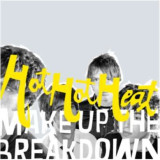
Hot Hot Heat’s classic debut album, ‘Make Up The
Breakdown’, filled with smart, energetic, dancepunk hits, returns to vinyl with this fully remastered
LP edition.
AllMusic called the album “an addictive, densely
packed pop gem that ranks among 2002’s best
albums,” and Pitchfork agreed, including it on their
list of The Best Albums Of 2002.
Following closely on the heels of their critically
acclaimed ‘Knock Knock Knock’ EP, ‘Make Up the
Breakdown’ is Hot Hot Heat's first full length,
recorded with Jack Endino at Vancouver, BC’s
Mushroom Studios (with engineering help from
Chris Walla of Death Cab for Cutie).
SPIN Magazine had this to say about ‘Knock
Knock Knock’: “Some retro new wavers hang
themselves on their own skinny ties. While their
peers lip-synch to Cure 45s, these Canucks take
subtler cues from early ‘80s synth disco. It’s not
new-wave worship, it’s the sound of punk teaching
itself to dance.”
‘Make Up The Breakdown’ delivered on the
promise hinted at on the EP. ‘Hot Hot Heat’ (along
with peers like Radio 4 and The Rapture) blended
angular post-punk twitch with danceable pop,
effectively (and finally) persuading white dopes on
punk to get on the good foot in the early 2000s.
Opaque yellow vinyl.
- A1: It’s The Most Wonderful Time Of The Year
- A2: Have Yourself A Merry Little Christmas
- A3: Christmas In New York
- A4: I’ll Be Home For Christmas Featuring Jonathan Groff
- A5: Do You Want To Build A Snowman?
- A6: Rockin’ Around The Christmas Tree
- B1: Silent Night
- B2: White Christmas Featuring Darren Criss
- B3: Silver Bells
- B4: Angels We Have Heard On High Featuring Cynthia Erivo
- B5: O Holy Nigh
Ever spent Christmas in New
York City? It’s pure magic…the
department store decorations,
the nip in the air putting color in
the cheeks of eager shoppers, the
general spirit of bonhomie that
pervades the street and subway,
and—if you’re lucky—the silent
beauty of a fresh snowfall reflecting
in the streetlights. Having grown
up in New York, Lea Michele knows
well just how spectacular New York
can be during the holiday season;
and on this, her Top 40 2019
album, the Glee star (currently
playing Fanny Brice in Funny Girl on Broadway)
captured a sleigh-full of that Yuletide joy. The centerpiece of the
record is “Christmas in New York,” an original that, in her words,
“paints this beautiful picture of New York, but it also is really about
what it means to be with your family and friends and engaged in that
holiday spirit.” The rest of the record, which is produced by Glee
producers Alex and Adam Anders, is equally transcendent, featuring
duets with fellow Glee stars Jonathan Groff (the voice of Kristoff
in Frozen) and Darren Criss, plus a showstopping vocal display on
“Angels We Have Heard on High” with Cynthia Erivo. For its vinyl
debut, Christmas in the City comes to you in a gatefold album jacket
containing a printed inner sleeve featuring beautiful shots of Lea
spreading some Christmas cheer. A snow white vinyl pressing limited
to 1500 copies…Merry Christmas!
Joining techno mainstays Spencer Parker, Leo Pol and label boss Mella Dee among others, BLACK GIRL / WHITE GIRL are the latest artists to come to Warehouse Music serving up an EP of mind-expanding techno rollers.
The Holland-based duo have made a name for themselves producing weighty, no-nonsense techno cuts to reputable labels Super Rhythm Trax, Balkan Vinyl, and more recently, their independent Bandcamp series Dancefloor Destroyers which remade old school classics in the image of jack: acidifying everything from Robyn to Donna Summer, these tools show off the pair’s ability to make a club (re)werk.
Now with their ‘Multiverse EP’, BLACK GIRL / WHITE GIRL take their sound to another plane where kick drums slide over spectral voices, bleeps smudge into cosmic fractals, and minimal hi-hats make way for a slinkier, deeper energy than on previous releases—all without spilling a drop of their signature raw power.
Both LPs pressed 45RPM in gatefold jacket+ white paper sleeves + LP3 insert for full album download. Yellow vinyl is for Indies only. It might be too soon to declare In Prism the best Polvo record ever…but it might be okay by the time you’re done reading this. ...Only at this point in life would Polvo be so assured, so casually stormy and intensely calm, graceful and free with their power without setting aside anything that made them the rock artists they were during their first, unblemished run. There is not a thing on In Prism that they aren’t doing better than before: the sidewinder guitars and the mighty roar and the moody atmospheres and the psychedelic explosiveness; the writing, the singing, the words you can understand, the ones you can’t. Polvo spent 1990–98 giving voice to a chorus of discrete rock & roll ideas that really hadn’t been heard before. And while there was nothing wrong before, it’s now so much more right—perhaps because after ten years none of the peripheral stuff matters anymore. Now is for Polvo, and Polvo is for now. In Prism is the best Polvo record even before you get to the majestic “A Link in the Chain,” serene and tempestuous like few other things you’ll hear. The album was recorded with Brian Paulson and Polvo has never sounded better. Don’t you agree? Mike Wolf, NYC (2009). Side A 1. Right the Relation 2. D.C. Trails Side B 3. Beggar’s Bowl 4. City Birds Side C 5. Lucía 6. Dream Residue/Work Side D 7. The Pedlar 8. A Link in the Chain
- A1: Elvis Presley - Suspicious Minds (Vocal Intro) - 0 25
- A2: Doja Cat / Shonka Dukureh - Vegas (From The Original Motion Picture Soundtrack Elvis) - 3 01
- A3: Eminem & Ceelo Green - The King And I - 3 13
- A4: Swae Lee & Diplo / Austin Butler - Tupelo Shuffle (From The Original Motion Picture Soundtrack Elvis) - 2 47
- A5: Kacey Musgraves - Can't Help Falling In Love - 2 48
- A6: Stevie Nicks & Chris Isaak - Cotton Candy Land - 2 41
- A7: Elvis Presley & Tame Impala - Edge Of Reality (Tame Impala Remix) - 2 43
- A8: Elvis Presley & Pnau / Elvis Presley - Don't Fly Away (Pnau Remix) - 4 05
- B1: Jazmine Sullivan - Sometimes I Feel Like A Motherless Child - 2 46
- B2: Måneskin - If I Can Dream (From The Original Motion Picture Soundtrack Elvis) - 3 23
- B3: Elvis Presley & Jack White - Power Of My Love - 4 15
- B4: Elvis Presley & Stuart Price / Lenesha Randolph - I Got A Feelin' In My Body - 3 33
- B5: Paravi - Suspicious Minds - 3 47
- B6: Elvis Presley Feat Nardo Wick - In The Ghetto (World Turns Remix) - 3 33
Mit "ELVIS Original Motion Picture Soundtrack" veröffentlicht RCA Records in diesem Sommer den Soundtrack zum neuen Baz Luhrmann-Film "ELVIS", der am 24. Juni in die Kinos kommt und Austin Butler sowie Tom Hanks in den Hauptrollen zeigt. "ELVIS" ist ein absolut episches Leinwandspektakel des visionären Filmemachers Baz Luhrmann, das das Leben und die Musik von Elvis Presley (Austin Butler) und vor allem seine komplizierte Beziehung zu seinem rätselhaften Manager, Colonel Tom Parker (Tom Hanks), beleuchtet. Der Soundtrack zeigt das außergewöhnliche Werk von Elvis aus den 1950er, 60er und 70er Jahren und würdigt gleichzeitig seine vielfältigen musikalischen Einflüsse sowie anhaltende Wirkung auf populäre Künstler von heute. Neben Musik von Elvis Presley, befinden sich Original-Soundtrack-Recordings von Austin Butler auf der CD als auch neue Reimagined Tracks von Künstlern wie Doja Cat, Maneskin, Swae Lee & Diplo, Chris Isaak & Stevie Nicks, Gary Clark Jr, Nardo Wick, Jack White uvm. Avec "ELVIS Original Motion Picture Soundtrack", RCA Records publie cet été la bande originale du nouveau film de Baz Luhrmann "ELVIS", qui sortira le 24 juin dans les salles et mettra en scène Austin Butler et Tom Hanks dans les rôles principaux. "ELVIS" est un spectacle à l'écran absolument épique du cinéaste visionnaire Baz Luhrmann, qui met en lumière la vie et la musique d'Elvis Presley (Austin Butler) et surtout sa relation compliquée avec son énigmatique manager, le colonel Tom Parker (Tom Hanks). La bande-son met en lumière l'oeuvre exceptionnelle d'Elvis dans les années 1950, 60 et 70, tout en rendant hommage à ses multiples influences musicales et à son impact durable sur les artistes populaires d'aujourd'hui. Outre la musique d'Elvis Presley, le CD contient des enregistrements originaux de la bande originale par Austin Butler ainsi que de nouveaux morceaux réimaginés par des artistes tels que Doja Cat, Maneskin, Swae Lee & Diplo, Chris Isaak & Stevie Nicks, Gary Clark Jr, Nardo Wick, Jack White et bien d'autres.
Mondo, in conjunction with WaterTower Music, is proud to present the premiere vinyl pressing of Hans Zimmer’s incredible score to WONDER WOMAN 1984.
Featuring incredible artwork by La Boca and housed in a tri-fold jacket with holo-foil elements, with liner notes by writer and director Patty Jenkins, the vinyl pressing is available on 3x 180 Gram Swirl colored vinyl.
Hans Zimmer’s score to WONDER WOMAN 1984 is quite possibly our favorite piece of superhero film scoring since John Williams’ SUPERMAN: THE MOVIE (1978), and Danny Elfman’s BATMAN (1989). We know that sounds hyperbolic, but even before our test pressings arrived, it was one of our most listened to albums on Spotify of the last 6 months. It’s that good. We can’t wait for you to hear how good it sounds on vinyl, out of big speakers.
Composed by Hans Zimmer
Artwork by La Boca
Manufactured in the Czech Republic
2022 White Vinyl Repress
JUZER by Beau Wanzer and Dan Jugel finds new stomping grounds at RUBBER with a four track release including a fresh remix by Unit Moebius Anonymous. Wanzer and Jugel, two pillars of the Chicago underground are known for their distorted jacked techno which is heavily rooted in the Chicago tradition. Together with Beau Wanzer we have selected three archival tracks made prior to Jugel's passing in 2018. The result is a grinding ensemble of raw techno jams that tips its hat to the different electronic flavors of Chicago and The Hague.
Black Vinyl[33,57 €]
Smoked Coloured Vinyl[36,09 €]
Strawberries & Cream Coloured Vinyl[28,15 €]
Raspberry Ripple Coloured Vinyl[28,15 €]
Yellow Vinyl[26,01 €]
Pink Vinyl[26,01 €]
Black Vinyl[26,01 €]
Red Vinyl[24,79 €]
Black feminist punk band Big Joanie have announced their upcoming second album 'Back Home', set for release 4th November on Daydream Library Series in the UK and Kill Rock Stars in the US. The brand new album 'Back Home' follows on from last month's one-off single 'Happier Still', and the release of their 2020 single ‘Cranes in the Sky’, a cover of Solange Knowles released on Jack White’s Third Man Records. Recorded at Hermitage Works Studios in North London, 'Back Home' was produced and mixed by Margo Broom (Goat Girl, Fat White Family) and features violin courtesy of Charlotte Valentine of the experimental art rock project No Home, who recently collaborated with the LA-based artist SASAMI. 'Back Home' is a dramatic leap forward for the band; the band build on their tightly knit, lo-fi punk formula to bring forth a collage of blazing guitars, down tempo dance punk, and melancholic strings that evoke the full depth of the band’s expansive art punk vision. The album title references a search for a place to call home, whether real or metaphysical. “We were really ruminating on the idea of a home and what it means,” explains Stephanie. “It’s about the different ideas of home, whether that’s here in the UK, back in Africa or the Caribbean, or a place that doesn’t really exist; it’s neither here nor there." The band worked with multidisciplinary artist Angelica Ellis to design the striking embroidered cover art, which is a depiction of Chardine’s nephew at the barbers. The artwork is a reference to the embroidered wall hangings popular in Caribbean homes post-Windrush that were a callback to the homes they left behind. The album’s strength lies in the band’s bold and varied new sound. Album opener ‘Cactus Tree’ is an eerie, gothic folk tale that tells the story of a woman waiting for her lover while a wall of euphoric harmonies and screaming feedback roll in the background. Lead single ‘Happier Still’ is a driving, Nirvana-influenced track that grapples with the idea of wanting to push through a depressive episode. Inspired equally by the melodic rock of Hüsker Dü and the mystical sensibilities of Stevie Nicks, closer ‘Sainted’ brings the club-ready sentiment of the 2018 single ‘Fall Asleep’ to its natural conclusion. Big Joanie live dates 2022 Sun 31st July - Liverpool International Festival @ Camp & Furnace Sat 20th August - La Route Du Rock Festival St Malo, France Sun 28th August - Greenbelt Festival, Kettering, United Kingdom Could the song splits across the sides be changed to this: Side A 1.Cactus Tree 2.Taut 3.Confident Man 4.What Are You Waiting For? 5.In My Arms 6.Your Words 7.Count to Ten Side B: 1.Happier Still 2.Insecure 3.Today 4.I Will 5.In My Arms (Reprise)6.Sainted
[l] 12 IN MY ARMS [REPRISE]
Black Vinyl[33,57 €]
Smoked Coloured Vinyl[36,09 €]
Strawberries & Cream Coloured Vinyl[28,15 €]
Raspberry Ripple Coloured Vinyl[28,15 €]
Yellow Vinyl[26,01 €]
Pink Vinyl[26,01 €]
Black Vinyl[26,01 €]
Black Vinyl[23,11 €]
Black feminist punk band Big Joanie have announced their upcoming second album 'Back Home', set for release 4th November on Daydream Library Series in the UK and Kill Rock Stars in the US. The brand new album 'Back Home' follows on from last month's one-off single 'Happier Still', and the release of their 2020 single ‘Cranes in the Sky’, a cover of Solange Knowles released on Jack White’s Third Man Records. Recorded at Hermitage Works Studios in North London, 'Back Home' was produced and mixed by Margo Broom (Goat Girl, Fat White Family) and features violin courtesy of Charlotte Valentine of the experimental art rock project No Home, who recently collaborated with the LA-based artist SASAMI. 'Back Home' is a dramatic leap forward for the band; the band build on their tightly knit, lo-fi punk formula to bring forth a collage of blazing guitars, down tempo dance punk, and melancholic strings that evoke the full depth of the band’s expansive art punk vision. The album title references a search for a place to call home, whether real or metaphysical. “We were really ruminating on the idea of a home and what it means,” explains Stephanie. “It’s about the different ideas of home, whether that’s here in the UK, back in Africa or the Caribbean, or a place that doesn’t really exist; it’s neither here nor there." The band worked with multidisciplinary artist Angelica Ellis to design the striking embroidered cover art, which is a depiction of Chardine’s nephew at the barbers. The artwork is a reference to the embroidered wall hangings popular in Caribbean homes post-Windrush that were a callback to the homes they left behind. The album’s strength lies in the band’s bold and varied new sound. Album opener ‘Cactus Tree’ is an eerie, gothic folk tale that tells the story of a woman waiting for her lover while a wall of euphoric harmonies and screaming feedback roll in the background. Lead single ‘Happier Still’ is a driving, Nirvana-influenced track that grapples with the idea of wanting to push through a depressive episode. Inspired equally by the melodic rock of Hüsker Dü and the mystical sensibilities of Stevie Nicks, closer ‘Sainted’ brings the club-ready sentiment of the 2018 single ‘Fall Asleep’ to its natural conclusion. Big Joanie live dates 2022 Sun 31st July - Liverpool International Festival @ Camp & Furnace Sat 20th August - La Route Du Rock Festival St Malo, France Sun 28th August - Greenbelt Festival, Kettering, United Kingdom Could the song splits across the sides be changed to this: Side A 1.Cactus Tree 2.Taut 3.Confident Man 4.What Are You Waiting For? 5.In My Arms 6.Your Words 7.Count to Ten Side B: 1.Happier Still 2.Insecure 3.Today 4.I Will 5.In My Arms (Reprise)6.Sainted
[l] 12. IN MY ARMS [REPRISE]
Dean Fertita has been at the heart of American rock ‘n’ roll for almost two decades, from his role as an invaluable member of Queens of the Stone Age and The Dead Weather, touring keyboardist with The Raconteurs, and backing musician on records by Jack White, Karen O, Iggy Pop, Brendan Benson, The Kills, Beck, and more. While his own music had been the focus in his role as lead singer, guitarist, and founder of The Waxwings and on recordings as Hello=Fire, Fertita began TROPICAL GOTHCLUB with no clear mission for a solo album under his own name. In early 2020, the TN-based musician put up a small A-frame in his backyard to use as a writing and recording space while stuck at home during the looming pandemic. With rare time on his hands, Fertita set to work recording demos of the many musical ideas he had accumulated over the years, building upon songs and fragments written during different stages of his busy career. Fertita then enlisted his old friend Dave Feeny – a veteran Detroit musician and owner of The Tempermill recording studios in Ferndale, MI – to help develop the recordings even further, pushing the original demos in deliberate new directions to create a showcase for his wide-ranging songcraft and visionary imagination.
Best-Of-Album mit allen 18 Singles in chronologischer Reihenfolge, die die Smoke Fairies seit ihrer Debüt-7" 'Living With Ghosts' 2008 veröffentlicht haben. Ein ganz besonderer Bonus sind die beiden von Jack White produzierten und an Schlagzeug und Gitarre begleiteten Songraritäten 'Gastown' & 'River Song', die 2009 exklusiv als limitierte, doppelseitige 7" in Third Man Records' berüchtigter Blue Series erschienen und jetzt erstmals auf einem Album erhältlich werden.
The third and most seasoned Drugdealer album, Hiding In Plain Sight, almost didn't happen at all. Frustrated and insecure with his own singing voice prior to the pandemic, Drugdealer founder and primary songwriter Michael Collins was nearly ready to throw in the towel. Due to a frequent impulse to hand over the microphone to friends and collaborators like Weyes Blood, Jackson MacIntosh, and his trusty musical companion Sasha Winn, Collins became increasingly unsure of himself as a singer. While attending Mexican Summer's annual Marfa Myths festival, a chance encounter with artist and composer Annette Peacock changed his outlook. Collins says, "I was so inspired by Annette. But similarly to all these other vocalists I'd worked with, I didn't feel like I had it in me." he recalls. "I told her my plight, then I played her a song, and she told me I wasn't singing high enough for my speaking voice. When I returned to LA, I started coming up with new progressions, which I'd modulate up three half steps. It forced me to find a new way to sing." "Madison," is the first song Collins wrote singing in this suggested range. His newfound confidence as a yarn-spinning vocalist in the gruff tenor tradition of Nick Lowe, or even Van Morrison, is readily apparent, with Conor "Catfish" Gallaher's pedal steel adding a dusting of cosmic country to Collins' down-hard love song. When Collins wrote the would-be AM Gold hit, he was summoning an imaginary vision of a love that had eluded him in reality. Tim Presley sings on the second song, "Baby," and Collins had a clear role in mind for the California avant-rock mainstay. "I love White Fence so much, but I also wanted to hear Presley sing a song that sounded like an early '60s sock hop band who had never tried drugs in their life." Meanwhile, Kate Bollinger floats an effervescent lead vocal over the Rhodes-driven groove in “Pictures of You.”. Taking inspiration from a canon of gruff but soulful rock vocalists like Phil Lynott, Collins looks back on his nocturnal meanderings through LA's warrens of bars and clubs ("New Fascination"). He’s right up front in the mix, detailing a search for love in all the wrong places.
- A1: Rock This Mother
- A2: Talk To Me Girl
- A3: You Can Find Me
- A4: Check This Out
- A5: Jesus Going To Clean House
- A6: Hope You Understood
- A7: Is It What You Want
- A8: Love Is Everlasting
- A9: This Is Hip-Hop Art
- A10: Opposite Of Love
- A11: Do You Know What I Mean
- B1: Saving All My Love For You
- B2: Look Out Here I Come
- B3: Girl You Always Talking
- B4: Have A Great Day
- B5: Take My Hand
- B6: I Need Your Love
- B7: Your Town
- B8: Talk Around Town
- B9: Booty Head/Take A Little Walk
- B10: I Love My Mama
- B11: I Never Found Anyone Like You
Vinyl LP[23,49 €]
As the sun sets on a quaint East Nashville house, a young man bares a piece of his soul. Facing the camera, sporting a silky suit jacket/shirt/slacks/fingerless gloves ensemble that announces "singer" before he's even opened his mouth, Lee Tracy Johnson settles onto his stage, the front yard. He sways to the dirge-like drum machine pulse of a synth-soaked slow jam, extends his arms as if gaining his balance, and croons in affecting, fragile earnest, "I need your love… oh baby…"
Dogs in the yard next door begin barking. A mysterious cardboard robot figure, beamed in from galaxies unknown and affixed to a tree, is less vocal. Lee doesn't acknowledge either's presence. He's busy feeling it, arms and hands gesticulating. His voice rises in falsetto over the now-quiet dogs, over the ambient noise from the street that seeps into the handheld camcorder's microphone, over the recording of his own voice played back from a boombox off-camera. After six minutes the single, continuous shot ends. In this intimate creative universe there are no re-takes. There are many more music videos to shoot, and as Lee later puts it, "The first time you do it is actually the best. Because you can never get that again. You expressing yourself from within."
"I Need Your Love" dates from a lost heyday. From some time in the '80s or early '90s, when Lee Tracy (as he was known in performance) and his music partner/producer/manager Isaac Manning committed hours upon hours of their sonic and visual ideas to tape. Embracing drum machines and synthesizers – electronics that made their personal futurism palpable – they recorded exclusively at home, live in a room into a simple cassette deck. Soul, funk, electro and new wave informed their songs, yet Lee and Isaac eschewed the confinement of conventional categories and genres, preferring to let experimentation guide them.
"Anytime somebody put out a new record they had the same instruments or the same sound," explains Isaac. "So I basically wanted to find something that's really gonna stand out away from all of the rest of 'em." Their ethos meant that every idea they came up with was at least worth trying: echoed out half-rapped exhortations over frantic techno-style beats, gospel synth soul, modal electro-funk, oddball pop reinterpretations, emo AOR balladry, nods to Prince and the Fat Boys, or arrangements that might collapse mid-song into a mess of arcade game-ish blips before rallying to reach the finish line. All of it conjoined by consistent tape hiss, and most vitally, Lee's chameleonic voice, which managed to wildly shape shift and still evoke something sincere – whether toggling between falsetto and tenor exalting Jesus's return, or punctuating a melismatic romantic adlib with a succinct, "We all know how it feels to be alone."
"People think we went to a studio," says Isaac derisively. "We never went to no studio. We didn't have the money to go to no studio! We did this stuff at home. I shot videos in my front yard with whatever we could to get things together." Sometimes Isaac would just put on an instrumental record, be it "Planet Rock" or "Don't Cry For Me Argentina" (from Evita), press "record," and let Lee improvise over it, yielding peculiar love songs, would-be patriotic anthems, or Elvis Presley or Marilyn Monroe tributes. Technical limitations and a lack of professional polish never dissuaded them. They believed they were onto something.
"That struggle," Isaac says, "made that sound sound good to me."
In the parlance of modern music criticism Lee and Isaac's dizzying DIY efforts would inevitably be described as "outsider." But "outsider" carries the burden of untold additional layers of meaning if you're Black and from the South, creating on a budget, and trying to get someone, anyone within the country music capital of the world to take your vision seriously. "What category should we put it in?" Isaac asks rhetorically. "I don't know. All I know is feeling. I ain't gonna name it nothing. It's music. If it grabs your soul and touch your heart that's what it basically is supposed to do."
=
Born in 1963, the baby boy of nine siblings, Lee Tracy spent his earliest years living amidst the shotgun houses on Nashville's south side. "We was poor, man!" he says, recalling the outhouse his family used for a bathroom and the blocks of ice they kept in the kitchen to chill perishables. "But I actually don't think I really realized I was in poverty until I got grown and started thinking about it." Lee's mom worked at the Holiday Inn; his dad did whatever he had to do, from selling fruit from a horse drawn cart to bootlegging. "We didn't have much," Lee continues, "but my mother and my father got us the things we needed, the clothes on our back." By the end of the decade with the city's urban renewal programs razing entire neighborhoods to accommodate construction of the Interstate, the family moved to Edgehill Projects. Lee remembers music and art as a constant source of inspiration for he and his brothers and sisters – especially after seeing the Jackson 5 perform on Ed Sullivan. "As a small child I just knew that was what I wanted to do."
His older brother Don began musically mentoring him, introducing Lee to a variety of instruments and sounds. "He would never play one particular type of music, like R&B," says Lee. "I was surrounded by jazz, hard rock and roll, easy listening, gospel, reggae, country music; I mean I was a sponge absorbing all of that." Lee taught himself to play drums by beating on cardboard boxes, gaining a rep around the way for his timekeeping, and his singing voice. Emulating his favorites, Earth Wind & Fire and Cameo, he formed groups with other kids with era-evocative band names like Concept and TNT Connection, and emerged as the leader of disciplined rehearsals. "I made them practice," says Lee. "We practiced and practiced and practiced. Because I wanted that perfection." By high school the most accomplished of these bands would take top prize in a prominent local talent show. It was a big moment for Lee, and he felt ready to take things to the next level. But his band-mates had other ideas.
"I don't know what happened," he says, still miffed at the memory. "It must have blew they mind after we won and people started showing notice, because it's like everybody quit! I was like, where the hell did everybody go?" Lee had always made a point of interrogating prospective musicians about their intentions before joining his groups: were they really serious or just looking for a way to pick up girls? Now he understood even more the importance of finding a collaborator just as committed to the music as he was.
=
Isaac Manning had spent much of his life immersed in music and the arts – singing in the church choir with his family on Nashville's north side, writing, painting, dancing, and working various gigs within the entertainment industry. After serving in the armed forces, in the early '70s he ran The Teenage Place, a music and performance venue that catered to the local youth. But he was forced out of town when word of one of his recreational routines created a stir beyond the safe haven of his bohemian circles.
"I was growing marijuana," Isaac explains. "It wasn't no business, I was smoking it myself… I would put marijuana in scrambled eggs, cornbread and stuff." His weed use originated as a form of self-medication to combat severe tooth pain. But when he began sharing it with some of the other young people he hung out with, some of who just so happened to be the kids of Nashville politicians, the cops came calling. "When I got busted," he remembers, "they were talking about how they were gonna get rid of me because they didn't want me saying nothing about they children because of the politics and stuff. So I got my family, took two raggedy cars, and left Nashville and went to Vegas."
Out in the desert, Isaac happened to meet Chubby Checker of "The Twist" fame while the singer was gigging at The Flamingo. Impressed by Isaac's zeal, Checker invited him to go on the road with him as his tour manager/roadie/valet. The experience gave Isaac a window into a part of the entertainment world he'd never encountered – a glimpse of what a true pop act's audience looked like. "Chubby Checker, none of his shows were played for Black folks," he remembers. "All his gigs were done at high-class white people areas." Returning home after a few years with Chubby, Isaac was properly motivated to make it in Music City. He began writing songs and scouting around Nashville for local talent anywhere he could find it with an expressed goal: "Find someone who can deliver your songs the way you want 'em delivered and make people feel what you want them to feel."
One day while walking through Edgehill Projects Isaac heard someone playing the drums in a way that made him stop and take notice. "The music was so tight, just the drums made me feel like, oh I'm-a find this person," he recalls. "So I circled through the projects until I found who it was.
"That's how I met him – Lee Tracy. When I found him and he started singing and stuff, I said, ohhh, this is somebody different."
=
Theirs was a true complementary partnership: young Lee possessed the raw talent, the older Isaac the belief. "He's really the only one besides my brother and my family that really seen the potential in me," says Lee. "He made me see that I could do it."
Isaac long being a night owl, his house also made for a fertile collaborative environment – a space where there always seemed to be a new piece of his visual art on display: paintings, illustrations, and dolls and figures (including an enigmatic cardboard robot). Lee and Issac would hang out together and talk, listen to music, conjure ideas, and smoke the herb Isaac had resumed growing in his yard. "It got to where I could trust him, he could trust me," Isaac says of their bond. They also worked together for hours on drawings, spreading larges rolls of paper on the walls and sketching faces with abstract patterns and imagery: alien-like beings, tri-horned horse heads, inverted Janus-like characters where one visage blurred into the other.
Soon it became apparent that they didn't need other collaborators; self-sufficiency was the natural way forward. At Isaac's behest Lee, already fed up with dealing with band musicians, began playing around with a poly-sonic Yamaha keyboard at the local music store. "It had everything on it – trumpet, bass, drums, organ," remembers Lee. "And that's when I started recording my own stuff."
The technology afforded Lee the flexibility and independence he craved, setting him on a path other bedroom musicians and producers around the world were simultaneously following through the '80s into the early '90s. Saving up money from day jobs, he eventually supplemented the Yamaha Isaac had gotten him with Roland and Casio drum machines and a Moog. Lee was living in an apartment in Hillside at that point caring for his dad, who'd been partially paralyzed since early in life. In the evenings up in his second floor room, the music put him in a zone where he could tune out everything and lose himself in his ideas.
"Oh I loved it," he recalls. "I would really experiment with the instruments and use a lot of different sound effects. I was looking for something nobody else had. I wanted something totally different. And once I found the sound I was looking for, I would just smoke me a good joint and just let it go, hit the record button." More potent a creative stimulant than even Isaac's weed was the holistic flow and spontaneity of recording. Between sessions at Isaac's place and Lee's apartment, their volume of output quickly ballooned.
"We was always recording," says Lee. "That's why we have so much music. Even when I went to Isaac's and we start creating, I get home, my mind is racing, I gotta start creating, creating, creating. I remember there were times when I took a 90-minute tape from front to back and just filled it up."
"We never practiced," says Isaac. "See, that was just so odd about the whole thing. I could relate to him, and tell him about the songs I had ideas for and everything and stuff. And then he would bring it back or whatever, and we'd get together and put it down." Once the taskmaster hell bent on rehearsing, Lee had flipped a full 180. Perfection was no longer an aspiration, but the enemy of inspiration.
"I seen where practicing and practicing got me," says Lee. "A lot of musicians you get to playing and they gotta stop, they have to analyze the music. But while you analyzing you losing a lot of the greatness of what you creating. Stop analyzing what you play, just play! And it'll all take shape."
=
"I hope you understood the beginning of the record because this was invented from a dream I had today… (You tell me, I'll tell you, we'll figure it out together)" – Lee Tracy and Isaac Manning, "Hope You Understand"
Lee lets loose a maniacal cackle when he acknowledges that the material that he and Isaac recorded was by anyone's estimation pretty out there. It's the same laugh that commences "Hope You Understand" – a chaotic transmission that encapsulates the duality at the heart of their music: a stated desire to reach people and a compulsion to go as leftfield as they saw fit.
"We just did it," says Lee. "We cut the music on and cut loose. I don't sit around and write. I do it by listening, get a feeling, play the music, and the lyrics and stuff just come out of me."
The approach proved adaptable to interpreting other artists' material. While recording a cover of Whitney Houston's pop ballad "Saving All My Love For You," Lee played Whitney's version in his headphones as he laid down his own vocals – partially following the lyrics, partially using them as a departure point. The end result is barely recognizable compared with the original, Lee and Isaac having switched up the time signature and reinvented the melody along the way towards morphing a slick mainstream radio standard into something that sounds solely their own.
"I really used that song to get me started," says Lee. "Then I said, well I need something else, something is missing. Something just came over me. That's when I came up with 'Is It What You Want.'"
The song would become the centerpiece of Lee and Isaac's repertoire. Pushed along by a percolating metronomic Rhythm King style beat somewhere between a military march and a samba, "Is It What You Want" finds Lee pleading the sincerity of his commitment to a potential love interest embellished by vocal tics and hiccups subtlely reminiscent of his childhood hero MJ. Absent chord changes, only synth riffs gliding in and out like apparitions, the song achieves a lingering lo-fi power that leaves you feeling like it's still playing, somewhere, even after the fade out.
"I don't know, it's like a real spiritual song," Lee reflects. "But it's not just spiritual. To me the more I listen to it it's like about everything that you do in your everyday life, period. Is it what you want? Do you want a car or you don't want a car? Do you want Jesus or do you want the Devil? It's basically asking you the question. Can't nobody answer the question but you yourself."
In 1989 Lee won a lawsuit stemming from injuries sustained from a fight he'd gotten into. He took part of the settlement money and with Isaac pressed up "Saving All My Love For You" b/w "Is It What You Want" as a 45 single. Isaac christened the label One Chance Records. "Because that's all we wanted," he says with a laugh, "one chance."
Isaac sent the record out to radio stations and major labels, hoping for it to make enough noise to get picked up nationally. But the response he and Lee were hoping for never materialized. According to Isaac the closest the single got to getting played on the radio is when a disk jock from a local station made a highly unusual announcement on air: "The dude said on the radio, 107.5 – 'We are not gonna play 'Is It What You Want.' We cracked up! Wow, that's deep.
"It was a whole racist thing that was going on," he reflects. "So we just looked over and kept on going. That was it. That was about the way it goes… If you were Black and you were living in Nashville and stuff, that's the way you got treated." Isaac already knew as much from all the times he'd brought he and Lee's tapes (even their cache of country music tunes) over to Music Row to try to drum up interest to no avail.
"Isaac, he really worked his ass off," says Lee. "He probably been to every record place down on Music Row." Nashville's famed recording and music business corridor wasn't but a few blocks from where Lee grew up. Close enough, he remembers, for him to ride his bike along its back alleys and stumble upon the occasional random treasure, like a discarded box of harmonicas. Getting in through the front door, however, still felt a world away.
"I just don't think at the time our music fell into a category for them," he concedes. "It was before its time."
=
Lee stopped making music some time in the latter part of the '90s, around the time his mom passed away and life became increasingly tough to manage. "When my mother died I had a nervous breakdown," he says, "So I shut down for a long time. I was in such a sadness frame of mind. That's why nobody seen me. I had just disappeared off the map." He fell out of touch with Isaac, and in an indication of just how bad things had gotten for him, lost track of all the recordings they'd made together. Music became a distant memory.
Fortunately, Isaac kept the faith. In a self-published collection of his poetry – paeans to some of his favorite entertainment and public figures entitled Friends and Dick Clark – he'd written that he believed "music has a life of its own." But his prescience and presence of mind were truly manifested in the fact that he kept an archive of he and Lee's work. As perfectly imperfect as "Is It What You Want" now sounds in a post-Personal Space world, Lee and Isaac's lone official release was in fact just a taste. The bulk of the Is It What You Want album is culled from the pair's essentially unheard home recordings – complete songs, half-realized experiments, Isaac's blue monologues and pronouncements et al – compiled, mixed and programmed in the loose and impulsive creative spirit of their regular get-togethers from decades ago. The rest of us, it seems, may have finally caught up to them.
On the prospect of at long last reaching a wider audience, Isaac says simply, "I been trying for a long time, it feels good." Ever the survivor, he adds, "The only way I know how to make it to the top is to keep climbing. If one leg break on the ladder, hey, you gotta fix it and keep on going… That's where I be at. I'll kill death to make it out there."
For Lee it all feels akin to a personal resurrection: "It's like I was in a tomb and the tomb was opened and I'm back… Man, it feels so great. I feel like I'm gonna jump out of my skin." Success at this stage of his life, he realizes, probably means something different than what it did back when he was singing and dancing in Isaac's front yard. "What I really mean by 'making it,'" he explains isn't just the music being heard but, "the story being told."
Occasionally Lee will pull up "Is It What You Want" on YouTube on his phone, put on his headphones, and listen. He remembers the first time he heard his recorded voice. How surreal it was, how he thought to himself, "Is that really me?" What would he say to that younger version of himself now?
"I would probably tell myself, hang in there, don't give up. Keep striving for the goal. And everything will work out."
Despite what's printed on the record label, sometimes you do get more than one chance.

'Back In Business Again', the long-anticipated new record from blues-rock
eccentrics The Hooten Hallers, is a fever-dream of thoroughly American
rock and roll from the fertile musical heartland of Missouri, USA
On this ten track thrill-ride, The Hooten Hallers inhale a wealth of roots and rock
influences — blues, soul, punk, even New Orleans jazz — and spit forth a highvoltage, swinging rumpus that defies what you thought you knew about rock and
roll. Bubbling beneath the rip- roaring surface are all- original songs of outsider
Americana delight, from tall tales about near-mythological characters to a eulogy
commemorating the demise of 15 years worth of tour vans to heartfelt blues and
well beyond. John Randall's infernal howl and frenzied guitar swirls into a
demon's brew with Andy Rehm's otherworldly falsetto screams and unbridled
drumming. Kellie Everett drives the unorthodox low end with the rich tones of her
rumbling baritone and bass saxophones, rounding out the band's sound and
placing it firmly in a class of its own.
Produced by Dominic Davis (Jack White, Greensky Bluegrass), 'Back In Business
Again' takes a match to The Hooten Hallers' fuse and explodes the renegade
power trio to the edge of madness and back again, one vigorous, swinging,
perfectly peculiar song at a time.
Iggy Pop, Debbie Harry, Henry Rollins... nur einige der Punk-Ikonen, die sich tief beeindruckt gezeigt haben von The Bobby Lees aus Woodstock, N.Y. Sam Quartin Gesang, Gitarre, Macky Bowman Schlagzeug, Nick Casa [Gitarre] und Kendall Wind [Bass] machen Musik, die von Geist und Seele her Punk ist; ungezügelt und entschlossen ehrlich.
Ein selbst veröffentlichtes DIY-Album (Beauty Pageant) erschien 2018 und erregte die Aufmerksamkeit des Garage-Rock-Impresarios Jon Spencer, der daraufhin das 2020er Album Skin Suit produzierte.
Im Jahr 2022 machte sich die junge Band, nun road-erprobt und entschlossener denn je, nach Nashville auf in die Sputnik Sound Studios, um Bellevue aufzunehmen, ihr Debütalbum für Label Ipecac Recordings, live im Studio mit Produzent Vance Powell (Jack White, Chris Stapleton, The Raconteurs).
Mit ihrem intelligenten und durchdachten Songwriting folgen The Bobby Lees ihrem Instinkt als Musiker und Freunde und arbeiten gemeinsam an der Entstehung der Songs. Der Sound ist düster, minimalistisch und viszeral, jeder Song eine Ode ans Außenseitertum.
Iggy Pop, Debbie Harry, Henry Rollins... nur einige der Punk-Ikonen, die sich tief beeindruckt gezeigt haben von The Bobby Lees aus Woodstock, N.Y. Sam Quartin Gesang, Gitarre, Macky Bowman Schlagzeug, Nick Casa Gitarre und Kendall Wind [Bass] machen Musik, die von Geist und Seele her Punk ist; ungezügelt und entschlossen ehrlich.
Ein selbst veröffentlichtes DIY-Album (Beauty Pageant) erschien 2018 und erregte die Aufmerksamkeit des Garage-Rock-Impresarios Jon Spencer, der daraufhin das 2020er Album Skin Suit produzierte.
Im Jahr 2022 machte sich die junge Band, nun road-erprobt und entschlossener denn je, nach Nashville auf in die Sputnik Sound Studios, um Bellevue aufzunehmen, ihr Debütalbum für Label Ipecac Recordings, live im Studio mit Produzent Vance Powell (Jack White, Chris Stapleton, The Raconteurs).
Mit ihrem intelligenten und durchdachten Songwriting folgen The Bobby Lees ihrem Instinkt als Musiker und Freunde und arbeiten gemeinsam an der Entstehung der Songs. Der Sound ist düster, minimalistisch und viszeral, jeder Song eine Ode ans Außenseitertum.
THE BOBBY LEES, fresh off an extensive European tour that
included the Woodstock, NY-based band’s first stint in the UK,
wowing audiences and critics alike (“screaming feedback,
howling vocals, and a thumping beat suggest that rock’n’roll is
still very much alive” - The Arts Desk), the Sam Quartin-led
quartet announce the release of their Ipecac Recordings’ debut
album, ‘Bellevue’.
The 13-song album, which was recorded live in-studio, was
produced by Vance Powell (Jack White, Chris Stapleton, The
Raconteurs).
Iggy Pop, Debbie Harry, Henry Rollins… these are just a few of
the punk icons who have shown support for the band. Sam
Quartin (vocals, guitar), Macky Bowman (drums), Nick Casa
(guitar) and Kendall Wind (bass) make music that is punk in
spirit and soul; unfettered and resolutely honest. To say their
sound is wild and untethered is an understatement. It’s the kind
of aural exorcism any listener can tap into, something that
struck a chord with Henry Rollins who brought them to Ipecac
Recordings where Mike Patton and Greg Werckman signed
them.
Two European tours in the past year plus their first ever UK tour
in Summer 2022.
“THE BOBBY LEES’ music, with its Sonic Youth-ian freakouts
and barebones grit, is kind of like the best bad trip ever.” -
Consequence
“... deliciously sleazy garage rock ‘n’ roll. It’s an old-school
adrenaline rush, overrun with jagged guitar work and vocals that
recall the spit and vigor of CBGB’s in the ’70s.” - Guitar World
Death. Sex. Doomed Romance. These three simple phrases define the sound and thematic presence of Panic Priest. The musical project of singer, songwriter, and multi-instrumentalist Jack Armondo (of “dark pop” outfit My Gold Mask), Panic Priest is centered around Armondoʼs deep, crooning vocals while weaving together dreamy guitars and synths. For fans of New Order, Tears for Fears, The Sisters of Mercy, and Clan of Xymox.
Panic Priestʼs long awaited sophomore effort Second Seduction is a significant sonic expansion on the projectʼs signature sound (which was first unveiled by way of the debut self-titled offering in 2018). Co-produced and engineered by Brian Fox (Wingtips, Ganser), the new album intertwines classic genres such as darkwave, post-punk and goth while a richly layered modern synth-pop sensibility elevates the album to something larger than simple nostalgic recreation. Performed and composed almost entirely by Armondo (with key contributions by Twin Tribes, Vincent Segretario of Wingtips and Gretta Rochelle of My Gold Mask), Second Seduction is simultaneously personal yet fantastical. A cathartic account of Armondoʼs real life experiences, stemming from personal heartbreak, life as a non-monogamous individual and even current political anxieties, be prepared to once again be tempted and lured into the world of Panic Priest. Midnight Mannequin Records is proud to present this deluxe reissue of Second Seduction, pressed on limited edition “Kiss Me Dead” ghost white (frosted clear) 140 gram vinyl. Includes OBI strip and insert with lyrics and liner notes.