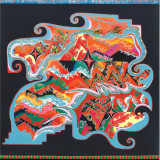
On their sophomore effort Tusky, surrealist duet Robbie & Mona ascend beyond the lo-fi scrawlings of their debut album to something altogether more grandiose. Between the lights down drama of sprawling opener ‘Sensation’, to the ‘roll credits’ coda of closer ‘Always Gonna Be A Dead Man’, Tusky exists as a glitzy, lucid journey playing out before the listener.
While debut album EW captured William Carkeet and Ellie Gray as they were finding their feet with one another, creating Tusky was a wholly symbiotic process from day one. “We got better at knowing what each other wanted,” William offers. “This was the album that we were trying to make from the beginning.”
Simultaneously evoking multiple eras of music, the album drifts through worlds of synth pop, jazz, trap, drill, ballroom waltz and leftfield electronica, with the scatterbrain sound palette melded by a peppering of instrumental motifs and William’s addiction to sampling sounds across multiple tracks. “I wanted there to be this weird dimensional thing going on,” William explains, “where songs from the album are playing in multiple places.”
The record sees an expansive cast of musicians assembled, with a much heavier focus on live instrumentation than previous outings. Alongside the expected fare of crackly synths, samplers and drum machines, Tusky gets its glossy sheen from a rich tapestry of jazz drums, double bass, grand piano and saxophone.
Most of the tracks are laden with improvised saxophone from Campbell Baum (Sorry, Broadside Hacks) and Ben Vince (Housewives, Joy Orbison), much of which was scrambled by William in post-production, lifting scraps from one song and layering them atop an entirely different track. Elsewhere, session musicians were cherry picked, including Bingo Fury, his drummer Henry Terrett, and a string ensemble led by Caelia Lunniss and Jo Silverston (Spindle Ensemble).
Most surprising is a rap feature from Monika (of South-East London collective Nukuluk), who brings album centrepiece ‘Mildred’ to new heights with a fiery verse on pain. Aside from being the most unlikely addendum to a sombre piano ballad, it demonstrates Robbie & Mona’s natural state of playfulness, forever following emotions and sensuality over any notion of traditional compositional boundaries.
Many of Tusky's tracks owe their inception to cinema, be it the soundtrack to Betty Blue, the glowing films of Wim Wenders, or the surprising parallels between La Belle Et La Bete and Bad Boys. Equally, much of Robbie & Mona's new-found sense of tension and spectacle comes from William’s recent work soundtracking independent filmmakers, while Ellie gave greater priority to threading a narrative through her stream of consciousness writing style.
In all its majesty, Tusky celebrates creativity with creation. “If you begin to see fiction as real, you can reincarnate and become different things. You can grow,” Ellie implores. “Nothing stays the same. You can shed old characters in yourself. There’s great joy in that.”
Search:who else
'BATSUMI’s 1974 classic. Repressed at Pallas in Germany on 180g black vinyl. Cover printed on reverse board and includes printed inner sleeve with liner notes from Francis Gooding. Initial copies shipped with exclusive 30cm x 30cm print of Batsumi performing in 1974.
Batsumi is a masterpiece of spiritualised afro-jazz, and a prodigious singularity in the South African jazz canon. There is nothing else on record from the period that has the deep, resonant urgency of the Batsumi sound, a reverb-drenched, formidably focused pulse, underpinned by the tight-locked interplay of traditional and trap drums, and pushed on by the throb of Zulu Bidi’s mesmeric bass figures. The warm notes of Johnny Mothopeng’s guitar complete a soundscape that is at once closely packed with sonic texture and simultaneously vibrating with open space, and in whose shimmer and haze Themba Koyana and Tom Masemola soar. A sonorous echo emanating from an ancient well, reverberant with jazz ghosts and warmed by the heat of soul and pop, Batsumi is nothing short of revelatory.
Many groups from this period did not issue recordings at all, and Batsumi are unusual in even having left an official recorded legacy. Out of print since the 1970s, and never issued outside of South African in its entirety, Batsumi is a landmark South African jazz recording, and a key musical document of its time.'
The legendary Ultramagnetic MC touches down in London for a one-away collab with We Are The Horsemen, featuring the one and only Kaidi Tatham.
What you sayin’, Kool Keith...? Enter your spaceship for a transatlantic meeting of minds as the legendary Kool Keith links up with We Are The Horsemen (Outernational Sounds head honcho Harvinder Singh Nagi and producer Sub One) and the great Kaidi Tatham for a future-jazz flavoured trip through the great MC’s London adventures.
Kool Keith needs no introduction to hip-hop heads worldwide. As one of the greatest MCs ever to touch the mic, Keith has never stopped innovating and progressing. From his days in the seminal 1980s Bronx unit Ultramagnetic MCs, through his pioneering development of new conceptual characters and styles in the 1990s (Big Willie Smith, Dr. Octagon, Dr. Dooom, Black Elvis), to his continuous run of radically independent recordings in the 2000s and beyond, Kool Keith defines rap longevity and artistic originality. No one else in hip hop has a comparable record of continuous reinvention, conceptual boldness, and stylistic panache.
And after four decades in rap, Keith is still one of the hardest working rappers in the game, perpetually seeking new sounds to spit on and new collaborators from across the musical spectrum. Fresh off the acclaim for his new Black Elvis 2 release, the protean MC has touched down on Outernational Sounds for a unique collab with We Are The Horsemen and Kaidi Tatham. ‘London Is The Place’ finds Keith riding the Horsemen’s atmospheric, break-toughened riddim and reaching back in time to drop kaleidoscopic, stream-of-consciousness impressions of the Ultramagnetic MCs infamous 1989 tour, before flashing forward to the present in order to namecheck Honest Jons Records, saxophone star Nubiya Garcia and master keyboardist and broken beat pioneer Kaidi Tatham, who contributes trademark jazz keys and bruk steez to the AA side remix. The 12” is closed out by a third version, the Horsemen’s own Kool Jazz Mix, bringing see- sawing organ stabs and a neck-snapping Ultra-sampling hook.
Kool Keith, Kaidi Tatham and We Are The Horsemen, taking it higher and overcoming the pressure with ‘music so progressive’, to quote Keith himself! Limited press – don’t sleep on this one!!
Salt Peter, by Ruby (AKA Lesley Rankine), was originally released in 1995 to critical acclaim under the trip-hop and electronica tags,
quickly becoming the soundtrack to many a student, clubber and vinyl junkie’s life.
Roll on 25 years to find Rankine & her brother, Scott Firth (bassist with PIL) in Covid lockdown together following the death of their mother. What else would they do but make some music?
So, while noodling around with some ideas one night, Rankine remade one of her old Salt Peter songs and was so pleased with the result she decided to do the whole album.
Rather than simply remixing or remastering the original album she decided to rebuild it from the ground up with completely new production, arrangements and vocals.
With Scott’s additional production, engineering and mixing, Salt Peter 25 is a completely different album from the original, but still with Rankine’s distinctive vocals
and her ear for the quirky and the dark. With densely textured sounds and uncompromising arrangements, Salt Peter has matured into an exciting new and unique animal.
Salt Peter 25 is a deeply personal album, created during a very difficult time and so the cover, fittingly, features a striking photo of Lesley and Scotts’ mother,
as well as other family photos, again echoing the aesthetics of the original album.
Now released on delicious orange double vinyl with a beautiful gatefold sleeve, featuring additional art by Toronto based designer, Henry Faber.
Lewis II was the follow up to Lewis Taylor's epochal, self-titled debut album. It was initially released in 2000 and this double LP release, its first ever vinyl edition, has been heavily anticipated for nearly a quarter of a century. It's often years before most listeners catch up with an album's breathtaking vision and devastating execution, and so it has proved with Lewis II; it stands up exceptionally well today.
After Island rejected Lewis Taylor's second release (later released as The Lost Album), he returned to the studio to record Lewis II. Less esoteric than Lewis Taylor, Lewis II is a more polished, sophisticated funk and mature uptempo soul than the dark psych-soul of his debut. The production, whilst slicker, is a bit tougher, with more crisp, R&B-flavoured grooves and head-nod beats and more bass pumping up his voice. The vocal intensity present on album number one doesn't abate. Indeed, as Lewis himself noted, "my voice is better on Lewis II and the vocals are high in the mix."
The moody funk of "Party" sounds like a mad blend of Riot-era Sly Stone and Brian Wilson. It rides a stuttering drum machine groove with acapella harmony vocals arriving halfway through to stay for the duration. "My Aching Heart", with its clean, slick, late 90s R&B drums, could surely have been a single. Perhaps Lewis's idiosyncratic melodies would've been too challenging for the charts. Lewis *had hoped* "You Make Me Wanna" would be a single but the dank, organ-drenched groove, coupled with the growling eroticism of Lewis's vocals would've, again, made this beyond the pale for most mainstream music fans. Somewhat incongruous acidic synths and bleeps give way to a laconic summertime groove on breezy highlight "The Way You Done Me", all funky acoustic guitars and stunning, good-time vocals. Sumptuous ballad "Satisfied", a real fan favourite, marries unusual instrumentation with classic soul-ballad structure and closes with a monster guitar solo which almost out-Princes Prince in its gritty melodicism, set against sweeping strings of real majesty. Prog-Funk-Rock!
The dubbed-out, spaced-out "Never Gonna Be My Woman" is the closest the album comes to classic D’Angeloesque neo-soul, with echoes of the esoteric funk featured across Maxwell's contemporaneous Embrya. But what follows is on some next level business. As Lewis's biggest fan, Geoffrey Scull, noted, "the "I'm On The Floor" / "Lewis II" / "Into You" song cycle stacks up against any other consecutive 15 minutes of recorded music, ever!" And who are we to argue with that? These could've been hits for Justin Timberlake during his fascinating Timbaland-collaborating days, such is the sonic and textural pop experimentation at play here. The extraordinary title track sounds like an outtake from Marvin Gaye’s Trouble Man and spends its last third as a searingly dark piano-led psychedelic-guitar-crunching soul instrumental. Just astounding. And then. AND THEN! The way it segues into, er, "Into You" is just straight up genius. Goosebumps galore on this one, no words can describe its celestial brilliance. Just kick back and be beguiled by the "Let me come on over again" refrain that ornately adorns its sensational coda. Phew.
The swoonsome, lovelorn ballad "Blue Eyes", apparently written in the spirit of Marvin’s "Vulnerable", is a lush, slow swinger with some gorgeous noir touches. To close, Lewis completely retools Jeff Buckley’s beloved, beautiful "Everybody Here Wants You" and, while talking some liberties, even manages to surpass the original. Yes, really! With soaring, fiery vocals set against icy piano and psychedelic guitars, Lewis recasts Buckley's effort as dramatic, ethereal soul.
When it came to translating the original CD booklet into a 12 inch LP sleeve, thanks to some suggestions from Cally Callomon (head of Island’s art department, who designed all the sleeves for Lewis’s two Island albums and their singles) and his trusting us with his “Lewis Taylor” folder full of various negatives, test prints and whatever else he was able to salvage from the old Island art department, we’ve gotten pretty close to what the original LP sleeve would’ve looked like if it existed. Simon Francis’s vinyl mastering, presents the eleven tracks over a double LP so, as ever, the record sounds outstandingly good. The records have been cut by Cicely Balston at Air Studios and pressed at Record Industry.
'Dream From The Deep Well' is the new album from celebrated Irish singer songwriter Brigid Mae Power. Recognised as a purveyor of dreamier pop with folky leanings, this new album is a departure; a unique marriage of traditional stylings and very modern melodies; a breath-taking soundtrack which underpins her gorgeous vocal. Filled with personal tales of offspring and grandparents, the lovelorn and the lost, it's the essence of re-imagined folk music, from the traditional intro and outro that act as bookends. It's folk music, but not as we know it. In these ever-confusing and often annoying times, Brigid brings us modern folk for modern folk, with her evocative vocal, doubling back on itself with strings, steel guitar, horns and mellotron adding to its baroque loveliness. It's waving back at her rootsy past, daubing new colours on a much-loved canvas. 'Dream From The Deep Well' is a new visionary beginning from a gifted songwriter. Elsewhere, there's the lovelorn longing of her version of Tim Buckley's 'I Must Have Been Blind', alongside a moving tribute to the late Ashling Murphy, a 23-year-old Irish primary school teacher and traditional Irish musician who was attacked and killed while jogging along the Grand Canal just outside Tullamore, County Offaly. It's a harrowing story, delivered with overwhelming compassion. In the best tradition of old school folk music, it opens up a pressing issue to a wider audience. It's an album that's politically primed and socially aware; a broadside for us all, this is Brigid Mae Power's most complete album yet. "Her haunting voice, an instrument that raises the everyday to a near-mystical realm." The Guardian. "The Irish singer-songwriter flits between past and present; between traditional and modern forms; between the heaven in her voice and the earthbound epiphanies of her words." Pitchfork
STEB delivers a brand new single featuring Dario Rossi and remixes from Marvin & Guy, Feel Fly and Van Der Kirche & THC. Italian STEB is no stranger to cooking up floor filling hits. For this latest offering he works with Dario Rossi, a renowned drummer with a signature style like no one else.
Their 'Kauris 1979' is a beautifully deep house track with shimmering chords and twinkling melodies. Echoing claps help drive this most classy of tunes forwards under subtle vocal sounds and the whole atmosphere is full of late-night magic.
The vibrant Marvin & Guy remix has a cosmic edge and that's the case here with this excellent remix. It layers in mysterious whistling leads and 80s synth sounds as well as a rasping bassline that brings a different perspective than the original.
Feel Fly remix brings all that alongside some feel-good piano chords that light up a punchy nineties house bassline.
Van Der Kirche & THC then join forces for an expansive broken beat remix with crisp hits and silky bass all making for a sublime trip.
This is is a package packed with disco-tinged grooves for late-night dance floors.
200 copies ~ Vinyl 180 grams ~ No Repress!
- 1: The Wild Horses Of The Revolution Have Arrived Without A Knight
- 2: Central Crisis Management Cell
- 3: Painful Memories From The Past Need To Be Acknowledged
- 4: Dancing On The Head Of An Eagle
- 5: He Worked With His Eyes Lowered
- 6: Starting Something You’re Not Able To Finish
- 7: Diplomatic Cocktail Circuit
Repress!
N0!zy blighter Russell Haswell returns to Diagonal 5 years after his label debut with a spontaneously combusting follow-up to ’37 Minute Workout’ generated again from a mix of analog/digital synths and modular systems edited on a computer. It was inspired by a visit to CERN, The European Organisation for Nuclear Research, in Geneva; and dinner with Ted Nelson, whose theories of interwingularity and transclusion chimed with the direction recordings took.There are few artists who can genuinely make music that sounds like your needle and/or record is melting, but Russell Haswell is one of them. His 2nd volume of extremely kinky calisthenics is a potent example of daring to be different in a world where exponentially increasing production options are leading producers of all stripes to the exact same conclusions. But, with thanks to Russell’s iconoclastic intent, restless nature and ascetic aesthetics, he still sounds quite like nobody else, and, even better yet, doesn’t give a shit if you like it or not. For the record (this one in particular), we’re all over it like a hot rash.
Since reincorporating his early love of freestyle electro and Industrial dance music into his patented n0!ze matrices circa the 1st volume of ’37 Minute Workout’, Russell has steered that rhythm-driven style into a string of fizzy bangers for Diagonal and even applied it to his production for Consumer Electronics with typically radical results. Russell’s 2nd volume of ’37 Minute Workout’ is cut from similarly (but never the same) ragged material as the first batch, and spits, kicks and claws with equal amounts of eething, pent energy and rambunctiousness ready to jab the ‘floor in the eye or dissolve a party where needed.
Crowbarring cues ranging from the Latin Rascals to Incapacitants and Jeff Mills into 7 wickedly awkward designs, Haswell keeps his avant aerobics radically irregular as he hops from the tendon-twitching angularity of ‘The Wild Horses of the Revolution have arrived Without Knight’ to steel-hoofed clatter in ‘Central Crisis Management Cell’ and the lacquer-eating dynamics of ‘Painful
Memories From The Past Need To Be Acknowledged’, before toning a proper nasty acid special in the UR inversion ‘Dancing on the Head of an Eagle’, and seemingly sucking your brain out thru a straw with ‘Starting Something You’re Not Able To Finish’, with the dry witted, skeletal jazz-funk squirm of ‘Diplomatic Cocktail Circuit’ closing the party down in style.
Richard Lamb’s second and (presumably) final release under this moniker is a bit of a special one. Lamb starts off with ‘Salt Lick’. A track with beautiful, lush, sunny sounds that lure you into an unexpected world of electro, heavy bass and more dance orientated tracks like ‘A Life In Harmony’.
Following up his first EP ‘Automatic Tango’ on his own Montreal based Temple imprint, there’s still hints of early Moog greasiness but overall it’s a more decisive production compared to the previous one. Intricately layered percussion mixed together with dreamy pads take you on a journey to a hidden Utopia where tight arrangements and tribal-esque rhythms dictate the pace. Once more we are shown how versatile Lamb’s productions are and how he juggles genres freely, ranging from dub to electronica, experimental, idm and techno.
The second side of this EP features two remixes by non other than Norwegian DJ and producer DJ Sotofett. A heavyweight in the electronic music scene who needs little introduction takes on the EP’s title track ‘A Life In Harmony’ and turns it into two electro-acid pieces ready to tear up any dance floor, or anything else for that matter. Surrender to the acid and indulge in these masterful tracks.
Merging a dynamic curio of melodic guitars, disconcerting monologues and a rhythm section both technical and unruly, London’s Legss create a wholly unique and mesmerising sound. New EP Fester is a literary and disarmingly lyrical collection of art-rock songs laden with ideas and sun-licked beneath the bus smog of anxious skies.
Even when leaning into more melodic territory, there’s a pervasive uneasiness that underpins both the vocals and instrumentation. Just as you drift into the relaxing arpeggio flow, vocalist Ned Green’s soft soliloquy accelerates to an exasperated yelp and we’re jolted by discordant noise-rock stabs dragging us into Legss’ deliciously feverish and poetic world.
“The lyrics were written in the summer, when you’re sun-drunk and romantic, and the buses look like they’re kissing as they cross each other, and everyone’s got a cold sore. But beneath all the sunny games there’s a bittersweet desire to be someone or something else.” - Legss
Fresh from supporting the likes of Pom Poko and Hotel Lux, Legss release Fester via The State51 Conspiracy on 16th June. Pressed on 12” black vinyl in a sealed polybag liner.
The next chapter of the Natural Information Society is here. Since Time Is Gravity, credited to Natural Information Society Community Ensemble with Ari Brown, presents a newly expanded manifestation of acclaimed composer & multi-instrumentalist Joshua Abrams nearly 15 year, 7 albums &-counting flagship ensemble. Joining the core NIS of Abrams (guimbri & bass), Lisa Alvarado (harmonium) Mikel Patrick Avery (drums) & Jason Stein (bass clarinet) are Hamid Drake (percussion), Josh Berman & Ben Lamar Gay (cornets), Nick Mazzarella & Mai Sugimoto (alto saxophones & flute), Kara Bershad (harp) & Chicago living legend of the tenor saxophone Ari Brown. Recorded live to tape at Electrical Audio & The Graham Foundation, cover painting Vibratory Cartography: Nepantla, by Lisa Alvarado. 2xLP on Eremite USA, 2xLP & CD on Aguirre/Eremite Europe. Out 14-04.
Since first developing Natural Information Society in 2010, Joshua Abrams has been gradually expanding the group’s conceptual underpinnings, its musical references & the sheer number of the group’s members. Its music is, in a sense, an expansive form of minimalism, based in repeated & overlaid rhythmic patterns, ostinatos & modality. Its roots, its scale & its meaning become clearer in time. If time is gravity, it also allows us to carry more. Having begun as fundamentally a rhythm section with Abrams’ guimbri at its core, the version here can stretch to a tentet, including six horns.
Abrams has been expanding his minimalism gradually, but he has long understood a key to minimalism’s potential: the breadth of its roots in the late 1950s & early 1960s, ranging from the dissatisfaction of young European-stream composers with the limitations of serialism to the simultaneous dissatisfaction of jazz musicians with the dense harmonic vocabulary of bop & hard bop. The former began exploring rhythmic complexity & narrow tonal palates in place of harmonic abstraction (Steve Reich’s Drumming, Philip Glass’ Music with Changing Parts; perhaps above all Terry Riley’s In C & his late ‘60s all-night organ & loop concerts); the later reduced dense chord changes to scales (signally with Miles Davis' Kind of Blue, but rapidly expanding with John Coltrane’s vast project). In the 1950s the LP record opened the world with documentation of Asian & African musics, key influences on both minimalists & jazz musicians. If John Coltrane’s soprano saxophone suggested the keening shehnai of Bismillah Khan, the instrument was rapidly taken up by two key minimalists, LaMonte Young & Riley, similarly appreciative of its flexible intonation, the same thing that kept it out of big bands.
If the guimbri, the North African hide-covered lute that Abrams plays with NIS, involves a rich tradition of hypnotic healing music associated with the Gnawa people, Abrams’ music also touches on other musics as well — other depths, memories & healings, different drones, rhythms & modes. As the group expands on Since Time Is Gravity, he has made certain jazz traditions in the same stream more explicit as well. If there is a mystical & elastic quality involved in the experience of time, both in direction & duration, you will catch it here. The parts for the choir of winds expand on the roles of Abrams’ guimbri, Mikel Patrick Avery & Hamid Drake’s percussion & Lisa Alvarado’s harmonium: at times, the winds are almost looping in the tentet version, each hitting a repeating note in turn, at once drone & distinct inflection on temporal sequence. The brilliance of the work resides in Abrams’ compositions, the NIS’ intuitive execution & in Ari Brown’s singular embodiment of the great tenor saxophone tradition, including the oracular genius of Eddie “Lockjaw” Davis, & Yusef Lateef. The three pieces by the expanded NIS featuring Brown —the opening “Moontide Chorus” & “Is” & the ultimate “Gravity”— have an immediate impact, & togther might be considered a kind of concerto for tenor saxophone. Here Brown presses almost indistinguishably from composed melody to improvised speech, getting so close to language that he might have a text. Everything here is a sign. Note the tap of the Rhythm Ace that links “Moontide Chorus” to “Is”, the attentive heart always present, even when signed by a machine. There’s a link here to the methodologies & meanings of dub music & the linear & vertical collage of beats, textures & tongues: treated with reverence, a sample of a beat-box can be as soulful, as hypnotic, as a mbira or a tamboura. If those pieces with Brown are heard as a suspended concerto, the three embrace & enfold the other works, like the sepals of a flower. That placement will also touch on the mysteries of our perception of time.
Particularly in “Is”, but elsewhere as well, a phenomenon of transcendence arises in which time appears to be tripartite, at once moving backwards & forwards & standing still. This is an act of technical brilliance certainly, but also an illumination of music’s ability to represent temporal consciousness through polymetrics. This particular listener has only heard it before in a few places, including the horn shouts & bowed basses of Coltrane’s Africa, in moments of Charles Mingus’ The Black Saint & the Sinner Lady, in certain pieces where tapes were literally running backwards, & earlier still in Dizzy Gillespie’s Cubana Be, Cubana Bop, in which the composer George Russell & conguero Chano Pozo found a music that spoke at once in the voices of Stravinsky’s Rite of Spring & the vestigial rites, rhythms & songs of the Yoruba language & Santeria religion of inland Cuba.
In Joshua Abrams’ compositions & the realization of them by the NIS, in the time of one’s close listening & memory thereof, distinctions between the “natural” & the “social”, the “quotidian” & the “transcendent” are erased, suspended or perhaps irrelevant. Consider two of the ensemble pieces, one named for nature, the other social science. In “Murmuration” the repeated wind figures of flute & alto saxophone combine with the interlocking patterns of harp, guimbri & frame drum (tar) to create a perfect moving stillness, not an imitation but a witness to the miracle of the starlings’ astonishing collective art, a surfeit of beauty that might be the ultimate defense tactic.
“Stigmergy” takes its name & concept from the Occupy movement’s Heather Marsh, who proposes a social system based on a cooperative rather than competitive models, one in which ideas are freely contributed & developed as ideas rather than an individual’s property. In its form, Abrams’ “Stigmergy” is the closes thing to traditional jazz, a series of accompanied solos by each of the wind players. However, the composed accompaniment is a radically collectivist notion: a repeated rhythmic figure, call it ostinato or riff, in which the different winds each play only a note or two of the figure, a concept both more collectivist & individualistic in its conception than any typical unison figure. It suggests another of the underlying recognitions that propel the Natural Information Society, the group as social organism, the teleology of hypnotic anarchy, all parts in place, functioning systematically, evolving & expressing itself, its nature & society, as a transformative organism.
George Lewis has described music as “a space for reflection on the human condition”. This suggests that, rather than a “distraction”, at least some music might serve as a distraction from distraction. It’s a focus, a clarity, a awareness, an external invitation to interiority, as if music itself is a model for form & contemplation, an organism contemplating for us or as us. If that is a possibility, & I am sure I have heard such musics, than this music is among them. How many of our rhythms, melodies & harmonies (cultural, historical, biological, psychic) might such music carry, translate & transform in the particulate ecstasy of our own murmuration? (Stuart Broomer, April 2022)
*The product of a move from South Carolina to Berkeley, CA and the subsequent extended separation from loved ones, Toro Y Moi's third full-length, Anything in Return, puts Chaz Bundick right in the middle of the producer/songwriter dichotomy that his first two albums established.
*There's a pervasive sense of peace with his tendency to dabble in both sides of the modern music-making spectrum, and he sounds comfortable engaging in intuitive pop production and putting forth the impression of unmediated id.
*The producer's hand is prominent- not least in the sampled "yeah"s and "uh"s that give the album a hip-hop-indebted confidence- and many of the songs feature the 4/4 beats and deftly employed effects usually associated with house music. Tracks like "High Living" and "Day One" show a considerably Californian influence, their languid funk redolent of a West Coast temperament, and elsewhere- not least on lead single, "So Many Details"- the record plays with darker atmospheres than we're used to hearing from Toro Y Moi. Sounding quite assured in what some may call this songwriter's return to producer-hood, Anything in Return is Bundick uninhibited by issues of genre, an album that feels like the artist's essence.
*Born and raised in Columbia, South Carolina, Chaz Bundick has been toying with various musical projects since early adolescence. Having spent his formative years playing in punk and indie rock acts, his protean Toro Y Moi project has been his vessel for further musical exploration since 2001. During his time spent studying graphic design at the University of South Carolina, Chaz became increasingly focused on his solo work, incorporating electronics and allowing a wider range of influences- French house, Brian Wilson's pop, 80s R&B, and Stones Throw hip-hop- to show up in his music. By the time he graduated in spring 2009, Chaz had refined his sound to something all his own. Music journals across the board touted his hazy recordings as the sound of the summer, and he released his debut album, Causers of This in early 2010.
*Since then, Bundick has proven himself to be not just a prolific musician, but a diverse one as well, letting each successive release broaden the scope of the Toro Y Moi oeuvre. The funky psych-pop of 2011's Underneath the Pine evinced an artist who could create similar atmospheres even without the aid of source material and drum machines. His Freaking Out EP, a handful of singles and remixes, and a retrospective box-set plot points all along the producer/songwriter spectrum in which he's worked since his debut, and Anything In Return is another exciting offering that shows he's still not ready to settle into any one genre.
Donovan Woods’ album is a study in contrasts, as one would expect from its name: Both Ways. That push-and-pull, especially in relationships, has long been Woods’ stock in trade. As the lead track of Both Ways, “Good Lover” unfolds with acoustic instruments and Woods’ quietly compelling delivery -- not what a listener might expect from the title alone. That masterful perspective has led to nominations for the Polaris Prize and the Juno Awards. In addition, his single “What Kind of Love Is That?” climbed to No. 1 on the CBC Top 20 Chart, while his catalog has accrued over 45 million streams. Woods is also a notable songwriter in Nashville with credits by Billy Currington, Charles Kelley, Tim McGraw and Charlie Worsham. NPR Music stated, "There are very few writers who can make you laugh and break your heart in the same song.” No Depression noted that Woods’ style is “as fresh and captivating as any out there.” Asked if he writes differently for himself than he does for other artists, Woods replies, “I used to think that there was a difference. I know now there's no difference. You just try to write the best thing. Everything I wrote where I said, ‘This is mine and I’m going to put it out’ – every song like that gets recorded by somebody else. I know now that I just try and write a song that I would want to do.”
EXTREME return in 2023 with their brand new studio album “SIX”. The multi-million selling hard rockers present 12 tracks ranging from funk-tinged bangers to soaring ballads as only EXTREME can deliver. Spearheaded by the songwriting team of vocalist Gary Cherone and guitarist Nuno Bettencourt (who blessed the world with chart toppers like “More Than Words” and “Hole Hearted”), “SIX“ is an essential addition to EXTREME’s discography. The album opener and first single “RISE” will immediately fire up legions of anxious fans with its signature riff. Elsewhere, “OTHER SIDE OF THE RAINBOW” showcases EXTREME’s gift for passionate acoustic magic. EXTREME are back with “SIX“ – everything the fans have been waiting for. Formats; CD, 2LP Black, 2LP Ltd Transparent, 2LP Ltd Red & Black Marble.
'Malombo music is an indigenous kind of music. If you listen to it, you can feel that it can heal you, if you’ve got something wrong. It’s healing music.'
Lucky Ranku
"Lucas ‘Lucky’ Madumetja Ranku (1941-2016) was one of the greatest African guitarists of his generation. He first made his name with the Malombo Jazz Makers – the successor group to the legendary Malombo Jazzmen, formed in Mamelodi township by guitarist Philip Tabane, drummer Julian Bahula and flautist Abbey Cindi. When Tabane left the Jazzmen in 1965, Bahula and Cindi called on Lucky to replace him, and the Malombo Jazz Makers were born. Building on the popularity and success of the original Malombo Jazzmen, the Malombo Jazz Makers become immensely popular, touring widely, winning numerous jazz competitions, and recording two successful albums for the Gallo label.
The deep and hypnotic Down Lucky’s Way was their third album. Recorded in 1969, it was the first Malombo Jazz Makers album to feature additional instruments, and the first to feature Abbey Cindi on soprano saxophone as well as flute. But more than anything else, Down Lucky’s Way is a transfixing showcase for Lucky Ranku’s sui generis guitar virtuosity. Quite different from their previous recordings, the album shifted the Jazz Makers’ sound toward hypnotic, extended compositions, layered by organ bass and guitar overdubs. Of all the Malombo Jazz Makers recordings, Down Lucky’s Way is the deepest of mood, and the richest of vision.
However, through one of the erasures that are ubiquitous in South African musical history under apartheid, it seems that the record may not ever have been properly issued. Original copies are outrageously rare – only a few are known among collectors. When we asked Lucky about the album, he was unaware it had ever been released, and had never seen a copy. Perhaps it was pulled; perhaps it was pulped; perhaps Gallo simply took their eye off the ball. Nobody knows, but it is not impossible that the apartheid authorities were involved, for by 1969, the Malombo Jazz Makers were well known to them.
Julian Bahula’s introduction of malopo drums to the music of the original Malombo Jazzmen was a moment of crucial political and cultural radicalism for South African jazz. Traditionally used by BaPedi people for healing, the malopo drums of Malombo music re-centered jazz
around indigenous sounds and culture, and over the next decade, the Malombo Jazz Makers became deeply involved in political opposition to apartheid. Their recovery of indigenous sounds made them the musical standard bearer for the Black Consciousness movement, and they toured South Africa clandestinely with the writer and anti-apartheid activist Steve Biko. They also broke apartheid laws by playing with the white rock group Freedom’s Children, sometimes appearing on stage in masks or made up with UV paint to avoid detection by the authorities; they appeared regularly at the rule-bending Free People’s Concerts organized by David Marks, where Marks’ clever exploitation of a loophole – mixed audiences were prohibited from attending ticketed concerts where anyone was being paid, but the law said nothing about private functions played by artists for free – meant people could come together in defiance of apartheid laws. The notorious Special Branch would raid their concerts; Lucky remembered police storming an auditorium, throwing smoke bombs.
Eventually the political situation became too dangerous, and the band were being actively sought by the police. Though Abbey Cindi remained in South Africa, both Julian Bahula and Lucky Ranku went into political exile in the UK, where Bahula founded the group Jabula with Lucky and former members of Cymande, Steve Scipio and Michael ‘Bami’ Rose. With Jabula, Julian and Lucky worked tirelessly for the anti-apartheid movement, raising funds and awareness all over Europe and in the US. They played with Dudu Pukwana’s Spear in the joint formation Jabula-Spear, and worked together in Bahula’s Jazz Afrika formation, and Bahula organized the first Concert for Mandela in 1984 (it was Jabula that supplied the chorus for The Special A.K.A.’s hit single ‘Nelson Mandela’). Lucky also played and recorded with Chris McGregor’s South African Exiles Thunderbolt group. After the fall of apartheid, they both remained living and working in the UK. In 2012 the South African government awarded Julian Bahula the Gold Order of Ikhamanga for his cultural work during the struggle against apartheid.
Until his death in 2016, Lucky continued to play with countless groups and musicians. putting together the band Township Express with Pinise Saul, and leading his own African Jazz Allstars. The influence of his playing on the international perception of South African township music was immense, and he was held in the highest regard by his peers – ‘Lucky was a guitarist who could bring any house down’, said Michael ‘Bami’ Rose.
But despite his continuous presence on the UK live circuit over four decades, Lucky Ranku never recorded an album as leader. And so as well as restoring an important lost piece of South African musical heritage, Down Lucky’s Way is a precious opportunity to hear one of Africa’s foremost guitarists stretching out, in focus and in his element."
First issue since 1969 of the Malombo Jazz Maker’s unknown third album.
Liner notes featuring interviews with Julian Bahula and Lucky Ranku.
Fully licensed from Julian Bahula.
Baby Rose makes healing music for the aimless and heartbroken. The Grammy-nominated singer/songwriter and producer's uniquely rich voice naturally lends itself to her powerful, smoke-filled ballads lamenting lost loves and broken futures. "I make music to help myself get through things," she says. The piercing honesty and vulnerability she brings to her lyrics in turn helps others process their feelings and find a place of healing. For Rose, it's a journey that's still ongoing. "If I'm going to leave anything behind, it's going to be getting people back to themselves," she says. "As I get back to myself, it's a constant reset: Remember who you are, remember who you want to be." You can hear the impact of this approach in Baby Rose's upcoming second album, Through and Through. Take the hypnotic "Fight Club." Over the track's simmering baseline and crashing cymbals, she declares, "I don't need no one else to show me the way." She describes the song as a "breaking of the shell. It encourages me to just go for it and not care about what anyone else thinks." Therein lies Baby Rose's strength: a determination to live, love, and create on her own terms. "I'm not just a singer with a unique voice," she says. "I'm somebody that has something to say." In the years since releasing her last album, To Myself, Rose has been painstakingly piecing together its sequel. Started almost immediately after its release, her new body of work finds her in a state of musical and personal transition. It's a subtle merging of new sounds_stirring rock, upbeat r&b, psychedelic funk, pop, and soulful ballads_, all mastered through analog tape to make the music feel warmer and all-encompassing. It's also a journey inward as she battles past fear and self-doubt to finally discover_and love_who she is, where she is. Finishing an album with such peace and firm resolution is a first for Rose, but she makes it clear: She's nowhere near done writing her story. "I think as long as I'm being raw and trying to push past my comfort zone, it will feel rewarding," she says. "I don't want to be the type that doesn't take risks because I'm afraid. I have to trust that as long as the music is honest and innovative, it'll be timeless."
Murmer is the long-standing project for Estonian field recordist and composer Patrick McGinley, and in Tether, The Helen Scarsdale Agency welcomes Murmer back to our roster, over a decade since he graced us with his last production for the Agency. His field recordings often center upon the amplification and activation of resonance from a particular space, landscape, or object. Such sounds emerge from a condition as begin fleeting, inconsequential, or ephemeral and explode into that which alien, sublime, and profound. Here lies the tremendous prowess of the contact microphone, as wielded by an accomplished musician! The source material cited by McGinley includes cables, fences, wires, and vents.
There is a heft to many of these sounds as heard throughout all of "Taevast" with deep throbbing pulsations from arctic wind generating subharmonic patterns upon thick high-tension wires. Elsewhere the subtle dissonance from a rasping cooling fan blooms into a brooding ambience that is sublimely rich in its metallic timbres and complex reverberations. McGingley has long been an exemplary artist in the field of phonography even as he is less prolific than others. On Tether, he has produced a majestic if occasionally foreboding work on par with the mythic wire recordings of Alan Lamb, Jacob Kirkegaard's haunted resonance from Chernobyl, and much of the Touch catalogue for that matter!
Patrick McGingley on Tether:
In 2006, I made a collection of recordings at a mobile phone mast in Mooste, southeast Estonia. It is a guyed tower, 80 meters tall, affixed to 3 support points with heavy cables. I attached my self-made contact microphones to these cables with poster tack, and spent many hours over several weeks recording the various wind and weather variances (it was summer), and the birds that passed or settled on the tower or cables. This was one of my first visits to estonia, where i now live, and one of the things that marked me about that experience was the access: the tower had no fences or protections around it (I have not been back there recently to answer my own question of whether or not this is still the case); it stands in the middle of a field of tall grass along a dirt road in the countryside, just out of view of the few nearby houses, and during all the hours I spent there I was never disturbed or shooed away.
For more than 16 years, I have been thinking about this location and these recordings, and have made several attempts to work with them. I have used the sounds in installations a handful of times, and uploaded one short edit to the Aporee soundmaps, but have never managed to use them in any composed work. They always seemed too big for any structure I could provide them, whether I left them on their own, or partnered them with other sounds. Finally, in 2019, after putting them down and picking them up again repeatedly over so many years, they seemed to allow me in, although it took me another few years before they were happy with what I could offer. They stand now not quite alone - the majority of the layered sounds in the piece come from various edits of those cable recordings, but I added two other contrasting sounds, related to one another: one is snowflakes landing delicately on a plastic cakebox with microphones inside it, and the other is a frosted field of grass thawing on a lightly warming autumn morning (both these recordings can also be heard on their own on the Aporee maps).
Coming back to those cables brought to mind so many other wind-driven sounds that I had spent time with and recorded, but never returned to, that I began digging through my archives looking for them. I ended up with a pool of sounds from resonant wires, cables, fences, poles, fans, and vents, which became the basis for the 2nd work on this release. One of these sounds is among the first sounds I ever recorded, possibly within a month or so of buying my first microphone and minidisc recorder: the rhythmic fan of a beer cooler in a pub where I worked in North London in 1999. Other sounds in the piece include another phone tower, recorded on the northern coast of France in 2008, a telephone pole recorded in the Beaujolais region in 2010, the drone of ventilator fans at a factory in Tezno, Slovenia in 2012, an electric sheep fence in the Scottish borders in 2013, a hanging wire in a storage space in Rovaniemi, Finland in 2016, and, with no relation to cables or wind at all, calcium deposits being cleaned from the inside of an electric kettle here in Estonia in 2019.
I offer these two new pieces as my first solo publication since 2018, the first release on a physical medium since 2016. No one has ever accused me of working too fast, or being too prolific. I have a need, it seems, to leave a physical space of time around my work, before I can consider it 'finished'. Perhaps it is a simple need to forget how I did something, or that I did something; perhaps I have a need to be able to hear a work as a first-time listener would, before I can consider it ready for such an encounter. In some part of my mind I have to forget it before I can let it go. Well, I've just about forgotten that London beer cooler now, and that walk in the Beaujolais (with my father, who has since passed away), and that sheep fence next to our campsite in the borders, and that kettle that is now leaky. So I guess it's time.
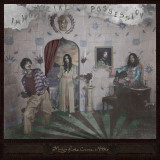
Mercy Of The Crane Folk’ is the beautifully accomplished second album from Athens GA’s Immaterial Possession. A theatrical soundscape littered with subconscious flashbacks, retro keyboard flurries, wandering Morricone-esque guitar and dreamy Sumac-like harmonies. Featuring the ethereal eerie dream pop of former artist commune residents Cooper Holmes and Madeline Polites, with drummer John Spiegel and Elephant 6 descendant Kiran Fernandes (keyboards, clarinets, flutes). Additional contributions come from drummer Jon Vogt who can be heard on ‘Mercy Of The Crane Folk’ and ‘Birth Of Queen Croaker’. It’s a haunting and immersive trip into the inner psyche of these nomadic soothsayers; a psychedelic dance party from a half-lit underground world; breathlessly eerie and all consuming; a salubrious sojourn that sounds like nothing else. Filled with a kind of peculiar optimistic uncertainty that any quest to make sense of a drowsy recollection of simpler and far better times would have; ‘Mercy Of The Crane Folk’ is soft and serene summoning up a fanciful folkloric place where, undoubtedly, the mysterious crane flock prosper
Irish-born, Manchester-based Kerrie is a multi-disciplinary artist, incorporating live sets, DJing, producing and running her label Dark Machine Funk across her repertoire of work. Now, Kerrie follows up last year's 'Raw Regimen' (BP063) with a second EP for James Ruskin's seminal Blueprint Records.
Having garnered a rich musical education through working at and holding a DJ residency for one of the UK's most respected record shops Eastern Bloc, Kerrie's in-depth knowledge and unwavering dedication to music shines through her notable back catalogue and bolshy, unforgiving DJ and Live sets. Honing her craft for over a decade, Kerrie has played worldwide in celebrated venues such as Tresor, Berghain, fabric, FOLD, Elsewhere NYC and festivals including Freedom Medellin, Freerotation, Drift and Basilar.
First learning to mix via her brother's turntables in the early 2000s, it wasn't until 2009 that Kerrie invested in her own set-up and built an extensive record collection, covering everything from ambient, electronic, house, EBM, acid, electro, and her go-to genre, techno. Kerrie delivers tough moods from the turntables, as conveyed in her mixes for Reclaim Your City, Bassiani, SLAM and Crack, where she carefully blended high-energy styles of UK, Detroit, and European techno, many of which stem from the 90s and the 00s. It's frequent to hear Kerrie weave broken elements into her mixes too, chopping up the 4/4 groove at just the right moment to keep things propulsive. Kerrie's Live sets are fast becoming renowned for their trippy motifs and high impact on the dancefloor, applauded by Berlin's long-running club Tresor, where she made several appearances with her Elektron machines. Kerrie's Live set at Freerotation in 2019 was one of the festival's most talked-about debuts, and this year, Kerrie will return to and debut at multiple festivals and clubs across Europe and the Americas.
Following well-received releases on labels such as Don't Be Afraid, Cultivated Electronics, I Love Acid and Symbolism, Kerrie launched her imprint Dark Machine Funk DMF in 2020. The label homes her distinctly raw aesthetic and honours her love for dark, gritty, metallic and industrial sounds melded with elements of funk, heavily influenced by second-wave Detroit artists, UK techno and music by some of her favourite artists; James Ruskin, Blawan and Surgeon. Kerrie's first release on DMF, 'Inner Space PT1', was praised by Resident Advisor, who credited her ability to make "lean, fierce techno that knows how to groove."
2022 was a watershed year for Kerrie's productions. She debuted on the monumental UK techno label Blueprint with her EP 'Raw Regimen', which landed acclaimed reviews. Truly welcomed to the Blueprint family, Kerrie shares her second EP on the label in May and joins the crew at Blueprint showcases around the globe. This year marks the release of Kerrie's 10th EP on vinyl, and considering her consistent output on DMF, Blueprint and many more labels, the producer shows no sign of slowing down.
Coming to international prominence in more recent years, regardless of her decade-long tenure in Manchester's vibrant scene, Kerrie is deeply invested in the culture of electronic music, starting from her teenage era as a raver in Ireland up to her innovative projects today. In 2017, she founded Eastern Bloc's in-house event space to nurture local talent, which remains at the heart of Manchester's music community. Having ended her 11-year stint at the shop in 2023 to fully commit to the studio and accommodate her increasingly busy tour schedule, Kerrie is forging a long-lasting path fuelled by drive, passion, authenticity and a community-first way of thinking.