Ken Jacobs, an essential figure of avant-garde cinema, developed the »Nervous Magic Lantern« in the 1960s — a self-made apparatus containing a spinning shutter, a light source, and lenses set in a wooden frame. Hand-painted circular slides, gently moved by hand, produce flickering imagery: geometric patterns, Rorschach-like inkblots, and three-dimensional forms that seem to float beyond the screen. These hallucinatory visions challenge perception and suggest what Jacobs once called »a whole new play of appearances«.
Unlike Jacobs’ politically charged works, the »Nervous Magic Lantern« is patently abstract, examining how the brain regulates perception. For these performances, Jacobs requested »sounds of daily life« — environmental recordings that anchor the phantasmagoria in reality. Field tapes of Chinatown streets, conversations, and other uncategorisable sounds became the material for Aki Onda’s sonic compositions, adding narrative resonance to the abstract visuals and creating an almost documentary dimension.
This album documents a performance of »Nervous Magic Lantern« at Spiral Hall, organised by Sound Live Tokyo on November 3, 2015. Jacobs’ selection and sequencing of slides offered improvisatory space, mirrored by Onda’s flexible arrangement of cassette recordings. The result is a work where life and art dissolve into one another — a soundtrack for life in the depth of illusion.
Music by Aki Onda Cassette field recordings by Ken Jacobs
Поиск:who is who
Все
- 1: Snooze You Lose
- 2: Look At My Phone
- 3: Lowering
- 4: Mystery
- 5: Tunnel Traps
- 6: Sarabandit
- 7: Blue Cat
- 8: Traveller / Caravan
- 9: Erase My Mind
Though Toronto rockers Hot Garbage’s signature tinge of moody, heavy psychedelia remains present on Precious Dream, their forthcoming sophomore album careens at high speeds into a darker world of searing post-punk riffs, grappling with themes of dread, loss, the resilience of the human spirit and the highs and lows of solitude. From the onset, elegant yet brutalist sonic architectures provide the scenery for an escape route, while cryptic poetic spurts act as surreal signage. By the end of the journey, we are left with a strangely pleasant void, but also with an uncontrollable urge to backtrack into the outfit’s beautiful 36-minute musical trap. True to form, prolific producer Graham Walsh (Holy Fuck, No Joy, !!!, etc.) – with whom, Hot Garbage recorded their critically-acclaimed debut full-length, RIDE – does right by the band, masterfully harnessing the four-piece’s unique brand of rock & roll, setting in motion a parallel universe where phones are not what they seem, lobotomy has its merits, lower is actually better, and tunnels stretch the very fabric of spacetime. Fans of Sonic Youth, Frankie and the Witch Fingers or Joy Division should welcome a confused stroll down this romantic if dystopian opus, for a cathartic and tender sense of resolution awaits.
Limited Edition Three Blind Mice Premium Re-issue Collection
180g vinyl LP with obi and insert
Remastered and cut by Bernie Grundman
Pressed and printed in Japan
Orig. Rel.:1970
This is the first album by Takao Uematsu, who played in the George Otsuka Group.
His blackness of blowing, spirit and technique, which are directly descended from Joe Henderson, set him apart from other Japanese players.
- Welcome To The Civilized World
- Alive
- That Jesus
- 5: Gold Pieces
- Levon
- Dime A Dozen
- When You All Were Young
- Song For Sunny
- From Now On
- Anhedonia
- Who Are You?
Orange Vinyl, Special Poster[25,63 €]
Auf ihrem 4.Album "Welcome to the Civilized World" sind Ghostwoman schärfer als je zuvor. Hypnotische Anflüge von Psych-Grunge, verfallendem Americana und zerfetzten Blues-Instrumentalstücken bilden die intuitive Tracklist; Evan Uschenkos dreckige Gitarren und knurrender, lebendiger Gesang und Ille van Dessels ätzende Schlagzeugbeats festigen die Essenz des Albums. Aufgenommen auf alten Instrumenten und einer Bandmaschine, ist die Kraft und das Gefühl der Platte stark - rücksichtslos, unlogisch und frei.
World Of Echo announces the reissue of two remastered albums by Japanese guitarist and songwriter Naoki Zushi, 1988’s Paradise, and 2005’s III. Two classics of Japanese psychedelia, both Paradise and III were originally released on Org Records, the imprint of Shinji Shibayama of acid-folk group Nagisa Ni Te, with whom Zushi has guested on second guitar for decades. Both intimate and expansive, rich with revelatory songwriting and blasted, sky-scouring guitar, these reissues return these albums to print for the first time since the 2000s. It’s the first time III has been officially released on vinyl, with an extra, previously unreleased track, “Under The June Moonlight.”
Recorded in Kyoto’s Townhouse Studios in mid 1987 and released in limited-to-500 vinyl pressing in 1988, Paradise emerged from a scene in Kansai, Japan that was embracing the idiosyncracies of 1970s singer-songwriters, the soaring solos of early seventies psychedelia, and the DIY impulse of 1980s post-punk. While Zushi’s musical history stretched back to the early eighties – he was a founding member of Jojo Hiroshige’s noise outfit Hijokaidan – he found his feet with groups like Hallelujahs, whose dream-pop collection Niku O Kuraite Chikai Wo Tateyo was recently reissued by Black Editions, and Idiot O’Clock.
Paradise appeared two years after that Hallelujahs album and share much the same membership – Zushi’s backing band on several of the songs includes Shibayama on drums and Ken-Ichi Takayama (aka Idiot) on electric guitar, though just as often, Zushi plays all the instruments himself. The coordinates here are wide-reaching – you can hear the volume and intensity of Neil Young & Crazy Horse (on “Hallelujah: Left Side” and “Paradise: Midday”), the slow-motion magic of Galaxie 500, the idiosyncratic spirit of The Only Ones, all mixed up with tender guitar miniatures and stumbling garage-psych-pop moves.
Seven years later, after the transitional album Phenomenal Luciferin, Zushi released III. Perhaps his masterpiece, it’s already been bootlegged on vinyl, but this reissue is the real deal. The album was recorded at Studio Nemu over seven years, and sees Zushi backed by Shibayama (bass) and Masako Takeda (drums), his erstwhile bandmates in Nagisa Ni Te. By this stage, Zushi had started to really stretch out, and many of the songs on III swoon languorously, taking their sweet time to say what they need to say. It’s rich with lovely, melancholy songs, in a similar realm to bandmates Nagisa Ni Te, of course, but you can also hear traces of everything from Syd Barrett’s The Madcap Laughs, through seventies private press loner folk, to the slow-burn meanderings of the likes of early Low or Damon & Naomi.
When interviewed by Shibayama in the mid-nineties, Zushi said of Paradise, “it was a sort of collection of songs that had meant something to me up to that point… it was my paradise. I wanted to create paradise.” That’s something Zushi achieves on both of these albums – visionary Japanese psychedelia, en route to paradise. - Jon Dale
g Under The June Moonlight vinyl only bonus track
- Ricochet - Ningyo Touge
- Ricochet - Blue Melody
- C. Memi - Ishin-Denshin
- C. Memi - Hitojichi
- C. Memi + Neo Matisse - Dream's Dream
- Harumi Shimada - Yako Shonen
- Harumi Shimada - Midnight Boy
- D.r.y. Project - Digital Wave
- D.r.y. Project - Requiem For
- Neo Museum - Area
- Neo Museum - Ethno-Music
- Dendö Marionette - Alchemist
- Dendö Marionette - Dendö Marionette
- Anima - Grey City
- Anima - Not Only One
- Mikan Mukku - Kan
- Mikan Mukku - Chin Dan
- Shinobu - Earth
- Shinobu - Ceramic Love
- Ricochet - Dream World
- Neo Museum - Sen-Ya Ichiya (Live)
- D.r.y Project - Sat Ist Fayler
- Anima - Melt Into The City
- Dendö Marionette - Sentinel
2[35,25 €]
Japan’s electronic music scene has always stood out as uniquely distinctive. In the late 1970s and early 1980s, a wave of underground projects, bands, and independent labels—primarily based in Tokyo and Osaka—began crafting their own sound. Inspired by the post-punk, new wave, and experimental movements emerging from Europe and North America, these artists embraced a DIY ethic, using whatever technology they had access to in order to forge something entirely their own.
This movement, often referred to as the "Nippon-wave" scene, remained largely hidden from the outside world. Many of its releases—on cassette tapes, flexi-discs, and privately pressed vinyl—were never distributed beyond Japan’s borders, making them rare treasures for the few who managed to discover them. “Nihon No Wave” presents a selection of these long-overlooked recordings, making them accessible to listeners beyond Japan for the first time.
- Rock Island Line
- (I Heard That) Lonesome Whistle
- Country Boy
- If The Good Lord's Willing
- Cry! Cry! Cry!
- Remember Me (I'm The One Who Loves You)
- So Doggone Lonesome
- I Was There When It Happened
- I Walk The Line
- The Wreck Of The Old 7
- Folsom Prison Blues
- Doin' My Time
Renowned DJ, Producer and House music aficionado, Giles Smith, returns to Eglo Records with his highly anticipated ‘I Can Change Your Life’ EP. A deep and soulful outing, that nods to the classic House sounds of Chicago, New York and Detroit. Evoking the spirit of late-night underground parties, the record captures the essence of House music’s soulful pulse.
Title track - I Can Change Your Life - features the immaculate tones of singer LaAriel. Who elevates the track into a bouncing, soul filled, bop, certified to get your dance floor moving correctly. Smith also delivers a deeper, teckier, jazzed out dub mix on the flip, alongside Paulo’s Keys, a prescription style instrumental track that mixes the rough with the smooth.
Previously known as one half the legendary Secretsundaze, this EP marks a new chapter for Giles Smith. Already a highly respected figure, his expansive knowledge, paired with his deep passion for DJ’ing and love of clubland make him an ever more important figure within dance music culture. His evolution, passion and dedication is evident and can be heard in the fabric of this essential EP.
- A1: Original
- B1: Instrumental
Johnny Davis and Reggie Hudson were American songwriters stationed at a G.I. base in Germany when they composed "Expand Your Mind”, a
song they originally wrote for Marvin Gaye but decided to put out on their own. Davis and Hudson stayed on in Germany where their music
careers flourished.
Johnny Davis, who handled the lead vocals, became one of the real voices of Milli Vanilli years later. Recorded in 1985, featured here is the original 12" version of "Expand Your Mind" including the original instrumental version.
- A1: Original
- B1: Instrumental
The talented Canadian vocalist Tara Laine recorded the funky gem “You Made Me Believe” with members of the band Change, an Italian-
American post-disco group that was heavily influenced by Chic. Recorded in 1985 for the legendary Street Level label, featured here is he
original 12” version complete with bonus instrumental. This session was produced by in-demand session drummer Leslie Ming, whose fine work
can be heard on the records of Kashif, Melba Moore, B.T. Express and many others.
- A1: Original
- B1: Instrumental
Local Philadelphia singing sensations Al and Tyrone Chestnut self produced the classic 12" single "Sweet Little Rita” mixed in New York in 1983
by the highly regarded Steve Goldman, who was the chief engineer for Mighty M productions and whose mixes for Kashif, Evelyn Champagne King, Melba Moore, George Benson and others, became radio staples. Like most Street Level releases,
"Sweet Little Rita" was recorded inPhiladelphia, mixed in New York, and originally released in Canada. Presented here is the original 12" version plus bonus instrumental version.
- A1: Original
- B1: Instrumental
A hard-hitting slab of electro-boogie released on the legendary Street Level label in 1985, Lemuria’s Thunder In Your Love was written and
produced by Phil Valentine, who also provides the gritty lead vocals, and features backing from members of the influential Italo-American post-
disco outfits B. B. & Q. Band and Change, including New York session aces Leslie Ming (drums), Timmy Allen (bass) and guitarists Kevin
Robinson and Ira Siegel, whose impressive fret work powers this highly addictive track. This is a must-have for collectors of funky sounds and
rare groove from the mid-1980s.
- No Sabes Que Me Siento Bien
- Mujer
- Dama
- Son Las 5
- En El Campo
- Everybody Is Free Bonus Track
- Ensueño
- El Tren Del Señor Taylor
- Atardecer De Un Verano
- Buscando Un Hogar
- Psiquiatra
- Dirty Girl Bonus Track
"Paloma mensajera" (featuring members of New Juggler Sound / Laghonia) shows the shift that was taking place within Peruvian rock away from psych and hard rock which had predominated during the early 70s. The style adopted by Grupo Amigos (and other bands and artists during this period) highlights the influence of soft rock, UK, US and Latin American folk rock and, above all, the desire to keep the melodic greatness of The Beatles alive. This reissue includes bonus tracks and extensive liner notes. DESCRIPTION "Paloma mensajera" (featuring members of New Juggler Sound / Laghonia) shows the shift that was taking place within Peruvian rock away from psych and hard rock which had predominated during the early 70s. The style adopted by Grupo Amigos (and other bands and artists during this period) highlights the influence of soft rock, UK, US and Latin American folk rock and, above all, the desire to keep the melodic greatness of The Beatles alive. The positive reception albums by artists such as We All Together, Telegraph Avenue and Zulu garnered between 1972 and 1975, marked a change of paradigm and in preferences within the Peruvian rock scene. Eclecticism gained new ground, to the detriment of the sectarian and orthodox, while melody grew more present and visible, moving away from the progressive experimentation that typified underground Peruvian rock up to the beginning of the 70s. For their first single on MAG, included on this reissue, the band adopted a formula in which Beatles harmonies converged symmetrically with folk motifs. 'Dirty Girl' was a hit on the radio. A full album followed but only a fairly small number of copies of the album were pressed, which seems to have been the main reason for omitting it from the historical accounts of Peruvian rock music from the late 90s onwards. In "Paloma mensajera" all compositions were penned by the group, after several years during which cover versions were a staple. Some of the musical resources that the band had at their disposal in terms of composition and arrangements are striking and even surprising, considering that they were a debut band, whose members were under the age of 20. The arrangements included the clever use of a Moog synthesizer which had just arrived at the MAG studio. The success achieved by the Beatles tribute performances played by the members of Grupo Amigos for decades have eclipsed the songs that Edmundo, Andrés Da Ros and Simón Ames composed with youthful enthusiasm and energy between 1972 and 1973 to the point where they have almost been forgotten. This re-release of "Paloma mensajera" should help rectify this major injustice. It includes bonus tracks and extensive liner notes.
Bendik Giske’s Beatrice Dillon-produced 2023 album gets an addendum with reworks from Carmen Villain, aya, Hanne Lippard, Hieroglyphic Being, Wacław Zimpel and Dillon herself.
Giske’s clearly got his ear to the ground; his last remix record was an invitation for Laurel Halo to put her stamp on »Cruising«, while 2018’s »Adjust EP« roped in Deathprod, Total Freedom, Lotic, and Rezzett. Now comes this new LP of remixes and it’s one of the best we’ve heard in aeons. Carmen Villain boots things off with a remix of »Slipping«, following her excellent (and way, way too underrated) »Nutrition EP« with a giddy, subtle roller that sounds as if it’s been constructed using only Giske’s raw stems. His breaths and leathery key presses – already amped up by Dillon’s detailed recording – are magicked into a dubby concrète groove that’s enhanced with the sparest melodic elements: echoing rainforest-at-night horn blasts, and lopped off decay trails that help fuel the momentum.
aya’s revision of the same track takes a different approach, forming forceful overlapping polyrhythms from Giske’s clanks, using the gamelan-like arpeggios for melodic weight and repetition. The result is a constantly shifting, hypnotic trancer that’s achingly organic – more Raja Kirik than Paul Van Dyke. Polish clarinetist and producer Wacław Zimpel, meanwhile, supplements his trippy recent collaboration with James Holden on a similarly levitational wrinkle of »Slipping« that twists Giske’s quivering sequences with microtonal synth prangs, and gusty echoes. But it’s Jamal Moss who plays fastest and loosest with Giske’s source material, calling back to April’s psy-house stunner »Dance Music 4 Bad People« with a powdery, sexualised banger that buries the breathy »Start« stems underneath neon synths, and brittle drum loops.
»I’m a digital nomad,« Lippard deadpans over Giske’s »Not Yet«. »I’m addicted you know that.« It’s a typically dry treatment from the conceptual artist that unexpectedly amps up the hypnotic qualities of Giske’s original, adding her circuitous charm to his concertina-ing sax sequences. And to tie things up perfectly, Beatrice Dillon returns with her diaphanous remix of »Rise and Fall«, built to emphasise the radically different approaches of each artist.
- Armageddon
- Guess Who Is Talking On The Microphone
- Live The Life / Love The Life
- Moving Away
- Africa – The Motherland
- Ready Or
- Talks Rubadub
- Mother Of Civilisation
"Laurel Hell" ist ein Soundtrack zur Transformation. Eine Landkarte für den Ort, an dem Verletzlichkeit und Widerstandsfähigkeit, Trauer und Freude, Fehler und Transzendenz in unserer Menschlichkeit Platz finden und als würdig angesehen werden können - um letztendlich anerkannt und geliebt zu werden. "I accept it all," verspricht MITSKI. "I forgive it all." Auf "Laurel Hell" festigt MITSKI ihren Ruf als Künstlerin, die die Kraft besitzt, unsere wildesten und zwiespältigsten Erfahrungen in ein heilendes Elixier zu verwandeln. "I wrote what I needed to hear. As I've always done." Nach der Veröffentlichung von "Be The Cowboy", einem der meistgelobten Alben des Jahres 2018, das von Outlets wie Pitchfork (u.a.) zum Album des Jahres gekürt wurde, stieg MITSKI vom Kultliebling zum Indie-Star auf. Mit spürbaren Folgen: Die Schinderei des Tourlebens und die Fallstricke die mit der erhöhten Sichtbarkeit einhergingen, beeinflussten ihre Musik ebenso wie ihren Geist, die sich in der ersten Single "Working For The Knife" niederschlägt. Ein Song, wie ein Prüfstein für das Gesamtgefühl von "Laurel Hell": "I start the day lying and end with the truth / That I'm dying for the knife." "Be The Cowboy" wurde von weiblicher Stärke und Trotz angetrieben, lebte jedoch von seinem Spiel mit Masken. Wie der Berglorbeer bzw. die "laurel hell", nach dem das neue Album benannt ist, kann die öffentliche Wahrnehmung, wie das berauschende Prisma des Internets, eine verlockende Fassade bieten, hinter der sich eine tödliche Falle verbirgt. Die sich immer enger zieht, je mehr man sich anstrengt. "I got to a point, where I just knew that if I kept going this way, I would numb myself to completion." Erschöpft von diesem verzerrten Spiegel und unserer Sucht nach falschen Binaritäten, begann MITSKI, Songs zu schreiben, die die Masken abstreifen und die komplexen und oft widersprüchlichen Realitäten dahinter offenbaren. MITSKI dazu: "I needed love songs about real relationships that are not power struggles to be won or lost. I needed songs that could help me forgive both others and myself. I make mistakes all the time. I don't want to put on a front where I'm a role model, but I'm also not a bad person. I needed to create this space mostly for myself where I sat in that gray area." Die daraus entstanden Songs verkörpern genau diesen Raum. Wie die zweite Single des Albums, "The Only Heartbreaker", die gemeinsam mit Dan Wilson geschrieben wurde und der erste Song dieser Art in ihrer Diskografie ist. "The Only Heartbreaker" verbindet treibenden 80er-Pop mit einem trügerisch einfachen Text, dessen aufrichtiger Refrain ins Ironische kippt, sobald dieser "the person always messing up in the relationship, the designated Bad Guy who gets the blame," beschreibt und sich zugleich fragt, ob "the reason you're always the one making mistakes is because you're the only one trying." MITSKI schrieb viele Songs für "Laurel Hell" während und teilweise vor 2018. Das Album wurde allerdings erst im Mai 2021 final abgemischt. Es ist die längste Zeitspanne, die MITSKI jemals für ein Album gebraucht hat und für die Musikerin inmitten einer radikal veränderten Welt endete. MITSKI nahm "Laurel Hell" mit ihrem langjährigen Produzenten Patrick Hyland in der Zeit der Isolation während der Pandemie auf, als einige der Songs "slowly took on new forms and meanings, like seed to flower." Das Album als Ganzes entwickelte sich "to be more uptempo and dance-y. I needed to create something that was also a pep talk" erklärt MITSKI. Die Spannung, die zwischen ihren raffinierten, aber wehmütigen Texten und dem sprudelnden Pop-Sound der 1980er Jahre entsteht, ist eine dringend benötigte Infusion in Zeiten wie diesen und das Werk einer reifen wie unwiderstehlichen Künstlerin, die auch zu fröhlich ansteckenden Dance-Beats immer noch etwas Profundes beizutragen hat.
Teppana Jänis was born in the village of Uuksujärvi in Suistamo on 21 June 1850. After becoming blind in the late 19th century, he went house to house, supporting himself by playing the kantele, a traditional Finnish and Karelian plucked string instrument belonging to the southeast Baltic box zither family. He performed at dances and in schools, and also participated in the Suistamo kantele and runosong competitions in 1911.
In the summers of 1916 and 1917, the young folk music researcher Armas Otto Väisänen (1890-1969) made collecting trips to Border Karelia. His aim was to collect kantele tunes, laments and shepherd melodies, which were confusingly few in the archives. The 1916 trip was financed by the Finnish Literature Society, who provided a phonograph for recording purposes. In 1917, the trip was financed by the Kalevala Society and the recording was carried out using a parlograph. During these two summers, Väisänen recorded kantele players in the parishes of Suojärvi, Korpiselkä, Suistamo, Tuupovaara, Kitee and Impilahti. Väisänen met Teppana Jänis in both summers and transcribed 22 kantele melodies from him. He recorded 14 of these on wax cylinders.
This LP, titled simply 'Teppana Jänis' fuses and intertwines the original raw cylinder recordings with replayed pieces by Kantele player and researcher Arja Kastinen together with the now late Finnish folk musician Taito Hoffrén, taking into account the additional information and notes found in Väisänen's sheet music manuscripts. Warm thanks to the Finnish Literature Society for permission to use the archive recordings, to Risto Blomster for his invaluable assistance, and to the Karelian Cultural Foundation.
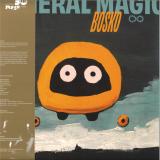
Editions Mego presents Bosko, landing exactly 30 years after the initial General Magic flights into the fantastic; the legendary first Mego release, a collaboration with Pita whereby all sounds were harnessed from the buzzing, drinking, humming sounds of fridges MEGO 001 General Magic & Pita and a 12” with Elin called Die Mondlandung (The Moon Landing) MEGO 002 which embarked on a minimal techno template so austere and strange it was one of the historic progenitors of austere and wonky rhythms alongside Sakho and other European explorers.
The initial return of the playful and mystical Austrian outfit General Magic came with the 20th year anniversary vinyl reissue of their classic debut Frantz eMEGO 010. A record so audacious and playful it still baffles as much as it entertains. At some point whilst working on this reissue GM’s Ramon Bauer and Andi Pieper were spurred on to rummage around with ideas and tools once more and after more than two decades of inactivity sonic sorcery was conjured once again. Live shows in honour of Peter Rehberg were performed in Vienna and London. Softbop, a limited risograph collaboration with Tina Frank came with the first new recordings as a digital download came out discreetly online. The first full length album following Rechenkönig in 2000 MEGO 032 “Nein Aber Ja” released in 2023 on Finlay Shakespeare’s GOTO Records on CD and cassette. An ongoing series of mix tapes online further highlights their interests encapsulating a new found angle on electronic mayhem. All of these elements retain the wildly eclectic and ecstatic glow that only they can harness and hand out to an unprepared world.
Now, we have General Magic’s second official full length comeback recording, Bosko. The new album is initially notable prior to the needle hitting the wax or the cursor identifying a track due to the artwork. Made by long term collaborator Tina Frank, this is Frank’s first analogue artwork, with a painting of a happy/nervous machine thing hovering in a landscape of no discernible identity. It’s quasi science fiction hovering amongst the potential for fun. Suited to the music? Natürlich.
Bosko sees Bauer and Pieper update and reframe their original investigations with a fresh supply of head scratching, heart racing tunes that hit the inexplicable with a wild mesh of drums, pianos, synthetic voices and all manner of immaterial sonic play. Startling sonics shock the ears on Club Duchamp which sounds like a conversation between synthetic adult ants in an environment still in development. Elfer features vocals supplied by a female-ish voice who, whilst grappling melody, has trouble executing a firm identity. Noorenhalt catapults along a mainframe of syncopation so unwieldy it feels like the voice, which is utterly alien, provides the only comfort. Seite 5 inhabits a fuzzy zone where a synthetic Horn of Jericho type ambience competes with rhythms never quite sure of who they are. Rise of the Ombré raises the spectral dread. Is this Science Fact? Absolutely nothing within Bosko is predictable.
The amount of change in the miasma of existence and the things we touch in order to make things has shifted so exponentially we are at the point where minds are starting to glaze over. All of this makes the return of the always original, always surprising, always fresh and exciting General Magic totally in tune with the artificial intelligent apocalyptic age we currently inhabit. The tools may have changed but the wonderfully warped gaze of Bosko offers a fresh new vision of perplexing funk and robotic punk.
Amoul Bayi Records continues its mission of discovering and showcasing West African artists. After introducing talents such as Daba Makourejah and Saah Karim, the Dakar-based label returns with a new release from one of the most soulful
voices in Gambian reggae: Royal Philosopher.
"Thank You Jah" is a song of gratitude, carried by the emotive and distinctive voice of Royal Philosopher. With humility, he expresses his thankfulness for the talent he has received, the path he has walked, and the strength that has guided him along the way.
Built on a dynamic Digi Roots riddim produced by Yared and mixed by Rootical45, the track provides the perfect space for his voice to shine. The refrain – “Thank you Jah for giving I talent” – echoes like a personal prayer and a universal message, able to resonate beyond belief systems.
Royal Philosopher is a Gambian singer whose powerful and precious voice is shaped by spirituality, African heritage, and musical commitment.
Born in Banjul, he first discovered his vocal gift in a church choir, where he developed a heartfelt and sincere expression. He fell in love with reggae through the voice of Garnett Silk, whose intensity and devotion deeply influenced his path. He began his journey with the group The Royal Family, before pursuing a solo career, releasing music with consistency and authenticity.
Today, he presents "Thank You Jah", a single produced by Amoul Bayi Records, imbued with gratitude and faith, true to his artistic vision: sincere, elevated, and deeply connected.
Designed both for turntables and streaming platforms, the single will be released in digital format and on 7" vinyl. The artwork is by renowned Senegalese graffiti artist King Mow.