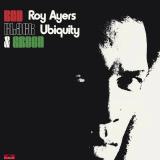
After years out of print, we are pleased to present this much-needed vinyl reissue of an essential album in Roy Ayers’ career. Pressed on 180g vinyl.
In the early 1970s, Roy Ayers formed his own band: Roy Ayers Ubiquity. Its lineup included artists well known to funk and soul fans such as Bernard Purdie, James Mason, and Edwin Birdsong.
This 1973 album presents Roy Ayers in the midst of a creative evolution toward a sound increasingly influenced by soul and funk, moving beyond the early phase of his musical career, which was more rooted in orthodox jazz.
On “Red Black & Green”, he teams up with highly accomplished collaborators such as keyboardist Harry Whitaker, arranger and producer William S. Fischer, and Strata-East musicians Charles Tolliver and Sonny Fortune. Here, however, the latter two do not venture into the spiritual jazz sounds so characteristic of their own recordings; instead, together they embrace a sophisticated funk groove where Ayers showcases his extraordinary vibraphone talent.
The album includes outstanding versions of ‘Ain’t No Sunshine’ and ‘Day Dreaming,’ as well as original compositions such as ‘Cocoa Butter,’ ‘Rhythms of Your Mind,’ and the superb title track, ‘Red Black & Green.’
Поиск:wi
Все
- 1: Lonely Me, Lonely You
- 2: Yesterday Man
- 3: Raining Dreams
- 4: Who's Afraid
- 5: Sad Day
- 6: Jesus Fish
- 7: Heartattack & Vine
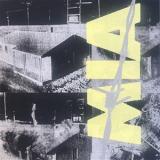
Die aus Las Vegas und Orange County stammende Hardcore-/Punk-Band M.I.A. spielte 1987 ihr letztes Konzertund löste sich auf. Mitte 1988 gründete Sänger Mike Conley die Band Naked Soul zusammen mit dem ehemaligen M.I.A.-Mitglied LarzPearson am Schlagzeug und seinem langjährigen Freund Jeff Sewell am Bass. Inspiriert von Bands wie The Replacements, den kanadischen The Doughboys oder The Nils, begann Mike, Songs zu schreiben, die den poppigen und doch kantigen Sound, der auf M.I.A.s ,After The Fact" seinen Anfang genommen hatte, mit vielschichtigen Arrangements und Gesangsharmonien weiterzuentwickelten. Diese erste Besetzung löste sich bald auf, doch Mike gab nicht auf und stellte eine neue Band zusammen mi tMike Brown am Schlagzeug und Carlos Soria von The Nils an der zweiten Gitarre. Die Band ging dann mit Richard Andrews (Big Drill Car, All, Jawbreaker usw.) ins Studio und nahm die drei sorgfältig ausgearbeiteten Popsongs auf, die hier zu hören sind, darunter der Naked Soul-Klassiker, ,Lonely Me, Lonely You", der ihnen schließlich einen Vertrag bei einem Major-Label einbrachte. Unterdessen begann der ehemalige M.I.A.-Gitarrist Nick Adams, mit dem Schlagzeuger Miles Gillettvon El Grupo Sexo am Schlagzeug und Bob Gnarly von Plain Warp am Bass zu spielen. Sie nannten das Projekt Flatbed und machten sich daran, einfach nur Spaß zu haben und rohen, harten und melodischen Rock'n'Roll zu spielen. Danny Wallis von Don't No übernahm bald den Bass und die Band ging ins Studio, um ein paar Eigenkompositionen und ein Tom-Waits-Cover aufzunehmen. Diese Veröffentlichung fängt einen Ausschnitt aus der Zeit Ende 1989 ein, als zwei Bands mit gemeinsamer musikalischer Vergangenheit unterschiedliche Wege einschlugen. Limitiert auf 300 Exemplare in handgestempeltem Cover und auf farbigem Vinyl.
- 1: Bender
- 2: Leyden Girl
- 3: No Man
- 4: Tomic Bomb
Die aus Las Vegas / Orange County stammende Hardcore-/Punk-Band M.I.A. ist zum ersten Mal seit 40 Jahren mit neuem Material zurück! Nachdem sich die Band 2008 zu einem Gedenkkonzert anlässlich desvorzeitigen Todes ihres Sängers Mike Conley wieder zusammengefunden hatte, spielte sie noch einige Jahre mit dem ursprünglichen Sänger Todd Sampson weiter. Leider verstarb Todd kurz darauf an einem Hitzschlag. Die verbleibenden drei Mitglieder beschlossen, weiterzumachen, wobei Gitarrist Nick Adams nun den Gesang übernahm. Im Jahr 2017 veröffentlichte Darla Records die letzten beiden Alben der Band, ,Notes From the Underground" (1985) und ,After the Fact" (1987), erneut auf CD. Ab 2023 begann Modern City damit, den gesamten Katalog der Band auf Vinyl neu aufzulegen, darunter das bahnbrechende Album ,Murder In a Foreign Place" von 1984 (in Zusammenarbeit mit Alternative Tentacles) und ihren Teil der LP ,Last Rites for Genocide and M.I.A." aus dem Jahr 1982. Die Titel dieser neuen Veröffentlichung wurden im Dezember 2025 aufgenommen und umfassen drei brandneue Songs sowie "'Tomic Bomb", einen sehr alten, unveröffentlichten Song, der 1980 von der allerersten Inkarnation von M.I.A. geschrieben wurde, die damals als The Swell bekannt war. Diese Veröffentlichung ist auf 300 Exemplare limitiert und erscheint mit einem handgedruckten Cover und auf farbigem Vinyl.
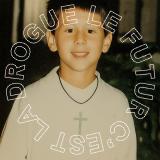
Le Futur c’est la drogue, which should here be translated as The Future Is the Drug, is not to be read as a promise, but as a statement of fact. The present is no longer an experience, but pure consumption. Life itself has taken the form of a dependency.
With this sixth album, Christophe Clébard goes straight to the point, driven by a free and repetitive form of writing, stripped of any syntactic rigidity. Words strike like balls against a wall, revealing darker zones of his mind where guilt, fear, and existential anxiety coexist.
The sound composition, equally minimal, sustains a dense and obsessive mental space, a vortex in which trance appears as the only escape. Driving drum machines, relentlessly hammered electronic loops, and a battered synthesizer, his music unfolds within a physical, strangely hypnotic synth-punk aesthetic that hits viscerally.
The Future Is the Drug is his sixth album.
One of the all-time Balearic greats gets an official re-rub by friend of Balearic London, Holmes Price. Taking the charms of the classic Cool And Breezy Jazz Version- produced by Pete Waterman's in-house team at his '80s powerhouse PWL Records, and also included here in all its glory - rearranging the phrasing and adding a meatier contemporary house groove, it's the perfect update for the modern dancefloor that we hope will also introduce the timeless 'original' mix to some new ears.
DJ Support: Kerri Chandler, Folamour, Louie Vega, Jazzy Jeff, Dimitri From Paris, David Morales, Dave Lee, The Shapeshifters, Brian Tappert, Quentin Harris, Michael Gray, Terry Hunter, Hector Romero, Tedd Patterson, Dr. Packer, Marcel Vogel, Dj Pippi and many others
Groove Culture main men Micky More and Andy Tee are once again at the controls as the label presents its' Third collection of “Groove Is In The Heart”. As with the popular imprint's various EPs, the focus is on joining the dots between organic house, revivalist disco, uplifting dancefloor soul and colourful jazz-funk. There's much to admire from start to finish, a very strong bunch including MM & AT,Gianni Bini and Angela Johnson celebratory cover of EWF swirling disco-funk ‘In The Stone', a wonderfully rolling and funky-House joint titled ‘Let The Rhythm’ from Ralph Session & Djfudge, Memi P. And Gisele Jackson tasty Feel Good Classic-house Tune “Make It On My Own” and the soulful-house warmth of Audiowhores ‘Touch The Ground' Feat. Angela Johnson.
With Zera, Len Faki returns to Figure with a tightly focused EP that moves between raw, driving functionality and more open, atmospheric moments. Across five tracks, he explores variations in groove, tone and energy, balancing direct, floor-ready structures with a more fluid and spacious approach.
Opening cut Maschine Girl locks into a restless, forward-driving groove. Crisp percussion and a tightly coiled low end create immediate momentum, while sharp synth fragments and metallic accents add a nervous edge. The track stays stripped and efficient, letting its steady build and controlled tension carry the energy.
Kobold follows with a darker and more twisted tone. Warped synth figures weave through a heavy rhythmic backbone, giving the track a slightly mischievous character while maintaining a firm, heads-down drive. The interplay between tonal movement and grounded percussion keeps the groove dynamic without breaking its focus.
Closing the A-side, Maschine Girl (Version) revisits the opener from a different angle. Elements are tightened and subtly rebalanced, shifting the emphasis further toward rhythm and direct impact. More reduced and tool-like in nature, it pushes the groove forward with a sharper, club-ready feel.
On the flip, Zera unfolds with a broader sense of space. Hypnotic synth movement and layered atmospheres sit atop a firm low-end framework, gradually building intensity while maintaining a deep, immersive flow. The track thrives on its slow development, drawing the listener further into its evolving structure.
Rounding out the release, Zera (Hardspace Mix) reimagines the original with a heavier, more physical approach. The groove becomes more pronounced and the rhythmic pressure more direct, tightening the structure into a denser, floor-driven tool that emphasises impact and propulsion.
With Zera, Len Faki delivers a cohesive and wide-ranging release that connects raw, driving tools with more expansive, early morning-leaning grooves — further reflecting the breadth and versatility that has defined his output in recent years.
KITCHEN. LABEL is proud to present AGATE, the latest album by Japanese artist MEITEI, marking a deepening of the world he first shaped through his Kofū trilogy released between 2020 - 2023.
Named after the mineral agate, a stone formed through slow accumulation, pressure, and time, the album reflects MEITEI’s patient approach to sound. AGATE brings together extended and newly rearranged works from across the Kofū cycle alongside new compositions and passages, refining material developed through years of performance and sustained practice.
The album presents seven tracks:
HAŌ (Previously unreleased track)
SHIN-OIRAN (Remodeled from Oiran I, Kofū 2020)
SHIN-SADAYAKKO (Remodeled from Sadayakko, Kofū 2020)
SHIN-WAROSOKU (Remodeled from Wa-rōsoku, Kofū III 2023)
KYŪGEKI (Remodeled from Shinobi and Akira Kurosawa, Kofū II 2021)
SHIN-OIRAN II (Remodeled from Oiran II, Kofū 2020)
SHIN-EDOGAWARANPO (Remodeled from Edogawa Ranpo, Kofū III 2023)
Across these works, MEITEI expands the musical vocabulary first introduced in Kofū, a sound he once described as “lost Japanese mood.” While Kofū drew from fragments of folklore, theatre, ghost stories, and forgotten urban memory, it was never an act of historical reconstruction. Rather, it reflected a sensibility of the past observed from the present. With AGATE, this worldview is clarified as Shinpu, a process of discovery in which historical awareness becomes a foundation for contemporary creation rather than a constraint.
During five years of Kofū tours across Japan, Europe, and Asia, MEITEI performed this material in a wide range of spaces, from underground live houses and listening rooms to culturally significant sites. These environments influenced pacing, dynamics, and structure, shaping how the material evolved over time. AGATE is therefore not only a studio album, but the result of material refined through repeated performance.
If the Kofū albums were windows into forgotten eras, AGATE explores what lies beneath, sediment and strata formed through time and pressure. MEITEI’s approach to sound mirrors the nature of agate itself. Grains become texture. Texture becomes narrative. Voices drift through decaying layers of sound, while ancient instruments are used in non-traditional ways, forming distinctive percussive rhythms and melodies that appear and vanish without fixed resolution.
The album’s visual materials were developed under MEITEI’s direction through physical art-making processes. The cover artwork originates from a letterpress print created by Kamisoe, a Karakami atelier in Nishijin, Kyoto, using Kyo-karakami paper. The original artwork, produced through traditional woodblock techniques on handmade washi, was subsequently reproduced on print for the album edition. Kamisoe continues to reinterpret this historical Kyoto craft with a contemporary sensibility.
The title calligraphy was created by Bio Xie, whom MEITEI personally invited to participate in the project. During his performances abroad, MEITEI encountered in Taiwan a lingering atmosphere reminiscent of “Shitsunihon” — a sense of old Japanese memory that quietly endures beyond time. He was deeply drawn to Bio Xie’s distinctive use of Chinese characters, which resonated with this experience, and asked him to contribute to the visual expression of AGATE.
In parallel, MEITEI continues to reinterpret Japanese sensibility through his concept of “Shitsunihon,” presenting it as a contemporary musical language. The refined Kyoto motifs envisioned by Kamisoe and the distinctive calligraphic expression by Bio Xie intersect with MEITEI’s singular artistic direction, weaving together a newly articulated worldview.
The accompanying visual imagery, including the liner photographs, was created by photographer Hiroshi Okamoto, who was also responsible for the visual direction of MEITEI’s previous work, “Sen'nyū.” It draws from MEITEI’s lived experiences of winter seas, solitary cliffs, and breaking waves. These scenes symbolize the inner conflicts of the ten years he spent living in Hiroshima, and his confrontation with solitude and the sounds he creates.
AGATE will be released on 17 April 2025 via KITCHEN. LABEL on 180g vinyl, CD, and digital formats. The album is mastered by Kelly Hibbert, known for his work with Flying Lotus, Madlib, and J Dilla.
With AGATE, MEITEI returns to the material of Kofū with greater focus and discipline, continuing an ongoing process of working forward with inherited material.
Guests is the home recording project of Jessica Higgins and Matthew Walkerdine. Vaguely named as such to avoid any problems with the poster if they pull out of a gig (which has only happened once, about a year and half before any songs were actually written to be fair) but also to capture a sense of reverse hospitality. That is, arriving at your door with a bottle of good wine (can’t turn up empty handed) or a fist full of savoury or sweet snacks (time of day dependant); oversharing at the afters (and then passing out on your couch); reading to your toddler while you make their lunch or put everything back where it was meant to go (only to get torn apart again). So, something about what happens when private worlds meet each other, making or having been made a space for. But at times, it’s a different kind of intimacy, a temporal or material one, like the feeling of crisp fresh sheets, and abundant and soft, body-part appropriate towels in a hotel in a city you’ve been to before and love to go back to.
Their debut record, “I wish I was special”, was variously described as “a collage of concrète experiments and outerzone pop gestures, music that sounds as if it’s been written from the depths of a dream”; “music for people who love music but also hate it too”; “something like chasing ghosts or befriending a wild animal”; “pulling apart nervous sensations with haphazard ease and requisite humour”; and “a melody of refusal, of being all-in (…) finding the exact right WRONG sound to express the discontent”. Common Domestic Bird continues in this vein, layering synthesiser, keyboards and samples over rudimentary drum rhythms and field recordings, which are in turn sung or spoken with to create nine new songs.
Written and recorded between autumn 2024 and summer 2025 in Reading, Berkshire, the music has matured since its last outing, in a way, leaning less into collage and more toward structured composition and melodic depth, yet retains a healthy dose of indeterminacy and off-kilter rhythms for the forever-amateur. The songs on Common Domestic Bird hint at some “about”-ness through a series of discrete vignettes which sound a bit like architecture or end of year lists, gossip or over-thinking subjectivity, like disappearances and impressions, the support structure of the spine, letters and signs offs, things you could really do without and where they should go, hoping you’ll see something that isn’t there, pretences and performance. At times they feel kind of funny, others kind of sad or a bit angry and annoyed, a bit like you really.
- A1: Unfelt Loss
- A2: So Easy To Love
- A3: Teardrops (Classic Hell On Earth)
- A4: Whiplash
- A5: Morning Doctor
- B1: Cherry Blossoms In Leschi
- B2: Southward Equinox
- B3: Velvet Rope
- B4: Backward Path
- B5: Don’t Remind Me
- C1: Season Of The Wish
- C2: The Last Resort
- C3: Two Rivers
- C4: A Little Game
- C5: Lilies Of The Field
- D1: Lifelong Sellout
- D2: Out Of My Mind
- D3: Golden Era
- D4: Sweet Routine
For two decades, Gun Outfit has been a band defined less by genre than by continuity, patience, and a commitment to making music that reflects their lived experience.
Formed in Olympia, Washington in 2006 but long since rooted in Los Angeles, the group has evolved from a raw duo into a quietly formidable five-piece, their sound growing from scrappy post-punk beginnings into something spacious yet intimate, and always underpinned by an experimental edge.
On Process & Reality, Gun Outfit return with their most ambitious and immersive work to-date, a sprawling 80-minute double album shaped by time, environment, and philosophy. Recorded over the course of a single month in the late summer of 2020, on an 80-acre ranch in Pine Flat, California, while a massive forest fire burned less than ten miles away, the seeds of these songs were stark and strange.
Its title, Process & Reality, draws from the central work of philosopher Alfred North Whitehead, whose philosophy places intuition, experience, creativity, and relationality at the center of existence.
The band’s current lineup reflects both longevity and openness. Sharp and Keith remain the band’s primary architects, joined by longtime drummer Daniel Swire, multi-instrumentalist Henry Barnes, and bassist Kayla Cohen. Additional collaborators include Chris Cohen, Warren Lee, and Danny Sasaki all of whom add further depth, leaving subtle fingerprints across the album.
Musically, the album expands the band’s palette without abandoning its core sensibility. Dulcimer, autoharp, sitar, melodica, keyboards, homemade electronics, and a wide range of acoustic and electric textures appear throughout. The sound is mellow yet expansive, songs move between fragility and hefty atmospheric passages.
Influences surface obliquely rather than overtly. Elements of reggae and dub inform the production’s spatial sensibility. Echoes of long-form European jam bands coexist with sharp post-punk. British folk traditions, American country, and classic West Coast songwriting drift in and out of focus; the band is never afraid to lead or follow.
With Neolithic Neon, Appleblim creates a kaleidoscopic reflection of the spirituality inherent within electronic music — the ineffable frequencies and communal traditions that spring from exploratory synthesis, deep-rooted rhythms and myriad other sonic codes.
Throughout his third album for Sneaker Social Club, Laurie Osborne continues to express a fascination with the ancient resonance held within modern rave as he guides his own studio practice towards more purposefully analogue processes. It's reflective of his desire to let go and trust his instincts within the more chaotic realm of voltages and signals, not to mention turning to a wider spread of instrumentation and opening up to noisier avenues. This direction defines the character of Neolithic Neon, which bristles with the living imperfections of the gear in the context of incisive and wide-ranging cuts touching on jungle, dubstep, techno, electro, acid and experimental electronic music of all stripes.
Across Osborne's solo output from 2018's Life In A Laser to 2021 tape Infinite Hieroglyphics, a strong melodic sensibility spills out of the richly layered production. It's equally audible in his Wrecked Lightship collaboration with Adam Winchester, and it charges Neolithic Neon with its star-gazing, contemplative streak. From the knotty plucks and licks weaving through opener 'Moorland' to the vaporous synths darting across the top of hardcore conductor 'Thunderstorm', a dreamlike evocation takes the sound off terra firma, musing on cosmic events and our connection to the enormity of the universe.
Eternally in thrall to the maverick vocabulary of pioneering beat scientists and fuelled by the inspiration of great thinkers dwelling on our purpose and place, Neolithic Neon unfurls big ideas without heavy-handed messaging. Instead, it trusts in the universal and time-honoured language of experimentation and rhythm to present its ideas, true to Appleblim's legacy to date while opening a new chapter in his ongoing sonic quest.
'A few months after recording Us, Lancaster recorded Mother Africa along with Clint Jackson III, a trumpeter, partner of Khan Jamal or Noah Howard on other recordings.
On march 8th, 1974, Lancaster and Jackson headed up a group composed of Jean-François Catoire (electric and double bass), Keno Speller (percussion) and Jonathan Dickinson (drums). Together, they create an immediate impression. From the first seconds of We The Blessed, they develop a free jazz which rapidly abandons any virulence under the effect of blues and soul based interventions.
When Gilson’s composition Mother Africa begins, listeners are transported into the studio, listening to the musicians setting up: chatting and joking… Then comes the melody: a dozen or so notes of a repeated theme which is accelerated and deformed according to their whims… The jazz played by the association Byard Lancaster / Clint Jackson III is rare: creative AND recreational. We the blessed, is apt listening to this again today!'
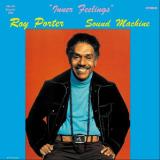
Roy Porter Sound Machine's 1975 follow-up to their 1971 debut, Inner Feelings, drifted deeper into Blaxploitation-era grooves by layering flanged guitars, jazzy horns, undulating basslines and electric piano licks with plenty of the flair that defined their standout debut album, Jessica. Standout track 'Panama' gets its first 7" outing here via a Muro re-edit alongside the original vocal version. The instrumental has busy keys and punchy drums, while the vocal adds bustling character and playful conversation, bringing a lively narrative to the tight funk framework. A seamless bridge between jazz sophistication and cinematic soul that shows off Porter's adventurous spirit and groove mastery.
Following the success of the first vinyl release from the Moroccan label Sotor Records, featuring Zadig, Perc & Oscar Mulero, Sotor writes a new chapter in its discography with its second vinyl release. Meaning "lines" in Arabic, Sotor reflects its commitment to championing the diversity of the techno genre.
The label's ninth release, "Processing Range," is a musical ode to the lines of space-time. With four original tracks from the Portuguese producer, Sotor invites you on a techno journey between mental tension and physical release.
The album opens with DJ Dextro's "Controle," which delivers a massive, sharp rhythm, dystopian synths, and a true immersion into a techno black hole.
The journey continues with the second track on side A. This time, DJ Dextro unleashes an uncompromising version of "Blue Dot," achieving a precarious balance while showcasing his signature percussive style. The Portuguese artist delivers the perfect track to unleash a crowd.
On the B-side, DJ Dextro offers us the eponymous track, "Processing Range." We're quickly drawn into an allegory of this decadent modern world where humanity is rushing towards its own destruction. Expect dusty techno rhythms and that sumptuous synth that sounds like the end of times. Probably a future classic!
And you'll finish on a gentler but no less dynamic note from DJ Dextro. He concludes the EP with "31 Atlas," which will leave you weightless with its galloping bassline and abyssal synth.
Drawn from the wider Microliths and Momentary Drifts project, this EP finds zak�, Ossa and ASC working in miniature form with signature restraint but real emotional resonance. Each piece functions as a fleeting vignette where tone and texture carry more weight than the structures. ‘Microlith 1’ opens with soft, cascading keys, while ‘Microlith 2’ drifts further into distant, spectral territory. By the time ‘Microlith 8’ arrives, its gentle fade into static leaves a quiet sense of unresolved possibility. It is a concise, thoughtful collection that will have you keen to hear the whole LP.
2026 Repress!
Doc Scott was on the decks. It was at Tribal Gathering (I think), 1996, standing in front of a wall of speakers to one side of the stage,
enjoying myself, like you do, when this sound started growing inside my brain. My head was then ripped clean off my shoulders!
Words are still hard to find! It was the first time I ever heard Shadow Boxing and its the only thing I still remember from that night. Om
Unit's 2014 Remix is paired with the 1996 original. DJ support from: Fabio, Mark Pritchard, Friction, Surgeon, Toddla T, Laurent
Garnier, Pinch, Zinc, Baliey, Rob Both, Billy Nasty, Krust & John B.
This first new volume of edits from Big Baba finds Elado digging with intent rather than on a purely nostalgic tip. Fresh off his Razor-N-Tape run, he opens the series by rewiring rare global grooves for contemporary club floors. The EP moves fast and wide as Bollywood disco mutates into techno on 'Disko Disko!', while Yeah Yeah flips obscure 80s Thai boogie-funk into something elastic and punchy. 'EL SOL' slides in as a proto-house warm-up weapon, patient but charged. Then there's 'YOR YOR', a joyous Bukharian disco edit that feels almost mythical in its rarity. Colourful and confident, and full of heat.
Disco-house fusionist Risk Assessment rounds off another successful year with a third and final EP of 2025. Braithwaite deals a near perfect hand on 'Play Your Cards', where excerpts from a Loleatta Holloway/Salsoul Orchestra style maximalist disco hit rise above a chunky, bass-heavy groove, before reaching for elements from a jaunty, piano-heavy disco number on the rolling and ear-catching 'Juicy Smollett'. Elsewhere, 'Testing Testing' is a gargantuan disco-house extravaganza full of sampled horns, rubbery bass, stellar orchestration and urgent male vocals, while 'Baby Call Me' sees him re-imagine a smooth and colourful 80s soul jam as a tactile and funky house workout.