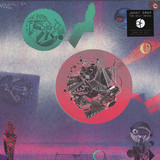
Craig Leon revisits the extraterrestrial origins of civilization on Anthology of Interplanetary Folk Music Vol. 2: The Canon, a continuing chronicle of his early 80s albums Nommos and Visiting. Exploring the cosmic lore of Leon’s earlier work, The Canon expands upon the conceptual cycle based on the alien and mathematical relationships that backbone the creation of art, architecture, science, and music.
In 1981, producer and composer Craig Leon, known in the downtown New York zeitgeist for his production on The Ramones and Suicide’s debut albums, released Nommos, a minimal, primitive electronic exploration based on a speculative, wildly imaginative anthropology.
After viewing an exhibition of Dogon art at the Brooklyn Museum in 1973, Leon remained fascinated by the Mali tribe’s creation myth that the Earth was visited in ancient times by the Nommos, a semi-amphibious alien race who travelled from the white dwarf Sirius B to impart their wisdom to mankind.
Nommos, curiously released on John Fahey’s Takoma Records, manifested Leon’s obsession and investigation: an abstract, ascendent collection of music that could have soundtracked the interstellar visitors’ journey to Earth. Shimmering, mechanical, and anchored by an entrancing pulse of the Dogon’s ceremonial music, Nommos and its sequel, the privately pressed 1982 album Visiting, careened into obscurity.
In the intervening years, while Leon pursued his career as a successful producer, cult interest in the albums grew, culminating in the Anthology of Interplanetary Folk Music Vol. 1., the 2014 archival collection which presented Nommos and Visiting as they were intended to be heard, two sides of the same coin.
The Canon picks up where Nommos and Visiting left off, tracing the path of ancient wisdom imparted by the Dogon’s alien visitors spreading from Mali into Egypt and across the water to Greece as imagined in William Stirling’s ""The Canon,"" an anonymous exposition of cosmic law published in a nearly invisible print edition in 1897.
Though the music – propulsive and spacious – is clearly of a part with Nommos and Visiting, the alien sounds of the Nommos become more familiar to western ears and musical vocabulary as the album narrative thrusts forward. The Canon implies – through ecstatic, contemporary sound and synthesis – that the origins of Western thought, and civilization itself, lie in the great beyond.
Nearly four decades since their first collaboration on Nommos and Visiting, Leon is once again joined by his partner Cassell Webb on vocals and album production. Leon composed, and both he and Cassell performed, and produced all of the music of The Canon, consciously engaging many of the same synthesizers and programs of Anthology of Interplanetary Folk Music Vol. 1 for Vol. 2.
quête:william earl
- A1: Boards Of Canada - Olson
- A2: Erasmo Carlos - Vida Antiga
- A3: Gene Williams - Don't Let Your Love Fade Away
- A4: The Chosen Few - People Make The World Go Round
- A5: Esther Phillips - Home Is Where The Hatred Is
- A6: Delegation - Oh Honey
- B1: Velly Joonas - Käes On Aeg
- B2: Stereolab - The Flower Called Nowhere
- B3: Kiki Gyan - Disco Dancer
- B4: Admas - Anchi Bale Game
- C1: Francis Bebey - Sanza Nocturne
- C2: Thundercat - For Love I Come
- C3: River Tiber Ft. Daniel Caesar - West
- C4: Charlotte Day Wilson - Work
- C5: The Beach Boys - Don't Talk (Put Your Head On My Shoulder)
- C6: Donnie & Joe Emerson - Baby
- D1: Les Prospections - Lido
- D2: Grady Tate - And I Love Her
- D3: Badbadnotgood - To You (Exclusive Andy Shauf Cover Version)
- D4: Steve Kuhn - The Meaning Of Love
- D5: Lydia Lunch - You, Me And Jim Beam (Exclusive Spoken Word Piece)
Canadian quartet BADBADNOTGOOD take on creating the ultimate late night' selection of tracks from their record collections, set for release on 28th July 2017. The original trio of Matthew Tavares, Alex Sowinski and Chester Hansen formed while studying music at Toronto's Humber College (they've recently added Leland Whitty to the line-up). A shared appreciation of hip hop and instrumental covers of Gucci Mane and Earl Sweatshirt suggested a worldly outlook and reciprocated love from Tyler The Creator and Ghostface Killah, which whom they made 2015's Sour Soul.
This is an international effort: Velly Joonas' Estonian version of 'Feel Like Makin' Love', Kiki Gyan, Admas and Francis Bebey representing Africa (Ghana, Ethiopia and Cameroon respectively), Les Prospection from France, Scots' Boards Of Canada and fellow Canucks River Tiber and Charlotte Day Wilson.
Finally, there's the no-small-matter of the Late Night Tales cover version, in which BADBADNOTGOOD take on Andy Shauf's 'To You' is turned into a mournful delight. while the Queen Of Siam herself, Lydia Lunch, delivers a sexual sermon involving only you, her and Jim Beam.
We were really excited to have the chance to put together a Late Night Tales compilation, it's a great organisation. We decided to use it as a vehicle to show everyone all the amazing music we have gotten to experience by touring and meeting new people. Every track on this comp was either shown to us by an incredible person or made by one of our friends. We also included a little cover of a song by one of our favourite current musicians, Andy Shauf.
These artists, as well as many, many others, have infuenced us to create and kept our deep love of music alive. This mix will keep you company on a quiet night by yourself or with friends. You can check it out on the plane, the bus, a long walk, or any situation where you want a soundtrack for reflection and meditation.' - BADBADNOTGOOD May 2017
Featuring Fab 5 Freddy,Jonzun Crew,Yoko Ono,Class Action,Johnny Dynell,Art ZoydandMore
Soul Jazz Records presents KEITH HARING: The World of Keith...
- A1: B Beat Girls – For The Same Man
- A2: Damon Harris – It’s Music
- A3: Pylon – Danger
- B1: The Jonzun Crew – Pak Man (Look Out For The Ovc)
- B2: Funk Masters – Love Money
- B3: John Sex – Bump And Grind It
- C1: Sylvester – Over And Over (12" Disco Mix)
- C2: Johnny Dynell And New York 88 – Jam Hot (Rhumba Rock
- D1: Art Zoyd – Sortie 134 (Part 2)
- D2: Adiche – Chuka-Ja (Get Ready)
- D3: Class Action – Weekend (Larry Levan Mix)
- E1: Gray – Cut It Up High Priest
- E2: The Golden Flamingo Orchestra – The Guardian Angel Is Watching Over Us
- E3: Extra T’s – E.t. Boogie
- F1: Fab 5 Freddy – Change The Beat
- F2: Convertion – Let’s Do It
- F3: Yoko Ono - Walking On Thin Ice
Soul Jazz Records are releasing this stunning new collection, The World of Keith Haring, featuring
music influential to the artist Keith Haring.
The art of Keith Haring is today one of the most recognisable of any visual artists of his generation,
defining 1980s New York during an intense period when downtown artists and musicians collaborated
like never before. Haring’s musical inspiration took in the punk/dance downtown sounds of clubs like
The Mudd Club, underground disco at Larry Levan’s Paradise Garage, as well the early days of hip-hop
and electro.
The album is released to coincide with the opening of the first major exhibition in the UK of Keith
Haring’s work at Tate Liverpool and which runs for the next six months.
Haring’s many friends included Jean-Michel Basquiat, Andy Warhol, Madonna, Fab Five Freddy,
William Burroughs, Jenny Holzer, Yoko Ono, Grace Jones, Larry Levan, Futura 2000.
If you were looking for a person to guide you through the wide variety of nightclub scenes of
downtown New York in the 1980s, then Keith Haring would have been your man.
This album comes in deluxe artwork and three formats – Double CD + 48-page book, a deluxe 3xLP +
bonus 7” + download code vinyl version, and a standard 3xLP + download standard vinyl version. All
formats of the album feature stunning photography, extensive sleevenotes and interviews.
The music here includes the work of a number of Haring’s close friends, including Jean-Michel
Basquiat, Yoko Ono, Larry Levan, John Sex and George Condo (The Girls), as well as healthy dose of
rare disco, early electro and New York punk/dance tracks.
In her varied career that would combine art gallery installations, major film soundtrackings and commissions for Atari, Suzanne Ciani’s earliest experiments remain some of her most challenging, beguiling and timeless... Flowers Of Evil ticks all the above boxes and flicks switches that would power-up a new uncharted universe of her own musical modernité. Finders Keepers present the first-ever release of these vital archive recordings.
As a genuine vanguard of electronic music composition at the forefront of the modular synthesiser revolution in the late 1960s, Suzanne Ciani’s forward-thinking approach to new music would rarely look to the past for inspiration, which makes this unheard composition from 1969 a rare exception to the collective futurist vision of Ciani and synthesiser designer Don Buchla. In choosing to adapt the controversial prose of French poet Charles Baudelaire, Suzanne would join the ranks of ongoing generations of pioneering musicians like Olivier Messiaen, Karlheinz Stockhausen, Serge Gainsbourg, Etron Fou Leloublan, Celtic Frost and Marc Almond (not forgetting Star Trek’s William Shatner!), all equally inspired by the 19th century writer’s works of “modernité” (modernity), a self-coined term dedicated to capturing the fleeting, ephemeral experience of life in an urban metropolis, best exemplified in his symbolic, erotic and macabre ode to Parisian industrialisation, Les Fleurs du mal (Flowers Of Evil).
In her varied career that would combine art gallery installations, major film soundtrackings and commissions for Atari, Suzanne Ciani’s earliest experiments remain some of her most challenging, beguiling and timeless... Flowers Of Evil ticks all the above boxes and flicks switches that would power-up a new uncharted universe of her own musical modernité. For the many enthusiasts that have already drawn the parallels between Baudelaire’s writings and experimental/electronic music (a relationship rivalled only by the likes of J. G. Ballard and Aldous
Huxley) some might instantly recognise an unconscious sistership between this recording and another 1969 electronic adaptation of Flowers Of Evil by celebrated female electronic composer Ruth White. An interesting distinction of White’s excellent version of Flowers Of Evil (released via Limelight records, home to the likes of Fifty Foot Hose and Paul Bley) is that its dark tone generation and vocal manipulation was created with a Moog synthesiser, the commercially triumphant
rival to Suzanne and Don’s Buchla Systems (Buchla and Moog’s historic, simultaneous, neck-and-neck synth developments are well documented.) The fact that Ciani’s version was never intended for commercial release (not unlike her 1975 Buchla concerts, which could easily have taken Morton Subotnick’s Bull by the horns!) is also poetically reflective of the nature of Ciani and Buchla’s alternative perspective. The choice to present this extract from Flowers Of Evil in its intended French language further distances Ciani’s faithful reaction from some of its better-known variations. Having attempted to voice the poem herself, the multilingual Italian-American composer’s French accent did not meet her own standards, resulting in the request for a fellow unnamed French student who lived on campus at Mills College in Oakland to accurately verbalise the section of Baudelaire’s collection entitled Élévation.
Winner of the 2018 BASCA British Composer Award for Solo or Duo
"Bloody hell that was good" Tim McKinney, BBC Radio 3
Dominic Murcott – The Harmonic Canon
A music project featuring a specifically design half-tonne double bell, an array of rare percussion and two highly virtuosic percussionists.
Dominic Murcott is a composer, percussionist, curator and educator based in London. Much of his work combines acoustic instruments with computers, film and other media. He has a continuing interest in work that is personalised for specific performers and has created acoustic/electronic pieces for trumpeter Noel Langley, percussionist Joby Burgess, clarinetist Joan Enric Lluna, harpist Sioned Williams and the Elysian String Quartet among many others. He has taken an unusual path to his current position, starting out as a self taught musician, his early career included playing drums with no-wave pioneers 'Blurt' and composing for the highly successful V-Tol Dance Company throughout their ten-year history. Changing from drums to vibraphone he became a member of art-pop band The High Llamas and has played on records by many influential artists including Stereolab and Pavement.
Created in collaboration with sculptor Marcus Vergette, The Harmonic Canon is both the name of the piece and the double bell that was custom-made for it. Comprising of two bells tuned a semitone apart, the bell was created using Finite Element Analysis, a type of structural analysis that determines the vibration patterns of the bell, manipulating its harmonic series to create a complex series of frequencies that make up a note. Part One is made up of rapid, high energy, virtuosic passages, articulated with the ominous striking of the bell while the second part contrasts with a single resonant tone that evolves and shifts over time. This is part of nonclassical's 21 Minutes series, a new project commissioning 21-minute pieces.
The piece won the BASCA British Composer Award for Solo or Duo. Premiered in 2018, the piece has had radio play on BBC Radio 3, broadcast from Huddersfield Contemporary Music Festival.
Compilation from British post-punk/Futurist group Ghosts of Dance formed in North Devon in 1981.
The members were Yvette Norris (vocals), Kevin Maynard (drums), Daryl Hunt (bass), Mark Butcher (keyboards), and Pete Heaton (guitar). Ghosts of Dance took their name from the song 'Ghosts' by David Sylvian which appeared on the first Japan album. After playing an early gig in Barnstaple, a gentleman in the audience named Richard Newman expressed his interest to start a record label and release their music. Richard scheduled a recording session for the band at Otter Studios in Georgeham with producer Harry Williamson, son of Henry Williamson, member of progressive rock band Gong. The debut single ‘Ghosts of Dance’ was released in 1982 on Plastic Canvas Records to mixed reviews as it was very different from anything being released at the time.
This compilation includes their debut single along with 9 bonus tracks recorded between 1981 and 1983 on vinyl for the first time. The band call themselves “Vocal Trance Music” on the 7” sleeve credits and it’s accurate. Melancholic pop with gloomy atmosphere and dream-like melodies. The final track shows the band moving in a New Romantic direction with Mark taking over the main vocals. All songs have been remastered by George Horn at Fantasy Studios. Each copy is housed in a jacket featuring original artwork by John Hurford and includes an insert with photos, lyrics and liner notes by Pete Heaton.
Next up on First Word Records, we welcome the return of Don Leisure, with an EP of beats that see his two alter-egos go head-to-head, 'Shaboo vs Halal Cool J'.
Probably best known as 50% of Darkhouse Family, along with Melange label boss Earl Jeffers, they released their acclaimed debut album 'The Offering' in 2017 and subsequent remix project last year, featuring DJ Spinna, Kaidi Tatham and more. The duo are coolly establishing themselves as Cardiff's very own Mizell Brothers, recently producing Kamaal William's latest work, featuring on Kutmah's recent Izwid compilation, and collaborating on the Chicago x London project 'Where We Come From', featuring Makaya McCraven, Joe Armon-Jones, Nubiya Garcia, Theon Cross and First Word label-mate Quiet Dawn, amongst others.
'Halal Cool J' appeared originally in early 2017 with 'An Ottoman Excursion' on our sister-label, Excursions. A series of edits born out of a decade-long love of Turkish music, and some record-digging expeditions in Istanbul, something Don Leisure did the very day after 'The Offering' release party, prompting another series of beats. Ahead of an all-new full-length Halal Cool J album, here we have two tracks to give you a taste, 'Kazakh Honey' and 'Kaymak'.
'Shaboo Strikes Back' on the flip-side, with a track of the same name, and 'Mango Season'. 'Shaboo' was the name of a beat album that came out on First Word in 2017, inspired largely by Don's Bollywood actor Uncle, Nasser 'Shaboo' Bharwani, and by memories of journey's with headphones hurling out Hip Hop, fused with the sonics of his Mum's interruptions, and her favourite Asian radio station. 'Shaboo' featured in several end-of-year album lists, with Piccadilly Records calling it "the best album of it's kind since Dilla's 'Donuts'. Unmissable."
Both prior projects got love from DJs and selectors far & wide, including Tom Ravenscroft, Lefto, Huey Morgan, Rob Da Bank, Om Unit, Simbad & Mr Thing. A truly global affair, the beat battle of 'Shaboo vs Halal Cool J' takes us on several short, sweet hikes across a variety of Eastern climes.
Join in the journey once again on 7" vinyl and digital on April 5th.
- A1: Odeyemi - Oni Suru
- A2: Prince Nico Mbarga & Rocafil Jazz - Sickness
- A3: Osayomore Joseph & The Creative 7 - Obonogbozu
- B1: Felixson Ngasia & The Survivals - Black Precious Colour
- B2: Sina Bakare - Africa
- B3: Saxon Lee & The Shadows International - Special Secret Of Baby
- C1: International Brothers Band - Onuma Dimnobi
- C2: Don Bruce & The Angels - Kinuye
- C3: Etubom Rex Williams & His Nigerian Artistes - Psychedelic Shoes
- D1: Rogana Ottah & His Black Heroes Int. - Let Them Say
- D2: Sir Victor Uwaifo & His Titibitis - Iziegbe (Ekassa No. 70)
- D3: M.a. Jaiyesimi & His Crescent Bros Band - Mundiya Loju
As part of their 20th Anniversary celebrations, Strut present the first new volume in their pioneering 'Nigeria 70' series for over 8 years, bringing together rare highlife, Afro-funk and juju from the '70s and early '80s. Compiled by collector and DJ Duncan Brooker, this new selection of tracks is receiving its first international release outside of Nigeria.
The compilation returns to a fertile heyday in Nigerian music when established styles like highlife and juju became infused with elements of Western jazz, soul and funk and musicians brought a proud new message post-independence. Brooker places the spotlight particularly on some of the incredible Ukwuani musicians from the Delta State region as guitarist Rogana Ottah and Steady Arobby's International Brothers Band forged their own fluid brand of highlife and soulman Don Bruce drew on the US R&B greats for a series of great albums and explosive stage shows at his residency at Hilton Hotel in Abuja.
Elsewhere, the album explores the close connection between Nigeria and Benin's music, most famously through Sir Victor Uwaifo, appearing here with a killer mid'80s ekassa jam, as well as highlife hitmaker Osayamore Joseph on 'Obonogbozu' (Joseph made headlines in Nigeria for very different reasons in 2017, surviving a one month kidnapping ordeal).
Other tracks include 'Sickness' a 1979 lament on how all countries share troubles by Prince Nico Mbarga, the Nigerian / Camerounian star behind the smash hit 'Sweet Mother'; reggae singer Felixson Ngasia switches to funk and disco for a heavy workout with potent lyrics around black identity; another major highlife great Etubom Rex Williams unleashes a punchy psych funk gem with 'Psychedelic Shoes' and Africa 70 member Pax Nicholas vocals a simmering Afrobeat groove from Jacob Lee's Saxon Lee & The Shadows International Band.
'Nigeria 70: No Wahala' iis released on 29th March 2019 on CD, 2LP and digital. All tracks have been restored by See Why Audio and mastered by The Carvery. The package features comprehensive sleeve notes including exclusive interviews with some of the original artists.
David Marston is a producer, DJ, musician, and guitarist hailing from the vibrant Caribbean island of Jamaica. He takes a multifaceted approach to his music, and has worked to achieve a sound that is a fusion of multiple genres, including, but not limited to, house, hip-hop, disco, jazz, as well as reggae. During a six-month stint in Jamaica in 2016, Marston reconnected with a close friend and fellow musician, Craig Williamson, and the pair began writing music that would become the basis of Marston's first full length album. With the album set to be released in early 2019, Marston has endeavored to put together a special 12" to showcase the club-friendly side of his music with a selection of the album's dance cuts.
The A-side of the vinyl kicks off with the title track, "Feeling You", which features Williamson's crooning voice over a hypnotic instrumental characterized by a swirling arpeggiated synth, punchy bass hits, and stomping drums. To round off the A-side, Italian DJ and production duo, Lowheads, give the aforementioned track a fresh makeover with their lively classic house remix and dub version. The flip side of the record consists of two instrumental tracks. The first, "Ragamuffin", is a mesmerizing four to the floor tune constructed around an Indian raga sample. The final number, "On My Mind" is an off-kilter house groove with rolling keys, garage style drums, and a soaring lead. Taken together, the 12" album 'sampler' is a robust yet tantalising collection of club-ready tunes.
The Seeds of Fulfillment by David Drazin (November 2018)
Andrew Venson founded Seeds of Fulfillment (SOF) in early 1978. In the 1960s he had played electric bass with Arthur Conley, and later the original Peaches and Herb. On the same bill with Big Brother and the Holding Company, he hung out backstage with Janis Joplin. Yes! Vince was hoping SOF would get all of us to the top. He composed three tunes for the band, and we always had a ball playing them.
Roger Myers is a marvelous drummer. We co-composed Namaste. Roger would settle on a drum pattern of four measures at a time that he wanted to keep, and I'd put chords and melody right on top of his pattern. When he layered a second drum pattern on top of the first one, we'd get two melodies at the same time. We thought we were going to collaborate on more songs this way, but it didn't happen.
Lee Savory is a very inventive jazz man. He's musically literate, and wrote excellent transpositions. I remember Lee's asking for my input while he was composing Tight Squeeze, but it was clear he had it down. Once when I was visiting a DJ who played the album in a local radio station, the total of checks next to Tight Squeeze for number of plays was by far the highest!
Randy Mather's sax playing always knocked me out. I could hardly wait to hear him solo. When he left SOF to go with Woody Herman's orchestra it was amazing, but true.
Jeanette Williams had recorded 45s for the Duke and Peacock label when she was 17 years old. Her powerful singing was incredible to me. When we needed an original for Jeanette, Vince composed it, and Roger's wife Linda wrote the lyrics.
In 1978 I was in my senior year at Ohio State University when I met Vince. He came into a bar called My Brother's Place where I was playing with a trumpet player named Bobby Alston. When I was a freshman at OSU I'd played in an off campus band called Akadama. Before that I played in my home town of Cleveland, Ohio in the Brush High School Stage Band and a jobbing band called The Midnight Combo.
Everyone in the band contributed something to Egg Cartons in a composition jam session. We rehearsed in Vince's basement, and he had covered the walls with egg cartons to make the room sound more like a recording studio. The Provider was inspired by Country Preacher by Joe Zawinul. In those days I especially admired the way Zawinul would get his soulful feelings across, but also loved Herbie Hancock and to a lesser degree Chick Corea too. It took two years (with a break of several months) for the band to conquer Self-Fulfilling Prophecy. It shows you what consideration and dedication is, that ultimately they felt it was worth learning.
We recorded at Fifth Floor Studios in Cincinnati, Ohio. While we were there I got to shake hands with Bootsy Collins, who was recording in the rooms downstairs at the same time. Years later, Fifth Floor burned down and all the master tapes were destroyed.
Black Rain returns with Computer Soul: the final part of a sequence of Blackest Ever Black releases that began with 2011's Now I'm Just A Number: Soundtracks 1994-95, and a first glimpse of the project's richly imagined future. For this outing Stuart Argabright (Ike Yard, Dominatrix, Death Comet Crew) is joined by BR founder member Shinichi Shimokawa as well as more recent recruit Soren Roi and Zanias (vocalist on 2015's Dark Pool) - making for the most most group-oriented iteration of Black Rain since its earliest days. Sonically too, there is a sense of evolution but also of coming full circle: the cyberpunk techno of Argabright's celebrated William Gibson soundtracks (compiled on Now I'm Just A Number) and extrapolations of Dark Pool's neuromantic yearning cut with glimpses of the thrash and industrial rock energies that animated Black Rain's incendiary live shows - and sought-after tapes for Kombinat and TPOS - in the early 90s. More than ever, Black Rain is propelled by a powerful science fiction impulse, whether responding to the themes and characters of Gibson's Sprawl or the Blade Runner universe (particularly K.W. Jeter's spin-off/continuation novels which extended its mythology, and timeline, further). It's not news that many of these works' most powerful predictions and prophesies have come to pass - the replicants are already living among us - so Computer Soul projects further into several possible unforeseen futures, its events 'set' in the second half of the current century, fifty or so years after those of Dark Pool. The hyperpopulated metropolises of Dark Pool are no more; the apartments are empty, haunted by ghosts of AC current, devices and machines running lonely without their owners...a melancholy internet of things. Where has everyone got to Gone but perhaps not gone. Oblivion beckons - always does - but on the other side of that, something else... another time, another place, a river....and a new way of living.
Dark Entries is honored to release a 4-track EP by Swiss musician Carlos Perón, founding member of Yello. Carlos was born in 1952 in Zurich and began collecting music at a young age. Inspired after attending a concert of Karlheinz Stockhausen in the 1960s, he began to compose Musique Concrete pieces using a 4-track reel to reel and found sounds. In 1979 Perón founded the trio Yello with musician Boris Blank and vocalist Dieter Meier. Yello released their first album in 1980 and the following year Carlos released his first solo album 'Impersonator'. In 1983 Carlos left Yello in order to pursue a solo career and released the soundtrack to Die Schwarze Spinne" and 1984 his second solo album Nothing Is True, Everything Is Permitted'. In 1988, Belgian label LD Records released a 4-song EP of instrumental tracks from 1984 that predated, influenced and became staples in the New Beat scene.
Dirty Songs' is a collection of songs from Carlos Perón recorded between 1980 and 1986. The recordings were made with the core set up of an ARP 2600, Roland's Drumatix, TB-303 and TR-808. Nothing Is True, Everything Is Permitted (Instrumental)' recorded in 1984 is a slow burner with dark, gloomy atmospherics, presented here in an extended version with a bonus intro. The song was inspired by William S. Borroughs' Naked Lunch' and paints a bleak futuristic landscape. Breaking In (Instrumental)', from 1984, is a crossover of electronic body music and pitched down Chicago acid house featuring overplayed snares by hand though an Ovomaltine Box. Originally featured on the soundtrack for Die Schwarze Spinne', the song is about breaking into a large pharmaceutical company to steal drugs. On the B-side is A Dirty Song (Instrumental)', originally recorded in 1986 and released by Play It Again Sam in 1988. The song uses one of the earliest Roland SH synthesizers, the SH-1 A, as a solo instrument and is strikingly aggressive with percussive rhythms. Et' was recorded in 1980 on a 4-track and later and remixed to 8-tracks in 1984 for the Frigorex' EP, which is where this extended version comes from. Featuring eerie, cut up vocals and Dadaist lyrics by Isa Nogara atop a proto-Techno beat.
All songs have been remastered for vinyl by George Horn at Fantasy Studios in Berkeley. The jacket features a never before seen black and white photo of Carlos taken in 1988. Each album includes an double-sided postcard featuring the cover art from the Frigorex' EP. Prepare to make your own movie to the Swiss John Carpenter soundtrack vibes of Carlos Perón.
SWINGTING017 is a bouncy JA-to-UK bashment banger that features a hefty combination of producers and vocalists from both the Equiknoxx & Swing Ting camps. The tune finds each artist at their most playful, riding the sparkly, jiggy riddim impeccably.
Jump to the Bar was built and voiced in two days at London Bridge's Red Bull Studios, late Summer 2017.
Day one involved Gavsborg , Time Cow , Platt & Samrai arriving from various residences of friends and family in the vicinity of the English Capital (shout to the Epsom crew). Alway early-birds, Gavs and Cow set to the task on various machines and available gear to construct the rough instrumental, with Platt & Samrai assisting on percussion and programming. Soon lush synths, tough kicks, flanged hats, grimy bass and snappy claps were combining neatly and the backdrop was set.
Day two featured Kingston's queen of the cool kids club Shanique Marie flying straight into the big smoke to lay down a witty hook in minutes before earning a lie down on the sofa. Original Brum-town don RTKal rolled in from the West-Midlands (driven by Farda Neeko) dropping a one-take freestyle (egged on by an excitable studio gathering including Randy Valentine, Mr Williamz & Specialist Moss) that later became his verse and the pre-chorus. With the clock ticking on the session, the flask was neatly passed to Mancunian stalwart Fox for the final flourish, giving shouts to buckfast tonic wine & organic herbal treats.
Supported by Toddla T (Coldest Record), Jubilee (BBC Radio 1 Residency), Chal Ravens (Top Flight), Max Glazer (Federation Sound Radio) as well as being added to Spotify's Dancehall Official Playlist.
Electro master Dez Williams joins the Discos Atónicos camp for the label's 4th installment and delivers 5 dystopian cuts infused with his signature sound - crunchy bass lines, spaced out drama, alien funk and a touch of acid. Strongly recommended!
Hailing from the north of England, he is no stranger to the global electronic music scene yet prefers to stick to the underground and stay true to his own artistic and creative spirit.
Dez started releasing in the early 00's and has tracks on such labels as SCSI-AV, Cheap, Bass Agenda, Earwiggle, Killekill, Mechatronica, Bedouin, Shipwrec, New Flesh as well as his own imprint Elektronik Religion.
Having previously featured on Comb and Razor's popular compilation 'Brand New Wayo', Caribou's 'The Longest Mixtape: 1000 Songs For You' (twice) and remixed by numerous DJs including Kornél Kovács. It has long been over due that Nigerian synth-funk legend Dizzy K gets the reissue he deserves, teaming up with London based record label Sticky Buttons for a very special double LP compilation.
Dizzy K Falola is one of Nigeria's most adored disco funk artists form the early 80's. His career was propelled by EMI Nigeria who brought him to notoriety with his first album 'Excuse Me Baby', released in 1982. Excuse Me Baby became an instant success in Nigeria and within 3 months he was back in the studio recording his second album and touring with international superstars such as The Whispers. The success of his work came both from the creative collaboration of musicians and their progressive style of synth-funk and disco influenced heavily by western artists. The team included Nkono Teles, Felix Liberty and Dizzy K's mentor and manager Tony Okoroji amongst others who together formed the disco funk that infected the homes, streets and clubs of Lagos. Noted in 'Hip Hop Africa: New African Music in a Globalizing World', Dizzy K's song titled Saturday Night Raps which features on Excuse Me Baby is thought to have been on of the earliest examples of commercial African Rap music. It was examples like this that showed Dizzy K was bringing something new to the Nigerian boogie scene.
With careful restoration by Colin Young at See Why Audio, (who's expertise and talents have graced some of the most iconic reissues of recent years, including "Who Is William Onyeabor" and Charanjit Singh's "Synthesizing: Ten Raga's to a Disco Beat") and vinyl mastering conducted by The Carvery, cutting the masters on a Neumann VMS70 mastering lathe originally used in Nashville's CBS studio to cut Motown classics. This is an uncompromising vinyl package covering Dizzy K's first 3 albums from '82-'84. Compiled for the dance floor and offering Sticky Buttons take on the bright boogie goodness of Dizzy. With personal liner notes from the artist and fresh artwork by the team this is a record that cuts to the point.
'Garage bands suddenly obtain cult status and become the antithesis of their initial appeal'
Garage Class were a group of reluctant outliers who produced one of the finest contributions to the wave of UK DIY music that emerged during the late 70s and early to mid-80s.
Hailing from Alsager in North West England and comprised of Tim Shutt (vocals) Phil Murphy (lead guitar) Clive Williams (guitar) Lynne Sanders (bass) and Phil Bourne (drums / bass on studio recordings) Garage Class originally went by the name of The Pits before their then manager Steve Hurt imposed an alias which, though unpopular within their ranks, would nevertheless reflect the shambolic art they would eventually capture on their first and only single.
As The Pits the group offered a loutish inflection on glam-punk flamboyance, evoking Johnny Thunder hitting the north and remaining disowned yet undeterred in a dreary old boozer. But as Garage Class the group distilled a roughcast and homespun primitivism that felt quintessentially their own. In this they proved too unruly to be assimilated into any wider scene. Early gigs descended into acrimony and recognition proved elusive. Yet what they managed to make back then now sounds like an extraordinary article of underdog ambition.
Released in 1984, four years after it was originally recorded, the Terminal Tokyo single is an unlikely triumph of exceptional messthetic punk. Though raw and unpolished the songs here are precariously pop-minded and indisputably anthemic. The titular A-side reveals the dry and detached drawl of Shutt aka The Subliminal Kid, a sharp, jaded and poetic voice that has some of the most iconic lines never heard in punk. Accompanied by second-hand guitars, on-the-fly handclaps and a chorus like a terrace chant this is the cult hit that never was, a heroically artless masterpiece that has all the ragged character and misfit euphoria of Swell Maps and The Buzzcocks if they were more impulsive and boisterous, and left to their own devices in the remote margins of a Cheshire town. The original B-side is here substituted for I Got Standards, a track that, until now, has somehow remained unreleased. An ideal twin to Terminal Tokyo there's the same brusque and dog-eared quality to the band's delivery, as well as the same upfront emphasis on strong hooks and insistent momentum. Yet again, Shutt is on impeccable form, perfecting an inflated, adolescent antagonism that has all the sardonic, malcontented charm of similarly 'shirty' buggers like Dan Treacy (Television Personalities), Patrik Fitzgerald and Mark Perry (Alternative TV).
Although never accepted in their own time both tracks represent a brief but inspired moment of fervent imperfection, one that epitomized the best of a diffuse and autonomous underground movement spearheaded by The Desperate Bicycles and built upon by the likes of Amos & Sara, The Homosexuals, The Cleaners From Venus and Family Fodder. Like them Garage Class were situated at a point where punk, art, humour and a sense of stubborn independence all intersected.
In the years since Terminal Tokyo has accumulated a retrospective appeal among certain trusted circles, with Jon Dale celebrating the single in his exhaustive and essential Story of UK DIY for Fact Magazine, and original copies regularly changing hands for a foolish forty quid or so. With this inaugural release on the Outer Reaches label Terminal Tokyo is not only restored for the very first time but given a worthy expansion courtesy of JD Twitch (Optimo).
Continuing his own fascination with the fringe history of UK DIY - documented on his own outstanding compilation Cease & Desist: DIY! (Cult Classics From The Post Punk Era 1978-1982) and in his re-edits of Crass Records classics for an early release on RVNG INTL - Twitch reinterprets I Got Standards as an incisive, dubwise outing that pictures Jaki Liebezeit and Muslimgauze on a bender in England's provinces, tasked with remixing the raw product of local punks. A new slant on Garage Class' crude magnificence, built to play loud on contemporary soundsystems.
Although the latter part of 1980 spelled the end for Garage Class with members moving on to other projects (Bourne fell in with The Colours Out of Time, Murphy went on to front The Regular Guys and Shutt eventually left to form Happy Refugees) this reissue attempts to give their fleeting time together and the unique single statement they made the treatment it deserves. If this means Garage Class have obtained cult status, their initial appeal remains. Just listen for yourself.
Jonny Drop's debut, Sub Plot, was the very first album release on the fledgling Albert's Favourites label at the beginning of 2016. The initial offering, a 7" of album favourites Mind Field and This Is The One had quickly been picked up on by the good people at BBC Radio 6 Music as well as some of Drop's personal heroes including Kenny Dope, Mr. Thing and Nightmares On Wax.
But when the infectious rhythms and warm production of the beat tape landed, its impact was greater than anyone at the label could have hoped.
Although Jonny never stopped producing beats in the following years, he was also kept busy as a drummer, playing live for Andrew Ashong, The Bongolian and Connie Constance, whose Boring Connie EP he also laid down beats for.
Then in early 2018 his band The Expansions delivered their celebrated Murmuration LP. All the while, with the support of his label family, Drop had been evolving his solo sound too.
'The Only Sound sees a huge progression in my writing direction, as I collaborated with multiple vocalists and musicians, instead of the usual 'one-man band' approach.
The development of these processes make this LP a steady departure from the beat-tape influence of my past releases, and hopefully, showcase the more original sound I've been working to achieve over the past few years.'
The new album is more atmospheric, emotional and expressive. It is filled with beautiful vocal performances, musical contributions from label partners and close friends Deoke and James O'Keefe, and inspirational London jazz composer, flautist and master saxophonist Tamar Osborn (Collocutor/On The Corner).
Voices here include Shea Soul, Grace Walker, former Myron and E soul man Eric Boss with his Lucid Paradise and Pendletons partner Ishtar, plus First Word Records producer/Golden Rules collaborator Sarah Williams White.
While there are thoughtful, down-tempo moments of electronica in abundance here, Drop brings his favourite elements of disco and soul into the picture too.
And there's no shortage of low end throughout. The Only Sound is a welcome next step from Jonny Drop, the sound of a beat maker not just finding his feet as a composer, but thriving in new territory.
Huey Morgan (BBC Radio 6 Music),
Music Is My Sanctuary premiere for All This Trouble, Bonafide Magazine premiere for Looking Glass
'A really talented musician, absolutely loving that" Lauren Laverne on This Is The One, BBC Radio 6 Music
The wonderfully monikered Golden Flamingo was one of many labels operating alongside the now legendary P&P Records imprint in late 70's to early 80's NYC. Fans of deep Disco, raw gritty Soul and rare as hen's teeth Electro and early Rap know of the cult status of it's brief but influential output and in recent years the P&P label and it's associated entities have enjoyed further popularity through the exposure of it's music by some of the world's most respected DJ's and selectors, and rightfully so. An amazingly lo-fi, endearing and overtly underground aesthetic runs through all of the labels, from the label artwork down to the music itself. This style is evident on Margo Williams' epic 'God Save And Protect All The Children', a colossally rare 12" from back in 1980.
A huge, drifting soulful Gospel number, 'God Save...' has been an oft overlooked gem in the wider P&P related catalogue. Not much info is known about Williams other than she contributed backing vocals to some classic Disco records including Inner Life's 'Inner Life II' and The Salsoul Orchestra's christmas LP as well as appearing on other P&P projects. The production on this record was handled by the absolute powerhouse duo of Peter Brown and Patrick Adams so it oozes that amazing quality that these 2 legendary studio figures brought to all of their projects - the trademark P&P sound. It's all here in this beautiful stirring plea to the lord to look after all of us set to some incredible arrangement and production. It's obvious these self-made music industry legends were at the top of their game back then and one only has to explore the rich and diverse catalogue of amazing music they've given us over the decades. Absolutely essential repress action here.
This is a 100% legit reissue, made in conjunction with Above Board distribution and the Demon Music group, lovingly remastered with love by Optimum Mastering, Bristol UK. Housed in original 1980 release full sleeve artwork.
- A1: Horace Andy - Illiteracy
- A2: The Heptones - Be A Man
- A3: The Manchesters - Natty Gone
- A4: The Gladiators - Down Town Rebel
- A5: Willie Williams - Calling
- B1: Roland Alphonso & Brentford All Stars - Sir D Special
- B2: Keith Wilson - God I God I Say
- B3: Alton Ellis - Almost Anything
- C1: Bobby Kalphat & The New Establishment - Adis A Wa Wa
- C2: Peter Broggs - Sing A New Song
- C3: Mystic Revelations Of Rastafari - Let Freedom Reign
- C4: Larry & Alvin - Free I Lord
- C5: Ernest Wilson & The Sound Dimension - Freedom Fighter
- D1: Jackie Mittoo - Happy People
- D2: Prince Lincoln - Daughters Of Zion
- D3: High Charles - Zion
- D4: Winston Jarrett - Love Jah Jah
This Is The Second Installment Of Deep Roots Rastafarian Reggae At Studio One And Features Classic Music From Some Of The Most Important Figures In Reggae Music - Alton Ellis, The Heptones, Jackie Mittoo, The Gladiators - Alongside A Host Of Rarities And Little-known Recordings, Such As A Truly Rare Mystic Revelation Of Rastafari Seven-inch Single, Willie William's First Ever Recording 'calling' And Horace Andy's Righteous (and Equally Rare) Masterpiece 'illiteracy. Black Man's Pride 2 Extends The Legacy Of Studio One's Ground-breaking Path In Roots Reggae Which Began At The End Of The 1960s And Continued Throughout The 1970s. The Album Tells The Story Of How The Rise Of Studio One Records And The Rastafari Movement Were Interconnected, Through The Adoption Of The Rastafari Faith By Key Reggae Artists - Everyone From The Skatalites And Wailers In The 1960s, Major Singers Such As Alton Ellis And Horace Andy At The End Of The Decade, Through To Major Roots Artists Such As The Gladiators In The 1970s - And How Clement Dodd Consistently Recorded This Heavyweight Roots Music Throughout Studio One's History.
The Sleeve-notes To This Album Also Discuss The Links Between Rastafari And Studio One In Time And Place, Noting How Both The Religion And Clement Dodd's Musical Empire Had Their Roots In The Intense Period Of Pre-independence Jamaica In Kingston, Expanded In The 1960s Following The Visit Of Haile Selassie In 1966, And How Roots Music Then Came To Dominate Reggae Music In The Early 1970s. Also Discussed Is How The Outsider Stance Of Both Reggae Music And The Rastafari Movement Relate Back Many Hundreds Of Years To The Original Rebel Stance Of The Maroons, Escaped Slaves Who Set Up Self-sufficient Enclaves In The Hills Of The Jamaican Countryside.
Extremely hot on the heels of 'A Library Excursion', Earl Jeffers teams up again with Don Leisure, his partner-in-beats for another EP of Darkhouse Family goodness. Following on from their highly acclaimed debut album 'The Offering' from late last year on First Word, the Cardiff duo have hand selected a group of friends, dons and legends (including DJ Spinna & Kaidi Tatham) to serve us up 'An Extra Offering'. Five remixes curated by the crew.
For the refix of 'The Accession' (which originally featured Kamaal Williams, Dave Newington and Daf Davies from Boy Azooga), label-mate Kaidi Tatham kicks off with some down-low bottom-heavy boom bap, before switching up the tempo mid-way for a blast of his inimitable jazz-funk bruk boogie.
Next up we're honoured to have not one, but TWO tracks from the Brooklyn legend, DJ Spinna. His Galactic Soul rub of 'Another World' flips the original into a deep soulful 4/4 house cut, featuring the lush vocals of Esther (and one Charlotte Church on backing vocals, pop fact fans).
Then there's DJ Spinna's Galactic Funk take on 'Just So You Know' with the marvellous Vanity Jay on vocals. This one is on the same mid-tempo tip as the original, but with that unmistakable Polyrhythm Addict flavour of big kicks, crisp snares, hench bassline and sweet spacey synths.
For the 'GAEA' remix we keep it Cardiff and introduce the man like Alfie Swan. Doubling up the tempo of the original, this adds some seriously wavy sonics and flips the groove entirely, creating a seriously innovative cocktail of riddims. One for those not shy of some jazz ethics in the dance.
And to close out this offering, Andromeda Jones lays down a ridiculously delectable broken beat mix of 'Journey To Love', this one again featuring Vanity Jay. No messing with this one, this is straight dancefloor fire, transforming the hip hop soul track into a future boogie heater. One for the ravers.
This EP illustrates once again Darkhouse Family's wide range of influences and sounds, as selectors and as music makers themselves, and is no doubt one that will stay in your box for a very long time...n
For our next Excursion, we're off to the library. In search of library records that is - you know the type, the crazy rare records used for soundtracks and such and such. We have a sick selection of synthed-up beats and pieces chopped together by one Earl Jeffers, making the most out of his international library digging card* (*not a real thing).
For those that don't know, Cardiff's Earl Jeffers is one half of Darkhouse Family, regular family at our sister label, First Word, on which they released their debut album 'The Offering' late last year. Earl is a prolific producer in his own right, also releasing over the years under the aliases Chesus and Metabeats on labels like MCDE, Fat City and Local Talk, collaborating with artists like Byron The Aquarius, Action Bronson and Kamaal Williams / Henry Wu, turning his hand ably to house, hip hop, jungle, jazz and more. All this in addition to running his own label, Mélange Records.
A dedicated digger and record collector first and foremost, Earl has provided us with a quadruple set of heavyweight stuttery sci-fi boom bap. In Earl's words: "This record was mostly inspired by my penchant for the more electronic / synthesized jams, mostly replayed from the original compositions then thrust in to 2028 and beyond...."
We're happy to present you in the future some of the best releases from this unique catalog! Starting with Sex Trax 15 - Spank Spank - Da E.P. This outstanding release was produced by L.A. Williams, Roy Davis Jr. and Phuture founder Earl Smith Jr. who died too young in 2016.
Alésia Cosmos was a collective of musicians led by Bruno de Chénerilles formed in the early 1980s in Strasbourg, France. The group consisted of Pascal Holtzer (guitar, synthesizer, tapes, drum machine, vocals), Pierre Clavreux (vocals, gong), Marie-Berthe Servier (vocals), Bruno (guitar, tapes, synthesizer, drum machine, vocals) and Tunisian percussionist Lotfi Ben Ayed (darbukas, bendir). In 1981 Bruno composed and wrote some sci-fi radio plays for French state radio channel France Culture. Under the influences of William Burroughs, John Cage, Pierre Henry and others, he developed tape music studio work. By 1982 he appeared for the first time under the name Alésia Cosmos Furi Show. It was a solo performance on guitar, voice, analog synth and tapes. This experimental show lead to a music project based on Bruno and Pascal's compositions to be performed and recorded with other musicians in the beginning of 1983.
Exclusivo! was the group's debut album recorded and self-released in 1983 on Planetarium. Pascal and Bruno would compose tunes in their personal home studios. Then they would bring the tapes, electronics, guitar lines and lyrics to experiment and rehearse with the other members of the group. Improvisations and adaptations brought more ideas and the album was recorded in a few days. The result was a musical mixing of electronic music, field recordings, North African and Asian percussion, electric guitars and voices, compositions and free improvisations. All four musicians take turns singing onomatopoeic phrases and backing vocals, even sometimes in an unknown language, a sort of mixed bag between Breton and Japanese. All songs have been remastered cut by George Horn at Fantasy Studios in Berkeley. Each LP is housed in a replica of the 1983 cover and includes a 6-page insert with photos, lyrics, reviews and liner notes by Bruno de Chénerilles.
With The Object Isn't There UK guitar player and producer Jack Allett has made a deeply personal masterpiece based around cyclical guitar parts and electronic percussion. Playing like a half remembered fever dream with an aesthetic that is ragged, hypnotic and spacey, its two side-long pieces touch on minimalism, kraut-infused dub and euphoric dance floor optimism. As comfortable being played after Manuel Göttschings E2-E4 as right before a Terekke lo-fi house anthem, it is laced with the melancholy of an early morning post-rave comedown. Yet for all the references and name-checking, it's a record that is hard to compare to anything else, past or present.
BIOGRAPHY
Jack Allett works as a producer in London and has been active for many years as an experimental guitar player, releasing a solo record on Blackest Rainbow and collaborating with UK avant-guitar player Cam Deas. The Object Isn't There was written, recorded, and mixed in Camberwell and Camden, London, UK. 2012-2016.
INFO
This record is about - insofar as instrumental music need be about anything - hallucinations. The title The Object Isn't There serves as a concise definition, derived from the quote 'An hallucination is a strictly sensational form of consciousness, as good and true a sensation as if there were a real object there. The object happens to be not there, that is all.' (William James, The Principles Of Psychology, 1890)
Having experienced constant tinnitus - a form of auditory hallucination - for the last 13 years, Jack has long questioned the distinction of something experienced as being either there or not-there. Even if, strictly speaking, an hallucination is something that's not there, if the reality of how it affects day-to-day existence is undeniable then to any extent that matters, it is there. But The Object Isn't There is no tale of woe, nor simply a response to this one condition, and tinnitus need not be considered only as distressing or distracting. Allett sees it merely as one example of many things in life that cross this uncertain terrain:
There are obvious parallels here with the notion of active listening. There is room for emotion too, particularly the kind of overwhelming, -all-consuming emotion that, once it fades, is hard to believe was actually how you felt. Essentially the music here is concerned with being overwhelmed by a sensation, never really being sure to what extent you are conjuring it up yourself, to what extent it exists independently of you, but ultimately deciding that it doesn't much matter; the sensation itself was undeniable.
— Jack Allett
A swirling haze with a plenitude of sounds bobbing to it's surface it's a heartfelt
Ninth instalment of Redscale. Grad_u with a masterpiece of dub techno. Vinyl only.
"Holdback", an unexpected twist of events for followers of Redscale, is actually a bold step forward in terms of pace and light. The enticing chords work like a magnet, and the potential of the lady on the mic is no lower than that one of a siren. The personal weapons of grad_u, the most powerful of which are the embracing loops, are of course out there, indicating the
producer's inner spirit and roots.
Picking up where "Holdback" left off, "Outwards from Laniakea" is a statement more rugged, yet as absolute as the message on side A. It's an invitation to put that jacket back to the
cloakroom, switch off that phone and let yourself go, again and again. It's, once again, a compelling statement against conformity.
***
Early support by DJ Deep, Cari Lekebusch, Jonas Kopp, Shlømo, Josh Wink, John Osborn, Echoplex, Don Williams, Wata Igarashi, Regal, Mark Broom, Marcus Intalex / Trevino, Ryan James Ford, Francois X, Albert van Abbe and many more... .
FUSE bosses Enzo Siragusa and Seb Zito have been invited by the highly respected Rawax to bring a taste of their beloved London rave culture roots to the labels first release of 2017.
Since their launch in 2011, Rawax's catalogue has beamed with nothing less than the finest, and Enzo and Seb are a welcomed addition to their already colourful and diverse roster. Barac, Boo Williams, Fred P, Paul Johnson, Ricardo Villalobos, Ron Trent and Unbroken Dub are just a small portion of an incredible list of artists that have released via the labels original monarch and many offshoots thus far.
With 'Woonie Trax' Enzo and Seb perfectly resurrect the sounds of early UK rave culture into the present by digging out the early gems of their record boxes as inspiration.
'Barring the kicks, I think almost everything came from sampling old garage, hardcore and jungle records from the 90's. For those in the know, the clues are in the names of the tracks'. - Enzo Siragusa
Whilst 'Shades of Riddim, 'Lil Ley', and 'Blue Notes' all lend themselves to the early UK sound, each track has its own individual quirk making the EP a diverse representation of the days Enzo and Seb fell in love with rave.
- A1: Bye Bye Session Band - Lily
- A2: Sentimental Hotel - Rie Nakahara
- A3: Bara To Yajyu - Haruomi Hosono
- A4: Why Don't You Move In With Me - Yasuko Agawa
- B1: Jiken Ga Okitara Beru Ga Neru - Pink Lady
- B2: Summer Champion - Yuko Asano
- B3: Dancin' - Junko Ohashi
- B4: Rainbow Paradise - Masayoshi Takanaka
- C1: Uragiri - Mari Natsuki
- C2: Maboroshi No Hito - Miyako Chaki
- C3: Tornado - Minako Yoshida
- C4: Banana - Kay Ishiguro
- D1: Funky Miyo-Chan - Masaaki Hirao
- D2: Yashow Macashow - Ebonee Webb
- D3: Lovin' Mighty Fire - Naoya Matsuoka & Minako Yoshida
Lovin' Mighty Fire' is Howard Williams' third Japanese music compilation for the Ace Records house of labels - this time, for BGP International. Assembled in between his job as a record distributor and his monthly Japan Blues show for NTS radio, the first two have taken a look at the late 50s for a blast of Japanese rockabilly ( Nippon Rock'n'Roll' CDWIKD 313), then the 60s and 70s for a romp in Japanese surf music ( Nippon Guitars CDWIKD 297). Following his retrospective of jazz singer Maki Asakawa for Honest Jon's, this new outing searches for the soul music of Japan, from the early 70s to the early 80s.
Japan has long been known as the final destination for many a collectible soul record. Yet, who suspected that some fine soul grooves were recorded for the domestic market, from ballads, to funk and disco Strangely enough, some of the busiest writers and producers in this field came from a late 60s rock band, Happy End, but on listening to their collaborations, their rhythmic, soulful feel is immediately apparent.
The bluesy funk of Lily, the soul-diva brilliance of Minako Yoshida - represented here in both slow-grind mode and epic disco, the maverick genius of Haruomi Hosono, the lively songstress Yasuko Agawa, and the sultry steaminess of Mari Natsuki, and more. This album finally plants a Japanese flag firmly on the global map of soul.
Diseño Corbusier is the avant-garde electronics duo of Javier G. Marín and Ani Zinc, formed in Granada, Spain 1981. Like Sheffield's relation to London during the punk explosion in the UK, Granada developed an experimental music scene 400 kilometers south of Madrid. As a child, there were no records in Ani's house, so she grew up listening to the radio and was hypnotized after hearing 'Remember Love', by Yoko Ono. While attending university in Granada she responded to an ad in a music magazine by Javier, If you're into bands like Cabaret Voltaire or Flying Lizards, call me'.
The duo recorded their debut album Stadia' in 1982 and self-released as a limited edition cassette on their label Auxilio de Cientos. They drew influences from contemporaries like SPK, Throbbing Gristle, Esplendor Geométrico and DAF. They employed the 'cut-up' technique William Burroughs used to write his books to splicing their magnetic tape loops. Instruments used included a Korg Lambda, Boss DR-55 drum machine, Roland SH 101, and MFB 501 drum machine. The lack of money to buy more expensive instruments forced the duo to be more creative. Everything was recorded directly to a cassette player that was plugged into a Revox B77 reel to reel tape machine to add echo. Ani manipulated and treated her naive, menacing vocals to match Javier's processed rhythms. These early sketches contain atonal, arhythmic, thick shifting curtains of synth, loops and radio samples. For this reissue we've added 7 bonus tracks taken from various cassette compilations, as well as three previously unreleased songs. Elements of industrial music, primitivistic techno and vocal manipulation are fused with a Dadaist approach utilizing modern technology.
All songs were remastered for vinyl by George Horn at Fantasy Studios in Berkeley. The front cover is an exact replica of the band's original design, restored by Eloise Leigh. Each copy includes a 4 page xeroxed booklet with photos, press clippings and liner notes from Javier. Powerful and evocative, soundtrack music for a rising storm or revolt.' Sound of Pig magazine 1985
Incl. Trus'Me Remix! Early supported by Loco Dice, Ame, Marcell Dettmann, Ben Sims, Ben Ufo, Fred P, Dj Tennis, Reboot, DVS1, Kevin Saunderson, Marco Carola, Truncate, Osunlade & many more..
Abstract Theory is back with a great new EP from Italian bangers Dirty Channels in team with the talented Eternal Entropy, who built up two ghetto house inspired bombs. The package includes a solid techno-dub Remix from Prime Numbers boss TRUS'ME and a lovely deep version from Francesco Bonora & Marcello Arletti.
After music from Terrence Parker, Boo Williams, John Tejada, Tony Lionni, Mike Shannon and Vince Watson, with this new release Abstract Theory confirms to be one of the finest italian labels to watch this year.
You can call them a »supergroup«, but Moderat understands that it's the »group« aspect that makes them interesting.
Gernot Bronsert, Sebastian Szary (aka Modeselektor) and Sascha Ring (aka Apparat) have been working together as a trio almost as long as their two separate projects have existed. We've seen their collaboration grow from »laptop boy-band,« (as Ring playfully puts it) in 2003—with computers synched using software Ring himself had written, because at the time, »there was just no live performance software around.«
Ring confesses that Moderat wasn't »really meant to be a recording act ,« with Bronsert agreeing that, »it was really just about fun.« This maybe explains the six-year break that followed Moderat's first EP before they finally returned in 2009 with their selftitled debut album. Intent on creating something that contrasted with their own projects, the group started the cycle which blossoms on their second album, aptly titled II, culminating now in the trilogy's completion, III. Whereas I was the combination of two separate entities, II brought the members closer together, and in III, the final chapter in the trilogy, Moderat sounds like one band.
Both Szary and Ring will tell you that Moderat moved progressively from making tracks towards a more traditional writing approach of making songs - a process more fully realized on III. That's partly why the vocals have become more prominent. Mostly, you hear Ring singing (there are no guests this time), as he so often does as Apparat, but listen closely to »Ghostmother« to hear Bronsert and Szary backing him up. Stepping out of their comfort zone is the kind of thing that helped create their interplay between pop and electronics; doing it right won them the Resident Advisor Best Live Act honor as early as 2009, and they continue to gain popularity while remaining independent and underground.
Szary describes the idea behind Moderat as, »imagin(ing) yourself sitting in the cinema and watching a movie with an incredible soundtrack.« This is true with Moderat in general, but III in particular pairs an emotional pull with sensual imagery, creating dynamic sound and depth with lyrics such as »the calming scent of lavender fills the air,« or »burning bridges light my way.« You'd have
to ask them whether they're intending to manipulate the listener in the same way that John Williams or Hans Zimmer might with traditional orchestras.
One of the best parts of Moderat is their use of electronics to achieve orchestral diversity. They update the songwriting tradition with an intriguing palette, borne of careful attention and skill, informed by their »experiences with sounds of nearly 25 years of suband club culture.«
Let's not forget that these three were brought together by Berlin's now legendary rave scene. With this as their common foundation as individuals, III signifies Moderat's maturation in modern pop — an achievement shared under their collective belt.
Bronsert explains that, »the new album isn't based on jams. We went into the studio and knew exactly what we needed to do.« This is reflected in the sophisticated themes explored in the music. Take »Ghostmother,« which ponders inner peace, acceptance, fear of the unknown and how facing that fear often reveals something not so scary. Or »Running,« which is about being part of a mass that constantly needs to move to function, but doesn't have the power to decide the direction of motion. Or how about the wisdom of »Reminder,« which recognizes the world for its flaws and our role we've each played in that, but choosing to act differently and light the way to something better.
Given that, it's a bit of an understatement when Bronsert says, »I'd say our music has definitely matured.« Successful in their own endeavors, now they've mastered the »group«. It doesn't mean the end of Moderat, but it does mean they'll have to find something else to excel in.
Driving weirdo techno, warm melodic acid and daring sound experiments - Killekill welcomes a new duo on board: SKEW & SATIRIST are Max Cooper and Gareth Williams who met in the Not- tingham, UK club scene in the early 00s, living together for a number of years, leading to an effec- tive collaboration.
Max learnt production from sitting and watching Gareth in the studio, Max helped show Gareth the way with his DJing. Both became successful in their solo projects, Max as a regular guest
on stages all over the world, Gareth starting a music technology business with partners such as Richie Hawtin, John Acquaviva or Daniel Miller.
Over the years the musical collaboration between the two friends has continued in the background and they've finally found the time to bring it to fruition and start this project for their darker, more extreme and twisted techno which has been lying dormant over the years.
Soma Holidays infused NYC electro / hop hop sound with the French New Wave sensibility, which made 'Shake Your Molecules' such a unique dance floor hit. This is a remastered reissue of Soma Holiday's cult classic. Soma Holiday was a Franco-American duo consisting of Jean-Marc Vallod (FR) and Jane Honicker (US), based in Williamsburg, Brooklyn back in the early 1980s
Kaspi & Stride is a new project from Justin Tripp, best known as one half of the Georgia equation. Leanings has its origins in rigorous yet laid back studio sessions, dual personal practice sensibilities that seem to get at Tripp’s creative ethos as well as any descriptors might. The material here was born out of collaborative studio sessions with multi-instrumentalist Jimy Seitang (Conga Square/Stygian Stride) - the “Stride” of K&S. The music from these sessions has been reworked and recontextualized by Tripp to form the eight tracks found on the record. These compositions are heady and diverse, anchored by infectious drum patterns and intricate electronics, capably occupying a somewhat hard to define space between “club ready” and “home listening.”
“Vishing” throbs with a wide-eyed intensity, infused with the type of deceptively rudimentary synth stabs and bass swells that wouldn’t be out of place on an early Hype Williams record. With contributions from Mary Lattimore and Jon Leland, “Kaptoxa” charts a more ethereal, if no less dizzying, course. Indeed, this is an album that navigates dense, tactile passages and airy, celestial planes with aplomb, making a case for Tripp’s prowess as both composer and arranger with equal priority. The most important thing is to keep moving.