quête:work records

Genres
Tout
Various - Dolores: Salsa & Guaracha From 70's French West Indies

In Guadeloupe, many people think that jazz and ka music are like a ring and a finger. To some extent, the same could be said about so called Latin music and the music played in the French West Indies.

Both aesthetics were born in the Caribbean and bear so many connections that they can easily be considered cousins. In constant dialogue, there are lots of examples of their fruitful alliance and have been for a while. The English country dance that used to be practiced in European lounges came to be called kadrille in Martinique and contradanza in Cuba. They both featured additional percussion instruments inherited from the transatlantic deportation. Drawing from shared feelings about the same traumatized identity – later to be creolized – it would be hard not to assume that they were meant to inspire each other. The golden age of the orchestras that graced the Pigalle nights during the interwar period further proves the point. As soon as the 1930s, Havana-born Don Barreto naturally mixed danzón and biguine music in a combo based at Melody's Bar. In the following decade, Félix Valvert, a conductor who was born and raised in Basse-Terre in Guadelupe, also worked wonders in Montparnasse with La Coupole, which was an orchestra made up of eclectic musicians. Afro- Caribbean performers of various origins were often hired on rhythm and brass sections in jazz bands, which used to enliven the typical French balls of the capital. In the 1930s and onwards, Rico’s Creole Band was one of them.


Martinican violinist-clarinettist Ernest Léardée, who would become the king of biguine music as well as the main figure of French Uncle Ben's TV commercials (a dark stigma of post-colonial stereotypes), had musicians from the whole Caribbean sphere play at his Bal Blomet – and they all enchanted "ces Zazous-là" (according the words of Léardée's biguine-calypso piece). In les Antilles (French for French West Indies), music history started to speed up in the 1950s, when trade expanded and radio stations grew bigger. The Guadelupean and Martiniquais youth tuned in their old galena radio sets to South American and Caribbean music. As for the women traders, les pacotilleuses, they bought and sold goods across different islands (the "passing of items through various hands" was thought to be most pleasurable) and brought back countless sounds in their luggage. Such was the case of Madame Balthazar, who once returned from Puerto Rico with the first 45rpm and 33rpm to ever enter Martinique.

Out of this adventure was created the famous Martinican label La Maison des Merengues, a music business she opened and undertook with her husband and which proved to be a major landmark. At the end of the 1950s, in Puerto Rico, Marius Cultier competed in the Piano International Contest playing a version of Monk's Round 'Midnight. He won the first prize and this distinction foreshadowed everything that was to come. Cultier, the heretic Monk of jazz, was quickly praised for writing superb melodies, always tinged with a twist that conferred a unique sound to his music. It didn't take long for the gifted self-taught musician to get to play with Los Cubanos, making a name for himself thanks to his impressive maestria on merengues.

The rest is history. Besides, in the late 1950s, Frantz Charles-Denis, born into the upper middle class in Saint-Pierre and better known by his first name Francisco, went back home after working at La Cabane Cubaine – a club located rue Fontaine where he had caught the Latin fever. Francisco's music was therefore heavily marked by his Cuban cousins' influence, which gave the combos he led a specific style and also led to renewal. Things were swinging hard in La Savane, located in the main square in Fort-de-France. He set up the Shango club close by and tested out the biguine lélé there, a new music formula spiced up with Latin rhythms. Soon afterwards, fate had him fly to Puerto Rico and Venezuela.

As for percussionist Henri Guédon (percussions were only a part of his many talents), he was born in Fort-de-France in May 22nd 1944, the day marking the celebration of the abolition of slavery. As an old man, he could remember that in " his father's Teppaz, a lot of hectic 6/8 music was constantly playing...". In the opening lines of his Lettre à Dizzy, a small illustrated collection of writings published by Del Arco, he highlighted the huge impact that cubop had on him as a teenage boy, around 1960. He eventually turned out to be the lider maximo in La Contesta, a big band steeped in Latin jazz. He was also the one who originated the word zouk to describe music which brought the sound of the New York barrio to Paris. It was the culmination of a journey that started in Sainte-Marie: "a mythical place for bélé, the equivalent of Cuban guaguancó". In the early 1960s, the tertiary economy developed to the detriment of agriculture. Yet rural life was where roots music emerged in Martinique and in Guadeloupe.

Record companies played a major part in the process of Latin versions sweeping across the islands – before reaching everywhere else. Producer Célini, boss of the great Aux Ondes label, and Marcel Mavounzy, both the head of Émeraude records - a firm which was founded in 1953 - as well as the brother of famous saxophonist Robert Mavounzy, were big names to bear in mind. Although there were many of them - all of whom are featured on this record - Henri Debs was definitely the major figure in the recording adventure. He proved to be so influential that he even got compared to Berry Gordy. In the mid 1950s, when he acquired his first Teppaz, he worked on his first compositions: a bolero and a chachacha. Then, he became the one man who made people discover Caribbean music, from calypso to merengue. He was among the first ones to rush out to San Juan, Puerto Rico, to buy records and distribute them through a store run by one of his brothers in Fort-de-France. He had members of the Fania All Star come and perform there, which he was madly proud about. He was also the first one to pay attention to Haitian music, such as compas direct and various other rhythms which would soon flood the market. As a result, many of the combos hitting his legendary studio would end up boosted by widespread "Afro-Latin" rhythms. However, he never denied his identity: gwo ka drums were given a major role, although they were instruments which had long been banned from the "official" music spheres. The present selection bears witness to such a creative swarming. Here are fourteen tracks of untimely yet unprecedented cross-fertilization: all types of music rooted in the Creole archipelago have found their way, whatsoever, to the tracklisting. Whether originating from the city or being more rural, they all go back to what Edouard Glissant, in an interview about the place of West Indian music in the Afro-American scope, called "the trace of singing, the one which got erased by slavery." "It is so in jazz, but also in reggae, calypso, biguine, salsa... This trace also manifests through the drums, whether Guadelupean, Dominican, Jamaican or Cuban... None of them being quite the same. They all point to the idea of a trace, seeking it out and connecting to each other through it. This is the hallmark of the African diaspora: its ability to create something new, in relation to itself, out of a trace. It may be the memory of a rhythm, the crafting of a drum, a means of expression which doesn't resort to an old language but to the modalities of it." The opening track features one of the emblematic orchestras of this aesthetic identity, criscrossing many music types from the archipelago. The 1974 Ray Barretto guajira – Ray Barretto was a major New York drummer influenced by Charlie Parker and Chano Pozzo – is magnificently performed by Malavoi, a legendary Fayolais group (i.e from Fort-de-France). Additionally, the compilation ends on a piece by Los Martiniqueños de Francisco. It symbolically closes the circle as it is a genuine potomitan of Martinique culture which also functions as a tireless campaigner for Afro-Caribbean music. Practicing the danmyé rounds (a kind of capoeiria) to the rhythm of the bèlè drum, it delivers a terrific Caterete, a kind of champeta of Afro- Colombian obedience which was originally composed by Colombian Fabián Ramón Veloz Fernández for the group Wgenda Kenya. The icing on the cake is Brazilian Marku Ribas, who found refuge in Martinique in the early 1970s, bringing his singing to the last trance-inducing track. These two "versions" convey the whole tone of a selection composed of rarities and classics of the tropicalized genre, swarming with tonic accents and convoluted rhythms. It is the sort of cocktail that the West Indians never failed to spice up with their own ingredients. For instance, the Los Caraïbes cover of Dónde, a famous Cuban theme composed by producer Ernesto Duarte Brito, has a typical violin and features renowned Martinique singer Joby Valente and his piquant voice.


The track used to be – or so we think – their only existing 45rpm. The meaningful Amor en chachachá by L'Ensemble Tropicana, a band which included Haitian musicians among whom was composer and leader Michel Desgrotte, also recalls how Latin music was pervasive in the tropics in the mid-1960s. They were the ones keeping people dancing at Le Cocoteraie in Guadelupe and La Bananeraie in Martinique. Around the same time, another "foreign" band, Congolese Freddy Mars N'Kounkou's Ryco Jazz, achieved some success on both islands by covering Latin jazz classics – such as their adaptation of Wachi Wara, a "soul sauce" by Dizzy Gillespie and Chano Pozo whose interweaving of strings and percussions can have anyone hit the dancefloor. How can you resist Dap Pinian indeed, a powerful guaguancó by Eugene Balthazar, performed by the Tropicana Orchestra and published by the Martinique-founded La Maison des Merengues? It also acts as a symbol of the maelstrom at work. Going by the name Paco et L'orchestre Cachunga, Roger Jaffory used to play guaguancó too: his Fania-inspired Oye mi consejo is one example of his style. Baila!!!!! Dancing was also one of the Kings' focus points. Oriza is a Puerto Rican bomba and a "classic" originally composed by Nuevayorquino trumpeter Ernie Agosto, which reserves major space for brasses, giving it a special sheen.

Emerging from the New York barrios crucible was also La Perfecta, a Martinique group originating from Trinidad, whose name directly references the totemic Eddie Palmieri figure as well as his own band, also called La Perfecta. Here they borrow Toumbadora from Colombian producer and composer Efraín Lancheros and interpret it by emphasizing percussions, which set fire to the track even more than the wind instruments. The same goes for Martinique's Super Jaguars, who use Tatalibaba – a composition by Cuban guitarist Florencio "Picolo" Santana which was made famous by Celia Cruz & La Sonora Matencera – as a pretext for sending their cadences into a frenzy. In a more typically salsa vein, the Super Combo, a famous Guadelupean orchestra from Pointe-Noire that was formed around the Desplan family and had Roger Plonquitte and Elie Bianay on board, adapt Serana, a theme by Roberto Angleró Pepín, a Puerto Rican composer, singer and musician also known for his song Soy Boricua. Here again, their vision comes close to surpassing the original. In the 1970s, L'Ensemble Abricot provided a handful of tracks of different syles, hence reaching the pinnacle of the art of achieving variety and giving pleasure. They played boleros, biguines, compas direct, guaguancó and even a good old boogaloo - the type they wanted to keep close to their hearts for ever, "pour toujours", as they sang along together in one of their songs. Léon Bertide's Martinican ensemble excelled at the boogaloo which had been composed by Puerto Rican saxophonist Hector Santos for the legendary El Gran Combo.


Three years later, in 1972, Henri Guédon, with the help of Paul Rosine on the vibraphone, tackled the Bilongo made famous by Eddie Palmieri. Such a classic!!!!! And so were the Aiglons, the band from Guadelupe: choosing to execute Pensando en tí, a composition by Dominican Aniceto Batista, on a cooler tempo than the original, they noticeably used a wonderfully (un)tuned keyboard in place of the accordion. On the high-value collectible single – the first one released by Les Aiglons under the Duli Disc label – there is a sticker classifying the track under the generic name "Afro". Now that is what we call a symbol. Jacques Denis

pas en stock

Commandez maintenant et nous commanderons l'article pour vous chez notre fournisseur.

21,43

Derniere entrée: 39 jours
FURY - FAILED ENTERTAINMENT
  • Angels Over Berlin
  • Goodtime
  • Vacation
  • America
  • Inevitable Need To Reach Out
  • Birds Of Paradise
  • Mono No Aware
  • Lost In The Funhouse
  • New Years Days
  • New Years Eve
  • Crazy Horses Run Free

Forming in 2014, Fury established themselves quickly, releasing both a demo on Washington, D.C.'s Mosher Delight Records and the "Kingdom Come" EP on Boston's Triple B Records in the same calendar year. They built on the melodic legacy of Orange County by way of heavy, rhythmic, start-stop guitars and Stith's wordy and referential lyrics. Then, in 2016, came their debut LP on Triple B Records, "Paramount," which was met with respect from the hardcore community and praise from outsider critics."Failed Entertainment" documents the work, both personal and creative, undertaken since the release of "Paramount," a period of time marked by as many difficulties as successes. Stith said, "I've asked myself `Why have I done this?' and `Why do I continue to do this?' more times in the last two years than the rest of my life combined." Those eternal, existential questions form the thematic foundation of the new songs, which look past the superficial concerns about status and popularity that preoccupy so many musicians, focusing instead on life's inevitable, inescapable problems and the ways in which they can be compounded by the banal realities of art-making _ the isolation of being on tour, the pressure of being expected to somehow transform that universal angst into nice, catchy songs that provide simple lessons.

pré-commande05.09.2025

il devrait être publié sur 05.09.2025

22,65
DRAB MAJESTY - CARELESS

DRAB MAJESTY

CARELESS

12inchDAISC675
Dais Records
05.09.2025

In the smoggy orange light of a new millennium, the young Deb Demure would take the bus, once a week, from his home in crumbling Hollywood to his grandmother's apartment, nestled in the pastel pristineness of Beverly Hills. During these visits, Deb couldn't help but notice the disconnect between the glow of his grandmother's temple, and the downtrodden, alienated figures that populated the seats of the mass transit that took him there. Week after week, he would observe these characters: fading B-movie starlets, leisure-suited alcoholics and forgotten civil servants. But one fateful commute home, as the twilight waned to the purple Los Angeles night, he realized these figures were not as lost as they appeared - there was a nobility in their failure, reflective of the dignity of the city's vanishing golden era. They were survivors, in need of a voice: a spokesperson for every color of hope and hopelessness, transcendent of gender and time; Drab Majesty became Deb's musical podium for this undertaking. Raised in a music-centric household, Deb would find the time to teach himself to play his father's right-handed guitar upside down and left-handed; an unorthodox fashion from where his earliest understanding of chords and harmony were conceived. Exploring the bins of discarded vinyl in his neighborhood thrift stores, his toolkit expanded with the subterranean sonic gems of the recent past. Influences range from the virtuosic arpeggiated guitar work of Felt's Maurice Deebank and the grittier pop progressions of Red Lorry Yellow Lorry's Chris Reed as well as Steve Severin from Siouxsie and The Banshees. He also studied the harmonic oscillations and utilization of the occult power of vibratory frequency present in New Age sounds of Greek artist, IASOS. In terms of orchestration, he consciously culls from the seaside maximalism of Martin Dupont and mechanized grooves of early Depeche Mode. Like a dualistic pendulum, his vocals swing from a preistly baritone to a choir boy's falsetto reflecting the sepulchral ambiance of church visits with his grandmother. Currently the drummer for Los Angeles lo-fi rock ensemble Marriages and having honed an unorthodox home recording style, Deb sources his sounds from a repository of "mid-fi" synthesizers and other lesser-quality instruments. Following the release of his debut cassette EP, "Unarian Dances", he also shared a split 12" with synth pop forefathers, Eleven Pond. During the Spring of 2015, Drab Majesty signed with Dais Records and released his first single, Unknown to the I, as a introduction for his first initial foray into the album format, romantically titled Careless. Written over the course of 2 years, "Careless" is a compendium of songs that have outlasted a malicious burglary of his studio, his struggles with substance addiction, and most recently, the death of his beloved grandmother.

pré-commande05.09.2025

il devrait être publié sur 05.09.2025

22,27
TARA LAINE - You Made Me Believe (7")
  • A1: Original
  • B1: Instrumental

The talented Canadian vocalist Tara Laine recorded the funky gem “You Made Me Believe” with members of the band Change, an Italian-
American post-disco group that was heavily influenced by Chic. Recorded in 1985 for the legendary Street Level label, featured here is he
original 12” version complete with bonus instrumental. This session was produced by in-demand session drummer Leslie Ming, whose fine work
can be heard on the records of Kashif, Melba Moore, B.T. Express and many others.

pré-commande05.09.2025

il devrait être publié sur 05.09.2025

14,66
DRAB MAJESTY - CARELESS

DRAB MAJESTY

CARELESS

12inchDAISC575
Dais Records
05.09.2025

In the smoggy orange light of a new millennium, the young Deb Demure would take the bus, once a week, from his home in crumbling Hollywood to his grandmother's apartment, nestled in the pastel pristineness of Beverly Hills. During these visits, Deb couldn't help but notice the disconnect between the glow of his grandmother's temple, and the downtrodden, alienated figures that populated the seats of the mass transit that took him there. Week after week, he would observe these characters: fading B-movie starlets, leisure-suited alcoholics and forgotten civil servants. But one fateful commute home, as the twilight waned to the purple Los Angeles night, he realized these figures were not as lost as they appeared - there was a nobility in their failure, reflective of the dignity of the city's vanishing golden era. They were survivors, in need of a voice: a spokesperson for every color of hope and hopelessness, transcendent of gender and time; Drab Majesty became Deb's musical podium for this undertaking. Raised in a music-centric household, Deb would find the time to teach himself to play his father's right-handed guitar upside down and left-handed; an unorthodox fashion from where his earliest understanding of chords and harmony were conceived. Exploring the bins of discarded vinyl in his neighborhood thrift stores, his toolkit expanded with the subterranean sonic gems of the recent past. Influences range from the virtuosic arpeggiated guitar work of Felt's Maurice Deebank and the grittier pop progressions of Red Lorry Yellow Lorry's Chris Reed as well as Steve Severin from Siouxsie and The Banshees. He also studied the harmonic oscillations and utilization of the occult power of vibratory frequency present in New Age sounds of Greek artist, IASOS. In terms of orchestration, he consciously culls from the seaside maximalism of Martin Dupont and mechanized grooves of early Depeche Mode. Like a dualistic pendulum, his vocals swing from a preistly baritone to a choir boy's falsetto reflecting the sepulchral ambiance of church visits with his grandmother. Currently the drummer for Los Angeles lo-fi rock ensemble Marriages and having honed an unorthodox home recording style, Deb sources his sounds from a repository of "mid-fi" synthesizers and other lesser-quality instruments. Following the release of his debut cassette EP, "Unarian Dances", he also shared a split 12" with synth pop forefathers, Eleven Pond. During the Spring of 2015, Drab Majesty signed with Dais Records and released his first single, Unknown to the I, as a introduction for his first initial foray into the album format, romantically titled Careless. Written over the course of 2 years, "Careless" is a compendium of songs that have outlasted a malicious burglary of his studio, his struggles with substance addiction, and most recently, the death of his beloved grandmother.

pré-commande05.09.2025

il devrait être publié sur 05.09.2025

22,27
Brbko - BRAK VS. BRAK ...?... (LP)

Brbko, one of the UK underground’s most enigmatic artists, shares his debut album ‘BRAK VS. BRAK’ via acclaimed label Scenic Route. The release is accompanied by new focus track ‘JOGA 07’ a bold, introspective moment marking a turning point in the project’s emotional arc.

BRAK VS. BRAK is a genre-fluid meditation on life, death, and duality, using the afterlife as a metaphor for ego, rebirth, and reflection. Its title nods to an episode of Samurai Jack, where the hero confronts a darker version of himself, a fitting metaphor for Brbko’s own exploration of internal conflict. “It’s about realizing that your demons aren’t always from outside,” he says. “Sometimes they’re of your own making.”

Written across Manchester, Lewisham, Paris, and New York, the album moves through raw vulnerability and surreal visions. It opens with ‘BONSAM 2’ a raw intro tackling power, appropriation, and immortality, before ‘POWER OF 6’ reflects on clout and connection. The title track pits Brbko against his own shadow, while ‘BUZZ LIGHTYEAR’ distills ego and isolation into a dreamy freestyle. ‘DARK CLARITY’ offers bittersweet closure through minimalist production and vivid intimacy. The mood shifts with ‘JOGA 07’, where faith and lightness emerge as redemption.

Manchester-born and Lewisham-based, Brbko has quietly shaped UK underground music: from pirate radio and stage curation to collaborations with Alice Glass, Zed Bias, and Andrew Aged. GQ calls him “an essential part of underground music,” while Dazed praises him as “a stir in the contemporary grime scene.”

With ‘BRAK VS. BRAK’, Brbko delivers his most personal and expansive work to date.

pré-commande05.09.2025

il devrait être publié sur 05.09.2025

30,67
Coflo feat Adeniji Heavywind - Jambala

Coflofeat.Adeniji Heavywind

Jambala

12inchFSRJA058
Fatsouls Records
05.09.2025

Coflo is a dancer, producer and Capoeira expert born and raised in the East Bay Area of California with a lifelong love of house music. For this one on Jambala, he hooks up with Adeniji Heavywind for a tune named after the label. It's the sort of cultured, organic sound that brings musical charm as well as infectious groove with Afro, soul and jazz all worked in through the bold brass notes, jangling rhythms and funky guitars, which get topped with a charming vocal a la Fela Kuti. The Backside mix is more deep and dubby to make for a tidy two tracker.

pas en stock

Commandez maintenant et nous commanderons l'article pour vous chez notre fournisseur.

23,32

Last In: 7 months ago
BASEMENT - I WISH I COULD STAY HERE
  • Fading
  • Plan To Be Surprised
  • Canada Square
  • Crickets Throw Their Voice
  • Earl Grey
  • Ellipses
  • Every Single Word
  • Yoke
  • Grayscale
  • March

Nestled away in the UKs quiet, picturesque east coast town of Ipswich, the lads in Basement are conflicted between the comfort of the beautiful familiar and the allure of escape. This duality pervades the band's existence. As frontman Andrew Fisher's gravelly yowl skips and stretches over driving rhythms and poignant guitar melodies, its clear Basement expertly walk the line between the contrasts of heartrending pop and gruff post-hardcore. When working through a slow-burning mid-tempo or pounding out driving punk, Basement has a quiet layer of jagged desperation weaving songs together under the smooth melodic surface. Much like a coming of age, the songs are toiling, torn and bursting at the seams.

pré-commande05.09.2025

il devrait être publié sur 05.09.2025

22,65
LEMURIA - Thunder In Your Love (7")
  • A1: Original
  • B1: Instrumental

A hard-hitting slab of electro-boogie released on the legendary Street Level label in 1985, Lemuria’s Thunder In Your Love was written and
produced by Phil Valentine, who also provides the gritty lead vocals, and features backing from members of the influential Italo-American post-
disco outfits B. B. & Q. Band and Change, including New York session aces Leslie Ming (drums), Timmy Allen (bass) and guitarists Kevin
Robinson and Ira Siegel, whose impressive fret work powers this highly addictive track. This is a must-have for collectors of funky sounds and
rare groove from the mid-1980s.

pré-commande05.09.2025

il devrait être publié sur 05.09.2025

14,66
Faetooth - Labyrinthine LP 2x12"
  • 1: Iron Gate
  • 2: Death Of Day
  • 3: It Washes Over
  • 4: Hole
  • 5: White Noise
  • 6: Eviscerate
  • 7: October
  • 8: Mater Dolorosa
  • 9: The Well
  • 10: Meet Your Maker
également disponible

Sea Blue Vinyl[38,61 €]

Cassette[18,07 €]


Los Angeles trio Faetooth sophomore album Labyrinthine is a deeply felt exploration of emotional weight: grief, memory, uncertainty, and the quiet work of growing around your own wounds. Following the band's 2022 debut Remnants of the Vessel, which introduced the band’s signature blend of heaviness and mysticism, Labyrinthine pushes further inward. True to its name, the album winds through a maze of feeling and form, where meaning is never handed over easily. It’s rooted in self-discovery through disorientation, the idea that understanding comes not from escape, but from getting lost. Ari May (guitars and vocals), Jenna Garcia (bass and vocals), and Rah Kanan (drums) manage to stay grounded in the immediate in parallel with fantasy themes of the band's namesake. Labyrinthine holds space for this contradiction; tenderness and intensity, restraint and release. The band's self-branded “fairy doom” sound fits between shoegaze, doom, and grunge. It isn’t just texture; it’s a framework for navigating the unsaid. Like the myth that inspired its title, Labyrinthine doesn’t end in victory, but in confrontation—not with escape, but with the Minotaur. Only here, the Minotaur isn’t a monster. It’s something quiet and more familiar: unresolved feelings, old memories, and sadness that refuse to stay buried. The album winds like a maze, sometimes heavy, sometimes hushed, always intentional. Faetooth isn’t chasing catharsis. They’re creating space to reflect, to feel, and maybe to get a little lost along the way.
Artist quote: "White Noise" emerged from a diary entry, and is a relentless and intense reflection on inner turmoil. We’re often drawn to the familiar, even when we don’t realize we’re reaching out for it. It is an emotional upheaval, carrying harsh truths that weigh heavily on the heart. Guitarist, Ari May mentions, “Performing the song always takes me back to a specific place, even if just for a moment.”
“Riffs and melodies brimming with loneliness and longing… this band’s incantations affect my mood the whole day after listening.” — The Sleeping Shaman
“Bringing otherworldly hazy doom goodness… dreamy clean vocals, echoing harsh vocals, entrancing riffs, meditative shoegaze melodies.” — Nine Circles
“Slow, lumbering behemoths of great weight… couched in a melancholy atmosphere and explosions of crushing heaviness.” - Where Strides The Behemoth

pré-commande05.09.2025

il devrait être publié sur 05.09.2025

35,25
Faetooth - Labyrinthine LP 2x12"

Faetooth

Labyrinthine LP 2x12"

2x12inchFR184LPX
Flenser Records
05.09.2025

Los Angeles trio Faetooth sophomore album Labyrinthine is a deeply felt exploration of emotional weight: grief, memory, uncertainty, and the quiet work of growing around your own wounds. Following the band's 2022 debut Remnants of the Vessel, which introduced the band’s signature blend of heaviness and mysticism, Labyrinthine pushes further inward. True to its name, the album winds through a maze of feeling and form, where meaning is never handed over easily. It’s rooted in self-discovery through disorientation, the idea that understanding comes not from escape, but from getting lost. Ari May (guitars and vocals), Jenna Garcia (bass and vocals), and Rah Kanan (drums) manage to stay grounded in the immediate in parallel with fantasy themes of the band's namesake. Labyrinthine holds space for this contradiction; tenderness and intensity, restraint and release. The band's self-branded “fairy doom” sound fits between shoegaze, doom, and grunge. It isn’t just texture; it’s a framework for navigating the unsaid. Like the myth that inspired its title, Labyrinthine doesn’t end in victory, but in confrontation—not with escape, but with the Minotaur. Only here, the Minotaur isn’t a monster. It’s something quiet and more familiar: unresolved feelings, old memories, and sadness that refuse to stay buried. The album winds like a maze, sometimes heavy, sometimes hushed, always intentional. Faetooth isn’t chasing catharsis. They’re creating space to reflect, to feel, and maybe to get a little lost along the way.
Artist quote: "White Noise" emerged from a diary entry, and is a relentless and intense reflection on inner turmoil. We’re often drawn to the familiar, even when we don’t realize we’re reaching out for it. It is an emotional upheaval, carrying harsh truths that weigh heavily on the heart. Guitarist, Ari May mentions, “Performing the song always takes me back to a specific place, even if just for a moment.”
“Riffs and melodies brimming with loneliness and longing… this band’s incantations affect my mood the whole day after listening.” — The Sleeping Shaman
“Bringing otherworldly hazy doom goodness… dreamy clean vocals, echoing harsh vocals, entrancing riffs, meditative shoegaze melodies.” — Nine Circles
“Slow, lumbering behemoths of great weight… couched in a melancholy atmosphere and explosions of crushing heaviness.” - Where Strides The Behemoth

pré-commande05.09.2025

il devrait être publié sur 05.09.2025

38,61
Faetooth - Labyrinthine (TAPE)

Faetooth

Labyrinthine (TAPE)

CassetteFR184MC
Flenser Records
05.09.2025

Los Angeles trio Faetooth sophomore album Labyrinthine is a deeply felt exploration of emotional weight: grief, memory, uncertainty, and the quiet work of growing around your own wounds. Following the band's 2022 debut Remnants of the Vessel, which introduced the band’s signature blend of heaviness and mysticism, Labyrinthine pushes further inward. True to its name, the album winds through a maze of feeling and form, where meaning is never handed over easily. It’s rooted in self-discovery through disorientation, the idea that understanding comes not from escape, but from getting lost. Ari May (guitars and vocals), Jenna Garcia (bass and vocals), and Rah Kanan (drums) manage to stay grounded in the immediate in parallel with fantasy themes of the band's namesake. Labyrinthine holds space for this contradiction; tenderness and intensity, restraint and release. The band's self-branded “fairy doom” sound fits between shoegaze, doom, and grunge. It isn’t just texture; it’s a framework for navigating the unsaid. Like the myth that inspired its title, Labyrinthine doesn’t end in victory, but in confrontation—not with escape, but with the Minotaur. Only here, the Minotaur isn’t a monster. It’s something quiet and more familiar: unresolved feelings, old memories, and sadness that refuse to stay buried. The album winds like a maze, sometimes heavy, sometimes hushed, always intentional. Faetooth isn’t chasing catharsis. They’re creating space to reflect, to feel, and maybe to get a little lost along the way.
Artist quote: "White Noise" emerged from a diary entry, and is a relentless and intense reflection on inner turmoil. We’re often drawn to the familiar, even when we don’t realize we’re reaching out for it. It is an emotional upheaval, carrying harsh truths that weigh heavily on the heart. Guitarist, Ari May mentions, “Performing the song always takes me back to a specific place, even if just for a moment.”
“Riffs and melodies brimming with loneliness and longing… this band’s incantations affect my mood the whole day after listening.” — The Sleeping Shaman
“Bringing otherworldly hazy doom goodness… dreamy clean vocals, echoing harsh vocals, entrancing riffs, meditative shoegaze melodies.” — Nine Circles
“Slow, lumbering behemoths of great weight… couched in a melancholy atmosphere and explosions of crushing heaviness.” - Where Strides The Behemoth

pré-commande05.09.2025

il devrait être publié sur 05.09.2025

18,07
S.T - Oslan Husein LP

S.T

Oslan Husein LP

12inchLMR023
Lamunai Records
05.09.2025

In truth, singing is not all that different from acting. Performing a song is very similar to playing a role in a theatrical production. A singer's delivery — the way they interpret and emphasize certain parts of a song — is much like what an actor does with their character.

That's why we often find singers who go on to gain popularity as performers — some on stage, but more often on the silver screen (film).

These are called 'singing stars' — vocalists who are also featured actors, usually given roles specially created to suit their primary strength: singing.

Among them, a few have become even more famous for their acting talents, which sometimes surpass their singing ability. However, the number who manage to do this successfully is very small. Oslan Husein is lucky enough to be counted among that small number. As his fame as a singer began to rise sharply, he also began his film career as an actor. It's true that he had previously appeared in a film, but only as an extra, alongside the orchestra he performed with.

Following that, he appeared in several other films, including Detik-detik Berbahaya, 1000 Langkah, Kasih Tak Sampai, Hadiah 2.000.000,-, Maut Menjelang Magrib, and Antara Timur dan Barat. Six films over a span of just about 2.5 years — quite an impressive achievement.

Over time, a number of songs that Oslan had performed in his films began to accumulate. Together with a few additional songs — also from films — there were eventually enough to compile into one long-playing (LP) record.

And so, accompanied by Jack Lemmers — who, for this project, created special arrangements and musical treatments unlike the usual (for example, the use of four guitars at once) — Oslan carried out the recordings at Irama studios.

By releasing this LP of songs from the silver screen, Irama took an exciting step forward and opened many new possibilities in its history. Because the world of recorded music and the world of film, wherever they are in the world, are like siblings — and they work best when they collaborate, shoulder to shoulder, in harmony.

pré-commande05.09.2025

il devrait être publié sur 05.09.2025

26,85
General Magic - Bosko LP

General Magic

Bosko LP

12inchEMEGO314V
Editions Mego
04.09.2025

Editions Mego presents Bosko, landing exactly 30 years after the initial General Magic flights into the fantastic; the legendary first Mego release, a collaboration with Pita whereby all sounds were harnessed from the buzzing, drinking, humming sounds of fridges MEGO 001 General Magic & Pita and a 12” with Elin called Die Mondlandung (The Moon Landing) MEGO 002 which embarked on a minimal techno template so austere and strange it was one of the historic progenitors of austere and wonky rhythms alongside Sakho and other European explorers.

The initial return of the playful and mystical Austrian outfit General Magic came with the 20th year anniversary vinyl reissue of their classic debut Frantz eMEGO 010. A record so audacious and playful it still baffles as much as it entertains. At some point whilst working on this reissue GM’s Ramon Bauer and Andi Pieper were spurred on to rummage around with ideas and tools once more and after more than two decades of inactivity sonic sorcery was conjured once again. Live shows in honour of Peter Rehberg were performed in Vienna and London. Softbop, a limited risograph collaboration with Tina Frank came with the first new recordings as a digital download came out discreetly online. The first full length album following Rechenkönig in 2000 MEGO 032 “Nein Aber Ja” released in 2023 on Finlay Shakespeare’s GOTO Records on CD and cassette. An ongoing series of mix tapes online further highlights their interests encapsulating a new found angle on electronic mayhem. All of these elements retain the wildly eclectic and ecstatic glow that only they can harness and hand out to an unprepared world.

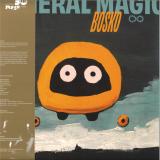
Now, we have General Magic’s second official full length comeback recording, Bosko. The new album is initially notable prior to the needle hitting the wax or the cursor identifying a track due to the artwork. Made by long term collaborator Tina Frank, this is Frank’s first analogue artwork, with a painting of a happy/nervous machine thing hovering in a landscape of no discernible identity. It’s quasi science fiction hovering amongst the potential for fun. Suited to the music? Natürlich.

Bosko sees Bauer and Pieper update and reframe their original investigations with a fresh supply of head scratching, heart racing tunes that hit the inexplicable with a wild mesh of drums, pianos, synthetic voices and all manner of immaterial sonic play. Startling sonics shock the ears on Club Duchamp which sounds like a conversation between synthetic adult ants in an environment still in development. Elfer features vocals supplied by a female-ish voice who, whilst grappling melody, has trouble executing a firm identity. Noorenhalt catapults along a mainframe of syncopation so unwieldy it feels like the voice, which is utterly alien, provides the only comfort. Seite 5 inhabits a fuzzy zone where a synthetic Horn of Jericho type ambience competes with rhythms never quite sure of who they are. Rise of the Ombré raises the spectral dread. Is this Science Fact? Absolutely nothing within Bosko is predictable.

The amount of change in the miasma of existence and the things we touch in order to make things has shifted so exponentially we are at the point where minds are starting to glaze over. All of this makes the return of the always original, always surprising, always fresh and exciting General Magic totally in tune with the artificial intelligent apocalyptic age we currently inhabit. The tools may have changed but the wonderfully warped gaze of Bosko offers a fresh new vision of perplexing funk and robotic punk.

pas en stock

Commandez maintenant et nous commanderons l'article pour vous chez notre fournisseur.

24,58

Last In: 7 months ago
Rivet - Peck Glamour

Rivet

Peck Glamour

12inchEMEGO317V
Editions Mego
04.09.2025

Rivet’s new album for Editions Mego is an uplifting and joyous affair coming in the wake of tragedy and disenchantment. It is yet another rebirth from an artist willing to take a step back and reprise the current situation he is in. Mika Hallbäck has a long credible history in the Swedish underground. First recognised for his industrial techno works under the Grovskopa moniker he worked privately on more experimental works that eventually came out as On Feather and Wire, an album released on Editions Mego in 2020. After much acclaim for this bold new direction that blended electronic abstraction, pop and industrial forms into a heavy synthetic trip two tragedies struck. One was the passing of label boss Peter Rehberg and then the passing of his dog Lilo, who was as close as a companion one could have. These events led to the release of the more unsettling follow up L+P-2 (Lilo and Pita minus two) on Midnight Shift Records in 2023. Peck Glamour sees Rivet return to the reawakened Editions Mego with an album of optimism inspired by reconciliation with loss and further explorations of new mental/sonic realms.

Hallbäck defines his approach as not being married to any particular machine, instrument, process or genre. However he holds a particular affinity to sampling, of which, he says, provides the dirt and grit amongst what would otherwise be pristine, generic machine music. The contemporary crate digging method of scouring obscure download music bogs for unique sounds was his preferred research practice.

Peck Glamour is an album full of tracks brimming with the excitement of exploration. It's the results of a mind informed by punk, industrial, techno, dancefloor, disappointment, trauma and rebirth. Here the synthetic and authentic is viewed simply as the same means of human rationale and expression.

The opening, ‘Catch Up to Light’, sets the scene with ecstatic and odd fluorescent vocals sliding amongst crystalline likembe whilst synths swirl amongst the external festivities. ‘Orbiting Empty Cocoon’ is somewhat a homage to the alien sound worlds of The Orb, one which takes the listener deeper into a mind melting array of teased potential as visual elements are executed in a mask of audio wizardry and euphoric staccato rhythms, the later being a nod to Singeli music. ‘Patitur Butcher’ is more dance frontal utilising the Ghatam drum and a YouTube rip of a Chinese language lesson. ‘Plastic Bag Putain’ was made during the beginning of Russia's invasion of Ukraine and should be clear of its intent. ‘All that Heaven Allows’ is a marimba cover of an imaginary Love Parade anthem. 'Kyrie Geire’ potentially briefly fills the void left by the demise of Coil. The entire trip of Peck Glamour is sewn up with ‘We left before we came’ whereby extraneous recordings of double bass player Gregory Vartian-Foss (tuning/strumming/moving the bass) are superimposed with local field recordings to create a gorgeous bed of sounds acting as an exciting exit music to this sharp collection of cinematic ear excursions.

pas en stock

Commandez maintenant et nous commanderons l'article pour vous chez notre fournisseur.

24,58

Last In: 7 months ago
Little Annie meets Night Foundation - Inertia (7")

A multidisciplinary artist, and avant-garde icon in her own right, Little Annie leaves little room for an introduction that is worthy of her prolific career. She has remained relevant for over four decades through her innate spirit of experimentation and the multiplicity of her genre-bending collaborations with artists traversing the globe such as Adrian Sherwood, Swans, The Wolfgang Press, Kid Congo, Current 93—the list goes on!

For this release, Noir Age is proud to present a 7” single of new material from Little Annie in collaboration with South Florida-based producer and label owner Richard Vergez, recording here under the moniker of Night Foundation. Annie and Richard met back in 2016 after a gig at the ICA in Miami through their mutual friend: Drew McDowall of Coil.

Sharing a requited spirit for visual art and music, they became fast friends and began collaborating, conjuring what you hear on this release: Inertia.

Edition of 300 records, each housed in a silkscreened, custom black 7" envelope jacket with newsprint insert.

Reviewed in The Wire magazine:

"Night Foundation is one of the current electronic projects envisioned by Florida's Richard Vergez. In this instance, his work is smooth and bassoid enough to have a vague dancefloor-friendly feel without being overtly prancy. This notion is enhanced by the presence of a dub B side, so things are not as dark as with most of Verge's projects. But they're still not sunny. Of course, Little Annie's lyrics and casual vocals have more in common with urban menace than sunshine pop, so the pairing works quite well."

pas en stock

Commandez maintenant et nous commanderons l'article pour vous chez notre fournisseur.

15,93

Last In: 7 months ago
Chip Wickham - The Eternal Now LP

Saxophonist, flautist and producer Chip Wickham casts a formidable shadow across the worldwide jazz landscape. Originally from Brighton, but now dividing his time between the UK, Spain and the Middle-East, he has made a name for himself with a series of beautifully crafted solo albums that draw equally on the hard swinging spiritual jazz of Roland Kirk, Yusef Lateef and Sahih Shihab, alongside the music of British jazz legends such as Tubby Hayes and Harold McNair and the more contemporary sounds of Jazzanova, Kyoto Jazz Massive and Robert Glasper. His close working relationship with Matthew Halsall’s Gondwana Records has spanned close to two decades (since he played on Halsall’s 2008 debut ‘Sending My Love’) and has since released three standout releases on the label (the ‘Cloud 10’ LP, and the ‘Astral Travelling’ and ‘Love & Life’ EP’s). Once again returning to the heralded label, he now prepares to release his elegant fifth studio album ‘The Eternal Now’. Further exploring his penchant for hard-hitting soulful, spiritual jazz and modal hard-bop, it denotes an exciting new chapter in his much- revered discography, once which sees his unbridled artist flourish into new and fruitful pastures.

A beautifully crafted record, ‘The Eternal Now’ is a heartfelt ode to submitting oneself to the practice of creating art, and the freedom that’s derived from letting go. Speaking on his journey to bringing it into the world, Chip explains “The Eternal Now is a creative place where time has no purpose. A place where the past and the future don’t exist. A place where an artist can create something that is timeless and relevant. Writing this album has been a deliberate journey of exploration and drive into the furthest reaches of creativity. An attempt to push myself artistically into new spaces using new colours and new energy”. On how he approached this record in comparison to his previous offerings, he divulges ‘I had to be playful and take risks. It has taken longer than any other album to make and it has been so worth it. I have been drifting and taking the road less travelled as well as not looking back. I’ve enjoyed being on the outside and the freedom it has brought me to create something new and fresh and relevant and timeless.’

pas en stock

Commandez maintenant et nous commanderons l'article pour vous chez notre fournisseur.

22,27

Last In: 7 months ago
DRAB MAJESTY - CARELESS

Drab Majesty

CARELESS

12inchDAISC775
Dais Records
02.09.2025

In the smoggy orange light of a new millennium, the young Deb Demure would take the bus, once a week, from his home in crumbling Hollywood to his grandmother's apartment, nestled in the pastel pristineness of Beverly Hills. During these visits, Deb couldn't help but notice the disconnect between the glow of his grandmother's temple, and the downtrodden, alienated figures that populated the seats of the mass transit that took him there. Week after week, he would observe these characters: fading B-movie starlets, leisure-suited alcoholics and forgotten civil servants. But one fateful commute home, as the twilight waned to the purple Los Angeles night, he realized these figures were not as lost as they appeared - there was a nobility in their failure, reflective of the dignity of the city's vanishing golden era. They were survivors, in need of a voice: a spokesperson for every color of hope and hopelessness, transcendent of gender and time; Drab Majesty became Deb's musical podium for this undertaking. Raised in a music-centric household, Deb would find the time to teach himself to play his father's right-handed guitar upside down and left-handed; an unorthodox fashion from where his earliest understanding of chords and harmony were conceived. Exploring the bins of discarded vinyl in his neighborhood thrift stores, his toolkit expanded with the subterranean sonic gems of the recent past. Influences range from the virtuosic arpeggiated guitar work of Felt's Maurice Deebank and the grittier pop progressions of Red Lorry Yellow Lorry's Chris Reed as well as Steve Severin from Siouxsie and The Banshees. He also studied the harmonic oscillations and utilization of the occult power of vibratory frequency present in New Age sounds of Greek artist, IASOS. In terms of orchestration, he consciously culls from the seaside maximalism of Martin Dupont and mechanized grooves of early Depeche Mode. Like a dualistic pendulum, his vocals swing from a preistly baritone to a choir boy's falsetto reflecting the sepulchral ambiance of church visits with his grandmother. Currently the drummer for Los Angeles lo-fi rock ensemble Marriages and having honed an unorthodox home recording style, Deb sources his sounds from a repository of "mid-fi" synthesizers and other lesser-quality instruments. Following the release of his debut cassette EP, "Unarian Dances", he also shared a split 12" with synth pop forefathers, Eleven Pond. During the Spring of 2015, Drab Majesty signed with Dais Records and released his first single, Unknown to the I, as a introduction for his first initial foray into the album format, romantically titled Careless. Written over the course of 2 years, "Careless" is a compendium of songs that have outlasted a malicious burglary of his studio, his struggles with substance addiction, and most recently, the death of his beloved grandmother.

pas en stock

Commandez maintenant et nous commanderons l'article pour vous chez notre fournisseur.

22,27

Last In: 7 months ago
THE RADA'S OLD BOYS - MANOS

THE RADA'S OLD BOYS

MANOS

12inchLBR131
LITTLE BUTTERFLY RECORDS
02.09.2025

Ruben Rada played a pivotal role in the development of Uruguayan music. By blending Afro-Uruguayan traditions with rock, soul, jazz, and funk, he paved a new musical path that began in the 1960s and continues to evolve today. Throughout his career, he has consistently been surrounded by talented musicians who have been integral to his sound. This was especially true with Daniel "Lobito" Lagarde, bassist and founding member of the iconic band Totem in the early 1970s; Ricardo Nolé, keyboardist, arranger, and musical director of Rada's band in Argentina during the 1980s; and Nelson Cedréz, the drummer who has been by Rada's side since the 1990s. In 2016, these three musicians reunited to form Rada's Old Boys, releasing an album of jazz-infused reinterpretations of Rada's songs that earned rave reviews. Now, they return with Manos, a bold new album that reimagines Rada's works from every phase of his career, featuring deeply personal renditions and a special guest appearance from Rada himself on one track.

pas en stock

Commandez maintenant et nous commanderons l'article pour vous chez notre fournisseur.

29,83

Last In: 7 months ago
Demi Riquísimo & Luke Alessi - Yes Bby

‘Two taches intertwine. An EP born out of Demi’s visit to Melbourne during his AU tour, and Luke’s easily accessible studio based above an inviting pub, naturally the vibes were high after a couple of schooners in the summer sun.’
Life & Death welcomes a standout collaboration from Demi Riquísimo and Luke Alessi with the release of their new EP ‘Yes Bby’ landing 29 August 2025. Setting themselves the brief of, “upbeat rollers and a little bit of naughtiness,” the two producers blend their sonic identities on this club-ready two tracker, formed of ‘Basement Trash’ and title track ‘Yes Bby’.
“Basement Trash was actually the first track we wrote. A funky, fun, hypnotic groover thatlocks you in on the d floor, made for those late nights (or early mornings) in the “basement” of a grungy club. For ‘Yes Bby’ we wanted something that worked on a bigger scale. We dialled up the French rave synths, bigger builds, more drive in the groove and added a cheeky classic vocal chop for the hook.”
– Demi Riquísimo & Luke Alessi

Known for his genre-blending productions and distinctive edits, Semi Delicious head honcho Demi has steadily carved out his space in the scene, a respected tastemaker and Ibiza mainstay, while Luke Alessi has continued to establish a global profile over the last 12 months with major European and US gigs, plus releases on Shall Not Fade, SMiiLE records and of course Life & Death, making this pairing a natural fit.
Already receiving support from the likes of Chloé Caillet, Call Super, Moxie and more, ‘Yes Bby’ marks an exciting moment in both artists’ trajectories. For Demi, this EP also serves as the first in a new chapter, one that places him at the centre of a more collaborative space, setting the tone for landmark projects to follow on his own imprint later this year.
As one of dance music’s most respected tastemakers, Life & Death continues to shape the global underground through its diverse output, with ‘Yes Bby’ slotting seamlessly into the label’s catalogue of playful, sexy and forward-thinking club music.

pas en stock

Commandez maintenant et nous commanderons l'article pour vous chez notre fournisseur.

13,03

Last In: 7 months ago
Articles par page:
N/ABPM
Vinyl