- 1: Cause A Scene
- 2: Probably Right (Too)
- 3: Y Feat. Kofi Stone
- 4: Worst Child Feat. Rozzz
- 5: Selfish Behaviour Feat. Daliso
- 6: You Don't Wanna
- 7: You Don't Like Me Because
- 8: Free Food Feat. Janel Antoneshia
- 9: Crying Of Laughter
- 10: Spirit & Breanna
- 11: Moodring
- 12: Browkeee
- 13: Tick The Box (Part 2)
- 14: Emmett Till Feat. Masta Ace
- 15: V. I. R. A. L Feat. Obi Rudo
- 16: Petty You, Petty Me
- 17: Yvonne's Daughter
Поиск:yvonne
Все
Handpicked by Gilles Peterson from Manchester’s vibrant live music scene, and newly signed to Brownswood, 2021 set to be the main stage for them to breeze on to the scene, as a multi-generational band breathing new life into the classic British street-soul sound, founded by singer/song-writer Kemani Anderson, multi-instrumentalist and song-writer Callum Connell and Manchester music scene stalwart Stuart Whitehead.
Debut track ‘The Sun’ was inspired by a poem written by Callum Connell at the top of Greenwich Park viewpoint looking over the infamous London cityscape as the sun set. At the time the band were writing and arranging separately with Callum & Kemani living in South London while they attended Trinity Laban (following in the footsteps of many of the UK’s young Jazz prodigies). Eventually, they congregated for a fateful recording session at Blueprint studios in Manchester, that would be the amalgamation of their individual processes, to create ‘The Sun’. Inspired by four bass chords flowing like a stream of consciousness, Callum’s poem sprung
to life as the centrepiece of the track, with the melody being polished and refined by Kemani on keys and vocals. The result is an invigorating debut produced by influential music producer and sound engineer Yvonne Ellis (Simply Red & Swing Out Sister). Kemani coins this sound as “spiritual and healing” whilst Callum shares “The Sun’ is a powerful and uplifting song that can take you on a
spiritual journey but also make you reflect on everyday life.”
strumentalist Teddy Lasry's story is noteworthy not just in regards to the music he released, but in the ways approached the craft of composing and experimenting with sounds and sonics.
Always intrigued with the capabilities of instruments, their groove and their feel, it was very much his family’s influence that helped to fuel these life long affections. As a performer in a parisien cabaret, Teddy’s father Jacques would mingle with giants like Serge
Gainsbourg and Charlie Chaplin (impressed by his ability to improvise, Chaplin wanted him to become his accompanist, but the pianist politely refused). Jacques and his wife (Teddy’s mother Yvonne), would later become members of the innovative experimental group Les Structures Sonores, and surround their children’s lives with sounds. Electronic music was still in its infancy and Les Structures Sonores, with their resonators that produced long, mysterious tones, were deemed ‘cosmic’. It was the era of the launching of the first Russian Sputnik and every time a radio or television station wanted music for their science fiction programs, they turned to one of their compositions. Showing a natural ability with multi instrumentalism, Teddy was rewarded with a spot in the band, allowing him to really explore unconventional methods of composition.
Following a brief stint with Ariane Mnouchkine's avant-garde Théâtre du Soleil after graduating school, Teddy joined the pioneering prog band Magma, with whom he would record three groundbreaking records during the early 1970s (According to former member
Laurent Thibault, their album Mëkanïk Dëstruktïẁ Kömmandöh and its sound were strong influences on David Bowie during the recording
of Low and Iggy Pop’s The Idiot at Hérouville). Despite the successes with these projects, Teddy was constantly searching for new ways
of expressing himself through music, leading him into the beginnings of a solo career that would last the better part of three decades.
Teddy’s transition into his solo career came with contrasting fortunes, in that he was now becoming a music to image composer but with the unfortunate realisation that his eyesight was gradually worsening (due to being diagnosed with retinitis pigmentosa at an early age). Nonetheless, his solo career would begin in 1975, and for the rest of the decade his sound would become increasingly mired in electrified Funk-Fusion and its endless sonic possibilities. The resulting music would serve to highlight Teddy’s love affair with the possibilities found within tireless instrumentation, with the flute and particularly synthesisers becoming a mini-obession of his (he once spent a 7,000 Francs loan, which was meant to be spent on fixing his roof, on synths).
To this day Teddy continues to record and experiment with music, a passion which in many ways has never left his sid, even at the age of 75. His career was one that was fuelled by innate curiosity and an intrinsic desire to discover new methods of expressionism, be it through the realms of Jazz-Funk, ambient electronics, Swing music or indeed through the medium of instrumentation itself. On this compilation, we look to encapsulate the essence of his innovative sound, and from start to finish a sense of his ingenious approach to composing structure and mood is made abundantly clear. The funk-jazz fusion style that embodied the majority of his 70s work is on full display here, with the vibrant flute driven "Los Angeles", the Miles Davis inspired "Blue Theme", the progressive and driving
"Chamonix", and the deeply intricate "Krazy Kat", along with one of his finest 80s slow jams, "Funky Ghost". Two cuts off the ‘Back To
Amazonia’ album are also featured (Teddy’s last album including his Prophet T8, Yamaha DX7 and Oberheim drum machines). "Raising
Sun in Bali" and the title piece both emphasise an ever present passion for synthesisers. "Birds of Space", a standout track off the e=mc2 album, closes the comp, and is a fitting way to end this journey.
Pulled together in close collaboration with Teddy and his family, this collection of songs looks to introduce new listeners to his work and we are proud to present this limited and carefully remastered compilation on vinyl, including extensive liner notes.
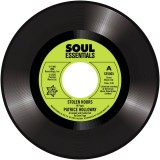
- A1: Stolen Hours
- B1: Love And Desire
PATRICE YVONNE HOLLOWAY was born in Los Angeles and is perhaps best known as the younger sister of Motown’s Brenda Holloway, the darling of the Northern Soul scene, particularly in recent years. Patrice also signed to Motown and recorded an unreleased version of “The Touch Of Venus” made famous by Edna Wright (aka Sandy Wynns).
In the mid-sixties Patrice signed to Capitol records and recorded “STOLEN HOURS”, arranged by the great Gene Page and written and produced by his brother Billy Page – she was only 15 years old at the time. It failed to hit Stateside but some thirty years later it became a Northern Soul anthem of the nineties, although it was originally played in the early days of Wigan Casino.
Our chosen flip-side, the follow-up single, “LOVE AND DESIRE”, was also penned, produced and arranged by the Page brothers. It failed to even get a commercial release in the U.S. although it was released in the U.K. and commands big money in today’s collectors market. Her final 45 for Capitol came in 1972 and was a credible version of the Sam Nesbit classic “Black Mother Goose”. Sadly, ill health, forced Patrice to step back from performing and she died before her time of a heart attack in 2006.
Patrice was also known as ‘Valerie’, singer with the animated girl-band Josie And The Pussycats produced by Hanna-Barbera and aired on CBS in 1971. She would beome the first black character to regularly appear on U.S. commercial TV.
Luciano Berio/Pierre Boulez/Olivier Messiaen/Karlheinz Stockhausen
Serenata I / Sonatine / Cantéyodjayâ / Zeitmasze
The avant-garde composer and conductor Pierre Boulez was a titan of post-War experimental classical music. Born in the small cheesemaking town of Montrbrison in central France in 1925, Boulez studied at the Paris Conservatoire with the composer and organist Charles Messiaen and received private tuition from pianist Andrée Vaurabourg; after moving to the Marais district in 1945, he briefly studied with Schoenberg disciple, René Leibowitz, and further influence came from immersion in Balinese gamelan, Japanese classical music and African drumming, among other sources. Earning money by playing an early electronic keyboard called the ondes Martenot on theatre productions, Boulez soon became music director of the Renaud-Barrault theatre company (led by actor/direction Jean-Louis Barrault and his actor wife, Madeleine Renaud), leading to tours of Belgium, Switzerland, Britain and both North and South America. American composer John Cage became an ally, though they subsequently clashed over Cage’s commitment to the role of chance in his compositions, paving the way for an intense and lasting friendship with the German composer, Karlheinz Stockhausen, who arrived in Paris in 1952 to study with Messiaen. In July of that year, the pair attended the International Summer Course for New Music in Darmstadt, leading to contact with Italian composer Luciano Berio and other noteworthy figures. Then, in 1954, with backing from Barrault and Renaud, Boulez began staging a series of concerts of experimental music at the Petit Marigny theatre, titled Le Domaine musical. The pieces collected on this album are all taken from performances staged for the 1957 Domaine musical season, beginning with Berio’s “Serenata I,” conducted by Boulez, which debuted in Paris in March of that year; arranged for flute and fourteen instruments, Berio said that the idea behind the piece was for the solo flute to be confronted by continuously interchanging elements, rather than mere accompaniments or oppositions. Boulez’s own “Sonatine,” composed in 1946 for flute and piano, is a 12-tone piece that evidences Messiaen’s influence, with shades of Asian classical music in places; then, Stockhausen’s monumental “Zeitmasze” or “Time Measures,” a serial composition for five woodwinds, played in different combinations of tempos and speed, was partly inspired by Webern’s principles of homogenous and harmonic textures. Finally, Messiaen’s 1949 work “Cantéyodjayâ,” delivered by pianist Yvonne Loriod, takes it shape from the classical Hindu rhythms of ancient India, as with much of the composer’s oeuvre.
Thandi Zulu known as T.Z. Junior was a young girl from Soweto. She started her musical career with Peter Moticoe who produced "Love Games" with The Young Five on Heads label in 1984. Then, Peter Moticoe brought her to Phil Hollis at Dephon Entertainment who then teamed them up with Attie Van Wyk who was the producer for Yvonne Chaka Chaka at that time.
Phil Hollis started Dephon Promotion (Dephon Entertainment) in the late 70's and developed into the largest independent record company in South Africa. He describes himself as the only person who has been involved in recording of major hit songs in nearly all genres of music in all the languages in South Africa. Phil Hollis was involved in all aspects of the Entertainment industry from production of recordings, recording company, distribution, marketing and promotion, events management, staging major events and filming.
"Sugar My Love" and "Are You Ready for Love" were produced and arranged by Attie Van Wyk. 'Back in the 80's I was a songwriter for a band called Ballyhoo when I got an offer from the Dephon Record Company to join them as a music producer. So I quit the band and joined them, producing records mainly for music targeted at the black market in those days,' he says. Between 1982 and 1992, Attie Van Wyk produced over 120 albums, including many for Yvonne Chaka Chaka.
Nach Dem Sensationellen Erfolg Des Ersten Albums - oracle Im Letzten Jahr, Erscheint Nun Das Zweite Album Der Deutschen Jazz-supergroup Web Web. - dance Of The Demons Ist Ein Furioser Tanz Mit Den Dämonen - Mal Im Positiven Spirit Soul Jazz Rausch Wie Bei - land Of The Arum Flower , Das Mit Seiner Ergreifenden Melodie An Ethopian Jazz Der 60er Jahre Erinnert, Oder Mal Verrückt, Entfesselt Wie Bei - sandia .
Web Web Spielt Nun Mittlerweile Seit 2 Jahren Intensiv Zusammen, Man Hat Duzende Konzerte Absolviert Und Man Spürt Förmlich Die Geschlossenheit, Intensität Und Kraft, Die Sich Als Homogener Organismus Aus Einem Guß Heraus Zu Einem Phantastischen Sound Zusammenbraut.
Als Einen Besonderen Glücksfall Konnte Die Band Den Berühmten Marrokanischen Sänger Und Gembri-spieler Majid Bekkas Gewinnen, Der In Rabat Beheimatet Ist. Tony Lakatos Arbeitete Mit Majid Und Joachim Kühn In Den Letzten Jahren Immer Wieder Zusammen, Ebenso Roberto Digioia In Zusammenhang Mit Klaus Doldinger. Insofern Lag Es Nahe, Diesen Brillianten Musiker Mit Seinen Nordafrikanischen Wurzeln Mit Dem Ungeschliffenen Konzept Von Web Web Zu Verbinden. In - maroc Blues , Einer Soloperformance Von Majid, Hört Man Den Warmen Klangkörper Der Gembri, Einem Kontrabassartig-klingendem Instrument (dreisaitige Langhalslaute), Sowie Auch Majids Wunderbare Stimme, In Der Sich Die Jahrhunderte Alte Tradition Der Berber Widerspiegelt. - safar Zeigt Ebenso Die Große Improvisatorische Klasse Von Web Web, Vor Allem Wie Sie Auf Allen Ebenen In Die Spirituelle Sprache Eintauchen.
Majid Bekkas Ist Einer Der Bedeutendsten Musiker Und Vertreter Der Gnawa-musik, Die In Der Südlichen Sahara Beheimatet Ist. Am Konservatorium Für Musik Und Tanz In Rabat Studierte Er Seit 1975 Klassische Gitarre Und Oud.
Nach Ersten Erfahrungen Mit Eigenen Bands In Den 80er Jahren Gründete Er 1990 Sein Trio Gnaoua Blues Band, In Dem Er Blues Mit Gnawa-musik Verband. In Den Darauffolgenden Jahren Interessierte Er Sich Zunehmends Für Jazz, Trat Schon Bald Mit Größen Wie Archie Shepp, Louis Sclavis, Peter Brötzmann Oder Hamid Drake Auf.
- dance Of The Demons- Wurde Wie Auch - oracle An Einem Wochenende Live In München Eingespielt
Toningenieur Ist Wie Auch Bei - oracle Jan Krause (beanfield, Poets Of Rhythm U.v.m.)
Das Nächste, Dritte Web Web Album Wird Im Winter 2018 Ebendort In München Aufgenommen, Und Es Werden Wíeder Ein Oder Zwei Hochkarätige Gäste Dazu Eingeladen.
Web Web Sind: Roberto Di Gioia (piano, Synth, Percussion), Tony Lakatos (tenor- Und Sopranosaxophone), Christian Von Kaphengst (upright Bass) Und Peter Gall (drums).
Roberto Di Gioia Arbeitete Mit Zahlreichen Jazz-legenden Zusammen, Wie Z.b. Mit Woody Shaw, Art Farmer, James Moody, Johnny Griffin, Charlie Rouse, Clifford Jordan, Clark Terry, Roy Ayers, Gregory Porter U.v.m.
Anfang 1990 Wurde Er Mitglied In Klaus Doldingers Passport.
Als Pianist Machte Er U.a. Aufnahmen Mit Udo Lindenberg (mtv-unplugged,2011), Charlie Watts (- music Of The Rolling Stones , 2005), Console (- reset The Preset , 2003), The Notwist (- shrink 1998, - neon Golden , 2002).
Seit 2007 Arbeitet Er Zusammen Mit Samon Kawamura Und Max Herre Als Kahedi: Max Herre (- hallo Welt , 2012), Joy Denalane (- gleisdreieck , 2017), U.v.m.
Seine Eigene Band Marsmobil (produziert Von Peter Kruder) Wird Im Herbst Ihr 4.studioalbum Veröffentlichen.
Tony Lakatos Stammt Aus Der Berühmten Lakatos-familie Aus Budapest, Ungarn. Sein Vater War Ein Berühmter Geiger, Ebenso Sein Jüngerer Bruder Roby. Er Begann Mit Dem Saxofon-spiel Als Er 15 Jahre Alt War.
Tony Studierte Auf Dem Bela-bartok-konservatorium In Budapest, Machte Seinen Abschluß 1979 Und Spielte Seither Auf Über 350 Jazzproduktionen Weltweit Mit, U.a. Mit Al Foster, Kirk Lightsey, Randy Brecker, George Mraz, David Witham, Terri Lyne Carrington, Anthony Jackson. Tony War Mitglied Der Band Pili Pili Von Jasper Van´t Hof. Seit 1993 Ist Er Solist In Der Hr Radio-bigband.
Christian Von Kaphengst Bekam Mit 6 Jahren Klassischen Klavierunterricht Im Peter-cornelius-konservatorium In Mainz.
Von 1988 Bis 1995 Studierte Er Jazz-kontrabass Sowie Instrumentalpädagogik An Der Musikhochschule In Köln.
Sein Jazzquartett - cafe Du Sport Absolvierte Im Auftrag Des Goethe-instituts Tourneen Nach Pakistan, Indien, Türkei Und Westafrika. Seit 1999 Ist Er Regelmäßig Bassist Von Patti Austin Sowie Der New York Voices Für Europäische Konzerte.
Von Kaphengst Spielte U.a. Mit Randy Brecker, Nat Adderley, Roy Hargrove, Joe Sample, Charlie Mariano, Katja Ebstein, Xavier Naidoo, Roachford, Yvonne Catterfeld.
Peter Gall Gewann Bereits In Jungen Jahren Erste Preise Bei Jugendjazzt Und Tourte Mit Dem Bundesjazzorchester Unter Leitung Von Peter Herbholzheimer. Er Studierte An Der Berliner Universität Der Künste Und Am Jazz Institut Berlin Bei John Hollenbeck. Gall Absolvierte Sein Masterstudium An Der Manhattan School Of Music Bei John Riley.
Er Arbeitete U.a. Mit Kurt Rosenwinkel, Seamus Blake, Ben Street, Gabriel Rios, Jasmin Tabatabai, Thomas Quasthoff, Peter Fessler.
Feedback - Web Web - oracle :
"oracle Ist Nicht Nur Ungemein Packend, Sondern Klingt Auch Absolut International, Bewegt Sich Auf Einer Ebene Mit Leuten Wie Kamasi Washington Oder Shabaka Hutchings." - Jazzthetik
"ein Wirklich Erstaunliches Erstes Album" - Süddeutsche Zeitung
"sun Ra Wäre Stolz Gewesen Auf Web Web Und Ihr Erstes Album Oracle." - Soultrainonline.de
"...the Album Is Engaging And Fascinating In Equal Measures. ... Sonically, The Album Embraces The Various Late 1960s And '70s Jazz Aesthetics Of Modal, Fusion And Spiritual Jazz Soundscapes, But 'oracle' Isn't A Strata East Or Black Jazz Tribute Record. This Is Very Much A Contemporary Affair With Its Richness Emanating From The Group's Varied Musical Tastes And Sensibilities And It Favours An Entire Listening Experience." - Ukvibe.org
"raise A Glass And Toast This Supremely Enjoyable Recording." - Birdistheworm
"oracle Contains 13 Tracks Of Pure Retro Sounding Perfection. This Is Like A Long Forgotten Treasure. It's Certainly An Album Serious Lovers Of The Genre Will Embrace." - Reviewgraveyard
"wonderful Album!!" - Simon Harrison / Basic Soul
"this Is Amazing. Going To Have To Grab A Vinyl Copy For The Collection" - Kev Beadle
"fantastic Record ! Love It ! We Need More Music Like This !!" - Peter Kruder
Patti Austin Is From Harlem, New York, The Goddaughter To Quincy Jones With Whom She Sang On the Dude' (including razzamatazz'). She Has Released Solo Albums Since 1976 And Won A Grammy For Her 2008 Release. Her First Singles Were For The Coral Label In The 60s From Where She Has Popularity Began With Northern Soul Fans. In The Early 70s She Recorded For Columbia, A Period From Which The Two Songs Re-released Here Are Her Most Popular. are We Ready For Love' In Its Own Right And didn't Say A Word' As A Highly Regarded Rendition Of A Classic First Recorded By Yvonne Baker. Patti Is Headlining At The Blackpool International Soul Festival In Manchester, Uk This Coming June.
From Buffalo, New York, Joanie Was Primarily A 60s Pop Singer And Actress Who Recorded Numerous Singles For Warner Brothers During That Decade. don't Pity Me' Was Recorded And Originally Released In 1965 And Has Become Her Most Sought After Release. An Original Has Been Valued At £400, A Rare Clip Of The Song Viewed Over 200,000 Times On Youtube. It's Popularity Stems From The Northern Soul Scene Where In The 70s It Was 'covered Up' Under The Artist Name Yvonne Daniels.
With France's long-fallow club scene back in international resurgence as Paris storms back into fighting form, Europe now has found a new source for yet-unheard music. It was a long time brewing, but names like Concrete, Katapult, Zadig, and Society of Silence, have begun to appear in the international clubbing circuit, and the growth is not limited to the capital. Further south in Lyon, a city quickly gaining its own renown for busy club parties booking bigger names, there exists a smaller circle of energetic operators whose name is also spreading rapidly and whose recent accomplishments include Nuites Sonores, Boilerroom and more. Spearheaded by Kosme, a DJ and producer of quickly increasing notice, the provincial powerhouse has already turned heads throughout France as Kosmo's Caramelo Records was snapped up by legendary Parisian distributor Syncrophone; he has a new label set to launch in 2014. It is with this background in mind that THEMA proudly offers Kosme's international debut, the 'April Moon' EP.
Kosme comes to the table with six tracks of low-slung Detroit-referencing house music laced with extra grit. 'Fondamental' rides shuffling hats and a building acid line to dramatic heights. 'Ever Shake My Mind' is slower and dirtier yet, with crushed hats and a bottom-lurking bass between Theo Parrish-esque drum-machine-down-the-stairs breakdowns. After an interlude, 'Mothafunka' resumes the beatdown with a talkover house track that escalates uncontrollably in intensity as drums shuffle before breaking down in congos & pads. 'Deep Function' dials down to sexier sounds with sultry vocal samples and sampled hiss, but it doesn't lose the drum kink. Finally the digital bonus 'A Thought for Yvonne' is the most subdued and skeletal of all with echoed drums and a lonely bassline tumbling over each other in slow motion.
Following the explosion of new sounds from the capital, it is no surprise to find the movement spreading, and THEMA arrives first with the freshest France has to offer.