A selection of the main sountracks of Naruto - one of the best known Anime in the world. Including the opening theme "Haruka Kanata".
In the village of Konoha lives Naruto, a young boy who is hated and feared by the villagers because he has Kyuubi (Nine-tailed fox demon) of incredible strength inside him, which has killed many people. The most powerful ninja of Konoha at that time, the fourth Hokage, Minato Namikaze, managed to seal this demon in Naruto's body.
Search:z people
- A1: Your Love Belongs To Me
- A2: Can I Be Your Lover
- A3: This World Is Really Mine
- A4: Step People
- B1: Don't Fight The Feeling
- B2: Going Through The Motions
- B3: You've Broken My Heart
- B4: You Don't Know What You're Doing
- C1: Devil With The Bust
- C2: J P. Walk
- C3: Blow Your Mind (Extended)
- D1: Can This Be True
- D2: Don't Bother Me
- D3: Summer Girl (Short Version)
- D4: Devil With The Bust (Instrumental)
In 2017, at Documenta Kassel (but in Athens), I invited José Jiménez Bobote, a remarkable gitano artist from the Tres Mil Viviendas neighbourhood in Seville, to record a series of actions in specific locations in the Greek capital. Ancient Greece and modern Greece. I wanted him to draw sound from the city, to strike it as only a flamenco artist can, with his feet. To hit the ground and make it moan, ring out with noises evoking significant moments in history: from Diogenes the Cynic and the Apostle Paul’s sermon at the Areopagus to Rosa Eskenazi’s resistance to the Nazi-German occupation, and the ups and downs of police Inspector Costas Haritos’s survival at the European Bank during the PIGS crisis. Bobote struck the ground and Athens responded, sending back echoes of the past, in an exceptional anachronistic exercise. In flamenco it is possible for several times to sound simultaneously.
We took seventeen hours of footage, and water from many wells.
I then shut away producer, musician, and friend Raül Refree with this material so that he could take the long titles and use them as scores, turning them into mere songs. It was very important to think in terms of songs. The tracks had to have the capacity to be songs, the kind of thing one whistles while absent-mindedly walking down the street. Generally speaking, the scores—that is, the texts—defended the use and abuse of the loose coins that people carry around in their pockets. Loose change as a kind of everyday fetishism against big financial capital. Pistis! Refree managed to coax that distinctive unity of songs, their bright catchiness, from the amalgamation of sounds that would, in other hands, end up being labelled concrete music. Peter Szendy would be pleased and grateful. Being able to sing under one’s breath something that others consider simply noise.
Seven songs, yes. And if you get the chance, take a stroll through Athens with them: the locations are clearly defined. If not, then let Athens fill your home with all its ancient wisdom, boring into your ears like worms, making holes in history.
Listen, and, as people used to say, turn up the volume!
Pedro G. Romero, Santa Marta, Colombia, November 2025
Comes with booklet with song lyrics written by Pedro G. Romero. Limited edition of 250 vinyl records.
Audio taken from a live performance by Anar Band (Jorge Lima Barreto and Rui Reininho) with E.M. de Melo e Castro in November of 1978 at Cooperativa Árvore, Porto. The performance was filmed. A segment was included in »Obrigatório Não Ver«, a weekly programme presented by Ana Hatherly on Public Television’s Second Channel. It was not possible to determine the exact date of the event, and no documentation seems to be available in the relevant archives.
»Encontro que Tenho« and »Profissões«: these titles are specific to this release. Having failed to locate the respective poems after a thorough search in E.M. de Melo e Castro’s body of work, it was deduced both texts were created for the occasion.
Even without a full contextualisation, the sound transmits the spirit of cultural agitation proper to these sessions. When this show happened, Anar Band were Jorge Lima Barreto (ARP Odyssey synthesizer) and Rui Reininho (Ibanez double-neck guitar), with the addition of E.M. de Melo e Castro, whom we shall call a poet but whose creative intervention was far reaching. Besides poetry, also continued his efforts in linking up diverse artistic areas (painting, drawing, collage, performance, video) and his official training in textile engineering. He was one of the artists featured in Henri Chopin's »OU Revue« in 1966, establishing his natural connection to the European concrete/visual/sound-poetry avant-garde. Melo e Castro was also proficient in the agitation of minds and political awareness. A good example in »Profissões«, where initially separate professionals (an intellectual, a fisherman, a soldier, a factory worker) are gradually mixed in a show of interdependency. Symbolically, through his words one listens to a transformation of society, although the same conclusion arises twice: surplus always finds its way to the hands of the capitalists.
That was the state of affairs many were looking to change, an economic and social malaise that the 1974 Revolution in Portugal fully uncovered, when dissident voices could finally be heard in public. Each in his own way, all three participants in this recording were non-believers in the structure of society such as it was presented. Through his books and press writings, mainly concerned with Jazz, Jorge Lima Barreto pushed his way into Portuguese artistic and critical circles since the late 1960s. Consciously and unwittingly, he collected enemies and pointed them by name, people he labelled as reactionary, people who delayed progress, social and cultural mixes, the avant-garde; they even delayed the chaos from which new forms and attitudes arise.
Rui Reininho, a non-conformist by heart, experienced incomprehension from an early age. His anarchic ways, a tendency to baffle others, were revealed through the choice of clothes and accessories, public behaviour, and »real life« performances. Just as Lima Barreto, and even together with him, he enjoyed provoking the extremes: Maoists on one side, right-wing conservatives on the other. He translated leftist books and joined Anar Band precisely on the day a duck or swan or goose (one of them) was thrown on stage in Porto, 1976.
This record documents a concrete action, a snapshot of the agitation, something we have no problem calling punk activism, something which allowed two people with little to no musical training to play and record music. By then, Anar Band had managed to release their only LP in 1977. It’s this performance, however, that reveals the naked rawness of the music: improvisation, mutual listening, and choice of intervention between both musicians and Melo e Castro, clearly sensing when the synth has to change tone, the voice has to make pauses, the guitar punctuates both and finds the space to… scream. The sound was captured by the film crew, adding to the rawness: the instruments are palpable, the voice often too close to the mic. Everything was preserved. First time on disc.
- 1: Sudden Death
- 2: Sudden Death
- 3: Public Enemy No.1
- 4: Public Enemy No.1
- 5: Whose Life (Is It Anyways?)
- 6: Whose Life (Is It Anyways?)
- 7: We The People
- 8: We The People
- 9: Guns, Drugs & Money
- 10: Guns, Drugs & Money
- 11: Never Dead
- 12: Never Dead
- 13: New World Order
- 14: Fast Lane
- 15: Black Swan
- 16: Wrecker
- 17: Millennium Of The Blind
- 18: Deadly Nightshade
- 1913:
- 1: New World Order
- 2: Fast Lane
- 3: Black Swan
- 4: Wrecker
- 5: Millennium Of The Blind
- 6: Deadly Nightshade
- 713:
- 1: Nart Shabatynoqo - Tizhin Gup
- 2: Ritmik Improvizasiya - Kamran Kərimov, Yusif Əzizov
- 3: Sivrin Dun - Tatiana Dordzhieva, Maria Beltsykova
- 4: Qartuli Dance - Arkady Kagramyan, Arseniy Kagramyan
- 5: Abredj Nuh - Mutat And Ilyas From Ulyap
- 6: Barkhallal Dawdi - Balkhar Ensemble
- 7: Nart Shabatynoqo - Zamudin Guchev
- 8: Zazu Daxe - Tizhin Gup
- 9: Arazbari - Şirzad Fətəliyev, Arazbarı Balaban Qrupu
- 10: Perizada - Bagdagyul Ramazanova
- 11: Cəngi - Şirzad Fətəliyev, Arazbarı Balaban Qrupu
- 12: Yali - Bagdagyul Ramazanova
- 13: Hüseyni - Aşıq Altay
- 14: Humayun - Mirjavid Cəfərov
- 15: Si Woreyda - Nayil Quoshi
The label ORED Recordings was founded in 2013 by Circassian friends and fellow musicians Bulat Khalilov and Timur Kodzoko, in order to start an activity which is dedicated to documenting and preserving the traditional and post-traditional music of the North Caucasus. Khalilov and Kodzoko, were just as excited about this music as it sounded like a force that transcends borders and in which time dissolves and community becomes the only compass.
Through hundreds of field recordings, which have been made at communal gatherings, local festivities or family meetings, the label has captured a wide range of individual voices and their unique acoustic manifestations. All recordings on this album capture the raw expressiveness of the mountainside villages. Music performances being played by people who dedicate their love to music and an additional willingness to share intimate emotions.
Whereas most academic ethnomusicologists travel around the world in order to study foreign cultures, Bulat Khalilov and Timur Kodzoko were fascinated by what they just heard in the familiar regions of their then home town Nalchik. In resolute contrast to Russian academic circles, they soon developed a DIY Punk ethos for their far reaching work, beginning to formulate their own language in the field of ethnomusicology and to push the traditions forward.
However, the label’s work goes far beyond mere preservation. »We started traveling around the North Caucasus and did recordings with people from many different ethnic groups. In the North Caucasus, our work had a political dimension because there used to be (and still are) a lot of conflicts between different ethnic groups. We quickly understood that our work is not just about music and art,« states Bulat Khalilov.
The work of the label aims to reflect not only the great music of the Caucasus and its various communities but also to tell the stories behind it. They are stories of struggle, of independence, of working with historical memory in the present times of the 21st century.
Since Bulat Khalilov and Timur Kodzoko are now based at the University of Göttingen, we were able to meet each other many times and to eventually exchange ideas which resulted in the release of this collection of recordings. The compilation »Music from the Caucasus« provides a first introduction to the comprehensive work of ORED Recordings. For this collaborative release on TAL the recordings are being made accessible for the first time ever on vinyl, CD and various digital formats, all coming with extensive liner notes and yet unpublished photographs.
Bulat Khalilov and Stefan Schneider, November 2025
- 1: All Strung Out Over You
- 2: People Get Ready
- 3: I Can't Stand It
- 4: Romeo And Juliet
- 5: In The Midnight Hour
- 6: So Tired
- 7: Uptown
- 8: Please Don't Leave Me
- 9: What The World Needs Now Is Love
- 10: Time Has Come Today
LP1 - Side A
A1 All Strung Out Over You (2:29)
A2 People Get Ready (3:51)
A3 I Can't Stand It (2:42)
A4 Romeo And Juliet (4:32)
A5 In The Midnight Hour (5:31)
A6 So Tired (4:04)
LP1 - Side B
B1 Uptown (2:56)
B2 Please Don't Leave Me (3:00)
B3 What The World Needs Now Is Love (3:19)
B4 Time Has Come Today (11:02)
We Jazz Records continues their 7" series with a new release by Oaagaada, a fresh quartet from the rural parts of Southern Finland. "Oag-ada / A Swimming Trip" appears on 30 October and presents the band's ability to create fiery and flowing jazz music with strong avantgarde leanings. Think Art Ensemble Of Chicago on their groovy mode and add a strong DIY mentality, four people in a room creating music in the now. The lows are low and the highs are high, with the trumpet firmly on the red, adding just the right amount of blurriness into the picture. Perhaps it's not "lo-fi jazz" per se, but rather music which is more concerned with other things than the cleanest of hi-fi imagery. This is "real jazz for real people".
The quartet includes Tuure Tammi (trumpet), Sami Pekkola (sax), Tero Kemppainen (bass) and Simo Laihonen (drums). Laihonen has recently appeared on We Jazz Records with Stanley J. Zappa and previously with Black Motor, and more Oaagaada can be heard on the recent "We Jazz Live Plates" album "Lonna 2019".
True to We Jazz style, the 7" single comes with old school heat-pressed labels and a plain brown paper sleeve.
CULT boogie funk release from ROBBIE M & The Midnight Express Show Band of Rock Island Illinois. A PPU follower's favorite, and after many requests the 7" reissue is now available..Includes the newly remastered 1983 7" version of "Danger Zone" and Robbie M's "I Need Good Lovin" from 1989.
Tiger Stripes debuts on Rekids with ‘I Heard It Through the Bassline’.
Stockholm’s Tiger Stripes appears on Matt Edwards’ Rekids for the first time with the ‘I Heard It Through The Bassline’ two-tracker. The EP starts with the aptly named title track, defined by its deeply infectious bass, which propels forward along tight house grooves and classy gospel vocals. ‘I Heard It Through the Bassline’ is followed by Tiger Stripes’ ‘Everybody’s Doing It’, a stylish, low-slung people mover with the air of a vibey, dim-lit establishment or introspective late-night journey through the city.
Strange Idols label founder Tiger Stripes is a prolific producer, remixer, and DJ who has been active since the early 2000s. He’s collaborated with artists like Kerri Chandler and Jerome Sydenham and released music via heavyweight underground imprints, including Hot Creations, Get Physical, and Sydenham’s Ibadan. Now, he moves the needle again with the ‘I Heard It Through the Bassline’ EP on Rekids.
- 1: This Is Not A Dream
- 2: Abuser
- 3: Kill
- 4: Parasites
- 5: Lacerate (Ft. Harvey Freeman)
- 6: Womb
- 7: Brother’s Lament
- 8: Red & Green
- 9: Wolfskin (Ft. Taylor Barber)
- 10: Loser
- 11: Death & Connection (Ft. Jonathan Finney)
- 12: Miss Me
“’Death & Connection’ is a body of work born from the absence of the people who no longer hold space in our lives”, comments the band. “This record was created from a necessity to express and soothe our deepest losses; however, that was never the intention — we simply set out to make an album we wanted to hear.” With “Death & Connection”, Shields invite the audience to experience the next evolution of their sound – mature, refined and fearless. Throughout the band’s career Shields toured with bands such as Ice Nine Kills, Born Of Osiris, Chelsea Grin, Veil Of Maya, Escape the Fate or Loathe.
- Maputxe
- Urrun
- Eguraldi Lainotsua
- Hay Algo Aquí Que Va Mal
- Balazalak
- La Línea Del Frente
- In-Komunikazioa (Intro Free Nelson Mandela)
- Desmond Tutu
- Newroz
- Azoka Eguna
- Euskal Herria Jamaika Clash
- A La Calle + La Familia Iskariote
- Bizitza Zein Laburra Den
- Nicaragua Sandinista
- Dow To The River To Pray
- Black Is Beltza ·
- After-Boltxebike
- Aiako Txikito/Hiri Gerrilaren Dantza
- Bidasoa Fundamentalista
- Jon Maia: Versos A Madrid
- Lehenbiziko Bala
- Itxoiten
- Etxerat
- Zu Atrapatu Arte
- Kolore Bizia
- Radio Rahim
- Dub Manifest
- Yalah Ramallah
- (Intro) Gora Herria
- Sarri, Sarri
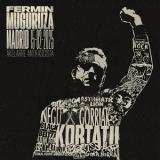
The musical legacy of a night that will live on for years - Fermin Muguruza's 40th anniversary roar! Under the title "Akelarre Antifascista" (which literal translation would be "Anti-Fascist Witches' Coven", but loosely translated as Anti-Fascist Celebration), in a reference to the legendary Akelarre, a wild gathering of Basque witches, this album distils all the intensity, sweat and collective excitement of a night when thousands of voices joined together to celebrate not just a career, but a way of seeing art as resistance. On 15th February 2025, Madrid saw more than just a concert: it was a collective ritual, an anti-fascist demonstration in which thousands of voices came together as one to emphasize the tenacity of a voice that never surrendered. Four decades after lighting the fuse of combative rock in Euskal Herria, the Basque Country, Fermin Muguruza chose the capital of Spain, a city that closed its doors to him so many times and that he has described as "the heart of the beast", to make the definitive record of his 40th anniversary tour. The result is "Akelarre Antifascista", a live album that distils the history of a musical and political resistance that has spanned generations, languages and frontiers. The concert, sold out with 15,000 people, was an explosion of energy, memory and future. Right from the first chord, the Sports Palace of Madrid became an open setting, a free territory where bodies, rhythms, languages and flags mixed freely. Triple 180gr vinyl LP in trifold sleeve.
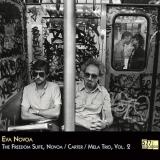
"Brooklyn-based pianist Eva Novoa returns with The Freedom Suite: Novoa / Carter / Mela Trio, Vol. 2 — the second radiant release from her compelling trio with saxophone icon Daniel Carter and celebrated drummer Francisco Mela. This marks Novoa’s sixth album with 577 Records. The trio first came together live in 2021, followed by a series of performances, including appearances in Cambridge (Boston) and later at the Brooklyn edition of the NY Forward Festival.
"The Freedom Suite is an homage to jazz titan Duke Ellington — particularly his masterful big band suites and legendary orchestra featuring Johnny Hodges and other luminaries who helped define an era of jazz greatness. In contrast, Novoa presents her Suite in a more intimate format: the piano trio. The album comprises twelve pieces — mostly brief — with a few extended tracks such as Free to Be Free and Cyborgs.
"For this recording, Novoa also steps in as a vocalist on several tracks, including Mainstream Media, Big Grande, Global, Free to Be Free, Dream, and Cyborgs. These pieces often feature a vocal dialogue between Novoa and Mela, whose expressive, word-infused style draws from rich Cuban traditions.
'Words are powerful,' says Novoa. 'They define who we are, where we come from, and who we hope to become. Without words, there is no conversation — and without conversation, there is no real sense of time, space, or connection.'
The Freedom Suite emerged from deep philosophical and creative conversations — spoken, written, and improvised — between Novoa, Carter, and Mela. In the studio, Novoa introduced printed texts that served as thematic foundations for spontaneous, in-the-moment musical interpretation. The result is an urgent and organic interplay, where instruments speak to one another in a language as fluid as it is fearless.
"Standout track Cyborgs begins with Novoa’s percussive piano, exemplifying the trio’s dynamic, conversational energy. Creative Destruction features Novoa on electric harpsichord in a wild, electric exchange. While Free to Be Free stands out as the album’s leading single, it also captures the essence and message of the entire Suite.
"Recorded in 2021 at New York City’s legendary Sear Sound Studio, the album captures a creative explosion of sound and spirit. Novoa dazzles on piano, Fender Rhodes, electric harpsichord, Chinese gongs — even whistle — showcasing her expansive sonic palette. Together, the trio embodies the power of free improvisation and emotional storytelling.
"Originally from Barcelona, Spain, Eva Novoa has been cultivating her distinctive voice since childhood. Now a staple of the New York creative music scene, she has performed across the globe and collaborated with some of the most adventurous voices in jazz and beyond."
- 1: Blame It On The Stones
- 2: To Beat The Devil
- 3: Me And Bobby Mcgee
- 4: Best Of All Possible Worlds
- 5: Help Me Make It Through The Night
- 6: The Law Is For Protection Of The People
- 7: Casey's Last Ride
- 8: Just The Other Side Of Nowhere
- 9: Darby's Castle
- 10: For The Good Times
- 11: Duvalier's Dream
- 12: Sunday Mornin' Comin' Down
Technological agitation. Narcissism fatigue. A galaxy of isolation. These are the new norms keeping Weyes Blood (aka Natalie Mering) up at night and the themes at the heart of her latest release, And in the Darkness, Hearts Aglow. The celestial-influenced folk album is her follow-up to the acclaimed Titanic Rising. (Pitchfork, NPR, and The Guardian admiringly named it one of 2019's best.) While Titanic Rising was an observation of doom to come, And in the Darkness, Hearts Aglow is about being in the thick of it: a search for an escape hatch to liberate us from algorithms and ideological chaos. "We're in a fully functional shit show," Mering says. "My heart is a glow stick that's been cracked, lighting up my chest in an explosion of earnestness." And in the Darkness, Hearts Aglow opens with the wistful, winsome "It's Not Just Me, It's Everybody," a song about the interconnectivity of all beings, despite the fraying of society around us. "I was asking a lot of questions while writing these songs. Hyper-isolation kept coming up," Mering says. "Our culture relies less and less on people. Something is off, and even though the feeling appears differently for each individual, it is universal." Other tracks follow in kind. The lullaby-like "Grapevine" chronicles the splintering of a human connection. The otherworldly dirge "God Turn Me into a Flower" serves as allegory about our collective hubris. "The Worst Is Done" is an ominous warning, set against a deceivingly breezy pop melody. "Chaos is natural. But so is negentropy, or the tendency for things to fall into order," she says. "These songs may not be manifestos or solutions, but I know they shed light on the meaning of our contemporary disillusionment."
- A1: Original
- B1: Extended Version
Psyché is an eclectic project rooted in the Neapolitan music scene. Conceived in 2018, the project includes Marcello Giannini (Nu Genea Live Band, Guru, Bassolino, La Famiglia), Andrea De Fazio (Nu Genea Live Band, Parbleu, The Funkin Machine), and Paolo Petrella (Nu Genea Live Band, Fratelli Malibu). They were recently joined by Roberto Porzio (Parbleu, Fitness Forever, 24 Grana, The Funkin Machine).
"Hurriya (We Must Resist)" is a sonic bridge crossing the Mare Nostrum, connecting the shores of Naples and Tunisia.
At the heart of this fusion is the voice and soul of Tunisian musician Ziad Trabelsi, whose Arab roots intertwine with the psychedelic, Mediterranean sound of Psyché.
In this track, Afrobeat and Arabic sonorities meet to create a hypnotic journey, one where Ziad's oud weaves an evocative groove that gallops like horses in the desert.
The song carries the echo of the ancient dominations and cultural exchanges that have shaped Naples—a millennia-old crossroads of civilization—where traces of Arab and North African influences continue to resonate in its streets and, most notably, in its music.
"Hurriya"—the Arabic word for freedom—is an anthem of resistance and resilience, a dialogue between East and West that dissolves the rigid boundaries of geography and politics. It is a collective song for the freedom of all peoples, against oppression, abuse, and injustice everywhere in the world. As Psyché emphasize: "Even if life tests us severely, and we often feel like giving up in the face of injustice, we must resist. We must refuse to disappear."
The single is available digitally and physically, on January 23rd, as a 7" vinyl. The B-side of the physical release includes an exclusive, extended version of "Hurriya (We Must Resist)", available only in this format.
Waiting is the essence of travel. Patience is its own reward.
Two people. A Telecaster guitar with a few effect pedals. A drum machine. An audio interface is connected to a laptop. The ingredients are simple yet effective.
But any suggestion of four-track cassette machines and vintage bedsit productions is quickly dispelled by digital dubbiness and refined arrangements. A tail of reversed echos. The crystalline flourish of octave-pitched delays. Riddled hi-hats tickle and taunt. A bass drum asserts its space.
Winkler's guitar patterns have a fragmented, almost haphazard connotation. Searching in a shimmer of reverb. Until the beat, the framework, sets in to reveal structure. Intentionality. Reihse's programmed rhythms go just to the point of a groove, holding the moment of tension, knowingly delaying the gratification. Beats that have scratchy patina anda subtly playful edge; their crispness stands in contrast to the contemplative drift of the guitar. Is it a trance? Or a dance? Yes.
There are some apparent references here: a good portion of Les Disques du Crépuscule, some kraut-esque electronica, even a smidgen of Morricone / Spaghetti Western, blending into a kind of Musique Noir – yet these serve as a set of orientational coordinates, rather than quotations.
This is so far the most assured release by Periode, perhaps eschewing some of the naiveté that was wilfully cultivated in earlier output – there is no cheeky cover version this time. And no singing either. The nine pieces have the quality of a series, a variation on a mood, or a subset of moods. What emerges is an inviting swagger in the face of bleakness. There is a profound melancholy, but it is not the darker kind, and does not exclude humour.
First impressions may suggest that this is purely nocturnal music. Yet it equally evokes the harsh sunlight and baking summer heat. Or a rainy day. And transportation: the music suggests the motion of travel, even if that travel only happens within the mind. And waiting. Waiting while doing nothing much. Because that's all you can do. (Alexander Paulick)
- A1: Tomaga - Dub Divers
- A2: Zzmmyyhh - Ypy
- A3: Kuzaliwa Upya - Hieroglyphic Being
- A4: Hilal - Tarek Yamani
- A5: Vaguement (Haddadi) - Alan Strani
- B1: And The Ashes Of Our Burning Souls Will Fly Away - Ben Bertrand
- B2: Schein Davon - Conny Frischauf
- B3: Sitt-Il Muhanna - Aya Metwalli
- B4: Zumayyah (Remix) - Joakim
- C1: Yā Mal (Midaf ) - Poul Rovsing Olsen (Archive)
- C2: Zumayyah - Poul Rovsing Olsen (Archive)
- C3: Haddadi - Poul Rovsing Olsen (Archive)
- D1: Bahrï - Poul Rovsing Olsen (Archive)
2LP[24,75 €]
New FLEE publication focused on Arabian Gulf's pearl divers, their culture through their soundscape, traditional songs & rhythms. Including archival recordings and reinterpretations by moderns electronic artists such as Joakim, Tomaga, Ben Bertrand, Conny Frischauf, Hieroglyphic Being .....
Available as 2LP, black vinyls & 2LP+258p book (English & Arabic text) bundle.
The pearls of the Gulf have stoked the imagination and desire of people around the world for centuries, their magnificence matched only by the courage of the divers who found them. This project aims to honor the memory of these valiant free-divers, their culture and their music by the means of a 2XLP compilation with undisclosed original recordings of pearl divers and inspired modern-day compositions by artists like Tomaga, YPY, Ben Betrand, Tarek Yamani or Hieroglyphic Being. Along with that record, a 258 pages long book in Arabic and English is available featuring contributions from regional experts and artists to contextualize the tremendously rich theme that is pearling and its music.