RVDMNTL's first release, composed of energetic and functional cuts in which textures, the distortion of some elements and a sound synthesis coming from modulars and analog devices seek to push the tracks to the limit and provoke their disfigurement.
Previously protected under other artistic names and owner of the INCENSE label, the artist definitively adopts this pseudonym after some years exhibiting his sets in booths and in charge of productions that seek to shape the genre through his own conception. Now, he will go into a more personal, complex and focused on the dancefloor. Non-conformism, independence, originality and forcefulness remain a common element in the artistic figure and label he runs."
Mastered at Koschitzky Studio
Artwork by Malsombra
Cerca:2 elements
For the five members of Punchlove - multi-instrumentalists Jillian Olesen, Ethan Williams, Joey Machina, Ian Lange-McPherson, and visual artist Viz Wel - moving into a maze of a house in Brooklyn together was the transition that created the album they had been writing their whole lives. Quietly evolving from a bedroom project to a headlining live phenom, Punchlove has geared up a densely layered bed of emotionally serrated pain-pop songs that coalesce around a digitally-stimulated, emotional brand of modern neoshoegaze. Channels, out March 1st on Kanine Records, is an album of deeply prepared sounds, sharply honed instrumentals, and a band performing them that knows each other all the way through. Having met studying music technology in college, multiple members of Punchlove work mixing live bands at prominent NYC venues and in the studio. Using that expertise, the inhouse production, mixing, and recording is a palpable highlight; mastered by 2000s shoegaze stalwart Kurt Feldman (The Depreciation Guild), the record melds DIY recording and experimental sonic visions with studio quality. Punchlove is dedicated to pushing the envelope of experimental sonic practices in live performances, where they can be seen performing with real-time audio reactive analog visuals, executing real-time sampling and looping, self-mixing onstage, running radios and tape loops through effects, improvising, and playing guitar with everything from double bass bows to vibrators. In their home recording environment, experimentation is at the core of their creative process, where they integrate self-programmed digital signal processing systems, psychoacoustic phenomena, tailored feedback, elements of 3D audio, immersive field recording soundscapes, early electronic instruments, and experimental recording and mixing techniques into the greater backdrop of pop songwriting. FOR FANS OF: Radiohead, Wednesday, Hum, DIIV, my bloody valentine, The Smashing Pumpkins, bdrmm, A Place to Bury Strangers
- A1: Wear Your Love Like Heaven
- A2: Mad John's Escape
- A3: Skip-A-Long Sam
- A4: Sun
- A5: There Was A Time
- B1: Oh Gosh
- B2: Little Boy In Corduroy
- B3: Under The Greenwood Tree" (Words By William Shakespeare, Music By Leitch)
- B4: The Land Of Doesn't Have To Be
- B5: Someone Singing
- C1: The Enchanted Gypsy
- C2: Voyage Into The Golden Screen
- C3: Isle Of Islay
- C4: The Mandolin Man And His Secret
- C5: Lay Of The Last Tinker
- D1: The Tinker And The Crab
- D2: Widow With A Shawl (A Portrait)
- D3: The Lullaby Of Spring
- D4: The Magpie
- D5: Starfish-On-The-Toast
- D6: Epistle To Derrol
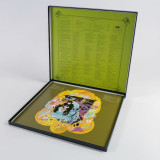
Donovan’s Original
A Gift From a Flower to a Garden made for a few firsts: the first double LP of Donovan’s
career, one of the first box sets in pop and, most importantly for Donovan himself; the first
pop album for the children of tomorrow.
He resolved to make A Gift From a Flower to a Garden an album of two halves. The first,
Wear Your Love Like Heaven, was intended for his own generation as they started to think
about the kind of world they wanted to leave behind. The second, For Little Ones, was for
the children they had or would have in the years to come. The result was a kaleidoscopic
folk-jazz suite on the power of love, imbued with all the romance and mystery of an Arthur
Rackham illustration for an ancient English fairy tale. The songs, remarkably adventurous
given Donovan was a globally famous singer at his commercial height, combined the
influences he had amassed so far.
There is something about A Gift From a Flower to a Garden that could never be repeated,
though. It is such an innocent evocation of the childlike imagination, so redolent of its time,
yet set apart from it too. All these years later, the peaceful qualities of this pioneering,
enchanting, deeply unusual album feel more valuable than ever.
The state51 Box Set
With authenticity core to the project, The state51 Conspiracy engaged one of the UK’s
leading experts in box set design, Daniel Mason at Something Else, to painstakingly recreate
the box, records and accompanying ephemera. The first challenge was to find the deep blue
leatherette paper the original box set was covered in; a problem since it was no longer in
production. “I knew people who had stacks of it, gathering dust on top shelves, so I bought it
up wherever I could find it,” says Mason. Then came the reproduction of 12 loose leaf lyric
sheets on fine art watercolour paper, each of them featuring a watermark and a fairytale-like
illustration by Donovan’s artist friends Sheena McCall and Mick Taylor. Where, though, to
find the same paper stock? “I found out that it was made at a paper mill in North Wales
called Abbey Mills. Unfortunately the mill dissolved in the early 70s and very little of the
paper remained. However enough paper remained to allow us to produce the numbered
certificate also signed by Donovan that sits within the box.”
Then to the iconic cover image. Donovan and Jimi Hendrix’s personal photographer Karl
Ferris, used infra-red film to achieve the psychedelic effect on the cover, but the original
negatives couldn’t be found. Mason then used digital technology to ramp up the colour levels
on a reproduction from an original copy of the album while allowing it to remain a little bit
faded, as it would be after half a century. The same labour of love and care has gone into
producing all elements of the box; from the rebuilding of the famous front cover font to the
hand-numbered and signed certificate; letterpress printed on the original paper stock of the
1968 UK release lyric sheets.
To cap it all off the original mono master tapes were waiting safely in the EMI Donovan
Archive and transferred from tape to digital by Abbey Road Studios where new lacquers
were cut, ensuring Donovan's favoured mono version of the album would be presented both
physically (and digitally for the very first time) in striking audiophile quality. The final touch to
dog-rose is an exploration of musical articulation and vocalization. Its themes can be felt gnawing at the surface of the world: people's clumsy everyday intimacies, the neverending pursuit of self-knowledge, God. Of foremost interest was the unreliability of memory as a tool through which we experience life, yielding an attempt to dismantle it into its minute elements.
"I arrived at a combination of diary entries in the form of field recordings, various, mostly acoustic, instruments through which I invoke different modes of memory // its associative functions, and my own voice, more an agent of introspection than any conventional vocal. The lyrics were originally written as pop-songs, but committed to the form of contemporary music they appear as field recordings made to be sung. They are field-songs."
"To me, musicmaking is a dialogue with sounds where I seek to understand their character and how to handle them. This is a performative process and admittedly also a projection – what I am actually discussing is myself. The recording took place at a remote cabin in the forests of Tribeč. Most of my work is created in isolation, regardless of the social distancing and lockdowns of the outside world."
Tomas Pristiak is a member of Tante Elze, Pain Palace (FKA Weltschmerzen), and dog-rose is his first solo album and the 11th release by contemplative label Weltschmerzen.
Complete with 10" vinyl record and booklet presenting Laurianne Bixhain's photographic work and text by Chloe Chignell.
Presented at the Mudam (Museum of Modern Art of Luxembourg) and initiated by a photographic exploration by Laurianne Bixhain, the work "The day begins with a loud boom" interrogates the manner and extent to which we are defined by our relationship to the physical environment, and the cultural import of the techniques of production. Its imagery follows the trajectories of the materials subjected to the processes of diamond cutting and automotive glassware fabrication, and presents the traces of human intervention of which those materials are both the object and the repository.
The interplay of its imagery, music and text constitutes a theatrical whole: both the staging of the text and the sonorities create an architectural space within which each constituent object is deployed. That spatiality is shared and complemented by the text’s sonorous and performative qualities. Likewise, the elements of texture and abstraction in the imagery invoke our sense of touch, as a means of material and spatial appreciation.
The succeeding reiterations of the ostinato the day begins with are treated graphically by its progressive effacement, evoking the tension in assembly line work between repetition and linearity, accumulation and exhaustion, trace and erasure. Such attrition is equally conveyed by the harsh, impassive, and architectural qualities of both the images and the music which accompany the text. The latter notably deploys a range of insidious effects, from the marriage of dissonance and unsettling rhythm evocative of the competing cycles of multiple industrial machines, to sensual and reassuring sonorities which are contaminated by their contrast with the harsh acoustic aesthetic elsewhere.
Blending sounds of early 70s Funk & Soul, Latin-Jazz, and Afrobeat, Mestizo Beat kicks the year off with a heavy dose of new material. First up is “She’s A Rose b/w Lotsapapa,” their next 45, offering two sides of masterful instrumental soul music written & produced by The Magaña Brothers out of their hillside studio, Spc 166 in Topanga, CA. Side A’s “She’s A Rose” takes us back to the golden years of the Blaxploitation film genre and the soundtracks we have grown to love. This song was inspired by the compositional and orchestral arrangements from the greats, such as Curtis Mayfield’s “Superbad,” Johnnie Pate’s “Shaft in Africa,” and Bobby Womack’s “Across 110 Street.” Featuring Tim Felten of Surefire Soul Ensemble on keys, with horns written and arranged by Jesse Audelo, Mestizo Beat takes the listener on an evolving journey, exploring the mood and cinematic elements of flute, saxophone, and wha’d-out guitar, topped off with a funky drum and percussion break. On the flip, “Lotsapapa” rounds out the B-Side, blending the musical styles of Latin and Nigerian disco-funk into a track that’s perfect for the dancefloor and those late nights out. Written about Bernard “Lotsapapa” Crowe, a notorious drug dealer who survived an attempted murder by Charles Manson, this side is sure to get the body moving with the afro-disco rhythms and chant vocals, dubbed out around a tightly arranged horn section written and arranged by Jesse Audelo and Jason Cressey. “Lotsapapa” features guests Steve Haney from Jungle Fire on Percussion and Cressey of the True Loves on trombone.
With each side highlighting the various talents of the ensemble, Mestizo Beat always stays true to their sound and recording techniques. Both tracks are mixed by Sergio Rios at Killion Sound and are featured on the forthcoming LP, Jaraguá, coming mid-2024.
B2 Recordings hits release number 13 with DJ Rocca and Lex combing on a trio of fresh house cuts that blend elements of disco, Latin and soul. Up first is the glorious 'Solid Street' which has loose and percussive disco-house grooves overlaid with big synth energy and steamy vocals. 'Solar System' is slower and deeper, with a more rugged bassline and low slung sense of funk that never lets up. 'Last of all, 'Rose Tree' is a ramshackle house arrangement with whistles, Rhodes keys, tin-pot percussion, florid flutes and plenty of sunny energy all making it a real standout. A timeless EP packed with musicality.
For 46 minutes Alex Zhang Hungtai punctures our perception of linearity, working like a conductor, encouraging percussive flurries to trip and fall over each other, sometimes tempered by contact mic feedback to help skewer the chronology. He’s assisted by three additional percussionists - Wet Hair’s Ryan Garbes and Shawn Reed, and Leonard King - while Signal Decay’s Nick Yeck-Stauffer plays trumpet, with each extra voice blurred into the middle distance, curling like pipe smoke into convulsive whorls.
The piece is frankly astonishing in its grasp of the maelstrom. Initially tentative, searching, with higher register hits like moths butting lone lightbulbs in an abandoned apartment block, the distant, plangent peal of twin brass wafts between rooms to impart a distinctly floating, OOBE- like feel for space. The brass recedes while the drums’ low end thickens and roils like a gamelan tempest, blurring impressions of knackered buildings or the temple rituals of ancient epochs, with sounds wafting in from other rooms to mess with the stereo field like ghosts of worshippers doing their thing. Remarkably, it conjures a fever dream miasma of ricocheting, thunderous polymetric clatter and proprioceptive fuckry without ever losing its head.
Hungtai’s canny use of contact mic feedback drone and cymbal saw gives the whole thing a sense of gauzy delirium that unites the grouches like mildewed grout and cobwebs, coarsely gelling the elements in a way that resonates with Pauline Oliveros and co’s Deep Listening band acousmagique as much as Basil Kirchin’s keeling ‘World Within World’ classic, the ghosts of Sun Ra’s ‘Nuclear War’, the possessed atmosphere of the cabin where Harley Gaber recorded ‘Wind Rises in the North’, and no doubt Harry Bertoia’s massive metallic sculptures, agitated at midnight.
Humid, menacing, and wraithlike, the album’s’ sense of keening chronics belies a visionary hand at the tiller, here tightened by Rashad Becker’s mastering, which faithfully brings to light, and shadow, the depth of perception and wild but concentrated energies at play, sealing in place a truly staggering session for adventurous ears, cineastes and Lynchian acolytes alike.
DJ Moplen has outdone himself with this reimagining of Machine’s disco classic. Sticking purely to elements from the original, he’s managed to completely redesign the song, starting with an extended version of the soulful piano intro. Punching up the kick drums and handclaps moves the track into house territory, complemented by a funky guitar riff that was completely buried in the original. When the bass enters front and center Moplen practically forces you to the dancefloor, leaving you vulnerable to August Darnell’s controversial lyrics. Fresh from a career-making start with Dr. Buzzard’s Original Savannah Band, lyricist/vocalist Darnell’s collaboration here with Machine was only months from his next incarnation as Kid Creole. Just like those groups, Darnell here fills his song with the politics of race, religion, and sexuality under the guise of a great beat. This release features that rarest of things: a dub just as good as the original. Rather than just removing the vocals, Moplen again rearranges the song, removing the slow intro and building a killer groove from the ground up. As well as the 1979 version, this 12” also features Timmy Regisford’s 1994 house mix and an alternate “acapella reprise” take of that mix, both of which capture the dark energy of the song perfectly.
Following on from their contribution to theButter SessionsCome Togethercompilation released in March this year, Melbourne'sPolitodeliver their debut EPUltraparallel.Politois the collaboration between musicians Robert Downie and Finnian Langham and dancers Arabella Frahn-Starkieand Hillary Goldsmith. The ensemble integrates improvised techno and contemporary dance to form well-considered and captivating performances. The spirit of these performances are masterfully captured on the 12" record. On the transition between mediums, the group states; "we always aim to capture the unpredictability and liveliness of our improvised performances when we record, and try to sculpt the feeling of continuous movement which is so intrinsically tied to Polito's identity."
Ultraparallelconsists of four tracks that were extracted from studio sessions, emerging organically whilst jamming. The EP's introductionHornet's Webwields mutilated samples of vocals and spoken word, paired with abrupt rhythms to forge anomalous techno. The eponymous trackUltraparallel, recorded in 2018, is a dark and brooding arrangement with a murmuring melody and an infectious recurring bassline. Polito reflects; "this track is from the first batch of studio sessions we had as Polito where our intention was to create more discrete 'tracks' which could be played by DJs, rather than the longform compositions more similar to the live performances which we had recorded up to that point."
Turning the record over,Seventh Limbembodies the music for dance nuance by infusing dub with sounds from outer-space. Polito reveals; "we wanted to explore creating something more in line with the mood of our live performances, which are typically slower and have a rather meditative atmosphere. The more relaxed tempo allows the dancers to move at a sustainable pace and gives the musicians more space to prepare and manipulate the various musical elements in real-time. The result is our first formal exploration of 'the chugger.'"Ultraparallel'sfinaleSublunaryis a playful sequence mingling electronics with an airy clarinet and saxophone.
Attuned to their audience,Politoimagines how their music will be consumed throughout the creative process. They comment "while making music in the studio, we try to transport ourselves mentally to hypothetical dancefloors the music we're making could be played on, adding moments and sounds which would excite, energise, disorient, or have some other desired somatic effect. We're also considering not just how the music sounds, but how it would 'feel' when played on large sound systems."Ultraparallelultimatelypresents a refreshing visual take on literal dance music; a considered and holistic approach to enhancing the experience of listening and moving.
Dark Machine Funk is delighted to welcome the first guest producer into the fold, Head Front Panel. A huge source of inspiration to DMF since those highly sought after HFP 12”s hit the record store racks in 2014, Head Front Panel delivers a superb well rounded 4 track EP titled ‘Tactile’ for DMF’s 5th release.
The opening track 'Panama' opens with some otherworldly pads, sweeping resonances tickle the ear before signature HFP drums hit you with pure engaging energy. Broken kick drums and rattling percussion perfectly sit on this hypnotic tribal-esque sonic dream, a depth and area that we've not heard from HFP before. 'Tactile' brings the perfect tool, loopy rhythms that stretch the perception of time whilst getting lost in subtle rides and eerie door creaking atmospheres, deep listening will provide a new journey on every repeat. 'Surdo' open's side B, and we're catapulted into the fire with shaker/hi hat percussions that grab your attention immediately and vocal samples scatter across the stereo field. Shimmering pads take the track into deeper territory but all while keeping in a constant state of forward motion accented by the occasional double kick drum. A huge baseline swings the track to give it it's funk. 'Them' probably the most recognisable HFP track hammers with a thunderous kick drum and a subtle repetitive synth line, groove is king here where percussion elements are pushed and modulated to create enough interest to carry the track through till close.
We are more than honoured to present ‘Head Front Panel - Tactile’ on DMF!
Ennio Morricone is known throughout the world for the Italian Western genre, but most of all for his famous soundtracks for Sergio Leone’s
masterpieces which have entered into popular culture on an international level, and here represented by iconic themes such as
A FISTFUL OF DOLLARS (1964), FOR A FEW DOLLARS MORE (1965), ONCE UPON A TIME IN THE WEST (1968), A FISTFUL OF DYNAMITE (1971) with extraordinary
soloists such as the whistle of Alessandro Alessandroni, the harmonica of Franco De Gemini, and Edda Dell’Orso’s soprano voice.
For the Westerns starring the legendary Giuliano Gemma - A PISTOL FOR RINGO and THE RETURN OF RINGO - both directed by Duccio Tessari, he wrote the songs
“Angel Face” (with lyrics by Gino Paoli) and “The Return of Ringo” respectively performed by Maurizio Graf with pop music arrangements that were popular at the time.
With PISTOLS DON’T ARGUE (1964) Morricone experiments with a still undefined pre-Leone sound, DEATH RIDES A HORSE (1967) presents a main theme for
guitars ostinatos, exotic flutes and choir. For LIFE IS TOUGH, EH PROVIDENCE? Ennio Morricone creates a theme that mixes religious elements for a female choir
with modern arrangements. And A FIST GOES WEST (1981) a late Western in which the composer himself interprets the Indian’s screams.
Division of Laura Lee emerged in the late '90s and quickly gained recognition for their unique sound, blending elements of post-punk and alternative indie rock. In a landmark celebration of their musical history, Division of Laura Lee proudly announces the 25th-anniversary re-release of their seminal 1999 album, "At the Royal Club." This re-issue features a compilation of tracks from the their first two years, allowing both long-time fans and a new generation of listeners to experience the album's intensity and the band's pioneering spirit. Previously released only on CD, the re-issue of "At the Royal Club" has been meticulously remastered for vinyl to bring a new life to the original recording.
At the Royal Club by Division Of Laura Lee includes the following tracks: "44", "Royal Club", "Chart Music", "Stop! Go!" and more.
"7 Estrelas | quem arrancou o céu?" ("7 Stars | Who ripped the sky down?") is the fourth album of the Sao Paulo-based artist Luiza Lian, and her third collaboration with French/Brazilian music producer Charles Tixier. Nearly five years after the celebrated "Azul Moderno", the duo returns to the scene they materialized before a period of darkness that rewrote Brazil's history. And this new visit pushes the boundaries even further with resources that the singer-songwriter had only started exploring on the previous record. The tracks, "Tecnicolor" (featuring the only guest appearance on the album, as Luiza is joined by singer Céu) and "Homenagem" (Homage), continue to explore this new horizon, which becomes increasingly bizarre and deceptive. In addition to layering noises and electronic elements over her musicality, Luiza also explores the range of her vocals by digitally distorting them. The first tracks are just the initial steps in this new work: a profound reflection on how we distort our lives based on false reflections we see both digitally in our use of social media and materially in an increasingly consumerist society. The new album recreates this artificial context in an almost caricatured way, deliberately exaggerated distortions to generate the estrangement we should feel towards the values we cherish and reject based on this false reality we force ourselves to believe in.
VOL 2[88,19 €]
As the developers at Relic Entertainment busily crafted the grand space strategy of 1999’s Homeworld, series composer Paul Ruskay was left largely to his own devices in crafting the now iconic score. He took diverse inspiration from Vangelis’ score for Blade Runner, Brian Eno, the sampling of traditional instruments from all over the globe by Algerian DJ Cheb i Sabbah, and ambient electronica duo Delirium. Homeworld’s score was born of limitations thanks to Ruskay’s “primitive setup” of synthesiser, sampler and sequencer — at the time his Studio X Labs were being built around him — and this forced him to produce instinctive, live mixes.
During the Homeworld Remastered Collection restoration process, Ruskay dug out the original music DAT tapes out of a shoe box, dusted off decade-old Pro Tool Studio sessions, and had uncompressed versions made of all tracks. Subtle, faithful musical elements were added to help widen the mixes of the first Homeworld, before it was then mindfully remixed and sequenced.
Out February 23rd on translucent orange vinyl for the album's 15th anniversary: Fucked Up’s now classic album 'The Chemistry Of Common Life' synthesizes numerous diverse impulses into an expansive epic about the mysteries of birth, death, and the origins of life (and re-living).
Merging elements of hardcore songwriting with up to 70 tracks of guitars, organs, winds and vocals, (including 18 guitars on the first single, the fatalistic “No Epiphany”), the music remains iconoclastic and startling, with Pink Eyes’ vocals front and center. Guest musicians, of course, abound, notably gorgeous voices such as Brooklyn’s Vivian Girls and Toronto’s Katie Stelmanis.
grey & green splatter vinyl
A1 - Spacewaves
Opening the EP in thunderous style, Aural Imbalance chops impeccable, clean amen breaks, rolling sublimely into a chorus of fluid, delicate keys. The track whisks the listener atop the crest of wavy edits before a quietly turbulent assortment of blips and notes punctuate a bass-heavy breakdown. The latter half combines the elements in surreal harmony for a triump hant crescendo, buoyed by the truly vibrant breaks.
A2 - Tranquil Sea
A masterclass in subsurface ambience introduces Tranquil Sea, glistening melodies cascade into punchy breakbeats, setting the pace. Brimming with sunken off-key 808 bass resonating unpredictably with the spirit of the ocean, Aural Imbalance gently builds the vibe with soothing waves of mesmerising soundscapes as the beats rumble on, inviting you to dance amidst the swirling currents of his inimitable sound.
AA1 - Concordia
Old school analogue breaks take center stage as Aural Imbalance rewinds the clock for a great dancefloor-friendly slice of history with a modern Spatial twist. Quiet plinky keys bubble underneath long, whooshing ripples of the sea, echoed hi hats and a distinctive classic bassline intertwine perfectly, carrying you to uncharted sonic territories that will linger in the recesses of your mind long after the needle is lifted.
AA2 - Fading Fields
Delicate cymbal work and stirring pads combine deliciously before the listener is lifted to blissful serenity with a sumptuous tapestry of synths and micro melodies set to an immense, head nodding break pattern. The noteworthy kickdrum delivers a classic analogue stomp while the drums joyously encircle them
in their droves, showcasing further the variety and density Aural Imbalance offers.
Fucked Up"s now classic 2008 album The Chemistry Of Common Life synthesizes numerous diverse impulses into an expansive epic about the mysteries of birth, death, and the origins of life (and re-living). Merging elements of hardcore songwriting with up to 70 tracks of guitars, organs, winds and vocals, (including 18 guitars on the first single, the fatalistic "No Epiphany"), the music remains iconoclastic and startling, with Pink Eyes" vocals front and center. Guest musicians, of course, abound, notably gorgeous voices such as Brooklyn"s Vivian Girls and Toronto"s Katie Stelmanis.
Progressive dark group TVINNA returns with their second act "Two - Wings Of Ember" - stylistically more open, more experimental and thoroughly free. A logical consequence of their own visions and artistic concept. But also a result of the new line-up. Laura and Rafael
Fella have remained from the original line-up. She, one of the enchanting voices in pagan folk band "FAUN", he, playing guitars for Swiss folk metallers "Eluveitie".
“Two - Wings Of Ember“ is the second out of four chapters, in which TVINNA breaks down the different episodes of life - each linked to one of the four elements. On this release, the element of fire takes the central stage.