Mit "Cotton Crown" erweitert die Band ihre Klangpalette um eine kaleidoskopische Bandbreite an Einflüssen: Von gefühlvollem Pub-Rock über HÜSKER DÜ-Aggression bis hin zu melancholischem Sophisto-Pop ist alles dabei. Wie Pitchfork feststellte, sehen THE TUBS den Jangle als eine "riesige Welt der Stimmungen und Musen" und "Cotton Crown" zeigt, wie sie diese Welt weiter erforschen und dabei einen unverwechselbaren Tub-ular-Sound kreieren. Das liegt nicht zuletzt an der Gesangsleistung von Owen 'O' Williams, der oft mit einem jungen RICHARD THOMPSON verglichen wird, und an seinen offenen, düster-komischen Texten. In "Cotton Crown" widmet er sich weiter seinen Lieblingsthemen: Liebespsychose, unsympathisches, psychisch krankes Verhalten und die Demütigungen des Musikerdaseins in London. Dieses Mal ist jedoch ein Gefühl des Risikos in seinen Selbsteinschätzungen und Bekenntnissen spürbar. Im Mittelpunkt steht das Leben in der Zeit nach dem Selbstmord seiner Mutter (der Folksängerin Charlotte Greig), und Williams singt über die unbeholfenen, aufdringlichen und gut gemeinten sozialen Interaktionen, die darauf folgten. Das Albumcover zeigt ein Bild von Williams als Säugling, der von Greig auf einem Friedhof gestillt wird - ein Werbefoto, das um die Veröffentlichung des Debütalbums von Charlotte Greig herum aufgenommen wurde. Der wesentliche Trick von "Cotton Crown" besteht darin, die lyrische Düsternis von Williams durch fröhliche, hakengeladene Pop-Perfektion zu kompensieren. Das liegt vor allem an der Gitarrenarbeit von George Nicholls, der auf dem Album mühelos zwischen dem virtuosen Jangle von JOHNNY MARR, dem treibenden Folk-Rock von PENTANGLE und den Refrain-lastigen Hi-Fi-Grooves zeitgenössischer Bands wie TOPS oder THE 1975 hin- und herwechselt. Dazu kommt die halsbrecherische Rhythmusgruppe von Taylor Stewart (Schlagzeug) und Max Warren (Bass) - die jeden Song mit einer Power-Pop-Wut angreifen, die an GUIDED BY VOICES in ihren besten Zeiten erinnert - und schon hat man ein Rezept für großartigen Indie-Rock. Das Debütalbum der Band, "Dead Meat", wurde durch Mundpropaganda zu einer Sensation, die der Band Auszeichnungen von Pitchfork, The Guardian, MOJO, Uncut, SPIN und anderen einbrachte. Sie gewannen sogar einige prominente Fans: der unnachahmliche Mark Proksch (The Office, Better Call Saul, What We Do in the Shadows) spielte die Hauptrolle im Video zu ihrer Single "Round The Bend" und die Punk-Legende IGGY POP lobte sie in seiner BBC 6Music Radiosendung. Owen Williams, Max Warren und George Nicholls waren zuvor Mitglied von JOANNA GRUESOME - eine Band, die den Welsh Music Prize gewann, ausgiebig durch Großbritannien und die USA tourte und von Pitchfork, Rolling Stone, The New York Times, The Guardian und anderen gelobt wurde. Sängerin Lan McCardle, mit der Williams sowohl bei JOANNA GRUESOME als auch bei EX VOID zusammen musizierte, steuert bei einigen Stücken auf "Cotton Crown" Backing Vocals bei.
Search:3 pi
- A1: Slaughter 03 20
- A2: Dusk 01 50
- A3: Winter Clouds 01 28
- A4: Hollow Tree 01 56
- A5: Still Alive 01 11
- A6: The Cave 02 13
- A7: In Court 01 37
- A8: Hope Through Confusion 01 49
- A9: Not Guilty 51
- A10: Village Ceremony 51
- A11: Road Tension 01 22
- B1: Kneipe 01 18
- B2: Hunt Introduction 01 30
- B3: Rifle, Second Attempt 38
- B4: Hunt Epilogue 01 01
- B5: Confrontation 02 21
- B6: Judenfreund 01 19
- B7: Flashback 41
- B8: A True Friend 57
- B9: False Promises 01 39
- B10: How Do You Suffocate Weeds 01 55
- B11: Under The Masks We All Look The Same 02 58
- B12: Dream 01 32
- B13: Freedom 01 08
Erik K Skodvin's feature-length score to Thomas Roth's thriller "Schächten" feels like the epitome of all his musical projects, conjuring a dark cinematic trip through 1960's post-WWII Vienna in a film that touches on topics such as law, justice & revenge.
Releasing a soundtrack as a stand-alone album can be challenging; and "Schächten" is by no means a typical listening experience. The record contains 24 more or less short pieces evolving through dramatic movements, underlaying menace and deep emotive scenes. One thing that stands out is the linear atmosphere throughout the story which creates a wholeness that keeps your attention to the very end. Set in wintery Austrian landscapes in dimly saturated colours, the film's dramatic events with dark political undertones feels like a perfect situation for Skodvin's atmospheric collages - perhaps sounding closer than ever to his early works as Svarte Greiner or Deaf Center. Cello, violin, piano, analogue synth and plenty of hardly recognizable instrumentation come together in a record that feels very organic in its subdued tones. The score also features percussion by Andrea Belfi as well as a Chopin piano interpretation by Kelly Wyse to the bizarrely schizophrenic piece "Judenfreund".
With the contemporary world sliding into darkness again, listening to the soundtrack feels like coming to terms with ones own anxieties - something that in the end comes through as a cleansing experience. As quoted in the film "Everyone is their own devil. And we make this world our hell".
Short synopsis : "Vienna 1960s - The young Jewish business man Victor has to witness how the prosecution of a Nazi crime against his family fails. The political and legal system is still virtually run by former Nazis with large parts of society being entangled in the past. When Victor also loses his grief ridden father and his girlfriend’s family opposes their relationship and his identity, Victor begins to loose faith in formal justice and takes matters in his own hands."
The Pitch is a quartet made up of Boris Baltschun, Koen Nutters, Michael Thieke and Morten Joh. Founded in Berlin in 2009, they play a hypnotic form of structured improvisation full of acoustic exploration and electronic intervention. On Neutral Star, The Pitch are joined by Australian guitarist/composer extraordinaire Julia Reidy for a record of star gazing electro-acoustic jazz.
Reidy's playing and compositional technique between Takoma-style fingerpicking and Glenn Branca'esque microtonality, perfectly complements the loose improvisational framework The Pitch is providing. Endless ≠ Limitless, a recent piece by Reidy and Joh, is transformed from a washed-out/obscured tape delay composition into a colorful, meandering ensemble piece with a swarming character - blooming with intrigue for the patient ear. The B-side strikes a more gentle tone: the 24-minute Neutral Star begins with a siren-like overtone whose drone-like flowing slowly morphs into a deterritorial modality with jazzy undertone. Accompanied by constant eruptions of vibraphone, clarinet, electronics and double bass punctuation – while permanently questioned by Reidy's drippingly pearly steel guitar work. Slowly evolving into new territories through the expansive instrumentation and keen listening between the players.
The fact that Neutral Star was recorded in one take (by Rabih Beaini in his Morphine Raum studio/venue) in front of a live audience and without overdubs is hard to believe, even for the trained ear. The recording appears to be too multilayered for a single snapshot, with its compositional structures constantly shifting and moving against themselves, counterintuitively and anti-cyclically. Reidy´s playing has been described as "unstable harmonic territory, and the collaboration with The Pitch interprets this concept brilliantly - adding further non-places to the territory. And the listener, however, is never left alone in the process of tectonic shifts - at least as long as their listening is attentive and contemplative at once.
Returning with its final instalments, Die Schachtel's Decay Music series extends its explorations of inspired contemporary experimental efforts of the ambient, ethereal, and emotively abstract with Luigi Turra and Elio Martusciello’s “Liminale” and Sergio Armaroli and David Toop’s “And I Entered Into Sleep”, two astounding electroacoustic gestures of blurred space and time, plumbing complexity of meaning bound to sonority. Creatively groundbreaking and inspired, radically rethinking the terms of what ambient music can be perceived to be, they stand among the most striking efforts to appear within the series to date.
An aural bridge between two distinct generations of Italian experimental musicians, “Liminale” is the debut collaborative outing from the creative partnership of Luigi Turra and Elio Martusciello. Active within the context for roughly two decades, Turra (b. 1975) is a reductionist/electroacoustic composer, noted from his tense deployment of concrete and acoustic sources — particularly small sounds and noises — whose work threads the balance between silence, tactile auditory perception, and aleatoric music. Martusciello (b. 1959), on the other hand, is a musician and composer working across the fields of acousmatic and electroacoustic composition, sound installation, multi-media and audiovisual art, and computer music improvisation, who is widely celebrated for both his solo efforts and his collaborations with Eugene Chadbourne, Mike Cooper, Alvin Curran, Chris Cutler, Rhodri Davies, Iancu Dumitrescu, Michel Godard, Tim Hodgkinson, Lawrence D. "Butch" Morris, Jérôme Noetinger, Tony Oxley, Evan Parker, Z'EV, and others.
A single, nearly 40 minute work, extending across the two sides of the LP, “Liminale” — as its title eludes — is an exploration of the liminal through sonic means: “places that exist on the threshold, transitional spaces suspended between a before and an after, between the real and the evanescent” conceiving the soundscape as “a liminal place, a space to be inhabited without the certainty of where it leads.” Unfurling like a labyrinth navigated in darkness, the piece’s first half is marked by sparseness and restraint, as slow-paced guitar tones and harmonics thread silences and resonant ambience within a sprawling sense of space, delicately populated by tiny sounds, fleeting punctuations drawn from undeterminable sources, vocal utterances, and the unexpected appearance of intoxicating piano tones.
As “Liminale” progresses into its second half, Turra and Martusciello enter a more densely populated notion of the in between. No less defined by the presence of space and mystery, discreet textures rustle and writhe within passages of pure concrete abstraction and a fragmented, stretched sense of musicality: long-tones, metallic pulses, minimal vibrations, processed vocalizations, guitar harmonics, and deconstructed piano melodies, buried in spectral, gauzy hazes drifting from beyond arm’s reach within an imagistic and immersive landscape of profoundly meditative scope, where each sonic element flirts the line between emergence and disappearance.
Intimate, fragile, and achingly beautiful, “Liminale”, Luigi Turra and Elio Martusciello’s debut collaboration, is a masterstroke in sound-craft and composition, revealing the potency of meaning locked within transitional spaces and the undefined, and imbuing silence with monumental gravity and weight. Mastered for vinyl by Giuseppe Ielasi, and taking electroacoustic minimalism to an etherial extreme, “Liminale” is issued as the ninth entry in Die Schachtel’s Decay Music series, highlighting inspired contemporary experimental efforts of the ambient, ethereal, and emotively abstract.
- A1: You Can Never Tell
- A.your Imagination
- A3: Puzzled Into Pieces
- A4: Lattershed
- A5: When Things Come Falling
- B1: In Between And After
- B2: False From Above
- B3: Snowflake Eye
- B4: Emergency Turn Off
- B5: Paradigm Somehow
★Japanese obi-strip
★First time reissued on vinyl
Turning Into Small, the second album by shoegaze band All Natural Lemon & Lime Flavors from New Jersey, originally released in 1998 on local label Gern Blandsten,
is now being reissued on both CD and vinyl.
Formed in the mid-90s, All Natural Lemon & Lime Flavors were deeply influenced by UK shoegaze and alternative rock—most notably My Bloody Valentine—while
pursuing a uniquely experimental sound within the US emo and indie scenes. Their innovative spirit reached full bloom on Turning Into Small, which remains their
final album to date.
One of the standout tracks is the nearly eight-minute-long “Your Imagination,” a spacious sonic landscape that draws listeners into deep immersion.
It has become a signature song for the band, heralding a new wave of shoegaze that emerged in the late '90s and beyond. Even more noteworthy, however, are
tracks like “Puzzled Into Pieces” and “In Between And After,” which showcase the band's layered, synth-driven electronic textures, dynamic collage-like structures,
and occasionally buoyant melodies. These elements come together to create a strange and otherworldly sense of weightlessness—something rarely found even
within the shoegaze genre.
While resonating with the likes of My Bloody Valentine, Stereolab, and The Flaming Lips, the band's mutant-like blend of styles also draws parallels with acts like
Swirlies, Serena-Maneesh, and contemporary shoegaze innovators such as They Are Gutting a Body of Water.
This is a groundbreaking album in US shoegaze—one that still feels fresh and vital thanks to its timeless experimental spirit and originality. Now is the perfect time
to (re)discover it.
- Breathing Air
- Still A Straw Man
- Turtle Rock
- Bettie Wait
- You Turned Off The Lights
- Cola The Actor (Ver 2)
- Bye Bye Basil
- Oh! A Good Friend
- Poppie + Spent
- Pull My Weight
- Everyone Forgot But You
- I See Your Face
- I'm Breaking Down
- Tokyo 1
- Osaka
- Nagoya
- Matsumoto (Beginning)
- Matsumoto (Ending)
- Hokkaido
- Tokyo 2
- Each Story
Cloudy White Vinyl[31,89 €]
Emily A. Sprague's Cloud Time traces an audio-spiritual journey through time and place, recorded across a long-awaited debut tour of Japan in the fall of 2024. Compiled from environmental improvisations captured in and for the moment, material at once welcoming, responsive, and inimitable, the album distills a voyage guided by psychic wayfaring, unbound presence, and activating performance for a reciprocal exchange with space, listener, and each fully engaged instant. The Japanese tour documented on Cloud Time held an almost mythic significance for Sprague, taking on properties of her own sonic white whale. After many near-departures and dropped plans to play in the country, "the empty spaces of cancelled trips and forgotten music turned into strange little misty spirits that I felt followed by," she says. "When I began preparing for the tour, I couldn't shake a sense that the invitation to Japan was more about opening myself up to this new place instead of bringing something into it tightly under my control. Improvisation has always been such a pillar in my music practice, and I really wanted to meet the country, spaces and people through that process." To amplify these intuitive whispers on-stage, Sprague reimagined her time-tested live rig, designed to be as free from error as possible, as a looser, more flexible set up that would allow her to interface with what was essentially a blank sonic canvas every night. Each performance became a collaboration between environment and instinct, Sprague processing the events, energies, and emotions informing the evening through her new sound ecosystem, and projecting an entirely present and unique version of herself to each open-eared and hearted crowd. "It was very much more than just an act of playing for me, but a total experience of time and place," she says. The seven long-form pieces that plot the course of Cloud Time, excerpted from over eight hours of recordings archived on the artist's on-stage recorder and generously shared on the album with no additional mixing and only minimal editing, invite listeners to become still in these deep-rooted moments of presence as the album moves from city to city, venue to venue. Cloud Time chronicles material recorded at each tour stop, Sprague selecting and sequencing the album around mood-based storytelling more so than linear chronology. "I tried to make the whole album flow in the way that any one of the complete live performances did," she explains, "while also keeping the spirit of the whole thing as a journey." The result is equal parts travelog, love letter, and impressionistic collage channeled from the potent ferment of a now encased in the glowing amber of memory. Intrinsically inspired by kankyo ongaku, an environmental music philosophy, known both in and widely outside of Japan that tunes into the similarly expansive ethos as Pauline Oliveros' deep listening practice and posits the listener as composer, Cloud Time is ambient music that seems to be listening right back, grounded in heartfelt synthesized frequencies that abundantly hold and heal. Pieces like "Nagoya," "Tokyo 1," and the ten minute "Matsumoto" in particular hum with the atomic resonance of gently tended landscapes, offering space for tuning way in and dropping far out from perspectives that stifle and bind. Cloud Time is an invitation to embrace each moment as both fleeting and eternal, floating by with nothing to grasp onto and absolutely everything to gain. The exercise in acceptance and letting go that Sprague practiced throughout the tour deeply impacted her understanding of self as both a guest and venerable performer. "The process of loving wherever I am, being present and focusing on a clear channel of communication for mind and emotion, rooted so deeply in respect for the space, those within it, and myself, ended up being profoundly healing," she says. "My vision and hope is that this album can be released as a gift back to anyone who either was or wasn't there. A cloud time of life passing by." Emily A. Sprague's Cloud Time will be released Friday, October 10th in vinyl, Japanese import CD (via Plancha), and digital editions.
D: Mit „Le retour des beaux jours“ feiert Vanessa Paradis ihr grosses Comeback in der Musikszene.
Dieses achte Studioalbum ist das Ergebnis ihrer engen Zusammenarbeit mit Étienne Daho und Jean-Louis
Piérot. Es wurde in Paris (Motorbass Studio) und London (Abbey Road) aufgenommen, abgemischt und
produziert. Die erste Single „Bouquet final“, einer der Hits des Sommers 2025, kündigt ein mit Spannung
erwartetes Pop-Soul-Album an... Vanessa wird ab März 2026 auf Tournee sein. Live Schweiz: 23.04.26,
Arena Genf
F: ’Avec « Le retour des beaux jours », Vanessa Paradis fait son grand retour à la musique.
Ce 8ème album studio est le fruit de son étroite collaboration avec Étienne Daho et Jean-Louis Piérot. Il
a été enregistré, mixé et réalisé à Paris (Motorbass Studio) et Londres (Abbey Road). Le premier single «
Bouquet final », l’un des hits de l’été 2025, annonce un album pop soul très attendu... Vanessa sera en
tournée à partir de mars 2026. Live Suisse : 23.04.26, Arena Genève.
Bachs Ouvertüren, auch Orchestersuiten genannt, sind eine Abfolge von Tanzsätzen oft fröhlichen und überschwänglichen Charakters. Die beiden hier eingespielten, Nr. 1 C-Dur & Nr. 3 D-Dur, sind mitreißende
Werke barocker Pracht, enthalten aber auch das berühmte „Air“, ein friedliches Stück voll in sich ruhender
Gelassenheit.
Kaum ein Ensemble hat unsere Hörgewohnheiten in Bezug auf ”Alte Musik” so stark beeinflusst wie ”The
English Concert”. Der Gründer und langjährige Dirigent, Trevor Pinnock, leitete die Musiker mit lebendiger
Artikulation vom Cembalo aus und formte so den Klang aus der Mitte des Ensembles.
Die audiophile Vinyl-Serie The Original Source präsentiert herausragende Aufnahmen der 1970er Jahre
in ganz neuer Klangqualität. Dafür haben die renommierten Emil Berliner Studios die originalen Vier- und
Achtspur-Bänder mit eigens für die Produktion der Serie entwickelten Technologien in 100% analoger Qualität (AAA) neu gemastert und geschnitten. Die klanglichen Unterschiede zu den Originalveröffentlichungen sind beträchtlich: Größere Klarheit, mehr Feinheiten und Verbesserungen im Frequenzgang, zugleich
weniger Nebengeräusche, Verzerrungen und Komprimierungen ermöglichen ein audiophiles Hörerlebnis wie
nie zuvor.
Auf 180g Vinylplatten und in einer Deluxe-Gatefold Edition mit Originalcovers und -texten werden die
Exemplare dieser Serie limitiert und nummeriert veröffentlicht, begleitet von zusätzlichen Fotos und Faksimiles der Aufnahmeprotokolle und Bandkartons.
Originally released in 1992 via Tesco, »Cancer« was recorded one year earlier by Thymme Jones, Dan Burke, Mark Klein, Mitch Enderle, Chris Block, and Jim O'Rourke.
This one was mostly a group effort focused on a dark ambient atmospheric environment and experimental minimalism that crawls under your skin. Mark & Thymme’s heavy synth is omnipresent, Mitch & Chris scraping every piece of scrap metal they could find, Jim’s extended piano & tabletop guitar is apparent, the abstract sampling techniques of founding member Daniel Burke appear throughout, & the beautiful solo minimalist piano composition of Thymme’s closes the LP. Soundtrack like in its scope the album is another in the ongoing concept of music without a film providing a dark soundtrack to the nightmares or realities we wish we could forget. The 2025 edit & remaster removes the excess and hones the meat down to 7 essential tracks that show the projects oeuvre at that point in their lengthy history sounding clear & fresh with the newly mastered version by Andrew Weathers.
- A1: Saw My Mama Cryin’
- A2: Lonely
- A3: The Sky Is Fallin’ Down
- A4: Blues For My Baby
- B1: You Can’t Go Home Again
- B2: Recovery_
- B3: Turn Off Your Tv
- C1: Lifestyle Of The Rich And Famous
- C2: Never Knew You Well
- C3: Puppet Master
- C4: Money Rules The World
- D1: All I Want Is You
- D2: Brother’s Keeper
- D3: Blues For The Modern Daze
- D4: Pray For Rain
Blues for the Modern Daze is an album by American blues rock musician Walter Trout, focussing more on the "traditional" blues, and taking a more straightforward approach to songwriting. The album reached #1 on the UK Jazz & Blues Chart and #4 on the Billboard Blues Chart.
It was produced by Trout himself together with Grammy-nominated producer Eric Corne. Some of the highlights on this album include the tracks "Saw My Mama Cryin'", "The Sky Is Fallin' Down" and "Pray For Rain"._x000d__x000a_Blues for the Modern Daze is available as a limited edition of 1000 numbered copies of translucent pink & blue marbled vinyl. It is housed in a gatefold sleeve and includes a 4-page booklet with lyrics.
LINKS
Zelienople frontman Matt Christensen returns to Miasmah with Constant Green - a record of reverberant country inspired songs that puts the weight somewhere between Johnny Cash and Slowdive. Matt pours out his soul through flashes of life - small and large. His voice roaming over the guitars in a way which feels like a floating poetic deluge.
Appearing fresh from last years Zelienople album Hold You Up, Matt has made a very personal record that arrives as perfectly as it could be. It is full of beautiful sparse moments that capture the feeling of time standing still while simultaneously flashing in front of your eyes. As a child of the 70ies, growing up with country influenced AM rock on the radio, riding around in cars without seatbelts, Matt creates this nostalgic feeling of free riding through the city streets at dusk : a dream world where one can see green as a symbol for humanity and optimism. Not to say the album doesn't have it's share of darkness. Christensen always lingers deep in melancholy, driving his fears and anxieties out through music.
Visions of being able to move anywhere, picking his mother up from jail, family matters, change, the small things in life - all outtakes from what he sings about. Although it's hard to pick up on unless you really listen, as his ramblings can at one moment be fully clear while in the next drowned or muffled - becoming a mere meditative element to the music. Steady collaborators Brian Harding and Eric Eleazer from Zelienople accompanies on pedal steel and keys to further fill the sound into a warm dream, following in the footsteps of Matt ́s previous Miasmah album Honeymoons (2016). That said, while Honeymoons used drum machines and vast open spaces, Constant Green is another step closer towards the classic singer-songwriter folklore. Timeless gold from an artist that never stops creating.
We are honoured to work with Neil, who’s been an intrinsic part of the UK techno scene, especially with his devotion to experimentation within the genre! Sorry for the typo on the centre label mate. This release came out of the thirst for something very much outside the box.. literally! Fun fact: Fang Man was inspired by a breakdown driver who Neil met the day before signing this EP with us. Maximum respect to all DJs who picked this one up for the club circuit or radio spins! Thanks to everyone who’s been supporting the label and bought the wax, we’ve got plenty more in the works.
“Oh damn I got fired suddenly, replaced by a hydraulic pump with life long guarantee”.
The undefinable Kaboom Karavan returns to the dusty Belgian roads with a total Fiasko! - or a full blown disaster if you will (seen from a minimalist perspective), although one that might be the antidote to the sterilised and scattered world that increasingly surrounds us. Fiasko! represents a musical chaos that feels both ecstatic, fun, as well as deeply melancholic. Like an overwhelming moment where the world seems to touch you on all senses. This is music for a new underground of black tie workers raising up to the dullness of societal norms by connecting to their inner child. It’s protest music towards the new normal, where the rules are thrown out of the window and unpredictable sense of joy prevails. Shortly said, Fiasko! Is contemporary exotica made by a madman with too much time on his hands.
As usual, Kaboom Karavan releases contains a conglomerate of strange, mostly home made instrumentation, which will be too long to list here. To shorten it down… Bram Bosteels himself, the captain of the ship, plays all kinds of acoustic instruments, guitars, electronics and uses his voice. Additionally we have Bart Maris on trumpet, tuba and trombone. Stefaan Smagghe plays violin and sarangi. Lastly we have Raphael de Cock on such typical instruments as igir, jadagan and uillean pipes. All that remains to be said is: Bring your neighbour, let yourself loose and have some fun. Listen to Fiasko!
Furthering the passionate exploration of cinema that has guided her two previous LPs - 2017’s ‘Fassbinder Wunderkammer’ and 2020’s ‘I Should Have Been a Gardener’ - the Milanese guitarist/composer, Alessandra Novaga, returns to Die Schachtel with ‘The Artistic Image Is Always a Miracle’, two sides off shimmering, tense compositions – culminating as one of her most creatively ambitious and conceptually rich outings to date – freely inspired by the life and work of the Russian director Andrej Tarkovsky and the music of Johann Sebastian Bach.
Classically trained at the Musik Akademie in Basel, Switzerland, over the last decade Alessandra Novaga has emerged as one of the leading figures within northern Italy’s thriving new, experimental, and improvised music scene, rendering striking solo efforts, in addition to collaborations with Loren Connors, Stefano Pilia, Elliott Sharp, Nicola Ratti, Paula Matthusen, Sandro Mussida, Kid Millions, Travis Just, Francesco Gagliardi, and others. Remarkably ambitious and forward thinking, her approach to the guitar embarks upon a relentless deconstruction and rethinking of her instrument’s unique properties through distinct applications of structure, resonance, space, and tone, creating in a deeply personal and emotive music, seeking narrative and meaning within the abstractions of sound.
In 2017, with the LP, ‘Fassbinder Wunderkammer’, issued by Setola Di Maiale, Novaga embarked upon the exploration of her love of film. Having begun with Rainer Werner Fassbinder, this was followed in 2020 by Die Schachtel’s release of ‘I Should Have Been a Gardener’, a deeply intimate mediation on the life and work of Derek Jarman. Rather than focusing on a fixed point of inspiration or a single film to work from, these pieces achieve a form of abstract portraiture, distilling elements drawn from these filmmaker’s life and work into ambient networks of texture and tonality. ‘The Artistic Image Is Always a Miracle”’ freely inspired by the Russian director Andrej Tarkovsky and the music of Johann Sebastian Bach, finds Novaga radically expanding her sonic palette within this approach.
The seeds of ‘The Artistic Image Is Always a Miracle’ can be traced to a conversation that Novaga had with Alan Licht (contained in the highly regarded Common Tones: Selected interviews with artists and musicians 1995–2020, Blank Forms, 2021), relating to the connections between music and cinema, which led her to consider Andrej Tarkovsky’s use of Bach's music within a symbiotic framework: how the music illuminates the imagism of the films, and the film illuminates new dimensions of the music. Slowly developing over the subsequent years, the resulting album comprises six individual works, some of which draw directly upon pieces of Bach’s music that Tarkovsky used in his films – specifically 'Erbarme dich, Mein Gott', 'Das alte Jahr vergangen ist', and 'Ich ruf zu dir, Herr Jesu Christ' - while others draw upon the sensibilities and moods evoked in the imagination by the director’s films.
As a point of departure and illumination into the process and spirit that underscored the creation of the album, Novaga points toward a passage in Tarkovsky’s "Sculpting in Time”:
“Art is born and takes hold wherever there is a timeless and insatiable longing for the spiritual, for the ideal: that longing which draws people to art. Modern art has taken a wrong turn in abandoning the search for the meaning of existence in order to affirm the value of the individual for its own sake. What purports to be art begins to look like an eccentric occupation for suspect characters who maintain that any personalized action is of intrinsic value simply as a display of self-will. But in artistic creation the personality does not assert itself, it serves another, higher and communal idea.”
‘The Artistic Image Is Always a Miracle’ can be understood as a realisation of the collectivism of which Tarkovsky speaks, in the service of something far beyond the expression of self. Encountering Novaga moving into fairly uncharted waters, three of the album’s pieces incorporate the human voice we encounter the voices of others: that of the poet Arsenij Tarkovsky, the director’s father; a singer from Bach’s ‘Erbarme dich, Mein Gott’, capturing a broadcast in an underground parking lot, and Novaga’s own, rendering the melody from Bach’s “Ich ruf zu dir, Herr Jesu Christ”. Roughly alternating between solo excursions on guitar and bristling electroacoustic pieces, over the course of the album’s two sides Novaga weaves one of her most abstract and ambitious bodies of recordings to date, shifting between the complex tonal mediations generated by the six strings of her instrument, and phycological densities activated by the expanded pallet of sonority made possible by the tactics and approaches of musique concrète.
An immersive, deeply engaging meeting of beauty and melancholy within a labyrinth of voices and ideas, ‘The Artistic Image Is Always a Miracle’ transfigures the life and work of Andrej Tarkovski – one of the greatest auteurs in the history of cinema – into a singular, experimental statement of collective truth. Belonging to recent, ambitious stream of contemporary new music releases on Die Schachtel that’s already included Novaga’s ‘I Should Have Been a Gardener’, Stefano Pilia’s ‘Spiralis Aurea’, Jim O'Rourke & Giovanni Di Domenico’ ‘Immanent In Nervous Activity’, Claudio Rocchetti’s ‘Labirinto Verticale’, and Damāvand’s ‘As Long As You Come To My Garden’, among others, ‘The Artistic Image Is Always a Miracle’ is available on as a limited edition of 300 dark turquoise vinyl LPs released on June 21, 2024. The LP, designed by Bruno Stucchi / dinamomilano, comes with an 8-pages insert illuminated by Alessandra’s text as well as the lovely and intense photographs of Matilde Piazzi.
- A1: Cadux Plectere I
- A2: Lacinia Off Axis
- A3: Maris Stella Plectere Ii
- A4: Ere
- B1: Arborea Plectere Iii
- B2: Eve
- B3: Sidereus Plectere Iv
- B4: Lacinia In Axis
- C1: Veris Plectere V
- C2: Nova Pt I
- C3: Eve For String Orchestra
- C4: Nova Pt Ii
- D1: Matrix Plectere Vi
- D2: Maris Stella Plectere Vii
- D3: Lacinia Off Axis
- D4: Cycle Plectere Viii
Returning to Die Schachtel with his fourth full-length with the label, the Genoa born, Bologna based, guitarist and electroacoustic composer, Stefano Pilia, delivers “Lacinia”, a new, immersive cycle of compositions, delving deeper into the realm of metaphysical, spiritual, and divine meaning, weaving astounding arrangements of sonority from a palette of synths, strings, brass, organ, various electroacoustic instruments, and percussion. Resting at a refined intersection of the acoustic and electroacoustic, drone, and chamber music - overwhelmingly beautiful, delicate, and bold, - “Lacinia” stands as a high-water mark in Pilia’s already remarkable and forward-looking career.
Since its founding in Milan during the early years of the new millennium, Die Schachtel has occupied a singular place in the landscape of experimental music, issuing a carefully curated body of reissues and archival releases by historically significant figures and projects like Christina Kubisch, Luciano Cilio, Marino Zuccheri, Prima Materia, Claudio Rocchi, Lino Capra Vaccina, Gruppo di Improvvisazione Nuova Consonanza, Roland Kayn, and numerous others, balanced against bristling contemporary counterparts by the likes of Jim O'Rourke, Giovanni Di Domenico, Nicola Ratti, Luigi ArchettI, Valerio Tricoli, etc. Running like a spine through the label’s output is a deep dedication to the work of the Italian guitarist and electroacoustic composer Stefano Pilia. Now Die Schachtel returns with “Lacinia”, Pilia’s forth full-length with the label and their first release of 2024. Building on the ground of deeply personal engagement with metaphysical, spiritual, and divine meaning, explored within his previous LP with Die Schachtel, 2022’s “Spiralis Aurea”, “Lacinia” encounters the composer working in close calibration with various ensembles, including the Bologna based Ensemble Concordanze and Comunale di Bologna String Orchestra, weaving synths, strings, brass, organ, various electroacoustic instruments, and percussion into an astounding reconfiguration of immersive, contemporary minimalism that stands among Pilia’s most noteworthy releases to date. Issued by Die Schachtel in two special double vinyl editions and a CD edition, “Lacinia” features artwork by Bruno Stucchi/Dinamomilano, and is an absolute marvel that draws you in and doesn’t let go.
First emerging during the early 2000s, over the past two decades – via solo releases and numerous collations with artists like Oren Ambarchi, Valerio Tricoli, Alessandra Novaga, Z'EV, Andrea Belfi, David Grubbs, and numerous others - the Genoa born, Bologna based, guitarist and electroacoustic composer, Stefano Pilia has presented a singular voice within Italian experimental music, harnessing visceral energy and hands-on immediacy within delicately woven tapestries of sonority, each investigating the sculptural properties of sound and illuminating its relationship to space, memory, and the suspension of time. “Lacinia”, Pilia’s forth solo venture with Die Schachtel, encounters the composer reentering his longstanding practice of collaboration with various ensemble forms, including the Bologna based Ensemble Concordanze, for the albums central piece, “Lacinia Off Axis”, spinning stunning string confirmations by Pietro David Carami and Elena Maury on violin, Alessandro Savio on viola, and Mattia Cipolli on cello.
A new, important cycle of compositions by Pilia, “Lacinia” (meaning "lace" in Latin) builds upon the exploration of the metaphysical, spiritual, and divine dimensions through numbers, geometry, and the creation of tonal forms explored by 2022’s “Spiralis Aurea”, mirroring archetypal, immutable forms at the juncture of the abstract realm of mathematics and architectural structures in the physical world, expands the poetics and compositional ideas featured in its predecessor. Regraded by Pilia as both a series of individual compositions and a single work, “Lacinia” was conceived to “define a circular path (a sort of "rhizomatic lace") where the beginning and end touch, suggesting the concept of time not only as linear but also cyclical and ritualistic—an eternal return, a process of transformation where matter changes, its state changes, but without altering the invisible internal principle of mutation”, embarking upon a a series of “steps, degrees, and energetic quanta in a progression of archetypal whole numbers and transcendent creation.”
The resulting 16 tracks unfold as a series of complex sonic meditations. While deeply resonant with the minimalism of composers like Arvo Pärt, LaMonte Young, Pauline Oliveros, and Eliane Radigue, Pilia digs deep and moves far beyond the predictable tonal relationships and structures of that idiom, echoing the ancient liturgical and devotional music of composers like Gesualdo da Venosa, Monteverdi, and John Dowland, at a refined intersection of the acoustic and electroacoustic, drone, and chamber music.
Fascinatingly structured as a whole to include a number of motif returns, across which we encounter works like “Lacinia Off Axis” appearing in slightly different rendering, states, or evolutions three times, and compositions like “Eve” appearing twice in subtly different forms and arrangements - first for four oscillators, guitar and voice and then for string orchestra - as well “Maris Stella”, which similarly makes two appearances, first for horn trio, organ and percussion, and then for string orchestra, with “Lacinia” Pilia delves further into the world of chamber music than ever before, creating a deeply inward, mediative body of work the totality of which, guided by its rich string arrangements of arching, sorrowful tone, feels almost like a mass for some unproclaimed loss; simultaneously locked in the nuances of a moment, while managing to suspend time.
Perhaps most remarkable is Pilia's ability to create a remarkable sense of sonic cohesion while using such a varied number of ensembles and instrumentation. From the sprawling string arrangements delivered by Comunale di Bologna String Orchestra, under the direction of Paolo Mancini, and Ensemble Concordanze, and a flute trio (Cadux / Plectere) brilliantly played by Manuel Zurria, to pieces for sax, organ and percussion, violin duo and percussion, organ and percussion, Pilia manages to create a sense of singular, encompassing world that flows forward like a shifting stream.
Overwhelmingly beautiful, delicate, and bold, “Lacinia” is unquestionably a high-water mark in Stefano Pilia’s already remarkable, forward-looking career. Nothing short of a marvel of contemporary Minimalism that, through its shifting arrangements of harmonics, tonality, and texture draws flickering images of ancient forms of music into the present day, “Lacinia” is Issued by Die Schachtel in two special editions on double vinyl and a CD edition, featuring artwork by Bruno Stucchi/Dinamomilano. This is an immersive all-consuming listen that can’t be missed.
Cassette
Earth Sounds Now is a collective made up of community activist and musician Stefan Christoff,
drummer, composer, scholar, and bandleader Asher Gamedze, music producer Nicolás Jaar, pianist
and composer Büsra Kayikçi, and novelist, poet, and sound performer Kaie Kellough.
Over 13 months, they met online to share sounds, readings, writings, and drawings, resulting in
Convergence—a project reflecting their collaborative process. Each member submitted different
works, including paintings, poetry, field recordings, and musical experiments, taking turns responding
to each other's contributions.
Member Stefan Christoff highlights the importance of listening in these sessions:
"Sometimes we would listen all together, so there was also silence on the online call as we all listened
on headphones to the sounds from our respective places. I am underlining listening here, which the
world needs much more of."
These submissions were organized into a sound library and finally mixed into record format by Jaar,
capturing the essence of their exchanges across global soundscapes.
- A1: West End Girls
- A2: Love Comes Quickly
- A3: Opportunities (Let's Make Lots Of Money)
- A4: Suburbia
- B1: It's A Sin
- B2: What Have I Done To Deserve This?
- B3: Rent
- B4: Always On My Mind
- B5: Heart
- C1: Domino Dancing
- C2: Left To My Own Devices
- C3: It's Alright
- C4: So Hard
- D1: Being Boring
- D2: Where The Streets Have No Name (I Can't Take My Eyes Off You)
- D3: Jealousy
- D4: Dj Culture
- D5: Was It Worth It?
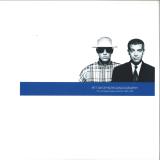
On May 30, 2025, Pet Shop Boys will reissue their 18-track greatest hits singles collection ‘Discography : The Singles Collection’ on limited blue vinyl, featuring updated 2023 remasters. ‘Discography’ was first released in 1991. The album charted No 3 in the UK album chart and includes ‘West End Girls’, ‘Always on My Mind’, ‘It’s a Sin’, ‘Domino Dancing’ and ‘Suburbia’.
Pet Shop Boys are an English synth-pop duo formed in London in 1981. Consisting of vocalist Neil Tennant and keyboardist Chris Lowe, they have sold more than 100 million records worldwide and were listed as the most successful duo in UK music history in the 1999 edition of The Guinness Book of Records. Pet Shop Boys have won three Brit Awards and have been nominated for 6 GRAMMY Awards. At the 2009 Brit Awards in London, they received an award for Outstanding Contribution to Music. In 2016, Billboard named Pet Shop Boys the number one dance duo or group since the chart's inception in 1976. In 2017, the duo received NME's Godlike Genius Award, and in 2024, they were awarded the Pop Pioneers award at the MTV Europe Music Awards.
- A1: Pinky
- A2: Jonny
- A3: White Noise
- A4: Interlude
- A5: State (Of U)
- B1: Toothskin
- B2: 01206-Scatti
- B3: Blue
Monster Florence bewegten sich schon immer an der Grenze der Genres und vermischten Hip-Hop, Punk und alles, was zum Moment passte, zu etwas Einzigartigem. Ihr letztes Album "Master System" erntete Kritikerlob für seine bissigen Texte und düstere, filmische Atmosphäre, die die Ängste des digitalen Zeitalters einfing. Seitdem hat die sechsköpfige Band aus Colchester ihre explosive Liveshow auf UK- und Europa-Touren ausgedehnt. Ihre neue EP PETTY CASH, eine Währung für Sorglose, fängt den Nervenkitzel flüchtiger Freuden ein. Die 8 Tracks bewegen sich durch Höhen und Tiefen von Exzess und Nachwirkungen. Es ist der Klang der Nächte, die ineinander übergehen, der Momente, die einem durch die Finger gleiten, und der Echos, die sie hinterlassen.