- Here And Now, A Free Rock Tentet (1969)
- Riot In The Solbosch (1970)
- Abstract And Concrete (1972)
- Five Sketches For A Short Film (1972)
- Lost In The Farmhouse (1973)
- Modular Excursions At John’s (1975)
- Kosmischer Afternoon (1975)
- The Big Slide (1976)
- Gyrovagations (1976)
- Imaginary Travels With Chris (1976)
- Proto-Kefak (1976)
- Didn’t Make It 1: Balinoid (1977)
- Didn’t Make It 2: Angeloid (1977)
- Java Ney (1977)
- Didn’t Make It 3: The Missing Dance (1977)
Suche:aksak maboul
- 1
In the wake of their acclaimed comeback album Figures (2020), Aksak Maboul took a playful sideways step to create this total work, a 63-minute, continuous suite of fifteen pieces, which could be described as an experimental audio play. The thread running through Une aventure de VV (Songspiel) is Véronique Vincent"s text, an enigmatic philosophical-poetical tale unfolding through monologues and dialogues, spoken and sung by a series of characters. The music was written & arranged by Marc Hollander and features his characteristic genre-hopping tendencies: strands of electronica, pop, jazz, collage, techno, ambient, improv, krautrock, contemporary classical & systems music are merrily woven together, in the inimitable Aksak Maboul style. The album"s subtitle, Songspiel, highlights its theatrical/musical aspect: the work pays oblique homage to the those experimental radio plays that once emerged from the creative workshops of the BBC, the RTF and the RAI, and especially to those German Hörspiels which, at their best, might combine spoken word, instrumental or electronic music, songs and sonic research. The album features appearances by Alig Fodder, Audrey Ginestet & Benjamin Glibert (Aquaserge), Lætitia Sadier (Stereolab), Blaine L. Reininger (Tuxedomoon), Don The Tiger, and the members of AKsak Maboul"s current live line-up.
- A1: Silhouettes (Vanishing Twin Remix)
- A2: C'est Charles (Shungu Remix)
- A3: Tout A Une Fin (The Notwist Version)
- A4: Eyelids & Phosphenes (Aksak Maboul Reconstruction)
- A5: Sophie La Bevue (Cate Le Bon Interpretation)
- B1: Hotel Suites (Carl Stone Redesign)
- B2: Un Caid (Spooky-J Remix)
- B3: Uccellini The Menace (Aksak Maboul Full Version)
- B4: Retour Chez A (Kate Nv Remix)
- B5: Charles Undresses (& Goes To Bed) (& Goes To Bed)
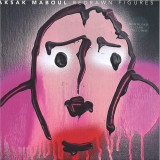
Im Mai 2020 erschien das Doppelalbum Figures der legendären belgischen Band Aksak Maboul. Nun folgen gleich zwei Alben mit Remixen, Coverversionen und neuen Versionen von fünfzehn ganz unterschiedlichen Musiker*innen auf Vinyl (jeweils streng auf 500 Exemplare limitiert). Betitelt sind sie Redrawn Figures 1 und Redrawn Figures 2. Mit von der Partie sind u.a. The Notwist, Cate Le Bon, Felix Kubin, Tolouse Low Trax und Matias Aguayo. Zu ihren Versionen kommen vier weitere von Aksak Maboul-Gründer Marc Hollander selbst. Wie im Albumtitel bereits anklingt, bat Aksak Maboul die Musiker*innen, sich nicht nur die Musik, sondern auch das von Véronique Vincent gestaltete Artwork von Figures vorzunehmen. Die daraus resultierenden sechzehn Bearbeitungen zieren das Cover von Redrawn Figures 1. Das Cover von Redrawn Figures 2 wiederum stammt vom französischen Maler Hervé Di Rosa, einem der Mitbegründer der "Figuration Libre"-Bewegung.
- A1: Tous Ko (Aksak Maboul Reconstruction)
- A2: Un Caid (Hello Skinny Remix)
- A3: Dramuscule (Ohh Luuu Remix)
- A4: Retour Chez A (Felix Kubin Remix)
- B1: L'adieu A L'histoire (Tolouse Low Trax Remix)
- B2: Fin (Stubbleman Remix)
- B3: Un Caid (Jordan Fields X Marc Hollander Old School Remix)
- B4: Anatomy Of A Dramuscule (Matias Aguayo Interpretation)
Im Mai 2020 erschien das Doppelalbum Figures der legendären belgischen Band Aksak Maboul. Nun folgen gleich zwei Alben mit Remixen, Coverversionen und neuen Versionen von fünfzehn ganz unterschiedlichen Musiker*innen auf Vinyl (jeweils streng auf 500 Exemplare limitiert). Betitelt sind sie Redrawn Figures 1 und Redrawn Figures 2. Mit von der Partie sind u.a. The Notwist, Cate Le Bon, Felix Kubin, Tolouse Low Trax und Matias Aguayo. Zu ihren Versionen kommen vier weitere von Aksak Maboul-Gründer Marc Hollander selbst. Wie im Albumtitel bereits anklingt, bat Aksak Maboul die Musiker*innen, sich nicht nur die Musik, sondern auch das von Véronique Vincent gestaltete Artwork von Figures vorzunehmen. Die daraus resultierenden sechzehn Bearbeitungen zieren das Cover von Redrawn Figures 1. Das Cover von Redrawn Figures 2 wiederum stammt vom französischen Maler Hervé Di Rosa, einem der Mitbegründer der "Figuration Libre"-Bewegung.
Originally recorded by Marc Moulin, Vincent Kenis and Marc Hollander in 1977 Brussels. Leapfrogging over style and genre boundaries, the LP shuffles between improvised jazz, minimalism, imaginary ethnic music, classical and even proto-techno ('Saure Gurke' foreshadows characteristic Detroit techno riffs by a good ten years).
It became a cult album in its own right and a few decades later Parisian dj / producer Krikor spontaneously decided to rework two tracks for his dj-sets. ensemble brings his remixes with the kind permission of Crammed, Marc Hollander / Aksak Maboul and Krikor.
- 1: Lemonade Tycoon
- 2: Anti-Bird-Spike-Bird-Nest
- 3: Interlude (Stride)
- 4: Allcapsallbold
- 5: Pet Boss
Taupe’s latest album release, waxing | waning delivers jazz experimentalism, ‘skronk’, avant-rock, and electronics, by the Glasgow-based trio, due out via Minority Records. Across its seven tracks, waxing | waning captures Taupe’s approach – bold and boundary pushing – shaped by a fresh shift in the band’s dynamic and compositional approach.
Taupe’s waxing | waning, co-composed and realised by its players in a studio that was once an undertaker’s premises in Glasgow, is an absolutely affirmative album, an act of cultural defiance in desperate times.
Comprising Mike Parr-Burman (guitar, bass guitar, electronics), Jamie Stockbridge (alto and baritone saxophones) and Alex Palmer (drum kit, percussion), Taupe work up a storm of skronk, free jazz and harmolodic frenzy whose closest relations include Zu, Melt Banana and John Zorn. However, waxing | waning is from its opening, stuttering blasts, an exercise in seeking out and claiming new territory, finding unique and novel permutations in which jazz, rock, electronics interbreed at breakneck pace. Here is a group determined to say and do things they don’t get to say and do elsewhere in their musical lives.
‘Lemonade Tycoon’ hits the ground skronking. It’s cubistic jazz, cumulative in its impact, avoiding the white lines of the conventional freeway, bridling, bustling, coming at you from all angles – a three way conversation of astonishing rapidity, fast track, telepathic communication – everyone from James Chance to Albert Ayler coming at you at once, before morphing in to a spidery scrawl of electronics and furious percussion. ‘Anti-Bird-Spike BirdNest’s‘ title somehow sums up the sort of mental images evoked by the music – its sheer creative disobedience, as if being chased in vain, like a delivery rider evading capture by ICE agents -– shapeshifting, assuming different shades, sprouting metal quills and, in its midsection, seeming almost to swallow itself alive, before regurgitating itself in a sublime mess.
‘Interlude (Stride)’ is not exactly ambient, more a horizontal enmeshment of percussion, drones, reverberant noise, electronics, a sonic mulch. ‘allcapsallbold' reminds of early Aksak Maboul, in its playfulness, a haywire series of short phrases, subject to mechanical interference, a complex weave of irregular rhythms, increasingly eloquent sax phraseology and caustic guitars, which land heavier and heavier. ‘Pet Boss' is the new jazz equivalent of a highly evolved, mature conversation among brilliant equals, sharp, empathetic, complementary, rising to a collective, joyful noise. On the title track, electronics descend like a shower of bright particles, intensifying in their luminosity, whitening the skies, as sax and drums kick up a tempestuous, spontaneously sculpted noise that summons the ghosts of the great free jazz players, before a dark calm descends slowly. Finally, ‘Turn Push Kick’, a burgeoning chatterstorm of electronics, before the group kicks in, at angles to one another, led by abrasive guitars, reminiscent of Sunn O))) in their ritualistic concussion, riffing, digging deep amid squealing sax and piledriving percussion.
Expected late October/early November
Scott Gilmore’s Volume 01, an Analog Synth Gem, Makes Its Vinyl Debut - Pressed at 45RPM for maximum fidelity.
Recorded on a vintage Tascam 388, the LP version of Gilmore’s alluring, easy-going instrumental electronic record arrives in the physical world via In Sheep’s Clothing Hi-Fi Records.
Los Angeles, CA — When the Los Angeles electronic musician and multi-instrumentalist Scott Gilmore recalls the creation of the songs on Volume 01, he describes specific moments of spontaneous inspiration. “I remember sitting at the tape deck, watching the leaves outside the window as they flittered in the sunlight—a moment of stillness that became intertwined with the melody I was recording,” Gilmore recalls, speaking of the track “Song For Cate.”
This sense of simplicity and presence is at the heart of Volume 01, which was recorded entirely on a Tascam 388 using a carefully curated selection of instruments.
Volume 01, an intimate, instinctual album that mixes lo-fi digital rhythms, strummed guitar, and melodic synth layers, is a collection of songs that captures Gilmore’s magnetic fluidity and the spontaneity of his process. Initially released digitally and as a limited edition cassette, Volume 01 is set to be issued on vinyl for the first time by In Sheep’s Clothing Hi-Fi.
The Tascam 388 is a classic mid-1980s analog machine that combines an 8-track reel-to-reel tape recorder with a built-in mixing console. Volume 01 exudes the kind of hazy, nostalgic warmth that only such recorders can provide. For the nine-song album, Gilmore harnessed analog synths including the Arp Odyssey, Yamaha CS-01, Korg DW-8000, Hohner Pianet T, Roland TR 606, and Roland SH 101, as well as bamboo alto saxophone, clarinet, electric guitar, and electric bass.
The album is awash in brief, propellant pieces. At just over four minutes, the relatively epic “Horizon Line” is driven by a three-note snare pattern, a two-note cymbal tap, with a humble bass-line serving as the rudder; Gilmore’s improvised keyboard runs move with an intuitive, conversational glee. The pensive "Shade" sounds like it could be a Penguin Cafe Orchestra demo. Closing track “D. Hareem” runs on a wobbly time signature but with an insistent, determined rhythm that belies genre descriptives. “I prefer to not know what I’m making as I compose,” Gilmore says. “It’s when I can’t clearly define what the music is that it’s then something that I want to put out into the world.”
In hindsight, Volume 01 was a portent. After its 2016 cassette release, Gilmore connected with International Feel, the Balearic imprint run by Marc Barrot, to release the sublime Subtle Vertigo. In 2019, Gilmore’s music caught the attention of Marc Hollander, the experimental composer and founding member of Aksak Maboul, which led to a signing with the Belgian label Crammed Discs. That deal enabled the creation of Gilmore’s solo album Two Roomed Motel and Doctor Fluorescent, a retro-futuristic, Vocoder-heavy 2020 collaboration with Eddie Ruscha V, a.k.a. Secret Circuit). Across these projects, Gilmore’s work has been mentioned in the same sentences as Stereolab, Arthur Russell, Woo, Air, R. Stevie Moore, and others, all of whom have combined synths and non-synths to memorable effect.
With the upcoming vinyl release, Volume 01 will set into wax an enduring set of works, offering listeners the chance to experience analog artistry in its most authentic, tangible form. In Sheep’s Clothing Records is honored to bring Gilmore’s work to vinyl.
Band Of Nowhere is a new constellation project by Juanjo Sánchez, together with other collaborators with whom he had previously worked. It is worth mentioning Bob Drake on drums, former member of the legendary formation Thinking Plague (also on Hail, 5UU's, The Science Group) who has also mastered the project from their studio in the Midi-Pyrénées and also to mention the guitarist Jordi Cabayol (Camino al Desván) both Juanjo and Jordi began their career in a significant band of Barcelona of the early eighties, such as Entr'acte.
The becoming of Juanjo Sánchez would take him to other latitudes as a member of Alondra Satori and without losing the lighthouse of his city, he would collaborate with other outstanding musicians such as Quicu Samsó (Koniec, Macromassa).
The fluidity and chromaticism of his previous album Gonza Magilla is still perceived in here, but in a much more electrified way with guitars that are sometimes expansive, other times exuberant wrapped up with contagious synthesizer modulations and very marked rhythms. The production and especially the arrangements are fantastic with those special presences of synthesizers that are not common around here.
Its original improvisation and experimentation is skilfully adjusted by Juanjo Sánchez, giving a much more playful result with unexpected combinations, very much in continuity with a certain European Art Rock such as Aksak Maboul, Etron Fou, Zamla,The Work or the mischievous resonances of The League of Gentlemen; all this mapping the sound transit, to an unpredictable and vibrant non-place.
Housed in it's original hand made artwork with the little upgrade twist of silk-screen printing textured grey cardboard and including a insert colour with photos and text provided by Juanjo Sánchez.
Housed in it's original hand made artwork with the little upgrade twist of silk-screen printing in Plastic clear cover and including a insert colour with photos and text provided by Juanjo Sánchez.
Javier Hernando
a1 Calling All Beginners
a2 Fleeing To the Poles
a3 Ashes
a4 Rouler ma Bosse
a5 Sunday Machinery
b1 lucid Dreams
b2 Twisted Maze
b3 Rolla Bolla
b4 Chinese Forecast
For a long time, the music of Congo-born Bony Bikaye had to be sought in the purgatory of "world music", where diamonds in the rough cohabited with bland nightmares of white dudes who froze rumba like fish sticks. Worse, they did put it on the menu, when so many longed to move on. Take Bikaye, who grew up listening to modern european music, digs Krautrock, struggles with tradition, obviously looking for trouble in the genre. In Brussels, he recorded a few albums with CY1 (Loizillon/Micheli), and brilliant defectors from Aksak Maboul, produced by Hector Zazou. Now it's up to french trio TONN3RR3 to take up the torch and build this project that proudly brags: "It's a bomb". Thought up at home by Guillaume Gilles (compo/keyboards), the album was finished at One Two Pass It studio, with Olivier Viadero and Gae"lle Salomon on percussion, Yoann Dubaud (machines & bass) and Guillaume Loizillon (synth of CY1 fame, and matchmaker of this affair). It's a deeply musical record, crafted by no-attitude reference players with nothing left to prove, and you can hear it. Floats well above the fray. "Keba na butu", beware. Indeed : beyond the simple pleasures of soukouss, or the rumba guitar riff that spins like a merry-go-round that skipped technical inspection, lie lush orchestrations. Freestyle, synthetic : something old, something new, something what-the- fuck-is-that-now. There's straight, there's syncopated, there's 808 and knee-jerk inducing bass patterns_with a vision. BIKAY3 plays his voice more than ever. His crazy vibrato has improved like hard liquor over the years. In "Zela" and "Balobi" in particular, he puts it to good use with flamboyant, Screamin' Jay Hawkins-style antics. He can also resort to pure storytelling : "La fore^t et les dieux", is a French-spoken excursion into the wild, moving along in grasslands of synths and percussion with TONN3RR3. A tale of gods and spirits, plain and simple. Nicole Mitchell brings the occasional flute in "Akei" for this trip in the bush of ghosts where lingala and kikongo rub with English and French. They saved "It's a bomb" for the end, a bastardized rumba, with rimshots that slap like a cool hand on willing skin. We're living in a golden age of reissues coming out in droves and satisfying our desire to catch up on our neighbors' musical heritage, but let's not miss the boat : it's now or never to listen to the music of the living. - Halory Goerger
Neben ihrer Zusammenarbeit mit Modern Cosmology, dem unglaublichen What Will You Grow Now? aus dem letzten Jahr und ihren fortgesetzten Tourneen mit den neu formierten Stereolab ist Laetitia mit Rooting For Love solo plus The Choir zurück in der Welt und ruft uns erneut dazu auf, uns auf unsere innere Ausrichtung und unsere Herzenskraft zu besinnen, um besser gerüstet zu sein für das, was kommen wird. Das regelmäßige Auftauchen von The Choir während Rooting For Love erinnert daran, dass diese Musik von einem Volk in der kritischen Masse stammt, zusätzlich zu einer Entwicklung, die die reichen harmonischen Felder, in denen Laetitia spielt, weiter vertieft. Die diversen musikalischen Arrangements tragen dazu bei - Orgel, Synthesizern, Gitarre, Bass, Posaune, Schlagzeugprogrammierung, Vibraphon und Zither, die alle auf verschlungenen Pfaden von Akkord- und Tempowechseln arbeiten. Der melodische Funk des Bassisten Xavi Muñoz führt zu gelegentlichen Dancefloor-Vibes und No-Wave-Rockouts, während Hannes Plattemier und Emma Mario abwechselnd die Tracks abmischen und das Material mit Vibes, zusätzlichem Drum-Programming und Synthesizern zusammen mit einer talentierten Besetzung von Spielern und Sängern aus Laetitas Source Ensemble und darüber hinaus bereichern. Ob sie sich Laetitia Sadier nun von der eigenen Zen-Shiastu-Ausbildung oder von den Texten von Véronique Vincent (Texterin und Sängerin von Aksak Maboul und einst Leadsängerin der Honeymoon Killers) inspirieren lässt, immer stellt sie sich der Wahrheit, ohne mit der Wimper zu zucken. Die Schatten, aus welchem Stoff sie auch immer bestehen - individuelle und kollektive, gegenwärtige und uralte - müssen erkannt und anerkannt werden, denn je mehr wir in uns selbst heilen, desto ungeteilter werden wir angesichts der drohenden neofaschistischen/neoliberalen Narrative, die die inneren und äußeren Landschaften verschmutzen. Wie das Titelbild des Winterbaums, das sich in den Wortmustern von Rooting For Love widerspiegelt, behauptet Laetitia, dass die Art und Weise, wie wir die kommende Welt heilen, und was wir daraus machen, eine Ko-Kreation sein wird. Die Qualität unserer Vorstellungskraft, die Ausrichtung, die wir unseren Gedanken geben, und die Fähigkeit, uns selbst und der Welt Liebe zu bringen, sind ein erster Schritt.
- La Ballade Du Zwin
- Ein Kleiner Mann
- Ud
- Piume Al Vento
- Nelle
- Granvelle
- Sabina And First Variation
- Un Instant Sous La Hache
- Geuzenlied
- Sabina And Second
- Variation
- The Ff Boom
Part fantastical historic sonic biopic, part anthropologic
journey into the deep roots of Belgium’s monstrous
cosmic rock sound, this wholly individualistic concept
album combines the lead members of the mighty COS
(Daniel Schell and Pascale Son) with studio genius
Alain Pierre (Ô Sidarta / Des morts) and celebrated
Dutch progressive rock singer Dick Annegarn, for what
many consider to be both the overlooked hiding place
of Belgium’s deepest psychedelic moment and
European prog’s lost map to the ‘Franco-Flemish
Boom’.
Emerging from the wider musical family that counted
Marc Moulin, Placebo and Marc Hollander amongst its
creative kin, Daniel Schell’s most profound conceptual
project ambitiously combines the tale of the heroic
historical figure of Count Egmont (1522–1568), while
simultaneously tracing the evolution of the ud, or oud,
(‘the grandfather of the guitar’) in this multifarious
hallucinogenic epic.
Featuring key members of other collectable groups
such as drummer Felix Simtaine from Solis Lacus and
bass player Jean-Louis Baudoin from the mythical
Classroom (COS predecessor), this best-kept secret
vinyl release also harbours the voices of Dirk Bogaert
(of Belgian hard rockers Waterloo), as well as Catalan
singer Ilona Chale (Marc Hollander / Aksak Maboul)
before her later tenure as the COS front woman.
Initially released in 1978 via Zeuhl school distributors
Free Bird alongside French pressings of Don Cherry,
Jacques Thollot and CAN, it is plain to understand the
niche nature of this maligned ‘lost COS’ LP as it finally
blooms from between the cracked branches of
European jazz-rock-synth-psych-prog-pop history…
and beyond
- A1: Avalon - Linked (Move D Remix)
- A2: Alegria - Danger (It's For Real) (Alien Remake)
- A3: Gemini - 7 15 Pm
- B1: Solar Quest - Acid Nation
- C1: Modulate - Dreams
- C2: Nu Era - Pisces
- C3: Hans G - Anything You Like (B2)
- D1: Q-Burn's Abstract Message - Mess Of Afros (Glenn Underground Remix)
- D2: Hector Zazou & Harold Budd - The Light Gave Us Away (House Mix By Herbert)
Hi Scores is beyond excited to present SSR Records: In Retrospect. This 2LP compilation album presented in a beautiful gatefold sleeve and through all digital platforms, wishes to highlight the immense and hard to grasp legacy of the Brussels based label. SSR Records was founded in 1988 by Marc Hollander as a sub label of his Crammed Discs and spanned the nascent years of house, acid, rave, trance, new beat, hip-hop, future jazz and broken beat, collaborating internationally and racking up close to 200 releases until it was put to sleep in 2002. Far ahead of their time, SSR Records released music of both European and North American artists that hadn’t broken through yet, such as those collected on this compilation: Move D, Nu Era, Gemini, Bjørn Torske, Glenn Underground or Matthew Herbert.
SSR Records was run by Crammed Discs chief Marc Hollander and Minimal Compact singer Samy Birnbach aka DJ Morpheus. SSR Records: In Retrospect comes with extended liner notes, exploring the pivotal milestones in the history of the adventurous label and zooming in on the origins of all records featured on the compilation.
All nine tracks on SSR Records: In Retrospect were selected by Hi Scores’s head honcho Kong DJ and have been remastered. Created between 1990 and 1996 and in the at the time pioneering spheres of house, breakbeat, electro and trance music, these treasures from the vast SSR catalog today stand as a stunning testimony to a truly remarkable and timeless musical legacy. Kong DJ: ‘While collaborating with Crammed Discs on the releases of Aksak Maboul in 2016 and Zazou / Bikaye in 2018 on Ensemble, I began to grasp the impressive catalog of the label and its sub labels, including SSR. Surprised by the tiny footprint SSR had left on the world wide web - often the case for labels ceased before the internet revolution - I wrote an article for British website The Vinyl Factory.
This would later prove to be the first step towards this compilation album, collecting favorites from the label as a kid in a giant candy store.’
This 4th full-length album by the legendary Congolese collective marks a new milestone in their already rich history, as the band have incorporated their own approach to electronic music into their new compositions. The album was produced by guitarist Mopero Mupemba, who also wrote about half of the songs. Mopero also took care of the often intricate programming, which is perfectly adapted to Kasai Allstars' peculiar rhythmic patterns drawn from traditional trance and ritual music. The album features Kasai Allstars mainstays such as vocalist Muambuyi (whose voice and personality inspired the making of multi-awarded feature film Félicité), vocalist and electric likembe player Kabongo, powerful singer Mi Amor, and instrumentalists Tandjolo and Bayila. Wonderful young vocalist Bijou makes a notable first appearance on several tracks. As is well-known by now, Kasai Allstars was born from the reunion of five bands, all from the Kasai region, but originating from five different ethnic groups whose diverse musical traditions were thought to be incompatible until these musicians decided to pool their resources and work together, an inspiring example of collaboration transcending ethnic and language barriers. Ever since the debut release in 2008, Kasai Allstars' music struck the imagination of music lovers and artists worldwide. They're particularly admired by avant-indie rock, electronic & hip hop musicians and media, who consider it as a kind of "primal rock", an accidental blend of trance and avant-garde. They're admired by artists such as Saul Williams, Questlove and Björk, have engaged in live collaborations with Deerhoof, Juana Molina and Konono Nd1, and have had their tracks remixed by the likes of Animal Collective, Deerhoof, Aksak Maboul, Jolie Holland, Shackleton and more.
- 1: Bat-Yam - Minimal Compact
- 2: Too Many Of Them - Minimal Compact
- 3: Immer Vorbei - Minimal Compact
- 4: Animal Killers - Minimal Compact
- 5: Aç La Recherche De B. - Benjamin Lew
- 6: Scratch Holiday - Aksak Maboul
- 7: Odessa - Aksak Maboul
- 8: Chez Les Futuristes Russes - Aksak Maboul
- 9: Ossip Et Lili - Aksak Maboul
- 10: Lili Danse - Aksak Maboul
- 11: Retour Chez Les Futuristes - Aksak Maboul
- 12: Mort De Velimir - Aksak Maboul
- 13: Fanfare - Tuxedomoon
- 14: No One Expects The Spanish Inquisition - Tuxedomoon
- 15: Driving To Verdun - Tuxedomoon
Crammed's legendary MADE TO MEASURE Series of New Music was described at the time as the aural equivalent of a collection of art books. Charting a map of some of the most interesting instrumental music of the era, thirty-five albums came out between 1983 and 1995, including works by artists such as Hector Zazou, John Lurie (his soundtracks for the Jim Jarmusch films), Fred Frith, Arto Lindsay, Zelwer, Steven Brown, Peter Principle, Harold Budd, Brion Gysin, David Cunningham, Benjamin Lew, Ramuntcho Matta, Karl Biscuit, Daniel Schell, Aksak Maboul, Minimal Compact and more. The loose idea behind the title of the series was: this is music which has been or could have been "made to measure" as a soundtrack for other media (film, theatre, dance, video). We'll also be rolling out selected vinyl reissues of some of the series' classic early releases, starting with the inaugural volume, MADE TO MEASURE VOL. 1, the multi-artist album from 1984, containing music created by Minimal Compact, Benjamin Lew, Aksak Maboul and Tuxedomoon for films, theatre plays and dance performances.
- 1