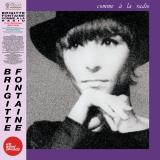
After the explosive Comme à la radio, infused with the free jazz energy of the Art Ensemble of Chicago, Brigitte Fontaine and Areski Belkacem released six albums together or separately between 1972 and 1977. Their music, often stripped down to voice, guitar, and percussion-or performed a cappella-stood in stark contrast to the orchestrated French pop of the time. This minimalist and spontaneous approach highlighted the poetic power of the lyrics and the intimacy of the melodies, earning them recognition in the counterculture and underground scenes. By the end of the 1970s, Fontaine sought to make her work more visible without losing its originality. The Baraka album marked this transitional moment, initially recorded in a home studio without external musicians. Its title (meaning "blessing" in Arabic) hinted at a desire for success. Mixing introspection, absurd humor, and bold stylistic choices, the album was technically ambitious, featuring stereo duets and layered vocals, and lyrically rich, tackling everything from metaphysical themes to playful nonsense. However, the project ultimately veered off course. After moving the recordings to the massive Studio Davout and bringing in producer and guitarist Martial "Mimi" Lorenzini, the album lost its original intimacy. Overproduced arrangements clashed with the simplicity of Fontaine and Belkacem's initial intent, resulting in an album-renamed Les églantines sont peut-être formidables-that the artists later disowned, refusing to allow its commercial release. Recently rediscovered demo tapes, stripped of their bombastic layers, reveal the raw, emotional core of the songs-showcasing the duo's voices with a rare authenticity. These recordings bridge a missing link in their discography, between their experimental lo-fi years and their later, more accessible work. Decades on, Fontaine and Belkacem remain defiant originals, never settling into a formula, always evolving, and continuing to shake the foundations of French chanson.
Cerca:belkacem
- 1
BYG album, facsimile-edition. Newly mastered to vinyl from original BYG tapes. Lacquers cut by Alchemy Mastering at AIR STUDIOS. Exclusive liner notes by author, journalist and BYG-authority Kevin Le Gendre. Cd: expanded cd edition in deluxe gatefold sleeve & printed inner wallet Original 1973 BYG album. Expanded with 2 original single-version tracks. Digitally mastered from original BYG tapes by Nick Robbins. 16-pages booklet with exclusive liner notes by author, journalist and BYG-authority Kevin Le Gendre. *** Vocalist-multi-instrumentalist Areski and singer Brigitte Fontaine are a legendary French musical couple that rose to prominence in the ‘60s, making a series of albums that showcased a boldly unorthodox approach to the art of song. While their defiantly esoteric style, which could veer from North African folk to Brazilian samba to subversive takes on French chanson, was striking their lyrics were no less provocative, broaching anything from mental health to social injustice. “This re-mastered version of a timeless work is a must-hear for open minds and open ears ...” Kevin Le Gendre, 2022
- A1: Vous Et Nous
- A2: Patriarcat
- A3: Mon Enfance
- A4: Vent D'automne
- A5: Le Serveur Du Dôme
- A6: Je Suis Venu Te Voir
- A7: Rien Que Changer
- A8: Le Ciel Est Doux
- B1: Les Épis
- B2: Le Repas Des Dromadaires
- B3: Vous Et Nous
- B4: L'amour Parfait
- B5: Un Soleil
- B6: Dans Ma Rue
- B7: L'orage Est Fini
- B8: Gamme
- C1: Le Brin D'herbe
- C2: La Harpe Jaune
- C3: Je T'aimerai
- C4: Diabolo
- C5: Cher
- C6: Ce N'est Pas Un Ennemi
- C7: Encaustique
- C8: Petit Sapin
- D1: Mon Lit
- D2: Je T'aimerai
- D3: La Déchirure
- D4: Le Petit Cheval Bleu
- D5: Personne
- D6: Les Roses Sont Farouches
- D7: Le Bouc
- D8: Dessin
- D9: Les Muzdus
Art is a matter of different phases and influence. The artists' core reaches out like heat waves. And very rarely do these artists' core merge like Brigitte Fontaine and Arseki Belkacem have. Their Saravah Era lasted ten years (1969 to 1979), ten years of "folle sagesse" (crazy wisdom), above all genres and song limitation.
"Le plaisir secret que donne une chanson, dessin à la craie sur le mur de tes sons" (the personal delight within song, a chalk drawing on your wall of sounds) whispers Areski, right after Brigitte's voice on the penultimate song of the double album "Vous et nous". Released in 1977, this free flowing record contains 33 songs, it's their 6th album after "Comme à la radio", "Brigitte 4", "Je ne connais pas cet homme", "L'incendie" and "Le bonheur", and it continues to spread the wide and generous spectrum of the couple fully blossoming talent. Electronic experiments, North African trance, refined acoustics and medieval drones gracefully blend with the acid and candid tongues of the singers, surprising us each step along the way. The making of this record was also full of twists and turns. It started out as a solo effort by Areski at Jean-Pierre Chambard's studio. Little by little, as Areski was filling tapes with poems and improvised skits, Brigitte would sneak into the studio at nightfall, adding her voice here and there, her whispers then became screams, giving fuel to the fire in a total blaze, a surreal blaze. The solitary work ("je") thrived to become us ("nous") and you ("vous") ...
Benjamin Barouh, June 2018
- Un Pays
- Une Reine Et Un Roi
- La Nuit Me Mord
- Buisson Ardent
- Mon Amie
- Et J'en Oublie
- Entre Le Oui, Le Non
- Dans Les Gares
- Tout Ce Que Je Sais De Toi
- La Sentence
- Faut-Il
- L'onde
Few lovers stay together for life-and beyond. Just as rare are the artists who manage to keep alive the burning flame of their creative desire. Areski Belkacem is one of those who nurtures in his heart a fire that never dies out, a passion that burns just as intensely for music as it does for his beloved. As long as the message eventually reaches its intended recipient, he cares little for how long the journey takes. His new album, Long courrier, is proof of this: twelve unreleased songs that flow like a love letter set to music. In nearly 60 years of career, Areski Belkacem has released only three solo albums-intimate and deeply personal works that feel like whispered confidences to a loved one. In an era where commercial demands shape much of music production, these records exist solely to fulfill his need for expression. The late music lover and producer Jean-Philippe Allard once said, "Areski goes against the tide-he always seems to enjoy taking forbidden paths!" In Long courrier, Areski tenderly expresses love for his homeland and his beloved. He believes in the power of sensuality, the sacredness of pleasure, and the hidden beauty in every person despite life's hardships. He shows a fraternal gaze toward outsiders and sings of inner journeys, doubt, vows, eternal bonds-with a voice as warm and bright as a loving smile. He honors the mystery of the union between music and the French language. Blending his familiar chaabi rhythms and guitar with piano, accordion, bass, and electric guitar, he plays alongside the same musicians who have accompanied him for over two decades on stage-supporting the woman he shares both stage and life with: the incomparable Brigitte Fontaine.
- A1: Simple Minds - Theme For Great Cities
- A2: Cabaret Voltaire - Silent Command
- A3: Ryuichi Sakamoto - Riot In Lagos
- A4: Grauzone - Eisbar
- B1: The Associates - White Car In Germany
- B2: Patrick Cowley - Nightcrawler
- B3: Isabelle Mayereau - On A Trouve
- B4: Chas Jankel - 3,000,000 Synths
- C1: Peter Gabriel - No Self Control
- C2: The Walker Brothers - Nite Flights
- C3: Thomas Leer - Tight As A Drum
- C4: Daryl Hall - The Farther Away I Am
- C5: Harald Grosskopf - So Weit, So Gut
- D1: Robert Fripp - Exposure
- D2: Areski Belkacem & Brigitte Fontaine - Patriarcat
- D3: Basil Kirchin - Silicon Chip
- D4: Holger Czukay - Ode To Perfume
By the turn of the 80s, the impact of David Bowie’s ground- breaking Berlin recordings – the synths, the alienation, the drily futuristic production – was being felt on music across Europe. What’s more, the records being made were reflecting back and influencing Bowie’s own work – 1979’s Lodger and 1980’s Scary Monsters owed a debt to strands of German kosmische (Holger Czukay), new electronica (Patrick Cowley, Harald Grosskopf), and the latest works from old friends and rivals like Robert Fripp, Peter Gabriel and Scott Walker, all of whom had been re-energised by the fizz of 1977.
Compiled by Saint Etienne’s Bob Stanley and the BFI’s Jason Wood, Fantastic Voyage is the companion album to their hugely successful Café Exil collection, which imagined the soundtrack to David Bowie and Iggy Pop’s trans-European train journeys in the mid-to-late seventies. “Fantastic Voyage” is what happened next.
Bowie’s influences and Bowie’s own influence were rebounding off each other as the 70s ended and the 80s began, notably in the emergent synthpop and new romantic scenes as well as through the music of enigmatic acts like the Associates and post-punk pioneers such as Cabaret Voltaire.
Like Low and Heroes, some of the tracks on Fantastic Voyage are spiked with tension (Grauzone’s ‘Eisbär’) while some share those albums’ sense of travel (Simple Minds’ ‘Theme for Great Cities’, Ryuichi Sakamoto’s ‘Riot in Lagos’) and others find common ground with “Lodger’s” dark, subtle humour (Thomas Leer’s ‘Tight as a Drum’, Fripp’s ‘Exposure’).
This is the thrilling, adventurous sound of European music before the watershed moment when Bowie would abandon art- pop for America and the emerging world of MTV with “Let’s Dance” in 1983. Fantastic Voyage soundtracks the few brief years when the echo chamber of Bowie, his inspirations, and his followers created an exciting, borderless music that was ready to challenge Anglo American influences.
- A1: Migas 2000
- A2: I'm Dead
- A3: Je Ne Suis Pas Tres Drogue
- A4: Down Underground
- A5: Je Suis Une Go-Go Girl
- A6: La Fille De La Ligne 15
- B1: Je M'en Vais
- B2: Salvation
- B3: Votre Cote Yeye M'emmerde
- B4: Cold Was The Ground
- B5: My Black Sabbath
- B6: Carnival Of Souls
- C1: El Beach
- C2: Prisunic
- C3: Dahlia Rouge
- C4: Garden Of Love
- C5: Istanbul Is Sleepy
- C6: The Gift
- D1: Shadow People
- D2: Dimanche
- D3: One Blood Circle
- D4: Calentita
- D5: Saul
- E1: Usa Motorbike (Feat David Menke)
- E2: La Musique (Feat Areski Belkacem)
- E3: Les Hommes Et Les Ombres
- E4: Domino (Feat Golden Bug)
- E5: Pulsing (Feat David Menke)
- F1: Hey I'm Going Down
- F2: She's On My Track
- F3: A Dream That Slips
- F4: Electrified
- F5: You Got My Soul
- F6: Drown
- F7: Belladelic
Black Vinyl[28,36 €]
Orange Vinyl
The garage -psychedelic French duo The Liminanas straddles since 2009 the boundary between psychedelic ,shoegaze,garage & French yé-yé up to cool vocals . Quintessentially French but first known at the start in the US before hitting homeland France. 7 studio albums so far, 2 rare tracks compilations, many Eps,some OST, collabs such as L’Epée with Anton Newcombe & Emmanuelle Seigner : time for a first time Best of, and actually more than a Best of : Double Cd , Ltd Triple Vinyl& Digital editions offer 12 exclusive bonus tracks -new songs + rare songs when they called themselves les Bellas, before The Liminanas-.
“Electrified” also includes 23 classics songs , with featurings such as Peter Hook, Anton Newcombe and French pionners Laurent Garnier, Etienne Daho & Pascal Comelade.
Features liner notes written by Iggy Pop, Peter Hook & Keith Streng (Fleshtones) : because it’s only rock’n’roll.
Birds are singing, a soft female voice embraces the stars, then the funk hits the fan: the second album of mysterious Japanese singer Nadja haunts immediately and marks one of the most exquisite reissues in the ever-growing catalogue of Studio Mule. Originally released in 1989 as promo only CD on the Japanese label Polystar, the album features some of the finest eighties pop funk fusion arrangements of the era. A deeply enchanting lost gem, that gets listeners instantly into heavy repeat addiction.
All ten songs are arranged by a group of grandmasters of their art. Japanese saxophonist, composer and music producer Yasuaki Shimizu, man behind the electronic ambient fusion classic “Kakashi”, was in charge for tunes like “Wac-Wack”, a neon light funk pop song, full of soft big city eroticism, ultra-slick synth lines and real funkateer explosions. It’s followed by “夢のとりこ”, the most stirring pop tune on the album, that originally was written by French composer, multi-instrumentalist, actor and singer Areski Belkacem, known for his and long-time collaborations with French avantgarde singer Brigitte Fontaine. Shimizu transformed the song into a low hanging funk jewel, with a cool rolling bassline, dub depth and synths that cry for cosmic help. Above all Nadja signs with a sexy chill, that somehow could only emerge in the 1980ees, when the cold war even made pop music real cool. The follow up is named “真珠のように”, features again music by Belkacem, this time transformed by Shimizu into electronic erotic pop - dreamy, witchy and precisely musical composed.
The B-Side opens with “Velvet Rain”, a funky urban boogie composition by Japanese keyboard player, composer and producer Akira Inoue, enlarged with glimmer camp kitsch, that immediately puts a smile on the listeners faces. It gets followed by “Paradise Catcher”, a soft pop tune with longing string and horn sections, arranged by legendary Jamaican rhythm and production duo Sly & Robbie. It somehow marks one of the strangest songs in their longstanding career, as it is largely minimal orchestral but yet super tight when it comes down to the rhythmic magnitudes. The next tune, “Private Tripper”, also stays soulful, funky and horn driven. Always pleasing the super tight, yet feathery voice of Nadja, that is dancing about boogie grooves and illuminating melodies with a seducing tragical coolness. Finally the album ends with a stylistic break in the overall musical atmosphere. It comes from Japanese musician Hiroaki Goto, it’s called “地図をずっと南へ”and features Afro-Brasilian voodoo rhythms, pan flutes, cosmic piano notes and Nadja, singing like a rain forest sorceress from outer space.
Ten arrangements by a bunch of high-grade arrangers, that all left Nadja’s voice enough space to widespread her talent as a supremely seducing singer, who wrote all lyrics, vocals and chorus by herself in order to present her touching vocal class in a vivid, bewitching timeless style. Come in and get ensnared!
- 1