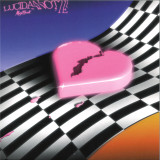
MODULAR CUISINE is an event, a vinyl, a charity auction.
The 140gr. black vinyl contains the exclusive “Modular Cuisine” sticker, and from the front QR code you will directly access the full stream of the release.
•ACID CASTELLO “analogue-infused electro and crafty acid sounds”
•ANDY MORELLO “unique merge of dub, ambient and experimental electronic music”
•IDRA “charming ambient soundscapes”
•JOAO CESER “deeply atmospheric dance”
•VOSM “solid and sweet rhythms”
Catorce reflexiones sobre el fin (Fourteen Reflections on the End) originated from an installation exhibited at the Museo de Arte Contemporáneo de Oaxaca, Mexico, in 2019. Fourteen magnetic bodies of tape that dialogued with the fourteen pieces of electroacoustic music now contained in this album composed from the sound anthology of Angélica Castelló. Thus, Catorce reflexiones sobre el fin is a complex piece consisting of multiple parts that, although articulated with each other, hold a life of their own.
Like every body, these have a unique history made up of mixed fragments spun by Angélica, ranging from field recordings, references, and self-references to previous pieces, experiences, and voice recordings made specifically for these compositions re-recorded in various formats, from lo to high fidelity, analog and digital, composed, decomposed and recomposed (Castelló, A., 2019). Likewise, as any body, they also reflect on their end, whether absolute or temporal, of the many ways of being finite and of saying goodbye.
During the Catorce reflexiones sobre el fin, Castelló takes you on a journey that is difficult to locate. An ethereal space between shattered glass, stridulation of cicadas, war drums, murmurs in French, Italian maledictions, and soft recitations in Spanish. From uproar to solace, all wrapped in a soft abstraction that only allows access to the subtle whisper of these expressions. A gesture between invitation and sharing because who does not recognize oneself in this emotional storm?
First, the approach of the winds, the first breeze that caresses the body. Then the bewilderment announced by the scent of uncertainty condensed in the air’s humidity. The prelude to the storm, to something that will shake you from head to toe, something from which there will be no return.
To the acceleration of the winds comes the percussions, the tremor of the storm with its lightning. la Ira (1). A vibration running through the whole body, unstoppable. This reverberating sound, resulting from its re-percussion with our body acoustics, owes its tones and echoes to the cavities and organs of different masses. From what is hollow and what is full; what is void and what is matter. There is no turning back. It is a dive into the void; to fight and resist because there is no other way to go. It is a matter of survival.
Ma fin est mon commencement Et mon commencement ma fin (2)
After this, the cicada resumes at the crack of dawn, a gentle breeze, and solitude, that temporarily musical silence of embraces (3) with hints of harpsichord and bells.
The breaking of the waves in Sicily is accompanied by the antenna that picks up radio transmissions that already invite other tastes. The Mediterranean and its currents mingle and divide tense routes of escape, exchange, and struggle between Blutorangen, tides, and birdsongs.
An immersion into deep waters.
And in the end, we all commit sins! Queste maledette! (4)
Castello, Sole is the first project signed by Issam Dahmani on Dischi Malizia.
This new series keep up the 80s and 90s feelings atmospheres very tied to Italy with a strong signature of modern vibes. Fresh sound from funk and italo disco ready for summer madness.
out of Stock
Last delivered 3 years ago available to reorder, subject to availability
"Lost in the spinning sound" is the 12th studio album by The Dining Rooms (Stefano Ghittoni and Cesare Malfatti) who, over the years, have delved into an original style that balances cinematic atmospheres with funk, dub and ambient music. Here they have invited just one vocal guest, Chiara Castello from I'm Not a Blonde, for a collaboration that delivers a slow, nocturnal, orchestral, very minimalist album, oscillating between folk and blues, with deeply meaningful lyrics that explore the intricate nature of interpersonal relationships. The album cover, an illustration by Sara Vivan, conveys the idea of metamorphosis and invites us to dive into the sounds that surround and protect us. This is also the main message of the album: losing ourselves in order to protect ourselves a little. Drifting along and finding new, safer and more peaceful shores.
“I Don’t Know Why”, sung by Chiara Castello, is the second single from The Dining Rooms’ next album: an urban funk ballad, with a powerful and deep rhythm accompanied by great bass lines and cinematic guitars and piano. It is an intimate reflection on the fragility of personal bonds suspended between light and shadow. On this 7” the B-side is a remix of “On And On” - taken from TDR’s previous album “Songs to Make Love to” - by FUTURESLOWDUBDISCO, a music project initiated by Roman producers Simone Ticconi and Francesco Colagrande. The duo explores soundscapes that combine downtempo, minimal techno and dub. Originally a soul ballad, it has turned into an unforgettable rhythmic, ethereal and psychedelic journey sung by Egeeno from the Tropicantesimo collective.
“For Today” is a timeless album—a sonic journey that seamlessly blends electronic influences, Trip-Hop, Folk, Indie Rock,
and Psychedelia.
It unfolds like an immersive soundscape, rich in complex atmospheres, experimental textures, and a deep emotional
undercurrent. Agosta has envisioned a record that transcends trends and market conventions, crafting a cinematic, soulstirring experience that fuses the intensity of trip-hop, the purity of folk, and the swirling colours of psychedelia.
The result is music that stimulates the intellect as much as it stirs the heart. With a delicate, refined touch and melodic
depth, Agosta combines contemporary sounds with vintage warmth, pairing poetic lyrics with themes of love, introspection,
and the human experience.
A standout element of “For Today” is the presence of five tracks featuring female performers and writers. This
intergenerational collaboration brings a richness of perspective and emotional range to the album. Far from a simple gesture
of gender inclusion, it serves as an authentic integration of diverse voices, offering new layers of sensitivity and storytelling.
Where Agosta’s previous work leaned more toward instrumental composition, here the inclusion of female voices adds
lyrical nuance and depth. These contributions explore themes such as love, identity, relationships, and personal liberation—
offering a poetic yet grounded lens through which to experience the album’s contemporary sound.
In essence, “For Today” is a mature and cohesive work that defies the boundaries of traditional genres, creating a unique
and resonant sonic world.
Each track explores a different emotional and musical dimension, with meticulous attention to sound design and a clear
desire for emotional experimentation. The album balances the introspective depth of trip-hop with the lightness and
spirituality of folk, weaving in modern pop elements and touches of psychedelia and groove.
The result is a compelling, emotionally charged, and genre-blending experience—one that invites listeners not only to hear,
but to feel.
An absolute must-listen!
Four years after Nuova Napoli, Nu Genea are back with Bar Mediterraneo, a new album and journey, which projects the sounds of the Neapolitan duo formed by Massimo Di Lena and Lucio Aquilina even further.
Nu Genea's Bar Mediterraneo is an idea of a shared place where people meet and fuse together; a space that leaves its doors open to travellers and their lives, always exposed to the whims of fate. Some of this can be experienced through the multitude of sounds that come together in the tracks, layers of different acoustic instruments, voices and synthesizers merging in a unique musical blend.
Opening up to the voices of many different people, separated by languages but united by the sea and the music, Nu Genea's hometown, Napoli, becomes a true place of encounter.
You can hear this all along. In "Gelbi", a gorgeously deep and propulsive Ney flute plunges into murky waters of the melancholic Tunisian dialect sung by Marzouk Mejri. In "Marechia'", unbridled happiness and sun ooze from the delicate vocals of Célia Kameni and create an acrobatic bridge between French and Neapolitan language. In "Straniero", your soul is arrested from the moment the slow spell-binding mandolin ignites the hypnotic patterns recorded by the legendary Afrobeat drummer Tony Allen. In "Bar Mediterraneo", the title track, bittersweet guitar’s riffs, analog waves and choirs are overwhelming the song giving you what you would like to hear on a boat trip along the Amalfi Coast.
Nu Genea couldn't afford to overlook their firmly anchored roots into the Neapolitan culture and its dialect with "Tienaté", where the power of neapolitan language (interpreted by Fabiana Martone) supports those quarter-tone strings and the uncessant folk-disco groove that spreads to the entire song. In "Praja Magia", repetitive mandolin riffs lead the song, giving space to a choral yet tight vocal line that speaks of Varcaturo, a village close to Napoli. In "Rire", a volley of poetic, deceptively laidback, lyrical fury interpreted by Sicilian Marco Castello intimately combines with a highly musical, multi-textured instrumental backbone and the swoon of a chanson in its heart. In "La Crisi'', the lyrics of a Raffaele Viviani’s poem from 1930 have been adapted to a laidback jazz-funk groove in full NG style. In "Vesuvio", revaluing the evocative verses and powerful mantra of Vesuvio, Nu Genea re-adapted to the dancefloor a folk song by the working-class band E’ Zezi from Pomigliano D'Arco, combining the voices of a school choir with Jupiter-6 arpeggios and bold percussions.
Bar Mediterraneo is the place where people constantly return to transform curiosity into participation, tradition into sharing, unfamiliar into familiar. When travellers come through its “doors”, carrying their treasures of words and emotions, they aren’t strangers any more. They take part in a shared experience, enriching themselves and others by leading to unexpected musical journeys.
“Songs to Make Love To” is the 10th studio album by The Dining Rooms (Stefano Ghittoni and Cesare Malfatti), extending the Milanese duo’s classic sound legacy among psychedelic folk, cinematic atmospheres and hip hop-inspired downtempo rhythms. As always divided into instrumental and vocal tracks, it is entirely played and produced by Stefano and Cesare and features guest appearances on vocals by Chiara Castello (I’m Not a Blonde), Egeeno (of the Roman collective Tropicantesimo) and labelmate Tomaz Di Cunto aka Toco. “Songs To Make Love To” talks about love and relationship dynamics in every aspect, but also explores anthropological and ethnomusicological themes by making use of field recordings. “Songs To Make Love To” talks about love and relationship dynamics in every aspect, but also explores anthropological and ethnomusicological themes by making use of field recordings. “Songs To Make Love To”, whose artwork was made with works by artist Tatjana Zonca, talks about love and the explicit act of loving each other, but also and especially about the construction of love, the dynamics of love relationships inside and outside the couple, free and liberated love, without constraints and outside the concept of possession. A further peculiarity that contributes to the uniqueness of “Songs To...” is the in-depth exploration of anthropological and ethnomusicological themes, particularly dear to Alan Lomax: the classic TDR sound therefore blends, especially in the instrumental tracks, with classic field recordings of sounds from the Genoese carruggi, the Milanese dockyard, the Spanish quarters of Naples and cities such as Istanbul and São Paulo.
microCastle’s first offering of 2024 welcomes Adrian Roman back to the label for his second artist showcase. Hailing from Spain, Adrian Roman first rose to prominence in 2021 with a string of superlative releases which redefined his sound, resulting in an aesthetic that was both cutting edge and effortlessly cool. F, nmully formed within the creative confines of his Castello studio, Adrian’s first microCastle project, 2022’s‘ Disturbing the Perception’ succeeded in showcasing his inventive approach to composition, while remaining club-effective, and in turn earning play from Aera, Fideles and Jimi Jules, amongst others. Moving forward the next eighteen months have proved to be impactful for the young Spaniard, recording standout projects for AZZUR and Sum Over Histories, releases which continued to build on his creative acumen, while remaining in the playlists of underground tastemakers Ame and Dixon. With 2024 beginning with Adrian’s latest Sum Over Histories vehicle ‘Oratorical Ability’, the Spaniard now makes a welcome return to microCastle with a six-track showcase entitled ‘This Is What I Was For A Moment’.
From the opening monochromes of ‘Le Sabbat’ Adrian’s craftsmanship reveals itself across this slow-burning piece, one where grating growls, granular flares and panoramic arps ultimately set the pace for the groove-centric ‘Customized Reality’. It’s here where Adrian puts a greater focus on the dancefloor, marrying hopeful vocal phrasing and silky chord stabs for a rejuvenating experience, while a drum-driven drop ultimately charts the course for a finale of deconstructed sonics and post-rave bliss. The haywire electricity of ‘Faces of Belmez’ finds the Spaniard once again flexing his creative muscles, as corrugated bleeps and cataclysmic rhythms provide a vast sense of space, creating the ultimate backdrop for distorted synths to propel choppy rhythms into dark underground passages, and perhaps onto some of the world’s most adventurous dancefloors.
The collection’s midway point is marked by the hypno-architecture of ‘Mind Design’. Trickling reverberations and long sighs of tonal tension wade through its pulsating framework, with frayed effects and thumping rhythms submerged beneath a buzzing panoramic glow. Played by Ame and sitting as one of the project's most enigmatic tracks is ‘TAGDI’ (They Are Gonna Do It). Tinted with contemplative synths and guttural vocals, Adrian’s unique emotionality peaks here, as he crafts a low-slung, slow-building dystopian romance, all while weaving in cerebral manipulations for an unforgettable ride. The mist breaks instantly on the collection’s final piece, as your thrusted into the muscular grooves of ‘Fear Track’. Horrifying vocal stabs strike, leaving the gauzy purple skies of ‘TAGDI’ behind for a more robust romp, one where anabolic bassline, retro-arps and off kilter percussion bring the release to a feverish peak. A fitting conclusion to a diverse collection of music, one where Adrian creates a journey that speaks to the complexities of life against an immersive and challenging backdrop.
From a research work started in full lockdown three years ago, finally sees the light (or darkness) Echi Senza Fine, a remastered collection of sound material by Tasaday. Inspired by the controversial media story in 1971 of the discovery of a tribe in the Philippines that apparently had technology that had stood still in the Stone Age, the project officially borrows the name Tasaday in 1984 from the evolution of Nulla Perreale, in turn union of Die Form (musical part) & Orgasm Denied (performative part).
To put it in the words of Marcello Ambrosini, the Tasadays find in Die Form the controlled destruction of the form after its careful design and construction, while in Nulla Iperreale the spontaneity free from any possible superstructure. They declare themselves new primitives, not in the perspective of a nostalgic return to a pre-industrial or prehistoric external world, but in the exception of an inner experience in stark contrast to the leviathan of the single utilitarian thought that has dominated the West for centuries.
Their production-action does not allow itself to be tempted by the repetitiveness used by many industrial groups of those years, thus resulting seminal in the evolution of the scene. Their impulse to go further and not remain caged in the format of the new wave is witnessed by their particular sound vocabulary that sees, along with the use of conventional instruments, the use of DIY tools such as Chopper Vox and highly sui generis tools, like the Camolofono, cariole loaded with sheets, stones, tubes, chains and “garbage” of various shapes and sizes.
A discography dotted with primordial electronic experiments that reaches the new millennium through several vinyl records and an endless number of cassettes. From this undefined and mysterious number of tapes that is born Echi Senza Fine: 14 tracks (+ 2 digital bonuses) remastered, collected by Asymmetrical, who also edited the release insert, a collage of visual and textual material from their fanzines. A series of 300 transparent vinyl + Insert.
Shake Stew ist mehr als eine Band - sie ist ein Ereignis. Seit ihrer Gründung durch Bassist und Komponist Lukas Kranzelbinder umweht die Formation ein Hauch von Magie und Energie, der sich live in eine hypnotische Kraft verwandelt. Zwei Schlagzeuge, zwei Bässe und drei Bläser erzeugen einen Sound, der zwischen tranceartigen Basslinien, eruptiven Grooves und fragilen Klanggebilden oszilliert. Die Jury des Preises der deutschen Schallplattenkritik sprach von "etwas Kultischem", das den Jazz bereichert, während MOJO begeistert: "Shake Stew twists, blisters and burns like a fevered dream!" Ob im Club oder im Wiener Konzerthaus - die Band zieht alle in ihren Bann. Mit dem Jubiläumsprojekt TEN ONE TWO öffnet sich Shake Stew noch weiter: neue Klangfarben, freie Improvisationen, Kooperationen und eine Besetzung, die mit Yvonne Moriel eine aufregende Stimme integriert. Nach zehn Jahren, zahllosen Konzerten und internationalen Auszeichnungen ist klar: Shake Stew definiert Jazz als lebendige Kunstform - kompromisslos, visionär und voller Dynamit.
After spending much of the last years focusing on the evolution of his own instrument, the drummophone, the release of ZERO,999… reveals a new paradigm in La Foresta's work and career.
In this album he collects fragments of live performances and site-specific installations conducted over the last decade, with and without the drummophone — reimagining and repurposing them as compositional elements that he has interwoven with recent studio recordings and collaborations to form eleven viscerally powerful pieces of overwhelming rhythmic and textural density.
La Foresta weaves together these captured moments in time, while employing combinatory strategies inspired by Italo Calvino's tarot stories in "Il castello dei destini incrociati," forging relationships and connections between recordings from the collaborators and his own. In approaching accompanying and augmenting these recordings, Riccardo, in the role of percussionist and composer explores the tension between his personal and academic focus on rhythmic structures and his fascination with repurposing the drum as a durational instrument.
Contributions from collaborators include the synthetic textures of Valerio Tricoli, Anthony Pateras, Aleksandra Słiż, and Renato Grieco, the vocalizations of Antonina Nowacka and Sara Persico, and the guitar experimentations of Ale Hop and Stefano Pilia, bringing together a distributed ensemble of musicians pulling apart the orthodoxies of their own instruments and techniques. Through the interaction of these elements, La Foresta imagines a causal network that binds, integrates and informs fragmented contexts, performers and performances, exploiting new possibilities of the drummophone.
ZERO,999… is conceived as a suite where sound and time are communicated simultaneously at different orders of scale, a single strike of a drum is a drone if slowed down one thousand times, an hour-long drone is a brief tick in the clock of geological time. A seemingly static object, such as the number 1, can both be defined by its fixedness, and as a process in which eternally approaching (0,999...) is the same as arriving.
k 11: EyeContact (Nereo`s) feat. Stefano Pilia
out of Stock
Last delivered 8 months ago available to reorder, subject to availability
“Waxwork Records is thrilled to present CASTLE FREAK Original Motion Picture Soundtrack composed by Richard Band (Re-Animator, From Beyond, Puppet Master). This 1995 direct-to-video release directed by Stuart Gordon (Re-Animator, From Beyond) has gone on to become a sought after Horror cult classic.
Jeffrey Combs and Barbara Crampton star as John and Susan Reilly, and Jessica Dollarhide as their blind daughter Rebecca. After visiting John’s newly inheri- ted 12th-century castle, the family soon realizes that they are not alone amongst the medieval stone walls. Chained up in the dungeons is Giorgio, the hideously disfigured son of the castle’s former owner. When Gior- gio escapes and wreaks havoc upon the unsuspecting Reillys, the family is brought to their breaking points.
Richard Band is an award-winning American com- poser who has written the music for over 100 fea- ture films, television series, and more. His score for Castle Freak features the innovative use of a string quartet in the film’s prologue, bringing a classical flair to his tense and terrifying score.
Waxwork Records is proud to release Castle Freak on vinyl for the first time. Featuring a heavyweight die- cut gatefold jacket with all new artwork by Anthony Petrie and pressed on “”Dungeon Splatter”” colored vinyl.”
Nour Mobarak’s Dafne Phono is an adaptation of the first opera, Dafne, composed and written by Jacopo Peri and Ottavio Rinuccini in 1598. Drawing on the myth of Daphne and Apollo from Ovid’s Metamorphoses—a story of unrequited love, patriarchal possession, conquest, and transformation—Mobarak’s multimedia and multispecies reimagining splinters the opera’s Italian libretto. Alongside English and Greek versions, it is translated into some of the world’s most phonetically complex languages—Abkhaz, San Juan Quiahije Eastern Chatino, Silbo Gomero, and !Xoon. In this process, the narrative—and an artifact of Western culture—is dismantled, metabolized, and rendered into unruly utterances that shape the sensorium as much as they do the capacity for sense-making. These voices are given material form by a cast of mycelium sonic sculptures whose rhizomatic compositions and broadcasted recordings resemble the formation and mutation of language over time, reconstituting speech into a new, polyphonic body politic, composed of voices whose striking, poetic utterances transfix and transcend meaning.
The A-Side of the record presents a stereo version of Mobarak’s 15-channel sound installation, Dafne Phono. The B-Side uses a recording of a portion of the translation process the libretto underwent in Namibia, live-processed by the artist.
The LP is published on the occasion of Nour Mobarak’s exhibition at The Museum of Modern Art, New York (October 26, 2024–January 12, 2025), with support from Sylvia Kouvali.
Artist Bio:
Nour Pamela Mobarak (Lebanese-American, b. 1985, Cairo, Egypt) lives and works between Los Angeles; Bainbridge Island; and Athens, Greece. Her works have been shown at Sylvia Kouvali (formerly Rodeo), London/Paris; Schinkel Pavillon, Berlin; MIT List Visual Arts Center, Cambridge, MA; Amant, Brooklyn; JOAN, Los Angeles; Kim? Contemporary Art Centre, Riga; Miguel Abreu Gallery, New York; Hakuna Matata, Los Angeles; and Cubitt Gallery, London. Exhibitions at the Museum of Modern Art, New York, and Castello di Tivoli Museo d’Arte Contemporanea, Turin, are forthcoming. She has performed at Western Front, Vancouver; 2220, the Hammer Museum, and LAXART, Los Angeles; Cafe OTO, London; Renaissance Society, Chicago; the Museum of Contemporary Art, San Diego; and elsewhere. Her music has been released by Recital (Los Angeles), Cafe OTO’s TakuRoku (London), and Ultra Eczema (Antwerp), and she has had sessions on BBC Radio 3, NTS Radio, and Dublab Radio. Mobarak’s writing has been published in Triple Canopy, F.R. David, The Claudius App, and the Salzburg Review, and her first catalog, Sphere Studies and Subterranean Bounce was published by Recital (2021). She received a BA in English and Media Studies from Sussex University and did further studies at Université Paris-Sorbonne, Paris IV. She has held residencies at Denniston Hill, New York and the Institute of Contemporary Art, Los Angeles, and was the recipient of the 2023 FOCA fellowship award. Mobarak was a 2024 faculty at Bard College MFA program.
Dafne Phono Vocalists:
Apollo: Renato Grieco (Italian)
Cupid: Arnou Argun (Abkhaz)
Dafne: Agnes | xaye (!Xoon)
Ovid: Olivia O’Dwyer (Latin)
Venus: Don Eugenio Darias (Silbo Gomero)
Abkhaz Chorus: Liana Ebzhnou, Murman Guaramia, Fatima Kharzalia, and Gunda Osia
Chatino Chorus: Felix Daniel Peña Mendes, José Vasquez Canseco, Catalina Candelario Matias, and Claudia Garcia Baltazar
!Xoon Chorus: Franco Tsame, John Djujui Klosi Barase, and Charity Tsame
Clarinet: Steve Kado
"A Seamless Symphony of Harmonious Electronica" - Jazziz
Emerging from over a year of creative hibernation following their debut album, Stavroz's upcoming EP "Kick Up the Dust" jolts them back into action. The EP flows gently, yet the overall mood of the journey isn’t always easy to pinpoint. There’s a certain vagueness to Stavroz’ sound which allows for bizarre experiments to seep through without interrupting the course. “We like to keep it lightly twisted, like a wink with a frown,” says the band.
In the title track however, Stavroz boldly steers towards the heart of the dance floor: efficient, remorseless, powerful, intense and most of all... elegant. Guiding you harmoniously through the club is a delightful duet of trumpet and saxophone, timed perfectly to heal you where it hurts most.
"Her Eyes Were Red" does what it says on the cover. There's melancholy - without sadness. Power - without force. Love - without lust. Stavroz's music possesses a distinct power that feels both natural and organic, never resorting to brute force or aggression. In their own way, the Belgian quartet offers an astonishing journey of saxophone & duduk, supported by broken beats and chopped vocals.
In Dae-El, a track featuring the Brussels-based producer and sound designer Poltrock, ethereal-sounding synths and duduk are combined with ghostly high-pitch distortions. Despite a backbone of muffled beats, the tune has vaporous qualities, reverberations that wobble and tinkle into space – it’s an easy listening experience but in a trippy, spaced-out way. “We’re trying to go for the sweet spot between the couch and the club”.
Adding further depth to their EP, Stavroz collaborates with Brazilian singer and composer Castello Branco in "Valente." Here, intimate Sade-like vocals harmonize with rubbery scratches, acoustic guitar, and horn segments, crafting a lush lounge piece that seamlessly balances both relaxation and empowerment, transparency and provocation. It's a testament to Stavroz's versatility and their knack for creating music that defies easy definition, leaving listeners eagerly anticipating the next twist and turn in their captivating musical journey.
out of Stock
Last delivered 5 months ago available to reorder, subject to availability
Puddu (Al Dente/Schema Records) with a solo release discography of 16 albums, among which stand out the three original volumes of the red-light soundtracks of Danish films ” The Golden Age Of Danish pornography", and also known for his collaborations with Edda Dell'Orso (Maestro Ennio Morricone's legendary vocalist,) Joe Bataan, Lonnie Jordan of L.A funk band War, and Gene Robinson Jr of Breakwater.
Alex Puddu will follow the previews singles Texas Blonde and Pullover Grigio releasing after the summer, for the first time a brand new album in Italian language, called ”Deliria” proposing a new sound that drags us into the Italian funk music of the late seventies and early 80s, and the new music from the italian indie pop and new disco scene, within names like, Nu Genea, Pellegrino. Viscardi & Il Duo Magnetico, Frah Quintale, Marco Castello and up to the electronic sounds, between adult oriented soul and disco that are part of the unmistakable style of Alex Puddu's writing and production.
out of Stock
Last delivered 2 years ago available to reorder, subject to availability
Erlend Øye & La Comitiva - 'La Comitiva': In einer kleinen Stadt wie Siracusa, Italien, findet das gesellige Beisammensein meist in den Häusern der Menschen statt und besteht aus: Zutaten für ein Essen kaufen, das Essen zubereiten und reden, das Essen essen und reden, die Instrumente holen und stundenlang am Tisch sitzen und spielen und singen. Erlend spielt eine Ukulele, Marco spielt Nylonsaitengitarre, Luigi spielt Cavaquinho, ein brasilianisches Samba-Instrument, und Stefano spielt Bass auf denselben Stahlsaitengitarren, die Erlend bei Kings of Convenience verwendet. Die Band wurde während einer Tournee 2018 durch Chile, Argentinien, Kolumbien und Mexiko professionalisiert. Während dieser Tour entstanden viele der ursprünglichen Songs der Band, wie Altiplano, dessen Arrangement in einer staubigen Grenzstation zwischen Chile und Peru stattfand. Nach vielen unfreiwilligen Pausen (Covid, Veröffentlichung des Kings of Convenience-Albums, Veröffentlichung des Marco Castello-Albums) wird die Full Length LP "La Comitiva" im Frühjahr 2024 endlich das Licht der Welt erblicken. 2016 wurde Erlend während des kollaborativen Festivals "People" in Berlin auf das freigeistige Klassik-Ensemble Stargaze aufmerksam und er begann, einige der Mitglieder in Studio-Aufnahme-Sessions und Live-Konzerte mit La Comitiva einzubinden.
Hauptsächlich mit dabei sind: Kobi Arditi (Posaune), Maaike van der Linde (Flöte), Romain Bly (Trompete, Horn und Percussions).
out of Stock
Last delivered 2 years ago available to reorder, subject to availability
Polistrumentalist, composer and producer Alex Puddu (Al Dente/Schema Records), also known for his collaborations with Edda Dell'Orso (Maestro Morricone's legendary vocalist,) Joe Bataan, Lonnie Jordan from L.A funk band War, and Gene Robinson Jr of Breakwater, and who boasts a solo discography of 17 albums, including the three original volumes of the red light soundtracks of Danish films" The Golden Age Of Danish xxxography. He debuts for the first time with a new double single sang in Italian language, with two tracks "Pullover Grigio" and Texas Blonde", proposing a new sound that draws us into the Italian funk pop music of the late 70s and early 80s and into the pop/indie melodies of the new Italian scene, up to electronic sounds (as Calcutta, Fulminacci, Fra Quintale, Marco Castello and Nu Genea have done), between soul and disco, which are part of Alex Puddu's unmistakable production style. Don’t Miss It!
out of Stock
Last delivered 2 years ago available to reorder, subject to availability
Little Girl Blue Remixed is the 2015 remix album of the iconic 1958 debut album by Nina Simone, Little Girl Blue. The original debut album was released by Bethlehem Records, the label that earned its place in jazz history by releasing acclaimed debut albums by Carmen McRae, Chris Connor, Herbie Mann, and Johnny Hartman amongst others.
When DJ Maestro got the chance to remix this album, he was thrilled. Soon he got the idea to ask some of his favourite producers to collaborate, like Mop Mop, Renegades of Jazz, Gramophonedzie, Fab Samperi, The Reflex, and Mees Dierdorp. They all had one thing in common: excitement to work with the original recordings from this iconic album. The result is 14 remixes, each with a unique approach to the original song, and all with a contemporary feel.
Little Girl Blue Remixed is available as a limited edition of 1000 individually numbered copies on translucent green coloured vinyl.
out of Stock
Last delivered 2 years ago available to reorder, subject to availability
After four years, De Lichting is back with a new double album: Drie Nul Drie!
This fresh addition to the infamous compilation series revolves around a central theme: The 303 Acid Bassline.
The double LP format has always been the weapon of choice for the crew when it comes to implementing diversity in their musical story.
Despite the 303 being a rather limited concept, everyone within the collective finds a unique way to approach this classic element that has been rinsed for decades.
From the typical techno bomb of “MJM002” to the sneaky after hours tech gem “5421”, or the Detroit influenced chill-out cut “Tool”, the album bursts with playfulness and creativity, while coming together logically sound wise.
out of Stock
Last delivered 12 months ago available to reorder, subject to availability
Gianni Brezzo, the jazz affiliated band / studio project led by Cologne-based producer maestro Marvin Horsch, has a diverse musical profile that is reflected both in his genre-hopping as well as his creative output. Along with producing for Cologne bands like Keshavara, Woman and Xul Zolar, Gianni has released a number of EP and LP’s since 2017, including 2021’s “The Awakening” which featured vocal appearances from Berlin/Tel Aviv based singer / producer J.Lamotta and soul singer Otis Junior from Louisville, Kentucky. Gianni’s 2022 LP “Tutto Passa,” released on Jakarta Records, was a meditation around Marvin’s relationship to Italian culture, accompanied by research into Italian composers of the 60’s / 70’s such as Piero Umiliani, Stelvio Cipriani and Armando Trovajoli to more recent work by Sven Wunder. This was quickly followed up with EP “Amoria,” an extension of the themes grown from “Tutto Passa.” Gianni’s tracks have consistently placed on Editorial Lists including Spotify’s “State Of Jazz” (509k Likes) and “Café / Croissant” (200k Likes), and “lofi beats” (4.8M Likes) and most recently was synced in an episode of Gossip Girl for HBO US. Gianni’s latest excursion, “Soundscapes Vol. 1 – Music for Harlequins” is a special kind of release, one that ventures into worlds familiar, yet undeniably foreign and exciting. Gianni journeys through baroque pastures and medieval acoustics to bring forth an aural palette of colorful, timeless arrangements that fit comfortably in the sonic pocket. Featuring lush and nuanced instrumentation, all seamlessly melded together within Gianni’s groove-driven framework, the tracks on “Harlequins” present thematic moods that act as sonic windows into an enduring past. Jakarta is ecstatic to share such a project, with limited 300 vinyl initially pressed, arriving March 10th, 2023.
Perhaps not as well known to the general public, Bethlehem Records earned its place in Jazz history with the release of debut albums from artists like Carmen McRae, Chris Connor, Herbie Mann and Johnny Hartman. Besides that, check those early covers - pure art!
Bethlehem's most famous release is the 1958 debut album by Nina Simone, Little Girl Blue. So when DJ Maestro got the chance to remix this album, he was thrilled. Soon he got the idea to ask some of his favorite producers to collaborate, like Mop Mop, Renegades of Jazz, Gramophonedzie, Fab Samperi, The Reflex and Mees Dierdorp.
One thing they all had in common: excitement to work with the original recordings from this iconic album. The result is 14 remixes, each with a unique approach to the original song, and all with a contemporary feel.
out of Stock
Last delivered 4 years ago available to reorder, subject to availability
"Turn To See Me" is yet another step forward for The Dining Rooms, an artistic duo that never lacked creativity. This ninth album of theirs is a further confirmation: an intense record, inevitably influenced by the events of the last two years and therefore imbued with dark and melancholy sounds, but at the same time positive and aimed at a hopefully better future. Once again, there are numerous collaborations and blends of various musical genres (hip-hop, folk, jazz, electronic, trip hop) that do not, however, betray the 'cinematic' trademark of the Milanese outfit.
When producer, songwriter and multi-instrumentalist Diogo Strausz arrived in France for the first time, he already had an impressive CV. First, as part of the duo Balako, his music was released on Razor-N-Tape, Barefoot Beats and Greco-Roman after gaining the attention of Joe Goddard of Hot Chip. His tracks also have been played by Gilles Peterson on BBC 6. He also produced Brazilian indie artists such as Castello Branco and Alice Caymmi and remixed a track by Brazilian legend Gal Costa. Arrived in France, it is by signing the co-production of the disc "Les Bruits de la Ville" of Voyou or tracks for Julia Jean-Baptiste that he drew attention.
Freshly signed on Goutte d'Or Records, affiliated label of Cracki Records, to whom we can thank for Agar Agar, Saint DX or Alma Elste, Diogo Strausz will present his first EP Flight of Sagittarius in April 2022. Flight of Sagittarius is both retro and current. Between the old school boogie of Marcos Valle and the jazz funk of Azymuth but also the sunny groove of Nu Genea or the electro-funk productions of Guts.
out of Stock
Last delivered 2 years ago available to reorder, subject to availability
SEX was composed during the formation of Imhof’s art show of the same name, previously exhibited at Tate Modern, London, The Art Institute of Chicago and forthcoming at Castello di Rivoli, Italy, this September. Imhof, Douglas and Bultheel, reworked the songs from how they appeared in the exhibition ‘SEX’. The result is a compelling record that acts as an imaginative accompaniment to the ‘SEX’ performances, as well as standing alone as a progressive collection of contemporary compositions.
SEX references punk, industrial and grunge, and boldly juxtaposes these forms with music of the classical and baroque period. The album combines classical formals and orchestration with vocals that are rooted in subcultural traditions, thus beautifully overdrawing and overwriting these forms with the composer’s own. Harpsichord and oboe are combined with distorted electric guitar, or exuberant string ensembles with heavy industrial drums.
The amalgamation of genres contained in the album was also integral to the choreography of SEX, where walzes and tangos were contrasted with stage diving, slam dancing and moshpits. What resulted was a surreal ballroom, loaded with desire and aggression. In the same vein, the record fearlessly shapeshifts, blends genres and styles evoking an impressive array of moods. Oscillating between fragility and flamboyance, Imhof and Douglas’ versatile voices reinvent themselves from one song to the next, while singing songs of love and hate.
The last song on Sex is ended by a quote of the band LOW, `All you Pretty People, you`re all gonna die`. This ambiguous moment, a prophecy sung in Douglas’ vibrating baritone voice, rattles the listener despite the mundane truth of the statement. This complexity is reflected in the album itself, allowing for an unusual multiplicity of emotions and interpretations with impressive depth and dynamism.
The album is mixed & engineered by Ville Haimala and mastered by Rashad Becker, featuring design by ZAK Group and photography by Nadine Fraczcowski. All tracks by Anne Imhof, Eliza Douglas & Billy Bultheel, track 6* by Eliza Douglas & Ville Haimala.
Penny Records presents the vinyl version of the soundtrack from the TV Series "Anna" written and directed by Niccolò Ammaniti. Fueled by Niccolò Ammaniti's passionate and immersive creative style, the score for 'Anna' was approached almost as a character study. 'Anna' exposes a world of extreme conditions where the essentials of human existence flourish in a wide range of emotions and sentiments tainted through the eyes of children. Striking brutality and primal savagery go hand in hand with the beauty of innocence and hope. Rauelsson's musical language for 'Anna' includes tense and spare textures that blend seamlessly with intimate ambient minimalism; classical elements that coexist with electronic drone experimentation and tribal rhythms, candid piano melodies buried in tape loops and otherworldly rituals of wordless voices. To arrive at this music landscape, Rauelsson enlisted an international cast of collaborators including Finnish percussionist Tatu Rönkkö, German cellist Anne Müller, American multi-instrumentalist Peter Broderick and Oslo-based vocalist Simin Tander. With this ensemble, Rauelsson's music documents a journey of survival that highlights the power of imagination and love.
Credits:
Music by Raúl Pastor Medall except A3 (Salvatore Cardillo, lyrics by Riccardo Cordiferro), A5 (Raúl Pastor Medall, Peter Broderick and Anne Müller), B3 (Raúl Pastor Medall and Anne Müller) and A2, B1, B2 (Raúl Pastor Medall and Tatu Rönkkö)
Played by Peter Broderick (Violin), Anne Müller (Cello), Raúl Pastor Medall (Piano, Electric Piano, Synthesizers, Electronics), Tatu Rönkkö (Drums, Percussion) and Simin Tander (Voice) with additional contributions from Christoph Berg (Violin), Aisha Burns (Violin) and Giulia Dragotto (Voice)
Recorded in 2020 at Rockaway Studios (Castelló, Spain; engineered by Raúl Artana), Niu (Benicàssim, Spain; engineered by Raúl Pastor Medall), Old House at Galgeberg (Oslo, Norway; engineered by Olav Torget), Tanum Church (Bærum, Norway; engineered by Olav Torget) and Indigo Studios (Palermo, Italy; engineered by Fabio Rizzo)
Additional recordings by Peter Broderick (Co. Galway, Ireland), Anne Müller (Berlin, Germany) and Tatu Rönkkö (Helsinki, Finland)
Produced by Raúl Pastor Medall and Niccolò Ammaniti. Mixed by Raúl Pastor Medall and Adam Selzer at Niu and Type Foundry (Portland, OR). Mastered by Adam Gonsalves and Adam Selzer at Telegraph Audio Mastering (Portland, OR). Lacquer mastercut by Andreas LUPO Lubich at Loop-O (Berlin, Germany). Artwork by Emiliano "Stand" Cataldo.
Kaleidoscope is the fourth album (and third solo piano album) by French- Georgian concert pianist Khatia Buniatishvili. The album features a unique combination of challenging pieces in which she shows her true virtuosic playing style. Some of the pieces taken on by Buniatishvili on this record are the beloved “Pictures at an Exhibition” by Moderst Mussorgsky on side A, as well as Ravel’s “La Valse” and Stravinsky’s “Petruschka”. Available on vinyl for the very first time. The two LP’s are housed in a heavyweight sleeve with gloss laminate finish. The package includes a 4-page insert. This edition is a feast for both the ears and the eyes.