Cerca:francois j bonnet

Generi
Tutto
  • 1
FRANCOIS J. BONNET / SARAH  DAVACHI - BANSHEE / BASSE BREVIS
  • François J. Bonnet Banshee
  • Sarah Davachi Brasse Brevis

Basse Brevis der kanadischen Komponistin Sarah Davachi wurde im Rahmen des Festivals Présences 2024 uraufgeführt, das Steve Reich gewidmet war und von Radio France und INA grm gemeinsam in Auftrag gegeben wurde. Ausgehend von ihrem eigenen minimalistischen Ansatz erkundet Sarah Davachi mit äußerster Sorgfalt die Verflechtungen und komplexen Beziehungen zwischen den klanglichen, räumlichen und zeitlichen Komponenten der Musik. Mit Hilfe von Entwicklungen, die im Laufe der Zeit nachvollziehbar sind, gelingt es der Komponistin, eine äußerst präzise, subtile und lebendige Musik zu schaffen. Was jedoch auffällt und in Basse Brevis besonders deutlich wird, ist die Tatsache, dass ein derartiger Ansatz, der sowohl abstrakt als auch zurückhaltend ist, dennoch zuweilen äußerst ergreifend ist. Das Werk verbindet Momente der formalen Erkundung mit Momenten reiner Emotion auf perfekt beherrschte Weise und erzeugt eine sanfte Spannung, während es zwischen zwei Arten des Hörens schwankt, die sich unentschlossen zwischen instrumentalen und konkreten Ansätzen bewegen und parallel dazu eine Diagonale des Klangs nachzeichnen, die sich um Wahrnehmung, Empfindung und Gefühl herum entfaltet.

pre-ordina ora21.03.2025

dovrebbe essere pubblicato su 21.03.2025

22,65

Last In: 2026 years ago
FRANCOIS J. BONNET & STEPHEN O'MALLEY - CYLENE II LP

Cylene II is the new materialization of the collaboration between François J. Bonnet & Stephen O"Malley, initiated in 2018 and continued without interruption since then, taking form in a myriad of contexts ranging from common practice to recording sessions, concerts and tours. Cylene II bears witness to these different contexts, offering a multifaceted sound signature developed on different occasions (artist residencies in La Becque, Switzerland and Modena, Italy, live performance excerpts, a studio session at INA-GRM Studios in Paris). The epic opening track "Four Rays (Anti Divide)" welcomes, for the first time, other musicians - in this case a wind quintet - expanding the duo"s sonic palette without betraying the fundamental component of their music, namely the driving of sonic energy. Elsewhere, Bonnet and O"Malley propel the energy between themselves, extending the singular climate that has characterized their musical development over the past five years. Among their minimal presentation of tones and resonances, as glacial harmonic intersections slowly elevate with massive physicality to an orchestral degree, new refinements become evident: the music"s relationship to silence, and a brightening of the fine metallic edge glowing at its core. For the listener, Cylene II is a sound that reaches from the deep and scales up to the far firmament in its careful motion, drawing emotions viscerally from the chest, giving rise to the suggestibility of the soul. A séance of sorts for all who witness it, whether playing or listening.

pre-ordina ora10.11.2023

dovrebbe essere pubblicato su 10.11.2023

38,61

Last In: 2026 years ago
Kassel Jaeger - Fernweh LP

Black Truffle is pleased to announce a new edition of Kassel Jaeger’s Fernweh, returning François J. Bonnet’s electroacoustic project to the label five years after the acclaimed Meith (BT069). Originally released on Giuseppe Ielasi and Jennifer Veillerobe’s impeccably curated Senufo Editions in 2012, Fernweh stands near the beginning of the gradual expansion of Bonnet’s approach after the austere acoustic textures of Aerae and Algae (both released on Senufo), leading to the lush, layered environments of recent solo works on Shelter Press and the epic electronic expeditions undertaken in duo projects with Stephen O’Malley and Jim O’Rourke.

A major work in the Kassel Jaeger oeuvre, stretching over two LP sides, Fernweh draws together synthesized and musique concrète materials into a drifting assemblage. Its title’s meaning is close to the concept of ‘Wanderlust’, fitting for this music that moves freely and unexpectedly between what Bonnet calls ‘climates’. Beginning with fizzing electronics whose rhythm of gradual approach suggests breaking waves, the clinical atmosphere is soon haunted by intangible traces of lived reality. Textures call up wind, water, insects, the crunch of feet on sand or the clinking of glasses, yet they can never be identified with any certainty. At times these concrete elements possess a vivid ‘closeness’; at others, the sounds shade into a formless distance. Though the listener forms no clear picture from the concrete sounds, these elements aerate the music, lending it their space.

Drawing from the rigorous formal language and conceptual apparatus of the French musique concrète tradition—with which Bonnet, as director of the GRM and researcher into its deepest archival recesses, is intimately familiar—the music of Kassel Jaeger is equally informed by how underground experimental music has rethought electroacoustic techniques, with Fernweh at times calling up the grit and grime of para-industrial eccentrics like Maurizio Bianchi or the Toniutti brothers, and at other moments suggesting the slow-moving grandeur of early Olivia Block. Subtle features of dynamics and rhythm act as connective tissue between the numerous ‘scenes’, with wave-like envelopes, rapid pulsations, and short, tape-loop patterns all recurring throughout the piece, shared ambiguously between electronic and concrete sounds. Amid these shifting, often inharmonic textures, the electronic elements sometimes cohere into melodic shapes and chordal patterns, cutting through the fog in distorted arcs or underpinning the layered surface with slow-moving harmonies. Like his friend and collaborator Jim O’Rourke, Bonnet displays a radical openness at odds with academic tradition, allowing unabashed emotion to coexist with rigorous experimentation. As Fernweh dies away with mysterious shudders, listeners are left at once moved and unsure of exactly what they just heard.

non in magazzino

Ordina ora e ordineremo l'articolo per te presso il nostro fornitore.

22,90

Last In: 7 months ago
BERNARD PARMEGIANI & FRANCOIS BAYLE - DIVINE COMEDIE LP 4x12"
 
46

Erste Gesamtausgabe als Deluxeausgabe: 4xLPs in einem geprägten Gatefold-Cover, gestaltet von Stephen O'Malley, mit einem 30 x 90 cm großen Poster. "Divine Comedie" ist ein Opus Magnum, geschaffen von zwei der führenden Komponisten ihrer Zeit, mit einem musikalischen Anspruch, der Dantes Gedicht und seiner visuellen Interpretation durch Sandro Botticelli oder Gustave Doré gleicht. Lange Zeit wurde dieses Triptychon als ein zweiseitiges Werk präsentiert, in dem Bernard Parmegianis Hölle und François Bayles Fegefeuer aufeinander reagierten und sich gegenseitig erweiterten. Michel Hermons Stimme führt durch die Vorstellungskraft des Zuhörers. Erstmals wird "Paradise", ein gemischtes Stück, das gemeinsam komponiert und live aufgeführt wurde, auf Tonträger veröffentlicht. Tatsächlich wird "Paradise" fünfzig Jahre nach seiner Uraufführung für unsere Ohren enthüllt und wertet damit die erste Gesamtausgabe von "Divine Comedie" auf. - François J. Bonnet, Paris, 2023

pre-ordina ora01.11.2024

dovrebbe essere pubblicato su 01.11.2024

40,76

Last In: 2026 years ago
Robert Cahen - La nef des fous

In the 1970s, Robert Cahen turned to the burgeoning field of video art, where he became a pioneering artist. He was originally trained in musique concrète, his creative background, and joined the Groupe de Recherches Musicales in 1972. The pieces on this record were composed in the GRM studios between 1971 and 1974. They testify to a lively inspiration and imagination combined with a precocious formal mastery that already carries the seeds of later developments, which the artist cleverly and inventively deployed in the field of visual arts. (François Bonnet, Paris, 2022)

--

«La nef des fous» (1974), 12’00

There are pieces of music whose title is obviously a mere label given afterwards to a finished product. And others, on the contrary, which develop in spiral around a bundle of images and impressions condensed into a few words. This is the case indeed with La nef des fous. However, this work by Robert Cahen oddly wraps itself around its title, with bends, breaks, and an impetus driven further every time to close a new circle, for such is the very essence of the spiral. This, at least, is the way I perceive the form of the work, with its theme-chorus which, in part one, both ponctuates and disrupts the emerging musical curve in various ways and at irregular intervals, as well as its broader and more open second part, which closes with a recollection of the beginning of the work. The challenge of a musical form justified by the topic it illustrates, right down to its gaps, its wanderings and its twists, and which would confer upon it the necessity of a profound logic, that of insanity, is the challenge attempted by Robert Cahen. In such a genre as tape music, so careful with respect to form, one can appreciate its audacity. La nef des fous, or Unity through heterogeneity, or Each to their own madness, but all in the same boat. This means that if we can listen to each of these sound characters, “broken chants”, which create the work for themselves, through the singularity of their delirium, we can also, from one to the other, trace the continuous chanting of a music that is inherently and spontaneously poetic, a music that carries “the unconscious under its skin” (Christiane Sacco). (Michel Chion, January 1976)

«Masques 2» (1973), 08’34

Concert version (for tape only) of an audiovisual work entitled Masques, in which the faces of old dolls and «masks», filmed during the Basel Carnival, were projected in 16mm. Masques 2 is a metaphorical version of Masques in which music is featured in its arcane musicality.
Through its concrete and suggestive music Masques 2 aims to bring to light hidden memories, buried within us, thus enabling an awakening, the resurgence of events from our own history. (R. C.)

«Plurielles» (1971), 08’35

Premiered at the Paris Biennale, 24 September 1971. Suite based on the score of a TV film directed by Sophie Talmon.

«Persona» (1971), 08’34

Premiered at the Paris Biennale, 24 September 1971.

«Passé composé» (1971), 05’29

pre-ordina ora12.01.2024

dovrebbe essere pubblicato su 12.01.2024

21,22

Last In: 2026 years ago
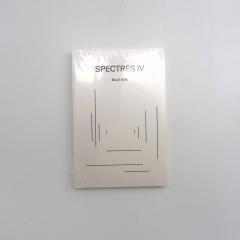
Various - SPECTRES IV: A Thousand Voices - Mille Voix

Fourth issue of Shelter Press' annual publication series »Spectres« (in association with INA GRM), this time themed around ›voice‹. Featuring contributions from/about François J. Bonnet, John Giorno, David Grubbs, Yannick Guédon, Lee Gamble, Sarah Hennies, Haela Ravenna Hunt-Hendrix, Stine Janvin, Joan La Barbara, Youmna Saba, Akira Sakata, Pierre Schaeffer, Peter Szendy and Ghédalia Tazartès.

The book includes an essay about the essence of improvisation by Joan La Barbara, Lee Gamble looking at neural networks and vocal simulation systems, an untitled anecdote from Ghédalia Tazartès (RIP) and Stine Janvin on the necessity of singing, plus much more.

»The voice is everywhere, infiltrating everything, making civilisation, marking out territories with infinite borders, spreading from the farthest reaches to the most intimate spaces. It can be neither reduced nor summarised. And accordingly, when taken as a theme, the voice is inexhaustible, even when seen in the light of its very particular relation with the sonic or the musical, as is the case in most of the texts collected in this volume. There is no point therefore in trying to circumscribe or amalgamate the multiple avatars of the voice. We must rather try to apprehend what the voice can do, to envisage its landscape, its potential effects.«

— Extract from the editors' foreword.

pre-ordina ora10.11.2023

dovrebbe essere pubblicato su 10.11.2023

21,22

Last In: 2026 years ago
Marc Richter - Coh Bâle

Marc Richter

Coh Bâle

12inchCELL-11LP
Cellule 75
15.07.2023

This new album compiles several songs made in the years following Black To Comm's classic "Alphabet 1968" album. Originally released on the seminal Type label in 2009 (and to be reissued on Cellule 75 this year) "Alphabet 1968" combined the sound of vintage shellac and vinyl loops with broken electronics and field recordings, the press release mentioning disparate influences "ranging from Moondog to Basic Channel by way of Bernard Herrmann". In a beautiful one-page review in The Wire magazine (later reprinted in his book Ghosts Of My Life) Mark Fisher compared Richter's music to JF Sebastian’s miniature automata in Blade Runner ("with their bizarre mixture of the clockwork and the computerised, the antique and the ultramodern, the playful and the sinister"), ETA Hoffmann's inventor-magicians and Auguste Villiers de l'Isle-Adam's 1886 tale of Thomas Edison's (fictitious) construction of an artificial human.

Now titled "Coh Bâle" (inspired by a strange dream) these recordings were supposed to become a follow-up to said album but for reasons unknown it never materialized and the album seemed forever lost. At the time Richter started to dive deeper into several strains of (so-called) world music aka the folk music of Southeast Asia and Eastern Europe as well as liturgical and medieval music, the Kraut-Electronica of Harmonia and several certain Mediterranean experimentalists from the 1980's who started to merge their mostly electronic and field recording based compositions with traditional musics from all over the world by way of new sampling technology.

Many of the songs for the album were recorded while travelling and at various residencies around Europe: a detuned piano in a Thessaloniki basement (Richter played at a children's birthday party there), vintage synthesizers in the GRM studios in Paris, decaying acoustic instruments found in an old Black Forest mansion, childrens' voices at a workshop in Karlsruhe's ZKM Institute; then mixed on headphones in the ICE trains running between these places and his hometown Hamburg.

"Coh Bâle" is taking inspirations from old Nonesuch Explorer and Ocora LP's, Crammed Records, 80s Mediterranean Ambient (Nuno Canavarro, Roberto Musci) combined with the DIY spirit of Deux Filles and Flaming Tunes and the playfulness of Asa Chang & Junray. The songs are both mysterious and transparent, intricate and frugal, vibrant and patient. One of the album's unexpected climaxes is a gorgeous (artificial) berimbau version of the Welsh traditional "Iechyd o Gylch".

No two songs feature the same instrumentation and many acoustic sources (pianos, flutes, wood percussion, viola, tablas, autoharp) were disassembled and later coalesced into new configurations or used as virtual instruments; later combined with samples, field recordings, electronics and (on a few tracks) autotuned vocals reminding of recent works by the likes of Claire Rousay or More Eaze.

We had to wait for a worldwide pandemic for Richter to dig deep into the vaults and finally bring these recordings to light. This is the 2nd release from his archives after the "Diode, Triode" LP which presented Musique Concrète/Acousmatic recordings made at INA/GRM and ZKM. Another massive Double-CD (MM∞XX Vol. 1 & 2) was released last year featuring collaborations with 33 artists such as Andrew Pekler, Richard Youngs, Eric Chenaux, Maja Ratkje, Radwan Ghazi Moumneh of Jerusalem In my Heart, GRM boss François Bonnet (Kassel Jaeger), Felix Kubin, Timo van Luijk (In Camera, Af Ursin), Luke Fowler and many others, showing Richter's versatility and his willingness to reinvent himself for every new release.

Marc Richter is widely known under his Black To Comm moniker, having released (at least) 12 albums under this alias in the last 20 years. He is currently signed to the Thrill Jockey label. Richter composes soundtracks for film and has worked with visual artists such as Mike Kelley and Ho Tzu Nyen. He also records as Jemh Circs and Mouchoir Étanche for his own Cellule 75 label (named in tribute to the late Luc Ferrari).

pre-ordina ora15.07.2023

dovrebbe essere pubblicato su 15.07.2023

20,13

Last In: 2026 years ago
Kassel Jaeger - Shifted in Dreams LP

Franco-Swiss composer & director of INA GRM François J. Bonnet, aka Kassel Jaeger, returns with a new solo album. Following a compositional approach stemming from the musique concrète tradition, without adopting a structuralist aesthetic, Shifted in Dreams explores a wide range of instruments and techniques, going seamlessly from instrumental improvisation to field recording, via micro-editing and the use of asynchronous loops. Mixing the electronic sounds of an ARP 2500 synthesizer with the acoustic drones of a positive organ, articulating guitar layers with the resonance of the Cristal Baschet, bringing together recordings of slamming windows and sound produced by complex modular synthesis patches, Bonnet offers a rich and generous palette of sounds, inviting a constantly renewed sonic investigation.

non in magazzino

Ordina ora e ordineremo l'articolo per te presso il nostro fornitore.

27,10

Last In: 2 years ago
Michèle Bokanowski - Rhapsodia / Battements solaires

Rhapsodia (2018), 17'

(2 movements and 1 interlude)

Dedicated to Marceline Lartigue

Created in the composer's own studio. T

echnical collaboration: Jonathan Prager


Battements solaires (2008), 17'35

Music for Patrick Bokanowski's film.

Produced in the Kira BM Films studios

Production: Kira BM Films with ARTE France and CNC contributions

Best Film Award, 2009 EXiS Festival Seoul (South Korea)

Michèle Bokanowski's art is one of densities, much like the density of a given colour, a given depth. Her sound textures are, indeed, profound, both in the space occupied by their frequencies and the sharp temporal trail they leave behind. Here lies the composer's immense talent that finds the right development for each sound, letting it blossom before altering it, adapting the musical structure to let the sounds "be", even if it sometimes means returning to the most basic form, such as a loop. This is a sign of great honesty and artistic sensitivity; able to stand back and let the music become music. It is the most radical, the most accurate gesture of composition. The two pieces on this record, dissociated in time, both in their approach and destination, nevertheless reflect, each in its own way, Michèle Bokanowski's highly singular and insightful musical intuition.

François Bonnet, Paris, 2020

non in magazzino

Ordina ora e ordineremo l'articolo per te presso il nostro fornitore.

18,78

Last In: 4 years ago
Various - PRSNT

Various

PRSNT

12inchMOMPRSNTB
Modern Obscure Music
02.08.2021

Ltd Black Vinyl Gatefold edition + 32 Page Booklet + Download Code

The LP contains original compositions by Ryuichi Sakamoto, Pascal Comelade, Laurie Spiegel, Lyra Pramuk, Chassol, Nicolas Godin and Pierre Rousseau, Pedro Vian and Pierre Bastien, Visible Cloaks, Kelman Duran, Raul Refree, Lucrecia Dalt, Lafawndah.

+ a booklet with writings by contemporary thinkers like Shumon Basar, François J. Bonnet, and pictures by, Araki, Juergen Teller, Elizaveta Porodina, Dani Pujalte, P Jack Davison, Zhong Lin, Alessandra Sanguinetti, Adrià Cañameras, Javier Tles among others. Lacquer cut by Josh Bonati & Mastered by Rashad Becker

'PRSNT' is a unique global artistic project combining the input of artists across the worlds of music, video and written word which acts as a statement on how we, as consumers, engage with music in the 21st century. Vital electronic musicians including Ryuichi Sakamoto, Lafawndah, Lyra Pramuk, Lucrecia Dalt and Visible Cloaks have each contributed tracks, which are approximately 32 seconds long.

The concept was devised by Created By Us and the Barcelona-based label Modern Obscure Music. They read a study which identified that the overwhelming volume of instantly accessible information online is shortening attention spans and altering how audiences engage with music digitally. Their curiosity about the state of online consumption developed further on discovering that around a third of all listeners using digital platforms skip to the next track, within the first 30 seconds of playing.

Each musician was given a fascinating challenge to create engaging compositions with real artistic merit, inside the confines of this shortened span. Akin to Brian Eno's famous Windows 95 start-up music, the time constraints are crucial, and the compositions are deceptively complex and more substantial than expectations of their nano nature would suggest.

'PRSNT' acts as a critique of flighty feed culture, but is simultaneously constructive, providing something which is either proposed solution, or "if you can't beat 'em join 'em" resignation. Every artist has interpreted the brief differently, resulting in an intriguing blueprint for the potential future of digital music. Could abbreviated micro compositions satisfy, inspire and nourish like their longer counterparts? They certainly take up much less of listeners' busy lives, which are often spent tackling ever-increasing workloads.

non in magazzino

Ordina ora e ordineremo l'articolo per te presso il nostro fornitore.

46,68

Last In: 70 days ago
Various - PRSNT

Various

PRSNT

12inchMOMPRSNT
Modern Obscure Music
25.06.2021

Ltd White Vinyl Gatefold edition + 32 Page Booklet + Download Code

The LP contains original compositions by Ryuichi Sakamoto, Pascal Comelade, Laurie Spiegel, Lyra Pramuk, Chassol, Nicolas Godin and Pierre Rousseau, Pedro Vian and Pierre Bastien, Visible Cloaks, Kelman Duran, Raul Refree, Lucrecia Dalt, Lafawndah.

+ a booklet with writings by contemporary thinkers like Shumon Basar, François J. Bonnet, and pictures by, Araki, Juergen Teller, Elizaveta Porodina, Dani Pujalte, P Jack Davison, Zhong Lin, Alessandra Sanguinetti, Adrià Cañameras, Javier Tles among others. Lacquer cut by Josh Bonati & Mastered by Rashad Becker

'PRSNT' is a unique global artistic project combining the input of artists across the worlds of music, video and written word which acts as a statement on how we, as consumers, engage with music in the 21st century. Vital electronic musicians including Ryuichi Sakamoto, Lafawndah, Lyra Pramuk, Lucrecia Dalt and Visible Cloaks have each contributed tracks, which are approximately 32 seconds long.

The concept was devised by Created By Us and the Barcelona-based label Modern Obscure Music. They read a study which identified that the overwhelming volume of instantly accessible information online is shortening attention spans and altering how audiences engage with music digitally. Their curiosity about the state of online consumption developed further on discovering that around a third of all listeners using digital platforms skip to the next track, within the first 30 seconds of playing.

Each musician was given a fascinating challenge to create engaging compositions with real artistic merit, inside the confines of this shortened span. Akin to Brian Eno's famous Windows 95 start-up music, the time constraints are crucial, and the compositions are deceptively complex and more substantial than expectations of their nano nature would suggest.

'PRSNT' acts as a critique of flighty feed culture, but is simultaneously constructive, providing something which is either proposed solution, or "if you can't beat 'em join 'em" resignation. Every artist has interpreted the brief differently, resulting in an intriguing blueprint for the potential future of digital music. Could abbreviated micro compositions satisfy, inspire and nourish like their longer counterparts? They certainly take up much less of listeners' busy lives, which are often spent tackling ever-increasing workloads.

non in magazzino

Ordina ora e ordineremo l'articolo per te presso il nostro fornitore.

49,54

Last In: 70 days ago
Lionel Marchetti - La grande vallée / Micro-climat

La grande vallée (1993/95), 20'41

Musical composition, design and sound production carried out at the INA grm Studios (Paris) in 1993/95

Original audio recordings in the Drôme and the Mont Ventoux areas

Voice: Hélène Bettencourt

Vocal occurrences: Frédéric Malenfer, Bruno Roche, Lionel Marchetti

Bass clarinet (for processing): Jean Andréo

Micro-climat (1989/90), 21'33

Micro-climat is the first movement of the Sirrus cycle (Micro-climat, Passerelle, Sirrus) composed in 1989/90

Musical composition, sound design and production, audio recordings in 1989/90 at the CFMI studios in Lyon (Lumière University, Lyon 2)

"I wonder if my fascination for clouds (without being an obsession) may have risen at the end of the 80s as, whilst composing Micro-climat, I would regularly wander between the Vercors mountains and the high plateaus of the Monts du Forez discovering, through my eyes, body, breath, active observation and walk, that natural forms when constantly changing and yet swollen with a unity of matter (in this instance, water) open one up to a deep, fundamental breath and a clear field for the mind. The sky and its forces: our ally.

A model for a natural music which, although fixed, as in musique concrète (a rule of the genre), moreover on a recording tape, will remain charged with such a poetic quality that (isn't it its role or rather its reality?) it will ensure a perpetual renewal for our senses, so as to reach another idea of the world, far more open and richer than what we could have imagined."

Lionel Marchetti, 2011

Lionel Marchetti is a major figure of the "third generation" of concrète musicians, a term he values. Listening to these works, imbued with poetry and traversed by micro-narratives, one can indeed retrieve the original concrète spirit, the one that draws from the sonic world, with ears wide open, so as to extract a fertile, rich and multiple substance then shaped and conveyed towards a formal and musical abstraction. Lionel Marchetti has mastered this process, but his real distinctive feature is a truly unique talent for setting climates (as one sets traps) and keeping us on constant alert. The two pieces in this record perfectly illustrate the entrancing dimension of Lionel Marchetti's music, whose charm leads us, through each successive listening, to become voluntary captives so as to better liberate ourselves.

François Bonnet, Paris, 2020

non in magazzino

Ordina ora e ordineremo l'articolo per te presso il nostro fornitore.

18,45

Last In: 4 years ago
Hecker & Okkyung Lee - Statistique Synthétique / Teum (the Silvery Slit)

Statistique Synthétique draws as much from the history of computer sound synthesis as from its latest developments. But well beyond developing simply as a proof of concept, this piece aims to transcend the abstract status of synthetic sound objects and lead them to a properly hallucinatory state, that is to say to a meeting point where the object and perception dissolve into each other, in a sort of transcendental field. Beyond, also, hylomorphism, to reach the world of matter-form fusions, where perception knows how to see "shoulders of hills", as Cézanne wrote.
Teum (the Silvery Slit) is, as the title suggests, an overture, an opening to the game of multiplications, fragmentations, duplications. But it is also the opening understood as the void that blossoms between two borders, a break from which escapes a double tension, both the pulling force of these two edges which move apart and the opposite force of reconciliation, of compression. Okkyung Lee invites us to a truly telluric moment, a rare moment of expression where tectonic movements and shear stresses become music. If the earthquakes were, as we thought in the 18th century, due to underground thunderstorms, there is no doubt that this piece of music, both celestial and continental, could have been their audible manifestation.
Text by François Bonnet


HeckerStatistique Synthétique2020 / 25'15Computer-generated sound with resynthesized situated texture recordingsWritten and produced by Florian Hecker, 2019 - 2020Texture analysis and resynthesis algorithm: Axel Röbel, Analysis/Synthesis Team, IRCAM, ParisMastered by Rashad BeckerPhoto by Mauricio Guillén, 2019
Thanks to Axel Röbel for his commitment to the project and special appreciation to GRM, Luke Fowler, Mauricio Guillén, Dirk Mayer and Porta33
Location Texture Recordings, using DPA 4060, DPA 4017B, DPA 4021 and DPA 4060 microphones to Sound Devices 702 recorder; except segment 04:31 - 05:37, recorded by Luke Fowler, April 2019 using Sony M10.
00:00 - 02:00 Lopud, Croatia, June 200802:00 - 03:12 Ponta do Sol, Madeira, ER 101, April 201903:12 - 04:14 Prentiss St, Cambridge, MA, February 201504:14 - 04:31 Anjos, Ponta do Sol, Madeira, ER 101, April 201904:31 - 05:37 Atelier Cézanne, Aix-en-Provence, April 201905:37 - 08:31 Anjos, Ponta do Sol, Madeira, ER 101, April 201908:31 - 09:46 Praia dos Anjos, Ponta do Sol, Madeira, ER 101, April 201909:46 - 10:39 Private garden, Kissing, September 200910:39 - 11:15 Praia dos Anjos, Ponta do Sol, Madeira, ER 101, April 201911:15 - 15:11 Porto do Paul do Mar, Calheta, Madeira, April 201915:11 - 16:53 Prinz Eugen Strasse, Vienna, June 200816:53 - 24:27 Risco, Rabaçal, Madeira, April 201924:27 - 25:15 Bois de Boulogne, Avenue du Mahatma Gandhi, Paris, September 2015
:::::::::::::::::::::::::::::
Okkyung LeeTeum (the Silvery Slit)2019 / 20'03Performed, recorded and composed by Okkyung Lee (ASCAP)Mixed by Lasse MarhaugMastered by Guuseppe IelasiPhoto by Lasse MarhaugPart of Re-Imagine Europe, co-funded by the Creative Europe Programme of the European Union.

Cut by Andreas Kauffelt at Schnittstelle, Berlin, September 2020Sleeve design by Stephen O'Malley

pre-ordina ora12.03.2021

dovrebbe essere pubblicato su 12.03.2021

18,45

Last In: 2026 years ago
Lucy Railton & Max Eilbacher - Forma / Metabolist Meter (Foster, Cottin, Caetani and a Fly) Lucy Railton & Max Eilbac

Forma by Lucy Railton, is a work that digs into us. It disorients us, plays with us, but without malice. It is like a nocturnal butterfly whose wings reflect a dark light, thus projecting fleeting hallucinations, which nevertheless persist on the surface of our retina. Its trajectories, too, are unpredictable. But such disorientation is not that of a chaotic space, it is rather a mysterious reason that presents itself to us, an imperious unfolding whose logic escapes us, but which nevertheless fascinates. It is also a history of shapes and their becomings. A story, also of their own vanishing.

Metabolist Meter (Foster, Cottin, Caetani and a Fly), by Max Eilbacher is a teeming piece, a matrix where textures and structures merge together, where the polyrhythmic instances become timbre, where the formal abstraction of the harmonic volutes coagulates around a vibrating form that is actualized in the dramatic reality of a dying fly. And this formal mastery is not disembodied in Max Eilbacher's work and the kaleidoscopic forms of the sound spectra that he has deployed know how to resonate in the sensations and experiences of each one.

These two pieces have this in common, but each with their own agenda, that they evolve with grace and inspiration in the vast domain of the sound world and it is a great pride for us to present them in this new collection.

Released in association with Editions Mego.
Coordination GRM: François Bonnet, Jules Négrier

Executive Production: Peter Rehberg

non in magazzino

Ordina ora e ordineremo l'articolo per te presso il nostro fornitore.

18,45

Last In: 5 years ago
Alvin Lucier - Criss Cross / Hanover

Re-Release

Black Truffle is honoured to present the premier recordings of two recent works by legendary American experimental composer Alvin Lucier. A friend and contemporary of pioneers like Robert Ashley, David Behrman, Gordon Mumma, and Christian Wolff, Lucier has been crafting elegant explorations of the behavior of sound in physical space since the 1960s. Lucier is perhaps best known for I Am Sitting in a Room (1970), in which he repeatedly re-recorded his own speaking voice being played back into a room until the room's resonant frequencies entirely obscure the spoken text. Beginning in the early 1970s, he has written a remarkable catalogue of instrumental works that focus on phenomena produced by the interference between closely tuned pitches, such as audible beating, often using pure electronic tones produced by oscillators in combination with single instruments.

Demonstrating the restless creative drive of an artist now in his 80s, the two recent works presented here both feature the electric guitar, an instrument Lucier has just recently begun to explore. In Criss-Cross, Lucier's first composition for electric guitars, two guitarists using e-bows sweep slowly up and down a single semitone, beginning at opposite ends of the pitch range. The piece is a model of simplicity, exemplifying Lucier's desire not to 'compose' in the conventional sense, but rather to eliminate everything that 'distracts from the acoustical unfolding of the idea'. In this immaculately controlled performance of Criss-Cross by Oren Ambarchi and Stephen O'Malley, (for whom the piece was written in 2013), a seemingly simple idea creates a rich array of sonic effects - not simply beating patterns, which gradually slow down as the two tones reach unison and accelerate as they move further apart, but also the remarkable phenomenon of sound waves spinning in elliptical patterns through space between the two guitar amps.

In the comparatively lush Hanover, Lucier draws inspiration from the beautiful photograph that provides the LP with its cover, an image of the Dartmouth Jazz Band taken in 1918 featuring Lucier's father on violin. Using the instrumentation present in the photograph, Lucier creates an unearthly sound world of sliding tones from violin, alto and tenor saxophones, piano, vibraphone (bowed) and three electric guitars (which take the place of the banjos present in the photograph). Waves of slow glissandi create thick, complex beating patterns, gently punctuated by repeated single notes from the piano. The result is a piece that, like much of Lucier's instrumental music, is simultaneously both unperturbably calm and constantly in motion.
Stunning LP design by Stephen O'Malley including an inner sleeve with a portrait of Alvin Lucier by Kris Serafin.
Criss-Cross' recorded at Studios Ina GRM, Paris by Francois Bonnet and mixed by Alvin Lucier. Hanover' recorded in Zurich and mixed by Alvin Lucier.
Mastered and cut by Rashad Becker at D&M Belin.
Criss-Cross' recorded at Studios Ina GRM, Paris by Francois Bonnet and mixed by Alvin Lucier. Hanover' recorded in Zurich and mixed by Alvin Lucier.
Mastered and cut by Rashad Becker at D&M Berlin.

non in magazzino

Ordina ora e ordineremo l'articolo per te presso il nostro fornitore.

18,28

Last In: 5 years ago
Kassel Jaeger - Le Lisse Et Le Strié

“Le Lisse et le Strié is a new work by french composer François J. Bonnet, released under his project name Kassel Jaeger. Based in Paris, Bonnet is the Director of INA GRM. He is also a writer and theoretician (The Order of Sounds, a sonorous Archipelago and The Infra-World have been published in english by Urbanomic). As a musician, Bonnet has been collaborating with artists such as Stephen O’Malley, Oren Ambarchi or Jim O’Rourke and most of his recent work has been published by Editions Mego.

Le Lisse et le Strié has been conceived as an exploration of the two antagonist concepts of “smooth” and “striated”, applied to the realm of electroacoustic sounds. If the “smooth” is linked to “nomos” as an open space of organic distribution, the “striated”, on the contrary, is associated to “logos”, as an enclosed space defined by a grid.

Elaborating a dialogue between these aspects, Kassel Jaeger draws here an intermediary space where pulsations become textures and layers, and where rhythmic elements are found in the qualities and bodies of sounds instead of being functionnalised, pre-determined sound objects, abstracted and frozen onto a temporal grid. The concept of “striated” is made audible only through the sonic landscape it inhabits, like the stripes of the camouflage fur of wild animals only exist as such in the woods and long grass, disappearing into a potentially uselessness in a desert plain.”

non in magazzino

Ordina ora e ordineremo l'articolo per te presso il nostro fornitore.

15,84

Last In: 6 years ago
Luc Ferrari - Music Promenade / Unheimlich Schön

Cut by Rashad Becker at Dubplates & Mastering, Berlin, November 2018
Digital transfer: Jonathan Fitoussi & Diego Losa

Translations: Valérie Vivancos
Layout: Stephen O'Malley
Photos: Jacques Brissot, ARR

Coordination GRM: François Bonnet
Executive Production: Peter Rehberg
Remerciements: Brunhild Ferrari

SIDE A
Music Promenade (1964-1969), 20'29

Electroacoustic Music
World premiere for the Théâtre de la musique, March 16, 1970
" Hétéro-Concert ""

Permanent version for four stand-alone tape recorders. A series of colliding realistic sounds and sonic images. Whilst walking, a man is struck by the violence of his surroundings. Nature has disappeared in a whirlwind of warfare and industry in the midst of which he encounters a dying folklore and a lost young girl.
The "Installation" version is used to sonify a place in which walkers are free to choose their musical itinerary.

SIDE B
Unheimlich Schön (1971), 15'40

Musique concrète made in 1971 in the studios of the Südwestfunk in Baden-Baden.
Voice: Ilse Mengel.

"How does a young woman breathe when thinking about something else "
To be listened to at a low volume.

non in magazzino

Ordina ora e ordineremo l'articolo per te presso il nostro fornitore.

19,54

Last In: 6 years ago
Francois Bayle - Tremblements...

Cut by CGB at Dubplates & Mastering, Berlin, June 2017

Digital Transfer: Jonathan Fitoussi

Translations: Valérie Vivancos
Layout: Stephen O'Malley

Coordination GRM: Daniel Teruggi & François Bonnet
Executive Production: Peter Rehberg

Tremblement de terre très doux (1978), 28'14

climate 1 / transit 1 / landscape 1 / climat 2 / landscape 2 / transit 2 / landscape 3 (walking - jumping - sliding - flying) / climate 3 / landscape 4 / climate 4 - transit 3 / landscape 4, end.

The familiar generates the strange.

These rolls, these hums, these sudden rushes, this song, these peaceful circlings, these sudden outbursts, these returns to quiescence - what do they remind us of

This piece's trajectory could also be a representation of the dramatic unfolding of a day - of a life - from sunrise (climate 1) to night-time (landscape 4) via restless encounters, transitions (1 to 3) that announce the drama climaxing in landscape 3, before reaching its denouement in climate 4... A whole concrete 'story'.

The subterranean properties inherent to listening gently shift our ideas...

François Bayle

First performance: 19 March 1979 - Grand Auditorium of Radio-France,

Ina-GRM's Cycle Acousmatique. .

Toupie dans le ciel (1979), 21'

A wave is swaying on two minors thirds. This constantly uniform yet constantly varied swaying revolves in a swarm of sharp designs that blink on and off in a layer of growing density and mobility.

Distance, speed, pressure, density, temperature, colour, intensity, are the "themes" of the 27 short interconnected cells flowing together though this seemingly unified movement.

Occasionally, a breach in the texture reveals skyes dotted with little comets. In the centre, a slow gliding picks up the distant harmonics of a basic chord. Toward the end, this gliding returns with a fiery burst.

Fine lines and whirs are generated from the song of a spinning antique top.

To end on a lighter note the title Toupie dans le ciel - Spinning Top in the Sky reminds us of Lucy in the Sky with Diamonds by The Beatles as well as Lucy, the oldest Australopithecine (3 million years), our African grandmother in the Erosphere...

The overall title Erosphere alludes to the desire inherent to the listening experience, and to the very primitive cues that sustain the auditory attention and are the basis of all musical pleasure.

François Bayle

First performance: 21 January 1980 - Grand Auditorium of Radio-France,

Ina-GRM's Cycle Acousmatique.

non in magazzino

Ordina ora e ordineremo l'articolo per te presso il nostro fornitore.

18,45

Last In: 8 years ago
  • 1
Articoli per pagina:
N/ABPM
Vinyl