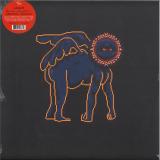
Gusstaff Records and Ant-Zen are proud to announce the second solo album by Maciej Frett (Job Karma, Wrocław Industrial Festival), which is vocally supported by Anna Frett. After FRETT's 2020 debut "The World as A Hologram" was warmly received by fans and critics, it's time for the next installment of the FRETT project.The album "NOTTWO" revolves around the theme of dualism, which seems to be the raison d'être of the being of man and the world. Opposites define our way of perceiving the surrounding reality, or is it just an illusion? the artist seems to be asking…Musically, "NOTTWO" is a continuation of the first heavily rhythmic album, but this time FRETT gives many compositions an almost song-like structure. However, let's not be fooled by appearances - derived from the author's post-punk and industrial lineage, analog retro futuristic synth melodies and strong rhythms will work well both on a dark dance floor and can be a soundtrack to a non-existent movie.
Vinyl is ultra-heavy 200g black.
Search:frett
- 1
- A1: Escalier
- A2: L'ile Perdue
- A3: Le Bal
- A4: Sur Le Chemin De L'école
- A5: L'ile La Nuit
- A6: Holidays(S)
- B1: Robot Rêveur
- B2: Dernier Vol
- B3: Pas De Côté
- B4: Cavalière De L'aube
- B5: Idésia
- B6: Balayeur De L'espace
The duo’s debut album sets off on an airy, groovy odyssey.
Recorded at the legendary La Frette studio (Parcels, Fontaines D.C.), the album follows an extensive period of demo development.
Immersed alongside outstanding musicians, the team worked in a relaxed, old-school spirit: a handful of takes, tape recording, and analog gear. Plenty of space was left for ideas to emerge organically in the studio. The arrangements—synthesizers, flute, backing vocals, percussion—were then carefully refined over many months.
"Idésia" stands out for its delicate production, brought to life by Maxime Kosinetz on recording (Oracle Sisters, Bon Voyage Organisation), Stan Neff on mixing (Andrea Laszlo de Simone, Polo & Pan), and Chab on mastering (Daft Punk, La Femme).
The record unfolds across changing sonic landscapes, with Will’s voice gliding over melodies rooted in a bright, warm groove. A subtle blend of pop and Californian warmth runs throughout the album.
The album explores themes of childhood (Sur le Chemin de l’École, L’Île Perdue), ecstatic escapes (Holiday(s), Pas de Côté, Escalier), and simple pleasures (Le Bal, Cavalière de l’Aube). It also casts a poetic eye on the evolution of the world (Dernier Vol, Robot Rêveur, Balayeur de l’Espace). Will & Paul play with contrasts, shifting perspectives along the way.
"Idésia" is the imaginary world in which Will & Paul gracefully lose themselves - a suspended place between nostalgia and science fiction, as if their silhouettes were drifting from a bright, carefree past toward a place suspended in time.
- A1: Return Of The Knödler Show 2 52
- A2: The Frogs Of Miwa - Cho (1) 4 52
- A3: Waiting (I) 5 38
- A4: An Old Friend Passes By 3 46
- A5: Coco Bolo Strip (1) 5 25
- B1: Peace And Pipe Utopia 3 14
- B2: Unidentified Dancing Object 1 44
- B3: The Call (I) 2 41
- B4: Wenn Das Rohr Dommelt 4 03
- B5: Mariahilf (Live Version) 3 36
- B6: Watching The Shades (I) 2 59
- B7: Playing The Table Music (Ii) 2 43
- C1: Could Be Nice Too 5 29
- C2: Ox Of Inner Depth 4 51
- C3: Ymir Shows Up 3 58
- C4: Could Be Nice 5 24
- C5: Playing The Table Music (I) 4 23
- D1: Coco Bolo Strip (Ii) 4 52
- D2: Locusts Looking Like Men 5 55
- D3: Waiting (Ii) ︎ 3 36
- D4: No Stove 2 29
- D5: An Old Friend Passes By Again 3 00
- D6: Heimkehr Der Holzböcke 3 16
Black Truffle is thrilled to announce Dalbergia Retusa, an extensive double LP selection of the solo guitar music of Hans Reichel, compiled by Oren Ambarchi. Last heard on Black Truffle as one quarter of the joyously anarchic Bergisch-Brandenburgisches Quartett, Hans Reichel (1949-2011) is one of the great figures of experimental guitar music. Though perhaps lesser known than peers like Derek Bailey, Fred Frith and Keith Rowe, Reichel’s rethinking of the instrument was in some ways the most radical of all. Early on, he dispensed with existing guitars to build a series of his own that explored the use of additional strings and fretboards, moveable pickups, extra bridges, special capos, and other innovations documented in the extensive booklet accompanying this release.
Reichel was a long-term resident of Wuppertal, the small Western Germany city that became an unlikely centre of European free jazz in the late 1960s, also home to Peter Brötzmann and Peter Kowald. His solo debut Wichlinghauser Blues was an early entry into the FMP discography and began a relationship with the label that stretched into the 1990s; all the solo performances heard here were first released on FMP. As Reichel says in the charming archival interview with Markus Müller included here, he was ‘always a cuckoo’s egg at FMP’, a label that began as an outlet for roaring European free jazz. What strikes the listener right from the opening selection on Dalbergia Retusa—‘Return of the Knödler show’, from 1987’s The Dawn of Dachsman—is the extraordinary beauty of Reichel’s music, at once alien in the shimmering sonorities and unconventional pitch relationships made possible by his invented instruments, and deeply lyrical, even romantic in its harmonic content. Growing up in West Germany in the 1960s, Reichel’s formative influences were mainly British and American rock bands, a background that shines through in many of the pieces included here: ‘An old friend passes by’ is haunted by the ghost of Hendrix’s rhythm guitar, and the wild closer ‘Heimkehr der Holzböcke’, taken from a rare 1975 7” and the only piece to use overdubbing, layers errant hammer-on and slide tones over a Canned Heat boogie chug.
Reichel was an important source for the development of Oren Ambarchi’s own extended approach to the electric guitar. Appropriately enough, his selection opens with the very first piece by Reichel he ever heard, on a flexidisc included with a 1989 issue of Guitar Player magazine. Though Reichel collaborated with others extensively in many settings and also performed on violin and his other major contribution to instrument invention, the daxophone, his music for solo guitar remains at the core of his oeuvre. Focusing exclusively on solo pieces recorded between 1973 and 1988, the 23 pieces on Dalbergia Retusa showcase the range and consistency of Reichel’s work, allowing the listener to see how his performances developed hand-in-hand with his instrumental inventions. On a piece from his very first LP, played on an 11-string instrument (partly strung with piano strings and using a schnapps glass a slide), we hear his intensive exploration of fret-hammering to create zither-like, chiming tone, which Reichel would hone further in later years with a double fretboard guitar specifically designed to be hammered rather than fretted and picked. On a piece from 1979’s Death of the Rare Bird Ymir, Reichel uses two steel-string acoustic guitars at once, with beautiful results: ‘some even say too beautiful’, he jokes in the interview included here. Many of the pieces from the 1980s make use of varieties of the ‘pick behind the bridge guitar’, instruments of uncanny harmonic richness primarily designed to be played on the ‘wrong’ side of the bridge. At times the unexpected behaviour of attacks, resonance, and decay can almost seem electronic, conjuring up the technology-assisted work of Henry Kaiser or even Fennesz, but realised solely through Reichel’s unorthodox techniques on his invented instruments. Extensively illustrated with photos and Reichel’s own plans and drawings of his instruments, Dalbergia Retusa is an essential introduction to the unique world of Hans Reichel. Rarely has music been at once so strange and so beautiful.
Das Avant-Rock-Sextett aus Beirut verschmilzt auf diesem großartigen Nachfolger seines gefeierten 2023er Debüts "Mais Um" Psych/Kraut, Improv/Skronk, Elektronik, Gothic und Jazzelemente mit traditionellem ägyptischem Gesang und moderner arabischer Poesie. Produziert von Radwan Moumneh (Matana Roberts, Sarah Davachi, Jerusalem In My Heart). Der Titel des zweiten SANAM-Albums ist ebenso vielversprechend wie die Musik der libanesischen Band. "Sametou Sawtan" bedeutet aus dem Arabischen übersetzt "Ich habe eine Stimme gehört". Spukhaft oder spirituell, wie auch immer man die Phrase liest, sie spricht von der Fähigkeit von Klang und Sprache, innezuhalten, Aufmerksamkeit zu stehlen und uns für den Moment zu öffnen. In ähnlicher Weise vermischt die Musik von SANAM zarte Rasereien und feuerverbrannte Balladen, indem sie frei fließende Rock- und Jazzgerüste mit der tief verwurzelten arabischen Tradition verbindet. Sie in vollem Flug zu hören bedeutet, in der Gegenwart gehalten zu werden und sich neu zu orientieren, um einen offenen Horizont zu eröffnen. Die Arbeit an "Sametou Sawtan" begann im Frühjahr 2024. Die ersten Ideen, die in den Tunefork Studios in Beirut entstanden, wurden im April während eines Aufenthalts in Beit Faris, einem mittelalterlichen Haus in der Küstenstadt Byblos, weiter ausgearbeitet. Das Sextett: Sandy Chamoun (Gesang), Antonio Hajj (Bass), Farah Kaddour (Buzuq), Anthony Sahyoun (Gitarre, Synthesizer), Pascal Semerdjian (Schlagzeug) und Marwan Tohme (Gitarren), wurde vom Produzenten Radwan Ghazi Moumneh (Jerusalem In My Heart) unterstützt. Die letzten beiden Tracks des Albums sind Aufnahmen aus den Beit Faris-Sessions, während der Rest in den La Frette Studios in Paris während der Europareise der Band im Sommer 2024 aufgenommen wurde. Die Platte verarbeitet Gefühle der Distanz und der Entwurzelung. "In den letzten fünf Jahren hatte ich das Gefühl, dass jeder den Libanon verlässt", erklärt Chamoun. "Das Album handelt nicht wortwörtlich davon, sondern von der Vorstellung, dass dich etwas verlässt. Eine Distanz zu den Ereignissen, obwohl du in ihnen lebst, eine Distanz zu deinem Haus, obwohl du in ihm wohnst." Ob in der sehnsüchtigen Ballade "Goblin" oder dem langsam brennenden, autotune-überladenen Freakout von "Habibon", Sametou Sawtan fängt das Streben nach festem Boden in einer Welt ein, die diesen nur selten bieten kann . Das Album hat die hypnotisierende Intensität des SANAM-Live-Erlebnisses, während es der Musik Nuancen, Tiefe und eine enorme dynamische Bandbreite verleiht. Wie bei ihrem Debüt sind die Texte vieler Tracks entliehen, Worte, die in neue Kontexte gestellt werden, um die Gegenwart zu verarbeiten. "Hamam" interpretiert ein ägyptisches Volkslied neu. In "Hadikat Al Ams" treibt der krachende Hardrock-Stampfer den Text des zeitgenössischen libanesischen Schriftstellers Paul Shaoul an. Und sowohl "Sayl Damei" als auch der Titeltrack verwenden Gedichte des iranischen Dichters und bahnbrechenden Mathematikers Omar Khayyam aus dem zwölften Jahrhundert. "Wenn man etwas von Omar liest, fühlt man eine Verbindung zur Gegenwart", sagt Chamoun. "Das Gefühl, dass es keinen klaren Weg gibt." "Sametou Sawtan" enthält auch zwei Lieder mit Chamouns eigenen Texten, darunter den Opener "Harik". Es war die Keimzelle des Albums, geschrieben von Chamoun im Februar 2024, wobei die Band den Track um ihre Worte herum aufbaute. Es beginnt mit einem Schauder, zerfetzter Elektronik und einer keuchenden Stimme, die das Schlagzeug durchdringt, bevor sich die Band zu einem triumphalen Aufstieg aufschwingt. Es geht um Eintauchen in "ein unendliches Feuer", verrät Chamoun. Den Text zu "Tatayoum" schrieb sie allein, bevor sie ihn der Band vorlegte. Er spiegelt eine andere Art von Intensität wider, "eine Schleife, eine Besessenheit", wie sie sagt. Buzuq webt durch schwebende Elektronik und drängende Trommeln, während Chamoun arabische Worte rezitiert, die die Liebe beschreiben. Die unaufhörlichen Energien, die in diesen Tracks erforscht werden, sind nicht unbedingt negativ. Sie vergleicht deren Intensität mit der eines Schriftstellers, der in einem Gedankengang gefangen ist, im Guten wie im Schlechten. "Es geht nicht darum, deprimiert oder traurig zu sein", sagt Chamoun. "Es ist eine Falle, aber sie kann auch magisch sein." "Sametou Sawtan" wurde von Farah Fayyad mit ikonischen Grafiken und Design versehen.
- 1: Bella Donna (4:08)
- 2: Générique (4:3)
- 3: Venus Mélodrame (4:47)
- 4: Solide Solitude (3:30)
- 5: Bleu Mirage (:49)
Générique unveils a rich musical world that brings French chanson, indie rock and electronic textures together. The five tracks, recorded at La Frette Studios in Paris, are brought to life by an ensemble of acclaimed Anglo-American musicians directed by Mercury Prize-winning producer James Ford and Loren Humphrey. Tinged with dark, mischievous poetry that glimmers with sensuality, Générique is a hymn to liberated women. A call to live and love freely.
Oxford band Low Island announce their new album, bird, produced by Grizzly Bear’s Chris Taylor on label Emotional Interference. Recorded at the legendary La Frette Studios, bird is an album as brash as it is tender, exploring the struggle to find freedom and presence in an increasingly automated world.
The result is an album where Jay’s guitars and synths screech with unhinged anger as much as they wail with anguish; Lively’s bass dances frantically whilst swimming underneath the songs with an effortless beauty; Higginbottom’s drums are as deft as they are punishing; Posada’s voice as frail as it is resilient.
These emotional polarities speak to the heart of bird: a coming to terms with the overwhelming breadth of experience in the modern world, trapped as we are in our own bodies. How do we act in the face of this? Do we try to reach beyond ourselves? Wish to be saved or transformed? Retreat inwards? Or embrace things as they are? These are the questions that haunt bird in its search for freedom and presence.
Giuseppe Crisci is a musician and composer who splits his life in between London and Naples.
Known for his previous Acid House projects under the pseudonyms of DoTheDu and Crishi, he released several records on labels like Senseverse Records, Stealth Mission, and Pareidolia Recordings.
Conceived and written in his apartment in London and mostly recorded in his studio in Santa Maria Capua Vetere, this album proposes the sound of an evolving artist who drags himself into the deepest corners of heart and soul using profound synthesisers sounds which are coloured by intimate saxophone solos and rusty piano chords that enfasise strengthen the true sentiment of his lyrics narrated in English and Neapolitan dialect.
“My aim is to reach people’s soul and humbly influence them positively by trying to express what I feel deep inside myself, beyond meanings and words”— Giuseppe Crisci
Gruff Rhys is pleased to announce his new album "Sadness Sets Me Free" which will be released by Rough Trade Records on 26.01.2024. This incredibly will be the 25th album he has released in his 35 year career individually, collaboratively and as a member of various bands. "Sadness Sets Me Free" is also the follow up to 2021"s "Seeking new Gods", his first solo top ten record. The album will be available in a range of formats including a unique Dinked edition on "honeycomb neo-neapolitan" vinyl, an LP sleeve with "container doors" and a bonus 7" with exclusive audio for the first 1500 copies. A gatefold soft pack CD also includes a pull out poster. Lead-off single "Celestial Candyfloss" is a telling four minute glimpse of the forthcoming album, revealing the heady wonders and classic pop sounds within. Soaring strings carry the sweet melodies along, anchored by just enough necessary melancholy to add emotional ballast. The eye-popping video was created by long-time collaborator Mark James and compliments the scope and style of the song on a galactic scale. "Celestial Candyfloss" is, Gruff says, "an attempted pocket symphony about the cosmic lengths that people will travel in the pursuit of love and acceptance. Mark James has brought the Sadness Sets Me Free album cover to life & managed to place me watching TV interference in a shipping container that"s lost in space. For what is apparently the 25th album I"ve had a hand in writing I"ve reverted to a rich seam of inspiration relating to shedding some light on sadness and the general terror of cosmic loneliness." And so it was that Gruff and his band - Osian Gwynedd (piano), Huw V Williams (double bass) and former Flaming Lips drummer turned Super Furry Animals archivist Kliph Scurlock (drums) piled into a van driven by the late, legendary tour manager "Dr" Kiko Loiacono and raced from Dunkirk, where they had just played the final show of a tour of Spain and France, to the outskirts of Paris in the early hours of a March morning in 2022. There, in La Frette Studios, a recording facility installed in a 19th-century house, Gruff and his road-hardened group tracked "Sadness Sets Me Free" in just three days. Backing vocals were added along the way by Kate Stables from This Is The Kit along with additional strings and orchestration and it was mixed between Marseille and Cardiff. What finally emerged from these intense bouts of cross-continental activity was Gruff"s most accomplished and beautiful record to date. In a career that has taken him from the slate-mining towns of north-west Wales, down to the expat communities of Patagonia, up to the Mandan tribe of the Great Plains of North America and across to the Tuareg rock groups of the Saharan Desert, Gruff Rhys, one of Britain"s most beloved and successful singer-songwriters, has always been willing to follow an opportunity, wherever it may lead him. "At this point I quite like working with serendipity," he says. "Not in a cosmic way, but I try and leave things open to chance encounters and chance geography. As I"m around 25 albums in I"m always looking for ways to make a different-sounding record".
Recorded in St. James Norlands church in London in November 1968 and first released in the following year, this work stands as the first solo bass album in the history of Jazz and improvised music. Born in 1934 in San Francisco, Barre Phillips is one the most influential bassists of his generation. In his long career Phillips has played and recorded with almost everyone in the world of Jazz and beyond, a long list of forward thinking music icons including Don Ellis, Bobby Hutcherson, Dave Holland, Archie Shepp, Marion Brown, John Surman, Paul Bley, Evan Parker just to name a few! Originally recorded as part of a 3 hours session this solo tour-de force expresses the true essence of a genius. A multifaceted, kaleidoscopic journey through a myriad of melodic, rhythmic, fretted and bowed lines. In other words: a true master class and a seminal statement from one of the greatest figures in creative music!
"...Not just an improviser of the highest order; but a true sound sculptor capable of drawing from his instrument such a vast array of shapes and colours that his creation is almost a form of visual art for the ears." Jazzwise
Die Arctic Monkeys veröffentlichen am Freitag, den 21. Oktober, ihr neues Album mit dem Titel 'The Car'. 'The Car' ist das siebte Studioalbum der Band und enthält zehn neue Songs, die von Alex Turner geschrieben und von James Ford produziert wurden. Aufgenommen wurde das Album in Butley Priory, Suffolk, den RAK Studios in London und La Frette in Paris. Nach dem 2018 erschienenen Album 'Tranquility Base Hotel + Casino' finden sich die Arctic Monkeys auf 'The Car' in einer neuen, üppig orchestrierten musikalischen Landschaft wieder und bieten einige der besten und beeindruckendsten Gesangsdarbietungen in der Karriere von Alex Turner.
The Flower-Corsano Duo, the world’s best and only drums / Japan banjo duo return to VHF for their first album since 2009’s monumental The Four Aims. Mick Flower (Vibracathedral Orchestra) and Chris Corsano (frequently seen with Bill Orcutt, Joe McPhee, and other luminaries) work an area that’s not really jazz, not really anything—a stream of endlessly mutating free sound, a unique mind-merge between Corsano’s nimble drums and percussion and Flower’s amplified Japan banjo (also known as a Shahi Baaja, a type of electric Indian zither with both fretted / keyed and drone strings).
Flower cuts a highly original line, playing neither “leads” nor making drone-music. Less amplified here than on the more “heavy” The Four Aims, the strings ring out with distinct clarity in short snippets of melody and a canvas of pleasing electric sound. Corsano’s bag is to charm out a flow of thoughtful percussion engagement, rolling around on his kit, continually varying his attack and approach in conversational free-jazz style. The Halcyon is a precious addition to a tiny discography, a fortunate event even in today’s world of small press overabundance. Thanks guys!
Sublime, unique, sexy and peculiar unreleased scores by electronic and jazz pioneer Ron Geesin, made for the sublime, unique, sexy and peculiar films by maverick director Stephen Dwoskin. There. we’ve said it. And if you have not heard of one or either of these two dudes it doesn’t really matter. Geesin made great music and worked with Pink Floyd. Dwoskin made odd films, most of them are in the BFI permanent collection. They are great and a bit strange.
These superb unreleased soundtracks come from a fascinating, progressive and important period in British film history. They represent an intriguing collaboration between the lively Ron Geesin from Scotland and the American Stephen Dwoskin, who both met in London.
Musically they are minimal, charismatic and quite groundbreaking. Here is the story…
HISTORY:
Steve Dwoskin arrived in London in 1964, aged 25, with several 16mm films in his trunk, shot in the cold-water flats of Greenwich Village. He had been on the fringe of the Factory scene, and some of his films starred Beverly Grant, ‘the queen of the underground’. But they had scarcely been seen, and they didn’t have soundtracks. For almost a year they stayed in the trunk, and stayed silent. Then he met Ron Geesin, somewhere around Portobello Road.
‘Slept last night, completely dressed after working over 12 hours on sound tracks at Ron’s,’ wrote Dwoskin in his diary for 29 July 1965. ‘My films are not anywhere near being anything. I need more energy, more concise and positive ideas and less inhibition. And of course space, money and people.’ Dwoskin, who taught and practised graphic design by day, had recently decided to stay in London beyond the term of the Fulbright scholarship that had brought him there.
Ron, living with Frankie in a basement flat in Elgin Crescent – they would marry the next year, with Dwoskin as best man – was about to leave the Original Downtown Syncopators, the trad jazz band he had joined aged seventeen-and-a-half, and was trying to go solo. On stage he would make vigorous use of piano and banjo; at home Frankie had bought him a new kind of instrument – a tape recorder. ‘Soon I had one tape recorder, two tape recorders, three tape recorders.’
Ron, wrote Dwoskin in his unpublished autobiography, ‘loved to record, and to cut and splice the quarter-inch recording tape to make new sounds. This triggered in me the idea of getting back to my films and finishing them’. Soon he was living in a dank basement in Denbigh Road, a few minutes’ walk from Elgin Crescent. Ron’s soundtracks for Dwoskin’ films, recorded in the Geesins’ flat, encompassed Ron’s very eclectic range of styles – madcap piano and fretted banjo as well as tape manipulation.
Aside from Ron’s soundtracks, some of which belong to films that no longer exist (including Pot Boiler), Frankie would act in one of the films that Dwoskin either lost or never finished during these years. He was disabled, having contracted polio as a child, and Ron and Frankie were both carers and collaborators; Ron had met him when he was struggling into his car.
There was no London equivalent to the underground film scene that Dwoskin had known in New York, and his films remained unseen until such a scene began to come into being, in the autumn of 1966. Some of them made their debut at the Mercury Theatre, near Notting Hill Gate, that September. Dwoskin wrote that Alone, starring Zelda Nelson (from Ron Rice’s Chumlum), and Chinese Checkers, with Beverly Grant and Dwoskin’s friend Joan Adler, went over best.
Soon both Dwoskin and Geesin became involved in the nascent London Film-Makers’ Co-op, which put on screenings in Better Books on Charing Cross Road – ‘if you can call them screenings,’ Ron recalls; ‘I’d call it fifteen blokes in various stages of disarray, peering through the smoke’. One or more of the films had been ‘striped’ with magnetic audiotape; with others ‘we had no means of direct syncing to the picture, so he started the film and I started the tape recorder’.
In the same autumn, Dwoskin moved into a flat almost opposite the Geesins on Elgin Crescent. More collaborations followed, including Naissant, on which Gavin Bryars, whom Geesin had met during a stint on the northern club circuit with novelty act Dr Crock and His Crackpots, played double bass.
Around the end of 1967 Geesin released his first solo LP, A Raise of Eyebrows, and Dwoskin won recognition the Fourth Experimental Film Competition, aka EXPRMNTL 4, an occasional film festival staged at Knokke-le-Zoute in Belgium. By now the films had optical soundtracks.
It was only after this that Dwoskin completed his first ‘British’ films, including Me Myself and I, with Barbara Gladstone, an American dancer who had appeared in Barbara Rubin’s Christmas on Earth, and with whom Dwoskin and Geesin had at one point devised a stage show, never produced. For Moment, a single-shot film, Geesin provided his most experimental score yet. At the time of its debut in 1970, Dwoskin and the Geesins were sharing a house in Ladbroke Grove.
By then, Ron was working with Pink Floyd, and soon afterwards he and Frankie moved out to the country, to be replaced by Bryars both in the house and as Dwoskin’s principal collaborator.
Until now these scores have remained part of the Geesin Archive and have never been issued.
There are some records that manage to sound both of a time and utterly timeless and Bon Voyage Organisation's Jungle Quelle Jungle (a nod to Supertramp's Crisis What Crisis) is one of those albums. Its silken-smooth production, irresistible grooves, funk-tinged guitars, lush soundscapes and general glowing presence could easily lead one to believe that have dug up a lost disco gem from the 1970s. However, behind the disco-pop gleam lies eerie dystopian sci-fi ruminations of a futuristic bent and tones that can often feel as French as they do Asian or African.
This sort of cross-continental exploration is an expansion on BVO's previous two EPs, the man behind the Organisation, Adrien Durand, says. 'I tried to continue the musical expedition between dystopian Science-Fiction Haunted Africa - plus Haitian Vaudou on 'Soleil Dieu' - and futuristic Asia. Addressing, in a double entendre manner, some of the political issues that I am sensitive to.' In fact the jungle in question in the album's title is a metaphorical one and one that creates a vast series of environments for Durand to explore such subjects as world trade, utopian ideals and themes of idols, as well as of time and communication. However, one will need to speak French to decipher such explorations, as well as shake off the natural impulse to move with every glorious beat on its 13 tracks, of which are moved along by Maud Nadal and Agathe Bonitzer's golden vocals.
Durand is a full-time producer based in Paris, working with the likes of Amadou & Mariam, so it makes sense that this record would absolutely sparkle in this department. Durand feeds off the variety of musicians coming and going during recording sessions as well as the rotating members and numbers of people involved with the band but fundamentally he writes all songs on piano first before bringing them to record live. 'We recorded a rhythm section of five - drums, percussion, guitar and myself on bass/synth bass and keyboards - at La Frette which is a studio located in a mansion outside of Paris and fitted with a beautiful 1973 NEVE desk. We only used analogue gear, by taste really, and found it a pretty reliable way of doing things. This simply consists of putting good players together in a room and waiting for the right take to happen.' Two four-day sessions and a 'cooling off' period (to let the recordings settle) soon followed before Durand picked the material back up to give it a final polish.
The resulting album is one loaded with intricacies and idiosyncrasies, something that Durand puts down to his own unique approach. 'I don't consider myself much of a songwriter but I love arranging rhythm sections and I'm pretty proud of the ones on this record.' This applies when it comes to working with such musicians as Inor Sotolongo Zapata, who with Durand used traditional Cuban percussive instruments and explored Haitian rhythms. When Durand expands on some of the ideas and influences that were funnelled into the record, you begin to get a sense of the vastness of the sounds that fill his world, from Trevor Horn's production work on ABC's Lexicon of Love, to the literary work of JG Ballard to the visual flair of the original Blade Runner and even the Tuareg sounds of Tinariwen, due to the fact that his studio neighbours their manager's and he would hear their rhythms bleeding through the walls. You therefore end up with an album that offers tracks such as 'GOMA' that fuses Chinese and African rhythms as well as 'SI D'Adventure' a piece of pop music that is dazzlingly hook-laden.
As a result of this cooking pot of sounds, influences, thoughts and creations, Durand has more of a gumbo approach to making this music than a set-out scientific formula. 'There is no definite recipe for me to like the production of a record,' he says. 'Of course it really sticks out that my work is really influenced by the 1978-1983 period, the golden age and last stand of analogue studios and session musicians.' Whilst Durand adores the traditional and conventional music, he really views this as something bigger and wider. 'I have a taste for the otherworldly vibe from records coming from less sought-after musical scenes, particularly Poland, Haiti, Ethiopia, Somalia, Congo and early Cantonese pop. Languages and the rapport of the people involved in the making of those records really inspires me. I particularly hate the use of the word 'World Music' as a potpourri for everything that doesn't sound quite western enough.'
- 1