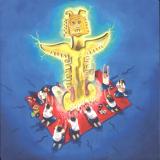
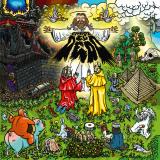
Michael Gray's monumental crossover dance hit, 'The Weekend,' originally released in 2004, is set to make a special return for its 20th Anniversary. For the first time ever, the track will be available on a limited edition coloured vinyl 7-inch, complete with the iconic original Sleeve Artwork. This commemorative release also includes previously unreleased 7-inch Version from Michael Gray himself. The 'Sultra 7' mix features live strings and an ambient feel, adding an extra layer of exclusivity for fans and collectors alike.
Search:moda
Conjunto Media Luna ft. La Terrorista del Sabor / ft. Turbo Sonidero
No es Moda / Kumbia Dos Pasitos (7")
Conjunto Media Luna presents two new tracks that bring together different geographies, collaborators, and histories of cumbia. “Kumbia dos Pasitos,” in collaboration with Turbo Sonidero, and “No es Moda,” alongside La Terrorista del Sabor, are released jointly on 7” vinyl by Little Beat More and on digital platforms through In-correcto. The cover design is by Bogotá-based artist Mateo Rivano, whose work has defined the visual identity of several influential projects in Colombian alternative music.
Conjunto Media Luna ft. La Terrorista del Sabor / ft. Turbo Sonidero
No es Moda / Kumbia Dos Pasitos (7")
Conjunto Media Luna presents two new tracks that bring together different geographies, collaborators, and histories of cumbia. “Kumbia dos Pasitos,” in collaboration with Turbo Sonidero, and “No es Moda,” alongside La Terrorista del Sabor, are released jointly on 7” vinyl by Little Beat More and on digital platforms through In-correcto. The cover design is by Bogotá-based artist Mateo Rivano, whose work has defined the visual identity of several influential projects in Colombian alternative music.
Mr Bongo’s Brazil 45’s series serves up another pair of Brazilian classics in the form of Rita Lee & Tutti Frutti ‘Agora É Moda’ and Pete Dunaway ‘Supermarket’.
'Agora É Moda' is a psychedelic, disco-boogie-groove monster brought to our attention by Greg Caz and Sean Marquand aka Brazilian Beats Brooklyn. Originally released on Rita Lee’s 1978 album Babilônia LP on Som Livre, this sublime track is drenched in squelching guitar licks, funk drums and sensuous cosmic vocal flavours.
Lee was the lead singer of Brazilian psychedelic rock band Os Mutantes and a hugely important figure in the Tropicalia movement. She sadly passed away in 2023 but her legacy well and truly lives on, loved both in and out of the music world.
On the flip side, Pete Dunaway’s ‘Supermarket’ is a rare groove/AOR masterpiece with a killer bassline, swaggering guitar and luscious string section layered with a perfectly delivered English vocal.
Pete Dunaway, real name Otavio Cardosa was a singer, composer, arranger and multi-instrumentalist from Sao Paulo, who spent the majority of his time composing for TV themes and library instrumentals.
Remastered with refreshed artwork.
Kazy Lambist's return heralds the start of an endless summer. Elegant, hedonistic and unstoppable, the music of Kazy
Lambist's music is designed to make you dream in a hammock, dance in a cosy lounge or on a dancefloor bathed in hypnotic sunshine.
With an undeniable international reputation - double platinum single and sextuple gold export single with hits such as
On You, Doing Yoga and Headson - Kazy Lambist defends his album with a world tour, with Kid Francescoli.
He just finished a tour in the US opening for Kid Franecscoli and will be touring in Germany in October:
Based in Bath, UK and born out of a love for drinking tea and dusty rhythms. Mint Tea is a platform that searches for up and coming talent within an emerging scene. In this blend, a various artists release with producers from four different countries curated into the perfect accompaniment for late nights or early mornings. With tracks from Moda, Raar, Akasha System and James Henry the release combines a beautiful balance of influences from ambient, lo-fi, techno and house.
Orbis X is a sublabel of Orbis Records and will be mainly focusing on softer yet often usable as DJ material for the broader mass interested in Electronic music. This sublabel is an extension of Orbis Records softer, more melodical and experimental side. Music will be ranging from house, dub, chicago over melodic acid and even breaks. Not any track makes it to this sublabel if it can't stand on its own and stand the test of time!
Aleksander Zekovski might not ring a bell but it should ring a bell within a few months.
We warmly welcome Moda on OrbisX with his very special and pure analog feel to sound.
Unique, funky, very good arrangements and multi-talented. Nothing more, nothing less.
Someone who deserves to be discovered or at least get a bigger audience.
We re taking the leap of faith with Moda, serving him a full EP to experiment.
The Roots EP was born.
The full EP is a mixture of funky beats with some housy touches with, in some phases, gentle and experimental dirty glitches.
Something to add to your collection. This EP can be played in quirky eclectic DJ sets, lounge bars or just at home with a nice glass of red wine.
Background music while having dinner with friends and you want to serve something special This is one of those special EP s!
Something To Talk About is funky, dreamy and sparks that twitchy leg movement when you doubt if you should be dancing or be slightly head banging to that tune.
That kinda track. Serves well with candles, wine and late night talks.
Under Her Skin might take off on a weird bit quirky dirty start, but when that lead kicks in, ... we were sold.
Extremely funky. Be aware: you can t hold yourself from clapping to this song.
On the B-side, "Winter Tale" counts as the second A track on the EP. Deep! Gentle and yet so snappy in it's own dirty way.
We fell in love from the first note, or should we say that filthy deep baseline, those dirty well mixed-in toms and snappy rude claps!
"Running Man". Well... if you like dreamy catchy house. This is for you.
A nice extra track, making this EP a brilliant pressing.
We can't emphasize the talent Alexander has.
We hope he gets more attention with this EP.
Full support for you Alex.
- mau
- B1: Ore-Se-Rere (Nigerian Juju Hilife)
- B2: The Gathering
- B3: Spiritual Blessing
- A1: Elevation
- A2: Greeting To Saud (Brother Mccoy Tyner)
Elevation, released in 1974 on Impulse! Records, finds saxophonist Pharoah Sanders expanding his spiritual jazz vision on an album that balances ecstatic expression with focused ensemble interplay. Produced by Ed Michel and recorded in 1973 across two live performances and a studio session, Elevation features a dynamic ensemble including Joe Bonner on piano, Calvin Hill on bass, and Michael Carvin on drums.
The album’s open forms, modal grooves, and spiritual themes underscore Sanders’s ongoing search for transcendence and cultural affirmation through sound. With chant-like melodies, circular motifs, and immersive rhythmic textures, pieces like “The Gathering” and the title track reflect a more meditative and exploratory side of Sanders’s aesthetic. Elevation comes towards the end of Sanders’ tenure on Impulse!— a cohesive and spiritually resonant statement that bridges the raw fire of earlier albums with a deeper, more spacious sound.
The album’s open forms, modal grooves, and spiritual themes underscore Sanders’ ongoing search for transcendence and cultural affirmation through sound. With chant-like melodies, circular motifs, and immersive rhythmic textures, pieces like “The Gathering” and the title track reflect a more meditative and exploratory side of Sanders’s aesthetic. Elevation marks the culmination of his Impulse! discography — a cohesive and spiritually resonant final studio statement that bridges the raw fire of earlier albums with a deeper, more spacious sound.
The Verve Vault series is always mastered from analog tapes and pressed on 180g vinyl at Optimal.
a A1. Elevation 18:26
b A2. Greeting To Saud (Brother McCoy Tyner) 4:15
[c] B1. Ore-Se-Rere (Nigerian Juju HiLife) [6:20]
[d] B2. The Gathering [14:09]
[e] B3. Spiritual Blessing [6:20]
[a] A1. Elevation [18:26]
[b] A2. Greeting To Saud (Brother McCoy Tyner) [4:15]
[c] B1. Ore-Se-Rere (Nigerian Juju HiLife) [6:20]
[d] B2. The Gathering [14:09]
[e] B3. Spiritual Blessing [6:20]
[a] A1. Elevation [18:26]
[b] A2. Greeting To Saud (Brother McCoy Tyner) [4:15]
[c] B1. Ore-Se-Rere (Nigerian Juju HiLife) [6:20]
[d] B2. The Gathering [14:09]
[e] B3. Spiritual Blessing [6:20]
[a] A1. Elevation [18:26]
[b] A2. Greeting To Saud (Brother McCoy Tyner) [4:15]
[c] B1. Ore-Se-Rere (Nigerian Juju HiLife) [6:20]
[d] B2. The Gathering [14:09]
[e] B3. Spiritual Blessing [6:20]
[a] A1 | Elevation [18 26]
[b] A2 | Greeting To Saud (Brother McCoy Tyner) [4 15]
[c] B1 | Ore-Se-Rere (Nigerian Juju HiLife) [6 20]
[d] B2 | The Gathering [14 09]
[e] B3 | Spiritual Blessing [6 20]
- 01: Nhá Zefa &Amp; Nhô Pai - We&Apos;Ll Never Forget
- 02: Leôncio &Amp; Leonel - Envious Affair
- 03: Grupo Sertanejo Do Lenço Preto - Oh I Cry
- 04: Mandi &Amp; Sorocabinha - Bad Weather
- 05: Jeca Mineiro &Amp; Bambuí - River Of Revenge
- 06: Zé Mané &Amp; Zé Pagão - White Rose
- 07: Zico Dias &Amp; Ferrinho - I Went For A Walk In The City
- 08: Mariano &Amp; Caçula - Shaved Moustache
- 09: Tonico &Amp; Tinoco - Example Of Faith
- 10: Sulino &Amp; Marrueiro - Return Of The Cowboy
- 11: Moreno &Amp; Moreninho - City Of Roses
- 12: Valdomiro &Amp; Valdemar - Old Saying
- 13: Serrinha &Amp; Caboclinho - The Crimes And Death Of Dioguinho
- 14: Raul Torres &Amp; Serrinha - Friday The 13Th
- 15: Canário &Amp; Passarinho - Goodbye
- 16: Mandi &Amp; Sorocabinha - I Dreamt I Had Died
Death Is Not The End present the first volume in a survey of a form of Brazilian country music known as música caipira ("hillbilly music") - a stripped-back forerunner to música sertaneja, the Brazilian equivalent to US country & western which in it's contemporary form has come to dominate the domestic music industry in recent decades. This collection covers some of the earliest recordings made by the pioneering folklorist Cornélio Pires at the end of the 1920s, through to records from the 30s, 40s & 50s and the beginning of the 60s.
Somewhat rooted in Portuguese troubadour folk traditions, música caipira is typically performed by a duo singing in parallel thirds and sixths, drawing upon a Portuguese-Brazilian style known as moda de viola - with the viola being the viola caipira, a Brazilian-style ten-string guitar that is the core instrument of the music. Born out of the "outback"-style region in north-eastern Brazil, these songs tell stories of pain, love, loss & betrayal - often backed by homemade guitars using invented tunings. Away from the polished pop country & western-stylings of the sertaneja, these recordings could be viewed as the Brazilian equivalent to the roots music of the American dustbowl or Appalachia.
The breakout underground star of the past year, the deservedly hyped Thought Leadership returns with another X ideas: the deck this time chooses the suit of Cups. This new collection is closer to the Post-Punk tonality of Pentacles, than the breezy Balearic Jazz of Swords. Gone are the brushed drum samples and airy synths and in their place are BIG guitars, 808 thumps and a decidedly more prominent use of bass as a melodic device.
As the suit of Cups reflects the emotional heart of the Tarot, presented within are a further X pieces, this time displaying the full range and fervour of Thought Leadership.
You know the drill by now. Originally out on cassette only, we present the first ever vinyl issue. It's a hideously limited pressing of 300 for the world, so don't sleep on this.
Side A explores the emotional levels of consciousness; angst, joy, love, sorrow, relief, regret – they are all represented across the first seven tracks, and often within the same piece. XXI kicks us off with a huge tumbling D minor passage, layers and layers of guitar front and centre, whilst the drums pound away in the distance. Release is provided with a gorgeous G Dorian section, where we hear the bass take flight with a high melodic line.
We’re still in familiar Durutti Column meets Dif Juz territory here, but things switch up with XXII. This piece showcases a darker, more angular palette of guitars; think Alan Rankine (The Associates), or Deb Demure (Drab Majesty) in the unexpected harmonic shifts, knotty arpeggiated patterns and heavy, goth-adjacent modulation. A real love letter to 45+ years of darkly inclined guitar heritage.
XXIII enters the fray with tight, thumping 808s and Marr-esque guitar figures; and again, the bass providing heavy melodic counterpoint to the guitars. Enter chiming, lyrical lead phrasing, reminiscent of the eternal opening to "Everybody Wants To Rule The World". Another accidental perfect pop moment from the Thought Leader. Whilst on the topic of Tears For Fears, XXIV comes swinging out of the gate with some serious Sophisti-chug; we’re reminded of "Shout" in the A section, before being beautifully juxtaposed in the B section with more Vini-eqsue patterns, reminiscent of his timeless classic, Another Setting.
XXV gives us welcome pause to take stock midway through the A side. No drums this time, but instead a heartbreaking conversation between two guitars; think Kevin McCormick and David Horridge’s masterful Light Patterns, or perhaps even the early solo-Bill Connors mid-70s cuts for ECM. The moment of quiet reflection passes, and is quickly shattered by the thudding march of XXVI – this piece comes across like The Associates playing "Wicked Game"; heavy, moody, and utterly compelling. XXVII ends our journey across Side A with more Marr-inspired playing; one for the heads and already featured on mixes, this one is real testament to the vision of Thought Leadership.
Side B again takes us on a trip through three long-form semi-improvised pieces. XXVIII is like those classic Jonny Nash, early Melody As Truth releases, slowly unfurling, additional details introduced deliberately piece by piece, this idea builds across 7+ minutes culminating in some utterly joyous ebow fireworks at the end – well Balearic.
XXIX again, like XXV before it, dispatches the drums with a focus purely on melody and mood. The piece feels like a lost Save Room Theme from the Resident Evil series, pure golden age Capcom Sound Team vibes. Unadulterated aural nostalgia for hours spent with a PS1 in haze of hash.
XXX completes this majestic voyage with another Modal exercise; this time the Thought Leader has opted for the Lydian Mode. Beautifully dreamy, undeniably Soundtrack-y, and arguably the most concise distillation so far of everything this project stands for; drum machines, guitars, pedals, one-take improvised solos – XXX has the lot, and is surely destined for greatness.
So, another X epic statements for guitar, homespun with the humblest of means, for all the dreamers out there. The first ever vinyl release of IV Of Cups has been carefully remastered by Be With's engineer Simon Francis to ensure it sounds better than ever after its initial tape release. Cicely Balston's expert skills have made sure nothing is lost in the cut at Abbey Road Studios whilst the records have been pressed to the highest possible standard at Record Industry, in Holland. The original tape cover artwork, so crucial to Thought Leadership's striking visual aesthetic, has been rejigged for vinyl issue here at Be With.
The last 2 LPs flew. You have been warned.
Das zweite Album des Palace-Records-Gründers Andrei Nikolsky ist stark von Soundtrack- und Library-Musik der Vergangenheit beeinflusst, darunter auch von einem seiner Helden, John Cameron (Kes, KPM, Bruton), der auf dem Album mit dem Song "Swing Time" zu hören ist. Die Platte bietet eine Mischung aus ungewöhnlicher Elektronik, modalem Jazz und experimentellem Disco. Weitere Mitwirkende sind Mitglieder seiner Band The Kanpai Quartet (Charlie Searle, Euan McGinty, Dan Kabakov) sowie die Schlagzeuger Filippo Galli, Mike Bandoni (aka Funkshone) und Felix Weldon (Johnny Dankworth, Ian Shaw, Jean Toussaint, The La's).
- "Verdammt nochmal, Mann, was für ein Jazz!" - Sarah Evans (BBC6-Produzentin)
- "Ein wunderschönes Album! Perfekt für meine One Jazz-Show." - Dom Servini (Wah Wah 45s)
- "Schöne Soundsammlung." - Rory More (Les Hommes)
- "Die neuen Tracks klingen super! Ich mag die Anspielungen auf Disco und die verschiedenen musikalischen Richtungen." - Paul Osborne (Project Gemini)
Modal Analysis returns in 2026 with a new 12'' EP from Greek artist Fragedis. Marking the Athens label's revival, Linear Sequence EP delivers four electro-leaning techno cuts, equally suited to the dance floor and late-night listening. Mastering by Alden Tyrell Artwork by Achileas Gerokostopoulos
Lilly Palmer ist eine Vorreiterin in der Welt der elektronischen Musik, bekannt für ihren einzigartigen Sound, der energiegeladenen Techno mit grenzen sprengenden Elementen verbindet. Mit ihrem langerwartenden Debüt Album „Bigger Than Techno“ geht sie den nächsten Schritt Richtung Techno Olymp!
Die in Deutschland geborene Lilly ist schnell zu weltweiter Bekanntheit aufgestiegen, gilt als eine der einflussreichsten und innovativsten Künstlerinnen ihrer Generation und würde jüngst vom renommierten DJ Mag auf #57 der besten DJs weltweit gewählt.
Renowned Italian jazz master Nicola Conte presents an incandescent limited edition 7" single for Record Store Day 2026. "Terra Em Transe" and "Naquela Base" are brand new tracks from sessions for Conte's forthcoming Far Out Recordings album, drawing deep from early 70s Brazilian jazz and modal hard bossa while underlining the vital role of the arts in social and political struggle.
In Nicola's own words: "Terra Em Transe' is a dedication to visionary director Glauber Rocha and to all free thinkers willing to portray the conflicts, contradictions and lies of those in power around the world." The original composition takes inspiration from Milton Nascimento's vocal harmonies and Tamba 4's sophisticated samba-jazz.
'Naquela Base' is a stunning reinvention of João Donato's classic: pure modal hard bossa recorded entirely live in the studio. Inspired by samba-jazz classics like Tenório Jr.'s "Embalo" and Paulo Moura's "Fibra", the track is carried beautifully by Teppo Mäkynen's masterful drumming, with solos from Gaetano Partipilo on alto saxophone and Pietro Lussu on piano, supported by Ameen Saleem on double bass and Abdissa Assefa on percussion.
Having released music with Blue Note, Impulse! and Schema records, Nicola Conte's relationship with Far Out Recordings has produced his acclaimed Umoja project, his five-part Viagem compilation series, and most recently Viaggio, a compilation exploring Italy's library music renaissance from 1970-79.
'Terra Em Transe / Naquela Base' will be released as a limited edition 7" single for Record Store Day 2026 via Far Out Recordings.
- A1: Hello To The Wind
- A2: The Orge
- A3: Mind Rain
- B1: After The Rain
- B2: Message From Mars
- B3: Rock Pile
Joe Chambers ist ein US-amerikanischer Jazz-Schlagzeuger, Pianist, Vibraphonist und Komponist. In den 1960er- und 1970er-Jahren spielte Chambers mit vielen namhaften Künstlern wie Eric Dolphy, Charles Mingus, Wayne Shorter und Chick Corea zusammen und wirkte an mehreren legendären Blue-Note-Alben der 1960er-Jahre mit. Double Exposure, ursprünglich 1978 bei Muse Records veröffentlicht, ist eine seltene und genreübergreifende Session, die zwei visionäre Musiker in einem sehr persönlichen, experimentellen Rahmen zusammenbringt. Der Schlagzeuger und Komponist Joe Chambers wird von Larry Young begleitet, einem wegweisenden Jazzorganisten, dessen modale und avantgardistische Neigungen Tony Williams' Lifetime und Miles Davis' Bitches Brew-Ära mitprägten. Remastered & Cut AAA direkt von den originalen Analogbändern durch Matthew Lutthans bei The Mastering Lab. Gepresst auf 180g-Vinyl und verpackt in Stoughton Old Style® Tip-On Jackets. Enthält ein Insert mit neu verfassten Liner Notes von Bill Milkowski und Barney Fields sowie seltenen Fotos von Jan Persson und Raymond Ross.
Cyborg Quest encapsulates MODAZ 2024—its learning, its searching, and its becoming. It moves through cycles of connection and disconnection, yet above all, it is driven by music. This EP is deeply personal. It echoes the phrases that resonate with his daily life: “It’s happening again,” lifted from Twin Peaks; “Where you at?”; and even “Why the world isn’t the way I wanted?” Together they form a blend of symbolism, mystique, and raw reality.
Woody Herman Shaw war ein US-amerikanischer Jazztrompeter, Flügelhornist, Kornettist, Komponist, Arrangeur, Bandleader und Pädagoge. Shaw gilt weithin als einer der bedeutendsten und einflussreichsten Jazztrompeter und Komponisten des 20. Jahrhunderts. Das ursprünglich 1976 bei Muse Records erschienene Album „Love Dance“ gilt als eine der spirituellsten und zukunftsweisendsten Aufnahmen von Woody Shaw. Diese audiophile Neuauflage stellt den vollen Klangreichtum des Albums wieder her und fängt Shaws schwebende Trompetenlinien und das dynamische Zusammenspiel des Ensembles mit beispielloser Klarheit ein. Shaw leitet eine hochkarätige Besetzung – darunter Billy Harper, Steve Turre, René McLean, Cecil McBee und Joe Bonner – durch fünf ausladende Titel, die Modal Jazz, spirituelle Themen und Post-Bop-Intensität miteinander verbinden. „Love Dance“ ist ein Meilenstein in Shaws Diskografie und ein Muss für jeden Musikliebhaber – jetzt präsentiert mit der Tiefe und Detailtreue, die es schon immer verdient hat.
- A1: Amedeo Tommasi - Brasilia (The Sound)
- A2: Max Rocci & His Friends - Colorombo (Il Mondo Dei Giovani, Vol 4)
- A3: Max Rocci & His Friends - Niagara Falls (Il Mondo Dei Giovani, Vol 4)
- A4: Alessandroni E Il Suo Complesso - Via Mare (L'ora Del Cocktail)
- A5: Joël Vandroogenbroeck - Electronic Jungle (Images Of Flute In Nature)
- A6: Kema - Pescatori (Canto Femminile) (La Natura E L'uomo)
- B1: Desert - Leaving (Desert)
- B2: The Swingers - Depressione (Jazz Video)
- B3: Latrudi - Feeling (Teleobiettivo)
- B4: Narassa, Amedeo Tommasi Trio - Lalo (Made In The Usa)
- B5: The Swingers Feat Marco Di Marco - Meditazione (Il Mondo Dei Giovani, Vol. 1)
- B6: The Swingers - Nostalgia (Il Mondo Dei Giovani, Vol 3)
Blue note / Schema / Far Out recordings artist shares a new compilation of golden age italian library music.
Following his acclaimed five-part Viagem compilation series celebrating Brazil's forgotten bossa nova and samba jazz, Far Out, Blue Note and Schema recording artist and international DJ Nicola Conte turns his curatorial attention homeward with Viaggio, an extraordinary exploration of Italy's library music renaissance 1970-79.
The 12-track compilation spotlights the remarkable creative explosion that occurred during the seventies: when some of the greatest yet most historically overlooked composers, including Amedeo Tommasi, Alessandro Alessandroni and Max Rocci, were composing and recording huge amounts of original music for film and television libraries.
Unlike commercial releases designed for mass consumption, library music was created specifically to accompany images on screen. This meant creative freedom for composers who imagined scenarios, feelings and worlds to soundtrack. Pressed in limited quantities, these recordings were distributed only to internal circles of music supervisors, journalists, and television professionals – making them virtually invisible to the general public for decades.
"This is a journey through a largely forgotten world," explains Conte. "While major jazz recording opportunities were scarce, an incredible network of small labels owned by publishing companies – often created by the composers themselves – began to flourish. This created an open space where musicians could express more experimental and free thinking sounds."
At the heart of Viaggio stands Amedeo Tommasi, the sophisticated jazz pianist who emerged in 1960 backing international stars like Chet Baker, Bobby Jaspar, and Jacques Pelzer. Tommasi was among Italy's earliest artists to introduce Black US modal jazz influences, and when traditional recording opportunities dwindled, he pivoted to soundtrack and library music, helping define a distinctly Italian sound that bridged experimental jazz with the emerging possibilities afforded by developments in synthesizer and recording technologies.
The compilation features rare gems from small label outputs, namely the Cenacolo and Rotary label catalogs. Tommasi's contemporaries include the great Alessandro Alessandroni and his vocalist wife Giulia De Mutiis (Kema), Stefano Torrosi (under the alias Farlocco - meaning fake/phony), and Belgian composer Joël Vandroogenbroeck. The recordings capture the technological evolution of the era as beguiling synthesis often combines with global influences spanning Brazilian rhythms, jazz-funk explorations, and Middle Eastern scales.
"You can hear both the haunting melodies and sun-kissed atmospheres so typical of Italian culture from that era," Conte observes. "Some of these albums could have been proper artist releases, while others were specifically designed for accompanying images on screen, yet all were crafted with exploratory creativity that still resonates powerfully today."
GATEFOLD DOUBLE VINYL WITH SPOT UV FRONT COVER
Following the skewed-unself-help-brilliance of ‘Sus Dog’ (which marked his first full foray into songs, abetted by Thom Yorke), and its companion piece ‘Cave Dog’, Chris Clark returns to the dancefloor’s simple, but no less affecting pleasures, with ‘Steep Stims’.
“I found it hard to pull away from listening to this record, hard to stop making it, I had to remove myself from the Stims and stop enjoying it at some point. The album feels like nature to me. I love it when electronic music feels more naturalistic than acoustic music, more potent, that’s the devil’s trick, the promise of electronic music.” comments Chris.
“I used an old synth - the Virus on all of the tracks. I used it at Mess in Melbourne - run by my friend Robin Fox - I loved it so much I had to buy one when I got back to the UK, it took a while to find. They’re a bit clunky to program but make some of my most favourite sounds.”
‘Steep Stims’ marks a back-to-basics approach, invoking the early years of gung-ho creativity enforced by limitations in technology at the time. “Most of the tracks on this album capture the spirit of making music on old samplers, which don’t have much memory time”, explains Clark. “It reminds me of making ‘Clarence Park’, my first album, where I would have to finish tunes in the session, as they would be saved on floppy disks and I couldn’t easily go between tracks. This new record is just a few synths and a few choice sounds; the writing is the important thing.”
Made quickly, ‘Steep Stims’ reflects the immediate rave energy of his live show, but that’s not to say it’s basic floor fodder, as it’s rife with personality, synth magic, and knack for melody. Although swift and impressionistically captured rather than laboured over, it’s still formidably deft, with plenty of oddball weirdness lurking beneath the dancefloor.
Soft, orange, scorched, brutal, the opening track ‘Gift and Wound’ captures the classic dance music dread / awe / euphoria combo perfectly, before ‘Infinite Roller’ merges sparkly-minimalism with snarling bass and soft sines, which turn more dense and metallic as it progresses.
The melancholic smoke belch of ‘No Pills U’ gives strong classic vibrations, which is belied by its creation, made in just 20 minutes. “I love working quickly sometimes”, comments Clark. “Inspiration hits, rough and ready. It’s off the cuff but also screams ‘don’t gild the lily with nonsense, keep it simple keep it clean’”. Segueing into its elder brother, the piece becomes bigger and beatier on ‘Janus Modal’, where it permutates for over 7 minutes of fluttering, beatific club majesty.
At ‘18EDO Bailiff’ you inexplicably find yourself at a clearing, things have suddenly got much quieter. You enter a decrepit and eerie old house, and as you move through its unsettling interior, you arrive at ‘Globecore Flats’. A real piano tuned to 18 notes per octave gives the pair of tracks a haunted, olde worlde feel, which promptly gets eaten by a huge tech step tearout monster, birthing a strange but exotic beast.
The white hot ‘Blowtorch Thimble’ is all hooktasm-rave-hyper-amen-energy, whilst acidic flute leaps around like Ian Anderson on pingers throughout the catchily simple jump-up lurch of ‘Civilians’.
“‘In Patient’s Day Out’ is like some sort of Morricone-does-kraut-rock-with-drum-machines, but that’s probably just in my head” says Clark. “I made several versions of this then went with the early mix but cranked through some choice outboard because it just had something.”
Drumless, yet still full of exhilarating-big-trance-drama, ‘Who Booed The Goose’ flashes by in stroboscopic fast forward, then ‘5 Millionth Cave Painting’ gives a palate cleanser, letting “the virus with its delicious broken, luxurious reverb have a moment”, before ‘Negation Loop’ swoops down in all its glory, with Clark’s tweaked vocals leading deconstructed trance breakdowns, tape edits and brutal noisebursts.
An antidote to the bombast of its predecessor is ‘Micro Lyf’, which closes the set on a poignant note, of sorts. Muted staccato gives way to field recordings “that gradually put it in this outside space; alien in a meadow somewhere nameless. It feels like a sinkhole. The record kinda swallows itself up and then is gone”, ends Chris.
On a "Balearic-Jazz trip", the phenomenally hyped Thought Leadership returns with another X ideas: the deck this time chooses the Ace of Swords. In the acclaim garnered by III of Pentacles, there were many whispers of “Balearic” from those in the know. As soon as you drop the needle on XI you will be basking in turbo Balearica.
Originally out on cassette only, we present the first ever vinyl issue. It's a hideously limited pressing of 300 for the world, so don't sleep on this.
The sonic palate has been augmented by the addition of synth and bass; there are more guitar layers, more pedals and more organic drums this time – a much fuller production. Still DIY, and still recorded straight to multitrack, just ever so slightly grander in scale; think a rough-hewn, long-lost Claremont 56 cut and you’ll have some idea of how XI opens this future classic LP.
The touchstones so key to the vision of Pentacles (Cocteau Twins, Dif Juz, Durutti Column) are all still present and correct; XII could be a piece from Extractions, XIII is pure Garlands-era Guthrie and, now with the shuffling jazz drums, XV makes TL even more LC – but more disparate influences are found this time out too. ECM guitar legends John Abercrombie and Pat Metheny in the more considered melodic phrasing and harmonic structure of the ideas and a nod to the cosmic Balearic spirit in the overall vibe, means more is offered to the listener across Swords.
XVI and XVII are the biggest indicators to Thought Leaderships’ new found love of The Real Book and their grasp of jazz chords. The former sounds like if Mike Hedges had produced on a heavily sedated ECM date in the early 80s, whilst the latter is Bright Size Life condensed into a most post-punk shard of Strat conversation. The syrupy Phase 90 on the lead parts lends much weight to the guitar melodies, a beautiful tonal counterpoint to the Vox-ish chimes of the plangent chords we’ve all come to love.
The flip again treats us to three extended, improvised jams. XVIII owes as much to Canterbury as it does to Krautrock, another modal voyage through the stars. Light the incense and drift away, guided by delayed cymbals and weaving ribbons of guitar. XIX has almost a New-Wave/Sophisti-Pop energy to it in tone, if not in structure and execution. Something almost Tears for Fears-esque in the chiming chorus guitars. An interesting outlier that has already received a lot of love from those that have heard it. XX is the starkest idea, and the only piece this time with no drums. What we do get, however, is a free exploration over a two chord-vamp. It’s Harvest Time meets Planet Caravan and a fitting end to this Balearic jazz trip.
Be With is honoured to present the first ever vinyl release of Ace Of Swords, carefully remastered by Be With's engineer Simon Francis to ensure it sounds better than ever after its initial tape release. Cicely Balston's expert skills have made sure nothing is lost in the cut at Abbey Road Studios whilst the records have been pressed to the highest possible standard at Record Industry, in Holland. The original tape cover artwork, so crucial to Thought Leadership's striking visual aesthetic, has been rejigged for vinyl issue here at Be With.
The last one flew. You have been warned.
Devianza, leading artist and owner of the label, returns to production by launching a new series of single-sided vinyl releases, each featuring only two tracks. The first instalment is a sonic catharsis rising from the very depths of a generous land, abundant with new seeds ready to sprout.
‘Le Piante di Elena’ is a dreamlike homage to a primordial world — untouched, pure, and still fertile. A tribute to a newborn bearer of the most radical values of a necessary humanism: a call to return to nature in its most spiritual and purest form. Devianza appears to be evolving into a higher, more spiritual dimension, where spirituality itself becomes the guiding force behind his musical production.
The single side opens with ‘Betullae’, a hypnotic ride between deep and leftfield, characteristic of Devianza’s sound, but this time enriched with an Indian tonal and modal flavour. Forest landscapes are traced by piano motifs that evoke interstellar journeys among endless birch trees.
‘Sunflower Sunset’ continues the hypnotic drift with a melodic crescendo that conjures the image of a sunflower field bathed in the warm glow of a summer sunset without wind. Here, where everything stands still yet everything is, this eight-minute piece becomes proof of the rarefaction of time — an instant that, though fleeting, feels infinite.
For fans of: Donato Dozzy, Voices From The Lake, Luigi Tozzi, Claudio PRC.
Related labels: Spazio Disponibile, Hypnus, Semantica, Silent Season.
Words courtesy of FOND/SOUND –
What makes チトチック/クラクラ (CHITOTIHC/KULA-kura) so fascinating is that, in some weird way, it’s a meeting of minds and musical language of disparate artists at the forefront of a new kind of groove. There might be no “L” in the Japanese language but that doesn’t stop it from trying to find a working substitute. Similarly, Chito enlisted members from his Asiabeat and East Pulse, others from Mu-Project, K2, and Adi, and brought in Haruomi Hosono to play mercurial bass. In the great expanse of experimental Japanese-made pop music all of them might have gone in “out-there” in separate directions but on this record it was Chito who pointed their focus all on the same track.
“Bayou (バイヨー)” presents this floating idea of dance music with beats and rhythms that hover among the ethereal. Other like “Scribble Dance (らくがき)” use Harry’s acid bass lines to dig cavernous grooves that only come up for air via adrenaline-fueled jumps by Haruo Kubota’s quite Adrian Belew-esque guitar lines. Perhaps, Discipline-era King Crimson is an apt comparison to what Chito and his crew pull off here.
Where Discipline signaled a way to reconcile the most out-there polymeter music of prog with the more satisfying parts of post-punk and the new electronic wave, so to do I think チトチック/クラクラ (CHITOTIHC/KULA-kura) has that bit of heart/spirit in mind. This is the out-there of Japanese experimental music satisfying the best parts of the, then, new electronic wave. It takes a certain degree of proficiency and sheer chutzpah to go from “11” to the wonderfully impressionistic, ambient minimalism of a track like “Sanghyang (サンヤン)”.
It’s the joy of not knowing what each new track will hold and just letting yourself follow the hard-working hands of such learned musicians that brings the most out of Chito’s vision. It’s this very liquid music that keeps you on your toes on tracks like “Astral Lamp (無影灯)”. Tracks like “Jagg-chagg (ジャグチャグ)” and “Filament (フィラメント)” present a fourth world music bifurcated in exponential parts by the glitch of newer, modern, electronic modalities, intersected by expressions by differing voices. Every track you switch to presents a new way to get lost in the many phases and places Chito wants you to travel to.
In the end, as always, it’s not the destination but the journey through it that plants this album in your memory. – Diego Olivas
Longtime label friends Peter and Lukas Visti return with a stunning long player rich in authentic Balearic sounds. It opens with the percussive nu-disco groove of 'Ocean View' then drifts into flamenco-tinged reflections on 'Invisible Sun' and 'Kathmandu.' Acoustic guitars feature prominently throughout, from the uplifting 'A New World' to the dreamy, sunset-ready title track. 'Eternal Love' brings us back to the dance floor while 'Lazy' leans into late-night Balearic house. The album closes with the serene, acoustic beauty of 'The Last Supper.' Fair Wind indeed.
DJ Feedback
Pete Herbert:
"Outstanding, and featured on radio show"
Faze Action:
"Lovely album full of beautiful melodies and calming atmospheres"
Chris Coco:
"Super-sunny, top quality Balearic gear from start to finish"
Max Essa:
"Absolutely superb!"
Bill Brewster:
"Cool beans!"
Richard Dorfmeister:
"Cool release!"
Sally Rogers/A Man Called Adam:
"Very Sunset set friendly collection, I'll be playing :)"
Nude Disco/Altra Moda Music :
"A really nice selection here"
Justin Robertson:
"Love these"
This is the story of a Telegram audio message suddenly poured and cast into the materiality of a vinyl record. Is it a correspondence archive? Above all, it’s a field recording, a moment bit torn from everydayness, where Androo found some fresh air in a church in Sardinia and started playing the organ. Next we’re in Naples, and Androo is playing a tiny instrument as we can hear sporadically the street hum in the background. This was all recorded on an already too old iPhone during the summer of 2023. As always, oscillating between heterogeneous elements, the album builds bridges between a radical and strangely romantic musique concrète (so slightly reminiscent of particular Luc Ferrari pieces), drawing inspirations from American minimalism, as well as traditional Sardinian music (which Androo listens to every morning), and a special kind of gospel-modal-jazz. Mostly, this is a very personal album (or its script), the fragments of a journey with no makeup. This is what it is.
credits
produced, played, recorded, mixed by androo
Slowly yet firmly blooming into focus, An Unfinished Rose is the new album from Australian duo Troth.
This is their first since relocating to Hobart, Tasmania and their introduction to Night School Records. With a detailed web of past releases on labels A Colourful Storm, Mammas Mysteriska Jukebox, Knekelhuis and Bowman’s own Altered States Tapes imprint, An Unfinished Rose is the group’s most realised and composed work thus far. While still drawing on the improvisatory and DIY practices that informed Troth’s beginnings, it points to a new incarnation of the duo’s music; an intentional language emerging from the fog of obfuscation and mists of uncertainty.
Over these 9 meditations on change, acceptance, renewal and rebirth, An Unfinished Rose finds Amelia Besseny and Cooper Bowman peeling back some of the roughhewn architecture that defined their earlier releases to reveal a masterful - if auto-didactic - use of space and melody. Composition and improvisation compliment and feed each other throughout, with locked-loop earworms providing the springboard for lines of clarinet or synth melody, and the negative space between chord clusters giving ample room for Besseny’s most confident vocal performances to date. Shaving off a little of the defining dissonance and tape compression of old reveals Troth’s music in radiant daylight, humbly accepting of its place in the world while yearning for better, more sympathetic modes of living. Leaning more heavily on acoustic instrumentation and post-production processes than previously, the result is a transcendent body of work infused with an almost zen-like presence.
Troth’s music exists in the border between forming and becoming, its goal to project a kind of preternatural beauty, leaving interpretation open to the listener. Field recordings, happenstance and improvisation may provide seeds for the duo’s compositions, particularly on Side A, but there is a deft touch of songcraft on show. Loam Loom Leaf Litter opens An Unfinished Rose, directly referencing natural cycles of life, death and regeneration, before the blissed-out drum machine groove of Gold Plum continues a discussion concerning the totality of nature and one’s place in it. Besseny’s vocal, swelling like an ocean churn in duet with itself is adorned with synthesised harp and a revolving synth pattern, conjuring plumes of medieval smoke. Thistle’s rounded, bass-heavy drums, nodding to the vast echo of dub, is a relatively new terrain for Troth. It’s propulsive and thumping, pulsing with a meaning and symbolism consistent with Troth’s past work, referenced overtly in Bessey’s lyrics - “Say it too much and it loses its meaning…”. Similarly, the sprawling modern-classical suite, Tides Reflected In Her Eyes, is intentional in its lyrical themes while traversing new ground, revelling in layers of bowed cello and vocal intonations. Side B’s 4 tracks feel like Troth’s most thoroughly accessible and affecting music to date. Leaning into their own detoured version of Synth Pop, Cocoonist explores downtempoisms via a crunchy low frequency synth, and dream-like, fuzzy trip-hop modalities, not unlike Besseny and Bowman’s other group, Th Blisks. Following on, Myrtle Mystes is an open and searching DIY pop song, forged out of drum machine, bass guitar and cello. (An) Unfinished Rose’s title-track is a clear stand-out, built upon an evocative rhythm sample that appears to change emotional resonance with each undulating repetition. Its cascading waves of affect, interjected with a subtle breeze of synth, bowed instrumentation and soaring, densely-layered vocals.
An Unfinished Rose is enveloping, warm, forgiving. Difficult, yet retaining a unique beauty. Troth’s music aims to celebrate the duo;s shared experiences of being in the world, despite the complexity often surrounding us all. Theirs is a message of hope and perseverance, learning and patience.
Monika Linges Quartet,Hipsters In The Zone,John ThomasandLifeforce,Maria Joao Quintet
The Aachen Jazz Files Compiled by Rainer Trüby & Miche
The Aachen Jazz Files
A collection of essential jazz from the NABEL record label (1980-1994), compiled by miche & Rainer Truby.
The Aachen Jazz Files celebrates the pioneering spirit of NABEL Records—one of Germany’s most underrated yet influential independent jazz labels. Founded in 1980 by Rainer Wiedensohler, NABEL became a home for innovative musicians blending classic acoustic jazz with fusion, Brazilian rhythms, and avant-garde flourishes.
This compilation collects some of the label’s finest moments, including the soulful and Latin-tinged brilliance of Monika Linges Quartet (whose album *Floating* was reissued last year by PANORAMA Records for RSD Black Friday), the cosmic jazz explorations of John Thomas & Lifeforce, the deep jazz-funk grooves of Hipsters In The Zone, and the stunning, expressive vocals of Maria João’s quintet.
Nestled in the far west of Germany, near the Dutch and Belgian borders, Aachen has long been a hidden gem for jazz lovers. Its vibrant scene, fueled by music schools and the legendary Malteserkeller jazz club, cultivated a unique sound that resonated far beyond its city limits. In fact, the city didn’t just birth a jazz movement—it also lays claim to opening Germany’s first discotheque in 1959.
From London to Tokyo, NABEL’s releases became secret weapons for jazz DJs seeking deep, danceable cuts. The label’s trademark blend of acoustic jazz, fusion, and Brazilian influences made its way onto turntables in underground clubs and festival stages worldwide.
Expect elegant samba jazz, spiritual grooves, and modal masterpieces that capture the essence of NABEL’s golden years. Monika Linges’ contributions shine with her rich harmonies and heartfelt compositions, while John Thomas & Lifeforce deliver a perfect storm of fiery instrumentation and deep soul. Maria João’s early recordings showcase her extraordinary vocal range, and Hipsters In The Zone bring a forward-thinking, acid jazz-infused perspective to the NABEL sound.
As co-compiler Rainer Truby puts it:
'NABEL Records always had this special ‘Aachen sound’—a jazz flavor that carried its own energy, somewhere between the cool sophistication of fusion and the warmth of Brazilian music. It’s a pleasure to finally bring together some of these classics in one essential collection.'
Compiled by miche & Rainer Truby.
PANORAMA Records is a London-based label dedicated to unearthing and reintroducing rare and essential music to new generations. With a focus on jazz, funk, and global grooves, the label has built a reputation for high-quality reissues that capture the spirit of the originals while providing fresh context for today’s listeners. Their past releases have garnered support from tastemakers like Gilles Peterson, Patrick Forge, and Mr Bongo DJs.
- A1: Leningrad Jazz Ensemble - Aria
- A2: Sh Jazz Quintet - Delilah
- A3: Josef Blaha Trio - Inter Mezzo Forte
- A4: Csaba Deseo Ensemble - Beyond The Csitári Mountains
- A5: Manfred Ludwig-Sextett - Skandinavia
- B1: Anatoly Vapirov - Mystery
- B2: Zbigniew Namyslowski - Piatawka
- B3: Andrzej Trzaskowski Quintet - Synopsis (Expression I)
- C1: Tomsits Quartet - Dhrupad
- C2: Nicolai Gromin Quartet - Corrida
- C3: Valery Kolesnikov, Vyacheslav Novikov, Vladimir Molotkov & Alexander Christidis - Rainbow
- D1: Tone Jansa - Goa
- D2: S+Hq - My Girl (And Other Things)
- D3: Pege Jazz Workshop - Hungarian Folk Song
One of the most politically charged terms of the 20th century, the Iron Curtain was a metaphor for political and cultural division. In a post-war telegram Winston Churchill referred to the fault line that ran through Europe between East and West as "an Iron Curtain is drawn down upon their front. We do not know what is going on behind".
In this two-part album, as far as jazz is concerned, we will showcase, describe and celebrate exactly what was 'going on behind'. We see that music is the power supreme, with the ability to transcend all barriers, be they physical, political or metaphorical.
Our liner notes illustrate the complex and contradictory history of Soviet jazz, and the tracks we've chosen cover the key period of the early 1960s to the 1980s. It was during these dark years of the Cold War that the Soviet Union and its satellite states produced a number of outstanding artists playing in a variety of styles. The impact of modernism, from hard bop and Latin to modal and cool jazz, had found its way through cracks in the curtain. The deeply-felt ancestral strains of traditional European folk music were combined with the exciting new and progressive sounds of the West, and a radical, intoxicating brew was created that no amount of guns, tanks or polonium tea could overcome.
We chronicle the triumph of jazz at a time of extreme geopolitical conflict. What went on behind the Iron Curtain in these countries was once mysterious and unknown to the West, but the perseverance of their artists provided sound and light amid the secretive, dark days of the communist-capitalist standoff. There was no end of life-affirming spiritual jazz behind the Iron Curtain.
"Whether it's by improvisation in the African-American jazz tradition, or by a village kobza player standing on top of a damn hill - he feels connected to the stars."
- A1: Sepehr - Twilight Calls
- A2: Sissy Fuss - No Restraint Instrumental Def
- A3: God Is God - Na Gore More Dub Edit
- A4: Alex Loveless - Voicenote
- A5: Suemori - Kisou
- A6: Mari Herzer - Limbal Ring
- A7: Elena Colombi Feat Juno Roche - Lost In A City
- A8: Loma Doom - Sisterresister
- A9: Decha - Mujeres
- B1: Pose Dia - Lovers Rock
- B2: Low End Activist - Need To Know Blue Room Version
- B3: Decha Wir Sind Da
- B4: Mayurashka - Libra Man
- B5: Nar John Silvestre - Ensel Ham
- B6: E-Bony - Slow Machines
- B7: Riva Ft Tommy Khosla - Resurfacing
- B8: Anenon - Length-Of-Night Improvisation
Following on from the celebrated first instalment, the second part of The Male Body Will Be Next compiles an entourage of daring sonic experiments, composed in response to bell hooks’ landmark book The Will to Change. Prompting artists and musicians to envision cross-gender solidarity, Osàre! Editions founder Elena Colombi presents an enrapturing, narrative album, conceptualised around collective transformation.
Resonating with hooks’ challenge to men to reclaim the sensitivity that patriarchy denies them, the name of the record arises from a photograph by Peter de Potter and Rebecca Salvadori’s film of the same title. In these depictions, naked flesh is exposed, made vulnerable and trembles with emotion as the fragility of masculine bodies are examined through the queer and female oppositional gaze. Transforming this visual language into musical expression, The Male Body Will Be Next swirls with punk vitriol, electrified noise, acid, electro and free-wheeling encounters charged by love, lust and limerence.
Gently plunking chords signal Pose Diva’s reimagining of lover’s rock before Sissy Fuss smashes in with a heavy-weight instrumental version of their erotic anthem ‘No Restraint’.
Made up of Turkish musician Etkin Çekin and Belarussian songstress Galina Ozeran, God is God delivers a gentle lullaby, while Low End Activist flirts with dark and brooding bass, shattering penetrating frequencies into luminous fragments. Riffing off the 2020 documentary about female early electronica pioneers, Loma Doom crafts a slowly oscillating drone zenith, the ultimate climax. In line with the conceptual underpinning, there are plenty of collaborations – Daytripper’s Riva and Sitar player Tommy Khosla, Lebanonese experimentalist N R and Swiss-French producer John Silvestre (AKA Typhon), as well as Colombi herself and trans author/activist Juno Roche. Within these partnerships, new modalities come alive as mediums, practices and perspectives are ignited and pushed in otherworldly, metamorphic directions.
Respected Swedish drummer and composer Dennis Egberth introduces new sextet in his first album with 577 Records.
"If you love the era in which electronic elements began to enter contemporary jazz, you’ll love what Sweden’s Dennis Egberth has been creating. The esteemed drummer/composer introduces us to his hand-chosen ensemble, The Dennis Egberth Dynasty, in the artist’s first album with 577 Records. The self-titled release highlights his creativity, painting a hypnotic soundscape that soothes the soul.
Experimental wizard Dennis Egberth is known for his distinguished approach to experimental music, free improv, and alternative pop, as well as his fascinating skills in blending cosmic composition and chilled ambient and electronic sounds. He presents floating melodies of irresistible bass lines and long, modal buildups that come alive with exploding lyricism. His new record highlights his compositional roots and was inspired by the evolution of electronics in this genre during the late ‘60s and ‘70s.
Egberth fused his talents with those of Fredrik Ljungkvist on tenor sax and clarinet, Niklas Barnö on trumpet, Alexander Zethson on Wurlitzer, Linus Hillborg on electronics, and double bassist Joe Williamson, forming an unforgettable sextet. Together, they’re more like a thriving ecosystem than anything else. Each member brings critical elements from their dynamic roles in the Swedish and European creative music scene and contributes them to the manifestation of a higher wave of sound unlike any other."
Tenor saxaphone and clarinet by Fredrik Ljungkvist.
Trumpet by Niklas Barnö.
Wurlitzer by Alex Zethson.
Electronics by Linus Hillborg.
Double bass by Joe Williamson.
Drums by Dennis Egberth.
Recorded by Niclas Lindström on December 14, 2023 at Atlantis Studio, Stockholm, Sweden.
Mixed by Anders af Klintberg.
Mastering by Kristofer Göransson.
Cover painting by MiHee Kim Magee.
Graphic design by Mark Smith.
All music by Dennis Egberth.
This record was made with support from the Swedish Arts Council.
The first release to document the solo cello work of musician and composer Lucy Railton, the 40-minute composition Blue Veil recorded at Église du Saint-Esprit in Paris invites listeners into the realm of precision-tuned states of resonance: states made manifest through Railton's careful traversal of her cello's most subtle acoustic characteristics as they harmonically interlock with mind's embodied modalities of attention and imagination. Blue Veil arises out of, is sustained in and finally dissolves back into Railton's momentary presence with her intimate connection to the cello, a way of hearing that allows for a deeper engagement with harmonic resonance, one that opens a space for immediate encounters of mind and sound. Railton's exploratory practice of harmonic perception emerges from a focus on the physical qualities of intervallic and chordal sounds, their textural qualities, degrees of friction, and inner pulsations. Composing in the moment guided by resonances within the cello's body, her own, and their shared vibrational space, Railton moves through Blue Veil by giving sounds what they ask for: sounds of pure texture manifesting as a move through temporal transparency, sounds of rough texture marking regions of dimensionally dense space. Railton's creative and highly refined use of just intonation harmony deforms sound's inner movements in ways that suggest a mode of listening that actively supplies imagery of sounds implied or completely absent rather than merely savouring those fully present. This active mode of "listening-with", playfully and semi-metaphorically referred to by Railton as "sing-along music", allows listening to reflexively participate in the music's movement as it gradually passes through richly saturated domains of harmonic imagination. And just as the precision-tuned tones of Blue Veil lose their individuality when fusing multifaceted uniformity, listening's structures of reference and recognition dissolve into nameless waves of intensity, continuously unfolding themselves upon and merging with the listener. Blue Veil is the result of a deep exploration of the inner worlds of tuning, an undertaking in turn informed by and emerging out of Railton's realisations of the music of Catherine Lamb and Ellen Arkbro, her collaborative work with Kali Malone and Stephen O'Malley as well as her interpretive practice in performing the work of Maryanne Amacher, Morton Feldman and others.
12" EP. Azmari is thrilled to announce the release of their fourth opus, 5-track EP 'In Oculis'. The EP is a reflection of the band's collective desire to reinvent themselves. With a more minimalistic approach, the four musicians have created an eclectic, intense, and vibrant body of work, recorded during various residencies in Belgium and abroad. The result is a fusion of genres that range from powerful grooves to cinematic jazz, from floating melodies to entrancing soundscapes.
For this new project, Azmari teamed up with a long-time collaborator, Guillaume Souffrice (alias Mosso Mosso), who had already been Azmari's guitarist in the band's early days. Souffrice's expertise as a music therapist and multi-instrumentalist, combined with his passion for cross-cultural rhythms and melodies, adds a new depth and dimension to the band's sound.
Souffrice's extensive travels have taken him from Iranian Kurdistan, where he studied the daf (a large frame drum used in Sufi ceremonies), to northern India, where he immersed himself in the modal subtleties of the shehnai (Indian oboe). His love for psychedelic guitar tones and the classic wha-wha pedal remains at the heart of his musical approach, creating a fusion of tradition and experimentation.
The EP opens with 'Night Plants Can Run,' a track that starts with a rhythmic loop on the Berimbau, a Brazilian percussion instrument traditionally used in Capoeira. The song offers a steady, groovy journey between Rio de Janeiro and Sarajevo, with a guitar theme doubled by the saxophone, all underpinned by a deep 4/4 groove. The middle part of the track introduces a lot of percussion (an Azmari signature move) that gives a sense of urgency and chase, inspired by the band's experience playing the track in the studio, imagining a pursuit through the depths of the Amazon.
Next, 'Disassembling the Matrix' takes listeners on a 9/4 march that feels both elusive and powerful. Born from a jam session where an arpeggiator loop wouldn't stop, the band decided to continue with it, highlighting the beauty of a spontaneous creation once again. 'Lizzard's Dream' is a guitar-driven trip that gradually intensifies in energy. The song surprises with a sudden groovy break - a moment that was initially the core of the track - before returning to its soft and introspective theme, closing out the A-side of the vinyl.
The fourth track, 'Eyelights,' was born from the shores of Vevey Lake in Switzerland. It reflects the result of a long period of mental observation and rhythmic exploration. Three different time signatures were used to create the song's intro, which comes together as they go along. The melody loops with a peaceful and nostalgic vibe, creating a dreamlike atmosphere. Under the direction of Frederik Segers, who produced the EP, 'Eyelights' takes on a cinematic feel, with classical upright piano sounds that are a first for Azmari.
The EP closes with "17th Tiger Print," which takes us to the banks of the Ganges. Souffrice's shehnai leads the track into a hypnotic, hallucinatory dimension, where the interplay between his instrument and the baritone saxophone creates a textured, mystical atmosphere. This track encapsulates the essence of Azmari, a sound that bridges cultures and emotions in a minimalist yet highly effective way.
'In Oculis' marks another milestone in Azmari's musical evolution, blending the band's signature style with new influences and experimentation. Whether you're a longtime fan or new to their sound, this EP promisesto take you on another ride around the world.
The album’s title deftly gestures to the sheer vastness of astronomical dimensions, while simultaneously capturing the musical breadth within, where the eight planets are imagined as the eight notes of an octave. The work draws inspiration not only from earlier compositions —most notably Gustav Holst’s The Planets—but also from the rich astronomical and cultural contexts surrounding these celestial bodies. Here, the focus transcends direct citation of melodic motifs, instead embracing an intriguing conceptual approach on a meta level, unfolding in a series of vividly contrasting soundscapes. These contrasts shape a sweeping sonic journey, one that fully embraces the album format with both arms, inviting the listener to venture into realms both strange and wondrous, feeling the immensity of the interstellar space that lies between them. Contrast, after all, is the brushstroke that enriches our world.
Embarking on an auditory voyage, "Astral Guide" establishes the sonic framework that propels us into the boundless expanses of the cosmos. Its ethereal tones evoke the vastness of space, crafting a mood ripe for exploration within the realms of sci-fi. The subsequent tracks unfold like constellations, weaving a rich tapestry of sound that seamlessly marries cinematic soundscapes with pulsating, club-oriented rhythms. This album invites listeners to traverse its immersive landscapes, whether nestled in the comfort of home or dancing under the starlit sky, each note a guide through the transcendent experience of a nocturnal journey.
"Solar Flares" draws its inspiration from the awe-inspiring expanse of solar phenomena, capturing the majestic power of the sun as it reaches into the cosmos. This track resonates with the idea that energy, while vital, can also be a force of destruction when unleashed with overwhelming intensity. The composition beautifully mirrors the sun’s duality, where brilliance and devastation coexist, inviting listeners to reflect on the delicate balance between creation and annihilation. Through its rich textures and dynamic shifts, "Solar Flares" serves as both a homage to the celestial and a poignant reminder of nature's formidable power.
"Mercury – The Winged Messenger" embodies a meticulously crafted soundscape where artistry meets astronomy. The tempo of 173.6 BPM, derived from precise astronomical data, propels the composition into a vibrant realm that resonates with cosmic energy. Synthwave sound design intertwines seamlessly with the fluid rhythms of Drum’n’Bass, imbuing the piece with an uplifting dynamism that evokes the ethereal grace of Mercury itself. In this sonic exploration, listeners are invited to ascend on wings of sound, navigating the celestial tapestry of the universe with each invigorating beat.
"Venus, The Bringer of Peace" strikes a decidedly cozy note, presenting a poignant contrast to the more tempestuous themes often found in cosmic narratives. This composition evokes a nostalgic vision of an optimistic era, one in which humanity transcended borders and embraced the infinite possibilities of space exploration, where no destination felt too distant. The dense, languid atmosphere envelops the listener, creating a tangible sense of serenity that unfolds gradually, allowing for a meditative journey through sound. Each note serves as an invitation to linger in this tranquil embrace, reflecting on the harmonious potential of our collective aspirations and the beauty of connection in a vast universe.
The central theme of „Gaia, The Bringer of Life“ —originally not part of the planetary cycle— is the profound enabler of life on Earth. The arrangement delicately mirrors the slow, tentative unfolding of this potential, marked by an initially sparse orchestration that gradually builds in momentum. This progression crescendos, embodying the explosive dynamism of the Cambrian burst of life, ultimately culminating in a euphoric fanfare—a triumphant, celebratory flourish echoing life’s victorious emergence.
"Blue Moon" unfolds as a contemplative reverie on the tranquil clarity of a night sky, now seldom glimpsed in its natural purity, unclouded by the relentless haze of urban light. The listener is drawn into the vast embrace of the star-strewn firmament, a journey that sways between euphoric awe at nature’s sublime beauty and a profound melancholy for its fragile and imperiled state. Musically, this duality finds expression in the delicate interplay of modal mixtures, while an ever-shifting triplet groove, poised at the intersection of Outrun and melodic house, lends a pulse that is both nostalgic and forward-looking—echoing the beauty and transience of a world on the brink.
Rather than replicating the original composition of „Mars, The Bringer of War“, this interpretation seeks to evoke its profound, foreboding atmosphere. Cyberpunk emerges here as an ideal genre, channeling the dark, relentless march synonymous with Mars, the ancient god of war. The piece reverberates with intensity, as distorted vocalizations rise, embodying the anguish and visceral torment that shadow war’s violent crescendo. This auditory descent into conflict captures the relentless pulse of warfare, where sound itself becomes an embodiment of suffering and fury.
Majestically, "Jupiter, the Bringer of Jollity" emerges on the celestial stage, sweeping away the somber tones with its radiant vigor. Drawing inspiration from the triumphant strains of the original, and borrowing a melodic motif in the refrain, the piece expresses joy and buoyancy through a shift to a major key and the lilting sway of a danceable 12/8 meter. Spirited and exuberant, it leaps boldly from major to minor and back again, playfully shifting time signatures to capture a mood of unbridled festivity and jollity.
Here, a more conciliatory concept is chosen than in the original inspiration. „Saturn“ aligns with the number six, being the sixth planet from the Sun and bearing the iconic hexagonal pattern at its northern pole. What, then, could be more fitting than to render this piece in a 6/8 time signature? The arrangement unfolds with a multifaceted richness, mirroring the countless stones and ice fragments that form the foundations of Saturn’s majestic rings.
„Uranus“ adopts the theme of a light-footed, dancing instrumentation, giving the impression of perpetual motion, never quite settling. This musical choice harmonizes with the planet’s own orbit, as it spins with breathtaking velocity, teetering and swaying, seemingly unable to attain rest or stability.
The chill and vastness of the cosmos find expression in „Neptune, The Mystic“. At its core, an electronic soundscape envelops a classical arrangement, its unreachability intensified by an ethereal, otherworldly choir. Hovering at the outermost boundaries of the solar system, where warmth is but a distant memory, the composition lingers in a slow, contemplative tempo, evoking a realm where space for speculation stretches wide and silence reigns supreme.
Though Pluto may have lost its planetary status, and its companion Charon never achieved one, this shift in classification subtly aligns with the cosmic scale invoked here—one that mirrors the musical tradition of an eight-note sequence. Fittingly, the album closes with „Kuiper Belt“, a composition emblematic of the turbulence and vitality of countless smaller
celestial bodies that, though diminutive, find their rightful place within the vast architecture of the solar system.
They say nature is the greatest composer, shaping the universe with a symphony of chaos and order, beauty and danger. It is this duality that fuels the artistic vision of Edictum—a producer who, armed with a doctorate in chemistry, delves as deeply into the mysteries of molecules as he does into the depths of sound. In the tension between the vastness of the cosmos and the microscopic processes that dictate life’s rhythm, Edictum creates sonic landscapes that dissolve the boundaries between science and art.
His music is a story of contrasts—a sonic tale where the raw forces of nature clash with the intricate structures of human culture. Opposites intertwine to form a harmonious whole: the primal rhythms of the earth meet the celestial melodies of the cosmos, the rigid laws of physics blend with the boundless freedom of art. Edictum explores these polarities with meticulous devotion, each composition an expedition into uncharted soundscapes—a quest to give voice to the unfathomable.
With over 20 years immersed in the realms of electronic music, Edictum has honed a keen sense for rhythm and movement. His driving beats compel both body and mind into a hypnotic flow. Yet beyond the pulse of dance lies a complex framework of conceptual thought. Today, his creative focus revolves around holistic album projects—self-contained worlds with overarching narratives that embrace contrast and complexity. Each track stands alone as a fragment of the whole, but together, they weave a cohesive tapestry, much like the chapters of a novel that guide the listener on an emotional and sonic journey.
Edictum’s distinctive musical signature has earned him international recognition. With over 150 releases, many on prestigious platforms like the iconic *NewRetroWave* label, and collaborations with artists such as Jan Johnston, Azumi Inoue, Powernerd, and Turbo Knight, he has solidified his place in the global electronic music scene. His latest work, *A Cosmic Scale*, marks his seventh vinyl album and is released under his own label, *Echoes of Expanse*. The label’s name is no coincidence—it captures the essence of his art: echoes of infinity, the vibrations of the universe distilled into a singular sonic experience that carries the listener ever further into the boundless expanse of sound and space.
System Error’s ERROR300 Series welcomes Amalgama, a musician from Quito, Ecuador, who delivers for us something deep and special for the dancefloor.
No Pretensions is an EP crafted with the intent of creating something different for the dancefloor. Deep basslines and chords are decorated with lush synths and touching arpeggios for a soulful journey. A record full of feeling…
Berlin based artist TWINS debut album of home produced, world infused
Lo-FI Soul / Psychedelic Pop / Devotional tape recordings
The wide array of sounds pulsing through The Human Jazz reflect the diversity of
Neukölln as well as Denck's extensive library. Tracks like "Some Kind of Space"
wobble and groove, vintage '60s Philicorda organ vamping over the top a la
Zamrock and other East African styles. The sleigh bells and droning keys of
"Anatman", meanwhile, are pulled from the vibes of another African music
explorer: "Alice Coltrane is a goddess to me," Denck says. "I spend so much of my
time listening to spiritual, modal, and free jazz." And as the track ends on a bit of
warped tape, a smoky purple portal rips open, pulling a new world into focus..
- A1: Flore
- B1: John Iii
- B2: Us
- C1: Just-Test
- D1: We The Blessed
- E1: Mother Africa
- F1: Sweet Evil Miss" Kisianga
- F2: Virginia
- G1: C Marianne Alicia
- G2: Dr Oliver W. Lancaster
- H1: Palm Sunday
- H2: Prima - Mr A.a
- I1: Keno - Exactement
- I2: Providence Baptiste Church
- J1: Just Test
- J2: Work And Pray
- J3: Rib Crib I
- K1: Rib Crib Ii
- K2: Loving Kindness
- K3: Dogtown
- L1: Love Always
Souffle Continu records presents Byard Lancaster – The Complete Palm Recordings 1973-1974, the definitive package of Philadelphia-born jazz wizard Byard Lancaster including his 4 legendary albums released on Jef Gilson’s Palm Records in the 1970s, Us, Mother Africa, Exactement and Funny Funky Rib Crib, along with the first ever standalone edition of Love Always, a fifteen minute modal jazz beauty plus a 20 page booklet with rare photos and in-depth article about Byard Lancaster’s Parisian years by Pierre Crépon.
At the beginning of the 1960s, at the Berklee College of Music, Byard Lancaster met some feisty friends: Sonny Sharrock, Dave Burrell and Ted Daniel. It is easy to see why he rapidly became involved in free jazz. Once he was settled in New York, he appeared on Sunny Murray Quintet, recorded under the leadership of the drum crazy colleague of Albert Ayler.
In 1968, the saxophonist and flutist recorded his first album under his own name: It’s Not Up To Us. The following year he came to Paris in the wake of... Sunny Murray. He would come back to France in 1971 (again with Murray) and in 1973 (without Murray for a change). This is when he met Jef Gilson, the pianist and producer who encouraged him to record under his own name again. On Palm Records (Gilson’s label), he would release four albums: Us, Mother Africa, Exactement and Funny Funky Rib Crib.
“Us”, the first of the four records was recorded on November 24th, 1973 with Sylvin Marc on electric bass (a Fender... Lancaster?) and the evergreen Steve McCall on drums.
On the album, the trio works from the John Coltrane model; free jazz shook up by the timely contributions of the bassist, followed by a mesmerizing atmospheric music. Then, Lancaster delivers a sinuous solo path, which is a reminder of his unique tone. On the album’s companion single, the trio launches into great black music of a different genre which would lead the clairvoyant François Tusques to claim that Byard Lancaster is an “authentic representative of soul/free jazz”, to sum up this is Great Black Music! A few months after recording “Us”, Lancaster recorded “Mother Africa” along with Clint Jackson III, a trumpeter, partner of Khan Jamal or Noah Howard on other recordings.
On march 8th, 1974, Lancaster and Jackson headed up a group composed of Jean-François Catoire (electric and double bass), Keno Speller (percussion) and Jonathan Dickinson (drums). Together, they create an immediate impression. From the first seconds of “We The Blessed”, they develop a free jazz which rapidly abandons any virulence under the effect of blues and soul based interventions. When Gilson’s composition “Mother Africa” begins, listeners are transported into the studio, listening to the musicians setting up: chatting and joking... Then comes the melody: a dozen or so notes of a repeated theme which is accelerated and deformed according to their whims... The jazz played by the association Byard Lancaster / Clint Jackson III is rare: creative AND recreational. “We the blessed”, is apt listening to this again today!
The recording of “Exactement” required two sessions in the studio: February 1st and May 18th 1974 – in between the two dates, Lancaster recorded, alongside Clint Jackson, the excellent Mother Africa.
Two names appear on the cover of “Exactement”: Lancaster (Byard) and Speller (Keno). Byard Lancaster wanted to be precise, moving regularly from one instrument to another: first on piano, which was the first instrument he learned. On “Sweet Evil Miss Kisianga”, his inspiration is first and foremost Coltrane (even if leaning more towards Alice than John), this announces the storm to follow.
It is Lancaster’s horn-playing which really stands out: on alto (the sound of which is transformed by an octavoice on one track, "Dr. Oliver W. Lancaster") or soprano saxophones, as well as on flute or bass clarinet, the musician walks a tightrope making the most of all the risks he takes. Using the full register of his instruments, he has fun with the possibilities.
Then, Lancaster invokes or evokes Ornette Coleman, Eric Dolphy and even Prokofiev, before going into a danse alongside Keno Speller on percussion. Above all, he has a unique sound. Byard Lancaster, on whatever instrument he plays and by continually seeking, always ends up hitting the right note... ends up by playing exactement the note he had to play.
“Funny Funky Rib Crib” is an unforgettable recording (made up of several sessions dating from the middle of 1974) of creative jazz overwhelmed by funk and soul. If Lancaster had already made successful albums in the same genre – notably New Horizons, under the name Sounds Of Liberation which he co-led with Khan Jamal –, this one is an homage to James Brown and Sammy Davis enjoying the company of a host of guests including François Tusques (electric piano), Clint Jackson III (trumpet), François Nyombo (guitar), Joseph Traindl (trombone)...
Funny Funky Rib Crib’s cover is a three-quarter profile portrait of the saxophonist (who can also be heard on flute, piano and even vocals), however, on the record, it is the whole group, inspired and frenetic, that tests the melodies of “Just Test”, “Dogtown” or “Rib Crib” – the two versions of which display leader Lancaster’s art of nuance. On both sides of the album, the group also moves into a calmer groove, infused by blues and soul, “Work And Pray” and “Loving Kindness” are meditative tracks where listeners can lay back and relax before asking for more: Funny Funky Rib Crib!
The magnificent “Love Always” was originally released on the fourth (and last) volume of the Jef Gilson Anthology series released in 1975.
Recorded on 8th March 1974, it is a beautiful 15-minute-long modal jazz piece. Four notes from the bass (the relentless Jean-François Catoire, who makes up the rhythm section alongside drummer Jonathan Dickinson and percussionist Keno Speller), and the group is up and running!
On piano, Gilson shows the subtle tact of a sideman, leaving the lions’ share of the place to the horns. This allows us to hear the trumpet of Clint Jackson III and the alto (which sometimes sounds almost flute-like) of Byard Lancaster each staking their claim in a long hallucinatory march which moves from moments of direct exaltation to profoundly sensitive collective playing. And if further proof was required of the confidence that Byard Lancaster and Jef Gilson inspire, “Love Always” provides it on this one sided release exclusive to the box set.
For our 8th EP we bring you fresh works from the Dominican producer Log_In. He’s released on underground staples such Dance Floor Rituals, Art of Dark, and Partout, always delivering his own take on modern italo-disco infused techno music.
Gamine’s own Christian ties the EP together with a slick remix of the B1 track. Slightly more minimalistic than the original, this track is suited for any point of the night.
The second instalment from London Odense Ensemble digs deeper into the group's vision of what modern psychedelic jazz should sound like. Cut from the same sessions as Jaiyede Sessions vol. 1, released last summer, vol. 2 presents a more nuanced approach to the material. On this set the ensemble focuses on shorter, layered pieces - travelling from deep spiritual jazz grooves to gorgeous free-flowing minimalism to full-on acid jazz. There's echo-drenched flutes being absorbed into layers of analog synth pads and guitars, bossa beats and double bass sequences merging with electronics. It’s an intoxicating mélange of sounds and styles, spanning wide temporal and geographical distances. London Odense Ensemble came together when two of the finest exponents of London's flourishing jazz scene, flautist and saxofonist Tamar Osborn and keyboard specialist Al MacSween, came over to Denmark to explore new sounds with Causa Sui's Jakob Skøtt and Jonas Munk, as well as local bass player Martin Rude. For two days the group laid down grooves and ideas and experimented in the studio, and later the best segments were edited and mixed by Jonas Munk, who took a somewhat liberal approach to the mixing process, often dyeing the material with external effects and synthesizers. Jaiyede Sessions are the kinds of records that defy genre-terms, yet have its own instantly recognizable fingerprint. It carries a unique shared vision between the players of what modern psychedelic jazz sounds like. bios: Tamar Osborn: Saxophonist, composer and multi-wind instrumentalist is the creative force behind modal jazz ensemble Collocutor (On The Corner Records). She is a member of the Dele Sosimi Afrobeat Orchestra, performs and collaborates regularly with Sarathy Korwar, Jessica Lauren, Emanative, Ill Considered and DJ Khalab. Al MacSween: Keyboard player & founding member of Kefaya. Collaborations include American jazz legend Gary Bartz, Syrian qanun master Maya Youseff, London Community Gospel Choir, Palestinian jazz singer Reem Kelani & kora player Kadialy Kouyate. Martin Rude: Multi-string instrumentalist & lead singer in Sun River & Edena Gardens with members of Papir & Causa Sui. Jakob Skøtt: Drummer in Causa Sui with a slew of side projects on El Paraiso, including Chicago Odense Ensemble, as well as being responsible for the label’s visuals. Jonas Munk: Guitarist in Causa Sui & studio wizard on most releases on El Paraiso. Also works with a wide palette of electronic music.