After the highly acclaimed first release Serenity Now is back presenting the debut EP by OP Boombox @op-boombox. An electronic duo formed by brothers Orion and Phoenix Jarvis out of Dharawal Country on the East Coast of Australia.
The new EP Initial Artifacts is an honest and unique collection of raw, yet grounded, dancefloor tracks performed and recorded live through their vast collection of hardware synths, drum machines and FX pedals. Expect a deep journey through breezy coastal house landscapes with slight nods towards dub and trance where bass is absolute key.
A versatile EP for every mood of the night, taking it all the way from downtempo chuggers to peak time hard hitters making this a longtime “stay in the bag” sure shot.
Search:op boombox
- 1
- A1: Oriana Ikomo - Never Forget
- A2: Moodprint - Eartha
- A3: Kin Gajo - Exit, Gajo!
- A4: Adja - Told You So
- A5: Bodies - Brioche
- B1: Orson Claeys - Conversations
- B2: Bodem - Kleine Mars
- B3: Honey - Bossa Dolce
- C1: Azmari - Sheep Party
- C2: Le Ministère - De L'amour
- C3: Ciao Kennedy - Parcifal Pt. I
- D1: Echofarmer - Beginning Would Have Been Outside
- D2: Kassius - Escapism
- D3: Bruno X Soet X Moene - Ott
Vol. 1[22,27 €]
Vol.2 Black Vinyl[24,79 €]
Vol.2 Limted Red Vinyl[26,01 €]
Vol. 3 Transparent Violet Vinyl[27,52 €]
Standard version on 2LP black vinyl in gatefold sleeve. ‘Lefto presents Jazz Cats' is back with volume 3 and still doing what it does best: putting you in the front row of what the thriving Belgian jazz scene currently has to offer and revealing a melting pot of the musical talent.
'Lefto presents Jazz Cats' is back with volume 3 and still doing what it does best: putting you in the front row of what the thriving Belgian jazz scene currently has to offer and revealing a melting pot of the musical talent coming out one of the smallest countries in Europe. Never change a winning team they say, so we're happy to have Belgian DJ and eclectic connoisseur Lefto on board again.
Although you expect thecompilation to be talking jazz, volume 3 explores a broader array of styles, genres, and sounds than ever before, arriving at a point where the 'young cats' of today don't bother no more. It may focus on the Belgian scene, but let's face it, seeing the influences, this one could be compiled from all over the world. From the empowering and bittersweet voices of Oriana Ikomo and Adja, over the more acoustic-electronic productions of Moodprint, Ciao Kennedy, Kassius and echofarmer. It's even expanding the Jazz Cats universe to dub and bass-heavy tracks with Kin Gajo and Le Ministère, Ethio-jazz from Azmari, while sending you back to earth with bodies' swirling sax and drums. That saxophone still rings in your ears when you end up in the orbit of the march-like drums of Bodem, Orson Claeys' piano testing your ability to follow him, slamming the breaks to go smooth cruisin' with HONEY (Morricone meets Khruangbin, anyone?), to crashing in a raging tempo on that last track of Bruno x Soet x Moene. And there you are, back with us.
2018's 'Lefto presents Jazz Cats' included tracks from some of Belgium's biggest hitters, including Black Flower, STUFF. De Beren Gieren and Glass Museum who have all gone on to receive global acclaim. The album was given the accolade of 'Album of the Week' on Worldwide FM and also received further radio support from Jazz FM in addition to numerous glowing reviews. The 2022 follow-up 'Jazz Cats volume 2' paved the way for a new generation inspired by its peers, entering another era of very talented individuals and collectives. Maybe even more so than 4 years before. It uncovered a beautiful balance of more established but also obscure musicians and artists. Opening up to electronics and dance, enter bands like ECHT!, Stellar Legions and TUKAN. Thrilling innovative soundscape grooves and jazz fusion with Bandler Ching and L?p?GangGang, not to forget about the weaving musical odyssey that is M.CHUZI. In addition, there's the balanced unease of One Frame Movement, the laidback 'acoustic electronica' of Boombox Experiments, the classic funky jazz stylings of Cargo Mas and cinematic The Brums, all of these have set volume 2 on the map as an essential release for any jazzhead with a passion for new sounds.
Tastemaker, selector, curator, DJ and producer, these words often get mentioned when Lefto's name pops up in discussions. And rightly so. If you've ever had the pleasure to listen to one of his incredible Boiler Room sets or one of his many radio shows, you'll know why. Famed for his gloriously eclectic taste on the decks, he switches effortlessly between hip hop, funk, breaks, neck-snapping beats, future bass, South-American influences, bruk riddims, some wild African rhythms and of course, jazz.
Growing up as a child, his father would have the sounds of jazz flowing through the speakers. Which led him to bars around town to hear the latest jazz ensembles. Falling in love with the genre, he would later refine his knack for record digging and fine ear for music working at Belgium's legendary Music Mania record store in his hometown Brussels. Which makes that Lefto is consistently a couple steps ahead. He doesn't wait for the next thing to land in his lap, but actively seeking it out.
Lefto on Jazz Cats volume 3:
"Another release in less than two years! I am very impressed by the amount of creative "jazz" talent we've managed to compile over the last couple of years. Thanks to the internet, young musicians find inspiration from around the globe and incorporate diverse influences into their work. Given the history and heritage of jazz in this country, it has managed to create a healthy jazz scene supported by festivals, venues, press, and labels. Therefore, I am very proud to present to you the thirdinstallment of Jazz Cats. This compilation is dedicated to the young and hardworking musicians who are the present and the future of Belgium's jazz scene."
These recordings weren't intended for release, they aren't even demos, but rather exercises – process tracks in an attempt to mirror the influences of an aspiring artist as they oriented their emerging work. Most of the tracks were constructed in single sittings and recorded to cassette at home in Glasgow through a Philips AW-7694 boombox. That they feel finished, even iconic amid the shortlived confluence between Detroit techno and intelligent dance music, is a testament to what was materialising, but also to our collective nostalgia, revisionism, and thirst to understand how we've arrived here and why. Übungen has that youthful and pre-internet utopian aura, without being tethered to the phony maxed-out optimism ricocheting across the Atlantic in a 4G pollution. That I first came to Dave Clark's earliest work in the anxiety-ripening stage of the pandemic while I was becoming chronically sick – a time when it was all too easy to glide through dystopian nightmares and realities alike – only speaks to the work's presence and its allowance to dream, ahistoricism or splice into the affect of histories, and to dismantle the contemporary, not in an arsy or nihilistic way, but to appreciate (questioningly) the passage of time.
Sitting somewhere between an EP and a full-length, these six pieces predate Dave's other archival release – Sparky's 94Archive2/8 Rubadub, 2015, which also features cassette transfers originally recorded in stereo without overdubs. As a sound archivist myself, it was a welcome experience first listening to Dave's transfers on headphones while walking around the canals of Maryhill rather than handling the digital captures in a studio. I've been enamored with the music ever since and despite the original utilitarian intention, shifting contexts and the chance to listen afresh decades on allows for clearance (dare I say recuperation). It is, for this reason, and the sardonic re-opening of archival material perverted into something on the ground, that's not merely dog shit, that I am very pleased to finally share this collection.
Each of the titles provides the recording year and is initialed by the respective influence: Carl Craig, Aphex Twin (you'll recognise the shimmering hi-hats), Yellow Magic Orchestra, Black Dog, Polygon Window, and Drexycia.
All music was produced by Dave Clark, except "1993CC" produced by Dave Clark & Graeme Slater, and "1992PW" produced by Dave Clark & Roger Elliott.
- Steppin' Out (Feat. Daniel David)
- Change It Up (Feat. Xl Middleton
- Give And Take (Feat. The Vapor Caves)
- Rock Me (Feat.marlon Petronio)
- Never Too Late (Feat. Maya Killtron)
- Drive Me Wild (Feat. Rojai)
- Boombox
- Time Flies (Feat. Shiro Schwarz)
Jonny Tobin is a Grammy and JUNO-nominated artist based in Vancouver. His sound resides in an alternate dimension between 90's video games and 60's Blue Note records, where fat synth funk grooves playfully collide with abstract jazzy undertones. To date, Tobin has released 5 original albums, making numerous official Spotify editorial playlists to the tune of over 10 million streams. As a live performer, recently Tobin headlined the 2023 Vancouver Jazz Festival and opened for notable acts like Adi Oasis, CARRTOONS and Braxton Cook. After the success of his 2019 vinyl debut "Sunrise" on Austin Boogie Crew Records, Tobin began work on Steppin' Out, his new and exceptional LP full of catchy modern funk songs. On this magnetic album executive produced by Austin Boogie Crew (ABC), the label connected Tobin with vocalists from all over. Featured collaborators include XL Middleton, Shiro Schwarz, Maya Killtron, The Vapor Caves, Rojai and Daniel David (FKA Trailer Limon), many of whom made previous appearances on ABC. Driven by Tobin's stellar production and synth wizardry, this project is a testament to the familial strength of the modern funk community in both good times and bad.
- A1: Oriana Ikomo - Never Forget
- A2: Moodprint - Eartha
- A3: Kin Gajo - Exit, Gajo!
- A4: Adja - Told You So
- A5: Bodies - Brioche
- B1: Orson Claeys - Conversations
- B2: Bodem - Kleine Mars
- B3: Honey - Bossa Dolce
- C1: Azmari - Sheep Party
- C2: Le Ministère - De L'amour
- C3: Ciao Kennedy - Parcifal Pt. I
- D1: Echofarmer - Beginning Would Have Been Outside
- D2: Kassius - Escapism
- D3: Bruno X Soet X Moene - Ott
Vol. 1[22,27 €]
Vol.2 Black Vinyl[24,79 €]
Vol.2 Limted Red Vinyl[26,01 €]
Vol. 3 Black Vinyl[24,16 €]
Limted version on 2LP transparent violet vinyl in gatefold sleeve, 300 copies! ‘Lefto presents Jazz Cats' is back with volume 3 and still doing what it does best: putting you in the front row of what the thriving Belgian jazz scene currently has to offer and revealing a melting pot of the musical talent.
'Lefto presents Jazz Cats' is back with volume 3 and still doing what it does best: putting you in the front row of what the thriving Belgian jazz scene currently has to offer and revealing a melting pot of the musical talent coming out one of the smallest countries in Europe. Never change a winning team they say, so we're happy to have Belgian DJ and eclectic connoisseur Lefto on board again.
Although you expect thecompilation to be talking jazz, volume 3 explores a broader array of styles, genres, and sounds than ever before, arriving at a point where the 'young cats' of today don't bother no more. It may focus on the Belgian scene, but let's face it, seeing the influences, this one could be compiled from all over the world. From the empowering and bittersweet voices of Oriana Ikomo and Adja, over the more acoustic-electronic productions of Moodprint, Ciao Kennedy, Kassius and echofarmer. It's even expanding the Jazz Cats universe to dub and bass-heavy tracks with Kin Gajo and Le Ministère, Ethio-jazz from Azmari, while sending you back to earth with bodies' swirling sax and drums. That saxophone still rings in your ears when you end up in the orbit of the march-like drums of Bodem, Orson Claeys' piano testing your ability to follow him, slamming the breaks to go smooth cruisin' with HONEY (Morricone meets Khruangbin, anyone?), to crashing in a raging tempo on that last track of Bruno x Soet x Moene. And there you are, back with us.
2018's 'Lefto presents Jazz Cats' included tracks from some of Belgium's biggest hitters, including Black Flower, STUFF. De Beren Gieren and Glass Museum who have all gone on to receive global acclaim. The album was given the accolade of 'Album of the Week' on Worldwide FM and also received further radio support from Jazz FM in addition to numerous glowing reviews. The 2022 follow-up 'Jazz Cats volume 2' paved the way for a new generation inspired by its peers, entering another era of very talented individuals and collectives. Maybe even more so than 4 years before. It uncovered a beautiful balance of more established but also obscure musicians and artists. Opening up to electronics and dance, enter bands like ECHT!, Stellar Legions and TUKAN. Thrilling innovative soundscape grooves and jazz fusion with Bandler Ching and L?p?GangGang, not to forget about the weaving musical odyssey that is M.CHUZI. In addition, there's the balanced unease of One Frame Movement, the laidback 'acoustic electronica' of Boombox Experiments, the classic funky jazz stylings of Cargo Mas and cinematic The Brums, all of these have set volume 2 on the map as an essential release for any jazzhead with a passion for new sounds.
Tastemaker, selector, curator, DJ and producer, these words often get mentioned when Lefto's name pops up in discussions. And rightly so. If you've ever had the pleasure to listen to one of his incredible Boiler Room sets or one of his many radio shows, you'll know why. Famed for his gloriously eclectic taste on the decks, he switches effortlessly between hip hop, funk, breaks, neck-snapping beats, future bass, South-American influences, bruk riddims, some wild African rhythms and of course, jazz.
Growing up as a child, his father would have the sounds of jazz flowing through the speakers. Which led him to bars around town to hear the latest jazz ensembles. Falling in love with the genre, he would later refine his knack for record digging and fine ear for music working at Belgium's legendary Music Mania record store in his hometown Brussels. Which makes that Lefto is consistently a couple steps ahead. He doesn't wait for the next thing to land in his lap, but actively seeking it out.
Lefto on Jazz Cats volume 3:
"Another release in less than two years! I am very impressed by the amount of creative "jazz" talent we've managed to compile over the last couple of years. Thanks to the internet, young musicians find inspiration from around the globe and incorporate diverse influences into their work. Given the history and heritage of jazz in this country, it has managed to create a healthy jazz scene supported by festivals, venues, press, and labels. Therefore, I am very proud to present to you the thirdinstallment of Jazz Cats. This compilation is dedicated to the young and hardworking musicians who are the present and the future of Belgium's jazz scene."
Los Angeles duo crushed announce their signing to Ghostly International and the first vinyl pressing of their 2023 debut EP, extra life. A love letter to `90s radio, the first collaboration from musicians Bre Morell and Shaun Durkan finds them tuning a shared taste for maximalist dream pop. Open-hearted hooks and melodic riffs move through a haze of breakbeats, spliced sound design, and distortion. Faithful yet fluid in its channeling of golden age alt-rock, Britpop, trip-hop, and electronica, there's a refreshing freedom to the sound, which quickly resonated with fans and critics upon initial release. Pitchfork called it "effortless, widescreen dream pop that's serene without being sentimental," and NPR cited its "deep sense of place and time." The music also struck Ghostly, and the first measure for crushed and their new label home is to give extra life a wider physical release paired with remixes from band favorites Real Lies and DJ Python. The story of crushed is written across midnight transmissions. In the early 2010s, Morell, who fronts the band Temple of Angels (Run For Cover Records), hosted a graveyard shift college radio show and used to play music from Durkan's former band Weekend (Slumberland Records). In 2020, Durkan, having focused on production work (Tamaryn, Young Prisms) following Weekend's run as a formidable shoegaze act, hosted a late-night program on a community radio station in San Francisco. Driving one day, he heard Temple of Angels by chance and was immediately drawn to Morell's voice. He added a song that night to his on-air tracklist. Morell saw it and reached out to thank him and point to that connection made a decade earlier. The exchange sparked a long-distance project. First, they filled an audible moodboard with `90s classics from the likes of Natalie Imbruglia, Sneaker Pimps, and The Sundays. Songs that transported them back to places of comfort and discovery; Morell's memories of a metallic, lavender boombox that dispatched past sounds from a world beyond her Houston suburbia, and Durkan, in his mom's car on the way to band practice. These touchpoints provided a palette for crushed to experiment without expectations, purely for the fun of it. A creative intimacy emerged; stepping outside the reverb walls of her full band, Morell embraced more clarity and a range of emotions in her vocals, while Durkan looked inward as a producer, collaging fragments from their everyday lives: voice memos, piano recordings, even the panting of Morell's late dog on "milksugar." The wistful ballad embodies extra life's feeling as a whole. "I am home again," sings Morell; her refrain cycles above a drum machine beat as Durkan colors their universe with star-lit strums, synth swells, and the crackle of fireworks in the distance. Elsewhere, the duo's uptempo mode is equally effective, like the super-charged duet "coil" or the propulsive opener "waterlily," which sets a cinematic tone for the set. Bold, bright, and replayable, extra life presents crushed as a project of immense promise, two artists unlocking something special within themselves, a space to hold both melancholy and bliss. Durkan adds, "To me, extra life is true and pure - in a way I haven't felt about music in a really really long time."
More than 3 years after the release of his last EP "Dance Machine", DJ Reiz is coming back with "No Man's Land", cruising between Trance, Hard Trance and Acid.
The opening track "Break A Leg" gives you the tone with a rolling bassline punctuated with Acid notes and cosmic gates to completely break up to an old school Dance line.
The following and main track of the EP "No Man's Land" will take you back to a nostalgic trip through a melancholic melody, evolving on retro stabs over the tune.
In 3rd position, “Soleil Froid” (Cold Sun) is a track telling a story beyond the music.
The chords are inspired by the iconic "Laura Palmer's Theme" by Angelo Badalamenti, the composer of the original soundtrack from David Lynch’s series « Twin Peaks ». Through the melancholic melody, the music gently encourages the listener to dig into their imagination.
DICA is completing the EP with his own vision of "Break A Leg" in a powerful Acid Trance remix.
Supported by KI/KI, MCMLXXXV, Daria Kolosova, Bad Boombox, Eargasm God, Amazingblaze & more
- 1: Funeral Bell
- 2: All Hail Hell
- 3: Servant Of No One
- 4: Unholy And Rotten
- 5: I Am Violator
- 6: Hot Graves
- 7: Long Live Death
- 8: White Hot Fire
- 9: Endless Slut
- 10: Lord In Chains
- 11: Strike Of Midnight
- 12: Take You To Hell
- 13: On The Wings Of Satan
- 14: Turn Up The Hell
- 15: Black Rock'n'roll
- 16: It's A Sacrifice
- 17: Vomit Queens
- 18: Screams Of Blasphemy
- 19: Cross Held High
- 20: Lucifer's Sanctuary
- 21: Berlin Is Burning
The 21-track "Complete and Total Hell" double LP features MIDNIGHT's pre-"Satanic Royalty" catalog. Back in print for the collectors of sleazy night dwelling Black Rock N’ Roll. Don't miss out on your chance to add to your collection, grab these classic tracks for the first time. NO CLEAN SINGIN: "Complete and Total Hell flows well as an album, even though it is a compilation. “Funeral Bell” opens with some Bathory-style atmosphere, and then the record pumps out track after track of chunky and distorted riffs. The early tracks sound like they were recorded straight to cassette in a basement over a boombox—which they may have been. The raw recording works in their favor since the songs emerge from simple building blocks. As the record progresses you can actually hear more and more money flow into Midnight’s recording—the guitar solos clear up, the bass rumbles deeper, until the music breaks into jangly boogie rock on “Berlin is Burning,” over an hour later. Yes, an hour"
Thaniil Alexandros can’t imagine a life without producing. Under the name of RBCHMBRS, Thaniil has been tinkering with sample based productions for 17 years. In one form or another, RBCHMBRS has mashed inspirations of hip hop instrumentals with the funky, snappy bounce of UKG.
Being half Greek and half Dominican means that Thaniil’s first memories of music were of classic Greek music and his mother’s love of dance and disco. Growing up on the Bronx meant that he was exposed to a mix of genres his entire life. From boomboxes on the street or from the windows of his neighbors home, gave Alexandros exposure to sounds he hadn't heard.
Toe the Line EP was intended to return to stripped down elements of older releases, but something “a little less outer space, a return to earth.” Armed with an SP-404, RBCHMBRS wants to be playful without being reminiscent, always trying to move forward. He believes that nostalgic pain can propel an artist to make their best work.
While noting history teachers as salient inspirations that opened his eyes to cultures unknown to him, as well as a father who is a history buff of his own, Thaniil has inherited some of their reverence for the classics and the importance of learning from the past. Alexandros’ fundamentals are influenced by Madlib, Timbaland (“the early stuff,” he interjects), Q Tip, Havoc, Alchemist, UKG, as well as the culture that surrounded the NBA in the 90s, during his most formative years.
Keeping it in the family, RBCHMBRS works closely with critically acclaimed emcee/producer THERAVADA, who co-produced Sick by Earl Sweatshirt with him, and who is his cousin. Currently, RBCHMBRS is working on a self-proclaimed “sprawling dance album” with Tesh Curry. His audience has a lot to look forward to.
With his Estrella EP, his intention was expressed through the imagined feeling of a time warp, a portal, and maybe coming out the other end of it. He wanted Toe The Line EP to feel more grounded, a down to earth project that he leaned towards as he searched for his life to settle. This EP reminds him that many things in his life have changed for the better, and a lot of that has to do with the structure hes begun to install.
- A1: Rock This Mother
- A2: Talk To Me Girl
- A3: You Can Find Me
- A4: Check This Out
- A5: Jesus Going To Clean House
- A6: Hope You Understood
- A7: Is It What You Want
- A8: Love Is Everlasting
- A9: This Is Hip-Hop Art
- A10: Opposite Of Love
- A11: Do You Know What I Mean
- B1: Saving All My Love For You
- B2: Look Out Here I Come
- B3: Girl You Always Talking
- B4: Have A Great Day
- B5: Take My Hand
- B6: I Need Your Love
- B7: Your Town
- B8: Talk Around Town
- B9: Booty Head/Take A Little Walk
- B10: I Love My Mama
- B11: I Never Found Anyone Like You
Vinyl LP[23,49 €]
As the sun sets on a quaint East Nashville house, a young man bares a piece of his soul. Facing the camera, sporting a silky suit jacket/shirt/slacks/fingerless gloves ensemble that announces "singer" before he's even opened his mouth, Lee Tracy Johnson settles onto his stage, the front yard. He sways to the dirge-like drum machine pulse of a synth-soaked slow jam, extends his arms as if gaining his balance, and croons in affecting, fragile earnest, "I need your love… oh baby…"
Dogs in the yard next door begin barking. A mysterious cardboard robot figure, beamed in from galaxies unknown and affixed to a tree, is less vocal. Lee doesn't acknowledge either's presence. He's busy feeling it, arms and hands gesticulating. His voice rises in falsetto over the now-quiet dogs, over the ambient noise from the street that seeps into the handheld camcorder's microphone, over the recording of his own voice played back from a boombox off-camera. After six minutes the single, continuous shot ends. In this intimate creative universe there are no re-takes. There are many more music videos to shoot, and as Lee later puts it, "The first time you do it is actually the best. Because you can never get that again. You expressing yourself from within."
"I Need Your Love" dates from a lost heyday. From some time in the '80s or early '90s, when Lee Tracy (as he was known in performance) and his music partner/producer/manager Isaac Manning committed hours upon hours of their sonic and visual ideas to tape. Embracing drum machines and synthesizers – electronics that made their personal futurism palpable – they recorded exclusively at home, live in a room into a simple cassette deck. Soul, funk, electro and new wave informed their songs, yet Lee and Isaac eschewed the confinement of conventional categories and genres, preferring to let experimentation guide them.
"Anytime somebody put out a new record they had the same instruments or the same sound," explains Isaac. "So I basically wanted to find something that's really gonna stand out away from all of the rest of 'em." Their ethos meant that every idea they came up with was at least worth trying: echoed out half-rapped exhortations over frantic techno-style beats, gospel synth soul, modal electro-funk, oddball pop reinterpretations, emo AOR balladry, nods to Prince and the Fat Boys, or arrangements that might collapse mid-song into a mess of arcade game-ish blips before rallying to reach the finish line. All of it conjoined by consistent tape hiss, and most vitally, Lee's chameleonic voice, which managed to wildly shape shift and still evoke something sincere – whether toggling between falsetto and tenor exalting Jesus's return, or punctuating a melismatic romantic adlib with a succinct, "We all know how it feels to be alone."
"People think we went to a studio," says Isaac derisively. "We never went to no studio. We didn't have the money to go to no studio! We did this stuff at home. I shot videos in my front yard with whatever we could to get things together." Sometimes Isaac would just put on an instrumental record, be it "Planet Rock" or "Don't Cry For Me Argentina" (from Evita), press "record," and let Lee improvise over it, yielding peculiar love songs, would-be patriotic anthems, or Elvis Presley or Marilyn Monroe tributes. Technical limitations and a lack of professional polish never dissuaded them. They believed they were onto something.
"That struggle," Isaac says, "made that sound sound good to me."
In the parlance of modern music criticism Lee and Isaac's dizzying DIY efforts would inevitably be described as "outsider." But "outsider" carries the burden of untold additional layers of meaning if you're Black and from the South, creating on a budget, and trying to get someone, anyone within the country music capital of the world to take your vision seriously. "What category should we put it in?" Isaac asks rhetorically. "I don't know. All I know is feeling. I ain't gonna name it nothing. It's music. If it grabs your soul and touch your heart that's what it basically is supposed to do."
=
Born in 1963, the baby boy of nine siblings, Lee Tracy spent his earliest years living amidst the shotgun houses on Nashville's south side. "We was poor, man!" he says, recalling the outhouse his family used for a bathroom and the blocks of ice they kept in the kitchen to chill perishables. "But I actually don't think I really realized I was in poverty until I got grown and started thinking about it." Lee's mom worked at the Holiday Inn; his dad did whatever he had to do, from selling fruit from a horse drawn cart to bootlegging. "We didn't have much," Lee continues, "but my mother and my father got us the things we needed, the clothes on our back." By the end of the decade with the city's urban renewal programs razing entire neighborhoods to accommodate construction of the Interstate, the family moved to Edgehill Projects. Lee remembers music and art as a constant source of inspiration for he and his brothers and sisters – especially after seeing the Jackson 5 perform on Ed Sullivan. "As a small child I just knew that was what I wanted to do."
His older brother Don began musically mentoring him, introducing Lee to a variety of instruments and sounds. "He would never play one particular type of music, like R&B," says Lee. "I was surrounded by jazz, hard rock and roll, easy listening, gospel, reggae, country music; I mean I was a sponge absorbing all of that." Lee taught himself to play drums by beating on cardboard boxes, gaining a rep around the way for his timekeeping, and his singing voice. Emulating his favorites, Earth Wind & Fire and Cameo, he formed groups with other kids with era-evocative band names like Concept and TNT Connection, and emerged as the leader of disciplined rehearsals. "I made them practice," says Lee. "We practiced and practiced and practiced. Because I wanted that perfection." By high school the most accomplished of these bands would take top prize in a prominent local talent show. It was a big moment for Lee, and he felt ready to take things to the next level. But his band-mates had other ideas.
"I don't know what happened," he says, still miffed at the memory. "It must have blew they mind after we won and people started showing notice, because it's like everybody quit! I was like, where the hell did everybody go?" Lee had always made a point of interrogating prospective musicians about their intentions before joining his groups: were they really serious or just looking for a way to pick up girls? Now he understood even more the importance of finding a collaborator just as committed to the music as he was.
=
Isaac Manning had spent much of his life immersed in music and the arts – singing in the church choir with his family on Nashville's north side, writing, painting, dancing, and working various gigs within the entertainment industry. After serving in the armed forces, in the early '70s he ran The Teenage Place, a music and performance venue that catered to the local youth. But he was forced out of town when word of one of his recreational routines created a stir beyond the safe haven of his bohemian circles.
"I was growing marijuana," Isaac explains. "It wasn't no business, I was smoking it myself… I would put marijuana in scrambled eggs, cornbread and stuff." His weed use originated as a form of self-medication to combat severe tooth pain. But when he began sharing it with some of the other young people he hung out with, some of who just so happened to be the kids of Nashville politicians, the cops came calling. "When I got busted," he remembers, "they were talking about how they were gonna get rid of me because they didn't want me saying nothing about they children because of the politics and stuff. So I got my family, took two raggedy cars, and left Nashville and went to Vegas."
Out in the desert, Isaac happened to meet Chubby Checker of "The Twist" fame while the singer was gigging at The Flamingo. Impressed by Isaac's zeal, Checker invited him to go on the road with him as his tour manager/roadie/valet. The experience gave Isaac a window into a part of the entertainment world he'd never encountered – a glimpse of what a true pop act's audience looked like. "Chubby Checker, none of his shows were played for Black folks," he remembers. "All his gigs were done at high-class white people areas." Returning home after a few years with Chubby, Isaac was properly motivated to make it in Music City. He began writing songs and scouting around Nashville for local talent anywhere he could find it with an expressed goal: "Find someone who can deliver your songs the way you want 'em delivered and make people feel what you want them to feel."
One day while walking through Edgehill Projects Isaac heard someone playing the drums in a way that made him stop and take notice. "The music was so tight, just the drums made me feel like, oh I'm-a find this person," he recalls. "So I circled through the projects until I found who it was.
"That's how I met him – Lee Tracy. When I found him and he started singing and stuff, I said, ohhh, this is somebody different."
=
Theirs was a true complementary partnership: young Lee possessed the raw talent, the older Isaac the belief. "He's really the only one besides my brother and my family that really seen the potential in me," says Lee. "He made me see that I could do it."
Isaac long being a night owl, his house also made for a fertile collaborative environment – a space where there always seemed to be a new piece of his visual art on display: paintings, illustrations, and dolls and figures (including an enigmatic cardboard robot). Lee and Issac would hang out together and talk, listen to music, conjure ideas, and smoke the herb Isaac had resumed growing in his yard. "It got to where I could trust him, he could trust me," Isaac says of their bond. They also worked together for hours on drawings, spreading larges rolls of paper on the walls and sketching faces with abstract patterns and imagery: alien-like beings, tri-horned horse heads, inverted Janus-like characters where one visage blurred into the other.
Soon it became apparent that they didn't need other collaborators; self-sufficiency was the natural way forward. At Isaac's behest Lee, already fed up with dealing with band musicians, began playing around with a poly-sonic Yamaha keyboard at the local music store. "It had everything on it – trumpet, bass, drums, organ," remembers Lee. "And that's when I started recording my own stuff."
The technology afforded Lee the flexibility and independence he craved, setting him on a path other bedroom musicians and producers around the world were simultaneously following through the '80s into the early '90s. Saving up money from day jobs, he eventually supplemented the Yamaha Isaac had gotten him with Roland and Casio drum machines and a Moog. Lee was living in an apartment in Hillside at that point caring for his dad, who'd been partially paralyzed since early in life. In the evenings up in his second floor room, the music put him in a zone where he could tune out everything and lose himself in his ideas.
"Oh I loved it," he recalls. "I would really experiment with the instruments and use a lot of different sound effects. I was looking for something nobody else had. I wanted something totally different. And once I found the sound I was looking for, I would just smoke me a good joint and just let it go, hit the record button." More potent a creative stimulant than even Isaac's weed was the holistic flow and spontaneity of recording. Between sessions at Isaac's place and Lee's apartment, their volume of output quickly ballooned.
"We was always recording," says Lee. "That's why we have so much music. Even when I went to Isaac's and we start creating, I get home, my mind is racing, I gotta start creating, creating, creating. I remember there were times when I took a 90-minute tape from front to back and just filled it up."
"We never practiced," says Isaac. "See, that was just so odd about the whole thing. I could relate to him, and tell him about the songs I had ideas for and everything and stuff. And then he would bring it back or whatever, and we'd get together and put it down." Once the taskmaster hell bent on rehearsing, Lee had flipped a full 180. Perfection was no longer an aspiration, but the enemy of inspiration.
"I seen where practicing and practicing got me," says Lee. "A lot of musicians you get to playing and they gotta stop, they have to analyze the music. But while you analyzing you losing a lot of the greatness of what you creating. Stop analyzing what you play, just play! And it'll all take shape."
=
"I hope you understood the beginning of the record because this was invented from a dream I had today… (You tell me, I'll tell you, we'll figure it out together)" – Lee Tracy and Isaac Manning, "Hope You Understand"
Lee lets loose a maniacal cackle when he acknowledges that the material that he and Isaac recorded was by anyone's estimation pretty out there. It's the same laugh that commences "Hope You Understand" – a chaotic transmission that encapsulates the duality at the heart of their music: a stated desire to reach people and a compulsion to go as leftfield as they saw fit.
"We just did it," says Lee. "We cut the music on and cut loose. I don't sit around and write. I do it by listening, get a feeling, play the music, and the lyrics and stuff just come out of me."
The approach proved adaptable to interpreting other artists' material. While recording a cover of Whitney Houston's pop ballad "Saving All My Love For You," Lee played Whitney's version in his headphones as he laid down his own vocals – partially following the lyrics, partially using them as a departure point. The end result is barely recognizable compared with the original, Lee and Isaac having switched up the time signature and reinvented the melody along the way towards morphing a slick mainstream radio standard into something that sounds solely their own.
"I really used that song to get me started," says Lee. "Then I said, well I need something else, something is missing. Something just came over me. That's when I came up with 'Is It What You Want.'"
The song would become the centerpiece of Lee and Isaac's repertoire. Pushed along by a percolating metronomic Rhythm King style beat somewhere between a military march and a samba, "Is It What You Want" finds Lee pleading the sincerity of his commitment to a potential love interest embellished by vocal tics and hiccups subtlely reminiscent of his childhood hero MJ. Absent chord changes, only synth riffs gliding in and out like apparitions, the song achieves a lingering lo-fi power that leaves you feeling like it's still playing, somewhere, even after the fade out.
"I don't know, it's like a real spiritual song," Lee reflects. "But it's not just spiritual. To me the more I listen to it it's like about everything that you do in your everyday life, period. Is it what you want? Do you want a car or you don't want a car? Do you want Jesus or do you want the Devil? It's basically asking you the question. Can't nobody answer the question but you yourself."
In 1989 Lee won a lawsuit stemming from injuries sustained from a fight he'd gotten into. He took part of the settlement money and with Isaac pressed up "Saving All My Love For You" b/w "Is It What You Want" as a 45 single. Isaac christened the label One Chance Records. "Because that's all we wanted," he says with a laugh, "one chance."
Isaac sent the record out to radio stations and major labels, hoping for it to make enough noise to get picked up nationally. But the response he and Lee were hoping for never materialized. According to Isaac the closest the single got to getting played on the radio is when a disk jock from a local station made a highly unusual announcement on air: "The dude said on the radio, 107.5 – 'We are not gonna play 'Is It What You Want.' We cracked up! Wow, that's deep.
"It was a whole racist thing that was going on," he reflects. "So we just looked over and kept on going. That was it. That was about the way it goes… If you were Black and you were living in Nashville and stuff, that's the way you got treated." Isaac already knew as much from all the times he'd brought he and Lee's tapes (even their cache of country music tunes) over to Music Row to try to drum up interest to no avail.
"Isaac, he really worked his ass off," says Lee. "He probably been to every record place down on Music Row." Nashville's famed recording and music business corridor wasn't but a few blocks from where Lee grew up. Close enough, he remembers, for him to ride his bike along its back alleys and stumble upon the occasional random treasure, like a discarded box of harmonicas. Getting in through the front door, however, still felt a world away.
"I just don't think at the time our music fell into a category for them," he concedes. "It was before its time."
=
Lee stopped making music some time in the latter part of the '90s, around the time his mom passed away and life became increasingly tough to manage. "When my mother died I had a nervous breakdown," he says, "So I shut down for a long time. I was in such a sadness frame of mind. That's why nobody seen me. I had just disappeared off the map." He fell out of touch with Isaac, and in an indication of just how bad things had gotten for him, lost track of all the recordings they'd made together. Music became a distant memory.
Fortunately, Isaac kept the faith. In a self-published collection of his poetry – paeans to some of his favorite entertainment and public figures entitled Friends and Dick Clark – he'd written that he believed "music has a life of its own." But his prescience and presence of mind were truly manifested in the fact that he kept an archive of he and Lee's work. As perfectly imperfect as "Is It What You Want" now sounds in a post-Personal Space world, Lee and Isaac's lone official release was in fact just a taste. The bulk of the Is It What You Want album is culled from the pair's essentially unheard home recordings – complete songs, half-realized experiments, Isaac's blue monologues and pronouncements et al – compiled, mixed and programmed in the loose and impulsive creative spirit of their regular get-togethers from decades ago. The rest of us, it seems, may have finally caught up to them.
On the prospect of at long last reaching a wider audience, Isaac says simply, "I been trying for a long time, it feels good." Ever the survivor, he adds, "The only way I know how to make it to the top is to keep climbing. If one leg break on the ladder, hey, you gotta fix it and keep on going… That's where I be at. I'll kill death to make it out there."
For Lee it all feels akin to a personal resurrection: "It's like I was in a tomb and the tomb was opened and I'm back… Man, it feels so great. I feel like I'm gonna jump out of my skin." Success at this stage of his life, he realizes, probably means something different than what it did back when he was singing and dancing in Isaac's front yard. "What I really mean by 'making it,'" he explains isn't just the music being heard but, "the story being told."
Occasionally Lee will pull up "Is It What You Want" on YouTube on his phone, put on his headphones, and listen. He remembers the first time he heard his recorded voice. How surreal it was, how he thought to himself, "Is that really me?" What would he say to that younger version of himself now?
"I would probably tell myself, hang in there, don't give up. Keep striving for the goal. And everything will work out."
Despite what's printed on the record label, sometimes you do get more than one chance.
- A1: Rock This Mother
- A2: Talk To Me Girl
- A3: You Can Find Me
- A4: Check This Out
- A5: Jesus Going To Clean House
- A6: Hope You Understood
- A7: Is It What You Want
- A8: Love Is Everlasting
- A9: This Is Hip-Hop Art
- A10: Opposite Of Love
- A11: Do You Know What I Mean
- B1: Saving All My Love For You
- B2: Look Out Here I Come
- B3: Girl You Always Talking
- B4: Have A Great Day
- B5: Take My Hand
- B6: I Need Your Love
- B7: Your Town
- B8: Talk Around Town
- B9: Booty Head/Take A Little Walk
- B10: I Love My Mama
- B11: I Never Found Anyone Like You
Cassette[11,72 €]
As the sun sets on a quaint East Nashville house, a young man bares a piece of his soul. Facing the camera, sporting a silky suit jacket/shirt/slacks/fingerless gloves ensemble that announces "singer" before he's even opened his mouth, Lee Tracy Johnson settles onto his stage, the front yard. He sways to the dirge-like drum machine pulse of a synth-soaked slow jam, extends his arms as if gaining his balance, and croons in affecting, fragile earnest, "I need your love… oh baby…"
Dogs in the yard next door begin barking. A mysterious cardboard robot figure, beamed in from galaxies unknown and affixed to a tree, is less vocal. Lee doesn't acknowledge either's presence. He's busy feeling it, arms and hands gesticulating. His voice rises in falsetto over the now-quiet dogs, over the ambient noise from the street that seeps into the handheld camcorder's microphone, over the recording of his own voice played back from a boombox off-camera. After six minutes the single, continuous shot ends. In this intimate creative universe there are no re-takes. There are many more music videos to shoot, and as Lee later puts it, "The first time you do it is actually the best. Because you can never get that again. You expressing yourself from within."
"I Need Your Love" dates from a lost heyday. From some time in the '80s or early '90s, when Lee Tracy (as he was known in performance) and his music partner/producer/manager Isaac Manning committed hours upon hours of their sonic and visual ideas to tape. Embracing drum machines and synthesizers – electronics that made their personal futurism palpable – they recorded exclusively at home, live in a room into a simple cassette deck. Soul, funk, electro and new wave informed their songs, yet Lee and Isaac eschewed the confinement of conventional categories and genres, preferring to let experimentation guide them.
"Anytime somebody put out a new record they had the same instruments or the same sound," explains Isaac. "So I basically wanted to find something that's really gonna stand out away from all of the rest of 'em." Their ethos meant that every idea they came up with was at least worth trying: echoed out half-rapped exhortations over frantic techno-style beats, gospel synth soul, modal electro-funk, oddball pop reinterpretations, emo AOR balladry, nods to Prince and the Fat Boys, or arrangements that might collapse mid-song into a mess of arcade game-ish blips before rallying to reach the finish line. All of it conjoined by consistent tape hiss, and most vitally, Lee's chameleonic voice, which managed to wildly shape shift and still evoke something sincere – whether toggling between falsetto and tenor exalting Jesus's return, or punctuating a melismatic romantic adlib with a succinct, "We all know how it feels to be alone."
"People think we went to a studio," says Isaac derisively. "We never went to no studio. We didn't have the money to go to no studio! We did this stuff at home. I shot videos in my front yard with whatever we could to get things together." Sometimes Isaac would just put on an instrumental record, be it "Planet Rock" or "Don't Cry For Me Argentina" (from Evita), press "record," and let Lee improvise over it, yielding peculiar love songs, would-be patriotic anthems, or Elvis Presley or Marilyn Monroe tributes. Technical limitations and a lack of professional polish never dissuaded them. They believed they were onto something.
"That struggle," Isaac says, "made that sound sound good to me."
In the parlance of modern music criticism Lee and Isaac's dizzying DIY efforts would inevitably be described as "outsider." But "outsider" carries the burden of untold additional layers of meaning if you're Black and from the South, creating on a budget, and trying to get someone, anyone within the country music capital of the world to take your vision seriously. "What category should we put it in?" Isaac asks rhetorically. "I don't know. All I know is feeling. I ain't gonna name it nothing. It's music. If it grabs your soul and touch your heart that's what it basically is supposed to do."
=
Born in 1963, the baby boy of nine siblings, Lee Tracy spent his earliest years living amidst the shotgun houses on Nashville's south side. "We was poor, man!" he says, recalling the outhouse his family used for a bathroom and the blocks of ice they kept in the kitchen to chill perishables. "But I actually don't think I really realized I was in poverty until I got grown and started thinking about it." Lee's mom worked at the Holiday Inn; his dad did whatever he had to do, from selling fruit from a horse drawn cart to bootlegging. "We didn't have much," Lee continues, "but my mother and my father got us the things we needed, the clothes on our back." By the end of the decade with the city's urban renewal programs razing entire neighborhoods to accommodate construction of the Interstate, the family moved to Edgehill Projects. Lee remembers music and art as a constant source of inspiration for he and his brothers and sisters – especially after seeing the Jackson 5 perform on Ed Sullivan. "As a small child I just knew that was what I wanted to do."
His older brother Don began musically mentoring him, introducing Lee to a variety of instruments and sounds. "He would never play one particular type of music, like R&B," says Lee. "I was surrounded by jazz, hard rock and roll, easy listening, gospel, reggae, country music; I mean I was a sponge absorbing all of that." Lee taught himself to play drums by beating on cardboard boxes, gaining a rep around the way for his timekeeping, and his singing voice. Emulating his favorites, Earth Wind & Fire and Cameo, he formed groups with other kids with era-evocative band names like Concept and TNT Connection, and emerged as the leader of disciplined rehearsals. "I made them practice," says Lee. "We practiced and practiced and practiced. Because I wanted that perfection." By high school the most accomplished of these bands would take top prize in a prominent local talent show. It was a big moment for Lee, and he felt ready to take things to the next level. But his band-mates had other ideas.
"I don't know what happened," he says, still miffed at the memory. "It must have blew they mind after we won and people started showing notice, because it's like everybody quit! I was like, where the hell did everybody go?" Lee had always made a point of interrogating prospective musicians about their intentions before joining his groups: were they really serious or just looking for a way to pick up girls? Now he understood even more the importance of finding a collaborator just as committed to the music as he was.
=
Isaac Manning had spent much of his life immersed in music and the arts – singing in the church choir with his family on Nashville's north side, writing, painting, dancing, and working various gigs within the entertainment industry. After serving in the armed forces, in the early '70s he ran The Teenage Place, a music and performance venue that catered to the local youth. But he was forced out of town when word of one of his recreational routines created a stir beyond the safe haven of his bohemian circles.
"I was growing marijuana," Isaac explains. "It wasn't no business, I was smoking it myself… I would put marijuana in scrambled eggs, cornbread and stuff." His weed use originated as a form of self-medication to combat severe tooth pain. But when he began sharing it with some of the other young people he hung out with, some of who just so happened to be the kids of Nashville politicians, the cops came calling. "When I got busted," he remembers, "they were talking about how they were gonna get rid of me because they didn't want me saying nothing about they children because of the politics and stuff. So I got my family, took two raggedy cars, and left Nashville and went to Vegas."
Out in the desert, Isaac happened to meet Chubby Checker of "The Twist" fame while the singer was gigging at The Flamingo. Impressed by Isaac's zeal, Checker invited him to go on the road with him as his tour manager/roadie/valet. The experience gave Isaac a window into a part of the entertainment world he'd never encountered – a glimpse of what a true pop act's audience looked like. "Chubby Checker, none of his shows were played for Black folks," he remembers. "All his gigs were done at high-class white people areas." Returning home after a few years with Chubby, Isaac was properly motivated to make it in Music City. He began writing songs and scouting around Nashville for local talent anywhere he could find it with an expressed goal: "Find someone who can deliver your songs the way you want 'em delivered and make people feel what you want them to feel."
One day while walking through Edgehill Projects Isaac heard someone playing the drums in a way that made him stop and take notice. "The music was so tight, just the drums made me feel like, oh I'm-a find this person," he recalls. "So I circled through the projects until I found who it was.
"That's how I met him – Lee Tracy. When I found him and he started singing and stuff, I said, ohhh, this is somebody different."
=
Theirs was a true complementary partnership: young Lee possessed the raw talent, the older Isaac the belief. "He's really the only one besides my brother and my family that really seen the potential in me," says Lee. "He made me see that I could do it."
Isaac long being a night owl, his house also made for a fertile collaborative environment – a space where there always seemed to be a new piece of his visual art on display: paintings, illustrations, and dolls and figures (including an enigmatic cardboard robot). Lee and Issac would hang out together and talk, listen to music, conjure ideas, and smoke the herb Isaac had resumed growing in his yard. "It got to where I could trust him, he could trust me," Isaac says of their bond. They also worked together for hours on drawings, spreading larges rolls of paper on the walls and sketching faces with abstract patterns and imagery: alien-like beings, tri-horned horse heads, inverted Janus-like characters where one visage blurred into the other.
Soon it became apparent that they didn't need other collaborators; self-sufficiency was the natural way forward. At Isaac's behest Lee, already fed up with dealing with band musicians, began playing around with a poly-sonic Yamaha keyboard at the local music store. "It had everything on it – trumpet, bass, drums, organ," remembers Lee. "And that's when I started recording my own stuff."
The technology afforded Lee the flexibility and independence he craved, setting him on a path other bedroom musicians and producers around the world were simultaneously following through the '80s into the early '90s. Saving up money from day jobs, he eventually supplemented the Yamaha Isaac had gotten him with Roland and Casio drum machines and a Moog. Lee was living in an apartment in Hillside at that point caring for his dad, who'd been partially paralyzed since early in life. In the evenings up in his second floor room, the music put him in a zone where he could tune out everything and lose himself in his ideas.
"Oh I loved it," he recalls. "I would really experiment with the instruments and use a lot of different sound effects. I was looking for something nobody else had. I wanted something totally different. And once I found the sound I was looking for, I would just smoke me a good joint and just let it go, hit the record button." More potent a creative stimulant than even Isaac's weed was the holistic flow and spontaneity of recording. Between sessions at Isaac's place and Lee's apartment, their volume of output quickly ballooned.
"We was always recording," says Lee. "That's why we have so much music. Even when I went to Isaac's and we start creating, I get home, my mind is racing, I gotta start creating, creating, creating. I remember there were times when I took a 90-minute tape from front to back and just filled it up."
"We never practiced," says Isaac. "See, that was just so odd about the whole thing. I could relate to him, and tell him about the songs I had ideas for and everything and stuff. And then he would bring it back or whatever, and we'd get together and put it down." Once the taskmaster hell bent on rehearsing, Lee had flipped a full 180. Perfection was no longer an aspiration, but the enemy of inspiration.
"I seen where practicing and practicing got me," says Lee. "A lot of musicians you get to playing and they gotta stop, they have to analyze the music. But while you analyzing you losing a lot of the greatness of what you creating. Stop analyzing what you play, just play! And it'll all take shape."
=
"I hope you understood the beginning of the record because this was invented from a dream I had today… (You tell me, I'll tell you, we'll figure it out together)" – Lee Tracy and Isaac Manning, "Hope You Understand"
Lee lets loose a maniacal cackle when he acknowledges that the material that he and Isaac recorded was by anyone's estimation pretty out there. It's the same laugh that commences "Hope You Understand" – a chaotic transmission that encapsulates the duality at the heart of their music: a stated desire to reach people and a compulsion to go as leftfield as they saw fit.
"We just did it," says Lee. "We cut the music on and cut loose. I don't sit around and write. I do it by listening, get a feeling, play the music, and the lyrics and stuff just come out of me."
The approach proved adaptable to interpreting other artists' material. While recording a cover of Whitney Houston's pop ballad "Saving All My Love For You," Lee played Whitney's version in his headphones as he laid down his own vocals – partially following the lyrics, partially using them as a departure point. The end result is barely recognizable compared with the original, Lee and Isaac having switched up the time signature and reinvented the melody along the way towards morphing a slick mainstream radio standard into something that sounds solely their own.
"I really used that song to get me started," says Lee. "Then I said, well I need something else, something is missing. Something just came over me. That's when I came up with 'Is It What You Want.'"
The song would become the centerpiece of Lee and Isaac's repertoire. Pushed along by a percolating metronomic Rhythm King style beat somewhere between a military march and a samba, "Is It What You Want" finds Lee pleading the sincerity of his commitment to a potential love interest embellished by vocal tics and hiccups subtlely reminiscent of his childhood hero MJ. Absent chord changes, only synth riffs gliding in and out like apparitions, the song achieves a lingering lo-fi power that leaves you feeling like it's still playing, somewhere, even after the fade out.
"I don't know, it's like a real spiritual song," Lee reflects. "But it's not just spiritual. To me the more I listen to it it's like about everything that you do in your everyday life, period. Is it what you want? Do you want a car or you don't want a car? Do you want Jesus or do you want the Devil? It's basically asking you the question. Can't nobody answer the question but you yourself."
In 1989 Lee won a lawsuit stemming from injuries sustained from a fight he'd gotten into. He took part of the settlement money and with Isaac pressed up "Saving All My Love For You" b/w "Is It What You Want" as a 45 single. Isaac christened the label One Chance Records. "Because that's all we wanted," he says with a laugh, "one chance."
Isaac sent the record out to radio stations and major labels, hoping for it to make enough noise to get picked up nationally. But the response he and Lee were hoping for never materialized. According to Isaac the closest the single got to getting played on the radio is when a disk jock from a local station made a highly unusual announcement on air: "The dude said on the radio, 107.5 – 'We are not gonna play 'Is It What You Want.' We cracked up! Wow, that's deep.
"It was a whole racist thing that was going on," he reflects. "So we just looked over and kept on going. That was it. That was about the way it goes… If you were Black and you were living in Nashville and stuff, that's the way you got treated." Isaac already knew as much from all the times he'd brought he and Lee's tapes (even their cache of country music tunes) over to Music Row to try to drum up interest to no avail.
"Isaac, he really worked his ass off," says Lee. "He probably been to every record place down on Music Row." Nashville's famed recording and music business corridor wasn't but a few blocks from where Lee grew up. Close enough, he remembers, for him to ride his bike along its back alleys and stumble upon the occasional random treasure, like a discarded box of harmonicas. Getting in through the front door, however, still felt a world away.
"I just don't think at the time our music fell into a category for them," he concedes. "It was before its time."
=
Lee stopped making music some time in the latter part of the '90s, around the time his mom passed away and life became increasingly tough to manage. "When my mother died I had a nervous breakdown," he says, "So I shut down for a long time. I was in such a sadness frame of mind. That's why nobody seen me. I had just disappeared off the map." He fell out of touch with Isaac, and in an indication of just how bad things had gotten for him, lost track of all the recordings they'd made together. Music became a distant memory.
Fortunately, Isaac kept the faith. In a self-published collection of his poetry – paeans to some of his favorite entertainment and public figures entitled Friends and Dick Clark – he'd written that he believed "music has a life of its own." But his prescience and presence of mind were truly manifested in the fact that he kept an archive of he and Lee's work. As perfectly imperfect as "Is It What You Want" now sounds in a post-Personal Space world, Lee and Isaac's lone official release was in fact just a taste. The bulk of the Is It What You Want album is culled from the pair's essentially unheard home recordings – complete songs, half-realized experiments, Isaac's blue monologues and pronouncements et al – compiled, mixed and programmed in the loose and impulsive creative spirit of their regular get-togethers from decades ago. The rest of us, it seems, may have finally caught up to them.
On the prospect of at long last reaching a wider audience, Isaac says simply, "I been trying for a long time, it feels good." Ever the survivor, he adds, "The only way I know how to make it to the top is to keep climbing. If one leg break on the ladder, hey, you gotta fix it and keep on going… That's where I be at. I'll kill death to make it out there."
For Lee it all feels akin to a personal resurrection: "It's like I was in a tomb and the tomb was opened and I'm back… Man, it feels so great. I feel like I'm gonna jump out of my skin." Success at this stage of his life, he realizes, probably means something different than what it did back when he was singing and dancing in Isaac's front yard. "What I really mean by 'making it,'" he explains isn't just the music being heard but, "the story being told."
Occasionally Lee will pull up "Is It What You Want" on YouTube on his phone, put on his headphones, and listen. He remembers the first time he heard his recorded voice. How surreal it was, how he thought to himself, "Is that really me?" What would he say to that younger version of himself now?
"I would probably tell myself, hang in there, don't give up. Keep striving for the goal. And everything will work out."
Despite what's printed on the record label, sometimes you do get more than one chance.
Like meeting an old friend again, Dalmata Daniel welcomes DJ Overdose back to their catalog. Six years ago the infamous Dutchman's '05 Poly 800 Loop' EP was released, which served as a powerful launch to Dalmata Daniel, opening the first chapter in their story. Later in 2019, a split release with Sematic4 was also a highlight in the life of the label; and now, 3 years later, DJ Overdose checks in with the 'Powers of Ten EP' with a J. Mono remix, available both in digital and vinyl format, the latter having 2 bonus tracks.
The distinct, crunchy sound of DJ Overdose, bearing aspects of old school hip-hop-infused sampling and contemporary analog vibes creates the perfect blend of both worlds. 'Garden of Lust' opens up the adventure with a combo of warm basslines and solid drum-programming. This initial track feeds us these cardinal elements as the bread and butter they are: subtle variations and fine spices do appear here and there as the track goes along, but the key, beating pulse in 'Garden of Lust' brings massive hits stable as a sledgehammer in the hands of a blacksmith.
'Feed The Beats' elevates the game to cinematic territories: its majestic string-like central melody makes me alert and ablaze, making me feel like I'm in a late 80s L.A. setting facing malevolent zombie-aliens in my Wayfarer shades. Blasting beats and Carpenterian coolness all over the place, while the spooky bassline just keeps sneaking up on me endlessly.
If you are wondering when's the best time of the year to bring out your boombox at last, then this is your lucky day: with 'BOB', the first bonus track on the vinyl, we can experience some roarin' bassdrums, snappy snares, MCs with the speed of light and all that jazz. The low-bit sampling and vinyl scratching come and kick you right in the face so hard that it becomes pretty obvious you'll can't help but start some serious beatbox battles in your bathtub with your rubber duck.
A feverish groove in the prime time of a funky bash, in the haze of a sensual rave-up: that's all one really wants when going for a Saturday night out. We definitely get this and much more from 'Room 714', another vinyl-only bonus track. A berserk voice and ethereal chords guide us through this mysterious track, but while we are busy trying to impress our crushes on the dance floor, things around us are slowly getting very, very freaky, maybe a bit way too freaky.
As wobbly and jolly as it gets, our Dutch friend ends his session with 'Ðr ¡v€ M€ ¢r@z¥', a vocoder-heavy disco banger, full of merry vocal FX and smart rhythmic glitches as he completes his flight. To close the EP, our local hero, J. Mono delivers an insane remix of 'Ðr ¡v€ M€ ¢r@z¥': one can clearly imagine how he grabs and turns the BPM knob all the way up, fires up some arpeggios on his mighty synths and casts a complete reimagination of the original track.
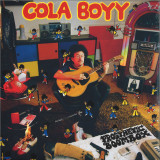
There’s liberation on the dance floor in the songs of Matthew Urango – glimpses of revolution that glimmer beneath the disco ball. “I want my music to bring people together,” says the Californian pop innovator, best known as Cola Boyy. “Because standing together is our best chance at fighting this shit show.” The shit show in question is a broken, brutal system the acclaimed multi-instrumentalist has witnessed up-close. Urango was born with spina bifida and scoliosis in Oxnard, California: a town in which almost 30,000 are estimated to live in poverty. Prosthetic Boombox, his eagerly awaited debut album, might at first glance seem a joyous confetti-burst of pop eclecticism, engineered to sound like “scanning between stations on a car radio, landing on all these different sounds and styles” as Urango puts it. Dig deeper, though, and you’ll discover a simmering sense of rebellion. “The working class are injured, struggling to pay rent and struggling to put food on the table,” he says. “I want to represent that.” Prosthetic Boombox
achieves that goal in a thrilling flurry of inventive indie, funk and soul: take Urango’s car radio analogy, place it in a time-travelling Delorean with Prince in the passenger seat, and you’re half-way there.
Look no closer than Prosthetic Boombox’s euphoric opener, the Avalanches-assisted ‘Don’t Forget Your Neighbourhood.’ The track – which Urango says mixes “the Beach Boys, French disco, house keys and ragtime piano, kinda like the Cheers soundtrack!” – ends with lyrics urging listeners to “fight for your town with your fist closed, strike it and make it more than just a memory.” It’s a reminder that the working classes need to “turn our fists against our oppressors instead of each other,” he explains. After that emphatic introduction comes a horn-laced funk wig-out titled ‘Mailbox’ – a song that gives Dua Lipa’s Future Nostalgia a run for its Studio 54-themed money, featuring rising Londoner JGrrey. Elsewhere, ‘Song for the Mister’ ventures into smooth R&B territory, before ‘Roses’ – a collaboration with Myd of Ed Banger fame – offers a bouquet of bustling disco guitars and infinite bisous of Connan Mockasin’s band drops in on the immaculate ‘Go the Mile’. Urango saves his most introspective moment for the album’s starry closer. ‘Kid Born in Space’, a cosmic collaboration with MGMT frontman Andrew VanWyngarden, sees the artist reflect on what he once had to overcome as a disabled person of colour. “I see them looking down on my dreams of being,” he sings tenderly. “I hear them making fun of my voice, but I keep on moving forward, I refuse to live in anyone else’s shadow.” Prosthetic Boombox, on this subject, is more than an album title – it’s a statement of intent.
“The message of my music is that our class is exploited, oppressed and murdered on the daily. That’s not right, and the system that enables that deserves to be wiped off the face of the earth,” he says. “The only way that happens is if we’re united. That’s the point of my music – to relate to people and unite them.” And what unites more than raucous, irresistibly danceable pop? Prosthetic Boombox is a riot of joyous grooves and catchy hooks for good reason. “I want to reach and spread my message to as many people as possible. You can’t do that if you’re some obscure motherfucker, you know?” he laughs. Don’t bet on him being an “obscure motherfucker” for long.
Daughter of the mighty George Kerr, Sandy set the scene alight in ’82 with the explosive classic, ‘Thug Rock’. Badass slap basslines, zapping synths, ethereal pads and Sandy’s iconic rap were a timeless recipe of pure ‘80s, boogie-infused power that’s blasted from many a boombox, sung on all manner of club systems and sound tracked endless open road cruises over the years.
Released on the South Carolina label Catawba Records, two prolific duos blessed ‘Thug Rock’ alongside Sandy and co. Her father, who produced for the likes of Alice Clark and The O’Jays and Sugarhill wizard, Reggie Griffin, headed up the production and arrangement, with ever-dependable M&M aka John Morales & Sergio Munzibai taking the reins on the mix. Their combined talents can be heard in the tangible weight of the track, each element getting the space it deserves to facilitate that crystal-clear clout - from the huge bass riffs and sublime keys, to the punchy drums and Kerr’s infectious rap. An earworm if ever there was one!
Take to the flip to find the much in-demand dub version, echoing out choice snippets of Sandy’s rap to focus in more on that killer boogie-funk groove. Original copies are tough to come by in the UK, so an official reissue will be music to many an ear.
- 1