- A1: Rk1 Age Of Spiritual Machines
- A2: Stop Making Stupid People Famous (Feat Pussy Riot)
- A3: Holes
- A4: Rk2 Consciousness
- A5: The Message
- A6: Wish You Well
- A7: Rk3 Ubi
- A8: Future Disease
- B1: 19 Days
- B2: Run
- B3: Rk4 Escape Velocity (Feat Emtee)
- B4: Simulation
- B5: Good Die Young
- B6: Rk5 Turing Test
- B7: Temporary Healing
Cerca:our lady peace
- 1
- A1: Down By The Cove
- A2: Mountain Mover Feat. Alex Cosmo Blake
- A3: Maintaining My Peace Feat. Novelist & Stephanie Cooke
- A4: Tears Feat. Saucy Lady
- B1: Brain Gymnasium
- B2: I Wanna Tell Somebody Feat. Josh Milan
- B3: Ōtaki Feat. Finn Rees
- B4: Love Language Feat. Nathan Haines
- C1: A Deeper Life Feat. Isaac Aesili
- C2: More Time Feat. Lee Pearson Jr. Collective
- C3: Tongariro Crossing Feat. Nathan Haines
- D1: Barefoot On The Tarmac
- D2: Marlboro Sounds
- D3: The Eternal Checkout Feat. Cenk Esen
2025 Repress
“We created a holiday inside our heads.”
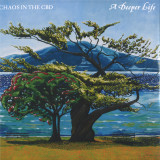
A Deeper Life, Chaos In The CBD’s debut album over 10 years in the making, is nostalgic for the duo’s nature-filled youth, exploring the magical coastline and lush rainforest of New Zealand. “The title refers to our childhood, which was idyllic,” says Ben. “It was just the sun, the sand, the sea, waterfalls, birds and fish…” The album’s blissful setting is also depicted on the album cover: a painting, by a childhood friend, of the beach where they grew up in Devonport.
A Deeper Life whirls that profound love of house music and wide-ranging influences – from Brazilian to R&B, ambient to Italo to deep house and downtempo pop – into a serene, cohesive whole with their signature finesse. The result is an international dance sound that feels unmistakably like Chaos and ebbs and flows from the beach party to the club to the afterhours.
On the album they’ve teamed up with a number of US legends and married their vocals with the UK underground: Josh Milan of house pioneers Blaze brings his soulful vocals to the bossa nova beats of ‘I Wanna Tell Somebody,’ a future jazz-dance anthem. Unheralded Chicago house hero and Larry Heard collaborator Lee Pearson Jr. goes deep over ‘More Time’s broken beat flex. And on ‘Maintaining My Peace’, the brothers have matched veteran house singer-songwriter Stephanie Cooke with UK grime MC Novelist, on a slinky LDN interpretation of LA hip-hop and g-funk.
Also featured on the album are New Zealand jazz artist Nathan Haines, frequent collaborator Isaac Asaeili and more.
Repress!
Little Dragon return with a spectacular second album offering in August, a pulsating electro pop epic that Prince would be proud of (only fronted by a beautiful Swedish lady with a sultry voice). A bold and surprising side/two step onwards from their self titled debut, released two years ago to great acclaim especially among specialist circles. Machine Dreams, with its nagging hooks and gloriously infectious tunes, should finally see the band break out into the mainstream.
Recorded in their home city of Gothenburg, Machine Dreams is a gigantic leap on from previous material but still maintains a distinct sound that can only be Little Dragon. Be it Yukimi s warmly inviting vocals, Erik s dextrous drumming, the vast array of synths and bleeps created by Hakan or Frederik s bubbling bass lines, together they don t sound like anything else around right now. The move towards a more electronic sound was a conscious one, as Yukimi explains; The title Machine Dreams seems obvious. These days, humans seem more and more like machines, and as technology evolves, machines feel more human and it becomes fuzzy and beautiful and science fiction-ish. We feel dependent on our machines to create and live, and their sounds reflect us .
Album opener A New breaks us in gently with a single whirring note on the synthesiser, an almost alien sound that gradually morphs into a slow, thumping bassline. Yukimi s vocals flow alongside Hakan s assortment of sound effects interspersed with militaristic drums breaks. A magical opener that sets the scene and seems to sink into itself, taking us with it, until the pace is swiftly ratcheted skywards with Looking Glass , the massive snare, crisp driving beat and experimental synths revealing the band s current penchant for the 80 s. This influence continues apace into stand out track My Step . Utilising a solid drumbeat that nestles next to jagged and playful synthlines, the track breaks down into motorik propulsion with a scuzzy techno bassline that Yukimi works with ease.
Upcoming single Feather finds Yukimi s voice at its most detached and blaze, seemingly nonchalant yet magnificently seductive. Backed by Hakan s keyboard atmospherics, the song creates a soundscape reminiscent of Tears For Fears more reflective moods. Gradually layering more vocals, synths, echoes and reverb, it builds to a quietly psychedelic, dreamy cosmic swirl. Runabout brings forth a mini Airto style percussive breakdown at the tail end of yet another Little Dragon pop gem. Swimming bursts forth into vision with stabbing keys and reflective bass alongside yet another wonderful vocal performance from Yukimi who sings of young love and now so many years have past, my memories as clear as glass . The song is over as quickly as it started, flowing into the next miniature masterpiece in the form of Blinking Pigs
The album closes with the stunning track Fortune , which has already caught the attention of none other than DJ Shadow. It s no wonder really, as the textured melodies blend with the drifting percussion, creating a blissful sonic mood. With a smattering of drums and bass and the magic of Yukimi s voice and Hakan s electronic dynamics floating on top, it s the perfect track to end this fascinating journey through Little Dragon s brave new world.
With disparate influences from Depeche Mode to Prince, LCD Soundsystem to James Holden, Dancehall to R&B, Jazz and Soul, Little Dragon take their place among artists who straddle many genres, yet somehow create their own and in doing so create sounds that make time stop (Yukimi). Futuristic yet somehow retro, Machine Dreams sees Little Dragon achieve something timeless; that elusive pop classic.
Since the release of 2020’s acclaimed ‘The Cause of Doubt & a Reason to Have Faith’, London based Lookman Adekunle Salami has been busy working on the eagerly-awaited follow up and today has released the first taste of what’s to come in the form of new single ‘Desperate Times, Mediocre Measures’. After four studio albums and with well over 35 million streams, Salami’s music continues to push genre boundaries and is certainly no stranger to spoken word - ‘Desperate Times, Mediocre Measures’ sees him return to this method as he waxes poetically about the state of power and wealth in the modern world; "Desperate Times, Mediocre Measures" is a song that tackles the idea of the cyclical and corrosive nature of power structures across our societies - Hierarchical Structures that, like all structures in our reality, are made up of, and reinforced by people who find themselves, more often than not, enforcing the very corrupted elements of those structures purely due to the fact that this can become the prime method of propping themselves up.” Very much a shift in a new musical direction, Lookman enlisted the help of renowned string arranger Stephen Bentley-Klein, who has worked with the likes of John Barry and Deep Purple, to provide the lush orchestration which works in perfect tandem with Salami’s thought provoking word play. L.A. Salami’s message is - once again - a highly interesting insight into the pitfalls of today’s society, constantly proving how is he is an artist we should all be paying serious attention to.
- 1: Zadar
- 2: Prasine Coast
- 3: Wild Encounter
- 4: Briçal De Mar
- 5: Windward Fort
- 6: Lady Lottie
- 7: Turquesa
- 8: Nanga
- 9: The Canopath
- 10: Tamer Encounter
- 11: Mokupuni
- 12: Anak Volcano
- 13: Dr. Hamijo
- 14: Giant Banyan
- 15: Wreck Of The Narwhal
- 16: Corrupted Badlands
- 17: Belsoto Encounter
- 18: Mines Of Mictlan
- 19: Quetzal
- 20: Dojo Master
- 21: Kakama Cenote
- 22: Kupeleleza
- 23: Jino Gap
- 24: Vumbi
- 25: Max
- 26: Nuru Lodge
- 27: Tasa Desert
- 28: The Battle Of Uhuru
- 29: General X
- 30: Uhuru
- 31: Neoedo
- 32: Iwaba
- 33: Onsenshima
- 33: Ryokan
- 34: Ku No Hosomichi
- 35: Miyako Village
- 36: Sacred Lake (Feat. Mioune)
- 37: Telobos
- 38: Loch Aduar
- 39: Lochburg
- 40: Meadowdale
- 41: Cromlech
- 42: Properton
- 43: Forest
- 44: Castle
- 45: The Final Encounter
- 46: The Arbury Reel
Black Screen Records is excited to announce that Damián Sánchez' chill and joyful orchestral soundtrack to Crema's massively multiplayer creature-collection adventure Temtem will be available on limited edition 3xLP Picture Disc vinyl. You get 47 songs and the three starters Crystle, Smazee and Houchic in one beautiful trifold set with gorgeous artwork by Alex Muñoz and Cristina Jiménez. The vinyl and CD both come with a download card for the full digital soundtrack including all tracks. ABOUT THE SOUNDTRACK: Temtem's original game soundtrack is a melodic journey through the adventures on the Airborne Archipelago. A mixture of musical styles and flavors ranging from the chill and joyful orchestral sounds from Deniz to the most vivid and chrer-ish celtic dances from Arbury, through the folk and peacefulness of Omninesia, the mysterious glassy mallets of Tucma, the warm drums and flutes of Kisiwa, and the modern-versus-traditional Asian tunes in Cipanku. Discover the traditions of each isle through its instrumental palette and melodies, and vibe with the rhythms of the combat themes while you become the greatest Temtem tamer. The aim of this physical edition it's always been to give our fans not only another way of listening to Temtem's soundtrack, but to make a piece of art they would love to display on their shelves or even hang on a wall. Both teams at Crema and Black Screen Records worked really hard for a long time to cherry-pick the best ideas and come up with these incredibly beautiful editions. We are really proud of these products and we really hope you enjoy them! - Damián Sánchez ABOUT THE GAME: Temtem is a massively multiplayer online adventure where you'll get to explore the colorful and exciting Airborne Archipelago with all your friends and other players! Discover, tame and battle the Temtem that inhabit these islands, and maybe save the Archipelago in the process? Temtem offers a lengthy story campaign in a fully online world, and the possibility of playing the entire adventure in Co-op with a friend; a rich, complex, RNG-free combat experience, and competitively oriented gameplay, with challenges for all play styles; a bustling economy and trading environment; advanced character customization, housing and a myriad of ways to express yourself!
For an artist whose career is flush with enigma, myth, and disguise, Nashville Skyline still surprises more than almost any other Bob Dylan move more than four decades after its original release. Distinguished from every other Dylan album by virtue of the smooth vocal performances and simple ease, the 1969 record witnesses the icon's full-on foray into country and trailblazing of the country-rock movement that followed. Cozy, charming, and warm, the rustic set remains for many hardcore fans the Bard's most enjoyable effort. And most inimitable. The result of quitting smoking, Dylan's voice is in pristine shape, nearly unidentifiable from the nasal wheeze and folk accents displayed on prior records.
Mastered on our world-renowned mastering system and pressed at RTI, this restored 45RPM analog version zeroes in on the shocking purity and never-again-replicated croon of Dylan's vocals. Enhanced, too, are the images associated with the calmly strummed and picked acoustic guitars and decay connected to the fading notes. The dimensions and ambience of the Columbia studio translate via subtle echoes and natural blend of instruments melding with one another, akin to honey integrating with tea. Providing comparably soothing effects, relaxing vibes pour forth from this reissue, which affords this masterpiece the fidelity it's always deserved. Wider grooves mean more information reaches your ears.
"Is it rolling, Bob?," Dylan famously queries producer Bob Johnston at the beginning of "To Be Alone With You," indicating the laissez-faire feelings that surrounded the sessions and helped yield the laidback, convivial music defining the album – arguably the most unique in the artist's vast catalog. While he dipped his toes into country waters on the preceding John Wesley Harding, Nashville Skyline throws its collective arms around the style in bear-hug fashion and drops any obvious folk references. Everything from the songs' moods to the amicable arrangements reacts against the era's turmoil and popular sounds.
This beautiful and beautifully executed effort might stand as Dylan's most effective protest ever, even if many missed the point upon original release. Advocating peace, love, and old-world allure without calling attention to any characteristic in an overly forward manner, Dylan frames the songs as ballads, rags, lullabies, and gentle honky-tonk dances. He adheres to expeditious brevity, keeping the arrangements tight and free of any filler, thus allowing the melodies to immediately work their magic and place hummable memories inside listeners' heads.
Indeed, if any Dylan masterpiece is overlooked, it's Nashville Skyline. In addition to his superb singing and infallible songs, Dylan enjoys backing from a crackerjack assembly of Nashville session musicians including Charlie Daniels, Marshall Grant, W.S. Holland, Charlie McCoy, Ken Buttrey, and Norman Blake. Country pros, and their respective performances, don't come any better.
As much as on any of his records, Dylan resides in a good place, mentally and emotionally. The idyllic, warmhearted environs of Nashville Skyline stand apart now just as they did in the late 1960s. The sincerity conveyed on the inviting "Lay Lady Lay," relief sighed on the romantic "Tonight I'll Be Staying Here With You," and unlimited promise expressed on the jittery "To Be Alone With You" parallel the lessons-learned yearning and genuine desire found on "One More Night," bracing "I Threw It All Away," and eternal "Girl From the North Country," performed to perfection with Johnny Cash.
- A1: Maria Maria
- A2: Cozinha
- A3: Pilar (Do Pila) (Do Pila)
- A4: Trabalhos (Essa Voz) (Essa Voz)
- B1: Lilia
- B2: A Chamada
- B3: Era Rei E Sou Escravo
- B4: Os Escravos De Jo
- B5: Tema Dos Deuses
- C1: Santos Catholicos X Candomble
- C2: Pai Grande
- C3: Seducao
- D1: Francisco
- D2: Maria Solidaria
- D3: De Repente Maria Sumiu
- D4: Eu Sou Uma Preta Velha Aqui Sentada No Sol
- D5: Boca A Boca
- D6: Maria Maria
Repress incoming...
Far Out Recordings proudly presents Milton Nascimento's Maria Maria. Recorded in 1974 and unreleased until almost thirty years later, the album was written as the soundtrack to a ballet which dealt with the legacy of slavery in Brazil. Raw, atmospheric and emotionally charged, Maria Maria reveals one of Brazil's greatest ever songwriters at his creative peak. Featuring an all-star cast of fellow Brazilian legends including Nana Vasconcelos, Joao Donato, Paulinho Jobim, and members of Som Imaginario, Maria Maria holds what Milton considers to be the definitive versions of some of his classic songs, including 'Os Escravos De Jó' and 'Maria Maria'.
Originally released in 2003 as a double CD package, with Milton Nascimento's 1984 follow up ballet soundtrack Ultimo Trem, Maria Maria will be available on vinyl for the very first time from December 2019, with Ultimo Trem set for vinyl release early 2020.
Milton Nascimento possesses one of the most immediately recognizable voices in Brazilian music: high and sweet and as breathtakingly sublime as that of any soul singer. It was this voice that the legendary Brazilian singer Elis Regina fell in love with back in 1964, having heard Milton perform his song 'Canção do Sal (Sultry Song)' at a private party in Sao Paulo. Ellis went on to record the song in 1967 -giving Milton his first hit in Brazil and beginning a career that has spanned over 50 years.
Born in Rio on the 26th October 1942, Milton moved with his adoptive parents at the age of 18 months to Tres Pontas, a rural town in the state of Minas Gerais, 500 miles north of Rio. He began his musical career as a young teenager, singing in a crooner style he learnt from listening to Brazilian singers and US groups such as The Platters on the radio. Hungry for more opportunities to perform, Milton moved to Belo Horizonte, the capital of Minas Gerais, at the age of twenty. By the beginning of the 60s Milton had made a name for himself both as an accomplished singer and guitarist.
Milton became part of a local network of musicians, film makers, dancers, theatre directors and writers that included the journalist and song writer Fernando Brant as well as lyricist Marcio Borges and his younger brother Lo Borges. Together these four wrote and produced what would become Milton's milestone album, 'Clube da Esquina (Club on the Corner)'. The originality of 'Club da Esquina' shaped the local scene, and it reflects the essence of 'the Nascimento Sound'. Milton's religious upbringing as an Afro-Brazilian Catholic saw him exposed to church choral music from an early age. His love of this genre of music is apparent in both his celestial falsetto and vocal choral arrangements. This collection also displays his early fascination with evocative, non-verbal, scat-style singing, spare, harmonic guitar work and local folk music, jazz and rock.
In 1976, Milton and Fernando Brant teamed up with a new contemporary dance company called Grupo Corpo, whose Argentinian choreographer Oscar Araiz, would become a collaborator with the two musicians. Together, they conceived a show based on the composite life story of the daughter of a black slave called Maria. Nascimento wrote music to Brant's lyrics and "Maria Maria" was premiered in the main theatre of the Belo Horizonte Palacio das Artes that year. "Fernando wrote the lyrics for the ballet, but there were originally no lyrics for the theme song, "Maria Maria'". Milton and Fernando worked on the lyrics together, basing them on folk stories about black women of the countryside. Adds Milton "These memories are mostly things that we witnessed – Fernando and I – rather than what we experienced ourselves.
Milton's music is impressionistic, emotional and romantic. Relying on songs without lyrics as well as evocative vocalizing and choruses, Milton experimented heavily with Afro-Brazilian percussion and taped jungle sounds. His composing method for these recordings was highly unconventional: "I wrote the music for 'Maria Maria' in a tiny Rio apartment with friends and their kids running around and having fun! I love to be in noisy places, surrounded by people", he says.
The music on 'Maria Maria' was performed by an impressive group of young musicians who are today household names in Brazilian music, including Naná Vasconcelos (percussion and effects), Toninho Horta (guitars) and Paulo Moura (sax). Several vocalist including Naná Caymmi, Fafá de Belém, Beto Guedes, and Milton himself, had hits in years to come with reworkings of these songs.
Milton says his compositions follow his visions "like a movie", and he believes that reflects his long love affair with cinema. "I only began composing because of enjoying the movies so much," he says. "I wrote my first song "Peace for the Coming Love" after seeing 'Jules et Jim' (the cult 60s French film directed by François Truffaut), with my friend Marcio Borges. We went early in the morning and watched it four or five times in a row, then went to Márcio's home and wrote the song."
The songs also include solo spoken passages set to music, clearly influenced by this style of French art cinema. On the title track, Maria's story is narrated and translated to music through the use of African Percussion, drums and metal signifying the field slave tools of the day. 'Trabalhos (Works)' runs to work rhythms and whipcracks: no words, just pain. 'Lília' documents the beating of the slave woman. After 'A Chamada (The call)' and the triumphant 'Era Rei e Sou Escravo (I was a king now I am a slave' things begin to turn and Milton employs tropical jungle cries to symbolize freedom. 'Santos Catholicos x Candomble (Catholic Saints vs Candomble)' represents the battle between African and European religions through the music of both sides. Milton's heavenly falsetto pours into 'Francisco' and 'Pai Grande (Great Father)' and the outstanding 'Eu Sou Uma Preta Velha Aqui Sentada no Sol (I'm an old black lady, sitting under the sun)' conjures images of an old woman sitting deep in the forest, her memories painted in drums, piano and voices.
Manchester's OURTIME MUSIC return with something of a electronic masterpiece ! After a 14 year hiatus, Salford's elusive cosmic composer returns to his Sonic Insomniac guise with a debut LP of the finest underwater electro & crisply rendered electronica As always, super limited !!
- 1