Repress
Escola Records is very proud to present a refreshing reinterpretation of Uptown Funk Empire’s 2009 cover of Pharoah Sanders’ You’ve Got to Have Freedom. The release features four dancefloor-oriented versions crafted by legendary French DJ and producer Greg Gauthier, alongside talented musician, DJ, and producer Lucas Moinet (half of Groove Boys Project and Keraw). The A-side delivers the smooth and mellow “937” Vocal and Dub versions, where Greg and Lucas offer two uplifting, soul-infused reworks in a groove- heavy ride full of organic grooves and a beautiful xylophone solo, creating the perfect space/beat for some of the most hopeful vocals we could ever dream of. The B-side completes the package with the “Dance Culture” remixes, paying tribute to the legendary party Greg launched over 20 years ago at Paris’ iconic house music mecca, the Djoon club.
Search:the freedom
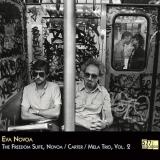
"Brooklyn-based pianist Eva Novoa returns with The Freedom Suite: Novoa / Carter / Mela Trio, Vol. 2 — the second radiant release from her compelling trio with saxophone icon Daniel Carter and celebrated drummer Francisco Mela. This marks Novoa’s sixth album with 577 Records. The trio first came together live in 2021, followed by a series of performances, including appearances in Cambridge (Boston) and later at the Brooklyn edition of the NY Forward Festival.
"The Freedom Suite is an homage to jazz titan Duke Ellington — particularly his masterful big band suites and legendary orchestra featuring Johnny Hodges and other luminaries who helped define an era of jazz greatness. In contrast, Novoa presents her Suite in a more intimate format: the piano trio. The album comprises twelve pieces — mostly brief — with a few extended tracks such as Free to Be Free and Cyborgs.
"For this recording, Novoa also steps in as a vocalist on several tracks, including Mainstream Media, Big Grande, Global, Free to Be Free, Dream, and Cyborgs. These pieces often feature a vocal dialogue between Novoa and Mela, whose expressive, word-infused style draws from rich Cuban traditions.
'Words are powerful,' says Novoa. 'They define who we are, where we come from, and who we hope to become. Without words, there is no conversation — and without conversation, there is no real sense of time, space, or connection.'
The Freedom Suite emerged from deep philosophical and creative conversations — spoken, written, and improvised — between Novoa, Carter, and Mela. In the studio, Novoa introduced printed texts that served as thematic foundations for spontaneous, in-the-moment musical interpretation. The result is an urgent and organic interplay, where instruments speak to one another in a language as fluid as it is fearless.
"Standout track Cyborgs begins with Novoa’s percussive piano, exemplifying the trio’s dynamic, conversational energy. Creative Destruction features Novoa on electric harpsichord in a wild, electric exchange. While Free to Be Free stands out as the album’s leading single, it also captures the essence and message of the entire Suite.
"Recorded in 2021 at New York City’s legendary Sear Sound Studio, the album captures a creative explosion of sound and spirit. Novoa dazzles on piano, Fender Rhodes, electric harpsichord, Chinese gongs — even whistle — showcasing her expansive sonic palette. Together, the trio embodies the power of free improvisation and emotional storytelling.
"Originally from Barcelona, Spain, Eva Novoa has been cultivating her distinctive voice since childhood. Now a staple of the New York creative music scene, she has performed across the globe and collaborated with some of the most adventurous voices in jazz and beyond."
- With You
- Picking Up The Pieces
- The Water
- Tell Me I'll Be Yours
- Get My Share
- Don't You Wanna Love Me
- So Much More
- Be Who You Are
- Anchor
- Coming Home
The Freedom Affair hat von Anfang an tiefe Wurzeln in der Soulmusik geschlagen, aber nach fast einem Jahrzehnt gemeinsamer Arbeit konzentriert sich der Sound der Gruppe auf ihrem selbstbetitelten zweiten Album genau dort, wo Muscle Shoals und Memphis Soul aufeinandertreffen. Es ist eine Meisterleistung an leidenschaftlicher Message-Musik, die zeitlose Themen wie Ungerechtigkeit, Liebe und Zusammengehörigkeit erforscht. Eine schicksalhafte Begegnung mit dem Grammy-prämierten Toningenieur Boo Mitchell (Mark Ronson, Bruno Mars, Al Green) in den Royal Studios im Februar 2023 löste einen Funken aus, der die Band mit neuer musikalischer Überzeugung zurück nach Kansas City schickte. Im November kehrte die Band zurück, um in dem legendären Studio in Memphis völlig neue, vom Southern Soul inspirierte Songs aufzunehmen. Das stets starke weibliche Trio an der Spitze der Band - Paula Saunders, Seyko Groves und Shon Ruffin - ist das Markenzeichen des Sounds und der Identität von The Freedom Affair, und ihr kollektives stimmliches Können ist in vollem Umfang zu hören - von hart bis zart, von Herzschmerz und Hoffnung. Die Erfahrung in den Royal Studios hat die Band davon überzeugt, dass es keinen besseren Raum gibt, um Bläser aufzunehmen. Die ,One-Take"-Bläser von Pete Carroll an der Trompete und Brett Jackson am Saxophon beweisen, dass sich ihre jahrelange Zusammenarbeit mit ihrer Präzision und den perfekt auf die Stimmung abgestimmten Linien ausgezahlt hat. Das Personal der Rhythmusgruppe ist das gleiche wie auf dem Debütalbum "Freedom is Love", aber Chris Hazelton wechselt vom Bass zu seinem Hauptinstrument, der Hammond B3-Orgel, sowie zu verschiedenen Keyboards. Branden Moser tauscht den Bass, der auch sein Hauptinstrument ist, mit seiner früheren Rhythmusgitarre aus. Cole Bales greift an der Leadgitarre weiterhin zu zeitlosen Riffs, und Dave Brick sorgt am Schlagzeug für das Rückgrat mit dem schweren Boom-Bap. Dieses Album hat den Sound von The Freedom Affair zementiert: beständige Melodien mit reichhaltigen Arrangements, unterstützt von einem düsteren Puls. Royal war der perfekte Ort für dieses Album, und die Band nutzte die Geschichte des Studios in vollem Umfang, indem sie Studiogeräte und Relikte während des gesamten Prozesses einbezog. Da die Band nur vier Tage Zeit hatte, um das zehn Songs umfassende Album aufzunehmen, bestand sie darauf, das gleiche Ampex 1"-Bandgerät zu verwenden, mit dem alle Hi-Record-Hits von 1974 und davor aufgenommen wurden, um die Authentizität zu wahren. Es war das erste Mal seit 1974, dass dieses Gerät für ein Album verwendet wurde. Die Einschränkungen und Macken, die sich aus der Verwendung alter, analoger Geräte ergeben, machten Platz für magische Momente, die den Charme des Albums ausmachen. Die Platte erweckt den klassischen Southern Soul zu neuem Leben, mit all der Gemütlichkeit und Wärme, die man erwarten würde, wenn man Al Green oder Ann Peebles Aufnahmen aus dem selben Raum hört. Abgemischt von Vince Chiarito (Hive Mind, Jalen Ngonda, Charles Bradley) und gemastert von JJ Golden (Sharon Jones & the Dap Kings, The James Hunter Six, Antibalas), ist dieses Album eine wahre Lektion in Sachen Soulmusik.
- A1: Flying Lotus - Anties Harp
- A2: Nick Drake - Three Hours
- A3: Terry Callier - You're Gonna Miss Your Candyman
- B1: The Freedom Sounds Feat Wayne Henderson - Behold The Day
- B2: Shuggie Otis - Aht Uh Mi Hed
- B3: Thom Yorke - Black Swan
- B4: The Cinematic Orchestra - Restaurant
- B5: Steve Reich - Electric Counterpoint
- C1: Bjork - Joga
- C2: Imogen Heap - Cumulus
- C3: Songstress - Sea Line Woman
- D1: Sebastian Tellier - La Ritournelle
- D2: Burial - Dog Shelter
- D3: Burt Bacharach - South American Getaway
- D4: The Cinematic Orchestra Ft Fontella Bass - Talking About Freedom
- D5: Will Self - The Happy Detective Part 3
Repress!
FORMAT: DOUBLE 180 GRAM HEAVY WEIGHT VIRGIN VINYL PRESSINGS INCLUDES MIX CD AND HIGH QUALITY COVER ART PRINT
LIMITED EDITION 1000 COPIES WORLDWIDE
This classic late night tales release is now finally available on heavy weight double vinyl, released back in 2010 this edition has gone on to become one of the most successful albums in the series 12 year history, cut using the unique 'half speed' mastering technique's and pressed on virgin 180 gram vinyl this is the ultimate audiophile format, each beautifully pressed disc is housed in a special anti static inner sleeve and comes with a special 30cm cover art print and the package also includes the original CD mixed disc and 12 page booklet.
CD UNMIXED TRACKS (FULL REMASTERED VERSIONS)
- A1: Amadou
- A2: Hip Hop Speaks
- A3: Make It All Better
- A4: Prankster Gangster
- A5: Prayer For Peace
- B1: A Plan Don't Get Up
- B2: No Laughing Matter
- B3: Break Bread
- B4: Hollow Points
- B5: Beyond Belief
- B6: Said & Done
- C1: Pleasure-Pain-&-Me
- C2: Unify
- C3: Love Supreme
- C4: Blues For Amadou
- C5: My Dna's Ok
- C6: Descended From Kings
- C7: Motha Goddess
- D1: You & I-Verse
- D2: Destiny's Finger
- D3: Black Male
- D4: Sun Drops
- D5: Tears For Amadou
- D6: Amadou's Journey
This is a 1999 album by Weldon Irvine, who gained new recognition with the rise of the hip-hop scene and the rare groove movement in the 90's and beyond, including appearances on Q-TIP and Mos Def albums! Now, for the first time ever, P-VINE is releasing this historically significant work on LP, as the original CD is hard to find.
Featuring guests such as Q-TIP, Mos Def, Talib Kweli, and other artists representing the street scene of the time, the jazzy and tight groove is a must-listen, with a crossover of 70s feeling and 90s sound!
- 1: Within
- 2: Hiraeth
- 3: Wakan Tanka
- 4: Diminish No More
- 5: Freedom (Feat. Ekaterina Shelehova)
Black Vinyl[30,67 €]
- 1: Within
- 2: Hiraeth
- 3: Wakan Tanka
- 4: Diminish No More
- 5: Freedom (Feat. Ekaterina Shelehova)
Green / Red Vinyl[37,19 €]
- Play Dead
- Kowp
- Drums On The Wheel
- Play Dead (Instrumental)
- Kowp (Instrumental)
- Drums On The Wheel (Instrumental)
- Rat Skull
- Snowmobile
- Twice Fried
- Frozen Caveman
Recently I was approached by my old friend Travis Millard to make some original music for Freedom Finger - a crazy space-shooter video game he had been developing with Jim Dirschberger and Wide Right Interactive game studio. I was able to land 6 instrumentals that pop up at various points throughout the gameplay.As the game was being rolled out, the idea arose to have me do 3 more tracks - this time fully fleshed out songs with lyrics mostly inspired by Freedom Finger's gameplay. These tracks would accompany some brand new levels that would be made available as downloadable content for the game.We have decided to release all of the music I have done for Freedom Finger as a 10" vinyl EP available through Rhymesayers Entertainment. This includes the 3 full length vocal tracks, as well as the 6 shorter beats that loop throughout the game. Some of these tracks also feature additional instrumentation from my friends and frequent collaborators, Grimace Federation.Furthermore, Jim has directed a video for the song Drums on the Wheel - featuring Freedom Finger gameplay, and some brand new visuals drawn by Travis and animated by Steven Gong.The game is an absolute blast, and I hope you enjoy this music. All relevant links below. <3Love,A.R.
* Speaker distressing early 1990s UK dub from The Disciples.
* `Chant of Freedom and `Armageddon' are dubplate cuts only ever heard before in sound system dances.
* The original versions of `Chant of Freedom' tracks appeared on 10' on the Boomshackalacka label in 1995, while `Armageddon' is previously unreleased on any format.
* Disciples, along with the likes of Sound Iration, Manasseh, Alpha and Omega and Conscious Sounds are the forerunners of what became known as the UK roots/dub scene.
* Highly regarded for their custom built dubplate cuts for Jah Shaka. Disciples have a sizable following worldwide, particularly in the UK, France, Germany and Japan.
- The Geek
- M.j.s. Funk
- That's It
- Freedom Sound
- From Exodus
- Coon
Freedom Sound, the 1961 debut by The Jazz Crusaders, began a prolific and successful decade-long association with Pacific Jazz. The Houston, Texas founded band featuring Stix Hooper, Joe Sample, Wayne Henderson, Wilton Felder, and Jimmy Bond blended jazz aspirations with R&B roots to create an enticing sound. This stereo Tone Poet Vinyl Edition was produced by Joe Harley, mastered by Kevin Gray from the original analog master tapes, pressed on 180g vinyl at RTI, and packaged in a deluxe tip-on jacket.
The Invisible Road: Original Recordings, 1985–1990 compiles an unheard, previously unreleased body of recordings by Sussan Deyhim and Richard Horowitz, dissidents from diametric backgrounds who met during the heady days of Downtown New York in the 1980s. This collection reveals the creative and life partners’ radical shared vision of avant-garde pop in all of its boundary pushing freedom, combining Deyhim’s singular approach to vocalization, Horowitz’s invention of new musical languages, and touchstones of traditional music from around the world, creating a new music that ultimately retains a voice entirely its own. Despite their difference in backgrounds and respective journeys, at the time of their meeting in the early 1980s in New York City, Sussan Deyhim and Richard Horowitz were both products of the search for freedom and understanding (and resultant awakenings) that swept the globe and helped culturally define the late 1960s and 70s. Deyhim, born and raised in Tehran, spent her teens dancing with Iran’s Pars National Ballet company, performing weekly on Iranian national television, and travelling her home country studying with master folk musicians and dancers, before relocating to Belgium and joining Maurice Béjart’s prestigious Béjart Ballet of the 20th Century. Horowitz, born and raised in Buffalo, New York, had spent much of the decade before abroad, first departing for Paris under the shadows of the Vietnam War, where he studied piano, Eastern philosophy, and became entrenched the city’s free jazz scene, playing with the likes of Steve Lacy, Anthony Braxton, and Alan Silva, before embarking south to Morocco where his friendship with Paul Bowles helped cultivate a deep passion for the country’s musical traditions and a shift in his musical practice.
The pair met by chance sometime in 1981 at Noise New York, a small studio on West 34th Street founded by the musician and recording engineer, Frank Eaton, as a utopian creative laboratory that beckoned artists and bands like Arthur Russell, Christian Marclay, Liquid Liquid and Butthole Surfers into its orbit. Both artists had recently relocated to the city, Horowitz having recently released his debut album, Oblique Sequences (Solo Nai Improvisations), on the legendary Paris based imprint Shandar, and fallen in with members of New York avant-garde like La Monte Young, Jon Hassell, David Byrne, and Brian Eno, and Deyhim having begun to more actively incorporate singing into her practice, notably recording a vocal score for choreography she was doing at La MaMa Experimental Theatre.
Initially bonding over a cassette tape of field recordings made by Paul Bowles that had been given to mutual friend and writer Brian Cullman (seeking answers for Ornette Coleman’s question “what is the sound of sound”), their earliest collaboration was documented on Horowitz’s 1981 album, Eros In Arabia, with Deyhim contributing vocals to the track “Queen Of Saba.” Over the coming years, their deep connection would routinely gravitate them into the studio, culminating in the body of recordings that would appear on their 1986 album for Crammed Discs, Desert Equations: Azax Attra. Unknown to nearly all but the artists, laying in wait over the decades on numerous multi-track and stereo reels, DAT tapes, and reference cassettes, were a vast array of recordings made by Deyhim and Horowitz bookending Desert Equations. The 13 pieces represented on The Invisible Road: Original Recordings, 1985–1990 were recorded largely between Noise New York and Daylight Studio in Brussels, during a period that Deyhim describes the partnership between herself and Horowitz’s as seeking a music “free of any specific cultural reference, with a personal musical signature,” blossoming into a body of sonority that embraced the energy of contemporary boundary pushing pop and the avant garde, filtered through their mutual love and study of various musical traditions from across the globe and deep engagement with the ideas and tactics of experimental music.
Undeniably rooted in Horowitz’s study of the North Africa ney and the music of the Berber and Gnawa cultures during his time in Morocco, Deyhim’s deep engagement with the folk traditions of Iran, and the couple’s immersion in the interconnected Downtown underground music scenes, each piece on The Invisible Road offers its own vision creative and cultural hybridity. Deyhim sings in both English and Farsi, as well as a composite tongue that she developed by drawing upon numerous indigenous vocal techniques from around the world, intuitively responding to Horowitz’s simultaneous sound syntax forming and combining a wide range synthetic and acoustic instrumentation, and experimental tape techniques, within a visionary series of free-standing expressions.
- A1: St Thomas 7 32
- A2: There Will Never Be Another You 5 52
- A3: Stay As Sweet As You Are 4 41
- A4: I've Told Ev'ry Little Star 4 52
- B1: How High The Moon 10 46
- B2: Oleo 6 00
- B3: Paul's Pal 9 30
- C1: Sonny Rollins Interview 1 54
- C2: It Don't Mean A Thing 4 54
- C3: Paul's Pal #2 7 00
- C4: Love Letters 5 34
- D1: I Remember You 6 50
- D2: I've Told Ev'ry Little Star #2 6 33
- D3: It Could Happen To You 3 27
- D4: Oleo #2 3 15
- D5: Will You Still Be Mine? 4 16
- D6: I've Told Ev'ry Little Star #3 4 26
- E1: I Want To Be Happy 4 08
- E2: A Weaver Of Dreams 4 12
- E3: It Don't Mean A Thing #2 4 31
- E4: Cocktails For Two 4 58
- E5: I've Told Ev'ry Little Star #4 5 54
- E6: I Want To Be Happy #2 5 15
- F1: Woody 'N' You 15 54
- G1: But Not For Me 17 39
- H1: Lady Bird 18 49
Freedom Weaver: The 1959 European Tour Recordings is the first official release of the 'Saxophone Colossus' Sonny Rollins’ European tour in 1959 with bassist Henry Grimes, and drummers Pete La Roca, Kenny Clarke and Joe Harris. Available previously only as a bootleg release, this is the first official release in cooperation with Sonny Rollins and released as a 3-CD set. Freedom Weaver includes an elaborate booklet with rare photos by Ed van der Elsken, Jean-Pierre Leloir, Bob Parent and many others; lead liners by jazz scholar Bob Blumenthal, and new interviews with Rollins himself, Branford Marsalis, James Carter, Joe Lovano, James Brandon Lewis and Peter Brötzmann. Mastered by the legendary mastering engineer Bernie Grundman.
Unreleased, "lost" 7inch off the Bruton library music album "Deep Funk". Two killer cuts by the Sound Stylistics: The Message is a piece of heavy soul featuring the vocals of late great UK soul singer Noel McKoy, Freedom Sound is a space funk groove with moog synth on top. Officially licenced from BMG Zomba Production Music in 2007, manufactured and forgotten. These 45s have just been unearthed from the pressing plant's storage room after more than 15 years.
After holding down a residency at Berlin’s Club der Visionaere for over a decade with their Perfumed Freedom events, dynamic duo Foehn & Jerome look to launch an exciting new record label under the same name. The Berlin based Austrian’s have teamed up for the inaugural release, wandering between tripped out minimalistic vibes with tinges of house textures spread across the record. This is “The Frisbee Of No Return”.
Join Foehn & Jerome as they evolve the Perfumed Freedom journey with their unrivalled chemistry, giving themselves and dedicated artists a platform to express themselves in the years to come.
- A1: Noonday Yellows
- A2: Rain
- A3: Dusk
- A4: The Jantzen Rag (Raccoons)
- A5: Pleasant, This Garden
- B1: Bedroom Of The Absent Child Lost Creek Suite
- B2: Bedroom Of The Absent Child Lost Creek Suite Into The Groves
- B3: Bedroom Of The Absent Child Lost Creek Suite Warm Pathways
- B4: Bedroom Of The Absent Child Lost Creek Suite Sunny Banks
- B5: Bedroom Of The Absent Child Lost Creek Suite Fragrant Duff
- B6: Bedroom Of The Absent Child Lost Creek Suite Beaver's Pond
- B7: Track 12
Black Vinyl[22,48 €]
Written and recorded between 1972 and 1982 in Western Oregon, Back to the Woodlands is a previously unreleased, and nearly lost, album made by Ernest Hood during the same era as his near mythical album Neighborhoods . A visionary combination of field recordings, zithers, and synthesizers, Back to the Woodlands offers an unprecedented depth of access to this singular artistic mind. Born into a musical family, Ernest Hood began a promising career as a jazz guitarist during the 1940s, touring internationally with his brother Bill Hood and the saxophonist Charlie Barnet , before contracting polio in his late twenties. The disease left Ernest unable to play the guitar and confined him to a wheelchair for the rest of his life. It also forced him to adapt and innovate around his musical practices in the face of adversity; Hood's value of sound matured with a remarkably democratic and nonhierarchical approach and application. Taking up the zither, a less physically-demanding stringed instrument to the guitar, embarking upon the unprecedented process of incorporating field recordings into his work as early as 1956, and eventually discovering the synthesizer, Hood's music became imbued with optimism and subtle cultural critique. This ethos and technique - refined over the coming decades - would lay the groundwork for a sprawling body of radio work, mail order recordings for homebound listeners, and Neighborhoods , self- issued as a small vinyl edition in 1975. Where Neighborhoods , a nostalgic opus, drawing from a well of collective memory of the 1950s, is defined by traces of human activity, Back to the Woodlands leaves the modern world behind, delving into Hood's love for nature. Only recently discovered in his archives, the album dramatically expands his concept of "musical cinematography," imagistically triggering states of sensory memory from within its zither and synthesizer melodies, intertwined with field recordings made during Hood's extensive travels throughout Oregon. If Neighborhoods is a retreat into the gauzy joys of a romanticized past, Back to the Woodlands is an immersion in the timeless sanctuary of the natural world. A fascinating counterpoint to its predecessor, Back to the Woodlands brings us even closer to Hood's belief in the transportive qualities of sound; that field recordings could serve as a vehicle for the imagination and liberation, particularly for those with similar mobile disabilities as his own. Across the album's twelve compositions, the rippling instrumental harmonics - shifting between abstraction and playful melody - fold so seamlessly into the birdsong, bubbling brooks, and other environmental ambiences, that they often give the impression of having been recording within the landscapes toward which they whisper. Falling somewhere between the immersive calm of healing music and New Age, the creative field recording practices of sound ecologists world building for Folkways, and the jazz infected ambiences during Obscure / Editions EG's highest heights, Back to the Woodlands sculpts an singular proximity of music for its moment; a form of ambient sonic realism that draws the consciousness toward its surroundings as much as within. Working closely with his estate to maintain his original vision, Freedom to Spend has restored and remastered this never before released, lost masterpiece by Ernest Hood from the original tapes. Ernest Hood's Back to the Woodlands will be issued on vinyl, as well as on CD in combination with its contemporary Where the Woods Begin , with new liner notes by Michael Klausman . On behalf of Ernest Hood and Freedom To Spend, a portion of the proceeds from this release will benefit Oregon Wild, an organization dedicated to protecting and restoring Oregon's wildlands, wildlife, and waters as an enduring legacy for future generations.
Electronic jazz pioneer, pianist, producer, re-mixer Mark de Clive-Lowe has an envious reputation as a cross genre creative artist who blends acoustic, electronic and world music exploring themes of belonging and identity. Equal parts jazz, house, hip hop and broken beat artist, Jazziz summed him upperfectly - "way before jazz hybridity became a worldwide phenomenon, de Clive-Lowe was busy designing its blueprint." Freedom is a live concert recording made at the Blue Whale, Los Angeles -where Mark put together a Los Angeles based collective made up by very accomplished and suitably talented Teodross Avery - saxophone, Corbin Jones - bass, souzaphone drummer Tommaso Cappellato Carlos Nino -percussion and the highly renowned spiritual jazz vocalist Dwight Trible.
The Ethiopians are one of the great vocal groups to come out of Jamaica. Singing songs of life and times as they found them, themes that resonated with the people of the Island that made them such a treasured group. Lenard Dillon (b. 9 December, 1942, Port Antonio, Jamaica) the founding member of the Ethiopians began his singing career at Clement 'Coxonne' Dodd's Studio One. Initially he recorded under the name of Jack Sparrow, and backed by the Wailers, cutting 'Ice Water' and 'Suffering In The Land'. Under The Wailers encouragement, he went on to form his
own vocal group. Recruiting singers Stephan Taylor (b.1944, Portland, Jamaica) and Aston 'Charlie' Morris to become The Ethiopians. They cut 'Live Good', 'Why You Gonna Leave Me Now' and 'Owe Me No Pay Me'. Although receiving favourable response, Aston Morris decided to leave the band and the remaining pair carried on and cut 'I'm A Free
Man' and 'Don Dead Already' and 'For You'. On meeting contract builder Leebert Robertson who had recently returned to live in Jamaica, ashad he wanted to get into the music business, a session was booked for Treasure Isle Studios. The session produced their seminal 'Train To Skaville' track, which became an immediate hit in Jamaica and in the UK, when in 1967 it reached number 40 in the charts. They also cut 'Engine 54', which became the title of their debut album. Its
follow up 'I Need You / Do It Sweet', did not fare so well and the band moved over to Sonia Pottinger's stable, where they cut 'The Whip / Cool It Amigo' which revived their fortunes and proved another big hit for the band. Two more hits followed 'Stay Loose Mama' and 'The World Goes Ska', after which the band decided to return to a trio, adding
Melvin 'Mellow' Reid to the line up. The band now hit another run of successes with producer JJ Johnson 'Everything Crash, 'Gun Man', 'Hong Kong Flu' and 'The Selah'. Many hits followed leading the band to work with a variety of Jamaican producers. Such tracks as 'I Want To Be a Better Man, ' Conquering Lion', 'Fire A Mus Mus' Tail', and the timeless 'Reggae Hit The Town' to name a few. Two albums 'Reggae Power' (1969) and 'Woman Capture Man' (1970), pulled a lot of these tunes together. Sadly Taylor was killed in 1975 after been struck by a van in a road accident. Dillon returned to Port Antonio till 1977, when he was persuaded to return to Treasure Isle studios with producer Niney The
Observer and cut the Rasta based album 'Slave Call'. Additional members who joined for this album were Bro Fatty, Bro Ewing, Bro T, Mello and Hychi Dread. An album that showed all the Ethiopians magic had not been lost.
For this release we have included the full 'Slave Call' set, 'Ethiopian National Anthem', 'Slave Call', 'Guilty Conscience', 'Hurry On', 'Mus Follow Babylon'(on CD Edition), 'Train To Skaville (1977 version, on CD Edition), 'Culture', 'Obeah Book', 'Let It Be' and 'I Love Jah'. Alongside some of the bands early hits including the original version of 'Train To Skaville', 'Engine 54', the great and poignant 'Everything Crash', 'Reggae Hit The Town' and 'The Selah'. An interesting set to remind us what a great group the Ethiopians really were.
Before there was Rimarimba, Suffolk-born, Felixstowe-based musician and home recording enthusiast Robert Cox assembled a cast of friends, some musicians and some not so much, for an experiment in group exploration and ecstatic expression under the name The Same. Sonically and gravitationally defined by Cox's collaboration with guitarist Andy Thomas (a partnership which formed in 1976 to record as General Motors), Sync or Swim, The Same's one and only album, also featured keyboards by Florence Atkinson and Paul Ridout, and vocals by Robert's sister Rebecca. Originally released in small cassette and vinyl quantities on Unlikely Records, Cox's imprint and a meeting point for many other musicians found at the fringe, the back cover of the original album jacket is as much a map of the personnel, place, and process fundamental to Sync or Swim as it is a table of contents for DIY music-making at the beginning of the 80s: "Recorded in peaceful Wiltshire between September 18th and October 6th 1981 (using a miscellany of home made devices) onto a Teac A-3300SX via a Teac A-3440. No noise reduction systems were used." Cox's own definition of British psychedelia is "folk music meeting technology and going bonkers." It's by this definition that Sync or Swim takes unexpected forms, from tape-speed tomfoolery, concrète sound collage and analog delayed marimbas, to the colorful spectrum of interwoven guitar play between Cox and Thomas reminiscent of Ghanaian Highlife but more accurately indebted to Jerry Garcia. On the album's culminating final track, "E Scapes," all of these elements are brought together in twenty-minute journey through layers of chiming guitar loops and spritely solos, keyed percussion, and tape experiments, all played as though the sun were rising over the standing stones of Salisbury Plain. Cox would later go to similarly greath lengths with certain solo sound endeavors, but the confluence of musicians on "E Scapes" pushes the piece to exceptional, unforgettable heights. Transferred and remastered from the original tapes, The Same's Sync or Swim arrives on LP July 16th, 2021 on Freedom To Spend, just in time for the album's 40th anniversary.
Mother Freedom Band’s Cutting The Chord is a funky modern soul classic. It’s both a criminally under-appreciated album and a hard-to-find record so we’re delighted to be giving this sweet disco-funk groover the reissue treatment it deserves.
Produced by the great Al Goodman from The Moments and originally released in 1977, Cutting The Chord seems to be one of the lesser known releases on the curious, and often great “All Platinum” label. Other than a 7" of a couple of these tracks, the only thing that the band seem to have released is this album, and what an album it is. Unbeatable soul-funk of the highest quality.
The album bursts open with “Love Will Stay In Your Corner”. It’s a soulful dancer that reliably slays any funk set you care to drop it in. It’s followed by the lithe disco funk “Flick Of The Wrist” that’s all bubbling baselines and elegant horns. The groovy, horn-enhanced sweet soul of “Gotta Get It Back” is equal parts heartbreaker/hip-shaker and the acidic organs on “Mr Brother” are an experiment in synth soul.
Perhaps the group’s best known track, “Beautiful Summer’s Day” might well be worth the price of an original copy alone. It’s pure piano-driven paradise soul. A tropical birdsong intro sets the scene of a warm, perfect sunshine day and the lead vocal soars over the lush, clean production. The tempo oscillates between contemplative and stomping. Essential.
The brilliantly-named “(Assistants Rag) When You’re Hot, You’re Hot” opens side two. Another huge highlight, its title refrain repeated over this laid-back, power-funk workout. It still sounds incredibly modern, like something off the last D’Angelo record, and if Public Enemy and Diamond D both sampled it you know it knocks hard.
The horn-heavy, clav-stabbing-stomper “We Like To Boogie” keeps things fast and funky before the airy, heavenly harmony soul of “Come On Home” mellows us all out. Things pick up again with “Touch Me”, and you might recognise its addictive elements sampled in Jay-Z’s Kanye West-produced “A Star Was Born”. The magical, reggae-tinged, gospel-influenced “Sweet Love” closes out this assured, classy set.
We dare to say that Cutting The Chord is a rare example of a funk-soul LP which is killer from start-to-finish. Sure, there are the stand-out bombs, but the whole thing is a complete and varied album of feel-good vibes held together by its fluid horns, tight, tight rhythm section and beautiful vocals.
Mastered for vinyl from the original analogue tapes by Simon Francis, cut by Pete Norman and artwork restored at Be With HQ, this new edition should hopefully stop this album slipping any further into obscurity. It’s just too good to be forgotten.
The Iceberg/Freedom of Speech... Just Watch What You
Say is the third studio album by rapper Ice-T, released in
1989. The album has an uncharacteristically gritty sound, featuring some of the darkest musical tracks that Ice-T ever released. Instead of focusing heavily on gangsta rap, Ice-T made First Amendment issues the album’s dominant theme. Setting the album’s tone is the opener “Shut Up, Be Happy”, featuring Dead Kennedy’s Jello Biafra. There are a few examples of first-rate gangsta rap - including “The Hunted Child” and the chilling “Peel Their Caps Back” as well as some humoristic raps on “My Word Is Bond” and “The Girl Tried to Kill Me”. The Iceberg/Freedom of Speech... Just Watch What You Say is now available as a limited edition of 2000 individually numbered copies on transparent red coloured vinyl.
- A1: High Tide Or Low Tide
- A2: Slave Driver
- A3: No More Trouble
- A4: Concrete Jungle
- A5: Get Up, Stand Up
- B1: Rastaman Chant
- B2: Burnin’ And Lootin’
- B3: Iron Lion Zion
- B4: Lively Up Yourself
- C1: Natty | Dread
- C2: I Shot The Sheriff – Live At The Lyceum, London/1975
- C3: No Woman No Cry – Live At The Roxy, 1976
- D1: Who The Cap Fit
- D2: Jah Live
- D3: Crazy Baldhead
- D4: War
- E1: Johnny Was
- E2: Rat Race
- E3: Jamming – 12″ Mix
- E4: Waiting In Vain – Advert Mix
- F1: Exodus – 12″ Mix
- F2: Natural Mystic
- F3: Three Little Birds – Alternate Mix
- F4: Running Away
- G3: Is This Love – Horns Mix
- G4: Smile Jamaica
- H1: Time Will Tell
- H2: Africa Unite
- H3: Survival
- H4: One Drop
- H5: One Dub
- I1: Zimbabwe
- I2: So Much Trouble In The World
- I3: Ride | Natty Ride – 12″ Mix
- J1: Babylon System
- J2: Coming In From The Cold – 12″ Mix
- J3: Real Situation
- J4: Bad Card
- K1: Could You Be Loved – 12″ Mix
- K2: Forever Loving Jah
- K3: Rastaman Live Up
- K4: Give Thanks And Praises
- L1: One Love/People Get Ready – 12″ Mix
- L2: Why Should I
- L3: Redemption Song – Live At The Stanley Theatre, Pittsburgh, 1980
- G1: Keep On Moving – London Version
- G2: Easy Skanking
Eine neu überarbeitete ”Island Years”-Auflage des klassischen Bob-Marley-Boxsets, zum ersten Mal auch auf Vinyl. Mit Marleys vielen Klassikern von ”Concrete Jungle” über ”Redemption Song” bis hin zu seltenen 12”-Mixen, B-Seiten, jamaikanischen Singles und Alternates. ”Songs Of Freedom: The Island Years” erscheint als 6LP-Set.
Das 6LP-Set auf schwarzem Standard-Vinyl (180 g) enthält ein 20-seitiges Booklet mit seltenen Fotos,
mehreren Essays und Titelinformationen.
Strut present the first ever international reissue of one of the most sought-after albums from the Black Fire catalogue, Lon Moshe & Southern Freedom Arkestra's life-affirming 'Love Is Where The Spirit Lies' from 1977. This first international reissue of the album features new sleeve notes including interviews and commentary by Lon Moshe, Plunky Branch and band members with original illustrated artwork by Mary E. Greer. Audio was remastered from original tapes by The Carvery. "Lon was creating his own path in his music life at this time," remembers Black Fire's Plunky Branch. "We had met in San Francisco and he had become an original member of JuJu during the early '70s. He then wanted to pursue his own music, primarily in jazz; he was an avant-gardist and loved Tribe, Strata-East and Sun Ra." For his Love Is Where The Spirit Lies album, Moshe drew from musicians within the Black Fire stable. Oneness Of Juju's Jackie Eka-Ete sang and helped to write songs and members of Southern Energy Ensemble contributed, including their bandleader Marvin Daniels. "The band name, Southern Freedom Arkestra, was a proud declaration that this music was from the U.S. South," continues Branch.
Freedom To Spend's first catalog wide deep dive into an artist's career focuses on four albums from Rimarimba, beginning with 1983's Below The Horizon, followed by 1984's On Dry Land, 1985's In The Woods, and finally, the once-imagined, now-realized assembly of 1988's Light Metabolism Number Prague.
Somewhere out there around the turn of the 1980s, to the left of the post-punk crew, to the right of the minimalists, and surfacing with a friendlier face than the dour industrialists of the time - there existed, seemingly unbidden, an entire, networked, tape-trading community; a community that crossed continents and oceans, that relied on the postal service to do its bidding; a community full of humble visionaries and lost, misunderstood, or just plain ignored home steeped genius.
Exploring that thicket of weirdness in the UK wild, you'd likely stumble across labels like Cordelia, Hamster, and Unlikely; compilations like the should-be-legendary Obscure Independent Classics series, or the Real Time cassettes; and inexplicable one-offs like The Deep Freeze Mice, Jody & The Creams, R. Stevie Moore, Leven Signs, Jung Analysts, and Rimarimba.
Rimarimba was the project of Robert Cox, based in Felixstowe, on the seaside in Suffolk, UK. Rimarimba was not Cox's first entry into the world of recorded music, but was the first time he explored, most perceptively, the parameters of a particular musical mode: one where minimalism is removed from its 'high-art' mantle, Cox inveigling its practices in amongst the doit-yourself creativity of a burgeoning and beguiling underground, letting the music breathe - and most importantly, letting it play, gifting it with imagination.
The first in the Rimarimba series, 1983's Below The Horizon, feature Cox in exploratory mode, figuring out exactly how to make his music. There's a pleasure in hearing how he feels out the parameters of his aesthetic, here - there's a boxy minimalism, slightly clunky and charming with it, that reflects the home-spun, improvisatory tenor of the compositions. It's ambitious music, though, wanting to do the most and the best it can with its limited resources. Cox himself admits to not being 'pre-wired' to making this music, but that only makes it more compelling: 'Were I to be properly musical, it wouldn't actually work as well in some ways; it'd be just another album of contemporary clattery music.'
On October 5, Freedom To Spend will offer Below the Horizon in a one-time edition of 750 copies, followed On Dry Land and In The Woods on January 8, 2019 and February 22, respectively. Each album features artwork reinterpreted from its original edition by Will Work For Good, and accompanying abstracts by Jon Dale.
GMT (Phil Moffa, Guy Gerber and Seth Troxler) heads of the A side with a bang. The haunting strings of the original wind their way through drums reminiscent of jacking 90's house before the
drop of the classic Decompression bassline, chopped and spliced sure to make your mid section feel nice.
Mike Shannon touches down with a modular synth rework that takes the original and twists it into a modern acid trip and groove signature of his programming style. Like surfing a spaceship through a technicolor wormhole to planet funk.
Deadbeat shows his strength with a spaced out dub version. A master of his craft he delivers a reverb drenched, morphing grove that will transport your head to an indica haze.
Natalia Escobar stretches the pulls the track into an intense ambient time machine. This escape into the 5th dimension will induce shivers down your spine and make your 3rd eye burst into flames.
We hope you enjoy the work of these talented navigators! Safe travels :
Volume 3 is still to come and will feature DJ Rush, DJ Sodeyama, Quenum and S Katz (a.k.a.Katsuhiko).
- A1: Heron Dance
- A2: Twilight Song
- A3: Yes—Singing
- A4: Dragonfly Song
- A5: A Homesick Song
- A6: The Willows
- A7: Lullaby—Lahel
- B1: Long Singing
- B2: The Quail Song
- B3: A Teaching Poem
- B4: A River Song
- B5: Sun Dance Poem
- B6: A Music Of The Eighth House
Music and Poetry of the Kesh is the documentation of an invented Pacific Coast peoples from a far distant time, and the soundtrack of famed science fiction author, Ursula K. Le Guin's Always Coming Home In the novel, the story of Stone Telling, a young woman of the Kesh, is woven within a larger anthropological folklore and fantasy. The ways of the Kesh were originally presented in 1985 as a five hundred plus page book accompanied with illustrations of instruments and tools, maps, a glossary of terms, recipes, poems, an alphabet (Le Guin's conlang, so she could write non-English lyrics), and with early editions, a cassette of field recordings' and indigenous song. Le Guin wanted to hear the people she'd imagined, she embarked on an elaborate process with her friend Todd Barton to invoke their spirit and tradition.
For Music and Poetry of the Kesh, the words and lyrics are attributed to Le Guin as composed by Barton, an Oregon-based musician, composer and Buchla synthesist (the two worked together previously on public radio projects). But the cassette notes credit the sounds and voices to the world of the Kesh, making origins ambiguous. For instance, The River Song' description reads, The prominent rhythm instrument is the doubure binga, a set of nine brass bowls struck with cloth-covered wooden mallets, here played by Ready.' According to writer and long-time friend of LeGuin, Moe Bowstern (who pens the liners for the Freedom To Spend edition of Kesh), Barton built and then taught himself to play several instruments of Le Guin's design, among them the seven-foot horn known to the Kesh as the Houmbúta and the Wéosai Medoud Teyahi bone flute.' Barton's crafting of original instruments lends an other-worldly texture to the recordings of the Kesh, not unlike fellow builders Bobby Brown and Lonnie Holley. Bowstern notes, Other musician / makers have crafted their own Kesh instruments after encountering the earlier cassette recordings that accompanied some editions of the book.' Both Barton and Le Guin are sensitive to the sovereignty of indigenous Californians and were careful not to trample the traditions of the Tolowa people who lived in the valley long before the Kesh. You research deeply, and then you bring your own voice to the table,' said Barton. Within the Kesh culture, the numbers four and five shape the lives, society and rituals. Barton composed loosely around these numbers, patiently listening to the land of Napa Valley for signs and audio signals from the natural elements. Todd incorporated ambient sounds of the creek by Le Guin's house and a campfire they built together. The songs of Kesh are joyful, soothing and meditative, while the instrumental works drift far past the imaginary lands. Heron Dance' is an uplifting first track, featuring a Wéosai Medoud Teyahi (made from a deer or lamb thigh bone with a cattail reed) and the great Houmbúta (used for theatre and ceremony). A Music of the Eighth House' sends gossamer waves of the faintest sounds to float on the wind.' Like the languages invented in the vocal work of Anna Homler, Meredith Monk, and Elizabeth Fraser, the Kesh songs and poems play with the shape of voice.
The Music and Poetry of the Kesh cassette was meant to accompany and enhance the experience of reading Always Coming Home. Presented in this edition as a long-playing album, where only traces of the book linger (the jacket offers some of Le Guin's illustration, and a letterpressed bookmark featuring the the narrative modes of western civilization and the Kesh valley is included), the music alone breaking the silence of what might be. It can transport—offering a landscape for imagining a future homecoming. One in which we are balanced, peaceful, and tend to the earth and its creatures. A line from the Sun Dance poem reminds us, We are nothing much without one another.' Freedom To Spend gives new life to the recordings of the Kesh people in the first ever vinyl edition of Music and Poetry of the Kesh, out on LP, and digital formats on March 23, 2018. The LP will include a deluxe spot printed jacket with illustrations from Always Coming Home, a facsimile of the original lyric sheet, liner notes by Moe Bowstern, multi-format digital download code and a limited edition bookmark letter pressed by Stumptown Printers in Portland, OR.
This past Monday, January 22, Ursula passed from this realm to another leaving a life spent building and exploring other worlds while challenging social concepts of the real word she inhabited.
Freedom To Spend had been working under Ursula's enthusiastic endorsement and with Todd Barton, her musical collaborator on Kesh, to give the music that accompanied her 1985 epoch a new life. With the Le Guin family's encouragement to move forward with our planned release, we are humbled to play this small role in sharing Ursula's work.
As Pete Swanson, one third of Freedom To Spend, stated, Ursula's legacy is her work which transformed the world, and this is another piece of the universe that her imagination birthed becoming real.' Listen to A Teaching Poem / Heron Dance' below.
- A1: Peace
- A2: Give Praises
- A3: Together
- A4: Plague
- B1: Freedom
- B2: Conquering Lion (With The Prophets - Dub Plate Mix)
- B3: Beware
- B4: God Is Watching You (With Dicky Burton - Dub Plate Mix)
- C1: Deliverance
- C2: Prophets
- C3: Feel Alright
- C4: Praises
- D1: Selassie I (Memorial Version)
- D2: Sensimena (With Tommy Mccook)
- D3: Life Money (Version)
- D4: Marshall Dreadlocks (Version)
- A1: Children (Dream Version)
- A2: One And One Feat. Maria Nayler (Radio Version)
- B1: Fable (Message Version)
- B2: Fable (Dream Version)
- C1: Children (Original Version)
- C2: Freedom (Rdio Edit)
- D1: Fantasya (Radio Edit)
- D2 4: Us
- Cd-01 | Children (Dream Version
- Cd-02 | Fable (Message Version)
- Cd-03 | Fantasya
- Cd-04 | Landscape
- Cd-05 | In My Dreams
- Cd-06 | Princess Of Light
- Cd-07 | Fable (Dream Version)
- Cd-08 | In The Dawn
- Cd-09 | Children (Original Version)
- Cd-10 | Red Zone
- Cd-11 | One And One Feat. Mary Nayler (Radio Version)
- Cd-12 | 4 Us
After 20 years of onset record of Robert Miles Self and Smilax Publishing have no exclusive for the World "Dreamland" in a special double LP "Deluxe Edition" which includes the most successful singles like CHILDREN, FABLE, ANE AND ONE and FREEDOM with the old so-called "Dreamland" in homage. unique debut album that holds the record as the most Italian dance 'album sold in the World of all time, but also as a representative of the only Italian manufacturer to have won the prestigious British award !!!!!!
If any album could conjure up the revolutionary spirit of Jamaica in the mid 1970’s, Tapper Zukie’s invincible M.P.L.A. set would surely be a fighting contender. The coming together of great rhythms and meaningful lyrics in a time of unrest in the country seemed to have made the album all the more urgent and relevant. As time would tell it would also prove to be a lasting success, not only with the hard core reggae fans but also their punk counterparts. Who embraced its militant themes and crossed the album over to a whole new audience. Tapper Zukie (b. David Sinclair, Kingston, Jamaica.) had already returned from a trip to London England by the mid 70’s .Initially sent with help from his parents, brother Blackbeard and producer Bunny ‘Striker’ Lee to remove the youth from his troublesome ways on the streets of Kingston, Jamaica. He had performed some live shows in London and made some recordings for Larry Lawrence, that produced his debut ‘Jump and Twist’. Alongside other recordings that would emerge as his ‘Man A Warrior’ set. But feeling homesick he had returned to Jamaica in 1974 to work with Bunny Lee. His work would consist of arranging sessions and collecting payments to bodyguard, the now very successful producer. His frustration of Bunny Lee’s reluctance to record him led him cutting ‘Judge I Oh Lord’ for producer Lloydie Slim. Bunny Lee’s then recording of Tapper’s ’Natty Dread Don’t Cry’ and its subsequent release aboard, led to an altercation between Tapper and producer. The police had to be called and an offer to provide the singer with a set of rhythms put this matter to rest. The eight rhythms and a further two from Jo Jo Hookim and Ossie Hibbert alongside some free studio time at King Tubby’s Studio would result in the M.P.L.A album.
The rhythm provided by Jo Jo Hookim was a Channel One studio cut by The Revolutionaires based on Little Richards ‘Freedom Blues’ and provided the backdrop to M.P.L.A. The Ossie Hibbert rhythm again cut at Channel One based on The Royals ‘Pick Up The Rockers’ would provide the backdrop to Tapper’s ‘Pick Up The Rockers’. These and the remaining Bunny Lee rhythms, were all cut in a one hour session, at King Tubby’s Studio. ’Don’t Get Crazy’ cut on a rhythm based on the Joe Frazier rhythm to Tony Brevett’s ‘Don’t Get Weary’. ‘Go De Natty’ cut on Cornell Campbell’s ‘Please Be True’, originally a cut to Alexander Henry’s ‘Please Be True’. ‘Stop The Gun Shooting’ runs over Horace Andy’s ‘Skylarking’.’Ital Pot’ cut on Johnny Clarke’s version of Burning Spear’s ‘Creation Rebel. ‘Marcus’ see’s Tapper professing over Johnny Clarke’s ‘Poor Marcus’ .’Chalice To Chalice’ pulls on Johnny Clarke’s ‘Give Me a Love’,’ Don’t Deal With Babylon’ answers Junior Ross and The Spears ‘Babylon Fall’ and ‘Freedom’ rides on the great rhythm of Junior Ross and The Spears ‘Liberty’. An outstanding album cut by one of Jamaica’s finest DJ’s and producers the mighty Tapper Zukie. We hope you enjoy this now timeless set.
- A1: John Keating- In Search Of Atlantis
- A2: Orchester Ambros Seelos - Mondgesicht
- B1: Plaisirs Erotique - Special Ero
- B2: Francis Lai - Young Freedom
- B3: Glenn - Zeit
- C1: Jack Adkins - Sunset Beach
- C2: Instrumental Group Cabas - Cry In The Night
- C3: Frederic Castel - Open Up
- C4: The Electric Connection - Cry Of The Lone Wolf
- D1: Fabio Fabor - Idolo Moresco
- D2: The Primates- King Kong
- D3: Tony Singlair Orchestra - Walkin Trough The Night
- D4: Trepidant's - Far Away
Part 1(LENGLP008) due in May, here is basic info for Part 2 (Due Early June)
- Unsafe Building (Electric)
- Up For Murder (Acoustic)
- Reason 41 (Emi Demo Session)
- The Deceiver (Emi Demo Session)
- Lie Of The Land (Emi Demo Session)
- Sixty Eight Guns (Illegal Records Demo Version)
- What Kind Of Hell (Illegal Records Demo Version)
- Marching On (Ep Version)
- Across The Border (Ep Version)
- The Stand (Single Version)
- For Freedom (Live Version)
- Reason 41 (Live Version)
- The Deceiver (Live Version)
- Third Light (Live Version)
- Lie Of The Land (Live Version)
- Legal Matter (Live Version)
- Marching On (Live Version)
- The Stand (Long Version)
- Blaze Of Glory (Single Version)
- Sixty Eight Guns (Single Version)
- Thought Of A Young Man (Part One)
- Sixty Eight Guns (Part Two)
Doppelalbum mit den ersten 4 Singles samt B-Seiten sowie der selbstbetitelten, nordamerikanischen Debüt-EP (1983) der legendären, britischen Alternative-Rock-Band The Alarm. Remastered von den Original Tapes unter Aufsicht des Sängers Mike Peters. Ausführliche Sleevenotes mit Beiträgen sämtlicher Bandmitglieder, Original-Artwork und bislang unveröffentlichtem Fotomaterial. Beide Formate wurden jeweils mit unterschiedlichen, exklusiven Bonus-Live- oder Live-Versions ihrer Klassiker erweitert.
- A1: Freedom Ft. Jack Tyson-Charles
- A2: One For The Trouble
- A3: Recipe For Love Ft. Jack Tyson-Charles
- A4: Coco
- A5: Brown Sugar Ft. Herbal T
- A6: The Gypsy Ft. Jack Tyson-Charles
- B1: The Contender
- B2: Missing Me Ft. Jack Tyson-Charles
- B3: No Guts No Glory
- B4: Making It Right Ft. Juliette Ashby
- B5: On The Road Ft. Jack Tyson-Charles
- B6: Here We Go Again Ft. Wax,Herbal T,Eom
A Wide ranging, eclectic and progressive musical outlook has always been the Lack of Afro approach. His latest material follows suit as he harnesses disparate musical styles ranging from funk, soul and hip-hop to create a contemporary yet vintage musical escapade of superb songs.
On his 4th studio album for Freestyle Records, the influences, sounds and musical textures are more eclectic than ever. Below, Adam talks us through some of the his favourite moments on 'Music For Adverts'.
First out of the box is the steaming funk killer Freedom: This time around I knew I didn't want an intro or a skit to start the album - I needed a strong, heavy opener - I had the melody for the chorus floating around in my head. It was then just a case of working with Jack Tyson - Charles on the rest of it and getting the vibe that the song required.
Long time Lack Of Afro collaborator Herbal T features on Brown Sugar: I had an idea of doing a disco track with an emcee on it, which you don't really hear often. This is actually the first time I've sung on a Lack of Afro track, adding my backing vocal warblings on the choruses! Special shout to George Cooper for the howlin' Hammond solo at the end too.
Of the gritty instrumental No Guts, No Glory Adam explains: I wanted to include 3 instrumentals as I always have a soft spot for them & it's what people know me for. The 'choir' was recorded by layering up my own voice in different octaves, nothing is auto-tuned, its all real. The studio allows me to do stuff like that but I could never sing live - I'll leave that to the proper vocalists.
'Proper vocalist' Jack Tyson - Charles again features on The Gypsy, which as Adam explains uses the classic song format to great effect: One of my favourite LOA tunes to date, Its in keeping with the album mission statement of wanting to write 'proper songs' instead of just grooves.