- 1: Action Action Action Action Action Action
- 2: Less Than Three
- 3: In The Graveyard
- 4: Bulimia Sisters
- 5: You Can Do Athletics, Btw
- 6: Fear Of Words
- 7: Pylons & Other Modern Art
- 8: Networking
- 9: This Is Vanity
- 10: Duplicates
- 11: Drawing Anarchy Signs On Your Pencil Case Is Redundant
- 12: Cyt #1
- 13: Stretch Armstrong
- 14: We Doctors Diagnose Ourselves
- 15: Turning Heads
Поиск:we are the physics
Все
- 1
- Land Of Eternal Delight
- Teleportation
- Black Hole In, White Hole Out
»Cosmogonical Ears« is Amosphère's first album for Hallow Ground. Following her contribution to the Swiss label’s »Epiphanies« compilation and her 2021 full-length debut »More Die of Heartbreak« on 33-33, it features three expansive pieces. The Paris-based composer and multidisciplinary artist delves deeper into themes of time, space, cosmology, human perception, and psycho-physical effects, crafting profound sonic meditations. Drawing on a minimalist approach while blending electronic and acoustic elements, Amosphère’s long-form compositions are living, breathing entities whose sonic richness and evocative power unfold gradually over time, putting »Cosmogonical Ears« in direct kinship with previous Hallow Ground releases by artists such as Kali Malone and FUJI|||||||||||TA.
The album opens with its longest piece, »Land of eternal delight,« composed for the Buddha10 exhibition at the Museo d'Arte Orientale in Turin. Written during three years of isolation—a period in which Amosphère explored meditation practices and diverse belief systems—it merges mythology with personal transcendental experiences, reflecting on a challenging time for humanity. »By blending Buddhist philosophy and sculpture with my own meditation practices, I sought to explore a way for people to transcend the boundaries of space and time—not as a believer, but as an observer,« she explains. Featuring handmade ceramic instruments and recorded by Thomas Lefevre, the piece combines Amosphère’s electronic organ with Marc Lochner’s flute contributions, creating a sound that is simultaneously minimalist and expansive.
The concept of teleportation and how it challenges traditional notions of time and space serves as the foundation for the second piece. »Recent advances in quantum physics suggest that teleportation might be possible through quantum entanglement,« Amosphère notes. »What if science fiction is becoming reality—or has already existed in ancient times?« Drawing inspiration from theories proposed by physicists such as Roger Penrose, Amosphère again worked together with flutist Lochner, this time using her VCS 3 synthesizer. »Teleportation« weaves single notes into intricate, non-linear patterns that defy conventional logic, creating a complex auditory tapestry. The last piece »Black hole in, white hole out« was recorded on Corsica and features Miao Zhao’s bass clarinet drones alongside Amosphère’s church organ. It imagines the possible sound of crossing a black hole while also suggesting the study of its theoretical exit and its potential applications for large-scale time and space travel.
The questions posed by »Cosmogonical Ears« do not yield straightforward answers. Instead, Amosphère’s restrained yet intricately layered compositions require full immersion and concentration from the listener. As expressed by the album’s title—which envisions the birth of a new universe through listening—»Cosmogonical Ears« offers an experimental approach to auditory perception as a tool for seeking truth, freedom, and harmony between the outer world and the inner self.
The landscapes of Orlan 19 resembled the dream of a mad cartographer: cliffs were floating above the surface, horizons were bending and vanishing into infinity, and energy vortices were flaring up beneath their feet in psychedelic patterns. The familiar laws of physics didn’t apply here — gravity shifted chaotically, and time flew with unpredictable intensity. As Spacelunch, absorbed in thought, stroked the ground which distorted like a mirage under his touch, Cat’s grumbling echoed simultaneously from the past and future:
— Doc, don’t you think we’re just walking in circles?
— No wonder. That’s how inverse modelling works. Every action we take reshapes the surrounding space.
— Can you explain it in simpler terms? There’s only one genius here.
— Ever heard of the Philadelphia Experiment?
— Of course! You know how much I love sushi rolls!
— Well, I set myself up for this predicament… Back in my university days, we experimented with magnetic fields trying to program them by thought. You get where I’m going, don’t you? The planet is reacting to our intentions. So, focus on visualizing the portal.
The confusion on Cat’s face gave way to a mask of detachment. Clusters of matter began to tremble pulling the threads of reality to their breaking point before finally forming a vortex. Having devoured as much as it could, the vortex snapped shut with a loud pop and dissolved in a blinding flash.
As the scene began to take shape, silhouettes emerged under the soft glow of a desk lamp, evoking an overwhelming sense of nostalgia. A worn desk and a small bed stood by the wall adorned with faded photographs, while the floor let out a gentle creak underfoot. The clearer the interior came to be, the more paralyzing the realization, and the more elusive the explanation for what had happened became.
— Holy…! Cat, are we looking at the same thing?
— Yeah, but… This can’t be real.
Spacelunch slowly approached the window and froze still. A single thought raced through his mind: “The only force strong enough to pull me this far… was love.”
The album’s title deftly gestures to the sheer vastness of astronomical dimensions, while simultaneously capturing the musical breadth within, where the eight planets are imagined as the eight notes of an octave. The work draws inspiration not only from earlier compositions —most notably Gustav Holst’s The Planets—but also from the rich astronomical and cultural contexts surrounding these celestial bodies. Here, the focus transcends direct citation of melodic motifs, instead embracing an intriguing conceptual approach on a meta level, unfolding in a series of vividly contrasting soundscapes. These contrasts shape a sweeping sonic journey, one that fully embraces the album format with both arms, inviting the listener to venture into realms both strange and wondrous, feeling the immensity of the interstellar space that lies between them. Contrast, after all, is the brushstroke that enriches our world.
Embarking on an auditory voyage, "Astral Guide" establishes the sonic framework that propels us into the boundless expanses of the cosmos. Its ethereal tones evoke the vastness of space, crafting a mood ripe for exploration within the realms of sci-fi. The subsequent tracks unfold like constellations, weaving a rich tapestry of sound that seamlessly marries cinematic soundscapes with pulsating, club-oriented rhythms. This album invites listeners to traverse its immersive landscapes, whether nestled in the comfort of home or dancing under the starlit sky, each note a guide through the transcendent experience of a nocturnal journey.
"Solar Flares" draws its inspiration from the awe-inspiring expanse of solar phenomena, capturing the majestic power of the sun as it reaches into the cosmos. This track resonates with the idea that energy, while vital, can also be a force of destruction when unleashed with overwhelming intensity. The composition beautifully mirrors the sun’s duality, where brilliance and devastation coexist, inviting listeners to reflect on the delicate balance between creation and annihilation. Through its rich textures and dynamic shifts, "Solar Flares" serves as both a homage to the celestial and a poignant reminder of nature's formidable power.
"Mercury – The Winged Messenger" embodies a meticulously crafted soundscape where artistry meets astronomy. The tempo of 173.6 BPM, derived from precise astronomical data, propels the composition into a vibrant realm that resonates with cosmic energy. Synthwave sound design intertwines seamlessly with the fluid rhythms of Drum’n’Bass, imbuing the piece with an uplifting dynamism that evokes the ethereal grace of Mercury itself. In this sonic exploration, listeners are invited to ascend on wings of sound, navigating the celestial tapestry of the universe with each invigorating beat.
"Venus, The Bringer of Peace" strikes a decidedly cozy note, presenting a poignant contrast to the more tempestuous themes often found in cosmic narratives. This composition evokes a nostalgic vision of an optimistic era, one in which humanity transcended borders and embraced the infinite possibilities of space exploration, where no destination felt too distant. The dense, languid atmosphere envelops the listener, creating a tangible sense of serenity that unfolds gradually, allowing for a meditative journey through sound. Each note serves as an invitation to linger in this tranquil embrace, reflecting on the harmonious potential of our collective aspirations and the beauty of connection in a vast universe.
The central theme of „Gaia, The Bringer of Life“ —originally not part of the planetary cycle— is the profound enabler of life on Earth. The arrangement delicately mirrors the slow, tentative unfolding of this potential, marked by an initially sparse orchestration that gradually builds in momentum. This progression crescendos, embodying the explosive dynamism of the Cambrian burst of life, ultimately culminating in a euphoric fanfare—a triumphant, celebratory flourish echoing life’s victorious emergence.
"Blue Moon" unfolds as a contemplative reverie on the tranquil clarity of a night sky, now seldom glimpsed in its natural purity, unclouded by the relentless haze of urban light. The listener is drawn into the vast embrace of the star-strewn firmament, a journey that sways between euphoric awe at nature’s sublime beauty and a profound melancholy for its fragile and imperiled state. Musically, this duality finds expression in the delicate interplay of modal mixtures, while an ever-shifting triplet groove, poised at the intersection of Outrun and melodic house, lends a pulse that is both nostalgic and forward-looking—echoing the beauty and transience of a world on the brink.
Rather than replicating the original composition of „Mars, The Bringer of War“, this interpretation seeks to evoke its profound, foreboding atmosphere. Cyberpunk emerges here as an ideal genre, channeling the dark, relentless march synonymous with Mars, the ancient god of war. The piece reverberates with intensity, as distorted vocalizations rise, embodying the anguish and visceral torment that shadow war’s violent crescendo. This auditory descent into conflict captures the relentless pulse of warfare, where sound itself becomes an embodiment of suffering and fury.
Majestically, "Jupiter, the Bringer of Jollity" emerges on the celestial stage, sweeping away the somber tones with its radiant vigor. Drawing inspiration from the triumphant strains of the original, and borrowing a melodic motif in the refrain, the piece expresses joy and buoyancy through a shift to a major key and the lilting sway of a danceable 12/8 meter. Spirited and exuberant, it leaps boldly from major to minor and back again, playfully shifting time signatures to capture a mood of unbridled festivity and jollity.
Here, a more conciliatory concept is chosen than in the original inspiration. „Saturn“ aligns with the number six, being the sixth planet from the Sun and bearing the iconic hexagonal pattern at its northern pole. What, then, could be more fitting than to render this piece in a 6/8 time signature? The arrangement unfolds with a multifaceted richness, mirroring the countless stones and ice fragments that form the foundations of Saturn’s majestic rings.
„Uranus“ adopts the theme of a light-footed, dancing instrumentation, giving the impression of perpetual motion, never quite settling. This musical choice harmonizes with the planet’s own orbit, as it spins with breathtaking velocity, teetering and swaying, seemingly unable to attain rest or stability.
The chill and vastness of the cosmos find expression in „Neptune, The Mystic“. At its core, an electronic soundscape envelops a classical arrangement, its unreachability intensified by an ethereal, otherworldly choir. Hovering at the outermost boundaries of the solar system, where warmth is but a distant memory, the composition lingers in a slow, contemplative tempo, evoking a realm where space for speculation stretches wide and silence reigns supreme.
Though Pluto may have lost its planetary status, and its companion Charon never achieved one, this shift in classification subtly aligns with the cosmic scale invoked here—one that mirrors the musical tradition of an eight-note sequence. Fittingly, the album closes with „Kuiper Belt“, a composition emblematic of the turbulence and vitality of countless smaller
celestial bodies that, though diminutive, find their rightful place within the vast architecture of the solar system.
They say nature is the greatest composer, shaping the universe with a symphony of chaos and order, beauty and danger. It is this duality that fuels the artistic vision of Edictum—a producer who, armed with a doctorate in chemistry, delves as deeply into the mysteries of molecules as he does into the depths of sound. In the tension between the vastness of the cosmos and the microscopic processes that dictate life’s rhythm, Edictum creates sonic landscapes that dissolve the boundaries between science and art.
His music is a story of contrasts—a sonic tale where the raw forces of nature clash with the intricate structures of human culture. Opposites intertwine to form a harmonious whole: the primal rhythms of the earth meet the celestial melodies of the cosmos, the rigid laws of physics blend with the boundless freedom of art. Edictum explores these polarities with meticulous devotion, each composition an expedition into uncharted soundscapes—a quest to give voice to the unfathomable.
With over 20 years immersed in the realms of electronic music, Edictum has honed a keen sense for rhythm and movement. His driving beats compel both body and mind into a hypnotic flow. Yet beyond the pulse of dance lies a complex framework of conceptual thought. Today, his creative focus revolves around holistic album projects—self-contained worlds with overarching narratives that embrace contrast and complexity. Each track stands alone as a fragment of the whole, but together, they weave a cohesive tapestry, much like the chapters of a novel that guide the listener on an emotional and sonic journey.
Edictum’s distinctive musical signature has earned him international recognition. With over 150 releases, many on prestigious platforms like the iconic *NewRetroWave* label, and collaborations with artists such as Jan Johnston, Azumi Inoue, Powernerd, and Turbo Knight, he has solidified his place in the global electronic music scene. His latest work, *A Cosmic Scale*, marks his seventh vinyl album and is released under his own label, *Echoes of Expanse*. The label’s name is no coincidence—it captures the essence of his art: echoes of infinity, the vibrations of the universe distilled into a singular sonic experience that carries the listener ever further into the boundless expanse of sound and space.
Köhncke rides again with another 12“ having 2 sides that couldn‘t be more different: the A-Side, „Timecode“, is a clock-ticking electronic disco tease promising a joyous release by building up tremendous expectations over its course of 8 minutes – and of course not delivering the final dance floor orgasm since the night has to continue in mutual happiness and expectations on the floor. But well, surely lots of „pre-cum“ spreaded...
The „flip“, „The Answer Is Yes“, displays Köhncke‘s love with The Beatles or Prefab Sprout and the likes, in a masterly programmed digital simulation of the „played“ sound of the likes (Köhncke cannot play any „real instruments“ except for a bit of Barré-Punk-Guitar). It‘s a love metaphor about 2 photons in „entanglement“, which is a proven very psychedelic effect in quantum physics. The photons are „entangled“ and „know“ each other‘s „spin“ in immediacy, thus not bent to the speed of light, even if they are 100000 light years from each other - a theory that even Einstein considered absurd when the pioneers of quantum physics came up with this in the 1930s. So Justus put his fascination with quantum physics into a pop love song metaphor – how much more do you want?
Köhncke kommt zurück mit einer 12“ - 2 Seiten, wie sie unterschiedlicher nicht sein könnten: Die A-Seite, „Timecode“, ist eine tickende elektronische Disco-Versuchungs-Zeitbombe, die über ihre Laufzeit von über 8 Minuten extreme Erlösungsversprechen macht, sie aber selbstverständlich nicht in einem endfinalen Floor-Orgasmus auflöst, denn die Nacht soll ja weitergehen in gemeinsamer Glücklichkeit und Erwartung auf der Tanzfläche. Allerdings, eine Menge „pre-cum“ wird schon versprüht in dieser unwiderstehlichen Spannungserzeugung von Track.
Die „flipside“, „The Answer Is Yes“, stellt Köhnckes Liebe zu den Beatles oder Prefab Sprout etc. ins Licht, in einer meisterhaft programmierten digitalen Simulation des „gespielten“ Sounds der Großmeister (Köhncke kann keine „echten Instrumente“ spielen außer ein bißchen Baréegriff-Punk-Rhythmusgitarre, sein Instrument ist der Sequenzer). Es ist eine Liebesmetapher über zwei Photonen im Zustand der „Verschränkung“, was ein heute wissenschaftlich nachgewiesenes extrem psychedelisches Phänomen aus der Welt der Quantenmechanik ist: die Photonen sind „verschränkt“ und „kennen“ ihren aktuellen „Spin“ (Rotationsrichtung des Teilchens) unmittelbar, also nicht gebunden an die Lichtgeschwindigkeit. Auch wenn sie 100000 Lichtjahre voneneinander entfernt sind – eine Theorie, die sogar Einstein absurd fand („Spukhafte Fernwirkung“), als die Pioniere der Quantenphysik sie in den 1930er Jahren postulierten. Köhncke verewigt seine Faszination für Quantenphysik hier also in Form eine Retro-Pop-Lovesong-Methapher – was will man mehr?
Downloads
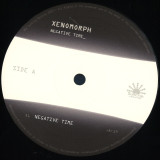
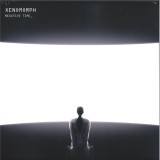
Negative Time! The new 12" vinyl EP of Xenomorph has a name that suits our global crisis. The best way to face these dark times is through the therapeutic powers of music. This 3-track 12" EP is the harbinger for the upcoming album "Netherverse" in early 2024. Fans of Mark Petrick know what to expect for sure. Goa-trance with a darker twist, but still filled with powerful melodies, unique kicks and psychedelic effects
The opening track, Negative Time, is a musical interpretation of zero point energy creation and quantum physics. Cutting, yet melodic goa-riffs take the listener on a journey backward in time through a mix of darkness leading to a positively melodic final. Danger on the High Seas is a deeper, more straightforward technoish track where light and dark are doing a wonderful mating dance between the crests of the high waves. The song was inspired by the mysterious vanishing of flight-19 in the bermuda triangle. The last track, Lost In An Old Junkyard, is known to the people that bought the Carpe Noctem compilation on Suntrip. But now it is available on vinyl as well as a different mix: the Tow Hook Mix! This track is the most classic Xenomorph track. Alienated tearing effects, mixed with exalted melodies.
Negative Time! The new 12" vinyl EP of Xenomorph has a name that suits our global crisis. The best way to face these dark times is through the therapeutic powers of music. This 3-track 12" EP is the harbinger for the upcoming album "Netherverse" in early 2024. Fans of Mark Petrick know what to expect for sure. Goa-trance with a darker twist, but still filled with powerful melodies, unique kicks and psychedelic effects
The opening track, Negative Time, is a musical interpretation of zero point energy creation and quantum physics. Cutting, yet melodic goa-riffs take the listener on a journey backward in time through a mix of darkness leading to a positively melodic final. Danger on the High Seas is a deeper, more straightforward technoish track where light and dark are doing a wonderful mating dance between the crests of the high waves. The song was inspired by the mysterious vanishing of flight-19 in the bermuda triangle. The last track, Lost In An Old Junkyard, is known to the people that bought the Carpe Noctem compilation on Suntrip. But now it is available on vinyl as well as a different mix: the Tow Hook Mix! This track is the most classic Xenomorph track. Alienated tearing effects, mixed with exalted melodies.
For the 11th installment of our ongoing Breaking New Soil series, we have an all-star compilation for you! First up is Patrick Siech, a core member of the BNS family from the beginning: „Basscamp“ has it all - it´s one of those late-night jams that locks the dancers into its irresistible groove after seconds and won´t ever let them go - we think it´s a timeless piece of classic, yet modern Techno. Next up is Petar Dundov, who really needs no introduction: „Feed“ is unmistakeably a classic Dundov production, yet it is more dark and hypnotizing than you would expect from the melody wizard. Oliver Deutschmann, who just remixed one of our recent releases, handed in "Physics", a relentless piece of raw Techno showcasing his signature production style! Next up, we have our friend Marco Effe returning to Break New Soil with a massive Warehouse Techno anthem! Then, P-Ben from France, one of our favorite artists of the moment, who continuously delivers one killer track after the other: We are more than happy to have his debut for BNS: „Wookit“! Enjoy „Breaking New Soil Vol. 11“!
- 1: The Fermi Paradox
- 2: Cosmic Void Spheres
- 3: Macrocosm + Microcosm
- 4: Spontaneous Synchronization
- 5: Hyperdimensional Physics
- 6: Esoteric Futuristic Visions
- 7: Geometric Congruence Vortex
Baptized with a name derived from astrophysical theories about dark matter and black holes, THE HOLEUM was formed in 2014 in Alicante, Spain. Founded by former members of NahemaH, Demised, quantumXperience, Hela, Neptunian Sun, and Priest of Dawn, the quintet set out to push the boundaries of heavy music and to intensify the emotional impact of darkness in sound. Their concept is both cosmic and sonic: “THE HOLEUM is related to the dark matter that forms the black holes in the universe. THE HOLEUM is not a black hole, but black holes are formed by The Holeum. That is the idea from which we extract our concept – we are a sonic and cosmic vision of the sublime.” With their third album “Ensis” (2025), the band continues its journey through experimental metal, death doom, melodic metal, and post-metal. This work is more than a continuation – it is a condensation and expansion of their previous soundscape. “Ensis” reveals itself as finely nuanced, challenging, yet at the same time profoundly sensitive and multifaceted. The songs unfold like cosmic landscapes where heaviness and melancholy meet subtle emotionality. The intensity remains palpable, but it is complemented by a deeper sensitivity that draws the listener into a fragile balance between harshness and delicacy. “Ensis” is an album that demands and touches at once – a work that makes the complexity of human existence audible in the mirror of the universe.
Heavyweight psychedelic improvisers EarthBall are back with their third and most monstrous record to date: ‘Outside Over There’, released on Upset The Rhythm (Nov 7th). Born from the haunted basements of Nanaimo, Canada, the quintet thrives on spontaneity, shaping improvisation into jagged hallucinations and ecstatic eruptions.
Recorded live-off-the-floor in 2024 in Jeremy, Izzy, and Kellen’s basement, and mixed by drummer John Brennan, ‘Outside Over There’ is an album that feels both summoned and inevitable. Each track lands with uncanny purpose, as if uncovered rather than written.
The opener, 100%, features a cameo from comedian and English icon Stewart Lee, who lent his blessing for the band to use a fragment of his stand-up. The album was mastered by John Dieterich (Deerhoof), with liner text contributed by longtime comrade John Olson (Wolf Eyes). Olson describes the album in his unmistakable style:
“This eight-track odyssey unfolds like a dreamscape, where whispered incantations brush against the shadowy fringes of the cosmos, and wild, Cézanne-inspired rock anthems erupt like geysers of color in the midst of a western warm and wet rain storm… culminating in the sprawling eleven minute masterpiece, ‘And The Music Shall Untune The Sky,’ aptly dubbed the Earth Crusher. A creation so utterly deconstructed and intertwined with the pulse of nature itself that if AI was called upon to conceive ‘Outside Over There’ anew, it would just spit back, “F.U. in Tree Font”. An enchanting invitation for even the flat-earthers to join the circle, if only just a little.”
EarthBall’s trajectory has been relentless. Their 2024 album ‘It’s Yours’ was praised by The Quietus as “fully aggressive and fully life-affirming,” and by The Wire as "a boisterous mind-melting album”. The band’s live double set LP ‘Actual Earth Music Vol. 1 & 2’ (2025) captured blistering performances: a performance opening for Wolf Eyes at the Fox Cabaret, and a Café OTO improvised throw-down featuring Chris Corsano and Steve Beresford. These releases on their own confirm them as one of Canada’s most vital experimental exports, not to mention the impressive self-released discography on their Bandcamp. The band’s reach has stretched far beyond their west coast roots with a UK tour May 2024, plus this past June, EarthBall closed Montreal’s Suoni Per Il Popolo Festival alongside Pulitzer Prize-winning composer Raven Chacon. This November they will perform at Le Guess Who? Festival in Utrecht, with a European tour to follow (tour dates below). Outside of EarthBall, each member carries their own torch. Jeremy Van Wyck, founding member of the legendary Shearing Pinx, has toured extensively, released over 100 records, and has been a vital force in the Vancouver and West Coast underground for the past 25 years. He and Isabel Ford (Izzy) play together not only in EarthBall, but also in Psychedelic Dirt, Shearing Pinx, Behaviours, and Crotch.
John Brennan collaborates widely, including recently with Endlings (Raven Chacon and John Dieterich), Evichen (Victoria Shen), Francesco Fonassi, Plan Your Future (with Greg Saunier of Deerhoof), Brennan/Corsano duo and Physics with John Dieterich. Kellen Maclaughlin performs with KVMP and Ora Corgan, while saxophonist Liam Murphy is a west coast staple, playing with the best across Vancouver Island and the mainland. On three of the tracks of ‘Outside Over There’, the band is joined by their comrade Justin Patterson, who also plays with Brennan in the duo Modale. This cross-pollination fuels EarthBall’s sound - a collective improvisation, psychically overdriven, and grinding into bloom.
Outside Over There’ is more than an album though, it is a ritual, a gathering of sound at the forest’s edge; where feedback, saxophone screams, and ecstatic vocals dissolve the boundary between chaos and clarity. EarthBall invite you into their circle, to share in the joyful terror of spontaneous creation. ‘Outside Over There’ will be released on November 7th through Upset The Rhythm digitally and as a limited blue-in-black vinyl LP.
- 01: The Lake Will Give You Everything You Need
- 02: Sounding The Voice (Feat. Koleka Putuma)
- 03: The Poetry Of The In-Between
- 04: Iqhude: A Tale Of Horns And Bones
- 05: I Am Because You Are
- 06: Portals
- 07: A Basic Guide To String Theory (Feat. Shane Cooper)
- 08: Everything Is Connected To Everything (Feat. Ben Lamar Gay &Amp; Gontse Makhene)
- 09: We Oscillate, We Modulate
- 10: Mothers
Pioneering Swiss trombonist and composer Andreas Tschopp marries contemporary jazz with South African horns and homemade ocarinas, creating a record quite unlike anything you've heard before. "What if We Align Our Breath" disregards the curvature of borders, genre, and time itself - tugging a thread through the history of wind instrumentation with ghostly agility.
At the heart of the record lie spiralling, bonelike kudu (antelope) horns - instruments that have lent their stirring calls to indigenous South African rituals and signalling systems for millennia. These horns are clustered, harmonised and stretched beyond their godly usage by Tschopp - his extended techniques coaxing an array of melancholy, playful voices to canter through the album.
Flourishes of trombone, alpine flutes and a stellar supporting cast on double bass (Shane Cooper), cornet (Ben LaMar Gay), udu drums (Gontse Makhene) and spoken word (Koleka Putuma) bring groove, countermelody and a sense of earthy introspection to the proceedings. This is inconceivable music: a sighing tapestry of brass, clay and bone that hints at some preconscious connectedness, tracing figures that rejoice, exhale and embrace outside of time.
Recommended if you like Francis Bebey, quantum physics, peat bogs.
Heavyweight psychedelic improvisers EarthBall are back with their third and most monstrous record to date: ‘Outside Over There’, released on Upset The Rhythm (Nov 7th). Born from the haunted basements of Nanaimo, Canada, the quintet thrives on spontaneity, shaping improvisation into jagged hallucinations and ecstatic eruptions.
Recorded live-off-the-floor in 2024 in Jeremy, Izzy, and Kellen’s basement, and mixed by drummer John Brennan, ‘Outside Over There’ is an album that feels both summoned and inevitable. Each track lands with uncanny purpose, as if uncovered rather than written.
The opener, 100%, features a cameo from comedian and English icon Stewart Lee, who lent his blessing for the band to use a fragment of his stand-up. The album was mastered by John Dieterich (Deerhoof), with liner text contributed by longtime comrade John Olson (Wolf Eyes). Olson describes the album in his unmistakable style:
“This eight-track odyssey unfolds like a dreamscape, where whispered incantations brush against the shadowy fringes of the cosmos, and wild, Cézanne-inspired rock anthems erupt like geysers of color in the midst of a western warm and wet rain storm… culminating in the sprawling eleven minute masterpiece, ‘And The Music Shall Untune The Sky,’ aptly dubbed the Earth Crusher. A creation so utterly deconstructed and intertwined with the pulse of nature itself that if AI was called upon to conceive ‘Outside Over There’ anew, it would just spit back, “F.U. in Tree Font”. An enchanting invitation for even the flat-earthers to join the circle, if only just a little.”
EarthBall’s trajectory has been relentless. Their 2024 album ‘It’s Yours’ was praised by The Quietus as “fully aggressive and fully life-affirming,” and by The Wire as "a boisterous mind-melting album”. The band’s live double set LP ‘Actual Earth Music Vol. 1 & 2’ (2025) captured blistering performances: a performance opening for Wolf Eyes at the Fox Cabaret, and a Café OTO improvised throw-down featuring Chris Corsano and Steve Beresford. These releases on their own confirm them as one of Canada’s most vital experimental exports, not to mention the impressive self-released discography on their Bandcamp. The band’s reach has stretched far beyond their west coast roots with a UK tour May 2024, plus this past June, EarthBall closed Montreal’s Suoni Per Il Popolo Festival alongside Pulitzer Prize-winning composer Raven Chacon. This November they will perform at Le Guess Who? Festival in Utrecht, with a European tour to follow (tour dates below). Outside of EarthBall, each member carries their own torch. Jeremy Van Wyck, founding member of the legendary Shearing Pinx, has toured extensively, released over 100 records, and has been a vital force in the Vancouver and West Coast underground for the past 25 years. He and Isabel Ford (Izzy) play together not only in EarthBall, but also in Psychedelic Dirt, Shearing Pinx, Behaviours, and Crotch.
John Brennan collaborates widely, including recently with Endlings (Raven Chacon and John Dieterich), Evichen (Victoria Shen), Francesco Fonassi, Plan Your Future (with Greg Saunier of Deerhoof), Brennan/Corsano duo and Physics with John Dieterich. Kellen Maclaughlin performs with KVMP and Ora Corgan, while saxophonist Liam Murphy is a west coast staple, playing with the best across Vancouver Island and the mainland. On three of the tracks of ‘Outside Over There’, the band is joined by their comrade Justin Patterson, who also plays with Brennan in the duo Modale. This cross-pollination fuels EarthBall’s sound - a collective improvisation, psychically overdriven, and grinding into bloom.
Outside Over There’ is more than an album though, it is a ritual, a gathering of sound at the forest’s edge; where feedback, saxophone screams, and ecstatic vocals dissolve the boundary between chaos and clarity. EarthBall invite you into their circle, to share in the joyful terror of spontaneous creation. ‘Outside Over There’ will be released on November 7th through Upset The Rhythm digitally and as a limited blue-in-black vinyl LP.
- A1: 100%
- A2: Helsinki
- A3: Outside Over There
- A4: Seeing Docks Unlock
- A5: Hellfire Relations
- B1: Where I Come From
- B2: Behind The Mall
- B3: And Music Shall Untune The Sky
Heavyweight psychedelic improvisers EarthBall are back with their third and most monstrous record to date: ‘Outside Over There’, released on Upset The Rhythm (Nov 7th). Born from the haunted basements of Nanaimo, Canada, the quintet thrives on spontaneity, shaping improvisation into jagged hallucinations and ecstatic eruptions.
Recorded live-off-the-floor in 2024 in Jeremy, Izzy, and Kellen’s basement, and mixed by drummer John Brennan, ‘Outside Over There’ is an album that feels both summoned and inevitable. Each track lands with uncanny purpose, as if uncovered rather than written.
The opener, 100%, features a cameo from comedian and English icon Stewart Lee, who lent his blessing for the band to use a fragment of his stand-up. The album was mastered by John Dieterich (Deerhoof), with liner text contributed by longtime comrade John Olson (Wolf Eyes). Olson describes the album in his unmistakable style:
“This eight-track odyssey unfolds like a dreamscape, where whispered incantations brush against the shadowy fringes of the cosmos, and wild, Cézanne-inspired rock anthems erupt like geysers of color in the midst of a western warm and wet rain storm… culminating in the sprawling eleven minute masterpiece, ‘And The Music Shall Untune The Sky,’ aptly dubbed the Earth Crusher. A creation so utterly deconstructed and intertwined with the pulse of nature itself that if AI was called upon to conceive ‘Outside Over There’ anew, it would just spit back, “F.U. in Tree Font”. An enchanting invitation for even the flat-earthers to join the circle, if only just a little.”
EarthBall’s trajectory has been relentless. Their 2024 album ‘It’s Yours’ was praised by The Quietus as “fully aggressive and fully life-affirming,” and by The Wire as "a boisterous mind-melting album”. The band’s live double set LP ‘Actual Earth Music Vol. 1 & 2’ (2025) captured blistering performances: a performance opening for Wolf Eyes at the Fox Cabaret, and a Café OTO improvised throw-down featuring Chris Corsano and Steve Beresford. These releases on their own confirm them as one of Canada’s most vital experimental exports, not to mention the impressive self-released discography on their Bandcamp. The band’s reach has stretched far beyond their west coast roots with a UK tour May 2024, plus this past June, EarthBall closed Montreal’s Suoni Per Il Popolo Festival alongside Pulitzer Prize-winning composer Raven Chacon. This November they will perform at Le Guess Who? Festival in Utrecht, with a European tour to follow (tour dates below). Outside of EarthBall, each member carries their own torch. Jeremy Van Wyck, founding member of the legendary Shearing Pinx, has toured extensively, released over 100 records, and has been a vital force in the Vancouver and West Coast underground for the past 25 years. He and Isabel Ford (Izzy) play together not only in EarthBall, but also in Psychedelic Dirt, Shearing Pinx, Behaviours, and Crotch.
John Brennan collaborates widely, including recently with Endlings (Raven Chacon and John Dieterich), Evichen (Victoria Shen), Francesco Fonassi, Plan Your Future (with Greg Saunier of Deerhoof), Brennan/Corsano duo and Physics with John Dieterich. Kellen Maclaughlin performs with KVMP and Ora Corgan, while saxophonist Liam Murphy is a west coast staple, playing with the best across Vancouver Island and the mainland. On three of the tracks of ‘Outside Over There’, the band is joined by their comrade Justin Patterson, who also plays with Brennan in the duo Modale. This cross-pollination fuels EarthBall’s sound - a collective improvisation, psychically overdriven, and grinding into bloom.
Outside Over There’ is more than an album though, it is a ritual, a gathering of sound at the forest’s edge; where feedback, saxophone screams, and ecstatic vocals dissolve the boundary between chaos and clarity. EarthBall invite you into their circle, to share in the joyful terror of spontaneous creation. ‘Outside Over There’ will be released on November 7th through Upset The Rhythm digitally and as a limited blue-in-black vinyl LP.
After a ten-year absence that left a palpable void in the hearts of millennial emo kids, MOTION CITY SOUNDTRACK are finally back-and yes, it"s everything we hoped for. The Same Old Wasted Wonderful World feels like coming home: a dizzying, emotionally articulate blast of guitar-laced pop-punk that reminds us why this band meant so much in the first place. It"s a sonic time machine, sure, but it never gets stuck in the past. Instead, it builds on it-older, a little bruised, but somehow more alive. Justin Pierre"s voice still wobbles gloriously between a scream and a sigh, only now it carries the weight of experience, not just anxiety. Rather than reinventing themselves, MOTION CITY SOUNDTRACK double down on what they"ve always done best: big hooks, bigger feelings, and that perfect tightrope walk between chaos and control. Tracks like "Particle Physics" (with Patrick Stump of Fallout Boy) and "Your Days Are Numbered" (featuring Mat Kerekes of Citizen) channel the kind of clarity that only comes after surviving your own worst years. In a world drowning in lazy nostalgia, The Same Old Wasted Wonderful World is a rare and welcome return that feels less like a reunion and more like a long-overdue continuation.
- Some Wear A Dark Heart
- She Is Afraid
- Particle Physics (Feat. Patrick Stump)
- You Know Who The Fuck We Are
- Melancholia
- Your Days Are Numbered (Feat. Mat Kerekes)
- Downer
- Mi Corazon
- Bloodline
- Things Like This (Feat. Sincere Engineer)
- The Same Old Wasted Wonderful World
BLUE MARBLE Vinyl[23,49 €]
After a ten-year absence that left a palpable void in the hearts of millennial emo kids, MOTION CITY SOUNDTRACK are finally back-and yes, it"s everything we hoped for. The Same Old Wasted Wonderful World feels like coming home: a dizzying, emotionally articulate blast of guitar-laced pop-punk that reminds us why this band meant so much in the first place. It"s a sonic time machine, sure, but it never gets stuck in the past. Instead, it builds on it-older, a little bruised, but somehow more alive. Justin Pierre"s voice still wobbles gloriously between a scream and a sigh, only now it carries the weight of experience, not just anxiety. Rather than reinventing themselves, MOTION CITY SOUNDTRACK double down on what they"ve always done best: big hooks, bigger feelings, and that perfect tightrope walk between chaos and control. Tracks like "Particle Physics" (with Patrick Stump of Fallout Boy) and "Your Days Are Numbered" (featuring Mat Kerekes of Citizen) channel the kind of clarity that only comes after surviving your own worst years. In a world drowning in lazy nostalgia, The Same Old Wasted Wonderful World is a rare and welcome return that feels less like a reunion and more like a long-overdue continuation.
Breaking new ground at The Third Room, we are introducing our first full EP by a guest artist, setting the stage for more to come.
Since quantum mechanics arose from classical physics' failure to explain microscopic phenomena, Berlin's exceptional creative mind Arthur Robert pays tribute to the interaction of little entities that can result in the release of colossal power and provide answers for questions older than the universe itself with his Particle Accelerator EP on The Third Room.
Genuine, dynamic techno that defines itself through crisp sound design, memorable textures, and highly compressed, sometimes distorted drum arrangements makes this piece of music a profoundly soundscaped lecture in four classes that gets its final, emotional touch from either melodic compositions or disruptive beeps. Creating those fascinating pieces within fast-paced and hard-hitting club sounds is one of Robert's trademarks, making him a hugely exciting producer.
Out from September 6th and available on all platforms and always remember - the whole is more than the accumulation of its units.
2024 The Third Room
Mastering by Ahmet Sisman (The Third Room Studios)
Artwork by Daniel Bornmann & Lennard Makosch (STUEDIO.XYZ)
returning, dream’ is the second album from Paradise Cinema – the‘Fourth World’ inspired project led by multi-instrumentalist Jack Wyllie (Portico Quartet/Szun Waves). While Wyllie’s other projects move between tightknit electronica, widescreen minimalism and improvised ambient sounds, ‘returning, dream’ contains nods to Jon Hassell, Terry Riley, Don Cherry and Midori Takada as well as more contemporary electronic, ambient and non-western music and even draws inspiration from physics and science fiction.
The first, eponymous, Paradise Cinema record, released in 2020, was recorded in Dakar (Wyllie lived in Senegal for a while in the late 2010s) and featured the dense rhythms of Mbalax music combining with Wyllie’s textural saxophone and synth playing, but here he takes a step into the unknown:
The music is no longer built primarily around the rumbling
propulsiveness of Mbalax, but takes its inspiration from the Many-Worlds Interpretation of quantum mechanics, which suggests that there are many different worlds that branch off from our own. Wyllie explains: “It is an imagining of what music could be like in a different time and space, ancient and futuristic from everywhere and nowhere at once. I was listening to a lot of physics podcasts when I created this record. I loved the many-worlds interpretation of quantum mechanics; about the multiple paths we are taking each time a quantum decision is taken. The different worlds then splitting off like branches on a tree. I could imagine different histories and worlds and multiple versions of myself, others and even other societies existing. In this album I’ve dug into these ideas andattempted to make music that would come from those different spaces, trying to poke my finger through to the other selves and stories. Effectively a form of composed science fiction, the music is an idea of what might be occurring or have occurred on a branch of the tree in a different world. But I like to think the tracks might actually have been composed somewhere or sometime.”
Created in London by Jack Wyllie with additional recordings from Dakar and Sydney, ‘returning, dream’ blends sounds that do not typically live together. It features Khadim Mbaye (sabar drums) and Tons Sambe (tama drums) who provide the dense Sengalese rhythms, plus Szun Waves colleague Laurence Pike, also on drums.
returning, dream’ is the second album from Paradise Cinema – the‘Fourth World’ inspired project led by multi-instrumentalist Jack Wyllie (Portico Quartet/Szun Waves). While Wyllie’s other projects move between tightknit electronica, widescreen minimalism and improvised ambient sounds, ‘returning, dream’ contains nods to Jon Hassell, Terry Riley, Don Cherry and Midori Takada as well as more contemporary electronic, ambient and non-western music and even draws inspiration from physics and science fiction.
The first, eponymous, Paradise Cinema record, released in 2020, was recorded in Dakar (Wyllie lived in Senegal for a while in the late 2010s) and featured the dense rhythms of Mbalax music combining with Wyllie’s textural saxophone and synth playing, but here he takes a step into the unknown:
The music is no longer built primarily around the rumbling
propulsiveness of Mbalax, but takes its inspiration from the Many-Worlds Interpretation of quantum mechanics, which suggests that there are many different worlds that branch off from our own. Wyllie explains: “It is an imagining of what music could be like in a different time and space, ancient and futuristic from everywhere and nowhere at once. I was listening to a lot of physics podcasts when I created this record. I loved the many-worlds interpretation of quantum mechanics; about the multiple paths we are taking each time a quantum decision is taken. The different worlds then splitting off like branches on a tree. I could imagine different histories and worlds and multiple versions of myself, others and even other societies existing. In this album I’ve dug into these ideas andattempted to make music that would come from those different spaces, trying to poke my finger through to the other selves and stories. Effectively a form of composed science fiction, the music is an idea of what might be occurring or have occurred on a branch of the tree in a different world. But I like to think the tracks might actually have been composed somewhere or sometime.”
Created in London by Jack Wyllie with additional recordings from Dakar and Sydney, ‘returning, dream’ blends sounds that do not typically live together. It features Khadim Mbaye (sabar drums) and Tons Sambe (tama drums) who provide the dense Sengalese rhythms, plus Szun Waves colleague Laurence Pike, also on drums.
- A1: Ringa Ringa (The Old Pandemic Folk Song) (Feat. The Mediaeval Baebes)
- A2: Day One (Feat. Dina Ipavic)
- A3: Are You Alive? (Feat. Penelope Isles)
- B1: You Are The Frequency (Feat. The Little Pest)
- B2: The New Abnormal
- C1: Home (Feat. Anna B Savage)
- C2: Dirty Rat
- C3: Requiem For The Pre-Apocalypse
- D1: What A Surprise (Feat. The Little Pest)
- D2: Moon Princess (Feat. Coppe)
Black Vinyl[31,05 €]
2 x Solid White LP, 5mm spine Sleeve UV Gloss Finish, 2x Heavy Weight Printed Inner Sleeve UV Gloss finish, marketing sticker.
Legendary electronic music duo Orbital return Early 2023 with new album “Optical Delusion”, the Hartnoll brothers first studio album since 2018’s Monster’s Exist. Recorded in Orbital’s Brighton studio, “Optical Delusion” includes contributions from Sleaford Mods, Penelope Isles, Anna B Savage, The Little Pest, Dina Ipavic, Coppe, and perhaps most surprisingly, The Medieval Baebes.
Earlier this year, Orbital celebrated their storied history with “30 Something” which, unlike other Best Of’s, contains reworks, remakes, remixes and re-imaginings of landmark Orbital tracks including “Chime”, “Belfast”, “Halcyon”, “Satan”, and “The Box”
SHORT BIOG:
“A human being experiences himself, his thoughts and feelings as something separate from the rest of humanity – a kind of optical delusion of his consciousness. This delusion is a kind of prison for us, restricting us to our personal desires and to affection for a few persons nearest to us. Our task must be to free ourselves from this prison…”
You many have seen this quote attributed to Albert Einstein on social media, the archetypal Smartest Guy Ever apparently having an out-of-character religious epiphany. It certainly leapt out at Paul Hartnoll of Orbital who spotted it in Michael Pollan’s 2018 book How to Change Your Mind: What the New Science of Psychedelics Teaches Us About Consciousness, Dying, Addiction, Depression and Transcendence.
“As soon as I saw ‘optical delusion’ I thought Oh hey, that’s the album title,” says Paul. “It just seemed to say so much about how people construct their own realities, how we see patterns that aren’t there, how we see what we want to see.
“But it’s actually a misquote. He never quite said that. In the German original what he’s really saying is that human experience is as relative as physics. Wouldn’t it be good if we could accept that, and find a kind of universal theory of everything for the human race? Then you look at everything from history to art to your Twitter feed and you think yeah, that’s what we’re all trying to do all of the time…”
Hence ‘Optical Delusion’, the tenth original Orbital album and the latest in a burst of renewed post-pandemic creativity for two brothers who’ve stayed at the top of their game longer than anyone from the post-1988 Class of Acid House.
Now with ‘Optical Delusion’ the Hartnolls dig deeper into the unquiet psyche of our increasingly surreal and disordered world. Sketched out partly during lockdown but fully recorded in the uncertain After Times, the album summons up conflicting emotions and sometimes beguiling images from years when the science fiction doomsdays that the Hartnolls watched on TV as kids finally came true. There are mesmeric tracks with names like ‘The New Abnormal’ and ‘Requiem For The Pre-Apocalypse’ and ‘Day One’. But there are also straight-up bangers and ethereal cosmic dreams, abstract sound wars and deeply human songs of separation and loss.
And it all starts with a bang. Lead single ‘Dirty Rat’, an outright Fall-meets-Front-242 class rant with vocals by Sleaford Mods mob orator Jason Williamson, harks right back to the Hartnolls’ days of politicised anarcho-squatpunk. It began as a remix swap (Orbital did the Sleafords’ ‘I Don’t Rate You’) and morphed into a comic, brutal, bass-driven harangue not so much against our rulers but at the petty, mean-spirited, frightened, Mail-reading voters who put them there: the people who are “blaming everyone in hospital/blaming everyone at the bottom of the English Channel/blaming everyone who doesn’t look like a fried animal.”
Also key to the album is opening track ‘Ringa Ringa (The Old Pandemic Folk Song)’ which returns to an Orbital truism, that time always becomes a loop. This chugging, cyclical Orbital groove gives way to an unnerving past-meets-present timeslip fit for ‘Sapphire And Steel’ as goth maenads The Mediaeval Baebes materialise to sing ‘Ring O’Roses’ – the innocent nursery rhyme whose roots are in the Black Death.
“I’ve always liked folk music and mediaeval sounds,” says Paul, himself an occasional Morris dancer. “I had the basis of that track and I wanted to spin it off somehow.” Trawling his archives he stumbled on The Mediaeval Baebes’ version of ‘Ring O’Roses’ “and my hackles just went up. I was like, my God, this is the original pandemic folk song.”
?his being Orbital, there are collaborations galore on the album, the roles once played by Alison Goldfrapp, Lady Leshurr or David Gray now filled by new talents. London singer-songwriter Anna B Savage contributes a compellingly fragile, Anohni-like vocal to ‘Home’, in which nature reclaims the scorched and vacant mega-cities. ‘Day One’ is a pulsing techno track featuring the singer Dina Ipavic. Paul got in touch with her after working on a score for a sculpture show of giant robotic installations by his friend Giles Walker during the pandemic. First Paul cut up his own score and Ipavic’s vocals on the track The Crane, which appears on the deluxe version of the album. Then he thought, Why not work with her for real? The result is school of ‘Belfast’, a bassy dreamscape with vocalised clouds billowing above.
The pensive ‘Are You ?live?’ adds to the Orbital product range of existential questions (‘Are We Here?’, ‘Where Is It Going?’) in collaboration Bella Union signings Penelope Isles, AKA brother and sister act Lily and Jack Wolter. “They’re our studio mates, they work upstairs!” says Paul happily. “And they’ve both got amazing voices.”
But Orbital are Orbital and never far from the dancefloor. “Eventually the more abrasive bits came back into the fold…” ‘You Are The Frequency’, first of two tracks to feature mysterious vocalist The Little Pest, surrounds the listener with warped voices ordering you to the dancefloor (Phil: “we wanted the idea that the music is kind of absorbing you”). And the second, the sinister ‘What A Surprise’, traps you in a paranoid electronic hall of mirrors.
In another nod to Orbital’s resurgent past the cover artwork once again comes from fine art painter John Greenwood, creator of fantastical grotesques for the covers of ‘Snivilisation’, ‘In Sides’ and Orbital’s most recent album, 2018’s ‘Monsters Exist’. Orbital had just had a slick Mark Farrow cover for ‘30 Something’ – this is a return to the overripe and bulbous techno-organic constructions that somehow express Orbital’s own uncontrollably fertile sound.
There are gaps in the future that Orbital are desperate to fill too; there will be tours and festivals and rooms and fields full of people. Those long paralysed months when we had little to look forward to but a Zoom DJ set made Paul and Phil appreciate the things that make life worth living.
- A1: Ringa Ringa (The Old Pandemic Folk Song) (Feat. The Mediaeval Baebes)
- A2: Day One (Feat. Dina Ipavic)
- A3: Are You Alive? (Feat. Penelope Isles)
- B1: You Are The Frequency (Feat. The Little Pest)
- B2: The New Abnormal
- C1: Home (Feat. Anna B Savage)
- C2: Dirty Rat
- C3: Requiem For The Pre-Apocalypse
- D1: What A Surprise (Feat. The Little Pest)
- D2: Moon Princess (Feat. Coppe)
White Vinyl[33,24 €]
DOUBLE BLACK LP : 2 x 140 G Black Vinyl , Sleeve & 2 x Heavy Weight Printed Inner with UV Gloss Finish
Legendary electronic music duo Orbital return Early 2023 with new album “Optical Delusion”, the Hartnoll brothers first studio album since 2018’s Monster’s Exist. Recorded in Orbital’s Brighton studio, “Optical Delusion” includes contributions from Sleaford Mods, Penelope Isles, Anna B Savage, The Little Pest, Dina Ipavic, Coppe, and perhaps most surprisingly, The Medieval Baebes.
Earlier this year, Orbital celebrated their storied history with “30 Something” which, unlike other Best Of’s, contains reworks, remakes, remixes and re-imaginings of landmark Orbital tracks including “Chime”, “Belfast”, “Halcyon”, “Satan”, and “The Box”
SHORT BIOG:
“A human being experiences himself, his thoughts and feelings as something separate from the rest of humanity – a kind of optical delusion of his consciousness. This delusion is a kind of prison for us, restricting us to our personal desires and to affection for a few persons nearest to us. Our task must be to free ourselves from this prison…”
You many have seen this quote attributed to Albert Einstein on social media, the archetypal Smartest Guy Ever apparently having an out-of-character religious epiphany. It certainly leapt out at Paul Hartnoll of Orbital who spotted it in Michael Pollan’s 2018 book How to Change Your Mind: What the New Science of Psychedelics Teaches Us About Consciousness, Dying, Addiction, Depression and Transcendence.
“As soon as I saw ‘optical delusion’ I thought Oh hey, that’s the album title,” says Paul. “It just seemed to say so much about how people construct their own realities, how we see patterns that aren’t there, how we see what we want to see.
“But it’s actually a misquote. He never quite said that. In the German original what he’s really saying is that human experience is as relative as physics. Wouldn’t it be good if we could accept that, and find a kind of universal theory of everything for the human race? Then you look at everything from history to art to your Twitter feed and you think yeah, that’s what we’re all trying to do all of the time…”
Hence ‘Optical Delusion’, the tenth original Orbital album and the latest in a burst of renewed post-pandemic creativity for two brothers who’ve stayed at the top of their game longer than anyone from the post-1988 Class of Acid House.
Now with ‘Optical Delusion’ the Hartnolls dig deeper into the unquiet psyche of our increasingly surreal and disordered world. Sketched out partly during lockdown but fully recorded in the uncertain After Times, the album summons up conflicting emotions and sometimes beguiling images from years when the science fiction doomsdays that the Hartnolls watched on TV as kids finally came true. There are mesmeric tracks with names like ‘The New Abnormal’ and ‘Requiem For The Pre-Apocalypse’ and ‘Day One’. But there are also straight-up bangers and ethereal cosmic dreams, abstract sound wars and deeply human songs of separation and loss.
And it all starts with a bang. Lead single ‘Dirty Rat’, an outright Fall-meets-Front-242 class rant with vocals by Sleaford Mods mob orator Jason Williamson, harks right back to the Hartnolls’ days of politicised anarcho-squatpunk. It began as a remix swap (Orbital did the Sleafords’ ‘I Don’t Rate You’) and morphed into a comic, brutal, bass-driven harangue not so much against our rulers but at the petty, mean-spirited, frightened, Mail-reading voters who put them there: the people who are “blaming everyone in hospital/blaming everyone at the bottom of the English Channel/blaming everyone who doesn’t look like a fried animal.”
Also key to the album is opening track ‘Ringa Ringa (The Old Pandemic Folk Song)’ which returns to an Orbital truism, that time always becomes a loop. This chugging, cyclical Orbital groove gives way to an unnerving past-meets-present timeslip fit for ‘Sapphire And Steel’ as goth maenads The Mediaeval Baebes materialise to sing ‘Ring O’Roses’ – the innocent nursery rhyme whose roots are in the Black Death.
“I’ve always liked folk music and mediaeval sounds,” says Paul, himself an occasional Morris dancer. “I had the basis of that track and I wanted to spin it off somehow.” Trawling his archives he stumbled on The Mediaeval Baebes’ version of ‘Ring O’Roses’ “and my hackles just went up. I was like, my God, this is the original pandemic folk song.”
?his being Orbital, there are collaborations galore on the album, the roles once played by Alison Goldfrapp, Lady Leshurr or David Gray now filled by new talents. London singer-songwriter Anna B Savage contributes a compellingly fragile, Anohni-like vocal to ‘Home’, in which nature reclaims the scorched and vacant mega-cities. ‘Day One’ is a pulsing techno track featuring the singer Dina Ipavic. Paul got in touch with her after working on a score for a sculpture show of giant robotic installations by his friend Giles Walker during the pandemic. First Paul cut up his own score and Ipavic’s vocals on the track The Crane, which appears on the deluxe version of the album. Then he thought, Why not work with her for real? The result is school of ‘Belfast’, a bassy dreamscape with vocalised clouds billowing above.
The pensive ‘Are You ?live?’ adds to the Orbital product range of existential questions (‘Are We Here?’, ‘Where Is It Going?’) in collaboration Bella Union signings Penelope Isles, AKA brother and sister act Lily and Jack Wolter. “They’re our studio mates, they work upstairs!” says Paul happily. “And they’ve both got amazing voices.”
But Orbital are Orbital and never far from the dancefloor. “Eventually the more abrasive bits came back into the fold…” ‘You Are The Frequency’, first of two tracks to feature mysterious vocalist The Little Pest, surrounds the listener with warped voices ordering you to the dancefloor (Phil: “we wanted the idea that the music is kind of absorbing you”). And the second, the sinister ‘What A Surprise’, traps you in a paranoid electronic hall of mirrors.
In another nod to Orbital’s resurgent past the cover artwork once again comes from fine art painter John Greenwood, creator of fantastical grotesques for the covers of ‘Snivilisation’, ‘In Sides’ and Orbital’s most recent album, 2018’s ‘Monsters Exist’. Orbital had just had a slick Mark Farrow cover for ‘30 Something’ – this is a return to the overripe and bulbous techno-organic constructions that somehow express Orbital’s own uncontrollably fertile sound.
There are gaps in the future that Orbital are desperate to fill too; there will be tours and festivals and rooms and fields full of people. Those long paralysed months when we had little to look forward to but a Zoom DJ set made Paul and Phil appreciate the things that make life worth living.
The story about the lost recordings of Ghia continues: Following the recently released "At The Hilton" single, our label is extremely proud to present "Curaçao Blue", the band's first full-length album. And it is simply mind-blowing, to say the least! The LP features 10 unreleased tracks in a similar Balearic vein as featured on the single.
Incredibly, it was only just a few months ago that these tracks were rediscovered on some old tapes by band members Lutz Boberg and Frank Simon. Could anyone imagine that two physics students from a small German town could create such beautiful, thrilling music in their home studio? Although the technical aspects in the creation of the band's earliest tracks may have been straightforward, the outcome is high-quality, creative, modern jazz-funk, with one step in the electro-funk genre due to the use of a drum machine and synthesizer basslines. The album features mostly 4-track recordings, based mainly on the musicians' weapons of choice: a DX21 keyboard (later updated to the legendary DX7) and a guitar. Many things had to be done live in just one take, though the artists were unafraid of using overdubbing techniques to weave their instrumental journeys. The DIY aesthetics just add more beauty and uniqueness to the songs and compositions, and the result is an extremely harmonic work of undeniable musicality. Ghia delivers Balearic jazz-funk at its finest.
Though the music was recorded in Germany, Ghia had a true relationship with the Balearic region and effortlessly applied the vibes to their compositions. As a side note, one track on their earliest demo tapes was called "3 AM at Moëf Gaga" and we did not know what it meant. The band explained that Moëf Gaga is a nightclub on the Spanish coast that is actually still active today. Boberg and Simon, the two original band members of Ghia, visited the club in the early 80s and spent their holiday close to the sea. With their music, they intended to create a summery vibe, capturing a relaxed and soulful view of the seashore, likely with a drink in hand... Perhaps a Blue Curaçao?
The album starts with a revised version of the title track. The drums in this take are much punchier, and we thought that it would fit just perfectly as an introduction. We continue with the already classic "Down At The Hilton" that was featured on the single, but like us, we are sure you could happily listen to this track on repeat. Next up, "Jump In The Water" opens with a catchy delayed melody, which develops into another perfect jazz-funk piece with an extended guitar solo. Another remarkable song might be "In The Fast Lane". As the name suggests, an uptempo number, now with an electro-funk beat combined with speedy keyboard solos that almost sounds like a marimba. On side B, the album keeps the relaxed seaside vibes flowing. To round out the album, we are treated to two pieces that originated after the return home, with memories of the Spanish coast fading but still lingering, likely recorded between 1986 and 1988. Both are instrumental versions of songs to be used later for studio sessions with their new band member, singer Lisa Ohm (who you will hear on Ghia's next album!). On "Crystal Silence In Dub" we get a perfect downtempo groove, positively reminding us of the sound of the 1980s UK funk scene. The album ends with "Keep Your House In Disorder", here as an earlier, rougher, and funkier take than on the final vocal version, which could be found on the B-side of the "What's Your Voodoo" single.
We hope you love this album as much as we do! Nothing like this has yet been released out of Germany. We hardly can recall any privately produced, home recorded jazz-funk/fusion from the 1980s as free, creative, and uninhibited as Ghia's Curaçao Blue. The playful and creative approach, coupled with those nostalgic tones should make this LP an essential pick for any record collection, whether you are a DJ, a home listener, a music lover, or a modern jazz-funk/synth-funk aficionado.
The album is out now on The Outer Edge, the new label by record collector DJ Scientist, aka John Raincoatman. We also want to thank Frederic Stader for his awesome work mastering and sound restoration of the material on this LP.
Giorgia Angiuli’s 13 track album ‘Quantum Love’ on her UNITED label combines and contrasts fast, insistent dance beats with her signature melodic synths and dreamy lyrics; ‘an eclectic work including piano downtempo tracks and techno melodic tracks with ethereal vocals’ (Angiuli).
The multi-talented live artist/DJ/producer/vocalist/lyricist and studio-building tech wizard used lockdown as a creative nexus. Einstein’s ‘Imagination is more important than knowledge’ led her to explore quantum physics, while her first India tour inspired ongoing interest in sound meditation and philosophy, culminating in the LP.
‘Quantum Love’ has many moods and speeds; physics and philosophy, contemplative and full-on fast, sweet vocals, meaningful lyrics or purely instrumental, it’s all there. ‘’Quantum Love’ is my inner soundtrack to my recent transformation, summarized in the following sentences: we are made of energy, everything is vibration. We are each our own placebo, happiness can be a choice, we have all the elements inside us for the right path. Nature can teach us everything.’ (Giorgia Angiuli)
Press:
DJ Mag Feature
Flow Music Interview
DJ Mag Post
Four Four Magazine News Piece
DJ Feedback:
Sasha (Last Night On Earth) - solid!
Guy Mantzur (Kompakt, Bedrock, Lost & Found, Sudbeat) - love them all
Anthony Pappa (Selador) - The Timo Maas Remix is excellent.
AFFKT (Sincopat) - Superb remixes!
Fur Coat (Oddity / Delete) - Nice Armonica and Glowal remixes
Israel Sunshine (Fur Coat / Oddity) - Great job! digging all tracks specially Timo and Glowal
Animal Trainer (Mobilee / Stil Vor Talent) - fab remix by Armonica!
Dee Montero (Knee Deep in Sound, Selador Recordings, Anjunadeep) - Timo Maas mix for me
Siavash (You Plus One) - Glowal mix takes the cake in this ep
Chris Fortier (Thoughtless / Sullivan Room / Balance) - super super
Pisetzky (JUST THIS / Last Night On Earth / Oddity) - amazing giu
Sinca (Anjunadeep) - Great remix ep
James Trystan (Suara / Bedrock) - Feeling this!!! Timo Maas for me
Henri Bergmann (Automatik) - armonica always!
Cesar Romero (Simply City) nice!
juSt b (Bedrock / Configurations of Self) nice release, love the key work and vox.
Nhii (No Human Is Illegal) (Sounds of Khemit / Stil Vor / Kindisch) - Timo Maas remix right up my alley!
Runhild Gammelsæter and Lasse Marhaug are two Norwegian musicians/sound artists. Both started in the early 1990s music underground and have worked in many constellations with a wide range of collaborators.
Despite knowing each other for a long time, Gammelsæter and Marhaug’s first collaborative work was the “Quantum Entanglement” LP in 2014. The album ignited a collective spark that both wanted to pursue further. Still, other commitments got in the way, and the project lay dormant until Stephen O’Malley, and Greg Anderson invited them to open for Sunn O))) for a special gig in the St. James Church of Culture in Oslo in the autumn of 2019. The two gathered for a long series of rehearsals, and after the successful performance, it was clear that it was time to start working on new compositions and recordings. That process initiated in late 2019 and continued to early 2021, encompassing before and after the world went through the lockdown. The result of this long development to be heard accumulated upon their new album “Higgs Boson” on Ideologic Organ Music.
Throughout the profound process of creating “Higgs Boson”, Gammelsæter and Marhaug drew inspiration from various subjects and artists. For Marhaug, it was concepts informed by the structuralist experimental cinema of Japanese directors Takashi Ito and Toshio Matsumoto, futurist worlds of French comic book artists Philippe Druillet and Jean Moebius Giraud, landscape photography of Fay Godwin, Kåre Kivijärvi, and Tamiko Nishimura, amongst others.
It became a metaphysical juxtaposition involving Gammelsaeter’s research and lyrical ideas based on several seemingly unrelated principles. A process of association inspired by “the Glass Bead Game” by Herman Hesse. The discovery of the Higgs Boson as a confirmation of the physical universe. The work of Ernst Schrödinger on the uncertainty principle. The four forces of physics. The Force. Helplessness under armed forces - as the war sailors in World War II. The influence of magic as expressed in tarot.
Gammelsæter experiments with a boundary involving the thresholds amongst various states of focus and legibility by forensic experimentation with techniques such as exclusive expression of consonants, syllabic repetition, retrograde text vocalisations and multi-lingual layering. Her vocal inspirational sources include Sidsel Endresen, Diamanda Galas, Natacha Atlas, the choral works of Rachmaninov, and the bands Carcass and Grave.
Two worlds coming together, making the music special. Mixing hard facts with science fiction helps create a kaleidoscopic cross point between the complex realities of the past and a possible future.
“Quantum Entanglement” featured two long-form pieces centred around a prepared piano and layered voice, while “Higgs Boson” developed a much more elaborate and ambitious compositional work. Across eight parts, the two artists brought a broad palette of instrumentation and sound. Electronic and acoustic, objects and field recordings, and pipe organ define the structures of which the centre is Gammelsæter’s magnificent voice. She has become known for her legendary voice, with her vast and unique range of inflective techniques and affective colour through her 30 years creating music. In the mix, Lasse approached the instrumental elements like landscapes, then Runhild’s vocals as characters that inhabit those worlds. Often, Gammelsæter multiple characters fused with the landscape. Make them occupy space, sometimes blend into it, sometimes dominate it. Constructing and setting visual guidelines helps set focus and open possibilities.
As an album, “Higgs Boson” is direct and focused, drawing on song structures. Within these tracks are vast strata of sound, an immersive multi-dimensional depth of music. Creating a feeling of depth while working with a flat two-channel stereo format - and how dimensions of texture and distortion can help develop the illusion of a space. The album structure is a story-like arc, a malleable subjective path, set as the album traverses oblique and suggestive areas, opening the concepts for the listener to unpack as they like.
– exclusive consultation with Gammelsæter & Marhaug, edited by Stephen O’Malley, June 2022
Valentina Goncharova's fundamental conceptual musical work released in full uncut form as part of Hidden Harmony Lost Tapes series (HHLTS01). Restored and mastered from the original 6.3 mm analog tapes. A large-scale work comprising eleven parts of varied, brooding, mystical reflection in which the author alters the instrumentation to fit both programmatic and musical character of each section.
Includes a 12-page booklet, which detailly explains the album's conceptual basis, background and creation context, and provides insights into unique sound recording and technical solutions adapted during the album recording in 1988. Created and written with direct involvement of V. Goncharova and I. Zubkov.
From the Liner notes:
"My task is to allow the listener to penetrate deeper into the music. The music is wholly improvisational. It has no concept in the rational sense of the word. It’s concept is purely intuitive. It presumes The Law of Analogies: “As above so below. Man is the same as the Universe. The Universe is the same as Man.” ("Emerald Tablet” by Hermes Trismegistus"). This intuition is a kind of rephrased logic which uses many more symbols which contain not only philosophical but also imaginative meanings/ visionary interpretations.
This music is a stream of consciousness in its purest form: not an imitation of a stream, as in the ‘suggestive poetry’ of the 20th century, but a stream where one flow is superimposed on another (a multilateral passage of recording). And, if we think this flow of music will be better understood under the influence of a verbal flow, then the verbal flow should also be more intuitive and associative, as objective for this short write-up you are currently reading.
Ocean did not appear within the coordinate system of logical scientific thinking of the last four centuries. It can be said that it is based on an intuitive concept of representations of the world which are captured in music figuratively. Similar to how myths were created in time immemorial with only partial support from verbal associations. Ocean is an experience of passing the Human Soul and Mind through the different states of the material world: birth, development, and achievement of perfection, transformation at the points of The Way and Silence, the manifestation of the harmony of the world (Om), which until then had remained in a latent state. It is averse to both mainstream contemporary physics and fringe scientific research. It exists outside their explanatory power.
Ocean is the source of all forms that can receive their life within time and space. Here it is. It has everything: beautiful and terrible, good and evil, self-sacrifice and betrayal. Boundless love and inspired creativity. But contact does not happen immediately. The memory of a bygone civilization is still fresh, and of the dearest things left with it."
Written, performed and produced by Valentina Goncharova
Composition A1 to C4 recorded in Kose subdistrict, Tallinn, Estonia (Recording period August-October 1988)
Composition D1 recorded in artist´s home studio in Lasnamäe subdistrict, Tallinn, Estonia (Recording period May 2021)
- 1: Glasgow Moths
- 2: Everyone Hates The Balloon Guy
- 3: Mortality Maths
- 4: I Didn't Choose The Thug Life Yet I'm Continually Subjected To Its Whims
- 5: I Can't Smell Flowers And Just Assumed Everybody Was Lying About It
- 6: Normalise This Very Niche Confession
- 7: I Fell In Love With An Abandoned Crisp Packet
- 8: When The Bomb Drops I Will F**King Run Into It
- 9: I Don't Want To Hold Your Hand
- 10: Do People In America Wear Easterhouse T- Shirts?
- 11: Puddles
- 12: Why Don't You Deepfake Your Apology?
- 13: Polite Nu Metal
- 14: The Phil Collins Cinematic Universe
- 15: It Doesn't Matter What You Say To Me (Because I Don't Exist At All)
Ex-We Are The Physics and current Slime City vocalist Michael M returns with a brand new album of irreverent lo-fi garage punk bangers
Short, fast, pointed anecdotes crammed into just over 30 minutes (so it's eligible for a Scottish Album of the Year Award) for fans of Weezer, Art Brut, Mike Krol, Half Man Half Biscuit, Mclusky, Jay Reatard. Includes download code and videos for each song.A scathing but reflective attack on the internet's Balloon Guy? 10003;The existential crisis of finding out how old the boy from the Sixth Sense is? A Shangri-Las inspired tragedy-pop song about an old crisp packet?Nu Metal, but polite?
Pressed on a totally randomly assigned Eco Colour Vinyl!
2023 Restock
Within the elusive confines of this film awaits an unreleased album that defies categorisation by a musician who in a different time and space would be revered amongst some of the most important exponents of progressive rock, dark ambient, Krautrock and pioneering synthesiser composition - not to mention sound design and art-house film scores. As a protégé of François Bayle and Luc Ferrari who had studied classical music before immersing himself in found-sound manipulation and oscillators, Alain Pierre quickly became an enthusiastic go-to man for sound sculpture and technical studio proficiency in Belgium’s small film industry.
To the many generations of dedicated fans of the visual work of Philippe Druillet it might seem virtually impossible to adequately “score” the alien, futurist landscapes of the man who many called the “space architect” (on account of his space age reductions of Gothic cathedrals, Art Nouveau, and Indian temples), but once you have heard the sonic reactions of Alain Pierre on this the first-ever dedicated Druillet documentary, Ô Sidarta, complete with his own equivalent sound palette, it will be difficult to “hear” Druillet’s world via any other composer. Despite Druillet’s truly incredible record sleeve designs for projects like cosmic disco ensemble Black Sun, concept albums such as Attention by Jean-Pierre Mirouze (composer of Le Mariage Collectif), Parisian metal bands like Sortilège, gatefold portraits of Jimi Hendrix, later period albums by William Sheller and most relevantly on albums by Igor Wakhévitch (Docteur Faust, 1971) as well as separate releases by both Richard Pinhas and Georges Grünblatt (both from the cosmic prog outfit Heldon), it is fair to say that this criminally unreleased album by Alain Pierre would conjure up the closest synergy between sound and vision that either artist would come close to.
The almost twelve of continuous music that Alain Pierre supplied for Ô Sidarta in 1974 fortunately appears in its entirety, unedited, as it does here for the first time ever away from its original broadcasts. Broadcast on Belgian and French TV that autumn, the film received a warm reception from Druillet fans, prospective film producers and space rock fans lucky enough to catch the short feature.
Throughout his career Alain’s commitment to conceptual music excelled within both cinematic realms as well as with the live arena. Never shying away from the constraints of transporting heavy synthesiser technolog and unpredictable analogue equipment to public spaces, Alain took his self-initiated “live” work very seriously. It was within his lesser-documented performances that you would find the closest sound to the music on Ô Sidarta, proving that the Druillet collaboration was naturalistic and conceptually close to Alain’s personal stylistic agenda. A rare recording of a one-off concert at the Université libre de Bruxelles in October 1976 reveals a very similar set of movements and soundscapes found on Ô Sidarta. This rare artefact has been included on the second side of this record under its original title Notions de physique intérieure (Notions Of Interior Physics) and stands as a perfect companion piece to Ô Sidarta - complete with a very similar “kit list” including the welcome addition of an Arp Sequencer, a Korg Vocoder and a Theremin (a back line whose total would far surpass any stationary studio of the era never mind a live show!).
By looking back at his original composition for one of his very first solo soundtrack commissions, Ô Sidarta, you can hear that back in 1974 Alain had already successfully managed to combine more unlikely musical influences, experimental techniques, and previously unheard soundscapes and studio tricks in to one twelve-minute score than most musicians fail to cram in to a whole discography. But still there is so much music yet to be discovered and Ô Sidarta is just the tip of the iceberg in the middle of a cosmic sea. Much like a character from one of Philippe Druillet’s books, Alain Pierre is a rogue pilot, steering his own ship in to the unknown, uncharted, unnoticed and quite unbelievable.
It’s been a busy eight months since Dampé’s debut on Dirt Crew Recordings. That time has seen the producer hold down monthly slots on Rinse FM, contribute a downtempo electronica/jazz edit to the S3A ‘Pages Remixes” EP as well as open big rooms for the likes of Surgeon and Blawan.
The intervening months have also seen the producer set up camp in the Rhythm Section studio in South East London, and the result of new access to studio gear can be heard all across ‘Garden’. Compared to the debut ‘Peach Shuffle’ this is a far more machine-led and darker listening experience. Snatches of acoustic instruments and space remain, but it’s never long before the disembodied vocals and oversaturated classic drum kits return reminding you this is music best enjoyed in the club.
‘A Basement, 10 Years Ago’ started just there. A bass line dimly recalled from a long-lost 6am jam is sequenced on a weighty analogue keyboard, while syrupy R&B vocals dance around mbira and gangsa, all slowly building and building together. ‘727 and Arp Breaks’ is a love letter to two of the producer’s favourite instruments from the studio. A TR-727 and an Arp Odyssey collide across dubbed out stabs to form some very rolling breaks.
Sunday Night Machines’ sees Dampé tame the box-of-physics that is the Arp Odyssey again with a sprawling meditation on two repeating arpeggios.
‘Garden’ is the one for the dancers. Four variations play with the same melodic theme in distinct sections, with the second variation being the deepest and most floor-ready the whole record gets. ‘France’ is a warped dub-come-hip hop beat that manages to conjure both Lil Jon and Yusef Lateef. We approached Liverpool’s finest ASOK (Lobster Theremin, M>O>S Delsin) for remix duties and to close out the record with a twisted bang. He turned in a propelling weapon that brings a whole new texture to the track listing. It’s very 90’s, very ravey and very raw, in a true IDM style.
With this eclectic mix of sounds we are entering another chapter of the Dirt Crew story and we hope you dig it as much as we do!
Back in stock!
Extracting a rich sense of emotion from an evolving analogue set-up, Hammer follows up his previous FMB outings Dahlia and C-Space with a similar tone and sound palette as he lays out a new EP with 3 tracks that capture the Feel My Bicep sound perfectly, striking the balance between delicate melody and power with aplomb. This EP follows what has been a heavy 2019 gig schedule, with stand out sets at many top festivals and clubs such as Glastonbury, Panorama Bar and Parklife, along with both an Australian and Indian tour under his belt. The lead track ‘Parabola’ manifested as a slow burning percussive experiment that, as Hammer explains, ‘quickly got fired up by an extra 10bpm for the dance floor effect, turning itself into an acid led epic’ and as a consequence accidentally becoming the A1 at the same time. ‘Parabola’ is followed by ‘Panoptic’ and ‘Entropy’; all three track names inspired by his recent love for physics podcasts. He describes how ‘they are based around types of curvatures and levels of order that, in my head, are the visualisation of the 3 tracks inside workings; the engine room of the time machine.’ All three tracks were created with Hammer’s much loved Yamaha CS1-X, ‘a spaceship in its own right’, he explains. ‘A Xoxbox and a Roland SH-2 did the rest of the hard work. Time to enter the twilight zone with this one’! Bicep continue to add substance to what has now become a distinctive and singular label with this new 12" courtesy of their long term friend and blog contributor Hammer. With their previous offering from James Shinra still in many roving record bags and with a release catalogue full until the end of the year, the development of the label has reached a certain zenith and here - as head strong and highly effective as ever - Hammer makes a welcome return to the label with another batch of machine-driven dance tracks.After 12 years of promoting parties in Glasgow, The Hammer Hits goes on tour inviting guests such as Sally C, Jennifer Cardini and fellow FMB signee Cromby across the UK, Ireland and Berlin.
Inner8 is Daniele Antezza, a multi-faceted thinker and electronic music producer, member of Dadub duo, co-founder of Artefacts Mastering Studio, Dadub Studio owner and Holotone label manager, whose regular invocation of the term praxis begins to hint at his creative aims: a primary synthesis of contemplation and action that, in turn, encourages a secondary and entirely unpredictable set of syntheses dependent upon the listener's unique interpretation. Though the Inner8 moniker has been in existence for several years as a private nickname for, as Antezza puts it, his 'experimental anarchist sounds,' his recent releases are just now surfacing which will reveal just how much this project has to communicate.
Like many transplants to Berlin's pulsating sonic underground (Antezza moved there from Italy in 2009), his past work seems to communicate traces of the ecstatic with the argot of technical precision and / or scientific rigour. However, Antezza is not what one would call a 'Berlin artist' despite sharing these traits in common with the city's most visionary producers: his work gives off an impression of restless nomadism that has little to do with representing a localized scene. Rather than carrying on the territorial / parochial projects of reinforcing an arts scene's geographic boundaries (or even redefining the boundaries of a musical genre), Inner8 is more concerned with a holistic 'deconstructive approach' through which 'it's possible to reveal the paradoxes of the dominant thought, the paradoxes behind the status quo.' His fascination with concepts as diverse as asymptotes and particle physics, though often trendy among those looking for a seat at the table of the avant-garde, is a heartfelt fascination - moreover, these interests merge perfectly with his relentless theoretical questing.
Antezza's relationship with that city's Stroboscopic Artefacts techno label has been a particularly fruitful one, to the point where his sound work prior to Inner8 is almost synonymous with SA's own development. As one half of the psychonaut duo Dadub along with Marco Donnarumma, Antezza has sculpted deep and immense tracks that mesmerize with their harmonious interplay of force and ambiguity. After having co-founded and managed for years Artefacts Mastering Studio, he recently launched his brand new audio postproduction Studio (Dadub Studio), where Antezza lends his sonic signature to an eclectic variety of electronic recordings. That signature can be identified by its hyperreal sense of presence and immediacy, qualities that have become crucial to the presentation of a music that generally relies on only a few sonic elements per track to communicate its message.
Antezza also takes pride in the ritualistic quality of Inner8's live sets; a mobile laboratory of dynamic tension in which his theories manifest as massive physical vibrations (here we can also see / hear / feel just how well Daniele has absorbed the lessons of the dub 'sound system' aesthetic).
Prolific Seattle producer Jon McMillion returns to Nuearth Kitchen with another crucial chapter in his epic tale of haunted house-music subversions. This EP offers four variations on a bizarre and engrossing theme. Don't It Make You (edit 1)' is a work of extremes: By some miracle of aural physics, it's at once one of McMillion's strangest tracks and one of his most accessible. He sets into motion a staunch, relentless house rhythm bolstered with congas, massed claps, synth-bass raspberries, and a badass male singer intoning, Don't it make you feel good, if you wanna get down/Just say it, say it again,' over which a miasma of enigmatic tones bubbles and swirls. Like Bohannon's disco-funk classics from the '70s, Don't It Make You' seems like a tease, even at 10 minutes duration, you wish it would roll on for at least 30. On Don't It Make You (edit 2),' McMillion strips things down to dance-floor essentials and erases some of the free-floating background weirdness.
The two remixes are revelatory. New York house icon Fred P. (aka Black Jazz Consortium) slides the track into a tighter pair of pants, but that just makes it swivel harder and slyer. He emphasizes Don't It Make You''s mysterious drones and then loops a female vocalist singing He keeps me' while dropping in some echoed male chatter to gently disorient. What a dreamy, soulful trip Fred P. conjures here. And rising German wunderkind Orson Wells layers and pitches up the original's cascades of bleeps, which becomes the dominant motif, and then subtly modulates said bleeps over the tune's seven minutes, while keeping that irrepressible rhythm strutting. McMillion's raw materials prove to be fertile ground for these two maverick remixers to flaunt their own fascinating quirks while maintaining the original cut's club-darkening and ass-moving functionality.
June 8th, 1984, a deadly F5 tornado nearly destroys the town of Barneveld, Wisconsin, killing 9 people, injuring nearly 200, and causing over $25,000,000 in damage, only five months later Nenad Markovic was born in Belgrade, Serbia. May 3th 2000, a rare conjunction of 7 celestial bodies (Sun, Moon, planets Mercury-Saturn) occurs during the New Moon, few weeks after that in his room on the 10th floor of a new belgrade skyscraper nenad made his first steps into the wild blue yonder. December 27th, 2005 - Astrophysicists from the Max Planck Institute for Extraterrestrial Physics in Garching near Munich measure the strongest burst from a magnetar. At 21:30:26 UT the earth is hit by a huge wave front of gamma and X-rays. It is the strongest flux of high-energetic gamma radiation measured so far. September 23th 2008, in the Akihabara area of Tokyo, Japan, a 25-year-old man stabs seven to death and wounds 10, before being arrested, that night nenad adopted his pseudonym 33. 10. 3402 (33th of october threethousandfourhounded and two) Jun 11th 2009, a Texas mother was hit by lightning while standing in her kitchen inside her Texas home. Witnesses say the lightning came through a light fixture and struck her chest and exited her foot. Her 9-year-old son franticly called 9-1-1 to save her life. She had to spend three days in the hospital. Few months later nenad performed for the first time under the name 33 10 3402 along with Dj Brka in 'The Wash' club. From that time on, nenad had numerous gigs in prominent Belgrade clubs. Dec 8th 2010, with the second launch of the SpaceX Dragon, SpaceX becomes the first privately held company to successfully launch, orbit and recover a spacecraft. The same year nenad become resident in famous balgrade club '20/44'. Nenad is not responsible for many of these events, nonetheless,he is constantly on the move.
- 1