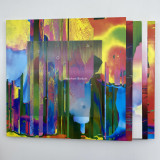
In pairing words with art, the ESP Institute often does everything journalists hate. We drown the reader in hyperbole, abstractions as opposed to didactic or literal depictions, and paint the press release with superlatives that construct an existential struggle around the art and its conditions. To articulate our reasoning behind collaborating with the artist, or the synergy between their work and our catalogue, is sometimes so challenging that crossing that finish line is achingly delayed. Patrick Conway’s 2xLP 'Cellular Housekeeping', his fourth release with the label, is one of these works so monumentally exciting for us that we’ve strained over how to deliver with honor his art unto the masses. After the initial hurdle of visual representation (in this case handled with gusto by artist Hassan Rahim), how do we directly and intentionally talk about the art we deeply love, when in reality we’re largely guided by instinct? We explore many angles, often failing along the way, until finding a final click in the combination that unlocks the floodgates. With Patrick’s album, that elusive impetus revealed itself in a literary gem that both symbolized his aggressive, melancholic, romantic, and bleak overtones, as well as synchronized his work and our task with a metaphor so grand it justified putting these words to paper. In the deeply British poem of despair and hope, 'Comus: A Mask Presented at Ludlow Castle', John Milton immortalized the classic idiom of the “silver lining”, and we find comfort in this transaction between struggle and what the poet considered divine intervention. Our bout of procrastination that brewed a cloud over the art may too tout a silver lining, the time that’s elapsed clearing a path for the album to exist in its rightful place, as opposed to fighting for a voice at an overcrowded table. In hindsight, this final hurdle might have only existed because without it, there is no glory, no resolution, but as all the pieces click and we collectively cross the finish line, Patrick Conway’s once captive 'Cellular Housekeeping' is now truly released.
out of Stock
Last delivered 4 years ago available to reorder, subject to availability
1. Some records hit you with an instant impression of timeless brilliance, and Low Life’s Dogging is one of those records, what the wise call “an instant classic”. 2. From Squats to Lots: The Agony and the XTC of Low Life is more like their second album Downer Edn (read Edition), a little more withdrawn, a little more textured. Complex. Rich. Which is to say: you’re going to need some time with it. 3. Some show, some grow. Low Life have done both. This one is a grower. Spend some time with this one. It’s got that nuanced flavour. Don’t guzzle. Sip. Savour. 4. Sip it, and sense the recurring brilliance of Mitch Tolman’s lyrics, exploring the usual territory of gutter life, lad life, punk life, low life. The dirge. Disgust and shame in white Australia. Council housing, bills piled to the neck, substance abuse and rehabilitation, the fallen lads and lasses who stood too close to the flame, loss and loneliness, from squats to lots. Un-Australian gutter symphony. 5. There is a celebration of resilience and that’s a central theme of this record and a time like ours needs a record like Agony & XTC. Low times are coming through, but if you’re low they won’t get to you. 6. Iggy Pop’s Bowie produced studio rock masterpieces ‘The Idiot’ and ‘Lust For Life’ are important reference points to the 3rd album sounds of Low Life. Here comes success! 7. ‘The Agony and Ecstasy’ is a 1985 novel by Irving Stone about the life of Italian Renaissance painter Michelangelo. Stone wrote another novel about the single eared painter Vincent Van Gogh called ‘Lust For Life’. This synchronicity hit me. 8. Iggy and the Stooges are a pretty safe reference for Low Life (and all good rock music). Iggy and the Stooges are a low life’s Michelangelo, but solo Iggy like Lust for Life is a better reference for this particular incarnation of Low Life, which is to say they are studio rock albums. 9. Bowie later referred to this period of his life as profoundly nihilistic. But Iggy looked at it as the period of his life that saved him from an early grave. This confrontation is Low life lore. 10. Let’s stick to this, because there’s something about this era of Bowie that makes sense with Low Life’s new album, particularly Low. One should never miss the Low in our new album from Low Life. Producer and studio boss Mickey Grossman has the ear for the Low, and he has carved out a little statue of David right here. 11. Mickey’s ears are recording, mixing and producing the best of Sydney, most notably the Oily Boys Cro Memory Grin. A great companion record to this one. Use Agony & XTC AFTER Oily Boys. Not on an empty stomach, and don’t try to operate heavy machinery (bobcat, bulldozer etc). 12. The relationship between Low Life and Sydney hardcore should not be understated, but it also shouldn’t guide how to listen to Agony & XTC. This is not austere, disciplined music. 13. Think, like, if Poison Idea were given the kind of studio time and budget as Happy Mondays. You wouldn’t play it to a teenager. It’s not for children. This is a mature flavour, one for the adults who have had to contend with failure and hardship, medical bills and disappointed family members, betrayed lovers and worrisome growths, police brutality and tooth decay, humiliating bowels and collapsed septums, detoxing and drying out, for those who have seen themselves as corrupted and putrid and unloveable, for those who endure all of this and aren’t willing to lie down and cop it sweet: Low Life are still here and they ain’t going nowhere. NOTES ON HOW NOT TO LISTEN TO AGONY AND XTC OF LOW LIFE: 1. Don’t think of shoe-gaze. It suggests a safe passage to 90’s reminiscences, a vogue style of our time, but nothing to do with Low Life style. Low Life style is always of its time. The content changes. Agony & XTC shares weight of records like My Bloody Valentine’s Loveless and Slowdive’s Kebab, records that were laboured on after the songs were recorded, songs that were written as they were recorded. 2. We can call these “studio albums” as opposed to albums built in the heat of live performance. Studio albums from the 90’s are called shoe-gaze by some journalist nerds, but we know better than to use words like this. 3. Studio albums are excessive and, at the same time, so empty. Agony & XTC, Loveless, Kebab, Rumours: excessive! And empty. This is not to suggest this is Low Lite, some throwback, soft. A band like Low Life can make an overproduced studio rock album without having to use the word shoe-gaze. So, don’t think studio albums mean anything especially 90’s. Don’t look back. 4. Let’s lose these distasteful labels, like “shoe-gaze”, “rehab rock”, “stab”, “guitar OD overdrive”, “western Sydney wonder”. They can fade out. A low life was once referred to as a vagabond. Who uses this term today? Nobody. Language can murder. Words can die. Kill ‘em all! - Daniel 'DX' Stewart, Melbourne, 2021.
ALTER- : A REACTION TO THE ALTERMODERNISM IN SOUND ART
For the Automatisme - Alter- album. I am inspired by how the art historian Nicolas Bourriaud defines the Altermodernism. Bourriaud understands the term "Alter" as a way to mean "other". The altermodernism would be another modernity that is different from the avant-garde modernism and post-modernism. More precisely, this is a new paradigm from the XXIe century with alternative ways to motivate artists to be more radical in art by traveling in the physical and digital world, by cutting the frontiers and by creating other time lines. I apply the "alter" subject to time and to landscape and those, to the rhythmic and the ambient glitch music.
1- THE ALBUM HAS A RHYTHMIC SIDE AND A LANDSCAPE SIDE.
1- a : The rhythmic tracks are named Alter-Rate. That means that I offer other types of rhythms by calculating beats with time rate experimentations. The form of the rhytmic tracks, expresses a course, a wandering, which, in the altermodern life, is not just in a standard 4/4 , or just grid based or non-grid based, but it's in a complex hybrid of all of those.
1- b : The ambient tracks are named Alter-Scape. That means that I offer another type of landScapes by a paused temporality and not by a random time or by the time of the nature. Alter-Scape tracks mimic the saturated globalized soundscapes of the XXIe century.
2- THE GLOBALISED AND SATURATED TIME
For Bourriaud, the artists respond to a new globalised perception. They traverse a cultural landscape saturated with signs and create new pathways between multiple formats of expressions and communications1. The Alter- album tracks have saturated rhythms Rates and static ambient soundScapes. The specific context within which we live is the age of globalisation2. In this album, it means that globalised or always evolving rhythm Rates are in constant movements and are also different every time an Alter-Rate track is exported or performed. On the other hand, a globalised landScape is an ambient track with a motionless temporality. In the era of the altermodern, displacement has become a method of depiction3. The movement of the sound in the Alter- album is two sound spaces. The first is the rhythms that make time movement become apparent and the second is an ambient paused or static time that makes possible to feel and to analyze the movement effect of our surroundings.
3- THE CONSTANT TENSION STATE OF ART
For Gilles Deleuze, art is in a constant state of tension, in as much as it oscillates between the poles of chaos and order4. The Alter- album is a tension between chaos and order in rhythmic beat tracks and ambient soundscapes tracks. It is a deterritorialization of the rhythms and the ambiences of today's natural and digital landscapes and it brings them into the computer glitch music format.
By pushing new softwares to their limits, I push at the extreme the software capacity to calculate and to generate sounds. The Alter-Rate tracks are experimentations with time rates and rhythms with the use of probability and artificial intelligence based sequencers. The partition signal starts from a master sequencer that gets into all instruments on a track. Each instrument receives this signal and modulates it with other sequencers that are each programmed differently for every instrument. Finally, all the instruments signals return to a master output that contains a stutter effect. This master channel is sequencing all other channels into one single rhythm. In short, a single rate merges and expands into a vast archipelago of rates and the transformed signal becomes a new single rate. The Alter-Scape tracks are experimentations with midi triggers that give the sensation of a timelessness. Multiple reverb effects are also routed into each other to create soundscapes of continuity. About the type of sounds created in this album, I do experimentations with deep frequency modulation synthesises (FM) on all Alter-Rate and Alter-Scape tracks.
I put a few layers in the tracks to be able to focus on the time space and perception. The tracks are generative and every parameter uses probabilities to be programmed. This is something that was not possible some years ago. The computers are enough powerful to generate that now. I export many times the tracks and i push the computers to their limits by making hard for them to calculate and to generate the tracks with a deep, a pointillist and an extreme software programming. These techniques do different versions every time that I export or perform a track and in my opinion, that opens a fresh and innovative way to do new experimental club music and ambient music. The computer has its own limits too.
Reviews in The Wire, Gonzo, A Closer Listen, Datacide, African Paper, Silent and Sound, and more
out of Stock
Last delivered 6 years ago available to reorder, subject to availability
When we think of the phrase Bonded By Blood, we think of two things: a brotherhood that is meant to outlast the trials of war, pain, and time... and the almighty EXODUS. With a bond forged in youth and decades-old friendship, the undisputed masters of thrash metal return with their eleventh studio album: PERSONA NON GRATA. Literally translating to “an unwelcome” or “unacceptable” person, PERSONA NON GRATA touches on themes of modern societal disgust and degradation. “The people that disgust you - cut ‘em out like cancer,” explains guitarist Gary Holt. “Who is that person? It could be anybody. That’s up to the listener. Who is ‘Persona Non Grata’ to them?”
For decades, EXODUS has impressed us with the ability to attract opposing factions to their music because of its intensity and versatility. A track like “The Beatings Will Continue Until Morale Improves” was inspired by the riots both in theme, and sound. “Without seeming insensitive to the riots, the song is tongue in cheek about what the people beating on the rioters were expecting to happen. Did you think you would beat a smile onto their face? At 3 minutes in length, it’s probably the shortest EXODUS song we’ve ever done. It gets in, gets out, and is just crushing,” describes Holt. While most of the songs do run on the shorter side, this album also comes equipped with crushing, epic tracks.
Whether it’s the music industry gossip sites, or the big players like CNN and FOX, we’re all aware of how news outlets love to set little rat traps; “Clickbait” discusses their methods of picking things out of context to grab your attention, add to their page views, and increase their revenue all while riling up your emotions. “It’s all journalistic dishonesty,” explains Holt, “it’s a modern-day version of Al Capone’s vault, everyone tunes in, and then there’s NOTHING.“ Evenly balanced with extraordinary speed and tremendous, catchy choruses, “Clickbait” is a song that explodes with vigorous energy. “As heavy as this album is, and it’s heavy as fuck, if times were different and there was still metal radio, this song, and probably over half the album, has single capabilities.”
Sitting as the second to last song on the album, “The Fires of Division” keeps PERSONA NON GRATA strong all the way through. “This album doesn’t operate on the normal parameters,” describes Holt, “we didn’t frontload this one, it’s strong right through to the end. It’s supposed to be a musical journey as the songs segway together.”
For the third time in the band’s history, EXODUS returned to Swedish artist Par Olofsson to create the album artwork PERSONA NON GRATA. “After this album, I feel like we probably won’t work with anyone else again, Par just gets it,” states Holt. A three-faced, winged creature sits atop a bloody pile of diseased and rotting humans as they scream in pain and reach their hands up desperately towards the beast. Undead riot cops beat mercilessly, and senselessly upon this pile of the dying and the world is red with fresh, sopping blood. “Is it an angel, a demon? Is the world being created or destroyed,” asks Holt, “you don’t really know.”
EXODUS don’t fall into the usual recording slump that most bands get stuck in. Gathering at Tom Hunting’s house up in the mountains, they avoided the need to book studio time or adhere to a certain schedule. “At first it was just Tom, myself, a half stack, and a drum kit; we call it jam camp. We lived there. We built the studio, we immersed ourselves in it. Number one, because we still enjoy each other’s company enough to do it. When we’re not actively rehearsing or recording, we’re still sitting there talking about the songs, working on them, plucking on acoustics until things really work,” explains Holt, “we’re not settling.” Working from three home-built studios, the band recorded PERSONA NON GRATA themselves with the help of Andy Sneap on mixing and mastering and with Steve Lagudi at the helm of engineering.
“As a band, I’m super grateful. I’ve seen a lot of things around the world and we’re still a band that loves each other, have each other’s back, and we genuinely like to hang out with each other,” explains Holt. “Take it how you will, but I’m this band’s biggest fan. We write songs that are designed to make us feel fired up - that’s why it’s still heavy.”
When we think of the phrase Bonded By Blood, we think of two things: a brotherhood that is meant to outlast the trials of war, pain, and time... and the almighty EXODUS. With a bond forged in youth and decades-old friendship, the undisputed masters of thrash metal return with their eleventh studio album: PERSONA NON GRATA. Literally translating to “an unwelcome” or “unacceptable” person, PERSONA NON GRATA touches on themes of modern societal disgust and degradation. “The people that disgust you - cut ‘em out like cancer,” explains guitarist Gary Holt. “Who is that person? It could be anybody. That’s up to the listener. Who is ‘Persona Non Grata’ to them?”
For decades, EXODUS has impressed us with the ability to attract opposing factions to their music because of its intensity and versatility. A track like “The Beatings Will Continue Until Morale Improves” was inspired by the riots both in theme, and sound. “Without seeming insensitive to the riots, the song is tongue in cheek about what the people beating on the rioters were expecting to happen. Did you think you would beat a smile onto their face? At 3 minutes in length, it’s probably the shortest EXODUS song we’ve ever done. It gets in, gets out, and is just crushing,” describes Holt. While most of the songs do run on the shorter side, this album also comes equipped with crushing, epic tracks.
Whether it’s the music industry gossip sites, or the big players like CNN and FOX, we’re all aware of how news outlets love to set little rat traps; “Clickbait” discusses their methods of picking things out of context to grab your attention, add to their page views, and increase their revenue all while riling up your emotions. “It’s all journalistic dishonesty,” explains Holt, “it’s a modern-day version of Al Capone’s vault, everyone tunes in, and then there’s NOTHING.“ Evenly balanced with extraordinary speed and tremendous, catchy choruses, “Clickbait” is a song that explodes with vigorous energy. “As heavy as this album is, and it’s heavy as fuck, if times were different and there was still metal radio, this song, and probably over half the album, has single capabilities.”
Sitting as the second to last song on the album, “The Fires of Division” keeps PERSONA NON GRATA strong all the way through. “This album doesn’t operate on the normal parameters,” describes Holt, “we didn’t frontload this one, it’s strong right through to the end. It’s supposed to be a musical journey as the songs segway together.”
For the third time in the band’s history, EXODUS returned to Swedish artist Par Olofsson to create the album artwork PERSONA NON GRATA. “After this album, I feel like we probably won’t work with anyone else again, Par just gets it,” states Holt. A three-faced, winged creature sits atop a bloody pile of diseased and rotting humans as they scream in pain and reach their hands up desperately towards the beast. Undead riot cops beat mercilessly, and senselessly upon this pile of the dying and the world is red with fresh, sopping blood. “Is it an angel, a demon? Is the world being created or destroyed,” asks Holt, “you don’t really know.”
EXODUS don’t fall into the usual recording slump that most bands get stuck in. Gathering at Tom Hunting’s house up in the mountains, they avoided the need to book studio time or adhere to a certain schedule. “At first it was just Tom, myself, a half stack, and a drum kit; we call it jam camp. We lived there. We built the studio, we immersed ourselves in it. Number one, because we still enjoy each other’s company enough to do it. When we’re not actively rehearsing or recording, we’re still sitting there talking about the songs, working on them, plucking on acoustics until things really work,” explains Holt, “we’re not settling.” Working from three home-built studios, the band recorded PERSONA NON GRATA themselves with the help of Andy Sneap on mixing and mastering and with Steve Lagudi at the helm of engineering.
“As a band, I’m super grateful. I’ve seen a lot of things around the world and we’re still a band that loves each other, have each other’s back, and we genuinely like to hang out with each other,” explains Holt. “Take it how you will, but I’m this band’s biggest fan. We write songs that are designed to make us feel fired up - that’s why it’s still heavy.”
When we think of the phrase Bonded By Blood, we think of two things: a brotherhood that is meant to outlast the trials of war, pain, and time... and the almighty EXODUS. With a bond forged in youth and decades-old friendship, the undisputed masters of thrash metal return with their eleventh studio album: PERSONA NON GRATA. Literally translating to “an unwelcome” or “unacceptable” person, PERSONA NON GRATA touches on themes of modern societal disgust and degradation. “The people that disgust you - cut ‘em out like cancer,” explains guitarist Gary Holt. “Who is that person? It could be anybody. That’s up to the listener. Who is ‘Persona Non Grata’ to them?”
For decades, EXODUS has impressed us with the ability to attract opposing factions to their music because of its intensity and versatility. A track like “The Beatings Will Continue Until Morale Improves” was inspired by the riots both in theme, and sound. “Without seeming insensitive to the riots, the song is tongue in cheek about what the people beating on the rioters were expecting to happen. Did you think you would beat a smile onto their face? At 3 minutes in length, it’s probably the shortest EXODUS song we’ve ever done. It gets in, gets out, and is just crushing,” describes Holt. While most of the songs do run on the shorter side, this album also comes equipped with crushing, epic tracks.
Whether it’s the music industry gossip sites, or the big players like CNN and FOX, we’re all aware of how news outlets love to set little rat traps; “Clickbait” discusses their methods of picking things out of context to grab your attention, add to their page views, and increase their revenue all while riling up your emotions. “It’s all journalistic dishonesty,” explains Holt, “it’s a modern-day version of Al Capone’s vault, everyone tunes in, and then there’s NOTHING.“ Evenly balanced with extraordinary speed and tremendous, catchy choruses, “Clickbait” is a song that explodes with vigorous energy. “As heavy as this album is, and it’s heavy as fuck, if times were different and there was still metal radio, this song, and probably over half the album, has single capabilities.”
Sitting as the second to last song on the album, “The Fires of Division” keeps PERSONA NON GRATA strong all the way through. “This album doesn’t operate on the normal parameters,” describes Holt, “we didn’t frontload this one, it’s strong right through to the end. It’s supposed to be a musical journey as the songs segway together.”
For the third time in the band’s history, EXODUS returned to Swedish artist Par Olofsson to create the album artwork PERSONA NON GRATA. “After this album, I feel like we probably won’t work with anyone else again, Par just gets it,” states Holt. A three-faced, winged creature sits atop a bloody pile of diseased and rotting humans as they scream in pain and reach their hands up desperately towards the beast. Undead riot cops beat mercilessly, and senselessly upon this pile of the dying and the world is red with fresh, sopping blood. “Is it an angel, a demon? Is the world being created or destroyed,” asks Holt, “you don’t really know.”
EXODUS don’t fall into the usual recording slump that most bands get stuck in. Gathering at Tom Hunting’s house up in the mountains, they avoided the need to book studio time or adhere to a certain schedule. “At first it was just Tom, myself, a half stack, and a drum kit; we call it jam camp. We lived there. We built the studio, we immersed ourselves in it. Number one, because we still enjoy each other’s company enough to do it. When we’re not actively rehearsing or recording, we’re still sitting there talking about the songs, working on them, plucking on acoustics until things really work,” explains Holt, “we’re not settling.” Working from three home-built studios, the band recorded PERSONA NON GRATA themselves with the help of Andy Sneap on mixing and mastering and with Steve Lagudi at the helm of engineering.
“As a band, I’m super grateful. I’ve seen a lot of things around the world and we’re still a band that loves each other, have each other’s back, and we genuinely like to hang out with each other,” explains Holt. “Take it how you will, but I’m this band’s biggest fan. We write songs that are designed to make us feel fired up - that’s why it’s still heavy.”
Time and life has happened and memories fade. These recordings were made in 1991 and 1992 when we were proudly surfing our mid teens and spending enormous amounts of time in the studio. Every weekend was spent upstairs at Zwarre’s house with analogue synths, VHS sessions watching splatter movies and Psychic TV’s ”8Transmissions8”, going through the Paul Kelday and Sound of Pig cassettes, reading zines to find out more about bands and labels operating the experimental music world, and dreaming about a life away.
Alvars Orkester had been going since ’87 and we had lost a few members so we were down to a duo. We had gone from being kind of all over the place, to investigating how sound affect your mind, and narrow it down. Recording together were magic moments, and it did change me to whoever I am today. These vague memories are dear to me.
Restlessly awakening from the depths of a feverish slumber, doomed heavy metal masters KHEMMIS return to reveal their fourth full length studio album, DECEIVER, arriving via Nuclear Blast Records in November 2021. Six tracks of desolate, soul-awakening heaviness encapsulate a project that has been nearly three years in the making. With a title that reflects the internal struggles that many of us battle in our daily lives, DECEIVER is a ferociously honest and appetizingly raw piece of musical artistry.
The first single LIVING PYRE signifies far more than just the beginning of another musical endeavour for the band; it is a substantial benchmark for emotional struggle and growth. “When it comes to my own mental health, when I’m in a bad place, I can’t access the part of me that creates art. After reaching that understanding of myself, the bulk of this song came out in one sitting. I was feeling stable. I was feeling hopeful–even though so much outside in the world was not exactly inspiring. All of us needed a reason to feel a glimmer of hope,” recounts Hutcherson. With a big, quintessentially KHEMMIS chorus embellished by a swampy sorrow, this song incorporates familiar elements of the band’s sound with a touch of Swedish death metal in its latter half. “The reason that this was the song that came first lyrically was because I was juggling all the things that were happening with the inside and outside world intersecting. All the lyrics for me feel very ‘of the time.’ So much was happening in this world, and they were just my efforts to contend with it,” explains Pendergast. “Like Ben, this was a breakthrough moment for me. Once I got the song out, it allowed me to write other songs for the album. It’s less about the fire metaphor implied by the title than about the fact that in order to escape fire you have to find water. You find the deepest, darkest cavern…you just want to stay there forever. It slowly fills up and you eventually drown.”
HOUSE OF CADMUS was another deeply collaborative writing effort between all three members of KHEMMIS. “I thought the opening riff had this cool almost-swing to it...but evil,” recalls drummer Zach Coleman. “I was drawn to the atmosphere of that first riff, and it felt like it needed to be a song that was dark the whole way through. Ben and I discussed getting some New Orleans-style sounds somewhere on the album, and I think this is where we were able to sneak some in to tie together other aspects of the song.”
“I knew that I wanted the lead guitar line in the second half of the song to tie two very different parts together,” explains Hutcherson, “but the idea was all really abstract until we were in a room together. It wasn't until we jammed out that big funeral/death doom bridge and the slow, sad coda that we found out what we wanted that lead line to be: memorable and emotive. It was a very honest musical moment together.” The writing and recording processes of HOUSE OF CADMUS were so emotionally driven that even producer Dave Otero of Flatline Audio (Cephalic Carnage, Cattle Decapitation, Act Of Defiance) encountered his own deeply personal and intense connection with the song. “With the lyric turn at the end, I was inspired by Dave’s imagery,” says Pendergast. “This idea of a person leaving some important part of themselves behind as they float away and leave the thing they love on the shore. The sound of this song is like a lighthouse beam cutting through the fog in a dark night on the ocean.”
While the lyrical themes of DECEIVER;sorrow, pain, longing for hope, will no doubt be familiar to longtime fans, these six songs display a broader collection of musical influences than on any other KHEMMIS record to date. “It being our 4th album, especially after the transition between the last two albums, it felt really freeing. We felt that we could really do anything on this record,” explains Coleman. “There’s a lot here that we’ve never done before,” adds Pendergast. “In some areas it gets darkly psychedelic. I think we found a cool way to mutate things using transitions that feel really natural. There is a subtle symmetry between the first and last songs which is one of the things that makes listening to the full album a satisfying holistic experience. It builds from almost nothing, becomes very dark, and then you slowly crawl out of that lowest circle of hell.” KHEMMIS’s DECEIVER is a beautiful, musically ambitious journey from beginning to end drenched in impassioned melody and complex, unrestrained variations of sonic savagery adorned with chilling, intensely tragic cover art by frequent collaborator Sam Turner.
Restlessly awakening from the depths of a feverish slumber, doomed heavy metal masters KHEMMIS return to reveal their fourth full length studio album, DECEIVER, arriving via Nuclear Blast Records in November 2021. Six tracks of desolate, soul-awakening heaviness encapsulate a project that has been nearly three years in the making. With a title that reflects the internal struggles that many of us battle in our daily lives, DECEIVER is a ferociously honest and appetizingly raw piece of musical artistry.
The first single LIVING PYRE signifies far more than just the beginning of another musical endeavour for the band; it is a substantial benchmark for emotional struggle and growth. “When it comes to my own mental health, when I’m in a bad place, I can’t access the part of me that creates art. After reaching that understanding of myself, the bulk of this song came out in one sitting. I was feeling stable. I was feeling hopeful–even though so much outside in the world was not exactly inspiring. All of us needed a reason to feel a glimmer of hope,” recounts Hutcherson. With a big, quintessentially KHEMMIS chorus embellished by a swampy sorrow, this song incorporates familiar elements of the band’s sound with a touch of Swedish death metal in its latter half. “The reason that this was the song that came first lyrically was because I was juggling all the things that were happening with the inside and outside world intersecting. All the lyrics for me feel very ‘of the time.’ So much was happening in this world, and they were just my efforts to contend with it,” explains Pendergast. “Like Ben, this was a breakthrough moment for me. Once I got the song out, it allowed me to write other songs for the album. It’s less about the fire metaphor implied by the title than about the fact that in order to escape fire you have to find water. You find the deepest, darkest cavern…you just want to stay there forever. It slowly fills up and you eventually drown.”
HOUSE OF CADMUS was another deeply collaborative writing effort between all three members of KHEMMIS. “I thought the opening riff had this cool almost-swing to it...but evil,” recalls drummer Zach Coleman. “I was drawn to the atmosphere of that first riff, and it felt like it needed to be a song that was dark the whole way through. Ben and I discussed getting some New Orleans-style sounds somewhere on the album, and I think this is where we were able to sneak some in to tie together other aspects of the song.”
“I knew that I wanted the lead guitar line in the second half of the song to tie two very different parts together,” explains Hutcherson, “but the idea was all really abstract until we were in a room together. It wasn't until we jammed out that big funeral/death doom bridge and the slow, sad coda that we found out what we wanted that lead line to be: memorable and emotive. It was a very honest musical moment together.” The writing and recording processes of HOUSE OF CADMUS were so emotionally driven that even producer Dave Otero of Flatline Audio (Cephalic Carnage, Cattle Decapitation, Act Of Defiance) encountered his own deeply personal and intense connection with the song. “With the lyric turn at the end, I was inspired by Dave’s imagery,” says Pendergast. “This idea of a person leaving some important part of themselves behind as they float away and leave the thing they love on the shore. The sound of this song is like a lighthouse beam cutting through the fog in a dark night on the ocean.”
While the lyrical themes of DECEIVER;sorrow, pain, longing for hope, will no doubt be familiar to longtime fans, these six songs display a broader collection of musical influences than on any other KHEMMIS record to date. “It being our 4th album, especially after the transition between the last two albums, it felt really freeing. We felt that we could really do anything on this record,” explains Coleman. “There’s a lot here that we’ve never done before,” adds Pendergast. “In some areas it gets darkly psychedelic. I think we found a cool way to mutate things using transitions that feel really natural. There is a subtle symmetry between the first and last songs which is one of the things that makes listening to the full album a satisfying holistic experience. It builds from almost nothing, becomes very dark, and then you slowly crawl out of that lowest circle of hell.” KHEMMIS’s DECEIVER is a beautiful, musically ambitious journey from beginning to end drenched in impassioned melody and complex, unrestrained variations of sonic savagery adorned with chilling, intensely tragic cover art by frequent collaborator Sam Turner.
SPICE singer Ross Farrar speaks of the band’s ambition to forge a sort of aesthetic patois: a mode of expression as strikingly regional as it is recognizable. Last year’s self-titled debut, released in the depths of the pandemic, fully achieved this goal, distilling decades of North Bay punk and post-hardcore into an urgent, artful set of emotive unrest. Their latest single, A Better Treatment b/w Everyone Gets In, further refines the group’s singular mix of weathered melody and abrasive poetics, equal parts bracing, bruised, and cryptic.
“A Better Treatment” began as a song about a friend who died but through the turmoil of collaboration transformed into something more macroscopic and opaque, blurring the boundary between hopeful and defeated (“I thought loving someone would cure my self-hatred”). Bass and drums build against walls of guitar while the violin threads its own melancholy within the noise; Farrar is blunt about the intention: “The violin is an instrument of death you know.”
“Everyone Gets In” is both poppier and more pained, an anthem for angst aging into the reverie of regret: “We lose our strength / along the way / we lose each other / the funeral sways.” The tempo sways too, gradually slowing to an anxious crawl before finally revving back into a storm of shimmering guitar and splashing drums, fighting against the dying of the light. It’s music of raw truths and
rejected pedestals, storied but unswerving, a revolt against the great regress: “and my / my time is spent / adoring seasons / that I / I never should’ve.”
SPICE singer Ross Farrar speaks of the band’s ambition to forge a sort of aesthetic patois: a mode of expression as strikingly regional as it is recognizable. Last year’s self-titled debut, released in the depths of the pandemic, fully achieved this goal, distilling decades of North Bay punk and post-hardcore into an urgent, artful set of emotive unrest. Their latest single, A Better Treatment b/w Everyone Gets In, further refines the group’s singular mix of weathered melody and abrasive poetics, equal parts bracing, bruised, and cryptic.
“A Better Treatment” began as a song about a friend who died but through the turmoil of collaboration transformed into something more macroscopic and opaque, blurring the boundary between hopeful and defeated (“I thought loving someone would cure my self-hatred”). Bass and drums build against walls of guitar while the violin threads its own melancholy within the noise; Farrar is blunt about the intention: “The violin is an instrument of death you know.”
“Everyone Gets In” is both poppier and more pained, an anthem for angst aging into the reverie of regret: “We lose our strength / along the way / we lose each other / the funeral sways.” The tempo sways too, gradually slowing to an anxious crawl before finally revving back into a storm of shimmering guitar and splashing drums, fighting against the dying of the light. It’s music of raw truths and
rejected pedestals, storied but unswerving, a revolt against the great regress: “and my / my time is spent / adoring seasons / that I / I never should’ve.”
There are records with empathy, records which are your friends and then there's the others... There might be little difference between them, a certain "je ne sais quoi", an "almost nothing but still something" which makes the difference between almost pointless and vital records. Despite, or rather thanks to his cynical despair, Matt Elliott's music never holds up a moralizing mirror to us - on the contrary, it creates a compassionate dialogue with listeners like the rhythm of two steps that synchronize to become as one. In 2016, Matt Elliot brought out his seventh solo album The Calm Before whose obscure title is neither exactly threatening nor comforting... the calm before what? Before the storm for sure but maybe also before the great record, the immediate classic we felt might be coming for a long time in the dual discography of the Bristol-born artist working under his own name and his electronic alias Third Eye Foundation. The elegant details and perspectives of Little Lost Soul (2000) already hinted at the upcoming masterpiece from the English singer-songwriter. The Mess We Made (2003) was Matt Elliott's first solo album and portrayed a universe in a kind of flight towards Balkan horizons made up of visceral despair. With the Songs trilogy, he put aside the electronic side of his work to continue working with a minimalist, stark and lucid style of writing. The Broken Man (2012) was full of tears and long laments sometimes carried by Katia Labèque's piano on a record which painted new shades of grey. On this record Matt began working with the producer, arranger and multi-instrumentalist David Chalmin (La Terre Invisible) who has kept on collaborating with the Bristol-born singer since then. Their partnership continued on Only Myocardial Infection Can Break Your Heart (2013) and The Calm Before (2016). Stéphane Grégoire is the head of the Ici D'Ailleurs label which has accompanied Matt Elliott since 2005 and perhaps he describes this album the best: "This new record by Matt is without a doubt his best album to date, a record that takes him into another dimension where he fully asserts himself as a songwriter and singer of the calibre of artists like Bill Callahan, Leonard Cohen or Johnny Cash." Matt Elliott's other records all seemed like empathic links between each other. Farewell To All We Know is an instant classic based on the sensitive piano and superb arrangements of David Chalmin, the sensitive cello of Gaspar Claus, the subtle bass of Jeff Hallam (who has also played with Dominique A and John Parish). There is a clear form of alchemy in all of this and still we find Matt Elliott's usual atmospheres and scenery, the same Eastern European folk music, long songs that take time to settle over time. Everything is the same but also is transfigured. By making his music stark and purifying and redefining the subject matter, Matt Elliott's work became so much more delicate. However this work is never frail nor really turned in on himself and thus becomes like a vital tune that vibrates and unfolds. The opening song Farewell To All We Know seems torn between the fear of what tomorrow may bring, inevitability and hope for the future in a permanent and progressive dramatic tension expressed by his Spanish guitar, the impressionist style piano and Matt's voice teetering on the edge of whispers. A funereal tribute to endless twilights and the dawns we all dream of seeing. There are touches of Leonard Cohen from Songs from a Room or Thanks For The Dance in The Day After That with Gaspar Claus's counterpoint cello. There is no spirit of resignation in Matt Elliott's work - life's path has to be followed against all odds. We have to follow the river's flow to reach the immense ocean and its infinite freedom. The haunted instrumental Guidance Is Internal harks back to the atmospheres of Howling Songs (2008) with its guitar parts full of scansions and muted threats. The music is transcendental but never seems afraid of the risk of falling. This is also what Bye Now tells us with its quasi-obsolete simplicity and sunburst melancholy reminiscent of the work of Luiz Bonfá, Bill Evans on Peace Piece or laidback crooners of the 50s. In Farewell To All We Know, Matt Elliott incessantly alternates between the dual desires to face up to the world or to protect himself from it. Hating The Player, Hating The Game is a lucid statement about the dullness of our daily lives sometimes, our right to get out of the game and no longer want to be part of it. Matt Elliott is tender but spares no one, particularly himself. Aboulia speaks of the tiredness of living and of looming death while Crisis Apparition says that there is always a time for reconstruction after chaos. This is like initially wearying wandering in the ruins of Aleppo with the slow dilution of the melody into a hallucinated drone. However the smell of great fires always fades and the earth always regenerates. Matt Elliott seems to suggest that the survival instinct is stronger than any cold winds could ever be. Matt Elliott never sings of certainties and prefers possibilities. Possibly the worst is over? Maybe... Maybe the storm has passed and devastated everything, now we just have to rebuild and live again. Farewell To All We Know shows us the distance that still needs to be walked and he walks next to you - right next to you, he is the friend who doesn't spare you the truth like all true friends really do.
We used to enjoy presenting Chapelier Fou's work using the idea of music in the form of a treasure hunt. However, while the phrase in itself it still just as relevant today, we would never have imagined that it would become such an integral part of one of his albums. Or two of his albums to be perfectly exact - Méridiens and Parallèles. Two records with twelve songs each which answer each other back in the form of anagrams. They are like the two sides of the same planet - similar but simultaneously so different. They need to be discovered one after the other taking the time necessary to travel through the sound territories produced by his imagination. The starting point is a sombre night in Uqbar… Chapelier Fou's opening reference to Borgès was obviously not made by chance. He subsequently confided in us the objective of his diptych, namely to combine reality with fiction to question certainties and our relationships with the imaginary sphere. He has continued with his traditional classical-contemporary electronic approach which, although now known to a wide audience, has the advantage of opening up a whole range of possibilities right up to the infinite scale. Moving away from an "État Nain" (Dwarf State) to take refuge on an asteroid...Throughout Méridiens, each composition can be seen as a universe in itself or a specific landscape with its own temporality. Proof of this is the introduction to the chamber music format composed for and performed by only strings which can only be given the date we want to give it. This is "État Nain" in which violins are played like guitars. In some parts we find the spirit of the Penguin Cafe Orchestra and the idea of cheering up classical instruments and not taking everything too seriously. In other parts, we find something close to a mischievous and childish unplugged grunge anthem that could be from the French series Les Shadoks. This mischievous view of things is shown to full effect in Am Scharchtensee. The introduction shows Chapelier Fou's whole classical universe and mastery of orchestration in which "modular" electronics provide a subtle and discreet backdrop. Then, the record suddenly switches to a surrealist dialogue between these classical sounds and modular synthesizers with the flavour of the German pioneers Kluster/Harmonia to name but one example. Timelessness and imaginary places. La vie de cocagne confirms this choice of total freedom. It's traditional music with old sounds, a kind of forgotten bourrée (old French dance) in which electronic sounds disturb the established order and thus reach another musical dimension. Le méridien du Péricarde followed by Désert de Sonora push this idea of a trompe l'oreille and a hall of mirrors even further. The latter track ends almost like a catchy 80s melody and we can no longer find any logical meaning. We let ourselves be carried away by this profusion of madness and are a little amazed by this mastery of sound, composition and space. It sometimes all seems like a succession of conjuring tricks. Chapelier Fou takes not being serious very seriously indeed. The end song Everest trail is the perfect conclusion, a deadpan track in which the primary aspect of a totally classical melody in all its straightness is underpinned by a permanent exchange of electronic tweets which mocks the main musical posture. This impertinence harks back to Pierre Schaeffer who directed the ORTF's very serious experimental department in another era and allowed the development of Jacques Rouxel's series Les Shadoks thus introducing the general public to the notion of concrete music. This is also perhaps why Louis Warynski's stage name is French – because he has opted to use his French musical heritage. Thus the first singles selected from this album, Constantinople with its groovy and jazzy allure and Le Triangle des Bermudes evoke composers like Michel Magne or Michel Colombier both of whom have totally open minds and consider all music to have the same importance, namely that of sound. In absolutely all the tracks that make up Méridiens, you will find at least one detail - a pattern, melody, sometimes a simple sound - that will draw you back to explore it a little more. And the words are carefully weighed for sure. It's quite simple. This is undoubtedly his most hypnotizing and catchy album. Chapelier Fou has become a complete master of his own universe. He draws the start and finish lines himself and no one can follow him in a field that now belongs to him alone. Composed imaginary spheres, illustrated territories...Music is just as meaningful as the more visual arts. Therefore the artwork of Méridiens had to project each of the twelve tracks considered individually and not just the whole album as such. Chapelier Fou therefore asked his old friend the contemporary artist Corentin Grossman to create twelve windows to represent glimpses of the twelve worlds composed for the record. Windows or mirrors when it comes to that? You can never be sure of anything...Space OK. But what about time? The years go by and sometimes we forget that fact. But a simple glance back is often enough to gently touch the time that has passed. It is over 10 years since his first official record and he has been composing, recording and sharing his music for almost 20 years. 20 years is a long time. It makes some people look old while others fall into reassuring but sterile nostalgia. Chapelier Fou, on the other hand, has released his most ambitious project and tried to take a higher view of his discography that was itself nevertheless irreproachable. Although the journey is over we can see Parallèles universes on the horizon. Chapelier Fou has announced 12 additional tracks which are like echoes of the compositions on Méridiens' and will be released on the album Parallèles next spring. They are neither twins nor opposites – they are instead totally original new compositions which go further in exploring a universe which is already richly abundant.
A true psychedelic masterpiece!
Black vinyl LP in black and white jacket with miniature two color booklet. Limited second pressing.
Blind Owl Wilson was a truly great guitarist and vocalist whose deep well of psychedelic blues songs were buried amongst the catalog of major label rockin’ blues band Canned Heat. Blind Owl served as Canned Heat’s guitarist and would chip in a song here and there as a front man. A couple of those songs became huge hits in the 60’s – “Going Up The Country” and “On The Road Again”.
Blind Owl’s songs for Canned Heat stood in stark contrast to the bands blustery blues rock – his was a gentle and nuanced voice and the themes of his song were all about personal heartbreak, grasp- ing for cosmic understanding, and ecological justice.
Here we have an LP of Blind Owl’s songs from Canned Heat’s records – left to sit alone and take you somewhere unexpected. Blind Owl’s personal vision quest can be heard throughout these songs. “Poor Moon’ tells the tale of Alan’s heartbreak as he watches the moon being misguidedly bombed by man, ‘My time ain’t long’ confronts death, “Parthenogen in 3 Blind Owls’ and ‘Parthenogen childs end’ take you to the psychedelic limits, and oh yes, we have the hit tunes on here too. Co-release with Sutro Park records.
Have we ever needed great storytellers so badly? Voices to snap us out of our collective grey funk, to pull us out of our narrow, hemmed-in worlds and to lighten our days and enlighten us with their perspectives, Immersing us in their worldview and history. People who can make us laugh, cry, gasp or nod sagely, to see our world anew and not feel so alone. We need stories, vignettes, new windows to look out of, and narrators to help those new visions make sense.
In short, we need Scott Lavene. Born and raised in Essex, but a man of the world who has wandered far and wide, Lavene’s a storyteller who can capture all the madness, joy and frustration of life while singing about worms writhing in the ground. Lavene’s been in bands since his teens, but only really located the voice that makes his new album Milk City Sweethearts so remarkable – that combination of wry observation, humble wisdom, unguarded vulnerability and unpredictable humour – in a music workshop for alcoholics and addicts, long after he’d bid farewell to childhood dreams of pop stardom, and the ghosts and demons that accompany those dreams.
He released an album as Big Top Heartbreak, 2016’s Deadbeat Ballads, and followed it with his first album under his own name, 2019’s droll and marvellous Broke. “I was signed to a little label in Bristol, but then they went skint,” he remembers. This time, however, the disappointment didn’t shake his confidence or his resolve. “I started writing prose, like ‘flash fiction’, and I’ve begun a novel,” he says. “And I’ve started some creative writing workshops for people who’ve come out of my situation.”
Amid all this activity, the songs that became Milk City Sweethearts began to take shape. Lavene noticed the border between his prose and his songwriting beginning to become porous, and the album feels like a clutch of excellent short stories set to music. Without a label, he recorded the album at home, and assembled it in a week in his mum’s garage during lockdown’s heavy manners. It’s a warm, witty, charismatic record with a dark heart at the centre, Lavene sounding dislocated and therefore able to write his everyday stories with a left-handed brilliance and blunt honesty that keeps them so fresh, like classic Kinks, or David Bowie if he’d never had to go to space to feel otherworldly. His songs are talking blues, set to loose and minimal and excellent art-rock with a pop sensibility, the honk of Roxy sax and the guttural weird-funk of Ian Dury’s Blockheads haunting their grooves.
Have we ever needed great storytellers so badly? Voices to snap us out of our collective grey funk, to pull us out of our narrow, hemmed-in worlds and to lighten our days and enlighten us with their perspectives, Immersing us in their worldview and history. People who can make us laugh, cry, gasp or nod sagely, to see our world anew and not feel so alone. We need stories, vignettes, new windows to look out of, and narrators to help those new visions make sense.
In short, we need Scott Lavene. Born and raised in Essex, but a man of the world who has wandered far and wide, Lavene’s a storyteller who can capture all the madness, joy and frustration of life while singing about worms writhing in the ground. Lavene’s been in bands since his teens, but only really located the voice that makes his new album Milk City Sweethearts so remarkable – that combination of wry observation, humble wisdom, unguarded vulnerability and unpredictable humour – in a music workshop for alcoholics and addicts, long after he’d bid farewell to childhood dreams of pop stardom, and the ghosts and demons that accompany those dreams.
He released an album as Big Top Heartbreak, 2016’s Deadbeat Ballads, and followed it with his first album under his own name, 2019’s droll and marvellous Broke. “I was signed to a little label in Bristol, but then they went skint,” he remembers. This time, however, the disappointment didn’t shake his confidence or his resolve. “I started writing prose, like ‘flash fiction’, and I’ve begun a novel,” he says. “And I’ve started some creative writing workshops for people who’ve come out of my situation.”
Amid all this activity, the songs that became Milk City Sweethearts began to take shape. Lavene noticed the border between his prose and his songwriting beginning to become porous, and the album feels like a clutch of excellent short stories set to music. Without a label, he recorded the album at home, and assembled it in a week in his mum’s garage during lockdown’s heavy manners. It’s a warm, witty, charismatic record with a dark heart at the centre, Lavene sounding dislocated and therefore able to write his everyday stories with a left-handed brilliance and blunt honesty that keeps them so fresh, like classic Kinks, or David Bowie if he’d never had to go to space to feel otherworldly. His songs are talking blues, set to loose and minimal and excellent art-rock with a pop sensibility, the honk of Roxy sax and the guttural weird-funk of Ian Dury’s Blockheads haunting their grooves.
Born in 1999, Charlie Hickey grew up in South Pasadena,
just minutes from Downtown Los Angeles. Raised by two
singer-songwriter parents, Charlie’s second language was
music since day one. As early as grade school, he was
making sense of the world through songwriting, and by
middle school he was writing, recording and performing
songs that attracted a community of collaborators and could
silence a room.
A turning point for Charlie came at around the age of
thirteen, when he covered a song by then up-and-coming
artist Phoebe Bridgers, who was still in high school herself.
The two quickly became friends and collaborators, setting
Charlie on an exciting new musical path. Years later,
Bridgers introduced Charlie to songwriter, drummer, producer
and her bandmate Marshall Vore, who noticed something
special about Charlie. The two began writing and recording
songs together, and soon Charlie dropped out of school to
work on his music full-time.
Charlie Hickey’s first proper single was ‘No Good at Lying’
and it’s the first track on ‘Count The Stairs’. The Marshall
Vore-produced track introduces us to Charlie’s evocative
storytelling and features Phoebe Bridgers on backing vocals.
“I’m no good at lying / on my back or through my teeth / but
I’m good at dreaming / I can do it in my sleep,” he sings over
hushed guitars and a whimsical banjo, searching for truth as
his unconscious mind runs wild and bleeds into reality. It’s a
slow, quiet, and understated peek to the world of Charlie
Hickey, who is barely of legal drinking age, but taps into such
universal themes that showcase a wisdom beyond his years
and exudes promise for what’s to come.
Born in 1999, Charlie Hickey grew up in South Pasadena,
just minutes from Downtown Los Angeles. Raised by two
singer-songwriter parents, Charlie’s second language was
music since day one. As early as grade school, he was
making sense of the world through songwriting, and by
middle school he was writing, recording and performing
songs that attracted a community of collaborators and could
silence a room.
A turning point for Charlie came at around the age of
thirteen, when he covered a song by then up-and-coming
artist Phoebe Bridgers, who was still in high school herself.
The two quickly became friends and collaborators, setting
Charlie on an exciting new musical path. Years later,
Bridgers introduced Charlie to songwriter, drummer, producer
and her bandmate Marshall Vore, who noticed something
special about Charlie. The two began writing and recording
songs together, and soon Charlie dropped out of school to
work on his music full-time.
Charlie Hickey’s first proper single was ‘No Good at Lying’
and it’s the first track on ‘Count The Stairs’. The Marshall
Vore-produced track introduces us to Charlie’s evocative
storytelling and features Phoebe Bridgers on backing vocals.
“I’m no good at lying / on my back or through my teeth / but
I’m good at dreaming / I can do it in my sleep,” he sings over
hushed guitars and a whimsical banjo, searching for truth as
his unconscious mind runs wild and bleeds into reality. It’s a
slow, quiet, and understated peek to the world of Charlie
Hickey, who is barely of legal drinking age, but taps into such
universal themes that showcase a wisdom beyond his years
and exudes promise for what’s to come.
Muscle Shoals singer-songwriter Dylan LeBlanc releases his new EP,
‘Pastimes’, a self-produced collection of covers of songs from Glen
Campbell, Bob Dylan, the Rolling Stones, Led Zeppelin, Buffalo
Springfield and JJ Cale that inspired him to create his own acclaimed altcountry sound.
‘Pastimes’ is released on orange coloured vinyl.
LeBlanc shared his thoughts about his cover of Led Zeppelin’s ‘Going to
California’: “When I was 15 years old I got my first paying gig at a local
coffee shop called Juri’s,” says LeBlanc. “I remembered this girl that sat
behind me in class and I bonded over Led Zeppelin ‘IV’. I remember I
had gotten a Led Zeppelin box set that year for Christmas, and her
favorite song was ‘Going to California’. I rushed home to learn that song
for her and spent hours in my room at my grandmother’s house where I
lived at the time so I could play it for her and impress her. This song will
always hold a special place in my heart. I love this record and this era of
music that I think will always remain untouchable forever and always.”
Each song was chosen for its deeply personal impact: JJ Cale’s
‘Sensitive Kind’ takes LeBlanc back to the smoky dive bars his father
would bring him along to as a child. Buffalo Springfield’s ‘Expecting to
Fly’ reminds him of teenage joyrides, speeding through the country and
listening to music to escape life’s harsh realities. He learned the art of
storytelling through songs with the Rolling Stones’ haunting ‘Play With
Fire’ and Bob Dylan’s ‘Blind Willie McTell’ - a track that he compares to
reading a Southern Gothic Faulkner novel. And Glen Campbell’s ‘Gentle
on My Mind’ is a song he remembers from his early childhood, when his
grandfather, also a guitarist, would throw parties where friends would
gather to drink and sing and forget their troubles.
‘Pastimes’ was recorded at Fame Recording Studios in Muscle Shoals,
live and with as few takes as possible in order to capture a sense of
authenticity. Says LeBlanc, “I feel like music is nothing more than a
spiritual endeavour to widen the horizons and heighten the senses of the
things inside of everyone that sometimes feel unreachable.”
Dylan LeBlanc has spent the last decade releasing four acclaimed
albums, winning praise for his arresting alt-country style, collaborating
with the likes of Emmylou Harris and Brittany Howard, and sharing
stages with heavyweights like Bruce Springsteen and Lucinda Williams.
“One of modern country’s most interesting voices, in both senses of the
term.” - Uncut
“Sublime voice and evocative songwriting.” - Nashville Scene
For the first time a Black vinyl pressing of the sold out LP of the latest Chills album. Latest studio album from the Dunedin (NZ) songsmiths helmed by the enigmatic Martin Phillipps with artwork by Trees’ David Costa. Dunedin’s finest, The Chills release their seventh studio album ‘Scatterbrain’, a glorious self-examination of Martin Phillipps’ songwriting hot (ish) on the heels of the hugely successful ‘Snowbound’ (2018) and the critically-acclaimed movie ‘The Chills: The Triumph And Tragedy Of Martin Phillipps’ a year later. “It’s about artistic integrity, self-realisation, self-acceptance and a reflection on mortality.” The Guardian…. Now in 2021, Phillipps is now taking stock of things – everything. Yes, everything. The result is this triumphant new Chills’ album ‘Scatterbrain’, a thought-provoking and evocative take from a man who has lived through good times and bad. A mature and honest reflection on life, destiny and the fate of our times delivered in beautiful melodies with Phillipps’ trademarked incisive turn of phrase. Viewed from the perspective of a man understanding his age and indeed his own mortality, the new album takes a mature look at matters arising with a side order of perspective. ‘Scatterbrain’ is a life passing before your ears as uncertainty increases and fake news rumbles on; during which aliens invade, Phillipps scales the walls beyond abandon as he probes the minutiae of worlds within worlds and the hourglass fills. A landmark album from one of the great modern song writers, it’s pure pop music for the new normal and we can’t wait to see how it ends…“This is what a living legend looks and sounds like” Rolling Stone // “An architect of New Zealand’s fabled Dunedin sound” Pitchfork
‘Of Process and Progression’ is a perfectly balanced combination of hip-hop, jazz, and soul from longtime collaborators Tall Black Guy & Ozay Moore, who continue to push themselves creatively after a collective more than 30 years in the game. On each and every track on this LP, the duo beautifully blend Golden Era boom-bap with modern sounds to deliver something altogether timeless and inspiring. There’s just so much to love about ‘OPAP,’ an easy candidate for one of the year’s best releases, regardless of genre. Both TBG and Ozay have been on a tear these past few years with their respective careers, but it’s safe to say they’re reaching a new peak together with this release.
WAR’s head-nodding mix of music and message started a revolution 50 years ago that continues to win over the hearts and hips of fans around the world. “Greatest Hits 2.0” will be available 29th October and is a new, career-spanning collection that expands on WAR’s platinum-certified 1976 greatest hits album, featuring the legendary songs “Spill The Wine,” “Low Rider,” “Galaxy,” and “Why Can’t We Be Friends?”
WAR’s “Greatest Hits 2.0” 2LP contains 20 tracks, 2CD contains 24 tracks recorded between 1970 and 1994, including the gold-certified singles “Slipping Into Darkness,” “The World Is A Ghetto,” “The Cisco Kid,” and “Summer.” Another gold single, “Why Can’t We Be Friends?” stayed on the charts for 31 weeks and became the soundtrack to the US-Soviet space mission where astronauts and cosmonauts linked up in the spirit of friendship. In the modern era, it has been streamed more than 100 million times. Also included is the #1 R&B smash “Low Rider,” which was inducted into the Grammy Hall of Fame in 2014.
In the collection’s liner notes, Los Angeles Times columnist Gustavo Arellano says GREATEST HITS 2.0 does more than capture WAR at its creative and commercial peaks. He writes: “All the big hits are here, of course, in chronological order from the Eric Burdon days up through cuts from 1982’s underrated Outlaw…But what I love about this collection is that it’s a symphonic suite for a perfect Southern California Sunday afternoon, the kind the rest of the world wants to experience but can only dream about. You can envision it by playing these albums from start to finish.”
out of Stock
Last delivered 4 years ago available to reorder, subject to availability
On 2020, the first full length album recorded at the infamous Chateau d’Herouville in France since its closure in 1985, Starr explores a year which none of us will soon forget.
Starr says of the album “I feel like this is us at our most blunt, I certainly haven’t felt very poetic this last year.
I’ve been writing about what is right in front of me and have chosen to eschew beauty for the raw reality of what has been happening in NYC this year.”
2020 is a genre hopping, time traveling whirlwind with heavy depth and impeccable range which is set very firmly in the surreal and manic time we are living in. The music and lyrics found within equal the surreal with the subtly psychedelic, the manic with a frantic talent.
About Brion Starr:
To qualify Brion Starr as a rock artist would be missing the point, an auteur in the deepest sense, the singer/songwriter makes records which stitch together familiar sounds from each generation past back to the dawn of popular music without ever crossing the fine line of retro-nostalgia, it sounds new while also accessing memories of something from your past that never actually happened, some band you’ve heard before that never actually existed or perhaps did on some alternate timeline.
Starr continues the complex derivation through the ages which was started on previous albums Global Identity (2018) and Rope Memories (2019) like a time traveler sent back to serenade us into a trance, once fallen under the spell of these melodies, hooks, and lyrics you become helpless, they embed themselves in your mind until you find yourself humming the tunes and wondering how you got here.
IMPORTANT NOTE: UNFORTUNATELY THE SIDES ARE REVERSED ON THE VINYL, I.E. THE A-SIDE IS THE B-SIDE AND VICE VERSA. WITH THE PURCHASE OF THE VINYL OR THE CD YOU WILL GET THE SINGLE MP3 FILES AS WELL AS A CONTINOUS MIX VIA E-MAIL.
With the cover artwork for Pop Ambient 2022, longtime KOMPAKT graphic artist Veronika Unland has once again outdone herself. Following the almost baroque, blood-red and jet-black, extremely physical sculptures of Pop Ambient 2021, which emerged from a dark, floral sea like bodies erect for dancing, the front of 2022 is adorned with a pastel-white form, intertwined, folded many times and crisscrossed with delicate shading, which seems to float on a pale pink background; soft, gentle waves woven from Venetian colors that leave the viewer puzzled: Is it a flower, a coral, a mollusk?
Again, the current edition of the tradition-steeped compilation series curated by Wolfgang Voigt is about the persistent and ever-necessary definition of beauty, of reduction, of electronic music of heavy lightness and light heaviness, of ambient's eternal promise of a state of physical and acoustic weightlessness and Pop's of redemption. And about the question why a never arbitrary combination of soundscape, drones, samples and loops, put together in a certain way, can create this feeling of warmth, depth and space, - something three-dimensional, where the imagination feels at home as a fish in the water or a bird in the sky. A key aesthetic stimulus that sends all the senses into a slow glide and drift, after which your synapses feel like they've been bathed in essential oil. Next to Soul, Ambient is probably the most effective musical healing plant of mankind.
Behind the aural test tubes, the who's who of Pop Ambient is once again at work, led for the first time by the highly trafficked Californian duo Blank Gloss, whose debut album "Melt" this year was certified by The Guardian as nothing less than "heartaching beauty". Yui Onodera's "Chrome" as well as "Kari", a cooperation of Markus Guentner and Joachim Spieth, could also be imagined in the score of Denis Villeneuve's new film version of DUNE - however, colleague Hans Zimmer managed that quite well without the three. After such wonderful and stylish contributions by Reich & Würden, Triola and Thomas Fehlmann, the ear then lingers a bit longer on the ghostly "Weiht" by Morgen Wurde feat. Maria Estrella, a track like a temple of sound, a deep electronic immersion in a Japanese onsen. In this sea of unnameable time you could sink forever, but with the tracks of Andrew Thomas, Thore Pfeiffer and Max Würden & Pepo Galán the journey slowly comes to an end.
Mit dem Cover-Artwork für Pop Ambient 2022 hat sich die langjährige KOMPAKT-Grafikerin Veronika Unland einmal mehr selbst übertroffen. Nach den geradezu barocken, in blutrot und tiefschwarz gehaltenen, äußerst physischen Formationen von Pop Ambient 2021, die wie zum Tanz aufgerichtete Körper aus einem dunklen, floralen Meer auftauchten, ziert die Vorderseite von 2022 eine pastell-weiße Skulptur, in sich verschlungen, vielfach gefaltet und von zarten Schattierungen durchzogen, die auf einem blass-rosa Hintergrund zu schweben scheint; weiche, sanfte Wellen aus venezianischen Farben gewebt, die dem Betrachter Rätsel aufgeben: Ist es eine Blüte, eine Koralle, eine Molluske?
Natürlich geht es auch in der aktuellen Ausgabe der traditionsreichen, von Wolfgang Voigt kuratierten Compilation-Reihe um die beharrliche und immer wieder notwendige Definition von Schönheit, von Reduktion, um elektronische Musik von schwerer Leichtigkeit und leichter Schwere, vom ewigen Versprechen des Ambient auf einen Zustand körperlicher und akustischer Schwerelosigkeit und dem von Pop auf Erlösung. Und um die Frage, warum eine nie beliebige Kombination aus Klangfläche, Drones, Samples und Loops, auf eine bestimmte Art zusammengefügt, dieses Gefühl von Wärme, Tiefe und Raum entstehen lassen kann, - etwas dreidimensionales, in dem die Fantasie sich so zuhause fühlt wie ein Fisch im Wasser oder ein Vogel in der Luft. Ein ästhetischer Schlüsselreiz, der alle Sinne in ein langsames Gleiten und Driften versetzt, wonach sich deine Synapsen wieder anfühlen, als habe man sie in ätherischem Öl gebadet. Neben Soul ist Ambient die wahrscheinlich wirksamste musikalische Heilpflanze der Menschheit.
Hinter den auralen Reagenzgläsern hantiert einmal mehr das Who-is-Who der kompaktschen Pop Ambient-Riege, erstmals angeführt vom hoch gehandelten kalifornischen Duo Blank Gloss, deren diesjähriges Debüt-Album “Melt” der englische Guardian nichts weniger als “herzergreifende Schönheit” bescheinigte. Yui Onodera’s “Chrome” sowie “Kari”, eine Kooperation von Markus Guentner und Joachim Spieth, könnte man sich auch gut im Score von Denis Villeneuve’s Neuverfilmung von DUNE vorstellen, - das hat der Kollege Hans Zimmer allerdings auch ohne die drei ganz gut hinbekommen. Nach so wundervollen wie stilsicheren Beiträgen von Reich & Würden, Triola und Thomas Fehlmann verharrt das Ohr dann etwas länger beim geisterhaften “Weiht” von Morgen Wurde feat. Maria Estrella-Weiht, ein Track wie ein Tempel aus Klang, ein tiefes elektronisches Eintauchen in einen japanischen Onsen. In diesem Meer aus unnennbarer Zeit könnte man ewig versinken, doch mit den Tracks von Andrew Thomas, Thore Pfeiffer und Max Würden & Pepo Galán geht die Reise langsam zu Ende.
out of Stock
Last delivered 17 months ago available to reorder, subject to availability
There is something magical about the synergy of the voices of a couple; they gel, they interweave, they lift each other. Remember classic duets sung by partners over the years; so much is said, more than just words.
'Warm You' is the collaboration between Mandaworld (aka Amanda Hicks) and partner Matthew Tavares (aka Matty of BADBADNOTGOOD fame). It is a song about your lover getting out of bed in the middle of the night because they can't sleep and you telling them to come back to where it’s warm and safe and they’re loved.
It was written in their Montreal apartment a few months after they moved in. Matty described the writing process "We just spontaneously decided to make music, and the idea came out pretty much immediately. I laid down some guitar and then Amanda played the synth line over it and I edited the guitar so the timing was more interesting. We worked on it for a few days getting the chorus and the verses to feel right and, for the most part, everything fell into place super intuitively. Amanda wrote the lyrics."
This heartfelt, dream-pop song, with a mellow shoe-gaze sensibility, lets the pair trade verses whilst the instrumentation builds to a crescendo and the duo's voices finally combine. Lush, passionate and personal, a beautiful song, rich in evocative memories.
On the ‘B-side’, Mandaworld takes centre stage. 'Spoonfeed' is a spacey synth bass-led ambient ballad with smokey hazy vocals, calming like a bubble bath. Produced with a timeless quality, the song leaves you with a sense of tranquility and a feeling of being submerged underwater.
Like all the best music this 7" is deeply personal, yet these are universal themes that are relatable to any listener as they recognise their own experiences within the mood of the songs.
Empty surrounds all of me. It’s a poignant line from the third album by Blackwater Holylight that encapsulates the search for self when suddenly everything has changed. There’s a theme of processing vast personal trauma throughout Silence/Motion that eloquently — both lyrically and musically — and simultaneously embodies the crushing emptiness, sorrow, strength and rebuilding of recovering from personal devastation.
“There was so much grief both in the world and interpersonally during the process of creating Silence/Motion,” says vocalist/bassist Allison “Sunny” Faris. “The four of us gave one another more space to be ourselves, to experiment with each other’s ideas and to be gentle with one another more than we ever have before. So, we knew this tenderness would manifest in extremely honest arrangements, and I think that you can hear that throughout the record.”
Curiously, considering the dark times in which it was created, this is the band’s most melodic and catchy music so far. Blackwater Holylight, as the name suggests, is all about contrasts: It’s a fluid convergence of sound that’s heavy, psychedelic, melodic, terrifying and beautiful all at once. And, Silence/Motion finds the band honing those contrasts, letting ideas and moods fully develop from song to song, rather than filling every song with a full range of their capabilities. It allows the band to go fully prog-rock here, and simply stay hushed and intimate there. There’s a new confidence to the band in how seamlessly they wield their stylistic amalgam.
“Writing this album was extraordinarily difficult emotionally, however it did come to fruition fairly quickly,” Faris says. “In the past, the theme of vulnerability has always been a big player and it definitely showed up full force while writing this album.”
Blackwater Holylight recorded the album as a four piece: Faris on vocals and guitar (on “Silence/Motion”, “MDIII”, “Around You” and “Every Corner”) and bass for the remainder, Sarah McKenna on synths, Mikayla Mayhew on guitar (and bass when Faris plays guitar) and drummer Eliese Dorsay. New second guitarist Erika Osterhout will perform the songs with them live. For Silence/Motion the band chose to work with a producer for the first time, bringing in A.L.N. (of Mizmor, Hell) to produce, along with recording engineer Dylan White — who also helmed their previous album Veils of Winter (2019) — at Odessa Recording Studio in Portland, OR. Guest vocals on album opener “Delusional” are by Bryan Funck (Thou.) Mike Paparo (Inter Arma) and A.LN. (Mizmor, Hell) lend guest vocals to album closer “Every Corner.”
Silence/Motion opens softly with interwoven folky single note guitars over an ominous sounding drone for the first minute, akin to moments from Pink Floyd’s Echoes. Suddenly an irresistibly head-nodding, groovy droptuned riff kicks in with the drums and it’s a full on blackened rocker with soaring synths and Funck’s witchy whispers over the top. “Who The Hell,” the track quoted above, takes proceedings into a Krautrock direction, centered around McKenna’s arpeggiated synth loop and Dorsay’s tom-tom triplets, while 16-note guitar strums add tension as Faris wearily sings, “So tell me who the hell would want to live this way — so afraid/ To feel this void, to dwell in it… I can’t describe this pain I wear/ It suffocates and you left it here.” It’s an incredibly powerful 6 minutes. The title track delivers the 1-2-3 punch of the album’s brilliant opening trilogy. It starts with lightly plucked acoustic guitar, plaintive piano chords and Faris’ voice gliding so softly it sounds more like a Mellotron. The song builds slowly toward crescendo, led by a swinging tom pattern, that abruptly switches back to a heavier version of the opening melody.“Silence/Motion” is about digesting and healing from sexual assault. As Faris explains, “It is an ode to the juxtaposition of feeling paralyzingly blank and and like your entire life is moving through you simultaneously.” Elsewhere, Black Metal guitars collide with dreamlike melodies. “Around You” brandishes a hopeful, hummable synth melody and shimmering shoegaze guitars like throwing down a gauntlet. In the end, it becomes undeniably clear just how completely into their own Blackwater Holylight has come.
“The analogy is that with our first record (Blackwater Holylight, 2018) we were getting into to the car and buckling up,” Faris says. “The second (Veils of Winter, 2019) we were turning the car on, and with this third we have kicked into drive toward our destination. Our destination is a bit mysterious and has the ability to change from day to day, but we’re on our way.”
Empty surrounds all of me. It’s a poignant line from the third album by Blackwater Holylight that encapsulates the search for self when suddenly everything has changed. There’s a theme of processing vast personal trauma throughout Silence/Motion that eloquently — both lyrically and musically — and simultaneously embodies the crushing emptiness, sorrow, strength and rebuilding of recovering from personal devastation.
“There was so much grief both in the world and interpersonally during the process of creating Silence/Motion,” says vocalist/bassist Allison “Sunny” Faris. “The four of us gave one another more space to be ourselves, to experiment with each other’s ideas and to be gentle with one another more than we ever have before. So, we knew this tenderness would manifest in extremely honest arrangements, and I think that you can hear that throughout the record.”
Curiously, considering the dark times in which it was created, this is the band’s most melodic and catchy music so far. Blackwater Holylight, as the name suggests, is all about contrasts: It’s a fluid convergence of sound that’s heavy, psychedelic, melodic, terrifying and beautiful all at once. And, Silence/Motion finds the band honing those contrasts, letting ideas and moods fully develop from song to song, rather than filling every song with a full range of their capabilities. It allows the band to go fully prog-rock here, and simply stay hushed and intimate there. There’s a new confidence to the band in how seamlessly they wield their stylistic amalgam.
“Writing this album was extraordinarily difficult emotionally, however it did come to fruition fairly quickly,” Faris says. “In the past, the theme of vulnerability has always been a big player and it definitely showed up full force while writing this album.”
Blackwater Holylight recorded the album as a four piece: Faris on vocals and guitar (on “Silence/Motion”, “MDIII”, “Around You” and “Every Corner”) and bass for the remainder, Sarah McKenna on synths, Mikayla Mayhew on guitar (and bass when Faris plays guitar) and drummer Eliese Dorsay. New second guitarist Erika Osterhout will perform the songs with them live. For Silence/Motion the band chose to work with a producer for the first time, bringing in A.L.N. (of Mizmor, Hell) to produce, along with recording engineer Dylan White — who also helmed their previous album Veils of Winter (2019) — at Odessa Recording Studio in Portland, OR. Guest vocals on album opener “Delusional” are by Bryan Funck (Thou.) Mike Paparo (Inter Arma) and A.LN. (Mizmor, Hell) lend guest vocals to album closer “Every Corner.”
Silence/Motion opens softly with interwoven folky single note guitars over an ominous sounding drone for the first minute, akin to moments from Pink Floyd’s Echoes. Suddenly an irresistibly head-nodding, groovy droptuned riff kicks in with the drums and it’s a full on blackened rocker with soaring synths and Funck’s witchy whispers over the top. “Who The Hell,” the track quoted above, takes proceedings into a Krautrock direction, centered around McKenna’s arpeggiated synth loop and Dorsay’s tom-tom triplets, while 16-note guitar strums add tension as Faris wearily sings, “So tell me who the hell would want to live this way — so afraid/ To feel this void, to dwell in it… I can’t describe this pain I wear/ It suffocates and you left it here.” It’s an incredibly powerful 6 minutes. The title track delivers the 1-2-3 punch of the album’s brilliant opening trilogy. It starts with lightly plucked acoustic guitar, plaintive piano chords and Faris’ voice gliding so softly it sounds more like a Mellotron. The song builds slowly toward crescendo, led by a swinging tom pattern, that abruptly switches back to a heavier version of the opening melody.“Silence/Motion” is about digesting and healing from sexual assault. As Faris explains, “It is an ode to the juxtaposition of feeling paralyzingly blank and and like your entire life is moving through you simultaneously.” Elsewhere, Black Metal guitars collide with dreamlike melodies. “Around You” brandishes a hopeful, hummable synth melody and shimmering shoegaze guitars like throwing down a gauntlet. In the end, it becomes undeniably clear just how completely into their own Blackwater Holylight has come.
“The analogy is that with our first record (Blackwater Holylight, 2018) we were getting into to the car and buckling up,” Faris says. “The second (Veils of Winter, 2019) we were turning the car on, and with this third we have kicked into drive toward our destination. Our destination is a bit mysterious and has the ability to change from day to day, but we’re on our way.”
"Free Jazz " - Ornette Coleman (as); Eric Dolphy (b-cl); Don Cherry, Freddie Hubbard (tp); Charlie Haden, Scott LaFaro (b); Billy Higgins, Ed Blackwell (dr)
The term 'free jazz' was already inexistence – but it had a quite different meaning, namely jazz without paying for an entrance ticket. The album "Free Jazz", however, was intended to lend its name to a quite different style of jazz. 'Free' playing – now this meant that no one was bound to conventions, you could let your imagination run loose. Free jazz gave one the chance to find new rules for every new composition. And it was to be the greatest boost to innovation in the world of jazz. Ornette Coleman’s album from December 1960 stands at the beginning of the free jazz era like a massive portal. Coleman thought big: he brought two quartets into the studio at the same time, both with two wind instruments and no piano, and let them play together for 36 minutes without a break – a collective improvisation. There aren’t any precise themes, although short, fanfare-like motifs do exist in which the winds come together. A continuousdense rhythmic beat underlies the music almost throughout – and the pulse is felt rather than heard. One musician after the other comes into the foreground to improvise, almost like at a jam session. First Coleman, then Dolphy, then the two trumpeters. The other winds, however, never remain silent, then make comments and support one another continually – the energy level is immense the whole time (it was cold in the studio ...). Only when it is the turn of the bass and drum players do the winds remain silent for about eleven minutes. This album is not only a historic caesura, but a truly great experience over andover again.
This Speakers Corner LP was remastered using pure analogue components only, from the master tapes through to the cutting head. More information under pure-analogue
All royalties and mechanical rights have been paid.
Recording: December 1961 in A&RStudios, New York City, by Tom Dowd
Robert Sotelo is a mercurial melodist building a resplendent world of pristine DIY pop from the ground up. The Glasgow-based artist’s songs are meticulously crafted, patchworked together with eclectic arrangements and ardent vocal performances. Each of his albums to date has been accompanied by a growth-spurt, 2017’s debut ‘Cusp’ was packed with miniature psych overtures, whilst 2018’s 'Botanical' was more keyboard-minded and playful with a near-absurdist palette of sound. ‘Infinite Sprawling’ came out towards the end of 2019 and surprised with songs pulled together like a wakeful stretch, brisk with a lightness of touch. This was neatly followed by ‘Leap & Bounce’ melding a sparse synth-pop minimalism to an emotional undertow.
This November Upset The Rhythm will release Robert Sotelo’s vivid new album ‘Celebrant’. ‘Celebrant’ was intended to be and still is to some extent a joyous wedding album (Sotelo is recently married), but in his own words “the pandemic and the death of my aunt Carmen intersected with the original concept so the album is darker than intended in places.” More cinematic and measured than prior albums, Sotelo expounds that “it is purposefully a bigger sounding attempt at my keyboard songs and I felt more ambitious about it in general.” That’s certainly reflected in these twelve sophisticated loops of song, all curiously affecting and catchy, sprinkled with Sotelo’s offbeat musings and keenly accurate observations. Guitars are rarely employed on this record with Sotelo recruiting Iain Mccall, Ross Blake, Celia Morgan and David Maxwell to contribute brass, woodwind, spoken word and acoustic drums respectively. All of these additions blend well with the album’s synthetic core, softening and subtly shaping its pop-first nature into something more nuanced, vulnerable and human.
‘Celebrant’ is a plucky synth-centric collection of unbridled songs at times surefooted at others threatened by disconnect, skilfully steered by Sotelo with typical classy touch. ‘Dear Resident’ is divinely metronomic, ‘Behaviour’ luxuriates in pitching a silken saxophone into a frenzied drum-off. ‘The Currency Is Love’ swaggers with 80s vibes aplenty: “all the globe is listening as a system of concern” sings Sotelo in clipped manner, enjoying the placement of each word in each song precisely, however seemingly stumbled upon and surreal their selection might seem. Other highlights include title track ‘The Celebrant’ with its lush environ of droning keys, swooning woodwind and baroque reverie, and ‘This Is My House’ a woozy, maze-like triumph of melody. ‘Influencer’ is similarly masterful with melancholic strains of synth, sax and voice: “extract the data from the fruit straight off the tree, conducive testing proves it’s not reality, create a substitute to simulate the tide, with rich efficiency the differences can hide.” The song itself a cipher for an ill-imagined future we might be living in already.
With ‘Celebrant’ Robert Sotelo has made an album that sounds as big as its heart and imagination, true depth of feeling, true depth of connection. It’s an ornate album, complex and thoughtful, a fitting tribute to a wedding in unsettled times. What a treat that we’ve all been invited to the reception.
"You ever wonder what Keith Morris does at the end of the day? Does he maintain that wide-eyed stare, the one that pins audiences to the floor with its very intensity, while he’s putting on his pyjamas? Does he continue spitting venom from that heroically ragged throat of his while he’s making his cocoa? Does he lay his head on his pillow with the same righteous fury that launched thousands upon thousands of moshpits? Hey, I’m just wondering. Y’see, all that intensity and venom and fury… it has to go somewhere while he’s otherwise occupied with mundane tasks like taking off his socks or brushing his teeth, right? And listening to the thrilling racket conjured up by Vancouver’s Chain Whip, you’d be forgiven for thinking that they have somehow become vessels for that energy. I mean, they’re Morris’ spiritual successors - if their 2019 debut ‘14 Lashes’ wasn’t enough of a clue, then this six-song blast of blink-and-you’ll-miss-it brilliance should leave you in no doubt. This is hardcore punk as it was originally conceived, and it slays. ‘But who are Chain Whip?’ I hear you ask. Well, they’re a bunch of dudes from British Columbia who’ve also served time in bands like The Jolts, Fashionism and Corner Boys (among others). They’re the ones who are gonna have you slashing the seats at your local cinema, or taking potshots at lines of empty bottles on street corners, cuz they make you feel so damn tuff. OK, I’m just goofing around here - whereas Chain Whip are serious business. No, really. I dare you to listen to the Germs-go-nuclear b(‘)last of ‘Laguna Bleach’, or the garage-slop-at-200-mph rush of ‘Fresh Paint And Philanthropy’, and not want to launch a stink bomb into your teacher’s car. Or, failing that, to bring about the extinction of global capitalism. If that fails, you’ll just end up wearing out the grooves of this very fine six-song EP while bouncing between walls like the DRI logo guy if he wore jet heels and spring-loaded shoulder pads. Jeez, imagine Keith finishing the night shift and giving these guys a handover. As if they’d even need to be told. Look, Chain Whip are the best straight-up old-skool punk band you’ll hear today. You know what to do. Trust your instincts. Dance that two-step to hell with ‘em. This. Is. The. Shit." Will Fitzpatrick.
After more than a decade of heating up dancefloors at over 600 festivals and stages in 34 countries and 6 released albums, the nine-headed instrumental collective Jungle by Night melted their years of passion, friendship, and influences from krautrock, dance, jazz and techno together into a new analogue composition that will put us in a trance. > makes us revel in the human things around us and connect with each other like never before in times of rampant digital distractions.
Jungle by Night: ''In a world in which technology and its algorithms have become highly influential in our daily lives, we'd almost rather stare at our screens than look out for each other. With >, we pay a tribute to natural, spontaneous HUMAN rhythm as a counterpoint to the sophisticated intoxicating algorithms of the computer.''
With this new analogue album, nine-headed instrumental collective Jungle By Night bursts our bubble and reminds us to surrender to being human. The oddball ensemble exists within its own cosmos and serves us a danceable and thundering live act, connecting with crowds like no other, with beaming fun and energy along the way.
"Jungle By Night has been one of the best live bands in the Netherlands for years."
- The Independent (UK) -
" To top it all off, they turn the stiffest festival audience in the Netherlands into a football choir at the long end. Jungle by Night can simply do all the festivals for another year.
- VPRO, 3voor12 -
"They're undeniably cool, they've come from Amsterdam and they're killing it! We're talking about Jungle By Night, the young Dutchmen who have been acclaimed by Tony Allen and described as the "future of Afrobeat".
- Radio Nova (FR) -
Tracks>>
1.Scrolling in the Deep 2.Axolotl 3.Cookies 4.E17 Snack 5.Angelo Samsonite 6.Where Are We Going
7.Destination A2 8.Multi Beam 9.Force 10.Odyssey
Stephan Bodzin proves once again why he is one of the most innovative techno artists in the world with new album Boavista. The expressive 17 track full length lands on Herzblut Recordings on October 8th 2021 and is proceeded by lead single 'Boavista' on the Afterlife label.
German icon Stephan Bodzin is globally recognised on a number of fronts - his live show is one of techno's most celebrated, his productions constantly push the genre forward with his own trademark sound. He has put out well-received solo long players Liebe Ist and Powers of Ten as well as worked on many other iconic projects under a range of aliases.
In the last year, Stephan had the chance to look back on the vast archives of music he has recorded but never finished. While spending time in Brazil, he picked his 25 favourites and finished them properly, with the best 17 making up Boavista. His simple aim was to tell stories with each track, to paint musical pictures that conjure up very real emotions in the listener. As always, playing the album live was in the back of Bodzin's mind throughout the creative process. This means each track is a powerful piece that is both emotional and honest, physical and straightforward, but also true to the authentic Bodzin sound. The lack of DJ gigs and club experienceshad no impact on the music: Stephan has long since done his own thing and has never tried to conform to expectations.
And so it proves. The album kicks off with the lush 'Earth' which pays homage to all the elements of life - water, fire, wind, as well as time, light and the rotation of the planet. 'LLL' is an electronic lullaby track defined by a sense of love for the people in Stephan's life and 'Astronautin' has a lead synth that came about after Stephan's daughter said she would like to be an astronaut when she grows up. It truly takes you to the stars before the simple but effective melodic patterns of the title track light up a night sky with real hope.
Elsewhere there 'Infinite Monkey' which was a freeform jam that was led by the music itself, the epic pads of 'Dune' and interstellar explorations of the more thoughtful and melancholic 'Cooper Station’. 'Nothing Like You' was written in a hotel room before Stephan's last pre-lockdown gig, then 'Isaac' is another powerful journey through space and time, different worlds and alternative realities.
Further hypnotising highlights come from the soft melodies but powerful basslines of 'Collider', the expansive synths of 'Trancoso' and the delicate beauty of 'Ataraxia', which references German composer Klaus Doldinger who was a huge influence on Stephan's understanding of melodies and harmonics. 'Breathe' is a second spindling vocal track featuring Luna Semara next to 'Nothing Like You' and closer 'Rose' isa heartbreaking piano piece.
Boavista is another exquisitely crafted album of rich, synth-heavy electronic music that takes you into new worlds of emotion and leaves you in awe
out of Stock
Last delivered 7 months ago available to reorder, subject to availability
absent origin’ reassembles and reimagines recordings and musical
scores composed by Mira Calix, globally, over the past decade. It’s a
collage album about edges and borders, cutting and tearing, and
composing new combinations that point to an audio visual manifesto for the 21st Century.
“Like Duchamp, I had started out wanting to make an album, or box, of approximately all the things I produced. In the end, I realised - as much as a collage is the coupling of two or more realities, it also offers the means to examine the materials and culture of an era, questioning and expanding its borders.” - Mira Calix
Every song on the album was created by applying a different collage
process relating to a different visual artist, spanning the history of collage to contemporaries of the practice. The sonic materials are subjected to a myriad of processes; layered, synthesised, constructed and assembled into electronic melodies, textures and complex, frisky dance rhythms that are constantly shifting in surprising ways. absent origin employs collage to make sense of the current moment of displaced voices, disjunction and political unrest.
Calix’s recording sessions from all over the world are the many
fragments we hear across the album; from India to Tasmania, Jordan to Belgium, China to Uganda, her former home of South Africa, to her
current home in Britain. Slicing into these are further recordings of
vocalists, percussionists, choirs, orchestras, quartets and soloists, never appearing in the form in which they were originally intended. The record is a polyphony of predominantly diverse female voices held together by pulsating baselines, haunting electronic sounds and orchestrated melodies and with them, we travel.
The album fizzes with a political energy and the interconnectedness of
everything. At this moment in time, there is an impossibility of separating one thing from another; the effect is strange and not exactly reassuring.
Collage suggests infinite possibilities and each track here is a singularly unique compositional combine, a dizzying hall of mirrors with its own unlikely harmony, its own distinctive rhythm. On ‘absent origin’, collage becomes the tool to make sense of a present that is often anything but.
2LP in printed inner sleeves with 5mm spine outer, printed insert and
digital download code.
out of Stock
Last delivered 4 years ago available to reorder, subject to availability
* New from Innerground Records (co-founded by DJ Marky), also the home of Calibre, BassBrothers, Random Movement and Blade, comes the highly anticipated double vinyl LP from DJ Marky & others, ‘100’. Drawing inspiration from the past 18 years of Innerground’s vast history and impact on the Drum & Bass movement, and the signature latin influences of DJ Marky that have brought excitement and vitality to stages around the globe. This special collaboration between one of the most important figures in the genre, and a collection of some of the most highly respected producers and artists in the scene, creates a ground-breaking LP that marks the 100th release from Innerground Records.
* It should come as no surprise that the double LP packs a punch, when looking at the combined experience of its contributors. ‘100’ begins as a bold statement from the main man DJ Marky, laying down the foundations of what’s yet to come from this veteran D’nB lineup. We’re taken on a ride through morphing tempos and enchanting vocals that hammer home what this immense centennial is all about - a special milestone in the genre that will be remembered in years to come.
TRACKLIST:
A1 : DJ Marky Feat. Lorna King – Changing Moods (LEAD SINGLE (SPECIALIST RADIO PLUGGING BY LISTEN UP)
The album launches with the warm Brazilian sunshine D&B that Innerground’s main man Marky is known for. Lorna King’s uplifting harmonies intertwine with playful melodies to shape not only a guaranteed party starter, but a track that will put a smile on your face. Shades of his legendary ‘LK’??!
A2 : Data 3 – String Theory
After the Brazilian sunshine comes the rain… We’re taken on a detour through a dark valley as spiralling synths ascend to a glitch filled break. Ominous chords reverberate around the onslaught of rattling hats and deep choral vocals.
B1 : Random Movement – Patty Melt
The American D&B veteran returns to Innerground, bringing a funky fast guitar filled banger. Rapid drums and airy synths balance over happy vocals and undulating groovy bass guitar to create a track you can’t help but move to. Potential (slow-burner) track of, ’Innerground : 100’, the album?
B2 : Melinki & D'Cypher - Listen To Everything
A dark bopper with swaying hats chiming over aggressive basslines. Vocal samples provide a short-lived breather from this menacing track’s all-consuming energy. This isn’t the first time Melinki & D’Cypher have linked up and we look forward to many more from these two!
C1 : Saikon - Guilty Pleasures
Anticipative strings and a steady break lead to snappy vocal chops, crescendos at a break that unfolds in to house-led bouncey stabs. You wouldn’t expect anything less from Saikon!
C2 : Carlito - About You
Fans know that this is far from Carlito’s first Innerground rodeo – he’s back with a track that balances male and female vocals over enchanting pads. Synths twinkle amongst racing breaks to make for a certified club heater.
D1: Collette Warren, DJ Marky & Tyler Daley - One Exception (Pola & Bryson Remix)
As the album draws towards its close, cinematic piano and vocals to make your hair stand on end craft a beautiful contemplation between Tyler Daley and Collette Warren. D&B household names Pola & Bryson show their take on the track originally produced by DJ Marky. If this song doesn’t move you, you’re made of stone!
D2: Fluidity & Loz Contreras - Back To You
The LP finishes with a bang. Fluidity & Loz Contreras pair up to transport us back to the sunshine that Marky initiated. Oceanic pads and wispy vocals merge seamlessly to craft a warm and groovy finale that will leave you craving more Innerground energy, as this incredible centennial LP boldly forges its place.
out of Stock
Last delivered 2 years ago available to reorder, subject to availability
Built around the successes of his soundtracks and songs for the movies of Christophe Honoré, Alex Beaupain’s profile in the ‘chanson française’ landscape is quite unique. Beaupain alternates between soundtracks, songs he writes for others (mainly great French actresses) and his own solo albums.
In march 2021, Beaupain paid tribute to the late Serge Gainsbourg for the 30th anniversary of his passing during a special live on air event where he covered in full, with the Radio France Philharmonic Orchestra, Gainsbourg’s penultimate shocking album from 1984 : Love On The Beat.
This experience led him directly in the studio with Saint DX as producer, the French American duet Faux Real singing backing vocals and a full string section to re-record this cult album with a 2021 twist. He had also dreamed of covering that particular album that had so much impact on him, musically and lyrically, when he first discovered it. The 80s funky sound of the record, produced by Billy Rush, was a new start for Gainsbourg and at the time, the lyrics schocked everyone but achieved to avoid any censorship.
“I was 10 when Love On The Beat was released in 1984. Covering the full album was an idea I always kept somewhere in my mind as I was fully aware of the long lasting impact this particular record had on all the teenagers at the time. This collection of songs is far from being the most covered or talked about works form Gainsbourg, but I’ve always had the feeling they were ‘mine’. That everything started there for me and that, one day or the other, I would have to come back to it.” (Alex Beaupain)
out of Stock
Last delivered 4 years ago available to reorder, subject to availability
Chicago singer, songwriter and pianist Neal Francis is ATO
Records’ newest signing, and today presents his new album, ‘In
Plain Sight’, the follow-up to Francis’s 2019 debut, ‘Changes’, a
New Orleans-R&B-leaning effort that landed on Best Of The
Year lists from the likes of KCRW, KEXP and The Current, and
saw him hailed as “the reincarnation of Allen Toussaint” by BBC
Radio 6.
After returning home from touring on the back of ‘Changes’,
Francis went through a breakup and found himself living in a
church, where he ended up writing a series of new songs about
honesty and resilience. “I’m owning up to all my problems within
my relationships and my sobriety,” he says. “So much of it is
about coming to the understanding that I continue to suffer
because of those problems. It’s about acknowledging that and
putting it out in the open in order to mitigate the suffering and try
to work on it, instead of trying to hide everything.”
Francis and his bandmates recorded In Plain Sight entirely on
tape - and mostly in that same church - and the resulting songs
are dreamlike and reflective, anchored in the rock and soul
sound that has led critics to compare him to legends like Allen
Toussaint and Dr. John. ‘In Plain Sight’ was mixed by the
Grammy-winning producer Dave Fridmann (The Flaming Lips,
Tame Impala, MGMT).
“There are hints of ’70s Brit Rock (including a very visceral
touch of Elton John) as well as New Orleans jazz-funk, gospel
soul, and some lighthearted Randy Newman - and the
amalgamation felt like a time-stamped treasure,” wrote the
Chicago Sun-Times on his recent hometown performance at
Lollapalooza. Early 2022 will see Francis embark on his first
ever UK and European tour.
LP pressed on Cherry Red vinyl and includes lyric insert with a
deluxe embossed vinyl jacket and custom inner sleeve. (Once
this pressing sells out, a standard black vinyl format -
ATO0577LP - on will become available.)
Hungry for some modern melodic death metal with ridiculously catchy pop influences? Well, your dinner has just been served. This steaming nine-course setting is called "Origin" and it is honoringly brought into the table by the renowned Finnish heavy metal band Omnium Gatherum. Omnium Gatherum – OG for close friends – has been offering remarkable pieces of melodic death metal for already twenty-five shining years. While storming through these ferocious decades, Omnium Gatherum has convinced worldwide legions of heavy metal lovers by releasing unstoppable musical onslaughts and touring relentlessly all over the world. "Any sort of popularity hasn't come overnight for OG, and rising to that "next level" has sometimes taken a considerably long time, but one thing has been set in stone: progress has been inevitable. In other words: a lot of great things have happened along the way but the journey hasn't been the easiest one", says longtime singer Jukka Pelkonen. ... And recent times are no exception. Contrary to what you might think, we are not talking about a global scourge that gripped the entire world about a year and a half ago. "Although most of the things around "Origin" have been really good – we have never had so much time to compose and sharpen the material for instance –, there have been some serious roadblocks as well. This, of course, has not come as a big surprise as OG was not born under the happiest stars", laughs guitarist extraordinaire and the band founder Markus Vanhala. "Above all, our dear fans should know that since the previous studio effort "The Burning Cold" (2018), half of the band's line-up has changed. I would say quite surprisingly as we haven't really had any major problems, at least to my knowledge." "This internal turmoil lifted dark clouds into the band's vast sky and everything was falling apart... well, for a few hours at least. After that, as many times before, we decided to turn these difficulties into something better!" Before the arrival of "Origin", Omnium Gatherum's colourful discography features eight studio albums, but the newcomer does not pale in comparison. The truth is, in fact, quite the opposite... By the stylish, majestic and melodic splendor of "Origin", it really feels like the band's original style called AORDM – adult oriented death metal – has reached its peak. Well, so far... "Over the years, OG's material has been deliberately moving further away from the anxiety of the windy Northern shores and traditional melodeath's gloomy despair. These days our music is a powerful mixture of older deadly roots and newer AOR-vibes that you get while listening to Survivor and driving a Corvette along the sunny shores of Miami of us, we will not forget the original enthusiasm for playing heavy metal... And therefore we will never give up!"
With nearly 400 million albums sold worldwide, 17 No. 1 hits and over 16 million weekly global streams, ABBA are one of the world’s most successful music acts of all time!!! One of the most successful pop groups of all time, have today announced that, for the first time in 40 years they are back! Their 9th studio album Voyage will be released on the 5th November. The album will be made aavailable on various formats. Massive marketing campaign as you would expect. Formats include CD, Eco Box CD a MC Gatefold Black LP.
HIGHLIGHTS: For the first time a sample of the essential work of Mesías Maiguashca, covering a period that goes from 1967 to 1989. This release includes historical pieces of electronic music, such as "El mundo en que vivimos" (1967) or "Ayayayayay"(1971), which are early references for electronic music in Latin America. DESCRIPTION: Mesías Maiguashca is a relevant figure on the map of contemporary avant-garde composers. Born in Ecuador but currently based in Germany, he has been a composer who, since the 60s, would constantly expand his possibilities in fields such as electronic music (where he stands out as a pioneer), mixed works, expanded interdisciplinary pieces and the creation of unconventional instruments, where the encounter between his country of origin's popular folkloric tradition and the new European music has produced a universe of tension, as fascinating as it is startling. Mesías Maiguashca: Música para cinta magnética (+) instrumentos (1967-1989) presents for the first time a sample of the essential work of Maiguashca, covering a period that goes from 1967 to 1989. This is the first of a new collection, a new series of albums that seeks to document the extensive recorded work of Maiguashca, with pieces that date from the mid-60s to the present. This first release is a good introduction to understand the various aesthetic options developed by the artist throughout his career. It includes his historical pieces of electronic music, such as "El mundo en que vivimos" (1967) or "Ayayayayay"(1971), which are early references for electronic music in Latin America, and also mixed pieces, such as "Intensidad y altura" (1979) for six percussionists and magnetic tape, "The wings of perception" (1989) for a string quartet and tape, and "Nemos Orgel" (1989) for organ and magnetic tape. As the critic Fabiano Kueva has pointed out: "During six decades of musical creation, Maiguashca has outlined diverse aesthetic axes, raising questions about the aural experience and generating a sound flow, a permanent oscillation between Latin America and Europe. Therefore, the blend of Western and non-Western concepts, techniques and timbres, the literary references or the historical approach are perceived as a complex gesture that reveals the tensions, the memories, the place of the artist." Mesías Maiguashca studied at the Quito Conservatory, the Eastman School of Music (Rochester, N.Y.), the Di Tella Institute (Buenos Aires) and the Musikhochschule Köln (Cologne). He has made recordings at the WDR music studio (Cologne), Center Européen pour la Recherche Musicale (Metz), the IRCAM (Paris), the Acroe (Grenoble) and the ZKM (Karlsruhe). In 1988, together with Roland Breitenfeld, he founded the K.O.Studio Freiburg, a private initiative for the cultivation of experimental music. He has been living in Freiburg since 1996. Mesías Maiguashca: Música para cinta magnética (+) instrumentos (1967-1989) is released as a double vinyl LP, in a limited edition of 300 copies, including photos and detailed information on the pieces. Liner notes by Mesías Maiguashca and Fabiano Kueva. Mastering: Alberto Cendra at Garden Lab Audio. Desing by Martín Escalante. Project carried out thanks to the Ibermúsicas fund.