Green Vinyl
For its fifth release, french label The Bass Academy goes back into time!!! Originally written by legendary Man Parrish, "Boogie Down Bronx", a cult classic from 1984, sees a mighty resurrection with a "fresh mix" rework from UK Electro veteran Bass Junkie. Not the first time Phil Klein (Battle Trax, Breakin' Records) remixes Man Parrish as he committed in 2002 the heavy “Bass Junkie's Boogie Down Bass Mix” of “Hip Hop Re Bop”. Today, he serves up an uncompromising electro funk mayhem made of old schoolish samples, vintage synth melodies, retro congas, relentless scratches and pounding 808 beats. This brand new Sci-Fi anthem, enhanced with the legitimate legacy from the past, will invite you for some irresistible B-Boy breakdancing movements on the linoleum!!! Tuuuuuunnne! On the flipside, Phil teams up once again with long time partner in crime Simon “The Dexorcist” Brown. Together, as Gods Of Technology, (Battle Trax), they revisit another untouchable song, “Future Computer”, an exclusive to TBA track written by Jamie Jupitor and published in 2017 (TBA02). Metallic sororities melt with nasty vocoder sequences and imparable whispers turn the cut into an ode to the dancefloor thanks to harsh and hammering beats. What a timeless monster in pure West Coast tradition! With abrasive outings to appear on the forthcoming months including an incredible album with Matt Whitehead on Dominance Electricity, Phil Klein definitively returns to studios stronger than ever, putting a end to a short blackout. Rush in this hypnotizing collector 12”, limited as usual to 150 copies as it marks one of Phil Klein’s best releases to date!
Buscar:abra
Bedroom pop singer-songwriter Gracie Abrams is seriously on the rise. The California-born 22-year-old is the daughter of director and composer J.J. Abrams (you may have heard of his work) and Katie McGrath, a film and television producer. Produced by Aaron Dessner of The National, Good Riddance, Gracie Abrams’s highly anticipated debut album, will be released February 24 via Interscope & Polydor Records. Includes the powerful new single “Where do we go now?”
- A1: End Titles (From "Star Trek The Motion Picture")
- A2: Main Titles (From "Star Trek Ii The Wrath Of Khan")
- A3: Bird Of Prey Decloaks (From "Star Trek Iii The Search Of Spock")
- A4: End Titles (From "Star Trek First Contact")
- B1: Hella Bar Talk / Enterprising Young Men (From "Star Trek")
- B2: Star Trek - Original Tv Version - Original Series Version
- B3: Theme (From "Star Trek The Next Generation")
- B4: Theme (From "Star Trek Deep Space Nine")
- B5: Theme (From "Star Trek Voyager")
- B6: Where My Heart Will Take Me (From Star Trek Enterprise")
Diese 10-Track-LP ist eine umfassende Geschichte von 43 Jahren Star Trek-Musik von der Original-TV-Serie von 1966 bis hin zu J.J. Abrams' kinoreifem Blockbuster-Neustart. Die Musik von Star Trek steht im Mittelpunkt der Legende – mysteriös und majestätisch, geschrieben von einigen der angesehensten Komponisten der Welt, darunter Größen wie Jerry Goldsmith, James Horner und Alexander Courage. Blaues Vinyl.
The next chapter of the Natural Information Society is here. Since Time Is Gravity, credited to Natural Information Society Community Ensemble with Ari Brown, presents a newly expanded manifestation of acclaimed composer & multi-instrumentalist Joshua Abrams nearly 15 year, 7 albums &-counting flagship ensemble. Joining the core NIS of Abrams (guimbri & bass), Lisa Alvarado (harmonium) Mikel Patrick Avery (drums) & Jason Stein (bass clarinet) are Hamid Drake (percussion), Josh Berman & Ben Lamar Gay (cornets), Nick Mazzarella & Mai Sugimoto (alto saxophones & flute), Kara Bershad (harp) & Chicago living legend of the tenor saxophone Ari Brown. Recorded live to tape at Electrical Audio & The Graham Foundation, cover painting Vibratory Cartography: Nepantla, by Lisa Alvarado. 2xLP on Eremite USA, 2xLP & CD on Aguirre/Eremite Europe. Out 14-04.
Since first developing Natural Information Society in 2010, Joshua Abrams has been gradually expanding the group’s conceptual underpinnings, its musical references & the sheer number of the group’s members. Its music is, in a sense, an expansive form of minimalism, based in repeated & overlaid rhythmic patterns, ostinatos & modality. Its roots, its scale & its meaning become clearer in time. If time is gravity, it also allows us to carry more. Having begun as fundamentally a rhythm section with Abrams’ guimbri at its core, the version here can stretch to a tentet, including six horns.
Abrams has been expanding his minimalism gradually, but he has long understood a key to minimalism’s potential: the breadth of its roots in the late 1950s & early 1960s, ranging from the dissatisfaction of young European-stream composers with the limitations of serialism to the simultaneous dissatisfaction of jazz musicians with the dense harmonic vocabulary of bop & hard bop. The former began exploring rhythmic complexity & narrow tonal palates in place of harmonic abstraction (Steve Reich’s Drumming, Philip Glass’ Music with Changing Parts; perhaps above all Terry Riley’s In C & his late ‘60s all-night organ & loop concerts); the later reduced dense chord changes to scales (signally with Miles Davis' Kind of Blue, but rapidly expanding with John Coltrane’s vast project). In the 1950s the LP record opened the world with documentation of Asian & African musics, key influences on both minimalists & jazz musicians. If John Coltrane’s soprano saxophone suggested the keening shehnai of Bismillah Khan, the instrument was rapidly taken up by two key minimalists, LaMonte Young & Riley, similarly appreciative of its flexible intonation, the same thing that kept it out of big bands.
If the guimbri, the North African hide-covered lute that Abrams plays with NIS, involves a rich tradition of hypnotic healing music associated with the Gnawa people, Abrams’ music also touches on other musics as well — other depths, memories & healings, different drones, rhythms & modes. As the group expands on Since Time Is Gravity, he has made certain jazz traditions in the same stream more explicit as well. If there is a mystical & elastic quality involved in the experience of time, both in direction & duration, you will catch it here. The parts for the choir of winds expand on the roles of Abrams’ guimbri, Mikel Patrick Avery & Hamid Drake’s percussion & Lisa Alvarado’s harmonium: at times, the winds are almost looping in the tentet version, each hitting a repeating note in turn, at once drone & distinct inflection on temporal sequence. The brilliance of the work resides in Abrams’ compositions, the NIS’ intuitive execution & in Ari Brown’s singular embodiment of the great tenor saxophone tradition, including the oracular genius of Eddie “Lockjaw” Davis, & Yusef Lateef. The three pieces by the expanded NIS featuring Brown —the opening “Moontide Chorus” & “Is” & the ultimate “Gravity”— have an immediate impact, & togther might be considered a kind of concerto for tenor saxophone. Here Brown presses almost indistinguishably from composed melody to improvised speech, getting so close to language that he might have a text. Everything here is a sign. Note the tap of the Rhythm Ace that links “Moontide Chorus” to “Is”, the attentive heart always present, even when signed by a machine. There’s a link here to the methodologies & meanings of dub music & the linear & vertical collage of beats, textures & tongues: treated with reverence, a sample of a beat-box can be as soulful, as hypnotic, as a mbira or a tamboura. If those pieces with Brown are heard as a suspended concerto, the three embrace & enfold the other works, like the sepals of a flower. That placement will also touch on the mysteries of our perception of time.
Particularly in “Is”, but elsewhere as well, a phenomenon of transcendence arises in which time appears to be tripartite, at once moving backwards & forwards & standing still. This is an act of technical brilliance certainly, but also an illumination of music’s ability to represent temporal consciousness through polymetrics. This particular listener has only heard it before in a few places, including the horn shouts & bowed basses of Coltrane’s Africa, in moments of Charles Mingus’ The Black Saint & the Sinner Lady, in certain pieces where tapes were literally running backwards, & earlier still in Dizzy Gillespie’s Cubana Be, Cubana Bop, in which the composer George Russell & conguero Chano Pozo found a music that spoke at once in the voices of Stravinsky’s Rite of Spring & the vestigial rites, rhythms & songs of the Yoruba language & Santeria religion of inland Cuba.
In Joshua Abrams’ compositions & the realization of them by the NIS, in the time of one’s close listening & memory thereof, distinctions between the “natural” & the “social”, the “quotidian” & the “transcendent” are erased, suspended or perhaps irrelevant. Consider two of the ensemble pieces, one named for nature, the other social science. In “Murmuration” the repeated wind figures of flute & alto saxophone combine with the interlocking patterns of harp, guimbri & frame drum (tar) to create a perfect moving stillness, not an imitation but a witness to the miracle of the starlings’ astonishing collective art, a surfeit of beauty that might be the ultimate defense tactic.
“Stigmergy” takes its name & concept from the Occupy movement’s Heather Marsh, who proposes a social system based on a cooperative rather than competitive models, one in which ideas are freely contributed & developed as ideas rather than an individual’s property. In its form, Abrams’ “Stigmergy” is the closes thing to traditional jazz, a series of accompanied solos by each of the wind players. However, the composed accompaniment is a radically collectivist notion: a repeated rhythmic figure, call it ostinato or riff, in which the different winds each play only a note or two of the figure, a concept both more collectivist & individualistic in its conception than any typical unison figure. It suggests another of the underlying recognitions that propel the Natural Information Society, the group as social organism, the teleology of hypnotic anarchy, all parts in place, functioning systematically, evolving & expressing itself, its nature & society, as a transformative organism.
George Lewis has described music as “a space for reflection on the human condition”. This suggests that, rather than a “distraction”, at least some music might serve as a distraction from distraction. It’s a focus, a clarity, a awareness, an external invitation to interiority, as if music itself is a model for form & contemplation, an organism contemplating for us or as us. If that is a possibility, & I am sure I have heard such musics, than this music is among them. How many of our rhythms, melodies & harmonies (cultural, historical, biological, psychic) might such music carry, translate & transform in the particulate ecstasy of our own murmuration? (Stuart Broomer, April 2022)
- A1: Difficult Machinery (Sonic Boom Remix)
- B1: Honesty (I Don't Wanna Know) (Vanishing Twin Remix)
French electronic post-punk/krautrock trio Veik recruit Sonic Boom and Vanishing Twin to reimagine tracks from their 2021 debut album, 'Surrounding Structures'. Both remixes have been pressed to wax by Fuzz Club, due out June 9 2023 on a heavy clear-blue 7" limited to 250 copies. On the A-side Sonic Boom (aka Pete Kember of Spacemen 3 and Spectrum) takes album-opener 'Difficult Machinery' and deconstructs it into a spaced-out, oscillating drone. Shifting gear on the B-side, 'Honesty (I Don't Wanna Know)' was already a piece of throbbing and discordant proto-punk and on this remix London psych-pop experimentalists Vanishing Twin turn it into an even more abrasive and unpredictable beast. Now being revisited via these remixes, Veik's 'Surrounding Structures' album was rooted in avant-garde krautrock and 70s no wave and inspired by brutalist and modernist architecture. It came highly praised by the likes of Loud & Quiet, Line of Best Fit, Louder Than War, BBC 6 Music, KEXP, France24, France Inter and more.
"If you’ve ever wondered what Catharsis covering The 13th Floor Elevators might sound like, wonder no longer—and that’s only the start!" - Decibel Magazine GELD make their Relapse Records debut with their third full length, Currency // Castration! The Australian band distills a despairingly hellish vision of the world into a thundering crack to the temple through an unsparing fusion of hardcore’s bleakest violence with metal’s ruthless strength-through-conviction. GELD's abrasive take on the genre is distorted through a lense of fuzzed out psych soundscapes; vocals truly sound like unhinged barks, while guitars, bass, and drums crash against one another frenetically, each track burning brighter and brighter. Every moment of Currency // Castration is urgent. Tracks such as “Chained to a Gate” edge and scratch at a relief that is ultimately denied, toying with the nightmarish promise of a breakdown that never comes. Elsewhere, "Cut You Down" pulses with frantically itching riffs that stream forth. "Fog of War" snaps and snarls; while "Secret Prison" evinces the honed physique of Japanese hardcore fed through the broken brain of someone on a years-long Rrröööaaarrr-era Voivod spin-out. Despite the band's innovative approach to the genre, GELD makes no pretensions at being “interesting” for interesting’s sake - As vocalist Al Smith puts it, “One of the most boring things people can do is try to dress up what someone else has already contributed to a genre and make it ‘clever’… We’re more interested in finding our own position.” With Currency // Castration, GELD offers no promise of a higher purpose or resolve. Rather, they lean into dissociation, finding truth and meaning in the transcendental joy of simply escaping, surviving, existing.
The Complex Inbetween is a mesmerising journey inspired by the spirit of krautrock early electronic music and experimental rock. JeGong return with their second full- length album which sees them continue their musical journey inspired by the spirit of krautrock, early electronic music and experimental rock. With The Complex Inbetween Dahm Majuri Cipolla (MONO, Watter) and Reto Ma"der (Sum Of R, Ural Umbo) put a dazzling spin on the timeless music of genre innovators like Can, Faust and Neu!, incorporating noisier and more abrasive elements to create a mental odyssey into the uncanny. Born from the collision of the most unreal moments of Ma"der's free-flowing musical associations with Cipolla's stick-wielding hands, these eight compositions form the duo's own mythical realm after the rhythm has been set. As the cradle of electronic music, krautrock is often viewed by outsiders in terms of the mechanical rather than the human, yet Ma"der and Cipolla manage to uncover a human side that has always been present in the music of their forebears. That driving beat which powers album opener «Come To The Center» was never meant to be called `Motorik', as explains its inventor Klaus Dinger of Neu! in one interview. "It is very much a human beat. I like to call it the endless straight. It's a feeling like a picture." With Cipolla behind the kit the machine becomes human, testifying to the power that rhythm can hold over us as a deeply communal obsession. Like their debut, The Complex Inbetween shows the profound knowledge these two musicians have of their source of inspiration as well as their tremendous skill in applying its principles. With the piece «Night Screaming Moves» JeGong expands their sound with atmospheric drone rock elements. A feedback laden guitar motif surrounds the oscillations of mellotron sounds, behind it pounds a slow motion drum beat that is reminiscent of dragging, shuffling footsteps in the dark of night. Evoking feelings of trench coat wearing film-noir or the cloying darkness of cult 70s horror flicks, «Night Screaming Moves» shows that not only are the duo of Ma"der and Cipolla experienced musicians, but cinephiles and soundtrack lovers with a strong sense for moods and emotions. RIYL Neu!, Cluster, Tangerine Dream, Swans, Mogwai, Sonic Youth, John Zorn Ltd Coloured Vinyl!
Abracadaboum is the third studio album for Bérurier Noir.
While the group went on a concert strike in the summer of 1987, they remained active and took advantage of the opportunity to record a new album with a sharp eye on world events.
Les Bérus, always in the vanguard of an alternative youth that challenges taboos and norms, release 10 new hymns to insurrection and try to explode the borders set up by intolerance.
The future is not violence but solidarity!
-
The band's name alone evokes the epic of alternative rock: rebellious and committed.
Born by mistake on a February evening in 1983, Bérurier Noir soon found itself the driving force behind a vast "Youth Movement", determined to take control of its life in the face of a society that was ultra conservative at the time. Times have hardly changed.
From the first self-produced records distributed by hand to the creation of self-managed labels, from concerts in squats and wild appearances in demonstrations, on the street or in the metro to endless tours, from interviews given to fanzines and free radio stations to unclassifiable appearances in the mainstream media, Bérurier Noir has waged the most exciting war of independence in the history of French rock, with only a microphone, a guitar, a drum machine, a few red noses and patched-up theatre masks.
The last finger of honour of this turbulent and irrecoverable raia, François, Loran and their "Troupeau d'Rock" commit hara-kiri, at the peak of their glory, during three last concerts in the heart of Paris in November 1989.
Forty years after its birth, Bérurier Noir's work still resonates, whether in demonstrations or free parties, nourishing the hopes of those who wish to overthrow this world to build a truly libertarian, united and fraternal society.
The label Archives de la Zone Mondiale reminds those who missed this unprecedented adventure, 8 discographic parts of the group Bérurier Noir in the form of reissues on particularly original colour vinyls (crown finish), in a limited series and distributed throughout the year.
"When everyone left NYC, the sewer opened and we crawled out." Prolific Brooklyn institution The Men return with their ninth studio album, 'New York City'. Arriving following 2020's 'Mercy', the new LP is released February 3rd 2023 on the group's new label home Fuzz Club Records and marks a return to the more scuzzy and abrasive rock ploughed over their decade and a half spent coursing through the grimy sewers of NYC. Here, nocturnal proto-punk meets a timeless, all-guns-blazing rock'n'roll gusto. That the album leans into a more primitive, back-to-basics sound owes largely to the way in which was forged, an earlier version of the record scrapped in favour of four people playing in a room together. "The New York City album was revised, reorganized and shaped until it became clear that things fall into place like the hammer driving the nail or the scythe's swipe through the tall grass." The end result is a series of cuts played live and recorded to 2" tape in Travis Harrison's (Guided By Voices, Built To Spill) Brooklyn studio. 'New York City' is a record that doesn't stop moving for a second, packed full of the kind of energy you can only really capture in a live setting. "These songs became the blood of the band as the band could only exist for and of these songs. There was no place else to hang their hats. Without making this record, the group would not exist, so there really wasn't another option. NYC is fluid. It means a lot of different things to all kinds of people. We present the record in that spirit." Pressing Info: 180g white vinyl, printed inner-sleeve, download card included. CD Gatefold jacket, printed inner-sleeve.
- A1: William Goldstein & The Magic Disco Machine Midnight Rhapsody (William Goldstein)
- A2: Azymuth Young Embrace (Um Abraco Da Mocidade) (José Roberto Bertrami)
- B1: Herb Alpert Rise (Herb Alpert, Randy Badazz)
- B2: Claudja Barry Love For The Sake Of Love (Jorg Evers, Jurgen S Korduletsch)
- B3: The Durutti Column Sketch For Summer (Vini Reilly)
- C1: Roger Gravel Avec Flashback Un Habit En La Bémol (Roger Gravel)
- C2: Marta Acuma Dance Dance Dance (Patrick Adams, Lonnie Johnson)
- C3: Sine Chimi (Patrick Adams, Richard Adler)
- D1: Timmy Thomas Africano (Noel Williams)
- D2: Gina X No G D.m. (Dedicated To Quentin Crisp) (Gina Kikoine)
- D3: Dunn Pearson Jr Groove On Down (Dunn Pearson Jr.)
The double vinyl containing the OST of music inspired by the docu-film "I RAGAZZI DEL COLUMBUS", these tracks just want to
tell the true story of an unrepeatable Era, of clubs, DJs and the generation that gave birth to the socio-cultural revolution which, starting in Italy between 1974 and 1985, it then spread throughout Europe, all with a passion for afro / disco /
funky music, which from the "Columbus" square in Riccione then spread everywhere. Thanks to djs and clubs
- A1: N.y's Finest - Do You Feel Me (Club Mix)
- B1: Groove Committee - Dirty Games (Victor Simonelli Club Mix)
- B2: Street Players Vol. 1 - Make It Thru The Night
- C1: Sound Of One - I Know A Place (118 Bpm Mix)
- D1: Inner Faith - I've Been Changed (Club Mix)
- D2: International Connection - I Can't Help Myself (Previously Unreleased Instrumental Mix)
Vol.1[31,05 €]
In the words of Bill Brewster - DJ History
‘At the turn of the 1990s, there were few more successful New York house producers than Victor Simonelli. Under a dizzying array of aliases – Solution, NY’s Finest, Groove Committee, Critical Rhythm and Cloud 9 being amongst the better-known – the Brooklyn-born DJ/producer delivered a string of underground club hits during the city’s early ’90s house boom.’
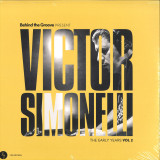
BTG presents “Victor Simonelli: The Early Years Vol 1” a collectors edition double Vinyl release - 2 X 12’s in each Vol
Launching the first Behind The Groove collectors edition vinyl series is New York’s finest Victor Simonelli with ‘The Early Years Vol 1 & 2’ double Vinyl releases. Featuring seminal house tracks such as Cloud 9’s ‘Do You Want Me’, Solution’s ‘Feel So Right’, Instant Exposure’s ‘Wanna Be With You’ and rare mixes of Raiana Page and EZ-AL, this collection brings together classic and rare Victor Simonelli cuts that reflect the early raw energy and buzz of the New York House scene. With ‘Vol 2” scheduled to follow shortly after, this is the most comprehensive collection of rare Simonelli cuts that firmly establishes his esteemed role in 90s House Music as well as introducing new fans to his inimitable sound.
Victor Simonelli is one of the early kings of NYC sampling In house music. The real deal - Victor danced at the legendary David Mancuso’s Loft sessions and developed a serious appreciation for good music. He interned for Arthur Baker at his renown Shakedown Studios (where Arthur worked with the iconic Afrika Bambatta on the seminal dance floor ’Planet Rock’ track) and went on to release hugely influential releases on seminal NYC labels 4th Floor and Nu Groove. Victor’s music was championed by the hugely celebrated iconic House Music DJ pioneers, Larry Levan and Tony Humphries at Paradise Garage & Zanzibar/WBLS/Kiss FM respectively.
Revered as a New York house heavyweight and prolific producer since the turn of the 1990s, Victor Simonelli grew up in Brooklyn, NYC, nurtured by a music loving family, with an avid record collecting father who also worked as a local party DJ. He took music lessons in piano, drums, guitar and bass, before discovering his first love, tuning into NY’s Radio Mix Shows on WBLS, WKTU and WRKS,98.7 Kiss FM) where he discovered the art of mixing and in his own words, ’I just simply got lost in the music’.
Graduating from NYC’s Centre For Media Arts, Victor got an internship in the legendary producer, Arthur Baker’s Shakedown Studios. Soon graduating to editing, mixing and then producing he worked for artists David Bowie, Quincy Jones, Debbie Harry, Sinead O’Connor and Talking Heads. Teaming up with fellow NYC producer Lenny Dee to become the Brooklyn Funk Essentials, they released records ‘Critical Rhythm’ and ‘Subliminal Aurra’ on 4th Floor before Victor went solo as Groove Committee releasing the classic ‘I Want You To Know’ on the legendary Nu Groove Records. Paradise Garage legend, Larry Levan broke ‘I Want You To Know’ rocking 2 copies on his last tour of Japan whilst King of NY House Music,Tony Humphries broke Victor’s new ‘Feels So Right’ across New York on his WBLS/Kiss FM Mastermix show and at his legendary Zanzibar club sessions. It was only a matter of time before Victor’s name became synonymous with quality House music ensuring a worldwide platform for his productions.
In the early 90s alongside his own productions, Victor Simonelli worked on high profile projects, including James Brown’s album, “Love Overdue” BeBe and CeCe Winans single featuring Mavis Staples “I’ll Take You There” and Quincy Jones’ “I’ll Be Good To You” featuring Chaka Khan and the legendary Ray Charles. Never straying too far from his clubland roots, Victor worked with Danny Tenaglia on his classic “The Harmonica Track”.
DJ gigs across the world started flooding in and Victor found himself recording for a dizzying array of labels including Tribal America, Sub-Urban, Bassline, King Street Sounds and Vibe, under a wide range of aliases. He also produced, wrote and remixed for artists such Nile Rodgers (Chic), Afrika Baambata, Hall & Oates, Frankie Knuckles, Kerri Chandler, Madonna and Michael Jackson. Famed for his own productions “It’s So Good” by Creative Force, “I Know A Place” as Sound Of One - the first release on Roger Sanchez One Records -, “Dirty Games” as well as the “Street Players Vol 1 EP”, Victor went on to set up Suburban Records with Tommy Musto and Bassline Records with two other partners. Notable releases on this label include “Do You Feel Me”, Connie Harvey’s gospel inspired, “Thank You Lord”, Urban Blues Project’s “Deliver Me”, Colonel Abrams “Not Gonna Let”, and Mone’s “Better Way”. Never ceasing to produce, DJ, run his own label and host radio shows like Groove Lift, Victor has worked with virtually every NYC producer and has nurtured a next generation talents including Angel Moraes, Jazz ‘N’ Groove, Urban Blues Project, Harlem Hustlers, Jay Jay and Julius Papp. Victor’s releases have also been used on M&S’s “Salsoul Nuggett” hit and Eddie Amador’s underground smash ‘House Music’.
In the late 90’s Victor launched his new Westside Productions, notable for the “Latin Impressions 1 & 2” releases, opened up a studio in Italy as he found himself increasingly working in Europe and now divides his time between New York and Italy. Suffice to say his unique sound of uplifting and spiritual music has kept him at the forefront of House Music and he is credited as one of its leading exponents with his string of classic releases and remixes.
Behind the Groove, branches out from its digital platform to embark on a programme of releases from the iconic pioneer producers of House Music. Esteemed for their high quality features and mixes that continue to explore, celebrate and venerate the contributions of highly respected, scene-shaping Labels, Artists, DJs and Special Events, BTG seeks to bring these talents and tales to the attention of the wider community. Unlocking the stories surrounding the pivotal roles they played and continue to play today in shaping the underground music scene we have come to know and love.
BTG presents “Victor Simonelli: The Early Years Vol 1” a collectors edition double Vinyl release, released on May 12th 2023. ‘Vol 2” follows on May 26th 2023 . These releases are the most comprehensive collection of rare Victor Simonelli cuts that firmly establish his esteemed role in 90s House Music and introduces new fans to his carefree sound.
With his 1981 solo debut album The Red and the Black, Jerry Harrison proves his formidable talent as a multi-instrumentalist and songwriter. Dense, abrasive and focused, The Red and the Black’s complex and funky musical style was ahead of its time. Harrison's observations throughout the album on the modern condition ring all the more true in our digital age. This limited edition 2LP edition features the 1981 album recut from the original tapes plus a bonus LP of previously unreleased outtakes and alternate mixes.
Lost in the depths of space, AAKAARA takes listeners on a journey to the outer limits of the sonic universe with their latest album “Obsidian Promises”. Blending influences from punk and metal, EBM, architectural design and certain celestial objects, AAKAARA offers a fresh take on industrial techno.
This body of work is dark and brooding, full of haunting and thought-provoking soundscapes. Metallic and cold one moment, blisteringly hot the next. Pounding drums create searing rhythms, acid-drenched synths weave abrasive textures, and noise permeates the stereo field. Inspired by the mysterious and alluring world of black holes, the producer explores the beauty of extremes through sound. “If you know my work or me,” AAKAARA says, “it’s no secret that I have a spiritual connection to, and an obsession with, black holes.
It’s not about doom and gloom, but about beautiful extremes: infinite calmness, ultra-high energy, being deeply centered, and inevitable attraction.” “I try to sonify this in a naive sense. It isn’t an attempt at science; it’s a way for me to practice a makeshift spirituality about these entities through craft and functional dance music for people.”
Spirituality and stellar inspiration were essential to AAKAARA’s life during the three years they spent between Los Angeles and London, while writing this album. It provided a sonic home during a period of transition, when they didn’t feel at home and didn’t have access to a studio.
Everything was made “in the box” using only Ableton 10. After collecting guitar pedals and amplifiers for years, AAKAARA has shifted away from a hardware-focused mindset and is now more invested in the conceptual framework, narrative, and cultural implications of their work. Visuals also play an integral role in this maximalist experience.
The outer sleeve (front and back cover) conveys the “big ideas” visually, while the companion poster includes custom typography, detailed drawings, symbol design, and poetry. The poetry provides a textual counterpoint to the lyric-less music, written in parallel but later stages of the production process. The visual identity of this work is inseparable from the music, describing it in an integral way. It’s the other side of the coin, not simply an accompaniment. With its spiritual connection to the infinite and mysterious, “Obsidian Promises” harnesses the beauty and intensity of celestial entities as musical inspiration, transforming the science into mystical, narrative-driven sonic experience. Get ready for a ride through the unknown as AAKAARA’s latest offering takes you on a high-energy trip through the black hole’s playground.
Tom Zé and Faust collide in Domenico Lancellotti's "machine samba"
Domenico Lancellotti's SRAMBA reaches back to the roots of samba whilst completely revamping its blueprint, indoctrinating guitar and percussion-led rhythms with analogue synthesisers, courtesy of album producer Ricardo Dias Gomes.
The majority of SRAMBA was recorded over two months in The Cave - Domenico's home studio in Lisbon, the city both Brazilian ex-pats reside in, where the arrival of a couple of Russian-designed synths purchased by Ricardo influenced the direction of their initial experimentation: "Ricardo had these instruments, modular machines" remembers Domenico, "and I had my guitar, some percussion instruments. On the first day we started making sounds and recording them, and songs started to appear, sambas started to appear."
The son of a renowned samba songwriter, at home Domenico would watch his father play and compose. At parties, the adults would hand his father a tamborim (a small tambourine) and ask him to play along. "I grew up inside samba, it's my roots", he says. "For me, everything is samba, I bring it into whatever style of music I am making".
Domenico and Ricardo instantly saw how the synthesisers were not at odds with the sambas they were playing, instead they had a similar sound to its typical percussion instruments (ganza, repinique, surdo, tarol). What's more, they saw a connection with roots samba, the samba that existed before bossa nova and samba jazz came along. This was rhythmic samba, with grooves that could go on ad infinitum. "It's samba de clave, geometrically structured" says Domenico. "It's ostinato samba", adds Ricardo.
"Diga" is a great example of what their proposal is capable of, as what begins as a glitchy machine whirring into action soon turns into a glorious samba in which the gurgles and scratchy beats coming from the analogue equipment only add to the arrangement. Likewise, on "Tá Brabo" it's an aching melody from one of the synths that gives the guitar rhythm its needed counterpoint, and shows how the duo's greatest accomplishment is not in invention alone, but in creating a great samba album. It's an album that can go from the opening track "Ere" with its reverberant bass thud, mantra-like vocals and staccato rhythms to the string-accompanied "Nada Sera de Outra Maneira", a swooning samba that pays tribute to the Brazilian ensemble Tamba Trio, who along with Tom Zé's Estudando O Samba, Domenico names as the biggest influence on their treatment of samba.
Other important reference points are made clear on "Um Abraço No Faust". One of three instrumentals on the album its title riffs off a JoãoGilberto song, "Um Abraço no Bonfá", but whereas JoãoGilberto was giving a hug (um abraço) to bossa nova guitarist Luiz Bonfá, Domenico and Ricardo are giving theirs to the German avant-gardists Faust. "Quem Samba", with its horn section and dramatic melody give a whiff of Domenico's Italian ancestry, while "Descomunal" is devoid of rhythm whatsoever, guest vocalist Tori singing over a bed of electronic drums, cello and swirling synths, that highlights the duo's unwillingness to stick to a particular formula.
Both Domenico Lancellotti and Ricardo Dias Gomes are revered names within Brazilian music over the past 20 years. As a member of the +2's, with Moreno Veloso and Kassin, Domenico released a trio of albums on Luaka Bop in the early 00s that pioneered a new Rio samba sound with elements of funk and psychedelia. With Veloso and Kassin he would later form Orquestra Imperial, a big band intent on reviving ballroom (gafieira) samba, and that has worked with guest vocalists such as Seu Jorge, Elza Soares and Ed Motta. SRAMBA is his fourth solo album. Multi-instrumentalist Ricardo Dias Gomes first came to notice as a member of Caetano Veloso's band Cê which helped reinvigorate Caetano's career with a sound influenced by British new wave. As well as collaborations with Lucas Santtana, Negro Leo and Thiago Nassif, and work with his own group Do Amor, he has released a series of acclaimed solo albums that reveal a restless music-maker.
SRAMBA is a glorious showcase of the duo's style, uniting Domenico's playful lyrics and rhythmic, samba-rooted songs with with Ricardo's assured accompaniment of unorthodox textures and instrumentations. It may be a new language for samba, machine samba (samba de máquina), but as Domenico says, "samba da máquina is samba".
Les Disques Bongo Joe return to the scorching Kabyle rock of Abranis, the pioneering Algerian band that blended traditional Berber music with western rock, folk, disco, and funk, all the while proudly celebrating their Kabyle heritage. Amazigh Freedom Rock is a comprehensive look into their discography, from the garage-rock experimentations of their early days to their lushly orchestrated North African fusion masterpieces of the 1980s.
The Abranis story begins in the mid-sixties, when Shamy El Baz and Karim Abdenou crossed paths in one of Paris' bohemian neighborhoods. Both were Kabyle, the Berber
people from Algeria’s northern regions, both loved rock music, and both were passionate about fostering a modern Algerian sound, as inspired by Kabyle rhythms and melodies as it was by western rock. The two musicians founded Les Abranis in 1967.
Together they experimented by mixing Kabyle vocals and melodies with garage and psych-rock but as the '70s progressed they increasingly moved away from the garage and psychedelia of their early days and began to interpret their Kabyle repertoire in more open and creative ways melting prog rock, jazz and some early electronic influences.
Over 11 electrifying tracks, Amazigh Freedom Rock 1973-1983 highlights their legacy as the underground kings of Kabyle rock.
- A1: Song Can Heal The Ailing Spirit - Yevgeni Abramovich Baratynsky
- A2: There Were Storms And Tempests - Yevgeni Abramovich Baratynsky
- A3: La Belle Dame Sans Merci - John Keats (Transl. Wilhelm Veniaminovich Lewick)
- A4: O Melancholy Time! Delight For Eyes! - Aleksandr Sergeyevich Pushkin (Excerpt From “Autumn”)
- A5: Farewell, O World, Farewell, O Earth - Taras Hryhorovych Shevchenko (Excerpt From “The Dream”)
- A6: I Will Tell You With Complete Directness - Osip Emil’evich Mandelstam
- B1: Here’s A Health To Thee, Mary - Aleksandr Sergeyevich Pushkin (After A Poem By Bryan Waller Procter)
- B2: Winter Journey - Aleksandr Sergeyevich Pushkin
- 9: The Isle - Percy Bysshe Shelley (Transl. Aleksandr Solomonovich Rapoport)
- B3: Autumn Song - Sergei Aleksandrovich Yesenin
- B4: Swamps And Marshes - Sergei Aleksandrovich Yesenin
- B5: Winter Evening - Aleksandr Sergeyevich Pushkin
The gentle music and quiet nostalgia of some of the most exquisitely beautiful poetry ever written flows through Hélène Grimaud’s latest album, a tribute to the Ukrainian composer Valentin Silvestrov. Together with baritone Konstantin Krimmel, winner of the 2018 International Helmut Deutsch Lied Competition, Grimaud presented extracts from Silvestrov’s song-cycle Silent Songs at the Stienitzsee Turbine Hall near Berlin last August, in the presence of the octogenarian composer, who has lived in Berlin as an exile from his war-torn homeland since March 2022.