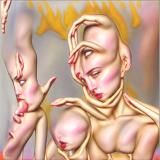
Fetter’s Body of Noise erupts at the threshold between ravey hypnosis and avant-pop experiment, slithering through the hinterlands of unconscious desire. Nine shape-shifting tracks conjure haunted landscapes where beauty refuses clarity and dancefloor logic warps underfoot. Vocals swoon, drift, and demand—stacking into fragments that multiply and weave through saturated pulses and shimmering, snarling synths.
Opening track "Like a Rose" traces a dreamer’s transition into the unstable physics of a perplexing but familiar dream world, where they gradually become lucid. “Beast” follows up humming with shadowed urgency, threading a path through self-sabotage and metamorphosis. “Spathiphyllums” drifts a while in a lush lostness, aching for something new before fracturing into wild, cathartic collapse. Side B’s “Do I Exist? (D.I.E)” and “The Longing” spiral into existential wonder, searching for a human origin story—both personal and collective—against a backdrop of uncertainty, while “Headache” thrusts forward as an absurd and insistent manifesto to stay the course and harness one’s own power within the madness.
Body of Noise is crafted not only for sweating bodies in motion, but for distorting time and opening psychic portals, where surrender becomes strategy and uncertainty transforms into ecstatic navigation. Rooted in all-hardware improvised production and shaped by Fetter’s years of boundary-blurring visual and performance art, their debut LP feels alive and in flux. Reminiscent of a spectral pop chorus trapped in a loop of broken machinery, or a lost broadcast from a dancefloor in a parallel realm, Body of Noise is a journey into chaos, transformation, and a bold refusal to be contained.
About Fetter:
Fetter makes clubby self-destructing noise pop to dance and weep to. Oscillating between ethereal and pounding, their all-hardware, largely improvised live sets take listeners through a foggy wilderness of saturated rhythms and menacing synth lines, a golden voice guiding the way through. Fetter is the stage moniker of multimedia artist Jess Tucker. Their performances take place in clubs as well as galleries, often incorporating video, installation, and interactive performance art elements to create other-worldly surrounds of mesmerizingly unhinged bodies and faces.
Cerca:absurd
"Later Than You Think" erscheint bei seinem neuen Label YOUNG und beschäftigt sich mit Themen wie Trauer, Gerechtigkeit, Wiedergeburt, Transformation und spirituellem Kampf. Es ist ein Werk von Bekenntnis und Konfrontation, für das sich Affekt, Intellekt und Geist auf der Suche nach dem Schönen, der Wahrheit und dem Realen zusammenschließen. Entstanden ist das Album in den Ozarks von Missouri. Die 16 Tracks vereinen Elemente und Gegensätze wie Üppigkeit und rohe Reduziertheit, das Heilige und das Profane, minimalistische Disziplin und maximale Schwelgerei, Kontrapunkt und simple Popharmonien. Im Kern unterstreicht das Album aber vor allem Maus" Hingabe an radikale Aufrichtigkeit und emotionale Wahrhaftigkeit in einem Zeitalter der Entfremdung - angetrieben von Konfrontation, Glauben und der tiefen Überzeugung, dass Sinn und Bedeutung noch immer etwas meinen. Maus, der einen Abschluss in Experimental Music und einen Doktortitel in Politikwissenschaft hat, wurde für die Art und Weise, auf die er akademische Sorgfalt und Lo-Fi Synthpop-Ästhetik verbindet, mal als "philosopher pop star" mal als "analog futurist" bezeichnet. Sein Wirken zieht sich dabei quer durch die Popkultur - von der Grime-Ikone Skepta, der seinen Track "I"m Only Human" sampelte bis zum Gen-Z-Rapper nettspend, von Filmemacher Josh Safdie ("Uncut Gems") bis zum Fotografen Wolfgang Tillmans. Sein Track "Cop Killer" ist im 2025er Film "Friendship" mit Tim Robinson und Paul Rudd enthalten. Mit exzessiven Liveshows und seinen bislang erschienenen Alben, auf denen Ironie, Trauer, Freude und Absurdität stets dicht beieinander liegen, hat Maus einen einzigartigen Weg beschritten und sich eine ergebene Fanbase erspielt.
On September 26th, 2025, two decades and seven albums into his career, American musician, composer, and academic John Maus will release his most transcendent work yet: Later Than You Think. Arriving via his new label YOUNG, the album explores themes of grief, justice, rebirth, transformation, and spiritual warfare - coalescing into a work of confession and confrontation: an aural metaphysics where affect, intellect, and spirit converge in search of the beautiful, the truth and the real. Written, produced, and recorded in the Ozarks of Southwest Missouri, Later Than You Think spans 16 tracks and contains multitudes - the lush and the bare, the sacred and the profane, minimalist discipline and maximalist indulgence, counterpoint and simple pop harmony. At its core, the album reaffirms John Maus’ commitment to radical sincerity and emotional truth in an age of alienation. Powered by confrontation, faith and transformation - driven by the urgent belief that meaning still matters, and time is of the essence. Holding a degree in experimental music from CalArts and a PhD in political science from the University of Hawaii, Maus has been dubbed a “philosopher pop star” and “analog futurist” for the way he merges academic rigor with lo-fi synth-pop aesthetics. His influence spans genres and generations—from UK grime icon Skepta, who sampled his track “I’m Only Human,” and Gen-Z rapper nettspend, to filmmaker Josh Safdie, actor Natasha Lyonne, and photographer Wolfgang Tillmans. His track “Cop Killer” features in the 2025 film Friendship, underscoring his continued relevance across high and low culture. With five previous albums under his belt - Songs (2006), Love Is Real (2007), We Must Become The Pitiless Censors of Ourselves (2011), Screen Memories (2017) and Addendum (2018) - Maus has carved out a singular path where irony, grief, joy, and absurdity can coexist and gained a cult following along the way. On Late r Than You Think Maus doesn’t just return—he confronts, confesses, and transforms. The result is not only a career-defining work, but a rare artistic offering: one that dares to believe in meaning, beauty, and the possibility of transcendence
Montreal duo Flabbergast—aka Guillaume Coutu Dumont and Vincent Lemieux—return to Circus Company, the label where it all began with their debut EP in 2015. Now seasoned veterans of leftfield club experimentation, they deliver Weirdo Active, a two-track vinyl release that distills their signature
blend of groove, absurdity, and refined weirdness.
On the A-side, “Timecrowave” is a swung, syncopated burner built around fragmented drum programming, warbled synth textures, and subtly detuned atmospheres. It's a tool that thrives in the inbetween moments of a set—unpredictable yet fluid.
On the B-side “Serpentoute,” a slinky groove laced with dubwise processing and modular squelch, maintaining tension through micro-edits and playful FX. Perfect for after-hours transitions or more openminded floors.
Following standout releases on Yoyaku, Copier/Coller, and Chapelle XVI, Flabbergast continue to offer up dance music that’s deeply heady, subtly unhinged, and always full of intent. A finely sculpted dose of dancefloor surrealism—just the way Flabbergast likes it.
In 2047, amidst the deafening yet oh-so-familiar soundscape of the Movement Festival in Detroit, we met again: I, pdqb, and Scape One, known as two of the most respected electronic music composers worldwide. The air pulsed not only with the latest beats but also with a barely perceptible energy only the two of us knew. We hadn't simply flown in; we'd arrived with our fantastic "Diskmind" time-travel machine, an incredible invention, capable of effortlessly catapulting us through the centuries.
"It's unbelievable, isn't it?" I shouted over the bass, eyebrows raised. "A machine that lets us travel through all of history, and there isn't a single song that honors it! Not one!"
Scape One nodded vigorously, his gaze sweeping over the stage lights. "That's absurd! How can such a revolutionary invention remain unsung? It's almost an insult to music history itself."
We looked at each other, a silent understanding in our gazes. The mission was clear: The "Diskmind" needed its anthems. And who, if not us, who used and loved it, should create them?
And so, we decided to become the musical chroniclers of the "Diskmind," ready to tell the story of our time machine across four different eras...
For Synaptic Cliffs, it's an extraordinary honor to present these three Scape One variations of the original song 'Diskmind' (first released on The Electrifying Dojo, 2025). Each masterpiece was recorded in different future decades of the 21st century (of ourse with the help of the Diskmind time travel machine) and reflects the corresponding trend in electronic music. A1: A timeless, pristine Electro composition from the year 2035. A2: An IDM marvel from late summer 2075, recorded in the Zero gravity of Space Station 775. B: An Experimental Electronica symphony recorded at pdqb's Studio 577 on Mars Outpost 47A. Only musical equipment that doesn't currently exist was used for this release
Back in 1999, nestled in a cramped box room in his parents’ house in Cambridge, George Aretakis, one half of the newly-formed “I Like It” label (ili records) was on a sonic mission. Fresh from releasing their debut 12" All Alone by Hal, he dove headfirst into the world of self-engineering — no acoustic treatment, a sketchy Yamaha sound card, and a PC with a mind of its own.
What came out of that chaos is a collection of raw, imaginative tracks that blend hardware glitches with human quirks. Computer Rage was born from a technical meltdown — literal computer voices, warped vocals, coughing, and all. Its sibling, the Silicon Circus Mix, takes that same glitchy DNA and pushes it even further into bizarro territory.
Then there's Space You Know — a groovy slow-burner driven by a sticky bassline and the haunting vocal of Katie Jeans (courtesy of friends at Tummy Touch), chopped and recontextualized into something beautifully strange.
Rounding it out is Environ Mental, a moment of playful spontaneity made in a single night. Early morning birdsong, passing cars, and absurd vocalizations collide in a whimsical microcosm of lo-fi joy.
This release is a love letter to the unfiltered creativity of early bedroom production — messy, noisy, and bursting with heart. A must-have artifact for fans of DIY electronica and late '90s experimental house.
Irlands bestes Avant-Punk-Quartett hat die The Early Years EP neu aufgelegt - eine Sammlung vergriffener 7"-Singles und Coverversionen, die ursprünglich auf Any Other City Records und The Quarter Inch Collective erschienen und 2015 bei Rough Trade veröffentlicht wurden. The Cha Cha Cha wurde nun zusammen mit den anderen Tracks remastert und ist bereit, erneut die Tanzfläche zu erobern. Ein Fan-Favorit (und fester Bestandteil der Live-Setlists), der auf der Sammlung zu finden ist, ist ein achtminütiges Cover des absurden Bangers und verdrehten Ohrwurms "Why They Hide Their Bodies Under My Garage" von Post-Dubstep-Mastermind Blawan - ein Track, der, einfach gesagt, so klingt wie nichts, was man je zuvor oder danach gehört hat.
- A1: Downtown Club Owner
- A2: Hot And Steamy Sweatpants
- A3: No Need To Thank Meme
- A4: Second Rate Quality Good Stuff
- A5: Look What The Dog Bought In
- B1: Shakin Cat Stevens
- B2: Farmer Had A Farm Song Crazy Dog Lady
- B3: Ukulele House Of Worship Aka Casino Place
- B4: This Town Is Big Enough For You Two
- B5: Less Is More For My Baby
- B6: Unexpected Money Transfer
With Schokolino Choco Loco, Icelandic duo Stilluppsteypa brings a warped dispatch from the outside fringes of experimental sound--part valium-drenched dreamscape, part dadaistic radio hallucination. Like a nocturnal transmission from a parallel universe, the record drifts and mutates through layers of joyous abstraction, laced with a deadpan sense of humour, while at the same time it is strangely sensitive. This LP is less a collection of tracks than a slow-motion joyride through Stilluppsteypa's singular sonic universe--so hypnotic and absurd, it ends up warming your heart.

This is the very limited marbled vinyl version of the repressed Lords of The Null Lines EP.
Here we have the beautifully remastered Foul Play and Foul Play ft Randall remixes of Lords Of The Null Lines. There is little to say about these definitive classics that has not already been said. You know ‘em, you love ‘em, they are essentials. However, the Danny Styles remixes are perhaps deserving of some explanation. There were created in the early 90s, and were cut, but quickly stopped by Moving Shadow as they were not really official remixes. A few test presses got out, and the result has been these remixes reaching a near mystical status in the passing decades, and the vinyl changing hands on discogs for absurd prices.
So it was with great pleasure that Hyper-On Experience and myself managed to broker a deal with Moving Shadow and Danny Styles to bring these amazing remixes to a legal and official release! It took over 25 years, but they can finally be bought...
Part 1[11,72 €]
A noughties classic, an earworming anthem, an eventual schoolyard ringtone favourite; Roman Flügel’s once inescapable ‘Geht’s Noch?’ celebrates turning 21 on Running Back, refreshed and remixed by a scene-spanning set of artists paying keen tribute to its absurdist energy.
Casually released as part of a Cocoon Records compilation in 2004, ‘Geht’s Noch?’ rose from the depths with the support of Sven Väth, becoming an international phenomenon, conquering and uniting the dominant scenes of minimal and electroclash alike. Some have said it laid the foundations for the ‘Dirty Dutch’
house scene, albeit from over the border in Germany.
Well known for injecting much-needed levity into the contemporary club landscape via her Live From Earth parties, DJ Gigola adds additional firepower to ‘Geht’s Noch?’, inducing a planet-shaking kick drum, before sending the track’s signature bleeps into nonsensical Morse code for even greater pleasure. Another rave
culture connoisseur, Luca Lozano, offers two alternate takes; his ‘Technocs’ mix rolls deep with additional cowbells, robotic voice commands and stadium-sized claps. Meanwhile, the ‘Gehts Garage Remix’ draws a savvy connection with the original’s as-yet-untapped UK funky potential.
Peder Mannerfelt, who straddles the line between innovation, functionality, humor and seriousness quite like its original author, takes ‘Geht’s Noch?’ to truly wuthering heights. His remix builds unexpected drama and catharsis around the enduring riff, before a collaboration with studio partner Par Grindvik as Aasthma
spins the club out with a glossy, anime-tinted take, full of whimsy and colour.
And while the digital release of Geht’s Noch? also spans interpretations from Audion, Domnik Eulberg & Moguai, this vinyl release presses Steve Angello vs Who’s Who remix to wax, that which helped take ‘Geht’s Noch?’ out of the underground and into the stratosphere. Twenty years on, and Flügel’s offbeat hit is always ascending. Love it or hate it, ‘Geht’s Noch?' will still get you good.
Words by John Loveless
From Sweden with Italo to Dresden with love. Stockholm's DJ City drops his first release on Dresden's Uncanny Valley with the COSMICOMICS EP, a 100% fun record for all the senses, deeply inspired by Italo Calvino's iconic short story collection.
The stories have inspired DJ City to a record that aesthetically draws from 80s Italo Disco and 70s science fiction films. In the book, each story is based on a scientific fact about the world and the cosmos whilst using fiction to ask how we understand it. Where Calvino's stories are comical and absurd, DJ City surrenders to the sublime and romantic and moves further into the metaphysical world that Calvino created to come up with three energetic and melodic tracks bursting heavily with fantasy and drama. Deeply rooted in dance music's history, they shine with Hi-NRG-vibes, strict dancefloor commitment and little easter eggs like that Drexciya-reference in COSMICOMICS.
The cover of the record is a painting from 2020 by Swedish artist Jens Faenge called THE INN. The picture seems to have been broken up into several dimensions, and abstract details make it difficult for the viewer to know exactly what and when the scene is taking place. When shown in Shanghai, the painting was censored by government agents and had to be taken down. A testament to the power of the image. Perhaps it shows our main character, perhaps it shows us the author or the artist. Depending on who listens, who reads and who looks, a multitude of universes open.
Anadol and Marie Klock have teamed up for a joint album, La Grande Accumulation. They met two years ago at a festival in England crowded with violent seagulls and outsider musicians. Klock being prone to barking on stage and Anadol not laughing at jokes she doesn’t find funny, they straight away had the intuition that they would meet again. And so they did, a few months later, at Anadol’s studio in Istanbul.
Today, the two Pingipung artists present the fruit of this musical friendship. La Grande Accumulation was born out of the peculiar atmosphere of the studio neighbourhood in Büyükada, an island where thousands of cats run free and humans randomly destroy things during apocalyptic times when parts of Turkey had just been turned into dust by terrible earthquakes. The French lyrics are inspired by hours of conversations, the music is consequently drenched in absurdity, overflowing with a strong urge to live and enjoy. According to the LP sticker, this album has been certified “Best handshake of 2024”, and stickers never lie.
La Grande Accumulation brings together Marie Klock's mysterious metaphors and Anadol's intriguing radiophonic psych-pop. Stretching forms beyond common sense to see how long they can resist is probably their favourite game. The result are six highly imaginative tracks that challenge the sub-3-minutes standards of Spotify pop.
Gözen Atila aka Anadol is well known to the Pingipung audience, with three solo LPs on the label. Her music follows a kind of collage logic, she interweaves countless styles, combining field and studio recordings with obscure quotation marks here and there. "I hope no one will come and explain this music to me, because it's the most beautiful music there is", says Kristoffer Cornils about her solo album Felicita.
Marie Klock is a French writer and musician who produces songs oscillating between synthpop and neo-folk, full of anarchic humour and existential dread. Her recent solo LP on Pingipung was a captivating tribute to the recently deceased poet Damien Schultz entitled Damien est vivant.
Marie Klock delivers her lyrics in song or spoken word, stream-of-consciousness musings on strange human adventures, and her rich keyboard melodies culminate in a nonchalant dialogue with the bass trombone (La Reine des Bordels). In the opulent opening piece (La Grande Accumulation), a woman is cursed to take home everything she kicks in the street; a bit later, we stumble upon a ghoul hiding in the gutter (Sirop amer), Mona Lisa loses her teeth (Sonate au Jambon) and a warthog struggles to climb the stairs of a silver tower (Sabots triviaux).
La Grande Accumulation was mixed and mastered by Jonas Romann at Chaos Compressor Club in Hamburg and cut to vinyl by Kassian Troyer at D&M in Berlin. It's an audiophile LP that invites to focus on every detail in this heap of musical ideas.
Boudica is proud to present their first record of 2024, featuring an artist who holds a special place within the platform - none other than DJ and producer Wallis.
DJ, live-act and former mastering engineer, Wallis speaks for a generation searching for novelty and emotion in the electronic music realm.
Sharp engineering skills coupled with a unique approach to sound design allowed her to develop a trademark sound. Using an array of synthesisers, effects units, and experimental studio techniques, Wallis produces melancholic electronic music rapidly shifting between different patterns and atmospheres.
She tours as a DJ and Live Act around the world, having played large festivals such as DGTL or renowned clubs like Berghain, and will happily play at a large stage one day but at a small intimate sweaty basement the next.
In 2024, she started producing music for fashion shows and debuted that project by creating the music for the entire Natasha Zinko runway show at London Fashion Week February 2024.
The EP's opening track, "Hell is a Girl from Before (Rainy Summer Mix)," introduces a stirring blend of emotions. Starting with an emotional melody, accompanied by synths and a plucked instrument, it swiftly transitions into energetic segments driven by the drums. Vocals emerge, their words almost imperceptible, adding an intimate layer to the experience. The track maintains a steady pace, evoking the ambience of a rainy summer day. This creates a melancholic yet hopeful mood, transporting listeners through a journey of introspection.
As "Protect Me From My Friends" unfolds, it feels like being whisked away to a new dimension, greeted by otherworldly, robotic sounds. The introspective journey of the previous track mutates into raw emotions, driven forward by a relentless bassline. Clear vocals take the forefront, guiding the listener through the sonic landscape, only to be interrupted by the commanding presence of the bassline, which assumes the main character role.
In "Sleeping Pills Are Gone," an atmospheric and gloomy introduction is abruptly interrupted by an acid and hefty bassline that dynamically evolves throughout the track, plunging the listener into an eyes-open dream born of a sleepless night. The vocals echo the track's title, creating a haunting repetition. Wallis strategically grants brief breaks, constructing a powerful crescendo that heightens the experience. These are momentary escapes before immersing the listener once more into the hypnotic trance induced by the solid four-to-the-floor march.
Closing the EP with a striking finale, "Teenage Apocalypse" introduces a clunky melody that encapsulates the signature sound of the record. Characteristic vocals weave throughout, guiding the listener towards the track's crescendo. Driven by a flawless fusion of drums, the song transitions seamlessly into a powerful breakbeat moment, accompanied by yet another impeccable bassline. True to its title, it evokes the intensity of a day of judgment, leaving a lasting impact as the EP draws to a close.
This EP is a testament to Wallis's growth as a producer and her fantastic storytelling ability through sound.
In the artist's words: "Sometimes life takes a weird turn. Angry, confused and dealing with moral: this EP targets the pain and absurdity of attachment and strongly themes Gregg Araki's teenage apocalypse trilogy. The artwork poem plastered on the wall was written by wallis."
- A1: India
- A2: Child Of Nature
- A3: Anna Was Mine (Demo Version)
- A4: Nature Boy (Mantovani Orchestra)
- A5: Land Of Love (Come My Love And Live With Me)
- A6: Hey Jacque (Hey Jacque)
- A7: Palm Springs (The Ray Anthony Orchestra)
- A8: Umgowah
- B1: Wild Boy ( With Mort Wise & The Wisemen And Rocky Holman)
- B2: Surfer John (Nature Boy & Friends)
- B3: Eden’s Island (Arthur Lyman)
- B4: Monterey (With John Harris And Paul Horn)
- B5: Overcomers Of The World (With John Harris)
- B6: The Clam Man
Black Vinyl[26,85 €]
“Wild Boy …” is a reissue of the well-known 2016 release curated by Brian Chidester, renowned researcher and biographer of Eden Ahbez. Especially for this album, Brian wrote an interesting text about Abi’s life, which definitely became the decoration of the release.
With the new 2020 re-release, we went a little further and kept what is commonly referred to as studio cuts. It’s a few more minutes in the studio with ahbez himself, full of emotion and life. In addition, to the delight of fans, the edition includes an additional composition Nature Boy (Mantovani Orchestra).
Especially, it is worth noting the outstanding mastering prepared from practically decomposed tapes by the Grammy-nominated Jessica Thompson, which guarantees the deepest and warmth possible sound. Jessica a huge ahbez fan and we’re highly appreciated for what she has done to save his music for the future.
Eden Ahbez is definitely at the origin of psychedelic music and this release can be taken as further proof. Over the past twenty years, the iconic figure of the world’s first hippie Eden ahbez has become famous primarily for his 1948 song “Nature Boy”, praising universal love, and his amazingly solo album from the 1960s called “Eden’s Island” – one from the first concept albums in the history of music and probably the first psychedelic music album. “Wild Boy: The Lost Songs Of Eden Ahbez” deepens understanding of the origins of the psychedelic movement in the 1950s.
The disc contains a musical selection of works by Eden ahbez himself, written by him in the period after Nature Boy. The inclusion of songs such as “Palm Springs” – Ray Anthony Orchestra and “Hey Jacques” by Erta Kitt gives the listener the chance to discover for the first time the little-known recordings of world-famous artists composed by Eden ahbez. Through “Wild Boy” and “Surfer John” you can hear the author’s handling of absurd rock and exotic experimentation, as well as sweet psychedelic pop like Monterey (with Paul Horn on flute). Overall, Wild Boy: The Lost Songs Of Eden Ahbez offers an overview of the lost works of 1949-1971 with seven unpublished recordings and eight rare singles.
If in 2020 you are missing the hallucinogenic content in Eden Ahbez, it amazingly makes up for that deficiency with simple chords, expansive arrangements, and lyrics about travel, relaxation, free love, and spirituality. Thus creating the standard of psychedelic music. Eden Ahbez’s songs weren’t only fantasy and his personal philosophy was the real thing that he lived.
reviews:
“This carefully and extensively researched compilation culls covers by top notch mainstream artists juxtaposed with unreleased Eden recordings. What might sound like a mixed bag is actually more like a chronological, musical non-fiction novel about Eden Ahbez. While Eden was writing hundreds of songs and performing live and making recordings in various styles, his songs were also being picked up by popular artists like Nat King Cole and Eartha Kitt who recorded with a more polished mainstream style. There are also some early rock n roll style recordings here. Eden’s professionally recordings often end up as Novelty Pop records such as “Child of Nature” and “The Clam Man” but if you read between the lines and listen to the lyrics it is pretty eye-opening that he is singing about Eastern-religion-style and pre-hippie philosophies about being at one with the planet Earth.
All of this is explained in the lengthy liner notes inside the lp along with a few choice photos that establish Eden as a founding father of Southern California mystic/psychedelic music.” – Tiki_News
“Eden Ahbez’s life philosophy was summed up in the lyrics of his most famous song, “Nature Boy,” a 1948 hit for Nat King Cole: the song describes a “strange enchanted boy” who wanders the world in search of truth. “The greatest thing you’ll ever learn,” he concludes, “is to love and be loved in return.” Ahbez was a pre-cursor of California’s beatniks and hippies, and an exalted icon of ex-otica via his rare 1960 album Eden’s Island. Beyond “Nature Boy” and Eden’s Island, though, there were nu-merous lesser-known Ahbez record-ings. Ahbez biographer Brian Chidester has been doing an exemplary job of archiving and documenting that catalog of work. The Exotic World of Eden Ahbez (reviewed in UT#38) appeared a few years ago, gathering together 14 Ahbez-related rarities” – Ugly Things
Köhncke rides again with another 12“ having 2 sides that couldn‘t be more different: the A-Side, „Timecode“, is a clock-ticking electronic disco tease promising a joyous release by building up tremendous expectations over its course of 8 minutes – and of course not delivering the final dance floor orgasm since the night has to continue in mutual happiness and expectations on the floor. But well, surely lots of „pre-cum“ spreaded...
The „flip“, „The Answer Is Yes“, displays Köhncke‘s love with The Beatles or Prefab Sprout and the likes, in a masterly programmed digital simulation of the „played“ sound of the likes (Köhncke cannot play any „real instruments“ except for a bit of Barré-Punk-Guitar). It‘s a love metaphor about 2 photons in „entanglement“, which is a proven very psychedelic effect in quantum physics. The photons are „entangled“ and „know“ each other‘s „spin“ in immediacy, thus not bent to the speed of light, even if they are 100000 light years from each other - a theory that even Einstein considered absurd when the pioneers of quantum physics came up with this in the 1930s. So Justus put his fascination with quantum physics into a pop love song metaphor – how much more do you want?
Köhncke kommt zurück mit einer 12“ - 2 Seiten, wie sie unterschiedlicher nicht sein könnten: Die A-Seite, „Timecode“, ist eine tickende elektronische Disco-Versuchungs-Zeitbombe, die über ihre Laufzeit von über 8 Minuten extreme Erlösungsversprechen macht, sie aber selbstverständlich nicht in einem endfinalen Floor-Orgasmus auflöst, denn die Nacht soll ja weitergehen in gemeinsamer Glücklichkeit und Erwartung auf der Tanzfläche. Allerdings, eine Menge „pre-cum“ wird schon versprüht in dieser unwiderstehlichen Spannungserzeugung von Track.
Die „flipside“, „The Answer Is Yes“, stellt Köhnckes Liebe zu den Beatles oder Prefab Sprout etc. ins Licht, in einer meisterhaft programmierten digitalen Simulation des „gespielten“ Sounds der Großmeister (Köhncke kann keine „echten Instrumente“ spielen außer ein bißchen Baréegriff-Punk-Rhythmusgitarre, sein Instrument ist der Sequenzer). Es ist eine Liebesmetapher über zwei Photonen im Zustand der „Verschränkung“, was ein heute wissenschaftlich nachgewiesenes extrem psychedelisches Phänomen aus der Welt der Quantenmechanik ist: die Photonen sind „verschränkt“ und „kennen“ ihren aktuellen „Spin“ (Rotationsrichtung des Teilchens) unmittelbar, also nicht gebunden an die Lichtgeschwindigkeit. Auch wenn sie 100000 Lichtjahre voneneinander entfernt sind – eine Theorie, die sogar Einstein absurd fand („Spukhafte Fernwirkung“), als die Pioniere der Quantenphysik sie in den 1930er Jahren postulierten. Köhncke verewigt seine Faszination für Quantenphysik hier also in Form eine Retro-Pop-Lovesong-Methapher – was will man mehr?
Downloads
- A1: Documentation
- A2: Block Rocker
- A3: Corals In Space
- A4: Meeting: Palermo
- A5: Astral Snow
- A6: Tooty Cutie
- B1: Coordinates Meeting
- B2: Mars Close Up
- B3: Alarm
- B4: Hammond A Lolo
- B5: Under Control
- B6: Lazer
- B7: Galaxy Fall-Out
- C1: Funky Flower
- C2: Power Boost
- C3: Lobby And Supercomputer
- C4: Schwarze Spinne
- C5: Wings
- C6: The Real Mccoy
- D1: Evening Air A
- D2: International Espionage
- D3: Milky Way
- D4: Electric Cats
- D5: Nightmare On Lsd
- D6: Cruising Crooner
Vol.2[28,78 €]
25 killer library music cuts by the German film music maestro on audiophile pressing in deluxe 2x10" set. Uberrare and never released before material from 1968-1976, sourced from Peter Thomas' personal reel-to-reel tape archive. Limited edition of 500 pieces.
From brassy big band funk, space jazz, krauty synth experiments to proto-hiphop, cosmic schlagers, heavy easy listening, soulful soundtrack moods and absurdly dreamy LSD ballads, this compilation encompasses the composer's most obscure and yet most transcendent work.
Peter Thomas is widely acknowledged as Germany's most inventive film music composer of the 1960s and 1970, best known for his iconic soundtrack work. He scored over 600 films and episodes, from the crime blockbusters of Jerry Cotton and Edgar Wallace to indie arthouse films like Playgirl, Bruce Lee's The Big Boss and the extraterrestrial Space Patrol and Chariot of the Gods.
His recordings for music libraries often provided an even more leftfield approach. Their visionary 'dope beats' appeal provoked a keen interest from vinyl aficionados, beatmakers and rare groove DJs alike. Unavailable for the public, the original "for professional usage only" albums are now sought-after collector's items that fetch astronomic prices on the 2ndhand market.
This double 10" album is the definite selection of Thomas' best library cues from the Golden Ring Records, KPM and DeWolfe catalogues, many of them available publicly for the first time - plus four recently unearthed "lost" tracks from Warner Chappell's CPM Archive series that have never been released on vinyl before. All music was carefully transferred from Peter Thomas' private master tapes and cut in full dynamics, housed in a beautiful fold-out cover with liner notes and private pictures. The compilation was realised in cooperation with Peter Thomas' son Philip who takes care of the Peter Thomas Sound Orchester catalogue after his father's death in 2020.
Pomegranate Skies is a new album from Sepehr exploring sonic themes of heaven and hell, dualities, split identities, and chaos. The music in this album is a reflection of the ever-constant existential chaos in his mind, reflecting a musical journey through all the different influences and inspirations of genres and electronic music eras throughout his life but also a nod to the amorphous weight of divine weirdness that inspires his music. Music that is reflecting a split identity, music in between cultures. Music that is both good and evil, both sensical and non sensical, both angelic and hellish, secular and divine. Music to give you visions of geographic wonders that don’t really exist. The absurdism of everything from Earth but also of Heaven. Music that doesn’t follow tropes but also sounds familiar. It makes you want to laugh and cry; the in betweenness of everything. Music that makes you want to reach up and taste the pomegranates growing in the skies.
RIYL: Konk, Loose Joints, Chaz Janke. The DFA debut from longtime family member Jayson Green also marks the return of the classic DFA twelve-inch. Maybe it actually stands for Dying Formats Always? Jay’s sung in a lot of bands. Like, a lot. Panthers, Violent Bullshit, Cheeseburger, and the legendary hardcore band Orchid. There are probably more. He’s always been smart and hilarious, never quite cynical though always quick to point out the absurd. Now in a bandleader role, he’s delivered us a classic a-side in “Local Jerk,” which sounds like a party because it was actually recorded during one: tight disco drums, big claps, a neck-rolling baseline, horns, and group vocals. You can literally hear the bottles clinking. The head trip is the b-side, “I Need Love,” which is a most terrifying, ridiculous piece of nightlife satire. Produced by W. Andrew Raposo and James Murphy. Mixed by James Murphy for the DFA. Mastered and cut by Robert “Sparklebear” Weston at Chicago Mastering Service. Pressed at Furnace Recording Pressing. A1 Local Jerk B1 I Need Love
Chilean Record Label based in New Zealand, Sounds of Sirius Music, returns with an amazing EP for its 6th release.
4 unique original tracks from none other than SWOY; No introduction needed for the talented producer.
Early Support: NuZau, Mihai Pol, userUNKNWN, Silat Beksi and Herman Saiz.
- A1: Permeate
- A2: Unity Gain
- A3: Eyes Shut Feat Faye Houston
- A4: What Is The State Of Our State (Part 1) Feat Repeat Beat Poet
- A5: Your Invasion Is A Lie Feat Idris Rahman
- B1: Unforgotten, Unforgiven
- B2: What Is The State Of Our State (Part 2) Feat Repeat Beat Poet
- B3: Flames Feat Faye Houston & Tamar Osborn
- B4: Refuge (Interlude)
- B5: Refuge
Albert’s Favourites label founder Scrimshire is set to release bold new album 'Paroxysm'. In the last few weeks of October 2022, Scrimshire wrote a new collection of songs with the descriptive working title "Scream". A direct response to the absurdity of the breakdown in the UK government, the horror of the treatment of refugees arriving on our shores and the callous disregard for the trauma being caused to low-income people or anyone considered "other". While self-preserving Conservative MPs fought for their jobs, record profits were announced by energy companies as they were gouging crippling amounts of money from people's pockets. The anger, sadness, mourning, and frustration he felt was poured into these recordings.
Originally named “Scream 8”, ‘Unity Gain’ was one of the early outpourings from those sessions. Piano and drums bubble up until it fully boils over with huge stabbing synthesiser and string sounds in an outburst of frenetic energy. "Division seems to characterise our daily experience”, says Scrimshire. “How does a society stop the callousness and corruption from seeping into its bones?".
Singer Faye Houston features on both ‘Eyes Shut’ as well as, alongside saxophonist, composer, and multi-wind instrumentalist Tamar Osborn, on ‘Flames’. About the latter Scrimshire explains, “One person can breathe fire into your life and the world, leaving an indelible mark. The album was influenced hugely by a friend we sadly have lost. I think of it like the heat you still feel after a fire has gone out”.
London-based poet and emcee The Repeat Beat Poet captures moments of time, thought, and feeling on ‘What Is The State Of Our State’, a furious yet succinct stream-of-consciousness diatribe in two parts. From afrobeat and reggae-influenced London band Soothsayers, clarinetist and saxophonist Idris Rahman features on ‘Your Invasion Is A Lie’, an ever-progressing, cosmic-jazz track.
The elegiac ‘Unforgotten, Unforgiven’ features saxophonist Nat Birchall, on which Scrimshire says "This is dedicated to the politicians who have forced refugees into life-threatening decisions. Pushing people into the hands of traffickers, into small boats and too many beneath the waves of our seas. Who force the lives of men, women, and children into more danger, in the hope of escaping war, poverty and persecution only to meet more cruelty and persecution. It won't be forgotten, and it won't be forgiven".
Scrimshire’s last album, 2021’s 'Nothing Feels Like Everything', received an Album of the Year nomination at the Gilles Peterson Worldwide Awards and last March he was named by the Guardian as one of three producers behind the new wave of UK soul, alongside Inflo (Michael Kiwanuka, Sault, Lil Simz) and Swindle (Joel Culpepper, Greentea Peng, Kojey Radical). Albert’s Favourites was formed by Adam, Dave Koor, and Jonny Drop, who designed the logo and artwork, and has released records by The Expansions, Hector Plimmer, Huw Marc Bennett, Pie Eye Collective, Qwalia, Ronin Arkestra.
Early support from Huey Morgan, Amazing Radio specialist playlist, Gideon Coe. Previous support from Gilles Peterson, Mary Anne Hobbs, Jamz Supernova
Schacke’s Make Them Remember is a point of genesis. From the insectoid trippiness of “Life Is Absurd” to the anthemic martial churning of “Make Them Remember” and the ocean floor pensiveness of “A Future Not Materialized”, the record mapped out the road ahead for not just Schacke, but for Copenhagen techno as a whole – a cornerstone in fast techno.
Young Boy Dancing Group
Young Boy Dancing Group was initiated in 2014 as a mercurial dance collective with an ongoing alternating cast. The group deals critically with modes of dance production, digital culture, originality and institutionalisation. Past performances include the Lithuanian Pavilion at the Venice Biennale 2015 and Manifesta 11 in Zurich, among others. The artwork for Schacke’s “Make Them Remember” is made up of a photo documentation from a performance by the group in Copenhagen in 2016.
This EP marks a natural convergence for Primal Instinct. Built around pure dancefloor intent, it presents a focused spectrum of moods, unified by intent. Each track is unmistakably Temudo, and unmistakably Primal Instinct: physical, driven, and designed to move bodies first and foremost.
The release is the result of close collaboration between Temudo and the label. A shared framework took shape, allowing Temudo to adapt to the vision without altering his sound, forming a joint effort where two aesthetics align.
Visually, an image rooted in memories of Carnival in Temudo's hometown becomes the perfect symbol: chaotic, social, and in constant motion, reflecting the absurdity of life and the human condition.
- 1: Throw It Out
- 2: Cockroaches
- 3Rabbit
- 4: She Used To Love Me
- 5: Killing Me
- 6: Two Horse Force
- 7: Show Me
- 8: Till 3
- 9: Lame
- 10: Head Up
- 11: No Struggle
Lange bevor er jemals ein Studio von innen sah, war Sam Snitchy auf der Straße unterwegs und schrie unter dem Namen Maniporno Gedichte - roh, furchtlos und im Einklang mit dem Chaos um ihn herum. Dann begann er, diesen Lärm in Platten zu verwandeln - zuerst als Melker, später als Sam Snitchy. Im April 2026 erscheint nun das dritte Snitchy-Album bei Voodoo Rhythm Records - ein weiterer Schritt auf diesem Weg, tiefer hinein in den Lärm, den Puls, die Verwirrung, mit der alles begann. Das neue Album ist ein klanglicher Exorzismus, aufgenommen mit Marco Fuorigioco, der Bass, Synthesizer und Gitarren verzerrt und das Tonband zerreißt, Philipp Schlotter (Me&Mobi, Music Against Airports) der den Raum mit geisterhaften Synthesizer- Halluzinationen erfüllt, und Domi Chansorn (Sophie Hunger, Knackeboul, Fai Baba, Bonaparte, Marie Krüttli, Béatrice Graf) der die Drums wie einstürzende Türme hämmert. Gemeinsam zerren sie dich durch psychedelische Punkwut, verschmelzen mit den Schatten dunkler Waves, mutieren zu Industrial Noise und Dub-Nebel, verwandeln sich in einen verzerrten Techno-Puls, bis du nicht mehr unterscheiden kannst, wo das eine aufhört und das andere anfängt - alles nährt das Feuer. Und über diesem Sturm spuckt Sam Snitchy seine Worte wie zerbrochene Spiegel - verzerrte und selbstreflexive Geschichten über Menschen, die in ihren eigenen Widersprüchen gefangen sind, über leere Routinen und bedeutungslose Lebensstile, die als Erfolg getarnt sind, über den absurden Tanz zwischen Ekstase und Verzweiflung. Die Texte erklären nicht - sie verstören. Sie halten dir ein zerbrochenes Glas vor und zwingen dich, dich selbst anzusehen, bis du nicht mehr weißt, ob du lachen oder schreien sollst. In VVR's own words: "Sam Snitchy transforms chaos into sound. Once a street poet known as Maniporno, he now blends punk energy with techno pulse, industrial grit, dub tension, and psychedelic garage haze. It's raw and hypnotic _ words like broken glass, beats like heartbeat and collapse spring to mind."
Kim Gordon hat Kunst und Noise über Jahrzehnte immer wieder neu gedacht - und dabei nie an Schärfe verloren. Vierzig Jahre nach ihren Anfängen wirkt ihre Vision noch immer provokant. Dieses Abenteuer setzt sie mit ihrem dritten Soloalbum "PLAY ME" fort, das am 13. März bei Matador Records erscheint. Mit der Ankündigung erscheint die erste Single "NOT TODAY", begleitet von einem Kurzfilm der Modedesignerinnen und Filmemacherinnen Kate und Laura Mulleavy (Rodarte). Gordon trägt darin ein eigens für sie gefertigtes, handgefärbtes Seidentüllkleid. Der Song offenbart eine neue, fast poetische Spannung in ihrer Stimme: "Da kam eine andere Stimme zum Vorschein", so Gordon. "PLAY ME" ist ein konzentriertes, direktes Album, das ihren Sound um melodischere Beats und den motorischen Drive des Krautrock erweitert. Entstanden ist es erneut mit Produzent Justin Raisen (Charli XCX, Sky Ferreira, Yves Tumor). Die Songs sind kurz, prägnant und stark rhythmusorientiert - fokussierter und selbstbewusster als zuvor. Nach "No Home Record" (2019) und "The Collective" (2024, zwei Grammy-Nominierungen) richtet Gordon den Blick auf die Gegenwart: Tech-Macht, KI-getriebene Kulturverflachung, den Abbau demokratischer Strukturen und den absurden Alltag des Spätkapitalismus. Trotz dieser Themen ist "PLAY ME" ein nach innen gewandtes, geradezu körperliches und ebenso emotionales Album. Mit verzerrten Stimmen und schroffen Beats legen Songs wie "Square Jaw", "Dirty Tech" oder "Busy Bee" gesellschaftliche Realitäten frei. Der Titeltrack entlarvt die Logik einer durchkuratierten Komfortkultur. "PLAY ME" ist radikal gegenwärtig, widerständig und kompromisslos eigenständig.
Don’t believe your ears - Pepper’s Ghost is the latest offering from NYC project Nuke Watch.
Whatever you think it is - it is not. By the same token it really can be whatever you want - electronica, jazz, improv, noise, new age, ambient - it’s none and all of these. Like the primitive visual illusion it’s named for - Pepper’s Ghost is a projection of a thing, it’s not the thing.
The Nuke Watch method - like that of Aaron Anderson and Chris Hontos’ other primary project Beat Detectives - leans almost entirely on live improvisation, with some advanced studio alchemy in post. Where the Beat Detectives palette draws from club music tropes, Nuke Watch blends recognizable tones (hand drums, woodwinds, keys, fretless bass) with sounds of providence unknown, the line between organic and synthesized instrumentation unintelligibly smudged. What is real and what is projection? It’s hard to say. What do our ears tell us? This is where we arrive at Pepper’s Ghost.
Warped as the sounds may be, the playing belies a crew of deeply expressive, learned improvisers who have their craft honed. Their friendship and psychic connection enhances the ritualistic rhythms, mutant modular synthesis, nimble keyboard runs, absurdist sampling and unidentified skronk. They’re wonderfully complemented across several tracks on this set by Cole Pulice’s levitational, sublime saxophone.
As unhinged as this might all appear, once the mind and music meet on the same wavelength this is profoundly moving, energizing and uplifting Alive Music that recalibrates the sense of what music can be.
Nuke Watch is Aaron Anderson and Chris Hontos, with an array of friendly guests. They’ve released records as Nuke Watch on The Trilogy Tapes, Commend and Moon Glyph. As Beat Detectives they’ve released records on Not Not Fun, 100% Silk and their own studio imprint NYPD Records.
Pepper's Ghost was written and produced by Aaron Anderson and Chris Hontos. Additional instrumentation on these recordings by Cole Police, Leonard King, Eric Timothy Carlson, Chris Farstad and William Statler. It was mixed by Chris Hontos and mastered by Jack Callahan. Painting on the cover is “The Unity Of Being” (2020), by Ry Fyan. Design and layout by Aaron Anderson.
RIYL - Musical illusions, puzzles and magic tricks, downtempo, music of the spheres, good journey, Eddie Harris, Ketron, "world building", orange sunshine, suspension of disbelief.
"Western Massachusetts band Landowner play abrasively-clean minimalist punk. Singer Dan Shaw started Landowner in 2016, writing and recording the project's debut Impressive Almanac with a practice amp and a laptop drum machine. Shaw's initial concept was a made-up genre called “weak d-beat”, meant to sound intentionally absurd “as if Antelope were reading the sheet music of Discharge”. When Shaw joined with his current bandmates in 2017, they translated these early experiments in restraint, minimalism, and caricatured hardcore as a live band. This provided Landowner with its own unique set of blueprints: the guitars “slap hard” without using any distortion or effects, the rhythm section is tight, fast, and repetitious, and the song structures make space for lyrics that reflect on the global systems and dark absurdities our lives are tangled in. Comparisons could be made to The Fall, Lungfish, or Uranium Club, but across their five albums, they make it clear: Landowner just sound like Landowner.
Assumption is the band's fifth album. Sonically, it captures the vibrancy and intensity of their live performances. The album title “Assumption” encapsulates the album's multi-layered themes. We make assumptions, taking in information online through an overload of decontextualized snippets and headlines, and then quickly form conclusions, or we allow artificial intelligence to do the thinking for us. Assumption is the sound of a band that established its own musical identity and has reached a place of tightness with an ease gained from years of playing together, sounding mechanically precise and at the same time fully human. It may be the band's most cohesive and fully realized work to date."
- Frei Wie Eine Kaugummi-Cloud
- Keine Nichtmusik Eins
- Der Sputz Der Tagropronisten
- Keine Nichtmusik Drei
- Röntgenstrahlen Strahlen
- Flieg, Du Mensch, Flieg (Version 1)
- Flieg, Du Mensch, Flieg (Version 2)
- Männer & Männer
- Hugs & Kisses
- Küsse & Umarmungen
- Gewalt, Herrschaft, Macht, Dominanz
- Schlingen Siefen Und Fässe Binden
- Ich Schäme Mich Sehr
How do we listen when we know the human is absent? Neue Deutsche Kunst present a collection of music created for their own films, from Bubblegum Pop (literally - the first track is about Kaugummi), Dada Chanson, sugary Psychedelia, Cartoon Prog, Fake Jazz - documenting a period of Unheimlichkeit in the technological development of humankind. The music was neither composed nor recorded, no soundwaves were moved, no microphones abused. Absurd lyrics speak of non-reality, LSD, violence and revolution in a flowery almost-German non-poetry. Three songs are sung in a non-existing speculative language. It literally is Keine Nichtmusik - or is it?
- Echoes Of Old Nightmares
- Nothing But Impurities Pt.1
- Nothing But Impurities Pt.2
- The Grotesque Within
- Something Over There
- I'm Your Mistake
- Dead Puppet Eyes
NEON GREEN VINYL[24,58 €]
"The Grotesque Within" is what we proudly call our first true self-produced album. Recorded in the winter of 2025 between Outside Inside Studio in Treviso and our own home studio, it marks a raw and uncompromising chapter in our sound. The record weaves a dense narrative inspired by the unsettling atmosphere found in the works of Thomas Ligotti - where reality constantly threatens to unravel, and horror seeps into the everyday. Much like Ligotti's existential tales, The Grotesque Within doesn't simply portray darkness - it observes how the absurd and the horrific have become indistinguishable from our modern reality. Each track is a confrontation - with the bizarre, the dissonant, and the disturbingly familiar.This is not just an album. It's a descent into the uncanny that already surrounds us.
Neon Green Vinyl. Limited to 350 copies. "The Grotesque Within" is what we proudly call our first true self-produced album. Recorded in the winter of 2025 between Outside Inside Studio in Treviso and our own home studio, it marks a raw and uncompromising chapter in our sound. The record weaves a dense narrative inspired by the unsettling atmosphere found in the works of Thomas Ligotti - where reality constantly threatens to unravel, and horror seeps into the everyday. Much like Ligotti's existential tales, The Grotesque Within doesn't simply portray darkness - it observes how the absurd and the horrific have become indistinguishable from our modern reality. Each track is a confrontation - with the bizarre, the dissonant, and the disturbingly familiar.This is not just an album. It's a descent into the uncanny that already surrounds us.
Official reissue. New remastering vinyl of the 1979 LP by Colin Potter + "silver edition" Gatefold cover + complete NWW list on Gatefold inner.
Chance Meeting on a Dissecting Table of a Sewing Machine and an Umbrella is the debut album by British experimental unusual and absurd music group Nurse With Wound, released on their own United Dairies label in 1979. An unusual record which blends noise and jamming.
The album's equally unusual title is a quote from the surreal, poetic novel Les Chants de Maldoror by Uruguayan-born French author Isidore-Lucien Ducasse, written under the pseudonym Comte de Lautréamont.It has been included in the "100 Records That Set the World on Fire (While No One Was Listening)" by TheWire in 1998, and is one of the records that have had a lasting impact on avant-garde, experimental and psychedelic music.It was on this record that the famous "NWW list" appeared for the first time, featuring dozens of names of musicians and groups who had influenced Nurse With Wound - a list that now serves as a treasure map for many collectors of the genre and fans of outsider music. It's been replicated here in the innersleeve of the gatefold.
- 1: Backside
- 2: Chernobyl Picnic
Dark Crystal Vinyl[36,93 €]
includes unearthed fragments of Bladder Flask by Richard Rupenus, circa ’80s, The paths of Nurse With Wound and Bladder Flask first crossed in 1980 and the following year Bladder Flask’s debut album One Day I Was So Sad That The Corners Of My Mouth Met & Everybody Thought I Was Whistling (Orgel Fesper Music) was distributed by United Dairies. Following the aborted project for a second Bladder Flask album, scheduled for 1981, some forty years later, Richard Rupenus approached Steven Stapleton to use fragments of old recordings he’d unearthed from “Bladder Flask”, an invitation that Stapleton accepted, and rather than simply remixing or reworking existing Bladder Flask tracks, Steve Stapleton and Andrew Liles have succeeded in reinforcing Nurse With Wound and Bladder Flask’s sense of the absurd in this new opus “Backside”.
Grupo um celebrate 50 years with release of lost dictatorship-era album nineteen seventy seven!
First time release - vinyl comes with printed innersleeves
Brazilian avant-jazz vanguardists Grupo Um celebrate their 50th anniversary, sharing a second previously lost 1970s album from the vaults. Nineteen Seventy Seven (titled after the year it was recorded) is another rip-roaring instrumental fusion treasure from the band which spawned from within Hermeto Pascoal’s famed mid-1970s São Paulo collective.
Like their debut album Starting Point, Grupo Um’s Nineteen Seventy Seven was recorded when Brazil's military dictatorship was at its most repressive. “There were no open doors to those who dreamt to be protagonists in creative instrumental music”, remembers drummer Zé Eduardo Nazario, “even popular composers and singers had to submit their songs to censors and many records were banned and confiscated from the stores.”
Just like Hermeto Pascoal's Viajando Com O Som (1977) and Grupo Um's previous album Starting Point (1975), both of which remained unreleased until the 21st century, Zé Eduardo asserts that the 1977 album was flatly 'without any chance to be released at that time."
Recorded at Rogério Duprat’s Vice-Versa Studios in São Paulo, the group were under both time and space restraints, “we chose the small Studio B,” Lelo Nazario recalls, “which had a Tascam (TE AC) 12x8 console and a 4-channel AMPEX AG 440 machine. Therefore, we had to record without overdubs, everything straight to tape.”
Expanding from a trio to a quintet, original Grupo Um members Lelo Nazario (keys), Zé Eduardo Nazario (drums), and Zeca Assumpção (bass) were joined by saxophonist Roberto Sion and percussionist Carlinhos Gonçalves. Carlinhos, Zé and Zeca had already played together in the group Mandala, while brothers Lelo and Zé had just finished a stint backing Hermeto Pascoal during his years in São Paulo.
Lelo was deeply immersed in modular synthesizer experimentation during this period, working extensively with the ARP2600 and EMS Synthi AKS. These electroacoustic explorations formed the sonic foundation for "Mobile/Stabile," one of his first compositions to merge modular synthesis with Brazilian music, a fusion that would ripple throughout the Brazilian jazz scene. The piece premiered at the first São Paulo International Jazz Festival in 1978, performed by Grupo Um with guest trumpeter Márcio Montarroyos. In a shocking moment, festival organizers interrupted the show mid-performance, sparking fierce backlash from both audience members and journalists who denounced the incident as artistic censorship during Brazil's era of political and cultural repression. The version on Nineteen Seventy Seven is the first recording of the composition.
Nineteen Seventy Seven combines Afro-Brazilian rhythm, modular synthesis and a plethora of whistles, percussion and effects pedals. Album opener “Absurdo Mudo” - so titled for the absurd difficulty it poses to the musicians performing it - starts out in a cloud of mysterious dissonance, before the haze breaks for a glorious keyboard and saxophone interplay atop an uptempo samba groove. “Cortejo dos Reis Negros (Version 2)” (Procession of the Black Kings), based on the maracatu rhythm, inverts the traditional jazz song structure by beginning with improvisations, which are followed by the theme and a final coda. “The studio also had two Parasound electronic reverb units,” Lelo notes, “and the timbre is very audible on the soprano sax and percussion.”
Grupo Um’s daring music represents a manifesto of resistance during the dictatorship years, but it’s one which remains just as relevant today. As Lelo puts it: “For me, the aesthetic issue has always been about combining contemporary avant-garde languages with Brazilian music, independent of categories and commercial interests. The result of this fusion takes music to a new level.”
Recording credits (1977)
Recorded at Vice-Versa B Studio, São Paulo, November 9, 1977
Produced by Lelo Nazario and Zé Eduardo Nazario
Engineered by Ricardo “Franja” Carvalheira
Lelo Nazario – Wurlitzer electric piano, acoustic piano, signal generator, percussion
Zé Eduardo Nazario – drums, percussion
Zeca Assumpção – electric bass
Carlinhos Gonçalves – percussion
Roberto Sion – soprano sax, clarinet
Release credits (2025)
Produced by UTOPIA Studio, São Paulo
Project Coordination in Brazil by Irati Antonio (Utopia Studio)
Tape Restoration and Digital Mastering by Lelo Nazario at Utopia Studio, July 2025
Liner Notes by Lelo Nazario and Zé Eduardo Nazario
Photography by Jorge Las Heras, Lelo Nazario, and artists' personal archives
Photo Restoration by Lelo Nazario
Artwork and Design by Alessandro Renaldin
Gelbes Vinyl, limitiert auf 200 Exemplare. Exklusiv für den Indie-Handel. Kommt mit Texblatt und Downloadcode. Great Resignation! So wird das massenhafte Kündigen von Bullshitjobs während der Corona-Pandemie bezeichnet. Die Verweigerung die eigene Arbeitskraft zu den widrigsten Bedingungen zu verkaufen, wenn es nicht mal zum Leben reicht. Auch wenn man sowieso bald wieder ran muss - nur für einen Moment spüren, die Macht zu haben alles lahm zu legen, hörten einfach alle auf: Wertschöpfung, Broligarchie, Kaufland, Deutschland. pogendroblem haben sich also nochmal zusammengerauft und ein neues Album gemacht. Drei Jahre für ein neues Album? In der Tat: Great Resignation. Oder zu wenig die Brotjobs gekündigt? Und wenn sie die Arbeit so hassen, warum haben sich pogendroblem dann noch weiter in die Musikindustrie reinbegeben? Widersprüche schärfen und aushalten. Ambiguitätstoleranz. Nachdem AWINHSMK Ende 2022 bei Audiolith erschien, ging es für die Band wild hin- und her zwischen Pop-Festivals, Punkbühnen, Preisverleihungen und Solishows für selbstverwaltete Kulturzentren oder gegen die extreme Rechte. Nun der Nachfolger Great Resignation bei Kidnap. Das Schulterklopfen der Kulturförderung darf natürlich auch nicht fehlen. Zwölf Tracks auf 1:22 bis 2:30. Ästhetisch nochmal diversifiziert und dennoch aus einem Guss, entstanden unter Regie von Gregor Hennig im Studio Nord Bremen, gemischt von Daniel Roesberg und gemastert von Christian Bethge. Musikalisch klarer und pointierter als zuvor. Obviously (Post-)Punk, poppige Niedlichkeit, Garage Vibes, bisschen Hamburger Schule, bisschen Kraut, etwas düsterere Gitarren und natürlich Brotschneidemaschine durch FX geballert. Große Resignation! Die große Traurigkeit zieht sich durch die Platte hindurch, auch in den auf den ersten Blick lustigen Liedern. Denn hier sind sich pogendroblem treu geblieben, es geht um absurde Alltagsgeschichten, um Subjektivierung, die nicht mehr zu funktionieren scheint. Um Fragmentierung von Gesellschaft, Arbeitsbeziehungen, der Linken. Wie durch die Zeit der Monster (Antonio Gramsci) navigieren, fragen pogendroblem. Wie weiter machen gegen Faschisierung und Klimakrise? Klar ist: Es kann nicht immer so weitergehen.
- A1: Robert Pico - Le Chien Fidèle
- A2: Annie Girardot - La Femme Faux Cils
- A3: Spauv Georges - Je Suis L'état
- A4: Zoé - Zoé
- A5: Jacques Da Sylva - Fou
- A6: Valentin - Je Suis Un Vagabond
- A7: Jacques Malia - Histoire De Gitan
- A8: Bernard Jamet - Raison Legale
- B1: Jean-Pierre Lebort - Barbara Au Chapeau Rose
- B2: Les Concentrés - Fils De Dégénérés
- B3: Les Missiles - Publicité
- B4: Hegessipe - Le Credi D'hegessipe
- B5: Marechalement Votre - Ethero Disco
- B6: Mamlouk - Decollez Les
- B7: Mozaique - L'amour Nu
- B8: Jean-Marc Garrigues - Je Dis Non
- B9: Penuel - Astronef 328
The journey through French-speaking pop archives continues with this fifth volume, packed with fuzz, gimmicks, and dissent. Far from the charts, the selected tracks display a great creative freedom, often backed by corrosive humor. Welcome to the surprising, kaleidoscopic, and colorful world of the late sixties and early seventies, Wizzz!
Born in Montauban, Robert Pico stumbled into music by chance when he met René Vaneste, then artistic director at Pathé-Marconi. René brought him to Paris to record his first 45 RPM EP in 1964. A year later, Pierre Perret introduced him to Vogue, where he recorded his second album with Claude Nougaro’s orchestra. Sylvie Vartan then introduced him to RCA, where he recorded four singles, including the astonishing "Chien Fidèle," a track backed by a hair-rising fuzz guitar. Alongside his solo career, he also composed for other artists like Alain Delon (the song was recorded but remains unreleased), Magali Noël, Bourvil, and Georges Guétary. In the Paris of the sixties, he mingled with Mireille Darc, Elsa Martinelli, Marie Laforêt, France Gall, Françoise Hardy, Petula Clark, Régine, Dani, Serge Gainsbourg, Joe Dassin, Franck Fernandel, Charles Level, and Roland Vincent. Despite his efforts and winning a Grand Prix Sacem for his final record, Robert Pico didn’t achieve the expected success in show business and decided to leave Paris and return to the Southwest, where he devoted himself to writing. He is the author of 23 books (including Delon et Compagnie, Jean-Marc Savary Editions 2025, a memoir about his youth and his many encounters). Today, he is relieved to never have become a celebrity and devotes himself to his work with passion.
In 1969, the Franco-Italian movie Erotissimo was released, directed by Gérard Pirès (who later directed Taxi in 1998, written and produced by Luc Besson). This pop comedy features Annie Girardot, Jean Yanne, Francis Blanche, Serge Gainsbourg, Nicole Croisille, Jacques Martin, and Patrick Topaloff. The soundtrack was written by Michel Polnareff and William Sheller, with lyrics by Jean-Lou Dabadie. "La Femme Faux-cils," performed by Annie Girardot. It recounts the feelings of a rich CEO's wife who seeks to develop her sex appeal under the influence of advertisement and magazines. Groovy, sparkling and light, this track, with ITS lush arrangements humorously critiques consumer society and feminine beauty standards.
“Je suis l’Etat” (1967) is the flagship track of the first EP by singer-songwriter Spauv Georges, aka Georges Larriaga, better known as Jim Larriaga (1941-2022). Born into a family of bakers, the young man was initially planning to become a hairdresser when he discovered English-speaking music through Elvis Presley and the Beatles. After this revelation, he decided he would become a songwriter and gave himself five years to succeed. He recorded his first two EP’s independently for RCA under the pseudonym Spauv Georges; meaning “that poor George”, a nickname given to him by the mother of her friend Jean-Pierre Prévotat (future drummer of the Players, Triangle, or Johnny Hallyday). Portraying a depressed and eccentric young man, Spauv Georges created corrosive and amusing songs that didn’t reach a wide audience, despite a TV appearance with Jean-Christophe Averty.
Supported by his loyal friend and fellow songwriter Jean-Max Rivière, Georges Larriaga met the future singer Carlos in the early '70s, then Sylvie Vartan’s assistant. He wrote songs for Carlos, including the popular "La vie est belle," "Y’a des indiens partout," and "La cantine", which went onto become a huge hit in 1972. He also composed for Claude François (“Anne-Marie”, 1971), Charlotte Julian (“Fleur de province”, 1972), helped launch child singer Roméo (who sold 4 million records), and later wrote the hit "Pas besoin d’éducation sexuelle" (1975) for the young Julie Bataille. In 1971, Jim recorded an album for Disc'Az: “L’univers étrange et fou de Jim Larriaga”, which featured pop gems like “La maison de mon père”.
The story of the song "Zoé" began when Pierre Dorsay, artistic director at Vogue Records, asked Swiss singer and musician Pierre Alain to write a song for a new female singer. The inspiration came when he realized that Zoé (the artist's name) was also the name of France's first atomic battery, created in 1948, which consisted of uranium oxide immersed in heavy water! The lyrics reflect a bubbling energy that must be handled with caution, while the instrumentation echoes this atomic theme, notably with the use of a theremin.
Zoé’s career lasted only as long as a single 45 RPM, but it seems Christine Fontane was the vocalist behind this pseudonym, who is known for several EPs, a good "popcorn" album in 1964, and a handful of children’s singles in the '70s. Regardless, the photograph on the cover is of a different girl entirely.
Later, Pierre Alain continued his career, writing songs for himself, Marie Laforêt, Danièle Licari, Alice Dona, Arlette Zola (3rd place in Eurovision 1982), and achieving multiple gold and platinum records in Canada. Also an inventor with several patents, president of the Romande Academy, and head of the French Alliance in Geneva, he now composes atonal music, books, and poetry. Moreover, he is also the host of "Les Mardis de Pierre Alain" at "Le P'tit Music'Hohl" in Geneva.
Filled with oriental choruses and fuzz guitar, "Fou" is from Jacques Da Sylva's only EP released by Vogue in 1967. Despite the quality of this recording, all traces of this singer disappear after this first effort.
Valentin is a baroque pop singer born in Belgium. He is the songwriter and composer of most of the tracks on his three singles released in the late 60s in Canada. A legend says that he reincarnated himself as Jacky Valentin during the 1970s for a rock'n'roll revival career in Belgium, but his older brother sadly debunked this story. Valentin's first two singles were arranged by Claude Rogen, a Parisian session pianist who had come to Canada to promote the song “Mister A Gogo”, a cover of David Bowie’s “Laughing Gnome”, adapted by singer Delphine, his wife at the time. Far from his usual network, Claude Rogen arranged music for Polydor, including the arrangements for “Je suis un vagabond” in 1969, a jerk tune with string arrangements and a furious optimism.
Jacques Malia wrote, composed, and recorded his only 45 EP for Festival in 1966. “Histoire de gitan” is an incredible beat track with bohemian scat that tells the story of a gypsy musician who came to Paris to make it in the Music-Hall, to no avail. The hero of the song and its author probably shared a similar fate, as Jacques Malia faded into anonymity after this remarkable attempt.
Bernard Jamet recorded two EPs for Barclay in the late sixties and co-wrote several songs with Christine Pilzer, Pascal Danel, and prolific songwriters Michel Delancray and Mya Simile. The track “Raison Légale” (1968), his masterpiece, immerses the listener in a courtroom right when a murderer is being judged, with jerk rhythm and free arrangements. A unique, paranoid, judicial, and psychedelic oddity.
Jean-Pierre Lebrot-Millers started his career in show business in 1967 as a singer and songwriter for the Philips label. After three singles, he wrote several songs of a new kind with his friend Pierre Halioche, in the midst of the sexual liberation movement and the democratization of drugs. With provocative lyrics, “Les filles du hasard” and “Barbara au Chapeau Rose” were released on a Philips singles in 1968. The character of Barbara was inspired by a queen of Parisian nightlife during the psychedelic years: model Charlotte Martin, who dated Eric Clapton from 1965 to 1968, then Jimmy Page from 1970 to 1983. Jean-Claude Petit’s arrangements, with a table-filled intro, soul brass, and Hendrixian guitar, emphasize the flamboyance of a hedonistic and sexy character, whose dog is named Junkie because “Junkie est un nom exquis”! The track was recorded live in three takes with a full orchestra.
Upon its release, the record was censored by Europe 1 and RTL due to its references to drug use. Jean-Pierre Lebrot was then banned from the airwaves and later dismissed by his record label. He changed his artist name to Jean-Pierre Millers, while his companion Pierre Halioche became D. Dolby for a new dreamy composition, “Chilla”, which Jean-Pierre produced himself with arrangements by Jean Musy. Once again, the song was immediately censored everywhere. After this setback, he decided to stop singing and started taking on odd jobs to support his Swedish wife and their son until the day he met Jean-Pierre Martin, then production manager at Decca, who had worked with Manu Dibango. Martin offered Jean-Pierre Lebrot-Millers, then employed at Rank Xerox, the position of artistic director at Decca. He accepted and became, a year later, promotion director (radio, press, TV). He worked on Julio Iglesias’s first album for Decca, which became a massive hit and allowed him to meet Claude Carrère. The latter asked him to write new songs and find their performers, much like a “talent scout.” It’s through him that Jean-Pierre discovered Julie Pietri and Corinne Hermès. He composed “Ma Pompadour” for Ringo, Sheila’s husband, and took the microphone again for the syncope hit “Rendez-Vous” in 1982.
That same year, Jean-Pierre Lebrot-Millers tried to release a track for which he had heavily gone into debt: “Si la vie est un cadeau”. Having recorded it in London, he presented it to numerous professionals, all of whom refused to get involved. The same thing happened with Antenne 2 and the Sacem when he proposed the song as France’s entry for Eurovision. He then met Haïm Saban, who was producing cartoon soundtracks and had just launched the Goldorak theme song. Saban, having listened to the song, declared it had the potential to become a hit. He sent Jean-Pierre and Corinne Hermès to meet the CEO of the Luxembourg radio and television network. The latter received them, asked to hear a verse and chorus a cappella in his office, and immediately hired them to represent Luxembourg at Eurovision 1983. They reworked the arrangements and recorded a new version with Haïm Saban as co-producer. The song ended up winning Eurovision 1983, a great comeback for our hero. He continued producing and hung out with the band Nacash in Belgium when a couple came to introduce their daughter for an impromptu audition in a hotel room. The girl sang “Les démons de minuit” while dancing to a radio cassette. Impressed, he had her take singing lessons for a year and composed a song for her (for which he had the melody and title, but no lyrics). This required him to go on the hunt for a lyricist, who ended up being Guy Carlier. They recorded the song, which was initially a ballad, at Bernard Estardy’s CBE studio, and gave the singer a new name: Melody. They showed the song around their industry network without success. Later, Estardy called Jean-Pierre to suggest changing the rhythm and making it pop-rock. Orlando, Dalida’s brother, liked the result and decided to co-produce the track. “Y’a pas que les grands qui rêvent » became a classic hit. The song has since been covered by Juliette Armanet (as a ballad, like the original) and Valentina.
Born into an aristocratic Breton family, Hervé Mettais-Cartier worked as a DJ at Queen Kiss, a nightclub in Poitiers, where he formed the band Les Concentrés with Michel (an actor) and Christian (a radio technician). Together, they created a repertoire of whimsical songs (“Ma bique est morte”, “J’suis un salaud”, “Fils de dégénéré”...) that they performed on stage dressed in white (in homage to “concentrated milk”). They performed at Bliboquet and Olympia in 1968 for the 10th edition of the “Relais de la chanson Française” organized by L’Humanité-Dimanche and Nous les Garçons et les Filles, sponsored by Pepsi Cola. Winners in the author-composer category, alongside Danish singer Dorte, their visibility allowed them to record a 45, and appear on television in Jean-Christophe Averty’s show. The A-side of the disc features Bruno le ravageur, a casatchok dedicated to Bruno Caquatrix, the director of Olympia, nicknamed in the song “Coq Atroce” or “croque-actrices”. The B-side is dedicated to “Fils de dégénéré”, a quirky tribute to Hervé's aristocratic roots, mixing absurdity with sophisticated vocal harmonies.
After Les Concentrés, Hervé Mettais-Cartier formed the duo La Paire et sa Bêtise with his friend Olivier Robert. They performed in Parisian cabarets and toured with Pierre Vassiliu. In the late 1970s, Hervé began a solo career. He recorded two albums for the Motors label in 1978 and 1979, which did not achieve their anticipated success due to lack of promotion. In 1980, he met Bernadette, with whom he started a family and created a “Chansons à voir” (songs to see) show that he performed until his death at the end of 2024.
Publicité comes from the final EP by the Missiles (Ducretet Thomson, 1966), a disc that also includes “La (nouvelle) guerre de cent ans”, featured on Volume 4 of our Wizzz! series. Please refer to the booklet for the story of the band.
“He’s 1.82 meters tall, 28 years old, weighs 135 kg, is black and Belgian”: this is the description of singer Hegesippe on the back of his sole single (Decca, 1967). He appears on the album cover wearing a Greek toga, like a hippie gag – we are at the end of the year 1967. In “Le crédo d’Hegesippe”, this former bodyguard of Antoine and the Charlots plays the delightful card of the thick brute converted to Flower-Power and non-violence, with arrangements by Jean-Daniel Mercier, aka Paul Mille.
“Ethéro-disco” was released on a promotional record for clients of the Maréchal company (Liège, Belgium) for the New Year 1979. Over a funky rhythm, celebrity impersonations (Brigitte Bardot, Jacques Dutronc, Fernandel…) deliver an enigmatic text about pharmaceutical products like ether, bismuth, and aspartate. The track was composed by Dan Sarravah (responsible for Joanna's “Hold-up inusité” featured on Wizzz! Volume 3) and Tony Talado, who was also a singer (one 45 in 1967), songwriter (with over a dozen credits between 1964 and 1985 in various styles from surf music to disco), author (Devenez Végétarien, Dricot Editions, 1985), ad designer, and psychologist.
Décollez-les is on the A-side of Mamlouk's only single, a pseudonym for Marsel Hurten, who is known for his work on several EPs in the late sixties, as well as composing music for Hervé Vilard’s “Capri, c’est fini”, Claude Channes' “La Haine”, Annie Philippe’s “On m’a toujours dit”, and Nancy Holloway’s “Panne de Cœur”.
This strange song, with Afrobeat horns and absurd dialogues between a chef and his kitchen staff, is the result of a collaboration between Marsel Hurten and one of his neighbors, a photographer from Pavillon-sous-Bois (93), where the musician settled after returning from the Algerian War. A music video was shot to promote the record.
Marsel Hurten was born in Tourcoing (59) into a musical family. At a young age, he joined the brass band founded by his grandfather, playing the piston before studying trumpet at the conservatory, as well as teaching himself how to play the guitar. As an orchestra musician, he toured in France, Belgium, Germany, and England. He released a series of solo 45’s between 1965 and 1968 for the DMF and Az labels before stopping recording to focus on working for other artists (Gilles Olivier, Noëlle Cordier…).
“L’amour nu” (Vogue, 1971) is the work of the short-lived Belgian band Mozaïque. The track, written by singer Jacques Albin, closely resembles another of his compositions, “Carré Blanc”, which he recorded in 1969 for Disc’AZ.
Represented by the Lumi Son micro-label based in Marignane (Côte d'Azur), Jean-Marc Garrigues released two 45 RPMs in the late sixties, defending the French jerk sound. The song “Je dis Non” is a short, joyful ode to youth, pop music, and rebellion.
Songwriter and performer Jacques Penuel released three singles. The first one, “Astronef 328” (Fontana, 1969), features a dizzying series of chords punctuated by sound effects, a sci-fi story, and arrangements by Jean-Claude Vannier.
We would like to sincerely thank Pierre Alain, Moon Blaha, Marsel Hurten, Bastien Larriaga, Jean-Pierre Lebrot-Millers, Bernadette Mettais-Cartier, Robert Pico, Olivier Robert, Claude Rogen, Micky Segura.
Mit Secret Love legt die Londoner Band Dry Cleaning ihr bislang reifstes Werk vor. Das dritte Studioalbum, produziert von Cate Le Bon, ist eine konzentrierte Momentaufnahme der besonderen Chemie zwischen Florence Shaw, Tom Dowse, Nick Buxton und Lewis Maynard. Aus intensiven Sessions in Peckham, Chicago, Dublin und schließlich im Black Box Studio in Frankreich entstand ein Werk, das Vertrauen und Verletzlichkeit ins Zentrum stellt - die Bande zwischen den vier Musiker*innen ebenso wie das fragile Verhältnis zwischen Nähe und Manipulation in der Gesellschaft. Musikalisch schlägt Secret Love eine Brücke zwischen den paranoiden Untertönen des frühen US-Punks, dem coolen Strut der Stones, Stoner-Rock, No-Wave-Experimenten und zarten, fast pastoralen Gitarrenfiguren. Die Stücke atmen gleichermaßen Schärfe und Verspieltheit, immer getragen von Shaws unverwechselbarem Sprechgesang, der präzise auf die dynamischen Soundlandschaften ihrer Band reagiert. Damit knüpft sie an eine Tradition von Spoken-Word-Künstlerinnen wie Laurie Anderson an, erweitert sie aber um eine ganz eigene Mischung aus Absurdität, Empfindsamkeit und lakonischem Humor. Die erste Single "Hit My Head All Day" zeigt exemplarisch, wie Secret Love gesellschaftliche Themen - etwa Desinformation und Einflussnahme - mit persönlicher Unsicherheit und existenzieller Fragilität verknüpft. Doch trotz aller Schwere bleibt das Album von einer spielerischen Offenheit geprägt: Ideen wurden ausprobiert, verworfen, neu zusammengesetzt - bis ein Sound entstand, der gleichzeitig roh, elegant und unerwartet warm klingt. Secret Love ist ein Album über das Vertrauen - in Freundschaften, in Musik, in sich selbst - und über die Risiken, die damit verbunden sind. Es markiert für Dry Cleaning den Schritt zu einer Band, die ihre avantgardistische Energie zu einem unverwechselbaren Ausdruck verdichtet hat.
Das fünfte Album der Newcastler Riffzauberer Pigs Pigs Pigs Pigs Pigs Pigs Pigs (aka PIGSx7) ist geprägt von kalkulierter Aggression und selbstzerfrleichenden Texten. Zu den verblüffenden Boni gehören verspielte Synthesizer-Arbeiten und der Auftritt eines Hip-Hop-Masters. Mit seinem Titel, der Absurdität und Ernsthaftigkeit einander gegenüberstellt, ist dies Death Hilarious. Während Land Of Sleeper von 2023 als immersives Kopfhörer-Erlebnis konzipiert war, strebten Pigs dieses Mal nach etwas direkterem, böseren. ,Wir wollten, dass es ein Schlag ins Gesicht ist", grinst Produzent und Gitarrist Sam Grant. Dieses Ziel kam zum Teil dadurch zustande, dass die Band in den letzten Jahren sooooo viele Gigs gespielt hat. Die Band fühlte sich gut geölt und reif dafür, den Zuhörern zu Hause die Art von Prügel zu verpassen, die ihr Publikum von der Bühne aus erhält. Death Hilarious bietet einige Überraschungen, vor allem der Track 'Glib Tongued', bei dem El-P von Run The Jewels als Gastmusiker mitwirkt. Als Bassist John-Michael Hedley unwissentlich das schrieb, was seine Bandkollegen als ihr Äquivalent zu einer Hip-Hop-Nummer betrachteten, setzten die Pigs ihre Ziele hoch an und sicherten sich einen fulminanten Beitrag von einem der größten Rapper der Welt. Das soll nicht heißen, dass Pigs zum Nu-Metal übergegangen sind. Death Hilarious ist eine abwechslungsreiches, straffes Album, das sich zwischen sabbathianischem Doom, grotesk minimalistischem Noise Rock und zyklischen Post-Metal-Fortissimos bewegt. Auch die Pigs treiben sich selbst weiter an. Unpassende Synthesizer-Soli tauchen dort auf, wo normalerweise Gitarren-Histrionik Platz hätte. Klaviertracks lauern im Mix und verleihen dem Klangstrudeln eine fast unterschwellige Tiefe. Stitches" ist wie Motörhead, die versuchen, Glamrock mit einem beschwipsten Keyboarder zu spielen. Und dann ist da noch das 100-Meilen-Tempo des Cosmic-Thrash-Openers ,Blockage". Verzerrte Licks fliegen aus den Verstärkern von Grant und Lead-Gitarrist Adam Ian Sykes, während die Rhythmusgruppe dahinter brutzelt. Mit all dieser Power, die durch die Adern fließt, wird Death Hilarious mit Leichtigkeit eines der besten Rockalben des Jahres 2025 sein... und das ist kein Witz!
- Deathless
- Unbound
- Corridor I - The Affliction
- Sempiternal Penance
- Corridor Ii - The Descent
- Beyond The Threshold Of Flesh
- Corridor Iii - The Void
Black Vinyl
Das Album enthält Material aus allen Songwriting-Phasen der Band, einiges davon stammt aus den Zeiten von „Deprived“ und „Bringer of Drought“ sowie natürlich aus „Foreordained“, erklärt Gitarrist Samuel Dufour.
„Gateway“ wurde von dem langjährigen Mitarbeiter Xavier Berthiaume (Gevurah, Sanctvs) während derselben Session wie „Foreordained“ aufgenommen, gemischt und gemastert, wodurch die beiden Alben einen einheitlichen Klang erhalten und „Gateway“ die etablierten Erzählungen abschließen kann. „Wir betrachten es als das Ende eines Kapitels für die Band“, fährt Dufour fort. „Das heißt nicht, dass unser zukünftiges Material sich komplett von unserem bisherigen unterscheiden wird, ganz im Gegenteil, aber wir haben beschlossen, es beim nächsten Mal ein wenig anders anzugehen, indem wir neue Elemente hinzufügen, die bisher in unserer Musik noch nicht vorkamen, verschiedene Dynamiken ausprobieren und mit einer neuen Stimmung experimentieren.
Thematisch baut „Gateway“ auf Ideen auf, die erstmals auf „Foreordained“ untersucht wurden: „Der Song ‚Revival‘ aus ‚Foreordained‘ inspirierte das Thema des Albums, nämlich die Tatsache, dass Menschen seit Anbeginn der Zeit versuchen, ewig zu leben – oder ihr Leben auf unnatürliche Weise zu verlängern –, oft aus Gründen, die noch absurder sind als das Streben nach ewigem Leben selbst“, erläutert Dufour.
„Wir haben dies als Hauptthema verwendet und das Konzept weiterentwickelt, indem wir die abstoßendsten Formen der Grausamkeit untersucht haben, zu denen Menschen fähig sind – selbst wenn sie die Wissenschaft als Mittel einsetzen, um die Barbarei gegenüber ihren Feinden zu verlängern.“ Visuell setzt das Album die Zusammenarbeit von Phobocosm mit Lauri Laaksonen (Desolate Shrine, Convocation, Pestilent Hex) fort. „Auf den ersten Blick sieht man, dass es sich um ein Tor zu etwas Unheilvollem handelt, aber was dahinter liegt, bleibt dem Hörer überlassen.“ Phobocosm wird „Gateway“ mit ausgewählten Auftritten in Nordamerika unterstützen, gefolgt von Terminen in Europa im Jahr 2026.
For over six decades, Charlemagne Palestine (b. 1947, New York) has been a pioneering composer, performer, and multimedia artist, celebrated for his ecstatic sonic explorations and ritualistic, metaphysical performances. Emerging from the cross-disciplinary New York art scene of the 1960s and ’70s, he helped shape a heretical edge of minimalism alongside figures like Conrad, Riley, Niblock, and Glass. Trained as a Jewish cantor and later as the carillonneur at St. Thomas Church, Palestine cultivated a deep fascination with resonance and overtone—an obsession that evolved through his use of percussion, early synthesizers, and monumental piano works, influencing artists from John Cale to Nick Cave.
Animated by a spirit of ecstatic play and what he calls his »meschugge« (Yiddish for »crazy«) sensibility, Palestine’s universe blends the sacred and the absurd, filled with soft toys, ritual gestures, and immersive sound environments. Rejecting the »minimalist« label in favor of a maximalist, »spontanimalist« approach, he creates long-form, resonant performances that transform spaces into vibrating, living organisms—opening portals into the nature of time, sound, and devotion.
In the same vein, the aptly titled live record »The Organ is the World’s Greatest Synthesizer« – performed during the Sonic Acts Festival at Amsterdam’s Oude Kerk in 2025, and taking its title and cover art from a drawing realized by Palestine himself during the concert – adds to his opaque yet vibrant personal mythology and intimate transcendence, marking a return to the Staalplaat catalog after »Fffroggssichorddd« (2020) and »Music for Big Ears« (2001).
Beginning with a resonating bell and his falsetto overtone singing, then surrendering to the endless, wild soundscapes of tone-feeling and beat frequencies generated by the church’s organ, across 40+ minutes, single sound sources evolve into clusters, entangle fully with one another, and establish their own spatial existence and aural architectures. We witness the traces of something that can be described as a perpetual performance, a test for the ever-changing interaction between artist, instrument, space and, ultimately, us.
Since Palestine has always defined his execution as a form of anti-composition - of simply »being in the music« as if inhabiting a space - the true power of »The Organ is the World’s Greatest Synthesizer« lies in encapsulating a moment of Palestine’s practice in its most authentic, live dimension. Sound becomes at once subtle substance and strange telluric force, animating physical forms from some unknown channel beyond and within, accessible only through our sensorium. The point in this liminal temple of tone, timbre and frequency is not to learn anything but to simply enter. Palestine earns once again his self-given title of contemporary shaman by keeping this sonic portal open, allowing us to witness and make it last.
»I have always felt and heard and mixed the sounds in my world as liquids not as solids. Sonic liquids are material that is endlessly transformable. But I’m not crazy about people who go around defining stuff.«