Murmer is the long-standing project for Estonian field recordist and composer Patrick McGinley, and in Tether, The Helen Scarsdale Agency welcomes Murmer back to our roster, over a decade since he graced us with his last production for the Agency. His field recordings often center upon the amplification and activation of resonance from a particular space, landscape, or object. Such sounds emerge from a condition as begin fleeting, inconsequential, or ephemeral and explode into that which alien, sublime, and profound. Here lies the tremendous prowess of the contact microphone, as wielded by an accomplished musician! The source material cited by McGinley includes cables, fences, wires, and vents.
There is a heft to many of these sounds as heard throughout all of "Taevast" with deep throbbing pulsations from arctic wind generating subharmonic patterns upon thick high-tension wires. Elsewhere the subtle dissonance from a rasping cooling fan blooms into a brooding ambience that is sublimely rich in its metallic timbres and complex reverberations. McGingley has long been an exemplary artist in the field of phonography even as he is less prolific than others. On Tether, he has produced a majestic if occasionally foreboding work on par with the mythic wire recordings of Alan Lamb, Jacob Kirkegaard's haunted resonance from Chernobyl, and much of the Touch catalogue for that matter!
Patrick McGingley on Tether:
In 2006, I made a collection of recordings at a mobile phone mast in Mooste, southeast Estonia. It is a guyed tower, 80 meters tall, affixed to 3 support points with heavy cables. I attached my self-made contact microphones to these cables with poster tack, and spent many hours over several weeks recording the various wind and weather variances (it was summer), and the birds that passed or settled on the tower or cables. This was one of my first visits to estonia, where i now live, and one of the things that marked me about that experience was the access: the tower had no fences or protections around it (I have not been back there recently to answer my own question of whether or not this is still the case); it stands in the middle of a field of tall grass along a dirt road in the countryside, just out of view of the few nearby houses, and during all the hours I spent there I was never disturbed or shooed away.
For more than 16 years, I have been thinking about this location and these recordings, and have made several attempts to work with them. I have used the sounds in installations a handful of times, and uploaded one short edit to the Aporee soundmaps, but have never managed to use them in any composed work. They always seemed too big for any structure I could provide them, whether I left them on their own, or partnered them with other sounds. Finally, in 2019, after putting them down and picking them up again repeatedly over so many years, they seemed to allow me in, although it took me another few years before they were happy with what I could offer. They stand now not quite alone - the majority of the layered sounds in the piece come from various edits of those cable recordings, but I added two other contrasting sounds, related to one another: one is snowflakes landing delicately on a plastic cakebox with microphones inside it, and the other is a frosted field of grass thawing on a lightly warming autumn morning (both these recordings can also be heard on their own on the Aporee maps).
Coming back to those cables brought to mind so many other wind-driven sounds that I had spent time with and recorded, but never returned to, that I began digging through my archives looking for them. I ended up with a pool of sounds from resonant wires, cables, fences, poles, fans, and vents, which became the basis for the 2nd work on this release. One of these sounds is among the first sounds I ever recorded, possibly within a month or so of buying my first microphone and minidisc recorder: the rhythmic fan of a beer cooler in a pub where I worked in North London in 1999. Other sounds in the piece include another phone tower, recorded on the northern coast of France in 2008, a telephone pole recorded in the Beaujolais region in 2010, the drone of ventilator fans at a factory in Tezno, Slovenia in 2012, an electric sheep fence in the Scottish borders in 2013, a hanging wire in a storage space in Rovaniemi, Finland in 2016, and, with no relation to cables or wind at all, calcium deposits being cleaned from the inside of an electric kettle here in Estonia in 2019.
I offer these two new pieces as my first solo publication since 2018, the first release on a physical medium since 2016. No one has ever accused me of working too fast, or being too prolific. I have a need, it seems, to leave a physical space of time around my work, before I can consider it 'finished'. Perhaps it is a simple need to forget how I did something, or that I did something; perhaps I have a need to be able to hear a work as a first-time listener would, before I can consider it ready for such an encounter. In some part of my mind I have to forget it before I can let it go. Well, I've just about forgotten that London beer cooler now, and that walk in the Beaujolais (with my father, who has since passed away), and that sheep fence next to our campsite in the borders, and that kettle that is now leaky. So I guess it's time.
Поиск:act one
Все
Anarcho Punk was the one sub-genre of Punk that emerged in isolation from the rock & roll establishment. During its pioneering days of the early 1980s it thrived in opposition to the music industry, existing as a fiercely underground alternative to the bands, labels and venues of the commercialised mainstream Punk scene. It continues to do so. Anarcho Punk represented one of the last truly underground and autonomous music movements ever witnessed and remains a movement that has never sold out and has never gone away.
The major differentiation between the Anarcho Punk acts and the more traditional Punk outfits was that for the former, albeit often more due to musical limitation than intent, the message was more important than the music. Standard song structures were often dispersed with in favour of a relentless lyrical polemic accompanied by a similarly uncompromising aural assault. As the scene grew, so did the diversity of records that emerged under the Anarcho Punk umbrella: from D & V (drums & vocals) to the proto-EBM synth-pop of Belfast’s one-man Hit Parade and the Dadaist Beefheart hybrid of The Cravats. In later days the two biggest acts of the scene, Flux of Pink Indians and Crass themselves, both released LPs which had more in common with improv Jazz than hardcore punk.
The resounding victory of Anarcho Punk is that it is now a the unifying soundtrack to a culture of resistance that spans Scotland to Indonesia and remains without compromise. It is still as removed from mainstream music and oppositional to conventional culture as it was over forty years ago and shows no sign of changing. Quite the opposite: the more popular Anarcho Punk becomes the less it has to engage with the music establishment and the more control it can enjoy. In 2023, that message remains as uncompromising as ever.
This is a double vinyl retrospective compilation of some of the most radical music ever made, a musical force that changed lives. Covering the years 1979 - 86 and including classic tracks from Crass, Poison Girls, Flux Of Pink Indians, The Mob, Zounds, Annie Anxiety, The Ex, ATV plus 10 more, all newly remastered by iconic Punk mastering engineer Daniel Husayn. It has been lovingly compiled by JD Twitch and Anarcho legend Chris Low and was ten years in the making. There are also a couple of previously unreleased mixes included. It comes as a high quality double vinyl pressing, and has a full colour sleeve with back and front images designed by the legendary Gee Vaucher. It also comes with a 6 page fold out poster on one side with detailed sleeve notes, recollections and essays on the other side.
The compilation is a fundraiser for Faslane Peace Camp. Not so far from Glasgow Faslane Naval Base is home to Britain's abhorrent Trident nuclear missiles. The camp has been there, protesting since 1982 and is still active to this day. We hope in our lifetime we will see those missiles leave Scottish soil. We have so much respect for those who have dedicated their lives to protesting these weapons and it seemed an obvious choice that the proceeds from this release should go to help them, and the Scottish Campaign for Nuclear Disarmament.
An unmissable pairing of Texan-born soul queens! Ruby Wilson was Memphis based for most of her life whilst Emily spent her formative years in Houston before relocating to Stockton, CA, to raise her family. Both were signed to Malaco Records in Jackson, MS, where these two timeless example of Southern Soul were recorded nearly 30 years apart and now appear on 7” vinyl for the first time.
Ruby Wilson first came to our attention in the mid-70s with two singles on T.K. subsidiary Glades, with Number One In Your Heart and the funkier Sky High both still sounding good today. She signed to Malaco during their most fruitful period, and her self-titled album in 1981, from which this classy below-midpaced selection comes, despite being a typically polished affair never reached the highs with the label that Jewel Bass, Fern Kinney, and of course Dorothy Moore had set over the previous few years. It remained her only outing with them, but she went on to make a further three albums in the late 80s with the Hot Cotton Jazz Band, one with the Climax Jazz Band, and finally back on her own A Song For You (2000 Cadre Ent.) and Show You A Good Time (2005 Unkut Music). She became an accomplished actress and was also known as the Queen Of Beale Street for her many club performances in Memphis. Sadly, Ruby died in 2016, but hopefully this release on Jai Alai will help us remember what a talent she really was.
Not only is Emily David an extraordinary talent, she is a remarkable woman too. Her only album Queen Emily was a direct result of her finishing as a semi-finalist of America’s Got Talent in 2008 at the tender age of 40. She was no stranger to talent shows having won a Sammy Davis Jr award in 1999, but back then, as a single-mother decided to put her singing career on hold to bring up her two daughters. One day her troubled sister arrived to stay but left without taking her two boys with her, so Emily felt she had to bring up her nephews as well. Her dreams of a musical career had evaporated but years later her daughters encouraged her to try once again.
It was almost a year after America’s Got Talent that Malaco boss Tommy Couch Jr. called out of the blue and offered her a contract without meeting her. As Queen Emily, a digital 4-track EP was released in the US, but her eponymous CD album, bizarrely released by Malaco in the UK before the US, is one of the best examples of 21st century Southern Soul, steeped with the label’s trademark live instrumentation by the Muscle Shoals Horns Rhythm Section and contains a number of polished standards such as Use Me, Angel In Your Arms, I Betcha Didn’t Know That and Going Crazy. However, it is the George Jackson-penned ballad Throw Away Me that really stands out and deservedly received critical acclaim in the UK at the time. It now gets a very welcome vinyl debut on Jai Alai and makes for a fabulous pairing.
- A1: Ghosts Of Decay (Album Mix)
- A2: Let's All Make Brutalism (Album Mix)
- A3: You've Heard This One Before (Album Mix)
- A4: (B) Owls In Tesco Bags (Album Mix)
- B1: Open Your Head (Album Mix)
- B2: Harder Times (Album Mix)
- B3: (B) We Never Wanted You (Album Mix)
- B4: 98 Russell Street (Album Mix)
- C1: (We Never Needed This) Fascist Groove Thang (Album Mix)
- C2: Thee Difference Ov Girls (Album Mix)
- C3: Empire Statement Humanoid (Album Mix)
- C4: Circus Ov Daath (Album Mix)
- C5: (B) Let Me Dada (Album Mix)
- D1: This Is Phil Talking (Album Mix)
- D2: Sound Ov Thee Crowd (Album Mix)
- D3: I Dare You (Album Mix)
- D4: Borstal Communications (Album Mix)
Sometimes, things "just happen". For months, we’d been working away on various projects and then, without really thinking about it, The Black EP just happened. It seemingly appeared from nowhere.
We’d been talking about the old days; making music with friends and dodgy kit, renting small practice rooms and using makeshift recording studios. It was such a common thing back then, you could pick a dusty space in a half-derelict building for as little as £25 a month. In those days, the Cabs and Human League had studios with posh-sounding names, but in reality, they were the same old workspaces long abandoned by the industries they were built for. Nevertheless, the grand names made them sound magical.
Sheffield had thousands of these spaces, and some still exist today, but their abundance and low-cost made Sheffield a very active place. Someone was always doing something. They’d exploded onto the scene in a flurry of excitement before disappearing just as quickly.
There’s something about these little mesters (workshops) that we believe lives in the very consciousness of Sheffield. It’s one of the reasons we never really had big scenes like Manchester or Leeds. The Hacienda would've never been built here.
We don’t really do big gangs or have that kind of mentality. We tend to exist in little pockets, often leaving each other alone. It would be 30 years before any member of The Black Dog talked to Cabaret Voltaire. Sure, we’d stood outside their practice room as kids, trying to listen in, but never felt any reason to approach. Sheffield is like that.
Once we had the first two tracks of the Black EP, we set off to see Jon at Do It Theesen, where he manually cut the tracks to an extremely limited set of 7" singles using a vinyl lathe. It just felt right to go back to the old ways; a small gang creating something special in workshops and sheds. There’s something very satisfying about it, a perfect circle, if you will.
We pushed further by adopting old practices, working with one synth per person and limiting the use of our computers. We only stopped short of putting everything on beer crates. It seems like madness these days, but there is raw creativity within these confines. Pretty much every band started this way. Depeche Mode travelled to the studio on the London Underground for their first appearance on Top Of The Pops, all lugging a synth each. That's how we approached the creation of this album; stripped back, raw and minimal - it just felt so right.
And then there’s the competitive element that was influenced when the original Human League split and became Human League MK II and Heaven 17. Both continued to use the same studio to write what became the albums "Dare" and "Penthouse and Pavement". There is something about that drive that is very Sheffield, just making stuff and hoping everything falls into place.
In Sheffield, we do things differently, because that’s how we are built. away on various projects and then, without really thinking about it, The Black EP just happened. It seemingly appeared from nowhere.
- A1: Love Is Like An Itching In My Heart
- A2: This Old Heart Of Mine (Is Weak For You)*
- A3: You Can’t Hurry Love
- A4: Shake Me, Wake Me (When It’s Over)*
- A5: Baby I Need Your Loving
- A6: These Boots Are Made For Walking
- B1: I Can’t Help Myself
- B2: Get Ready*
- B3: Put Youself In My Place
- B4: Money (That’s What I Want)*
- B5: Come And Get These Memories
- B6: Hang On Sloopy*
The Supremes A’ Go-Go marked the
group’s first number one pop album. It is
presented here in its rarely heard Mono
mix, which according to many reviews has
more punch and immediacy than the Stereo
version. Various compilations had skimmed
the most familiar songs off of other Supremes’
albums, but the concept behind Supremes A’
Go-Go was to get the group to cover some of
the top hits of other (mostly Motown) acts. As
a result, every song on the album was familiar
in name, and only “You Can’t Hurry Love” was
culled for any hits packages. A number one
album on the pop and R&B charts, Supremes
A’ Go-Go also benefited from the fact that the
album didn’t include any pop standards or
slow ballads, just solid R&B dance numbers. It
was the first LP by an all-female group to reach
number-one on the Billboard 200 album charts
in the United States. The LP contains two of the
Supremes’ top ten Billboard Hot 100 singles:
the #9 hit “Love Is Like an Itching in My Heart”
and the #1 hit “You Can’t Hurry Love”. 180-
gram VIRGIN VINYL LIMITED EDITION.
- A1: Nsera
- A2: Somaw
- A3: Sete
- A4: Seguen
- A5: Massa Den
- A6: Mogokan
- A7: Blues
- B1: Moussoya
- B2: Netara
- B3: Yada
- B4: Tolon
- B5: Dambe
- B6: Dakan
- B7: Maya
Blue Coloured Vinyl[32,35 €]
Grammy-nominated Malian singer, songwriter, guitarist and actress Fatoumata Diawara’s highly anticipated new album London Ko, which sees Diawara combining forces with collaborator Damon Albarn (Gorillaz, Blur) who co-produces a number of tracks on the album and is featured performing on the first track “Nsera”.
2023 marks the big comeback of Fatoumata Diawara.
After LAMOMALI (the afro-pop project of -M- awarded a Victoire de la Musique (French Grammy equivalent) and a double platinum album), her solo album FENFO (nominated for the Grammy Awards and the Victoires de la Musique) and successful international collaborations (Gorillaz, Disclosure…), one of Africa's greatest voices presents LONDON KO. Distinguished guests (-M-, Angie Stone, Roberto Fonseca, Yemi Alade, Ghanaian rapper M.anifest) and 6 tracks co-produced with Damon Albarn: a perfect combination between synthetic sounds and traditional Malian rhythms; a dive into an eclectic and an absolut avant-garde universe. Bamako versus London, London Ko, a story to follow and share!
Grammy-nominated Malian singer, songwriter, guitarist and actress Fatoumata Diawara’s highly anticipated new album London Ko, which sees Diawara combining forces with collaborator Damon Albarn (Gorillaz, Blur) who co-produces a number of tracks on the album and is featured performing on the first track “Nsera”.
2023 marks the big comeback of Fatoumata Diawara.
After LAMOMALI (the afro-pop project of -M- awarded a Victoire de la Musique (French Grammy equivalent) and a double platinum album), her solo album FENFO (nominated for the Grammy Awards and the Victoires de la Musique) and successful international collaborations (Gorillaz, Disclosure…), one of Africa's greatest voices presents LONDON KO. Distinguished guests (-M-, Angie Stone, Roberto Fonseca, Yemi Alade, Ghanaian rapper M.anifest) and 6 tracks co-produced with Damon Albarn: a perfect combination between synthetic sounds and traditional Malian rhythms; a dive into an eclectic and an absolut avant-garde universe. Bamako versus London, London Ko, a story to follow and share!
The Croatian production powerhouse and disco boogie impresario steps up to International Feel, and takes a left turn into deep space with a new six track LP Pulsar Diaries.
Ilija’s discography stretches back to 2003, and over those 20 years he’s packed it full with albums, versions, remixes and singles. His releases are often perfectly-penned love letters to ‘80s boogie, electro and disco, and like postcards from an old flame, they’ve landed in an array of record label catalogs, from Bear Funk, Rong, and Electric Minds, to Is It Balearic? as well as his own Red Music and Imogen Recordings. He’s long-been an active voice on the underground club scene, and if you’ve been out dancing in Zagreb, Berlin or even Tisno beach, chances are you’ve gotten down to one of his beautifully blended sets of cosmic-tinged electro funk and disco dubs.
On Pulsar Diaries, Ilija delivers a panoramic collection of spaced-out synths and drum machine grooves, dedicated to the planet and our place in the universe. The A side opens up with the blissful, weightless pads of the title track, before it breaks out into filtered stabs over a minimal b-boy bounce. Delphic Expanse ebbs and flows like a lunar eclipse, sounding like a futuristic version of Key-Matic’s Breaking In Space, all uprock rhythms and syrupy synth horns as it spins off beyond the asteroid belt. Side A closes out with Blackburn Tales, a suspenseful and spacious electro rhythm packed with strings and 303 squelch, which you might call anti-gravity acid, if you were so inclined.
Side B picks up the tempo with Fourth Amendment, perfect for the space station discotheque with its sweeping bass filters and ice-cold synth melodies hovering in orbit. Farewell Theme takes an introspective moment, slowing the pace to a cosmic 90 bpm and inviting a certain cinematic feel to proceedings. This feeling applies not just to the vivid landscapes we travel through, but also wider thoughts about humankind: as we pause for a breath and look around, we find ourselves in Ilija’s space, considering human motivations, like the pursuit of happiness, or the eternal struggle with the self.
Every journey begins with a goodbye, and so the last track of the album feels like the arrival at a new destination: Ursa Major is ablaze with cascading drum fills, bubble-wrapped bass riffs and bright synth chords that sparkle like city lights underneath a re-orbiting satellite.
With Pulsar Diaries, Ilija Rudman has created a rare artifact: an album that straddles several worlds at once. Part soundtrack to space travel, part meditation on the human condition, part deep-burning dancefloor dynamo - whether in the club surrounded by friends or at home by yourself, this is a record that expands the mind and lets the imagination soar.
MD Pallavi & Andi Otto first crossed paths on a theatre stage in India ten years ago. They started collaborating instantly and in 2016 MD Pallavi's mesmerizing vocals for the downtempo raga Bangalore Whispers warmed hearts and ears. Their musical relationship flourished with artistic residencies in Bangalore and Hamburg, their respective hometowns, and a concert tour in Japan. The collaborative track Six made ears turn again on Andi’s album Bow Wave (Multi Culti 2019). And now, years later, the fruits of this artistic endeavour are fully formed here on Songs for Broken Ships - the debut album of the duo.
The album presents an interwoven pop-aesthetic vision of the two artists with their contrasting musical backgrounds. It ranges from organically woven folktronica to cut-up disco tracks and acoustic ballads. Reminiscent of, but not akin to Nicola Cruz, Beach House or Four Tet’s early productions the music is experimental but focused on the listener and their experience.
MD Pallavi is a singer, actress, filmmaker and performer from Bangalore, South-India, where she trained in Hindustani music and poetry since childhood. On Songs for Broken Ships, poems in her native tongue Kannada*, one of India's many languages, are performed over Andi’s alluring production, translating the stories into musical narratives. The poems address topics that are as timeless as the music itself. Social equality is touched upon in Bayalu (written by Bontadevi in the 12th century). Artistic struggles - communicated on An Unwritten Word (Gangadhar Chittala, 1865) - are almost prophetic and the surreal, dreamlike scenario of Clockshop (KS Narasimhaswamy,1958) brings you further inside the sonic journey.
Andi Otto is a composer, cellist and DJ based in Hamburg, Germany, He is known for his idiosyncratic and unconventional dance music productions on labels such as Multi Culti, Shika Shika and Pingipung (which he co-runs and curates). For this collaborative experience his dubbed out basslines gently interlock with the 7/4 and 5/4 beats to create a backbone for the instrumentation and expressive vocal timbres of MD Pallavi. His sound design combines graceful acoustic recordings, juxtaposed against modern drum machines, computer generated noise and vintage synthesizers.
*The LP comes with a text sheet containing all Kannada lyrics - which have their own vocabulary and script - together with the phonetic transcription and English translation.
- A1: Hyperactive Cracke
- A2: Love On Sale
- A3: Get Terminated
- A4: Johnny The Liar
- A5: Fiesta
- B1: Bohemian Life
- B2: Euphoria
- B3: Beat Me Up
- B4: Utopia
- B5: Where My Rats Play Snooker
- C1: Stamping White Horses
- C2: Like A Happy Reptile
- C3: One Lonely Summer (Ft Pia)
- C4: Dynamite Cocoa
- C5: The Quiller
- D1: Bay Rum
- D2: Mercer
- D3: Please Lighten Up
- D4: Walking Seaside Postcard
- D5: A Better Place To Be
Die deutsche Rocklegende Phillip Boa und seine Band Phillip Boa and the Voodooclub, in Zusammenarbeit mit Universal Music, freuen sich, anlässlich des 30-jährigen Jubiläums die Wiederveröffentlichung des
bahnbrechenden Albums Boaphenia anzukündigen.
Im Jahr 1993 veröffentlicht, stellte das Album aufgrund ihres musikkritischen so wie kommerziellen Erfolg eine wahre Zäsur in der Karriere der Band dar und gilt heute als Kultklassiker. So erreichte es in den deutschen Albumcharts Platz 25 und war auch in Österreich und der Schweiz in den Charts vertreten.
Boaphenia wird weithin als eines der bedeutendsten Alben der hiesigen Szene angesehen, welches vor allem Phillip Boas einzigartigen Ansatz beim Songwriting und seine Fähigkeit, verschiedene Genres und Stile zu vermischen, eindrucksvoll unter Beweis stellt. Mit seinem innovativen Ansatz zur Rockmusik und den
poetischen Texten etablierte sich die Band als einer der wichtigsten Acts in der deutschen AlternativeRock-Szene. Gleichzeitig reicht ihr Einfluss auch heute noch über deutsche Grenzen hinaus.
Die umfangreiche 30 Jahre Jubiläumsedition fährt mit edler weißer 2LP-Doppelvinyl und einem 2CDMintpack auf, und enthält außerdem ein nie zuvor dagewesenes Earbook, bestehend aus insgesamt vier
CDs, einem Hardcover-Fotobuch über 52 Seiten und einer 10“ Single auf Vinyl. Zudem befinden sich auf dem Release 10 komplett neue, bisher unveröffentlichte Songs.
- A1: Hasta La Cumbia
- A2: Carnaval Arco Iris (Feat Veronica Ferriani)
- A3: Vem Desacatar (Feat Lucas Santtana)
- A4: Cade Renan
- A5: Eu Te Conheco (Feat Suzana Salles)
- A6: Cheia De Manias
- B1: O Capitao Do Sax (Feat Jucara Marcal)
- B2: Cara Do Apetite (Feat Tulipa Ruiz)
- B3: Shabab'la
- B4: O Trombonista
- B5: Hino Da Charanguinha (Feat Veronica Ferriani)
- B6: Nao Para (Don't Stop'till You Get Enough) (Don't Stop'till You Get Enough)
- B7: Oba Ina
São Paulo-based carnival collective and brass band combine retro horns with cumbia, baile funk, jazz, Michael Jackson & more
A Espetacular Charanga do França started as a political act, part of a recent movement which has seen the people of São Paulo reclaim their streets, turning their city into a revelation of Brazilian carnival. The group takes equal inspiration from the powerful charanga horn and percussion bands that stir the crowds at Brazilian football matches, and the expertly-arranged sounds of 60s
samba, finding that sweet spot between musicianship and music that makes you lose your shit. And they do it with humour, clear as day in their covers of Michael Jackson and pagode pop hits, and the baile funk and Balkan rhythms that sneak their way in to the tunes.
Since forming in 2013 the group have become an iconic staple of São Paulo’s revived carnival, generating crowds 15,000 strong. Though COVID-19 put a stop to them hitting the streets this year, in 2020 they made their way to carnival with over 60 brass players and 30 percussionists, declaring their bloco an anti-fascist zone, their reply to a political climate in Brazil that is suffocating human rights, culture and any hope for equality.
“I like to think that Charanga is an oasis in the middle of all the shit that we live, where you don't have to be worried about who you are, what are your preferences, whether you can be comfortable. If you want to parade with us wearing a tea towel you can, you won't be harassed. And it's also about music, it's about listening to music. We do this thing the whole year, we rehearse all year, we do too much so that people can just get crazy and not care about the music.” Thiago França
The group is the brainchild of saxophonist Thiago França, best known as a founding member of Afro-punk explorers Metá-Metá, and one of São Paulo’s most in-demand horn men, with credits on influential albums by Criolo, Elza Soares, Céu and Lucas Santtana. A
- A1: Okay
- A2: Eventide (Feat. Shepard Albertson)
- A3: Sterling
- A4: Dotted Lines
- A5: In My Head
- A6: Crop Circles
- A7: Portrait
- A8: It Happened Last Morning
- A9: Thanxiety
- A10: September Fools’ Day (Feat. Kim Manning)
- B1: Talk Talk (Feat. Bat Flower)
- B2: Watercolors
- B3: Holding My Breath
- B4: Still Life (Feat. Murkage Dave)
- B5: After Tears (Feat. Sa-Roc)
- B6: Positive Space
- B7: Bigger Pictures
- B8: Truth & Nail
- B9: Sculpting With Fire
- B10: Alright (Okay Reprise)
The new album from hip-hop duo Atmosphere, So Many Other Realities Exist Simultaneously, opens with veteran rapper Slug and seasoned producer Ant taking a gentler approach. A departure from the brute intros of earlier works, the lead-off track “Okay” sounds focused on comforting and reassuring the listener, as if informed by fatherhood and implicit duty. With Slug rapping over one of the most twinkling productions Ant has released, the song lays the groundwork for an album-length exercise in fumbling consciousness without setting a precedent for how they intend to navigate it. Yet, as gently as the album begins, there’s an unmistakable sense of unease from the onset that continues to evolve throughout the project, as Slug and Ant weave the listener through indistinct themes of insomnia and woe.
From the subtle panic at the heart of songs like “Dotted Lines,” to the overt anxiety of songs like “In My Head,” the tension seems to cede and swell, but just as the tears begin to well, they seem to find resolve again through songs like “Still Life,” whose hopeful outlook undercuts the tensity of the album. Meanwhile, the rhythms on So Many Other Realities are some of the most inventive of Ant’s career. The playful percussion on “In My Head” acts as a nice counterweight to the roiling writing, while the drum patterns on “Holding My Breath” and “Bigger Pictures” allow Slug to play with his
flow to emphasize the anxiety driving the record.
Where previous records in this most recent act of Atmosphere’s career have been focused on emphasizing the parts of life that carry the most meaning—family, brotherhood, purpose—So Many Other Realities is an almost unnerving excavation of paranoia that can be grafted onto the general malaise of a pandemic weary society full of civil unrest. The tension of these songs is palpable, but the album’s mere presence is a testament to the hope that has to underpin even the most stressed out songs. Regardless of when the curtains might close, the music goes on.
- A1: S O.n.s - & Go Dam - Force Of Will
- A2: Volodymyr Gnatenko - Subra
- B1: Rds - & Eversines - Plooooooink
- B2: Ray Castoldi - 1991
- B3: Maara - & Priori - C'mon
- C1: Big Zen - Really Bad Habit
- C2: Furious Frank - Red Herring
- D1: Sansibar - Between Two Circles
- D2: Roza Terenzi - Beat Pig
- E1: Adam Pits - Spreadable
- E2: Sound Mercenary - Float Downstream
- F1: Syzygy - Can I Dream?
- F2: Sohrab - Silk Road
- G1: D Tiffany - Ghost Filter
- G2: Maara - Floating In The Swamp
- H1: Oma Totem - Sardana Sardana
- H2: Sw - Bixsixstreetlicks
- H3: Eversines - Onigi (Ambient Version)
Six years, more than fifty releases, countless artists and multiple subsidiaries; the Oyster Cult’s reach extends far beyond what sceptics once thought possible. It’s only fitting, then, that we gather some of our finest under the Kalahari banner in celebration.
The anniversary release is upon us. Six whole years since Jacy helped inaugurate the label with a spin on Midwestern house, OYSTER40 signals a landmark occasion. 18 tracks, quadruple vinyl boxset action, and in true Oyster Cult tradition, it comes bearing pearls.
Dancefloor squarely in focus, the Cult assembles on a compilation spanning alumni and new inductees alike. It’s an assemblage of the fractal, explorative and ritual-ready; at once a focused distillation of the Kalahari sound and celebration of its many acolytes. Big on atmosphere, heavy on groove, we delve deeply into the musical DNA shared by all who grace the label.
Tough, direct cuts (Sansibar, Roza Terenzi, Big Zen, Maara & Priori) to the pristine and widescreen (S.O.N.S., Volodymyr Gnatenko, Adam Pits), this is all quintessentially Kalahari. Elsewhere though, the likes of D. Tiffany and SW. journey further into realms of abstraction: the former opting for hi-tech, dreamstate IDM, while the SUED co-founder dissolves a house template into dubby introspection.
Calling upon contemporary talents for the most part, there are also exceptions. Raymond Castoldi - the one-time house producer best known as Madison Square Garden’s music director - returns with an unreleased nugget from ’91, while an ‘Aliens’-sampling track from Detroit-indebted techno outfit Syzygy gets the reissue treatment.
Unreleased but perfectly formed "hidden" album, recorded in 1989-90 by Nuno Rebelo on the wake of his "Sagração Do Mês De Maio" double LP (composed in 1988 as soundtrack to the third Manobras de Maio fashion event in Lisbon). The tracks convey a sense of investigative curiosity regarding computer composition and they sound wonderfully artificial. Titles as "Moon OK", "Tiny Space Ships" or "Dança Das Creaturas Elásticas" ("Elastic Creatures Dance") embody this idea of otherworldness, a kind of music actually coming from another place, composed and played by elastic creatures. It displays the functional qualities of Library Music, illustrating playful as much as moody and dense moments. In this way the album comes across as a soundtrack for moving images, sure, but with unusual framing and sharp angles. A unique object in the Portuguese avantgarde, keeping its distance from Academia but also from contemporary independent releases ("Plux Quba" by Nuno Canavarro comes to mind). António Duarte's 2019 mastering enhances this collection of music liberated from the archives of one of the most brilliant, active and challenging musicians of his generation.
Nuno Rebelo was born in 1960, graduated in Architecture, founded Street Kids and Mler Ife Dada, played in the "transitional" line up of GNR in 1982. His creativity expanded into improvised music. Performances and recordings with other musicians multiplied. He composed music for theatre, dance, jingles and, on an almost contradictory scale to his underground credentials, soundtracks for the Expo 98 and Porto 2001 mega events.
“Improvisações Cristalizadas” by Nuno Rebelo:
Short electronic pieces composed in 1989-90 using the Atari 1040ST computer with Steinberg Pro24 Software, Two Yamaha Sound Modules (TX81ZX and TG55) and Ensoniq Mirage Sampler with keyboard. The composition method for each piece evolved from a short improvisation on the Mirage keyboard, recorded in MIDI to the computer. Counterpoint permutations (inversion, reversion, inverted reversion, transpositions) were then applied through the software, distributing the variations of the initial improvisation by other timbres. No other musical material was used.
A precedent of sorts to, erm, Armand van Helden vs Fatboy Slim’s 1999 bout, ‘The Heavyweight Sound Fight’ takes pride of place among iDEAL’s hall of oddities with one of the zaniest recordings by three international leaders of the avant-garde. Double LP with an LP-sized 12-page booklet designed by Sean McCann of Recital.
Adapting all the pomp and ceremony of a boxing match to ludicrous ends - including a flier depicting each artist with their dukes up - they produced what sounds like a great night out for NYC’s experimental cognoscenti with Charlie Morrow (USA) vs Carles santos (Spain) each backed by a band - Soho Baroque Opera Company with the assistance of the New Wilderness Foundation - while Sweden’s Sten Hanson acts as referee, and Armand Schwerner takes the role of announcer in thick, nasal New York brogue. It’s brilliantly daft and subversive but accomplished in a witty way that maybe escapes too many solemnly po-faced avant-garde conceptualists nowadays, and remains a strange outlier in the history of NYC avant garde and beyond.
“Operating as an aural window into an happening that occurred more than 40 years ago, “The Heavyweight Sound Fight” unveils a different context of experimental music than is not often encountered today. Running across the album’s four sides, within all the seriousness of art and technique, is the unmistakable presence of humor, play, and the absurd. The audience can’t help but laugh and cheer as the announcer - effecting a deep New York accent and nodding toward notable attendees like Allison Knowles, Dick Higgins, and Jackson Mac Low - takes an active role in the fight, each artist delivering an array of vocalizations - from extended technique utterances to rants - against the next, with the bands weighing in and engaging in their own battles, ranging from big band dirges and marches, to outright experimental electronic madness. It’s a trully raucous affair that brings that radicalism carried by its sounds into entirely new zones.
According to Marrow, he was deemed “winner” in an “off-script” move by the judges, and Santos never spoke to him again, continuing the wild and wonderful mystery and humor of the performance into the present day. Who knows what Santos, who sadly passed away in 2017, would say.”
Never one to pull inventive punches, Left Coast electronic music producer Dave Aju reassembled this notorious cast of characters for a remarkably fitting album package made during one of the most strange times our world has ever faced in the throes of the COVID-19 pandemic. While things were essentially shutdown, reopened, cycle-repeat worldwide, and every other species in mother nature's kingdom temporarily rejoiced while humans remained still in their caves, Aju and The Invisible Art Trio, his formidable if not-seen-in-a-minute musical team behind such underground anthems as "Be Like the Sun", went to work in the final days of the glorious G-Son studios in Atwater Village LA to record this LP.
Indeed, the same four/five walls and vocal booth that saw the Beastie's iconic Check Your Head and Hello Nasty come to life, became the birthplace of Glossolalia, Aju's fifth studio album and appropriately impressive seven-song set. As always, myriad musical styles and influences are strung together and boldly combined here, to the degree that drawing comparisons or attempting genre references feels futile. There are, however, clear visceral expressions of political provocation, hope and anger, fear and joy laid over twisted yet dedicated grooves in a lockdown era where Aju's imaginary collective dance floor feels in the temporary absence thereof and bizarro sixth-world unification strategy of recording every song's lyrics in complete non-languages aka total gibberish, feels right at home. Even the vocal guests join in the literal chant here, granting us diverse spell-casting and sensual nonsensical lyrical lines over tech-funk mother lodes, before closing the otherworldly proceedings with a powerful grand finale tribute to the US of A's proud boys-in-blue in the wake of George Floyd's very public assassination.
Equal parts timely anti-establishment and uplifting call-to-action, Glossolalia serves as a decidedly coarse yet crucial reminder of the possibilities in collaborative and devoted noise-making, booty-shaking, and alternative world-building during greater global disarray - beyond stylistic, nationalistic, and linguistic dividing lines. An overtly universal and unifying message liberating us from any fixed cultural identities and thus differences, to instead just focus on how the music delivers and we physically respond, together, as the foundation. Perhaps also an inspired response to the talking heads in every corner of the world's media, spewing useless and politically-tainted mouth data at us amidst these turbulent times.
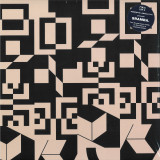
Tom Zé and Faust collide in Domenico Lancellotti's "machine samba"
Domenico Lancellotti's SRAMBA reaches back to the roots of samba whilst completely revamping its blueprint, indoctrinating guitar and percussion-led rhythms with analogue synthesisers, courtesy of album producer Ricardo Dias Gomes.
The majority of SRAMBA was recorded over two months in The Cave - Domenico's home studio in Lisbon, the city both Brazilian ex-pats reside in, where the arrival of a couple of Russian-designed synths purchased by Ricardo influenced the direction of their initial experimentation: "Ricardo had these instruments, modular machines" remembers Domenico, "and I had my guitar, some percussion instruments. On the first day we started making sounds and recording them, and songs started to appear, sambas started to appear."
The son of a renowned samba songwriter, at home Domenico would watch his father play and compose. At parties, the adults would hand his father a tamborim (a small tambourine) and ask him to play along. "I grew up inside samba, it's my roots", he says. "For me, everything is samba, I bring it into whatever style of music I am making".
Domenico and Ricardo instantly saw how the synthesisers were not at odds with the sambas they were playing, instead they had a similar sound to its typical percussion instruments (ganza, repinique, surdo, tarol). What's more, they saw a connection with roots samba, the samba that existed before bossa nova and samba jazz came along. This was rhythmic samba, with grooves that could go on ad infinitum. "It's samba de clave, geometrically structured" says Domenico. "It's ostinato samba", adds Ricardo.
"Diga" is a great example of what their proposal is capable of, as what begins as a glitchy machine whirring into action soon turns into a glorious samba in which the gurgles and scratchy beats coming from the analogue equipment only add to the arrangement. Likewise, on "Tá Brabo" it's an aching melody from one of the synths that gives the guitar rhythm its needed counterpoint, and shows how the duo's greatest accomplishment is not in invention alone, but in creating a great samba album. It's an album that can go from the opening track "Ere" with its reverberant bass thud, mantra-like vocals and staccato rhythms to the string-accompanied "Nada Sera de Outra Maneira", a swooning samba that pays tribute to the Brazilian ensemble Tamba Trio, who along with Tom Zé's Estudando O Samba, Domenico names as the biggest influence on their treatment of samba.
Other important reference points are made clear on "Um Abraço No Faust". One of three instrumentals on the album its title riffs off a JoãoGilberto song, "Um Abraço no Bonfá", but whereas JoãoGilberto was giving a hug (um abraço) to bossa nova guitarist Luiz Bonfá, Domenico and Ricardo are giving theirs to the German avant-gardists Faust. "Quem Samba", with its horn section and dramatic melody give a whiff of Domenico's Italian ancestry, while "Descomunal" is devoid of rhythm whatsoever, guest vocalist Tori singing over a bed of electronic drums, cello and swirling synths, that highlights the duo's unwillingness to stick to a particular formula.
Both Domenico Lancellotti and Ricardo Dias Gomes are revered names within Brazilian music over the past 20 years. As a member of the +2's, with Moreno Veloso and Kassin, Domenico released a trio of albums on Luaka Bop in the early 00s that pioneered a new Rio samba sound with elements of funk and psychedelia. With Veloso and Kassin he would later form Orquestra Imperial, a big band intent on reviving ballroom (gafieira) samba, and that has worked with guest vocalists such as Seu Jorge, Elza Soares and Ed Motta. SRAMBA is his fourth solo album. Multi-instrumentalist Ricardo Dias Gomes first came to notice as a member of Caetano Veloso's band Cê which helped reinvigorate Caetano's career with a sound influenced by British new wave. As well as collaborations with Lucas Santtana, Negro Leo and Thiago Nassif, and work with his own group Do Amor, he has released a series of acclaimed solo albums that reveal a restless music-maker.
SRAMBA is a glorious showcase of the duo's style, uniting Domenico's playful lyrics and rhythmic, samba-rooted songs with with Ricardo's assured accompaniment of unorthodox textures and instrumentations. It may be a new language for samba, machine samba (samba de máquina), but as Domenico says, "samba da máquina is samba".
In the Detmold area (Westphalia, Germany), there wasn‘t much going on for metal fans in the first half of the eighties. Fortunately, the members of two bands met in 1982 in a chip shop and recognized their common preference for hard music by their long hair, leather jackets and moustaches, which were good manners at that time. In this moment SACRAFICE were born, who subsequently became local heroes - of course influenced by the NWOBHM that was just spilling over into Germany, but also by the usual suspects like Black Sabbath, Deep Purple, Rainbow or Kiss, as well as Judas Priest and the early Accept.
Two unusual choices were made at once: In the spirit of Def Leppard or Led Zeppelin, the band name was deliberately changed - i.e. NOT Sacrifice, but Sacrafice. And they decided not to make the typical demo tape, but a 12“ EP on their own. This one is called „The First Experience WIth The Unknown“ and can be bought here and now on Discogs for 120 Euro and more used.... But already the book „Heavy Metal Made In Germany“, which was published in the nineties via Iron Pages, lists the record as „Top German Metal Rarity“.
No wonder, because the quite aggressive heavy rock and metal knows how to please even today - or maybe especially today - and reminds us of the upbeat mood of the German metal scene in the first
half of the eighties. This is also true for the three live tracks, which have been elaborately restored in days of work.
Another house number are the tracks of the follow-up band TranQuilL
(that‘s right, that‘s the correct spelling). The mostly overlong songs can be classified as heavy prog. Due to various circumstances these pearls remained (as good as) unreleased. Again, a lot of time and work was invested in restoring and mastering these private studio recordings (there are six long TranQuill songs on the CD version, while there was only room for two tracks on the LP, without losing sound quality).
As always, the printed inlay contains liner notes (actual interview with a former band member). Photos and other illustrations.
The CD version of the Golden Core re-release has already received very good reviews in Rock Hard and Good Times, among others!
- A1: & Mental Trance - Intro Track
- A2: & Crystalline Reality - The Growl (Crystalline Mix)
- A3: & Eye Soul8R - Autumn Subs
- A4: & Dj 1999 - The Abyss
- B1: & Brain Liquor - Jaque?
- B2: & Crystalline Reality - The Growl (Night Mix)
- B3: & Mental Trance - Mental Trance
- B4: & The Foundation - Steppers Worldwide, Unite!
- B5: & Dj 1999 - Almost Pleasant
Taking his cue from seminal mix albums of days gone by, Glenn Astro is back with a compilation of original productions from a cast of fictional artists on Nothing Is Real. Across 13 tracks, the Tartelet mainstay celebrates the thrill of discovery which came as standard listening to new entries in series’ like X-Mix and DJ Kicks, moving between head-nodding downtempo, ambient techno, broken beat and all manner of chill-out room delights. You might be left wishing artists such as DJ 1999, Mental Trance and Eye Soul8r had actual discographies to go and explore, but as Astro himself is keen to point out, “nothing is real.”
Astro has never been shy to embrace classic tropes and tones in his past albums for Tartelet, Apollo and Ninja Tune, but he’s drawing on a different set of influences for this album and embracing the flexibility afforded by using imagined aliases for varied production styles.
“I had the idea to do a mixtape, preferably with unknown dance tracks that also reflect that whole 90s/early 00s vibe,” Astro explains. “Instead of digging for some records that haven’t been sourced yet or trying to find those ‘forgotten’ treasures, I made the tracks myself. That way I had full control over BPMs, feel and the whole arrangement of tracks. I thought of a few alter egos and started producing the tracks in the order that I intended to play them in a mix. In the end a whole compilation of tracks emerged.”
While the concept might suggest you’re going to hear a lot of over- familiar sounds, don’t be fooled. Astro is inspired and inquisitive, channeling the experimental spirit of the 90s and early 00s when electronic music was still continually being redefined in all kinds of micro-scenes. In many cases, Astro’s productions slip into the cracks between genres rather than specifically mimicking a style.
Even if the reference points are detectable, the end result is a curious blend as indebted to ambiguity as the overall concept of the compilation. Like the spine-tingling sensation of hitting play and awaiting the waves of unknown sonics on one of those seminal mixes, you never know exactly what you’re going to get as you take the trip through Nothing Is Real.