Tachyon Audio 005 is another installment of the Mutations Volumes by Tachyon Audio creators
Nick Payne and Paradaux A1
The second track A2 Sputnik presented on vinyl as a locked groove.
B1 and spares no one as Inhabitants dive into a deep dark chasm of acid throttled driving rhythms with subtle yet apparent drums driving the track forward into the sci-tech space realm.
Mutations III closes with Mut19 an emotional pulsing and broken beat track featuring the vocal of U.S. free speech and civil rights activist
Mario Savio from a speec in Berkley CA in 1964.
Buscar:act one
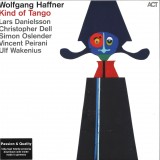
‘Kind of Tango’ is a kaleidoscope of shifting emotions. Wolfgang Haffner’s conception of tango has drama and propulsion in it but also melancholy and longing, with room for frenetic outbursts too. All this is unified by his inimitable groove and feel that commentators have called “an absolute dream,” “magical” and “profoundly relaxed.” Alongside trusted co-protagonists Christopher Dell and Lars Danielsson, he has two guests with him who defy all the clichés associated with tango: guitarist Ulf Wakenius cut his teeth musically in Oscar Peterson’s band and his Swedish heritage always shines through in his playing; Vincent Peirani is one of the leading innovators on the accordion and he finds new ways to define the instrument’s role in the tango. Also, young pianist Simon Oslender makes a first appearance with the band. Jazz and tango find a natural yet constantly shifting equilibrium - to be heard particularly effectively on ‘Close Your Eyes And Listen’ by Astor Piazzolla. In addition to compositions by Haffner himself and by his band members, pieces by the celebrated Argentinian bandoneon player and composer are the focal point of the album. Piazzolla’s innovations with the tango, such as bringing jazz into it, date from around 1955. Haffner and the tango
seem perfectly matched to each other. Tango is no longer a fixed style nowadays, it is above all an attitude to playing and an attitude to life. Wolfgang Haffner’s approach to tango is both authentic and new. It is his and his alone and it is irresistible.
L’Escalier des Aveugles, or The Stairway of the Blind, was commissioned in November 1990 by Spanish National Radio (Radio Nacional de España). Asked for a piece to premiere as part of the European Day of Music, Luc Ferrari returned with a radiophonic concept that organised his anecdotal music into montage form, sequencing short, elusive narratives in a successive way.
The completed composition is formed of thirteen chapters containing a mixture of environmental and synthesised sound, commentary, chatter, and encounters with people and places. Each focuses on a small event within this playbook, and Ferrari notes that each “in addition to being a realistic photograph, will be the subject of a ‘setting to music’: fragments of voice and atmosphere will be sampled and will produce musical matter or a ‘song’.”
The sonic language of Madrid forms the setting to which Ferrari lays out the persistent theme of the piece, that of the composer being guided throughout the city by a young woman. Using a game-like structure (liners for this edition include Ferrari’s “Regles de Jeu”, or “Rules of the Game” which act as a script or score to the piece) the motivation is posed: imagine that one day you are told “I know a place in Madrid that sounds amazing (or bizarre)”, to which you reply “Let’s go to it together.” The recordings toy with the relationships between guide and tourist, translator, director and actress, and masculine and feminine that emerge as Ferrari and the actresses follow this action, documenting the shared experience and connections they make as they visit these places.
Six actresses guide Ferrari (and the listener) through locations simultaneously ordinary and sonically rich: the metro; the El Corte Inglés department store where we hear the gossip from changing rooms set against music emanating from the PA; vagabonds declaiming their political stance in the Conde de Barajas plaza; interactions buying apples in a market; the reverberant and spacious halls of the Prado Museum where one actress gives a moving description of her favourite painting - Goya’s The 3rd of May 1808.
Ferrari replies in French to their comments in Spanish, and there are several self-referential plots, devices, and word games that flirt with the poetics and rhythm of language and sound. A recital of Lorca’s poem "La Casada Infiel" in “Hommage À Lorca” in amongst the location recordings feels striking, and the call and response of “La Nouvelle de L’Escalier”, where one of the actresses descends the staircase of the blind - a long stone stairway in Madrid proposed to Ferrari as an interesting location to visit during the trip by producer José Iges. She replies to Ferrari’s vocal enunciation of the place (and title) in French - L’Escalier des Aveugles - with the place-name in Spanish: La Escalera de los Ciegos.
Using this repeated title and image of the staircase of the blind as a symbolic place, a line is drawn to a situational landscape experienced and diffused through snapshots and allusion rather than holistically overviewed, sound conjuring pictures within the imagination. In the sensorial qualities of Ferrari’s treatment of emotion and language—fortified with electro-acoustic motifs and musical properties—the piece accelerates towards a render that is truthful, beautiful, yet also surreal; somewhere between theatre and reality, a gonzo cinema of the ear.
What is Randolph & Mortimer? A folk duo, a pair of accountants, a techno act…a law firm? What started off as an ‘art project’, influenced by 80s Industrial, 90s rave music and inspired by the documentaries of Adam Curtis, has morphed into a full on New Beat / Body Music dance-floor moving machine. Their studio releases have gained support from some of the biggest underground DJ’s in the world like Ancient Methods and gone on to top various genre sales charts on Bandcamp. Whilst the R&M live shows have seen them share bills with Godflesh, Youth Code, PIG and 3Teeth.
In 2019 it was time for R&M to throw a marker down and so came “Manifesto For A Modern World”, the debut album comprised of tracks from the “$ocial £utures”, “Hope Tragedy Myths” and “Citizens” EP’s plus some additional songs. This album is basically a greatest hits of Randolph & Mortimer. A statement of intent. All killer and no filler. The original limited edition CDs and tapes sold out and it had some incredible reviews. A Model Of Control called it “An absolutely outstanding release” and super cool New York DJ Andi Harriman (Synthicide) made it one her of top 10 albums of 2019 on Post-Punk
So here we are in 2020 and the Randolph & Mortimer story has seriously stepped up a gear with this double vinyl version of the album featuring all Manifesto tracks plus the acid styled dance-floor favourite “Apply Yourself” and four brand new tracks (“Crystal Peaks”, “Stateless”, “What Are You?”, “Fantasy Land”) which make up a whole new EP.
Limited edition of 400 copies with folded poster/insert and sticker.
- A1: Your Love Is A Miracle 6.04
- A2: Same Feeling, Different Song 5.16
- A3: Daddy's All Gone 4.38
- A4: Big City Lights 4.52
- B1: She's A Dream 5.36
- B2: Warmer Communications 4.07
- B3: The Price Of The Dream 3.59
- B4: Sweet & Sour 4.50
- B5: One Look Over My Shoulder (Is This Really Goodbye?) 3.55
Widely and rightly regarded as one of the best ever soul and funk bands, the now legendary Average White Band tore-up the rule book and conquered the US, UK & International charts with a series of soul and disco hits between 1974 and 1980. AWB’s repertoire has been a source of inspiration and influence for many R&B acts and they are one of the most sampled bands in history, remaining relevant today, continuing to reach new generations of younger audiences. Snoop Dogg, Fatboy Slim, Ice Cube, Puff Daddy, TLC, Rick Ross, will.i.am and Mark Ronson amongst countless others, have all borrowed sections of their grooves. ‘Warmer Communications’ is the 7th album by AWB, originally released in 1978. The album reached #28 in the
USA. ‘Warmer Communications’ includes the single ‘Your Love Is A Miracle’, which reached #33 in the USA. It was produced by Atlantic’s legendary producer, Arif Mardin.
- A1: Get It Up For Love 4.33
- A2: Fool For You Anyway 5.38
- A3: A Star In The Ghetto 7.01
- A4: The Message 5.17
- B1: What Is Soul 4.34
- B2: Someday We'll All Be Free 5.13
- B3: Imagine 4.56
- B4: Keepin’ It To Myself 4.30
Widely and rightly regarded as one of the best ever soul and funk bands, the now legendary Average White Band tore-up the rule book and conquered the US, UK & International charts with a series of soul and disco hits between 1974 and 1980. AWB’s repertoire has been a source of inspiration and influence for many R&B acts and they are one of the most sampled bands in history, remaining relevant today, continuing to reach new generations of younger audiences. Snoop Dogg, Fatboy Slim, Ice Cube, Puff Daddy, TLC, Rick Ross, will.i.am and Mark Ronson amongst countless others, have all borrowed sections of their grooves. ‘Benny And Us’ is the 6th album by AWB, who were joined by Soul/R&B legend, Ben E. King and originally
released in 1977. The album reached #33 in the USA. ‘Benny And Us’ includes the singles ‘Get It Up For Love’ (later covered by Tata Vega), ‘The Message’, a new version of ‘Keepin’ It To Myself’ and the classic ‘A Star In The Ghetto’. It was produced by Atlantic’s legendary producer, Arif Mardin and Jerry Greenberg
- A1: When Will You Be Mine 4.23
- A2: Please Don't Fall In Love 3.42
- A3: Walk On By 3.56
- A4: Feel No Fret 6.22
- B1: Stop The Rain 4.28
- B2: Atlantic Avenue 3.12
- B3: Ace Of Hearts 3.48
- B4: Too Late To Cry 3.40
- B5: Fire Burning 3.27
Widely and rightly regarded as one of the best ever soul and funk bands, the now legendary Average White Band tore-up the rule book and conquered the US, UK & International charts with a series of soul and disco hits between 1974 and 1980. AWB’s repertoire has been a source of inspiration and influence for many R&B acts and they are one of the most sampled bands in history, remaining relevant today, continuing to reach new generations of younger audiences. Snoop Dogg, Fatboy Slim, Ice Cube, Puff Daddy, TLC, Rick Ross, will.i.am and Mark Ronson amongst countless others, have all borrowed sections of their grooves. ‘Feel No Fret’ is the 8th album by AWB, originally released in 1979. The album reached #15 in the UK and #32 in the USA. ‘Feel No Fret’ includes the singles ‘Atlantic Avenue’, ‘Walk On By’ and ‘When Will You Be Mine’, as well as the much sampled ‘Stop The Rain’. ‘When Will You Be Mine’ reached #33 in the US
This was the Band’s final complete studio album for Atlantic Records, which they produced alongside Gene Paul.
Sometimes, what seems “to be” ... isn’t. And what “was” actually wasn’t. What’s "in" is sometimes out. And what was thought to be "north" is sometimes south.Similarly, up until now, there just wasn’t enough ... of TOO MUCH.
That’s how its been, ever since dynamic-duo TOO MUCH — Rich Morel & Ian Svenonius – let the world listen in on their once-in-a-millenia electro-beat gobstopper “PATENT LEATHER” (MERGE RECORDS); the monster hit which defined dance floors since its release in 2019.
“PATENT LEATHER” a bewitching blend of lechery and love, was tattooed on the brain of every loitering lothario in every night-club, roadhouse, and streetlight latrine in both the free and not-so-free worlds.It was so incessant; it shook houses down, burned parliament, and crashed the stock market. Dancers everywhere pleaded for more.
TOO MUCH have finally relented and deigned to give the heaving, begging, prostrate mass a new mess of motor-robot rhythm rockers. Yes, that's correct. TOO MUCH have a full length record and they call it ... “CLUB EMOTION.”
CLUB EMOTION is nine songs of pure ecstacy perfectly suited for the club, the car or the closet.Its a pure joy to listen to in one’s bedroom or at the beach. On a stroll, at a drive-thru, or while careening through the astral-plane, looking for a ro- mantic rendezvous.
One of the biggest selling hits by T. Rex from late spring/early summer 1971. These bare alternative versions were recorded in London during January 1971. 500 copies pressed on red vinyl in T.REX House Bags, 500 copies pressed as picture discs. All royalties go to The Light of Love Foundation (These recordings and many more were amongst the tapes stolen from Marc & Gloria’s home in 1977, some of this material was returned to The Light of Love Foundation last year). This year sees T. Rex inducted into the U.S Rock n Roll Hall of Fame in May and has already seen the profile of T.Rex heightened.
Fusing dexterous hand-percussion, hypnotic guitar riffs & soaring melodies, Waaju rise from London’s rich cultural palette with their latest album ‘Grown’, proving UK Jazz doesn’t have to sound the way we expect it to. Led by drummer and percussionist Ben Brown (Alfa Mist, Dizraeli, Ashley Henry), the band comprises percussionist Ernesto Marichales (Jordan Rakei, Sigala), guitarist Tal Janes (Nubiyan Twist, Bahla), Sam Rapley (Fabled, Maria Chiara Argiro) and Joe Downard (China Moses, Judi Jackson), each with their own strong presence on the UK’s extensive music scene. Waaju’s refined and divergent sound connects the dots between the likes of Ali Farka Touré, Alain Peters, Los Muñequitos de Matanzas, Oscar D’Leon and Beth Carvalho. Waaju formed as a means of exploring music’s hidden connections, from trance-inducing Moroccan Gnawa to Caribbean carnival music, and embracing them to reflect different shades of London’s own musical culture. It was the band’s love for Mali’s folk music – and Ali Farka Touré’s stylistic prowess in particular – that first set the project in motion. London’s Jazz Cafe invited Waaju to reinterpret classic tracks from Farka Touré’s catalogue to sold-out audiences in 2018 and 2019. According to Brown: “Ali’s one of the best. He has such a unique sound. His playing is so gnarly. His spirit and attitude are things I always think of when making music.” Waaju (meaning ‘to urge, inspire or influence to take action’ in Malian language Bambara) blends pulsing Latin polyrhythms, psychedelic Malian blues licks and cinematic textures. Following the group’s 2018 self-titled debut record, Grown presents a group more unified and distinctive-sounding than ever with six fresh, bold compositions. The record begins with Moleman, a potent reminder of the intricacy and energy Waaju’s become known for. Gritty, clattering metal defines the landscape for sizzling builds, hinting at rave culture styles like Bashment and Jungle. Listening Glasses follows and it’s clear why this is the album’s lead single – its Afrobeat-like energy and joyful interplay between guitar and tenor sax lies somewhere between Tony Allen’s grooves, Chimurenga guitar and Headhunters’ funk. On late night jam Rollando, Joe Downard’s skulking bass frequencies rule and wonkiness reaches new heights as heavy dub grooves almost tear themselves apart. Time’s Got a Hold was co-written by Waaju and Jordan Rakei for a show together in November 2018. Kicking off side B, this version features special guest vocalist Will Heard over bouncing triplets evocative of 1970’s Sega from La Reunion. A kind of looseness found only at night, the quiet drive of Wassoulou is sparse yet purposeful. Pulling back the tempo and dimming the lights, cavernous percussion fills each corner of the room, springing back as spectral reverbs. The title and final track shows the many dynamic sides of the outfit’s far-reaching sound, with its expansive harmonies and explosive psychedelia, spanning Yoruba Andabo to Hendrix, signing off an exciting and energetic second LP from Waaju at their most scintillating.
- A1: Pendulum
- A2: Dark March
- A3: O Lucky Man
- A4: Pull My Daisy
- A5: Beehive
- A6: On Paul's Imp
- A7: Hardly
- A8: Cemetery Raga
- A9: Platform
- A10: Black Flame
- A11: Putty
- A12: One Two
- A13: Nocturnal
- B1: Swordfish
- B2: Cars
- B3: I'm Brave I'm Scared
- B4: Hooks 'N Lines
- B5: Original Putty
- B6: Ooh Everything, Every Little
- B7: Sugar Mommy Part One
- B8: Sugar Mommy Part Two
Alastair Galbraith is considered nothing less than a genius around these parts. A New Zealand underground legend active since the '80s, his solo works have seen release on Siltbreeze, MIE, Emperor Jones and Grapefruit Records while his own labels, Xpressway and Next Best Way have released the likes of The Dead C and Damo Suzuki. His list of collaborators reads like a who's who of freeform musicianship: Peter Jefferies, Bruce Russell, Robert Scott (The Clean; Flying Nun) and Maxine Funke to name but a few. Seconds Mark III is Galbraith's first solo album since Mass (2010) and is a collage of pensive, longing and almost forgotten pieces stitched in his inimitable style. A thrilling addition to A Colourful Storm's ever-expansive catalogue. 21-track LP
Black Vinyl Edition
The Log and the Leeway follows a 6 year journey of personal exploration and drastic change for Bram Bosteels and his singular Kaboom Karavan universe. What entails is a sound-curiosity of rare format, following a metamorphosis that goes beyond the musical.
Early in the process, Bram was struck by the word/concept of a Leeway : the gradual departure from an intented course due to external influences. Following a boyish fascination for explorers travel journals, logbooks and the far fetched corners of the world, he could not have forseen how fitting of a title he had chosen. Drastically all of a sudden one day, completely unexpectedly, Bram experienced his own father dying in front of him from a rare disease. Shocked and confused by this intense encounter, his perspectives and musical course departed from its original path. But at the same time it was an enlightenment and a necessary influence for him to realise the initial idea and finish this album, started over half a decade before.
The ones familiar with Kaboom Karavan already know that nothing really sounds quite like it. Bram’s musical (and non-musical) universe is of the rare breed that seems to be entirely his own. Self-contained, but never opaque. Quite the opposite actually. Bram never pushes us away, instead, by listening to his music we are given view to a synesthetic wunderkammer of images, places, objects and possibilities. Distant but magnetic, alien but intimately familiar, Kaboom is folk music from another dimension. Listening to The Log and the Leeway is like waking up next to a bonfire in the middle of a swamp wearing somebody else’s clothes: You may not know how you got here, but whatever is happening seems to very directly involve YOU. What will happen?
Note from Erik K Skodvin (Miasmah): All the sounds, fabrics, instrumentation and stories that binds The Log and the Leeway together go far beyond what can be touched up in this simple writeup. As someone who have followed this journey since the beginning, and seen it shift from lighthearted fun to the most crepuscular personal experience, heard the stories behind (almost) every field recording and gone through boundless amounts of clips, visual details, notes, and inspirations – I can only say that it is with great pleasure and certain nostalgia I can present this record in full through Miasmah and close this quite extraordinary chapter. Bram is without doubt the most fascinating person I know. Like I told him in April 2020 during a trying time: “If everything fails, we´ll open a Kaboom Karavan museum” - an idea that might not be as far-fetched as it sounds.
Featuring: Cover painting by John Lurie. 16 page booklet of Musical illustration / collagés by Walter Dhoogh & Erik K Skodvin that more or less connects (or confuses) the dots between the music and stories behind. Mastered by Lupo at Loop-O
Originally recorded direct to disc and released by Incus in 1978, this new edition from Treader is pressed from the original stampers. Hand-finished sleeve.
‘Parker uses rapid tonguing techniques and circular breathing to create a sound all his own, marked by the simultaneous intonation of multiple notes. One hears a note as well as all the residual tones around it; each breath ends up sounding like a battle between the different registers of the horn. At various times, Parker’s saxophone sounds like dolphin speech, electronic tape squeals, or human murmurs; namely, anything but what it actually is. His language on the instrument is essential listening for anyone interested in acoustic experimental music’ (AllMusic).
‘Eight years after Topography Of The Lungs, and two years after his Saxophone Solos, Monoceros was the most muscular statement of Evan Parker’s solo saxophone muse. Superbly recorded, it seemed to place the listener within the chaotic air flows of the saxophone’s own tubing. Philip Clark said: ‘Parker’s dialogue with the saxophone throws up so much that is unexpected, and indeed unknowable, that the problem he faces is how to keep pace with his own invention’’ (The Wire, Best Albums Of The Year).
Following a high-pressure drop on Sneaker Social Club in 2019, bass-toting instigator Low End Activist steps up with his most expansive release yet.
His sound is a perfect amalgam of elements from the hardcore continuum – at times a dark and malevolent brainstorm of grubby drums dragged through crusty samplers, future-weary textural scrapes, moody splashes of pads and of course bucketloads of crushing subs, lows and low mids all designed to rock you from the waist down. You'll hear spectres of culture past lurking in the shadows – a trip hop skit from a gaunt figure here, a riotous brawl of grime MCs there – and feel the decades of soundsystem absorption seeping off the platters. It's like the LEA reached capacity and these productions were what happened when the sponge got squeezed.
One voice cuts a more prominent figure up front though – the peerless Flowdan, lending some powerful bars to Game Theory. What needs to be said about the Pay As You Go / Roll Deep mastermind you don't already know? His flow is mightier than any sword you care to step with.
Speaking of platters, this particular release marks the first vinyl pressing for Seagrave since the BOA 12" Warp Purpose Vol. 1 back in 2015 (slated for a repress – don't sleep!). It's an occasion worth toasting, building on a powerful and varied catalogue of sub-heavy sonics operating well outside the mainstream in service to naught but the sound, all packaged in a full-colour sleeve. As an expansive double pack of seven sure shots, it's also a fitting document of a subversive operative bringing some devastating angles to the hardcore tradition.
- Oli Warwick.
For their sophomore album, Chemical Reaction, Galaxians have stripped back the music and pumped up the vocals. Emma Mason's unstoppable voice elevates the group to a fully-formed musical act. This new LP is all about her voice.
Mason's powerhouse vocal on the West End Records-inspired Chemical Reaction beckons you onto the dancefloor. Jed Skinner's bright and breezy synth melodies allow the song to really breathe, whilst Sam Bell's front-and-centre conga groove (straight out of Double Exposure's My Love Is Free) and Matt Woodward's intricate rolls ramp up the track's energy and momentum. The shorter Mama Ghetto Vogue Edit is brought to life by Darren Pritchard, vogue dancer and mother of Manchester's House of Ghetto, who meets a neon wonderland in the electrifying video.
Elsewhere on the album, Heartbreaker champions female empowerment and personal freedom over a pounding boogie groove. It's a tight arrangement which drops into a delay-drenched Levanesque drum break before crescendoing back into a final chorus via one of Skinner's trademark JX-3P synth solos.
On the proto-house funk of Fight For Love, where Emma flexes her vocal chords to jaw-dropping effect, a failing relationship is thrust into the spotlight over a punchy Linn Drum groove. On the silky shuffle of after-hours jam Work It Out, which brings to mind the classic Sly & Robbie Compass Point productions, Emma croons about a lover, her voice cast in a softer, more subdued glow. Heat of the City sizzles with the essence of an urban summer, and is peppered with heart-stopping hand claps.
Third single Horizon sees the band in more reflective low-key mode, and could be their minor hit of the summer. There's some neat drum programming here, intertwined with Woodward's intricate fills and hi-hat playing.
On Not The Money, Mason's vocal shifts to a lower register in the mid-section, bringing to mind Grace Jones at her most commanding.
All in all it's a life-affirming experience, one born out of a sense of community and collaboration. Seven years on from their early explorations Chemical Reaction sees Galaxians retain sight of the principles that make their output, and dance music as a whole, so vital - commonality of experience, singular moments shared by a crowd, and rhythm as the best medicine.
The globe-trotting Robert Millis returns to Helen Scarsdale for this beautifully fragile album of dissolved glass rendered as a collage of recontextualized minimalism. To astute listeners, Millis should be a household name due to his work in the unpredictably diverse Climax Golden Twins as well as his impeccable curations for Sublime Frequencies (collections include the Deben Bhattacharya: Men and Music on the Desert Road and Indian Talking Machine books). Hie previous solo work include Relief (released here on The Helen Scarsdale Agency in 2013) and The Lonesome High for the Sun City Girls’ Abduction Records in 2016. His scholarship into the hidden corners of music across the world has also earned him Guggenheim and Fulbright fellowships.
Related Ephemera is an album composed mostly from the hiss, the crackle, the surface noise of 78rpm shellacs and wax cylinders. “Horrifying,” Millis explains “is the concept to record collectors that vinyl degrades and can be easily damaged. however, initially records were considered ephemeral, especially 78rpm records. They were novelties. Fleeting. Entertainment.” Millis intends for the album to be a feedback loop whereby the patina of handling, playing, living with the record will circle back to the original source material. Furthering that metaphor, Millis amplifies and dilates feedback tones generated from his collection of vintage gramophones.
That said, Millis does cite the intrusion of exactly one field recording, a broken toy, and a few notes from a cello. But the construction of these rarified tones, crispy textures, ghostly rattles, and fluid resonance that ripples through all of Related Ephemera has its origins in the tactile nature of the vinyl medium. It’s hardly the stuff of sentimental nostalgia though. Related Ephemera is more an act of time travel, slipping backwards and forwards with the scratch of a needle (Watch out! What pre-recorded needle jump sound is not your turntable going haywire!). The emotional core to the album is that of a resigned melancholy, almost Bergman-esque in its starkness but not without a brief moment of dark humor.
Here is an album that aligns itself aesthetically with Nurse With Wound’s Soliloquy For Lilith, Philip Jeck’s more languid collages, and even some of Harry Bertoia’s sculptural atmospherics.
The vinyl was mastered and cut by Helmut Ehler at D&M Berlin, whose expertise was necessary given that part of the original compositions from Millis’ reworked surface noise were exceedingly problematic to cut. The D&M cut does temper the composition into a mysterious, diaphanous cloud; where the digital-only mastering provides a cascade of insects gnawing within your inner ear. Two facets. One piece of music.
Swiss jazz bliss! We Release Jazz is very, very, VERY happy to present its sixth release (following Ryo Fukui’s Scenery and Mellow Dream, Le Cercle Rouge’s soundtrack by Eric Demarsan, Stuff Combe 5 + Percussion, and Marc Moulin’s Placebo Live 1971) coming straight from its beloved hometown of Geneva. Boillat Thérace Quintet’s self-titled album is available for the first time since its original limited private pressing in 1974 and comes as a vinyl LP as well as a digipack CD* (with 3 never-heard bonus songs). Full of prolific and inspired local clusters and boosted by the recently launched Montreux Jazz Festival, the Swiss jazz scene was vibrant and inventive in the 1970s, notably in the region surrounding Lake Geneva. This is precisely where jazz activist and brilliant pianist Jean-François Boillat and wind instrument master Raymond Thérace formed their quintet whose dazzling debut album was recorded in 1974. An absolute Lemanic gem of the soul-jazz/modal kind, the self-titled album includes superb covers of Freddie Hubbard’s “Straight Life”, Keith Jarrett’s “In Your Quiet Place”, and Rahsaan Roland Kirk’s “Sweet Fire”, plus groovy original compositions from the Boillat-Thérace crew. Helvetian fun facts: the velvety “1224” is dedicated to Geneva’s public transport line Tram 12, and one exquisitely funky track on the album is named after the famed yet elusive (and locally legendary) Swiss Marmite: “Cenovis”! This is reissued in conjunction with Boillat Thérace Quintet’s My Greatest Love featuring Benny Bailey (1975), also available via We Release Jazz. *The CD version includes 3 bonus tracks (Herbie Hancock, Wayne Shorter, and Claude Engel covers), never released before.
Forma by Lucy Railton, is a work that digs into us. It disorients us, plays with us, but without malice. It is like a nocturnal butterfly whose wings reflect a dark light, thus projecting fleeting hallucinations, which nevertheless persist on the surface of our retina. Its trajectories, too, are unpredictable. But such disorientation is not that of a chaotic space, it is rather a mysterious reason that presents itself to us, an imperious unfolding whose logic escapes us, but which nevertheless fascinates. It is also a history of shapes and their becomings. A story, also of their own vanishing.
Metabolist Meter (Foster, Cottin, Caetani and a Fly), by Max Eilbacher is a teeming piece, a matrix where textures and structures merge together, where the polyrhythmic instances become timbre, where the formal abstraction of the harmonic volutes coagulates around a vibrating form that is actualized in the dramatic reality of a dying fly. And this formal mastery is not disembodied in Max Eilbacher's work and the kaleidoscopic forms of the sound spectra that he has deployed know how to resonate in the sensations and experiences of each one.
These two pieces have this in common, but each with their own agenda, that they evolve with grace and inspiration in the vast domain of the sound world and it is a great pride for us to present them in this new collection.
Released in association with Editions Mego.
Coordination GRM: François Bonnet, Jules Négrier
Executive Production: Peter Rehberg
Soundsmith and technology rebel Katatonic Silentio back now on a solo LP one year after her first personal release.
Bass missiles, encompassing atmospheres & killer fast focused drums shouts, everything is intently encased in an emancipation act, an insurgent statute against our own oppressions.
Seven tracks pathway leading to a final act of awareness and deliverance from ourselves, without any aversion to go far away, beyond all flags, all frontiers, all countries, all barriers, all beliefs.
Mono Han are brothers Alessandro and Davide, who collectively have a deep and long understanding of electronic music. Davide is a co-founder of N.O.I.A, one of Italy’s first electronic live acts to perform and record with drum machines and synths as early as 1978. He was also behind seminal Italo outfit Klein + M.B.O and proto-house hit “Dirty Talk”. Alessandro, following in his brother’s footsteps was inevitable and he too became hooked on the incredible new sound palette emanating from the early electronic machines.
Since then they have released under an array of aliases, have clocked up numerous club hits and this project brings them back to their 80’s roots.