We return with the second Glenn Davis” 12”, a year on from his last Yore twelve-inch “Soul On My Side”, Dublin-based DJ and producer Glenn Davis returns with its sequel, the as-stellar Better Daze. The EP's melodic, soulful sound. The dynamic title cut locks in instantly with a pumping kick drum and builds layer by layer thereafter. Percussion, hi-hats, electric piano chords, and synthesizers add to the thrust of the production as it grows ever more urgent. As the track advances, Davis drapes a jazzy keyboard solo across the booming base as the swing swells to a near-ecstatic level. “Your Time” rounds out the A-side with a cut that suggests pure energy at its outset before quickly morphing into a sleek house strut. With percussion included and late-night synth atmospherics folded in, the breezy tune starts to sound like something you'd hear banging out on the Dancefloor thats surrounding you.
On the flip, Davis brings the skipping house groove of "Inner Monologue” to a fever while. Moody chords, hand drums, and a snappy groove set the scene. The female vocalist's soulful delivery and vibes-like earworm that make the tune the standout it is. Think of a dark Room and a red light bulb & House Music forever and a day.
Buscar:advance
Limited edition white vinyl w/download.
This is van Wyk’s 5th full-length and first following a plethora of soundtrack work.
The followup to “Threads”, his 2021 debut on n5MD, Descendants advances the narrative of van Wyk’s broad- er-scope, atmospheric sound.
This new work brings into focus an approach that builds on van Wyk’s production methods. Underlying elements are taken further and pushed to the extremes while the influence of his film composition work continues to shine through.
Descendants is a slow dive into enigmatic depths; disarming, explorative, evolved. A tentative descent into introspection, with each track a sonic rumination of drifting elements, tunneling into a subterranean wilderness.
Yazzus follows up her appearance on the Tresor 30 compilation with a new EP named BLACK METROPOLIS.
Within its, at times, rough-hewn textures lies a core
that explores joy and energy within the roots of black techno. In her words: “I want this release to be black and beautiful, to be queer, and playful, a nostalgic nod to the 90s but also reimagining it in the current times.”
The Ghana-born, London-bred, now Berlin-based producer’s research into afro-futurism, envisaging a path forward for science, technology and culture through the black experience, has impressed a deep
vision on this EP. Yazzus sets like a cartographer, using her tracks to explore a technologically advanced world, each representing dierent regions and environments.
Human Error Processor introduces an ear-worming percussion pattern nearly swamped by distorted bass drums and a vocal sample screwed just beyond recognition. Perforated leads with a 150bpm four to the floor stomp, infectious and supercharged. Gluey synth
motions soak in an otherworldliness, where industrious,
mechanical rhythms map out futurist structures in all directions.
Metro City Bay Area exhibits a ghettotech soul, lean and bouncy - this part of the galaxy is an infinite source of fun, with the heart of groove at it’s core. Three Deities brings adventurers of its region towards higher powers, its ravey synths and an engulfing bass provoke a complete NRG release, ascending into a spiritual trance where dense melodies bubble and fizz.
Digital-only track United By Fate meddles busy vocal samples with searching melodies, a fitting end to the kaleidoscopic that is BLACK METROPOLIS.
- A1: Ecstatic (Dancing On My Mind) 04 07 Min
- A2: I’m Only 03 50 Min
- A3: Another Casualty 02 50 Min
- A4: Here We Go 01 28 Min
- A5: It Doesn’t Really Matter 03 41 Min
- B1: Territory (Phone Home) 02 30 Min
- B2: No, Not Today 02 30 Min
- B3: Ch-Ch Check My Position 03 36 Min
- B4: Spaced Out 02 48 Min
- B5: Scaffolding For Support 03 37 Min
Advanced Style. It’s only human. Bell Tower’s most intimate musical output to date. Promoting thoughtful, subtle, tongue in cheek electronic pop music since 2005.
This 10 Track LP has it all, deep & ecstatic (goofy many) moments.
Life is too short not to listen to this Album, still if you don’t it doesn’t really matter.
Or does it? Life’s a mystery…
THE UK DOOM LEGENDS PERFORMING TRACKS FROM THEIR CLASSIC
DEBUT ALBUM LIVE IN BRADFORD, 1989
Creators, pioneers & purveyors of the whole Gothic Doom Metal scene which
subsequently came to prominence in the early 90's, Britain's Paradise Lost rose
from humble Northern roots to become one of the UK's leading artists in the
metal genre throughout the decade & beyond, remaining as relevant & revered as
ever to this day after a career spanning over three decades. The band's first two
albums were released on Peaceville, in the shape of 1990's influential deathly
debut 'Lost Paradise', followed up by the more atmosphere- focussed genre
classic, 'Gothic' in 1991.
'Live Death' features a band still in their formative years, with an early showcase
of their raw potential from Bradford Queens Hall, 1989, in their home county of
West Yorkshire, England. From an era of what was still an evolving & blossoming
extreme metal scene, Paradise Lost already displayed an advanced maturity to
their compositions & a developing style of their own, as the quintet perform a set
containing tracks featured on their debut album, the masterpiece of death metal
that is 'Lost Paradise', with tracks such as 'Frozen Illusion' & 'Rotting Misery'.
This edition of 'Live Death' is presented on black vinyl, featuring the original cover
art.
For most of us, life is a series of human interactions; some good, some bad, some happy, some sad. But what would life be without those peripheral characters who plant themselves into our worlds through the sheer force of their presence? Whether we speak to them or not, those vibrant contrasts to the everyday tide of ordinary people are a magical part of the human experience. Oddballs and misfits, flamboyant instigators or low-key game changers, we all clock them on our own hectic journeys, and they make the day a little brighter. Everyone has their favourite people.
Following the runaway success of their first one-shot single in 2020, Favourite People reconvene for a full-length of blues-tinged cuts stemming from sessions at Selva Studios in Brooklyn. The project’s roots predate the studio, from scattered jams and sweaty nights in New York nightspots to impromptu recordings on cruise ships, but the flashpoint of inspiration that truly set the album in motion was the arrival of a blonde 1960s Fender Telecaster. From there, the motley crew of sharp-shooting string slingers and sticks men set about crafting paeans to those striking souls who make the world a more colourful place.
The emphasis here is on the kind of forward-facing, electrically charged mix you felt (whether you realised it or not) hearing early Sabbath or Priest for the first time. With their undeniable bias towards vintage soul, Favourite People are far from heavy metal, but the same lineage of blues and by extension jazz informs the music, while the tonal crunch of that 70s era guides the sound. Feasting on tasteful overdrive and leaning on the unmistakable flavour of tape for much of the recording, the deal was sealed on this purposeful exercise in vibe thanks to the near-mythical texture of Guy Davie’s EMI Nigeria console at Electric Mastering.
Across the album there are mellow shades and bursts of good-time get-down exuberance, but the lead singles capture the essence of the band in no uncertain terms.
‘Promise Of Nibbles’ brings the Favourite People MO into sharp relief with a low-slung, hard swinging blues confection full of overheating organ and duelling guitars in pursuit of Southern-stewed boogie (im)perfection.
‘We’ll Be Late To The Party’ turns up the tempo and dials in the fuzz, striking an anthemic note which lands somewhere between urgent highway escapism and euphoric communal revelation.
‘Mass and Mustiness’ leans in on the funk dimension of the group’s sound with the sweetest licks and chops on that fabled telecaster backed up by an acutely angled beat and the slinkiest of b-lines.
These are but three of the vibrant vignettes laid down by this quietly unassuming collective of heads down jammers, loose groovers and vintage sound freaks –heavy grooving instrumentals pulled from their own moments of pure musical magic and captured on disc for your listening, dancing, living, loving pleasure.
Adding to what already has been a tremendous year for the Berlin-based producer, Nat Wendell returns home for his third release on his very own imprint, Depths of My Soul. On the surface, DMS 003 may appear to be vintage—and pulsating—Wendell. Under the cracks of these three tracks, though, is a producer moving towards music as a tool of political and musical advancement.
A1’s “Takes These Chains off My Mind” is an explicit cry from liberation away from mental slavery, an anthem for, in the words of Wendell himself, people “emancipating themselves from mental slavery, placed on black and people of colour alike.”
B1’s “Tha Music” plays on similar ideas of music as liberation, jolting dancers into submission with its rolling hats and snappy arrangements that will easily fit into any house head's bag. Judging by the name,
B2’s “Questioning Existence” may seem a tad existential—but, taking a late-nite 90’s garage cue from his own hometown, it’s anything but!
Advanced Myth is the lucid debut album from Dialect, the long standing project of British composer, multi-instrumentalist, and field recordist Andrew PM Hunt. An enchanted exploration of unusual source synthesis, electro-acoustic arrangements, and sound found in foreign environments, Advanced Myth is its own cosmos expanding and contracting in real time. Although a largely meditative listen, it oscillates between moments of shimmering lucidity and corrosive washes of noise. Originally released digitally by tasty morsels in 2015, Advanced Myth has been newly mastered by Stephan Mathieu from definitive mixes, and is available for the first time on vinyl. Since his debut, Hunt has built a broad oeuvre with a quiet confidence across several albums, including Gowanus Drifts (2015), Loose Blooms (2017), and Under ~ Between (2021), his debut for RVNG Intl., and its companion piece, Keep Goingü... Under. For Fans of Laurie Spiegel, Visible Cloaks, Oneohtrix Point Never, Catarina Barbieri, Clare Rousay.
From 2008 comes 'Keys, Strings, Tambourines' - Kenny Larkin's fourth full length LP.
Yet another advanced, singular and funked out techno milestone that bears all of Larkin's idiosyncratic stylings and melodic touches. Once more he shows us how it's done, sounding like nothing you've heard from him previously, 'Keys, Strings, Tambourines' is a truly adventurous record that defies categorisation today. Quietly influencing producers and DJs since its release, it points to where techno can go and what it can be and is a truly and criminally overlooked modern Detroit techno classic. This is an essential purchase for all electronic machine-funk aficionados worldwide. This special expanded edition boasts a slightly reshuffled track order and some additional cuts that were only available on singles at the time, now giving the world 3 solid slabs of futurist techno sonics for the believers! Essential music from the motor city.
'Keys, Strings, Tambourines' has been legitimately reissued for 2022 on Kenny’s own Art Of Dance imprint. Remastered from DAT tapes and original sources by Curve Pusher. Artwork redesigned by Atelier Superplus.
At the centre of the project 'Iboja's Songs' sings 99-year-old Iboja Wandall-Holm.who unfolds her unrivalled inventory of childhood memories and unique treasures of songs. Iboja has collected these and brought them from her childhood in Eastern Europe. She later translated them into Danish.
The album appears as a musical encounter. An encounter where Iboja's memories and songs are put in a new light by Danish musician Mikkel Hess and other members of the band Hess Is More, in collaboration with co-producer Kenneth Bager.
Even at her advanced age, Iboja sings with a beautiful timbre that miraculously encapsulates intimacy and the sense of travelling through history. Iboja has had a career as a journalist and writer. One therefore immediately senses her storytelling abilities both as a singer, but especially also as a writer. Iboja is in more than one sense the voice of the century. The singles 'Jeg Er Blevet Gammel' and 'Solen Går Ned Over Land' were the first two releases from this project's musical journey. They laid the groundwork for the release of 'Iboja's Songs' to flourish.
- 1: Zadar
- 2: Prasine Coast
- 3: Wild Encounter
- 4: Briçal De Mar
- 5: Windward Fort
- 6: Lady Lottie
- 7: Turquesa
- 8: Nanga
- 9: The Canopath
- 10: Tamer Encounter
- 11: Mokupuni
- 12: Anak Volcano
- 13: Dr. Hamijo
- 14: Giant Banyan
- 15: Wreck Of The Narwhal
- 16: Corrupted Badlands
- 17: Belsoto Encounter
- 18: Mines Of Mictlan
- 19: Quetzal
- 20: Dojo Master
- 21: Kakama Cenote
- 22: Kupeleleza
- 23: Jino Gap
- 24: Vumbi
- 25: Max
- 26: Nuru Lodge
- 27: Tasa Desert
- 28: The Battle Of Uhuru
- 29: General X
- 30: Uhuru
- 31: Neoedo
- 32: Iwaba
- 33: Onsenshima
- 33: Ryokan
- 34: Ku No Hosomichi
- 35: Miyako Village
- 36: Sacred Lake (Feat. Mioune)
- 37: Telobos
- 38: Loch Aduar
- 39: Lochburg
- 40: Meadowdale
- 41: Cromlech
- 42: Properton
- 43: Forest
- 44: Castle
- 45: The Final Encounter
- 46: The Arbury Reel
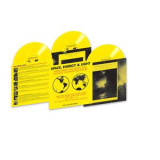
Black Screen Records is excited to announce that Damián Sánchez' chill and joyful orchestral soundtrack to Crema's massively multiplayer creature-collection adventure Temtem will be available on limited edition 3xLP Picture Disc vinyl. You get 47 songs and the three starters Crystle, Smazee and Houchic in one beautiful trifold set with gorgeous artwork by Alex Muñoz and Cristina Jiménez. The vinyl and CD both come with a download card for the full digital soundtrack including all tracks. ABOUT THE SOUNDTRACK: Temtem's original game soundtrack is a melodic journey through the adventures on the Airborne Archipelago. A mixture of musical styles and flavors ranging from the chill and joyful orchestral sounds from Deniz to the most vivid and chrer-ish celtic dances from Arbury, through the folk and peacefulness of Omninesia, the mysterious glassy mallets of Tucma, the warm drums and flutes of Kisiwa, and the modern-versus-traditional Asian tunes in Cipanku. Discover the traditions of each isle through its instrumental palette and melodies, and vibe with the rhythms of the combat themes while you become the greatest Temtem tamer. The aim of this physical edition it's always been to give our fans not only another way of listening to Temtem's soundtrack, but to make a piece of art they would love to display on their shelves or even hang on a wall. Both teams at Crema and Black Screen Records worked really hard for a long time to cherry-pick the best ideas and come up with these incredibly beautiful editions. We are really proud of these products and we really hope you enjoy them! - Damián Sánchez ABOUT THE GAME: Temtem is a massively multiplayer online adventure where you'll get to explore the colorful and exciting Airborne Archipelago with all your friends and other players! Discover, tame and battle the Temtem that inhabit these islands, and maybe save the Archipelago in the process? Temtem offers a lengthy story campaign in a fully online world, and the possibility of playing the entire adventure in Co-op with a friend; a rich, complex, RNG-free combat experience, and competitively oriented gameplay, with challenges for all play styles; a bustling economy and trading environment; advanced character customization, housing and a myriad of ways to express yourself!
- A1: Let The Light In (Feat Douglas Dare)
- A2: Wknd (Feat Liz)
- A3: Don't Wanna Dance With U (Feat Albertina)
- A4: Sweat (Feat Liz)
- B1: X Hopeless Romantic (Feat Little Boots)
- B2: Remember To Forget Me (Feat Chester Lockhart)
- B3: Joyful Death (Feat Tyler Matthew Oyer)
- B4: Remember 2 Forget Me (Feat Douglas Dare - Piano Version)
SONIKKU announces the release of their new album ‘Joyful Death’, via Bella Union. “I love songs that make you want to cry and dance at the same time,” says Tony Donson, the London-based musician who records as SONIKKU. That sense of unfettered release and liberation drives their new album, ‘Joyful Death’. A fluent, fertile and full-colour hybrid of vibrant Italo-house, liquid synth-pop, righteous disco and French philosophical asides, it’s an album that signals the emergence proper of SONIKKU - a fully formed dancefloor artist. It’s also a farewell of sorts, perhaps, but with an emphatic rebirth at its heart. “This album feels like a transformation in the sense that I’m creating the music I’ve always wanted to make. A fully realised, coherent pop record that showcases my craft as a song-writer and producer.” Total control of their craft is swiftly asserted on ‘Let The Light In’, where the
influences of lost-in-music disco and the Pet Shop Boys merge under vocals from immersive, exploratory British singer-songwriter Douglas Dare. The pace accelerates as ‘WKND’ gets into a groove pitched somewhere between Madonna, Daft Punk and Indeep, with LA future-pop singer LIZ primed for dancefloor abandon on vocals. Meanwhile, SONIKKU’s independent intent is firmly asserted on the freestyle-inspired ‘Don’t Wanna Dance with You’, where singer Aisha Zoe coolly brushes off unwanted advances in favour of dancefloor pleasures.
LIZ assumes vocal duties again for ‘Sweat’, a song fully equipped to make dancefloor devotees do as its title suggests. Dreamily melodic evidence of SONIKKU’s dynamism (and love of melancholy Swedish electro-pop queen Robyn) beckons on ‘X Hopeless Romantic’, where Little Boots contributes a sweetly loved-up vocal over a sublimely
infectious chorus. Pummelling synths signal a dramatic shift of pace on the almost electro-darkwave dash of ‘Remember To Forget Me’, where actor/singer Chester Lockhart presides over a summit meeting between Depeche Mode and New Order. Performance artist Tyler Matthew Oyer takes the vocals for the Italo-disco-inspired title-track, a vividly imagined album manifesto - of sorts - inspired to varying degrees by an 1892 poem, French thinker Gilles Deleuze’s concept of the “body without organs” and a 1997 anime called The End Of Evangelion. Finally, that grand piano takes over as Dare returns, presiding over an achingly stripped-back version of ‘Remember To Forget Me’. With help from friends and artists they admires on vocals, ‘Joyful Death’ is a hugely confident and self-contained leap forward for SONIKKU after his time as a feted DJ. Having moved from Derby to London at the age of 18, Donson worked as an intern (at MTV, Dazed & Confused, SHOWstudio and elsewhere) then turned to DJing (from
London to Tokyo, Paris and Berlin) after they were signed to London label Lobster Theremin. Though they continues to DJ regularly at Tottenham’s LGBTQ rave-up Adonis, they have extra ambitions in mind: “I love DJing but I’m more looking forward to developing a live show.” LP pressed on mint green vinyl with digital download.
Christopher 'Lav' Landin is a master of ambient sounds but it's been a while since we heard from him after 2017's collab with Purl on A Strangely Isolated Place. A New Landscape is a fresh album on Past Inside The Present that comes on limited and transparent orange vinyl. Contained within are a beguiling bunch of tunes with soul stirring pads, gently propulsive rhythms and gorgeous sound designs that call to mind various different references from deepest space to a warm spring day. It is an accomplished album design for mental escape.
From 2008 comes 'Keys, Strings, Tambourines' - Kenny Larkin's fourth full length LP.
Yet another advanced, singular and funked out techno milestone that bears all of Larkin's idiosyncratic stylings and melodic touches. Once more he shows us how it's done, sounding like nothing you've heard from him previously, 'Keys, Strings, Tambourines' is a truly adventurous record that defies categorisation today. Quietly influencing producers and DJs since its release, it points to where techno can go and what it can be and is a truly and criminally overlooked modern Detroit techno classic. This is an essential purchase for all electronic machine-funk aficionados worldwide. This special expanded edition boasts a slightly reshuffled track order and some additional cuts that were only available on singles at the time, now giving the world 3 solid slabs of futurist techno sonics for the believers! Essential music from the motor city.
'Keys, Strings, Tambourines' has been legitimately reissued for 2022 on Kenny’s own Art Of Dance imprint. Remastered from DAT tapes and original sources by Curve Pusher. Artwork redesigned by Atelier Superplus.
Once again Studio Mule dives deep into the music history of Japan, unearthing the multi-colored album “A-Key” by Eiki Nonaka, released as CD only on the short living japanese label Sun & Moon Records in 1995. An album, that uniquely unifies global ethnic music styles, the playfulness of Jazz, innovative electronic soundscapes, and the winding per-sonality of spiritual music.
It’s the only solo album of a musician, that is triggering the advanced electrified japanese music culture since the early 1980ees. Eiki Nonaka was part of electronic New Age quartet interiors, releasing the two minimalistic, synth-pop leaning albums “Interior” and “design” in 1982 and 1987. likewise, he was a member of Haruomi Hosono’s band friends of earth, playing, voicing, and tuning the drum machine, guitar, synthesizers, and mi-crophone on their second landmark experimental Pop Electronic album “Sex, Energy and Star”, released Hosono’s outstanding non-standard label in 1986.
His one and only solo album “A-Key” features the essence of all his musical journeys until 1995, bringing, as he puts it on his blog: viewz.jp, “all my musical career up to that point designed in sounds that were ringing in my head at that time. It's extremely introspective, but the various mental landscapes of that time are still vibrating fresh and acoustically new.”
'The Best Of The MPS Years' presents you all the classics and highlights
of Oscar Peterson's time at the Black Forest label on one album
It was 1961 when Oscar Peterson came to Villingen, Germany the first time.
Hans-Georg Brunner-Schwer, former owner of the hifi dynasty SABA, had just set
up the first version of his studio, equipped with the most advanced recording
technology of the time. This was the bait used by the piano enthusiast to attract
the famous pianist to the Black Forest. After a performance in Zurich, Peterson
climbed into a limousine and embarked on a journey across the mountains. As
soon as he arrived, along with bassist Ray Brown and drummer Ed Thigpen, the
international star was led to the Steinway grand in the living- room where a
number of excited guests were eagerly waiting. "I listened to him play 'til four
o'clock in the morning and lost the desire to ever hear the Beatles again!", says
Matthias Brunner- Schwer, HGBS' son, still starry- eyed half a century later. The
legendary pianist himself was equally delighted when he listened to the recording
of the nocturnal living-room performance, never before having heard such a direct
and pristine piano sound on tape. Peterson's enthusiastic response marked the
beginning of a long-term friendship and spiritual kinship with Brunner-Schwer.
In the following years, the Canadian pianist returned again and again with various
line-ups to capture his musical vision on tape. The legendary "Exclusively For My
Friends" live series was the very first release for Brunner- Schwer's newlyestablished MPS label with many studio albums to follow.
- 1: Connais Tu L'animal Qui Inventa Le Calcul Integral?
- 2: Evariste Aux Fans
- 3: Les Pommes De Lune
- 4: La Chasse Au Boson Intermédiaire
- 5: Dans La Lune
- 6: La Faute À Nanterre
- 7: Ma Mie
- 8: Wo I Nee
- 9: Si J'ai Les Cheveux Longs C'est Pour Pas M'enrhumer, Atchoum!
- 10: La Révolution
- 11: Je Ne Pense Qu'a Ça
- 12: Je Chante Pour Vous Faire Marcher
- 13: Je Ne Suis Pas Simple
- 14: Si Les Étoiles Pouvaient Parler
Évariste is one of the rare specimens of artist-cum-scientists. Among his kind stand others like Pierre Schaeffer, a Polytechnique graduate (an engineer but also the father of musique concrète) and the eccentric Boby Lapointe (graduate of the École centrale and inventor of the Bibi-binaire system, patented in 1968). Évariste's songwriting, joyful and full of energy (albeit extremely critical), shrouds an original tragedy: born in 1943 among résistants, Joël Sternheimer (aka Évariste) grew up without a father, lost to Auschwitz. Although he makes little reference to Jewish culture in his music, his origins leave their mark: in 1974, he sings a Hebrew song on television. In 1966, the young Joël sports Princeton's colourful paraphernalia - that's because he's freshly returning from the US, where he was sent to pursue his research on "particle mass and the interpretation of observed regularities, such as the effects of a wave" (will understand who may). When he gets there the country's in the midst of the Vietnam War. With McNamara keen to find an alternative to the nuclear weapon and calling upon the country's biggest brains to undertake the task, there's a "fund shift" within the university - a diplomatic way to give notice to whoever may not be disposed to follow the government's scheme. Joël, who's under the supervision of a rebellious physician, is dismissed. He regardless keeps following the prestigious seminaries of the Institute for Advanced Study, chaired by Oppenheimer, inventor of the atomic bomb. Likely inspired by the hippie movement and music, Joël buys a guitar and starts playing in Washington Square - after all, Bob Dylan himself started there. He blithely skips Oppenheimer and receives a warm (though surprised) welcome from a crowd thoroughly unfamiliar with French. When the ageing physicist questions him about his decreasing attendance, Joël explains how drawn he is to music, and how he thinks it could help him in self-financing his research. Évariste recalls seeing the sickened man, his face torn by remorse, lighten up to his words and say: "What's keeping you - go for it! If I was still young that's exactly what I'd do." The student takes these words as a testimony from his professor - and it's enough to convince him . And so he takes the leap during the Christmas vacations he spends in Paris. A journalist friend he often sees around the Sorbonne introduces him to the artistic director of Disques AZ. The latter passes the tapes on to the label's boss, Lucien Morisse, also program manager on Europe N°1. Morisse is blown away - and signs him onto the label right away. Michel Colombier, arranger for Serge Gainsbourg and co-author of "Psyché Rock", with Pierre Henry, contributes some of his original ideas to the 7 inch "E=mc2": Évariste's preoccupation with the percussion sound on the track "Le calcul intégral" is that it goes "poom poom" and not "tock tock" - Colombier is aware of the issue and records Évariste's guitar like a percussion in an isolated booth. The organist Eddy Louis, who is to participate, in 1969, to the success of Claude Nougaro's "Paris mai", also appears on the record. It's 1966 and the Antoine phenomenon (signed on Vogue) storms through France. The two singers share similarities: Antoine is an engineer of the École centrale, gifted with a great originality in his song-writing. A godsend for the two labels who turn this resemblance into a commercial strategy, setting them out as rivals. To this day though, Évariste still denies what was little more than slushy tabloïd gossip. Success comes around swiftly and in 1967 Évariste launches into a second 7 inch, "Wo I nee", again arranged by Michel Colombier. Quantum mechanics fans finally get their anthem with "La Chasse Au Boson Intermédiaire" (or the "Intermediary Boson Pursuit"). To sum up what's a boson, say he's a close pal of the meson, photon and other gluons. A few months later, it's May 68 and everything's turned upside down. Évariste writes a series of songs inspired by the events, which he immediately submits to Lucien Morisse. When the man behind "Salut les copains", once married to Dalida, hears the song "La révolution" - a father and son dialogue - he can't take any more: AZ simply cannot release this. But there and then Lucien Morisse makes a gesture which will remain engraved in French music's history: sorry to be unable to officially stand by the singer, he encourages him to self-produce the record, but with his tacit support. He calls the pressing factory and asks they apply the same rate for Évariste as they would for AZ. The singer and his musicians use the same studio as for the previous record, all of them playing for free awaiting a return on investment. Évariste keeps singing at the Sorbonne with "Jussieu's gang" and "the young Renaud" he nicknames "le p'tit gavroche" (or "street urchin"). Renaud volunteers to type the lyrics of the song "La révolution" so that the chorus can be sung and recorded. A boy in the group is related to Wolinski and introduces them. The two get along so well that Wolinski ends up drawing the cover for the record "La révolution", for free. The self-released 7 inch "La révolution / La faute à Nanterre" is sold under the table and door-to-door for half the price of a standard record, on and around the boulevard Saint-Michel; and it runs out fast. In the end, there will be 6 releases of the record, and 25000 copies sold. When the theatre director Claude Confortès decides to adapt Wolinski's drawing series titled "Je ne veux pas mourir idiot" ("I don't want to die a fool"), he asks Évariste to write the original soundtrack. His friend, now cartoonist for Hara-Kiri Hebdo, often promotes him in accordance with a principle dear to him by virtue of which he gives a special place to his friends. Dominique Grange (writer of the song "Nous sommes les nouveaux partisans") soon joins the team. After 150 performances, Évariste leaves his place to Dominique Maurin (brother of Patrick Dewaere). Évariste composes the songs for Claude Confortès' next play, "Je ne pense qu'à ça" ("That's all I think about"), co-wrote with Wolinski in 1969. The comedians of the play record the songs on a 7 inch, with a cover signed, again, by Wolinski. In 1971, French television produces the documentary "Évariste et les 7 dimensions", but doesn't air it. Indeed, the scientific sub-comity of the programming comity (sic) censors the show. The given justification is that "Évariste dangerously mixed science with science-fiction, numerology and other non-scientific disciplines". The underlying motive might have been a will to censor the singer-mathematician's political discourse. In the documentary and among other things, Évariste discusses hierarchy, alienation and revolution. Half a century later the documentary remains invisible, though some excerpts resurfaced in 1992 in the cult show "L'oeil du cyclone", on Canal +. Though flourishing, Évariste's career is nearing its end. 1970 is the beginning of a decade in the course of which he is to make a decisive discovery in the musical and scientific domains. Following this breakthrough, he moves away from self-produced music and gaucho magazines to focus on science. He keeps Oppenheimer's encouraging words in mind, now freely pursuing his research thanks to the sales of his records. Joël realises that when decoding protein sequences, one finds musical sequences recognisable to humans. He names them "proteodies". If, when listening to a proteody, one responds by being so sensitive as to finding it beautiful, then it reveals a deficiency of the related protein - and this peculiar music may be the cure. We could trace back the music history in light of proteins lacking in a given artist, or within a public's majority. You always thought these hysterical groupies who'd throw their underwear with passion and faint in the pit had miraculously appeared because they had never heard anything as wonderful as the Beatles? Make no mistake! For Évariste, it all boils down to an intro's protein content. Indeed, the beginning of their first hit "Love Me Do" corresponds to dopamine, the neurotransmitter linked to compulsive buying. An intro like this could only unleash the fervour of groupies, victims of fashion and biology. Évariste's success is such that the income from his sales gives him the autonomy to which he had aspired when confiding to Oppenheimer. It made it possible for him to pursue his research without any institutional constraints. He now devotes himself to his proteodies, sat in the offices of the European University for Research, just around the corner from the Sorbonne he knew so well. Évariste is no more. Joël regained control of this strange and comical beast.
Imperfect Stranger is the pseudonym of Glasgow based soundtrack composer and producer Kenny Inglis. “Everything Wrong is Right” is his debut solo album for Castles in Space.
Born in 1975, Kenny didn't listen to much music, unless it was the opening credits to a TV show or a film score that had caught his ear. "I loved the pre-title music on a lot of those 80's U.S. TV shows. From the family orientated stuff like The A-Team, to darker dramas such as The Equalizer. My mother would let me stay up to watch the opening sequence of the latter then send me to bed because the story would be too heavy for a kid. That left me with this hanging sense of ambiguity as to what would happen in that hour after the titles came up.”
Exposure to a work colleague’s tiny project studio in a kitchen cupboard was a lightbulb moment for him and the experience of utilising music technology as a way of writing and producing entire tracks stirred a wave of determination to chase a career in music using the opportunities that technology could offer. Kenny figured the best way to move forward was to start a small project studio and learn his craft as a recording engineer. "It was a bit of a shock to the system. I literally had no idea how to work any of the equipment. Kenny focused on learning as much about the craft as he could whilst winging his way through recording and mixing everyone from the likes of singer/songwriters to bands, to voiceovers artists and anything in between. "Eventually, I stopped writing the music I thought people would want to hear, and started writing the music I wanted to make. I didn't come from a music loving background, but I was always obsessed by the way music and film would interact - how music brings this atmosphere and tone to even the most mundane visual stuff. I wanted to capture that. I wanted to grab some of that ambiguity I felt from the TV shows of my childhood and make it into a project of some sort". That project was Spylab. A dark, downtempo project with a cinematic edge. The initial demo consisted of three tracks, with the melancholic 'This Utopia' leading the playlist.
"At the time you did demos on normal cassette tapes. I remember having this endless battle with the bias control to try and get the best sound I could on these little tapes. Ten went in the post one Monday morning, and the following Monday there were three offers from three different labels. Studio K7 were interested in a singles deal, as was Flying Rhino in London. But then there was an offer from a Chicago based label by the name of Guidance Recordings. They wanted an album, and were offering a $15,000 advance. It wasn't a difficult decision to make"
Writing and recording Spylab 'This Utopia' began in 1999. The album took a whole year to produce. The album was to catch the attention of Mary Anne Hobbs at Radio One. At the time Mary Anne was presenting The Breezeblock - a late Sunday night show with an eclectic playlist of alternative electronic music. Picking out the album's title track 'This Utopia', Mary Anne would go on to play it no less than 8 weeks in a row. A request for Spylab to DJ on the show was to follow. "I had never DJ'd before. I think I had a week to figure out how to do that and put a playlist together. I'm not entirely sure how I pulled that off.” In March 2001 the Spylab album was finally released to a hoard of excellent reviews. A North American live tour would follow. From the launch party in Los Angeles, to a sell out show at SXSW in Austin. "I then started a new project under the name Cinephile. It had some of the core elements of the Spylab sound but it was deeper, more cinematic.” Kenny received news that a track from the previous project Spylab had been requested by HBO for the first episode of a new TV drama called Six Feet Under. This was to become a major turning point in Kenny's career. The Spylab track 'Celluloid Hypnotic' dropped during a poignant party scene of the first Six Feet Under episode. Within a couple of days Kenny was getting requests for music from other music supervisors. "It was a chain reaction. The Six Feet Under sync was like the tip of an iceberg. One day I called CBS in America and they put me on to the CSI music supervisor and I managed to get on a call with him. I sent the Cinephile stuff out and within a few months I got this fax through from CBS - a quote request for one of the tracks for a potential use on CSI. It changed my life."
The tone and style of Kenny's music sat perfectly with the CSI score requirements. So much so he found himself part of a pool of incidental writers who worked on all three aspects of the franchise - CSI, CSI: NY, and CSI: Miami. This would continue until 2013, when the last of the series would come to an end.
"I was juggling a bunch of stuff for those ten years. Writing material for CSI, whilst releasing new Cinephile stuff and playing live. As Cinephile continued to gather pace, one of the tracks from Kenny's efforts on CSI was chosen for the Hollywood trailer for the Samuel L. Jackson film 'Lakeview Terrace'. Further trailers would follow, from Gangster Squad to Dead Man Down, Spike Lee's Undisputed Truth, to Fifty Shades Freed.
At the same time, Kenny picked up his first factual commissions in the UK, and this too would be the beginning of a regular run of fully scoring factuals and documentaries. By 2021, six of these had won BAFTAs. He also would find himself soundtracking adverts for the likes of Nike, Audi, and American AirlinesIn early 2020, Kenny made a return to focusing on his own music under the pseudonym Imperfect Stranger. A tweet from Colin Morrison from Castles In Space regarding a charity compilation album 'The Isolation Tapes' caught his eye. Kenny had made a start on his debut album as Imperfect Stranger and submitted the track 'Hymn To The Sun' (which would become the lead track on the album). Further discussions ensued, and the album found a home on CiS. "I had been doing TV and film stuff for almost ten years. It paid the bills and was as close to a 'real job' as I'd had, but I yearned to get back to writing for myself, so doing an album for Castles in Space was a joy.
“The music I write is like a diary. There's an authentic narrative to everything i do. I don't write tracks for the sake of writing. I write tracks to diarise and process the stuff that I've lived through, and the experiences that have come along with the passing years. That's what makes me tick. It's a very public and vulnerable way of expressing myself. If people want to know the real me, all they have to do is listen."
Greek genius Christos Chondropoulos’ stunning debut for The Death of Rave finally lands on vinyl - an incredibly imaginative masterwork rich with quartertone melody and meticulously chiselled production, shaped into a future-folk songbook that deeply expands on his wonders for 12th Isle and The Wormhole. Highly recommended if yr into Paul DeMarinis, Rashad Becker, Ryuichi Sakamoto, Kara-Lis Coverdale's 'Aftertouches', Jonathan Bepler’s soundtracks for Matthew Barney, Black Sabbath or Aphex Twin. Floors us every time!
Continuing Christos’ singular fascination with, and reappraisal of, Ancient Greek modes, ’Relics’ further excavates the deeptime topography of Greek music prior to the ban of “oriental” or 1/4 tone microtonal modes nearly 100 years ago.
Clandestine, euphoric, hyperreal and otherworldly; it takes shape as faintly familiar forms of new age folk, avant-techno and metal musicks, but with an alien appeal that treats the past almost like another planet, never mind a foreign land. Christos studiously raids the past for lost treasure, navigating his tuned instincts as an improvising percussionist, and lover of non-Western composition, to create a uniquely absorbing soundworld that resembles an AI’s dreams after ingesting encyclopaedia entries on thousands of years of Greece prior to 1936. In the process, the album acutely questions his and our relationship to the past, and what has become lost in translation with reliance on prelaid templates and the “wisdom” of elders.
Bursting to life with the iridescent arps and new age AI chorale of ‘First Love Fereter’, and concluding with bone-clacking raverie of ‘Jungle X’, the album offers a stunning advance of the themes and aesthetics in Christos' previous records, from the self-released free jazz of ‘Fingerpainting’ (2013) to 2021’s 12th Isle released ‘Athenian Primitivism.’
Thanks to meticulous detailing, ‘Relics’ allows a finer play of textured light and almost tangible - yet entirely generated - voices into his music: most strikingly on the sublime songcraft of ‘Regret’ and ‘I Dream Of You’, while the likes of ‘Asham’ are bathed in deeply uncanny atmosphere, and his percussive proprioceptions are most heightened in the delirious battery of ‘War Horns’ and ‘Sacrifice’, with ‘Cyber Crust’ calling up demonic, cthonic pagan spirits resembling Black Sabbath undergoing regression therapy.
- 1: The New Real
- 2: Don't Switch Me Off
- 3: Pink Beatles In A Purple Zeppelin
- 4: Dr Slumber's Eternity Home
- 5: Yellowstone Memorial Day
- 6: Parental Procreation Permit
- 7: Where Pigs Fly
- 8: When I'm A Hundred Sixty-Four
- 9: Lost In The New Real
- 10: E-Police
- 1: Our Imperfect Race
- 2: Battle Of Evermore
- 3: Welcome To The Machine
- 4: The Space Hotel
- 5: Some Other Time
- 6: So Is There No God
- 7: You Have Entered The Reality Zone
- 8: Veteran Of The Psychic Wars
- 9: The Social Recluse
- 10: I'm The Slime
This limited reissue of Arjen Lucassen’s (of Ayreon fame) second solo album from 2012 comes in a gatefold jacket and features the original booklet. The story of “Lost in the New Real” follows Mr. L, a twenty-first century man who was cryopreserved at the moment of clinical death from a terminal disease. The album begins as Mr. L is being revived at a point in the distant future, when technology has advanced enough to cure his disease. Mr L finds himself in a world that has drastically changed — to the point that the line between what’s real and what’s not is no longer clear. Arjen Lucassen as “Mr. L” Vocals, instruments, music, lyrics Rutger Hauer as “Dr. Voight-Kampff” Instrumentalists Arjen lucassen: all instruments, with the exception of those listed below Wilmer Waarbroek: backing vocals Ed Warby: drums Rob Snijders: drums Ben Mathot:violin Maaike Peterse: cello Jeroen Goossens: flute Elvya Dulcimer: Hammered dulcimer on “Battle of Evermore”
The Ice Warriors is the 39th story arc of the series Doctor Who consisting of 6 parts and ran in the 5th season. Parts 2 and 3 are considered lost and were animated for DVD release in 2013.
Plot: The TARDIS materializes on Earth, where humanity is fighting a new ice age. At Brittanicus Base, scientists are trying to use an ionic device to combat the advance of a glacier. When a giant humanoid creature is discovered nearby in the perpetual ice, additional complications arise as the ice warrior comes to life after thawing. It is the captain of a spaceship from Mars that crashed centuries ago. Varga also wants to revive his comrades and conquer Earth, since life is no longer possible on Mars. The Doctor and his companions must not only prevent Varga's plans but also save the base's crew from the approaching glacier....
On three LPs in a deluxe box set, fans can now relisten to the four surviving original TV episodes from 1967. The 140 gr. LPs come in the special color Molten Ice vinyl. Elaborately illustrated sleeves on top.
In their first outing since They Can't Be Saved, released on Skam in 2020, they enlist British rapper King Kashmere, who features on two tracks. Where James Ruskin has appeared
on Tresor Records for his seminal albums Point 2, Into Submission, The Dash and his recent Siklikal EP, the only appearance of Mark Broom on the label is a 2002 remix of
The Golden Apple by Eddie “Flashin” Fowlkes.
The duo unveiled this new work and collaboration with King Kashmere in a live show for a 30th Anniversary event for
Tresor Berlin televised on Arte, performing amidst a battery of lights and fogged-up refraction. It demonstrated their
rough-hewn fundamentals, roving melodies and investigative power, newly advanced by voice.
Death Switch is the first appearance by King Kashmere, savaging questions on segregation and suering, encoding
into our brains the much-repeated refrain - “You wanna know, why they wanna flip the death switch“. Spinning Globe
captures Kashmere in a gritty flow over a swaggering beat, bouncing and resonant. This unsanded voice lends an
enhanced texture and tension to the highly-processed sonic palette of Broom and Ruskin, accumulating with innate mettle.
Elsewhere, Appi dredges depths as widescreen beats lurk, digital artefacts pave the way to a hauntingly melancholic
coda. Lacovset features singer Ella Fleur who has worked with Mark Broom on his solo release Fünfzig. It enacts a
pointillist gated vocal alongside dolphin-like percussive communications. On LFIVE, the duo embalms their sonic textures with digital eects that flutter austerely with
syncopation in the crosswind of a beat that recalibrates at points.
An urgency slowly draws in on title track Slinky through fizzing electronics and fractured drums all corroded. Eem
locates a semblance of euphoria, with a tranceinducing release led by swirling arpeggios. Closer KZAP finds
the calmest moment on the record, with its wafting, nebulous synths and swamped hip hop beat.
Slinky finds an ever-evolving project, The Fear Ratio shapeshifting by bringing in the voice into their work and
continually pushing with their incredibly-eected rhythmic styles and peculiar, wandering synthesis.
How Sweet It Is (To Be Loved By You)' is a new advance single on the album. It’s an instrumental cover of Marvin Gaye's 1964 Motown classic. This reading of the song has a shuffle groove and features uber rhythms from Brand New Heavies' guitarist Simon Bartholomew. As Bangs put it, "we wanted to put a different slant on the tune, small combo vibe with a Wurlitzer piano lead. We were thinking of getting a vocalist to sing the tune but it's been done that way so many times.
The Entertains were a vocal group from Cleveland Ohio whose line up at different times varied between four to five members. Initially signed to Belkin Productions in Cleveland the group were persuaded by Nick Holiday to move to his Pittsburgh Steel Town Records Label. The group had already been working on two songs penned by C-Way Productions Richard Calloway who had strong links with Cleveland through his work with Jesse Fisher and Lester Johnson at Way Out Records. The two songs in question being “Love Will Turn It Around” and Why Couldn’t I Believe Them”, demo cuts of both songs where touted around to several major labels with 20th Century showing some serious interest, but the owner reputedly turned down 20th Century’s advances and instead chose to release the songs on his own Steel Town Label. Recorded at Jerree’s Studio in New Brighton P.A with the musical arrangements being provided by Don Groton, The Entertains 45 received limited local airplay reputedly due in part to Holiday’s refusal to provide a set of Dining Room furniture for an influential local radio promotion man. Greater radio play was eventually received with “Love Will Turn It Around” gaining air time on WANN, Annapolis Maryland’s largest Black radio station, courtesy of Disc-jockey Charles “Hoppy” Adams. For a time, a popular tune throughout Baltimore, Washington and Delaware without breaking out nationally. Wider appreciation of the Entertains 45 would come from foreign shores as copies of the 45 found their way in the UK. The effervescent dance side of the 45 “Love Will Turn It Around” was heavily championed by Legendary DJ Colin Curtis and became a firm favourite with the dancers within the Highland Room of the Blackpool Mecca and subsequent Northern Soul venues of the time. The Entertains line up on the Steel Town sessions where Donald Rice, Howard Rice (the cousin of Donald) Alfred Wilson and Andrew Wright the lead vocalist on all The Entertains songs. During 1978 Richard Calloway held a second recording session on The Entertains again at Jeree’s Studio’s which yielded a further two songs “I’ll Answer You With Love” and “Your Love I Give It Up” which due to lack of finance at the time of their conception remained in the can. These two songs have now been brought to life through Soul Junction’s licensing deal with C-Way Production’s in the format they originally intended for. The A-side of the release is the emotional charge stepper “I’ll Answer You With Love” with the opening monologue parts been performed by Howard Rice. While the B-side “Your Love I Give It Up” is a punchier up-tempo version of Richie Merrett’s earlier C-Way Records recording “I Gave It Up”, the flipside to “You’ll Always Have Yesterday Standing By” (C-way 103).
In later life Donald Rice would perform with Lonnie Turner Jr a former member of the Detroit groups The Mighty Lovers (Boo-Ga-Loo and Soulhawk) and Innervision (Private Stock and Ariola America) and his daughter Africa Turner in a vocal combo known as The Ambassadors Of Soul, sadly Donald has now passed. It is believed that the other members of The Entertains are still out there performing solo or as members of other different groups.
After making waves and receiving coverage from a wide range of outlets such as Complex and Coindesk for being the first artist in history to accept a $1M advance in Bitcoin, Money Man drops off the aptly titled crypto-inspired album, Blockchain. The album coincides with the release of his first NFT which saw fans clamoring to snatch up the limited amount of tokens available to mint within a matter of days. Money Man flexes his knowledge of cryptocurrency and financial gains across 13 tracks, enlisting help from Moneybagg Yo, Jackboy, & Yung Bleu as we see his star power headed to the moon.
"Don’t be afraid, old son, it’s only me,
though not as I’ve appeared before,
on the battlements of your signature,
or margin of a book you can’t throw out"
~ Michael Donaghy
Whytwo is a young, enigmatic artist from Scotland, UK. A talented multi-instrumentalist and performer with an extraordinarily broad range.
First coming to Blu Mar Ten's attention after entering their 2017 remix competition, Whytwo created a wildly different take on their track 'Titans', bending it into a skittering, menacing groove while somehow maintaining a playful edge.
Fast-forward a little and we've now arrived at Whytwo's debut LP, 'Ghost', an exhilarating and elasticated take on Drum & Bass that exists in the hinterland between elation, melancholy and longing.
Mirroring Whytwo's music, the album's title, 'Ghost', is richly layered word, meaning, in different places and at different times; a memory of something or someone; to disappear without communication; to move quietly and quickly; to secretly do work for another; and, of course, a being caught between worlds.
From the old English, 'Gast', meaning 'breath' or 'spirit', the word eventually transformed into 'Ghost' coming to describe "a slight suggestion, mere shadow or semblance". All of these definitions relate, in some way, to the album now before us.
In conversations with Whytwo, he describes how his Jazz musician Grandfather was the person responsible for first giving him music-making software, and whose clarinet features on some of the album tracks. At the same time that 'Ghost' was being created, Whytwo was looking after a young child and some of the drums on 'Ghost' are recordings of the child hitting things. Whytwo describes the feeling of existing between these two extreme states, young & old, naive & experienced, primitive & advanced, and taking the role of a medium 'caught between worlds' whose task was to stitch together this generational fabric.
The result is nothing less than spectacular. Despite having its roots in Drum & Bass, the rules and conventions of the style are ruthlessly disobeyed resulting in glittering cascades of melody, harmony and rhythm that somehow burst with both sadness and joy, hope & loss, memory and anticipation. The music swoops and dips, briefly casting shadows before blasting them away with sunlight, evoking memories both personal and collective. This is 'Lost Soul Music' that manages to speak to all of us.
Despite being deceptively listenable, Whytwo insists this is not relaxing background music. Listeners should fully engage with the music beyond its attractive surface and absorb it at the same deep human level where it was created. 'Ghost's production levels are astoundingly high but focussing on those would be a mistake. They only serve to carry the spiritual content of the music across to the audience and unlock the valves of feeling. The beauty here is not the machine, but the ghost in the machine.
New album by the Berlin-based musician, composer and producer MIDORI HIRANO aka MIMICOF, entirely recorded using the EMS SYNTHI100 at Electronic Studio Radio Belgrade during an artist residency: contemporary electronic music / ambient for the advanced listener.
Midori Hirano is a Japanese musician, composer and producer based in Berlin. She started learning the piano as a child and later studied classical piano at university. Therefore the music she releases under her own name is based on the use of piano, but yet experimental and an eclectic mixture of modern digital sounds with subtle electronic processing and field recordings. So far, Hirano released 7 solo albums under her civilian name on labels such as Sonic Pieces and DAUW.
Under the moniker MimiCof she explores the realm of more experimental music and detailed rhythmic patterns, combined with an idea of drawing melodic shapes and harmonies. As MimiCof she performed at prestigious festivals and events such as CTM, Heroines of Sound Festival, Boiler Room Berlin and L.E.V. Festival, and was selected by Frank Bretschneider for the first volume of the "Sichten" compilation series on his raster label.
Besides producing her own works, Hirano has composed music for dance performances, video installations and films which have been screened at Berlin International Film Festival, Krakow Film Festival, SXSW Film Festival and HongKong International Film Festival (among others) and remixed tracks by artists including Rival Consoles, Foam And Sand aka Robot Koch, Liars and Pascal Schumacher.
While the last MimiCof album "Moon Synch" (2017, Alien Transistor) was recorded on the Buchla analogue modular Synthesizer at EMS Elektronmusikstudion in Stockholm, her latest effort "Distant Symphony" (the 4th as MimiCof) was created on a different synthesizer: the EMS SYNTHI 100 Synthesizer at Radio Belgrade. All sounds from this instrument were recorded as single sound samples at first, then mixed and modified into three long pieces of music, so that the audience can experience the machine's uniqueness and versatility of sound. Hirano understands this work as a gesture of respect for the SYNTHI 100's character: though a vintage instrument, it has never lost the beauty of its modern sound.
Who controls the mind controls the body. After three years of experimentation in isolation, Dopplereffekt have emerged with Neurotelepathy, an oracular narrative of cerebral entanglement and advancement. The sleek mathematical models of 2017’s Cellular Automata have evolved into these synaptic interpretations, transferences and modifications, rejecting binary expectations to meditate on the possibilities and pitfalls of what’s to come. With their second LP and fifth release in total on Leisure System, the duo of Rudolf Klorzeiger and To-Nhan have themselves achieved a near-telepathic capacity for collaborative thought and mechanical construction. They continue to use live appearances to present experimental trials of theoretical models, and that effort is heard in the sizzle and swing of the percussive highlights here, programmed with a serious depth and wriggle that reflect both an extension of and return to form. Considerations of the machine-human interface, neurological realities and physical probabilities dominate. But these tracks are economical and precise, glittering with emotional depth and cinematic effects. The album's core, a three-act movement of symphonic uncertainty and revelation, marks one of the pair's most evocative compositions in a career full of them. Territory is monitored, traced and scanned, resulting in unexpected modulations. Underlying systems are questioned, competing mindsets animated and mutated: brain-to-brain, brain-to-machine and beyond. Neurotelepathy processes these transformative mental, psychological and transgenerational states both traumatic and triumphant.
- A1: Signe" (Eric Clapton) - 3:13
- A2: Before You Accuse Me" (Ellas Mcdaniel) - 3:36
- A3: Hey Hey" (Big Bill Broonzy) - 3:24
- A4: Tears In Heaven" (Clapton, Will Jennings) - 4:34
- B1: Lonely Stranger" (Clapton) - 5:28
- B2: Nobody Knows You When You're Down And Out" (Jimmy Cox)
- B3: Layla" (Clapton, Jim Gordon) - 4:46
- B4: Running On Faith" (Jerry Lynn Williams) - 6:35
- C1: Walkin' Blues" (Robert Johnson) - 3:37
- C2: Alberta" (Traditional) - 3:42
- C3: San Francisco Bay Blues" (Jesse Fuller) - 3:23
- D1: Malted Milk" (Robert Johnson) - 3:36
- D2: Old Love" (Clapton, Robert Cray) - 7:53
- D3: Rollin' & Tumblin'" (Muddy Waters) - 4:10
Strictly limited to 10,000 numbered copies, pressed on MoFi SuperVinyl at RTI, and mastered from the original master tapes, Mobile Fidelity's ultra-hi-fi UltraDisc One-Step 180g 45RPM 2LP collector's edition enhances the blockbuster work for today – and the ages to come. Surpassing the sonics of any prior version, it peels away any remaining limitations to provide a transparent, lively, ultra-nuanced presentation of a record that won six Grammy Awards – including prizes for Album of the Year, Best Male Rock Vocal Performance, and Best Rock Song. The expanse and depth of the soundstage, fullness of tones, natural snap and extension of the guitar strings, realistic rise and decay of individual notes, and roll of Clapton's vocals all attain demonstration-grade levels.
Housed in a deluxe box, the UD1S Unplugged pressing features special foil-stamped jackets and faithful-to-the-original graphics that illuminate the splendor of the recording and the reissue's premium quality. No expense has been spared. Aurally and visually, this UD1S reissue exists as a curatorial artifact meant to be preserved, touched, and examined. It is made for discerning listeners that prize sound quality and production, and who desire to fully immerse themselves in the art – and everything involved with the album, from the images to the finishes.
Truly, everything about Unplugged matters. Having sold more than 10 million copies in the U.S. and more than 26 million copies worldwide, the 1992 work resonates with listeners of all generations and speaks a universal language. Recorded for MTV before a very small audience on January 16, 1992, the 14-track set became the signpost for future acoustic-based endeavours that witnessed artists of all stripes re-examining their catalogues and, in many instances, as Clapton does here, placing familiar originals in fresh contexts and unveiling spirited versions of cover material. Needless to say, Clapton's session turned MTV's series into can't-miss programming for which the likes of Rod Stewart, Tony Bennett, Nirvana, Pearl Jam, and more would soon participate.
Kicking off his performance with a spirited instrumental to establish the mood, Clapton immediately wades into the style that originally caught his attention as a British teenager in the early 1960s: American blues. Backed by a superb band that includes guitarist Andy Fairweather Low, pianist Chuck Leavell, bassist Nathan East, and drummer Steve Ferrone, Slowhand delivers a rhythmic, toe-tapping rendition of Bo Diddley's "Before You Accuse Me" that announces he's come to reconnect with his muse. What follows over the course of nearly the next hour stirs the heart, shakes the soul, moves the mind, and invigorates the senses.
Of course, there's no talking about Unplugged without keying in on "Tears in Heaven," the striking ballad Clapton penned about the death of his four-year-old son. More emotional, direct, spare, and healing than the studio version released a year prior, it crackles with an intimacy, maturity, poignancy, honesty, sweetness, and integrity that inform the entire concert. Indeed, how Clapton frames other favorites here – transforming "Layla" into a relaxed, comfortable stroll and ruminating on the seasoned ripples flowing throughout "Old Love," for example – indicate both a creative rebirth and gleeful acceptance of the next phase of his career.
And that very direction (two of Clapton's next three albums would be all-blues projects) is what really makes Unplugged so indispensable. Equivalent in mastery if not in volume to the output that earned him his "God" nickname, interpretations of Jesse Fuller's "San Francisco Bay Blues" (complete with kazoo!), Big Bill Broonzy's "Hey Hey," Robert Johnson's "Walkin' Blues" and "Malted Milk," and Muddy Waters' "Rollin' & Tumblin'" showcase a learned professor in his element and all the wheels turning.
In every regard, Clapton's Unplugged session was appointment listening when it came out in August 1992. With the arrival of MoFi's UD1S pressing, that sensation is more urgent than before.
More About Mobile Fidelity UltraDisc One-Step and Why It Is Superior
Instead of utilizing the industry-standard three-step lacquer process, Mobile Fidelity Sound Lab's new UltraDisc One-Step (UD1S) uses only one step, bypassing two processes of generational loss. While three-step processing is designed for optimum yield and efficiency, UD1S is created for the ultimate in sound quality. Just as Mobile Fidelity pioneered the UHQR (Ultra High-Quality Record) with JVC in the 1980s, UD1S again represents another state-of-the-art advance in the record-manufacturing process. MFSL engineers begin with the original master tapes and meticulously cut a set of lacquers. These lacquers are used to create a very fragile, pristine UD1S stamper called a "convert." Delicate "converts" are then formed into the actual record stampers, producing a final product that literally and figuratively brings you closer to the music. By skipping the additional steps of pulling another positive and an additional negative, as done in the three-step process used in standard pressings, UD1S produces a final LP with the lowest noise floor possible today. The removal of the additional two steps of generational loss in the plating process reveals tremendous amounts of extra musical detail and dynamics, which are otherwise lost due to the standard copying process. The exclusive nature of these very limited pressings guarantees that every UD1S pressing serves as an immaculate replica of the lacquer sourced directly from the original master tape. Every conceivable aspect of vinyl production is optimized to produce the most perfect record album available today.
MoFi SuperVinyl
Developed by NEOTECH and RTI, MoFi SuperVinyl is the most exacting-to-specification vinyl compound ever devised. Analog lovers have never seen (or heard) anything like it. Extraordinarily expensive and extremely painstaking to produce, the special proprietary compound addresses two specific areas of improvement: noise floor reduction and enhanced groove definition. The vinyl composition features a new carbonless dye (hold the disc up to the light and see) and produces the world's quietest surfaces. This high-definition formula also allows for the creation of cleaner grooves that are indistinguishable from the original lacquer. MoFi SuperVinyl provides the closest approximation of what the label's engineers hear in the mastering lab.
SACD
Mastered from the original master tapes, Mobile Fidelity's numbered hybrid SACD enhances the blockbuster work for today – and the ages to come. Peeling away remaining sonic limitations to provide a transparent, lively, ultra-nuanced presentation of a record that won six Grammy Awards (including prizes for Album of the Year, Best Male Rock Vocal Performance, and Best Rock Song), it places Clapton and company in your room. The expanse and depth of the soundstage, fullness of tones, natural snap and extension of the guitar strings, realistic rise and decay of individual notes, and roll of Clapton's vocals all attain demonstration-grade levels. A perennial audiophile favourite, Unplugged now tosses its hat into the ring as a demonstration disc.
Japanese artist Yama Warashi releases new album "Crispy Moon" via PRAH Recordings. The first material to come out of her relocation to London is a bold advancement of her sound. Much of the move and Yoshino's experiences of being in the capital have made their way into the themes of the record. There are new contributing members, including Cathy Lucas of Vanishing Twin (with whom Yama toured with in 2021), Aletta Verwoerd on drums and Mermaid Chunky's Moina Walker on sax. Compared to the more lo-fi, homespun feel of early releases such as Moon Zero and Moon Egg, there's larger brush strokes at play, a bigger sound and an understated but self-assured grandeur.
Giacomo “Mino” di Martino started his musical career in several early 1960s Italian beat bands. By 1968 he had found enormous success with pop superstars I Giganti. After a brief split in 1970 –during which Mino formed Il Supergruppo with Ricky Gianco and other greats of the Italian scene– he came back to I Giganti in 1971. With them and with new advanced ideas that set the band pretty far away from the sophisticated pop and beat sounds they had been so successful with, they would record the amazing Terra in Bocca conceptual LP, an adventurous experimental album that explored the obscure connections between the Italian state and the mafia. A delicate topic full of political criticism which also found them having to fight censorship –it was played only once in the radio. This fact, along with the advanced new sound probably being too far ahead from the mainstream audience’s taste, turned the record into a commercial flop. Nowadays Terra in Bocca is a highly regarded album among critics, afficionados and collectors, and a pretty seminal one for the Italian scene of the seventies, since it can even be seen as a precursor to the works on the Cramps label. Gianni Sassi, producer and photographer who founded Cramps was involved in the release of Terra in Bocca –his is the amazing cover concept.
After the Terra in Bocca experience, Mino’s will was to keep exploring new musical paths and free his mind to experimentation. Along with his wife, actress and singer Edda “Terra” di Benedetto, they formed the Albergo Intergalattico Spaziale, just after the brief post-Giganti project Telaio Magnetico (with Franco Batiatto, among others) was over. The Albergo was a venue where artists from diverse disciplines, mainly musica and theatre, could meet and create works together.
On the musical side of the community, Mino and Terra explored the cosmic sonorities that were coming from Germany and mixed them with the Italian experimental scene of names like Franco Battiato, Luciano Berio or Roberto Cacciapaglia. It is from the sessions that took place in the Albergo from 1974 onwards that the Albergo Intergalattico Spaziale LP came out. Originally released in 1978 the compositions had been made during those years of exploration, the goal not being the release of an album but the aim to explore new sounds and experiment with music. Eventually it was decided to present a sample of all that work, and a few copies of the Albergo Intergalattico Spaziale LP were privately pressed.
The record sleeve and notes on the insert reivindicate the fight against nuclear power. The music is dominated by Mino’s keyboards, creating amazing space sounds reminiscent of those from 1950s and 1960s science fiction B movies brought to the most avantgardist experimentation of the moment, exploring new sounds with the newest keyboards available. This intriguing background sets the athmosphere for Terra’s voice to improvise all over.
- A1: Nothing It Can (2022 Remaster) 04 52
- A2: Your Zenith (2022 Remaster) 02 10
- A3: In Everything Was Given (2022 Remaster) 04 30
- A4: Nature People (2022 Remaster) 01 26
- B1: Bold Advances (2022 Remaster) 03 12
- B2: Equal Ourselves (2022 Remaster) 04 03
- B3: Ours Everyday (2022 Remaster) 03 18
- B4: Ideals Or Hopes (2022 Remaster) 03 47
Originally released in 2012 on the artist's own Unseen label only in digital formats, Moiety by Helios aka Keith Kenniff is finally getting its well deserved physical release in a new 2022 vinyl edition, remastered by Taylor Deupree.
In 2012, Kenniff shared this free, digital-only collection called Moiety, which marked a notable shift in pace, both in output and style. Slower, more meditative than past work, Moiety honed in on Kenniff's proclivity as an ambient producer. Moiety is a stunning piece of work, largely instrumental with vocals as an instrument rather than a voice. It's a visceral listen with cinematic scope. No surprise that the opener "Nothing It Can" is one of Helios' most streamed tracks in his whole catalog.
Fractal head rearrangement from Keith Fullerton Whitman on his first vinyl release in what feels like years, here blessing Japan’s NAKID label with a new instalment in his forever-evolving Generators project, arcing from bleeping post-Kosmische sounds into completely unexpected drum mutations in footwork and grime modes. It’s properly head melting gear that links the algorithmic mind-fukkery of Laurie Spiegel with the floor-bending rhythmic experimentation of Mark Fell, Rian Treanor or Jana Rush, and the first in a three part series that offers some of the strongest gear we’ve heard from one of the very best in the game.
Modular synth scientist, critic and historian Keith Fullerton Whitman first debuted his »Generators« set in 2009, using a modular setup to create non-repeating melodic patterns that basically came close to generating themselves. Over the course of hundreds of live shows (and a handful of releases on Root Strata, Editions Mego and other labels), Whitman glacially honed his process and allowed the concept to slither down different avenues, mutating as it picked energy from the various venues it was situated in. His rigorous method meant ‘Generators’ was never played out the same way twice, veering from psychedelic Kosmische experimentation to obliterated, off-grid Techno.
In 2019, on the tenth anniversary of the project, Whitman was invited by the GRM in Paris to set up in Studio C, where he avoided the arsenal of pristine, museum-worthy modular synthesizers and instead reprogrammed his classic ‘Generators’ patch. Recorded in a single take using luxe analog- to-digital convertors, the result is a 45-minute durational piece, split into two distinct sides for this release.“Very little manual interaction happened,” Whitman explains. The music is, as its title suggests, generative, and at this point basically sounds as if it reached its most advanced, final form. The first few minutes of the opening side mine the original theme, with clocked LFO shapes triggering oscillator blips in mind-expanding non-looping patterns. Soon, percussion enters the matrix, at first wrong-footing us with a 4/4 fake-out - possibly nodding to the piece’s 2010 Root Strata iteration - before splitting into staccato polyrhythmic abstractions of the most loose- limbed and deadly variety.
General MIDI drums can sound almost hilariously boxed-in, but handled by Whitman they show off a plastic cultural sheen to piercing effect, deployed in a way that re-draws the rhythmic bass music of someone like Jlin while nodding to Mark Fell and Rian Treanor’s quasi-generative dance explorations. These comparisons take on even more weight on the second side, where Whitman opens up his filters to allow the synth bleeps to sing even more loudly, introducing that all- important clap/hat interplay that dialogues with Atlanta and Chicago simultaneously.
- A1: Bakeina's Dream (Feat Bocar Sana Coulibaly)
- A2: Golden Cage
- A3: Quicksand Blues
- A4: Mad Girl Lament (Feat Mariam Kone & Samba Toure)
- A5: Ghost Sands
- B1: Are U Satisfied (Feat Samba Toure)
- B2: The First Sone (Feat Anansy Cisse & Bocar Sana Coulibnaly)
- B3: Minamba (Feat Mariam Kone)
- B4: Heaven Sands (Feat Hugo Race)
- B5: Bankoni (Feat Djime Sissoko)
Based in Bamako for sixteen years, Philippe Sanmiguel has been the producer of albums by the famous Malian bluesman Samba Touré since his international debut. Over the years, Philippe has expanded his work with other artists such as the legendary Tuareg band Tartit, Anansy Cissé, Mariam Koné or Djimé Sissoko among others.
While working on the albums of these artists, he often had the inspiration to add influences from his original rock culture but in small measures. That's how Black Mango was born, to gather his favorite musical collaborators around his own compositions and expand the vision. It started with an EP released on Glitterbeat Records in 2014 from which the idea for a full-length album was born.
Black Mango's Quicksand album was recorded in Bamako over a period of several years, in various recording sessions, giving each musician free range to play on a rhythmic and melodic basis prepared in advance. The alchemy was immediate in all cases, often from the first takes.
Philippe originally met producer and musician Hugo Race with Chris Eckman during their stay in Bamako for the recording sessions of Dirtmusic's Troubles & Lion City albums. Hugo loved the raw feeling of the tracks and offered to remix the album in his Melbourne studio, bringing his own unique touch.
The fruit is ripe!
Recorded at Akan Studio & Funhouse Studio in Bamako, Mali by Konan Kouassi & Philippe Sanmiguel
Produced, mixed and mastered by Hugo Race at Helixed Studio
A few words about the main " stars " :
- Samba Touré is Samba Touré.
- Anansy Cissé is a young songhoy artist for whom Sanmiguel has produced two albums, including the recent and acclaimed "Anoura".
- Mariam Koné is one of the most beautiful voices of Mali, who has a self-produced album and teaches music at the conservatory of Bamako.
- Singer Bocar Sana Coulibaly & Ali Traoré are singer and guitarist from Niafunké, nephews of the great Ali Farka Touré and have a band called Espoirs de Niafunké
A new album by legendary Estonian pianist Tõnu Naissoo, accompanied by his new group Tõnu Naissoo Electric Trio !
Accompanied by his synthesizers and two of the best Estonian jazz musicians, bassist Mihkel Mälgand and drummer Ahto Abner, Tõnu Naissoo began recording his album “Different Directions” in the autumn of 2019 at the legendary Linnahall studio that he had booked for that purpose several years in advance. The new tracks he composed for the album flow from jazz-rock to smooth jazz, lingering briefly on the frequency of free jazz.
The popular Estonian jazz pianist Tõnu Naissoo was born in Tallinn, Estonia in 1951. His father Uno Naissoo was a renowned composer and an organizer of jazz festivals, who encouraged Tõnu to take an interest in jazz and improvisation. By the age of 15 he had already begun participating in local jazz orchestra. He performed first time with his trio and presented his jazz music compositions at the international Tallinn Jazz Festival of 1967 in Tallinn. The next year he was given an opportunity to record his own album. Since then he has dedicated himself to jazz music and recorded around 30 albums that have been released in Estonia, Japan and Russia. Most of his earliest recordings have been reissued in recent years.
“Different Directions” feels like Tõnu Naissoo’s ’missing piece’ album from the 1980s. It will be a worthy addition to Tõnu Naissoo’s and Frotee’s discography.
This classic piano/ guitar duo album between Bill Evans and Jim Hall has had several label reincarnations, firstly on United Artists and Solid State, and then finally on Blue Note.
"Other than four piano solos from April 4, 1962, this set was pianist Bill Evans' first recordings after a hiatus caused by bassist Scott LaFaro's tragic death. The first of two meetings on record in a duo format with guitarist Jim Hall, the collaborations are often exquisite. Both Evans and Hall had introspective and harmonically advanced styles along with roots in hard-swinging bebop. There is more variety than expected on this fine set with some cookers, ballads, waltzes,
and even hints at classical music." Scott Yanow, AllMusic
The Bela Session is a full release of Bauhaus' first studio session from January 26 1979, where the iconic "Bela Lugosi's Dead" was recorded. This is the first and only official reissue of "Bela Lugosi's Dead" on vinyl, and the first time 3 of the 5 tracks have been released. This EP has been produced directly by the band with Leaving Records, in advance of the band's 40th anniversary
UK post-punk pioneers Bauhaus' immensely influential 'Bela Lugosi's Dead' - originally released in 1979 - is considered the original gothic rock record.
The first official vinyl reissue of 'Bela Lugosi's Dead' and first release of complete recording session (including 3 previously unreleased tracks), mastered by Mandy Parnell.
The live version of 'Bela Lugosi's Dead' was in iconic 1983 film The Hunger. It has been covered by Nine Inch Nails, Massive Attack and Nouvelle Vague.
The original version of 'Bela Lugosi's Dead' has never been on streaming services.
180g vinyl. The art is a variation of original 1979 12-inch. Reproduction of original recording session tape on inner sleeve. Includes 50x50cm poster of cover, gold retail sticker.
Next up from Renegade Hardware's 'From the Vaults' rerelease series we have an EP that might have just celebrated its twentieth anniversary, but still sounds as future-proofed as ever. This is the 'Street Level EP'.
First, a bit of background. By 2001, Q Project and Spinback – or Total Science as they're known in combination – were already well-established pillars of the junglist community. Between the pair of them, they'd delivered anthems like the perennial 'Champion Sound', released on labels as disparate as Reinforced, Good Looking, Hardleaders and Metalheadz, and even dropped a full-length album, 'Advance', on their own CIA imprint.
As we journey from 'Street Level' to 'Rebel Soul' onwards to 'Room Service', we hear the influence of Total Science's junglistic roots, a sound that has remained steadfastly relevant across the generations. Breaks and samples are sliced,
twisted and manipulated into heart-palpitating arrangements, with an expert's ear for rhythm programming keeping us just the right side of insanity.
The EP is closed out with Source Direct's remix of 'Out of Touch', reconfiguring Total Science's break and bass workout into an evolving old skool-tinged surrealist landscape. So, we're shown yet another facet of drum 'n' bass music's possibilities drawn out by Hardware's roster.
And again, Renegade Hardware's 'From the Vaults' series delivers. Many current junglists are actually younger than this EP, which is why it's huge that this music has become available for them in an accessible form. Clearly, this era of stylistic meldings as jungle influence combined with drum 'n' bass technique should be a cornerstone of their musical education.
The Olympos series returns with its sixth instalment, this time calling on Athena, daughter of Zeus, goddess of wisdom and warfare.
Olympos 06 features 4 tracks of trippy techno that rides space themes and strong advanced sound fx's that make listeners feel like they are travelling the galaxies.
A-side, starts with 'Enceladus D' which is a jaunt into futuristic electro. Featuring a proper continuous build that's supported by an eeriness, giving you a strong sense of space trek. Gritty breaks and next-level breakbeats just add to the tension. 'Minerva' is an adventurous tech workout not for the faint of heart. The wobbling bass makes for a bumpy mission, throwing off your equilibrium...in a good way.
The B-side is a heavy one! First off, 'Ophis' is an ominous yet powerful voyage into the abyss. A strong magnetic gravity is literally pulling your ship apart as you ride this dangerous route.
Lastly, 'Glaphcopis' pushes the boundaries of deep techno further. The 90's mood is palpable in this stargazing journey. Don't let the robot noises distract you. They are just adjusting the spaceflight travel coordinates.
Scott Walker, PJ Harvey, Coil, Matmos, Autechre & Pan Daijing. 180g LP with inner, 12”x24”poster + DL card. The Debut Full-Length By Montréal Producer Kee Avil, The Project Led By Avant/Improv Guitarist Vicky Mettler, Also Known As A Member Of Sam Shalabi’s Land Of Kush And As Co-Founder Of Concrete Sound Montréal. Advance Single “See, My Shadow” Premiered By Mary Ann Hobbs On BBC6 And Picked Up By Music & Riots, Backseat Mafia, Aural Aggravation, Etc In Dec 2021. Kee Avil, a project led by Montréal producer and guitarist Vicky Mettler: a singular expression of fractured dream logic concretized in chiselled postpunk guitar, sinuous low-end electronics, a panoply of organic and digital samples creating alternately twitchy and propulsive rhythm, and the anxious intimacy of her finely wrought lyricism and vocals. Bound by an outstanding production sensibility throughout, Crease unfolds one oblique earworm hook after another, with compositional innovation anchored to an inscrutable and compelling voice across 10 songs of tremendous and imaginative sonic detail. Kee Avil brings a contemporary electroacoustic sensibility to bear on traditions and conventions of pop, postpunk, electronic and sound-art songwriting, where touchstones range from Scott Walker and Coil to Fiona Apple, (early) PJ Harvey and (later) Juana Molina to Eartheater, Pan Daijing and Smerz; or Grouper produced by Autechre. Her unconventional alloys also conjure the guitar-inflected deconstructions of Gastr del Sol and the crystalline micro-worlds of Bjork, Matmos and Rashad Becker. Crease is one of those debut records that excites a wide range of peerless references precisely because it's so compelling in its own idiosyncratic authority, originality and execution. Each song on Crease is its own sculpture, meticulously assembled to resemble disassembly: “each of these worlds was built without consideration for the other; it felt impossible to me, once I would enter the atmosphere of a song, to try to start another until that idea was finished.” The album nonetheless unfolds in impressive holistic integration through a palette of textures and techniques deployed in recurring but continually refracted ways. Alongside her superb austere guitar work stitched into electro-industrial, dark-ambient and minimal-techno soundworlds, it’s her voice and lyrics confidential, hermetic, implacable that provide the galvanizing, always captivating through-line. Her more compositional, exacting, (de)constructed musical identity was first unveiled with the self-titled Kee Avil EP (Black Bough Records) and further honed by pre-pandemic tours sharing stages with Pere Ubu, Marc Ribot and Bill Orcut among others. Woodshedding since then, Crease presents a quantum leap in Kee Avil's exploration of studio-based experimentation, arrangement and production, signaling the arrival of a brilliantly genre-melding, refined and assiduous new voice in avant-garde songcraft.