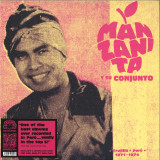
Following the 70s Peruvian cumbia compilation by Ranil last year, Analog Africa returns to Latin America to highlight the work of one of Perú’s undisputed masters of the electric guitar: Manzanita. This 13th release in the Limited Dance Edition Series includes 14 mostly instrumental compositions of electrifying Peruvian cumbia and guaracha. Manzanita's unique guitar lines rest on confident foundations that shifts gears effortlessly. Limited Edition LP in Gatefold Cover pressed on 180g high quality virgin vinyl
"I was in Lima, hanging out with collector-extraordinaire Victor Zela, who had spent the previous few years pouring his passion for Peruvian Cumbia into the blog „la cumbia de mis viejos“, a trove of incredible music. But after the birth of his first child, his priorities shifted and he decided to part with some of his rarest LPs. I was one of the lucky few given an early chance to examine his treasures, and when I picked up the album Manzaneando com Manzanita, Victor said: “Take it! its one of the best LPs ever recorded in Perú … easily in the top five”. That was all the encouragement I needed … two years later many of the songs from that masterpiece have made it onto Manzanita y su Conjunto, a compilation of electrifying Cumbia sides from Manzanita’s golden era.
Berardo Hernández – better known as Manzanita – first surfaced during the psychedelic Cumbia craze. At the head of the scene were the magnificent Los Destellos, whose leader, Enrique Delgado, was such a six-string wizard that other guitarists found it impossible to escape his shadow. But when Manzanita arrived, his electric criollo style sent shockwaves through Lima’s music scene and posed a serious threat to Delgado’s dominance as king of the Peruvian guitar.
Manzanita had come to Lima from the coastal city of Trujillo, five hundred miles up the coast – a place where Spanish, African and indigenous populations had been living and making music together for centuries – and came of age at a time when the first wave of psychedelic rock from the US and UK was starting to sweep the airwaves. But the sounds of Cream and Hendrix disappeared from the radio just as quickly in 1968 when Juan Velasco seized control of the country in a military coup. The new regime, which favoured local traditions over cultural ‘imports’ from the north, was a blessing in disguise for the Peruvian music scene.
Record labels flourished as new bands, raised on a hybrid diet of electric guitars and Cuban rhythms, rushed in to fill the vacuum created by the lack of imported rock. A new genre, known as Peruvian cumbia, was born and Manzanita quickly became one of its most original voices.
Starting in 1969, Manzanita y su Conjunto released a steady stream of singles that used Cuban guaracha rhythms as the foundation for dazzling electric guitar lines. After countless 45s and several years on the touring circuit, the band signed to Virrey, an important Peruvian label, and recorded two LPs acknowledged as masterpieces among aficionados of tropical music. Most of the songs on Analog Africa’s new compilation Manzanita y su Conjunto are drawn from those legendary sessions of 1973 and 74.
Although he scored a few more hits in the later 70s, his dissatisfaction with the music industry caused him to withdraw from the scene for several years; and when he finally retired for good, the golden age of Peruvian cumbia was a distant memory. But when Manzanita was at the top of his game he had few equals. Victor Zela was right: this is some of the best music ever recorded in Perú."
Suche:after work
Dauw welcome Spanish based artist Jason Kolàr to the label with his new work Loops & Pieces (2017-2020). It’s a prelude to his new full-length album coming in October 2021 through Dauw.
Three years after Stroom TV released his debut album Modified Perspectives, Kolàr now offers a documentation of sounds he has been working on in the period 2017-2020. According to Kolàr, this tape is full of vaporous drafts transforming into solid forms with the help of time and distance. Compared to his previous work, the music on Loops & Pieces is much more stripped down and minimal, yet the dreamy character remains.
I first discovered khroniky – Ukranian folk songs – in the Highlands of Scotland. I was watching a screening of Bajka, a mesmerising documentary made by the filmmaker Lucia Nimcová and sound artist Sholto Dobie. I knew nothing about these ballads beforehand, but I was fascinated by these odd, beautiful songs, especially the easy way in which they mixed misery and levity, where gentle melodies blend with tales of dark violence. The folk songs describe hardship, murder, torture, death in gulags, heavy drinking, outsmarting men, love affairs. But they’re often very funny too – many of the songs make fun of marriage, and there’s an amazing subcategory of khroniky songs called potka (vagina) songs.
The khroniky have never been properly documented because they were considered too crude, or contained lyrics that were problematic, politically. When Ukrainian folk songs have been archived in the past, it’s normally a sanitised, more polite version of the ones that Lucia remembers from her childhood. Lucia grew up on the other side of the Ukrainian border in Slovakia. She is part of the Rusyn (Ruthenian) minority ethnic group found in the borderlands of Slovakia, Hungary, Romania, Ukraine and Poland. Rusyn is a centuries-old Slavic language, looked down upon as a poor, uneducated dialect by the neighbouring Ukraine and Slovakia. It was forbidden to talk about Rusyn culture at Nimcova’s primary school, but the khroniky stayed in her memories.
“I remember weddings when I was young,” says Lucia, who now lives in Addis Abeba, Ethiopia. “At the end of the night, when everyone was drunk and the young couple would go around their guests, people would sing in Rusyn. There was singing and dancing, and songs about being in prison or falling in love. I picked up the lyrics and sometimes my mum would make my sister and I sing them for people we met on the train. I was about five or six but the lyrics still come back when I sing to my kids.”
Determined that these rich, nuanced, unique songs shouldn’t be forgotten, she decided to record them. Over two years, Lucia, joined by experimental musician Sholto Dobie, visited Rusyn villages high in the Carpathian mountains to rediscover the songs and make the documentary. It was at the beginning of war breaking out in Ukraine in 2014.
“The Rusyn community is a very closed one,” explains Lucia. “Sometimes we’d have to wait several days to hear someone sing; we had to earn their trust before they shared something very personal to them. We’d stay up ‘til 5am at a wedding, then go straight to a morning baptism, or collect haystacks with the villagers, hoping they’d sing while they were working.”
DILO is named after an important independent Ukrainian daily newspaper that was shut down when the Red Army entered Lviv in 1939. The four long tracks on DILO blur field recordings with song; an unpolished, privileged glimpse into a private world. We hear dogs barking and insects buzzing in the summer heat, then a blast of hurdy gurdy or violin will drift in, or a plaintive song soars softly over the rural background noise, with casually harrowing lyrics about a cuckoo, “lifeless in a world of misery”, as translated in the album’s booklet.
For both Lucia and Sholto, it was important not to tamper too much with what they heard. “When you think about ethnography,” Lucia explains, “you have to have a lot of time, love and respect to document it with sensitivity.”
“The songs all have their own atmosphere and intimacy from the spaces they were recorded in and it was important to maintain these particularities and move with them,” adds Sholto, who now lives in Vilnius, Lithuania. “They guide and sometimes interrupt a journey between interiors – domestic spaces; in kitchens, by the fire – and exteriors; marketplaces, cow sheds. We used contact microphones to record metal bridges and fences, and we spent one afternoon recording a wool processing machine, the details of the rattling and tuning wheels are the ground layer for the third track.”
Lucia took rough notes and diary entries during the recording process, which are now shared in the booklet alongside a selection of lyrics, loosely translated, but revealing the depth and astonishing beauty that sometimes lies in the language of these folk songs.
The feel of the album is intimate, flipping between laughter, where a woman sings about selling her pussy to buy a cow in one track, then shifts to a raw, painful truth; an adult son asks his mother why his dad won’t be back for dinner, as he’s gone to war.
Since Lucia and Sholto began working together in 2014, they have shared the audio recordings on radio and film and shown photos in gallery spaces, making sure these special, smutty, poignant songs don’t get lost. This new record and booklet joins that same continuum, another glorious fruit from the same rare tree.
Blue Vinyl
Lynch protégé and Twin Peaks sound designer Dean Hurley coaxes an incredible puzzlebox of atmospheres and mood pieces on this killer contribution to our Documenting Sound series, now remastered and pressed on vinyl for what is, perhaps unsurprisingly, the most cinematic and neon-lit instalment in the series. Like a
smudged and overdubbed copy of the BoC Maxima tape, with added iridescence.
Across almost 40 minutes we transition from aerosolised synths to romantic chromatics, thru to Nurse WIth Wound-style severed rhythms and fading glimmers of hope, ‘Concrete Feather’ epitomises Dean Hurley’s prized knack for nuanced instrumental story-telling in the finest and most engrossing style we could imagine. Against the backdrop of the Hollywood film industry that has primed us for as long as we can all remember, the music spans a panorama of lush, mirage-like choral pads and starry flickers thru to gloaming
nightmare sequences and screwed drums, while touching on some of the dankest synth tones this side of his ‘Anthology Resource’ volumes or indeed his soundtrack work for Twin Peaks: The Return. It’s full of dread and a slowly unfolding sense of tragedy.
“Having a regular practice of recording is probably the single most important element to my craft. It’s a way of dropping indiscriminate mile markers while constantly moving forward in time without ability to pause.
Over the years, working for David Lynch taught me a great deal about this and the concept and importance of experimentation. I’ve found myself clinging to those lessons during this time and using them as tools for both productivity and balance. His notion of experimentation is a simple one, yet incredibly profound. It was one of the very first words I heard him say during our initial meeting, and I never stopped hearing the term daily over the subsequent 13 years working together. An ‘experiment’ can provide a legitimate mental back-entrance into the act of creation. It can position an approach toward discovery as opposed to effort, and eliminate the thought that one needs to ‘will’ something into existence. It also aids in calming the judgmental
side of a brain from stepping on/interfering with expression…after all, experiments are not about success or failure, they’re simply about learning. In the Lynch school of thought, multiple experiments then become firewood…and with firewood, one can not only build but actually sustain a fire…even turn it into a multipleacre blaze or more.
Dean Hurley
A fantastic little record – and very much the kind of set that the Strata East label was created to represent! The music here would hardly have found a home on the bigger jazz labels of the period – not because it's too avant-garde or non-commercial, but just because it's so deeply personal and powerful – the boldest vision on record of trombonist John Gordon, who composed a mind blowing suite of tracks for the first side of the album, as well as some equally great tunes for the second half! Gordon leads the group on trombone – with solos that are soaring and soulful, alongside work by the great James Spaulding on alto and flute, Waymond Reed on trumpet, John Miller on piano and keyboards, Lyle Atkinson on bass, and Frank Derrick on drums! If you know some of the other players here from their own work of the time, you know you're in for a treat – as the music has this fantastic sound of strong individual voices coming together, instruments lifted high on a mission of music – with results that are as fantastic all these many years as they were in the 70s.
Re-mastering by: Cicely Baston at Alchemy/Air Mastering, London
Electric blues guitarist Melvin Taylor had been sporadically recording solo albums for 20 years when Dirty Pool arrived — and was somehow just beginning to find fame. Already a hit in Europe, it had taken a steady run of performing in Chicago’s famed blues clubs to slowly earn Taylor a well-deserved reputation as an equal talent among the giants before him, such as Otis Rush, Albert King and Stevie Ray Vaughan.
While early records like Melvin Taylor Plays the Blues For You show off an equally amazing jazz side, Taylor traded away his Wes Montgomery-inspired runs for more Luther Allison/Jimi Hendrix attacks with the formation of the trio Melvin Taylor and the Slack Band in the mid ’90’s.
The title song of the second album by that outfit, “Dirty Pool,” is actually more the balls-to-the-wall, no-compromise, hard-rockin’ electric Texas blues of Vaughan and Johnny Winter than the sweet Chicago soul of Buddy Guy.
Indeed, three tracks on this 1997 release, including “Dirty Pool,” were SRV tunes. Other standards, like “Kansas City” and “Floodin’ in California” also have more of a Lone Star State approach to them. But the Jackson, Miss.-born Taylor’s guitar is cleaner than his forebears and technically, he even surpasses them, yet the anger and sorrow of the blues is readily evident in his playing.
This rare combination of qualities really comes out in a slow blues tune like his solo in “Dirty Pool,” which after repeated listens, still makes me head shake in disbelief when I hear it.
“Too Sorry” is a good example of how well Taylor fares when he treads in Jimi Hendrix territory, whereas his rhythm work is the best I’ve heard from a lead guitarist since Vaughan; listen to “I Ain’t Superstitious,” “Born Under A Bad Sign” and the funky “Telephone Song” for your proof.
It also helps that Taylor’s drummer James Knowles is well in synch with him, while Ethan Farmer completely owns the low end of the sound. Farmer’s peppering bass lines in and “Floodin’ in California” is the textbook way electric blues bass should be. Overall, a tight little band.
Taylor’s vocals certainly won’t draw any comparisons to the Wide-Brimmed–Hatted One but he holds his own just fine until it’s cuttin’ time. This is right at the top of my list of best blues guitar playing on record over the last couple of decades. If you decide to give this one a listen, prepare to be blown away.
Nimbus West spirit jazz essential: the Creative Arts Ensemble's classic debut One Step Out. One of the most sought after and highly-regarded titles to have appeared on Tom Albach's celebrated Nimbus West imprint, One Step Out is a timeless work of spiritualized jazz. A true gem from the Los Angeles jazz underground, the album was pianist and composer Kaeef Ruzadun Ali's first recording as leader of the Creative Arts Ensemble, the only large ensemble group that emerged directly from Horace Tapscott's legendary Pan Afrikan Peoples Arkestra community jazz group. A Los Angeles native, Kaeef was introduced to the Tapscott circle in the late 1970s. His first experience of the Arkestra's ethos was through PAPA tenorist Michael Session, who took him to the famous "Great House" at 2412 South Western Ave., LA -- a large mansion house which members of the Arkestra had taken over as a space for communal living. Life in the Great House was a continuous stream of music, dance and community events. "When I walked in there," recalled Kaeef, "it was like this whole rush came over me, just from going in the front door -- It was like a very, very warm feeling of love. I went and I came out with 'Flashback Of Time', and that was my first arrangement." Kaeef quickly became a significant contributor of compositions to the Arkestra's songbook -- his piece "New Horizon" would be recorded by Horace Tapscott for the latter's Tapscott Sessions series. But "Flashback Of Time" would eventually appear on One Step Out, played by the new group he had put together from stalwart Arkestra members. Inspired by both Tapscott's example and by the Art Ensemble of Chicago, Kaeef had wanted to follow their lead by assembling a larger unit. Featuring seasoned Arkestra regulars including reedsman Dadisi Komolafe, drummer Woody "Sonship" Theus and altoist Gary Bias, with veterans Henry "The Skipper" Franklin on bass and George Bohannon on trombone, One Step Out is a key document of the Los Angeles radical jazz underground. Featuring the sanctified vocals of Kaeef's sister, B. J. Crowley, the album is a tour de force of spiritually energized independent jazz music.
In October last year Pete Josef's second album ëI Rise With The Birdsû came out. Now Sonar Kollektiv has decided to release four remixes of three different songs off the fantastic album. First of all there is the Jazzanova remix of ëGiantsû, which almost completely gets rid of the vocals, but all the more absorbs the zeitgeist - a remix probably working perfectly for a group of battling breakdancers. The program continues with a remix by Pete Josef himself. The Englishman strips down ëThis Sunû to its basic structure, then simply building a modern Salsa track out of it. Which brings us to the remix by Friend Within. The Liverpool producer and Pete Josef have been friends for many years, dating back to a 2013 collaboration (ëThe Workû) that made it onto Disclosure's Mixmag mix CD. ëMainframeû sounds super fresh after Friend Within's rework and seems like the party banger we've been looking forward to for months! But what Feiertag finally takes the liberty of doing with his remix of ëGiantsû is beyond imagination. Far away from the original Feiertag's interpretation moves in dark downtempo realms - dubby and spheric at the same time. In short: Each of the four remixes is a small masterpiece on its own.
Hong Kong based hypno-tropicalia duo Blood Wine or Honey are set to release their second album 'DTx2' on 30th June 2021. Made up of seasoned multi-instrumentalists James Banbury (synths, bass, percussion, cello) and Joseph von Hess (vocals, clarinet, sax, percussion), they create a heaving, heady brew of brazen sax themes, lo-fi/hi-tech electronics, densely layered cello inflections and motorik drums.
These explorations start with the dance-floor then go above and beyond, taking notes from post-punk and tropical polyrhythms, always anchored by the bass weight of the sound system. Their distinctive sound is created in the industrial warehouses and hidden rural settlements of Hong Kong, surrounded by the low-end throb of heavy machinery, the lingering scent of hand sanitiser and the humidity of the South China Sea.
Written and recorded during 2020-21, new album 'DTx2' looks ahead to an uncertain future, drawing deep on their experiences and influences and welcoming a host of co-conspirators.
Jean Daval, aka Preservation (credits include Yasiin Bey fka Mos Def, MF Doom, RZA, GZA, Raekwon, KRS-One, Aesop Rock), provided truffle-hunted beats, synths and basses, which, when put through the BWoH mangle, emerged as 'Messenger'.
Superstar and old friend of the band KT Tunstall came to work with BWoH after they contributed a DJ mix for her lockdown 'KTRave' on Instagram. 'Attraction' was the result. Wonky bass, found-bounce beats and Buddy Rich drums smashed out by Tim Weller (Marc Almond, Future Sound of London, Goldfrapp, The Chemical Brothers, David Axelrod) resulted in a bonkers production with passionate vocals and layers of harmony.
'I Shall Rush Out As I Am' is a collaboration with legendary pop provocateur Paul Morley and Janice Lau of Hong Kong band David Boring. The track is based on the words and the spirit of sci-fi writer, satirist, literary critic and radical feminist Joanna Russ and took shape quickly, with tinges of A Certain Ratio and memories of Suicide, provoking Janice to an authentic scream-of-consciousness delivery.
Multi-talented London singer, musician and composer Kamal (Neighbourhood Recordings) took time away from being the Next Big Thing to transform 'Testing Time' with funk-edged keys. A key figure in the extraordinary '90s Hong Kong music scene, Zoë Brewster contributed vocals.
Roughly divided, the album's first set of songs make relatively short statements, punchily self-contained with common threads. The final four tracks, Testing Time, Embers, Embrasure
and Echt Embrace disperse into flights of mantric fantasy, with quicksand time-signature shifts and key-changes emerging into a more introspective zone with a fervent pulse, a shift in energy: stamina over speed.
Apparel Wax is back with the 9th gem of its catalogue, a stunning six track EP out worldwide on the 7th of June 2021. The vinyl faced hero always wants to grow, therefore is on a constant quest for the evolution of its music and this record proves it once again being it a superb array of assorted sounds. A1 kicks it off in style with its Chicagoan touch taking over after a smooth intro: the mellow pad chords laying down the foundation of the arrangement, the soft strings and the melodious piano notes make it a perfect start. A2 opens with a steady kick and a silky bassline murmuring throughout the whole track while some more keys create a Deep dynamic beat. To end side A here's A3 with its far-out, spacey atmosphere and its Deep chords backed by an energetic rhythm section. Side B of our vinyl is about class: B1 is a nothing short of chic with its sampled vocals and its elegant pads. B2 is more Deep with its evolving piano melody, its balanced and groovy drums and some masterly crafted tiny vocal samples. B3 wraps up the record with a Jungle beat sprinkled with Jazz, R&B and Soul. APLWAX009 is a tenacious and cohesive work, yet disseminated by inspirational and diverse sounds which will be Wax's touch forevermore. A perfect EP to start the warmest season with the hope of being able to enjoy the outdoors without restrictions.
Since the release of the first volume in 2019, we knew we couldn't stop there. In 2021 we are even more excited to present the 'Drum'n Voice Remixed 2' album by the legend Billy Cobham in collaboration with Italian producers and composers Nicolosi / Novecento. As a taster to the album we are very happy to be releasing an EP containing remixes of ‘Interactive’ from the legend Louie Vega.
Acclaimed as jazz-rock fusion's greatest drummer, Billy Cobham has dedicated his whole life to musical exploration and creative expression. Born in Panama, he has been surrounded by music. His father was a pianist, his mother was a singer and Billy started playing drums at four years old. Throughout his career he has collaborated with artists like Miles Davis, Horace Silver, Airto Moreira, George Benson and appeared on over 300 recordings, including icons like Peter Gabriel, Quincy Jones, Jack Bruce, Bob Weir, and James Brown, and to date, has produced and released more than forty albums as a leader. The first album ‘Spectrum’ is a masterpiece and still considered a reference album today.
Billy and Nicolosi composed so many songs of the highest quality and class that we immediately wanted to get to work preparing a second volume of remixes. We are really happy to present the Louie Vega remixes of ‘Interactive’ in the run up to ‘Drum’N Voice Remixed 2’ collection that's set for a release later in the year.
‘Little’ Louie Vega does not need any introduction. One half of the Masters At Work (that are back now after a long time with their new single), he is one of the most important House Music duo of the last 30 years, even receiving a nomination in the last Grammy Awards. With the collaboration of Josh Milan (aka Honeycomb and former one half of Blaze) at the keyboards, these incredible remixes of 'Interactive' make track shine thanks to a powerful blend of funky cosmic disco and a perfect killer groove that makes us dance on Brian Auger's magnificent Hammond improvisation.
Something wicked this way comes. Following singles 'Know The Future' b/w 'Digital Warfare' in 2019 and 'Hypersocial' b/w 'Safety Test' in 2020, ESP’s own Patrick Conway has now teamed up with the illustrious Appleblim (of Skull Disco and Apple Pips fame) for a meaty self-titled debut 2xLP under the new collaborative moniker, Trinity Carbon. There is something to be said for art created in the face of global unraveling, while mass transgression and the friction of culture shifting produce poignant commentary, but more often than not, it’s the personal coping mechanisms within our work that have the power to speak directly to the receiver. After a number of sessions resulting in wild imaginative beginnings, it was the untimely passing of Andrew Weatherall and a coming to terms with that loss that moved the two Brits-via-Berlin to herd their roaming sketches into a more narrative statement. In the uphill struggle to retain some sense of individualism, it’s always outsiders like Weatherall whose risks illuminate the roads of creativity less traveled, and when those beacons go dark there is a disorientation felt far and wide. Conway and Blim concede to the internal inquiry, “What would Weatherall do?” bringing to mind the man’s pervading morale, always soldiering onward through mediocrity, as it was undoubtedly an impetus for the duo growing steadfast and chiseling 'Trinity Carbon' into completion. While employing trusted machines in the bass department, they established a warm euphonic home base from which they could stray in a variety of tonal and rhythmic directions without straining a tether to the album’s core. However, as soon as any hint of familiarity may arise, or listeners begin to mentally assign stylistic epithets, the duo boldly change course to remind us that while the banal stay safely defined, it’s the iconoclasts, the outsiders who make us feel.
Born and bred New Yorker Jean Pierre is stepping out with his own brand new label, Pakate. The vinyl-only outlet kicks off with a fantastic first EP from FLETCH featuring remixes from Pierre himself and Franco Cinelli.
This exciting new label will be an outlet for Jean and other friends to serve up mature and minimal sounds focused around unique designs and powerful grooves. Dealing in heady underground sounds that also work on larger dance floors, the label comes after Pierre has spent 15 years entrenched in the electronic scene. This is his way to carefully curate his own music exactly how he wants to, with three releases already lined up for 2021.
The first one is from FLETCH, a red hot UK talent who has released on the likes of Kaluki and Whippin’ Records. His opening tune 'Actin Up' is a slick and slippery minimal groove with real depth and freaky sound designs that make it pop. 'Want Me' then hits harder, with loopy house drums and squelchy synths all bubbling away beneath soulful female vocal sounds and cosmic synths.
The first fine remix is from France Cinelli who takes 'Actin Up' super deep, with punching kicks and rolling bass that gets you in a state of hypnosis., Closing out the package is a Jean Pierre remix of 'Want Me' that shows off his ability to lay down stripped back but compelling house grooves with deft sound design and a freaky atmosphere.
This is a standout first EP that perfectly sets the scene for what is sure to become a vital new label from this American mainstay.
- A1: Preaching To The Choir
- A2: Stronger (Feat Jswiss)
- A3: Superstrada
- A4: Concrete Stardust
- A5: Where Do We Go From Here (Feat Lee Fields)
- A6: Macumba
- B1: Take On The World (Feat Gizelle Smith)
- B2: Return To Space (Feat Peter Thomas)
- B3: Golden Shadow
- B4: Today
- B5: Here We Go (Feat Mocambo Kidz)
- B6: Bounce That Ass (Feat Ice-T &Amp; Charlie Funk)
Limited edition gold vinyl edition.
Hamburg's funk adventurers at the top of their game with special guests Ice-T, Charlie Funk, Peter Thomas, Gizelle Smith, Lee Fields, JSwiss & the Mocambo Kidz.
Original press release note (2019):
Carrying blistering funk lines in their fingers and worldly influences in their hearts, the unique and distinctive Mocambo sound is not one to be confused with retro bands trying to recapture an era. Eschewing traditional recording methods, this DIY crew are committed to driving forwards, and 2066 sees them at the height of their powers, broadcasting a call for unity.
After reaching new audiences worldwide and earning critical praise for their two long players on Brooklyn's Big Crown Records in their tropical guise as Bacao Rhythm & Steel Band, the band have reassembled and refocused in their original form, the workhorses behind dozens of 45s on the Mocambo label and beyond. Crossing generations, this album introduces some of the world's youngest funk talent to step up and rub shoulders with soul and rap legends, soul sisters, an elder statesman composer/arranger and a brand new emerging artist out of New York.
As with all Mocambo releases, the two sides of the record have been meticulously sequenced by the
band. Side A welcomes us aboard with joyous instrumental stomper Preaching To The Choir, and a call to build bridges from Mocambo chanteuse and percussionist Nichola Richards, duetting with emerging rap talent, New York MC JSwiss. B-girls and b-boys are called to the dancefloor as Superstrada and Concrete Stardust commence, all buzzing synth lines and relentless drums. New Jersey legend and Big Crown associate Mr Lee Fields is guest of honour for Where Do We Go From Here before a horn workout brings us to a close with Macumba. It's time for a breather.
The B side kicks off with the grand return of the Golden Girl of Funk, Gizelle Smith, a sister who's been busy taking on the world. Composer and presenter Peter Thomas narrates a Return To Space to mark the centenary of the debut of his score to sci-fi show Space Patrol, which first broadcast in 1966. We're back down to Earth and the mean streets for the furious drums and car chase workout of Golden Shadow. Today slows down the pace for a reflective ballad with Nichola front and centre - and here's the next generation: the Mocambo Kidz sing along to their parents' instrumentation for Here We Go, a new kids' block party anthem... with no sleep 'til bedtime. The album closer makes it clear that the Mocambos are nowhere near powering down as Ice T and Charlie F unk bring their A-game for an old school attack which, since you're up bouncing anyway, gives you no excuse not to flip the LP and drop the needle right back on to Side A. Onwards!
A summation of their journey so far and a celebration in anticipation of what's to come, the album is set
to take its place in a legacy of open minded, organically recorded music, showering listeners with the crew's maze of tantalising sounds pulled from funk, afro, hip hop with cinematic composition and storytelling.
Imperium Droop brings two mavericks of sweeping exploration together into new avenues of musical expression. Kid Millions and Jan St. Werner explore a liminal space between improvisation and composition, a fluid yet defined sound-space, founded on the unique chemistry of their friendship and pushing into the future. Kid Millions stands as one of the most sought after drummers and improvisers in NYC, known for his work as the drummer for Oneida, his expansive solo work as Man Forever, as well as collaborations and performances with the likes of Laurie Anderson, Philip Glass, Royal Trux, Boredoms, White Hills, and Spiritualized. Regardless of who he's working with Kid Millions radically redefines the drums as an instrument. Jan St. Werner has consistently remained at the vanguard of electronic music. In his work as one half of the visionary duo Mouse On Mars, as well as his acclaimed solo work both as a composer and sound artist, and in collaborations with The Fall's Mark E Smith, Oval's Markus Popp, Stereolab, and The National St. Werner constantly pushes the limits of recorded sound. Together, Millions and Werner have crafted a monument of unpredictable beauty built on breathless forays into the unknown. Werner's application of a seemingly infinite arsenal of textures unleashes colorful swaths of energy. Mats Gustaffson joins Werner on the maximalist "Color Bagpipes," unleashing torrents of swiveling melody and breathy clicks over the exponential thunder of Millions' drum kit. Pieces like "Dark Tetrad" and "Astral Stare" demonstrate the duo's mastery of space and surprise. Dark flutters flow in slow pulses across "Apotropaic" where erratic swirls of sound twist and mutate on "Sorrows and Compensations," unified as a single force by the overwhelming diversity of sounds. Millions' drums effortlessly rides each wave of Werner's prismatic deluges and channels their energy into dynamic movements. Through his singular prowess, Millions' tireless rhythms and subtle gestures mirror Werner's boundless textural palette and drive each piece towards transcendence. On Imperium Droop, Kid Millions and Jan St. Werner have combined their powers into an incomparable work of gripping and intrepid sonic fluctuations.
LTD COLOUR[29,79 €]
Classic black LPs housed in gatefold w/ special canvas cardboard stock and silver hot foil! Nordic pop diva KARIN PARK of ÅRABROT adds her ethereal, mournful voice and keys to the primordial sound of legendary electronic pioneer LUSTMORD for this sublime and poignant collaboration. ALTER is a ritual of our times. On the pair's frst collaborative work, the nine tracks that make up ALTER are every bit as heart-wrenching as they are terrifying, mining new sonic territory, it is a fascinating study of light and shade that delves deep into vast uncharted darkness. Their ability to create atmosphere on the album opener "Hiraeth" is second to none, perfectly assembling a harrowing backdrop for Park's lilting sound of longing. From there, Park's vocals add all of the emotional depth and power found in names like Kate Bush, Maynard J Keenan and Elizabeth Frasier, perfectly playing against Lustmord's waves of dark drama and creating a wholly unique record that recalls Dead Can Dance, Massive Attack and Portishead at their greatest. Considering Park's credentials, it might be surprising that a collaboration with Lustmord would ft so seamlessly. Utilizing a sound comprised of elements of industrial, synth pop and more, the celebrated Swedish solo artist and member of Norwegian rock band Årabrot utilizes experimentation in her work, blazing trails and bringing to mind the work of her peers The Knife, Scott Walker, Robyn, Depeche Mode and Burial with her darkly-rich compositions. Multiple winner of Norway's Spellemann award, Park co-wrote the Norwegian entry for the 2013 Eurovision, fnishing fourth overall. But it is the sensibility of the sacred music of her youth that Park adds to ALTER, contributing a powerful vocal that guides the listener through the cavernous, mystical depth of their collaborative work. "Lustmord is the Gustave Doré of music", Karin Park ofers pensively. "Painting magical pictures with a sound that is so vast, it gives space for your own imagination." Brian Williams grew up in North Wales, beginning his musical career as Lustmord in 1980 and becoming a pivotal fgure and pioneer in the early industrial music scene in the UK. A former member of SPK during arguably their most crucial era, Williams went on to work with Throbbing Gristle members Chris & Cosey and appeared on early albums by Current 93 and Nurse With Wound amongst others. After relocating to Los Angeles in 1993, Williams worked on dozens of motion picture soundtracks including The Crow, Underworld and Paul Schrader's First Reformed, as well as on several video game, television scores and solo albums. Williams has also contributed to and collaborated with artists as varied as the Melvins, Clock DVA, Jarboe, John Balance of Coil, Clock DVA, Paul Haslinger (Tangerine Dream), Wes Borland (Limp Bizkit), Puscifer and more, including Grammy Award-winners Tool from their much acclaimed eforts 10,000 Days and Fear Inoculum. FOR FANS OF Lustmord, Årabrot, Dead Can Dance, Hans Zimmer, Sunn O))), Fever Ray, Chelsea Wolfe, Boards of Canada, Heilung, Zola Jesus, Swans.
2LP[25,59 €]
Limited coloured LPs housed in gatefold w/ special canvas cardboard stock and silver hot foil! Nordic pop diva KARIN PARK of ÅRABROT adds her ethereal, mournful voice and keys to the primordial sound of legendary electronic pioneer LUSTMORD for this sublime and poignant collaboration. ALTER is a ritual of our times. On the pair's frst collaborative work, the nine tracks that make up ALTER are every bit as heart-wrenching as they are terrifying, mining new sonic territory, it is a fascinating study of light and shade that delves deep into vast uncharted darkness. Their ability to create atmosphere on the album opener "Hiraeth" is second to none, perfectly assembling a harrowing backdrop for Park's lilting sound of longing. From there, Park's vocals add all of the emotional depth and power found in names like Kate Bush, Maynard J Keenan and Elizabeth Frasier, perfectly playing against Lustmord's waves of dark drama and creating a wholly unique record that recalls Dead Can Dance, Massive Attack and Portishead at their greatest. Considering Park's credentials, it might be surprising that a collaboration with Lustmord would ft so seamlessly. Utilizing a sound comprised of elements of industrial, synth pop and more, the celebrated Swedish solo artist and member of Norwegian rock band Årabrot utilizes experimentation in her work, blazing trails and bringing to mind the work of her peers The Knife, Scott Walker, Robyn, Depeche Mode and Burial with her darkly-rich compositions. Multiple winner of Norway's Spellemann award, Park co-wrote the Norwegian entry for the 2013 Eurovision, fnishing fourth overall. But it is the sensibility of the sacred music of her youth that Park adds to ALTER, contributing a powerful vocal that guides the listener through the cavernous, mystical depth of their collaborative work. "Lustmord is the Gustave Doré of music", Karin Park ofers pensively. "Painting magical pictures with a sound that is so vast, it gives space for your own imagination." Brian Williams grew up in North Wales, beginning his musical career as Lustmord in 1980 and becoming a pivotal fgure and pioneer in the early industrial music scene in the UK. A former member of SPK during arguably their most crucial era, Williams went on to work with Throbbing Gristle members Chris & Cosey and appeared on early albums by Current 93 and Nurse With Wound amongst others. After relocating to Los Angeles in 1993, Williams worked on dozens of motion picture soundtracks including The Crow, Underworld and Paul Schrader's First Reformed, as well as on several video game, television scores and solo albums. Williams has also contributed to and collaborated with artists as varied as the Melvins, Clock DVA, Jarboe, John Balance of Coil, Clock DVA, Paul Haslinger (Tangerine Dream), Wes Borland (Limp Bizkit), Puscifer and more, including Grammy Award-winners Tool from their much acclaimed eforts 10,000 Days and Fear Inoculum.
For Bajram Bili, every new record is the kick off for reinventing himself in a series of explorations and experimentations.
After venturing through techno, Adrien Gachet opens a new page bursting with artistic possibilities and sonic freedom. His new research is founded on two cornerstones : his reassuming of the piano, the historic medium he’s left aside those past years, and the deconstruction of contemporary electronic music. The result is a flush yet tight affair condensing the broad spectrum of its ambitions in just six tracks.
A true mine for textures and melodies, Detuning Euphoria feels like a blinding mirage. The music conjugates cinematic composition and borrowings of the 2020’s club music, where laser synths and skeletal beats melt one another in bare and frontal feelings. It’s a total work, an exhilarating and untamed piece opening a new chapter in a maniac and turbulent discography. We’re very proud to be associated to this new stage of Bajram Bili’s fascinating research for new horizons.
It’s been ten years since Adrian Gachet first ventured into electronic soundscapes under his Bajram Bili moniker. On wax, the project started with the romantic label Another Record with the Sequenced Fog EP and his dance-kraut manifest of a debut album Saturdays With No Memory.
The affair became more muscular with the acquaintance of the Neo Punks from Le Turc Mecanique. After a first warning with the break-heavy Distant Drone (with the banger ‘Roger and Stan’) and the blasting Need Meditation, the Remembered Waves LP is released, oscillating between ecstatic urgency and foggy electric landscapes.
The following Spin / Consequence was dedicated to the drills of seminal techno giving way to the quieter Reshaped Distortion EP on Chloe’s label Lumière Noire.
Those years of intense creation, massive live sets and federating DJ sets come together in today’s new research, mixing the experience of his epic machinery with the deviation of the acoustic piano, following the aesthetic of his new record Detuning Euphoria.
His last solo album for Beggars, Cascade came after a time of change for Peter Murphy. He had dissolved his longtime backing band and moved to Turkey with his family. After a year of soul-searching and re-discovery, the songs flowed. He said "It confirmed my belief that writing - like painting or any art form - comes from a very silent place that's not dependent on outside stimulus. It was like rediscovering the initial innocence and purity that's there when you join your first band." The album was written with Paul Statham and produced by Pascal Gabriel. It also contains guitar work by noted artist Michael Brook. The four bonus tracks added to Cascade are: Mercy Rain (production rough mix) Gliding Like A Whale (backing track) Sail on White (backing track) Wish (backing track)
Bring Me The Head of Kyle Bobby Dunn is a full length triple vinyl reissue of the original 2012 double compact disc album from Canadian composer Kyle Bobby Dunn. It was recorded at Bunce Cake studios in Brooklyn and remote parts of Ontario. The compositions are mostly long, slowly evolving minimal ambient and drone based works created from electric guitar processing. Perhaps more cinematic than previous albums, some pieces have since appeared in BBC documentaries and independent films over the years since its release. The original recordings on this Diggers Factory vinyl edition, however, have been remastered and practically rebuilt from the fog of their initial masters which have often been considered the composer's most quiet and even translucent works. Iranian composers and engineers, Milad Bagheri and Maryam Sirvan have brought out a certain clarity and freshness to the music and Dunn has considered it an almost completely different listening experience from the originals.
The album was critically praised and became a favourite of most fans and even after several subsequent albums later it remains a favourite and of the composer's as well.


