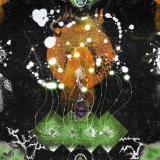
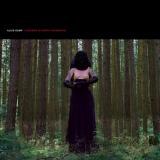
Some years ago, Kjell Bjørgeengen and Keith Rowe attempted to convert video signals into sound by setting up Rowe’s pickups next to an old CRT monitor, turning its magnetic field into a sound generator. Rowe further developed the system with David Jones at Alfred University, slimming down the setup using a copper coil, a circuit board, a video input, and a telephone pickup. Jones named it the »Flood Coil«, and it’s that instrument you can see on the album’s front cover and that lies at the core of these recordings, made without any physical live input from the artists themselves. In essence, it’s generative music in its purest form.
Bjørgeengen’s video feed is generated by oscillators, then routed into Marhaug’s pedals and then back into the Flood Coil, so any visual shifts alter the sound, and any modification to the sound changes the video. The duo have played this setup live many times, but for this studio version they left the system to do its thing without any intervention for two minutes at a time before moving onto the next idea. They recorded hours and hours using this process and then selected 18 highlights for this album, extracting harsh noise, power electronics, lulling feedback drone, and peculiar rhythmic snippets to show the scope of their technique.
A wall of growling, hi-octane Pulse Demon-style noise opens the set, gradually exposing us to more asymmetric textures, shifting through unstable repetitions that transform Merzbow’s metal-inspired screams into »Aaltopiiri«-era rhythmic noise. It’s remarkable, actually, how much Marhaug and Bjørgeengen can squeeze from the system, chancing on shivering, lower-case chugs and pops, galloping drums, soundsystem subs, and grinding blast beats that sound like Napalm Death’s »Scum« piped through a broken amp stack. It ain’t pretty, but noise/industrial freaks will revel in the fierce delights inside.
Search:amp
Following his debut appearance on HABITAT in 2024 with his standout ‘My Eyes Are Failing’ remix, Echonomist returns to serve up his ‘Dominator’ EP - a five-track release that captures the Greek artist’s unmistakable tension, groove, and analogue character, paired with high-caliber remixes from Fango and Toto Chiavetta. With previous releases on Innervisions, Exit Strategy, TAU, and Kompakt, Echonomist has steadily built a reputation for fusing raw emotion with forward-leaning sound design. His prolific output and effortless ability to experiment with various styles have long made him a respected figure within the global electronic landscape. Now, with his ‘Dominator’ EP, he brings that creative force back to Mind Against’s imprint in commanding form.
Opening with the title track, ‘Dominator’ immediately sets the tone: bustling energy, driving drums, and siren-like synths cut through a deep, Detroit-leaning atmosphere. ‘Modulator’ follows with a pulsing, oscillating bassline and rattling percussive breaks that coil around warped vocals. On ‘Use Your Illusions’, the pace becomes chuggier as he combines raw industrial drums with a thudding kick, dubby chords, and fizzing synths. The package is then elevated by two heavyweight reinterpretations, with Fango’s remix of ‘Dominator’ pushing the cut into a more intense, pressure-driven space, upping the ante with amplified rhythmic density. To close, Toto Chiavetta delivers an electro-laden rework, sculpting the track into a dense, atmospheric journey that prioritizes ever-evolving groove and textural depth.
Echonomist 'Dominator’ EP drops via HABITAT on 10th April 2025.
The culmination of an incredible six months of touring the new ‘Aria’ live show, Marsh shares his ‘Aria EP’.
Originally birthed as an audio-visual live concept designed to showcase Marsh’s growing catalogue and the many talented vocalists he has worked with, ‘Aria’ began as two UK shows - the first at London’s premium new venue, HERE at Outernet, followed by a night at New Century in Manchester.
More recently the EP has been supported by a run of eight North American shows including dates at New York’s Webster Hall, Los Angeles’ Fonda Theatre, and a set at Montreal’s Piknic Électronik festival. The ‘Aria’ live show reached its final stop at iconic Colorado venue Red Rocks Amphitheatre for Anjunadeep Open Air - a particularly snowy and enchanting performance for all those lucky enough to be there.
The full EP features two brand new Marsh tracks; ‘Mercy’, a hard-hitting club record known for getting the crowd moving on ‘Aria’ tour dates, and ‘Hope’, a softer track with uplifting vocal samples.
The ‘Aria EP’ is out November 15 on Anjunadeep.
2025 Reissue.
Münchenbuchsee, a suburb of Bern, Switzerland. Stephan Eicher is the youngest of three children. His father, a radio and TV repairman, is also a jazz violinist and a sound tinkerer in his spare time. In the family home's converted fallout shelter turned studio, Mr. Eicher experiments with homemade sequencers, tortures handcrafted drum machines, and abuses reel-to-reel tape recorders—all under the fascinated gaze of young Stephan.
The boy quickly develops a musical curiosity, exploring sound through various experiments and wanderings. Alongside his younger brother Martin, Stephan crafts audio plays on a homemade multi-track recorder (essentially several cassette decks hooked together!), which they write, record, add sound effects to, and perform for family and friends. Just a couple of nice kids, really...
Then comes 1972, and Lou Reed's Transformer album changes everything for the Eicher kids. For 13-year-old Stephan, it's a revelation—especially "Vicious", the opening track, which he plays on repeat for months. He convinces his father to buy him an electric guitar. Not stopping there, his father also builds him a tube amp using an old radio.
Then comes adolescence. A rough one. Stephan leaves home at 16 and moves to Zurich. With obvious artistic talent, he persuades his art teacher to help him get into F+F, a radical, alternative art school—despite his young age. Accepted, he starts learning video techniques, determined to become a filmmaker.
At F+F, Stephan organizes Dada-style happenings and concerts with a group of friends known as the Noise Boys. Among them: one of his teachers on bass, Veit Stauffer on drums (who would later found ReR/Recommended Records), his girlfriend Sacha on vocals, and Stephan on guitar. In one of their early performances, they release a remote-controlled mouse covered in dull razor blades into the audience to create panic and chaos. Keeping with this aggressive, confrontational spirit, they once played a concert while wearing headphones blasting Tristan and Isolde, trying to perform their own songs simultaneously—to maximize the cacophony. The goal was always the same: clear the room.
Their “songs,” if you can call them that, followed suit. Take "Hungeriges Afrika", for instance—performed entirely with power drills and some drum feedback.
To make ends meet, Stephan returns to Bern on weekends to work as a waiter at the Spex Club, the city’s main punk venue. On September 16, 1980, during a show by proto-electro group Starter, the police raid the club and arrest everyone. Stephan, who manages to avoid arrest, seizes the opportunity to “borrow” Starter’s gear left behind. He suddenly finds himself in possession of a Roland Promars synth, a Korg MS20, and a gorgeous CR78 drum machine, which he runs through a Big Muff distortion pedal to get that perfect gritty sound.
He then sets out to reinterpret some Noise Boys tracks, reworking them during impromptu sessions recorded on a dictaphone (yes, a dictaphone—now the lo-fi sound makes more sense, doesn’t it?). He ironically titles the resulting cassette "Stephan Eicher spielt Noise Boys" ("Stephan Eicher plays Noise Boys"). This gem features seven tracks, which are the ones reissued here.
Back in Zurich, he visits his friends Andrew Moore and Robert Vogel, who have a DIY cassette duplication setup. They make 25 copies of Stephan Eicher spielt Noise Boys for Stephan and his friends. Robert encourages him to visit Urs Steiger of Off Course Records and play him the tape.
Without much hope, Stephan shows up at Urs’s office. But Urs is instantly hooked and suggests releasing a 7” single. Due to space constraints, they reluctantly drop two of the seven tracks ("Hungeriges Afrika" and "One Second"). As for the musical score featured on the cover—it was randomly chosen and remains a mystery to this day. Calling all music theory nerds!
The 7-inch is pressed in 750 copies and released in the first week of December 1980—a date Stephan remembers well, as it’s the same week John Lennon was killed. Smartly, Urs sends a promo copy to François Murner, Switzerland’s answer to John Peel, who hosts a show on alternative station Sounds. Murner falls in love with the record and starts giving it airtime. To Stephan’s surprise, sales follow—and people actually seem interested in his music.
Even this modest underground success scares Stephan a bit. He stops making music for a year and moves to Bologna, where he works as a programmer at Radio Città, a feminist radio station.
Meanwhile, Stephan’s younger brother Martin, who’s also involved in the punk scene, joins the band Glueams as a singer and guitarist. Glueams, named after the fanzine run by two of its members (drummer Marco Repetto and bassist GT), eventually rebrands as Grauzone. Stephan is invited to their shows to project hacked Super 8 visuals live on stage.
Urs Steiger, now working on a compilation titled Swiss Wave – The Album, asks Grauzone to contribute alongside bands like Liliput, Jack and the Rippers, The Sick, and Ladyshave (Fall 1980).
For the album, Martin tasks Stephan with producing their recording sessions. Under Stephan's artistic direction, two tracks emerge: "Raum" and "Eisbär". During "Eisbär", Martin plays a minimalist bass line borrowed from post-punk band The Feelies (just an open string). Drummer Marco Repetto struggles to keep time. Later that evening, unhappy with the takes, Stephan builds a four-bar drum loop from a ¼-inch tape and uses it instead of the flawed original. He then adds bleepy synths and wind sounds to complete the track’s icy vibe before handing it over to Urs.
The Swiss Wave – The Album compilation is released quietly at first, but things snowball thanks to "Eisbär", which eventually becomes a smash hit—selling over 600,000 singles.
Meanwhile, Stephan plays in a rockabilly band called SMUV (named after Switzerland’s social security agency) and begins producing artists, including the debut album of Starter (1981), which includes a more pop-oriented version of "Minijupe".
By early 1982, Stephan starts spending time with the post-punk girl band Liliput (formerly Kleenex). They’re older than him, and he happily drives them around in his Renault Major, acting as their roadie.
By 1983, Grauzone—signed to the major label EMI, which turned out to be a misstep—is falling apart. Stephan begins to pivot toward a more mainstream pop sound with his debut solo album Les Chansons Bleues.
But that... is already another story.
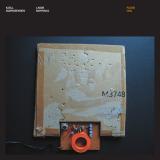
Building upon the striking elegance of their first collaboration, Tobias Freund and Shun Watanabe reunite as Tobias. Doltz. for another extended excursion into designer electronica with a warm, dubby glow at its centre. Their first album Versus arrived on Delsin in early 2025 as a result of a chance meeting at Eden Festival the year before. The spark of inspiration led quickly to a complete and coherent first body of work, and the same can be said for its prompt, equally inspired follow-up. Dealing in the gentle hum of digitally sculpted ambience and needlepoint micro-pulses, Freund and Watanabe evoke the experimental spirit and mellow immersion of golden-era clicks n' cuts techno. While that early 00s phenomenon sometimes cracked around the edges of its DSP limitations, here a rich and porous sound world blooms out from the crisply defined structure of each track. At times the palette opens up to more organic sound matter, and there is ample space for full-bodied synths to ratchet down the rhythm, but a strong digital core of granular processing and exacting sound design form the bedrock of the album's subtle, sublime sound. Even though its calm demeanour radiates an instant charm, like all great electronica Frontiers Of Science is an album of hidden depths to be absorbed steadily over subsequent trips.
- 01: Open The Map
- 02: New Borders
- 03: Red Dust Feat Sailormo &Amp; Yffa
- 04: Night Shift
- 05: Rugged Soil Feat Bva, Jman &Amp; Blackout Ja
- 06: Celesta Roads Feat Sailormo
- 07: Limbo Waters Feat Yugen Blakrok B
- 08: Saturday Part I Feat Ceschi
- 09: Savage Realm
- 10: Silent Lands
- 11: Saturday Part Ii (The Creek)
- 12: Ghosts In The Sands Feat Grin &Amp; Paloma Prada
- 13: Skylines
Between flesh and silicon. “Under My Skin” (2026) is the first album by IADI, released by Neo Life. A record like few
others, highly conceptual, cover art included. Its essence lies in the folds of the increasingly ambiguous relationship
between man and machine, where the former designs the latter and, perhaps without fully realizing it, is gradually
destined to adapt and be reprogrammed by it. Each track of “Under My Skin” is, in fact, a sort of interface, connector, or
any other imaginative point of contact between two creative phases, amid emotional impulses and binary calculations.
The sonic architecture oscillates between analog warmth and algorithmic coldness, constructing landscapes in which
pulsating synthesizers and mechanical rhythms seem to question each other. There's no linear narrative, but rather a
progressive immersion in a zone of near-friction, where the comfort of technology coexists with more than a faint
musical uneasiness, like a background noise that never ceases to remind you who's truly in charge. In “Under My Skin”,
the machine is neither an enemy nor a simple instrument: it's a real presence, intimate, even tactile, amplifying desires,
fears, and dreams of dawns beyond the digital realm. Intelligent dance music. Less noise, more sensations. Electronic,
but profoundly human.
The final result, then, is a music project that speaks to the present, yet sounds like an X-ray of the future, capturing that
fragile moment when humanity and technology stop observing each other from afar and begin to merge, track after
track. It's no coincidence that IADI's album opens with “Impulse”, an immediate expression of an electrical impulse, for
both humans and machines, which is also the language of the nervous system, as fast as it is vital—pure energy and
rhythm, a track as intense as it is irregular. And after this introduction, it's the turn of the equally erratic “Axon”, whose
title describes the neuron that transmits the signal over distance, telling the listener to sit back and relax for a new
journey through the notes toward the more melodic “Cortex”. The cerebral cortex, the ultimate seat of thought and
memory, becomes the source from which the musical flow of the first part of the work is drawn.
Then, suddenly, an automatic, or instinctive, response to the constant succession of impulses: “Reflex”, or zerotemperature techno, with a fragmented pace, featuring vocal samples, breaks, and restarts. In the producer's
imagination, the subsequent, and conversely placid, “Neuron” represents the emotional core of the second part of the
work, providing a kind of respite from the seething vibrations. While the neuron is the basic unit of the nervous system,
the synapse is the functional connection point between one neuron and another effector cell, essential for the
transmission of nerve impulses and communication in the nervous system, enabling functions such as learning and
movement. Likewise, a track like “Synapse” once again illuminates the path traced by IADI. The more experimental and
streamlined “Static” instead suggests true ordered chaos. “Dreamstate” is the conclusion suspended in the void, relating
to that dreamlike state between waking and sleeping, where consciousness fades toward infinity and visions begin. Pure
fading into the subconscious. Eternal return to where it all began. Dancing is a form of consciousness. Every beat is a
question. IADI, however, holds all the answers you need.
This 2026 reissue of Isolée’s 'Beau Mot Plage' revisits one of the most quietly influential tracks of early-2000s minimal techno and deep house.
Presenting a trio of reworks that stretch its sun-bleached elegance in different directions. Built around Isolée’s signature warm chords, skittering rhythms, and hypnotic restraint, 'Beau Mot Plage' remains a masterclass in subtle groove and emotional economy.
The A-side opens with the Heaven & Earth Re-Edit, Luke Solomon and Rob Mello's extended take that amplifies the track’s balearic glow while preserving its intimate pulse. This is followed by the Freeform Five vs Idjut Boys Beats version, which nudges the original toward a looser, club-ready feel, adding bounce and attitude without sacrificing its understated charm. On the B-side, Freeform Reform Parts I & II delivers a deeper, more exploratory reconstruction.
The London based singer and keyboard player Dominic Appleton, known since the early eighties for his musical activity in the post punk/dream pop band Breathless, and perhaps even more for his vocal contributions to the legendary This Mortal Coil project on 4AD, joins forces with the Milanese producer and sound artist Matteo Uggeri, active from 1993 behind several projects spanning from industrial to post-rock and ambient soundscapes, known for collaborating with artists such as Maurizio Bianchi, Nocturnal Emissions, Controlled Bleeding, De Fabriek, OvO, Giuseppe Ielasi, Lau Nau, Giulio Aldinucci and many more.
Starlight Assembly’s first album, “Starlight and Still Air”, was released in 2021 by the American label Beacon Sound. In Italy the album received amazing reviews in all four of the main music monthlies. It was album of the month in Blow Up and Rockerilla ran a four page interview. Several articles and reviews were made, including a special issue on Foxy Digitalis by Brad Rose.
A remix project was launched afterwards, including old and new friends and fans of the two S.A. members: among the others, Robin Rimbaud/Scanner, Auscultation, Gabriel Saloman (Yellow Swans), Patricia Wolf, Insides, Julia Sabra with Fadi Tabbal, Sawako and Pan American.
The new album, “There Will Be Fireworks”, continues the duo’s complex cross-genres approach to music by melding Uggeri’s intricate musical textures with Appleton’s sweet and melancholic melodies, in this case even supported by the haunting guitars of Gary Mundy (in Breathless as well but also in Ramleh and Broken Flag’s label manager). The tracks on this album are more songlike, the journey more cohesive, with the artists playing more to one another’s strengths. The mastering will be done by Martin Bowes/Attrition, making it even more powerful and clean for its publication on Silentes (ex-Amplexus), historic italian label well known for releases by Rod Modell, Gigi Masin, Dirk Serries, Eraldo Bernocchi, Merzbow, Fabio Orsi and the latest releases by AUBE and much more.
1) WAIT FOR THE WORLD
2) TIME
3) THIS DESERT
4) ALL THE LOVE THE STANDS BESIDE US
5) MOTH TO THE FLAME
6) FRICTION
7) SYMPHONY IN MELANCHOLY
8) THE NOT DEAD
9) RELIEF
+
10) THERE WILL BE FIREWORKS (ghost track)
Drawing from traditions of musique concrète and ambient synthesis, The Vertical Luminous creates a world of textural depth and microscopic wonder. Across its tracks, bubbling tones, processed field recordings, and shifting electronic layers intertwine, evoking the sensation of listening in on the hidden rhythms of atoms, molecules, and micro-organisms.
'While grounded in experimental technique, The Vertical Luminous avoids the academic or austere, instead embracing a mischievous sense of melody and curiosity - a reminder that exploration and joy can coexist in sound.
'The result is a record that is both meditative and playful, equally suited to deep listening or casual drift.'
- 01: Maanitus &Amp; Tšiižik
- 02: Markka
- 03: Melkutus
- 04: Letška
- 05: Kuuen Parin Hoirola
- 06: Brišatka
- 07: Tšiižik
- 08: Kirkonkellot
- 09: Kirkonkellot Korkea
- 10: Hoirola, 3 Parin
- 11: Lippa
- 12: Kyngäkiža
- 13: Ristakondra
- 14: Vanha Polkka
- 15: Viistoista
- 16: Vanha Valssi
- 17: Kiberä
- 18: Maanitus Kuokan Kanteleella
- 19: Tuuti Lasta Nukkumahe
Vinyl[22,65 €]
Death Is Not The End present a further volume of Arja Kastinen's eerie amalgamations of 110 year old wax cylinders with her own meticulously transcribed takes, this time focussing in on Armas Otto Väisänen's field recordings of kantele player Iivana Mišukka (b. 1861 d.1919).
"Ivana Mišukka (1861–1919) was one of the Karelian kantele players recorded by the folk music researcher Armas Otto Väisänen on wax cylinders in 1916 and 1917. In the early 20th century, the remote areas of Border Karelia were undergoing the final phase of a transformation in musical culture, with the ancient runo song tradition giving way to newer forms of music. This transition is reflected in Mišukka's repertoire and choice of instrument. The ancient small kantele, hollowed out of a single piece of wood, was already rare at the turn of the century. Mišukka's kantele was a new type of instrument with 26 strings, constructed of several parts, but he played it using the traditional plucking technique. Like other Border Karelian kantele players, his repertoire consisted of music rooted in runosong culture, as well as newer dances and songs from the east and west. Most of the recorded material falls into the latter category.
Ivan Bogdanov Mišukka was born out of wedlock in Suursara village, Suistamo, on 1 May 1861. He began playing the kantele at the age of five or six, quickly mastering the instrument. In adulthood, he was considered one of the area's best master players. Mišukka was landless for most of his life and lived in different parts of the Suistamo parish. His first wife, Tekla Markintytär, died in 1897 at the age of 40, and his second wife, Jevdokia Filipintytär Jeminen, died in 1907 at the age of 50. Seven children were born from the first marriage, two of whom died young. The third wife, Maria Ignatintytär Gurnan (Kuurnanen), was a well-known master of lamentations. Together with Maria, Iivana Mišukka worked as a tenant farmer in the village of Suursara. Mišukka suffered from rheumatism, which prevented him from participating in physical work like Maria. This was apparently partly the reason why Iivana Mišukka went to earn extra money by playing the kantele on gig trips. He often had other traditional artists from Suistamo as his travelling companions, such as the runosingers Konstantin Kuokka and Iivana Onoila. Iivana Mišukka died in Leppäsyrjä village, Suistamo, on 18 May 1919 at the age of 58, and his kantele was donated to Teppana Jänis.
Mišukka only used 14 of the 26 strings on his kantele, playing the same tunes either a fourth higher or lower. He tuned his kantele to the major scale using fifths, except for a low seventh scale degree on the upper strings, but not below the fundamental. Since he did not use the seventh note of the scale on the upper strings at all, he could use the major scale both lower and a fourth higher with this tuning. According to Mišukka, the sound of higher, or 'finer', strings is 'more beautiful', while that of lower ones is 'greater'. Among runosingers, the size of the thirds varied, ranging from major to minor to neutral. A similar phenomenon can be observed in kantele tunings, where the third, sixth and seventh scale degrees vary in a comparable way.
During a meeting, Väisänen suggested that Mišukka play the smaller kantele belonging to Konstantin Kuokka. The idea was to bring it closer to the horn to improve the recording quality. However, the kantele was completely out of tune, and now Mišukka tuned it to the Lydian scale (track 18).
Using the old plucking technique, Mišukka placed his right middle finger on the fundamental tone, his right index finger on the second scale degree, his left middle finger on the third scale degree and his left index finger on the fourth scale degree, and his right thumb on the fifth. The thumb also played the notes above the fifth note of the scale. As Mišukka remarked to Väisänen: 'Peigaloll' tuloo enemb ruadoa' (the thumb has to do more work). However, he did not use the seventh note of the scale on the upper strings at all. Below the fundamental note, he played the seventh and sixth notes of the scale with his right middle finger of and the fifth note of the scale with his right ring finger. This fifth scale degree below the fundamental is almost always used as a drone. Sometimes, when the melody required it, Mišukka, like other players, also varied the fingering. He would also occasionally strike the same string with the side of his fingernail after plucking it.
The wax cylinder recordings of Karelian kantele players are kept in the archives of the Finnish Literature Society in Helsinki, Finland. Copies were made of them onto reel-to-reel tapes in both the 1960s and 1980s. The 1960s copies are mono and the 1980s copies are stereo. However, not all kantele recordings from these decades have survived.
The sound of the kantele is difficult to hear in wax cylinder recordings due to its low volume, and it occasionally becomes completely obscured by noise. During the copying process, the cylinder sometimes rotates unevenly, resulting in breaks or jumps in the music. Additionally, the rotation speed of the cylinder in the copies does not correspond to the performance speed of the original music, which alters the pitch. However, since Väisänen's precise notes are available in the archive, it is possible to deduce the melodies, their speed, and the tuning level of the kantele in the recordings. Of the copies of the original recordings from the 1960s and 1980s, I have selected the one that best met the requirements of this publication and adjusted the speed of the recording to align with Väisänen's notes. To enhance the listening experience, I have replayed the songs, which now partly overlap the old recordings on this release."
— Arja Kastinen
- 01: Maanitus &Amp; Tšiižik
- 02: Markka
- 03: Melkutus
- 04: Letška
- 05: Kuuen Parin Hoirola
- 06: Brišatka
- 07: Tšiižik
- 08: Kirkonkellot
- 09: Kirkonkellot Korkea
- 10: Hoirola, 3 Parin
- 11: Lippa
- 12: Kyngäkiža
- 13: Ristakondra
- 14: Vanha Polkka
- 15: Viistoista
- 16: Vanha Valssi
- 17: Kiberä
- 18: Maanitus Kuokan Kanteleella
- 19: Tuuti Lasta Nukkumahe
Tape[16,39 €]
Death Is Not The End present a further volume of Arja Kastinen's eerie amalgamations of 110 year old wax cylinders with her own meticulously transcribed takes, this time focussing in on Armas Otto Väisänen's field recordings of kantele player Iivana Mišukka (b. 1861 d.1919).
"Ivana Mišukka (1861–1919) was one of the Karelian kantele players recorded by the folk music researcher Armas Otto Väisänen on wax cylinders in 1916 and 1917. In the early 20th century, the remote areas of Border Karelia were undergoing the final phase of a transformation in musical culture, with the ancient runo song tradition giving way to newer forms of music. This transition is reflected in Mišukka's repertoire and choice of instrument. The ancient small kantele, hollowed out of a single piece of wood, was already rare at the turn of the century. Mišukka's kantele was a new type of instrument with 26 strings, constructed of several parts, but he played it using the traditional plucking technique. Like other Border Karelian kantele players, his repertoire consisted of music rooted in runosong culture, as well as newer dances and songs from the east and west. Most of the recorded material falls into the latter category.
Ivan Bogdanov Mišukka was born out of wedlock in Suursara village, Suistamo, on 1 May 1861. He began playing the kantele at the age of five or six, quickly mastering the instrument. In adulthood, he was considered one of the area's best master players. Mišukka was landless for most of his life and lived in different parts of the Suistamo parish. His first wife, Tekla Markintytär, died in 1897 at the age of 40, and his second wife, Jevdokia Filipintytär Jeminen, died in 1907 at the age of 50. Seven children were born from the first marriage, two of whom died young. The third wife, Maria Ignatintytär Gurnan (Kuurnanen), was a well-known master of lamentations. Together with Maria, Iivana Mišukka worked as a tenant farmer in the village of Suursara. Mišukka suffered from rheumatism, which prevented him from participating in physical work like Maria. This was apparently partly the reason why Iivana Mišukka went to earn extra money by playing the kantele on gig trips. He often had other traditional artists from Suistamo as his travelling companions, such as the runosingers Konstantin Kuokka and Iivana Onoila. Iivana Mišukka died in Leppäsyrjä village, Suistamo, on 18 May 1919 at the age of 58, and his kantele was donated to Teppana Jänis.
Mišukka only used 14 of the 26 strings on his kantele, playing the same tunes either a fourth higher or lower. He tuned his kantele to the major scale using fifths, except for a low seventh scale degree on the upper strings, but not below the fundamental. Since he did not use the seventh note of the scale on the upper strings at all, he could use the major scale both lower and a fourth higher with this tuning. According to Mišukka, the sound of higher, or 'finer', strings is 'more beautiful', while that of lower ones is 'greater'. Among runosingers, the size of the thirds varied, ranging from major to minor to neutral. A similar phenomenon can be observed in kantele tunings, where the third, sixth and seventh scale degrees vary in a comparable way.
During a meeting, Väisänen suggested that Mišukka play the smaller kantele belonging to Konstantin Kuokka. The idea was to bring it closer to the horn to improve the recording quality. However, the kantele was completely out of tune, and now Mišukka tuned it to the Lydian scale (track 18).
Using the old plucking technique, Mišukka placed his right middle finger on the fundamental tone, his right index finger on the second scale degree, his left middle finger on the third scale degree and his left index finger on the fourth scale degree, and his right thumb on the fifth. The thumb also played the notes above the fifth note of the scale. As Mišukka remarked to Väisänen: 'Peigaloll' tuloo enemb ruadoa' (the thumb has to do more work). However, he did not use the seventh note of the scale on the upper strings at all. Below the fundamental note, he played the seventh and sixth notes of the scale with his right middle finger of and the fifth note of the scale with his right ring finger. This fifth scale degree below the fundamental is almost always used as a drone. Sometimes, when the melody required it, Mišukka, like other players, also varied the fingering. He would also occasionally strike the same string with the side of his fingernail after plucking it.
The wax cylinder recordings of Karelian kantele players are kept in the archives of the Finnish Literature Society in Helsinki, Finland. Copies were made of them onto reel-to-reel tapes in both the 1960s and 1980s. The 1960s copies are mono and the 1980s copies are stereo. However, not all kantele recordings from these decades have survived.
The sound of the kantele is difficult to hear in wax cylinder recordings due to its low volume, and it occasionally becomes completely obscured by noise. During the copying process, the cylinder sometimes rotates unevenly, resulting in breaks or jumps in the music. Additionally, the rotation speed of the cylinder in the copies does not correspond to the performance speed of the original music, which alters the pitch. However, since Väisänen's precise notes are available in the archive, it is possible to deduce the melodies, their speed, and the tuning level of the kantele in the recordings. Of the copies of the original recordings from the 1960s and 1980s, I have selected the one that best met the requirements of this publication and adjusted the speed of the recording to align with Väisänen's notes. To enhance the listening experience, I have replayed the songs, which now partly overlap the old recordings on this release."
— Arja Kastinen
Yellow Vinyl
Blue Lake reveals his most ambitious album yet, which finds its visionary creator Jason Dungan harnessing the collective alchemy of his band, with ten spirited tracks that resonate with a powerful directness, evoking an ecological connection to the wider world.
The solo project (Blue Lake), now on its fifth album, found its name and inspiration via Don Cherry's 1974 live album, sparking a creative epiphany in Dungan, who set off on a path into his own untapped sonic world, guided by what he cited as the emotional potential found within non-lyrical composition. With a newly inspired ethos aimed toward creating direct and simple instrumental music imbued with a deep sense of feeling, Jason began combining an array of musical elements that gave rise to his highly revered album 'Sun Arcs' (2023), with its "ornate, zither-led lattices" (Pitchfork, Best New Music). Conceived in the blissful isolation of a Swedish cabin set in the woods, this was music that soundtracked spring in full bloom. Then, in contrast to the solitary approach of 'Sun Arcs', the highly lauded mini-album 'Weft' (2025) began to set the tone for a more band-oriented approach to delivering the Blue Lake sound. Jason had by this time experienced a special collective energy with his band during a swathe of live performances, which he then sought to harness and distill on 'The Animal', leading him to take the project into a traditional recording studio (The Village) and its limitless potential along with his gifted cohorts.
'The Animal' at its core vividly celebrates human collaboration and is deeply rooted in a sense of community and non-hierarchical connectivity. The group's creative alchemy transcends outwards and beyond the musicians performing together, to summon an inclusive, existential and ecological connection to the wider world and its inhabited spaces. The album contemplates the idea of the human as an animal as Dungan explains: "I'm quite fascinated in thinking about humans more as part of the animal environment and not as something that's so separated into a "human" realm, or sitting on top of a hierarchical pyramid. So the Animal is also me, or us - that we are just living, existing, in the same way as a piece of moss or a sparrow or a cow.
'The Animal' is a form of musical metamorphosis, still acoustic, yet more amplified, elevating it to new dimensions. The Blue Lake project takes on a new lease of life to encompass collaboration with Jason Dungan bound in a universal connectivity, resulting in his most ambitious album to date. A harmonious rejoicing that cements his reputation as a transformative presence in contemporary music.
2026 Repress
Dez Andrés returns to Deep Fried Music with a healthy serving of Detroit Electro showcasing why he's considered one of the most versatile figures in dance music.
World Famous DJ Dez aka Dez Andrés, got his first drum set at the age of three. While hanging out in Amp Fiddler’s home studio, he met J Dilla, who recruited him to DJ for his hip hop group Slum Village. Parallel to revolutionizing the U.S. rap landscape with the group, Andrés went on to explore his hometown’s house legacy from the late 90’s onwards releasing a string of 12-inches on KDJ and four acclaimed full-length albums for Mahogani Music. In 2012, Dez Andrés inaugurated his own La Vida label with the future classic “New For You,” which became one of the decade’s most delectable dance floor cuts, selling out multiple pressings.
This marks the third collaboration between Dez Andres and Deep Fried Music.
The long-awaited reissue of Another Song by Music Service, one of the finest Italo-Disco tracks goes to Antony Soumas, the amazing Greek DJ owner of Disco Time Records in Athens. Tony's passion for Italo-Disco style is known worldwide and is worth further amplifying. Among the spin-offs conceived by Amin-Peck (editor's note: in strict Bolognese dialect means "I hang myself!"), Another Song turns out to be the favorite of the "purists" of Italo. The synthesizers of George Fyron and Leonard Parker are excellent as always, but here we also find awesome sauce male voices! In a certain sense you have the sensation of listening to Big In Japan, but perhaps it is just a suggestion of the dee-jays who push one record after another. One last curiosity dictated by the sagacious dj-writer Antonio Stanzani, better known as Ciancio DJ: the Music Service band proposed to Luca Zanarini to sing Another Song, but the lyrics of the song did not yet existed His friend Gianni Ruberti made himself available and by isolating in a room for two hours he made the lyrics that all of us after more than 40 years enjoy.
- 01: Bunny&Apos;S Pie (Feat. Bruce Johnson, John Abercrombie &Amp; Chip White)
- 02: Trial N. 5 (Feat. Bruce Johnson, John Abercrombie &Amp; Chip White)
- 03: Dimenticare Stanca (Feat. Bruce Johnson, John Abercrombie &Amp; Chip White)
- 04: Katcharpari (Feat. Bruce Johnson, John Abercrombie &Amp; Chip White)
- 05: Fluid Connection (Feat. Bruce Johnson, John Abercrombie &Amp; Chip White)
- 06: Cheerin&Apos; Cherry (Feat. Bruce Johnson, John Abercrombie &Amp; Chip White)
- 07: Peace (Feat. Bruce Johnson, John Abercrombie &Amp; Chip White)
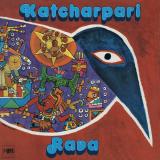
The breakthrough album. Enrico Rava's second solo record, recorded in Milan in January 1973 and released on the German BASF label, is nothing less than a cornerstone of Italian jazz-rock - the record that caught Manfred Eicher's attention and opened the doors to ECM. Rava himself has called it his breakthrough, and history proved him right.
The lineup is killer: John Abercrombie on guitar, Bruce Johnson on bass, Chip White on drums. Four musicians operating at the absolute peak of early seventies fusion energy - electric, cosmopolitan, burning with that particular fire that only existed in that brief window when jazz met rock and nobody knew the rules yet. Abercrombie, already on his way to becoming one of the most distinctive voices in electric jazz guitar, delivers some of his most ferocious early work here. White's drumming is relentless, pushing the music forward with an intensity that never lets up.
If Miles' Bitches Brew-era speaks to you, if Ian Carr's Nucleus gets you moving, if you know Sun Ra's Lanquidity and Don Cherry's Relativity Suite by heart - this is essential listening. Rava's vision was already fully formed: South American rhythms, Mediterranean warmth, free jazz ferocity, rock power - all flowing together without borders or categories. By the early seventies, Rava had absorbed everything - the New Thing, the European free scene, the electric revolution coming out of Miles' studio - and forged something entirely his own.
The seven tracks cover serious ground. "Bunny's Pie" introduces the music with an almost cosmic atmosphere of suspense, hovering in that liminal space before it trails off into the up-tempo vibrant frenzy of "Trial N. 5" - Abercrombie and Rava trading swirling solos at full intensity, the rhythm section locked in tight. "Dimenticare Stanca" moves from Rava's expressive balladic intro into pure funk, guitar and trumpet steering over the rhythmic drive with absolute confidence. The title track carries the lyrical feel and cadence of an Incan-Peruvian folksong - that cosmopolitan spirit made audible. "Fluid Connection" rides a funky bass riff into fusion heaven, with standout trumpet and guitar solos that build and release with perfect tension. "Cheerin' Cherry" pays homage to the great Don Cherry - Rava's spiritual mentor and fellow traveler in world music - exploring a North African soundscape that points toward the global jazz to come. Johnson's "Peace" closes the album with a minute and a half of serene, blissful calm - a moment of stillness after the storm.
This audiophile reissue - cut from the original masters, pressed by Pallas in Germany on 180gm vinyl, housed in a thick laminated hand-glued gatefold - does full justice to an album that remains a collector's holy grail.
Don't sleep on this one. Limited Edition.
Alice Kemp is a British artist working with noise, performance, fetish objects, installation and many other forms of media. Throughout her work, she articulates a broken and illogical syntax of the subconscious through trance states, dreams, and disturbances. She has performed extensively, occasionally as an associate to the Schimpfluch-Gruppe of Swiss extreme aktionists.
It is a rarified violence that the Kemp invokes on her 9 Dreams In Erotic Mourning. Something disfigured. Something fucked. Something left behind. The subject matter of her investigations are deliberately inscrutable as she grotesquely amplifies a moment of terror, or fear, of sadness through pockets of piano melodies broken by psychoacoustic noise, razor-cut silence, ghastly vocalizations, crushed acts of physical aggression, and buckets of high-pressure suspense. Cryptic and oblique by design Kemp's work reads perhaps as a seance gone awry, certainly as private ritual made public, and as a transfiguration of literary body horror turned into a sonic nightmare that runs parallel to the works of Rudolf Eb.Er, Puce Mary, Sewer Election, and Luc Ferrari.
9 Dreams In Erotic Mourning was originally published as part of the instantly out of print boxset, On Corrosion - a 10 cassette anthology from 2019 that was housed in a handcrafted wooden box and featuring full albums from Kleistwahr, Neutral, Pinkcourtesyphone, Alice Kemp, She Spread Sorrow, G*Park, Relay For Death, Francisco Meirino, Fossil Aerosol Mining Project, and Himukalt. The collection also stood as the 50th release for The Helen Scarsdale Agency.
- A1: Hard To Deal
- A2: Soul Tricker
- A3: Ladies
- A4: Once Upon A Time
- A5: Burning Land
- B6: Bliss & Joy
- B7: Raise Your Hands
- B8: Fall Guy
- B9: Madness
- B10: Ravish Holy Land
- B11: Top Of The Bock
Coloured Vinyl[28,15 €]
Born in Douarnenez, at the far edge of Brittany (France), Komodor has quickly established itself as one of the most vibrant names in the French rock landscape. Their high-energy rock, fueled by fuzz, sweat, and vocal harmonies woven in the spirit of MC5 and T. Rex, immediately drew attention: Rolling Stone, Rock & Folk, Libération and Rock Hard Germany all praised the fiery impact of their debut album Nasty Habits (which sold over 2,000 vinyl copies). Since then, the quintet has mostly lived on the road: a long European tour, followed by the larger-than-life saga of Komodrag & The Mounodor, carrying them to stages such as Hellfest, Les Vieilles Charrues, and the Francofolies de La Rochelle, among many others.
Their second album, Time & Space, reveals a band in full metamorphosis. Without abandoning the explosive force that defines them, Komodor widens its scope: volcanic riffs, more sinuous grooves, mist-laden harmonies, psychedelic flashes… The energy is still wild, but more inhabited, more liberated, almost ceremonial at times. The record opens with two telling bursts: Bliss & Joy, a libertarian charge with the feel of a manifesto, and Soul Tricker, a rock incantation where trance overtakes sheer electric assault. Two sides of the same coin, pulled taut between urgency and enchantment.
On stage, Komodor remains a true shockwave, forged across European festivals (Freak Valley, Motocultor, Fête du Bruit, and more) and now awaited at the legendary Desertfest London. Their music feels made for such spaces: a visceral, flesh-and-amp kind of rock, drawing from the seventies’ heritage to speak even more vividly to the present. A band moving forward at full volume, without nostalgia or calculation, carried by a simple conviction: as long as the amps are hot, rock can still burn.
In short: Komodor is the band of friends from Douarnenez bringing pencil-and-paper rock into the streaming age while preserving its analog soul (with the album mastered at the legendary Miraval Studios), the smell of warm tubes, the grain of vinyl. With this second album, they hit harder, truer, and more vividly than ever.
Time & Space stands as a “must-have French rock record”, a tangible piece worth cherishing in any collection.
Born in Douarnenez, at the far edge of Brittany (France), Komodor has quickly established itself as one of the most vibrant names in the French rock landscape. Their high-energy rock, fueled by fuzz, sweat, and vocal harmonies woven in the spirit of MC5 and T. Rex, immediately drew attention: Rolling Stone, Rock & Folk, Libération and Rock Hard Germany all praised the fiery impact of their debut album Nasty Habits (which sold over 2,000 vinyl copies). Since then, the quintet has mostly lived on the road: a long European tour, followed by the larger-than-life saga of Komodrag & The Mounodor, carrying them to stages such as Hellfest, Les Vieilles Charrues, and the Francofolies de La Rochelle, among many others.
Their second album, Time & Space, reveals a band in full metamorphosis. Without abandoning the explosive force that defines them, Komodor widens its scope: volcanic riffs, more sinuous grooves, mist-laden harmonies, psychedelic flashes… The energy is still wild, but more inhabited, more liberated, almost ceremonial at times. The record opens with two telling bursts: Bliss & Joy, a libertarian charge with the feel of a manifesto, and Soul Tricker, a rock incantation where trance overtakes sheer electric assault. Two sides of the same coin, pulled taut between urgency and enchantment.
On stage, Komodor remains a true shockwave, forged across European festivals (Freak Valley, Motocultor, Fête du Bruit, and more) and now awaited at the legendary Desertfest London. Their music feels made for such spaces: a visceral, flesh-and-amp kind of rock, drawing from the seventies’ heritage to speak even more vividly to the present. A band moving forward at full volume, without nostalgia or calculation, carried by a simple conviction: as long as the amps are hot, rock can still burn.
In short: Komodor is the band of friends from Douarnenez bringing pencil-and-paper rock into the streaming age while preserving its analog soul (with the album mastered at the legendary Miraval Studios), the smell of warm tubes, the grain of vinyl. With this second album, they hit harder, truer, and more vividly than ever.
Time & Space stands as a “must-have French rock record”, a tangible piece worth cherishing in any collection.
- A1: Summer Rolls
- A2: Shut Me Up
- A3: On My Mind
- A4: Vagues ? Montmarte
- A5: Shake! Discoteque Mix
- B6: Good Company
- B7: Differences
- B8: Rimbombo
- B9: Everybody?S Dancing Discoteque Mix
Rom Com is the debut album from Disco In Sochi; a Liverpoolborn duo injecting full-throttle glam rock theatrics into modern pop. Built on strutting guitars, neon synths, & unapologetically huge hooks, their sound is loud, glossy, and engineered for the spotlight. Drawing from the lineage of glam’s excess and pop’s instinct for spectacle, Disco in Sochi trade subtlety for swagger. Their songs are designed to hit hard and fast — all attitude, amplification, and choruses made to be yelled back from the front row. It’s music that treats the stage like a catwalk. Disco in Sochi make pop music for outsiders who dress loud, move louder, and don’t believe in playing it cool. Equal parts flash and force, they arrive with the confidence of a band ready to turn volume into a statement.