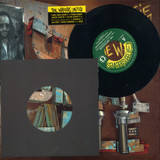
Cassegrain announce collaborative EP. The Berlin based duo of Alex Tsiridis & Hüseyin Evirgen will release new work recorded alongside DJ Nobu, Tensal & Lady Starlight via their own Arcing Seas imprint in September. Leaning towards the more heady, high octane end of the genre - the three track EP showcases the duo's natural affinity for collaboration, maintaining Evirgen & Tsiridis' characteristic finish and atten-tion to detail, whilst providing ample space for the guests to properly colour the work. CT01, alongside Tensal, marries caustic drones with a potent lead sequence to produce a perfect peak time roller; whilst CN01, with DJ Nobu, riffs on a more melodic, stepping approach - maintaining that same rousing energy, but with a more psychedelic bent. CLS01, the duo's collaboration with La-dy Starlight comes in at almost 11 minutes, an ambient Techno journey that warps and shifts organi-cally across it's extended run time - complete with beat-less intro and multiple segues that work to bind the piece and it's different sections into one, cohesive narrative. Effective and impeccably produced - but with a keen ear for new & exciting sonics within the genre - this first collaborative outing proves an enviable addition to the duo's already impressive discogra-phy.
Cerca:amp
Alborosie is a dynamic talent on the contemporary reggae scene, a singer, songwriter, multi-instrumentalist, producer and engineer. Unbreakable' is his ninth album for the Greensleeves label. His choice of players and vocal features on the album have resulted in a product that amplifies his multiple talents on a new level, delivering strong reggae songs that are solidly commercial. Unbreakable features performances from Aston 'Family Man' Barrett, Tyrone Downie and Junior Marvin of the famed Bob Marley backing band, now called The Wailers United. Plus, vocal features from Beres Hammond, Chronixx, Jah Cure and J Boog
Often inspired by the cosmology, sonology, and culture of indigenous people from Borneo, Nursalim Yadi Anugerah is a Pontianak based composer well-known for his peculiar approach on instrumentation and composition. Adapted from Kayaan people oral literature Takna' Lawe', HNNUNG is a chamber opera that amplifies the cosmic dramaturgy of Kayaan culture—in which the narrative of matriarchy is essential. HNNUNG the opera was performed by Balaan Tumaan Ensemble and Kerubim Choir using various instruments ranging from kaldii' and sape' to tenor saxophone and contrabass. For this edition, he selects nine recording pieces from his opera HNNUNG in the form of sonic-fiction—he lets his composition works as a narrator.
Cat.no.: XVIII-IV
Format: MC
Krikor Is Back On The Label With A New Six Tracker. Following Up His Pacific Alley Lp From Last Year, We Now Get Pacific Alley In Dub, Taking Tracks From The Lp And Re-working With Ample Echo And New Riddims Strictly Made For The Dancefloor. Spacious Pads And Linn Drum Claps Are Run Through The Board As Voices Ping Back And Forth In The Chamber, Equally Blissed Out And Trippy Turning These Tracks Into Completely New Freaked Out Compositions. Summer Jams Guaranateed
Another very special EP on Al Zanders A to Z label
Teaming up this time with vocalist Sheyi, for a one-off foray into Broken Beat territory.
The story of its inspiration begins with a trip to Notting Hill Record & Tape Exchange...
After asking for some broken beat, the assistant ventured a withering opinion that "won't be monotonous enough, try the house music section instead"
Turns out it was Phil Asher of Co-op fame - who, after establishing a genuine desire for said genre - sold Al a bunch of West London music which became the influence for this EP.
Allowing Sheyi to shine over a bare bones, syncopated rhythm track on the title cut and an equally stripped down 'Satisfy' Al amps up the groove, with the G.I.T dub, which was made for IG Culture's radio show.
Limited run on these - don't snooze !
It is said that every generation casts its mind back to a previous era in times of crisis; the resources that will allow us to decode the questions of our moment may lie in the myths of another era.
Le Renard Bleu, the new musical and cinematic collaboration between Lafawndah and composer Midori Takada, and filmmakers Partel Oliva, takes a cross- generational echo as ground zero for recovering a crucial myth for uncertain times: the blue fox.
As transmitted by Takada, the fox appears in both ancient Senegalese and Japanese folktales as the trickster archetype; belonging both to the heavens and to the earth, the fox is the agent of chaotic good, shaking the world up when its energy has become stagnant. Above all else, the fox is famous for its cunning nature.
Renard Bleu marks the first new music released by Takada in nearly twenty years; it would be difficult to overstate the importance of her return to the public eye. Her first solo record, 1983's Through the Looking Glass, has been rediscovered and heralded as a lost classic; the influence of her percussion trio, the Mkwaju Ensemble, continues to permeate and inspire a new generation entranced by its lucid beauty, playfulness, and sensual patience. Takada has performed in numerous film score orchestras, including the ensemble for Akira Kurasawa's Dreams, coincidentally a key influence on Renard Bleu.
In the ensuing years, Takada has worked closely with theater group the Suzuki Company of Toga on productions of Electra and King Lear, an experience, she says, that allowed her to pursue 'a unity of music, body and space.' Recent live solo performances have evinced the depths of her exploration of all three.
Equally, it is Lafawndah's freedom of tone, decentralized maps of ancient and modern music cultures, and alloying of devotional intensity with modern songcraft casts her as a distinct relative of Midori Takada's.
Over the course of two EPs, self- directed music videos, and countless live performances, Lafawndah has drawn out an uncompromising exploration of how theater, situational intervention, and choreography can amplify the affective palate of forward pop music. One can trace the influence of artists such as Meredith Monk, Carlos Sara, and Andy Kaufman as much as musical antecedents AR Rahmann, Missy Elliott, or Geinoh Yamashirogumi.
It is in a mutual commitment to this unity that Lafawndah, Takada and Partel Oliva find fertile aesthetic common ground.
The music of Renard Bleu originated in Takada's preoccupation with the legend of the fox; after constructing a vivid instrumental composition dramatizing the spirit animal's journeys through waterphone, bells, marimba and various forms of drums, Lafawndah responded - in her inimitable mix of fairytale and undertow-- with melodies and lyrics capturing a dialogue between her and the fox himself. Eventually, the duo met in Tokyo for a week of communing with the material at Avaco Creative Studios, where new elements were composed on site.
Created in partnership with KENZO and premiered today via their channels, it was Partel Oliva who imagined a contemporary cinematic frame for the myth of the fox to re- appear, creating a hybrid of choreography and narrative around Takada and Lafawndah's performance of their joint composition (also titled Le Renard Bleu.) Returning to film in Japan for the third time, Partel Oliva's moving image work (Club Ark Eternal, The Pike and the Shield) has set the standard for and revolutionized the fashion art film. Their deployment of original music, dance, and a highly stylized mis en scene coalesces here in the casting of Los Angeles krump artist Qwenga as the eponymous fox, stalking the halls of the ancient Noh theater in which Takada and Lafawnda's performance takes place.
Why call up the myth of the fox now In Le Renard Bleu, Lafawndah and Takada's collapsing of distance between generations, styles, and milieus intimates that the relationship to time must be shaken. The future lies in fragments in the past; to remember is to recover it; the fox rises to thicken the plot.
'A love project' from the heart and mind of UK broken beat stalwart and iconic keyboard maestro Kaidi Tatham, alongside an outstanding group of Danish musicians led by percussionist Peter Stenbæk.
12 Senses debuts with the Movement EP, a record drawing on jazz-funk, broken beat and disco, laced with the distinctive melodic progressions and boogie touches Kaidi Tatham is known for. Recorded over an intensely productive three-day session, which produced 20 plus songs, this EP is a first taste of what's to come from this creative gathering.
With recent records on First Word, Sound Signature and 2000Black, plus a brand new solo album 'It's A World Before You' it appears there is no letup in Kaidi Tatham's prolific output spanning a 2 decade long career, that has seen him work with artists such as Bugz In The Attic, 4Hero, Slum Village, Jazzy Jeff & Will Smith, Amy Winehouse, Leroy Burgess, Moonchild, Soull II Soul, Amp Fiddler, Mr Scruff and Dego, to name but a few.
Touch starts with the heavily syncopated rhythms of drummer Anders Meinhardt, accompanied by a bed of airy Rhodes, synths and guitar on top of a ruthless, disco-tinged bassline. Life evolves on a spiritual and hypnotic tip with a driving lick that just keeps on building, sprinkled with beautiful intertwining organ, piano and synth solos by Kaidi and pianist Poul Reimann. Movement slows the mood to a soul-tinged stepper with soothing choir and deft touches from the trumpet of Rasmus Juel. Kaidi changes up the pace on his remix with a smooth boom bap vibe before hitting the halfway point and switching up to his signature, breakneck latin bruk funk.12 Senses evolved from yearly marathon concerts at the Copenhagen Jazz Festival, arranged by percussionist Peter Stenbæk, who simply e-met Kaidi Tatham and insisted on him coming to Denmark to share the festival stage. Over the course of five years the friendship and musicianship between the two has gone from strength to strength, reinforced by the skilled musicians around them; drummer Anders Meinhardt, guitarist David Rosenkilde, bassist Andreas Hatholt, trumpeter Rasmus Juel and pianist Poul Reimann. The record was brought to life by Morten Trust (aka. Soulmagic), who kindly contributed his heart, studio and mixing skills to Movement.
The music on this EP was conceived in China, between 1989 and 1993. The original tracks were mixed to DAT in real time, in a small neighbour-proof studio inside my apartment in Macau, a 19th floor with a view to the hurricanes. There's a small, unexpected or improbable story behind each track, some little magic fused with the local atmosphere, certainly guaranteeing their lasting authenticity 25 years later.
TAIPEI DISCO
Late 80s Guangzhou was an exotic city where the traditional past coexisted in harmony with the present and even already with the future.
I'd rather spend my weekends in Guangzhou than diving into Hong Kong consumerism - as most ex-pats in Macau did. I took a cab at the border and travelled 150 Km through chaotic roads with family and friends until reaching the hot, humid, mega South China metropolis.
We ate on street joints in the evenings, went on to a karaoke bar and ended up at Taipei Disco, the only proper club in town. All the others were inside hotels and played generic music or they were seedy, sleazy, smoky cabarets.
Taipei Disco used to be a cinema and played cantonese pop music and anglo-saxon pop/rock (that was new). The spacious dance floor was generously lighted, the atmosphere was airy and modern. Boys and girls were in the habit of dancing in pairs, one in front of the other, observing a respectful yet sensual distance. When the girl took a few steps back, the boy went along and vice versa. With legs and feet (more than the upper bodies) synchronized with the music, they never exceeded in extroversion. Cool.
I always carried a MicroComposer and a portable DAT recorder in my travels through China and weekends in Canton. Any spontaneous musical idea was imediately recorded and memorized. The MicroComposer allowed multitrack recording, which was very handy on the road. Based on the emphatic choreography of Taipei Disco's dancers, i started to compose a rhythm track while sitting at a table, with headphones, listening to Cantopop in the background. As if by magic - not a rare occasion in music - everything began fitting together. Odd as it may seem, the track ended up sounding more germanic (Kraftwerkian) than Cantonese pop.
The story ends in a circle: the cantonese DJ at Taipei Disco, whom i used to ask to play certain records, wanted to play my music at the disco when it was basically only just a rhythm track and little else. From a cupboard under his set up he took out a battered keyboard (unrecognizable brand) and invited me to play over the track with the available sounds on the keyboard. The circle was complete, with Cantonese clubbers happily dancing forwards and backwards, as if it were another Cantopop hit.
I didn't get payed but the house offered us free ice cream cups in which little Portuguese flags were sticked.
The track would be finished later, in studio, with vocoder strings ensemble and synth solos.
TAIPEI DISCO (LIVE)
The live version of 'Taipei Disco' was recorded during a live set at the China Pop venue, in Macau, 1993. China Pop was a rock club built in the ample space of an old fishing warehouse, located in the labyrinthic Inner Harbour area. It was decorated with large Mao Zedong and Cultural Revolution posters and memorabilia and had a unique atmosphere, fusing Pop Art with film noir. We began our performance at 1AM, pretty early for Macau's nightlife standards. We were lucky. An audience showed up. And in Macau there were always several friends among the audience, which tranformed a musical performance into a relaxed party.
The atmosphere was particularly surreal on that night. The front row was dominated by French Crazy Horse dancers, a sort of Oriental Moulin Rouge. The girls had finished their last performance of the evening at the Crazy Horse and were still energized from their show. During our performance, right in front of us and perfectly synched, we could hear the famous irreverent screams of can-can dancers. You always had to expect the unexpected in Macau.
RED MAMBO (IMPROMPTU)
I was familiar with the Portuguese-speaking African countries well before having lived in China. I found myself returning several times to one in particular, always attracted by its magic and very distinct, identitary culture and music: Cape Verde.
During the early years of DWART a lot of the inspiration for drum machine rhythms (Roland's TR series) came from African music, especially from new musical trends that gained full autonomy with Cape Verde's independence from Portugal, as was the case with funaná.
I had the privilege of having known and befriended some of the greatest Capeverdian composers, musicians and singers during the 70s and 80s, such as Bana, Luís Morais, Cesária Évora, Paulino Vieira, Chico Serra, Tito Paris, and historical bands such as Bulimundo (ambassadors of funaná) and Os Tubarões (great innovators of morna, coladera and funaná, with the sonic impact of an afro-beat big band).
When Luís Filipe de Barros began playing Os Tubarões for the first time on Portuguese radio, that was the turning point for African music in Portugal. The 'Tabanca' album was so widely heard and talked about that it quickly got a Portuguese release through one of the big labels of the time.
The mystic of this band from the Santiago Island would reach the East. Os Tubarões played to a packed room in Macau in 1992, and after the bombastic gig we arranged a dinner and party at my place.
We ate and drank generously and the moment came for a jam session at the small studio on the 19th floor. Because Os Tubarões didn't all fit in the studio, we recorded an impromptu with only three of the musicians: Tótó Silva (electric guitar), Mário Russo Bettencourt (bass) and Zeca Couto (piano). And there we were improvising without barriers, suddenly detached from cultural roots, labels and constraints, a truly unique moment. The track is now being released exactly as it was recorded, imbued with the real communion between the musicians. And it could only be titled 'Red Mambo'. I wish to dedicate it to the memory of Ildo Lobo and Jaime do Rosário, founders of Os Tubarões, sadly and too soon departed from the land of music.
Last spotted tomfooling as Tryck & Ton with Edvin Edvinsson, and prior to that as Tiedye on Mike Simonetti's Italians Do It Better imprint, subversive Swede Anton Klint makes his debut on Simonetti's latest label 2MR with two more vitally trippy, heavily dub-informed originals.
'Mun' chugs at a stately 107. Rippling in places, squiggling in others, there's an unabashed FX weirdness bubbling and popping over the insistent shimmering dubwise groove. Tweaking, freaking but running at such a smooth temper there's space between the chaos, Anton is balancing some heavily hypnotic alchemy here.
'Strupe' takes things even lower and slower. A dusty bluesy chugger, unhurried-yet-relentlessly building with a great sense of cosmic drama, listen and marvel as more elements are precision introduced throughout the seven minute trip. A masterclass in modern day honkytonk.
Remix-wise we're thrusted into the later hours with a technoid twist from Andre Laos. Maintaining Anton's original's trippy charm and measured pace but re-amping it with grittier foundation, teasing risers and an insurgent synth strike, it's the perfect complement to one of 2MR's most singular releases to date. Open wide.
* Arikon is a solo project of Berlin-based drummer & producer, Arik Hayut - half of doom-tech duo Gainstage with Pierce Warnecke. Loyal to the sonic concepts of Gainstage, Arikon presents The Prophet's Blood Is Boiling, a solo enterprise into deepest 'drum & drone'. Hypnotizing distorted polyrhythms puncture through shards of fragmented melodies, producing potent mixtures of desperate tin can banging, a panoramic sonic scope, and the bleakest of soundsystem nightmares. Across the album, Arikon deploys an arsenal of samples plus electronic, acoustic, and self-constructed percussion instruments, constructing eight powerful productions that manage to embody both brute force and delicate decay.
* Formerly active in Tel Aviv's leftfield experimental scene during the 90's, Hayut made Berlin his permanent home for working on his own projects while composing and performing music for off-theater and contemporary dance. In 2004, a severe health crisis initially threw Hayut into crisis, slowing down his activity to a standstill. However, the precarious process of his fortunate recovery contributed to Hayut involving himself more deeply with concepts of time, death, and decay.
* Inspired by the decadent still life paintings of the Flemish Baroque, the cover artwork for The Prophet's Blood Is Boiling comprises a bowl of decomposing fruit. Like the music, its aim is to illustrate the beauty and perfection of the decay process, whilst also referring to the West's hyper-capitalistic, technology-centric culture. In recent years a new form of 'digital life' has been born, whereby all data - regardless of its worth or importance - is mummified, reproduced, and distributed with no real disintegration or loss in quality. This new digital life is resulting in a sort of 'frozen death', ending the hitherto natural cycle of life.
* The songs on themselves are inspired by the 'beasts of holiness' - mythological monsters that appear in the Hebrew bible and the Jewish apocrypha (non-canonical scriptures). There's the punching of bassy thuds out of an oceanic ambient swell throughout 'Tanin Gadol', named after the ancient water monster of Babylonian times. The dense net of fumbling scrapes and amp-busting hits of noise on 'Nahash Akalaton' similarly refer to a titular sea-snake monster, its tendrils lashing out of the speakers aggressively. These demons symbolize a force of evil equal in power, yet in direct opposition to the monotheistic deity of their time. They were therefore neither acknowledged nor canonized in much dominant scripture. Arikon invokes these demons across The Prophet's Blood Is Boiling, setting them loose across these gnarled noisy chambers of pummeling percussion and cracked sampled detritus.
Fresh off the back of the languorous poolside disco and tropical pop of their debut album 'Shapes On Shapes' released last November, LA based duo Wild & Free return with a collection of essential remixes from label mates and influences alike by revisiting the heady disco of recent single 'Ferns and Stuff'.
Both multi-instrumentalists, singers and producers in their own right, Wild & Free duo Drew Kramer and George Cochrane came together in 2015 and have spent the past 2 years crafting a series of acclaimed EPs and remixes (for the likes of Joe Goddard (Hot Chip), Panama, Gigamesh, RAC and Ben Browning of Cut/Copy) that saw them tipped by the likes of Spin, XLR8R, Indie Shuffle, Clash Magazine, Data Transmission and many more and take their live show on the road playing alongside the likes of Brooklyn's Body Language.After releasing a few solid ep's and two full lengths album's Xinobi has gained real recognition among established and well-known artists and opinion-makers, and his underground cult has amplified. What has followed is remixes, edits and reworks for artists such as Sbtrkt, The Avener, John Grant, Toro Y Moi, Nicolas Jaar, Agnes Obel, Kris Menace and Tensnake.Along with Moullinex and Mr. Mitsuhirato he gave birth to the still-growing-influent Discotexas who here lend their label mates their expert musical arrangement skills with 'Discotexas Club Mix' thrown in for good measure. And it doesn't stop there, with legendary New Yorker Justin Strauss, who has produced and mixed records and remixes for the likes of LCD Soundsystem, Beyonce, La Roux and Goldfrapp contributing a 'Whatever/Whatever' mix as part of the slick and hugely influential production duo he formed with Bryan Mette.
Already noticed for his remixes and array of collaborators and with several releases under his belt (including a track on the 'Bonjour Colette' compilation), Tokyo-based Yuki Abe AKA producer/DJ Boys Get Hurt gets his inspiration from the melancholic feelings the end of summer inevitably brings about, a personal and evocative sensibility in tune with the land of the rising sun's delicate culture. Yuki expertly crafts bouncy disco-house music with sprinklings of electronica, indie, ambient, hip-hop and R&B. Here he adds a mix with a loose and joyful feel that fits the sentiments of what Wild and Free represent perfectly.
Shunter, the new album by the Berlin-based duo Driftmachine, is their most ambitious work to date. Although instantly recognizable, featuring their trademark Kosmische and Avant-garde sounds, it also presents a new journey into abstract and hallucinatory worlds. Filled with eerie textures, their electronic visions are darker and more vaporous than ever.
Driftmachine's fourth album (also the fourth one for Umor Rex) offers a new perspective on their ample sound spectrum and systemic narratives. Shunter overlaps and mutates their post-industrial-dub motives. It was conceived and produced in search of a very different kind of imagery, with sections of noise and field recordings intersecting with analogue sounds, a mixture of contrasted fragments, where the usual creative process of modular-synthesis leads Gerth and Zimmer to the discovery of a dark, hazy and diffused experience. There is a protean quality to the rhythmic elements, with tempos constantly contracting and expanding, a departure from the mono-beat-rhythms of "Nocturnes" and "Colliding Contours". The first half of Shunter is made of four pieces named "Shift", although individually separated, they are conceptually linked and can be understood as a sort of score. Imagine a late stage of the industrial revolution, with the interaction between heavy machinery and human beings. The second half of the album is not completely separated, but it has three other substantial melodic moments. Somewhere between the hauntological and the realms of archive-music, a huge range of subterranean beats and distinct patterns dotting the landscape of early electronic and post dub music.
All songs written & produced by Driftmachine (Andreas Gerth & Florian Zimmer), Berlin.
Mastered by Rafael Anton Irisarri. Design by Daniel Castrejón.
Presenting 'Envelope'. Album written, produced & mixed by Milan W. and pressed on 180g vinyl, by Ekster. Coming out on the 6th of June 2018, with foil-stamped cover-drawing by Gerard Herman. Mastered & cut by Helmut Erler at Dubplates & Mastering.
.
Milan W (AKA Milan Warmoeskerken) is an Antwerp-based musician. In 2015 he released the Slo Mo cassette, on local label JJ Funhouse. The Intact LP a year later. Compositions constructed from gentle, yet persistent, rhythms. Intricately textured downtempo echoes. Brain-dancing, rather than four-to-the-floor raving. 2017`s split with Ekolalis, for The Hague`s BAKK, made clear the direction Milan`s headed in. His contribution being a seventeen minute float. The kick largely removed. The textures cut-up, expanded and magnified. Envelope, for Ekster, builds on this work.
The harlequin turns the handle. The contraption sucks in air, and breathes. Blows out tone poems. Wordless ballads that soundtrack enchanted scenarios. Issues forth magic. A sorcerer`s apprentice casting its spell. Animating the inanimate. To everything a life. Sets the frozen fluttering. Pirouetting in red shoes. Illuminates what was dark. Astma sings a Gamelan lullaby. Summons comforting angels to a post-Industrial landscape. Glaasjes has Jazz ghosts inhabit an empty bar room. Spirits stealing excuse-me`s under its deserted spot. In Limbo amplifies their whispers. Lead soldiers court jewellery-box ballerinas behind shuttered shop fronts. On Heraldic Snippets, a tin infantry marches. Ten thousand men up to the top, and back down again. Keys make-believing that they are massed brass and fife.
The bellows pump, and the pipes all the while wheezing. An automaton philharmonic at the bidding of a steam-punk master. Analogue and digital. Clockwork and glitch. Malady finds sounds isolated, extrapolated, mutated. Orchestral`s organ-grinder moves with urgency, and alchemy. Spinning straw into gold. Snare rolls become bubbling mercury. Metallic, yet fluid. Racing at the speed of flight and escape. Slope is the music of water chasing through crystal caves. Slow Runner, a funeral crawl. Shoved into motion by a drama of strings remembered.
Like the charismatic Rat-Catcher of Hamelin, the harlequin turns the handle, and we bang the cup.
Spell PETS backwards to get STEP. Spell STEP forwards and you get PETS going back to basics. STEP is the new vinyl-only label from the founders of PETS - Catz n Dogz - with a focus on the rawest forms and root functions of dance music. STEP searches for the fundamentals with under-the-radar house and techno that's not afraid to be rough around the edges. It's all about the music.
Danny McLewin (Psychemagik) and Jamie Cruisey have a new label of original signed artists called SPIRITS. The first release is from Mexican hotness 'Lokier' of She Made Monster and 'Jason Greer' aka 'The Machine', one of the Californian undergrounds best kept secrets. They met in 2015 at a festival in London and after spending a few days together, became musically obsessed with each other. That summer, as Jason bounced around Europe, he stayed with Lokier in Barcelona for some weeks and after long night walks, some tapas and absinthe bars they came up with their first EP together.
A1 "White Room's" slo-mo headnod film score, kick starts the EP, brooding synths buzzing with electric cocaine gloss, their oscillators fluttering like cyborg butterflies around the pulsating strobelight beat. Creepy.
A2 "Stained Glass" hits tough straight out the gate with subterranean bubbling acid bass and charges headlong into deep psychedelic territory with a goth-inspired guitar, reverb on 11, turning the track into a next-level robo-Giallo monster!
B1 "Pearly Hate" begins as if a menacing swarm of bionic rave bees is slowly surrounding you, the tension of their impending drone amping up steadily as your brain thinks: Do I run This midtempo Carpenter-esque jam is atmospheric putty in the hands of sleazoned DJ's and sounds like the beginning of a long, strange trip.
B2 "Red Floor" is a chugging, barely restrained dark disco beast, flagrantly wearing its Weatherall and Neu Beat-ing heart on its tattered sleeve, elliptical melodies keeping you from your sanity with a solid drop for the dancefloor - another one for DJ's who ride it rough.
Thus completes the first release for new label SPIRITS. Four tracks exploring another corner of otherworldly analogue hedonism for extra-dimensional travel. Keep your ear on "Red Floor", as its potential for dancefloor uplift is proven and Machine-ready! Stay jacked in for more missives soon...
Ivan Smagghe:
"When your best Mexican chola low-rider meets our favourite Californian mechanic, you get a proper slice of (Lokier and) Machine funk. This is grease electronics, black leather under the very dark sun of 'Pearly Hate' or in the bright isolation tank of 'White Room''
With the Split EP, the fourth release of their own label Rapid Eye Movement, Memorial Home and VII Circle head the way with two original cuts both and sign another stunning dark and hypnotic techno odyssey with a strong emotional pattern.
The opening track 'Metaphysical Functions', starting with a slow building atmospheric overture, encompasses much of what the VII Circle's sophisticated sound is about. A combination of compelling and dark pulsing kick drums with deep and melodic synth lines and dramatic ethereal breakdowns.
'Dogma' is stamped by a strait cavernous and rugged beat, powerful and catchy basses as well as propelled by uplifting and immersive melodic motifs that have a fierce cosmic appeal.
Following the path, Memorial Home delivers with 'Second Floor' an intense ambient-driven piece, harnessing haunting and misty cinematic textures with a tension-building repetitive bassline which provides a rising magnetic and powerful effect.
Closing the journey or rather keeping the flame high and firm till the deep end, 'Ampere' evinces a more pin-sharp and frantic percussive techno approach overlaid with highly suggestive atmospheric swirling synth effects.
Four captivating weapons which display an aesthetic quest focused and driven both by dancefloor-orientated climax and underground-rooted emotive escapism.
After putting out Kito Jempere's well received Sea Monsters album last year, Hell Yeah now serve up another selection of remixes of it. Accomplished musician Jimi Tenor, plus Miskotom and Max Essa all contribute before a 7", also taken from the album, lands later in summer. First up is Jimi Tenor, the legndary Finnish musician who has released on Warp, collaborated with Tony Allen and has his own band as well as occasionally playing sax with Kito Jempere Band at live gigs. He flips Puzzled into five minutes of stripped back and moody electronics with plenty of his own flute playing in the track. Busted drum sounds, spooky sci-fi synths and scattered hits make it woozy and late night and utterly absorbing. Miskotom—a newly emerging pair made up of Mik and his wife Andra, both based in Vilnius, Lithuania with credits on Pleasure Unit and Balearic —then reimagine 'Ampa' as a beatdown but of deep house with trudging drums staying low and shimmering synths drift out in all directions. Crunchy hits bring a subtle sense of funk and reverb drenched vocals bring a heavenly feel to the soul drenched grooves and summery keys.
Then comes Max Essa, the Japan based Brit who is a regular on this label as well as the likes of Is It Balearic. His first remix is a huge one that is sure to soundtrack many a boat party this summer. It's a gorgeous rework of 'Ampa' that puts achingly blissful vocals front and centre as low slung bass and slowly turning drums sink you into a pan-pipe laced reverie. Secondly, Essa offers a Dub Reprise that removes the vocals and places all the focus on his churning drums and new age grooves.
This is another perfect package of masterfully electronic horizontal sounds.
Since the release of their critically acclaimed debut album in 2013 on Names You Can Trust, La Mecánica Popular has quietly been contemplating the evolution of the group's sound, philosophy, and overall approach to making music. Band leader Efraín Rozas' experimental nature has continually pushed the boundaries of his own definition of not only Latin American music, but its broader relationship with music's global culture and history. The sound of "psychedelic salsa" that LMP helped capture in their debut was destined for further outside-the-box interpretations, and with the formation of a new quintet lineup over the last few years, LMP began to incorporate a more free, improvised and instrumental-focused performance of Rozas' increasingly radical compositions. The band subsequently took this liberated approach directly into the studio, recording Roza Cruz live, in its entirety. It was a cathartic experience, a necessary methodology for the new album's concept that embraced the intimate performance of its players and did away with standard techniques of isolation and overdubs.
The evolution of the band's sound on Roza Cruz brings forth a blend of styles rarely heard together, a touch reminiscent of electric-era Miles Davis or Eddie Palmieri at his most experimental, as the driving force of timbales and congas provide a bed for a wave of lush, analog amplification that mirrors the dueling leads of fuzz guitar and electric piano. But as far out as those instruments take the listener, the raw rhythm — the clave — always keeps it tethered to the earth and the dance, a cerebral yet visceral gift for the mind and feet.